Spali

Published Post author

This is what Jordanes says about the travel of the Goths from Gothiscandza:

“In search of suitable homes and pleasant places they came to the land of Scythia, called Oium in that tongue. Here they were delighted with the great richness of the country, and it is said that when half the army had been brought over, the bridge whereby they had crossed the river fell in utter ruin, nor could anyone thereafter pass to or fro. For the place is said to be surrounded by quaking bogs and an encircling abyss, so that by this double obstacle nature has made it inaccessible. And even to-day one may hear in that neighborhood the lowing of cattle and may find traces of men, if we are to believe the stories of travellers, although we must grant that they hear these things from afar.  This part of the Goths, which is said to have crossed the river and entered with Filimer into the country of Oium, came into possession of the desired land, and there they soon came upon the race of the Spali, joined battle with them and won the victory. Thence the victors hastened to the farthest part of Scythia, which is near the sea of Pontus; for so the story is generally told in their early songs, in almost historic fashion. Ablabius also, a famous chronicler of the Gothic race, confirms this in his most trustworthy account.”

It would seem then that the “race of the Spali” would be relevant in determining the place of entry of the Goths into “Scythia.”

Who were the Spali?

Based on some OCS texts, Max Vasmer claimed (Russisches etymologisches Wörterbuch, vol. 3) that the word Ispolini meant “giants” in… Slavic.  No evidence for this exists other than from Russia and some Bulgaria legends.  Undeterred, he then proceeded to link these Ispolini with the Spali of Jordanes.

Herwig Wolfram felt compelled to weigh in a typically vapid way observing that “[s]uch an unfriendly name is typically used to label foreigners, and thus the Spali were probably not Slavs.”  

The (German, of course) Ural-Altaische Jahrbücher (Otto Harrassowitz Verlag) went one better and had one of its authors claim that the name is Iranian and the Slavic negative association of that name must have come from some time when the Iranians ruled the Slavs.  (Presumably somewhere far in the East).

This approach would have us believe that:

  • Ispolini is a Slavic name
  • Ispolini means “giants”
  • Spali are Ispolini
  • Spali/Ispolini are not Slavs because being called a “giant” suggests an “otherness” or “unfriendliness”

All of this stands on the thinnest of legs.

Why would Ispolini or Spali be a Slavic word?  Because the name supposedly means “sleeping”.  It is true that in Slavic spali means “they slept” (third person plural past tense).  But it could also mean a bunch of other things:

  • s-pali as in z-pali meaning “[ones] from the fields” (S-Labi [ones] from the Elbe or S-parti “[ones] from Parthia) – in effect “Polans” (!)
  • spali as in “[he] will burn” – perhaps worshippers of fire (!)

Or you may choose to see in Spali a form of the Italian spalare (to shovel)…

Or perhaps from the German spalten as in “to divide”…

And what of the town of Spalathra (next to Castana – see Pliny Book 4, chapter 9) in the Greek province of Magnesia (current capital Volos – by reason of the efforts of the Bulgar Akamir apparently).  Or of Aspalatus?  Or the town of Hispalis (Seville)?

Ok but what of the “giant” connection?  That connection depends on the meaning.  If we go with the Slavic “sleeping” meaning, then the legend of the “sleeping giants” comes up.  However, in most versions of that legend the “sleeping giants” are simply anthropomorphized mountains.

Then there is the question of connecting Ispolini with Spali.  Spali may mean “they slept” but Ispolini is not Spali.  One might just as well argue that Ispolini meant any of the other meanings of spali or, independently, that the term refers to “island dwellers” (Yspa = Polish island (Ispania?)).

Now, if all of the above is accepted, the notion that these Slavic-named “giants” could not be Slavs themselves is rather silly.  What better way to inspire fear among your neighbors than to call yourselves “the giants”!?

So basically, we have no idea (and neither does anyone else) what this word means and where it comes from…

Ok, but where were these Spali?

Well, if you thought that the Goths actually were in Poland you might look to the Polish town of Spała.  In fact, this town’s name is not tied to any giants – sleeping or otherwise – but rather to the “burning” (see above) of lime which took place in the area.  The name also appears for the first time only at the turn of the 16th century.  (Interestingly, there was a town nearby called Winduga – Winduga – apparently – was a typical name of so-called river villages of river rafters (oryl or flis from the German Flößerei)).

Pliny in his Natural History makes, perhaps, an earlier reference to the Spali when he says (in Book 6, Chapter 7 – the same that also mentions the Serbi):

“…Some write, that the River Opharius runs through the Canteci and the Sapaei: and that the River Tanais traversed through the Phatarei, Herticei, Spondolici, Synthietae, Amassi, Issi, Catazeti, Tagori, Catoni, Neripi, Agandei, Mandreim Saturchei, and Spalei.”

aliqui flumen Ocharium labi per Canticos et Sapaeos, Tanain vero transisse Satharcheos Herticheos, Spondolicos, Synhietas, Anasos, Issos, Cataeetas, Tagoras, Caronos, Neripos, Agandaeos, Meandaraeos, Satharcheos Spalaeos.

(As noted above, Pliny also speaks of Spalathra in Greece).

Of course, the Tanais is the Don:

So the question arises, how could the first tribe in all of Scythia that the Goths encountered since leaving Gothiscandza be the tribe of the Spali on the Don?  And how could they then “hasten” to the “farthest part of Scythia, which is near the sea of Pontus” (Black Sea) when the Don is basically right there in the farthest part of Scythia?

If all of this were true, then the question would have to be asked whether Gothiscandza was really somewhere in the remote North or perhaps East.  This could help explain the reason why “Gothic” – although the oldest Germanic language known – is not the predecessor of any of the existing Germanic languages.  Perhaps someone should test for Gothic-Tocharian connections.

It would also help explain why the Goths seem to have started their conquests with Finnic peoples and the Spali before moving to attack the Veneti.

On this topic more generally see our earlier post:

What Language Did the Goths Speak?

Copyright ©2017 jassa.org All Rights Reserved

April 14, 2017

The Slavs of the Chronicle of Monemvasia

Published Post author

Although we wanted to relate only the “Slavic” passages of the Chronicle of Monemvasia, the size of the Chronicle lent itself to a translation of it in toto so we went that way so as to, in addition to the Slav references, give more of the context.

The chronicle is extant in the following manuscripts:

  • Turin Codex (Codex Taurinensis Rev. 336)
  • Koutloumousion Codex (Codex Kutlumus 220/3293)
  • Iveron Codex (Codex Iviron 329 (aka Athous 4449))
  • Rome Codex (Codex Collegio greco (Rome))

A portion of the chronicle is very similar to the Scholion of Arethas of Caesarea which we discussed here which led to some suggesting that Arethas was the author.  The dating of the Chronicle is also uncertain with general “agreement” putting it at about the year 1000 A.D. give or take a few hundred years (earliest about 800 to latest in the 1500s – see below for detail).

The Chronicle was first published in print by Joseph Pasinus (Giuseppe Passini) in 1749.  This publication was based on the Turin Codex from the Royal Library of Turin.  It remained largely ignored until the Slavophobe Jacob Philip Fallmerayer cited it as evidence for the proposition that the Greeks had been exterminated by various invaders such that the denizens of 19th century Greece were not really Greeks (the next argument that followed naturally and that Fallmerayer’s theories helped usher, was that the “original” Greeks were not, therefore, like the current Greeks but rather were “Arians” of the Nordic type best represented by the Germans and associated northern peoples, of course).

That Fallmerayer himself looked more, ahem, swarthy than your typical Slav and came from a provincial backwater of Germany (Tyrol which soon became part of the Hapsburg lands) foreshadowed another provincial man’s backwater and personal complexes.  Though Falmerayer did manage to graffiti the Great Temple of Ramses II with the inscription of his name (as did others), thankfully the  overall damage he wrought was less significant than that caused by another confused denizen of the podunk Austrian borderland. (For Falmerayer’s views see Fragmente aus dem Orient, 2nd edition, edited by Georg Thomas published in Stuttgart in 1877).

In any event, with the world’s attention now focused (a bit) on this entire question, the Greek historian (and later a rather inept prime minister) Spirydon Lambros (also Lampros) in 1884 published a new edition of the Chronicle featuring three manuscripts – the two “new” ones that Lambros located came from two separate monasteries on Mount Athos (Koutloumousion and Iveron).  Another edition came out in 1909 in Athens and was produced by Nikos Athanasiou Bees.  Finally, in 1912 Lambros printed another version – this one based on yet another manuscript from the Collegio Greco in Rome.

The most striking feature of these manuscripts is that the Iveron Codex covers the earliest time, the Turin and Koutloumousion Codices also cover events from 1083 through 1350 or so whereas the Rome Codex contains only the additional information from the Turin and Koutloumousion Codices with no overlap with the Iveron Codex.  (Consequently, the Rome Codex is almost a different chronicle is of little relevance for our purposes here).  There is also some information in the Iveron that is not present in the Turin and Koutloumousion Codices.

More modern English language scholarship on the Chronicle comes from historian Peter (Panagiotis) Charanis’ article “The Chronicle of Monemvasia and the Question of the Slavonic Settlements in Greece” (Dumbarton Oaks Papers, volume 5. 1950) (available for free on JSTOR) and some follow up work from him and most recently (?) from Stanisław Turlej’s 2001 study .  Much of the information in this post is courtesy of Charanis’ article. (Separately, Paul Lemerle published a partial French translation of the Chronicle in 1963 and in 1979 an Italian version of the Chronicle was published by the Bulgarian historian Ivan Duičev and there have been a few additional articles/books discussing the work in other contexts).

Charanis’ view is that the Chronicle (as well as the Scholion of Arethas) is based on a now lost chronicle that was put together between 805 (the year of the rebuilding of Patras and its elevation to a metropolitan see) and 932 (year of the Scholium).  That lost chronicle itself was, according to Charanis, based on the writings of Menander, Evagrius, Theophyllact Simocatta and some other lost source.  Although Charanis’ article is most lucid, the introduction of this intervening chronicle seems unnecessary.  Instead, it is also possible that the writer of the Chronicle of Monemvasia (and the Scholion) used the above named sources directly.

Interestingly, the 19th century controversy raised by Fallmerayer about the nature of the present day Greeks (i.e., they are all Slavs or other assorted invaders) led to another controversy with a response by some Greek scholars denying any Slavic invasion of Greece proper (the references to Hellas being invaded in Evagrius, Menander being explained as made to the Byzantine Empire’s lands in the Balkans but not Greece itself.  For those scholars the Chronocle was, of course, very inconvenient.  Current scholarship seems to have settled on a more balanced view seeing an actual Slav settlement – but not in all of Greece or even all of the Peloponnesus (Fallmerayer who brought up the Chronicle in the first place seems to have missed this point) – while also pointing to a Greek (and other) resettlement of the area.

Charanis also brings up the fact that Max Vasmer in his 1941 study of Slav settlement in Greece tallied Slavic toponyms in the area showing the following numbers: Corinth 24, Argolis 18, Achaia 95, Elis 35, Triphylia 44, Arcadia 94, Missenia 43, Laconia 81.  Oddly Vasmer did not mention the Chronicle of Monemvasia or the Scholion of Arethas.  Hopefully, he was not trying to fit his data to the report of the Chronicle (Die Slaven in Griechenland (Abhandlungen der Presussischen Akademie der Wissenschaften, Jahrgang 1941) Philosophisch-historische Klasse, number 12, Berlin 1941).  Here is a map of Peloponnesus from Vasmer’s book (color scheme is ours):

Charanis claims that Vasmer’s study supports the Chronicle’s position that the Avars/Slavs primarily occupied western Peloponnesus.

(Of course, there is another question that is not on any mainstream scholar’s radar and that is the question of the possibility of Slavic settlements in the Peloponnesus prior to the events described in the Chronicle of Monemvasia. For example, if one were to view S-parta as a compound along the same lines as S-labi that would suggest a “Parthian” origin of the inhabitants (ironically, given the Battle of Thermopylae) – compare, Mount Parthenion whose name suggests that Sparta may be a compound.  For that matter, if you were interested in our Elbe <?> Laba post, compare ακρωτήρι, the Greek for “cape” with “Cape Arkona” (Cape Cape?).  Or compare Krak with Krk island off of Croatia but better yet with Kerkyra off or Epirus with the Karkisa (Carians) called KRK by the Phoenicians and krka by the Persians.  To top it off the Carians seem to have either defeated or (as per Herodotus) been the Leleges who now moved to Laconia and whose King – Lelex – whose great-granddaughter was Sparta who would, in turn, marry Lacedaemon 🙂 ).

In any event, here is the Chronicle of Monemvasia as per, mostly, the Iveron Codex.

***

“In the 6064th year from the Creation of the world, which was the 32th [actually 31st] year of the reign of Justinian the Great [557 A.D.], there came to Constantinople envoys of strange people, the so-called Avars.  Having never seen such a people, the whole city rushed to see them.  Their jackets were made of long hair, tied with ribbons and twisted.  The rest of their clothing was similar to the clothing worn by other Huns.”

“As Evagrius says in the fifth book of his Ecclesiastical History, they were a nomadic people from the lands beyond the Caucasus mountains and inhabited the plains beyond [these mountains].  Having suffered badly at the hands of the Turks, they escaped these neighbors of theirs, abandoned their land, crossed the Black Sea coast and reached the Bosphorus.  Moving on from there, they crossed the lands of many peoples, fought barbarians they met, until they came to the banks of the Danube [and] then sent messengers to Justinian and asked to be welcomed [within the Empire].  Having been graciously welcomed by the Emperor, they received from his permission to settle in the region of Moesia, in the city of Dorostolon which is now called Dristra[1].  [And] so from poor they became rich and they spread over a very wide space.  Showing themselves forgetful [of the graciousness of Justinian] and ungrateful, they began to subjugate the Byzantines, they took the inhabitants of Thracia and Macedonia as slaves [and] even attacked the capital [Constantinople] and ruthlessly devastated its surroundings.  They also occupied Sirmium[2] [in 581/582 A.D.], an illustrious city in Europe which – being now in Bulgaria, is called Strem [‘Strjamos’] – had earlier been under the control of the Gepids, [to/by?] whom it was given [by/to?] the Emperor Justin[3].  It was for this reason [occupation of Sirmium by the Avars] that the Byzantines concluded a humiliating treaty with them [the Avars], promising to pay them an annual tribute of eighty thousand gold solidi.  On this condition the Avars promised to keep the peace.”[4]

“When in the year 6,000 [582 A.D.] Maurice received the scepter, the Avars sent envoys to him demanding that the eighty gold pieces they were receiving from the Byzantines be increased by another twenty thousand.  The emperor who loved peace agreed to this as well.  But even this agreement did not last more than two years.  [Every] time their master, the khagan, came up with another pretext so as to find a reason for war and demanded excessive things, so as to [be able to] get out of the agreements whenever some of his [new] demands were not fulfilled.  So he, finding the Thracian city of Singidunum [Belgrade] defenseless, he occupied it and, also, Augusta and Viminacium [Stari Kostolac] – a large island on the Danube.  He also conquered Anchialos [Pomorie, Bulgaria] which today is called Messina in Macedonia[5], and he also subdued many other cities that were in Illyria.  Pillaging all he came up on the outskirts of Byzantium [Constantinople] and even threatened to destroy the Great Wall.  Some of them [the Avars] crossed the Strait of Abydos [Hellespont], looted the lands of Asia [meaning today’s Turkey] and then turned back again [towards Constantinople].  The emperor sent envoys to the khagan, the patrician Elpidius and Comentiolus [probably 584 A.D.], agreeing to increase the stipend [tribute].  On these conditions the barbarian agreed to keep the peace.   [But] left alone for a short time, he [then] broke the agreements and undertook a terrible war against the Scythian province [Scythia Minor] and Moesia and destroyed many fortresses.”

“During [yet] another invasion they [the Avars] occupied all of Thessaly,[6] all of Greece, Old Epirus, the Attica and [the island of] Euboea.” 

“Impetuously pushing forth also in the Peloponessus, they took it by force of arms.  Scattering and destroying the noble population and the Greek [noble and Hellenic nations?], they themselves settled in this territory.”

“Those who managed to escape their murderous hands were dispersed into one region or into another.  [The people of] the city of Patras moved to the region of Rhegium in Calabria, the inhabitants of Argos to the island called Orobe, the Corinthians moved to the island called Aegina.  At that time even the Laconians [Lacedaemonians] abandoned their homeland and some of them sailed to the island of Sicily and some still remain there [living] at a place called Demena[7] and preserving the Laconian dialect and changing their name to the Demenites rather than Lacedaemonites.  Others though, having found a place inaccessible by the sea coast, built a strong city [there] and called it Monemvasia as there was only one way for those arriving.  They settled in this city along with their bishop. The shepherds and farmers moved into the rough areas surrounding [this place] and came to be ultimately called Tsakoniae.”

“The Avars having occupied and settled in this way the Peloponnesus, remained there for two hundred and eighteen years, without being subject to the Emperor of the Byzantines nor to any other [ruler], that is from the year 6,096 [587 A.D.] from the Creation of the world – which was the eighth year of the reign of Maurice – until the year 6313 [805 A.D.] – which was the fourth year of the reign of Nicephoros the Elder whose son was Staurakios[8].

“Because only the eastern part of the Peloponnesus, from Corinth up to Malea remained – due to its rough and inaccessible nature – free from the Slavic people and to that area [there continued to be] sent by the Emperor of the Byzantines a governor [strategus] of Peloponnesus.  One of these governors, a native of Lesser Armenia, [a member] of the so-called Skleros [Skleroi] family, went to battle the people of the Slavs, reduced them in battle with his arms and completely annihilated them [and] then he permitted the original inhabitants to get back their homes.  Upon hearing of this, the aforementioned Emperor Nicephoros, full of joy, immediately ordered that the cities in that region be rebuilt and all the churches [too] that the barbarians had destroyed and that these barbarians be converted to Christianity.  He informed the Patras exiles – at the place where they fled to – of his order reestablishing them in their ancient seat together with their bishop who at the time was Athanasius [and] gave the city of Patras – which until then was an archbishopric – metropolitan rights.”

“And he rebuilt from bottom up their city and their holy churches of God when Tarasios was still Patriarch [Patriarch of Constantinople 784 – 806].   He built the foundations well as the city of Lacedaemon and placed there a diverse population [of] Caferoe [Cabaroe/ Cabeiroe/Kibyraeotae?], Thrakesioe [Thracians/Thracesians?], Armenians and others, gathered from various places and cities and also established [the city] as [the seat of] of a bishopric and arranged that it be under the jurisdiction of the metropolis of Patras,  to which he also assigned two other bishoprics, Modon and Koron [Methoni and Koroni both in Messenia].  By reason of this the barbarians having been with the help and by the grace of God catechized, were [then] baptized and joined the Christian faith, for the glory and grace of the Father and of the Son and of the Holy Spirit, now and ever and ever, Amen.”

[1] note: modern day Silistra in northeastern Bulgaria]
[2] note: modern Sremska Mitrovica, Serbia]
[3] note: probably the reference is to the Gepids returning Sirmium to Justin II in 567 A.D. when the Gepids were being crushed by Lombards and Avars and offered to give up Sirmium for Byzantine help.  The Byzantines did in fact regain Sirmium at that point]
[4] note: Sirmium fell during the reign of Tiberius II Constantine who possibly agreed to pay three years’ worth of the 80,000 tribute to have the inhabitants spared.  Shortly afterwards he died and Maurice became the emperor]
[5] note: Anchialos is different from Messina – this is a chronicler error.  The Avars took Anchialos in 584 A.D.]
[6] note: ditto Book II of the Miracles of Saint Demetrius – to come]
[7] note: probably in northeastern Sicily – refered to in ninth and tenth century documents]
[8] note: both victims of the 811 Battle of Pliska against Krum who encased Nicephorus’s skull in silver, and used it as a cup for wine-drinking]

Copyright ©2017 jassa.org All Rights Reserved

April 10, 2017

Nedao in the Carpathians

Published Post author

“They took up arms against the destruction that menaced all and joined battle with the Huns in Pannonia, near a river called Nedao.  They took up arms against the destruction that menaced all and joined battle with the Huns in Pannonia, near a river called Nedao. (261) There an encounter took place between the various nations Attila had held under his sway. Kingdoms with their peoples were divided, and out of one body were made many members not responding to a common impulse. Being deprived of their head, they madly strove against each other. They never found their equals ranged against them without harming each other by wounds mutually given. And so the bravest nations tore themselves to pieces. For then, I think, must have occurred a most remarkable spectacle, where one might see the Goths fighting with pikes, the Gepidae raging with the sword, the Rugi breaking off the spears in their own wounds, the Suavi fighting on foot, the Huns with bows, the Alani drawing up a battle-line of heavy-armed and the Heruli of light-armed warriors.” 

So writes Jordanes in his Getica.

But… where is the River Nedao?  It has been assumed that this must be a river somewhere in Pannonia.  After all Jordanes says so.  Since the Gepids established themselves in future Transylvania and since Attila’s court had been on the Tisa, these facts would also point towards somewhere in Hungary or Romania.

A hint may be that Nedao seems to be a Germanized version (Nedau) of a name that likely was Nedava (see for example Częstochowa > Tschenstochau and a million other examples of the same) .  Interestingly, there is a village called Niedów (the former German Nieda which the Nazis renamed Wolfsberg, presumably because Nieda did not sound German enough for their ears).  Nieda appears in written sources starting in 1346 (NMP 7, 390) as Nedaw and other versions of the name follow (Nede, NiedaNyde, also Nedin, Nidaw, Niede, Nida).

Slavia Occidentalis

And this from University of Leipzig’s Namenkundliche Informationen:

Which brings us to another matter.  The Hervarar saga (ok Heiðreks) speaks of the Battle of the Goths and Huns which lists the participants:

Ár kváðu Humla
Húnum ráða,
Gizur Gautum,
Gotum Angantý,
Valdarr Dönum,
en Völum Kíarr,
Alrekr inn frækni
enskri þjóðu.

This is supposed to have been near the (or “a”) Mirkwood (Myrkviðr) viðr “wood, forest” and nearby we have the River Witka (Wittig).  Now the Goths and the Huns were supposed to have fought in the Vistula forest as per Widsith:

þonne Hræda here      heardum sweordum
ymb Wistlawudu      wergan sceoldon
ealdne eþelstol      ætlan leodum.
Rædhere sohte ic ond Rondhere,      Rumstan ond Gislhere,
Wiþergield ond Freoþeric,      Wudgan ond Haman 

This area is not near the Vistula sources.  But it is cut through by the Lusatian Nysa/Neisse which empties into the Oder/Odra.  Moreover, it’s possible to mistake the Nysa/Neisse as the source of the Oder.  Why is this relevant?  Because the Oder seems to be a better candidate for what the ancient writers meant when they wrote of the Vistula than today’s Vistula is.

Further, the Neisse/Nysa springs in the Jizera Mountains.  Are they a better candidate for the Jassarfjollum than the Jeseník?
(note: King Alfred puts the Goths east of Moravia – and be eastan Maroara londe is Wisle lond.  and be eastan þæm sint Datia, þa þe iu wæron Gotan – but this may be the “new” Vistula, that is the current one.)

Note that the name Nida appears all over Europe… In Poland several rivers bear that name.  But we also find Nida in Prussia and the Baltics and, most interestingly, as a tributary of the Main, entering that river west of Frankfurt. 

Copyright ©2017 jassa.org All Rights Reserved

April 3, 2017

Laba the Elbe

Published Post author

The river Elbe‘s etymology is not fully explained and probably never will be.  However, there are a number of plausible theories.

First and foremost is the “white” etymology which was touted by Hans Krahe or Julius Pokorny among others.  In this version the name means something like “white water.”  This etymology rests on an Indo-European or even pre-IE basis. (The idea is that “alb” means “white water” versus “dub” meaning “black water”).  The same etymology arguably applies to the Alps (as in the “white” mountains) though high mountains has also been proposed (from Celtic, though the higher the mounaints as in taller, the whiter they’d be so this becomes a bit of a conundrum).

Another theory has the name simply mean “river” based on the occurrence of the word in Celtic or Germanic languages.

The first and the second are not necessarily in conflict if, for example, one proposes that the Germanic/Nordic languages developed far in the north such that it made sense to call rivers “white” (after all, was there any other sort of river up there?).

The Slavic version of the name Laba is said to derive from the Nordic/Germanic:

  • Elbe > Labe

Kozierowski’s Atlas of Western Slav Geographical Names

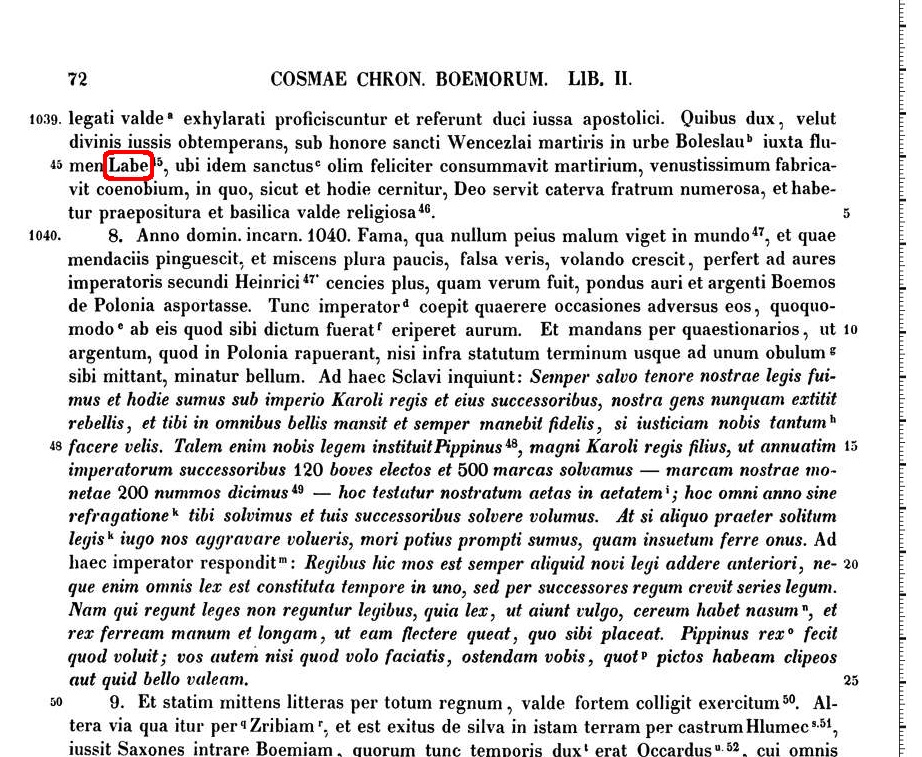
It has been argued that Laba (Polish Łaba that is waba) is a late Czech innovation but we know that that is nonsense.  The name “Labe” appears already in Cosmas’ Chronicle at the beginning of the 12th century.

Earlier we have the Polabingi mentioned by Adam of Bremen (which also show the tendency of some writers to “create” -ingi endings for Slavic tribes (or Baltic, as in Jatwingi).

A Slavic word for a “boat” – łajba – may also come from this as already previously discussed.  Note that the Baltic > Slavic works the same way for that too:

  • Lithuanian aldija > ladja or лодья (lodya)

This is the same construct as with the proposed:

  • Aldoga > Ladoga
  • Elde > Lada

Or for that matter:

  • albus > łabędź [swan]

Or…

  • Arbeit > Rabota

Or countless others:

  • delve > dilbas/dulbis [Baltic] > dłubać

And assuming the Balts’ version of this corresponds closer to the Germanic version you can even explain the Baltic name:

  • baltais [Latvian for white] > ato [Czech for bog] but bołoto [Russian]

also the name for Lake Balaton suggesting that either the Balts or Slavs used to live in Pannonia.

At least that is the story.

That being said, there is no reason necessarily to suppose that Elbe needed to be the “first” version.  It is true that the earliest sources use elb/alb but could that itself be a “nordicization” of the underlying names?

Here we should note that there are plenty lab- lad- led- names in Indo-European, particularly, in Greek and related languages.

We have, after all, the Queen Leda – a lover of Zeus who appeared to Leda, appropriately for the topic du jour, in the form of a swan.  Interestingly, Leda’s children included Castor and Pollux with whom Lel and Polel had been wishfully (?) identified.  Both of the twins participated in Jason‘s Argonautic expedition to Colchis (for the proposed Colchian origin of the name of Poland see here), the same expedition which (as per Apollonius Rhodius’ Argonautica) later passed by the dragon (?) Ladon on the way back still alive after having been smitten by Heracles.  (Needless to say that some of these names appear similar to the Polish Gods Lada and Yassa).

Outside of mythology, we also have lips or labia which bear a striking similarity (in meaning and, arguably, in function) to the mouth of the Laba River.

We also have Ablabius or Ablavius – one “from” (ab) Laba?  (This Eastern Roman/Greek name also appears as the name of one of the sources for Cassiodorus’ Getica).  Thus in Indian languages we have abhi, abhi-tas.  In Slavic we have obok.  And in German we have ab.  As in ab und zu.  (Compare this to the Slavic od (earlier ot in a kind of a Slavic Lautverschiebung)).

Of course, the “z” is also present in Slavic to represent “from” (Interestingly, our suggestion that Z-łaby (or Słaby) could help explain the name of the Slavs had been made already in the 18th century!)

Uebi? Where is this from!?

In any event, in Germany/Netherlands there is also another River Leda.  In Spain we have the town of Liedena (next to Yesa).  Also, and curiously, Lada was the name for Anglo-Saxon legal “purging” rituals on which we will have more (see King Æthelred’s laws) (and, as mentioned the law of Genghis Khan was called Yassa).

There are at least two possibilities here.  One is that the Germanic languages have the capacity to originate/maintain both the Led- and the Eld- versions of names (but the Slavic only the latter!).  This is the same overreaching argument as in personal names – there we are told that the suffix –mir may be Slavic but it can also be Germanic.  But the suffixes -mar and –mer are exclusively Germanic.  In more recent times, we see the same argument applied to genetics.  The European versions of the haplogroup R1a may be “Slavic”.  But they also may be Germanic (or Celtic).  However, haplogroups R1b and I1 cannot be Slavic and are Germanic (or Celtic)… (What all of this, frankly, suggests is that the Germans are a mix of at least three different populations, bits and pieces of whose language and genes made their way into the common pot).  

Another possibility is that some of these names are simply not Germanic.  This would raise another question.  Which version is Germanic and which is not.  As between the Eld- and the Led-, we’d say that the Led- is the not Germanic version.  In that case, the question is whose language does it belong in?  And could it be Slavic, Baltic or something else altogether.

Copyright ©2017 jassa.org All Rights Reserved

April 2, 2017

The Slavs of Wipo’s Deeds of Conrad II

Published Post author

We present here the full Slavic contingent from Wipo’s The Deeds of Conrad II (Gesta Chuonradi II imperatoris).  We previously featured one little component of that work but here is the full account in Karl Morrison’s translation.

Wipo of Burgundy (also Wippo circa 995 – circa 1048) was Conrad’s chaplain and served also his son Henry III so he was intimately familiar with the goings on at court.  Although he is obviously biased towards his masters, his sycophancy does not prevent him from delivering a number of interesting facts.

I. On the Assembly of Princes

“In the year 1024 from the incarnation of the Lord, the Emperor Henry II, although of sound mind, was taken with an infirmity of the body, which prevailing, he departed this life the 3rd of the Ides July [July 13]… [lists the various eminent members of the Empire]  These were the dukes, on the other hand, contemporaries of the wove-mentioned men: … Udalric, duke of Bohemia…”

II. On the Election of the King

“…While all the magnates, and, so to say, the valor and the vitals of the kingdom, had convened there, they pitched camps on this side and in the region about the Rhine.  As it [the Rhine] separated Gaul from Germany the Saxons, with their neighbors, the Slavs, the eastern Franks, the Bavarians, and the Alamanni, convened from the German side; and from Gaul, the Franks who live above the Rhine, the Ribuarians, and the Lotharingians were joined together.

IX. Of Boleslaus, Duke of the Slavs

In the same year [1025] which I have mentioned above, Boleslaus Sclavigen [of the Slavic nation], duke of the Poles, took for himself in injury to King Conrad the regal insignia and the royal name.  Death swiftly killed his temerity.”

“But his son Misico, similarly rebellious, cast his own brother Otto out into the province of Russia because he favored the partisans of the King [Conrad].  I shall tell in its proper place how King Conrad afterwards curbed the impudence of this Misico and the perfidy of a certain Udalric, duke of Bohemia.”

XXI.  That the King of Burgundy Came to meet the Emperor at Basel

“…Shortly after, Adalbero, duke of the [H]istrians or Carinthians, convicted of less majesty, was exiled  with his sons by the Emperor, and that Cuono just mentioned received from the Emperor his dukedom, which the father of this very Cuono is said to have had once.  So Duke Cuono, as long as he lived, remained faithful and one who strove well for the Emperor and also for his son, King Henry.”

XXIX.  Rudolf, King of Burgundy, Died, and Odo Invaded His Realm

“In the year of the Lord 1032, Rudolf, king of Burgundy, the uncle of the Empress Gisela, died in peace.  Count Odo Francigen, son of his sister, invaded his realm, and took certain very well-armed castles or cities by craft or battle.  Neither did he dare to make himself king nor, indeed, did he wish to lose the kingdom.  Some persons related that he had often said that he never wished to be king, yet always to be the master [magister] of a king.  In this fashion he drew away [for himself] a great part of Burgundy, although King Rudolf had already confirmed, not long ago, through a solemn oath that the kingdom of Burgundy should go to Emperor Conrad and his son, King Henry, after his death.  But while Count Odo did these things in Burgundy, Emperor Conrad was in Sclavonia with his troops.*  What he did there and how he afterwards repelled Odo from Burgundy, I shall tell in the following [passages].”

* note: In his expedition against Misico (Mesko), which was begun in 1031 and concluded with a treaty at Merseburg in 1032. [notes are Morrison’s]

“When the aforementioned Boleslaus, duke of the Poles, died, he left two sons, Misico and Otto.  Misico persecuted his brother Otto and expelled him into Russia.  While Otto lived there for some time in a miserable condition, he began to ask the favor of Emperor Conrad, in order that through his intercession and assistance he might be restored to his fatherland.  Since the Emperor was willing to do this, he decided that he himself would attack Misico with troops on one side and Otto on the other.  Since Misico was unable to withstand this attack, he fled into Bohemia to Duke Udalric, against whom at that title the Emperor was enraged.  But Udalric was willing, in order to please the Emperor, to give Misico up to him.  Caesar renounced this dishonorable pact, saying that he did not wish to buy an emery from an enemy.  Otto was restored to his fatherland and made duke by Caesar; but since, after some time, he acted wit too little caution, he was slain secretly by one of his household.**  Then Misico sought in every way the favor of the Empress Gisela, and of the othe princes, that he might be found worthy to return to the favor of the Emperor.  Caesar, moved by compassion, granted him pardon; and after the province of the Poles had been divided into three parts, he made Misico tetrarch and commended the remaining two parts to two other men.  So, with his power diminished, his temerity was reduced.  After the death of Misico,*** Casimir, his son, has served our emperors faithfully until this very time.****”

** note: 1032
*** note: 1034
**** note: From 1042 his relations with Henry II worsened, and in 1050 Henry readied an expedition against him.  The expedition was canceled however by Casimir’s voluntary submission.

XXXIII.  That King Henry Subjected the Slavs

“In the meantime, while the Emperor was doing those things in Burgundy which have been recounted above, his son, King Henry, although still in the years of boyhood, attended no less energetically the affairs of the commonwealth in Bohemia and in the other regions of the Slavs, where he vigorously subjugated Udalric, duke of Bohemia, as well as many other opponents of Caesar.  When his father returned, he met him, and thus he gave to the peoples double joy because of the double victory.”

“Then, when troops had been collected from Saxony, the Emperor came upon those who are called Liutizi and who, once semi-Christian, now are wholly pagan through the wickedness of apostasy; and there he brought to an end an implacable conflict in an astounding fashion.  For there were at that time many quarrels and border raids between the Saxons and the pagans.  And when Caesar came, he began to to inure by which side the peace, which had lon bgeen inviolate between them, had been destroyed first.  The pagans said that t peace was disturbed first by the Saxons and that this would be proven through a duel, if Caesar so commanded.  The Saxons, on the other hand, although they contended unjustly, similarly pledged before the Emperor their willingness to engage in single combat to refute the pagans.  The Emperor, even though he took the counsel of his princes, did not act cautiously enough and permitted this matter to be adjudged by a duel between them.  At once two fighters met, each elected by his own men.  The Christian began to fight boldly, confiding in that faith alone which, however, is dead without works of righteousness, and not diligently heeding the fact that God, who is Truth, disposes everything in true judgment, He who makes His sun to rise over good and evil, who causes rain to fall on the just and the unjust.  The pagan, however, put up a staunch resistance, having before his eyes only the consciousness of the truth for which he fought.  Finally, the Christian fell, wounded by the pagan.  Because of this outcome, the pagans became so greatly elated and bold that, if the Emperor had not been present, they would have thrown themselves upon the Christians straightaway.  But, in order to curb their incursions, the Emperor constructed the castle of Werben in which he stationed garrisons of knight,s and he constrained the princes of Saxony by solemn oath and imperial order to resist the pagans of one accord.  Then he returned to Franconia.”

“But in the following year, the same castle was taken by the pagans through craft, and many of our men who were in it were killed by them.  Disturbed by this, the Emperor again came with troops to the Elbe River.  But since the pagans prevented the crossing, the Emperor sent part of the army across under cover through another ford of the river.  When the enemies had been set to flight in that way, Emperor Conrad entered the region by the now-free bank of the river and laid them so low with immense devastations and burnings everywhere except in impregnable places that afterwards they paid to him the tax which had been imposed by emperors of old and which was now increased.”

“For both before and at that time, Emperor Conrad toiled greatly amidst the nation of the Slavs. Because of this, one of us composed a short account in verse which afterwards he presented tot he Emperor.  There one may read how the Emperor sometimes stood in h marshes up to the thighs, fighting in person and exhorting the soldiers to fight; and how, after the pagans had been conquered, he slew them with the greater ferocity because of a certain reprehensible superstition of their.  For it is said that at some time the pagans kept a wooden effigy of our crucified Lord Jesus Christ in shameful mockery and spat upon it and struck it with blows; finally they tore out the eyes and cut off the hands and feet.  To avenge these deeds, the Emperor in a similar manner mutilated a great multitude of captured pagans for one effigy of Christ and destroyed them with various deaths.  Therefore Caesar is called an avenger of the Faith in these verses and is compared with the Roman princes Titus and Vespasian, who in avenging the Lord had exchanged thirty Jews for one coin since the Jews sold Christ for that many denarii.”

“After his return the Emperor imperiously cast aside whatever resistance he found in the kingdom.  In the same year, Adalbero, duke of the Carinthians lost the favor of the Emperor and was deprived dog his dukedom and sent into exile.”

40. Verses on the Death of the Emperor Conrad

[after telling how Conrad subdued the Saxons, Alemanni, Bavarians, Rome, Ravenna and Verona  (Pavia?) he comes to the Slavs]

“…The Emperor never tarried, everywhere the giver of peace.
He carried war to the pagans lest they harm Christians:
The marsh did not defend them, nor was there safety in the waters;
Well he made the barbarian Slavs and all peoples depraved feel his force.
O King God, guard the living and have mercy upon the dead.”

Copyright ©2017 jassa.org All Rights Reserved

March 31, 2017

Improvements

Published Post author

We’ve added a Strabo citation to our discussion of the Tropaeum Alpium that previously escaped our notice.  It makes for an interesting confirmation of the Tropaeum’s information.

Copyright ©2017 jassa.org All Rights Reserved

March 31, 2017

Speculation Lust

Published Post author

We’ve received some requests asking us to talk a little about the origins of the Slavs.  Specifically, the questions were “are they from Central Europe or from somewhere else” and were the Veneti or Suevi Slavic.  Obviously, we can only provide educated guesses and our opinions on this topic but, to the extent it isn’t obvious to the readers yet, where we (at present) stand, we can try to discussion this again.  (Incidentally, we tacked a version of this already here).

The Veneti are said to have raised mules and sacrificed horses – the horse of Arkona may be a distant relation – above are Vindelician and from Bretagne

First of all, as repeated a million times, any question can only be answered once we agree on the terms.  Otherwise we are all just speaking past each other.  What do we mean by Slavs?  People who speak a particular language?  Or blood relations?   And as of when?  As of “forever” or during the period 0AD – 500 AD or during some other period?  When we say the Veneti were Slavic, what do we mean by that?  And as of when were they Slavic (or those we call Slavs today Venetic)?  How does one account for people that were in a particular place, were then driven out for a few hundred years and then came back?  Are they autochtonous or not?  Does it matter that the people who came back were not exactly the same people as those who left?  Does it matter that historical sources indicate that even before they were driven out, they themselves were the invaders?

All of this can best be illustrated in our discussion.

There are two theoretically opposed ideas here.  One is that the Slavs migrated into Europe at some late date after the fall of the Roman Empire (512 being the earliest date typically given as attested by Procopius with the return trip of the Heruli through Slavic lands).  This is the “allochtonous” theory.  The other theory is that the Slavs were in Central Europe already during the Roman Age and likely some time before that.  This is the “autochtonous” theory.

Note that right out of the gate we run into difficulties.  Even the allochtonous theory (at least as it is stated these days) assumes that the newcomers did not entirely replace the existing population – positing some percentage as surviving and continuing on.  But what is that percentage?  As we’ve already discussed it might matter if that percentage is, say, 5% versus 95%.  It would be hard to say that the Slavs were allochtones if they composed just 5% of the overall population at the time of their arrival.  This is the case even if the newcomers brought with them their new culture, language (?) and form of government.

Assuming those populations mixed with one another, does that mean that your right hand is autochtonous but your left came from somewhere else?  How do we measure this in other words?

And as of when?  Let’s assume that the newcomers were 95% of the overall population but their offspring over the years amounts to no more than 50% of the current population with the remaining 50% being the product of the autochtonic community.  Possible?  Sure.

On the other hand, even the autochtonous theory presents its own difficulties and has to, at some point, run out of steam.  If the Slavs lived in Europe at the time of Christ, did they also live in Europe at 2000 BC?  What about 4000 BC?  Unless you believe that the Slavs arose independently as a population in Eastern Europe or that they were the first Homo Sapiens out of Africa and into Europe or that, in a variation of this, God created the Slavs already in Eastern Europe, they must have come into their present at some point in time.

So what do we think?

(WARNING: entering aree rife with speculation)

Pre-Pre History

It is striking that physiologically most northern Slavs, Balts and to some extent Finns resemble each other.  Although this resemblance is not necessarily reflected through haplogroups the overall similarities are obvious.  (The same could also be said of some Germans and many Scandinavians but on a more limited scale).  Thus, the study that indicated the genetic similarity of Poles to Veps should not be surprising.

We are willing to posit that what is today’s Central Northern Europe was inhabited in the remote past by a population that is the direct ancestor to present day populations of the same area.  It was not the only ancestor but it was the “main” component.

What language did that population speak?  This is absolutely unknown and likely unknowable.  We’d be inclined to believe that this language was akin to some Indo-European language (Baltic?) or, less likely, a “Uralic” language (Finnish?).*

* See below though on the discourse regarding potential for a pre-genetic Teutonic population.

 (Indo-Europeans would have gotten to Europe thousands of years before the Veneti so there is no way that IE came to Europe first with the Veneti (if IE had indeed been their language) if that is what you were thinking – at least not with the Veneti of the Trojan War migration – whether the Veneti had already been in Europe before that time we will not take up here – if indeed such a topic could even be discussed sensibly given the present – and likely future – lack of data).

The Veneti

The Veneti were people who lived at one time in Paphlagonia.  We know that much.

We do not know, however, where else they lived at the time.  It is quite possible, for example, that they already also lived north of the Black Sea.  The Veneti may also have lived in other parts of Anatolia and even down into Palestine (it is tempting to think that the Phoenicians may have had something to do with the Veneti – perhaps they were the Semitized Veneti or the Veneti were the Indo-Europeanized Phoenicians).  They may have bordered on the Assyrians and Lake Van in Turkey may indeed derive its name from them.  In fact, it is possible that it was the Veneti that – before the Trojan War – spread as “Arians” into India (see here on the Odras and the Wartas).  This would explain the Mount Demawend, R1a in Afghanistan and the various “Venetic” names in India (not the least being the Vindhya Range).

We can assume that the Veneti spoke a language akin to Slavic (proto-Slavic?) (certainly names of places in Anatolia that include Prusa suggest something like that).  But it is possible that they spoke their own language and got Slavicized once they crossed the Bosphorus.

At some point, let’s say after the Trojan War, the Veneti, or some portion of them, really did migrate East.  They went over the Ister and ended up spreading their “Slavic” language (or adopting the Slavic of the autochtones they encountered) and their culture all the way up to the Adriatic (perhaps into Dacia and Illyricum in the first instance).  It is for this reason that the Slovene city of Ljubljana has Jason feature in its founding myth.  It’s likely that Jason was in fact a Venetic fertility God that found His way into Greek myth (and that Iasion and Jason were the same originally).

The Veneti went further ending up in today’s Poland as well as Eastern Germany and Noricum/Vindelicia (which lic refers to the nearby River Lech – unsurprisingly, the alleged progenitor of the Poles and of the other Western Slavs – note too that Lech may mean a “white” river as in Leuco-Syrians).  They went further through France (hence the various Wendish names in France) yet, ending up in today’s northern France and, famously, Bretagne and then, eventually, crossing to Gwynedd in Wales and perhaps portions of Ireland (Dublin – Lublin).  They also may have crossed from Illyria over to southern portions of Italy (such as Messapia) and even northern Spain/Portugal.  And they may have reached present day Denmark and southern Sweden and perhaps even other portions of Britain (Picts? Apennine Range whose name seems to be constantly getting older?).

If the Veneti originally spoke Slavic then all these Veneti would have (at least initially) spoken Slavic.  If, however, that was not the case, it is possible that each grouping of the Veneti – even if springing from a common source – begun to speak the language of the local population they were absorbed into.  In Central Europe that could have been Slavic but elsewhere not so much.  It is also possible that a combination of these two cases occurred and that Slavic (or some other language) is the language of the original Veneti but that in other places the Veneti adopted the local language.

Although the same could be said about culture, there appears to be something that is the distinguishing characteristic of the Venetic culture – cremation burials.  It is curious that – in Poland – such burials in this period stop roughly on the Vistula line – as if the Venetic influence did not penetrate further east towards Prussia.  This may explain why even as late as the time of Alfred the Great, west of the Vistula we had Wendland but east of the Vistula we had Vitland.  The fact that in the West, the Rugians worshipped Svante-vit (and Rugevit and Porevit) may indicate that those populations – at least originally – were more akin to the Prussians and Lithuanians (or derived from them) and that – later – they became separated by the “Veneti”.

What happened to the “autochtons” when the Veneti arrived?

And we know there were autochtons present.  Sources tell us that even in the Venice region, the Veneti displaced a local population.  More generally, we obviously do know that there were humans in Central Europe prior to the Trojan War.

The Trojan War itself has been dated to the 13th or 12th century BC.  It is curious that the recently discovered remains of an ancient battle at Tollensee have been both dated to approximately 1250 BC and said to have contained dNA similar to that of present day Poles/Scandinavians but also southern Europeans.  Although obviously this is pure speculation, a tempting construct would see these as being the “locals” and the “Venetic” arrivals.  (Of course, we have no idea whether the battle groups were in fact divided according to today’s “geographies” or whether they had anything at all to do with the Veneti – this is all obvious speculation).

If all of the above is true then the first question we ought to be asking is what was the percentage of the Veneti among the locals?  5% or 95%?  And at what location?

We can assume that the Veneti controlled most of Central Europe but would guess that it was at this point that the “Balts” remained outside of the Venetic influence while the Balts’ autochtonous cousins became pre-Slavic “Wends” by reason of their mingling with the Veneti.  It is possible that it was at this point that Slavic was carved out of Baltic with the former either being originally a “Venetic” language or, more likely, a mixture of Venetic and Baltic.  The Veneti and the “captured Balts” became Slavs – from Trieste through Noricum, possibly Suevia and up to the Baltic.*  The remaining Balts stayed Balts – now designated Aestii.

* In fairness, it is possible that the original pre-Venetic population may have been Nordic or Teutonic even in Central Europe… As an interesting side note recall that the word Deutsch comes from the same PIE root (*teuta- “people”) as:

  • Old Irish tuoth “people,”
  • Old Lithuanian tauta “people,”
  • Old Prussian tauto “country,”
  • Oscan touto “community.” 
  • Polish tu or tutaj each meaning “here” or tutejsi “the ones from here” (Hierige) or tato “dad” (on this last point note also the Suevic – Langobardic ruler Tato – the Langobards who seem to have conquered the original Winulli also had a king named Lethuc which is just way too similar to the Polish prehistoric Leszek)

Not to mention the Germanic Ur-Gott Tuisco or Tuisto.

The Gauls

If one were to believe the ancient writers, the Gauls may have originally come into Gall and other places from Germany.  But to get to Germany they likely would have come from Scandinavia. While the La Tène culture with its cremation burials may have been Venetic, Hallstadt was likely Celtic.  This does not mean however that the Celts exterminated the Veneti (meaning – at this point – what we would call today Slavs).  In many places they melted into the local population and only maintained their “Gallic” presence in today’s France.

Perhaps at the time the invasion of the Gauls “cut off” the Veneti in Bretagne (and southern France/northern Spain) from the rest of the Veneti.  On the Veneti of Bretagne see here and here and here.

The Suevi and the Nordics

The Nordics or those what we would today call “Germans” likely came next.  They too however did not displace the local population.  The language of the Suevi who arose at this time is quite uncertain but it is interesting to note that they may have had “Indic” prisoners (as per Pliny) and that they did keep slaves –  the Latin word for whom at the time was Servi.  Whether the Servi were the same as the Veneti and whether they were ethnically different from the Suevi is, of course, uncertain.  It is certainly possible that the Suevi of Ariovistus and Veleda were Slavic speaking and no different from their servitors.  It is curious that the Suevi maintained good relations with the Rhaetians or the Norici (one of Ariovistus’ wives came from there) and that their names sound similar to those of the Dacians of the time.  This suggests a common Venetic heritage.  Note too that the very name Suevi may have derived from the River Suevus which may well have been the Eastern Saale (Solawa in Slavic and hence the later Solaviane).  These Suevi thus may well have been a combination of the original “Baltic” population, the Veneti who arrived a millennium or so earlier and, possibly, a new northern element.  Their language, however, may well have been a version of Venetic.  The fact that their garb and customs are supposed to be similar to that of the Baltic Aestii (or, really, vice versa) and just the language a little (?) different suggests that the Suevi and Aestii were not too separate.  The fact that Tacitus views them as a large assembly of nations not like the “other” German tribes also suggests that the Suevi were not just Nordics.  

But the Suevi were soon broken.  Initially, in the time of Caesar, they reached the Rhine.  But then they kept being beaten back and by the time of Tacitus the bulk of them (some Suevi – Wiltzi – may have remained in the Netherlands/Belgium– for that see here) was nowhere near the Rhine, having been driven by the Romans as well as by the continued outpouring of tribes out of Scandinavia, further East towards the Elbe.  The country of the Veneti was cut off and what we now view as Western Germany became, well, Germanized.

Other Suevi, we know, were driven towards the Danube and, later yet, into Pannonia where they allied frequently with the “Sarmatian” Jazyges.  Did the Jazyges speak Venetic as well?  They were Sarmatian as were the (Vistula) Veneti so – if that term means more than just geographic association – perhaps they had been “Venetized” already (by the forces of Antenor on the way west or even earlier?).  (The names of the individual Sarmatians (Jazyges?) do not sound Slavic and neither do the names of the, perhaps, related Alans – but then again, we are told that Germans take Roman names and Sarmatians frequently taken Germanic names).

The Vandals – to the extent they existed prior to their appearance in modern day Romania – likely skipped along the Elbe/Oder down into Czechia/Moravia bypassing Poland entirely. The notion that the so-called Przeworsk culture has anything to do with Vandals is nothing but a flight of fancy, wishful thinking or outright lying.

The Goths may have lived at the Vistula but we do not even know which river the Vistula was with the Oder being the main candidate.  It is also rather remarkable that all the tribes mentioned in the Getica as having fallen to the Goths appear to be of eastern origin.  This is true of the Spali who appear in the East and then the numerous Finnic tribes that are conquered before the Goths try their hand at taming the Veneti.  But for the seemingly earlier mention of the Vandals and Rugi, it would be tempting to suggest that the Goths came from the East – not from Scandinavia.   The fact that the Tocharian language seems to have been a centum language would support this hypothesis.

What of the Veneti at This Time? 

It would be quite simplistic and unrealistic that cultures such as Wielbark and Przeworsk were exclusively assignable to one particular group.  It would likewise be silly to suggest that a particular territory was exclusively possessed by a particular group.  And also silly to suggest that only one language must have been spoken in the same territory.

Central Europe was likely still mostly Venetic at the time, no matter who ran the show.  This is so for no other reason than the fact that invaders were far too lazy to till the soil – why would they, if they could just impose themselves upon the locals (much as the Rus did later in Russia – transferring the name onto the native Polans but otherwise becoming thoroughly assimilated).

This is not to say that the Veneti were the only people there.  In fact, if the tales of Scrithifinni (or Screrefennae) are to be believed, a Finnic or Baltic (original?) population may have remained present in the area even into that late day.  Note that skryty means hidden or reserved in Slavic.

As we’ve discussed numerous times, it’s less than clear who the Lugii/Legii/Lygii were.  They were supposedly Suevic (implicit in Tacitus’ Germania) but what does that really mean if we can’t even say what language the Suevi spoke?  It is quite likely that the Lugii were the ancestors of some of the Poles and spoke some sort of Venetic (Slavic) language – but the north of Poland (including Pomerania, Mazovia and, of course, Prussia probably still spoke the language of the “Baltic” autochtones – the “Aesti”.  There may also have been some Goth outposts on the Baltic shore.

It is possible that some of the Veneti had been dragged south-eastwards by the advance of the Goths (assuming the Goths came from the North.  Perhaps some had been taken prisoner.  Hence we have the Veneti on the Danube on the Tabula who then later invade the Byzantine Empire.  It is however possible that these Veneti had been there from time immemorial – perhaps a result of Antenor’s march or perhaps a result of the presence of an even earlier, pre-Trojan War Venetic population.

So What Happened Next?

That Slavic was likely spoken in Pannonia in the 5th century is best shown by the strava reference in Jordanes’ description of Atila’s funeral.  As noted above the mixing of the Suevi and the Jazyges is likely to have been happening even before Nedao but likely accelerated thereafter.

After the Battle of Nedao (in which the Suevi – but now referred to as the Suavi – took part), it is possible that the remnants of the Suevi (previously Venetic speaking and now further mixed with the Pannonian Jazyges who, again, could have spoken the same tongue), still remembering that they came from somewhere further Northwest (Noricum) headed back North and West.  This is likely where the Suevic – now Slavic – name arose but the Slavs even later remembered that they were Noricans (as noted in Nestor) before they got to Pannonia.

(That the Slav name may have been a late addition into this mix is suggested by the fact that Jordanes explicitly names the Veneti as the progenitors of the tribe and says that the other group was the Antes which itself may be a version of the Veneti or maybe even a reference to a long-remembered memory of Antenor.)

In the North, any returning Venetic Suevi, would have found the remaining Vistula Veneti and perhaps also Balts even at the Pomeranian coast plus some Gothic remnants (hence Viti- or Vidi-varii) and over time merged with them – all now calling themselves Suavi or “Slavs”.

In the West, however, the matter was not so simple.  In Eastern Germany some remnants of the original Suevi/Veneti may have survived (Germanized?) but Western Germany was now the abode of the Saxons, Thuringians and, further West, the Frisians and Franks.

And in the East the lands would have already been held by the Veneti who now, with the Byzantine Empire weak  began to pour over the border.

Post Scriptum

Note too that the suggestion only the Eastern Danube Veneti were Slavs whereas the “Sarmatian” Veneti of the Vistula were not, is silly on its face.  It would be quite bizarre if each of these populations, on the one hand, shared a name and the fact that each became “Slavicized” in the future but, on the other hand, did not – at the time of the crafting of the Tabula – share anything else in common. 

Note further that the fact that Slavic remained mutually understandable for most Slavs at this time does not necessarily indicate that all the Slavs must have lived close to one another (though Suavic Pannonia could have been that area if we must go there).  It is indisputable that even today Slavic languages are to a large extent mutually comprehensible for all Slavs (at least if spoken slowly) and certainly more so than Germanic languages.  This seems to be a function of the complicated nature of the language.  In other words, the Germanic languages are much simpler and as such they are much simpler also to change.  This is their strength – they are easier to learn than Slavic or Chinese and, consequently are more adaptable or changeable – something that is harder to achieve with a more complicated language.

So Where Does This Leave Us?

It is thus entirely possible that the original (and largely continuing) autochtonous population of Central Europe was Venetic (as in Slavic) by Roman times.  But all of this may also mean that the Veneti – post 1250 AD – just gave such population its fire-worshipping culture and – perhaps – language (Slavic)* whereas such population was – and remains – largely “Baltic” or perhaps “Balto-Finnic” biologically (Balts are somewhat similar to Slavs on a genetic level – Finns – at least today’s Finns – are somewhat different).  Whether or not the Suevi were Venetic (Slavic) speaking originally or became so later (either after contacts with the Veneti or, much later, with the Venetized Jazyges) they may well have given their name to the Slavs.

[* It is also possible however that Slavic was spoken in Central Europe already before the Veneti and that the Veneti became Slavicized as a result of their conquest of the area.]

Thus, it is possible, that Slavs are autochtonous to Central Europe (including Slovenia) as a population and – perhaps – as a matter of language.  It is also very likely that the Vistula, Danube (and possibly the Adriatic and… maybe the Gallic) Veneti spoke some form of Slavic.  But this does not necessarily mean the Veneti – before 1250 BC – had much to do with the population that today is called Slavic (or, depending on your vies, with the Slavic language).

If you can live with that distinction then we’d say that the Vistula and Danube Veneti – by Roman times – were very likely identical with Slavs.  The Adriatic Veneti and Vindelici – even though they may have been the same “Slavic” people originally – were likely for the most part first Gallicized and then Latinized by that time in terms of language – though, perhaps, some pockets survived deep in the Alps or other forlorn places (and it may well be that it was these pockets that resuscitated the Slovenes).

Copyright ©2017 jassa.org All Rights Reserved
March 30, 2017

Of Marshes

Published Post author

We’ve previously mentioned that the word lug/ług/łęg which means a “marshy meadow” in Slavic (but too in Lithuanian).  As the link above shows, Brueckner was aware that the same name appears in Strabo’s Geography.  Didn’t pick up on this at first but then looking over that work, we came across the following statement about the lands about Pannonia:

“In like manner, also, there is a pass which leads over Ocra from Tergeste, a Carnic village, to a marsh called Lugeum/Lugeon.”

(Strabo’s Geography (Book 7, Chapter 5))

We should also add Mount Ocra sounds vaguely Slavic (okryt “to cover” or kra meaning “ice”) and similar to names such as Uecker or Wkra (recall, for example, Ucromirus).

We’ve already pointed out a few times that it seems odd that the town of Serbinum, also known as Servitium or Servicium in province of Pannonia should have been there under that name already in Ptolemy’s time even though the Serbs are said not to have gotten to the neighborhood until the 6th century (unless the Serbs did not get that name until they got to that area which seems improbable).

Copyright ©2017 jassa.org All Rights Reserved

March 28, 2017

Arrian’s Veneti

Published Post author

One of the more knotty assertions has been that the Paphlagonian Veneti had been driven out from their lands by the Assyrians (or by the Leuco (or white) Syrians though it may also be the case that the Veneti were the Leuco-Syrians).  This claim appears in a number of 19th centuries works – usually written by amateur historians and without citations.  We finally decided to get to the bottom of this.

Apparently, the statement was made by Arrian of Nicomedia (circa 86/89 A.D. – circa after 146/160 A.D.), the author of the Periplus of the Euxine Sea, Indica and a number of other works.  However, it does not seem to have been directly preserved in any surviving work of Arrian’s.  (we say “does not seem” because we hadn’t had a chance to look through the Arrian section in Felix Jacoby’s Fragmente der Griechischen Historiker – FGrH 156).  Instead, the assertion is made by a 12th century Greek scholar Eustathius of Thessalonica (circa 1115 – 1195/6).  Among Eustathtius’ works is a series of commentaries including one on the work of Dionysius Periegetes (Dionysius the Traveler), a Roman traveler and author of a geography book who is believed to have lived during the reign of the Emperor Hadrian (117–138 A.D.) though some say that he lived at the end of the third century.

It is in that commentary on Dionysius Periegetes (specifically, in section 378) that Eustathius cites Arrian.  We find the passage of interest to us in the German philologist Gottfried Bernhardy‘s 1828 edition of Dionysius’ work (Dionysius Periegetes : graece et latine, cum vetustis commentariis et interpretationibus) which also happens to contain Eusthathius’ commentary on  Dionysius.

Although about a millennium separates Arrian and Eustathius and fewer years than that have passed from Eustathius’ time to ours, nevertheless it is certainly possible that Eustathius did have access to one of Arrian’s lost works.

The following is the excerpt from the “Arrian” section of the commentary which section refers to the Veneti:

“[378] …The Eneti, who are now called the Veneti, as Arrian writes saying that the Eneti struggled hard in the fight against the Assyrians and passing into Europe lived by the river Po and the native language of these [people] is still called Venetian by reason of the Eneti and the land they dwell in [is called] Venetia.  The old [people] truly say that some of those who come from the Eneti, people of Asia, brought their kind, those who struggled in that war (as it is said) fleeing to Europe.  Others say that from the Eneti, who at one time inhabited Paphlagonia, they brought forth an exceptional nation, that after the attack on it was left wandering.  Their leader Pylamenes went to Thracia and the Veneti wondered about and retreated to the Adriatic.   This poet [Strabo] recalls such Venetian Paphlagonians saying: ‘from the [land] of the Veneti, whence comes the breed of wild mules.’  Many of the Veneti who are close to Aquileia, have colonies there by the same name.  The ocean is called home not only by the Veneti but also by the Belgae.  The Belgae are a Celtic nation.  The geographer [Strabo] also writes that clearly the cities of the Veneti who live by the ocean were founded by those who live on the Adriatic.  In a naval encounter they fought against Caesar such that they might prevent him from crossing to Britain.  Nor is it an accident that the Veneti are those Paphlagonians that arrived safe from the Trojan War with Antenor the Trojan, as this is demonstrated by the fact that they excelled in raising horses, as reported by Homer.  [Thus,] the training of horse is among the Greek called Venetica [?]  It was from these that Diomedes was given an offering of a white horse.  Moreover, they say their sea is similar to the Ocean [both] returning and flowing.  And these lakes are filled by channels (as old historians recount), just as the Egyptian lakes are derived/filled [?].  It should also be noted that the entire region beyond the Calabrians was called Apulia and the people there Apulians.  Note also that just as the wind that blows through Thracia is called the Thracian, and the Locrician the one that blows through Locris, so does the one that blows through Iapygia is called the Iapygian.*”

* This is confusing but Iapygia is the same as Apulia and as Messapia at the back heel of Italy (also the home to a town Sybar present apparently at the Trojan War before it was renamed Lecce by the Romans – given as Lipiae or Lippiae by Strabo and Ptolemy).  Whether the Iapyges could have something to do with the Iazyges is a question at least worth asking.  Why this passage should be thrown in here is uncertain – perhaps the author thought the Messapians/Apullians/Iapyges had something to do with the Veneti.  Perhaps because of the city of Pula now in Croatia (Colonia Pietas Iulia Pola Pollentia Herculanea).  What Locris has to do with any of this is even more unclear.  Afterwards, the author continues with the description of the northern Adriatic turning his gaze to Triest so it seems that some connection is being drawn by Eustathius (or by Arrian?).

“[382] Also Tegaestrae, an Illyrian city, which is located in the innermost part of the Adriatic: its other name is Tergest as it is [written?] in the book of the Gentiles/[heathens?].”

Copyright ©2017 jassa.org All Rights Reserved

March 28, 2017

Alamannic Rivers

Published Post author

The Alamanni were the inheritors of the Suevi or Suavi (or, in West Flemish, Sueevn or Sueeven, in German also Sueben, Sueven or Suawen) and the relationship between the two peoples has been a source of debate and contention.  What is interesting, however, is that they are described as being “nature” worshippers – much like the Sclavi (Sclaveni/Suovianie/Slavianie).  Here is an excerpt from Agathias and the better known one from Procopius writing about the same time.

Agathias: The Histories (1.6.3, 1.7.1)

“The Alamanni, if we are to take the word of Asinius Quadratus, an Italian who wrote an accurate account of German affairs, are a mixed and mongrel people, and their name signifies this…They have their own traditional way of life too, but in matters of government and public administration they follow the Frankish system, religious observance being the only exception.  They worship certain trees, the waters of rivers, hills and mountain valleys, in whose honour they sacrifice horses, cattle and countless other animals by beheading them, and imagine that they are performing an act of piety thereby.”

Procopius, History of Wars Book 7, 14

“They reverence, however, both rivers and nymphs and some other spirits, and they sacrifice to all these also, and they make their divinations in connection with these sacrifices.”

Copyright ©2017 jassa.org All Rights Reserved

March 24, 2017