On the Waters of Jassa

Published Post author

We have previously discussed the “Jassa” mountains and gave a teaser of the “Far North” reach of the Jassa name.

However, it is a fact that the name Jassa or variations thereof appear in northern Belarus and Russia and we thought we ought to mention such appearances.  They are interesting not just because they seem to be captured in the name of a Polish Deity but because such names appear in many, many other places.

To start with we have the rivers:

  • River Jessa (Ecca) (Belarus) which turns into the Ulla which, as is speculated below, may have been called Jassa during the “Polish times”, i.e., before the partitions of Poland.  The Ulla river ultimately joins the Daugava.
jessa2

from Ivan Fedorovich Shtukenberg’s Hydrographie des Russischen Reiches (1844)

Jessa River has the additional curious feature that it starts its run very close to Lake Sialiava (Sialaveanie!?):

sialiava

  • River Issa which (Russia) which starts around Sebezh and continues North until it becomes part of the Velikaya (which, in turn, heads towards Pskov).

issa1

All together now:

jessenintro

Then we have the lakes:

  • Lake Lacha (aka Jassa) – that, as mentioned above, we’ve already discussed here.
  • Lake Yassy – forms a nice triangle with the aforementioned rivers.

jessen2

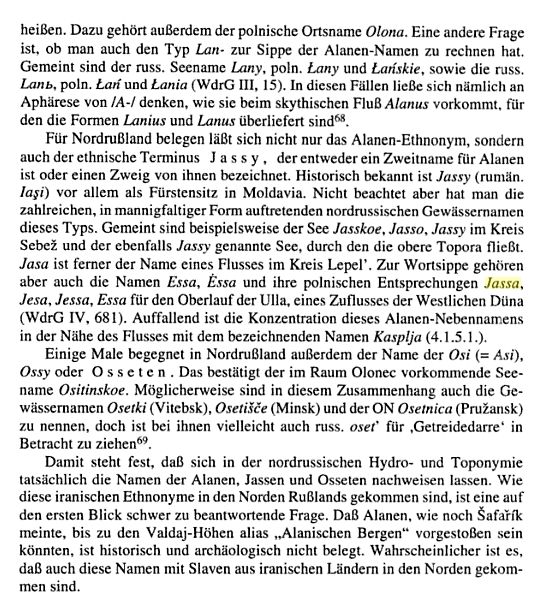
The problem with these names is that they look like signs of “Iranian” Alans (their description by Ammianus Marcellinus does not resemble today’s Iranians) who have been, usually, seen as related to the Ossetian peoples.  We’ve been accustomed to seeing Iassi in Romania (and people named that also in Hungary) but that is because we can pretty much trace their arrival from historical sources.  Likewise, we are not shocked by seeing the Yassy name also in Tatarstan as here:

jessen3

After all, Alans were supposed to have lived on the fringes of Europe – becoming, by virtue of their location, the first victims of the Huns so this, kind of, makes sense (and may be a “Tatar” appellation too).  We even get Lake Essey far East in Central Siberia:

jessen4

But we are not aware of any Alans (and, yes, they were the ones that joined with the Vandals and Suevi on their way to Africa) this far Northwest in European Russia.  Alans were supposed to have been horse riders of the steppe (perhaps related to their Western cousins (?) the Yazyges) – not travelers through the deeply forested lands of Northern Belarus and Russia.

The same was noticed by others before, e.g., Heinrich Kunstmann:

kunstmann1

Kunstmann’s “Die Slawen”

kunstmann2

What gives?

Perhaps the name has nothing to do with the Alans? (in case you are wondering, the Alan chieftain names, such as we have records of, do not sound, at all, Slavic, e.g., Sangiban of Jordanes or Goar of Gregory of Tours).  Perhaps these river names were some sort of border indications of where the Mongol Yassa rule began?  But that word was derived from Dzyassik and, in any event, the Mongols didn’t reach that far, at least not for very long.

The name Jassa appears in many contexts as seen here (and many others).

Here are the known paths of those Alans who headed to Africa (including their part in the Vandalic kingdom and their part (supposed) in the sack of Rome):

alauni

And maybe there were different Alans?  Maybe, there is something to palanioru(m), Palania or Alanos, quos dicunt Sclavos really referring to the Alans (just as the uhlan cavalry seems to)?  And there are other hypotheses that are more “appropriately” northern, e.g., Alainen sounds vaguely… Finnish (meaning employee, subordinate, ancillary!).

Copyright ©2015 jassa.org All Rights Reserved

August 25, 2015

Were There Vandals in Poland? – Part VII

Published Post author

We have examined the Vandals (even though this is a blog about Slavs) just to see if there could be any connection.  Maybe there was.  But it is not apparent to us (about the best that can be said is that Kadlubek speaks of the legend of Wanda…).

So what do we discover on this topic if we look around?  What does the academic profession write about this?

Looking at Wikipedia is most dangerous but why not start there.  Here we came on materials describing the connection between the Vandals and the Lugii.  These included:

  • the Germania treatise written by John Anderson in 1938 – given the title’s reference to Tacitus, we decided it was unlikely to say much about Vandals;
  • the more recent (2006) Encyclopedia of European Peoples published by InfoBase Publishing by Carl Waldman and Catherine Mason – a derivative work where neither of the authors is a scholar of the matters in question and,
  • much more interestingly, The Roman Empire and Its Germanic Peoples (original: Das Reich und die Germanen no, not that Reich, don’t worry! – published by the University of California Press – a work by the German (Austrian, technically, but we prefer not dealing with abstractions) historian Herwig Wolfram, a professor emeritus (now) at the University of Vienna.

Wolfram had written the History of the Goths and so this seemed like a natural choice to compare and contrast.

primus

Primus inter bullshitters?

The section on the Vandals pre-405/406 is, unsurprisingly, short but we were nevertheless struck by how much it is inundated with supposition and wishful thinking.  The author appears to have abandoned his critical faculties and entered the land of fancy.  As Wolfram appears to be one of the leading scholars of the era, this is, of course, a most lamentable, result.  We were so disappointed that we did not bother to read the rest of the book (we hope to go back to it after the initial shock wears off).

With a heavy heart, we present what the author has to say about the pre-405/406 Vandals.  Commentary, obviously, in red.

Wolfram: The Roman Empire and Its Germanic Peoples

The Vandals

Wolfram: “The history leading up to the great Vandal assault, in which both Hasding and Siling Vandals crossed the Rhine along with other peoples and thus stepped into the bright light of history , can be reconstructed only in rough outline.”

Yes, and that very rough outline we gave in the prior posts here.  What follows in Wolfram’s writing is not a reconstruction but a wholesale construction “from the ground up.”

Wolfram: “Already the Tacitus speaks in the same breath of the central Vandili cult site (“a sacred grove of ancient worship”), which was presided over by a priest dressed like a woman, and of the Alci-Alces, two deities he equates with the Dioskouroi Castor and Pollux.”

Either an outright lie or Wolfram is a crappy historian.  Tacitus does not speak of any “central” or other “Vandili” cult site (in the “same” or many breaths).  He speaks of a Naharnavali cult site.  Wolfram assumes that Naharnavali are Vandals and attributes the Naharnavali site to the latter.  The mention of a grove should probably point us towards the Lugi (given one Slavic meaning of the word “lug” – on that see here).  This would fit in nicely with the fact that the Naharnavali were listed by Tacitus as a member group of the Lugii.

Wolfram: “The Vandals, who had originally formed one large ethnic group (like the Suevi), bore “a genuine and old tribal name.”

Leaving the Suevi aside, Tacitus does not claim that a the Vandal name was a “genuine” one and an “old” one.  Rather he says that:

  • Some people assert “with the freedom of conjecture permitted by antiquity” that the people living in Tacitus’ “Germania” (or a subpart of them?) had several names and that, on that list, there was a Vandili name (last on the list); and that 
  • [some people assert] that “these are genuine old names” (not genuine and old), i.e., meaning simply, “some people say that the name was “old, really!”

Put differently, Tacitus is careful not to say the same but rather to point out that others are saying something about these Germanic tribes.  He asserts that they are guessing (conjecture) but given how long ago all of this was (antiquity), perhaps their guessing is worth something, or they are entitled to more leeway, so he is going to include this information in his ethnographic text.

The notion that the Vandals were a group of smaller tribes/peoples (?) comes solely from Pliny.  The notion that they were an ethnic group (as opposed to, say, an alliance of tribes of different ethnicity) cannot be derived from ancient authors and represents a “construction” of Wolfram’s.

Wolfram: “The Longobards arose in the struggle against the Vandals.”

The only source for this is Origo (Paul the Deacon is derivative).  This may well be true but one ought to note that the Origo was written several hundred of years after the “arising” of the Longobards and only after the Vandals had gotten their fearsome reputation, i.e., where the notion of struggling and winning against the Vandals would actually mean something impressive.

Wolfram: “The Gothic tribal saga too reflects centuries of conflict between Goths and Vandals.  True to its bias the saga celebrates the very first class as a Gothic victory.  In reality, what took place was probably not a singular incident but a longer process that freed the Gutones from dependence on the Vandals.  Pliny the Elder still knew the Gutones as a subgroup of the Vandals-Vandili.”

Pliny, as we noted was the only one and even with Pliny we have to assume that the Gutones are the later Goths – a possibility but not a certainty.  And even if the Goths of Cniva (not to mention the later Goths) were related to the Gutones, that does not mean that the first came from the second – as opposed to, say, some parallel migration along the Daugava, as described in the Gutasagan.  

Moreover, the notion of “centuries of conflict” appears misleading.  Jordanes’ text suggests several skirmishes probably over a few centuries but the Vandals are presented by him, not as the “ur-enemies” of the Goths but rather as one of many tribes being beaten by and fleeing from the Goths.

Nevertheless, this seems to be the most accurate group of sentences in this passage thus far.

Wolfram: The Gutones are also mentioned in connection with the Lugians,”

The Gutones are mentioned by Tacitus as living past the Lugii.  But Tacitus does not know any people then living by the name of Vandals and certainly does not claim that the Lugii were Vandals.  Moreover, given the number of Goths’ victims, one might just as well claim that the Lugii were the Spali or some other tribe (allegedly) defeated by the Goths (the list is impressive).  

The French and Americans were, no doubt, listed several times “in connection” with one another in WWII histories but that does not mean that the Americans were French or French were Americans.  And the Germans and Russians are also, of course, mentioned “in connection with” one another in works discussing the same time period.  Is this supposed to be some sort of “we’re all out of Africa” theory?

Ptolemy also mentions a Gotini people and a Lugii people but does so in two different sections of Geography – the first are in Sarmatia, the second in the earlier chapter on Germania.  Hence no evident connection exists except that they, along with hundreds of others, are in the same book.

Wolfram: “and even Tacitus speaks of Lugians and the Vandals in one breath.”

Huh!?  We were puzzled by this clause.  Unless, Wolfram knows something about Tacitus’ and his breathing that we do not or unless Wolfram has come into possession of a document unknown to us (a possibility!), we have to admit we know of no text of Tacitus that mentions the Lugians and Vandals other than Germania (which is the only time he mentions the Vandals).  Of course, in Germania the Vandals are mentioned as an “appellation” of some/all (?) of the “Germans” in chapter 2, whereas the Lugii are mentioned as an actual tribe in chapters 43 & 44 – good luck holding your breath.  

As discussed before, Tacitus in his Annals (12, 29 & 12, 30) notes that during the reign of Claudius an army of Lugii (the other time the Lugii are mentioned by Tacitus and the only other time they are mentioned by him) confronted Vannius of the Suevi who were being aided by Iazyges.  But where are the Vandals?

The clause is obviously false. 

The question is who did Wolfram mean?  Or is this just totally made up?  The only thing that we can come up with is Zossimus (the much later- 5th-6th century writer) who says in his Historia Nova:

The emperor [Probus] terminated several other wars, with scarcely any trouble; and fought some fierce battles, first against the Logiones, a German nation, whom he conquered, taking Semno their general, and his son, prisoners. These he pardoned upon submission, but took from them all the captives and plunder they had acquired, and dismissed, on certain terms, not only the common soldiers, but even Semno and his son. Another of his battles was against the Franks, whom he subdued through the good conduct of his commanders. He made war on the Burgundi and the Vandili. But seeing that his forces were too weak, he endeavoured to separate those of his enemies, and engage only with apart. His design was favoured by fortune;

[Zossimus also claims the Burgundi and Vandili were then resettled in Britain – a topic to which we will come back]

Now, one could read that in one breath but that would be an impressive breath and the reading not very clear by the time one got to the Vandili.  

In any event, measuring  the closeness of ethnic relationships described by a writer by the ability of the reader to engage in some pulmonary gymnastics (even if especially impressive ones) seems an unusual way of establishing such affinities (this is the second such “breath” reference in this text).  If you think Zossimus thinks of the Logiones and the Vandili as the same people, based on the above text, more power to you.

Tacitus was also known for his free diving skills

Tacitus was also known for his free diving skills (BTW what is it with Austrians and their long breaths?)

Is Wolfram reinterpreting Strabo‘s Vinde-lici? 

Is it a translator mistake?  

Or is he just making it all up and no one checks this stuff before it goes to print?  No, that… couldn’t be it.  There must be systems in place that prevent that, right? 

If readers have any other ideas, please let us know.

Wolfram: “In all likelihood the Lugians and the Vandals were one cultic community that lived in the same region of the Oder in Silesia, where it was first under Celtic and then under Germanic domination.”

“In all likelihood” is one of those subjective phrases that is intended to seem as a model of objectivity.  It implies a carefully balanced decision making process where the author, after sweating over the topic for years, comes to a difficult but inevitable conclusion that something is true.  The phrase in “all” likelihood suggests something more than “it is likely”, “it is probable” or “it is more likely than not”).  It suggests that, by implication, in “no likelihood” could matters have been different.  But is that the case? 

Why are the Lugians or Vandals a “cultic” community now?  So are they of a different ethnicity but worship the same Gods?  We assume this statement is based solely on the mention of the poor Naharnavalis’ rites – but what that statement has to do with Vandals, is beyond us, unless one, a priori, assumes that Tacitus’ description of the Naharnavali as Lugii is correct (let’s assume that) and that the Lugii, or at least the Naharnavali, were Vandals. 

But maybe one does not have to do that – maybe we can just call them all a “cultic community”? (This suggests interesting possibilities for the worshippers of the Roman Catholic Church – perhaps now Paraguaians are ethnically related to the Bavarians?  Through a “cultic community”, of course – not to mention Alfredo Strößner). 

Ehhh, academics…

Wolfram: “What was for the most part considered “Celtic” around the time of Christ’s birth was considered “Germanic” a century later.”

This is a perplexing statement.  Presumably, Wolfram means “considered” by Romans since they were the only literate ones in the area (or at least the only one who left relevant records).  If so, is he suggesting that the name changed by the people did not?  Did their language change?  

Now, interestingly, Wolfram does say something curious about the Slavs in his book – we will return to that later. 

Wolfram: “The Lugian name was preserved, and so Tacitus could simultaneously recognize the importance of the Vandals, locate the Gutones – from the perspective of the Danubian frontier – “beyond the Lugians,” and include many Lugian subtribes among the Vandals.”

This sounds like an explanation/rationalization of something that Tacitus wrote.  But it isn’t that because Tacitus didn’t write anything of the sort.

Tacitus could have included “many” Lugian sub tribes among the Vandals – had Tacitus agreed with Wolfram’s view of the Lugii that the latter were Vandals.  Then Wolfram could have written the above sentence, telling us why Tacitus wrote such a thing – a thing not immediately obvious to the rest of us.

But Tacitus did not include “many” or any Lugian sub tribes among the Vandals.  As noted above, Tacitus’ list of the peoples of Germania does not even describe any tribe by the name Vandals existing in Tacitus’ own time.  So Wolfram is explaining why Tacitus did something that Tacitus did not do.

Perhaps the above should have read “Tacitus could have had written”?  Or “should have written”?  Maybe it is the translator’s fault?

Of course, in that case Wolfram is just telling Tacitus how Tacitus should have written his Germania set in Tacitus’ own time, to fit with Wolfram’s views – views shaped by a perspective nearly two millennia distant from Tacitus’ own time.  In any event such a sentence would belong in a late night prayer to Tacitus not in what purports to be a history book.

Wolfram: “At the end of the first and the beginning of the second century, the Gutones separated from the Lugian-Vandal community and moved from Pomerania to the Vistula.”

Let’s see, there is no evidence that:

  • there was a Lugian-Vandal community (putting aside the confusing hyphen, i.e., were Lugii Vandals or not?);
  • the Gutones moved east (south?) to the Vistula;

Easily granting that Jordanes speaks of the Goths moving from Scandinavia to present-day Ukraine (?), he is less than clear on how they got there.  Did they migrate over Finland?  Did they land in Estonia?  On the Daugava?  On the Niemen?  Were they at the Vistula or at the Oder?

And there is no evidence when that (whatever their itinerary) happened.

Wolfram: “The Vandals (assigned by archaeologists to the Przeworsk culture) meanwhile expanded southward from what is today central Poland.”

For the Vandals to have “expanded southward from what is today central Poland” they must have been in central Poland in the first place.  Of course, this is not per se impossible, but, as we have seen, the evidence as to the Vandals’ path (if indeed they came from Scandinavia) or the Vandals’ formation (if they did not) points mostly to the territories of today’s East Germany.

On the Przeworsk culture see here.

It is also noteworthy that elsewhere Wolfram says: “…in the Wielbark culture, where the Gutones belonged to the Lugian cult league, which was originally dominated by the Celts.”

Basically, Wolfram acknowledges the archeologists’ typology of “Przeworsk” and “Wielbark” and associates the former with the Vandals and the latter with the Goths.  His problem is that the ancient writers label these areas as belonging to the Legii or Lugii or Lygii but not the Vandals and, except for portions of Pomerania, not the Goths.  So Wolfram confabulates away by connecting the Vandals and the Goths with an entirely made-up Lugic “cultic community” or “cult league” – even though neither such connection nor such “cultic” community is reported anywhere…  For good measure (and presumably to anticipate any suggestion that the Lugii were Slavs), he also labels the Legii/Lugii/Lygii with the neutral name of “Celts”.  

We are thus presumably to believe that these territories were covered by Vandals and Goths and if there were any people before them there, they were “Celts.”  Wolfram does not even mention the Veneti (why is the Baltic, the Sarmatian Sea?  What of the Veneti dwelling at the Veneticus Sinus?).  And, as for the Lugii/Legii/Lygii, well, their attested presence in Poland is, of course, unfortunate for Wolfram but he disposes of that issue by making up one large Lugo-Vandalo-Gothic community (of Celtic origins of course).  The fact that the Lugii/Legii/Lygii were seem to live in Suevia and the Polish Lechites live in the same space later as “Slavs” does not seem worth exploring to Wolfram (presumably the explanation would be that the incoming Slavs stole the Suevic name, and, for good measure, probably also stole the Lugii/Legii name).

Wolfram: “The Sudeten Mountains became the “Vandal Mountains” and demarcated the land of one of the Vandal sub tribes, the Silesian Silings.”

This is a mixture of partial BS and pure BS (call it 75% BS). The Sudeten Mountains may have been called the Vandalic Mountains.  However, there is only one such reference and that reference of Cassius Dio’s  is hardly dispositive as to the question of which mountains bore such name.  

One would also have to ask who lived in the territories that the Vandals moved from and moved to…

That’s the partial-BS part.

The total BS part is the suggestion that the the Vandal Mountains demarcated the land of a Vandal sub tribe of the Silesian Silingi.  This is because:

  • there is no evidence that the Silingi lived in Silesia;  
    • even assuming that the Silingi deviated eastwards at some point and traveled through Silesia that hardly would make it their land and hardly a land with any (this sounds so statist and formal) need for officially “demarcated” borders.
  • there is evidence that the Lugii lived in Silesia and that the Silingi lived west of the Lugii and, therefore, west of Silesia;
  • the combining together of the adjective Silesian with the Silingi (actually Silingae) looks like a parlour trick designed to force a connection where there is likely none – the Silingae probably derive their name from Zeeland of Denmark and are never shown as being in Silesia; (incidentally, any honest examination of the Silingi should begin with their mention in medieval sources, where, e.g., a people named Silendi are named in Royal Frankish Annals, e.g., under the year 815 as being Norsemen north of the River Eider) 
  • even if the Silingi became Vandals later, the Silingi are not described as Vandals (or a “sub tribe” thereof) by the only source before the 5th century (Ptolemy) that mentions them at all; 

Wolfram: “To their east we can make out the other Vandals, the Hasdingi, the “long-haired,” whose ancient customs and instituions probably reach back into the Lugian period.”

At this point, we began to suspect that Wolfram, immediately prior to writing this chapter, had consumed substances considered illegal in most countries and that the effects of said substances – perceptible to the reader’s eye only weakly at first – had become, shall we say, “preponderant”.

pinki

“We” can’t “make out” anyone to the East of the Silingi that is called the Hasdingi.  Ptolemy, the only author mentioning the Silingi says nothing of the Hasdingi.  And Ptolemy lists a LOT of tribes. 

We “are told” that in the second half of the second century a tribe named Hasdingi did in fact appear in Dacia.  That Hasdingi tribe was, in fact, later referred to as Vandals.  

There is no suggestion anywhere that the Hasdingi were related to the Lugii or that they had any “ancient customs and institutions”.

Wolfram: “For example, the first three generations of their royal line are pairs of military kings: Ambri and Assi (“alder” and “ash”) resist the Longobards, Raus and Rapt (“beam” and “reed”) request permission in 171 to enter Trajan’s Dacia, and even two hundred years later Hasdingi warriors invade the Roman Empire under the leadership of two kings whose names are unknown to us.”

As to the names, this is true if one believes Jordanes and Paul the Deacon to have written accurately the names of Vandalic leaders in their founding myths of the Goths and Lombards, respectively.  As to the interpretation of names, several come to mind.

Wolfram: “The Hasdingi in the narrower sense can be compared to the Gothic Amals, who were also considered to be Aesir: for one thing, both names represent the ethnic group from which “the kings are chosen”;

They represent family or clan names but a whole ethnic group?  Is Wolfram saying here that there were other ethnic groups within the Vandals/Goths?  On this he may be write but it is not clear what he means here.

Wolfram: “for another, the name of the Amal Aesir probably means the same as the names of the Vandal dual kings Raus and Rapt, namely, a log or tree from which stake idols were carved.”

We have said a lot of things on this site and engaged in a lot of speculation but we would never suggest that such a thing was “probable”.  It is Wolfram’s freewheeling interpretation and he is entitled to it but he should declare it as such. 

Wolfram: “While the majority of the Silings remained beyond the Sudeten Mountains, Hasding groups and already crossed the Carpathian Mountains southward by the time of the Marcomannic wars.”

There is no evidence for this whatsoever.  Once again, the only time that the Silingae appear before the year 400 A.D. is in Ptolemy’s Geography, in the 100s and probably around the town of Leipzig.   As to the Hasdings, we have no idea how or from where they came to Dacia – or whether they coalesced out of the natives of the surrounding countryside.  

Remember, the Dacians were previously known as Getae and may have birthed the Goths and if so why not the Vandals too? (yes, we know the Getae may not have been the Goths and yet the latter first appear on history’s pages precisely where the former lived – a surprising alleged coincidence).

Wolfram: “We are told that they joined the great Gothic military King Cniva around 250; in 270 they penetrated from the upper reaches of the Tisza River all the way to Pannonia.  Just as the Saxons backed the Franks, the Vandals backed the Goths in the conflict with Rome.”

So not mortal enemies after all (though, to be fair, “joined” is probably a euphemism).  The sources of all these statements are in our prior postings.  Here, where he has to write history and not speculate, Wolfram is at his best. 

Thoughts

We had previously enjoyed Wolfram’s History of the Goths but now the question arises whether we will have to revisit that as well.  Hopefully not, as there are too many Slavic topics that merit review.

Copyright ©2015 jassa.org All Rights Reserved

August 19, 2015

Were There Vandals in Poland? – Part VI (Przeworsk)

Published Post author

As we have previously stated on a number of occasions we do not feel that pots & pans are determinative of ethnicity within closely existing geographic areas.  It’s one thing to compare Ming vases and Olmec sculptures and speculate who used/owned those but it’s another thing to try to tell apart a material culture of one northern barbarian tribe of Europe from another.  And, as art collectors grow to be increasingly international even the Ming/Olmec ownership distinction is unlikely to be sustained much longer.  One certainly cannot assume that every driver of a German or Japanese car is German or Japanese (in fact, one could probably assume the opposite).  Even with locally made goods export is certainly possible.

przeworskos

Przeworsk town hall – no signs of graffiti or other vandalism are immediately apparent

Nevertheless, a persistent theme in history has been the attempt to identify the so-called Przeworsk “culture” with one ethnicity.  Specifically, that of the Vandals.  Since the Przeworsk culture covers much of Poland, this would give the hypotheses of Vandal presence in Poland a leg to stand on. Not surprisingly, this has caused much past acrimony between German and Polish archeologists in the past.  Nevertheless, as the turbulence of past strife has, at least temporarily, receded, a “consensus” position has emerged that, indeed, Przeworsk means Vandals.  As we have seen in the past entries on this topic:

  • it is not clear that there was such a group as Vandals before Dacia in the second century; and
  • even if there was such a group, it is likely that it would have lived – or, more accurately, would have passed through – on its way to Dacia, areas of central Germany, rather than Poland.

We further saw that:

  • there is absolutely no evidence whatsoever that the Lugii – who may have lived in parts of Poland – were Vandals; and
  • the Silingae were a tribe that is mentioned only once before the 5th century and that in Germany, not in Silesia – and in its one and only mention from the 2nd century, it is nowhere called Vandal.

Given the lack of virtually any evidence for the existence of a Vandal tribe prior to 171 A.D. in general and the lack of any evidence for their existence in Poland, in particular, it seems perplexing that German or Polish or any historians or archeologists would identify the Vandals as the creators of the Przeworsk culture.  Nevertheless, some do.

As noted, we do not want to get into archaeology here but we do want to address this issue briefly.  To help us do that we will quote an entry from a book – in fact, the only recently published book that deals exclusively with the Vandals by the Australian scholars Andrew Merrills and Richard Miles.

merrills

The authors are academics and, being Australian, likely emotionally uninvested in this “ethnic” German versus Polish debate (or, nowadays, German-Polish versus Polish debate).  The book is, appropriately and unsurprisingly, called “The Vandals”.  Here is what the authors have to say about Przeworsk:

“While few scholars would now claim [but they do!] that the settlement of the Vandals could be mapped precisely onto the extent of the Przeworsk culture – indeed most would argue vigorously against such assumptions – the association between the prehistoric ‘people’ and their supposed material culture remains close in much scholarship… If a relationship can be assumed between the Vandili of Tacitus and Pliny and the Przeworsk material culture, if these peoples were connected to the groups who later appeared on the Danube and the Rhine, and eventually conquered Carthage, then the Vandals quite clearly had an impressive prehistory.”

“Regrettably, such assumptions cannot be sustained, and it is for this reason that the present volume begins its Vandal history where it does [i.e., in the 2nd century].  Both Tacitus and Pliny do refer to groups of Vandili, but neither does so with any geographical precision.”

[actually, as we saw, one could go further and say that neither Tacitus nor Pliny show any inclination to even try to locate the Vandals – the only thing that can be assumed here is that, in their minds, they lived (or, in Tacitus’ case, had lived) somewhere north of the Danube in Magna Germania].

“We can assume that groups go ‘Vandals’ did exist somewhere in the barbarian territories (or at least that Roman authors believed that these ‘Vandals’ existed), but we cannot say precisely where they were.  Consequently, the link to the Przeworsk culture area is far from clear, and the subsequent assumption that the expansion of this region reflected either the migration or the expanding cultural influence of the Vandals and their neighbors cannot be sustained.”

przeworsk

Przeworsk culture extension after the expansion of Wielbark culture into formerly Przeworsk “held” lands

“Without this link, and the crucial assumption that the spread of this culture into the Carpathians represented a genuine migration, there is no link between the Vandili confederacies mentioned by our first-century ethnographic sources, and the ‘Hasdings’ and ‘Vandals’ who appear in historical texts of the later period.  The historians and geographers of the later Roman empire commonly employed archaic names to refer to new groups who came to their attention on the frontier.  Consequently, the fact that the warbands of the third- and fourth-century frontier bore the same name as the tribal confederations mentioned by Tacitus and Pliny several centuries earlier need not be taken as evidence for a direct connection.”

“This observation has some important implications for our understanding of the earliest stages of Vandal history.  The association with the Przeworsk culture worked on the assumption that the Vandals of pre-history were a large and influential group, and itself helped to sustain this impression.”

[i.e., the chicken and the egg problem]

“When we look at conventional archaeological maps which depict north-eastern Europe in the later iron age, the Vandals seem to occupy an impressive chunk of territory beyond the Roman frontier.  This, in turn, helps to foster the illusion that the later movement of the Vandals into the Roman empire and a devastating historical momentum, and provides a satisfying explanation for the group’s eventual conquest of North Africa.  This is not the narrative that appears in the contemporary sources.  The Vandals who first appeared on the Roman frontier in the second and third centuries do not appear to be the representatives of a vast barbarian confederacy, but a rather small and mobile group of soldiers…  They rose to power in North Africa not because of their long and proud heritage, but in spite of a history that was both short and undistinguished.   But their history – and their brief moment in the Mediterranean sun – is all the more fascinating for that.”

swords

This damage done to this heavily vandalized sword of the Przeworsk culture definitively establishes its Vandalic origins (www.archeologia-sandomierz.pl)

So what do other professors say about Vandals?  Next time.

Copyright ©2015 jassa.org All Rights Reserved

August 18, 2015

Were There Vandals in Poland? – Part V (On the Poor Lugii/Legii or Linki)

Published Post author

What About the Lugii!?

The name of the Lugii tribe is very frequently mentioned in connection with the Vandals.  Specifically, the claim is that:

(1) the Lugii lived in Poland, and

(2) that the Lugii were Vandals.

Let’s take a look at these assertions in turn.

(As an editorial side note we observe that the name of the tribe was variously described as:

  • Lugii (Strabo);
  • Legii/Leugii (Tacitus);
  • Luti or Lugi (Ptolemy);
  • Logiones (Zossimus).

linki

We stick to Lugii generally but note that the name is not certain. (Note also in the above excerpt from a 1562 edition of Ptolemy’s Geography the words Lincis – which has been interpreted to refer to the Silingi…)

Were There Lugii in Poland? 

The first source on the location of the Lugii is TacitusGermania itself where he says (in Chapter 43) that beyond the Marcomanni and Quadi are the Marsigni, Gothini, Osi, and Burrii.  He observes that the Gothini (or Cotini) and the Ossi do not speak German by language but rather, in the case of the Gothini the language is Gallic and, in the case of the Ossi, Pannonian.  However, the Marsigni and Burrii “resemble the Suevi” in language and in dress.

He further notes that “all these people inhabit but a small proportion of “champaign” (i.e., flat, i.e., fields, i.e., campaniae) country.”  Rather they settle mostly “forests, and on the sides and summits of mountains.”  Then Tacitus notes, in reference to the same mountains, that “a continued ridge of mountains” divides Suevia and that various more remote tribes live on the other side of those mountains.

To pause here, if the Marsigni etc can be assigned to the back of the Marcomanni and Quadi and if the latter two were in Bohemia (having, in the case of the Marcomanni, driven out the Boii (or Boyki?)) and if the various Marsigni/Burri/Gothini/Ossi peoples lived in the mountains themselves then:

(A) we can put them somewhere in the Carpathians (the unhappy Gothini who are said to have slaved in the mines were perhaps slaving in the Ore Mountains, i.e., Erzgebirge); and

(B) the people beyond the Carpathians would be inhabiting either or both of south-eastern Germany (i.e., the Lausitz/Lusatia) and southern Poland.

With that in mind, we can go back to Tacitus.

He says that, of these (the remoter tribes beyond the [Carpatian] mountains), the Lygians [Lugii] are “the most extensive [tribe], and [that the Lygian tribe] diffuses its name through several communities.”  In other words, various peoples – with their own names – were gathered under the “Lygian” umbrella.  He says that “the most powerful of them” included the “Arii, Helvecones, Manimi, Elysii, and Naharvali.”

He also names the Naharnavali as people in whose country there is “a grove, consecrated to religious rites of great antiquity.” There,”[a] priest presides over them, dressed in woman’s apparel; but the gods worshipped there are said, according to the Roman interpretation, to be Castor and Pollux. Their attributes are the same; their name, Alcis.”

A Digression on Elks

Now, interestingly enough, other than this mention the tradition of worshipping any Dioskouroi is rather weak among the Scandinavians.  It does exist, however, amongst the Poles in the form of “Lel” and “Polel”, or as the saying goes “Leli, Poleli” (to this day, dolls (yes, related to “i-dol”) in Polish are “lalki“).  Those were not recorded by Jan Dlugosz but are mentioned by later chroniclers.  One of the two is also recorded as a God at Łysa Góra:

“In that place there was (then? later?) a church to three idols named LadaBoda and Leli where simple people would come to pray and make offerings on the first of May.”

This, in turn, is strange as Łysa Góra  is also associated with the animal, elk.  That animal is called Jeleń in Polish today but previously was also called leleń – would that be Lel?  Would it also be Alcis?  Who knows.  More on all of this later.  We will only note here that already Julius Caesar thought to remark about the elks of “Germania” right next to his discussion of the “tur“.

Back to the Lugii

Tacitus then goes on to describe the “Arii” before stating the following:

“Beyond the Lygii are the Gothones, who live under a monarchy, somewhat more strict than that of the other German nations, yet not to a degree incompatible with liberty.”

But what does “beyond the Lygii” mean?  Can we get a topographical feature of some sort in there?

Well, Tacitus proceeds to say that “[a]djoining to these [the Gothones] are the Rugii and Lemovii, situated on the sea-coast—all these tribes are distinguished by round shields, short swords, and submission to regal authority.”

This suggests that the Rugii and Lemovii were on the [Baltic?] coast and the Gothones were, perhaps, on the coast or, perhaps, between the Lugii and the coast.   It stands to reason that the Rugii should have been at or near the island of Ruegen and Lemovii somewhere near there.  This would put the Goths around the middle Oder or in the future Mark Brandenburg.

But weren’t the Goths in the former West Prussia – at the mouth of the Vistula?  Possibly, but, as we already discussed here, they were even more likely to have been either West on the Oder or East on the Daugava.

In any event, the location of the Goths anywhere at or close to the Baltic coast would leave a rather large portion of Germany and Poland open to the Lugii (Tacitus does not mention Burgundians as an actual “live” nation).  So after looking at Tacitus we have something like this:

luglugitacitus

The second source on the location of the Lugii appears to be Ptolemy.  He lists several Lugii peoples (we use “Lugi” here following Ptolemy):

  • Lugi Omani (Λοῦγοι οἱ Ὀμανοὶ) – Ptolemy notes that the Suevi Semnones occupy the lands around the Elbe extending to the Suevus River and he also mentions the Buguntae who seem to follow the Suevi “as far as the Vistula”.  He then says that below the Semnones are the Silingae but below the Burguntae (here he adds an “r” – or at least the much later manuscripts do…) are the Lugi Omani.  This would put these Lugi, East of the Silingae.
  • Lugi Diduni (Λοῦγοι οἱ Διδοῦνοι) – Ptolemy places them directly “below” the Lugi Omani and “extending as far as the Asciburgius mountains.”  It is, we think, remarkable, that these people seem to be located in the Asciburgius mountains – for if the “ash” mountains were the Hrubý Jeseník, (i.e., Altvatergebirge), then this name would have been preserved in Slavic in the names of such mountains as:
    • Praděd (German, Altvater)
    • Velký Děd (German, Großer Vaterberg)
    • Malý Děd (German, Kleiner Vaterberg)

Thus these would be the Lugi “of” Ded or Dziad or Old Father – whether the Old Father was Jassa is another question. (Although legends of the Old Man of the Mountain abound in the area – more on that later).  In other words, the Diduni may have nothing to do with the Celtic (?) word “dunum”.

diduni

  • Lugi Buri (Λοῦγοι οἱ Βοῦροι) – above the Batini and next to the Corconti but “below the Asciburgius mountains” Ptolemy places the Lugi Buri who (together with the Corconti?) extend as far as the source of the Vistula River.  (As we already noted “bury” is a color (in Polish) and means gray-brown).

(But what is a “Lug”?  Before we go there, let us finish reviewing some of the sources).

It seems thus that the Burrii of Tacitus are now the Lugi Buri of Ptolemy.  It may be that the Buri were always Lugi and Tacitus did not know that or that they became part of the Lugi later.  In any event, it would seem that whereas the Omani and Diduni are North of the Sudetes (?), the Buri are somewhere around them and close to the sources of the Vistula.

Note also that the names of the  Lugian “sub tribes” of “Arii,” “Helvecones”, “Manimi”, “Elysii”, and “Naharvali” are nowhere to be found (unless we think Manimi is the same as Omani).

If we follow Ptolemy and try to identify various regions and towns of today with the Lugi, the first thing that comes to mind is the land of Lusatia, i.e., the Lausitz (where the Sorbs are).  Towns in Poland can also be included, e.g., Legnica or Glogow.  Either of these may have been the “Lugidunum” a town listed by Ptolemy between:

  • Susudata/Colancorum and Stragona/Limis Lucus (west, east); and
  • Laciburgium/Bunitium and Casurgis/Strevinta/Hegetmatia (north, south).

Nothing really matches that well but we can probably come up with something like this:

luglugi

Obviously this is a different map than that of Tacitus.  All this requires judgment calls and neither Tacitus nor even Ptolemy are very clear.  We could have made the Lugian territory larger as “lugi” type names appear in other Polish places too, (maybe it encompassed Ługów in the Lublin voivodeship?) but we decided against such over extensions.  (For a quasi-full list of place names “Ługi” in Poland see Wikipedia).

We also note that Ptolemy:

  • places the Silingae West of the Lugii, i.e., in a direction opposite where one would have expected a tribe that allegedly gave its name to Silesia to be found;
  • lists the various Lugii tribes but does not list the Silingae amongst them and clearly (or as clearly as any of this can be) separates the Lugii from the other tribes, Silingae included.
  • does not list any of Pliny’s alleged “Vandalic” peoples, i.e., the Goths, the Buguntae (or Burguntae) or the Varini (as Viruni?) among the Lugii;
  • shows us no “other” Vandals (or any Vandals) anywhere.

It has often been stated that the Lugii must have been Vandals because where Ptolemy places the Lugii, Pliny places his “Vandals”.  As can be seen from the above, this makes little sense since:

  • Ptolemy does list some of the tribes that likely were listed by Pliny, but
  • Ptolemy does not list the Lugii among them nor list any of them as among the Lugii.

And the same is true of the Silingae.  Thus, even if Pliny were right about his list of “Vandalic” peoples, these peoples were not the Lugii and neither were the Lugii a constituent part of these “Vandals”.  About the only thing that can be said of these is that some of them may have bordered on one another.

Also, the Si-lingae may just have been Lingae – for an example of this confusion see here.

So Is That It?

Not quite.

The Lugii appear in in Strabo, in Tacitus’ Annals and in Cassius DIo.  However, none of these mentions tells us much about their location.  Nevertheless, it’s worth mentioning them.

Strabo, in his Geography (8,1), says that the Lugii were a “large tribe” and fell under the rule of Marobodus of the Marcomanni:

Here, too, is the Hercynian Forest, and also the tribes of the Suevi, some of which dwell inside the forest, as, for instance, the tribes of the Coldui, in whose territory is Boihaemum, the domain of Marabodus, the place whither he caused to migrate, not only several other peoples, but in particular the Marcomanni, his fellow-tribesmen … on his return he took the rulership and acquired, in addition to the peoples aforementioned, the Lugii (a large tribe), the Zumi, the Butones, the Mugilones, the Sibini, and also the Semnones, a large tribe of the Suevi themselves.  However, while some of the tribes of the Suevi dwell inside the forest, as I was saying, others dwell outside of it, and have a common boundary with the Getae.

[these Getae were the Dacians – not Goths]

From this we can surmise that they, or at least some of them, lived somewhere close to the Marcomanni.  Since the latter are typically thought of as living in Bohemia (having driven out and/or subdued the Boii), the location of the Lugii (maybe only the Lugii Burrii) as set forth above in Ptolemy would be broadly consistent with having them be subject to the Marcomanni.

The Lugii are also mentioned by Tacitus in his Annals (12, 29 & 12: 30) where he notes that during the reign of Claudius an army of Lugii confronted Vannius of the Suevi who were being aided by Iazyges (circa A.D. 40s-50s).  We wrote about this when discussing the Suevi-Sarmatian connection but we bring it up here again, this time focusing on the Lugii:

At this same time, Vannius, whom Drusus Caesar had made king of the Suevi, was driven from his kingdom. In the commencement of his reign he was renowned and popular with his countrymen; but subsequently, with long possession, he became a tyrant, and the enmity of neighbours, joined to intestine strife, was his ruin.  Vibillius, king of the Hermunduri, and Vangio and Sido, sons of a sister of Vannius, led the movement.  Claudius, though often entreated, declined to interpose by arms in the conflict of the barbarians, and simply promised Vannius a safe refuge in the event of his expulsion.  He wrote instructions to Publius Atellius Hister, governor of Pannonia, that he was to have his legions, with some picked auxiliaries from the province itself, encamped on the riverbank, as a support to the conquered and a terror to the conqueror, who might otherwise, in the elation of success, disturb also the peace of our empire.  For an immense host of Ligii, with other tribes, was advancing, attracted by the fame of the opulent realm which Vannius had enriched during thirty years of plunder and of tribute. Vannius’s own native force was infantry, and his cavalry was from the Iazyges of Sarmatia; an army which was no match for his numerous enemy.  Consequently, he determined to maintain himself in fortified positions, and protract the war.

But the Iazyges, who could not endure a siege, dispersed themselves throughout the surrounding country and rendered an engagement inevitable, as the Ligii and Hermunduri had there rushed to the attack.  So Vannius came down out of his fortresses, and though he was defeated in battle, notwithstanding his reverse, he won some credit by having fought with his own hand, and received wounds on his breast. He then fled to the fleet which was awaiting him on the Danube, and was soon followed by his adherents, who received grants of land and were settled in Pannonia. Vangio and Sido divided his kingdom between them; they were admirably loyal to us, and among their subjects, whether the cause was in themselves or in the nature of despotism, much loved, while seeking to acquire power, and yet more hated when they had acquired it.

We will let others decide whether:

  • Vibillius or Vibill could be explained with the Slavic wybyl;
  • Vannio could be explained with the Slavic Ваня (which is, supposedly, just a Russian diminutive of Ivan);

(Who knows!? 🙂 )

The next mention of the Lugii comes from Cassius Dio (67, 5, 12) and, once again, it involves the  Lugii going against the Suevi and the Iazyges (A.D. 98) (this, too, was the topic of the Suevi-Sarmatian post earlier):

In Moesia the Lygians, having become involved in war with some of the Suebi, sent envoys asking Domitian for aid.  And they obtained a force that was strong, not in numbers, but in dignity; for a hundred knights alone were sent to help them. The Suebi, indignant at his giving help, attached to themselves some Iazyges and were making their preparations to cross the Ister with them. Masyus, king of the Semnones, and Ganna, a virgin who was priestess in Germany, having succeeded Veleda, came to Domitian and after being honoured by him returned home.

The last mention of the Lugii comes from the Byzantine Count (?) Zossimus (Book I) in the reign of Probus (the same one we discussed when talking about the Vandals) who reigned in A.D. 276 – A.D. 282:

The emperor terminated several other wars, with scarcely any trouble; and fought some fierce battles, first against the Logionesa German nation, whom he conquered, taking Semno their general, and his son, prisoners. These he pardoned upon submission, but took from them all the captives and plunder they had acquired, and dismissed, on certain terms, not only the common soldiers, but even Semno and his son.“*

* Greek accusative singular – Semuona 

Where this battle took place is uncertain though some people thing that it was on the River Lech  (Lygis river)  – if so, and we do not opine on that, then we would have another connection between the Vindelici of Strabo and a later “L” tribe – this time, the Logiones.  Whether Semno could have something to do with the Piast Siemomysł, we will let you decide. (Obviously, they were not the same person but the root of the word is similar and, similar to to Samo – a Frankish merchant who, however, by some was named a “Caranthinian” – more on that later).

Finally, we should mention the Lugiones Sarmate of the Tabula Peutingeriana, a, likely, 3rd century Roman map.  Here the Lugiones Sarmatae appear just next to the Venedae Sarmatae.  Right away a number of possibilities present themselves as a result of this matching:

  • that the Lugiones and Venedae were both ethnic Sarmatians (regardless of whether they lived in Sarmatia), and/or
  • that the Sarmatia of the Romans began east of the Oder not of the Vistula (because we think the Lugii lived west of the Vistula and they were Sarmatians as seen above), and/or
  • that the Venedae lived west of the Vistula.

bruberis

So, Now… Is THAT it?

Yes, that’s it (there is one more source but we will add it later).  It’s fair to say that there is:

(1)  high probability that the Lugii lived in at least some portion of today’s Poland (West? South-West? Both?), but

(2) no evidence that the Lugii were Vandals.

(If we missed something let us know!)

Now we can look at a few other things.  First, we will ask what is a “lug”.  Then we will cite what Professor Latham wrote in his book on Germania regarding German historians’ approach to the Lugii.

Who Ya Callin’ a Lug!?

No one has as yet provided a convincing (to everyone worth convincing) etymology for the Lugi. And plenty of great minds have struggled with the question.  A good description is found in the Reallexikon der germanischen Altertumskunde by Hoops.  It seems that there were many questions when the Lugier were in volume 3:

wassolldas2

and many questions remain even now despite the fact that the Kunde has grown and the Lugii have, consequently, been bumped to volume 19:

wassolldasnoch

The best that we can see here is the Lugi as “liars” – which, if accurate, one can only hope, was not a self-designation.

Of course, given so much energy spent on the question, we certainly do not want to sound like we’ve solved anything here (and, likely, we haven’t!).  And yet.

A Ług as a Marsh

There is a Slavic word lug/ług/łęg which means a “marshy meadow”.  This is what the Polish dictionary by Linde says:

lugluglug1

Essentially, it says that a lug/lugh has the same origin as “lacus”, “laeg”, “lake” or, for that matter, a German “lager” (as in camp which, too, is related to the Latin campo) – all meaning meadow and a rather wet one at times.

Interestingly, one German form of this is LacheLusche.

In Polish the word is ług and ługowisko means as much as a swamp/Suempf.  Same for łęg.  Thus, a century after Linde, Aleksander Brueckner can state that (A) the word ług a marshy lowland country and (B) that the Lusatia/Lausitz name is a Slavic word for that country; Upper Sorbian: Łužica, Lower Sorbian: Łužyca, Polish: Łużyce, Czech: Lužice.  Here, the “ž” is a natural change from “g”. E.g., Bóg > Božy.

legleg2

Ług as a Grove

The same word, now chiefly preserved in Croatian, may signify a “grove”.  Here is Brueckner again:

lug3

Presumably, groves of trees did grow in marshy meadows and – maybe – these were places of worship:

lug1

The word is parallel (in its first above meaning) to the word “haj/gaj” in most Slavic languages.  Thus:

lug2

Thus, we get an interesting application of the name in Croatia in the form of Turopolskij Lug:

turopolskij

As another digression, if you bear with us, it is interesting to note that the Turopolskij Lug is in the area of the Odransko Polje.  Odransko because the river shown is the Odra (see, e.g., mention of Odagra in the Annals of Fulda under the year 892; see also the town of Adra in Liburnia in Ptolemy’s Geography). This itself raises a number of possibilities:

  • The name is in its form Slavic but the Slavs first got the original from the northern or southern Veneti and then brought it with them when they – the Slavs – went from North to South (when the Croats moved south from White Croatia?) or from South to North (when the Czechs came up into Bohemia/Poland from the Danube area?);
  • The name really is German (Oder) and the Slavs changed it and then moved South with it (or it is Gothic and they moved North with it (after changing it first, of course));
  • The name was Old-Veneti and the Slavs took it over just as they did with the Oder – a rather remarkable Slavic presence in multiple places where there were the earlier Veneti;

Then, of course, there is also an Odra in Russia so that further suggests a rather Suavic etymology.

And this is what the Old Polish Dictionary (Słownik Staropolski) by Krasnowolski & Niedźwiedzki:

Ług – bog/marsh

Ługowaty – marshy

Ługowisko – grove

Anyway, Back to the Lugi

What is interesting here is that – although the word appears to be Indoeuropean – the form with a “u” pronunciation has been preserved only in Slavic (and in Baltic (Lithuanian – liugas) although, apparently, only as “marshland,” not as a “grove”).  That is to say, the only word actually corresponding to the Lugii of Strabo, the Lugi of Ptolemy and, we would argue, closest to Lygii/Ligii of Tacitus, is a Slavic one (the Logiones of Zossimus are a closer call).

Which brings us to a point about Professor Latham.  He excoriates Zeuss for, being quite aware that most Western Slavs were referred to by their Eastern cousins by the name Lachs but never exploring any connection between the Lugii and the Lechites or Lachs.  Without saying as much, Latham attributes bad faith to Zeuss:

But, with all this there is not a single reference from Lygii to Lekh, nor yet any from Lekh to Lygii; so that the very important fact of similarity of name coinciding with identity of area, is not even recognised as a complication worth investigating… The situation of the Lygii of Tacitus is that of the Lekhs of Nestor.  The present Poles are the Lekhs of Nestor under another name. This is admitted by Zeuss. —

[Latham here quotes Zeuss:] ‘The name Lech, originally a general name given by the eastern to the western branch of Slavonians, must most frequently have been applied to those who lived nearest, viz., the Poles.  At length, after ceasing to be a general appellation, it became fixed as their special designation.’

With all this, not a word about Lekh being even like Lyg-ii.

Latham then gives a bit of a nod to Nestor‘s migration theory but concludes that Zeuss, nevertheless, seems to be willfully blind:

But it may be said that the assumption of a migration in the case of the Slavonic Lekhs is legitimate, inasmuch as it is suggested by the very passage of Nestor lately quoted.  Be it so. There would still stand over the very remarkable fact that the very area in which these immigrant Lekhs settled, should be an area occupied by a people with a name almost identical with their own.

What should we say to a writer who argued that Boston in the United States was, very likely, wholly unconnected with Boston in England; that it was an aboriginal American name; that by mere chance, the Bostonlans of Lincolnshire fell in with a place named like their native town; and that by mere chance the aboriginal Bostonians of Massachusetts were displaced by a population bearing the same name as themselves?

But they might have taken their name from that of the earlier Lygii. [Fair point!] Not so. The tradition about the eponymus Lekh is strong evidence in favor of its being native.  What Anglo-Saxon ever called himself a descendant of Brut; or placed Brut at the head of his genealogy?

[this is a reference to Brut of Troy, the eponymous founder and first king of the Britons]

But What About Those Lugii Burii?  

Weren’t they part of the Vandals – After all, some say, signs of their Germanic presence are in Portugal where we know the Vandals went!

The reference in this argument is to the Terras do Bouro.

Well, not just the Vandals went to Spain and Portugal but also the Alans and, importantly, the Suevi.  So what do we have when we look at the Terras de (or do) Bouro?  Something like this map:

Terras do Bouro

One could say that Gouvim in the neighborhood sounds like Gowin but that is hardly conclusive.  And the -iz (-itz, -ic?) ending of Gondoriz may be Slavic but is Gondo-?  Surely not. Sounds Germanic.  And yet it is odd that we also have in the neighborhood: Guilha-mil, Estru-mil or Sera-mil. The classic -mil ending could be Germanic.  But what about the town/district of Chorense?

chorenze1

Chorense is the district just south of Terras de Bouro (in the larger district of Braga… Braga? Praga? Praha? Hmmm…):

TERRAS

The pinkish district is Chorense

Wasn’t there a Charenza on Rugia ? – but maybe that was Germanic too – have we just proven that the Rugian Rani were always just Germanic or have we shown something different?  But isn’t something like that a Romanian word (stomach or something?) so then that would establish an independent Latin connection that may have been the same in Romania, Portugal and on Ruegen/Rugia?  Latin?  Or Venetic?

We leave you with Latham:

latham1

latham2

latham3

chorenze

Copyright ©2015 jassa.org All Rights Reserved

August 18, 2015

Were There Vandals in Poland? – Part IV

Published Post author

We have seen that the first definitive appearance of the Vandals was in Dacia.  Before that we had Vindelici around Lake Venetos, Vindili composed of Burgodiones, Varinnae, Charini and Gutones somewhere in eastern Germany and Silingi somewhere in Mark Brandenburg.  A later, one time report of the “Vandalic” mountains somewhere in Bohemia or thereabouts completes this meager picture.

Do subsequent chroniclers say anything else about the Vandals?  They do, albeit what is said is usually in the context of discussing other peoples.  Nevertheless, we learn some things.

The Later Chronicles

On the Origin of the Vandals

Procopius believes that Vandals, Goths and Gepide were all related and spoke (in his time) Gothic.  He also notes that “from of old” these people dwelt above the Ister River and that they were called Sarmatians and Melanchlaeni.  That is, Procopius does not know any Scandinavian past for any of these people but only knows that they lived somewhere above the Danube.

Both the Gothic odyssey (Jordanes’ Getica) and the Langobardic one (Origo and Paul the Deacon’s History of the Langobards) feature Vandals as the antagonists of the Goths and the (main) antagonists of the Lombards/Langobards.  In each case the Goths and the Winuli (before they became Langobards) come from Scandinavia and after hitting the shores of central Europe engage the Vandals.  If this took place, where did this take place?

In the case of the Goths, this is dependent on where one thinks Gothiscandza existed.  Tacitus only tells us that the Goths were on the Baltic [?] sea beyond the Lygians.  As already noted the Goths’ location is next to the Rugii and the Lemovii – if the Rugii were where the island of Rugia is then it would seem Gothiscandza was somewhere close to Rugia.  Further, if the River Oder is the River Guttalus that might mean that that is where the Goths were.  (If Vistula is Guttalus (and Oder is Vistula?) then the Goths may have been at the Vistula).

This Brandenburg hypothesis of the Vandals location seems supported by a much later mention (by Adam of Bremen) of the Winuli (remaining Langobards – now as Slavs) on the middle Oder.  Whether that was the country of Golaida as related by Paul the Deacon and whether that was where Anthaib and Bainaib were is unclear – however, Paul’s mention of Burgundaib as another place occupied by the Longobards seems to fit the middle Oder too to the extent it related to the Burgundians.

There is another alternative, of course – the Eastern hypothesis.  Ptolemy lists Gythones below the Venedae – presumably  somewhere in Russia or Lithuania.  Up through the beginning of the 20th century, the Lithuanians of Prussia would refer to the inhabitants of Žemaitija/Samogitia as Gude.  In turn, the Samogitian would employ the same name for the Belarussian.  And in the Gutasagan, the 13th century saga of the “Gotlanders”, these Gotlanders (Goths?) are said to leave Gotland and go to “mainland” Europe via the River Daugava/Dzwina which flows in Latvia (and at whose mouth sits Riga).  And, of course, the Vikings followed the northern route when they descended upon Russia via Novgorod.  Consequently, a Gothic continental landing (if there was only one) could likewise have bypassed Poland on the Northeast.

But you say… the Vandals didn’t live that far East!  No problem! Here comes Procopius with the claim that they lived… “about the Maeotic Lake” (i.e., the Sea of Azov).  At what point that was, Procopius does not tell us.

All in all, anything is possible but we are inclined to believe that the Goths “landed” (if in fact they actually took ships as opposed to just walking over through Denmark) somewhere in Mecklenburg-Pomerania.  If so, then the Vandals could have been in Brandenburg.  (Of course, another Gothic group may have gone East too).

And Where They Were Later

(But Before the Rhine Crossing!)

As mentioned previously, Jordanes claims that the Goths used the Hasdingi (presumably sometime in 270-271) to help raid the Empire.  He also says that later (or presumably later) – perhaps in the first half of the 4th century, the Goths under Geberich took on the Vandals under Visimar.  At the time, Jordanes says the Vandals dwelt north of the Danube in Dacia “near the rivers Marisia, Miliare, Gilpil and the Grisia” where the Gepids later lived (he actually says he relies on Dexippus – discussed previously).  (incidentally, this province had been abandoned by the Romans in the 270s).  A great battle was fought on the river Marisia and the Goths supposedly won.

constantinez

The Vandals picked themselves up and, allegedly, asked the Emperor Constantine (First? If so this would be in 306-337.  Second?  Then 337-340) for permission to settle in Pannonia.  Specifically, they then dwelt in both Roman Pannonian provinces (as per Jordanes) quietly for “about sixty years” before heading for Gall.  To get to Pannonia Superior and Pannonia Inferior, the Vandals presumably went through (or south (?) around) the territory of the Iazyges (who sat on the Tisa River).

(The Vandals again fought the Goths later (early 5th century) and one of their (Gothic) kings was named Vandalarius (incidentally, the son of Vinitharius – as per Jordanes)).

A Blast From the Past

An interesting example of medieval (pre-medieval?) intercontinental communications and diplomacy is contained in Procopius’ Vandalic War, chapter XXII.  We are told that the Vandals’ cousins who stayed behind when Godigisclus set the rest of the Vandals on their destructive way to Gall, Spain and then Africa heard of the Vandals’ exploits in Africa and decided to send an embassy to clear some things up.  Apparently, they were worried that the African Vandals would eventually get either their collective behinds kicked out or perhaps would just get bored and then would get the crazy notion of going back to their home country.  In effect, everyone left behind would have to live with the possibility of the return of their long lost “family” from Africa – a concept which, no doubt, put into question various property questions related to the Old Country.

In order to clarify things, the embassy arrived at the court of Gizeric/Geiseric and tried to convince the Vandal king that he should formally give up his people’s rights to the realty back home.  It seems that the king was initially convinced by these curious visitors but, swayed in the last moment by an old geezer with an octogenarian’s penchant for hoarding, the king decided not to give up anything after all.  The envoys departed not having fulfilled their mission.

The episode is most peculiar and, if true, indicates an awareness of geography and political sensibilities (not to mention property relations and law) that one would not have expected of a barbarian people.  It recalls a similar mission of the Heruli to Scandinavia to obtain a new king.  Clearly, ancient communication was not as primitive as we might today imagine.

However, what interests us most is the claim, made by some, that the Vandal embassy came from lands the ancestral lands of the Vandals in Central Europe – perhaps Poland, perhaps Bohemia.  Procopius’ language that :

Now as for those Vandals who remained in their native land, neither remembrance nor any name of them has been preserved to my time.  For since, I suppose, they were a small number, they were either overpowered by the neighbouring barbarians or they were mingled with them not at all unwillingly and their name gave way to that of their conquerors.” 

This fits in nicely with the notion that the Slavs were the new coming barbarians who absorbed the remaining Germanic Vandal population and that is the reason why anyone would, presumably, make such a claim.  However, the idea is baseless for what should be an obvious reason and that is that (A) we do not actually know where the embassy came from and (B), given the Vandals’ path across Europe, it could have come from anywhere:

  • Spain – where the Vandals had just left;
  • Gall – where they had previously been;
  • Pannonia – where they lived for 60 years prior;
  • Dacia – where they lived before that from at least 171 A.D.;

Even if one were to assume that the Vandals had – prior to their first recorded appearance in Dacia – lived somewhere else, that presumably would be the most distant (geographically and chronologically) chapter of their past from the perspective of the African Vandal kingdom.  If those Vandals who were left behind had actually come from Bohemia, Germany or Poland, it is curious why no similar embassies have been recorded from them before.  When the Vandals “moved” to Dacia, were their cousins not concerned that the marauders would return?  When they hopped over to Pannonia, were they not terrified that they would be back?  When they moved to Gall and Spain, were they not anxious that their long-lost cousins would show up on the door step?  Frankly, once Geiseric had moved his people to Africa, it would seem that any remaining worry-wart back home would finally have blown a sigh of relief that the pesky relative would not ever be back – in the ancient world that was as far as one could move without, we suppose, moving to Asia…

But maybe there were embassies before and they were just not written about!  Well, we can’t prove a negative so we will let that one lie.

One also has to remark that – if one believes – in an “earlier” Vandalic past, i.e., prior to their time in Dacia, one has to ask why Poland, Bohemia and Germany would be the places where such an embassy would have come from.  After all, we have seen some evidence that the Vandals may have come from Lake Venetos (if they were the same as the Vindelici) or from Scandinavia.  Why would the embassy not have come from the Vandals’ (alleged) ancient haunts in Scandinavia?  That Scandinavians kept in touch with their departed cousins is shown by the episode of the Herules so that link would make sense here as well (to the extent it makes sense at all).

So where did they come from?  Our guess is Spain, maybe Gall but, perhaps, as far back as Pannonia.  Even Dacia seems too long ago.

Anything Else?

That’s pretty much it for the time before the Vandal time before Rhine Crossing unless, perhaps we include some much later sources such as:

  • Fredegar, who claims Crocus as a Vandal King; or
  • Isidore, who claims that “[t]he River Vindilicus springs from the far frontier of Gaul and people maintain that the Vandals lived by it and got their name from it.”

Sources

Procopius

(History of the Wars, Book III, Vandalic War, chapter II 395-423 A.D.)

There were many Gothic nations in earlier times, just as also at the present, but the greatest and most important of all are the Goths, Vandals, Visigoths, and Gepaedes. In ancient times, however, they were named Sauromatae and Melanchlaeni*; and there were some too who called these nations Getic.  All these, while they are distinguished from one another by their names, as has been said, do not differ in anything else at all. For they all have white bodies and fair hair, and are tall and handsome to look upon, and they use the same laws and practise a common religion. For they are all of the Arian faith, and have one language called Gothic; and, as it seems to me, they all came originally from one tribe, and were distinguished later by the names of those who led each group. This people used to dwell above the Ister River from of old.

* Incidentally, for the Melanchlaeni, see Ptolemy, Pomponius Mela and others.

Procopius

(History of the Wars, Book III, Vandalic War, chapter III)

Now the Vandals dwelling about the Maeotic Lake, since they were pressed by hunger, moved to the country of the Germans, who are now called Franks, and the river Rhine, associating with themselves the Alani, a Gothic people [!]. Then from there, under the leadership of Godigisclus, they moved and settled in Spain, which is the first land of the Roman empire on the side of the ocean. At that time Honorius made an agreement with Godigisclus that they should settle there on condition that it should not be to the detriment of the country.”

Procopius

(History of the Wars, Book III, Vandalic War, chapter XXII)

And the Vandals, recalling an ancient saying, marvelled, understanding clearly thereafter that for a man, at least, no hope could be impossible nor any possession secure. And what this saying was and in what manner it was spoken I shall explain. When the Vandals originally, pressed by hunger, were about to remove from their ancestral abodes, a certain part of them was left behind who were reluctant to go and not desirous of following Godigisclus.  And as time went on it seemed to those who had remained that they were well off as regards abundance of provisions, and Gizeric with his followers gained possession of Libya. And when this was heard by those who had not followed Godigisclus, they rejoiced, since thenceforth the country was altogether sufficient for them to live upon. But fearing lest at some time much later either the very ones who had conquered Libya, or their descendants, should in some way or other be driven out of Libya and return to their ancestral homes (for they never supposed that the Romans would let Libya be held for ever), they sent ambassadors to them. And these men, upon coming before Gizeric, said that they rejoiced with their compatriots who had met with such success, but that they were no longer able to guard the land of which he and his men had thought so little that they had settled in Libya. They prayed therefore that, if they laid no claim to their fatherland, they would bestow it as an unprofitable possession upon themselves, so that their title to the land might be made as secure as possible, and if anyone should come to do it harm, they might by no means disdain to die in behalf of it. Gizeric, accordingly, and all the other Vandals thought that they spoke fairly and justly, and they were in the act of granting everything which the envoys desired of them.

But a certain old man who was esteemed among them and had a great reputation for discretion said that he would by no means permit such a thing. “For in human affairs,” he said, “not one thing stands secure; nay, nothing which now exists is stable for all time for men, while as regards that which does not yet exist, there is nothing which may not come to pass.” When Gizeric heard this, he expressed approval and decided to send the envoys away with nothing accomplished. Now at that time both he himself and the man who had given the advice were judged worthy of ridicule by all the Vandals, as foreseeing the impossible. But when these things which have been told took place, the Vandals learned to take a different view of the nature of human affairs and realized that the saying was that of a wise man.

Now as for those Vandals who remained in their native land, neither remembrance nor any name of them has been preserved to my time.  For since, I suppose, they were a small number, they were either overpowered by the neighbouring barbarians or they were mingled with them not at all unwillingly and their name gave way to that of their conquerors. Indeed, when the Vandals were conquered at that time by Belisarius, no thought occurred to them to go from there to their ancestral homes. For they were not able to convey themselves suddenly from Libya to Europe, especially as they had no ships at hand, but paid the penalty there for all the wrongs they had done the Romans and especially the Zacynthians. For at one time Gizeric, falling suddenly upon the towns in the Peloponnesus, undertook to assault Taenarum. And being repulsed from there and losing many of his followers he retired in complete disorder. And while he was still filled with anger on account of this, he touched at Zacynthus, and having killed many of those he met and enslaved five hundred of the notables, he sailed away soon afterwards. And when he reached the middle of the Adriatic Sea, as it is called, he cut into small pieces the bodies of the five hundred and threw them all about the sea without the least concern. But this happened in earlier times.

Jordanes

Getica

IV “Now from this island of Scandza, as from a hive of races or a womb of nations, the Goths are said to have come forth long ago under their king, Berig by name. As soon as they disembarked from their ships and set foot on the land, they straightway gave their name to the place. And even today it is said to be called Gothiscandza. Soon they moved from here to the abodes of the Ulmerugi, who then dwelt on the shores of Ocean, where they pitched camp, joined battle with them and drove them from their homes. Then they subdued their neighbors, the Vandals, and thus added to their victories.

XIV “Now the first of these heroes, as they themselves relate in their legends, was Gapt, who begat Hulmul. And Hulmul begat Augis; and Augis begat him who was called Amal, from whom the name of the Amali comes. This Amal begat Hisarnis. Hisarnis moreover begat Ostrogotha, and Ostrogotha begat Hunuil, and Hunuil likewise begat Athal. Athal begat Achiulf and Oduulf. Now Achiulf begat Ansila and Ediulf, Vultuulf and Hermanaric. And Vultuulf begat Valaravans and Valaravans begat Vinitharius. Vinitharius moreover begat Vandalarius; Vandalarius begat Thiudimer and Valamir and Vidimer; and Thiudimer begat Theodoric.”

XVI “Now the Gothic race gained great fame in the region where they were then dwelling, that is in the Scythian land on the shore of Pontus, holding undisputed sway over great stretches of country, many arms of the sea and many river courses. By their strong right arm the Vandals were often laid low, the Marcomanni held their footing by paying tribute and the princes of the Quadi were reduced to slavery. Now when the aforesaid Philip–who, with his son Philip, was the only Christian emperor before Constantine–ruled over the Romans, in the second year of his reign Rome completed its one thousandth year. He withheld from the Goths the tribute due them; whereupon they were naturally enraged and instead of friends became his foes. For though they dwelt apart under their own kings, yet they had been allied to the Roman state and received annual gifts.  And what more? Ostrogotha and his men soon crossed the Danube and ravaged Moesia and Thrace.  Philip sent the senator Decius against him.  And since he could do nothing against the Getae, he released his own soldiers from military service and sent them back to private life, as though it had been by their neglect that the Goths had crossed the Danube.  When, as he supposed, he had thus taken vengeance on his soldiers, he returned to Philip. But when the soldiers found themselves expelled from the army after so many hardships, in their anger they had recourse to the protection of Ostrogotha, king of the Goths.  He received them, was aroused by their words and presently led out three hundred thousand armed men, having as allies for this war some of the Taifali* and Astringi and also three thousand of the Carpi, a race of men very ready to make war and frequently hostile to the Romans. But in later times when Diocletian and Maximian were Emperors, the Caesar Galerius Maximianus conquered them and made them tributary to the Roman Empire. Besides these tribes, Ostrogotha had Goths and Peucini from the island of Peuce, which lies in the mouths of the Danube where they empty into the Sea of Pontus. He placed in command Argaithus and Guntheric, the noblest leaders of his race.  They speedily crossed the Danube, devastated Moesia a second time and approached Marcianople, the famed metropolis of that land. Yet after a long siege they departed, upon receiving money from the inhabitants.

* whether the Taifali were also Vandals is not known (same question for the earlier Lacringi).

XXII “For he was the son of Hilderith, who was the son of Ovida, who was the son of Nidada; and by his illustrious deeds he equalled the glory of his race. Soon he sought to enlarge his country’s narrow bounds at the expense of the race of the Vandals and Visimar, their king. This Visimar was of the stock of the Asdingi, which is eminent among them and indicates a most warlike descent, as Dexippus the historian relates. He states furthermore that by reason of the great extent of their country they could scarcely come from Ocean to our frontier in a year’s time. At that time they dwelt in the land where the Gepidae now live, near the rivers Marisia, Miliare, Gilpil and the Grisia, which exceeds in size all previously mentioned. They then had on the east the Goths, on the west the Marcomanni, on the north the Hermunduli and on the south the Hister, which is also called the Danube. At the time when the Vandals were dwelling in this region, war was begun against them by Geberich, king of the Goths, on the shore of the river Marisia which I have mentioned. Here the battle raged for a little while on equal terms. But soon Visimar himself, the king of the Vandals, was overthrown, together with the greater part of his people.  When Geberich, the famous leader of the Goths, had conquered and spoiled the Vandals, he returned to his own place whence he had come. Then the remnant of the Vandals who had escaped, collecting a band of their unwarlike folk, left their ill-fated country and asked the Emperor Constantine for Pannonia. Here they made their home for about sixty years and obeyed the commands of the emperors like subjects. A long time afterward they were summoned thence by Stilicho, Master of the Soldiery, Ex-Consul and Patrician, and took possession of Gaul. Here they plundered their neighbors and had no settled place of abode.

XXVII “Now in the place of Valens, his uncle, the Emperor Gratian established Theodosius the Spaniard in the Eastern Empire. Military discipline was soon restored to a high level, and the Goth, perceiving that the cowardice and sloth of former princes was ended, became afraid. For the Emperor was famed alike for his acuteness and discretion. By stern commands and by generosity and kindness he encouraged a demoralized army to deeds of daring.  But when the soldiers, who had obtained a better leader by the change, gained new confidence, they sought to attack the Goths and drive them from the borders of Thrace. But as the Emperor Theodosius fell so sick at this time that his life was almost despaired of, the Goths were again inspired with courage. Dividing the Gothic army, Fritigern set out to plunder Thessaly, Epirus and Achaia, while Alatheus and Safrac with the rest of the troops made for Pannonia.  Now the Emperor Gratian had at this time retreated from Rome to Gaul because of the invasions of the Vandals.*  When he learned that the Goths were acting with greater boldness because Theodosius was in despair of his life, he quickly gathered an army and came against them. Yet he put no trust in arms, but sought to conquer them by kindness and gifts. So he entered on a truce with them and made peace, giving them provisions.”

* This smacks of confusion – Gratian was Emperor from 375 to 383 whereas the Vandals were crossing the Rhine in 405 or 406.

XXXI “When Athavulf became king, he returned again to Rome, and whatever had escaped the first sack his Goths stripped bare like locusts, not merely despoiling Italy of its private wealth, but even of its public resources. The Emperor Honorius was powerless to resist even when his sister Placidia, the daughter of the Emperor Theodosius by his second wife, was led away captive from the city. But Athavulf was attracted by her nobility, beauty and chaste purity, and so he took her to wife in lawful marriage at Forum Julii, a city of Aemilia. When the barbarians learned of this alliance, they were the more effectually terrified, since the Empire and the Goths now seemed to be made one. Then Athavulf set out for Gaul, leaving Honorius Augustus stripped of his wealth, to be sure, yet pleased at heart because he was now a sort of kinsman of his.  Upon his arrival the neighboring tribes who had long made cruel raids into Gaul, — Franks and Burgundians alike,–were terrified and began to keep within their own borders. Now the Vandals and the Alani, as we have said before, had been dwelling in both Pannonias by permission of the Roman Emperors. Yet fearing they would not be safe even here if the Goths should return, they crossed over into Gaul. But no long time after they had taken possession of Gaul they fled thence and shut themselves up in Spain, for they still remembered from the tales of their forefathers what ruin Geberich, king of the Goths, had long ago brought on their race, and how by his valor he had driven them from their native land. And thus it happened that Gaul lay open to Athavulf when he came. Now when the Goth had established his kingdom in Gaul, he began to grieve for the plight of the Spaniards and planned to save them from the attacks of the Vandals. So Athavulf left at Barcelona his treasures and the men who were unfit for war, and entered the interior of Spain with a few faithful followers. Here he fought frequently with the Vandals and, in the third year after he had subdued Gaul and Spain, fell pierced through the groin by the sword of Euervulf, a man whose short stature he had been wont to mock. After his death Segeric was appointed king, but he too was slain by the treachery of his own men and lost both his kingdom and his life even more quickly than Athavulf.

Origo Gentium Langobardum

I. “There is an island that is called Scadanan, which is interpreted “destruction,” in the regions of the north, where many people dwell. Among these there was a small people that was called the Winniles. And with them was a woman, Gambara by name, and she had two sons. Ybor was the name of one and Agio the name of the other. They, with their mother, Gambara by name, held the sovereignty over the Winniles. Then the leaders of the Vandals, that is, Ambri and Assi, moved with their army, and said to the Winniles: ‘Either pay us tribute or prepare yourselves for battle and fight with us.’ Then answered Ybor and Agio, with their mother Gambara: ‘It is better for us to make ready the battle than to pay tributes to the Wandals.’ Then Ambri and Assi, that is, the leaders of the Wandals, asked Godan that he should give them the victory over the Winniles. Godan answered, saying: ‘Whom I shall first see when at sunrise, to them will I give the victory.’ At that time Gambara with her two sons, that is, Ybor and Agio, who were chiefs over the Winniles, besought Frea, the wife of Godan, to be propitious to the Winniles. Then Frea gave counsel that at sunrise the Winniles should come, and that their women, with their hair let down around the face in the likeness of a beard, should also come with their husbands. Then when it became bright, while the sun was rising, Frea, the wife of Godan, turned around the bed where her husband was lying and put his face towards the east and awakened him. And he, looking at then, saw the Winniles and their women having their hair let down around the face. And he says, ‘Who are these Longbeards?’ And Frea said to Godan, ‘As you have given them a name, give them also the victory.’ And he gave them the victory, so that they should defend themselves according to his counsel and obtain the victory. >From that time the Winniles were called Langobards.

II. “And the Langobards moved thence and came to Golaida [?] and afterwards they occupied the aldionates of Anthaib and Bainaib and also Burgundaib. And it is said that they made for themselves a king, Agilmund by name, the son of Agio, of the race of Gugingus. And after him reigned Laimaichio of the race of Gugingus. And after him reigned Lethuc* and it is said that he reigned about forty years. And after him reigned Aldihoc the son of Lethuc. And after him reigned Godehoc.

* This name just screams Lestek/Leszek from the Polish Chronicles…

Paul the Deacon

History of the Lombards, Book I, chapter VII

The Winnili then, having departed from Scandinavia with their leaders Ibor and Aio, and coming into the region which is called Scoringa, settled there for some years.  At that time Ambri and Assi, leaders of the Vandals, were coercing all the neighboring by war.  Already elated by many victories they sent messengers to the Winnili to tell them that they should either pay tribute to the Wandals or make ready for the struggles of war. Then Ibor and Aio, with the approval of their mother Gambara, determine that it is better to maintain liberty by arms than to stain it by the payment of tribute. They send word to the Wandals by messengers that they will rather fight than be slaves. The Winnili were then all in the flower of their youth, but were very few in number since they had been only the third part* of one island of no great size.

* whether this relates to the Gutasagan‘s division of Gotland into three parts held by each of Graip, Gute and Gunfjaun is anyone’s guess.

Paul the Deacon

History of the Lombards, Book I, chapter VIII

At this point, the men of old tell a silly story that the Vandals coming to Godan (Wotan) besought him for victory over the Winnili and that he answered that he would give the victory to those whom he saw first at sunrise; that then Gambara went to Frea (Freja) wife of Godan and asked for victory for the Winnili, and that Frea gave her counsel that the women of the Winnili should take down their hair and arrange it upon the face like a beard, and that in the early morning they should be present with their husbands and in like manner station themselves to be seen by Godan from the quarter in which he had been wont to look through his window toward the east. And so it was done. And when Godan saw them at sunrise he said: “Who are these long-beards?” And then Frea induced him to give the victory to those to whom he had given the name.  And thus Godan gave the victory to the Winnili. These things are worthy of laughter and are to be held of no account.  For victory is due, not to the power of men, but it is rather furnished from heaven.

Paul the Deacon

History of the Lombards, Book I, chapter X

The Winnili therefore, who are also Langobards, having joined battle with the Vandals, struggle fiercely, since it is for the glory of freedom, and win the victory. And afterwards, having suffered in this same province of Scoringa, great privation from hunger, their minds were filled with dismay.

Copyright ©2015 jassa.org All Rights Reserved
August 16, 2015

Were There Vandals in Poland? – Part III

Published Post author

We have some basic issues with Vandal pre-history in part I here and in part II here.  So when do the Vandals actually make their appearance on the stage of world events?

Cassius Dio

It seems that the first person to report on actual Vandals is the Greek writer Cassius Dio (circa 155 A.D. – circa 235 A.D.) who mentions them in his Roman History (Historiae Romanae).  Specifically, he speaks of the Vandals in – probably – four separate instances:

First, he states that the “Albis rises in the Vandalic Mountains, and empties, a mighty river, into the northern ocean.”  This is in the context of describing the campaign of Drusus the Elder (father of Germanicus and Claudius, grandfather of Caligula) about 9 A.D.  Whether the Vandalic Mountains were called that in the time of Drusus, as opposed to the time of Cassius – some two centuries later – is unclear.  More importantly, where the Vandalic Mountains were located is also  unclear.  At first glance, we note that, what we call today the Elbe, rises in the KrkonošeKarkonosze/Riesengebirge Mountains which are part of the Sudeten/Sudety range (interestingly, there is a connection here to the Mountains of Jassa (and note the Vandal name of Assi, ash) so maybe the old (southern) Poles were Vandals after all?).  However, as any river, the Elbe is constituted out of a number of smaller rivers and the “origin” of the Elbe is partly a matter of convention (e.g., see the Ohre, the Vltava, the Sazava, the Berounka, etc.)  Therefore, the mountains may have been the Sudety/Sudeten or the Ore Mountains/Erzgebirge/ Krušné hory/Rudawy or even the south-western Bohemian Forest Mountains/Šumava.

elbe

In fact, if one only looks at the situation from the perspective of the Roman legionary who is coming from the Rhein, the Elbe appears to originate in the Ore Mountains, i.e., the Erzgebirge/ Krušné hory/Rudawy

Furthermore, Cassius Dio nowhere states as to whether the Vandals occupy the lands to the north of the Vandalic Mountains, to the south of them, the mountains themselves or some or all of the above.  

And, to be perfectly frank, he does not say that these mountains were named that by reason of the Vandals actually inhabiting them or territory near them or for some other reason.

The next two mentions that may be relevant come from the Marcomannic Wars (also known as the German and Sarmatian Wars, bellum Germanicum et Sarmaticum) of 166 A.D. – 180 A.D.  Specifically, Cassius mentions that, circa 171 A.D., the tribes of the Astingi (led by chieftains Raus and Raptus) and Lacringi tried to negotiate a deal with Marcus Aurelius to get some land in Dacia.  The Astingi dislodged the Costoboci and then, failing to obtain a deal with the Romans, ravaged Dacia.  The Lacringi then turned on the Astingi and defeated them.  After that the Astingi kept their head down and agreed to help Marcus Aurelius in the Marcomannic Wars against other tribes in exchange for land.

There is nothing in Marcus’ passage to suggest that these were “Vandals”.  However, it has been argued that the Astingi were the same as the Asdingi/Hasdingi who are mentioned later as a type of a Vandal “stock” (family?) in Jordanes’ Getica (albeit at that point their past wa a memory).   If so, then we have Vandals in the 2nd century in Dacia (today in Romania) – far away from Germany, Poland or even the Riesengebirge or Erzgebirge.  No one knows who the Lacringi were and they are never heard of again.

(Incidentally, the above mentioned passage ends with the following statement by Cassius Dio illustrating who he, at least, thought, the Romans called “Germans”: “for we give the name of Germans to those who dwell in the northern regions“).

Thereafter, Cassius notes that, at the end of the Marcomannic Wars, Commodus – Marcus Aurelius’ son – apparently obtained a promise from the Marcomanni not to attack “the Iazyges, the Buri, or the Vandili.”  This is the first ever unambiguous mention of the Vandals set at a specific time and – roughly – place.  If the Iazyges were on the Tisa at the time, this passage seems broadly consistent with the Vandals being in Dacia.

The last “Vandalic” passage in Cassius Dio’s work is the observation that,  circa 212 A.D. – 213 A.D., the Romans (in the person of Fabricius Luscinus though not the one from the 3rd century B.C. obviously) “stirred up enmity” between the “Vandili and the Marcomani, who had [apparently at that point] been friends.”

So, Dio identifies the Vandalic Mountains as somewhere in today’s Czech Republic but actual Vandals only in Dacia.

Exit Dio.

Other Sources

Other sources on the Vandals are scarce.

The  Historia Augusta (between 238 and 270 or 4th century) speaks of the Vandals as amongst the peoples defeated by Marcus Aurelius in Pannonia.  Flavius Eutropius of Constantinople (latter half of the 4th century, i.e, two centuries after the Marcomannic Wars) in his Compendium of Roman History, lists the Vandals among those peoples who were defeated by Marcus Aurelius during the Marcomannic Wars.  On the other hand, another East Roman author, Peter the Patrician (Πέτρος ὁ Πατρίκιος, 500 A.D. – 565 A.D.) claims (he may not have been the author of “his” History but that is neither here nor there at this point) that the Lacringi and Astingi came to help Marcus Aurellius and, as noted above in the discussion of Cassius Dio‘s work, the Emperor Commodus, apparently, ordered the Marcomanni not to attack the Iazyges, Buri or the Vandals. Thus, it would seem that the role of the Vandals changed during the course of the wars (that too is suggested by the Astingis’ (if these were Vandals) quieter stance after their defeat by the Lacringi, as per Dio above).

Jordanes in his Getica also mentions that by the Goths’ “strong right arm the Vandals were often laid low…”  and that the “Astringi” (Astingi?) were one of a number of tribes in the army of Ostrogotha which he sent against the Roman Emperor Philip (reigned 238 A.D. – 249 A.D.) or rather to loot the Empire’s provinces in Dacia and Thrace.  That army was commanded by Ostrogotha’s generals Argaithus and Guntheric and the Vandals are not otherwise mentioned here.  The invasion has been dated to 248-249 A.D.  The Vandals are notably absent from the later Gothic invasions of Cniva and the other Goths that raged in the area throughout the second half of the third century.

Publius Herennius Dexippus (Δέξιππος) (circa 210 A.D. – 273 A.D.) also briefly mentions these events in his Skythica.  According to him, the Emperor Aurelian (reigned 270 A.D. – 275 A.D.) defeated the “Vandeloi” in 271 A.D. at which point the Vandals asked for peace.  At this point Aurelian apparently conferred with his army commanders who felt charitable and they all decided to accept the peace.  Two Vandal kings gave their sons as hostages and Aurelian gave the Vandals provisions enough to enable them to return to Dacia.  A band of five hundred Vandals strayed, however, and ravaged Moesia.  They were defeated by the Romans and the Vandal kings had the band members put to death so as not to tick off the Romans even more.   In concord with this, Peter the Patrician also claims that the Vandals crossed the Danube at the beginning of the reign of Emperor Aurelian, were defeated, sued for peace and surrendered hostages and control over trade routes.  The Historia Augusta also mentions Vandals participating (as prizes apparently – perhaps the same hostages as mentioned above) in the triumph of Emperor Aurelian.  (The same Aurelian is also mentioned as freeing the Vindelici – whoever those were then – presumably members of the breakaway “Gallic” Empire). 

These events seem to have been partly repeated during the reign of Emperor Probus (reigned 276 A.D. – 282 A.D.).  According to the same Historia Augustathe Vandals were among the people who were resettled by the Probus, who then rebelled and who were subsequently crushed by him.  This seems to be confirmed by Zossimus (490s–510s) in his New History (probably relying on Eunapius).  Zossimus also, interestingly, states that Probus fought against the Vandals and Burgundians suggesting that the two, at least at the time of Probus, were distinct groups.

Another source that deserves mentioning here is the Tabula Peutingeriana of the 3rd-5th century (?) which lists the “Vanduli” squeezed between the Danube and the Marcomanni.

marcomanivanduli

Vanduli & Marcomanni

  Where Does this Leave Us?

Thus, the examination of the earliest authors after the four mentioned previously (Strabo, Pliny, Tacitus and Ptolemy) reveals relatively little of Vandal history.  Very generally, at the end of the second century and throughout the third, they appear on the Danube along with many other tribes converging slowly on the Roman Empire.

  • Pre-Marcomannic Wars (?) – Vandals’ location at this point is completely unclear.   Based on the sole reference by Cassius Dio to “Vandalic” Mountains, it is possible – on the assumption that these mountains were named for their inhabitants – that they lived somewhere in or around the  mountains surrounding Bohemia.  Whether this was north, south, west, east of or in Bohemia itself is, of course, speculation.
  • Marcomannic Wars (166 A.D. – 180 A.D.) – Vandals (perhaps including the Asdingi and/or Lacringi) take part in the wars in Dacia (?) and then (?) in Pannonia.  At first some (but not all – Lacringi?) of them fight against the Roman Empire (Asdingi?) and are defeated.  Then they become friends with the Romans again.  Whether these are the same Vandals as those of Pliny or whether these are the Vindelici of Strabo or both, we do not know.  This occurred in the reign of Marcus Aurelius and then Commodus.
  • Circa 212 A.D. – 213 A.D. – Vandals are now friends with the Marcomanni but the Romans set them against each other – whether this leads to a war we do not know.  This occurred in the reign of the Emperor Antoninus, aka, Caracalla.
  • Circa 248 A.D.-249 A.D. – The “Asdringi” are part of a large Gothic force invading Dacia and Moesia.  Vandals defeated by Goths (?)
  • Reigns of Aurelian and Probus (270 A.D. – 282 A.D.) (there actually were two emperors in between too) – the Vandals are defeated, resettled, rebel again and a re defeated again.

Taking this all in, it seems that a group or groups by the name Vandals operated in a minor (relative to the Marcomanni, Quadi and Iazyges) role during and shortly after the Marcomannic Wars.  Thereafter, they established themselves on the Danube and were a small irritant to the Romans from time to time.

Next time, we will see what other peoples thought of where the Vandals came from.  We will look at Jordanes (above what we already wrote), Procopius, Paul the Deacon and maybe some others.

Source Materials

Cassius Dio’s Historiae Romanae (55.1) 

[1] “The events related happened in the consulship of Iullus Antonius and Fabius Maximus.  In the following year Drusus became consul with Titus Crispinus, and omens occurred that were anything but favourable to him.  Many buildings were destroyed by storm and by thunderbolts, among them many temples; even that of Jupiter Capitolinus and the gods worshipped with him was injured.

ταῦτα μὲν ἐπί τε τοῦ Ἰούλλου Ἀντωνίου καὶ ἐπὶ Φαβίου Μαξίμου ὑπάτων ἐγένετο, τῷ δὲ ἐχομένῳ ἔτει Δροῦσος μετὰ Τίτου Κρισπίνου ὑπάτευσε, καὶ αὐτῷ σημεῖα οὐκ ἀγαθὰ συνηνέχθη: πολλὰ μὲν γὰρ καὶ ἄλλα καὶ χειμῶνι καὶ κεραυνοῖς, πολλοὶ δὲ καὶ ναοὶ ἐφθάρησαν, ὥστε καὶ τὸν τοῦ Διὸς τοῦ Καπιτωλίου τῶν τε συννάων αὐτοῦ κακωθῆναι.”

[2] Drusus, however, paid no heed to any of these things, but invaded the country of the Chatti and advanced as far as that of the Suebi, conquering with difficulty the territory traversed and defeating the forces that attacked him only after considerable bloodshed. From there he proceeded to the country of the Cherusci, and crossing the Visurgis, advanced as far as the Albis, pillaging everything on his way.

οὐ μέντοι καὶ ἐφρόντισέ τι αὐτῶνἀλλ᾽ ἔς τε τὴν τῶν Χάττωνἐσέβαλε καὶ προῆλθε μέχρι τῆς Σουηβίαςτήν τε ἐν ποσὶν οὐκἀταλαιπώρως χειρούμενος καὶ τοὺς προσμιγνύντας οἱ οὐκ ἀναιμωτὶκρατῶνκἀντεῦθεν πρός τε τὴν Χερουσκίδα μετέστηκαὶ τὸνΟὐίσουργον διαβὰς ἤλασε

[3] The Albis rises in the Vandalic Mountains, and empties, a mighty river, into the northern ocean.  Drusus undertook to cross this river, but failing in the attempt, set up trophies and withdrew. For a woman of superhuman size met him and said:  ‘Whither, pray, art thou hastening, insatiable Drusus? It is not fated that thou shalt look upon all these lands. But depart; for the end alike of thy labours and of thy life is already at hand.’

μέχρι τοῦ Ἀλβίουπάντα πορθῶνἐκεῖνον γάρ ῾ῥεῖ δὲ ἐκ τῶν Οὐανδαλικῶν ὀρῶνκαὶ ἐς τὸν ὠκεανὸν τὸν προσάρκτιον πολλῷμεγέθει ἐκδίδωσιν᾽ ἐπεχείρησε μὲν περαιωθῆναιοὐκ ἠδυνήθη δέἀλλὰτρόπαια στήσας ἀνεχώρησεγυνὴ γάρ τις μείζων  κατὰ ἀνθρώπουφύσιν ἀπαντήσασα αὐτῷ ἔφη ‘ποῖ δῆτα ἐπείγῃΔροῦσε ἀκόρεστεοὐπάντα σοι ταῦτα ἰδεῖν πέπρωταιἀλλ᾽ ἄπιθικαὶ γάρ σοι καὶ τῶνἔργων καὶ τοῦ βίου τελευτὴ

[4] It is indeed marvellous that such a voice should have come to any man from the Deity, yet I cannot discredit the tale; for Drusus immediately departed, and as he was returning in haste, died on the way of some disease before reaching the Rhine.

ἤδη πάρεστι.’ θαυμαστὸν μὲν οὖν τό τινα φωνὴν παρὰ ῾̣̣̓οῦδαιμονίου τοιαύτην τῳ γενέσθαιοὐ μέντοι και ἀπιστεῖν ἔχωπαραχρῆμα γὰρ ἀπέβησπουδῇ τε ὑποστρέψαντος αὐτοῦ καὶ ἐν τῇὁδῷ νόσῳ τινίπρὶν ἐπὶ τὸν Ῥῆνον ἐλθεῖντελευτήσαντος.”

[5] And I find confirmation of the story in these incidents: wolves were prowling about the camp and howling just before his death; two youths were seen riding through the midst of the camp; a sound as of women lamenting was heard; and there were shooting stars in the sky.  So much for these events.”

καί μοι τεκμηριοῖ τὸ λεχθὲν ὅτι καὶ λύκοι περὶ τὸ στρατόπεδον ὑπὸτὸν θάνατον αὐτοῦ περινοστοῦντες ὠρύοντοκαὶ νεανίσκοι δύο διὰμέσου τοῦ ταφρεύματος διιππεύοντες ὤφθησανθρῆνός τέ τιςγυναικεῖος ἠκούσθηκαὶ ἀστέρων διαδρομαὶ ἐγένοντο.”

Cassius Dio’s Historiae Romanae (72.11 & 72.12)

[72.11.6] “Both the Astingi and the Lacringi came to the assistance of Marcus.”

ὅτι ἦλθον καὶ Ἄστιγγοι καὶ Λάκριγγοι εἰς βοήθειαν τοῦ Μάρκου.”

[72.12.1] “The Astingi, led by their chieftains Raus and Raptus, came into Dacia with their entire households, hoping to secure both money and land in return for their alliance. But failing of their purpose, they left their wives and children under the protection of Clemens, until they should acquire the land of the Costoboci by their arms; but upon conquering that people, they proceeded to injure Dacia no less than before.”

ὅτι Ἄστιγγοιὧν Ῥᾶός τε καὶ Ῥάπτος ἡγοῦντοἦλθον μὲν ἐς τὴνΔακίαν οἰκῆσαι 1 ἐλπίδι τοῦ καὶ χρήματα καὶ χώραν ἐπὶ συμμαχίᾳλήψεσθαιμὴ τυχόντες δὲ αὐτῶν παρακατέθεντο τὰς γυναῖκας καὶτοὺς παῖδας τῷ Κλήμεντι ὡς καὶ τὴν τῶν Κοστουβώκων χώραν τοῖςὅπλοις κτησόμενοινικήσαντες δὲ ἐκείνους καὶ τὴν Δακίαν

[72.12.2] “The Lacringi, fearing that Clemens in his dread of them might lead these newcomers into the land which they themselves were inhabiting, attacked them while off their guard and won a decisive victory.  As a result, the Astingi committed no further acts of hostility against the Romans, but in response to urgent supplications addressed to Marcus they received from him both money and the privilege of asking for land in case they should inflict some injury upon those who were then fighting against him.”

οὐδὲν ἧττον ἐλύπουνδείσαντες δὲ οἱ Λάκριγγοι μὴ καὶ  Κλήμηςφοβηθείς σφας ἐς τὴν γῆν ἣν αὐτοὶ ἐνῴκουν ἐσαγάγῃἐπέθεντοαὐτοῖς μὴ προσδεχομένοις καὶ πολὺ ἐκράτησανὥστε μηδὲν ἔτιπολέμιον τοὺς Ἀστίγγους πρὸς τοὺς Ῥωμαίους πρᾶξαιπολλὰ δὲ δὴτὸν Μᾶρκον ἱκετεύσαντας χρήματά τε παρ᾽ αὐτοῦ λαβεῖν καὶ χώραν γεἀπαιτῆσαιἄν γέ τι κακὸν τοὺς ”

[72.12.3] “Now this tribe really did fulfill some of its promises; whereas the Cotini, though they made similar offers, nevertheless, upon receiving Tarrutenius Paternus, the secretary in charge of the emperor’s Latin correspondence, on the pretext that they wished to make a campaign with him against the Marcomani, not only failed to do so, but even treated Paternus himself shamefully, thereby bringing about their own destruction later.”

τότε πολεμοῦντάς οἱ δράσωσικαὶ οὗτοι μὲν ἔπραξάν τι ὧνὑπέσχοντοΚοτινοὶ δὲ ἐπηγγείλαντο  μὲν  αὐτοῖς ὅμοιαΤαρρουτήνιον δὲ Πάτερνον τὸν τὰς ἐπιστολὰς αὐτοῦ τὰς Λατίναςδιὰ χειρὸς ἔχοντα παραλαβόντες ὡς καὶ ἐπὶ τοὺς Μαρκομάνους αὐτῷσυστρατεύσοντες οὐ μόνον οὐκ ἐποίησαν τοῦτοἀλλὰ καὶ αὐτὸνἐκεῖνον δεινῶς ἐκάκωσανκαὶ μετὰ ταῦτα ἀπώλοντο.”

[72.12.5] “When the Marcomani were successful in a certain battle and slew Marcus Vindex, the prefect, the emperor erected three statues in his honour; and after conquering the foe he himself received the title of Germanicus (for we give the name of Germans to those who dwell in the northern regions).”

τῶν δὲ Μαρκομάνων εὐτυχησάντων ἔν τινι μάχῃ καὶ τὸν Οὐίνδικα τὸν Μᾶρκον ἔπαρχον ὄντα ἀποκτεινάντωντούτῳ μὲν τρεῖςἀνδριάντας ἔστησεκρατήσας δὲ αὐτῶν Γερμανικὸς ὠνομάσθηΓερμανοὺς γὰρ τοὺς ἐν τοῖς ἄνω χωρίοις οἰκοῦντας ὀνομάζομεν.”

Cassius Dio’s Historiae Romanae (73.2)

[1] “The Marcomani by reason of the multitude of their people that were perishing and the constant ravishing of their lands no longer had an abundance of either food or men. At any rate they sent only two of their chief men and two others of inferior rank as envoys to sue for peace.”

“ ὅτι οἱ Μαρκομάνοι οὔτε τροφὴν οὔτ᾽ ἄνδρας συχνοὺς ὑπό τε τοῦπλήθους τῶν ἀπολλυμένων καὶ ὑπὸ τῆς ἀεὶ τῶν χωρίων κακώσεωςἔτι εἶχονδύο γοῦν μόνους τῶν πρώτων καὶ δύο ἄλλους τῶνκαταδεεστέρων πρέσβεις πρὸς αὐτὸν ὑπὲρ τῆς ”

[2] “And, although Commodus might easily have destroyed them, yet he made terms with them; for he hated all exertion and was eager for the comforts of the city. In addition to the conditions that his father had imposed upon them he also demanded that they restore to him the deserters and the captives that they had taken in the meantime, and that they furnish annually stipulated amount of grain — a demand from which he subsequently released them.”

εἰρήνης ἔπεμψανκαὶ ἐξεργάσασθαι αὐτοὺς δυνάμενος ῥᾳδίωςμισόπονος δὲ δὴ ὢν καὶ πρὸς τὰς ἀστικὰς ῥᾳστώνας ἐπειγόμενοςἐσπείσατο αὐτοῖς ἐπί τε τοῖς ἄλλοις ἐφ᾽ οἷς  πατὴρ αὐτοῦσυνετέθειτοκαὶ ἵνα τούς τε αὐτομόλους καὶ τοὺς αἰχμαλώτουςοὓςμετὰ ταῦτα ἔλαβονἀποδῶσιν αὐτῷκαὶ σῖτόν τινα κατ᾽ ἔτοςτακτὸν τελῶσιν,”

[3] “Moreover, he obtained some arms from them and soldiers as well, thirteen thousand from the Quadi [actually Kouadi] and a smaller number from the Marcomani; and in return for these he relieved them of the requirement of an annual levy.”

“ ὃν ὕστερον αὐτοῖς ἀφῆκενὅπλα τέ τινα παρ᾽ αὐτῶν ἔλαβεκαὶστρατιώτας παρὰ μὲν τῶν Κουάδων μυρίους καὶ τρισχιλίουςπαρὰ δὲτῶν Μαρκομάνων ἐλάττουςἀνθ᾽ ὧν ἀνῆκεν αὐτοῖς τὸ

[4] “However, he further commanded that they should not assemble often nor in many parts of the country, but only once each month and in one place, and in the presence of a Roman centurion; and, furthermore, that they should not make war upon the Iazyges, the Buri, or the Vandili.  On these terms, then, he made peace and abandoned all the outposts in their country beyond the strip along the frontier that had been neutralized . . .”

“ κατ᾽ ἔτος διδόναι τινάςπροσεπέταξε μέντοι σφίσιν ἵνα μήτεπολλάκις μήτε πολλαχοῦ τῆς χώρας ἀθροίζωνταιἀλλ᾽ ἅπαξ ἐνἑκάστῳ μηνὶ καὶ ἐς τόπον ἕνα ἑκατοντάρχου τινὸς Ῥωμαίου παρόντος,πρὸς δὲ καὶ ἵνα μήτε τοῖς Ἰάζυξι μήτε τοῖς Βούροις μήτε τοῖς Οὐανδίλοις* πολεμῶσινἐπὶ μὲν τούτοις συνηλλάγηκαὶ τά τεφρούρια πάντα τὰ ἐν τῇ χώρᾳ αὐτῶν ὑπὲρ τὴν μεθορίαν τὴνἀποτετμημένην ὄντα ἐξέλιπεν…”

*ou)andi/lois, bandh/lois; cf. bandi/lous.

Cassius Dio’s Historiae Romanae (78.20)

[2.2] “Antoninus maligned himself when he claimed that he had overcome the recklessness, greed, and treachery of the Germans by deceit, since these qualities could not be conquered by force.”

ὅτι  Ἀντωνῖνος ἑαυτὸν διέβαλεφάσκων ὅτι τῶν Κελτῶν τὴνθρασύτητα καὶ τὴν ἀπληστίαν τήν τε ἀπιστίανἀνάλωτον οὖσαν βίᾳἀπατήσας εἰλήφει.”

[3] “He likewise commended Fabricius Luscinus because he had been unwilling to secure the death of Pyrrhus through the treachery of a friend; and yet he took pride in having stirred up enmity [about 212/213] with the Vandili and the Marcomani, who had been friends, and in having executed Gaïobomarus/Gaïovomarus, the king of the Quadi, against whom accusation had been laid.”

ὅτι  αὐτὸς τὸν μὲν Λουσκῖνον τὸν Φαβρίκιον ἐπῄνει ὅτι μὴἠθέλησε τὸν Πύρρον διὰ τοῦ φίλου αὐτοῦ δολοφονῆσαιἐμεγαλοφρονεῖτο δὲ ἐπὶ τῷ τοὺς Οὐανδίλους καὶ τοὺς Μαρκομάνους φίλους ὄντας ἀλλήλοις συγκεκρουκέναικαὶ ὅτι καὶ τὸν τῶνΚουάδων βασιλέα Γαϊοβόμαρον

 Publius Herennius Dexippus’ Skythica

(ed. Karl Wilhem Ludwig Müller – see also Jacoby for the “modern” version)

dexi1

dexi2

Historia Augusta

Marcus Aurelius Part 2

[17] “Toward the provinces from then on he acted with extreme restraint and consideration. He carried on a successful campaign against the Germans.  He himself singled out the Marcomannic war — a war which surpassed any in the memory of man — and waged it with both valour and success, and that at a time when a grievous pestilence had carried away thousands of civilians and soldiers.  And so, by crushing the Marcomanni, the Sarmatians, the Vandals, and even the Quadi, he freed the Pannonias from bondage,”

Ergo provincias post haec ingenti moderatione ac benignitate tractavit. contra Germanos res feliciter gessit. speciale ipse bellum Marcomannicum, sed quantum nulla umquam memoria fuit, cum virtute tum etiam felicitate transegit, et eo quidem tempore quo pestilentia gravis multa milia et popularium et militum interemerat. Pannonias ergo, Marcomannis Sarmatis Vandalis simul etiam Quadis exstinctis, servitio liberavit et Romae cum Commodo, quem iam Caesarem fecerat, filio, ut diximus, suo triumphavit.

Historia Augusta

Life of Aurelian Part 2

[33] “There were Blemmyes, Axomitae, Arabs from Arabia Felix, Indians, Bactrians, Hiberians, Saracens and Persians, all bearing their gifts; there were Goths, Alans, Roxolani, Sarmatians, Franks, Suebians, Vandals and Germans — all captive, with their hands bound fast.”

Blemmyes, Axomitae, Arabes Eudaemones, Indi, Bactriani, Hiberi, Saraceni, Persae cum suis quique muneribus; Gothi, Alani, Roxolani, Sarmatae, Franci, Suebi, Vandali, Germani, religatis manibus captivi.

Historia Augusta

Life of Aurelian Part 3

[41] “He it was who gave us back the provinces of Gaul, he who set Italy free, he who removed from the Vindelici the yoke of barbarian enslavement.”

“ille nobis Gallias dedit, ille Italiam liberavit, ille66 Vindelicis iugum barbaricae servitutis amovit.”

Historia Augusta 

Life of Probus

[18] “Having made peace, then, with the Persians, he returned to Thrace, and here he settled one hundred thousand Bastarnae on Roman soil, all of whom remained loyal.  But when he had likewise brought over many from other tribes, that is, Gepedes, Greuthungi and Vandals, they all broke faith, and when Probus was busied with wars against the pretenders they roved over well nigh the entire world on foot or in ships and did no little damage to the glory of Rome.  He crushed them, however, at diverse times and by various victories, and only a few returned to their homes, enjoying glory because they had made their escape from the hands of Probus. Such were Probus’ exploits among the barbarians.”

Facta igitur pace cum Persis ad Thracias rediit et centum milia Bastarnarum in solo Romano constituit, qui omnes fidem servarunt.  sed cum et ex aliis gentibus plerosque pariter transtulisset, id est ex Gepedis, Greuthungis et Vandalis, illi omnes fidem fregerunt et occupato bellis tyrannicis Probo per totum paene orbem pedibus et navigando vagati sunt nec parum molestiae Romanae gloriae intulerunt.  quos quidem ille diversis vicibus variisque victoriis oppressit, paucis domum cum gloria redeuntibus, quod Probi evasissent manus. haec Probus cum barbaris gessit.

FlaviusEutropius’ Compendium of Roman HistoryBook VIII

[13] “Having persevered, therefore, with the greatest labour and patience, for three whole years at Carnuntum, he brought the Marcomannic war to an end; a war which the Quadi, Vandals, Sarmatians, Suevi, and all the barbarians in that quarter, had joined with the Marcomanni in raising; he killed several thousand men, and, having delivered the Pannonians from slavery, triumphed a second time at Rome with his son Commodus Antoninus, whom he had previously made Caesar.  As he had no money to give his soldiers, in consequence of the treasury having been exhausted for the support of the war, and as he was unwilling to lay any tax on the provinces or the senate, he sold off all his imperial furniture and decorations, by an auction held in the forum of the emperor Trajan, consisting of vessels of gold, cups of crystal and murrha, silk garments belonging to his wife and himself, embroidered with gold, and numbers of jewelled ornaments. This sale was continued through two successive months, and a great quantity of money was raised from it. After his victory, however, he gave back the money to such of the purchasers as were willing to restore what they had bought, but was by no means troublesome to any one who preferred to keep their purchases.”

History of Peter the Patrician

(Routledge 2015, edited by  Thomas M. Banchich)

lacringipeter

patrician

Jordanes Getica, Chapter 16

(89) “Now the Gothic race gained great fame in the region where they were then dwelling, that is in the Scythian land on the shore of Pontus, holding undisputed sway over great stretches of country, many arms of the sea and many river courses. By their strong right arm the Vandals were often laid low, the Marcomanni held their footing by paying tribute and the princes of the Quadi were reduced to slavery. Now when the aforesaid Philip–who, with his son Philip, was the only Christian emperor before Constantine–ruled over the Romans, in the second year of his reign Rome completed its one thousandth year. He withheld from the Goths the tribute due them; whereupon they were naturally enraged and instead of friends became his foes. For though they dwelt apart under their own kings, yet they had been allied to the Roman state and received annual gifts. (90) And what more? Ostrogotha and his men soon crossed the Danube and ravaged Moesia and Thrace. Philip sent the senator Decius against him. And since he could do nothing against the Getae, he released his own soldiers from military service and sent them back to private life, as though it had been by their neglect that the Goths had crossed the Danube. When, as he supposed, he had thus taken vengeance on his soldiers, he returned to Philip. But when the soldiers found themselves expelled from the army after so many hardships, in their anger they had recourse to the protection of Ostrogotha, king of the Goths. (91) He received them, was aroused by their words and presently led out three hundred thousand armed men, having as allies for this war some of the Taifali and Astringi and also three thousand of the Carpi, a race of men very ready to make war and frequently hostile to the Romans. But in later times when Diocletian and Maximian were Emperors, the Caesar Galerius Maximianus conquered them and made them tributary to the Roman Empire. Besides these tribes, Ostrogotha had Goths and Peucini from the island of Peuce, which lies in the mouths of the Danube where they empty into the Sea of Pontus. He placed in command Argaithus and Guntheric, the noblest leaders of his race. (92) They speedily crossed the Danube, devastated Moesia a second time and approached Marcianople, the famed metropolis of that land. Yet after a long siege they departed, upon receiving money from the inhabitants.”

Zossimus, Historia Nova (Book I)

“Another of [Probus’] battles was against the Franks, whom he subdued through the good conduct of his commanders. He made war on the Burgundi and the Vandili.  But seeing that his forces were too weak, he endeavoured to separate those of his enemies, and engage only with a part.  His design was favoured by fortune; for the armies lying on both sides of the river, the Romans challenged the Barbarians that were on the further side to fight.  This so incensed them, that many of them crossed over, and fought until the Barbarians were all either slain or taken by the Romans; except a few that remained behind, who sued for peace, on con.dition of giving up their captives and plunder; which was acceded to.  But as they did not restore all that they had taken, the emperor was so enraged, that he fell on them as they were retiring, killed many of them, and took prisoner their general Igillus. All of them that were taken alive were sent to Britain, where they settled, and were subsequently very serviceable to the emperor when any insurrection broke out. The wars upon the Rhine being thus terminated…”

Copyright ©2015 jassa.org All Rights Reserved

August 13, 2015

Were There Vandals in Poland? – Part II

Published Post author

The Vandals are a curious people.  They are apparently a Scandinavian group but rather a late comer to the light of history.  What do we know of them? (For Part I of this series, see here).

Turns out rather little before their Rhine Crossing of 405 or 406.

But Aren’t Vandals an Ancient People known to Romans?

It depends on how one looks at this question.  Let’s look at Strabo, Pliny, Tacitus and Ptolemy first.

Strabo – Not Really

Strabo, who was the earliest of the four, does not speak of Vandals.  He does speak of the Vindelici who fought Tiberius on Lake Venetos but those were, supposedly, Celts and we have made a case that they may have been Slavs or a portion of pre-Slavs.  (See also here).  In any event, “mainstream” historians do not claim these Vindelici as Vandals…

Ptolemy – Don’t Know That Name

Ptolemy who wrote mid 2nd century and, therefore, closest to the appearance (reappearance?) of Vandals on the Danube, does not know of any Vandals. To be precise: Ptolemy does mention the Silingi.*  However, he does not say that they were Vandals.  The Silingi are called Vandals only later in the 5th century.  In fact, this is the single mention of the Silingi before the 5th century.  In truth we do not have proof that the Ptolemaic SiIingi were the same as the later Vandal Silingi.  Nevertheless, we ought to mention them.

* Incidentally, Ketrzynski claims that the number of manuscripts that mention the Silingi is one, whereas 38 mention just Lingi.  We have not confirmed this though, if true, that might put into question whether the Silingi even existed under that name… The below 1562 edition of Ptolemy seems to support Ketrzynski but, of course, according to Mommsen and his progeny, the rule is that German scholarship only has to show a single mention of the SIlingae – the other 38 are naturally immaterial:

lincae

And where did Ptolemy place the (Si)lingi?  Silesia, surely?  Not really.  Ptolemy places the Suevi Semnones between the Albis (Elbe) and the Suevus (whatever river that was).  South of (or rather “below”) them he places the Silingi.  Then he says that “below the Silingae are the Calucones on both banks of the river Albis”.  This means that the Silingi must have been somewhere west of the Oder – probably in the later Mark Brandenburg.

Where does the name Silingi come from?  The obvious suggestion given the probable origin of all Germanic peoples would be in Scandinavia – specifically, the island of Sjælland in Denmark – a hypothesis supported by no less an authority on the Germanic peoples than Gustaf Kossina.  Alternatively, also, Zeeland in the Netherlands would make a good candidate.  (Whether either of these could be the Selentia of Gallus Anonymous is another question).

selentia

(Again, the Silingi are never heard from again in Germany and, if this indicates, a transitory character of their appearance there, all the more reason to believe that they and their name originated somewhere else.  Of course, it is possible that Silesia was named after a passing Silingi but (A) we have a different etymology of the name Silesia in German chronicles, (B) there is no evidence so far for any Silingi in Silesia and (C) if the Silingi were in Brandenburg in the 2nd century and in Dacia in the 2nd/3rd (?) there would not have been much time for them to have spent in Silesia).

That’s all for Ptolemy.

Which leaves us with Tacitus and Pliny the Elder.

But Didn’t Tacitus Write of the Vandals?

Sort of.

In his “chapter” 2 of Germania, Tacitus says the following:

“The Germans themselves, I should regard as aboriginal, and not mixed at all with other races through immigration or intercourse. For, in former times, it was not by land but on shipboard that those who sought to emigrate would arrive; and the boundless and, so to speak, hostile ocean beyond us, is seldom entered by a sail from our world. And, beside the perils of rough and unknown seas, who would leave Asia, or Africa, or Italy for Germany, with its wild country, its inclement skies, its sullen manners and aspect, unless indeed it were his home? In their ancient songs, their only way of remembering or recording the past, they celebrate an earth-born god, Tuisco, and his son Mannus, as the origin of their race, as their founders.  To Mannus they assign three sons, from whose names, they say, the coast tribes are called Ingævones; those of the interior, Herminones; all the rest, Istævones.  Some, with the freedom of conjecture permitted by antiquity, assert that the god had several descendants, and the nation several appellations, as Marsi, Gambrivii, Suevi, Vandilii,* and that these are genuine old names.  The name Germany, on the other hand, they say, is modern and newly introduced, from the fact that the tribes which first crossed the Rhine and drove out the Gauls, and are now called Tungrians, were then called Germans. Thus what was the name of a tribe, and not of a race, gradually prevailed, till all called themselves by this self-invented name of Germans, which the conquerors had first employed to inspire terror.”

Ipsos Germanos indigenas crediderim minimeque aliarum gentium adventibus et hospitiis mixtos, quia nec terra olim, sed classibus advehebantur qui mutare sedes quaerebant, et inmensus ultra utque sic dixerim adversus Oceanus raris ab orbe nostro navibus aditur. Quis porro, praeter periculum horridi et ignoti maris, Asia aut Africa aut Italia relicta Germaniam peteret, informem terris, asperam caelo, tristem cultu adspectuque, nisi si patria sit?  Celebrant carminibus antiquis, quod unum apud illos memoriae et annalium genus est, Tuistonem deum terra editum. Ei filium Mannum, originem gentis conditoremque, Manno tris filios adsignant, e quorum nominibus proximi Oceano Ingaevones, medii Herminones, ceteri Istaevones vocentur. Quidam, ut in licentia vetustatis, pluris deo ortos plurisque gentis appellationes, Marsos Gambrivios Suebos Vandilios* adfirmant, eaque vera et antiqua nomina. Ceterum Germaniae vocabulum recens et nuper additum, quoniam qui primi Rhenum transgressi Gallos expulerint ac nunc Tungri, tunc Germani vocati sint: ita nationis nomen, non gentis evaluisse paulatim, ut omnes primum a victore ob metum, mox etiam a se ipsis, invento nomine Germani vocarentur.

* Other manuscripts of Germania have the following forms: Wandalios, vandalos, Vandilios, Vandalios, Vandilos, Vandileos.

So all Tacitus says is that –  “with the freedom of conjecture permitted by antiquity” – some other people say the German nation had different names (including something like Vandals) sometime before but, apparently, this was not so during Tacitus’ own time since “modern” nomenclature was limited to  Ingævones, Herminones and Istævones.  That the freedom of conjecture or speculation regarding matters of antiquity is greater than permissible historical and scientific methods would otherwise allow, is obviously implicit from Tacitus’ statement.  Tacitus does not name Vandals as a tribe or a tribal confederation or any other social grouping existing as of the time of the writing of Germania.  He proceeds to name plenty of other tribes but never returns to the Vandal name.  The above reference is it.

Ok, on Tacitus – But What About Pliny?

Pliny, supposedly, says the following:

“There are five German races; the Vandili, parts of whom are the Burgundiones, the Varini, the Carini, and the Gutones.”

plinygermania

The 1582 edition of Pliny’s Natural History

Actually, however, the manuscripts primarily relay another name, that of Vindili – thus the above text becomes:

“Germanorum genera quinque: Vindili,* quorum pars Burgodiones, Varinnae, Charini, Gutones.”

* In some versions: Vandili, Vandali but also Vandalici, Vandilici

However, the Vindili appear similar to the Vindelici and the Vindelici are not otherwise unknown to history:

  • as noted above, they are discussed by Strabo in the invasion of their lands around Lake Constance (e.g., at Bregenz) – the same report is also independently, though indirectly, confirmed on the Augusta Vindelicorum;
  • in the Historia Augusta where the Emperor Aurelian is said to have freed them; and
  • later as the pagan tribe worshipping Fortune (“quippe qui etiam Vindelicos et Leuticios“) alongside the Lusatians (?) in the writingsof William of Malmesbury (here they have been intepreted as Slavs).

(And, of course, the term Windische, i.e., with an “i”, is used throughout the Middle Ages to speak of the Slavs.  And, strangely, the Lici-ka-viki are the tribe of the Polish ruler Mieszko I.  (Putting aside the entire legend of the Lechites).

Considering that the manuscript versions include Vindili and also Vandilici, one question that would seemingly be in order would be whether these Vindili/Vandilici of Pliny’s could have anything to do with Strabo’s Vindilici?  But such a question does not seem to be asked a lot.  Why?  There are at least two possibilities.

First, it may be that Pliny really is talking about the same people as Strabo and, therefore, this is not really a reference to “Vandals” (whoever they then were).  If so, then Pliny would not be the first source talking about actual, “live” Vandal peoples.

Second, it is also possible that the Vindilici of Strabo were the future Vandals.  But the problem is that we know the location of the Vindilici quite accurately – they were a people settled on Lake Venetos (i.e., Lake Constance).  This connection may make sense since Lake Constance is a lot closer to the Danube than Poland is and when the Vandals actually make their (in this case less questionable appearance) appearance in the 2nd and 3rd centuries (see below), they do so precisely on the Danube.  Certainly a migration, after their defeat by Tiberius, from Lake Constance downstream along the Danube towards Pannonia (with a slight detour in Bohemia perhaps) is not an out of the question scenario and, in many ways, seems more plausible than an unexplained Vandal migration from the North.

It is true that the people who supposedly constitute the Vandals in this account of Pliny’s include Burgodiones, Varinnae, Charini, Gutones.  However, the ethnicity of Varinnae is unclear – we know that they may have been a German tribe at one point but later we see them to be a Slavic-speaking tribe – why they would have changed languages (if indeed they did) remains unclear.  Their location is not given by Tacitus except in the most general terms but they are likely to have lived somewhere between Warnau just south of Kiel and Warnemuende near Rostock.  In other words, assuming these are the same people, the relevant location would be the northwest portion of the former East Germany and into Schleswig-Holstein.

The Charini, likewise, are of uncertain provenance.  Their name – at least in that form – does not appear anywhere else.

Both of those tribes exhibit in their names the characteristic Slavic -in ending.

The Burgodiones too are, surprisingly, difficult to trace.  Ptolemy names the Buguntae “who occupy the region as far as the Vistula.”  However, he also names the Burguntae “below” whom he locates the Lugi Omani.  It is likely that these are the same tribe but even that is uncertain.  In any event, if “below” means “south” and if the Lugi relate to the Lausitz, i.e., Lusatia/Łužica, and if Burgodiones means Burguntae then we should place them in the middle Oder region.  If Burgodiones are the Buguntae then that location could be pushed “as far as the Vistula” and what that means may depend on what we think Vistula meant to Pliny (on which topic, see here and here).

Finally, the Gutones may be the Gotones (located by Tacitus “beyond the Lugii” next to the Rugians and Lemovians – so, potentially, at the mouth of the Oder but maybe at the mouth of the Vistula – again, see above) but they may also be the Cotini or Gotini or Gothini  (located somewhere in Moravia or Slovakia by Tacitus).

Thus, the location of these “Vandalic” tribes – were we to use Ptolemy as a crutch in interpreting Pliny and were such a crutch a reliable one – would, perhaps, be somewhere between the Baltic Sea and further south but more likely in the former East Germany with, potentially, some spillover into Western Poland and the Carpathians.

All of this is, of course, further confused by the fact that Pliny wrote a generation before Tacitus (in the 70s) whereas Ptolemy wrote likely 70-80 years later.  Whether Ptolemy’s Geography can be used to interpret the location of highly movable tribes such a long time before it itself was written should be at least slightly questionable.

Moreover, the problem with the Burgodiones, Varinnae, Charini, Gutones is that no other writer of antiquity – even if they claim a relation amongst the Goths, Vandals and others – asserts that Goths or Burgundians were Vandals.  The Vandals feature as the mortal enemies of the Goths and Langobards – not as their cousins.  The Burgundians are not spoken of as Vandals anywhere else.  And neither are the Varini.  (The Charini do not appear again).

Furthermore, the fact that the Goths, Varini and Burgundians later appear on the Danube and Rhein (and, separately named, so do the Vandals) suggests that a connection of the Vindili with the earlier Vindelici who lived south of the Danube (rather than with any tribes populating areas north of the Carpathians) may be more relevant than historians have, thus far, were willing to admit.

So Where Are We on All of This?

The concept of Vandals is fairly ancient but their origins are not to be found in the most ancient of geographers.  Nor is their then location.  Strabo speaks only of Vindelici on Lake Constance.  Pliny the Elder names a people called Vindili who may have been Vandals but may also have been the Vindelici.  Tacitus does not name any tribe existing in his time as Vandal.  Ptolemy does not mention Vandals at all.

None of the above writers of antiquity, to the extent they even mention a name that may be interpreted as Vandals, provides any location for the group.

At best, stitching sources together as best as we can, we can say that if such a people were around in this early imperial period, they lived either (A) somewhere around the Danube or (B) in eastern Germany.  In the latter case, some portion of Poland is also possible if we are talking about the upper or middle Oder/Odra.  Even that much seems a highly variable guesstimate which, in case (A), is based on entirely on Strabo and, in case (B), is based entirely on Pliny identifying other tribes as “Vandalic” and Ptolemy – separately – listing similar sounding tribe names.  Of course, it’s also possible that at some point they lived somewhere between (A) and (B) which would be Bavaria or Bohemia.

While they may have originally migrated out of Scandinavia (whatever their prior ethnicity or origin may have been before that migration), as the much later res gestae suggest, such a migration, properly set in time, is not incompatible with either case (A) or (B).   In such a case, a straight shot path towards Rome would have led over current Denmark and through eastern portions of current Germany.  Whether Vendsyssel in Denmark relates to the Vandals or the Wends (Slavs) is another mystery.  How much time they actually spent in any of intermediate locations between Scandinavia and the Danube would be another question.  And that question further assumes that the “same people” left Scandinavia as the people who are later reported on the Danube or in Gall – which is yet another unprovable assumption.  Not to mention that we would also have, in case of such a migration, the question of who lived in the Vandals path across Germany.

We will not get more information on any of these topics as the chronicles, such as they are, are silent.  What we are dealing with here is, at best, Vandal pre-history.

To get more information on the Vandals in later times we will have to look past these earliest of sources.

That, next time.

(Incidentally, Pliny does speak of the geographic location (if in only very vague terms) of the Veneti:

veneti

The same source – notice also the reference to Codanus (Gdansk?) Bay

“Some writers state that these regions, as far as the river Vistula, are inhabited by the Sarmati, the Venedi, the Sciri [known later to be a Germanic (?) tribe in Pannonia], and the Hirri, and that there is a gulf there known by the name of Cylipenus, at the mouth of which is the island of Latris, after which comes another gulf, that of Lagnus, which borders on the Cimbri.”)

Copyright ©2015 jassa.org All Rights Reserved

August 11, 2015

Were There Vandals in Poland? – Part I

Published Post author

Poles as Vandals

An interesting aspect of the debates about the “pre-historic” past of Poland has been the insistence on a Vandal connection.  That insistence has a long tradition.  An early reference is Gerhard from Augsburg’s statement that in year 992 there died “Misica dux Vandalorum referring to Mieszko I of Poland.  Of course, “Wandal” was then prominently featured in various Polish sources:

  • Kadlubek mentions, Wanda the princess who was the daughter of Krak;
  • Dzierzwa (Mierzwa) Chronicle puts a Vandalus in the family tree of the first Poles;
  • Greater Poland Chronicles name Vistula the River Vandalus after the same Wanda and hence the Poles become known as Vandals, etc.

Elsewhere, in Fredegar, there is a Croccus (Krak?) who is presented as a Vandal (as opposed to Gregory of Tours’ Alemanic prince).  All of this contributed to the thinking that the Poles were the descendants of Vandals – simplistically, not that some were but that all were – or at least the important ones.  (An exhaustive literature deals with this topic and we will not repeat all of that here).

Later, the Bishop of Warmia/Ermland, the Polonized German, Marcin Kromer claimed that the Slavs were not Illyrians, nor Dacian nor Germans (in the then “modern” sense) nor Vandals (“Polonos & Slauos, Vandalos non esse“).  Rather, he said, the Slavs were related to the old Veneti who were Sarmatians.  That is, for Kromer, Sarmatian was not an ethnic concept as much as geographic and he noted that the Veneti came out of Sarmatia and out of the Veneti there came Slavs.  In this discussion he based his reasoning primarily on the work of Jordanes.  And he too, like the earlier Polish authors, presented his views in the “all or nothing” package.

vannalos1

The 1589 edition of Kromer’s “Siue de origine et rebus gestis Polonorum”

In the centuries that followed, the Poles dropped the “Vandal” attire and began to view themselves as Sarmatians.  In fact, Polish nobility developed an entire “Sarmatian” style.  However, in doing so, they basically ignored the Veneti and focused, instead on re-creating the old Sarmatian, as they imagined him, which, in practical terms, for them, came to mean someone with an appearance of an Eastern-flavored Scythian/Cossack type with a heavy dose of the then relevant Tatar and Turkish styles.

Germans as Vandals

The Polish move away from the Vandals left the field open for the Germans to claim the Vandals as their own.  The Vandals, at least of the sixth century, spoke Germanic, i.e., Gothic, as per Procopius (History of the Wars, Book III, Vandalic War, chapter II):

There were many Gothic nations in earlier times, just as also at the present, but the greatest and most important of all are the Goths, Vandals, Visigoths, and Gepaedes. In ancient times, however, they were named Sauromatae and Melanchlaeni; and there were some too who called these nations Getic.  All these, while they are distinguished from one another by their names, as has been said, do not differ in anything else at all. For they all have white bodies and fair hair, and are tall and handsome to look upon, and they use the same laws and practise a common religion. For they are all of the Arian faith, and have one language called Gothic; and, as it seems to me, they all came originally from one tribe, and were distinguished later by the names of those who led each group. This people used to dwell above the Ister River from of old.

Furthermore, the then names of Vandal leaders certainly did sound Gothic.  Thus, it was possible to identify the Vandals as Germanic speaking – again, at least as of the sixth century.

That, in turn, translated into politics and the the expansionist aims of the German Reichs (both the second of the 19th century and the third of the 20th).   It was claimed that the Vandals (and Goths and other Germanic tribes) inhabited all of Central Europe and so the Germans were now simply reclaiming their property which, previously had been stolen (when the Germans were out fighting Romans) by the Slavs (who came from the Pripet Marshes or Urals or space) when no one was looking.

Of course, this too was an “all or nothing” type of thinking.  Had the Vandals been in, e.g., Poland, they would have left some of their offspring there presumably who would then (presumably) be Poles.  At the same time, the “Germans” of the time may well have been Germanized Slavs.  To have the latter claim more ownership of Vandal heritage would seem bizarre* but there you have it.  (The Nazis, of course, took a more “nuanced” view and went out looking for “Aryan” children amongst the Slavs as part of their Lebensborn program – Poland lost about 200,000 children this way – most of whom live as Germans to this day and do not know who they are).

Although today no sane German claims any part of Poland (or any other European country) on the basis of some mythical Vandal past, the rapprochement in historical science has resulted in the wide acceptance that Vandals, in fact, had been in Poland and many historians and archeologists – German, Polish and Scandinavian – claim as much.  In particular, the Vandals have been associated with the so-called Przeworsk “culture” of pots and pans.

But What of the “Real” Vandals?

We will not deal with the archeologists as their pots and pans are not known to have been stamped “Made in Vandalia”.  We will ask, however, what the historians say of the Vandals.

Next time.

* Not to mention that the references to the Sarmatians and the Melanchlaeni above could serve to build an entirely new theory of the “Scandinavians” coming into Europe last, in an (appropriately styled) pincer maneuver, whereby the first wave would have been the northern one that pushed past Finns into Scandinavia and then south through future Denmark and the second wave were the other Goths, Vandals and others who would have come from the Volga region a century ahead of the Huns.  Alas, we leave that for others to construct – though note such a theory might have the advantage of explaining the Tocharian language being centum!

Copyright ©2015 jassa.org All Rights Reserved

August 7, 2015

Alfred’s “Orosius” & Its North European Geography

Published Post author

King Alfred of Wessex (871-899) was a true Renaisance man and this too quite a few hundred years before the Renneissance.  He ran England, fought Viking invaders and in spare time wrote and translated ancient tomes.  Amongst his works was, until recently, thought to be a translation (into Old English) of Paulus Orosius’ (375 till after 418) book “History Against the Pagans” (Historiarum Adversum Paganos).  That book (or books, since there are, technically, seven such books) contains a version of the history of the world (as per Orosius) up until the sack of Rome by Alaric in 410.  (There are now some who question whether Alfred (who did write books) was the translator of Orosius).

Whether it was Alfred or someone else, the fact is that the Old-English Orosius also contains a 9th century imprimatur on Orosius, namely, a geographical section describing the continents as known at the time of Alfred.  Here we have the first medieval references to lands of Northern Europe, including those then occupied by the Slavs.  Tacked onto that geography are also the stories of the journeys of Ohthere north of Norway into the White Sea and of Wulfstan along the Pomeranian coast to the trading emporium at Truso.

maporosius

We will, of course, return to Ohthere and Wulfstan in their own time.  In the meantime, however, let us look at what the good king Alfred wrote about the lands and tribes of Northern Europe.  These are from Book I, Chapters 11 and 12.  The latter we broke up into four pieces to make it easier for the reader to follow.  Each piece is further subdivided into the Old-English, English and general observations sections.  A copy of the relevant text from the Lauderdale manuscripts precedes the Old-English version.  The references to Slavic or likely Slavic tribes or localities are in red.  Note too that the Old-English text contains three letters no longer in use:

  • Þ þ – “thorn” – basically a “th”;
  • Ð ð – “eth” – roughly the same “th”;
  • Æ æ – “ash – representing a middle sound between “a” and “e”;

Finally, we note that there are only two surviving manuscripts of Alfred’s Orosius.  The so-called Lauderdale manuscripts (aka the Tollemache or Additional 47967) and the Cotton Tiberius B.i.  The first may have been written in Alfred’s time (and court) or in the first half of the 10th century.  The second has been dated to the early 11th century.  Both of these manuscripts (as per above references) reside in the British Library.  The British Library is woefully behind France, Germany, Austria, Switzerland, Poland and the Czechs in their digitization efforts so only certain pages are available online.  The below is a montage of the Lauderdale and the Cotton manuscripts taken from the Bosworth (1859) & Sweet editions (1883). We lean towards the latter, e.g., we use lond rather than land following Sweet (and ie rather than ea).

Chapter 11

orosius11

Old English

“Nu wille we ymb Europe lond-gemære reccan, swa mycel swa we hit fyrmest witon. — Fram þære ea Danais, west od Rin da ea, (seo wyld of þæm beorge þe man Alpis hæt, and yrnd þonne nord-ryhte on þæs garsecges earm, þe þæt land utanymblid, þe man Bryttannia hæt); — and eft sud oþ Donua þa ea, (þære æwylme is neah þære ea Rines, and is siddan east yrnende wid [norþan] Creca land ut on þone Wendel-sæ); — and nord oþ þone garsecg, þe man Cwen-sæ haet: binnan þæm sindon manega deoda; ac hit man hæt eall, Germania.”

English

“Now we will speak as much as we know about the boundaries of Europe from the river Don westward to the river Rhine (which springs from the mountains called Alps and then runs right north into the arm of the ocean that lies around the country called Britain) and again south to the river Danube (whose spring is near the river Rhine and which afterwards runs east by the country north of Greece into the Mediterranean Sea) and north to the ocean which is called the White Sea within there are many nations but they call it all Germania.”

Observations

Obviously quite an interesting text for many reasons.  Note that the Anglo-Saxon words used are much closer – both in meaning and in form – to similar Slavic words:

  • reccan – to speak – today’s remnant of that being reckon with “I reckon” originally probably meaning no more than something like “I say”; see, e.g., Polish rzekac or Czech rikat;
  • witon – to know – today’s German wissen; see, e.g., Slovenian vedeti (to know) but also videti (to see) – same concept, obviously; also same as Svante-vit – the name of the Rugian God and, maybe, as Ario-vistus;
  • manega deoda – many peoples/nations – today’s German manche or Englich many; previously too Gothic manags; see, e.g., Polish/Russian, etc mnogi/mnogo (numerous, plentiful) or, for that matter mnożyć (g >ż as in Bóg > Boży), i.e., to multiply; thus you can see that the “g”, common to all these languages was dropped from English/German but remains in Slavic languages.  Deoda itself is likely related to leuda as in Slavic lud;

As regards some geographic names, Creca land is not Cracow but Greece or, really, by that time, the Byzantine Empire (but, of course, there could always be an unexplored link (!between the Slavs and the Greeks).  Wendel-sæ (Sea of the Vandals) is not the Baltic Sea but the Mediterranean Sea.  Finally, note the priceless statement regarding Germania being the home of many nations – in the 9th century at least.

Chapter 12

Section I

orosius12-1

1) Old English

“Þonne wyð nordan Donua æwylme, and be eastan Rine syndon East-Francan; and be suþan him sindon Swæfas, on oþre healfe þære ie [same as Bosworth’s ea] Donua.  and be suþan him and be eastan sindon Bægware [Bosworth uses Bægð-ware], se dæl þe man Regnesburg [Bosworth Regnes burh] hætt.  and ryhte be eastan him sindon Bæme [Bosworth – Beme], and eastnorþ sindon Þyringa(s).  and be norþan him sindon Eald-Seaxan, and be norþanwestan him sindon Frysan.  and be westan Eald-Seaxum is Ælfe-muþa þære ie, and Frysland.”

1) English

“Then to the north from the spring of the Danube and to the east of the Rhine are the East Franks and to the south of them are the Suabians on the other side of the river Danube.  To the south and to the east are the Bavarians that part which is called Ratisbon.  Right to the east of them are the Bohemians and north east are the Thuringians.  To the north of them are the Old Saxons and to the north west of them are the Friesians.  To the west of the Old Saxons is the mouth of the river Elbe and Friesland.”

1) Observations

Not much here.  The Bohemians are obvious.  The Swæfas are the “modern” Germanic Swabians.

Chapter 12

Section II

orosius12-2

2) Old English

“and þonan, west-norð is þæt lond þe mon Ongle hæt, and Sillende and sumne dæl Dene.  and be norþan him is Afdrede and eastnorþ Wilte, þe mon Hæfeldan hætt.  and be eastan him is Wineda lond, þe mon hætt Sysyle, and eastsuþ, ofer sum dæl, Maroara.  and hie Maroara habbað bewestan him Þyringas, and Behemas, and Begware healfe; and be suþan him on oþre healfe Donua þære ie is þæt land Carendre suþ oþ þa beorgas þe mon Alpis hæt.”

2) English

“From thence north west is the country called Anglen and Zealand and some part of Denmark.  To the north are the Afdrede and north east the Wylte who are called Haefeldan.  To the east of them is the country of the Wends who are called Sysyle; and south east at some distance the Moravians.  These Moravians have to the west of them the Thuringians and Bohemians and part of the Bavarians.  To the south of them on the other side of the river Danube is the country Carinthia lying south to the mountains called the Alps.

2) Observations

The Afdrede are most likely the Slavic Obotrites perhaps on the River Wirra (today’s Werra, a tributary of the Wesser) about the future town of Bremen (see “in Vulgmodia in loco Bremon vocato super fluvium Viraam” – wir is obviously a Slavic word).

The Wilte are the Veleti of whom we wrote copiously before.

The Sysyle are the Susli/Suseli/Susły mentioned along with the Sorbs in a revolt of 869 or 874 (as per the Fulda Annals) and later too by Otto III (985) who wrote about the main towns of the Suseli. Elsewhere, it has been claimed that the name Shesil engraved in runes refers to the Susli.   Also, the ode of Harald the Valiant mentions a “tour” by Harald’s ships of Sicily – though some suspect the Susli country is meant.  This is unlikely as the Vikings did in fact take Sicily itself (as did the Vandals earlier).  There is also a reference in one of Snorri’s Sagas to the Syslo kind who, allegedly, put an end to the Swedish King Yngvar (Ynglinga Saga chapter 16) – there is no proof that such a king ever existed.  Much of this derives from the suppositions of Forster (who also sees the Susli as coming as far East as the Esti/Osti – presumably, he thinks, in Estonia – but see below not that topic).

The Moravians (like the Bohemians) need no introductions.

Finally, Carinthia was the seat of the Slavic Carantani since at least the time of Samo (indeed, at least one source claims Samo was Carinthian) but by 745 fell into the hands of the Franks.  The Carinthinians are the ancestors of southern Austrians and of Slovenes.

Chapter 12

Section III

orosius12-3

3) Old English

“To þæm ilcan beorgan licgað Begwara landgemæro and Swaefa.  Þonne be eastan Carendran londe, begeondan þæm westenne, is Pulgara land. and be eastan þæm is Creca land.  and be eastan Maroara londe is Wisle lond.  and be eastan þæm sint Datia, þa þe iu wæron Gotan.  Be norþaneastan Maroara sindon Dalamentsan and be eastan Dalamentsan sindon Horigti.  and be norþan Dalamentsan sindon Surpe;  and be westan him Sysyle.  Be norþan Horoti is Mægþa land; and be norþan Mægþa londe Sermende oþ þa beorgas Riffen.”

3) English

“To the same mountains extend the boundaries of the Bavarians and of the Suabians and then to the east of the country Carinthia beyond the desert is the country of the Bulgarians and to the east of them the country of the Greeks.  To the east of the country Moravia is [the country of the Wisle or Vislaland] and to the east of them are the Dacians who were formerly Goths.  To the north east of the Moravians are the Dalamensan, and to the east of the Dalamensan are the Horithi, and to the north [?] of the Dalamensan are the Surpe and to the west of them are the Sysele.  To the north of the Horiti is Maegtha-land and north of Maegtha-land,  are the [Sarmatians?] even to the Rhipaean mountains.”

3) Observations

The Pulgara land reference is an obvious to the Bulgarians, the former Turkic people who by the 9th century (in fact much earlier) had taken over the Slavic tribes of the Black Sea.

Wisle lond or Wisle land designates the country of the Vistula (presumably not the Oder by this time!)  Whether that country formed an independent polity at the time or whether it was just a geographical description is uncertain.  In the Anglo-Saxon poem Widsith we have the “wood of Wistla” – Wistlawudu (“ymb Wistlawudu wergan sceoldon“) but not much else.  However, that poem refers to a much earlier time.  Nevertheless, the tribe of the Vistulians – in the form Vuislane – is mentioned by the Bavarian Geographer.  And there is the letter from Methodius to the “duke in Vislech” from the tenth century, suggesting a polity did arise there in the 9th century – presumably around Cracow – perhaps even before Gniezno.

The Dalamensan are likely the tribes of the Tollensee – the Redarii.  This was the tribe of the Rethra/Redegost temple – a member (at some point) of the Veleti confederation.

Continuing on: the Horigti or Horoti are likely the Croatians of White Croatia – presumably somewhere in Poland.  Into the speculation of whether these (and indeed the Croats) were the same as the earlier Harudes/Harudi of Caesar we will not go into now (though some suspect that the Harudes came from the region around Lake Constance, i.e., Lake Venetos).  Incidentally, the Cotton manuscript has Horithi and Horiti, respectively.  Apparently, neither scribe was able to keep a name spelling straight even for a few lines.

The Surpe are the Sorbs of White Serbia/Sorbia.

Finally, the mysterious Maegtha-land, as the name may suggest (if you believe it refers to the German Mägd, as in English maid, meaning also “servant girl” or, just girl) may refer to :

  • the mysterious City of Women of Ibrahim ibn Ya’qub which according to him was located somewhere “West of the Rus”;
  • the land of the Amazons from the Ravenna Geography (though that was in Hour 9 whereas the Slavs feature in hour 6) and many ancient sources (a survey for another time).

Whether that place of Amazons has anything to do with the Polish central region of Mazovia where, according to Jan Dlugosz, long after the baptism of Poland, people worshipped the Goddess Lada is uncertain.  (Later sources point to south-central Poland too; on Lada, generally, see also here).

The Sermende seems to mean “the Sarmatians” – whether that covers people belonging to a specific set of tribes (Alans?) or is simply an ancient use of the term, we do not know.

Chapter 12

Section IV

orosius12-4

4) Old English

“Be westan Suþdenum is þæs garsecges earm þe þe liþ ymbutan þæt land Brettania; and be norþan [him] is þæs sæs earm þe mon hæt Ostsæ; and be eastan him and be norþan sindon Nortðdene, ægþer ge on þæm maran landum ge on þæm iglandum; and be eastan him sindon Afdrede; and be suþan him is Ælfe muþa þære ie and Ealdseaxna sum dæl. Norðdene habbað be norþan him þone ilcan sæs earm þe mon hæt Ostsæ, and be eastan him sindon Osti þa leode; and Afrede be suþan.  Osti habbað be norþan him þone ilcan sæs earm, and Winedas, and Burgendan; and be suþan him sindon Hæfeldan.  Burgendan habbað þone (ilcan) sæs earm be westan him; and Sweon be norþan; and be eastan him sint [Sarmatians?], and be suþan him Surfe.  Sweon habbað be suþan him þone sæs earm Osti; and be eastan him [Sarmatians?] ; and be norþan him ofer þa. westenne is Cwenland; and be westannorþan him sindon Scridefinnas; and be westan Norþmenn.”

4) English

“To the west of the South-Danes is the arm of the ocean, which lies around the country of Britain; and to the north of them is the arm of the sea called the Baltic [Ostsee]; and to the east and to the north of them are the North-Danes, both on the continent and on the islands: to the east of them are the Afdrede; and to the south of them is the mouth of the river Elbe with some part of the Old Saxons.  The North-Danes have to the north of them the same arm of the sea called the Baltic [Ostsee]: to the east of them are the Osti population and the Afdraede to the south.  The Osti have, to the north of them, the same arm of the sea, and also the Wends and Burgundians; and to the south are the Haefeldan.  The Burgundians have the same arm of the sea to the west of them, and the Swedes [Sweones] to the north: to the east of them are the Sarmatians, and to the south the Sorbs.  The Swedes [Sweones] have, to the south of them, the Estonian arm of the sea; and to the east of them the Sarmatians: to the north, over the wastes, is Cwén-land, and to the north-west are the Scride-Finns, and to the west the Northmen.”

4) Observations

As a geographic/linguistic curiosity we should mention that the name for the Baltic Sea, i.e., the Ostsee may not in fact mean East-Sea.  Rather, it is possible that the name derives from the people who populated its shores – the Osti.  If so, then the “Westsee” name for the North Sea would simply be an indication of the ignorance of the origin of the name for the Baltic – though an ignorance that made sense in this case and “fit”, so to speak.

Most likely these people are the same as the Esti – a people mentioned by Tacitus and many others (including, as Esti, the traveling Wulfstan about whom we have written and will write again).  However, there have been many controversies surrounding the question and some have tried to place the Osti – whether or not these be the same as the Esti) at the mouth of the Oder river (or is that the Vistula?) – were that the case then their interactions with the Susli may have taken place (on the Susli see above).

The Haefeldan are the Hevellians, which, here presumably (see above) means the same as the Veleti (“Wylte who are called Haefeldan”).

The listing of the Sorbs as Surfe is likely not an indication of their favorite pastime.

Copyright ©2015 jassa.org All Rights Reserved

August 3, 2015

On Guthalus sive Visculus

Published Post author

One of the interesting aspects of the geographic description of Northern Europe by Pliny the Elder in his Natural History is in the following passages in Book IV:

“Some writers state that these regions, as far as the river Vistula, are inhabited by the Sarmati, the Venedi, the Sciri, and the Hirri…  The more famous rivers that flow into the ocean are the Guttalus, the Vistillus or Vistula, the Albis, the Visurgis, the Amisius, the Rhine, and the Mosa. In the interior is the long extent of the Hercynian range, which in grandeur is inferior to none.” 

quidam haec habitari ad Vistlam usque fluvium a Sarmatis, Venedis, Sciris, Hirris tradunt… amnes clari in oceanum defluunt Guthalus, Visculus sive Vistla, Albis, Visurgis, Amisis, Rhenus, Mosa. introrsus vero nullo inferius nobilitate Hercynium iugum praetenditur.

At first glance nothing is out of place.

However, what is strange, if you look again, is that the river Guttalus comes first in the list of rivers.  Why is that strange?  Well, because the river had been identified with the River Oder.  “So what?” you say.  Well, the question is why should it be the Oder?

There are three reasons for this.  The first two are a reflection of the above text of Pliny’s:

1) The only major river in the area otherwise – supposedly – not on this list would be the Oder; and

2) we know what every other river on the list is.

Hence, the river Guttalus must be the Oder.

So what is strange about this being the Oder?  Well, if you look at the list again, you will note that the list generally runs East to West – except for the Oder/Guttalus which, apparently, comes ahead of the Vistula.   So that the list goes: Oder > E (Vistula) > W two “spaces” (Elbe) > W (Weser) > W (Ems) > W (Rhine) > W (Meuse/Maas).

The third reason comes from another author of antiquity, Gaius Julius Solinus (about third century) who wrote in his Polyhistor (chapter 21) that:

“The interior of [Germania] is cut through by the Elbe, the Guttalus, the Vistula, major rivers that flow into the Ocean.”

De internis ejus partibus, Albis, Guthalus, Vistula, amnes latissimi praecipitant in Oceanum.

polihistoriz

So Solinus would have gotten this right in his West to East list.  However, it appears that Solinus’ work was rooted in Pomponius Mela’s Geography and in the above Natural History of Pliny.  The former did not write about the river Guttalus and the latter’s description is much more detailed as can be seen above.

For this reason some folks have tried to find another location for the River Guttalus and specifically a location East of the Vistula.  For example, one such candidate has been the Pregel/Prieglius and others have also been suggested.  If the Vistula, however, is understood to have been the border of Germania with Sarmatia then this approach would put the Guttalus rather deep into Sarmatia.  On the other hand, you could look at this as just expanding Germania – and Germania always likes to expand.

Nevertheless, the majority approach has been to assume that Pliny was just careless here and that the Guttalus really is the Oder.

Thoughts

Obviously, other possibilities exist.  In particular, we observe that those who have previously been eager to locate the Goths at the mouth of the Vistula seem now to have forgotten that urge and insist on the Oder being Guttalus.  And yet, at the mouth of the Vistula we have today the city of Gdansk (as well the city of Gdynia).  Now, the names of these are Slavic but the root is highly suggestive.  Highly suggestive of the Goths.  (This would not necessarily mean that the Goths ruled the area but it could mean that Gothic trading emporia (like the earlier/later Truso) were located there or, simply, that the Goths came into port there to trade).

So was Guttalus just another name for the Vistula?  If so, then we would have a solution to our puzzle and Pliny’s carelessness (or ignorance, take your pick) would have been been shown to be nonexistent, a modern world’s misunderstanding of the great man’s writing.

The price for this solution, however, is that the nomenclature surrounding the river Vistula is getting busy indeed.  Pliny already has “Visculus sive Vistla” and now too Guttalus.  All for the same river.  A worthy river, we admit, but, nevertheless, three names as opposed to only one for the mighty Rhine seems a bit much.

There is another possibility.  It is possible, of course, to show that:

  • Guttalus is its own river separate from the “Visculus sive Vistla”; and that
  • one need not look for the Guttalus in former East Prussia or further Northeast; and that
  • Pliny really did go East to West for all his listed rivers.

But the admittance of such a possibility requires a kind of a paradigm shift.

We would have to admit the possibility that today’s Vistula was once called Guttalus and that today’s Oder was yesterday’s Vistula.  Of course, this would shift the eastern boundary of the Roman concept of Germania and the western boundary of the Roman concept of Sarmatia westwards.  It would also put the Goths deep in Sarmatia – though, of course, they eventually ended up even deeper on the Black Sea.  For more on this see here.

Copyright ©2015 jassa.org All Rights Reserved

August 1, 2015