Category Archives: Poles

Thietmar (Book VIII)

Published Post author

Chapter 1 [1018]

In the year 1018 of the Incarnation, in the second indiction, in the sixteenth year of Lord Henry’s reign, and his fourth as emperor, the same Henry celebrated the Circumcision and Epiphany of the Lord in Frankfurt, with great solemnity (1, 6 January).  On January 25, Ezzelin the Lombard was granted his liberty.  He had been held in custody for four years.  Afterwards in January 30, Bishops Gero and Arnulf, the counts Herman and Dietrich, and the emperor’s chancellor Frederick agreed to a sworn peace at the burg Bautzen.  The agreement was are at the emperor’s order and in response Boleslav’s constant supplications.  This was not as it should have been,  however.  Rather, it was the best that could be accomplished under the circumstances.  In the company of a select group of hostages, the aforesaid lords returned.  After four days, Oda, ililargrave Ekkehard’s daughter, whom Boleslav had long desired, was escorted to Zuetzen by Otto, the duke’s son.  When they arrived they were greeted by a large crowd of men and women, and by many burning lamps, since it was night-time.  Contrary to the authority of the canons, Oda married the duke over Septuagesima.  Until now, she has lived outside the law of matrimony and thus in a manner worthy of a marriage such as this one.

Chapter 2

In her husband’s kingdom, the customs are many and varied. They are also harsh, but occasionally quite praiseworthy.  The populace must be fed like cattle and punished as one would a stubborn ass.  Without severe punishment, the prince cannot put them to any useful purpose.  If anyone in this land should presume to abuse a foreign matron and thereby commit fornication, the act is immediately avenged through the following punishment.  The guilty party is led on to the market bridge, and his scrotum is affixed to it with a nail.  Then after a share knife has been  placed next to him, he is given the harsh choice between death or castration.  Furthermore, anyone found to have eaten meat after Septuegesima is severely punished, by having his teeth knocked out.  The law of God, newly introduced in these regions, gains more strength from such acts of force that from any fast imposed by the bishops.  There are also other customs, by far inferior to these, which please neither God nor the inhabitants, and are useful only as a means to inspire terror.  To some extent, I have alluded to these above.  I think that it is unnecessary fro me to say any more about this man whose name and manner of life, if it please Almighty God, might better have remained concealed from us.  That his father and he were joined to us, through marriage and great familiarity, has produced results so damaging that any good preceding them is far outweighed, and so it will remain in the future.  During false periods of peace Boleslav may temporarily regard us with affection.  Nevertheless, through all kinds of secret plots, he constatnly attempts to sow dissension, diminish our inborn freedom, and, if time and place permit rise up and destroy us.

Chapter 3

In the days of his father, when he still embraced heathenism, every woman followed her husband on to the funeral pure, after first being decapitated.* If a woman was found to be a prostitute moreover, she suffered a particularly wretched and shameful penalty.  The skin of around her genitals was cut off and this ‘foreskin,’ if we may call it that, was hung on the door so that anyone who entered would see it and be more concerned and prudent in the future.  The law of the Lord declares that such a woman should be stoned, and the rules of our ancestors would require her beheading.**  Nowadays, the freedom to sin dominates everywhere to a degree that is not right or normal.  And so it is not just a large number of frustrated girls who engage in adultery, having been driven by the desire of the flesh to harmful lust, but even some married women and, indeed, with their husbands still living.  As if this were not enough, such women then have their husbands murdered by the adulterer, inspiring the deed through furtive hints.  After this, having given a wicked example to others, they receive their lovers, unite openly and sin at will.  They repudiate their legal lord in a most horrible fashion and prefer his retainer, as if the latter were sweet Abro or mild Jason.  Nowadays, because a harsh penalty is not imposed, I fear that many will find this new custom more and more acceptable.  O you priests of the Lord, forcefully rise up and let nothing stop you!  Take a sharp ploughshare and extirpate this newly sprouted weed, down to the roots! You also, lay people, do not give aid to such as these! May those joined in Christ live innocently and, after these supplanters have been rooted out forever groan in shame.  Unless these sinners return to their senses, may our helper, Christ, destroy them with a powerful breath from his holy mouth and scatter them with the great splendor of his second coming.

* note: according to Boniface, the Wends “observed the mutual love of matrimony with such great zeal that a woman would refuse to live after her husband had died.  Among them, moreover a woman was judged praiseworthy if she chose to die by her own hand and burned together with her husband on a single pure. (Bon. Epistolae 73).

** note: John 8:5.

Chapter 4

Now, I have said enough regarding that matter, since I must still related certain things regarding Duke Boleslav’s misfortune.  The latter’s territory include a certain burg, located near the border with the Hungarians.  ITs guardian was lord Prokui, an uncle of the Hungarian king.  Both in the past and more recently, Prokui had been driven from his lands by the king and his wife had been taken captive.  When he was unable to free her, his nephew arranged for her unconditional release, even though he was Prokui’s enemy.  I have never heard of anyone who showed such restraint towards a defeated for.  Because of this, God repeatedly granted him victory, not only in the burg mentioned above, but in others as well.  HIs father, Deuvix, was very cruel and killed many people because of his quick temper.  When he became a Christian, however, he turned his rage against his reluctant subjects, in order to strengthen this faith. Thus, glowing with zeal for God, he washed away his old crimes. He sacrificed both to the omnipotent God and to various false gods.  When reproached by his priest for doing so, however, he maintained that the practice had brought him both wealth and great power.  His wife, Beleknegini – the name means beautiful lady in Slavonic – drank immoderately and rode a horse like a warrior.  Once, in a fit of anger, she killed a man.  These polluted hands would have been better employed at the spindle, and her frenzied spirit should have been restrained by patience.

Chapter 5 [1018]

The Liutizi were always united in evil.  Now, they attacked lord Mistislav who had not supported them with troops during the emperor’s expedition, the latter having taken place in the previous year.  They devastated much of Mistislav’s territory, forcing his wife and daughter-in-law to flee, and compelling him to seek protection within the burg Schwerin.  He was joined there by his best milites.  Then, the evil cunning of the populace, rebellious against both Christ and their own lord, forced him to abandon his paternal inheritance.  He barely managed to get away.  This detestable presumption occurred in the month of February which the heathen venerate with rites of purification and obligatory offerings.  The month takes its name from the god of hell, Pluto, who is also called Februus.  Then, all of the churches, dedicated to the honour and service of Christ, were wasted by fire and other forms of destruction.  Even worse, the image of the crucified Christ was mutilated and the worship of idols was preferred to that of God.  The minds of this folk called the Abodrites and Wagrii, hardened like the heart of Pharaoh.  They seized for themselves the kind of liberty possessed by the Liutizi and, following the model of that famous deception, removed their neck from the sweet yoke of Christ even as they willingly submitted to the burdensome weight of the Devil’s rule.  They did this even though they had previously had a much better father and nobler lord.  The members of Christ should lament this weakness of theirs and complain about it to their head, constantly asking, with the voice of their hearts, that this might be changed for the better.  They themselves should not allow this situation to continue, to the extent that this is possible.

Chapter 6 [1018]

As soon as he learned of these events, Bernhard, one of my brethren at Magdeburg and formerly bishop of those apostates, did not hesitate to bring the issue to the emperor’s attention.  It was not from concern over his secular losses that he did this, but rather from  a deep spiritual sadness.  After receiving the news, the emperor gave a heavy sigh.  Neverthless, he decided to delay his response until Easter, so that, with more prudent advice, what had been engendered through an unfortunate conspiracy might be utterly destroyed…

Chapter 20

Now I shall truthfully explain what provoked them to do this.  In the times of Bishop Giselher and Margrave Gunther, the generous beneficence of Otto II, smiling broadly upon everyone, granted to our church a certain forest.  It was situated between the rivers Saale and Mulde, and between the districts of Siusuli and Plisne.  After the sad destruction of our diocese, during the reign of Otto II, Margrave Ekkehard [I] acquired another forest, in a  place called Soemmering, and traded it for the one belonging to us.  Afterwards, along with most of our property, this forest was returned to us by King Henry, the restorer of our office.  This restitution was confirmed through a legal judgement in the presence of all the king’s leading men, and with the brothers Herman and Ekkehard II unable to support their claim.  This forest had been in our church’s possession for more than twelve years.  And Margrave Herman had in no way succeeded in reacquiring it by offering me sixty manses of land.  Nevertheless, he thought that he and his brother might still claim it by means of imperial diplomats relating to the possession of two burgwards, Rochlitz and Teitzig.  He hoped that the old document which confirmed our rights had been lost.  When he showed me his documents, he realized that they would do him no good.  For at Magdeburg, when our respective diplomata were presented before the emperor, it was clear that our church’s claims took precedence, in every way.  At last, in his brother’s presence and hearing, the aforesaid margrave declared: ‘Until now, whatever we have done regarding this matter has been undertaken because we hoped to have justice, and not out of recklessness.  Now let us give it all up.’

Chapter 21 [1018]

Ekkehard was a young man and therefore immature.  Shortly afterwards, at the instigation of his miles Budislav, he began to erect tall enclosures in his burg ward, Rochlitz, for the purpose of capturing wild game.  When subsequently informed of his actions, I accepted the news peacefully.  Nevertheless, through my intermediary – namely his brother – I asked that he desist.  Also, I immediately complained to his brother.  In each case, I was completely unsuccessful, and so things stood until Easter had passed.  Them, because both the weather and the condition of the roads were favorable, and because I had never visited that part of my diocese, I decided to go there and carefully investigate the situation, as yet unfamiliar to me.  On May 2, a Friday, I went to Kohren and confirmed the people who gathered there.  Continuing my trip, I encountered the area, mentioned above, which had been fitted out with ropes and great nets.  I was astonished and wondered what I shod do.  Finally, because I could not take the apparatus with me, I mediately ordered that part of it to be cut down.  Afterwards, I and directly to Rochlitz. There I confirmed a few people and, under threat of the ban, forbade the withholding of my rightful tithes and use of the forest.  I declared all of  this to be property of our church, and made peace.

Chapter 22 [1018]

Then I returned to my estate at Kohren where, after seven days, I heard that Ekkehard’s millets were threatening my people.  At that time, the chancellor happened to be spending the night with me.  When I explained the situation to him, he responded favorably.  On numerous occasions, those same warriors gathered together and tried to attack me, but our guards stopped them, in timely fashion.  Meanwhile, I sent my representative to the emperor, at Mainz, and humbly sought his mediation.  Now, on his own behalf, Ekkehard agreed to a truce, and his brother, whom I had long awaited, returned from Poland and offered his own hand in peace.  Neither kept his word very well, however.  Six flogged and shave men, and as many devastated houses, prove how others must defend themselves against such lords.  In their accustomed manner, their dependents not only raged against me, but also harmed other, better men.  They attacked Archbishop Gero in Werben and Count Siegfried at Nischwitz and took whatever they wished.

Chapter 31 [1018]

We may not keep silent regarding the sad and harmful events that occurred in Russia.  For, on or advice, Boleslav attacked it with a large army and caused much destruction.  On July 22, the duke came to a certain river, where he ordered his army to set up camp and prepare the necessary bridges.  Also camped near the river, along with his army, was the king of the Russians.  He was anxiously awaiting the outcome of the upcoming battle, for which both rulers had called.  Meanwhile, the Poles provoked the enemy into fighting and, with unexpected success, drove them from the river bank which they were supposed to defend.  Elated by this news, Boleslav hastily notified his companions and quickly crossed the river although without effort.  In contrast, the hostile army, drawn up in battle formation, vainly attempted to defend its homeland.  It collapsed at the first attack, however, and failed to mount any effective resistance.  Among those who fled, many were killed, but only a few of the victors were lost.  On our side, the dead included Erich, an illustrious miles whom our emperor had long held in chains.  From that day on, with every success, Boleslav drove his scattered enemies before him, and the whole populace received and honoured him with many gifts.

Chapter 32 [1018]

Meanwhile, Jaroslav captured a city which had been subject to his brother [Sventopolk], and abducted the inhabitants.  At Boleslav’s instigation, the very strong city of Kiev was disturbed by the constant attacks of hostile Petchenegs and severely weakened by fire. It was defended by its inhabitants, but quickly surrendered to the foreign warriors, after its king fled and abandoned it.  On August 14, the city received Boleslav and Sventipolk, its long-absent lord.  Thereafter, through his favour, and from fear of us, the whole region was brought into submission.  When they arrived, the archbishop of that city received them, at the church of Saint Sophia, with relics of the saints and other kinds of ceremonial apparatus.  In the previous year, this church had been severely, but unintentionally damaged by fire.  Here were found the king’s stepmother, wife, and nine sisters, one of whom had previously been desired by Boleslav, that old fornicator.  Unmindful of her husband, the duke unlawfully took her away.  There, too , he was shown an unspeakable amount of treasure, most of high ch he distributed among his friends and supporters.  He sent some of it back to his homeland, however. Among those rendering assistance to the aforesaid duke were three hundred of our warriors, five hundred Hungarians, and one thousand Petchenegs.  Al of these were no sent home, since, as Sventipolk was happy to see, the populace flocked to him and appeared loyal.  In this great city, the centre of that kingdom, there are more than four hundred churches, eight markets, and an unknown number of inhabitants.  As in this entire land, the city gains its strength from fugitive serfs who converge on this place from everywhere, but especially from areas overrun by the fast-moving Danes.  Until now, it successfully resisted the attacks of the Petchenegs and was also victorious over other enemies.

Chapter 33 [1018]

Elated by this success, Boleslav sent the bishop of this city to Jaroslav, to ask that his daughter be sent back to him.  In return, he promised to send back Jaroslav’s wife, stepmother, and sisters.  Afterwards, he sent his beloved Abbot Tuni to our emperor, with splendid gifts that he might more firmly secure his favor and aid.  He also indicated that he would follow the emperor’s wishes in all matters. He also sent messengers to nearby Greece, who promised good things to the emperor there, if he would consider him as his faithful friend.  Otherwise, they intimated, he would be a most obdurate and invincible enemy.  Among all of these, omnipotent God stands firm., mercifully revealing what pleases him and profits us.  In those days my cousin Udo, took Herman prisoner.  This was a man equal to him in nobility and power; and he led him to his burg against his will.  I fear that another dangerous weed will sprout from this, and be exceedingly difficult or impossible to eradicate.

Copyright ©2017 jassa.org All Rights Reserved


September 12, 2017

Ausserordentlich Viele Koinkidinks

Published Post author

Speaking of Grimm, it is unfortunate that his Deutsche Mythologie has not been translated into a Slavic language (as far as we know).  There are lots of interesting tidbits throughout that book…

For example:

Most adults are aware that light travels faster than sound.  The difference is actually quite significant.  The speed of light is about 186,000 miles per second whereas sound will travel only 1,125 feet in that same second.  It is for this reason that when you see lightning, you then expect to hear thunder.  In fact, you can calculate how far lightning struck from you merely by counting the number of seconds that pass when you hear the thunder sound that follows it.

What does that have to do with Grimm and Slavs?

Well, there is an interesting passage in Procopius that says something like:

“For they believe that one God, the maker of lightning, is alone lord of all things, and they sacrifice to him cattle and all other victims…”

For years, it was assumed that this was a reference to the Russian Perun.*  And yet, as we know the Polish Piorun, the East Slav Perun or Lithuanian Perkunas refer to thunder not lightning.  Is the same God the maker of lightning?

* note: the cattle reference suggested Veles to some but, to the extent that there even was any Veles, it seems odd to sacrifice “cattle” to the alleged “cattle god”. Veles can, on the other hand, be another name for Piorun.

We might say yes if we look at expressions such as “Jasny piorun”, “jasny grom” and others…  And yet these expressions seem like conflations of two independent atmospheric phenomena.

The distinction of these two phenomena is hinted at in the 8th century work of Cosmography of Aethicus Ister where we learn that:

“Naxos and Melos and these islands are islands of the Cyclades, and the very round Isle of Melon as well, which is ver fertile; Jason, Pluto or Paron, and Pharius were born there.”

Naxon et Melos et ipsae insolae Cicladum insolaque Melon rotundissima adeo et fertilis, ubi Iason et Plutonem uel Paronem et Pharium editos.  

Here Paron is equated with Pluto but “Iason” remains separate.

So what does this have to do with Grimm, again?

Well, we’ve previously noted the strange fact that Odin simply means “one” in Russian/Ukrainian (Polish jeden – eden?).

Did Grimm know that?  He was a competent anthropologist, well-learned in Teutonic, Gallic and Slavic beliefs.

And so right at the beginning of the very first edition of his book, he mentions some Slavic Gods.

Among those, looking for similarities and differences between Slavic and Germanic Gods, he notices a God from the Slavic region of Krain (Italian Carniola) in today’s Slovenia (mentioned in a local dictionary).  That God’s name is Torik or Tork.  Grimm looks at the name and expresses his belief that this (war!) God has nothing to do with either the Germanic Tyr nor Thor.

So far so good…

But Grimm then provides an explanation of the Slavic God’s name, the implication of which he does not appear to grasp.

“There is an extraordinary great overlap in Germanic and Slavic superstitions”

He says that the Slavic God’s name simply comes from vtorik, that is the “other” or “second”.  He says this is because the Slavic Torik was a war God and the name was a simple translation of the  name Mars.  Mars or Martis was and is Tuesday (incidentally, Tyr’s day) which was the second day of the Slavic week.  So the Slavs started to call their Mars by using their translated name of the “second” day of the week which day was dedicated to the god Mars.

This may or may not be true, of course.

A much more interesting question, however, is why is Thor called Thor or Tyr called Tyr?

And here is the real brain twister.  How is it that two Germanic Gods’ names Odin and his “son” Thor correspond to Slavic numerals of one and two.  Note also that vtori can mean the returning, repeated.

And why is Odin called Odin, again?  What is the Germanic etymology here?

Moreover, is not the God of Lightning, the “first” God?  You see lightening first before you hear the corresponding thunder.  Lighting is, well, bright.  Brightness corresponds to the name of the God Jasion (the Polish Jaś), the God of the “year” or Jahr or spring (Slavic v-esna or v-iosna) also the God of agriculture rebirth (notice the adventure with Demeter – Dea – meter – the Mother Goddess but also the Earth Goddess).

First, comes Jasion (“lightning”) and then comes Peron (“thunder”).

“Father” and “Son”.

Odin and Vtor

Odin and Thor.

Was then Zeus Thor who struck his father Jasion in an act of not simply “divine punishment” but usurpation?

Incidentally, Jasion is also mentioned in Sacra Moraviae Historia  where He is referred to as “Chasson/sive Jassen”.

It is also noteworthy that “Chasson” was the name of one of the Slavic leaders in Book 2 of the Miracles of Saint Demetrius.

Copyright ©2017 jassa.org All Rights Reserved

July 22, 2017

Sermo Secundus & Fragments of Quartus & Septimus

Published Post author

Since we’ve previously discussed Magister Lucas’ Pentacostal sermons (there seem to be at least seven) including the sermon mentioning the “Three Polish Gods” (et andere?) on a number of occasions (here or here), we figured it made sense to put it up in toto.

Thankfully, after Maria Kowalczyk‘s article (Wróżby, czary i zabobony w średniowiecznych rękopisach Biblioteki Jagiellonskiej) discussing it, the whole second sermon came to the attention of Richard Tatarzynski who edited and published it (along with the first sermon, the Biblical references/citations are his) (but seems to have missed the fact that there is no Quia there). It was then reported by Leszek Kolankiewicz in his book “Dziady” and after that everyone was aware of it.

Unfortunately, no one seems to have bothered to translate the whole thing into any language spoken currently on this planet.  Since we’re far too lazy to tackle this whole sermon, if you’re interested in understanding it all, suggest you hit Google Translate or shell out some cash on a professional translator.

Also including the pagan portions of sermon 4 (as reported by Jerzy Wolski) & 7 (as reported by Krzysztof Bracha).

Kowalczyk was interested in Lukasz of Great Kozmin years before the publication of her more famous article


Sermo Secundus


Qia, fratres carissimi, custodia mandatorum praeparat ad susceptionem Spiritus sancti, cuius hodie festivitas celebratur, ideo in lectione sancti Evangelii praesentis diel ponitur incitatio omnium nostrorum ad observationem mandatorum divinorum.  Habetur autem Ioan. 14[23] et eius/tenor sequintur in haec verba: ‘Si quis diligit me, sermonem meum sevabit’ etc.

Sed quia ut ait beatus Gregorius in homilia huius lectionis sanctae tractans illud [Ioan. 14.26]: ‘Paraclitus autem Spiritus sanctus, ille vos docebit omnia,’ ‘quod nisi idem Spiritus sanctus cordi adsit audientis, otiosus est sermo doctoris’; et post: ‘Nemo ergo docenti homini tribuat quod ex ore hominis intelligit, quia nisi intus sit qui doceat, doctoris lingua exterius in vacuum laborat’.  Et declarans hoc dicit sicut et ego vobis dicere possum.  ‘Ecce unam loquentis vocem omnes pariter audistis, nec tamen pariter sensum auditae vocis percipitis.  Cum ergo vox dispar non sit, cur in cordubus vestris dispar est vocis intelligentia, nisi quia per hoc quod vox loquentis communiter admonet, est magister interior qui de vocis intelligentia quosdam specialiter docet?’  Quare carissimi humili prece et devotione sincera hunc Spiritum sanctum Paraclitum totius veritatis magistrum invocemus dicentes: ‘Veni Creator Spiritus mentes tuorum visita, implre superna gratia quae tu creasti pectora.  Accende lumen sensibus, infuende amorem cordibus’ etc.  Quatenus ad gloriam tantae sollemnitatis et dici valeant et intelligi eo auctore quae suae sint grata maiestati et nostra saluti proficua.  Ad quod melius impetrandum matris misericordiae auxilium posulemus insuper dicentes: Ave Maria…

Dicit igitur: ‘Si quis diligit me, sermonem meum servabit’ [Ioan. 14. 23]. In quo notatur amoris communitas: omnibus enim se communicat, pusilis et magnis, informis et sanis, divitibus et egenis.  Non enim proprietas et personarum acceptio apud caritate, ‘non enim,’ ut dicitur 1 Cor. 13[5], ‘quaerit quae sua sunt.’  Notatur etiam amoris nobilitas in hoc quod dicitur: ‘Si ouis’.  Nobilitas autem eius attenditur in hoc, quia est illesibilis, secundum quod dicitur 1 Petri 3[13]: ‘Et quis est qui vobis noceat, si boni aemulatores fueritis’ quasi diceret: nullus, nam / et adversa et prospera cooperantur semper in bonum, talibus numquam in malum, iuxta illus Apostoli Rom, 8[28]: ‘Scimus quoniam diligentibus Deum omnia cooperantur in bonum’.

Sed diceres carissime, quomodo in bonum omnia eis cooperantur qui diligunt Deum?  Certe sic, ut ait Glossa ordinaria ibi super Apostolum, quod italis Deus consolatur prosperis et exercet adversis’.  Nam propria ipsorum infirmitate exercetur humilitas, afflictione patientia, contradictione sapientia, odio benivolentia et usque adeo talibus Deus omnia cooperatur in bonum, ut si qui horum deviant et exorbitant etiam hoc ipsum eis faciat proficere in bonum, quia  humiliores redeunt atque doctiores.  Discunt enim cum tremore se exultare debere, non quasi arrogandi sibi tamquam de sua virtute fiduciam permanendi.  Unde et ut dicit beatus Thomas in quaestionibus ‘De veritate’, in responsione ad quintum: ‘Contingit qoud potentiores freequenter succumbunt.  Ostenditur enim per hoc quod victor magis est ex divina providentia quam ex humana virtute’.  Et ergo dicitur in Psalmo [2,11]: Servite Domino in timore et exultate ei cum tremore’.

Unde et hodie cum Spiritus sanctus venit, dicitur Act. 2[2] et in Epistola hodierna, quod ‘factus est repente de caelo sonus tamquam advenientis spiritus vehementis’ vel in hoic quod dicitur” ‘Si quis diligit me’ [Ioan. 14, 23] notatur verorum amicorum raritas, ut sit sensus ‘si quis diligit’ quasi diceret: Rarus, est, quia ‘omnes, quae sua sunt, quarerunt fastigia, multi ambitionem, multi luxuriam, multi gulam et cetera vitia.  Unde rarus est in fastigiosis, in quibus regnat amor propriae excellentiae et tales sunt hodie plures.  Iam enim prophetia Apostoli 2 Tim. 3[2] verificatur dicens: ‘Erunt homines seipsos amantes.’  Rarus est etiam/ amor Dei in ambitiosis, qui amant pecuniam, Mat. 6[21]” ‘ubi thesaurus tuus, ibi est et cor tuum’.  Item rarus est in luxuriosis et voluptuosis.  Plures enim sunt, ut ait Apostolus 1 Tim. 3[4], ‘voluptatum amatores magis quam Dei’.  Haec sonsiderans beatus Chrysostomus dicebat: ‘Argento et voluptate inhonorabilior nobis Deus, etenim pro illis sustinemus pericula, insidias, vigilias, peregrinationes et infinita mala.  Nos autem propter Deum nec verbum asperum possumus sustinere.’

Amor etiam hic in gulosis locum non habet, quia de talibus dicitur Philip. 3[19], quod ‘eorum Deus est venter’, qui certe ventri oboedientes etiam secundum philosophos gentiles loco bestiarum irrationabilium et percorum computandi sunt.  Unde quia gula gignit tenuem sensum, immo premit ingenium, unde et ad primam viam virtutis, quae est doceri secundum Senecam et beatum Bernardum, assurgere non possunt et ita ad virtutem et sic ad caritatem, quae est forma virtutum.  Unde tales, si volunt corrigi et Deo servire, audiant consilium beati Augustini dicentis: ‘Ante omnia quia Dei servus vult esse omni hora legere debet’, in quo non notat continuationem sine interruptione, sed assiduitatem.

Et in lectione intellige etiam auditionem, quoniam lectio ipsa est quae facit servum Dei, ipsa est quae consolatur, ipsa est quae erigit animas ad caelum, ipsa est quae despici facit mundum et amare Deum.  Quare sequitur, cum dixit: ‘Si quis diligit me, sermonem meum servabit’ [Ioan. 14.23]. Qui sermo corrigit in detestationem peccatorum, dirigit in viam praeceptorum, errigit in ascensionem supernorum, colligit in societatme beatorum.  Dicitur autem sermo, quia serit mores in terra cordis, scilicet nostri, et hoc praecisa in contritione, comminuta in confessione, compluta in lacrimarum effusione, bene stercorisata, vulgariter ‘nagnoiona‘, in iugi peccatorum recordatione.

Servatur autem sermo Domini / in corde, ore, opere, iuxta illud Deut.  6[6]: ‘Erunt verba haec, quae praecipio tibi hodie in corde tuo’.  Ecce primum: ‘et narrabis ea filiis tuis’ [Deut. 6, 7]; ecce secundum: ‘et ligabis ea quasi signum in manu tua’ Deut. 6,8; ecce tertium, scilicet operatio.  In corpde autem servatur sermo Domini per amorem et iugem meditationem iuxta illud psalmistae: ‘In lege Domini fuit voluntas eius et in lege Domini meditabitur die ac nocte’ [Ps. 1,2].  Item: in intellectu autem per cognitionem sine errore, in affectu per amorem sine contradictione, in ore autem servatur sicut fons fluendo, nam vitium capiunt nisi moveantur aquae, ita corrumpitur scientia, si non aliis derivetur.  In opere autem servatur sicut vitis cultura arescit et deperit, Os. [10,1]: ‘Vitis frondosa Israel, ructus adaequatus est ei’, id est opera respondent sermonibus, alias enim non est sons 1 Cor 13[1]: ‘Factus sum velut aes sonans aut cymballum tinniens’.  Item servatur sermo Dei in opere sicut vita per cibum, opus enim est cibus spiritualis.  Unde Ioan. [4,34] dicitur per Christm: ‘Meus est cibus ut faciam voluntatem eius, qui misit me’; unde Gen 30[1[ dixit Rachel ad Iacob: ‘Da mihi liberos, alioquin moriar’.

Sed diceres: qua elitas observationis? certe dicitur, quia Pater caelestis diliget eum.  Signum autem dilectionis Patris non solum in Filii missione, de quo 1 Ioan. [4,9]: ‘In hoc apparuit caritas Dei in nobis, quoniam unigenitum Flium suum misit Deus in mundum, ut vivamus per eum’, sed etiam, quia inhabitat animam tota Tinitas iuxta illud 1 Cor. 3[17] et [2 Cor] 6[16]: ‘Templum Dei sanctum est, quod estis vos’.  Et de hoc subditur [Ioan. 14,23]: ‘et fortem faciendo, quia ei attribuitur potentia, Filius illuminando, quia ipse est Patris sapientia, Spiritus sanctus caritatem inflammando, quia ipse est caritas et benignitas.

not his signature

‘Et mansionem apud eum faciemus’ [Ioan. 14,23] gratiam confirmando, roborando, augmentando, perseverantiam tribuendo, vel veniemus in praesenti inhabitando per gratiam ‘et mansionem apud eum faciemus’ in futuro.  Et haec mansio est visio Dei, quando manifestabit se ipsum diligentibus, sed non malis, de quibus subdit: ‘Qui non diligit me, sermones meos non servat’ [Ioan. 14,24].  Unde et si alias, maxime hodie deberemus insistere sermonibus divinis, non idolorum.  Tales etiam debent esse sermones nostri, ut possent referri ad Deum Patrem iuxta illud 1 Petri 4[11]”: ‘Si quis loquitur, immo non solum sermones, sed etiam meditationes: nam sermones summi Patris sunt meditatio iusti.

Hoc deberent advertere hodie in choreis vel in aliis spectaculis nefanda loquentes et in cordibus immunda meditantes, clamantes et nominantes idolorum nomina: ‘LadoYassa‘ et attendere* an possit referro ad Deum Patrem? Certe non venit ad summum bonum nisi quod bonum. Non enim festa Liberi, id est Bachi, quales proh dolor celebrant ex remanentiis rituum exsecrabilium paganorum, quales fuerunt praedecessores nostri, pervenire possunt ad aures Dei nisi ad ulciscendum, sicut ascenderat clamor Sodomorm et Gomorrhorum. Nam in hoc festo Liberi fiebant turpes / denudationes et alia turpia, quae deixit Apostolus etiam non nominari gratia Domini Dei, tamem talia iam auctis praedicatoribus cessant et in multis locis cessaverunt.

[*note: in another manuscript apparently nominantes nominorum ydolorum alado yasa]

[Ioan. 14,25]: ‘Haec locutus sum vobis apud vos manens’ corporali praesentia, quae scilicet sunt salutis, quae vitae aeternae.  Unde et Petrus dicebat Ioan. 6[69]: ‘Ad quem ibimus? verba vitae aeternae habes’.  Locutus est nobis ea quae sunt caritatis, quae est via excellentior in vitam aeternam.  Nam et si alias Scriptura sacra, ut dicit Augustinus libro tertio ‘De doctrina christiana’, capitulo decimo: ‘nihil aliud docet nisi caritatem et nihil damnat nisi cupiditatem’, multo magis evangelica quae est Christi.

‘Paraclitus autem Spiritus’ [Ioan. 14, 26], ubi advertatis, quod Spiritus sanctus quadrupliciter, ut hic sufficit, nominatur.  Dicitur enim Spiritus sanctus primo, secundo Spiritus veritatis, tertio Paraclitus, quarto amor sive caritas.  Dicitur Spiritus sanctus, id est purus, ut expellat immunditiam; Spiritus veritatis, quia expellit errorem vel ignorantiam; Paraclitus, quod sonat, consolator, quia expellit tristitiam; Amor vero dicitur quia sedat discordiam.  E contrario vero spiritus malus dicitur etiam spiritus immundus iuxta illud Luc. 11[24]: ‘Cum immundus spiritus exierit ab homine’ etc. spiritus erroris, spiritus vexationis et spiritus discordiae et dissensionis.

Spiritum sanctum autem Pater mittit in nomine Christi, unde dicitur” ‘Quem mittet Pater in nomine meo’ [Ioan. 14, 26].  Nicholas Gorran hic. id est in fide nominis mei, quia non nisi credentibus in Christum datus est.  Unde Ioan. 7[38] dicitur: ‘Qui credit in me, sicut dicit Sciptura, flumina de ventre eius fluent aquae vivae’ et Act. 4[12]: ‘Non est aliud nomen sub caelo, in quo oporteat nos salvos fieri’.

Non enim salvatur in hoc nomine Lado, Yassa, Nia,* sed in nomine Iesus Christus.  Quid ergo vis habere Spiritum Dei, invoca in nomine Christi, quod est Iesus, id est salutaris; quaera ea quae sunt salutis, non quae damnationis.  Hoc nomen saepius digne nominatur, / quod iuxta Bernardum ‘est mel in ore, melos in aure, iubilus in corde’.  Non Lada, non Yassa, non Nia, quae sunt nomina alias idolorum in Polonia hic cultorum, ut quaedam cronicae testantur ipsorum Polonorum.  Unde plures interficiebantur tunc, utinam non nunc, eo quod non invocabant nomen illud, de quo dicit Ioel 2[32]: ‘Omnis, qui invocaverit nomen Domini, salvus erit’.  Istis namque invocantibus nomen Domini, qui sunt veri Israel, pax: unde subditur: ‘Pacem relinquo vobis, pacem meam do vobis’ [Ioan. 14,27].

[*note: in another manuscript apparently Jassa, Quia, Niya]

Tria reliquat vel legavit Deus specialiter discipulis suis: humilitatem, de quo Ioan. [13,15]: ‘Exemplum dedi vobis, ut et vos similiter faciatis’; dilectionem, Ioan. ibidem 13[34]: ‘Mandatum novum do vobis’ [Ioan. 14,27].  Haec autem tria reliquit eis, ut nullo indigerent, sed in omnibus abundarent, ut humilitas, id est humilis opinio sui esset in rationabili apud eos, caritas seu dilectio in concupiscibili pax in irascibili.

‘Non, quomodo mundus dat, ego do vobis’ [Ioan. 14,27], ‘Dominus enim dat abundanter et non improperat’ Iac. 1[5].  Sed e contra de mundodicitur Eccli.  20[15]: ‘Pauca dabit et multa improperabit’; [Ioan. 14, 27]: ‘Non turbetur cor vestrum’ ad interiores dolores neque formidet ad exteriores afflictiones.  Unde in consolationem subdit: ‘Audistis, quia ego dixi vobis’ [Ioan. 14,28], qui ‘sum via, veritas et vita’ [Ioan. 14,6], et quid dixit ‘vado’? scilicet vobis parare locum, ‘et venio ad vos’ [Ioan. 14,28] et assumam vos ad me ipsum.  Supra eodem in principio capituli simile dicitur: ‘Non turbetur cor vestrum’ et subdit, quare non deberet turbari: quia ‘in domo Patris mei mansiones multae sunt’ [Ioan. 14,1-2].  Nam consideratio praemii minuit vim flageli, unde et hic dicitur [Ioan. 14,28]: Si diligeretis me, gauderetis utique quia vado ad Patrem, quia Pater maior me est’, homine scilicet.  Ita et nunc gaudendum est nobis dum homines / vadunt ad Deum, dolendum dum vadunt ad diabolum, sicut fecit David dicens: ‘Defectio tenuit me, pro peccatoribus derelinquentibus legem tuam’ [Ps. 118,53].

Multi et multae sunt quae tristantur hodie, quod eorum filii vel filiae Deo illuminati vel illuminatae sunt humiles, non verbosi, non mundum sequentes, cum tamen deberent gaudere, eo quod eos, quos spernit mundus, eligit Deus, quia iuxta Apostolum 1 Cor. 1[27]: ‘Infirma mundi elegit Deus’.  Et certe sunt plures, de quo dolendum, de quibus dicit Chrysostomus super Matthaeum: Alii filiis suis militiam praevident, alii honores, nemo filiis suis praevidet Deum, perditionem ollorum magno pretio comparant, salutem autem eorum nec accipere volunt.  Sed si viderint illos pauperes tristantur, si viderint peccatores et ita mundum sequentes non tristantur, ut ostendant, quod corporum amatores sunt non animarum.

‘Et nunc dixi vobis, it, cum factum ferit, credatis’ [Ioan. 14,29].  Glossa ordinaria: ‘Non quod factum videritis, quia non est laus vel meritum fidei, immo nec fides est de eo quod videtur, sed de eo quod non videtur.  Sed credatis me Filium Dei, non nova fide, quia et prius crediderunt’, apostoli scilicet, ‘sed aucta fide et refecta, quia et modo cum haec diceret parva fides erat et cm moreretur, nulla’.  Si igitur in apostolis fides aucta est per crementum et in nobis per gratiam, unde plura credenda discere possumus et possemus saltem secundum explicationem.

‘Iam non multa loquar vobiscum’, dixit Christus apostolis [Ioan. 14,30], ita ego etiam finiturus sermonem, quia adversarius noster diabolus 1 Petri [5,8] ‘circuit nos quserens quem devoret’ et maxime nunc, utinam igitur una vobiscum possem dicere: ‘Venit enim princeps huius mundi’, id est diabolus qui principatur non creaturis, sed peocatoribus et mundi amatoribus, ‘et in me non habet quidquam’ [Ioan. 14,30], scilicet mortalis / pecccati nec actus nec occasiones nec voluntatem, et sic non superbiam, non avaritiam, non luxuriam, non invidiam, non gulam, non iram, non acediam, non perccatum oris, non cordis, non operis, non ignorantiae, non impotentiae et infirmitatis; maxime non ex malitia: nam certe, si is spiritus malus quod absit, aliquid horum in nobis invenerit.

Spiritus sanctus, cuius festivitas hodie celebratur, ut dicitur Sap. 1[4-5]: ‘Fictum’, id est diabolum, ‘effugiet nec habitabit in corpore subdito peccatis’ et ita quod absit suavitate et donis eius maximis privaremur, et si non esset alia causa nobis movens nos ad peccatum vitandum, virtutes faciendum sufficere deberet, et maxime dilectione Dei uti Christus nobis ostendit dicens: ‘ut cognoscat mundus quia diligo Patrem et, sicut mandatum dedit mihi Pater, sic facio’ [Ioan. 14,31].

Ita enim nos carissimi ad veritatis, quid dicit egregius doctor, beatus Augustinus, in libro tertio ‘Catechizzandis rudibus’, etiamsi impune peccare possent, Dei tamen dilectionem offendere verentur, qui etiam inferni poenas non timerent dummodo Deum diligerent.  Nam, ut tactum est, talibus ‘omnia in bonum cooperantur’ Rom 8[28], non solum in vita praesenti, sed etiam in aeterna, ad quam nos perducat Spiritus sanctus qui cum Patre et Filio regnat.”


Sermo Secundus?

[There is also this potential fragment whose provenance is to me uncertain:]

“…ut mos erat polanie, scilicet hijs diebus sanctis nominaciones vtinam non invocaciones, scilicet Leda yassa et quia, que recolo me legisse tempore adolescencie fuisse idola…”


Sermo Quartus Fragment


[From the Kielce manuscript only [?]; there these are titled “Sermones per modum postillae; Dum complerentur dies penthecostes…” This was published by the priest Jerzy Wolny in his Materiały do historii wagantów w Polsce średniowiecznej and thanks to that article came to the attention of Kolankiewicz.]

“Sermo quartus sequitur [In festo Penth.] [V]idemus ad sensum, fratres karissimi, quomodo magna solempnitas et gaudium aput multos reputatur…

…eos dicentes lada, yassa, nya, que in quadam Cronica recolo tempore adolescencie mee me legisse fuisse [fuere] ydola in Polonia, unde et iste ritus usque ad tempora nostra pervenit, nam chorea exercebantur puellule [puelle] cum gladiis ac si ymmolande demonibus et non Deo disponebantur et masculi cum fustibus et gladiis armabantur et invicem [adinvicem] findebantur, more illa quo legitur fecisse sacerdotes baal…

…et Filio vivit ac regnat Deus per omnia secula seculorum. Amen.”


Sermo Septimus Fragment


[From the same Kielce manuscript only [?]. This was published by the Krzysztof Bracha in his article Tria Ydola Polonorum.]

“…Celebramus hodie dilectissimi ut ait beatus Berhardus sermone primo huius festivitatis spiritus sancti sollempnitatem totum cum iocundidate celebrandum dignum…

…Vnde illi, qui faciebant, vtinam iam non facerentur conventicula et talibus diebus, que lingua Polonorum dicuntur stada, in quibus omnes pariter de vna villa congregati pugnabant contra alios et tunc plures interficiebantur et tales faciebant contra spiritum sanctum, qui vnit et, ipsi dividunt. Na, certe habitare fratres in vnum, in bonum et iocundum dixit Ps. [132.1-3] et post subiungit de vnccione, de ascensione, de ascendante dicens: ‘sicut vnguentum [optimum] in capite, quod descendit in barbam Aaron’ et que vnccio, quo est vnguentum sic in vnitas descendas nisi illa, de qua Johannes in Canonica dicit [1 John 2.27]: ‘ ‘vnccio docebit vos’ in eodem loco, id est in cenaculo, quia datur sepius cenantibus spiritualiter, scilicet dum auditur verbum dei…

…quod nos ipse spiritus bonus et suavis spiritualiter dignaretur, qui cum patre et filio regnat vnus deus per omnia secula seculorum. Amen.”


The castle at Kozmin – portions of it even predate the Magister

Copyright ©2017 jassa.org All Rights Reserved

July 3, 2017

Westpolen

Published Post author

We’ve previously described here the curious case of the town of Soest.  However, what can be said about Soest can also be said about other places in Westphalia.  Take, for example, Osnabrück.  What is the origin of that name?

One theory holds that the oldest version of the name – Osenbrugge* – was a reference to a bridge (German Brücke) and that the Osen was a reference to German Gods, i.e., Asen.

* note:  elsewhere Asnabruggensi

First off, there is the interesting matter that the German Brücke seems like it should be related to the Slavic bereg (Берег) meaning “shore” (also related probably German Berg meaning “mountain”.  Either “bridge” or “shore” would be a fitting description of the settlement’s location.  However, on balance, brugge seems closer to Brücke

But what about the “Asen”?  Apparently, someone who knows a lot about water names – particularly Slavic ones –  Jürgen Udolph (the author of, among other titles, Die Stellung der Gewässernamen Polens innerhalb der alteuropäischen Hydronymie) – stated in an interview for the Norddeutscher Rundfunk (NDR) that the name *Osna or a similar form was once  the name of a portion of the run of the River Hase* and that, later, it was renamed Hase.  According to this version, the name *Osna would have survived in the name of the city of Osnabrück, which would mean something like “a bridge over the river Osna.”

* note: Regarding the river Hase, it appears in 763 as Hassa (elsewhere Assa).  Those who’d like to connect it to Tacitean Chasuarii will, however, find a gap of seven centuries.  In German Hasa or Hassa is supposed to mean “grey” – similar to “hazy”.

Haven’t heard this interview so can’t say for sure how far Udolph took this but one has to observe that Osna is actually the first reported name of the Polish Silesian town of Ośno Lubuskie.  The name of that town before WWII was a German Drossen but the name (as far back as we can tell) is Slavic.  It was written as civitas forensi Osna in 1252 in the report on the possessions of the bishopric Lebus (Polish/Slavic Lubusz).  In the same document,the other towns listed as belonging to the Osna grant are such Slavic towns as Boriza and Boleseouiz. Indeed, in 1856 the Landbuch der Mark Brandenburg und des Markgrafthums Nieder-Lausitz expressly admitted that the town’s name was likely Slavic and even provided an etymology noting that the place was probably named by the “immigrant Slavs” – eingewanderte Slawen:

As late as 1350, the name of the town was still reported as Osna.

One observation that also deserves making is that the combination of:

  • vowel > s > n > vowel

is a rather Slavic combination.  Take, for example, jasna (“light”) or vesna/wiosna (“spring”) or, for that matter, sosna (“pine”)  

While it is true that similar combinations appear in France too – as an example you have the name Chesney – it is striking that the appearance of such French names seems limited to the northwest of the country – just slightly East of where would have expected to find the Gallic Veneti.

Further, there is also the Ptolemaic tribe of the Ossi who lived close to the Wilzi/Welatabi (note that the Dietrich of Bern saga features a “king of the Wiltzi” named Ossantrix).

Just for kicks you can open the Westfälisches Urkunden-Buch which has a rather nice list of early Westfallian documents.  There are plenty of German/Nordic names but there are a number of place names which, again, seem rather Slavic as these names and fragments:

  • Ysin-burg, Lippia (yes, the same one as this), Bure
  • in fluuuio Uuisura, in pago Uimodia nuncupato, cui confinis est uilla Liusci uocata
  • in ducatu Budinisuelt
  • in pago Logni
  • Uualanae
  • Chestinacha

And there are plenty of others even more interesting.

So the question that has to be posed is “how far have these Slavs really eingewandert“?

For more on this question see here and here and here and here and here and, of course, here.

We leave you with the coat of arms of the town of Osnabrück (for more on such rosettes, see here):

Copyright ©2017 jassa.org All Rights Reserved


June 13, 2017

Lollus of the Borderlands

Published Post author

It has been assumed that Germanic gods were Odin/Wotan, Thor and the like.  But their worship in Germany proper is attested only poorly.  On the other hand, during the Enlightenment, German amateur anthropologists and folklore collectors began to write down and study local folk tales, myths and superstitions.  The most well-known of this bunch are, of course, the Brothers Grimm.  However, already many years before them, folklore research was well under way in Germany.

Some of the more curious discoveries in the Main include references to old German Gods.  Many of these have been discarded as untrustworthy but they nevertheless merit mention.  This is particularly so since – whether or not they were actual Gods – their names suggest a Slavic origin and, thus, a Slavic presence far West of the Elbe.

Such names include Germanic Krodo (perhaps related to the Polish Krotoszyn/Krotoschin?), the Sorbian Flins but also, among a number of Thuringian Gods, Jecha, Ostara, Cisa and Biel (a Sun God!) and others.

Take Lollus described usually as a Frankish agricultural God.  Apparently, a statue or a figurine was discovered at some point near Schweinfurt (originally mentioned as Suinuurde in about 720 – what does it really refert to?).

The statue was of a youth with curly hair who holds his stretched out tongue in his right hand and a bucket of corn (mixed with wine?) in the left.  According to the tale, he was worshipped along with the Goddess Diana in a holy grove on the shore of the river Main.  The locals are supposed to have given him grape offerings (Dionysus?).  Saint Killian the Irish monk had the effigy of Lollus thrown into the Rhein but… after Killian perished a martyr’s death, a new statue was cast and worshipped.  The name of the God survives in the name of a square in Schweinfurt called the little Lollein.  A second effigy of the God was found in the wall of a churchyard at Lellenfeld near Eichstadt.

The first to report the figure’s discovery was Johann Laurentius in his chronologic Swinfurtensia in the 1600s (though an earlier 16th century letter may have mentioned the same).  He reported that even in his day the place where the Lollus was worshipped previously was called the Löhle or Lölle.

(Then the story appeared many other folklore works – in Johann Heinrich Bockreuß’ (or Bochris’) the Elder’s (1687-1716) Miscellanea lipsiensia, ad incrementum rei litherariæ edita volume 3 (1716) (edited by Karl Friedrich Pezold), in Johann Wilhelm Englert’s Dissertatio historico-theologica Franconiam in tenebris Ethnicismi et in luce Christianismi sistens…, in Johann Georg Sulzer’s Charaktere der vornehmsten Dichter aller Nationen, volume 7 (1803); in Heinrich Christian Beck’s the Chronik der Stadt Schweinfurt (1836) and in many other authors).

The name Lollus appears also as Lullus, Loellus and Lallus.

Whether he may have something to do with the Polish Lel (or Polel)  is an obvious question.

Another question is whether the name could have something to do with Tacitus’ Alcis.

Yet another question can be asked whether this has something to do with “dolls.”  A lalka is a doll in Polish (as also in Slovene and among some East Slavs).  Was the name “dolls” originally applied just to little idols?

In some Slavic languages a similar word indicates a familial relationship.  Thus:

  • lola means father (Polabian, portions of Ukraine/Belarus)
  • lela means aunt and lelak uncle (Bulgarian/Balkan and portions of Ukraine/Belarus)

Note also that a laluś in Polish is a boyish dandy who cares about his looks a bit too much (with all the same connotations as in English).

A more nuanced question could be asked why is it that in the Frankish dialect Loell or Lolli refers to someone who can’t speak well.  Why does that matter?  Because lulac means to try to put to sleep (and or ululac means to put to sleep).  This is, of course, in some unknown way cognate with a “lullaby” and the English “lull” as in a peaceful pause.

But, interestingly, in Polish the same meaning of “not being able to speak well” is expressed but the word ululany which just means someone who is way drunk.  That someone like that won’t speak well is, of course, obvious (it seems to be the opposite of the Latin ululare, that is, to howl).  That Lel/Polel were also described as bar drinking expressions in the Polish late Renneisance is also interesting (in fact, the much later Brueckner is on the record for claiming that these were not deity names but merely drinking shouts).  And so we may come all the way to Jas, Dionyssus or Bacchus.

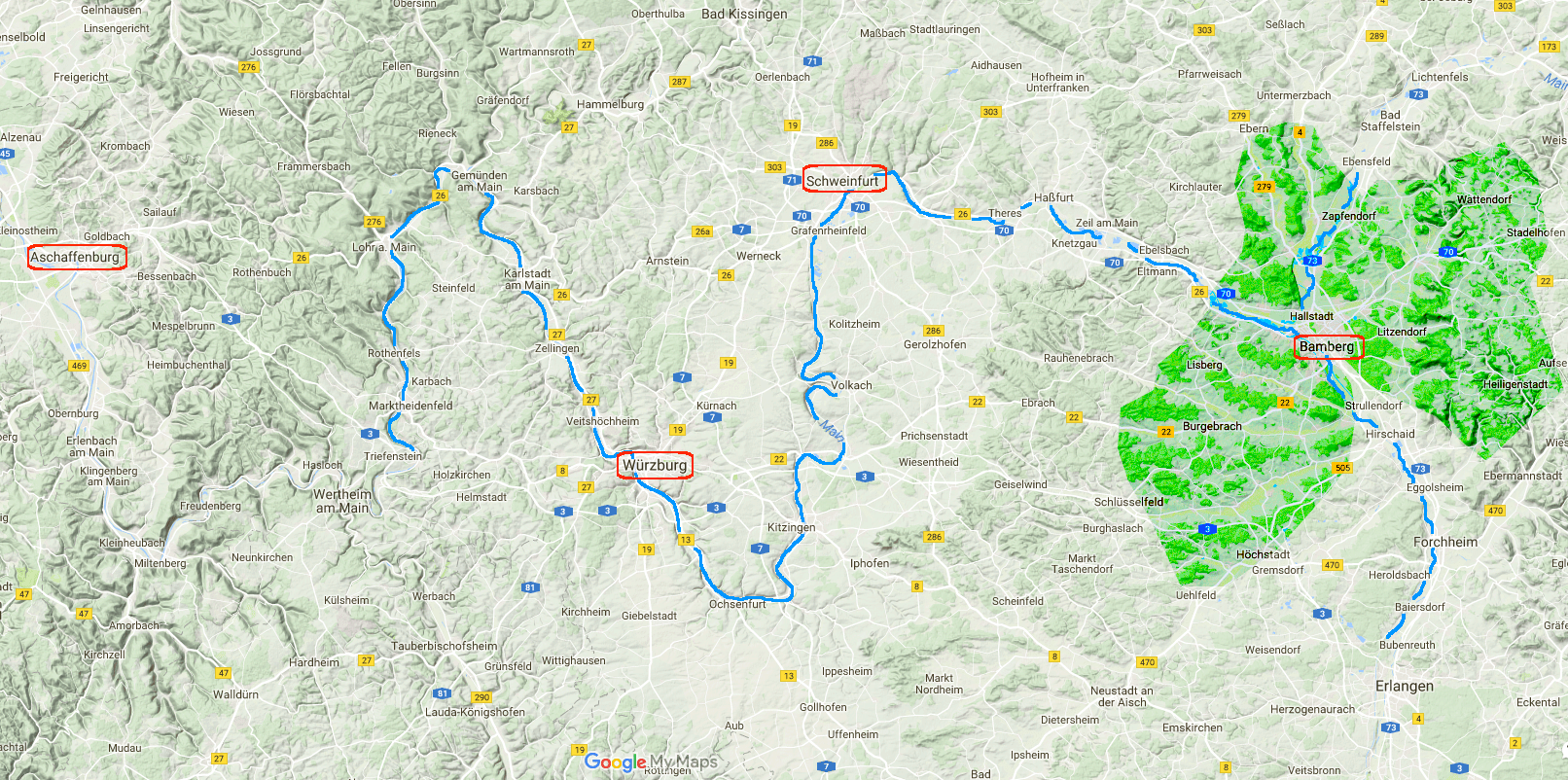
About the Main and Regnitz Wends we already wrote here.  About Würzburg we wrote here.  About Bamberg here.  About the River Jossa/Jassa in the vicinity of Aschaffenburg, here.  Here is a map showing these places in relation to Schweinfurt with the terra Slavorum in rough outline.

And here is another German map of Slavic place names – the roughly same highlighted area, this time in the western portion of the map.Make of it what you want but something tells us that at least some of the Slavs did not come from the East.

Interestingly, in 1990 halfway between Bamberg and Munich, in Kemathen – which these days is  a part of the town of Kipfenberg (Landkreis Eichstätt) there was discovered a Germanic warrior grave from about 420-450.  In it was found this belt (picture from Ludwig Wamser’s book). 

While the rosette is a common symbol, this type was particularly popular as a protection symbol in Polish houses.  Check these out from the Podhale region.

Starry Detour

Incidentally, if the rosettes above remind you of the asterisk symbol, you should know that an asterisk is derived from Greek for “little star”.  On the star of Jastarnia see here.  The interesting thing about stars is that Balto-Slavic languages have a very different word for them:

  • gwiazda (Polish)
  • żwai(g)zdē (Lithuanian)

Interestingly, in Prussian swaigstan meant “light” (Polish światło). Even more interestingly, stara in Slavic means “the old one” (female gender).  Whether this goes to something meaning “stars” or has more to do with old people lacking a certain flexibility (compare “to stare” or “stiff) is another matter.

Back to Our Stary, err… Story

Finally, it is also interesting that a lelek refers to a stork in parts of Poland (lelek is also a separate type of bird – the nightjar.  The more typical name for stork (nowadays German Storch) is bocian (compare that with Latin buteo and Germanic buse and busart (!)).

Copyright ©2017 jassa.org All Rights Reserved

May 27, 2017

Modelski & the Franks

Published Post author

You ask where is the rest of the Teofil Modelski’s article (parts 1 & 2 being here) on the Opusculum‘s Lechia?  (No translation… too much of a pain in the ass).

Well, here is part 3 of 5:

Here is part 4:

And finally part 5:

Copyright ©2017 jassa.org All Rights Reserved

May 12, 2017

The Legend of Walther and Wisuav

Published Post author

We have previously presented some of the legendary tales from the various chronicles of the Slavs.  These included the legends of:

Another legend is that of Walther of Tyniec (and Wisuav of Wislica) found in the Greater Poland Chronicle (also known as Boguphal’s Chronicle).

Tyniec is a former village about seven miles southwest of Cracow center (it’s now been incorporated into Cracow).

Tyniec Benedictine Abbey

Wislica is a town on the River Nida northeast of Cracow on the road to Sandomierz.

Wislica fort – courtesy of the local museum and of Google

This story bears a resemblance to the various Walther sagas of Western Europe.  In most Polish versions the protagonist is referred to as Walgierz.  The curious fact that this should have been Walcerz but may have been influenced by a reference in the Chronicle of Regino of Pruem speaking of a certain Walager we’ve already discussed here – where we also pointed out the identification of that Walager with Theodoric the Great.

That last one’s “adventures” became the adventures of  Didrik af Bern (Dietrich of Verona) and also happen to contain a bridal drama.  Curiously, the Dietrich von Bern saga contains references to Osantrix the king of the Wilzen (Wilzenkoenig) or Osantrix von Wilzenland which is clearly a reference to the Veleti.  The fact that we know from Ptolemy that: “Back from the Ocean, near the Venedicus bay, the Veltae dwell, above whom are the Ossi” makes these references all the more curious.

Another curious fact is that Thomas Nugent in his “The History of Vandalia” mentions no less than three Vandalic king by the name Wisislaus (an idea of uncertain provenance). This is the same name as Wisuav or Wislaw.

Some Slavs, some Germans

About some of the similarities between all these tales you can read in “Origin and Development of the Walther Saga” by Marion Dexter Learned PMLA Vol. 7, No. 1, The Saga of Walther of Aquitaine (1892), pp. 131-195 (published by the Modern Language Association).

Here is the tale – for ease of use we use the name spelling Walther and Wisuav.

The Legend of Walther and Wisuav
Or Of the Betrayal of the Town of Wislica

“In those days there was in the kingdom of the Lechites a very famous town, surrounded by tall walls, called Wislica.  Back then, in heathen times, its lord was Wisuav the Fair who was descended from the clan of King Pompilius [Popiel].  A certain lord, who also came from the same family, great in strength, by the name of Walther the Strong, who in Polish was called Walther the Comely and who held the town of Tyniec in the vicinity of Cracow where these days there is the abbey of Saint Benedict founded by Casimir the Monk [Kazimierz Mnich or Casimir the Restorer – Odnowiciel] the king of Poles, that is of Lechites, took him [that is Walther took Wisuav captive] in some campaign, threw him into prison and ordered that he be held under close guard in the depths of the Tyniec tower.”

Wisuav was in the one on the right

“This Walther had for his wife a certain noble lady, by the name of Helgunda, the betrothed of the son of a certain duke of the Alemans and who was also the daughter of the king of the Franks; whom, as they say, he secretly spirited away to Poland at great personal danger.”

“For when the son of that certain duke of the Alemans – in order to learn good manners – was being raised at the court of the Frankish king – the father of the aforesaid Helgunda – Walther, a man who was clever and crafty, seeing that the princess Helgunda returned the feelings of the son of the duke of Alemannia, on a certain night climbed the walls of the town, paid off the guard such that this one should not reveal him [or his name] and sang so loud and sweet that the princess awoke and hearing the sweet sound of his voice, came out of bed and, together with other maidens, forgetting about her nightly rest, she listened for as long as the singer intoned his melodious voice.”

Walther’s serenades were irresistible

“And when morning came, Helgunda ordered to bring in front of her the guard and urgently queried him who it had been [that gave the concert].  This one, did not dare to name Walther, assuring her that he knew not who the singer was.  But when the young Walther during the two subsequent nights, from a hidden place proceeded as before [to serenade], Helgunda unable to withstand this, with threats and intimidation tried to force the guard to reveal the singer[‘s name].  And because he nevertheless refused to do so, she ordered him put to death.  Thus, when the guard confessed that it had been Walther signing, she burning with hot love, succumbed completely to his [Walther’s] wishes, completely spurning the Aleman prince.”

Walther & Helgunda’s escape

“The Aleman prince seeing thus that Helgunda had foully rejected him and that in his place in the game of love she chose Walther, burning with great wrath at Walther returned to his father, and had all the crossings over the river Rhine be held and guarded such that no one should traverse it without paying a gold price for the ferrying across.  And when some time had passed, Walther and Helgunda see an opportunity to flee and escape upon the long-awaited day.  But when, in accordance with their plans, they arrive at the Rhine shore, the boat masters demand a golden price for the crossing but receiving it, they refuse the crossing until the Aleman prince should arrive.  Seeing that the delay brings danger, [Walther] gets on a mighty horse, orders Helgunda to sit behind him and spurring the horse into the river, crosses it faster than an arrow.  And when he had left Rhine somewhat behind, he hears behind him the pursuing Aleman’s voice: ‘Foul traitor!  So, you have skulked away with the king’s daughter and crossed the Rhine without paying the duties!  Halt now and stand so that I can duel you – and he that should triumph shall keep the horse, the arms and too Helgunda.'”

“Walther, fearlessly answers as follows: ‘Tis a lie, what you say, for I have given the boatmen their gold and the princess i did not take by force but made her my companion for she willingly wanted to come with me.’  And after these words they boldly strike each other with spears.  And when these shatter, they fight with swords testing their manly prowess.  The Aleman seeing Helgunda stand in front of him, aroused by her glances, forced Walther backwards until, that is,  this one retreating cast his eyes on Helgunda.”

The Aleman proved more of an annoyance than any serious challenge to Walther

“And seeing her he halted, filled both with the greatest shame as well as with limitless love for her.  Regaining his strength he boldly charged at the Aleman and immediately killed him.  Then, taking his horse and arms, he set out home to his fatherland, twice honoured by the happy and  praiseworthy victory [that is, the winning of Helgunda and the defeat of the prince of the Alemani].  Arriving at the town of Tyniec after successfully navigating many adventures in his travels, he spent some time in rest so as to regain his strength.”

“It was there that he learned from the complaints of his people that Wisuav the Fair the duke of Wislica during his [Walther’s] absence caused them certain wrongs.  Having become aware of these, with great regret he challenges Wisuav to avenge them [the wrongs] and eventually he fights him, wins and then, as already, he puts him in chains to be guarded in the dungeon of the Tyniec Castle tower.”

“After some time has passed, he crosses far away lands on military campaigns as is the knightly custom.  And when two years have passed of his absence, Helgunda greatly disturbed by her husband’s absence, felt forced to confide in a certain girl, her confidante, announcing with a downcast face that they are ‘neither wives nor widows’; and by that she meant those [women] who are bound in matrimony with men of an entrepreneurial spirit who seek opportunities for military skirmishes. And her confidante, trying to ease her lady’s miserable wretchedness which she endured so long a time, immediately set aside the shame which comes with betrayal, states that Wisuav, the duke of Wislica [and a man] of a refined appearance and a comely body, beautiful to the eye, sits imprisoned in the tower.”

Usually Helgunda was not so easily impressed but this time was a little different

“And the wretch urges her [Helgunda] to order him removed from the tower during the silence of the night and having satiated herself with the much coveted embraces then to send him back carefully to the tower dungeon.  This one [Helgunda] applauds her confidante’s persuasions, and though frightened of the perilous consequences nevertheless not fearing to wager her life and good name, orders that Wisuav be brought out of the depths of the prison; and upon seeing him she delights in his beauty, filled with great admiration.  And she did not order that he be sent back to the prison dungeon but rather she chose entirely to leave the bed of her own husband and to flee to the town of Wislica with that one with whom she had bonded in friendship and united in an inseparable knot of love. In this manner Wisuav returns to his own town thinking that he had achieved a double victory – though this [victory] in the course of dangerous events was to bring both of them a deadly end.”

“After a short time the returning Walther is asked by his townspeople why is it that, in this moment of [his] joyful return, does Helgunda not rush to his side at the very least to the castle gates.  [It is] from them that he learns how Wisuav, trusting in the help of the guards, carried Helgunda with him.  Himself imbued with terrible wrath, he immediately hurries to Wislica and without fear for himself or his fate in unexpected adventures, he suddenly enters the town of Wislica at a time when Wisuav outside the town was busy on a hunt.”

“Helgunda seeing him in the city rushes quickly towards him and falling face down in front of him she complains that Wisuav kidnapped her by force.  She urges Walther to enter an out of the way part of the dwelling promising that if he so desires, she will forthwith bring Wisuav there so that he [Walther] should seize him.  Trusting this fraudster and ensnared by the deceptive persuasions he enters a fortified chamber, where, due to trickster’s efforts, he falls into Wisuav’s hands.  Joyful are Wisuav and Helgunda, happily applauding this auspicious result which now for the third time brought fortune; they do not ponder how this happiness may come to an end though ones such as these often do happen to be taken by a sad death.  He [Wisuav] did not wish to keep him [Walther] under prison guard but rather he wanted to oppress him with something worse than prison muck.  Instead, he ordered to have him bound in irons to the dining hall’s wall, with arms outstretched, with his neck and feet completely straight.  To the same hall he ordered be brought a bed in which during summer time he and Helgunda would lie devoting themselves to love’s pleasures.”

Walther’s anguish knew no limit

“[But] Wisuav had a sister of his own blood whom no one wanted to take as wife by reason of her ugly looks.  Her watchfulness did Wisuav trust more than that of Walther’s other guards.  But this one greatly sympathizing with Walther’s sufferings, [and] entirely casting aside a maiden’s timidity, asks whether Walther would have her as his wife should she come to his aid in his misfortune by freeing him from his chains.  He solemnly swears and confirms the same with a promise that so long as he should live, he will give her marital love and will not fight with his sword against her brother Wisuav, as per her wishes; and asks her to take his sword from her brother’s bedchamber and to bring it here forth so as to cut away his fetters with it.  [And] she, bringing the sword, then in accordance with Walther’s command cut away the peg at the very end on each of the iron cuffs and the sword she placed between Walther’s back and the wall so that he could remove himself at an opportune moment.  And he waits till noontime of the next day.”

Wisuav’s sister with friends

“And when Wisuav with Helgunda reveled in their embraces in the dining hall bed, Walther, uncustomary, speaks to them with these words: ‘How would you feel, should you gaze upon me in front of your bed, freed from my binds, holding my melodious sword in my hands and threatening to take revenge for [your] crimes?’  At his words, Helgunda’s heart stopped and shivering she spoke to Wisuav: ‘Oh woe my lord!  I had not seen your sword in the bedroom but engrossed by your kisses I forgot to mention this to you.’  At this Wisuav replied: ‘Even had he ten swords to aid him, without the adroitness of smiths he would not be able to rip apart his irons.’  When they so spoke with one another, they note that Walther, free of his chains, jumps forth and brandishing his sword stands by their bed; and soon tossing curses at them, raises his sword hand high and drops WIsuav’s own sword onto them both; this falling cuts both in the middle.  And so each of them ended their miserable life in an even more miserable manner.  And this Helgunda’s tomb, forged in a rock is to this day shown in Wislica town to all those who wish to see it.”

Copyright ©2017 jassa.org All Rights Reserved

May 9, 2017

On the Errors of the Franks

Published Post author

A reader asked a question about the so-called Opusculum contra Francos: is it true that the word Lechia appears there (meaning Poland) and is true that this is dated to the ninth century?  Or, as someone told him, was this really written in 1101?

Ok… so the answer is “no one really knows”.  Satisfied?

Well, there is one thing that is probably not true.  It’s very unlikely that we can pinpoint the Opusculum to 1101 (any such precising dating should be immediately suspect).

But let’s start at the beginning…

The Opusculum is a Byzantine polemic against the version of Christianity practiced by the Roman Latin Church that is, the “Franks” (since the Franks had by then taken over what was left of the Latins and the Popes were anointing Frankish emperors).  It is one of a number of such works and similar works also exist on the Catholic side directed against the Byzantines, of course.

Photius enjoying some morning foot kissing

The Opusculum has traditionally been ascribed to Photius and, if you believe that, then it is a work of Photius.  If you do not, then it is a work of Pseudo-Photius (meaning “we don’t know who wrote it but it wasn’t Photius but may as well refer to Photius since people think he wrote it”).

Photius or Phōtios or Φώτιος (circa 810 – circa 893) was the Patriarch of Constantinople (who had a hand in a schism now called by his own name (!) the “Photian Schism” of 863-867.

Apparently, the Opusculum was translated from Greek to Latin by Hugo Etherianus in 1178 and again in 1252 by the Dominican Bartholomew of Constantinople, who appended it to his Tractatus contra Graecos.  Presumably, the Latins needed to know what the Greeks’ arguments were in order to counter them effectively (the level of the polemic in the document itself is rather low with bitching about dress and hairstyle mascara ding as theological arguments).

In any event, this means that the Opusculum was written before 1178.

The “recent fame” of the Opusculum is due to Zachariae‘s edition of 1839 and then to Joseph Cardinal Hergenröther (1824 – 1890), Cardinal-Prefect of the Vatican Archives who was also, in addition to being an archivist, a church historian and canonist.  Hergenröther was interested in the Schism with the Byzantine Church and in the role played in that by Photius.  In addition to a number of articles he published the following on Photius:

  • Photii Constantinopolitani Liber de Spiritus Sancti mystagogia (Regensburg (Ratisbonae), 1857)
  • Photius Patriarch von Constantinopel, sein Leben, seine Schriften, und das griechische Schisma (3 volumes, Regensburg, 1867-69)
  • Monumenta Græca ad Photium ejusque historiam pertinentia (Regensburg, 1869)

His work was also instrumental in helping Migne put together his version of Photius (P.G., CI-CIV) (1860).

So here is the Hergenröther version of the Opusculum from his Monumenta Græca ad Photium ejusque historian pertinentia:

As can be seen, Lechia does appear in argument 24 (dealing with how long one ought to fast – in the East they do better than in the West, etc.).  What this actually says is:

“The forty day fast is undertaken in their countries and among the surrounding peoples unevenly: thus, Lechia fasts for nine weeks and among the others, some fast for eight and some for more whereas others fewer [weeks].  The Italians only six.”

(presumably their dolce vita puts limits on their piety)

Note also the mention of the Venetians/Veneti/Slavs? at the beginning of the Opusculumgermanikoi, molphinoi, benetikoi

In volume 3 of Photius Patriarch von Constantinopel Hergenröther discusses the Opusculum and concludes that it is not a work of Photius because (among other reasons) Lechia must mean Poland and Poland was not Christianized until the second half of the tenth century so people in Poles can’t possibly have kept a Christian fast in the ninth century.  Of course, we can’t use the same logic if the question on the table is instead when did Poland begin to be called Lechia without running into circular reasoning problems.

But we can say that Hergenröther’s logic is based on two crucial assumptions, of course:

  • that Lechia must refer to Poland (likely but not entirely certain) or, for that matter, to all of Poland (that is very unclear), and
  • that a country is either Christian or it is not (this is doubtful and, as we know from the “Life of Methodius” that the Byzantine Christians (Photius’ buddy Methodius) were already threatening conversion of the “duke in Visla” just as the Franks were threatening Slavic lands to the West).

Following Hergenröther a pamphlet was issued on the work by the Czech priest František Snopek (1853-1921) in 1908 and then a more extensive article was written by Teofil Modelski (1881-1967) under the title of “Pseudo-Photius’ Lechia” (Lechia Pseudo-Focyusza)  in 1914.

parts 1 & 2 (of 5)

You can read all the arguments in those works (no, we won’t translate it all – too much work).  In the end, no one really knows.  It’s certainly possible that Lechia had been used in the ninth century.  But even if not, the use of the term (assuming it refers to Poland) is still one of the earliest uses of the term for Poland (predating Kadlubek).

The one thing that can be said is that the Opusculum probably started out in Photius’ “intellectual circle” – perhaps with Photius himself – and that it was likely not written in 1101.  1101 is an error by someone who misread the number to mean a year – instead it is the number of one of the manuscripts housing the Opusculum – Vat. gr. 1101.

First page of the Opusculum from Vat. gr. 1101 (note Benetikoi three lines down from the “1”)

Note that Hergenröther himself dated the Opusculum to somewhere in 1054-1100.

As regards the word lach the best idea on this that we’ve seen was Piotr Czarkowski’s and later Jan Karłowicz’s who said it just  means a “large forest” (and so it more apt than pole meaning “field” since Poland was covered by forests back in the 10th century.  For other examples of s > ch (or vice versa?):

  • piasek > piach
  • las(ek) > lach
  • pas(ek) > pach
  • laska > lacha

Copyright ©2017 jassa.org All Rights Reserved

May 1, 2017

The Slavs of Wipo’s Deeds of Conrad II

Published Post author

We present here the full Slavic contingent from Wipo’s The Deeds of Conrad II (Gesta Chuonradi II imperatoris).  We previously featured one little component of that work but here is the full account in Karl Morrison’s translation.

Wipo of Burgundy (also Wippo circa 995 – circa 1048) was Conrad’s chaplain and served also his son Henry III so he was intimately familiar with the goings on at court.  Although he is obviously biased towards his masters, his sycophancy does not prevent him from delivering a number of interesting facts.

I. On the Assembly of Princes

“In the year 1024 from the incarnation of the Lord, the Emperor Henry II, although of sound mind, was taken with an infirmity of the body, which prevailing, he departed this life the 3rd of the Ides July [July 13]… [lists the various eminent members of the Empire]  These were the dukes, on the other hand, contemporaries of the wove-mentioned men: … Udalric, duke of Bohemia…”

II. On the Election of the King

“…While all the magnates, and, so to say, the valor and the vitals of the kingdom, had convened there, they pitched camps on this side and in the region about the Rhine.  As it [the Rhine] separated Gaul from Germany the Saxons, with their neighbors, the Slavs, the eastern Franks, the Bavarians, and the Alamanni, convened from the German side; and from Gaul, the Franks who live above the Rhine, the Ribuarians, and the Lotharingians were joined together.

IX. Of Boleslaus, Duke of the Slavs

In the same year [1025] which I have mentioned above, Boleslaus Sclavigen [of the Slavic nation], duke of the Poles, took for himself in injury to King Conrad the regal insignia and the royal name.  Death swiftly killed his temerity.”

“But his son Misico, similarly rebellious, cast his own brother Otto out into the province of Russia because he favored the partisans of the King [Conrad].  I shall tell in its proper place how King Conrad afterwards curbed the impudence of this Misico and the perfidy of a certain Udalric, duke of Bohemia.”

XXI.  That the King of Burgundy Came to meet the Emperor at Basel

“…Shortly after, Adalbero, duke of the [H]istrians or Carinthians, convicted of less majesty, was exiled  with his sons by the Emperor, and that Cuono just mentioned received from the Emperor his dukedom, which the father of this very Cuono is said to have had once.  So Duke Cuono, as long as he lived, remained faithful and one who strove well for the Emperor and also for his son, King Henry.”

XXIX.  Rudolf, King of Burgundy, Died, and Odo Invaded His Realm

“In the year of the Lord 1032, Rudolf, king of Burgundy, the uncle of the Empress Gisela, died in peace.  Count Odo Francigen, son of his sister, invaded his realm, and took certain very well-armed castles or cities by craft or battle.  Neither did he dare to make himself king nor, indeed, did he wish to lose the kingdom.  Some persons related that he had often said that he never wished to be king, yet always to be the master [magister] of a king.  In this fashion he drew away [for himself] a great part of Burgundy, although King Rudolf had already confirmed, not long ago, through a solemn oath that the kingdom of Burgundy should go to Emperor Conrad and his son, King Henry, after his death.  But while Count Odo did these things in Burgundy, Emperor Conrad was in Sclavonia with his troops.*  What he did there and how he afterwards repelled Odo from Burgundy, I shall tell in the following [passages].”

* note: In his expedition against Misico (Mesko), which was begun in 1031 and concluded with a treaty at Merseburg in 1032. [notes are Morrison’s]

“When the aforementioned Boleslaus, duke of the Poles, died, he left two sons, Misico and Otto.  Misico persecuted his brother Otto and expelled him into Russia.  While Otto lived there for some time in a miserable condition, he began to ask the favor of Emperor Conrad, in order that through his intercession and assistance he might be restored to his fatherland.  Since the Emperor was willing to do this, he decided that he himself would attack Misico with troops on one side and Otto on the other.  Since Misico was unable to withstand this attack, he fled into Bohemia to Duke Udalric, against whom at that title the Emperor was enraged.  But Udalric was willing, in order to please the Emperor, to give Misico up to him.  Caesar renounced this dishonorable pact, saying that he did not wish to buy an emery from an enemy.  Otto was restored to his fatherland and made duke by Caesar; but since, after some time, he acted wit too little caution, he was slain secretly by one of his household.**  Then Misico sought in every way the favor of the Empress Gisela, and of the othe princes, that he might be found worthy to return to the favor of the Emperor.  Caesar, moved by compassion, granted him pardon; and after the province of the Poles had been divided into three parts, he made Misico tetrarch and commended the remaining two parts to two other men.  So, with his power diminished, his temerity was reduced.  After the death of Misico,*** Casimir, his son, has served our emperors faithfully until this very time.****”

** note: 1032
*** note: 1034
**** note: From 1042 his relations with Henry II worsened, and in 1050 Henry readied an expedition against him.  The expedition was canceled however by Casimir’s voluntary submission.

XXXIII.  That King Henry Subjected the Slavs

“In the meantime, while the Emperor was doing those things in Burgundy which have been recounted above, his son, King Henry, although still in the years of boyhood, attended no less energetically the affairs of the commonwealth in Bohemia and in the other regions of the Slavs, where he vigorously subjugated Udalric, duke of Bohemia, as well as many other opponents of Caesar.  When his father returned, he met him, and thus he gave to the peoples double joy because of the double victory.”

“Then, when troops had been collected from Saxony, the Emperor came upon those who are called Liutizi and who, once semi-Christian, now are wholly pagan through the wickedness of apostasy; and there he brought to an end an implacable conflict in an astounding fashion.  For there were at that time many quarrels and border raids between the Saxons and the pagans.  And when Caesar came, he began to to inure by which side the peace, which had lon bgeen inviolate between them, had been destroyed first.  The pagans said that t peace was disturbed first by the Saxons and that this would be proven through a duel, if Caesar so commanded.  The Saxons, on the other hand, although they contended unjustly, similarly pledged before the Emperor their willingness to engage in single combat to refute the pagans.  The Emperor, even though he took the counsel of his princes, did not act cautiously enough and permitted this matter to be adjudged by a duel between them.  At once two fighters met, each elected by his own men.  The Christian began to fight boldly, confiding in that faith alone which, however, is dead without works of righteousness, and not diligently heeding the fact that God, who is Truth, disposes everything in true judgment, He who makes His sun to rise over good and evil, who causes rain to fall on the just and the unjust.  The pagan, however, put up a staunch resistance, having before his eyes only the consciousness of the truth for which he fought.  Finally, the Christian fell, wounded by the pagan.  Because of this outcome, the pagans became so greatly elated and bold that, if the Emperor had not been present, they would have thrown themselves upon the Christians straightaway.  But, in order to curb their incursions, the Emperor constructed the castle of Werben in which he stationed garrisons of knight,s and he constrained the princes of Saxony by solemn oath and imperial order to resist the pagans of one accord.  Then he returned to Franconia.”

“But in the following year, the same castle was taken by the pagans through craft, and many of our men who were in it were killed by them.  Disturbed by this, the Emperor again came with troops to the Elbe River.  But since the pagans prevented the crossing, the Emperor sent part of the army across under cover through another ford of the river.  When the enemies had been set to flight in that way, Emperor Conrad entered the region by the now-free bank of the river and laid them so low with immense devastations and burnings everywhere except in impregnable places that afterwards they paid to him the tax which had been imposed by emperors of old and which was now increased.”

“For both before and at that time, Emperor Conrad toiled greatly amidst the nation of the Slavs. Because of this, one of us composed a short account in verse which afterwards he presented tot he Emperor.  There one may read how the Emperor sometimes stood in h marshes up to the thighs, fighting in person and exhorting the soldiers to fight; and how, after the pagans had been conquered, he slew them with the greater ferocity because of a certain reprehensible superstition of their.  For it is said that at some time the pagans kept a wooden effigy of our crucified Lord Jesus Christ in shameful mockery and spat upon it and struck it with blows; finally they tore out the eyes and cut off the hands and feet.  To avenge these deeds, the Emperor in a similar manner mutilated a great multitude of captured pagans for one effigy of Christ and destroyed them with various deaths.  Therefore Caesar is called an avenger of the Faith in these verses and is compared with the Roman princes Titus and Vespasian, who in avenging the Lord had exchanged thirty Jews for one coin since the Jews sold Christ for that many denarii.”

“After his return the Emperor imperiously cast aside whatever resistance he found in the kingdom.  In the same year, Adalbero, duke of the Carinthians lost the favor of the Emperor and was deprived dog his dukedom and sent into exile.”

40. Verses on the Death of the Emperor Conrad

[after telling how Conrad subdued the Saxons, Alemanni, Bavarians, Rome, Ravenna and Verona  (Pavia?) he comes to the Slavs]

“…The Emperor never tarried, everywhere the giver of peace.
He carried war to the pagans lest they harm Christians:
The marsh did not defend them, nor was there safety in the waters;
Well he made the barbarian Slavs and all peoples depraved feel his force.
O King God, guard the living and have mercy upon the dead.”

Copyright ©2017 jassa.org All Rights Reserved

March 31, 2017

Thietmar (Book V)

Published Post author

We presented the Slavs and Slavic place names in the first four books of Thietmar’s Chronicle here.  We now continue with Book V (translation is David Warner’s).

Chapter 7 [year 1002]

“…The course of Ekkehard’s life loas so worthy that his lord allowed him to hold the greater part of his benefice as personal property.  He forced the free-born Milzeni under the yoke of servitude.  With flattery and threats, he won Duke Boleslav [III] of Bohemia, called the ‘Red”, for  his military service and turned the other Boleslav [Chrobry of Poland] into a personal ally.  He acquired the office of duke over all of Thuringia by the election of the whole populace.  With only a few exceptions, he reckoned on the support of the eastern counts and therefore of the duchy.  All of this came to such a miserable end.”

Chapter 9 [1002]

“Meanwhile, Boleslav [Chrobry of Poland] , a son far inferior to his father Miesco, rejoiced over the death of Margrave Ekkehard.  Shortly after this, he assembled an army and seized Margrave Gero’s march as far as the river Elbe.  Then, with siege troops sent ahead, he captured the burg Bautzen [Budisin], with all its possessions,and immediately thereafter attacked Strehla.  Secretly, he also tried to bribe the residents of Meissen who were always happy for something new.  One day, when they realized that most of the garrison had left to find fodder for the horses, Duke Gunzelin of Kuchenburg led them in an assault on the east door, in that part of the city inhabited by ministeriales known in Slavic as Withasen [witeź].”

“After killing Bezeko, one of Count Herman’s ministeriales, they took up arms and met at the count’s chamber where they threw large rocks at the window and loudly demanded that Ozer, the lord of the city, be handed over to them for execution.  But the miles Thietmar, having no other protection that the room itself, asked them: ‘Why are you doing this?  What madness so seduced you that, forgetful of the benefits bestowed by Margrave Ekkehard and your willing invitation, you rise up to destroy his son?  If you wish to reveal the reason for such an outrage, either publicly or secretly to one of us, on behalf of my lords and all of us, I firmly promise you an agreeable settlement of the offence and security regarding your future concerns.  As for the man you seek to have handed over, namely so that he can be killed, you will not received him as long as we are living.  We are few and you should know for certain that we will either die together or leave this city unharmed.’  After they had heard this and consulted among themselves, the attackers granted the garrison freedom to leave.  Then, they sent messengers to summon Duke Boleslav and received him with open doors.  Hence, the words of the scriptures were fulfilled: ‘They may rejoice when they act wickedly, and exult in evil things and again.  Their beginnings are as honey and their end as absinthe.'”

Chapter 10 [1002]

“Elated by this success, Boleslav occupied the entire region up to the Elster and secured it with a garrison.  Then, when our people gathered together to resist him, that deceitful man sent a messenger who announced to them that these things had been done with the favour and permission of Duke Henry.  He added that Boleslav would in no way injure the inhabitants and, if Henry came to power in the realm, he would assen  to his will in all things, but if otherwise, he would willingly do whatever pleased them,.  Considering this, our people believed the beautiful words and shamefully advanced to him as if to their lord, thereby exchanging their inborn honour for supplication and unjust servitude.  Hoe unequally are our ancestors and our contemporaries compared!  In the days of the illustrious Hodo, this man’s father Miesco, would not have dared to wear furs when entering a house in which he knew him to be or to sit while he was standing.  May God forgive the emperor for making a lord out of a tributary and raising him to the point that, forgetful of his father’s customs, he might dare to gradually drag his superiors into subjection and seize those caught with the shameful hook of temporal wealth to the detriment of both slaves and free.”

Chapter 11 [1002]

“Also the other Boleslav [III], the Bohemian ruler nicknamed ‘the Red’ and generally a source of the worst impiety, departed from his usual custom and supported Duke Henry…”

Chapter 15 [1002]

“From there [Thuringia], Henry went to Merseburg where he was received by Abbot Heimo and by his faithful count Esiko [24 July].  Esiko had manfully held this city along with Allstedt, Dornburg and all their possessions until his lord arrived, though this had greatly angered Ekkehard while he lived.  Here also were Archbishop Liawizo of Bremen and Giselher of Magdeburg with other colleagues: Rethar of Paderborn, Bernward of Hildesheim, Arnulf of Halberstadt, Ramward of Minden, Eid of Meissen, Bernhar of Verden, Hugh [II] of Zeitz.  Also present were dukes Bernhard and Boleslav with the margraves Liuthar and Gero and the count palatine Frederick.  Many others were also there, both bishops and counts, but it would take too long to give their names individually.  All of these received the king with humble devotion.

Chapter 18 [1002]

Except for Liudger, everyone who had served the previous emperor offered his hand to the king and swore to aid him faithfully.  Meanwhile, Boleslav schemed to acquire the burg Meissen at whatever cost.  Because it was not advantageous to the realm, he got nowhere with the king and only barely succeeded in securing it for his brother-in-law Gunzelin.  He himself received the regions of Lausitz and the Milzeni.  Margrave Henry, my cousin, held Boleslav in great esteem and aided him freely and amicably in whatever way he could.  As he prepared to escort Boleslav, departing well rewarded and with the king’s permission, he saw an armed multitude gathering and moving to attack them.  May God be my witness, this was without the involvement or knowledge of the king!  When he wanted to discover the cause of this great tumult, and resolve it so that more damage might not arise, he was barely able to get away and lead his companion out by breaking the exterior door.  Out of his entourage, some warriors were plundered by the surging mob while others though severely wounded escaped death with the help of Duke Bernhard.  Because they had entered the royal court armed and refused to leave when ordered, the penalty they paid was justified by their own offense.  Boleslav saw this as part of an evil plot and, deeply disturbed, blamed the king although unjustly.  After bidding farewell to Henry and firmly promising his aid, should it ever be required, he quickly returned to his own lands.  When he arrived at the city of Strehla, he immediately set fire to it and abducted a large part of the populace. At the same time, he sent back representatives through whom he tried to attract as many of the king’s supporters as possible.  Soon afterwards, when this came to the king’s ears, he asked his dependents to inquire about the secret plots of the Slav and, if possible, to capture his spies.”

Chapter 23 [1002]

Meanwhile, because the power of a consort and successor always inspires fear, the duke of the Bohemians, Boleslav [III], castrated his brother Jaromir and wanted to suffocate the younger brother in his bath.  Then he sent both brothers and their mother into exile.  Then, ruling alone like the noxious basilisk, he oppressed the people unspeakably.  When they could no longer bear the weight of this outrage, they secretly called Wlodowej [Duke of Bohemia 1002 – 1003] from Poland, whose name means power of the army.  He was a poisonous snake who treated his people without any respect for the law.  After Boleslav the basilisk had been deposed, this one was unanimously elected in his place because of his consanguinity and because of the people’s affection.  I can say one thing about him that is incredible and not to be copied by any Christian, namely that he could not endure even one hour without drink.  As this was the only path of escape open to him, Boleslav fled to Margrave Henry, then his neighbor, who seized him as an enemy because of past injuries.  Afterwards, because he had arrived as a guest, he was set free and, being fond of his life, he went to the like-named son of his aunt who was his equal in shamefulness though unequal in ability.  Inclined to better advice, the other one went to the king, then residing oat Regensburg, and recognized him as his lord with humble subjection and the promise of loyalty.  He received what he sought from him as a benefice and, after being treated warmly in all matters, returned in peace.

Chapter 24 [1002]

“…In the expectation of receiving the abundant support promised by the Italians, the king sent Duke Otto of Carinthia and Verona, Otto the son of Count Heribert, Ernst the son of Margrave Leopold, and a few others to resolve the situation [December 1002 to beginning of January 1003].

Chapter 29 [1003]

Meanwhile Duke Wlodowej died and the brothers who had been expelled along with their mother were recalled by the repentant Bohemians.  But Boleslav, the ruler of the Poles, collected an army and expelled them again.  He then restored his exiled namesake to his previous dignity and went home, with his plots deeply concealed.  He knew that his cousin would be too vindictive towards those who had supported his expulsion and hoped that at a more auspicious moment he might himself intervene.  And so it actually happened.  When Boleslav [III] of Bohemia perceived that his people dedicated themselves to paganism in all security, his own impiety was fortified for breaking the peace treaty which he had confirmed by oath.  Thus, when all the great men had been assembled before him in one house, he himself killed his brother in law by striking him in the head with a sword and then, with his evil supporters, this bloody and deceitful man who was unworthy of half the days conceded to him, killed the others although they were unarmed and it was the holy season of Lent.

Chapter 30 [1003]

The rest of the people, in great fear because of this, secretly sent representatives to Boleslav of Poland who revealed the magnitude of the shameful deed and asked him to rescue them from fear of the future.  He heard these things with pleasure and immediately asked the other Boleslav, through a faithful representative, to come to him at a certain citadel for a personal discussion regarding matters of mutual interest.  The younger Boleslav agreed to this, came to the agreed-upon place, and was affectionately received by him.  The following night he was blinded by the other’s henchmen thereby ensuring that hew would never treat his people in that manner again or even be able to rule there.  He was also sent into a long exile.  On the following day, the elder Boleslav travelled quickly to Prague where he was introduced and unanimously acclaimed as lord by the inhabitants who were always happy to have a new ruler.  As his world power increased, his willfulness became much greater than is normal in a restrained mind.  Note this well, dear reader: he who becomes too proud in prosperity will often be brought lower in adversity.  It is affirmed by scripture that a wise man does not do this.”

Chapter 31 [1003]

“The king learned all of these things from hearsay, and accepted them with the due seriousness of a patient mind.  At least, he imputed to his sins whatever misfortune occurred in the kingdom in his time.  Therefore, as seemed most opportune to him, he ignored everything that had happened to the Bohemians, and sent representatives to Boleslav with the following demand: if he wished to retain the land he had recently occupied, by the king’s grace, as the ancient law requires, and serve him in all things faithfully, the king would agree to his requests.  If otherwise, he would oppose him with arms.  Boleslav received this legation unworthily, though it was just and well composed, and therefore deservedly brought revenge on himself in the future.  When the Lenten fast was finished, as I have mentioned, the king followed the custom of his predecessors by celebrating Easter, in an appropriate manner, at Quedlinburg [28 March].  There, as befits such a great feast, he ignored both Boleslav‘s evil presumption and Henry’s ambitions and enjoyed the company of his familiars.  On the same occasion, the king bestowed royal gifts on Dukes Otto and Ernst, recently returned after their disastrous defeat, and consoled them with fatherly encouragement.  He also received representatives of the Redarii and the people known as the Liutizi and, claiming these rebels with the sweetness of gifts and the joy of promises, turned them from enemies into friends.”*

* Warner’s note: this refers to “Henry II’s controversial decision to form an alliance against Boleslav Chrobry with the pagan confederation of the Liutizi.”

Chapter 32 [1003]

“After this, the king celebrated the Rogation days, which should be observed by all the faithful of Christ, at Merseburg [3-5 May].  There he learned of the open rebellion of Duke Boleslav and Margrave Henry.  Then he celebrated the feast of Pentecost at Halberstadt [16 May].  After this, he travelled to Bavaria where he initially tried to defeat Henry, who was offering resistance with the help of Boleslav but afterwards concentrated on quashing conspiracies instigated elsewhere.  In this regard, he learned that Ernst whom he had recently honoured and Bruno [Henry II’s brother, later the bishop of Augsburg] , his own brother, had also joined the conspiracy.  They were heedless of what has been written: ‘Virtue lacking council fails of its own weight.’  To restrain their arrogance, the king gathered his supporters from all sides and, at the beginning of August, wasted the lands of Margrave Henry, thereby forcing him to abandon his residence and hide wherever he could.  Anyone aware of the cause of the margrave’s stubbornness would say that his actions were necessary: the higher powers may not withdraw something firmly promised to a faithful servant without alienating the devotion of others,  Tho those, I respond, every dominion in this world derives from God and whoever rises against it offends the divine majesty.  One must weather the sudden burst of injustice with the rudder of patience and, with humble supplication await a consolation which will be truly useful.  I think it better to ascend the heights gradually rather than incur a sudden and insurmountable ruin.  I admit that I would defend my cousin in some other way, if I did not fear to violate that truth which must be honoured by all faithful people.”

Chapter 33 [1003]

“In many ways, the proverbs of the ancients have been confirmed: the old crimes of humankind bring forth new acts of evil and shame.  For Margrave Henry’s father had often opposed the father of the king, as if an enemy rather than one of his milites, and himself admitted that he had supported the emperor’s side because of a boon promised under oath.  In similar fashion, Margrave Henry had been faithful to Otto III until the latter’s death and serve King Henry strenuously up to this unhappy time.  The king was still intensely aware of their fathers’ rivalry, but I believe that the love of Christ would have moved him to let it go entirely unpunished, if only he had not seen Margrave Henry in the company of his other enemies, opposing him so cruelly and openly.  Although Margrave Henry alone might appear guilty in this crime, it was not undertaken without the advice of others from the very beginning.  Because betrayal is deemed particularly shameful in this world, however, he preferred to pursue the matter, with his conscience groaning, rather than increase his own blame by endangering others.  Thus, he who once zealously defended the realm from the enemy now opened it to pillaging.  He secretly received aid from Boleslav though it did him no good.”

Chapter 34 [1003]

“When the king was traveling to a place called Hersbuck, the royal treasure, having been sent ahead, was seized by the margrave’s miles Maganus and his band.  Dividing the booty among themselves, they returned happily to the burg at Ammerthal.  The king followed and, after preparing for a siege, forced them to ask only for their lives., through intercessors, and to return both the burg and booty.  Then, after the burg had been virtually destroyed and the many Poles divided among his men, he set forth for the castle at Creussen where Margrave Henry’s brother, Bukko, was supposed to be guarding the Margrave’s wife, Gerberga, and his children.  From outside, Margrave Henry and his supporters fought the army which had surrounded the burg on all sides…”

Chapter 36 [1003]

“Meanwhile, as the king was besieging Margrave Henry’s burg at Creussen, Boleslav was straining with every effort to injure him in some way.  Secretly collecting an army, he sent representatives to demand that his brother-in-law, Gunzelin, surrender the burg of Meissen into his power and renew their old alliance as he had promised.  Gunzelin knew, however, that with Boleslav’s entry he would virtually be excluded from the king’s favour and from his own domain.  Thus, he offered the following response: ‘Everything you ask from me other than this, dear brother-in-law, I will freely provide and, if ever the opportunity arises for doing what you ask, I will not refuse.  But my lords retainers are with me and they would not suffer such things [senioris mei satellites(!)].  And, if this were revealed, my life and all that I possess would be endangered.’  When Boleslav heard this message, he put the messengers under guard and ordered his army to hasten to the Elbe.  He hollowed them, the next morning, after the character of the fords had been determined.  At the burg Strehla, because it was his daughter’s morning gift, he declared that the occupants had nothing to fear from him but that they should not try to warn their neighbors by crying out.  Without delay, the duke ordered the army to divide into four parts and reconvene in the evening at the burg Zehren.  Two detachments were sent ahead to ensure that they would not be troubled by the margrave.  In one day, the whole fertile region of Lommatzsch was ravaged with fuire and sword and had its inhabitants abducted.”

Chapter 37 [1003]

“Here, it might be recalled how Boleslav Chrobry who was so often accustomed to deceive others was himself fooled by the garrison of the citadel of Muegeln.  When they were besieged by the detachment sent against them they asked: ‘Why are you doing this?  We know your lord to be the best and hold him above us.  Just go on, and have no doubt that we will follow with our families and possessions.’  After they said these things their enemies ceased to harass them and reported to their lord that the garrison would arrive shortly.  Nevertheless, when Duke Boleslav saw that his retainers arrived late at the agreed-upon spot, and that the garrison stayed at home, was very angry and threatened to punish this false allies.  The next morning, at sun-up, a huge amount of booty was sent ahead.  A large part of the enemy drowned in the Elbe, but the rest returned home uninjured and divided the booty, assigning the best parts to God and their lord.  There were at least three thousand captives and eye witnesses have said that the actual number was still larger.”

Chapter 38 [1003]

“Margrave Henry, now perceiving that he had failed, hurried to the burg Kronach where he found Siegfried, the young son of Count Siegfried, who awaited him with aid.  Siegfried saw no hope of a rebellion in those parts, whether at his own or Henry’s instigation.  At last, after they had talked for a long time, Henry set the burg on fire and, together with lord Bruno and his remaining supporters, went to Boleslav the invader of Bohemia.  Siegfried, his hope of open resistance frustrated, did not go with them, but instead returned, intent on making amends fro what he had done.  The king had followed his enemy to Kronach and was pleased to see that he had taken the trouble to destroy everything.  Then he sent Bishop Henry of Wuerzburg and Erkanbald, abbot of Fulda, to burn and destroy the burg Schweinfurt.  When they arrived, Margrave Henry’s illustrious mother, Eila, received and greeted them, as was proper for such persons.  As soon as she understood the nature of the king’s orders, she became agitated and hurried to the church, declaring that she would rather die in the flames than cooperate in the burning of this building by departing alive.  Hence, the previously mentioned lords, putting aside secular concerns in favour of the love of Crhist, modified the punishment and merely pulled down the walls and outbuildings.  They also mollified the sorrowful woman with the promise that they would themselves restore everything, whenever the king’s favour permitted.”

“After he had restated all the count’s property and distribute it along with his benefice, the king went to Bamberg where he dismissed his army and celebrated the birth of the Mother of God with joyful festivities [8 September].  From thence he went to the forest of Spessart and relaxed from the labour of the expedition with the pleasure of the hunt.  Having passed a pleasant autumn there, he travelled through Franconia to Saxony where he announced that he would undertake an expedition against the Milzeni during the upcoming winter.  After this, he celebrated the birth of the Lord at Poehlde with spiritual and secular splendor, according to the custom of his predecessors.”

Chapter 39 [1004]

“…The king granted this and the prelate, traveling in a wagon as was his cutom, went to his estate at Trebra where he departed from this world after two days, on 25 January.”

Chapter 44 [1004]

“…Whatever he demanded from his most beloved Tagino, he received as a gift from his abundant good will.  Concerning the bishoprics of Meissen and Zeitz, he ordered a complete restoration, by royal power, because in this instance the earlier situation could justify the removal.  Therefore, I will compose a reface and sing songs of Christ with these verses.”

Copyright ©2017 jassa.org All Rights Reserved

March 19, 2017