On the Danube Theories and the Suavi – Part VI – Cassiodorus

Published Post author

Here are some of the letters of Cassiodorus that deal with the province of Savia as it existed within the Ostrogothic Kingdom. In the Hodgkin translation (from 1886), Savia is in several places labeled by the translator as Suavia.  In the index, Hodgkin labels Savia as “Sclavonia” thinking the two to be the same.  In fact, it seems precisely because he thinks that Savia refers to the Slavs (or Slavs to Savia) that he seems to insert the “u” into “Suavia”.  If this view were right, this would be the first identification of the former Roman province of Savia as Slavonia (probably not Slovenia?).  We also note that the events in question occur sometime between 514 and 515.

cassiocasiodorus

The last letter below talks about the incursion of the Suevi into Venetia.  It seems unlikely that these intruders came from the much further removed province of Swabia within the Frankish Kingdom.  Rather, the Suevi appear to have come from Savia/Suavia which raid occurred in 536.

The standard version of history teaches that at neither of these dates were there to be any Slavs in Savia (because they only came in with the Avars at or after 568).   In fact, even the Lombards were probably not yet there as they supposedly entered Pannonia only in 546 under Walthari or Audoin (perhaps).

For the curious, the Latin version comes from the LatinLibrary.com and is not necessarily based off of the same manuscripts as the Hodgkin version (most of which seems to have come from the British Library collections).

Book 4, Letter 49

From: King Theodoric

To: all the Provincials and the Long-haired Men [Langobards], the Defensores and the Curiales residing in Suavia

Re: Fridibad to be Governor of Suavia, and to punish freebooters

Year: ?

“The King’s orders must be vigorously executed, that terror may be struck into the hearts of the lawless, and that those who have suffered violence may begin to hope for better days. Often the threat of punishment does more to quiet a country than punishment itself. Therefore, under Divine guidance, we have appointed Fridibad to be your Governor.”

“He will punish cattle-lifters with due severity, will cut off murderers, condemn thieves, and render you, who are now torn by presumptuous iniquity, safe from the daring attempts of villains. Live like a settled people; live like men who have learned the lessons of morality; let neither nationality nor rank be alleged as an excuse from these duties. If any man gives himself up to wicked courses, he must needs undergo chastisement.”

(UNIVERSIS PROVINCIALIBUS ET CAPILLATIS DEFENSORIBUS ET CURIALIBUS SISCIA VEL SAVIA CONSISTENTIBUS THEODERICUS REX Districtio semper subtrahi non debet regiae iussionis, ut et audaces metus comprimat et laceratos spes futura refoveat. plerumque enim denuntiata comminatio plus efficit quam poena componit. et ideo deo auspice Fridibadum locis vestris praeesse censuimus, qui abactores animalium legitima severitate coerceat, homicidia resecet, furta condemnet quietosque vos ab sceleratis ausibus reddat, quos nunc praesumptio iniqua dilacerat. vivite compositi, vivite bonis moribus instituti, nullum natio, nullum promeritus honor excuset. necesse est vindictae subiaceat qui pravis moribus obsecundat.)

Book 5, Letter 14

From: King Theodoric

To: Severi(a)nus, Vir Illustris

Re: Financial abuses in Suavia

Year: A.D. 514-515

“We send you to redress the long-standing grievances of the Possessores of the Province of Suavia, to which we have not yet been able to apply a remedy.”

“It appears that some of the chief Possessores are actually making a profit out of the taxes, imposing heavy burdens on their poorer neighbours and not honestly accounting for the receipts to us. See that this is put right, that the land-tax (assis publicus) is fairly and equitably reimposed according to the ability of each Possessor, and that those who have been oppressing their neighbours heal the wounds which they have made.”

“See also that a strict account is rendered by all Defensores, Curiales, and Possessores of any receipts on behalf of the public Treasury. If a Possessor can show that he paid his tax (tributarius solidus) for the now expired eighth Indiction (a.d. 514-515), and the money has not reached our Treasury, find out the defaulter and punish his crime.”

“Similarly with sums disbursed by one of the clerks of our Treasury, for the relief of the Province, which have not reached their destination.”

“Men who were formerly Barbarians, who have married Roman wives and acquired property in land, are to be compelled to pay their Indictions and other taxes to the public Treasury just like any other Provincials.”

“Judges are to visit each town (municipium) once in the year, and are not entitled to claim from such towns more than three days’ maintenance. Our ancestors wished that the circuits of the Judges should be a benefit, not a burden, to the Provincials.”

“It is alleged that some of the servants of the Count of the Goths and of the Vice-dominus (?) have levied black-mail on some of the Provincials. Property so taken must be at once restored and the offenders punished.”

“Enter all your proceedings under this commission in official registers (polyptycha), both for your own protection and for the sake of future reference, to prevent the recurrence of similar abuses.”

(SEVERINO V. I. THEODERICUS REX  Iustitiae ratio persuadet excedentes reprimere, ut ad cunctos possit quietis suavitas pervenire. nam quemadmodum aequabilitas agitur, si vires mediocrium consurgere non sinantur? provincialium itaque nostrorum saepius querela comperimus possessores idoneos Saviae non solum casarum suarum tributariam functionem in tenuem relisisse fortunam, verum etiam scelerato commercio aliquid exinde suis applicare compendiis, ut functio publica commoditas sit privata.  Hoc quidem per plurimos desideravimus corrigi, sed hactenus in tuam laudem videtur potuisse differri, quatenus fides haberetur acceptior, quando post multos neglegentes studium vestrum efficacissime comprobatis. atque ideo prudentia, qua notus es, universum possessorem considerata iustitia te iubemus inspicere et aequalitatem tributi hac ratione moderari, ut quae sub aliis facta est omni redemptione cassata pro pessessionum atque hominum qualitate assis publicus imponatur. sic enim et iustitia perficitur et vires nostrorum provincialium sublevantur. Eos autem, quos sine iussione nostra censum imposuisse constiterit et pro libito suo quorundam onera in alios proiecerunt, legum severitas insequatur, ut omnia illis detrimenta sarciant, quibus incompetenter damna fecerunt. illud quoque praecipimus inquirendum, ut inter defensores, curiales et possessores illatorum ratio vestigetur et quicquid ab octava indictione nuper exempta super tributarium solidum se possessor probaverit intulisse nec nostro aerario constat illatum aut in expensis necessariis, quae in provincia factae sunt, iusta ratione non claruerit erogatum, iniqua praesumptio modis omnibus corrigatur.  Hanc quoque partem non aestimes neglegendam, ut si hoc, quod tabularius a cubiculo nostro suscepit, rationabiliter non docetur expensum, ab iniusto retentatore reddatur. quid enim tam absurdum, nisi ut liberalitas nostra, quam universis proficere volumus, nunc a paucis furtivo compendio opprimatur?  Iudices quoque provinciae vel curiales atque defensores tam de cursu quam de aliis rebus illicita dicuntur possessoribus irrogare dispendia: quod te perquirere et sub ratione legum emendare censemus.  Antiqui barbari, qui Romanis mulieribus elegerunt nuptiali foedere sociari, quolibet titulo praedia quaesiverunt, fiscum possessi cespitis persolvere ac superindicticiis oneribus parere cogantur.  Iudex vero Romanus propter expensas provincialium, quae gravare pauperes suggeruntur, per annum in unumquodque municipium semel accedat: cui non amplius quam triduanae praebeantur annonae, sicut legum cauta tribuerunt. maiores enim nostri discursus iudicum non oneri, sed compendio provincialibus esse voluerunt.  Domestici comitis Gothorum nec non et vicedomini aliqua dicuntur provincialibus concinnatis terroribus abstulisse: quibus iustitia vestra in examinationem deductis, quicquid super hac parte inique gestum esse cognoverit, amotis dilationibus legaliter ordinabit.  His ergo ac talibus, quae ad utilitatem publicam vel provinciales pertinent, sub omni ratione discussis ea te per omnia volumus agere, quae nostrae mansuetudini non debeant displicere. illud sane providentia nostra respexit, ut omnibus a te sollicita atque aequabili indagatione compertis polyptychi iubeantur ascribi: quatenus et testimonia vestrae fidei clareant et nulla posthac, quae abrogari volumus, semina fraudis iterentur.)

Book 5, Letter 15 

From: King Theodoric

To: all the Possessores in Suavia

Re: Financial abuses in Suavia

Year: A.D. 514-515?

“Although our Comitatus is always ready to redress the grievances of our subjects, yet, on account of the length of the journey from your Province hither, we have thought good to send the Illustrious and Magnificent Severinus to you to enquire into your complaints on the spot. He is a man fully imbued with our own principles of government, and he has seen how greatly we have at heart the administration of justice. We therefore doubt not that he will soon put right whatever has been done wrong in your Province; and we have published our “oracles” [the previous letter, containing Severinus’ patent of appointment], that all may know upon what principles he is to act, and that those who have grievances against the present functionaries may learn their rights.’

(UNIVERSIS POSSESSORIBUS IN SAVIA PROVINCIA CONSTITUTIS THEODERICUS REX Licet cunctis laborantibus comitatus noster concedat deo auxiliante iustitiam et hinc remedia subiectis ad reliquas regni partes quasi a vivo fonte descendant, tamen frequenti aditione permoti ingeniosa pietate repperimus et aequitatem vobis concedere et fatigationem longi itineris abrogare, quia dulciora sunt beneficia, quae nullis difficultatibus obtinentur. Misimus itaque illustrem et magnificum Severinum nostris institutionibus eruditum, ut hoc apud vos gereret quod nobis semper placuisse cognovit. vidit enim quam honorabilis apud nos iustus habeatur, quemadmodum bonis actibus clementia nostrae serenitatis arrideat. exercet profecto quod nos aestimat gratanter accipere: nec potest amari rapacitas continenti principi nulla redemptione placitura. praesumenter ergo conveniat ad eum laesorum tumultus: speret remedium qualibet pressus iniuria.  Difficultatem vobis querelae summovemus, dum in ipsis cunabulis scelera commissa resecantur: sine aliqua formidine alieni tributi sarcina gravatus exclamet, accepturus remedium quod de legibus habet. sic enim confidimus, quia per eos, quos instituta nostra componunt, innocentibus detrimenta non veniant. qualia vero pro quiete vestra vel aequalitate tributorum disponenda censuimus, oracula nostra, quae dedimus ad supradictum virum illustrem Severinum, vulgata declarabunt, ut unusquisque unde supplicare debeat, evidenter agnoscat.)

Book 9, Letter  8

From: King Athalaric

To: Count Osuin (or Osum), Vir Illustris

Re: Osuin made Governor of Dalmatia and Savia  

Year: 526-534

“We reward our faithful servants with high honours, hoping thereby to quicken the slothful into emulation, when they ask themselves why, under such an impartial rule, they too do not receive promotion.  We therefore again entrust to your Illustrious Greatness the Provinces of Dalmatia and S(u)avia. We need not hold up to you the examples of others. You have only to imitate yourself, and to confer now again in your old age the same blessings on those Provinces which, as a younger man, you bestowed on them under our grandfather.”

(OSUIN V. I. COMITI ATHALARICUS REX  Propositi nostri est honestos labores palma remunerationis ornare, ut vicissitudine, qua provecti gaudent, desides mordeantur sibique imputare possint quod clementissimis temporibus iudicii nostri praemia non merentur. atque ideo illustrem magnitudinem tuam deo iuvante ad Delmatiarum atque Saviae provincias iterum credidimus destinandam, ut quicquid pro utilitatibus nostris esse cognoscis, aequabili ordinatione disponas populumque nobis devotum per tuam iustitiam facias esse gratissimum, quia dominorum laudibus applicatur, cum se probabiliter tractat electus.  Non exempla aliena perquiras: memor esto quae feceris et non indiges ammoneri. quid est enim quod de tua quisquam debeat actione dubitare, quando ipsis provinciis adhuc propria bona redolere cognoscis? quodam modo iam debitum est illi velle praestare, apud quem te scis fuisse laudabilem. oboedientibus enim iuste indulgetur animus et quos scimus memores bonorum, indubitanter eis denuo praebemus affectum. Aetas quidem tua provecta est, sed actus quoque maturior quid tibi nunc subripere valeat, in quo nec iuventus reprehensibilis fuit? sed haec in domni avi nostri regno fecisti: nunc talia demonstra, ut temporibus nostris reservasse videaris, quicquid probitatis addideris.)

Book 9, Letter  9

From: King Athalaric

To: all the Goths and Romans (in Dalmatia and Savia)

Re: Osuin made Governor of Dalmatia and Savia

Year: 526-534

“We send back to you the Illustrious Count Osuin, whose valour and justice you already know, to ward off from you the fear of foreign nations, and to keep you from unjust demands. With him comes the Illustrious Severinus, that with one heart and one mind, like the various reeds of an organ, they may utter their praiseworthy precepts.”

“As an act of grace on the commencement of our reign, we direct the Count of the Patrimony to remit to you all the super-assessment (augmentum) which was fixed for your Province at the fourth Indiction.”

“We also grant that when the aforesaid person [Severinus] returns to our presence, you may send suitable men with him to inform us of your financial position, that we may, by readjustment of the taxes, lighten your load if it be still too heavy. Nothing consolidates the Republic so much as the uninjured powers of the taxpayer.”

(UNIVERSIS GOTHIS SIVE ROMANIS ATHALARICUS REX Per provincias nobis deo praestante concessas tales viros cupimus destinare, qui sunt armis praediti et iustitia gloriosi, ut absit a vobis et extranearum gentium metus et calumniosis non pateatis insidiis, quia non minus est malum bellicum vitasse quam saeva discussionis evadere. ipsa est enim vera securitas, quae de nulla iudicis iniquitate formidat. atque ideo, quod deo auspice dictum sit, illustrem comitem Osuin et palatio nostro clarum et provinciis longa conversatione notissimum Dalmatiis decrevimus praesidere. cui pro utilitate nostra iubenti parere procurate, quoniam tantam eius estis iustitiam frequenter experti, ut et sine regia iussione ei deberetis priorum memores oboedire. habet enim proprium ius ille qui iustus est: nam etsi terrore minime potestatis erigitur, aequitate tamen suadente semper auditur. Simul etiam et virum illustrem Severinum ad vos aestimavimus dirigendum, ut compositi consona voluntate possint vobis laudanda praecipere. nam si disparibus calamis convenit unum melos edicere, multo magis viris prudentissimis aptum est iusta concordi voce suadere. Verum ut primordia nostra a praestitis inchoarent clementissimumque dominum in ipso regni limine sentiretis, per quartam indictionem quod a vobis augmenti nomine quaerebatur, illustrem virum comitem patrimonii nostri nunc iussimus removere. Hoc etiam insuper vobis concedentes, ut, cum deo propitio supra dictum virum ad nostra obsequia venire fecerimus, tales homines destinate, per quos possimus evidenter agnoscere, quemadmodum in futurum census doceatur impositus, ut, si gravatos vos esse cognoscimus, pro parte nobis qua visum fuerit considerata aequitate relevemus. ita fit ut habeatis spem et futuri beneficii, qui estis iam pro parte remedia consecuti. Quapropter servire vos convenit utilitatibus nostris, quando ea quae magis sperare precibus potuistis, ultro contulit munificentia principalis. sic enim tradente clementissimo nobis auctore didicimus, ut a subiectorum beneficiis non vacemus. disciplina videlicet imperandi est amare quod multis expedit, quoniam res publica nimium soliditatis accipit, si tributariorum facultas inlaesa constiterit.)

Book 12, Letter 7

From:  Senator, Praetorian Praefect Cassiodorus

To: Tax-Collector of the Venetian Province

Re: Remission of taxes on account of invasion by the Suevi

Year: A.D. 536

“A good Sovereign will always exert himself to repair fortuitous disasters, and will allow those who have paid their taxes punctually in prosperity, considerable liberty in times of barbaric invasion. On this ground, and on account of the incursions of the Suevi, the King grants for this year, the fifteenth Indiction, a discharge of all claims by the Fiscus preferred against A and B. And in all similar cases where you shall be satisfied that the property has really been laid waste by those Barbarians, you are at liberty to remit the taxes for this Indiction. Afterwards you will use all the ordinary methods, in order that you may be able to pay over the stipulated sum to the Royal Treasurer. But meanwhile the poor cultivator has the best of all arguments against paying you, namely, that he has nothing left him wherewith to pay. Thus is his calamity his best voucher for payment; and we do not wish that he who has been already alarmed by the arms of the robber should further tremble at the official robe of the civil servant.”

(CANONICARIO VENETIARUM SENATOR PPO  Sub clementia boni principis nihil constat licere fortuitis, quando sinistros casus corrigunt, qui praestare prosperrime censuerunt. nam quemadmodum ferret nudus saevam barbariem et districtum principem, quando spoliatus iure negat quod affluens inferre didicerat? atque ideo illi vel illi Sueborum incursione vastatis fiscum quintae decimae indictionis serenitas regalis indulsit, sicut te poterit instruere relecta praeceptio.  Unde oboedientiam commendantes a supradictis possessoribus de praediis, quae tamen cognoveris esse vastata, praesentis indictionis tributa non exigas: reliqua vero sollemni compulsione procura, ut constitutis temporibus arcario nostro residuam compleas quantitatem. cave ergo, ne gravior fias hostibus, si adhuc nudare velis exutos: chlamydes non pavescant, qui arma timuerunt: rapinas non sentiant post praedones. validas contra te apochas invenerunt: invictas securitates illis dedit calamitas sua: violentus abstulit quod quaerebas. cui nihil videtur relictum, a tributis constat esse liberatum.)

Copyright ©2015 jassa.org All Rights Reserved

June 13, 2015

On the Danube Theories and the Suavi – Part V

Published Post author

The famous Senator Cassiodorus on whose work Jordanes allegedly based his Getica also wrote of the Suebi.  Or, rather, like Jordanes in Getica and like Procopius in his Wars, of the Suavi.   Specifically, he wrote of the Suavi that have lived in the province of Suavia which appears to have been somewhere around Dalmatia – perhaps on the river Sava.  These Suavi, as we already discussed here, were participants in the Battle of Nedao in 454 and the one of the losers of the Battle of Bolia in 469-470?  Their kingdom was in Pannonia and the nearby area between those years.  They shared the space with the other victors of Nedao, i.e., the Herulians, the Sciri, the Rugii and the Sarmatian Iaziges.  Before we get to Cassiodorus, however, it may be helpful to review the situation on the Danube right after the collapse of the Hunnic Empire, or rather, right after the Battle of Nedao:

pannonias

(Mountainous regions in extra dark burgundy)

Of course, we know that the Ostrogoths eventually returned and other intruders, well, intruded (Odoacer’s forces from Italy and eventually the Lombards and then Avars) so that the results of the next reshuffling of the deck were as follows:

  • Rugian kingdom (somewhere in lower Austria – perhaps opposite of Noricum) – defeated in 469-470 at Bolia by the Ostrogoths; at war with Odoacer’s Kingdom from 476 to 486 when they are finally destroyed by his forces;
    • remainder attaches itself to the Amal Goths under Theodoric (coming from southern Balkans) heading to Italy (in 487/488) versus Odoacer;
    • their former lands are encroached upon around 488-489 by the Lombards coming from Bohemia/Middle Elbe area;
  • Herulian kingdom (southern Moravia) – (probably) defeated at Bolia by the Ostrogoths in 469-470;  then destroyed in 508 by the Lombards who enter Pannonia from the North
    • one group heads north to Scandinavia (past the “lands of the Slavs”);
    • another group flees to the Gepids then strikes a deal with Byzantines w/Anastasius  who gives them land somewhere on the Danube in the early 510s – they stay here till 540s or so and then send for a new king to Scandinavia; new fights with second preferred choice candidate vs Justinian’s choice so split again:
          • one group stays in with Byzantines – this group used by Byzantines to help Langobards versus the Gepids;
        • another group returns to the Gepids;
  • Gepid kingdom (old Hun Attila’s haunts in the East of the Pannonian plain) – kingdom survives Odoacer’s Kingdom, the Ostrogoths’ passage to Italy and exists past Theodoric’s death in 525.  However, then the Langobards move into Pannonia in 526-546 and in 552 the Gepids are defeated by them; the final coup de grace comes from the Avars in 567 – it is at this point that the Slavs are supposed to have entered Pannonia with the Avars as their overlords.
    • Nevertheless, as late as the 630s, Byzantines are said to have encountered Gepids in Pannonia;
  • Sciri (central Theiss/Tisza plain or maybe north of Danube’s bend) – these ancient tribe’s kingdom, if it can be called that, lasted till 468-469 when they were destroyed by the Ostrogoths (though killed their leader Valamir);
  • Suavi – (right (southern) bank of the Danube) – kingdom of the Suavi lasts till about the Battle of Bolia in 469-470;
    • Nevertheless, the province of Suavia and Suavians appear in Cassiodorus’ writings well into the sixth century in the year 514-536 – see here;
    • Furthermore, the Suavs are said to have been defeated by the Langobard Wacho sometime between 526/546 – 568 – see here;
  • Sarmatians – (likely on both sides of the Danube, perhaps along the Theiss/Tisza valley); unclear when the kingdom falls (Battle of Bolia 469-470?);

Thus, chronologically, we have (roughly given the quality of the sources) the following events and the following “kingdoms” go under:

  • 451 – Battle of Catalaunian Fields (somewhere in France);
  • 453 – death of Attila;
  • 454 – Battle of Nedao (in Pannonia) – Huns (and, likely, Ostrogoths who fought on the Huns’ side) defeated;
  • 468-469 – Sciri mostly destroyed by Ostrogoths;
  • 469-470? – Hunimund of the Suavi raids Gothic cattle; Thiudimir and the Goths defeat the Suavi/Suavs of Hunimund at Lake Balaton;
  • 469-470? – Battle of Bolia – Goths defeat Suavi/Suavs, (probably the) Heruli, rest of Sciri, probably Rugi and Sarmatians;
  • 476 – Odoacer deposes Romulus Augustulus – end of the Western Roman Empire;
  • 476-486 – Odoacer fights and defeats the Rugii;
  • 488/489 – Theodoric and his Ostrogoths enter Italy;
  • 488/489 – Lombards from Bohemia/Middle Elbe move past former Rugi kingdom into (northern?) Pannonia ;
  • 488-493 – Theodoric’s Goths versus Odoacer;
  • 493 – Odoacer killed by Theodoric;
  • 508 – Lombards crush the Heruli some of whom emigrate back to Scandinavia “past the countries of the Slavs“;
  • 510s – first mentions of Slavs in the East raiding the Eastern Roman Empire;
  • 526 – death of Theodoric;
  • 535-553 – Gothic War of Justinian and Belisarius – the Byzantines invade Italy;
  • 526-546 – Langobards under King Wacho move into Pannonia south of the Danube and defeat local Suavi/Suavs;
  • circa 549 – the Lombard heir HiIldigis flees “to the Slavs” (as per Procopius);
  • 567 – Avars (supposedly with Slavs) enter Pannonia;
  • 568 – Lombards under King Alboin leave Pannonia and enter Italy unopposed;

Copyright ©2015 jassa.org All Rights Reserved

June 12, 2015

On Polish Hydronymy – the River Świder

Published Post author

The name of the river Świder in Mazovia has been etymologically explained as meaning “water” or “to shine”.  These are supposed to have come from a prot-Slavic root świd which goes back to an Indo-European root.  Indeed świt also means dawn and there is, as we know,  lots of shining when the Sun rises.svieter

There is also the explanation which states that the river Świder’s name comes from the turning or meandering motion of the river or from the river eddies (świdry)

Curiously, świder also means (in Polish) a drill and świdrować means (in Polish)  to drill a hole.

ŚWIDRY FS3214 Wysokiej jakości stal Wygodne rączki z tworzywa, waga 2300g, dł.1220mm, średnica 14cm

The name świder appears in various town names in Poland.  It should then come as a surprise that Svidr is also the (Swedish) name for Odin (to be fair, Odin has many names!).  In the Prose Edda we learn that the name of Sweden (likely) is Svithjod which is (supposedly) a compound name made of Svidr (Odin) and thjod (people).

More mysteries.

Copyright ©2015 jassa.org All Rights Reserved

June 9, 2015

And Then There is This

Published Post author

This peninsula is called Schwaben. It is in Altenburg-Jestetten (Jestetten!) on the German-Swiss border and is a site of an ancient “Celtic” fortress.

jestetten

Apparently, it was listed in the 9th century as Suabowa (as per Forschungen zur deutschen Geschichte).

halbinsel


The -owa is, supposedly, derived from -ava relating to water…  This is not the only -owa in parts of Germany where there had been no Slavs:

owa1 owa2


And here we can see Germanic influence in Poland – the town of Stalowa (Wola) also, of course, located on a river – this time the river San.

stalova

Hilarious!

Copyright ©2015 jassa.org All Rights Reserved

June 8, 2015

On the Curious Case of Ordericus Vitalis

Published Post author

Orderic (later Ordericus “Vitalis”) was a Frankish/Norman/English monk.  Born in England of a priest who had accompanied one of the Norman lords along with William the Conqueror and of a local (probably) woman, he traveled in England, Normandy and France.  Sometime between 1110 and 1142 he also penned an interesting Ecclesiastical History.  Although the book deals mostly with English, Norman and French matters, it contains a passage regarding the Danes’ expedition against England in 1069 that may prove somewhat interesting to us as well.  Here it is.

Ecclesiastical History (Historia ecclesiastica) Book IV (probably written between 1122 and 1131):

Hic ingenti potentia pollebat, universas regni sui vires contrahebat, quibus a vicinis regionibus et amicis auxilia magna coacervabat.  Adjuvabant eum Polenia, Frisia necne Saxonia.  Leuticia quoque pro Anglicis opibus auxiliares turmas mittebat.  In ea populossima natio consistebat, quae gentilitatis adhuc errore detenta verum Deum nesciebat; sed ignorantiae muscipulis illaqueata, Guodenen et Thurum Freamque aliosque falsos deos, immo daemones colebat.

(His [Danish King Svein II Estridsen’s] enormous power let him collect a great strength from a number of neighboring countries that lent their assistance.  Poland helped him [the Danish King] as too did Frisland or Saxony. Leuticia too sent auxiliary companies against the English.  For this populous nation remained pagan and in the snare of blindness and ignorance did not know the true god but rather worshipped Wodan, Thor and Freya and other false Gods, true demons).

Now what does that mean exactly?  Was Leutizia then the land of the Liutizi?  Was it Lusatia?

Although this passage has been used to argue that the Liutizi were “Germanic” (but their rulers were Slavic), it is not clear whether one can go anywhere as far as that.

That the Slavs, Danes and other denizens of the Baltic region maintained close and difficult relations is clear.  We have written much about the efforts of every tribe in the area to exert influence over every other.  Already Gallus Anonymous wrote that Boleslav the Great either defeated or exerted his control over Pomerania, Prussia and the mysterious Selentia which was, most likely, an incorrect (or at least no other source confirms this) reference either to the island of Sjælland (German Seeland) or to the Dutch province of Zeeland (after which New Zealand is named).  The Danish King Svein II who mounted this expedition against William the Conqueror (then already in England) had either the Polish duke Mieszko I or the Obotrite duke Mistivoi as one of his great-grandparents.

But Orderic had never traveled (as far as we know) so far East as to come to the Liutizi/Veleti or Lusatia.  There is no record of him having even been in Germany.  It is likely that he was using the names of pagan Gods known to him which Gods further fit the Danish-led expedition against England.  And further we know of no other chronicler of the times that suggests such a cult among the Liutizi/Veleti (i.e., not Saxo Grammaticus, not Adam of Bremen (this one actually met Svein II), not Thietmar, not any other contemporaneous source).

A more realistic (as well as tantalizing) possibility is that the above mentioned names are the functional equivalents (as known to someone like Orderic of actual Liutizian/Veletian Immortals).

Whatever the truth, in the interest of providing interesting sources on Slavic (Suavic?) Gods in as complete form as we can get our hands on, we include this piece as well.

(PS Svein II took York but then was bribed to leave Britain.  He came back a few years later but was unsuccessful then)

Copyright ©2015 jassa.org All Rights Reserved

June 8, 2015

On Names – Part I

Published Post author

Slavs

The interesting thing about ancient Slavic names is that it is difficult to claim with certainty that any of them are “really” Slavic.  For what does it really mean “really Slavic”?  To a modern Slav any name with the following suffixes (or prefixes) would “sound” Slavic:

  • -mir
    • Branimir
    • Dragomir
  • -gost
    • Milogost, Miłogost
    • Riedogost
  • -slav or –sław (i.e., -suav)
    • Boleslav, Bolesław
    • Branislav, Bronisław
    • Yaroslav, Jarosław

The first means “peace” or “world”.  The second “guest”.  The third fame.  All or most of these can be made female by just adding an -a at the end, e.g., Dragomira.

Germans

But it is quickly made clear that various Germanic/Scandinavian peoples used similar names.  And so we have the corresponding suffixes (and prefixes):

  • -mar, -mer but also -mir, e.g.:
    • Visimar
    • Merobaudes
    • Vithimiris
    • Geilamir
  • -gast
    • Arvagastes
    • Cunigastus
    • Merogaisus
    • Neviogastus

Slavs Again

To add confusion, the very first Slavic chieftain names are written also with a -mer not necessarily -mir and with a -gast not always -gost.  Thus, for example we have the Slavic (or Antes) chieftains (see here for more details):

  • -mer
    • Mezamer (Antes)
  • – gast
    • Ardagastus
    • Kelagast (Antes)
    • Peiragastus

So were the Slavs led by a Germanic leader class?  Or did the Slavs not have names of their own before they met the Germans?  (OTOH, the Germanic -bod suffix occasionally showed up in Slavic names too as –bud meaning “to be” or “being”).

Thankfully, we can grow some comfort from the fact that the prefix and suffix -slav are 100% pure Slavic.  It may be that the Western Slavs will pronounce that -suav but the Germanic Schwaben never had such names.

Germans Again

Well, not exactly true, they did have names like Suabhard, Swabberaht, Suab, Swab, Suabo, Swap, Suabalah, Suabberi, Suabilo, Suabin, Swabulf, Swabinc, Swabizho, Swapold, Swabperaht, Swabger, Suabgast, Suaphart, Swabahilt, Suaprod, Suabolach (!), Suavarich, Suabrito.  (Most of these are out of Forschungen zur deutschen Geschichte, volume 16).

But here is another source showing much of the same :

swab1 sawab2

Slavs Return

But at least we still have our suffixes!  And that is how you can tell a true Slav.  Or for that matter a Slava – if we are talking female.  So we have, e.g., the above names

  • Boleslav, Bolesław – great fame
  • Branislav, Bronisław – defender of the fame
  • Yaroslav, Jarosław – strong fame

and the female versions

  • Boleslava, Bolesława
  • Branislava, Bronisława
  • Yaroslava, Jarosława

Thus, we see that the only way to be absolutely sure that we have us a “Slav” is to have a suffix with –slav or -slava in it.

There are just two problems.  Hopefully, they are minor.

First, the meaning of the above words is odd.  Fame is Chwala or Slava but not Slav.  Boguchwal or Boguslav works because the chwal or slav could be a verb in the injunctive.

But Boleslav, Branislav, Yaroslav or for that matter Wladyslaw does not work if slav is meant to be the noun Slava.  That is because the prefix is not a noun that can be modified by a subsequent verb (as in Boguslav/Boguchwal) but rather is an adjective (Bole-) or a verb (Brani- or Yaro-) that modifies the subsequent noun, i.e., -slav.  But if -slav is a noun it cannot mean fame since fame is Slava not Slav.

But maybe it works for the female names?  Well, it’s a bit better but not really convincing.  That is because in Slavic languages the adjective gender has to match up with the noun gender.  So you would have to have had Yaraslava not Yaroslava.  This suggests that the female version is merely a derivative of the male onto which the -a was slapped on.  But the male version does not work as we note above.  Is there a solution?

Well, you could make it work if you thought that Slav was not a reference to any “fame” or “glory” but rather to a person, i.e., to a Slav or, as the Western Slavs would pronounce it, to a Suav.  Then you would have a:

  • Boleslav – Great Slav
  • Bronislav – Defender Slav
  • Yaroslav – Strong Slav (this one does not work perfectly, maybe Yareslav?)
  • Wladyslaw – Ruling Slav

(all pronounced Suav for the Western Slavs if they so insist and yes Wlady, Vald and Veleda are likely Indo-Europeano related)

In other words, now the prefix is an adjective that describes the ethnic Slav.

So we fix the first problem.  And we continue to own our own Slav name.  In fact, we own Slav and the female Slava!  That is how you can tell a Slav or a Slava!

Hmmm

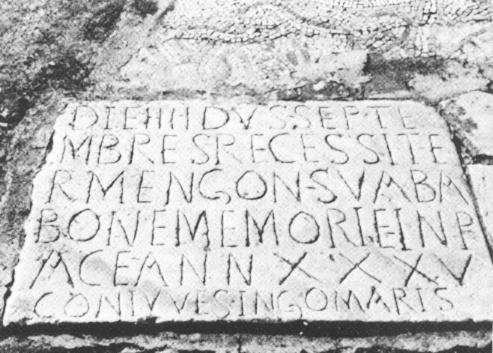
Hippo Regius was a Vandalic-controlled town in Africa.  Many ruins remain to today.  Here is an inscription on one female tomb (dated to 474):

ermengon

The woman’s husband who gave the dough to pay for this was named Ingomar.  No problem there – sounds very Swedish/Germanic.

So does the woman’s name is – the best scientists inform us – Ermengond, a lovely Germanic name for no doubt a beautiful person.  The name is actually written RMENGON as you can see.  So it seems the husband could not fit the initial “E” or the final “D”.  He did manage to fit in the woman’s ethnic designation, however – SVABA.  Strange, you do not fit the actual name but focus on ethnic details?  Was it that important that the world know that Ermengond was a woman of the Suevi (or, as it so happens here, Suavi)?  Did it matter that she was not of local stock or of the ruling Vandals or Alans (whatever was left of the latter by that time)?  Or was that, perhaps, part of her name?

[E]RMENGON[D]SVABA

RMENGONSVABA

Nothing seems sacred to these people!  Now there is that separator dot between the “N” and the “S” so maybe these are two words.  But then we hear (again from the same volume of Forschungen zur deutschen Geschichte) of Altswab, Adalswab and Erchanswab.

Other Thoughts

There are other interesting names.  E.g., the ultra-Slavic Bogdan meaning “God’s gift”.  If you want to have fun just change Bog to the Greek θεός/Theo/Theos and you get Theo[s]dan.

Or Bozydar (same meaning) – and you get Theo[s]dar.  And there was that stuff about -ik being a Slavic suffix (bartnik, miecznik, etc).  Or, for that matter the words dar or podarek (meaning a gift or present).  We will return to podarek when discussing Veneti again.

Funny stuff.

Copyright ©2015 jassa.org All Rights Reserved

May 30, 2015

On Krak of Cracow

Published Post author

The original (or at least as original as we think) story of Krak was put to pen by Master Vincentius (Wincenty) aka Kadlubek in his Polish Chronicle.  We have previously explored the origin of the Krak name/persona but did not delve into the actual Krak legend.  Given that we’ve already given space to the legend of Piast, it seems fitting that we should also finally get to Krak. This then is that story.  (We will also get to the Czech Krok, of course!)

(The chronicle is in the form of a dialogue between Matthew and John, Polish clergymen that Master Vincentius greatly respected.  For the duration of the Krak tale, Matthew is the one telling the tale while John chimes in with philosophical observations (usually taken from the Epitome of the Philippic History of Pompeius Trogus of Marcus Junianus Justinus).  Since the latter are not relevant to the story of Krak, we’ve left them out and only have Matthew speaking).

The Legend of Krak

“It is said too that at time it was the Gauls who had taken control of almost all of the world.  Our legions killed a great number of them in many a battle.  The ones that remained, a long time harassed, our men compelled to an agreement that stated that, whether by fortune or by bravery, either side should gain something from others, each side should get an equal share.  The Galls received all of Greece and we got the lands running from, on the one side, the country of the Parthians, on the other side all at the way to Bulgaria and on the third side to the borders of Carinthia.  Then after many a battle with the Romans, after braving many a danger of war, they took over cities, setting up regional governors and elected a duke by the name of Gracchus.  But eventually they [it appears that here the author is talking about the Galls] grew indolent in their profligacy, slowly losing their mettle by the debauchery of [their] women [or women running things].  The most noble of this tribe died poisoned and the others bent their heads to the yoke of the locals.  And so those, who could not be defeated by a force of arms, were brought down by the sloth of the few.”

gallish2

Galls being brought down by women

“From then on many a man was beguiled by a desire to rule.  For that reason, Gracchus, returning from Carinthia, for he had the gift saying deep things, calls a council of the whole troop, has them all face him, gets their support and unites them in obedience [to him].  He says that a headless man like a wounded animal is pathetic.  The same is a body without a soul, the same a lamp without light, the same a world without the sun – as too a country without a king.  For a soul refuels the spirit of bravery, light makes seen the nature of things, the sun too spreads to all its beneficent rays.  With these rays, as with jewels, is encrusted a diadem on a kingly head such that from the brow there shines magnanimity, from the back restraint and from both sides there sends its munificent radiance a garnet of enterprise.  He promises that should they elect him such, then he will not be a king but rather a partner in the kingdom.  For he believes that he was not born for himself but for the whole world [see Lucan].”

teamwork

Krak explaining his concept of partnership through teamwork

“And so they all greet him as the [new] king.  And he lays down laws and enacts statutes.   And so there arises the seed of our civil law and there takes place its birth.  Because before him freedom had to give way to servitude and right to walk step by step behind injustice.  And that was just which brought the biggest advantage to the wealthiest.  Nevertheless strict justice was not to rule right away.  But from then on it did not yield to great violence, and justice was called that which benefitted that one who can do the least.”

“Poland flourishing thus wonderfully under Gracchus’ leadership would most assuredly recognized his offspring as the most worthy heir to the throne had not the second of his sons been disgraced by the crime of fratricide.”

Of the Dragon 

“For there was in the cracks of a certain rock/boulder a terribly cruel monster, that some used to call ‘whole-eater’ [holophagus, in other writings also draco].  To sate his hunger based on the number of days he was to be given a certain count of cattle.  Should the inhabitants fail to deliver the same offerings they would be punished by the monster through a loss of a commensurate number of their own heads.”

oligophalos

Another victim of the whole-eater about to be eaten whole

“Gracchus, unable to suffer this shame – for he was a more affectionate son of the fatherland than a father to his own sons – secretly called his sons and presented his plan and gave his advice: ‘Cowardice is the enemy of bravery, foolishness of wisdom, indolence of youthful vigor.  For it is no bravery if it is cowardly, it is not wisdom if it is foolish and it is not youth if it is indolent.  What’s more when there is no opportunity to practice courage, so must one create one.  Who then should avoid glory when it presents itself on its own, unless he be someone inglorious!  Yet the good of the citizenry, defended and preserved, becomes an eternal triumph.  For one should not  care about his own safety whenever a common danger arises.  It is for you, you who are our favourites, who, one as well as the other, we have raised according to our abilities, to arm yourselves so as to kill the monster, it befits you to join battle with him but [also] not to risk yourselves too greatly for you are one half of our life, those who deserve to inherit this kingdom.‘”

“And they answered thusly: ‘Truly one could count us filled with the hatred of [as if we were treated as mere] stepsons, should you withhold from us so glorious a task!  To you belongs the power of commanding and to us the necessity of obedience.‘”

oligopholuos

One of Krak’s sons confronts the holophagus

“And so when they have experienced many a time an open manly combat and futile tests of strength, they were forced to rely on their guile [instead].  For in lieu of placing cattle, they put in the usual place only hides filled with burning sulphur.  And when the greedy whole-eater greedily gulped these down, he choked on the flames blazing through his innards.”

“And right after this took place, the younger of the brothers attacked and killed the older, his partner in victory and in the kingdom, [treating him] not as a companion but as a rival.  He follows his [brother’s] body [during the funeral procession filled] with crocodile tears.  He lies saying that [his brother] had been killed by the monster but the father welcomes him back happily as a victor.  For it is often the case that grief becomes overcome by the happiness of triumph.”

banishment

Once his crime was discovered, the younger Krak agreed to banishment

“And so in this way, the younger Gracchus takes the rule after his father, a criminal inheritor!  Yet he was longer branded by the fratricide than decorated with power.  For when the deception soon after was revealed, as penance for his crime he was sentenced to eternal banishment: ‘for it is the most justice law that those who commit crimes should be [slowly] killed by the same.

And of Wanda

“Soon thereafter, on the rock [perhaps, crag? interesting, is that Celticism where the name of the city comes from!?] of the whole-eater, a famous city was founded, from the name of Gracchus named Gracchovia.  And the funeral rites were not concluded but with the completion of the building of the city.  Some called it Cracow from the crowing of crows that gathered there to feast on the corpse of the monster.”

“And so great a love of their departed ruler filled the Senate, the magnates and all of the people that they entrusted his only daughter Wanda with the rule of the country after her father.  She so exceeded all others by her beautiful person as also by the allure of her grace that you would have thought that nature, when rewarding her [with its gifts], not only generous but even extravagant was.  For even the most prudent of the wise were astounded by her advice and the most cruel amongst the enemies relented at her sight.”

“Thus, when a certain Lemmanic [Alemannic? but see here] tyrant raged forth with the intent of destroying this people, thinking to take the throne seemingly free [i.e., because there was no male king], he yielded to her unspeakable charm rather than the force of [her] arms.”

A FISH CALLED WANDA, Jamie Lee Curtis, Kevin Kline, 1988, (c) MGM

Wanda denies the Alemannic tyrant

“For the moment his armies saw in front of them the queen, they fell as if touched by some sort of a ray of light – and all of them as if commanded by some god, purged themselves of all hostile feelings and stood aside from the fight.  They claimed then that they did not balk at battle but rather at sacrilege.  They said that they were afraid of no man but in [this wo]man they venerated a godly majesty.  Their King touched by the torment of love or perhaps of outrage [at his soldiers refusing to fight], or both, proclaims:

Wanda, the sea,

Wanda, the Earth,

the clouds, let Wanda command,

to the immortal gods, let her give herself as sacrifice for her own people

and I for you, oh my lords, make this solemn sacrifice to the gods of the underworld, that you as also your successors forever should grow old under this womanly rule!‘”

He said thus and then threw himself onto his sword giving up his spirit, and so his angry life, with a complaint, amongst the shadows escapes.”

“From her name, they say, is the name of the River Wandal[us] [meaning Vistula] derived, for that [river] was the center of her kingdom; so too all those who were under her rule became known as Vandals.  Because she desired no one marry and even virginity she thought of higher than marriage, she left the world without an heir.  And for a long time did the kingdom teeter without a ruler.”

Thoughts 

Interestingly, it was Isidore of Seville that first suggested in his Etymologies that the Vandals got their name from the River  “Vindilicus” or “Windilicus” though he placed it in Gaul.  Kadlubek was probably aware of Isidore’s works though whether he got this idea from the Etymologies is unknown.

sevillavanali

The River Vindilicus springs from the far frontier of Gaul and people maintain that the Vandals lived by it and got their name from it

It was only much later that Jan Dlugosz gave name to the “tyrant”, i.e., Rytygier or Ruediger.  Interestingly, in the so-called Dietrich of Bern sagas, Ruediger is also the emissary of Etzel/Attila  to the king of the Wilzi/Veltabi who tries to get the king – Ossantrix – to give the hand of the king’s daughter – Helke – to Attila/Etzel.  As if that were not enough, Dlugosz, at least in some manuscripts, also states that Popiel’s name in German was Osserich – presumably, deriving that from Ossen – ash.  On the Asciburgian mountains we wrote already here.  Whether this Ossantrix has anything to do with the ancient Ossi of Tacitus’ Germania – which Ossi lived in the neighborhood of the Veltae/Veltabi in Ptolemy’s Geography – and whether either of those have anything to do with the land of Ossum that the Goths entered from Gothiscandza in Jordanes Getica is a matter for another time.

Copyright ©2015 jassa.org All Rights Reserved

May 29, 2015

The Suevi-Sarmatian Connection

Published Post author

We’ve been asked to expand on the Suevi-Sarmatian connection that we previously briefly talked about.  So we oblige listing here most of the relevant sources.  (We keep the Suebi spelling of the translations, where it appears, though suspect most manuscripts refer to the Suevi).

oliphants

Some scholars speculate that the Iazyges cavalry consisted of war oliphants

Tacitus Annals (Book 12, 29)

“At this same time, Vannius, whom Drusus Caesar had made king of the Suevi, was driven from his kingdom. In the commencement of his reign he was renowned and popular with his countrymen; but subsequently, with long possession, he became a tyrant, and the enmity of neighbours, joined to intestine strife, was his ruin. Vibillius, king of the Hermunduri, and Vangio and Sido, sons of a sister of Vannius, led the movement… an immense host of Ligii, with other tribes, was advancing, attracted by the fame of the opulent realm which Vannius had enriched during thirty years of plunder and of tribute. Vannius’s own native force was infantry, and his cavalry was from the Iazyges of Sarmatia an army which was no match for his numerous enemy. Consequently, he determined to maintain himself in fortified positions, and protract the war. But the Iazyges, who could not endure a siege, dispersed themselves throughout the surrounding country and rendered an engagement inevitable, as the Ligii and Hermunduri had there rushed to the attack ; …He then fled to the fleet which was awaiting him on the Danube, and was soon followed by his adherents, who received grants of land and were settled in Pannonia. Vangio and Sido divided his kingdom between them; they were admirably loyal to us [i.e., the Romans]…” [close to the years 40-50];

Tacitus Histories (Book 1, 2)

“The history on which I am entering is that of a period rich in disasters, terrible with battles, torn by civil struggles, horrible even in peace. Four emperors fell by the sword; there were three civil wars, more foreign wars, and often both at the same time. There was success in the East, misfortune in the West. Illyricum was disturbed, the Gallic provinces wavering, Britain subdued and immediately let go.  The Sarmatae and Suebi rose against us [Charles Dennis Fisher’s edition has “the tribes of the Suevi and the Sarmatæ rose in concert against us“]; the Dacians won fame by defeats inflicted and suffered; even the Parthians were almost roused to arms through the trickery of a pretended Nero.” [years 85-88]

Inscriptions

These date to the years 89-92 and Domitian’s war against the Dacians and then Quadi and Marcomanni:

inscriptions3

inscriptions2version2

inscrptions

Cassius Dio (67, 5, 12)

“In Moesia the Lygians, having become involved in war with some of the Suebi, sent envoys asking Domitian for aid. And they obtained a force that was strong, not in numbers, but in dignity; for a hundred knights alone were sent to help them. The Suebi, indignant at his giving help, attached to themselves some Iazyges and were making their preparations to cross the Ister with them. Masyus, king of the Semnones, and Ganna, a virgin who was priestess in Germany, having succeeded Veleda, came to Domitian and after being honoured by him returned home.” [year 98];

Tacitus Germania (46)

“I am in doubt whether to reckon the Peucini, Venedi, and Fenni among the Germans* or Sarmatians; although the Peucini, who are by some called Bastarnae, agree with the Germans in language, apparel, and habitations.  All of them live in filth and laziness. The intermarriages of their chiefs with the Sarmatians have debased them by a mixture of the manners of that people. ” [written about the year 98]

* Suevi are described as the largest of the German tribes

(Unknown Authors) Historia Augusta (Marcus Aurelius – Emperor 161-180, 21)

“He armed the Diogmitae, besides, and even hired auxiliaries from among the Germans for service against Germans.  And besides all this, he proceeded with all care to enrol legions for the Marcomannic and German war.  And lest all this prove burdensome to the provinces, he held an auction of the palace furnishings in the Forum of the Deified Trajan, as we have related, and sold there, besides robes and goblets and golden flagons, even statues and paintings by great artists.  He overwhelmed the Marcomanni while they were crossing the Danube, and restored the plunder to the provincials.  Then, from the borders of Illyricum even into Gaul, all the nations banded together against us — the Marcomanni, Varistae, Hermunduri and Quadi, the Suebians, Sarmatians, Lacringes and Buri, these and certain others together with the Victuali, namely, Osi, Bessi, Cobotes, Roxolani, Bastarnae, Alani, Peucini, and finally, the Costoboci. Furthermore, war threatened in Parthia and Britain.  Thereupon, by immense labour on his own part, while his soldiers reflected his energy, and both legates and prefects of the guard led the host, he conquered these exceedingly fierce peoples, accepted the surrender of the Marcomanni, and brought a great number of them to Italy.”

“Always before making any move, he conferred with the foremost men concerning matters not only of war but also of civil life.  This saying particularly was ever on his lips: “It is juster that I should yield to the counsel of such a number of such friends than that such a number of such friends should yield to my wishes, who am but one”.  But because Marcus, as a result of his system of philosophy, seemed harsh in his military discipline and indeed in his life in general, he was bitterly assailed; to all who spoke ill of him, however, he made reply either in speeches or in pamphlets.  And because in this German, or Marcomannic, war, or rather I should say in this “War of Many Nations,” many nobles perished, for all of whom he erected statues in the Forum of Trajan, his friends often urged him to abandon the war and return to Rome.”

(Unknown Authors) Historia Augusta (Aurelian – Emperor 270-275, 18)

“Aurelian, too, during that same time, fought with the greatest vigour against the Suebi and the Sarmatians and won a most splendid victory…” [years 270-275];

(Unknown Authors) Historia Augusta (Aurelian – Emperor 270-275, 33)

“It is not without advantage to know what manner of triumph Aurelian had… there were Goths, Alans, Roxolani, Sarmatians, Franks, Suebians, Vandals and Germans — all captive, with their hands bound fast.”

(Item Aurelianus contra Suebos et Sarmatas iisdem temporibus vehementissime dimicavit ac florentissimam victorian rettulit… Non absque re est cognoscere qui fuerit Aureliani triumphus… Gothi, Alani, Roxolani, Sarmatae, Franci, Suebi, Vandali, Germani, religatis manibus captive) [years 270-275];

Flavius Eutropius’ Compendium of Roman History, Book VIII, 13

“Having persevered, therefore, with the greatest labour and patience, for three whole years at Carnuntum, he brought the Marcomannic war to an end; a war which the Quadi, Vandals, Sarmatians, Suevi, and all the barbarians in that quarter, had joined with the Marcomanni in raising…”

(Unknown Author) Panegyric of Constantius (I Chlorus), 10

“…Raetia was lost and Noricum and the Pannonias devastated.  Italy herself, mistress of nations, lamented the destruction of very many of its cities.  There was not so much distress over individual losses when the Empire was deprived of almost everything.  But now that the whole wold has been reclaimed through your courage, not only where it had been Roman, but thorough subjugated even where it had been the enemy’s, vince Alamannia has been trampled so many times, the Sarmatians so often shackled, the Iuthungi, the Quadi and Carpi so frequently utterly crushed, the Goth submitting and seeking peace, the King of the Persians making supplication through gifts, this one disgrace of such a great Empire was searing our souls – we can now at last confess it – and seemed the more intolerable to us because it alone frustrated our glory.”

Ammianus Marcellinus (Book 16, 10, 20)

“…but he [Constantius II] was alarmed by frequent reliable reports that the Suebi were attacking the two provinces of Raetia and the Quadi Valeria*, and that the Sarmatians, who are particularly expert marauders, were devastating Upper Moesia and Lower Pannonia” [years 357-358];

* A division of Pannonia, named from Valeria, daughter of Diocletian and wife of Galerius; Basically they were both attacking Pannonia at different parts

Paulinus of Beziers Epigramma (19-21)

“Even though the Sarmatian devastates, the Vandal lights fires, and the quick Alan pillages, we strive, with painful effort and uncertain results, to put everything back to order.” [year 407];

Note that here the usual Suebi, Vandal, Alan trio of the Rhein-crossing fame is actually replaced by the Sarmatian, Vandal, Alan trio.

Saint Jerome Letter to Heliodorus (16)

“For twenty years and more the blood of Romans has been shed daily between Constantinople and the Julian Alps.  Scythia, Thrace, Macedonia, Dadania, Dacia, Thessaly, Achaia, Epirus, Dalmatia, the Pannonias – each and all of these have been sacked and pillaged and plundered by Goths and Sarmatians, Quades* and Alans, Huns and Vandals and Marchmen.”

*Quadi, one of the tribes of the Suevi

Saint Jerome Letter to Agenuchia (16)

“Nations innumerable and most savage have invaded all Gaul. The whole region between the Alps and the Pyrenees, the ocean and the Rhine, has been devastated by the Quadi, the Vandals, the Sarmati, the Alani, the Gepidae, the hostile Heruli, the Saxons, the Burgundians, the Alemanni, and the Pannonians [or “alas! for the commonweal even the Pannonians”].”

Again, the Vandals and the Alans are accounted for so which/where are the Suebi?

And, of course, the Baltic Sea is the Suevic Sea of Tacitus but also the Sarmatian Ocean of Ptolemy.

Copyright ©2015 jassa.org All Rights Reserved

May 28, 2015

On Celtic Suevi

Published Post author

Were the Suevi German?

Cassius Dio (circa A.D. 155–235) in his History of Rome wrote (Book 51, chapter 22) that:

professor

Professor Earnest Cary tackles confusion by “exercising discretion”

“Ἐπεὶ δὲ ταῦτα διετέλεσε, τό τε Ἀθήναιον τὸ Χαλκιδικὸν ὠνομασμένον καὶ τὸ βουλευτήριον τὸ Ἰουλίειον, τὸ ἐπὶ τῇ τοῦ πατρὸς αὐτοῦ τιμῇ γενόμενον, καθιέρωσεν. Ἐνέστησε δὲ ἐς αὐτὸ τὸ ἄγαλμα τὸ τῆς Νίκης τὸ καὶ νῦν ὄν, δηλῶν, ὡς ἔοικεν, ὅτι παρ´ αὐτῆς τὴν ἀρχὴν ἐκτήσατο· ἦν δὲ δὴ τῶν Ταραντίνων, καὶ ἐκεῖθεν ἐς τὴν Ῥώμην κομισθὲν ἔν τε τῷ συνεδρίῳ ἱδρύθη καὶ Αἰγυπτίοις λαφύροις ἐκοσμήθη. Καὶ τοῦτο καὶ τῷ τοῦ Ἰουλίου ἡρῴῳ ὁσιωθέντι τότε ὑπῆρξε· συχνὰ γὰρ καὶ ἐς ἐκεῖνο ἀνετέθη, καὶ ἕτερα τῷ τε Διὶ τῷ Καπιτωλίῳ καὶ τῇ Ἥρᾳ τῇ τε Ἀθηνᾷ ἱερώθη, πάντων τῶν πρότερον ἐνταῦθα ἀνακεῖσθαι δοκούντων ἢ καὶ ἔτι κειμένων ἐκ δόγματος τότε καθαιρεθέντων ὡς καὶ μεμιαμμένων. Καὶ οὕτως ἡ Κλεοπάτρα καίπερ καὶ ἡττηθεῖσα καὶ ἁλοῦσα ἐδοξάσθη, ὅτι τά τε κοσμήματα αὐτῆς ἐν τοῖς ἱεροῖς ἡμῶν ἀνάκειται καὶ αὐτὴ ἐν τῷ Ἀφροδισίῳ χρυσῆ ὁρᾶται. Ἐν δ´ οὖν τῇ τοῦ ἡρῴου ὁσιώσει ἀγῶνές τε παντοδαποὶ ἐγένοντο, καὶ τὴν Τροίαν εὐπατρίδαι παῖδες ἵππευσαν, ἄνδρες τε ἐκ τῶν ὁμοίων σφίσιν ἐπί τε κελήτων καὶ ἐπὶ συνωρίδων τῶν τε τεθρίππων ἀντηγωνίσαντο, Κύιντός τέ τις Οὐιτέλλιος βουλευτὴς ἐμονομάχησε. Καὶ θηρία καὶ βοτὰ ἄλλα τε παμπληθῆ καὶ ῥινόκερως ἵππος τε ποτάμιος, πρῶτον τότε ἐν τῇ Ῥώμῃ ὀφθέντα, ἐσφάγη. Καὶ ὁ μὲν ἵππος ὁποῖός ἐστι, πολλοῖς τε εἴρηται καὶ πολὺ πλείοσιν ἑώραται· ὁ δὲ δὴ ῥινόκερως τὰ μὲν ἄλλα ἐλέφαντί πῃ προσέοικε, κέρας δέ τι κατ´ αὐτὴν τὴν ῥῖνα προσέχει, καὶ διὰ τοῦτο οὕτω κέκληται.”

“Ταῦτά τε οὖν ἐσήχθη, καὶ ἀθρόοι πρὸς ἀλλήλους Δακοί τε καὶ Σουῆβοι ἐμαχέσαντο. Εἰσὶ δὲ οὗτοι μὲν Κελτοί, ἐκεῖνοι δὲ δὴ Σκύθαι τρόπον τινά· καὶ οἱ μὲν πέραν τοῦ Ῥήνου ὥς γε τἀκριβὲς εἰπεῖν (πολλοὶ γὰρ καὶ ἄλλοι τοῦ τῶν Σουήβων ὀνόματος ἀντιποιοῦνται), οἱ δὲ ἐπ´ ἀμφότερα τοῦ Ἴστρου νέμονται, ἀλλ´ οἱ μὲν ἐπὶ τάδε αὐτοῦ καὶ πρὸς τῇ Τριβαλλικῇ οἰκοῦντες ἔς τε τὸν τῆς Μυσίας νομὸν τελοῦσι καὶ Μυσοί, πλὴν παρὰ τοῖς πάνυ ἐπιχωρίοις, ὀνομάζονται, οἱ δὲ ἐπέκεινα Δακοὶ κέκληνται, εἴτε δὴ Γέται τινὲς εἴτε καὶ Θρᾷκες τοῦ Δακικοῦ γένους τοῦ τὴν Ῥοδόπην ποτὲ ἐνοικήσαντος ὄντες. Οὗτοι οὖν οἱ Δακοὶ ἐπρεσβεύσαντο μὲν πρὸ τοῦ χρόνου τούτου πρὸς τὸν Καίσαρα, ὡς δ´ οὐδενὸς ὧν ἐδέοντο ἔτυχον, ἀπέκλιναν πρὸς τὸν Ἀντώνιον, καὶ ἐκεῖνον μὲν οὐδὲν μέγα ὠφέλησαν στασιάσαντες ἐν ἀλλήλοις, ἁλόντες δὲ ἐκ τούτου τινὲς ἔπειτα τοῖς Σουήβοις συνεβλήθησαν. Ἐγένετο δὲ ἡ θεωρία ἅπασα ἐπὶ πολλάς, ὥσπερ εἰκὸς ἦν, ἡμέρας, οὐδὲ διέλιπε καίτοι τοῦ Καίσαρος ἀρρωστήσαντος, ἀλλὰ καὶ ἀπόντος αὐτοῦ δι´ ἑτέρων ἐποιήθη. καὶ ἐν αὐταῖς οἱ βουλευταὶ μίαν τινὰ ὡς ἕκαστοι ἡμέραν ἐν τοῖς τῶν οἰκιῶν σφων προθύροις εἱστιάθησαν, οὐκ οἶδ´ ὅθεν ἐς τοῦτο προαχθέντες· οὐ γὰρ παραδέδοται.”

Herbert Baldwin Foster of the Delphi edition translates Κελτοί as “Celts.”   However, Ian Scott Kilvert of Penguin Classics and then Earnest Cary of the Loeb edition translate the same as “Germans“.  The text of the Loeb edition has this as:

“After finishing this celebration Caesar dedicated the temple of Minerva, called also the Chaldicum, and the Curia Iulia, which had been built in honour of his father. In the latter he set up the statue of Victory which is still in existence, thus signifying that it was from her that he had received the empire.  It had belonged to the people of Tarentum, whence it was now brought to Rome, placed in the senate-chamber, and decked with the spoils of Egypt. The same course was followed in the case of the shrine of Julius which was consecrated at this time, for many of these spoils were placed in it also; and others were dedicated to Jupiter Capitolinus and to Juno and Minerva, after all the objects in these temples which were supposed to have been placed there previously as dedications, or were actually dedications, had by decree been taken down at this time as defiled. Thus Cleopatra, though defeated and captured, was nevertheless glorified, inasmuch as her adornments repose as dedications in our temples and she herself is seen in gold in the shrine of Venus.”

“At the consecration of the shrine to Julius there were all kinds of contests, and the boys of the patricians performed the equestrian exercise called “Troy,” and men of the same rank contended with chargers, with pairs, and with four-horse teams; furthermore, one Quintus Vitellius, a senator, fought as a gladiator.  Wild beasts and tame animals were slain in vast numbers, among them a rhinoceros and a hippopotamus, beasts then seen for the first time in Rome. As regards the nature of the hippopotamus, it has been described by many and far more have seen it. The rhinoceros, on the other hand, is in general somewhat like an elephant, but it has also a horn on its very nose and has got its name because of this.  These beasts, accordingly, were brought in, and moreover Dacians and Suebi fought in crowds with one another. The latter are Celts [but he says Germans!], the former Scythians of a sort. The Suebi, to be exact, dwell beyond the Rhine (though many people elsewhere claim their name), and the Dacians on both sides of the Ister; those of the latter, however, who live on this side of the river near the country of the Triballi are reckoned in with the district of Moesia and are called Moesians, except by those living in the immediate neighbourhood, while those on the other side are called Dacians and are either a branch of the Getae are Thracians belonging to the Dacian race that once inhabited Rhodope. Now these Dacians had before this time sent envoys to Caesar; but when they obtained none of their requests, they went over to Antony. They proved of no great assistance to him, however, owing to strife among themselves, and some who were afterwards captured were now matched against the Suebi. The whole spectacle lasted many days, as one would expect, and there was no interruption, even though Caesar fell ill, but it was carried on in his absence under the direction of others. On one of the days of this celebration the senators gave banquets in the vestibules of their several homes; but what the occasion was for their doing this, I do not know, since it is not recorded.”

From the Lacus Curtius wbesite we learn that:

“While it follows the standard system used in the Boissevain edition, Prof. Cary exercised a good deal of editorial judgment on the fragmentary texts of Dio.”

Indeed!

Maybe there is a different manuscript than the standard Boissevain edition above?

Or maybe this  made sense to Kilvert and Cary because “many people elsewhere claim their name” so let’s go with the default of “Germans”?

Or maybe it was just all Greek to them?

(In addition, Dio states too that the Bastarnae were Scythians).

Copyright ©2015 jassa.org All Rights Reserved

May 27, 2015

On Ariovistus

Published Post author

Before Armin-ius there was Ariovist-us.  With Arminius, oddly, once you take away the Latin -ius, the ending becomes the Slavic -in.  What happens with Ariovistus?

wieszcz

Well, first we have Ariovist.  Then we break it down to Ario-vist.  Now, we are not going to weigh in on Ario-.  (Supposedly, it is a Celtic prefix meaning “noble”).

However, -vist seems familiar.

wieszcz2

Smith’s Dictionary of Greek and Roman Biography and Mythology translates -vistus by  claiming it is simply the German Fürst, “a prince”.  Alternatively, the suffix is supposed to be Celtic from, as per the ever correct Wikipedia, uid-, uidi-, uissu-, meaning “perception, knowledge.”

wieszcz3

To know that -vid means knowledge one does not need to look to Celtic.  The Indian vedas have the same derivation.  In fact, so does the Polish wiedza.  But the suffix is -vist not -vid.

If you are thinking sight, as in vista, you may be right.  Assuming that is correct, we may want to ask if there is a word that expresses the concept?

wieszcz4

If you said Czech věštec, Slovak veštec or Polish wieszcz (essentially, viest) we think you could be right.  (If one accounts for the fact that the Polish mazurzenie seems to have been the correct way of talking of old, the Czech/Slovak and Polish versions would sound the same except for the -ec suffix not present in the Polish version (though there is a Polish – diminutive version – wieszczek).  What does that mean?

wieszcz5

A teller of news, a fortune teller, an augured, a seer but also – the necessarily derivative – magician, mage.  Linde’s Polish dictionary from 1814 also has the following Slavic forms visct, vjesct, vishtac.  Bruckner’s etymological dictionary concurs showing the Polish wieść (“news”) to be cognate with the Avestani visti-, Indian vit-ti.

ariov

Thus, Ariovist would be a seer/magician.  And we must not forget his contemporary anti-Roman rebel commander, the Getae-Dacian chief Byrebistas, Boirebistas or Buruista/Burvista.  Again, once you eliminate the -as, you end up with Burebist or something like that.  However, as we pointed out, in Greek at least, the “b” in many places meant “v” (see, e.g., Sklabinoi, Sklaboi).

Another interpretation may be that vist meant as much as man.  Aleksander Brueckner believed that niewiasta (nye-veasta) (woman) originated from a word for a bride meaning one who was not known yet because she came from “the outside” (of the family).  Therefore, there was “no knowledge” (no wiedza or vista) of her (he analogizes the Hungarian word for son in law – igen).  However, this use appears at best secondary and at worst slightly contrived.  If one were to assume that nie-wiasta simply means “not a man” (sorry), that would match up with the vist being just a man.  The association of man with knowledge and woman with no knowledge thus seems unnecessary (or at least secondary).  The words may simply have meant man and not man (i.e., woman).

It seems entirely plausible that a vist, over time became the knowledgeable leader – wieszcz, its original meaning of “man” forgotten.  On the other hand, niewiasta (nye-veasta) may have lived on as the original name for a woman and this even after Slavic languages developed their own term for “wise woman/leader”, i.e., wieszczka.

Finally, yet another etymology name is possible. Assuming for the moment that this name was not some sort of a “call sign” given to him “in the Suavic military” but rather was simply a name given to him by, well, you know, his parents, the above reference to wieść (“news”) suggests a simpIer explanation:

(y)ari-vist

meaning:

“robust (good) news”

This would make the name similar to, for example, Tęgo-mir (aka Tugumir), that is, “robust (strong) world.”

Note too that the name Arwist (sometimes shown as Herwist) appears Polish source, although it is perhaps possible that the name is of Old Prussian origin:

And so, as they say, here we are.

things

When you are enjoying a vista of the Rodina, take a moment to give some thought to the sacrifices of Ariovist and Burevist

Copyright ©2015 jassa.org All Rights Reserved

May 26, 2015