On Krok the Czech, Libuse and Premysl

Published Post author

Now that we have taken our time to discuss the Polish Krak and Wanda here and here, we have decided it was time to relay some information about the Czech Krok, his three daughters and his son-in-law – Premysl – the protoplast of the Czech ruling house, the ploughman Premysl (who, seems very similar in his background to Piast whom we briefly introduced here).

crocco

The below are excerpts from Lisa Wolverhampton’s translation of Cosmas’ Chronicle of the Czechs (with some, we think, improvements).  The pictures of the chronicle itself are from the Budisin/Bautzen Codex of Chronica Boemorum.  And so without further ado, we give the voice to Cosmas:

Chronicle of the Czechs

On Krok and His Three Daughters

“One particular man had arisen among them, called Krok, after whom a castle is known to have been named, located in the forest adjacent to Ztibecna and now overrun by trees.  He was a man absolutely perfect in his generations, exceptional for his wealth in secular things, discreet in considering lawsuits.”

krokcompanies

Krok with His Three Daughters

“Like bees to their hive, so everyone, both from his own tribe and from the common folk of the whole province, flocked to him to sort out their lawsuits.  Such a great man lacked a manly offspring.  Nevertheless, he fathered three daughters, to whom nature gave riches of wisdom no fewer than she was accustomed to give men.”

kazi3

Kazi was the emotional one

“The eldest of them was named Kazi who surpassed Medea of Colchis in herbs and song and the Paeonian master in medicinal art, because she often made the Fates themselves cease their unending work and oracles follow the commands of her song.  Hence the inhabitants of this land, when the lose something and despair of its recovery, say the following proverb about her: ‘Even Kazi herself cannot get it back.’ Like the place there the daughter of Ceres was abducted by a tyrant, her burial mount cash still be seen today, heaped up very high by the inhabitants of the land in memory of their mistress, on the bank of the River Mze near the road which leads to the province of Bechne, over the mountain called Osek.”

tetka2

The very Bohemian Tetka with a specimen of local fauna

“Worthy of praise though second by birth, Tetka was a woman of keen discernment lacking a husband.  She built a castle on the River Mze, named Tetin after herself, well fortified by the nature of the placem with rocks reaching steeply to the summit.  She taught the stupid and senseless people to adore and worship Oreads, Dryads, and Hamadryads, and established every superstitious sect and sacrilegious rite.  Like many villagers up until now, just like pagans, this one worships waters of fires, hat one adores groves and trees and stones, another sacrifices to mountains or hills, and still another beseeches and prays to the deaf and dumb idols he has made himself, so that they rule both his home and his one self.”

libuce

Libuse was able to see far

“Younger by birth but older in wisdom, the third was called Libuse.  She built a castle, the most powerful then, next to the forest which reaches to the area of Ztibecna, and called it Libusin after her own name.”

“She was truly a woman among women: cautious in counsel, quick to speak, chaste in body, upright in character, second to no one in resolving lawsuits of the people.  Affable, even lovable, in all things, she adorned and glorified the feminine sea while handling masculine affairs with foresight.  But because no one is altogether blessed, this woman of such quality and of so great praise – alas the terrible human condition! – was a prophetess [phitonissa].  Since she predicted many proven futures for people, that whole people took common counsel and set her up as judge over them after the dearth of her father.”

A Challenge to Libuse

“At that that time not a small litigation arose concerning the boundaries of a contiguous filed between two citizens, both among the more eminent in wealth and birth, men who considered themselves leaders of the people.  They erupted to such a degree into mutual conflict that one flew at the thick beard of the other with his fingernails.  Exposing the sounds of their confrontation and confounding each other disgracefully with a finger under the nose, they entered the court raving.  Not without a great din, they approached the lady and asked humbly that Libuse resolve the undecided case between them by reason of justice.  She, meanwhile – as is the wanton softness of women when they do not have a man whom they fear – reclined very softly deep in a painted coverlet, propped on an elbow, as if she had just given birth to a child.  Walking on the path of justice, not respecting men’s persons, she brought the cause of the whole controversy that had arisen between them to a state of rectitude.”

“Yet he whose cause did not win the palm [of victory] on the judgment, more indignant than was fitting, shook his head three or four times, foolishly hit the ground thrice with his staff, and with a full mouth, saliva sprinkling his beard, cried out: ‘Oh, the injuries hardly to be tolerated by men!  A woman full of cracks treats manly judgments with a deceitful mind.  We know indeed that a woman standing or sitting on a throne knows little; how much less must she know when she is reclining on a coverlet?  Truthfully, this posture is more suitable to the approach of a husband than to prescribing laws to warriors.  They all have long hair, to be sure, but women are short on sense.  A man should rather die than suffer such things.  A disgrace among nations and peoples, nature has forsaken us alone, who lack a ruler and manly severity, and whom feminine laws rule.'”

notsofastlibuse

“Not so fast Libuse – where is your man?”

“At this the lady smiled, dissembling the insult made to her and concealing her heart’s pain in feminine modesty.  ‘It is,’ she said, ‘as you say: I am a woman, I live as a woman, and for that reason I seem to you to know too little.  Because I do not judge you with a rod of iron and since you live without fear, you rightly look down on me.  For where fear is, there is honor.  Now, it is very necessary that you have a ruler fiercer than a woman.  Just as the doves once spurned a white bird for a kite whom they had chosen as their king, so you spurn me.  They appointed as their duke a much fiercer hawk, who, inventing crimes, began to kill both the innocent and the wicked.  From then until now, the hawk eats the dove.  Go home now.  I will accept as my husband whomever you should choose tomorrow as your lord.'”

“Meanwhile, she summoned the aforesaid sisters, who stirred up matching rages.  With their magical skill and her own, she made a fool of the people through everything.  Libuse herself was, as we said above, a prophetess like Sibyl of Cumae, the other sister a sorceress of potions like Medea of Colchis, and the third an enchanter like Aeaean Circe.  What kind of counsel those three Eumenides obtained that night and what kind of secret they carried out was then unknown.  Nevertheless it was made manifest – clearer than light – to everyone in the morning, when their sister Libuse revealed both the place where the future duke was hidden and who he was by name.  Who would believe that they would request their first duke from the plow?  And who would know where plows the man who would become ruler of the people?  What does prophetic rage not know?  And what is there that magical skill cannot make happen?  Sibyl was able to predict to the Roman people the course of their destinies almost to the day.  She even – if we can believe it – foretold of Christ.  (A certain teacher inserted verses about the coming of the Lord, composed by Virgil for the persona of Sybil, in the words of his preaching.)”

“Medea was often able to lead Hyperion and Berecynthia back from heaven through her herbs and song; she was able to call forth rainstorms, lightning, and thunder from the clouds; she was able to make the Aegean king a youth from an old man.  By the song of Circe, the friends of Ulysses were transformed into various forms of wild animals, and King Picus into the flying creature which is now called a picos [woodpecker].  What wonder?  How much did magi in Egypt do through their arts, they who performed almost every kind of wonder with their song, as many wonders as Moses, God’s servant, was said to have produced from God’s power?  Enough of that.”

The Lecture of Libuse

“The next day, as was ordered, they convened an assembly without delay and gathered the people; at once everyone came together into one.  Sitting on the highest throne, the woman addressed the boorish men: ‘Oh most pitiable common folk, who do not know that you live free and that no good man gives up [freedom] except with his life.  You flee that freedom not unwillingly and submit your necks voluntarily to unaccustomed servitude.  Alas, later you will regret in vain, as the frogs regretted it when the serpent whom they had made their king, began to kill them.  If you do not know what the rights of a duke might be, I will try to tell you in a few words.”

betternagging

Everyone enjoyed Libuse’s lectures

“First, it is easy to appoint a duke, but difficult to depose one appointed.  For he who is now under your power, whether [it was] you [who] made him a duke or not, when later he is established, you and everything your will be in his power.  In his presence your knees will tremble and your mute tongue stick to the roof of your dry mouth.  Because of great fright you will hardly respond to his voice, ‘yes, lord, yes, lord,’ when by his command alone and without your fore judgment he will damn this one and slaughter that one, order these sent to prison and those hanged from the gallows.”

“He will make you yourselves and from your midst, as he pleases, some slaves, some peasants, some taxpayers, some tax collectors, some executioners, some heralds, some cooks or bakers or millers.  He will establish for himself tribunes, centurions, bailiffs, cultivators of vineyards and fields, reapers of grain, makers of arms, sewers of various hides and skins.  He will force your sons and daughters into obedience to hi,m.  From even your oxen and horses and mares and cattle he will take, at his pleasure, whichever are best.  Everything yours, what is better in villages and in plains, in fields and meadows and vineyards, he will take away and reduce to his own use.  Why do I delay with these words?  Toward what end do I speak as if to frighten you?  If you persist in what you have begin and do not swear your oath falsely, I will now announce to you both the duke’s name and the place where he is.”

Libuse’s Quest

“At this, the base commoners jumped up with a disordered shout; with one voice everyone demanded a duke be given to them.  Libuse said to them: ‘Behold! Beyond those mountains’ – and she pointed to the mountains with her finger – ‘is a river not yet large, named Bilina, on whose banks a village is to be found, Stadice by name.”

“In its territory lies one newly cleared field, twelve paces in length and in width, which – wonder of wonders – while positioned in the midst of some many [arable] fields, yet pertains to no field.  There your duke plows with two parti-colored oxen: one ox is girded with white and has a white head, the other is white from forehead to rear and has white rear feet.  Now, if  you please, take my ankle-length robe and mantle, and capes fitting for a duke and go.  Report my and the people’s commands to that man, and bring back your duke and my husband.  The name of the man, who will think up [excogitabit] many laws upon your necks and heads, is Premysl (for this name means in Latin, ‘thinking upon’ [superexcogitans] or ‘thinking beforehand’ [premeditans]).  His subsequent progeny will rule all this land forever and ever.”

questers

Libuse’s most trusted servants were chosen for the mission and equipped with a detailed map

“Meanwhile, messengers were chosen, who would bring the lady’s and the common folk’s orders to the man.  When Libuse saw them delaying, as if they did not know the way, she said: ‘What delays you?  Go confidently: follow my horse.  He will lead you on the right road and bring you back, because that road has been trod by him more than once.’  Empty rumor and false conjecture both fly that , always at night, Libuse, on an imaginary ride, was accustomed to go there in the evening and return before daybreak  (Let Apella the Jew believe it!)  What then? Wise, though uneducated, well aware of their ignorance, the messengers proceeded, following the horse’s footsteps.”

“Soon they crossed mountains and eventually approached the village to which they went.  One boy ran to meet them; they said to him, inquiring: ‘Hark, excellent boy! Is not that village named Stadice?  If it is, is a man named Premysl in it it?’  The boy said: ‘It is the village you seek.  And behold, the man Premysl goads his oxen in the field nearby so that he might finish more quickly the work he is doing.'”

The Meeting with Premysl

“Approaching him, the messengers said, ‘Happy man! Duke produced by the Gods for us!’  As is the custom for peasants, it was not sufficient to have said once, so with puffed out cheeks, the predated: ‘Hail, duke! Hail, most worthy of great praise!  Release the oxen, change your clothes, and mount this horse!’  And they showed him the clothes and the nighing horse.  ‘Our lady Libuse and all the common folk demand that you come quickly and take up the realm fated for you and your descendants.  Everything ours and we ourselves are in your hand.  We elect you duke, you judge, you ruler, you protector, you our only lord.'”

premyslpremysl

When they saw Premysl, they knew he was their man

“At this speech the foreseeing man, as if unaware of future things, halted and fixed in the earth the prod he carried in his hand.  Releasing the oxen, he said, ‘Let us go to the place you came from.’  Immediately, quicker than can be said, the oxen vanished from his sight and were never seen again.  The hazel-wood prod which he had fixed in the ground produced three branches and – what is more miraculous – leaves and nuts.  Seeing such things happen thus, the messengers stood astonished.  In turn thinking the visitors, Premysl invited them to a meal, shook moldy bread and part of a cheese out of his cork-wovern bag, put the bag in the ground for a table, and placed other things on the rough cloth.”

“Then while they were eating the meal and drinking water from a jug, two of the branches or two of the bushes) withered and died, but the third grew much higher and wider.  Whence greater astonishment, mingled with fear, grew in the visitors.  Premysl said: ‘What are you astonished at?  You should know that from our progeny many lords will be born, but one will always dominate.  If your lady does not immediately hurry in this matter, but awaits the galloping fates awhile and does not quickly send for me, as many master’s sons as nature produces, your land will have that many lords.'”

“Afterward, dressed in a princely garment and shod with regal shoes, the plowman mounted his spirited horse.  Still, not forgetful of his lot, he took with him his boots, stitched in every part from cork, and ordered them preserved for posterity.  They are indeed preserved now and forever in the duke’s treasury at Vysehrad.”

The Wisdom of Premysl

“It so happened that, while they took a short cut, until now the messengers had not yet dared to speak more familiarly to their new lord.  Just like doves when some falcon approaches them, they first tremble at it but soon become accustomed to its flight, make it their own, and love it.  Thus, while the riders chatted, shortened the trip with conversation, and lightened their labor by joking and with jesting words, one of them, who was more audacious and quicker to speak, said, ‘O Lord, tell us: why did you make us save those woven cork shoes, fit for nothing except to be thrown away?  We cannot wonder at this enough.’  Premysl said to them: ‘I had them saved and will have them preserved forever for this reason: so that our descendants will know whence they sprang, and so that they will always live trembling and distrustful, and will not unjustly, out of arrogance, oppress the men committed to them by God, because we are all made equals by nature.  Now allow me to inquire in turn of you, whether it is more praiseworthy to be raised from poverty to honor or to be reduced from honor into poverty?”

hrrrrr

Premysl’s speech had to be reconstructed as no one in the rapt audience could pull himself away to write it down

“Of course, you will tell me that it is better to be raised to glory than to be reduced to indigence.  Yet some people, born of noble parentage, are later reduced to base indigence and made wretched.  When they proclaim their parents to have been glorious and to have had power over others, they are hardly unaware that they confound and debase themselves more when they lose through their own laziness what their parents had possessed through industry,  Fortune always plays this game of chance with her wheel: now she raises these men to the pinnacle, and now she plunges those into the depths.  Whence it might happen that earthly honor, which brought glory for a time, is lost to disgrace.  Truly, poverty conquered through virtue does not hide itself under a wolf’s pelt but lifts up to the stars as a victor him whom it had once dragged to the depths.”

The Meeting of Libuse and Premysl

“After they had traversed the road and eventually arrived near the burg, the lady rushed to meet them surrounded by her followers.  With their right hands entwined, Libuse and Premysl went indoors with great rejoicing, reclined on couches, refreshed their bodies with Ceres and Bacchus, and gave themselves up to Venus and Hymen for the rest of the night.”

bestactorbridges

Libuse & Premysl together at last

“This man – who is deservedly to be called a man from his might – restrained this savage people with laws, tamed the untamed populace by his command, and subjected them to servitude by which they are now oppressed.  All the laws which this land possesses and by which it is ruled, he alone with only Libuse decreed.”

The Establishment of Prague

“One day, at the beginning of the new reign of laws, the aforesaid Libuse, excited by prophesy, with her husband Premysl present and other elders of the people standing nearby, foretold thus: ‘ I see a burg, whose fame touches the stars, situated in a forest, thirty stades distant from the village where the Vltava ends in streams.  From the North the stream Brusnice in a deep valley strongly fortifies the burg; from the south a broad, very rocky mountain, called Petrin from rocks [petrae], dominates the place.  The mountain in that spot is curved like a dolphin, a sea pig, stretching to the aforesaid stream.”

“When you come to that place, you will find a man putting up the doorway of a house in the middle of the forest.  From that event – and since even a great lord must duck under a humble threshold – the burg you all build, you will call Prague [Praha, from pray, threshold].  In this burg, one day in the future, two golden olive trees will grow up; they will reach the seventh heaven with their tops and glitter throughout the whole world with signs and miracles.  All the tribes of the land of Bohemia, and other nations too, will worship and adore them, against their enemies and with gifts.  One of these will be called ‘Greater Glory,’ the other, ‘Consolation of the Army.'”

[these are references to Saint Vaclav and Saint Vojtech/Adalbert]

prague

Once the architects were done with their designs, Prague was built at an incredible pace

“More was to be said, if the pestilential and prophetic spirit had not fled from the image of God.  Immedaitely passing into the primeval forest and having found the given sign, in the aforesaid place they built the burg of Prague, mistress of all Bohemia.”

Meanwhile Somewhere Else But Close By

“At that time the maidens of that land, growing up without a yoke, pursuing military arms like Amazons and making leaders for themselves, fought together like young soldiers and trod manfully through the forests on hunts.  Men did not take them, but they took men for themselves, whichever ones they wanted and whenever they wanted.  Just like the Scythian people, the Plauci or the Pechenegs, man and woman also had no distinction in their dress.  Whence their feminine audacity grew so great that on a  certain cliff not far from the aforementioned [Prague], they built themselves a fortress fortified by the nature of its location.  It was given the name Devin, from a maidenly word [i.e., deva, a girl] .  Seeing this, young men, many of them coming together at once, angry with the women and very jealous, built a burg among the bushes on another cliff, no farther than a trumpet call [from Devin].  Present-day men call it Vysehrad, but at that time it took the name Chrasten from the business [chrasti].”

amazons

Unfortunately, as soon as Prague was built it was threatened by vicious Amazons

“Because the maidens were often more clever at duping the young men, and because the young men were often stronger than the maidens, there was sometimes war between them and sometimes peace.  At a time when they possesses peace between them, it pleased both parties to come together with food and drink as a token [of that peace].  For three days they engaged in festive sport – without arms – in an agreed upon place.  What more?  In no other way could  the young men have fun with the girls.  And so, like rapacious wolves seeking food, they entered the sheepfold.  They spent the first day merry, with sumptuous food and too much drink.  While they wanted to quench their thirst, another thirst sprang up, and the young men could hardly defer their happiness to the hour of the night.  It was night and the moon was shining in a cloudless sky.  Then blowing a horn , one of the men gave the signal to the others ,saying: ‘You have played enough, you have eaten and drunk enough.  Arise!  Golden Venus calls you with the hoarse rattle.’  Immediately, each of the men carried off a girl.”  Come morning and having entered into agreement of peace, supported by Ceres and Bacchus, the girls yielded the empty walls of their fortress to Vulcan of Lemnos.  Since that time, after the death of Prince Libuse, the women of our people are under the power of men.”

“But since all men have a journey to make, where Numa and Ancus have gone before, so Premysl, now full of days, who was worshipped like a god while living, was carried off to the son-in-law of Ceres after he established the rule of laws.  Nezamysl succeeded him in rule.”

Copyright jassa.org ©2015, All Rights Reserved

July 4, 2015

On the Sorbs – Albis Germaniae Suevos a Cerveciis dividiit

Published Post author

We believe the Sorb people deserve more attention than they have thus far received here – and deserve their own tab apart from the other major Polabian Slavs (Obotrites and Veleti).

Admittedly, the Sorbs (and Serbs) are a bit of mystery within the Slavic family.  They are most often accused of having Eastern, “Sarmatian” or “Iranian” roots (the Croats, or at least some of them, get dragged into this as well).  But as we have shown, Sarmatian peoples (in the shape of the Iazyges) were not only no strangers to Europe but, in fact, their most notable “friends” on our continent were the Suevi.  Were there other Sarmatians?

sorbenlittlepeople

The Sorbs are Little People – and They Need YOUR Help!

And what better way to begin their story – though, we think, mid-stream – than with that 4th or 5th century writer, Vibius Sequester.  Mind you, he was a 4th (i.e., 300s) or 5th (i.e., 400s) century A.D. persona.  And while Slavologists (or whatever) talk freely about Jordanes and Procopius (even if only to lambast the former), they are somehow silent about Vibius – why?

vibiis

Vibius, you see, wrote a little pamphlet of lists called De fluminibus, fontibus, lacubus, nemoribus, gentibus, quorum apud poëtas mention.  It contains lists of various things but, currently, what’s of interest to us, is the list of Flumina, i.e., rivers/waterways.  There, on his list we have the following sentence:

Albis Germaniae Suevos a Cerveciis dividiit: mergitur in Oceanum

or, “Elbe of Germany divides the Suevi from the Cervecii and empties into the Ocean”

[as to the Ocean, actually the reference is to the North Sea but ok; some manuscripts do not contain this reference]

In two manuscripts the name is shown as Corvitiis and Servitiis (!)

All the manuscripts feature the above forms.  However, the printed editions vary.  Originally, they all followed the above formulations.  But in the Jeremias Jacob Oberlin (1735-1806) edition of Vibius, published in 1778, a switch was made to Cherusci.  Why?  Oberlin, confessed that this was based on a conjecture of (apparently, though this itself is not clear, of a 16th century Swiss theologian, Josias Simmler).  From that edition onwards the name Cherusci began to appear in the Vibius editions.  For no apparent reason. Other than… Well, it can’t be Serbs, right?

So who were the Cervecii?  

The natural thought would be that these were Servii or Serbii or, using today’s nomenclature, just Sorbs.  The Sorbs appear in the Story of Samo so we know that they were on the Elbe in the early to mid 7th century.  (Some recent dendrochronological measurements put Slavic settlement on the Elbe in the 8th century – go figure – apparently, if there is no sufficiently aged wood, there are no Slavs – a new requirement).

Ok, early 7th century.  But 4th or 5th century?  That can’t be right.  After all there were no Slavs in Europe at the time, right?

And there is something else.

On the Serbs and Suevi

The Bavarian Geographer’s list traces the Slavs – or at least the Eastern ones (there are at least two separate lists within that list) – to a people called Zeriuani – no one really knows who these were – were they Zerivani?  Zervingi? Tervingi?  Do they (any of them) have something to do with the Черве́нські городи́/ Rotburgenland or Tscherwener Burgenland/Grady tscherwenske/Grody Czerwieńskie?  These are located partly in Poland and partly in Ukraine (here is a Polish map):

cervenske

But some have suggested a Serb or Sorb connection.  The same Slavic tribe list also contains the mysterious line about the Suevi being “sown” not “born” (and also about the Boii being from the River Boia), i.e., “Suevi non sunt nati sed seminati.”

Further, we may ask, putting aside the Cervecii, what’s going on with the Suevi here?  Were they not to be found in the Swabia of today already?  Is this proof of the Suevi being on the Elbe in the 4th or 5th century?  Is that the same population as the population of the North Suavi, i.e., Nordschwaben that we discussed as being suspiciously close to Slavs here?

Cervetiis (Vaticanus Latin 4929)

In any event, if these are Serbs/Sorbs, it is interesting then to see here them so close to the Suevi – another population with “source” potential for the Slavic question.

suevoz

Suedos? Servetiis? (Parisian Codex Latin 8413)

Does this mean that between the Suevi, the Serbs and the Veneti, we probably have our Slavs covered (somewhere in there, wherever that may be)?

And what if the Cherusci?  Well, they last appear in Tacitus about 98 A.D. and make it into Ptolemy’s Geography – meaning their last mention is in the 2nd century.   So could these have been Cherusci?

Sure, anything is, of course, “possible”.  What will people think of next?  Perhaps that Cherusci were Serbs!?

cherusci

The Latin “forte” means “possibly” – but why?

Copyright ©2015 jassa.org All Rights Reserved

July 2, 2015

Politicizing Roots

Published Post author

Every once in a while we come across information that sheds some light on a particularly convoluted topic (which usually is a good opportunity to do some ranting – for those who do not care for rants, see you next time).

Sometimes, such information radically changes our previously held views, at other times it adds needed confirmation to what has long been suspected.  A fascinating example of the latter has come to our attention, courtesy of the University of Warsaw and the Polish Education Ministry.  But first for some brief background.

19th Century – First Half of the 20th Century

In this period, the discussion about Germans and Slavs on the territory of present Poland (specifically, in the Oder and Vistula area was a shouting match between the hyper nationalists of the German school who, in order to justify continued territorial claims in the East, concocted  theories that denied any room for the existence of Slavs in the same area (or indeed in Central Europe) before the 5th and maybe even 6th centuries.  There were many proponents of this view from:

  • the seemingly dim Johann Kaspar Zeuss, best remembered in the words of a poem:

Was man nicht deutsch erklären kann,

Das sieht man gleich als keltisch an

(What can’t possibly be explained as Germanic, that is immediately seen as Celtic)

  • the proto-Nazi Gustaf Kossina (member of the “Nordic Ring” society, loving teacher of such luminaries as SS-Obersturmbannführer Hans Schleiff), to
  • the Noble prize winning Theodor Mommsen – in eigenen Worten:

 “the Czech skull is impervious to reason, but it is susceptible to blows

and once more:

In any event, much more will fall away from the German Nation than the children of Israel, when its current form is corrected [durchkorrigiert] to fit with Tacitus’ Germania.  Mr. Quatrefages had shown many years ago that only the central states [of Germany] are truly German and that the Prussian race is a mass of peoples made up of reprobate Slavs and all kinds of other waste of humanity.

(to be clear, this was written by Mommsen to defend (!) Jews against Treitschke  In other words, Mommsen’s view was, “yes, Jews are, of course, not Germans but, come on, look at all the other crap that we have living here in Germany”)

And many, many others who sacrificed scientific objectivity for their exploration of inner demons, pursuit of careers and raw politics.

durchkorrigierung1

Mommsen’s “Durchkorrigierung” Begins

The fact that Mommsen was Danish and Kossina Polish should provide some exculpation for the Germans as well as a window into the twisted souls of some of these creatures (of course, if one were to go through Germany with a magnifying glass and see who actually has Scandinavian ancestors, many, many more Kossinas would first be found – many with names you would never have guessed were not Nordic).

14th December 1945: Huddling in blankets the only survivors of an original 150 Polish people who walked from Lodz in Poland to Berlin hoping to find food and shelter. They are waiting by a railway track hoping to be picked up by a British army train and given help. (Photo by Fred Ramage/Keystone/Getty Images)

Side Effects of Mommsen’s “Durchkorrigierung”

Since, with the exception of tiny Serbia, there were no independent (not counting the Romanov Empire’s prison of nations) Slavic nation-states throughout most of the 19th century (people should remember that when bemoaning the effects of World War I), any response to this kind of “science” had to be a private one.  And, indeed, many Czechs, Poles and others undertook to tackle this kind of behaviour financing their activities and publications often out of their own private funds given official indifference or even hostility.  It was an uphill battle for it was fought against the machinery of the state but, in the end, it was victorious.

Even if for only a little while.

21st Century 

Compared to the many works produced by scholars roughly through the mid-20th century, what strikes one today is the paucity of decent (forget good, how about merely decent!) scholarship regarding Slavs.  There literally has not been a single respectable book published in English-speaking academia in over 50 years.  The situation in the local Slavic publishing world is not much better.  What gives?  People too busy with their every day lives to write or read about this stuff?  Maybe.  But is that it?

The response to the question of the autochtonous nature of the Slavs in Central Europe once again seems to shed some light on what may be going on.

If in the 19th century German historiography had a political goal of incorporating Slavs into the German nation – as Germans; if during the (late) Nazi time, the goal became separation and subjugation of those who would not hop on board; nowadays, a new goal is on the horizon.

Puzzle Palace

Whereas before Slavic autochtonism was a stumbling block on the road to consolidation of the lands of the overstretched reformed Germany Empire, now Slavic authochtonism is a major problem for the plans laid out for Europe in general.  Since, as we see recently, the party line is that anyone can come to Europe and anyone can be a European, the idea of a “native” or indigenous population is not too popular an idea.

After all, if there are “natives” then, one might ask, whether it is the natives that have a right to their lands – a right, tentatively speaking, greater than anybody else.  Greater than others from within Europe and certainly greater than others from outside.

But in the age of globalization this presents a problem.  The economics and demographics of Europe in relation to the economics and demographics of nearly everywhere else other than Asia are such that a migration stream is all but inevitable as people are swept up by dreams of a better life somewhere else.

The elites have no mechanisms for dealing with the underlying structural problems in the origin countries except foreign aid…  [Now, if you thought that the various foreign aid programs have an uncanny resemblance to the kind of “stipends” that the Byzantines and Romans paid to their barbarians, you would not be the only one thinking that (you’ve got to wonder how much of what got paid to Gothic kunungs and Avar khagans ended up back in Constantinople’s bank vaults).]

All the Western elites can really try to do is to try to influence (one way or another) the future host populations.

And whereas no one cares about migrations to third world countries because whatever strife or misery such a migration may cause, the global impact of such upheavals is unlikely to create anything other than misery and violence in the given locality, e.g., the UAE or South Africa – Europe (and America, Japan) is different.

If the Europeans were to try to object to all of this, things could get proverbially ugly.  Europe has, ahem, a history.  And Europe has the technological capabilities to create a rather nasty “reactionary” regime.  In this respect, realistically, a regime that could halt or reverse some of these global trends would not be a democratic regime and such a regime could, for example, seek nuclear weapons, etc, etc, etc.

This is a problem (though, again, not just for Europe) because while the rich and powerful of this world do not determine the world’s course and had not planned any of this, neither do they want to be swept along with all of its currents – if they were there just for the ride, they would not be rich and powerful for long.  And, once someone has power, then, of course, that someone is unlikely to willingly want to surrender it.  So managing inevitable change (or at least inevitable to those that believe that the cure would be worse than the disease) becomes extremely relevant.

In this respect, Germany is the key to Europe and it has recently become clear Germany has been either successfully pacified…

(Proponents of the “pacification view” point to recent events such as the fact that the German football team will no longer be the Nationalmannschaft – just the Mannschaft.  No more national, in other words, in Germany (whether this suggests that some players on the team are, ahem, not German or whether using the word “Mann” is offensive to women folk, are the kinds of political mines that we will let the Germans, or what’s left of them, decide)).

… or at least co-opted to play a policeman role (at least on this matter).

But to be serious, these people are not evil – rather, they have that endearing combination of both being robustly filled with utter certitude as well as being entirely clueless]

And the pacification or co-optation of Germany means that Germany can now be used (or, again, can do so, reassessing its interests, willingly) to pacify or co-opt others.  After all, it is a model democracy and the most inclusive country on the continent (and there is that export-driven economy which is its Achilles heel).  Why not use it as a cudgel to help others fall in line?  All you have to appeal to is German sense of humanity and democracy (for some would be cudgelers) and to German nationalism (for other, unreformed, cudgelers).  After all, in the end, it does not matter why they will do what they will do.

This is why, once again, historical truth regarding Slavs (and others) becomes hostage to the day’s politics – this time on a global stage.

Dispeling and Deconstructing “National Myths”

And so, it is difficult not to notice that, beginning in the 1990s (or late 1980s even) the German juggernaut was being repurposed as a steamroller against the resurgence of ugly Slavic nationalism.  Foundations and institutes were established.  Scientific articles were written.  And donations and subsidies were handed out to understanding individuals and various “independent” organizations all over Central Europe.

Sometimes, the results of such deconstructive scholarship were quite amusing:

  • as when one would be scholar of the topic tried to argue that a migration myth has always been an appealing myth to the Slavic nationalist.

Thereby wonderfully illustrating that all that took place in the ’90s was a dusting off of the various essays earlier written by the same crowd about the Germanen (who, if by this term we mean the Norse, in our view, really did – originally – come out of Scandinavia but did not then walk into empty lands);

To all prospective deconstructors: if you aim to deconstruct our national myths then, at least, have the common courtesy of deconstructing our national “myths” not those of other peoples.

  • or when another thinker constructed a theory of Slavic identity as imposed from above and the Slavic “nation” basically being a collection of pre-existing populations;

Then had to quickly backpedal when he realized that this effectively legitimized the so-called Venetic Theory…

In all of this, history and truth cannot matter.  Europeans are being reeducated and Slavs were just accepted as full-fledged passengers on the Euro-tanic.

But we are being only half-serious when pointing the finger at the “globalists”. Facts are what they are and the globalists do not shape them they only ride with them as best as they can.  Moreover, the Germans, no doubt, think they have a very good reason to reeducate the East independent of any pan-European or globalist designs – the more accepting the Slavs are of “Others”, the fewer “Others” end up in Germany… The fewer riots in Germany, etc. After all, wasn’t Poland the dumping ground of, to quote one illustrious German Noble Prize winner, “all kinds of … waste of humanity“?

And this should help answer the question of why the nature of Slavic scholarship is – recently – of such very, very poor quality.

A Case in Point

Let’s just take a look at one modest example.

This Polish website:  www.mpov.uw.edu.pl is advertised as created by the “National Center for Science” (“national” for how much longer?) which on its page states:

“There is urgent [sic] need for a thorough new study of the cultural, social, ethnic, demographic and environmental transition observed in Central Europe during the Migration Period. A greatly improved recognition of these processes may be gained by taking a diachronic and interdisciplinary approach.  This is precisely the aim of our 5-year Project began in mid-2012 – to investigate in a comprehensive manner processes observed between the late 4th and early 7th century on the Odra and the Vistula. This region could be crucial for tracing the processes sweeping across Europe. From here the Germans – the Goths and the Vandals spilled out and played their part in the fall of the Western Roman Empire, setting up their first states over its ruins.”

One might ask, why is there an “urgent” need to study these processes of “transition” now?  What makes it urgent now?  Is it perhaps the fact that Europe is experiencing an unprecedented migration by non-Europeans – something that was entirely foreseeable for the last 50 years?

The website states its purpose in plain (albeit slightly broken) English:

“Input from our Project is expected to essentially alter views commonly accepted in archaeology, late Antiquity and early medieval history, palaeodemography and palaeobotany, especially, on the causes and course of settlement in Central Europe on the turn of Antiquity and Middle Ages, demographic and ethnic processes, the extent of colonisation, destruction and regeneration of the natural environment. We expect a significant impact on the public in and outside Poland, particularly, their sense of identity which has its roots in the Migration Period, the time of the first medieval states established over the ruins of the Roman Empire and its periphery.  The fictitious “proto-Slav past” of Poland will now be replaced with hard facts.  By broadcasting the research results, both in traditional form (conferences, publications and exhibitions) and especially, in an interactive form (e.g., presentations on the web, including social networking sites, and also, during themed picnics), and through mass media, we expect to promote interest, especially of the younger generation, in past changes in civilisation for a better understanding of the modern age.

[note that the underlined language was highlighted by the authors of this quote]

This is not a conspiracy.  It’s a consensus.  It’s as open as possible.  They are basically saying that:

  • ONE: the dispute about the proto-Slavic past is now over and Proto-Slavs re a “fiction”

Notice this itself is a curious claim – have there been new sources of information discovered?  Did someone find Cassiodorus’ Chronicle and we just missed it?;  if the dispute is, in fact, over then why does the Project have to “essentially alter views commonly accepted in archaeology, late Antiquity and early medieval history, palaeodemography and palaeobotany.”  These are not views of the “common people” after all.  (If you have a neighbor that is hard-core into palaeobotany, please let us know, we’ll get him on Oprah).

Why do the views of a scientific community have to be “essentially altered” if this is all so uncontroversial?

  • TWO: the aim of the project is to change the sense of identity of the Poles (though we can only assume that similar projects are underway in other European and Slavic countries) especially young people.

Now, almost all of the team members of this illustrious Project team are Polish.  Although you get some curious cases such as Jan Schuster and others either have German names or some past German connection.  Nonetheless, some of that is to be expected given the geographic closeness of Poland and Germany and, in and of itself, would not raise many eyebrows.

But then we get to the Steering Committee.  After all, you just can’t have a serious vehicle for change if the vehicle is improperly steered.  So who are the political officers of this outfit and where do they hail from?

  • Prof. dr hab. Karl-Ernst Behre
    • Niedersaechsisches Institut fuer historische Kuestenforschung
      Viktoriastrasse 26-28, D-26382 Wilhelmshaven
  • Prof. dr hab. Claus von Carnap-Bornheim
    • Zentrum für Baltische und Skandinavische Archäologie
      Stiftung Schleswig-Holsteinnische Landesmuseen
      Schloss Gottorf D-24837 Schleswig but also
      Institut für Vor- und Frühgeschichte
      Christian-Albrecht Universität zu Kiel
      Johanna-Mestorf-Straße 2-6
      D-24098 Kiel
  • Prof. Ulla Lund Hansen
    • Saxo-Instituttet
      København Universitet
      Njalsgade 80
      DK-2300 København

Thankfully, the natives (sorry, not natives, Slavs) are represented as well!

  • Prof. dr hab. Andrzej Kokowski
    • Instytut Areologii
      Uniwersytet Marii Curie-Skłodowskiej
      Pl. Marii Curie-Skłodowskiej 4
      PL-20-031 Lublin
  • Prof. dr hab. Piotr Kaczanowski
    • [DECEASED]

Needless to say the Polish Culture Ministry also has no funds to sponsor digs to test the Y-DNA of Roman and pre-Roman age populations on the territory of Poland.

Go figure.

national

Copyright ©2015 jassa.org All Rights Reserved

July 1, 2015

Once More on William of Malmesbury

Published Post author

We have discussed William of Malmesbury’s contribution to Slavic mythology here.  So why come back to this text?  Well, the thing is, it’s not entirely clear that this text has anything to do with Slavs…  The text talks about two tribes: Vindelici and Leutici, of whom the Vindelici worship “fortune”.  The  Leutici have been interpreted as the Veleti/Luticians.  But what of the Vindelici?  It is, after all, the Vindelici who worshipped fortune not the Leutici…

malmesbury

The answer given seems to be “some other Polabian” Slavic tribe.  Wends of some other type.  One suggestion was that these were the Rugians, those worshippers of Svantovit of Arkona.  The reference to the horn of plenty in the passage would seem to confirm that (although the cornucopia is hardly a Slavic invention).  On the other hand, there are two issues here:

First, is the name Vindelici – this is a name that our readers should already be familiar with.  We wrote about them here when discussing Strabo and here when discussing certain Slavs.  They were the ones who lived on the River Lech and were attacked by Tiberius.  But, these Vindelici were Celts… or so we are told.  So is William of Malmesbury just confusing some Wendish/Slavic tribe with the Vindelici of old?

Second, there is the reference to the Suevi.  Henry III, we are told by William, “subdued the Vindelici and the Leutici, and the other nations bordering on the Suevi, who alone, even to the present day lust for the pagan superstitions.”  But the Suevi, if by these we mean the Schwaben, were, at the time, nowhere near the Slavs.  On the East they bordered Bavarians, on the North the Franks and Thuringians…  Of course, back in Tiberius’ day, the Vindelici would have lived right next to – what would later become Suebia/Allemania.

So what is the solution to this puzzle?

Were Vindelici still neighbors of the Schwaben in the 11th century – a thousand years after Tiberius allegedly finished them off at Lake Veneticus (i.e., Bodensee)?  Was the name Vindelici transferred to some other tribe?  Did William make a mistake?  Was there another tribe of Vindelici – independently bearing that name?

Or was the relation of the Vindelici and Suevi a little bit more complicated?  Were, perhaps the Vndelici also Suevi or, perhaps at least Suavi?  Did they get up after their rout by Tiberius and heard North?  Nestor does say that the Vlachs persecuted the Slavs and that was when the Slavs headed North… Could that memory have survived 1,000 years somehow despite the fact that the Slavic culture was at the time illiterate?  It seems unlikely.  And yet…

And who are these Suevi?  Could they be the North Suevi that we talked about here?  Or perhaps they are instead Slavs and William just confused the two concepts…

licikaviki

Holy Horse of… Svantovit?

Copyright ©2015 jassa.org All Rights Reserved

July 1, 2015

On Leibniz, Hammon, Swentebuek & Vitelubbe (& Radegast)

Published Post author

The name of Ebbekestorp appears in a number of German stories or, you will, legends usually describing a battle fought by the Germans against the Northmen or Danes.  However, one version of this story does not involve Northmen but rather Slavs.  It was compiled out of an ancient codex (with, as you’ll see below, some parts illegible) by Gottfried Wilhelm (Freiherr von) Leibniz (a Slavic name of the town, of course  – and yes “that” Leibniz) in the first volume of his collection on the ancient writers of Brunswick (Scriptores Rerum Brunsvicensium) in the year 1707.  (The story itself apparently derives from a 14th century Codex Antverpensis, the location of which is at this time unknown).

scriptoressesThere are two reasons why this story is interesting.  First, it lists some of the Polabian Slavic Gods that we have seen before and some that we have not, e.g., Swentebuek [Svantovit?] and Vitelubbe [appellative of Vitu lubi?].  Second, it is a story that comes from the town of Hamburg and it strongly hints at that town basically being Slavic or, at least, in Slavic country – you can decide yourself whether you think that Harucht and Herina – the ruling couple of Hamburg as per below – were Slavs (or just heathens).

Without further ado, here is the story of the Slavs of Hamburg and the martyrs of Ebbekestorp:

leibnitz


“This is what is written in the Chronicle of Charles the First [Charlemagne] who is called the Great.  A true Christian, God fearing, a zealot of the Christian faith, its defender and champion with all his strength.  Among his acts that commended the grace of God, he completed the conversion of Saxony, Thuringia, Westphalia, Hesse, Friesland, Slavonia, Holstein [Holtsacia?] with all their neighboring countries to the Catholic faith – acting both with illuminating teaching and [also] with a strong hand – so that the people left the errors of old and did not desert the Catholic faith but preserved it inviolate.”

“After his death, he was named the most serene Emperor Charles the Great but the strong hand was missing and false Christians, especially beyond the Elbe, left the Christian faith compelled by the enemy of the human race and again erected their idols that they had previously thrown out including, among others, of Hammon [Carthaginian/Phoenician (Venetian?) god], Swentebuek [Svantovit?], Vitelubbe, and Radegast.  This happened after the death of Charlemagne during the reign of Ludwig I who was Charles’ son.  For many years thereafter, the priests from [various] orders and priests outside of orders rebuked this apostasy and scolded it with all strength but with little success for this apostasy remained hidden to the neighboring countries and lands and because the Emperor Ludwig always remained concerned about the Church in Italy, France, Gall and the other above-named countries.  After his death his son Ludwig II followed him as Emperor.  In these days the errant evil of the Slavs showed itself clearer beyond the Elbe and began to be better known in the neighboring countries and lands for at that time they defied the scoldings and teachings of the priests of Christ even more and began to attack [these lands] with arms.  Back then there were in those lands many cities, namely Lauenburg, Razeborch, Old Stargard [?], Stettin among the other towns, castles and villages.”

(Hinc est quod in kronicis reperitur, Karolus primus, qui Magnus dictus est Vir Christianissimus verus Dei Cultor Christianaeque fidei Zelator, Defensor ac totis Viribus propugnator.  Inter caetera quae commendabilia Dei gratia suffragante perfecit Saxonoiam, Turingiam, Westfaliam, hassiam, frisiam, slavoniam, holtsaciam cum suis confiniis ad fidem catholicam doctrinis praedicationibus illuminatorum virorum pariter & armata manu convertit, ut relictis erroribus perpetuis temporibus ipsam catholicam fidem non desererent, sed inviolabiliter ipsam conservarent;  post mortem vero praenominati Karoli Magni Serenissimi Imperatoris quidam non veri Christiani sed falsi praecipue trans Albeam, quia potenti manu ad fidei Christianae susceptionem quodammodo compulsi sunt, fuadente generis humani totiusque nostrae salutis hoste crudelissimo susceptam fidem Christi relinquentes idola sua projecta Hammon scilicet Suentebueck, Vitelubbe, Radegast cum ceteris erexerunt & in loca sua pristina statuerunt & ut ante susceptam fidem relicto Deo vero coluerunt.  Haec facta sunt post mortem Karoli, sicut profertur tempore Ludowici primi, qui Karoli filius fuit.  Quam tamen Apostasiam religiosi plures & seculares Presibiteri Deum timentes annis pluribus redarguentes ac viribus totis corripientes, parum prosecerunt.  Quia multis annis haec Apostasia vicinis terris & regionibus occulta permansit & Serenissimus Imperator Lodowicus primus Veri Dei Cultor Christianaeque Religionis Amator in Italia, Francia, Gallia ceterisque superioribus partibus in hiisque pertinent ad sactae matris Ecclesiae profectum sollicitus perseveranter erat.  Quo feliciter in Domino defuncto fillius ejus qui Lodowicus secundus dictus est in imperio successit.  Hujus igitur temporibus apostatica malitia Slavorum trans Albeam lucidius apparuit, & cepit latius in vicinas partes ac provincias divulgari, quia tunc amplius correctiones & informationes Christi Sacerdotum contempserunt, & armatis in eos manibus violenter irruere ceperunt. Erant tunc temporis in illis partibus plures civitates Levenborch scilicet, Razeborch, antiqua Stargardia, Stedzyn cum ceteris opidis castris & villis:) 

leibnitz2


“Their inhabitants united themselves in an alliance and in mutual defense and fought back many of the foreign nations who raised themselves against them.  Among the most famous of these towns was Hochburg, today’s Hamburg…  Harucht was the lord of both castles – the one on this the south side of the Elbe where now the church of the Virgin Mary stands and the other on the North side around the river called Alster – and of the entire city.  His wife was named Herina.  They were both of nobleblood but they lived in the manner of pagans and were [only] elevated by earthly power…  A messenger was sent from a Christian people [of the land] to the Emperor Ludwig, the son of King Charles [but the chronicler means Ludwig II, Charlemagne’s grandson].  The Emperor followed the messenger with many knights and in his entourage there went the Pope Benedict, seven bishops – that is Theoderic of Winden, Dudo of Padeerborn, Anfrid of Utrecht, Reinbert of Hamburg and Erlorf of Berden – seven dukes [and] fifteen counts.  The Slavs could not resist their might, they sent out peace  messengers and, after peace was granted them, they [however] attacked the killed in many ways the God beloved people.  The Chirstians collected the corpses and brought them to Ebbekestorp in order to bury them there.  But the pagans, who knew nothing of God, carried many prisoners away and imprisoned them and place many heads of the slain martyrs on spikes and raised them as signs of victory on the battlements and the towers of the fortresses Stargard and Gdansk/Danzig…”

(Quorum inquilini data fide pacis inter se concordiae que foedera juraverunt; statuentes sibi mutuis auxilis quibuscunque necessitatibus aut causis incombentibus fortiter fideliterque subvenire; ut hoc modo pacis optata dulcedine retenta suas terras pacifice quieteque possiderent.  Et roboris eorum divulgata virtute nationes alienas insurgentes contra se potentius debellarent.  Inter has autem Civitates praenominatas & plures alias Hochburgh nunc Hamborch defamosioribus suit… duo magna & robusta castra, unum in parte Australi circa ALbeam, in illo loco, in quo nunc beata Maria Virginis est fundata pariter & consecrata Ecclesia: Aliud vero in parte Aquilonari circa flumen quod Alstria nuncupatur.  Eratque Dominus istorum castrorum toriusque Civitatis Harucht, contoralisque sua dicebatur Herina: Fueruntque pariter sanguine generosi, gentili tamen ritu viventes, potentia terrena sublimes … Imperatori Lodewico Karoli Regis Filio mittitur nuntius a populo Christiano, quem ipse cum ingenti sequitur militia in paganorum confinia; habens in Comitatu Papam Benedictum, Pontifices septem, Theodiricum Myndensem Episcopum, Dudonem Paderbornensem Episcopum, Drogonem Osnaburgensem Episcopum, Dodonem Mimigar devordensem Episcopum, Asfridum Trajectensem Episcopum, Rembertum Hamburgensem Episcopum, Erlorfum Verdensem Episcopum; Duces septem; Comites quindecim.  Quorum vim Slavi non ferentes praemittunt nuncios pacem petentes, sed data pace irruunt & dilectum Deo populum variis mortibus intermunt.  Christiani cadavera congerunt & in Ebbekestorp sepelienda convehunt.  Pagani vero Deum nescientes quosdam captivos abduzerunt & incarceraverunt, & multa capita caesorum martyrum hastis praesigentes in titulum victoriae super pinnaculum defixerunt, & super murum urbis, quae appellatur Stargart, altera vero Danzeke …)

Copyright ©2015 jassa.org All Rights Reserved

June 28, 2015

On Words Part II

Published Post author

We want to talk about words again (for Part I see here).

We’ve come across an interesting “Swebic” etymology in Wilhelm Obermüller‘s Deutsch-Keltisches, Geschichtlich-Geographisches Wörterbuch Volume 2 (published 1868).  The book is full of rather outrageous assertions.  Nonetheless, we thought why not review what Obermüller proposes and maybe we will find something interesting?  And so it was that we found this:

“Suebos is a Celtic word that means water forest (watery forest) or forest water from sua water and bosbus forest.”

This, of course, brought to our heads the thought we had about the Veneti, namely that the word wundan meant water in Old Prussian (see here) – as, indeed, does vanduo in Lithuanian.  And, a few paragraphs down below we came across this in Obermüller’s curious book:

“That the explanation (etymology) of water people is correct can also be seen in the fact that the Ravenna Geographer calls the Swebes Jani from ean water, thus the same [name] as the Eneti or Veneti.”

Not sure where the Jani comes from.

Then goes on to say:

“The Swebes fall in the same category [too] as the Finns, who also name themselves ‘water people’ from buinne.”

schwabenNow, the important thing here is that “water people” does not mean “living by the ocean or sea.”  Rather, a river might suffice or a lake.  This, of course, is not very descriptive and for good reason – most early clans and tribes obviously had to live by a source of fresh water (if you have to ask why, well…).  Thus, differentiating between people on this basis could only tell us that they were likely less advanced than those who could afford to live away from the rivers, e.g., because of aqueducts.

But when one thinks a bit more about this, the implications are quite interesting.  For example, where does the word rik as in Reich as in “kingdom” come from?  Could it be that originally it referred to a river?  After all, that word is Indo-European:

  • rives (Latin);
  • rith (Anglo-Saxon);
  • river (English);
  • řeka (Czech);
  • rieka (Slovak);
  • река, i.e., reka (Russian);
  • rio (Spanish);
  • rega, rego, reguerro (also… Spanish but only in Northwestern Spain);

So perhaps the first “kingdoms” or countries were just “realms” along rivers?  And hence all the Gallic rix‘s (Vercingeto-rix) and all the Germanic rik’s (Theude-ric) or Theude-rik)?

And speaking of rivers, what about these Suebi?

Isn’t the Slavic word for Elbe Labe?  Labe, yes, but better yet it is Łaba in Polish.   Łaba with our favorite “Ł”, i.e., to bring it back to the English pronunciation – “w”.  That is, in Polish, you would say, roughly, Waba.  The letter “z”, on the other hand, is directional meaning – in some contexts – “from where” you come from.  Now, apparently, in West Slavic languages, it was originally “iz” but this is not certain.

Now, if you ask where do you come from and the answer has to be “from Elbe”, you could say “Z Łaby” or “zwaby” or “swaby” but pronounced “suaby”.  (Łaby is the genitive case of Łaba – or, rather, it is the genitive case acting in place of the ablative case – which Polish does not have).  Of course, to accept this – putting aside etymological/linguistic objections – one would have to accept that the Suabi spoke Slavic or something close to that language.

So now we have:

  • Suabi as in “from the River Łaba (Elbe)“;
uebi

Wörterbuch der Altgermanischen Personen- und Völkernamen by Schönfeld

and, as per this discussion:

  • Suavi [or Sowaveanni] as in “from/of the River Soława (Saale)”;

At least these two rivers are real close!  So maybe these were really two different peoples?  One living on the Saale and the other on the Elbe?  However, even in that case, the Swebes would have had to be Slavic in order for the, e.g., Nemetes = Niemcy = Nemcy name to work.

polabin

Adam of Bremen (the letter “ł” did not (?) exist at the time)

hablab

“Albea seu Hab vel Lab” from the GPC in the Polish National Library – codex from the 15th century

Copyright ©2015 jassa.org All Rights Reserved

June 26, 2015

Of the North Suavi

Published Post author

After the death of Charles Martel, the Merovingian dynasty was pretty much already extinguished.  However, the final coup de grace was delivered not by Martel but his son Pepin the Short (Charlamagne’s father) with the tonsure of Childeric III, the last Merovingian King.    With the aid of the then Pope, Pepin took the Frankish crown himself in 751.  Before that happened, Pepin outmaneuvered his brothers – the older one Carloman (who, apparently willingly, retired to become a monk in 746) and his younger half-brother Grifo (who had been previously imprisoned by Carloman but escaped in 747).  By 754 Childeric, Grifo and Carloman were dead (though apparently only Grifo of causes unnatural).

Speaking of Grifo.  He appears, after his escape, at some point to have run to the Saxons.  And this is where things get interesting.  He heads north and is followed by Pepin’s forces.  This is partly described in, e.g.:

The Continuations of the Fredegar Chronicle (CFR)

(part III, probably by Hildebrand)

continuations

The CFR text is as follows in the relevant portion (31):

“In the same year [in which Carlomann stepped down – 746], the Saxons, [as was their custom, broke the faith which they had given his brother [i.e., Pippin’s brother Carloman] and tried to tell lies.   For this reason, he was forced to [intercept] them by sending an army.  Also the Kings of the Wends or [and?] the [Frisians] unanimously/with one voice came to help him.  When the Saxons saw that they were gripped by common fear.  After many of them [Saxons] were cut down and [many] sent to exile and their countries were burned with flames, they sued for peace as in the ancient times, in the reign of Clothar (Chlotar I, to whom the Saxons paid 500 cows for rebelling against him) and promised to pay us all that was owed us.  And many of them seeing that they were unable to withstand the might of the Franks, deprived of their strength, demanded the sacraments of Christianity [i.e., “demanded” to be converted].”

(Eodem anno Saxones, more consueto, fidem quam germano suo promiserant, mentiri conati sunt.  Qua de causa, adento exercitu, eos praevenire compulsus est; cui etiam reges Winidorum seu Frisionum/Frigionum ad auxiliandum uno animo convenerunt.  Quod videntes Saxones, consueto timore compulsi, multi ex eis iam trucidatis, et in captivitate missis, regionibus eorum igneque concrematis, pacem petentes, iure Francorum sese, ut antiquitus mos fuerat, subdiderunt: et ea tributa quae Chlotario quondam praestiterant, plenissima solutione ab eo tempore deinceps esse reddituros promiserunt.  Ex quibus plurima multitudo videntes se contra impetum Francorum rebellare non posse, propriis viribus destituti, petierunt sibi Christianitatis sacramenta conferre.)

Thus, we have a reference to the Kings of the Wends or (and?) of the Frisians.  That, in and of itself is of interest.  But there is more.  

For one, as can be seen, the above does not mention Grifo.  For Grifo’s connection to the Saxons we have to look at, e.g.:

The Earlier Annals of Metz (Annales Mettenses Priores) (AMP)

priores

The AMP text goes as follows:

“In the same year, Pepin gathered his armies in the town of Duria [Dueren].  He [also] held a synod there to build the church and to improve the condition of the poor, the widows and the orphans and to pass justice.  Grippo [Grifo], however, who had been held in the custody of brotherly affection, filled with tyrannical pride fled with many a noble, and passing over the Rhine [?], came to Saxony.  And many young Frankish nobles followed [him].”

(Hoc anno Pippinus placitum suum habuit in villa quae dicitur Duria.  In qua sinodum congregare iussit pro ecclesiarum restauratione et causis pauperum viduarumque et orphanorum corrigendis iusticiisque faciendis.  Grippo vero, quem de custodia fraterno affectu Pippinus solverat, tirannico fastu multos sibi nobilium sociavit et fuga lapsus, Rethnum transiens, in Saxoniam venit.  Quem plurimi iuvenes ex nobili genere Francorum inconstantia ducti, proprium dominum relinquentes, Gripponem subsecuti sunt.)

“Pepin gathered his armies and entered Thuringia and Saxony and arrived with a firm hand at the ends of the Saxons who are called North Swebians [Suevians].  There he met the dukes of the Slavs, a rough people who came united/with one mind to help him against the Saxons, all valiant warriors [who could fight] as if they were one hundred thousand.  Saxons who are called North Swebians [Suevians] were broken, subjugated and brought under his [Pepin’s] control.  Many were baptized by priests and converted to the Christian faith.  At this time he [Pepin] took the castle called Hocseburgh [Hoohseoburg, Hohseoburg, Ocsioburg] and the Franks caught the treacherous Theodoric the Saxon [duke of Saxony] for the third time now [previously, Pepin and Carloman defeated Theodoric in 743 and again in 744].  From there he reached the river which is called the Obacra [German Ocker, Slavic Okra] and set up camp on the same river.  he Saxons with Grifo were camped on the other [right] side [of the river] and they and the Franks were set waiting.  But at night, those who thought they were not [least?] able to defend [?] fled the camp.  And Pepin, went with his army destroyed their towns and villages and for forty days he ravaged almost all Saxony and  thereafter he returned as victor to his own lands.”

(Pippinus vero adunato exercitu per Toringiam ad Saxoniam venit et in fines Saxonum quos Nordosquavos vocant cum valida manu intravit.  Ibi duces gentis asperae Sclavorum in occursum eius venerunt, unianimiter auxilium sibi contra Saxones ferre parati, pugnatores quasi C milia.  Saxones vero qui Nordosuavi vocantur sub suam ditionem subactos contritosque subegit, ex quibus plurimi per manus sacerdotum baptizati ad fidem Christianam conversi sunt.  In eodem itinere cepit castrum quod vocatur Hocseburgh et perfidum Theodericum Saxonem tertia iam vice a Francis captum conprehendit.  Inde proficiscens pervenit ad fluvium quod dicitur Obacra [Ocker] et castrametatus est iuxta ripam eiusdem fluminis.  Saxones vero cum Grippone ex alia ripa erant, ubi maximam inter se et Francos firmitatem statuerunt.  Sed dum eos eadem firmitas minime defendere posse arbitrati sunt, per noctem fuga lapsi castra desruerunt.  Pippinus vero cum exercitu suo totam pene Saxoniam per dies quadraginta vastavit et castella eorum destruxit, indeque victor remeavit ad propria.)  

So, once again, as with the Danubian Suevi, we have an intersection of the Slavs and the Suevi.  Here, there are no Wends and no Frigians/Frisians either (as opposed to the above text of CFR) but Slavs.  

A much the same story is also told in:

The Royal Frankish Annals (RFA)

where, under year 747, we read that (we do not include a Latin version as these passages do not mention the Slavs, Wends or Suevi so are given here for context only):

“Grifo fled to Saxony, and Pepin entered Saxony through Thuringia, going as far as the River Meissau [elsewhere, Missaha] near Schoeningen [elsewhere Scahaningi].  Grifo joined the Saxons on the River Oker near Ohrum.”

And in the revised version of the RFA, we read also:

“Grifo, Carloman’s and Pepin’s brother, did mot want to be under the thumb of his brother Pepin, although he held an honorable place.  He gathered a handful of men and fled to Saxony.  In Saxony he raised an army of natives and positioned himself on the River Oker near Ohrum.  But Pepin marched through Thuringia with the Frankish host, entered Saxony in spite of his brother’s machinations, and positioned himself on the River Meissau [elsewhere, Missaha] near Schoeningen [elsewhere Scahaningi].  Nevertheless, there was no battle between them; instead, they separated after making a treaty.”

The Annals of Fulda

The North Suevi are also mentioned in the Annals of Fulda, under the year 852:

“From here he [King Louis] went through the lands of the Angrians, the Harudi, the Suabians and the Hochseegau… and came to Thuringia.”

So Where Are We With All Of This?

Who were these Suevi?  And were they Suevi in the sense that history currently understand them?

MGH says these were Suevi who lived in the Suevon district (gau) between the Rivers Saale (Solawa) and Bode (Boda) (Suevi  in  pago  Suevon (‘  Nordschwabengau ‘),  inter  Salam  et Badam, habitants).  Their main seat was around Aschersleben (whether the oak in the coat of arms was really originally an Eschen/Jesion/Ash/Fraxinus we leave for the readers to investigate – for our discussion of the God Jassa – see here).

What were the borders of this Gau?  Most commentary suggests, as mentioned above, the River Bode (Boda) on the North, the River Saale (Solawa) on the East and the upper River Wipper (elsewhere Wippra – Wypra?) on the South.  However, some commentary suggests that the Suevi reached all the way to the River Unstrut (Unstruta).

There is a problem with that last piece of information since that would have infringed on the alleged Frisians’ Gau.  Frisians in Ostphalia?  Well, yes, we are told that these were Frisians from the (much later) Thuringian district/Gau Frisonovelt (between the Wipper and the Unstrut).

And what about the Wends or Slavs?  These, apparently, lived in the district/Gau of Winidengo (Winnethahuson).  This district was very much West of the Elbe and indeed West of the Saale as well.

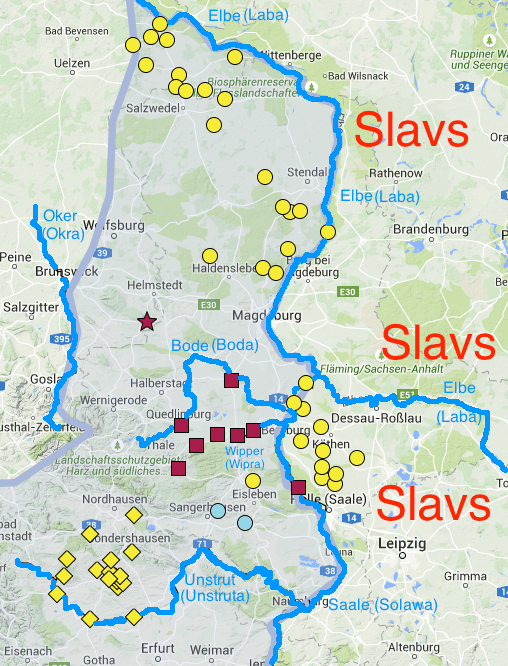
Based on this commentary we tried to replicate the locations in Thuringia of all these peoples.  Below you have a map with the borders of Thuringia:

  • the red squares represent the locations of the Suevi;
  • the blue circles show where the Frisian allies of Pepin resided as per the commentary on these events;
  • the yellow squares show the Slav towns of district Winidengo; and
  • the red star is Schoeningen [elsewhere Scahaningi] where the battle between the Saxons and the Franks almost took place.

finalmapz1z

Oh, we almost forgot.

  • The yellow circles are (some of the) Slavic town names where the Slavs are known to have resided around the area of the events in question.

You will note that all of these are on the left (West) bank of the Elbe.  In fact, the Slavs were present between the Elbe and the Saale as shown in more detail here.  Enjoy the zoom:

finalmapz2z

So in the middle there we had a mysterious group of Suevi (fighting for the Saxons).  But all around we had Slavs.  But there is more.  The following is from August von Wersebe’s Beschreibung der Gaue zwischen Elbe, Saale und Unstrut, Weser und Werra or the “Description of the Districts Between the Elbe, Saale and Unstrut, Weser and Werra” from the year 1829:


beschreibung

In a 937 gift of King Otto I to the Quedlinburg (nuns’) abbey (cloister?) (don’t we all just love presents?), the following towns are apparently listed (among others) – we include also their subsequent names:

  • Merselevo (Marsleben);
  • Uttislevo (Ussleben);
  • Waldislevo (Weddersleben);

The same is confirmed in the Codex Diplomaticus Anhaltinus, Volume 1:

ottos1

otto2

And here is where those were (see the yellowish houses):

finalmapz3z

(BTW, if you think these names are interesting – take a look at this listing from Ernst Wilhelm Förstemann’s Altdeutsches namenbuch – zweiter band Ortsnamen (just some highlights dotted in):

ortsnamen

It, thus, seems that many a -leben suffix is really a – levo in the original.  Now, no doubt, much of this can be explained by references to water (which brings us too to the Swebi but that’s a topic for another post) but it nonetheless all sounds strangely familiar).

Now, getting back to the current topic, it seems that our Suevi del Norte seem to have been  surrounded by Slavs in all, or almost all, directions.  But we know that they were Suevi, right?  How did they get there? The standard answer to this hearkens back to Gregory of Tours and Paul the Deacon.  The usual answer is that they were settled there by the Frankish King Clothar I  (same one as with the sheep above) or, more likely (to fit the timeline of Lombards entering Italy in 568), by his successor Sigibert.  The Suevi settled in places previously held by the Saxons but which had been vacated by the Saxons when these particular Saxons (friends of the Lombards, from the latter’s days on the Elbe?) went down to give the Lombards a hand in Italy (hence, presumably, at or after 568).

We present the relevant passages below.  Note, however, that nowhere does it say where these Suevi came from.  Must they have come from Swabia?  Perhaps, instead, from Pannonia (the Danube Suevi)?  Or perhaps the below Suevi/Suavi have nothing to do with our North Suevi?

There is too the interesting fact that all of this is around the town of Quedlinburg – the alleged place of origin (?) of the very Suevic Quadi (yes, Quedlin- burg but never mind the Slavic -in ending, we are told) so, if the Quadi were Suevi, which seems to be the case, and if Quedlinburg is really related to the Quadi, then, why must the Suevi be shipped from somewhere else to get to Quedlinburg?

And, in any event, where else were there Suevi?

Gregory of Tours History of the Franks (Book V, Chapter 15)

“Inasmuch as Clothar and Sigibert had settled the Suevi and other tribes on their land when Albin had gone to Italy, they who returned in the time of Sigibert, namely the men who had been with Albin rose against them, wishing to thrust them out from that country and destroy them.  But they offered the Saxons a third of the land, saying: ‘We can live together without interfering with one another.’ But the Saxons were angry at them because they had themselves held this land before and they were by no means willing to be pacified.  Then the Suevi made them a second offer of a half and then of two-thirds, leaving one-third for themselves.  And when the Saxons refused this, they offered all their flocks and herds with the land, provided only they would refrain from attacking them. But they would not agree even to this and demanded battle. And before the battle, thinking that they had the Suevi already as good as slain, they discussed among themselves how they should divide their wives and what each should receive after their defeat.  But God’s mercy which does justice turned their thoughts another way. For when they fought there were 26,000 Saxons of whom 20,000 fell and of the Suevi 6000 of whom 480 only were laid low; and the remainder won the victory. The Saxons who were left took oath that they would cut neither beard nor hair until they had taken vengeance on their adversaries. But when they fought again they were defeated with greater loss and so the war was ended.”

Paul the Deacon, History of the Lombards (Book 2 Chapter 6)

“But Alboin, being about to set out for Italy with the Langobards, asked aid from his old friends, the Saxons, that he might enter and take possession of so spacious a land with a larger number of followers. The Saxons came to him, more than 20,000 men, together with their wives and children, to proceed with him to Italy according to his desire. Hearing these things, Chlothar and Sigisbert, kings of the Franks, put the Suavi and other nations into the places from which these Saxons had come.”

Paul the Deacon, History of the Lombards (Book 3 Chapter 7)

“And when they had come to their own country they found it was held by Suaviand other peoples, as we have before related.  Bestirring themselves against these, they attempted to drive them out and destroy them. The Suavi however offered them a third part of the region, saying: “We can live together and dwell in common without strife.” and when they in no way acquiesced, the Suavi offered them a half and afterwards two parts, reserving only a third for themselves. And when they were unwilling, the Suavi offered with the land also all the flocks if only they would cease from war, but the Saxons, not content with this, sought a contest, and they had a strife among themselves beforehand in what way they should divide the wives of the Suavi. But it did not turn out with them as they thought, for when battle was joined 20,000 of them were killed, but of the Suavi four hundred and eighty fell, and the rest obtained a victory. And six thousand of the Saxons who survived the war made a vow that they would cut neither beard nor hair until they avenged themselves upon their Suabian enemies. And again going into battle, they were grievously wasted and so they ceased from war.”

The same story appears in the History of the Deeds of the Saxons by Widukind of Corvey.  Interestingly, in some manuscripts the reference is to Suevi (actually, again, Suavi) beyond the Elbe (Transalbini) not beyond the Bode (Transalbani).  But “beyond the Elbe” – looking East (from a Frankish point of view – but was it Widukind’s?) were the Slavs:

Widukind of Corvey, History of the Deeds of the Saxons (Book I, Chapter 14)

Qualiter Saxones agros dividunt, et quia triformi genere ac lege vivunt

Saxones igitur possessa terra summa pace quieverunt, societate Francorum atque amicitia usi. Parte quoque agrorum cum amicis auxiliariis vel manumissis distributa, reliquias pulsae gentis tributis condempnaverunt. Unde usque hodie gens Saxonica triformi genere ac lege preter conditionem servilem dividitur. A tribus etiam principibus totius gentis ducatus administrabatur, certis terminis exercitus congregandi potestate contenti, quos suis locis ac vocabulis novimus signatos, in orientales scilicet populos, Angarios atque Westfalos. Si autem universale bellum ingruerit, sorte eligitur, cui omnes obedire oportuit, ad administrandum inminens bellum. Quo peracto, aequo iure ac lege propria contentus potestate unusquisque vivebat. De legum vero varietate nostrum non est in hoc libello disserere, cum apud plures inveniatur lex Saxonica diligenter descripta. Suavi vero Transbadani/Transalbini illam quam incolunt regionem eo tempore invaserunt, quo Saxones cum Longobardis Italiam adierunt, ut eorum narrat historia, et ideo aliis legibus quam Saxones utuntur. Igitur Saxones variam fidem Francorum experti, de quibus nobis non est dicendum, cum in eorum gestis inveniatur scriptum, paterno errore obligati usque ad tempora Karoli Magni perdurabant.

widukin

The North Suevi are also mentioned by the Frankish King Theudebert, the Merovingian ruler (533-547/548) of Austrasia, in his letter to Emperor Justinian (Duchesne I, 862) but here the reference is to Norsavorum – as in the Sava River:

Norsavorum (Nordsuavorum?) gentis bobus placata majestas colla subdidit.

So that’s it for now.

P.S. Did we mention that the word sąsědъ/sąsiad/sused/soused (“neighbor” in Slavic languages) may be derived from the Slavic word for Saxon, i.e., Sas? – literally, sąsědъ, the one (Sas) who sits next [to us].

Copyright ©2015 jassa.org All Rights Reserved

June 24, 2015

On the Adriatic Veneti

Published Post author

We’ve been asked to produce a more complete list of sources regarding the Adriatic Veneti than the few references from Polybius that we gave here.  We oblige (and incorporate the prior posting) by producing, as far as we know, all information that is out there on the Adriatic Veneti.

Most of these come from from Perseus except for (1) Polybius 2,17 which we show in two translations, the Dindorf from Perseus but also the W.R. Paton since that chapter has some specific ethnographic information that is relevant to the question of the language of the Veneti (that is the chapter we have previously shown) so two translations may be a better deal and (2) Strabo where we use Perseus and Horace Leonard Jones (Loeb).  We also provide these two Polybius translations to demonstrate how different these translations, and in fact all translations, may be and how much is left to the eye and mind of the translator.

The Fragments of Greek Historians are from Jacoby (who else?) as given by Brill.  We included the original Latin along with the translations here (but not the Brill commentary which you can look up yourself).

We also include Pliny’s entire discussion of “where does amber come from?” – a topic we previously briefly touched upon here.  That chapter brings together the Veneti (Adriatic), Pannonia, the Germans, “glæsum” and the island (ostrów?) of “Austeravia“.

As a side note, it is interesting how the Veneti along with the Boii and the Senones (from Sienna) appear in this early Roman historiography as Romans’ northern neighbors.  Tribes with similar names we learn of in later Roman history as well, the Sarmatian Veneti, the Boii in Bohemia and the Suevi Semnones.

Finally, note that for Strabo we do include Book 1, Chapter 3 as it talks of the Veneti traveling from Paphlagonia to the Adriatic but we do not include Book 3, chapter 2 as that seems to relate solely to the Paphlagonian Veneti in Paphlagonia – a topic for when we discuss the Paphlagonian Veneti.

In any event, hold on to your horses – this one is a long one.

triestetargeste

Τεργέστη – Targ yest (where the market is) – Eppensteiner? Or “mit einer banier rôtgevar, daß was mit wîße durch gesniten hûte nâch wendischen siten”?  Or both?

Polybius 

Histories Book 2 Chapter 17 

(W.R. Paton)

“The Etruscans were the oldest inhabitants of this plain at the same period that they possessed also the Phlegraean plain in the neighborhood of Capua and Nola, which, accessible and well known as it is to many, has such a reputation for fertility.  Those therefore who would know something of the dominion of the Etruscans should not look at the country where they now inhabit but at these plains and the resources they drew thence.  The Celts being close neighbors of the Etruscans and associating much with them, cast covetous eyes on their beautiful untry, and on small pretext, suddenly attacked them with a a large army and, expelling them from the plain of the Po, occupied it themselves.  The first settlers at the eastern extremity, near the source of the Po, were the Laevi and Lebecii, after them the Insubres, the largest tribe of all, and next these, on the banks of the river, the Cenomani.  The part of the plain near the Adriatic had never ceased to be in the possession of another very ancient tribe called the Veneti, differing slightly from the Gauls in customs and costume and speaking another language.  About this people the tragic poets tell many marvelous stories.  On the other bank of the Po, by the Apennines, the first settlers beginning from the west were the Anares and next them the Boii.  Next the latter, towards the Adriatic, were the Lingones and lastly, near the sea the Senones.  These are the names of the principal tribes that settled in the district.”

beltus

“They lived in unwalled villages, without any superfluous furniture; for as they slept on beds of leaves and fed on meat and were exclusively occupied with war and agriculture, their lives were very simple, and they had no knowledge whatever of any art or science.  Their possessions of cattle and gold, because these were the only things they could carry about with them everywhere according to circumstances and shift where they chose.   They treated comradeship as of the greatest importance, those among them being the most feared and most powerful who were thought to have the largest number of attendants and associates.”

Polybius 

Histories Book 2 Chapter 17 

(Theodorus Buettner-Wobst edition – after L. Dindorf)

“To continue my description. These plains were anciently inhabited by Etruscans, at the same period as what are called the Phlegraean plains round Capua and Nola; which latter, however, have enjoyed the highest reputation, because they lay in a great many people’s way and so got known. In speaking then of the history of the Etruscan Empire, we should not refer to the district occupied by them at the present time, but to these northern plains, and to what they did when they inhabited them. Their chief intercourse was with the Celts, because they occupied the adjoining districts; who, envying the beauty of their lands, seized some slight pretext to gather a great host and expel the Etruscans from the valley of the Padus, which they at once took possession of themselves. First, the country near the source of the Padus was occupied by the Laevi and Lebecii; after them the Insubres settled in the country, the largest tribe of all; and next them, along the bank of the river, the CenomaniBut the district along the shore of the Adriatic was held by another very ancient tribe called Venĕti, in customs and dress nearly allied to Celts, but using quite a different language, about whom the tragic poets have written a great many wonderful tales. South of the Padus, in the Apennine district, first beginning from the west, the Ananes, and next them the Boii settled. Next them, on the coast of the Adriatic, the Lingones; and south of these, still on the sea-coast, the Senones. These are the most important tribes that took possession of this part of the country.”

“They [all?] lived in open villages, and without any permanent buildings. As they made their beds of straw or leaves, and fed on meat, and followed no pursuits but those of war and agriculture, they lived simple lives without being acquainted with any science or art whatever. Each man’s property, moreover, consisted in cattle and gold; as they were the only things that could be easily carried with them, when they wandered from place to place, and changed their dwelling as their fancy directed. They made a great point, however, of friendship: for the man who had the largest number of clients or companions in his wanderings, was looked upon as the most formidable and powerful member of the tribe.”

Polybius 

Histories Book 2 Chapter 18

(Theodorus Buettner-Wobst edition – after L. Dindorf)

[B.C. 360-330 – Gallic invasion of Italy]

“In the early times of their [Gauls/Celts] settlement they did not merely subdue the territory which they occupied, but rendered also many of the neighbouring peoples subject to them, whom they overawed by their audacity. Some time afterwards they conquered the Romans in battle, and pursuing the flying legions, in three days after the battle occupied Rome itself with the exception of the Capitol.”

But a circumstance intervened which recalled them home, an invasion, that is to say, of their territory by the Venĕti. [see here 🙂]  Accordingly they made terms with the Romans, handed back the city, and returned to their own land; and subsequently were occupied with domestic wars. Some of the tribes, also, who dwelt on the Alps, comparing their own barren districts with the rich territory occupied by the others, were continually making raids upon them, and collecting their force to attack them.”

venetissimo

them runes

“This gave the Romans time to recover their strength, and to come to terms with the people of Latium.  When, thirty years after the capture of the city, the Celts came again as far as Alba, the Romans were taken by surprise; and having had no intelligence of the intended invasion, nor time to collect the forces of the Socii, did not venture to give them battle.”

“But when another invasion in great force took place twelve years later, they did get previous intelligence of it; and, having mustered their allies, sallied forth to meet them with great spirit, being eager to engage them and fight a decisive battle.”

“But the Gauls were dismayed at their approach; and, being besides weakened by internal feuds, retreated homewards as soon as night fell, with all the appearance of a regular flight.”

“After this alarm they kept quiet for thirteen years; at the end of which period, seeing that the power of the Romans was growing formidable, they made a peace and a definite treaty with them.”

Polybius 

Histories Book 2 Chapter 23

(Theodorus Buettner-Wobst edition – after L. Dindorf)

[B.C. 225 – invasion of Italy by the Gaesatian Gauls]

The Gaesatae [Gaesatian Gauls], then, having collected their forces, crossed the Alps and descended into the valley of the Padus with a formidable army, furnished with a variety of armour, in the eighth year after the distribution of the lands of Picenum.  The Insubres and Boii remained loyal to the agreement they had made with them: but the Venĕti and Cenomani being induced by embassies from Rome to take the Roman side, the Celtic kings were obliged to leave a portion of their forces behind, to guard against an invasion of their territory by those tribes. They themselves, with their main army, consisting of one hundred and fifty thousand foot, and twenty thousand horse and chariots, struck camp and started on their march, which was to be through Etruria, in high spirits.  As soon as it was known at Rome that the Celts had crossed the Alps, one of the Consuls, Lucius Aemilius Papus, was sent with an army to Ariminum to guard against the passage of the enemy, and one of the Praetors into Etruria: for the other Consul, Gaius Atilius Regulus, happened to be in Sardinia with his legions. There was universal terror in Rome, for the danger threatening them was believed to be great and formidable. And naturally so: for the old fear of the Gauls had never been eradicated from their minds. No one thought of anything else: they were incessantly occupied in mustering the legions, or enrolling new ones, and in ordering up such of the allies as were ready for service. The proper magistrates were ordered to give in lists of all citizens of military age; that it might at once be known to what the total of the available forces amounted. And such stores of corn, and darts, and other military equipments were collected as no one could remember on any former occasion. From every side assistance was eagerly rendered; for the inhabitants of Italy, in their terror at the Gallic invasion, no longer thought of the matter as a question of alliance with Rome, or of the war as undertaken to support Roman supremacy, but each people regarded it as a danger menacing themselves and their own city and territory. The response to the Roman appeal therefore was prompt.”

Polybius 

Histories Book 2 Chapter 24

(Theodorus Buettner-Wobst edition – after L. Dindorf)

[B.C. 225 – invasion of Italy by the Gaesatian Gauls]

“But in order that we may learn from actual facts how great the power was which Hannibal subsequently ventured to attack, and what a mighty empire he faced when he succeeded in inflicting upon the Roman people the most severe disasters, I must now state the amount of the forces they could at that time bring into the field.  The two Consuls had marched out with four legions, each consisting of five thousand two hundred infantry and three hundred cavalry. Besides this there were with each Consul allies to the number of thirty thousand infantry and two thousand cavalry. Of Sabines and Etruscans too, there had come to Rome, for that special occasion, four thousand horse and more than fifty thousand foot. These were formed into an army and sent in advance into Etruria, under the command of one of the Praetors. Moreover, the Umbrians and Sarsinatae, hill tribes of the Apennine district, were collected to the number of twenty thousand; and with them were twenty thousand Venĕti and Cenomani. These were stationed on the frontier of the Gallic territory, that they might divert the attention of the invaders, by making an incursion into the territory of the Boii. These were the forces guarding the frontier. In Rome itself, ready as a reserve in case of the accidents of war, there remained twenty thousand foot and three thousand horse of citizens, and thirty thousand foot and two thousand horse of the allies. Lists of men for service had also been returned, of Latins eighty thousand foot and five thousand horse; of Samnites seventy thousand foot and seven thousand horse; of Iapygians and Messapians together fifty thousand foot and sixteen thousand horse; and of Lucanians thirty thousand foot and three thousand horse; of Marsi, and Marrucini, and Ferentani, and Vestini, twenty thousand foot and four thousand horse. And besides these, there were in reserve in Sicly and Tarentum two legions, each of which consisted of about four thousand two hundred foot, and two hundred horse. Of the Romans and Campanians the total of those put on the roll was two hundred and fifty thousand foot and twenty three thousand horse; so that the grand total of the forces actually defending Rome  was over 150,000 foot, 6000 cavalry: and of the men able to bear arms, Romans and allies, over 700,000 foot and 70,000 horse; while Hannibal, when he invaded Italy had less than twenty thousand to put against this immense force.”

Dio Chrysostom

Discourses (The Eleventh Discourse Maintaining that Troy was not Captured)

“Then Antenor acquired dominion over the Heneti and the very best land about the Adriatic, while Aeneas became master of all Italy and founded the greatest city in the world.”

Strabo 

Geography, Book 1, Chapter 3

“Having remarked that the ancients, whether out on piratical excursions, or for the purposes of commerce, never ventured into the high seas, but crept along the coast, and instancing Jason, who leaving his vessels at Colchis penetrated into Armenia and Media on foot, he [Strabo is talking about Eratosthenes] proceeds to tell us that formerly no one dared to navigate either the Euxine or the seas by Libya, Syria, and Cilicia.  If by formerly he means periods so long past that we possess no record of them, it is of little consequence to us whether they navigated those seas or not, but if [he speaks] of times of which we know any thing, and if we are to place any trust in the accounts which have come down to us, every one will admit that the ancients appear to have made longer journeys both by sea and land than their successors; witness Bacchus, Hercules, nay Jason himself, and again Ulysses and Menelaus, of whom Homer tells us.  It seems most probable that Theseus and Pirithous are indebted to some long voyages for the credit they afterwards obtained of having visited the infernal regions; and in like manner the Dioscuri gained the appellation of guardians of the sea, and the deliverers of sailors.  The sovereignty of the seas exercised by Minos, and the navigation carried on by the Phœnicians, is well known. A little after the period of the Trojan war they had penetrated beyond the Pillars of Hercules, and founded cities as well there as to the midst of the African coast.  Is it not correct to number amongst the ancients Æneas, Antenor, the Heneti, and all the crowd of warriors, who, after the destruction of Troy, wandered over the face of the whole earth? For at the conclusion of the war both the Greeks and Barbarians found themselves deprived, the one of their livelihood at home, the other of the fruits of their expedition; so that when Troy was overthrown, the victors, and still more the vanquished, who had survived the conflict, were compelled by want to a life of piracy; and we learn that they became the founders of many cities along the sea-coast beyond Greece, besides several inland settlements…”

venetissiscus

“Those who desire to instil into us that more perfect freedom from [ignorant] wonder, which Democritus and all other philosophers so highly extol, should add the changes which have been produced by the migrations of various tribes: we should thus be inspired with courage, steadiness, and composure. For instance, the Western Iberians, removed to the regions beyond the Euxine and Colchis, being separated from Armenia, according to Apollodorus, by the Araxes, but rather by the Cyrus and Moschican mountains. The expedition of the Egyptians into Ethiopia and Colchis. The migration of the Heneti, who passed from Paphlagonia into the country bordering on the Adriatic Gulf.  Similar emigrations were also undertaken by the nations of Greece, the IoniansDoriansAchaians, and Æolians; and the Ænians, now next neighbours to the Ætolians, formerly dwelt near Dotium and Ossa [remember Gallic Ossismii or the Ossi on the Baltic Sea?] , beyond the Perrhæbi; the Perrhæbi too are but wanderers here themselves.  Our present work furnishes numerous instances of the same kind. Some of these are familiar to most readers, but the migrations of the Carians, the Treres, the Teucrians, and the Galatæ or Gauls, are not so generally known. Nor yet for the most part are the expeditions of their chiefs, for instance, Madys the Scythian, Tearko the Ethiopian, Cobus of Trerus, Sesostris and Psammeticus the Egyptians; nor are those of the Persians from Cyrus to Xerxes familiar to every one.  The Kimmerians, or a separate tribe of them, called the Treres, have frequently overrun the countries to the right of the Euxine and those adjacent to them, bursting now into Paphlagonia, now into Phrygia, as they did when, according to report, Midas came to his death by drinking bull’s blood.  Lygdamis led his followers into Lydia, passed through Ionia, took Sardis, but was slain in Cilicia. The Kimmerians and Treres frequently made similar incursions, until at last, as it is reported, these latter, together with [their chief] Cobus, were driven out by Madys, king of the ‘Scythians.  But enough has been said in this place on the general history of the earth, as each country will have a particular account.”

Strabo 

Geography, Book 1, Chapter 3 (alternate translation)

(Jones (Loeb))

“Not only might one disapprove of Eratosthenes for telling such a story, but also for this reason: after admitting that the exact details about the seas were not yet known even in his own time, and although he bids us not to be too ready to accept the authority of people at haphazard, and although he gives at length the reasons why we should believe no one who writes mythical tales about the regions along the Euxine and the Adriatic, yet he himself accepted the authority of people at haphazard.  So, for example, he believed that the Gulf of Issus is the most easterly point of the Mediterranean; whereas the point at Dioscurias in the extreme corner of the Euxine Sea is farther east by almost three thousand stadia, even according to Eratosthenes himself, if we follow the reckoning by stadia which he gives.  And when he describes the northernmost and extreme parts of the Adriatic Sea there is nothing fabulous about them from which he holds aloof.  And he has also given credence to many fables about the regions beyond the Pillars of Heracles, mentioning an island named Cerne and other countries which are nowhere pointed out today — matters about which I shall speak later on.  And although Eratosthenes has said that the earliest Greeks made voyages for the sake of piracy or of commerce, not, indeed, in the open sea, but along the coast — as did Jason, who actually abandoned his ships and, starting from the Colchians, penetrated as far as Armenia and Media — he says later on that in ancient times no one had the courage to sail on the Euxine Sea, or along Libya, Syria, or Cilicia.  Now if by “the ancients” he means those who lived in the times of which we of to‑day have no records, then I am in no wise concerned to speak about them, as to whether they made voyages or not.  But if he means men who are mentioned in history, then one would not hesitate to affirm that the ancients will be shown to have made longer journeys, both by land and by sea, than have men of a later time, if we are to heed what tradition tells us: for instance, Dionysus, and Heracles, and Jason himself; and, again, Odysseus and Menelaus, whose stories are narrated by the poet.  And again, it is doubtless because Theseus and Pirithous had the hardihood to make such long journeys as they made that they left behind them the reputation of having gone down to Hades, and that the Dioscuri were called “guardians of the sea” and “saviours of sailors.”  Again, the maritime supremacy of Minos is far-famed, and so are the voyages of the Phoenicians, who, a short time after the Trojan War, explored the regions beyond the Pillars of Heracles and founded cities both there and in the central parts of the Libyan sea-board.  As to Aeneas, Antenor, and the Enetians, and, in a word, the survivors of the Trojan War that wandered forth into the whole inhabited world — is it proper not to reckon them among the men of ancient times?  For it came about that, on account of the length of the campaign, the Greeks of that time, and the barbarians as well, lost both what they had at home and what they had acquired by the campaign; and so, after the destruction of Troy, not only did the victors turn to piracy because of their poverty, the still more the vanquished who survived the war.  And, indeed, it is said that a great many cities were founded by them along the whole sea-coast outside of Greece, and in some places in the interior too…”

“…Writers also add the changes resulting from the migrations of peoples, wishing to develop in us, to a still greater extent, that virtue of not marvelling at things (a virtue which is lauded by Democritus and all the other philosophers; for they put it in a class with freedom from dread and from perturbability and from terror).  For instance: the migration of Western Iberians to the regions beyond the Pontus and Colchis (regions which are separated from Armenia by the Araxes according to Apollodorus, but rather by the River Cyrus and the Moschican Mountains); and the migration of Egyptians to Ethiopia and Colchis; and that of Enetians from Paphlagonia to the Adriatic.  This is what took place in the case of the Greek tribes also — Ionians, Dorians, Achaeans, and Aeolians; and the Aenianians that are now neighbours of the Aetolians used to live about Dotium and Mt. Ossa among the Perrhaebians; and, too, the Perrhaebians themselves are emigrants.  And the present treatise is full of such instances.  A number of them, to be sure, are matters even of ready knowledge to most people, but the emigrations of the Carians, Trerans, Teucrians, and Galatians, and likewise also the expeditions of the princes to lands far remote (I refer to Madys the Scythian, Tearko the Ethiopian, Cobus the Treran, Sesostris and Psammitichus the Egyptians, and to Persians from Cyrus to Xerxes) are not likewise matters of off-hand knowledge to everybody.  And those Cimmerians whom they also call Trerans (or some tribe or other of the Cimmerians) often overran the countries on the right of the Pontus and those adjacent to them, at one time having invaded Paphlagonia, and at another time Phrygia even, at which time Midas drank bull’s blood, they say, and thus went to his doom.  Lygdamis, however, at the head of his own soldiers, marched as far as Lydia and Ionia and captured Sardes, but lost his life in Cilicia.  Oftentimes both Cimmerians and Trerans made such invasions as these; but they say that the Trerans and Cobus were finally driven out by Madys, the king of the Scythians.  Let these illustrations be given here, inasmuch as they involve matters of fact which have a bearing upon the entire compass of the world in general.”

Strabo

Geography, Book 5, Chapter 1

(Jones (Loeb))

“After the foothills of the Alps comes the beginning of what is now Italy. For the ancients used to call only Oenotria Italy, although it extended from the Strait of Sicily only as far as the Gulfs of Tarentum and Poseidonia, but the name of Italy prevailed and advanced even as far as the foothills of the Alps, and also took in, not only those parts of Ligustica which extend from the boundaries of Tyrrhenia as far as the Varus River and the sea there, but also those parts of Istria which extend as far as Pola.  One might guess that it was because of their prosperity that the people who were the first to be named Italians imparted the name to the neighbouring peoples, and then received further increments in this way until the time of the Roman conquest.  At some late time or other after the Romans had shared with the Italiotes the equality of civil rights, they decided to allow the same honour both to the Cisalpine Galatae and to the Heneti, and to call all of them Italiotes as well as Romans, and, further, to send forth many colonies amongst them, some earlier and some later, than which it is not easy to call any other set of colonies better…”

“…Taking the parts severally, however, we can speak as follows: as for the Alps, their base is curved and gulf-like, with the cavities turned towards Italy; the central gulf are near the Salassi, while the extremities take a turn, the one as far as Ocra and the recess of the Adriatic, the other to the Ligurian seaboard as far as Genua (the emporium of the Ligures), where the Apennine Mountains join the Alps.  But immediately at the base of the Alps there lies a considerable plain, with its length and its breadth about equal, namely, two thousand one hundred stadia; its southern side is shut in both by the seaboard of the Heneti and by those Apennine Mountains which reach down to the neighbourhood of Ariminum and Ancona; for these mountains, after beginning in Liguria, enter Tyrrhenia, leaving only a narrow seaboard, and then, withdrawing into the interior little by little, when they come to be opposite the territory of Pisa, bend towards the east and towards the Adriatic until they reach the regions round about Ariminum and Ancona, there joining in a straight line the seaboard of the Heneti. Cisalpine Celtica, accordingly, is shut in by these boundaries; and although the length of the seaboard, together with that of the mountains, is as much as six thousand three hundred stadia, the breadth is slightly less than one thousand.  The remainder of Italy, however, is narrow and elongated, terminating in two heads, one at the Sicilian Strait and the other at Iapygia; and it is pinched in on both sides, on one by the Adriatic and on the other by the Tyrrhenian Sea.  The shape and the size of the Adriatic are like that part of Italy which is marked off by the Apennine Mountains and by both seas as far as Iapygia and that isthmus which is between the Gulfs of Tarentum and Poseidonia; for the maximum breadth of each is about one thousand three hundred stadia, and the length not much less than six thousand.  The remainder of Italy, however, is all the country occupied by the Brettii and certain of the Leucani.  Polybius says that, if you go by foot, the seaboard from Iapygia to the strait is as much as three thousand stadia, and that it is washed by the Sicilian Sea, but that, if you go by sea, it is as much as five hundred stadia short of that. The Apennine Mountains, after joining the regions round about Ariminum and Ancona, that is, after marking off the breadth of Italy there from sea to sea, again take a turn, and cut the whole country lengthwise.  As far, then, as the territory of the Peucetii and that of the Leucani they do not recede much from the Adriatic, but after joining the territory of the Leucani they bend off more towards the other sea and then, for the rest of the way, passing throughout the centre of the territory of the Leucani and Brettii, end at what is called Leucopetra in the district of Rhegium.  Thus much, then, I have said about what is now Italy, as a whole, in a merely rough-outline way, but I shall now go back and try to tell about the several parts in detail; and first about the parts at the base of the Alps.”

“This country is a plain that is very rich in soil and diversified by fruitful hills.  The plain is divided almost at its very centre by the Padus; and its parts are called, the one Cispadana, the other Transpadana.  Cispadana is all the part that lies next to the Apennine Mountains and Liguria, while Transpadana is the rest.  The latter is inhabited by the Ligurian and the Celtic tribes, who live partly in the mountains, partly in the plains, whereas the former is inhabited by the Celti and Heneti.  Now these Celti are indeed of the same race as the Transalpine Celti, but concerning the Heneti there are two different accounts: Some say that the Heneti too are colonists of those Celti of like name who live on the ocean-coast; while others say that certain of the Heneti of Paphlagonia escaped hither with Antenor from the Trojan war, and, as testimony in this, adduce their devotion to the breeding of horses — a devotion which now, indeed, has wholly disappeared, although formerly it was prized among them, from the fact of their ancient rivalry in the matter of producing mares for mule-breeding.  Homer, too, recalls this fact: “From the land of the Heneti, whence the breed of the wild mules.”  Again, Dionysius, the tyrant of Sicily, collected his stud of prize-horses from here, and consequently not only did the fame of the Henetian foal-breeding reach the Greeks but the breed itself was held in high esteem by them for a long time.”

“Now this whole country is filled with rivers and marshes, but particularly the part that belongs to the Heneti.  And this part, furthermore, is also affected by the behaviour of the sea; for here are almost the only parts of Our Sea that behave like the ocean, and both the ebb-tides and the flood-tides produced here are similar to those of the ocean, since by them the greater part of the plain is made full of lagoons.  But, like what is called Lower Egypt, it has been intersected by channels and dikes; and while some parts have been relieved by drainage and are being tilled, others afford voyages across their waters.  Of the cities here, some are wholly island, while others are only partly surrounded by water.  As for all the cities that are situated above the marshes in the interior, the inland voyages afforded thereto by the rivers are wonderful, but particularly by the Padus; for not only is it the largest of these rivers but it is oftentimes filled by both the rains and the snow, although, as the result of separating into many streams near the outlets, the mouth is choked with mud and hard to enter. But even the greatest difficulties are overcome by experience…”

“… But Opitergium, Concordia, Atria, Vicetia, and other small towns like them are less hemmed in by the marshes, though they are connected with the sea by small waterways.  It is said that Atria was once an illustrious city, and that the Adriatic Gulf got its name therefrom, with only a slight change in the spelling.  Aquileia, which is nearest of all to the recess of the Gulf, was founded by the Romans as a fortress against the barbarians who were situated above it; and there is an inland voyage thither for merchant-vessels, by way of the River Natiso, for a distance of more than sixty stadia.  Aquileia has been given over as an emporium for those tribes of the Illyrians that live near the Ister; the latter load on wagons and carry inland the products of the sea, and wine stored in wooden jars, and also olive-oil, whereas the former get in exchange slaves, cattle, and hides.  But Aquileia is outside the boundaries of the Heneti.  The boundary between the two peoples is marked by a river flowing from the Alps, which affords an inland voyage of as much as twelve hundred stadia to the city of Noreia, near which Gnaeus Carbo clashed to no effect with the Cimbri.  This region has places that are naturally well-suited to gold-washing, and has also iron-works.  And in the very recess of the Adriatic there is also a temple of Diomedes that is worth recording, “the Timavum“; for it has a harbour, and a magnificent precinct, and seven fountains of potable waters which immediately empty into the sea in one broad, deep river.  According to Polybius, all the fountains except one are of salt water, and what is more, the natives call the place the source and mother of the sea.  But Poseidonius says that a river, the Timavus, runs out of the mountains, falls down into a chasm, and then, after running underground about a hundred and thirty stadia, makes its exit near the sea.”

“As for the dominion of Diomedes in the neighbourhood of this sea, not only the “Islands of Diomedes” bear witness thereto, but also the historical accounts of the Daunii and Argos Hippium, which I shall relate insofar as they may be historically useful; but I must disregard most of the mythical or false stories, as, for example, the stories of Phaethon, and of the Heliades that were changed into poplar-trees near the Eridanus (the Eridanus that exists nowhere on earth, although it is spoken of as near the Padus), and of the Electrides Islands that lie off the Padus, and of the guinea-fowls on them; for not one of these things is in that region, either.  It is an historical fact, however, that among the Heneti certain honours have been decreed to Diomedes; and, indeed, a white horse is still sacrificed to him, and two precincts are still to be seen — one of them sacred to the Argive Hera and the other to the Aetolian Artemis.  But some mythical elements, of course, have been added: namely, that in these sacred precincts the wild animals become tame, and deer herd with wolves, and they allow the people to approach and caress them, and any that are being pursued by dogs are no longer pursued when they have taken refuge here.  And it is said that one of the prominent men, who was known for his fondness for giving bail for people and was twitted for this, fell in with some hunters who had a wolf in their nets, and, upon their saying in jest that if he would give bail for the wolf, and agree to settle all the damage the wolf should do, they would set the wolf free from the toils, he agreed to the proposal; and the wolf, when set free, drove off a considerable herd of unbranded horses and brought them to the steading of the man who was fond of giving bail; and the man who received the favour not only branded all the mares with a wolf, but also called them the “wolf-breed” — mares exceptional for speed rather than beauty; and his successors kept not only the brand but also the name for the breed of the horses, and made it a custom not to sell a mare to outsiders, in order that the genuine breed might remain in their family alone, since horses of that breed had become famous.  But, at the present time, as I was saying, the practice of horse-breeding has wholly disappeared.  After the Timavum comes the seaboard of the Istrii as far as Pola, which belongs to Italy.  Between the Timavum and Pola lies the stronghold of Tergeste, at a distance of one hundred and eighty stadia from Aquileia.  As for Pola, it is situated in a harbour-like gulf which has isles with good mooring-places and with fruitful soil; it was founded in early times by those Colchians who were sent forth in quest of Medea, but failed in their undertaking and thus condemned themselves to exile: “which a Greek would call ‘the city of the exiles,’ ” as Callimachus has said, “but their tongue hath named it Polae.”  The Transpadane districts, then, are occupied both by the Heneti and by the peoples who extend as far as Pola; and, above the Heneti, by the Carni, the Cenomani, the Medoaci, and the Symbri; of these peoples, some were once enemies of the Romans, but the Cenomani and the Heneti used to help the Romans in their battles, not only before the campaign of Hannibal (I mean when the Romans were making war upon the Boii and the Symbri), but thereafter as well.”

“But the Cispadane peoples occupy all that country which is encircled by the Apennine Mountains towards the Alps as far as Genua and Sabata.  The greater part of the country used to be occupied by the Boii, Ligures, Senones, and Gaezatae; but since the Boii have been driven out, and since both the Gaezatae and the Senones have been annihilated, only the Ligurian tribes and the Roman colonies are left.  The Romans, however, have been intermingled with the stock of the Ombrici and also, in some places, with that of the Tyrrheni; for both these tribes, before the general aggrandizement of the Romans, carried on a sort of competition with one another for the primacy, and since they had only the River Tiber between them could easily cross over against one another.  And if, as I suppose, one of the two peoples went forth on a campaign against a third people, the other of the two conceived a contentious desire not to fail to make an expedition to the same places; and so, too, when the Tyrrheni had sent forth an army into the midst of the barbarians round about the Padus and had fared well, and then on account of their luxurious living were quickly cast out again, the other of the two made an expedition against those who had cast them out; and then, in turns, disputing over the places, the two, in the case of many of the settlements, made some Tyrrhenian and some Ombrican — the greater number, however, Ombrican, for the Ombrici were nearer.  But the Romans, upon taking control and sending settlers to many places, helped to preserve also the stocks of the earlier settlers.  And at the present time, although they are all Romans, they are none the less called, some “Ombri,” and some “Tyrrheni,” as is the case with the Heneti, the Ligures, and the Insubri.”

Strabo

Geography, Book 6, Chapter 3

(Jones (Loeb))

“From Barium to the Aufidus River, on which is the Emporium of the Canusitae is four hundred stadia and the voyage inland to Emporium is ninety. Near by is also Salapia, the seaport of the Argyrippini.  For not far above the sea (in the plain, at all events) are situated two cities, Canusium and Argyrippa, which in earlier times were the largest of the Italiote cities, as is clear from the circuits of their walls.  Now, however, Argyrippa is smaller; it was called Argos Hippium at first, then Argyrippa, and then by the present name Arpi.  Both are said to have been founded by Diomedes.  And as signs of the dominion of Diomedes in these regions are to be seen the Plain of Diomedes and many other things, among which are the old votive offerings in the temple of Athene at Luceria — a place which likewise was in ancient times a city of the Daunii, but is now reduced — and, in the sea near by, two islands that are called the Islands of Diomedes, of which one is inhabited, while the other, it is said, is desert; on the latter, according to certain narrators of myths, Diomedes was caused to disappear, and his companions were changed to birds, and to this day, in fact, remain tame and live a sort of human life, not only in their orderly ways but also in their tameness towards honorable men and in their flight from wicked and knavish men.  But I have already mentioned the stories constantly told among the Heneti about this hero and the rites which are observed in his honour.  It is thought that Sipus also was founded by Diomedes, which is about one hundred and forty stadia distant from Salapia; at any rate it was named “Sepius” in Greek after the “sepia” that are cast ashore by the waves.  Between Salapia and Sinus is a navigable river, and also a large lake that opens into the sea; and the merchandise from Sipus, particularly grain, is brought down on both.  In Daunia, on a hill by the name of Drium, are to be seen two hero-temples: one, to Calchas, on the very summit, where those who consult the oracle sacrifice to his shade a black ram and sleep in the hide, and the other, to Podaleirius, down near the base of the hill, this temple being about one hundred stadia distant from the sea; and from it flows a stream which is a cure-all for diseases of animals.  In front of this gulf is a promontory, Garganum, which extends towards the east for a distance of three hundred stadia into the high sea; doubling the headland, one comes to a small town, Urium, and off the headland are to be seen the Islands of Diomedes.  This whole country produces everything in great quantity, and is excellent for horses and sheep; but though the wool is softer than the Tarantine, it is not so glossy.  And the country is well sheltered, because the plains lie in hollows.  According to some, Diomedes even tried to cut a canal as far as the sea, but left behind both this and the rest of his undertakings only half-finished, because he was summoned home and there ended his life.  This is one account of him; but there is also a second, that he stayed here till the end of his life; and a third, the aforesaid mythical account, which tells of his disappearance in the island; and as a fourth one might set down the account of the Heneti, for they too tell a mythical story of how he in some way came to his end in their country, and they call it his apotheosis.”

Pomponius Mela

Description of the World (De situ orbis libri III) – 1.58, 1.59 & 1.61

“…Italy as a whole is narrow, and in some places much narrower than where it had begun.”

“Various peoples cultivate its interior.  The Carni and Veneti cultivate the left part up to Gallia Togata; the some Italic peoples – Picentines, Frentani, Dauni, Apulians, Calabri, and Sallentines.  To the right at the foot of the Alps are the Ligurians; at the foot of the Apennines, Etruria; after that, Latium, the Volsci, Campania, and, below Lucania, the Brutti.  Of the cities that are inhabited far from the sea, the wealthiest are, too the left side, Antenor’s Patavium, Mutina, and Bononia, colonies of the Romans; to the right, Capua, founded by the Tuscans, and Rome, long ago founded by shepherds, now a second book in itself if there is to be discussion on the topic.”

“On the shores, by contrast, Concordia is next after Tergeste.  Between them flows the Timavus, which rises from nine herds but debouches through a single mouth.  Then, not far from the sea, the Natiso River runs beside rich Aquileia…”

Titus Livius (Livy) 

The History of Rome (Ab Urbe Condita Libri) (Book 1, Chapter 1)

“To begin with, it is generally admitted that after the capture of Troy, whilst the rest of the Trojans were massacred, against two of them —Aeneas and Antenor —the Achivi refused to exercise the rights of war, partly owing to old ties of hospitality, and partly because these men had always been in favour of making peace and surrendering Helen.  Their subsequent fortunes were different. Antenor sailed into the furthest part of the Adriatic, accompanied by a number of Enetians who had been driven from Paphlagonia by a revolution and after losing their king Pylaemenes before Troy were looking for a settlement and a leader.  The combined force of Enetians and Trojans defeated the Euganei, who dwelt between the sea and the Alps and occupied their land.  The place where they disembarked was called Troy, and the name was extended to the surrounding district; the whole nation were called Veneti. Similar misfortunes led to Aeneas becoming a wanderer but the Fates were preparing a higher destiny for him. He first visited Macedonia, then was carried down to Sicily in quest of a settlement; from Sicily he directed his course to the Laurentian territory.  Here, too, the name of Troy is found, and here the Trojans disembarked, and as their almost infinite wanderings had left them nothing but their arms and their ships, they began to plunder the neighbourhood. The Aborigines, who occupied the country, with their king Latinus at their head came hastily together from the city and the country districts to repel the inroads of the strangers by force of arms.”

“From this point there is a twofold tradition. According to the one, Latinus was defeated in battle, and made peace with Aeneas, and subsequently a family alliance.  According to the other, whilst the two armies were standing ready to engage and waiting for the signal, Latinus advanced in front of his lines and invited the leader of the strangers to a conference.  He inquired of him what manner of men they were, whence they came, what had happened to make them leave their homes, what were they in quest of when they landed in Latinus’ territory.  When he heard that the men were Trojans, that their leader was Aeneas, the son of Anchises and Venus, that their city had been burnt, and that the homeless exiles were now looking for a place to settle in and build a city, he was so struck with the noble bearing of the men and their leader, and their readiness to accept alike either peace or war, that he gave his right hand as a solemn pledge of friendship for the future.  A formal treaty was made between the leaders and mutual greetings exchanged between the armies. Latinus received Aeneas as a guest in his house, and there, in the presence of his tutelary deities, completed the political alliance by a domestic one, and gave his daughter in marriage to Aeneas. This incident confirmed the Trojans in the hope that they had reached the term of their wanderings and won a permanent home.  They built a town, which Aeneas called Lavinium after his wife. In a short time a boy was born of the new marriage, to whom his parents gave the name of Ascanius.”

Titus Livius (Livy) 

The History of Rome (Book 5, Chapter 33)

“After the expulsion of that citizen whose presence, if there is anything certain in human affairs, would have made the capture of Rome impossible, the doom of the fated City swiftly approached. Ambassadors came from Clusium begging for assistance against the Gauls.”

coffee

The Veneti invented the coffee mug – though the first model fell flat

“The tradition is that this nation, attracted by the report of the delicious fruits and especially of the wine —a novel pleasure to them —crossed the Alps and occupied the lands formerly cultivated by the Etruscans, and that Arruns of Clusium imported wine into Gaul in order to allure them into Italy. His wife had been seduced by a Lucumo, to whom he was guardian, and from whom, being a young man of considerable influence, it was impossible to get redress without getting help from abroad.  In revenge, Arruns led the Gauls across the Alps and prompted them to attack Clusium.”

veneticsa

whereas v. 2’s complicated instruction manual frightened away potential purchasers

“I would not deny that the Gauls were conducted to Clusium by Arruns or some one else living there, but it is quite clear that those who attacked that city were not the first who crossed the Alps.  As a matter of fact, Gauls crossed into Italy two centuries before they attacked Clusium and took Rome.  Nor were the Clusines the first Etruscans with whom the Gaulish armies came into conflict; long before that they had fought many battles with the Etruscans who dwelt between the Apennines and the Alps.  Before the Roman supremacy, the power of the Tuscans was widely extended both by sea and land.  How far it extended over the two seas by which Italy is surrounded like an island is proved by the names, for the nations of Italy call the one the ‘Tuscan Sea,’ from the general designation of the people, and the other the ‘Atriatic,’ from Atriaa Tuscan colony. The Greeks also call them the ‘Tyrrhene’ and the ‘Adriatic.’  The districts stretching towards either sea were inhabited by them. They first settled on this side the Apennines by the western sea in twelve cities, afterwards they founded twelve colonies beyond the Apennines, corresponding to the number of the mother cities.  These [Etruscan] colonies held the whole of the country beyond the Po as far as the Alps, with the exception of the corner inhabited by the Veneti, who dwelt round an arm of the sea.  The Alpine tribes are undoubtedly of the same stock, especially the Raetii, who had through the nature of their country become so uncivilised that they retained no trace of their original condition except their language, and even this was not free from corruption.”

Titus Livius (Livy) 

The History of Rome (Ab Urbe Condita Libri) (Book 10, Chapter 2)

[303/302 BC – Greeks invade Italy]

“During the year a fleet of Greek ships under the command of the Lacedaemonian Cleonymus sailed to the shores of Italy and captured the city of Thuriae in the Sallentine country. The consul, Aemilius, was sent to meet this enemy, and in one battle he routed him and drove him to his ships.  Thuriae was restored to its former inhabitants, and peace was established in the Sallentine territory.  In some annalists I find it stated that the Dictator, Junius Bubulcus, was sent into that country, and that Cleonymus left Italy to avoid a conflict with the Romans.  He sailed round the promontory of Brundisium, and was carried up the Adriatic, where he had on his left the harbourless shores of Italy and on his right the countries occupied by the Illyrians, the Liburnians, and the Histrians, savage tribes chiefly notorious for their acts of piracy. He dreaded the possibility of falling in with these, and consequently directed his course inland until he reached the coasts of the Veneti.  Here he landed a small party to explore the neighbourhood.  The information they brought back was to the effect that there was a narrow beach, and on crossing it they found lagoons which were affected by the tide; beyond these level cultivated country was visible, and in the further distance hills could be seen.  At no great distance was the mouth of a river deep enough to allow of ships being brought up and safely anchored —this was the Meduacus.  On hearing this he ordered the fleet to make for that river and sail up-stream. As the river channel did not admit the passage of his largest ships, the bulk of his troops went up in the lighter vessels and came to a populous district belonging to the maritime villages of the Patavii, who inhabit that coast.  After leaving a few to guard the ships they landed, seized the villages, burnt the houses, and carried off the men and cattle as booty.  Their eagerness for plunder led them too far from their ships.  The people of Patavium were obliged to be always under arms owing to their neighbours, the Gauls, and when they heard what was going on, they divided their forces into two armies.  One of these was to proceed to the district where the invaders were reported to be carrying on their depredations; the other was to go by a different route, to avoid meeting any of the plunderers, to where the ships were anchored, about fourteen miles from the town.  The latter attacked the ships, and after killing those who resisted them, they compelled the terrified sailors to take their vessels over to the opposite bank.  The other army had been equally successful against the plunderers, who in their flight to their ships were intercepted by the Veneti, and, hemmed in between the two armies, were cut to pieces.   Some of the prisoners informed their captors that King Cleonymus, with his fleet, was only three miles distant. The prisoners were sent to the nearest village for safe-keeping, and some of the defenders got into their river boats, which were flatbottomed to allow of their passing over the shallows in the lagoons, whilst others manned the vessels they had captured and sailed down the river.  When they reached the Greek fleet they surrounded the large ships, which were afraid to stir and dreaded unknown waters more than the enemy, and pursued them to the mouth of the river. Some which in the confused fighting had run aground were captured and burnt.”

“After this victory they returned.  Failing to effect a successful landing in any part of the Adriatic, Cleonymus sailed away with barely a fifth part of his fleet undamaged.  There are many still living who have seen the beaks of the ships and the spoils of the Lacedaemonians hung up in the old temple of Juno in Patavium, and the anniversary of that battle is celebrated by a sham fight of ships on the river which flows through the town.”

Pliny the Elder 

Natural History – Book 3, Chapter 6

(Of Italy)

“Next comes Italy, and we begin with the Ligures, after whom we have EtruriaUmbriaLatium, where the mouths of the Tiber are situated, and Rome, the Capital of the world, sixteen miles distant from the sea. We then come to the coasts of the Volsci and of Campania, and the districts of Picenum, of Lucania, and of Bruttium, where Italy extends the farthest in a southerly direction, and projects into the [two] seas with the chain of the Alps which there forms pretty nearly the shape of a crescent. Leaving Bruttium we come to the coast of [Magna] Græcia, then the Salentini, the Pediculi, the Apuli, the Peligni, the Frentani, the Marrucini, the Vestini, the Sabini, the Picentes, the Galli, the Umbri, the Tusci, the Veneti, the Carni, the Iapydes, the Histri, and the Liburni.

Pliny the Elder

Natural History – Book 3, Chapter 22

(The Tenth Region of Italy)

“We now come to the tenth region of Italy, situated on the Adriatic Sea.  In this district are Venetia, the river Silis, rising in the Tarvisanian mountains, the town of Altinum, the river Liquentia rising in the mountains of Opitergium, and a port with the same name, the colony of Concordia the rivers and harbours of Romatinum, the greater and less Tiliaventum, the Anaxum, into which the Varamus flows, the Alsa, and the Natiso with the Turrus, which flow past the colony of Aquileia at a distance of fifteen miles from the sea. This is the country of the Carni, and adjoining to it is that of the lapydes, the river Timavus, the fortress of Pucinum, famous for its wines, the Gulf of Tergeste [Triest – apparently it means “targ jest” or “market place”], and the colony of that name, thirty-three miles from Aquileia.  Six miles beyond this place lies the river Formio, 189 miles distant from Ravenna, the ancient boundary of enlarged Italy, and now the frontier of Istria. That this region takes its name from the river Ister which flows from the Danube, also called the Ister, into the Adriatic opposite the mouth of the Padus, and that the sea which lies between them is rendered fresh by their waters running from opposite directions, has been erroneously asserted by many, and among them by Nepos even, who dwelt upon the banks of the Padus.  For it is the fact that no river which runs from the Danube discharges itself into the Adriatic.  They have been misled, I think, by the circumstance that the ship Argo came down some river into the Adriatic sea, not far from Tergeste; but what river that was is now unknown.  The most careful writers say that the ship was carried across the Alps on men’s shoulders, having passed along the Ister, then along the Savus, and so from Nauportus, which place, lying between Æmona and the Alps, from that circumstance derives its name.”

Pliny the Elder

Natural History – Book 3, Chapter 23

(Istria, its People and Locality)

Istria projects in the form of a peninsula. Some writers have stated its length to be forty miles, and its circumference 125; and the same as to Liburnia which adjoins it, and the Flanatic Gulf, while others make it 225; others again make the circumference of Liburnia 180 miles. Some persons too extend Iapydia, at the back of Istria, as far as the Flanatic Gulf, a distance of 130 miles, thus making Liburnia but 150 miles. Tuditanus, who subdued the Istri, had this inscription on his statue which was erected there: “From Aquileia to the river Titus is a distance of 1000 stadia.”

masvetiveri

Ma Sveti Veri!

The towns of Istria with the rights of Roman citizens are ÆgidaParentium, and the colony of Pola, now Pietas Julia, formerly founded by the Colchians, and distant from Tergeste [again, Triest – apparently it means “targ jest” or “market place”; but then what is Ateste below?] 100 miles: after which we come to the town of Nesactium, and the river Arsia, now the boundary of Italy. The distance across from Ancona to Pola is 120 miles.  In the interior of the tenth region are the colonies of CremonaBrixia in the territory of the CenomanniAteste belonging to the Veneti, and the towns of AcelumPataviumOpitergiumBelunum, and Vicetia; with Mantua, the only city of the Tuscans now left beyond the Padus.  Cato* informs us that the Veneti are descendants of the Trojans, and that the Cenomanni dwelt among the Volcæ in the vicinity of Massilia.  There are also the towns of the Fertini, the Tridentini, and the Beruenses, belonging to the RhætiVerona, belonging to the Rhæti and the Euganei, and Julienses to the Carni. We then have the following peoples, whom there is no necessity to particularize with any degree of exactness, the Alutrenses, the Asseriates, the Flamonienses with those surnamed Vanienses, and the others called Culici, the Forojulienses surnamed Transpadani, the Foretani, the Nedinates, the Quarqueni, the Taurisani, the Togienses, and the Varvari.  In this district there have disappeared—upon the coast—IramenePellaon, and PalsatiumAtina and Cælina belonging to the VenetiSegeste and Ocra [Ukra?] to the Carni, and Noreia to the Taurisci.  L. Piso also informs us that although the senate disapproved of his so doing, M. Claudius Marcellus razed to the ground a tower situate at the twelfth mile-stone from Aquileia.”

* Cato, i.e., Cato the Elder (234 BC – 149 BC), born Marcus Porcius Cato

nemasvetiveri

Ne Ma Sveti Veri?

“In this region also and the eleventh there are some celebrated lakes, and several rivers that either take their rise in them or else are fed by their waters, in those cases in which they again emerge from them. These are the Addua [remember Viadua?], fed by the Lake Larius, the Ticinus by Lake Verbannus, the Mincius by Lake Benacus, the Ollius by Lake Sebinnus, and the Lambrus by Lake Eupilis—all of them flowing into the Padus.”

“Cælius states that the length of the Alps from the Upper Sea to the Lower is 1000 miles, a distance which Timagenes shortens by twenty-two. Cornelius Nepos assigns to them a breadth of 100 miles, and T. Livius of 3000 stadia; but then in different places. For in some localities they exceed 100 miles; where they divide Germany, for instance, from Italy; while in other parts they do not reach seventy, being thus narrowed by the providential dispensation of nature as it were. The breadth of Italy, taken from the river Var at the foot of these mountains, and passing along by the Vada Sabatia, the Taurini, Comum, Brixia, Verona, Vicetia, Opitergium, Aquileia, Tergeste, Pola, and Arsia, is 745 miles.

Pompeius Trogus

Lost Historiae Philippicae‘s Table of Contents Regarding Volume 20

“The twentieth volume describes the accomplishments of Dionysios I of Sicily. How he undertook wars in Italy once the Carthaginians had been defeated. Here are found the origins of the Veneti and the Greeks and the Gauls who inhabit Italy.”

(vicensimo volumine continentur res gestae Dionysii Siculi patris. ut pulsis Poenis Italica bella sit molitus. inde repetitae origines Venetorum et Craecorum et Gallorum, qui Italiam incolunt.)

Justinus, Epitome 20.1.4-12

“[Dionysios] made all the Greeks of Italy his enemies.  These peoples occupied almost all of Italy at the time.  Indeed, many cities still show traces of Greek custom after such a great length of time.  For the Etruscans, who possess the coast of the lower sea, came from Lydia;  and Troy, having been captured and destroyed, sent the Veneti, who dwell near the upper sea, under the leadership of Antenor.  Adria also … is a Greek city;  Diomedes founded … Arpi.  Among the LiguriansPisa has Greek founders, and among the Etruscans Tarquinii was founded by Thesallians, also Spina among the Umbrians; the Perugians, too, take their origin from Achaeans.  And what am I to say of Caere? What of the Latin peoples, who are known to have been established by Aeneas?”

(omnesque Graeci nominis Italiam possidentes hostes sibi destinat, quae gentes … universam ferme Italiam ea tempestate occupaverant.  denique multae urbes adhuc post tantam vetustatem vestigia Graeci moris ostentant.  namque Tuscorum populi, qui oram Inferi maris possident, a Lydia venerunt, et Venetos, quos incolas Superi maris videmus, capta et expugnata Troia Antenore duce misit.  Adria quoque … Graeca urbs est;  Arpos Diomedes … condidit.  sed et Pisae in Liguribus Graecos auctores habent, et in Tuscis Tar- quinii a Thessalis et Spina in Umbris; Perusini quoque originem ab Achaeis ducunt. quid Caeren urbem dicam? quid Latinos populos, qui ab Aenea conditi videntur?)

Pliny the Elder Natural History – Book 26, Chapter 26

(Halus or Cotonea: Five Remedies)

“The plant halus, by the people of Gaul called “sil,” and by the Veneti “cotonea,” is curative of pains in the side, affections of the kidneys, ruptures, and convulsions. It resembles cunila bubula in appearance, and the tops of it are like those of thyme. It is of a sweet flavour, and allays thirst; the roots of it are sometimes white, sometimes black.”

[not clear whether this means Adriatic, Gallic or some other Veneti – but we include it here for the sake of completeness]

Pliny the Elder Natural History – Book 37, Chapter 11

(Amber: the Many Falsehoods That Have Been Told About It)

“Next in rank among the objects of luxury, we have amber; an article which, for the present, however, is in request among women only. All these three last-mentioned substances hold the same rank, no doubt, as precious stones; the two former for certain fair reasons; crystal, because it is adapted for taking cool drinks, and murrhine vessels, for taking drinks that are either hot or cold.  But as for amber, luxury has not been able, as yet, to devise any justification for the use of it.  This is a subject which affords us an excellent opportunity of exposing some of the frivolities and falsehoods of the Greeks; and I beg that my readers will only have patience with me while I do so, it being really worth while, for our own practical improvement, to become acquainted with the marvellous stories which they have promulgated respecting amber.”

“After Phaëthon had been struck by lightning, his sisters, they tell us, became changed into poplars, which every year shed their tears upon the banks of the Eridanus, a river known to us as the “Padus.” To these tears was given the name of “electrum,” from the circumstance that the Sun was usually called “elector.”  Such is the story, at all events, that is told by many of the poets, the first of whom were, in my opinion, ÆschylusPhiloxenusEuripidesSatyrus, and Nicander; and the falsity of which is abundantly proved upon the testimony of Italy itself.  Those among the Greeks who have devoted more attention to the subject, have spoken of certain islands in the Adriatic Sea, known as the “Electrides,” and to which the Padus, they say, carries down electrum.  It is the fact, however, that there never were any islands there so called, nor, indeed, any islands so situate as to allow of the Padus carrying down anything in its course to their shores. As to Æschylus placing the Eridanus in Iberia, or, in other words, in Spain, and giving it the name of Rhodanus; and as to Euripides and Apollonius representing the Rhodanus and the Padus as discharging themselves by one common mouth on the shores of the Adriatic; we can forgive them all the more readily for knowing nothing about amber when they betray such monstrous ignorance of geography.”

“Other writers, again, who are more guarded in their assertions, have told us, though with an equal degree of untruthfulness, that, at the extremity of the Adriatic Gulf, upon certain inaccessible rocks there, there are certain trees which shed their gum at the rising of the Dog-Star.  Theophrastus has stated that amber is extracted from the earth in LiguriaChares, that Phaëthon died in the territory of Hammon, in Æthiopia, where there is a temple of his and an oracle, and where amberis produced; Philemon, that it is a fossil substance, and that it is found in two different localities in Scythia, in one of which it is of a white and waxen colour, and is known as “electrum;” while in the other it is red, and is called “sualiternicum.”  Demostratus calls amber “lyncurion,” and he says that it originates in the urine of the wild beast known as the “lynx;” that voided by the male producing a red and fiery substance, and that by the female an amber of a white and less pronounced colour: he also informs us that by some persons it is called “langurium,” and that in Italy, there are certain wild beasts known as “languri.” Zenothemis, however, calls these wild beasts “langæ,” and gives the banks of the river Padus as their locality.  Sudines says, that it is a tree in reality, that produces amber, and that, in Etruria, this tree is known by the name of “lynx;” an opinion which is also adopted by Metrodorus.  Sotacus expresses a belief that amber exudes from certain stones in Britannia, to which he gives the name of “electrides.”  Pytheas says that the Gutones, a people of Germany, inhabit the shores of an æstuary of the Ocean called Mentonomon, their territory extending a distance of six thousand stadia; that, at one day’s sail from this territory, is the Isle of Abalus, upon the shores of which, amber is thrown up by the waves in spring, it being an excretion of the sea in a concrete form; as, also, that the inhabitants use this amber by way of fuel, and sell it to their neighbours, the Teutones. Timæus, too, is of the same belief, but he has given to the island the name of Basilia.

“Philemon says that electrum does not yield a flame.  Nicias, again, will have it, that it is a liquid produced by the rays of the sun; and that these rays, at the moment of the sun’s setting, striking with the greatest force upon the surface of the soil, leave upon it an unctuous sweat, which is carried off by the tides of the Ocean, and thrown up upon the shores of Germany.  He states, also, that in Egypt it is similarly produced, and is there called “sacal;” that it is found in India, too, where it is held as a preferable substitute for frankincense; and that in Syria the women make the whirls of their spindles of this substance, and give it the name of “harpax,” from the circumstance that it attracts leaves towards it, chaff, and the light fringe of tissues. According to Theochrestus, amber is thrown up by the tides of the Ocean, at the foot of the Pyrenæan range; an opinion adopted also by Xenocrates.  Asarubas, who has written the most recently upon these subjects, and is still living, informs us, that near the shores of the Atlantic is Lake Cephisis, known to the Mauri by the name of “Electrum;” and that when this lake is dried up by the sun, the slime of it produces amber, which floats upon the surface.  Mnaseas speaks of a locality in Africa called Sicyon, and of a river Crathis there, which discharges itself from a lake into the Ocean, the banks of which are frequented by birds which he calls “meleagrides” and “penelopes:” it is here that, according to him, electrum is produced, in manner above mentioned.  Theomenes says that near the Greater Syrtis are the Gardens of the Hesperides, and Lake Electrum: on the banks, he says, are poplars, from the summits of which amber falls into the water below, where it is gathered by the maidens of the Hesperides.”

Ctesias asserts that there is in India a river called Hypobarus, a word which signifies “bearer of all good things;” that this river flows from the north into the Eastern Ocean, where it discharges itself near a mountain covered with trees which produce electrum; and that these trees are called “siptachoræ,” the meaning of which is “intense sweetness.”  Mithridates says, that off the shores of Germany there is an island called “Serita,” covered with a kind of cedar, from which amber falls upon the rocks.  According to Xenocrates, this substance is called, in Italy, not only “succinum,” but “thieum” as well, the Scythian name of it, for there also it is to be found, being “sacrium:” others, he says, are of opinion that it is a product of Numidia.  But the one that has surpassed them all is Sophocles, the tragic poet; a thing that indeed surprises me, when I only consider the surpassing gravity of his lofty style, the high repute that he enjoyed in life, his elevated position by birth at Athens, his various exploits, and his high military command.  According to him, amber is produced in the countries beyond India, from the tears that are shed for Meleager, by the birds called “meleagrides!”  Who can be otherwise than surprised that he should have believed such a thing as this, or have hoped to persuade others to believe it?  What child, too, could possibly be found in such a state of ignorance as to believe that birds weep once a year, that their tears are so prolific as this, or that they go all the way from Greece, where Meleager died, to India to weep?  “But then,” it will be said, “do not the poets tell many other stories that are quite as fabulous?”  Such is the fact, no doubt, but for a person seriously to advance such an absurdity with reference to a thing so common as amber, which is imported every day and so easily proves the mendacity of this assertion, is neither more nor less than to evince a supreme contempt for the opinions of mankind, and to assert with impunity an intolerable falsehood.”

amberlikeses

Everyone likes that Roman amber

There can be no doubt that amber is a product of the islands of the Northern Ocean, and that it is the substance by the Germans called “glæsum;” for which reason the Romans, when Germanicus Cæsar [Pliny means Germanicus, the father of Caligula – see Paterculus] commanded the fleet in those parts, gave to one of these islands the name of Glæsaria, which by the barbarians was known as Austeravia.  Amber is produced from a marrow discharged by trees belonging to the pine genus, like gum from the cherry, and resin from the ordinary pine. It is a liquid at first, which issues forth in considerable quantities, and is gradually hardened by heat or cold, or else by the action of the sea, when the rise of the tide carries off the fragments from the shores of these islands. At all events, it is thrown up upon the coasts, in so light and voluble a form that in the shallows it has all the appearance of hanging suspended in the water. Our forefathers, too, were of opinion that it is the juice of a tree, and for this reason gave it the name of “succinum:” and one great proof that it is the produce of a tree of the pine genus, is the fact that it emits a pine-like smell when rubbed, and that it burns, when ignited, with the odour and appearance of torch-pine wood.”

Amber is imported by the Germans into Pannonia, more particularly; from whence the Veneti, by the Greeks called Eneti, first brought it into general notice, a people in the vicinity of Pannonia, and dwelling on the shores of the Adriatic Sea.  From this it is evident how the story which connects it with the Padus first originated;  and at the present day we see the female peasantry in the countries that lie beyond that river wearing necklaces of amber, principally as an ornament, no doubt, but on account of its remedial virtues as well; for amber, it is generally believed, is good for affections of the tonsillary glands and fauces, the various kinds of water in the vicinity of the Alps being apt to produce disease in the human throat.”

“From Carnuntum in Pannonia, to the coasts of Germany from which the amber is brought, is a distance of about six hundred miles, a fact which has been only very recently ascertained; and there is still living a member of the equestrian order, who was sent thither by Julianus, the manager of the gladiatorial exhibitions for the Emperor Nero, to procure a supply of this article. T raversing the coasts of that country and visiting the various markets there, he brought back amber, in such vast quantities, as to admit of the nets, which are used for protecting the podium against the wild beasts, being studded with amber.”

“The arms too, the litters, and all the other apparatus, were, on one day, decorated with nothing but amber, a different kind of display being made each day that these spectacles were exhibited. The largest piece of amber that this personage brought to Rome was thirteen pounds in weight.”

“That amber is found in India too, is a fact well ascertained.  Archelaüs, who reigned over Cappadocia, says that it is brought from that country in the rough state, and with the fine bark still adhering to it, it being the custom there to polish it by boiling it in the grease of a sucking-pig. One great proof that amber must have been originally in a liquid state, is the fact that, owing to its transparency, certain objects are to be seen within, ants for example, gnats, and lizards. These, no doubt, must have first adhered to it while liquid, and then, upon its hardening, have remained enclosed within.”

Vergil Aeneid, Volume 1 

[Contains the sentence: “Hic tanem ille urbem Patavia, sedesque locavit Teucrorum, et genti nomen debit, Armaque fixit Troia nunc placid composts pace quiescent” (Yet even there he built the city of Padua and established a Trojan settlement and gave the Nation [those Trojans who settled there] a new name).  According to John Connington, that name was probably Veneti, which was identified with Heneti.  James Henry disagrees]

Tacitus Annals Book 11, Chapter 23

“In the consulship of Aulus Vitellius and Lucius Vipstanus the question of filling up the Senate was discussed, and the chief men of Gallia Comata, as it was called, who had long possessed the rights of allies and of Roman citizens, sought the privilege of obtaining public offices at Rome. There was much talk of every kind on the subject, and it was argued before the emperor with vehement opposition. “Italy,” it was asserted, “is not so feeble as to be unable to furnish its own capital with a senate.  Once our native-born citizens sufficed for peoples of our own kin, and we are by no means dissatisfied with the Rome of the past.  To this day we cite examples, which under our old customs the Roman character exhibited as to valour and renown.  Is it a small thing that Veneti and Insubres have already burst into the Senate-house, unless a mob of foreigners, a troop of captives, so to say, is now forced upon us?  What distinctions will be left for the remnants of our noble houses, or for any impoverished senators from Latium?  Every place will be crowded with these millionaires, whose ancestors of the second and third generations at the head of hostile tribes destroyed our armies with fire and sword, and actually besieged the divine Julius at Alesia. These are recent memories. What if there were to rise up the remembrance of those who fell in Rome‘s citadel and at her altar by the hands of these same barbarians! Let them enjoy indeed the title of citizens, but let them not vulgarise the distinctions of the Senate and the honours of office.”

Copyright ©2015 jassa.org All Rights Reserved
June 18, 2015

Ubi Ister Oritur

Published Post author

Where is Lake Musianus?  We are told we don’t know (but we do).

How do we find it?  Well, in addition to Lake Musianus, Jordanes also discusses the Mursian swamps.  Mursian?  Well, it seems in some manuscripts also Musian (as with the Lake that “r” seems to find its way in there).  But where is the Musian (or Mursian) swamp?

musianus

Where the Ister originates says Jordanes.  What is Ister?  Pliny thought that it was the part of the Danube from the Iron Gates to the Black Sea.  But others did not.  Nor did Pliny write the Getica.  Jordanes wrote the Getica and he himself explained what he thought the Danube was and what the Ister was.  The word Ister appears four times in the Getica.  One of those times, Jordanes mentions “the farthest channel of the Ister, which is called the Danube all the way from mouth to source.”  Thus, Danube is the last part of the Ister but Ister is just the Danube to Jordanes – all of the Danube.

But where are the sources of the Danube?  And is there a lake and a swamp there?

maps

So to recapitulate:

“The abode of the Sclaveni extends from the city of Noviodunum and the lake called Mu(r)sianus to the Danaster, and northward as far as the Vistula.”

So one might call this post redundant.

Copyright ©2015 jassa.org All Rights Reserved

June 16, 2015

Regarding Bruno of Querfurt’s Letter to Henry II (and, again, Zuarasiz)

Published Post author

Bruno of Querfurt was an educated man of good breeding, monk, a scholar and a first-rate traveler around Eastern Europe.  He was inspired by Adalbert (Vojtěch) of Prague and wrote Adalbert’s “Life” which was the second such “Life” regarding Vojtěch (as mentioned already, the first was written by John Canaparius and is the first written mention of Poles as “palanioru” – see here).

He really wanted to get people to be Christian and was saddened that the German and Polish Kings – Henry II and Boleslav Chrobry were at war.  He wrote a letter to then King Henry II (later Holy Roman Emperor) Henry II urging the German King to put aside his war (fought in three pieces between 1002-1018 when Boleslav marked the end of the war by putting “steel” pylons as border posts in the River Saale, i.e., Solawa) with Boleslav the Brave of Poland and to fight instead against the pagans (i.e., among others, Henry’s allies the Leutici/Veleti/Wilzen) for their conversion.  He was unsuccessful.

However, he had more luck following the footsteps of his idol, Saint Adalbert who achieved martyrdom by the Prussians in 997.  Bruno was martyred by either the Prussians or the Lithuanians in early 1009.

Ironically, he is best known not for his peace efforts nor for his martyrdom but for his contribution to the preservation of knowledge regarding Slavic deities.  In particular, in his letter to Henry II, Bruno mentions the Slavic God Zuarasiz [or Zuarasi] which may have been the God on the stanicas (standards) of the Leutizi marching as allies of Henry into Poland (though Thietmar mentions a Goddess – see here).  Thus, Bruno, independent of Thietmar (and before Thietmar (who mentions a Zurasici here) since Bruno’s letter is dated to the year 1008) confirms the name of one of the chief Polabian Slavic deities.  We offer the following extract from that letter. We also include a picture of a fresco of Bruno – again, ironically, the fresco is at the Holy Cross church – a former pagan site – see here).

querfurt

Bruno in his martyrdom

Bruno of Querfurt’s Letter to King Henry II

“If someone has also said that I bear greater fidelity and friendship to this lord, this is true: clearly I love him as my own soul and more than my life. But as God, from whom nothing precious is hidden, is my public witness, I do not love him against your grace, because more than I am able, I want to convert him to you. But, if it is permitted to speak thus without losing the king’s grace: Is it good to persecute a Christian people and hold a pagan people in friendship? What concord hath Christ with Belial? What communion hath light with darkness? In what way can the devil Zuarasiz [or Zuarasi] and the duke of saints, your and our Maurice, concur? On what battle line do the sacred lance and the diabolic banners (vexilla), which are nourished with human blood, go forth together? Do you not think it a sin, O king, when a Christian head is sacrificed under the banner of the demons – a thing which is horrible even to say? Would it not be better to have such a person as your faithful man, with whose aid and counsel you could receive tribute and make a sacred and most Christian people from a pagan one? O how I would like to have lord Boleszlav, about whom I am speaking, as a faithful subject (fidelis), not an enemy. Perhaps you shall respond: I wish it, too.”

bruno

(Ut autem salva gratia regis ita loqui liceat: bonumne est persequi christianum et habere in amicitia populum paganum? ‘Quae conventio Christi ad Belial?’ quae comparatio luci ad tenebras? quomodo conveniunt Zuarasiz [or Zuarasi] diabolus, et dux sanctorum vester et noster Mauritius? qua fronte coeunt sacra lancea et, qui pascuntur humano sanguine, diabolica vexilla?  Non credis peccatum, o rex, quando christianum caput, quod nefas est dictu, immolatursub daemonum vexillo? Nonne melius esset talem hominem habere fidelem, cuius auxilio et consilio tributum accipere et sacrum, christianissimum facere de populo pagano posses? O quam vellem non hostem, sed habere fidelem, de quo dico, seniorem BOLESZLAVUM! Respondebis forsitan: volo.)

The letter continues if interest continues (this is from the  H. Karwasinska/W.L. North translation – the English (W.L. North) version of which may be found in full at this site):

“Then act mercifully, put aside cruelty; if you want to have him as a faithful subject (fidelis), cease from persecuting him; if you want to have him as a knight, act with goodness, in order that he may like you. Beware, O king, if you want to do everything with power and never with mercy, which the good man loves, lest by chance Jesus, who now helps you, should laugh at you in mockery. But let me not speak against the king, let it happen as God wills and you will. Would it not be better to fight with pagans for the sake of Christianity than to inflict violence on Christians for the sake of secular honor? Of course, man proposes, God disposes. Didn’t the king enter this land with pagans and Christians among the forces of his kingdom? What then do you expect? Didn’t Saint Peter, whose tributary he claimed he was, and the holy martyr Adalbert — didn’t they protect him? And if these saints had not wanted to help, the five holy martyrs killed in their land, who poured out their blood and do many miracles under the power of divine terror, would never have remained quiet. My hero, you will not be a soft king, which is harmful, but a just and active rector, which is pleasing, if this alone is added, namely that you also be merciful and not always reconcile a people and make them acceptable to yourself with power, but also do so with mercy. You will appear to acquire a people more by benefit than by war, and you, who now have a war in three regions, would then not even have it in one.”

zuarasiz

All images courtesy of the university library at Kassel.

Copyright ©2015 jassa.org All Rights Reserved

June 15, 2015