From the Pomeranian Diplomatic Codex

Published Post author

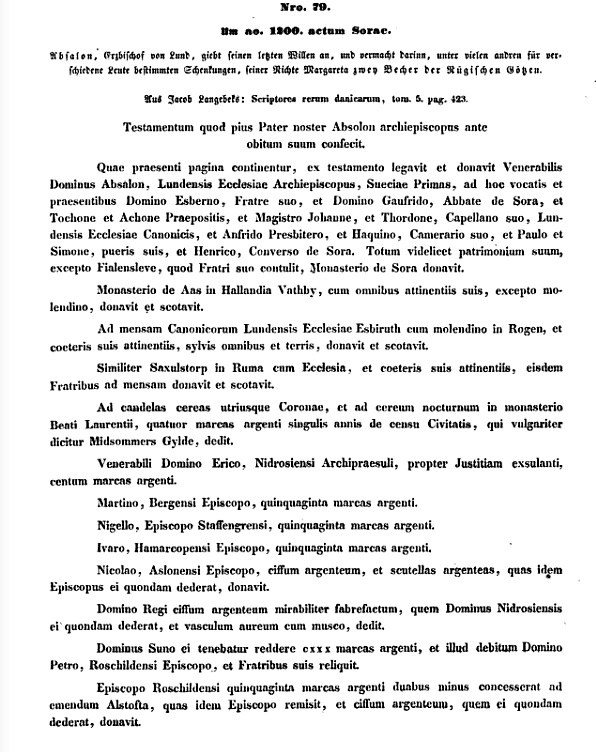
There are (at least) two pieces of interest to those interested in Slavic religion in the Pomeranian Diplomatic Codex (edited by Hasselbach & Kosegarten).  The first is a description of the activities of Berno of Amelungsborn, the first Bishop of Schwerin, (aka the Apostle of the Obotrites) who took part with Pribislav (the subdued Obodrite leader) in Bishop Absalon’s 1168 campaign against the Rani on Arkona.  The second is a brief entry in Absalon’s own will document describing a donation of Rani idols to a certain lady.

codexpom

Diploma Frederici imperatoris
(regarding 1170, written about 1200)

“Notum esse volumus…, qualiter quidam pauper spiritu monachus nomine Berno… gentem paganorum transalbinam, sub principe tenebrarum in tenebris infidelitatis et idolatrie inclusam, primus predicator nostris temporibus aggressus est, … ipsos baptisans, ydola comminuens, ecclesias fundans … postremo quia gens Ruynarum, ydolatrie spurcitia deo et hominibus inuisa, verba predicationis flecti noluit, idem… fructum … inuenit nam ad hoc principes et omnem populum animavit, ut ydolatriam zelo christiani nominis armis ad fidem cogeret, et ita cum tyronibus Christi, quasi ipse signifer effectus, maximo ydolo eorum Szuentevit destructo, in die beati Viti martiris inuitos ad baptismus coegit.”

pom1

“… We wish it to be known… , how a certain monk, weak in the faith, by the name of the Berno …  became the first person in our time to set out to convert, the Transalbinian pagan peoples who [until now] have lived under the prince of darkness in the darkness of unbelief and idolatry enclosed… [how he] baptized them, crushed [their] idols and founded churches … At last, as the nation of the Rugians would not be swayed [practicing] idolatrous corruption, hateful to God and man would not be swayed by the words of the same preaching … [fruit?] … and so [for this task] he finds the princes and all the people aroused since idolatry compels all those zealous Christians to their faith and arms, and so with the recruits of Christ, as if he [Berno] were the standard bearer, their greatest idol Szuentevit destroyed, he forces them in the day of Saint Vitus the martyr, to baptism.”

Testamentum Absolonis archiepiscopi
(circa 1200)

pom3

“To the Lady Margaret, [I leave] two Rani [Rugian] cup idols.”

pom4


So who was this lady Margaret and where are these idolatrous cups now?

r

Copyright ©2016 jassa.org All Rights Reserved

May 9, 2016

On Names Part II – Confirmation Biases and the Like

Published Post author

ugiThe trouble with showing Slavic names in antiquity is that there are virtually no Slavic names that would not also be claimed by scholars as Germanic names.  We have made this point here but it is worth reiterating because the standard approach to this matter has a predetermined result.  What do we mean by that?

Let’s assume the question is whether there were Slavs (or their ancestors) west of the Elbe prior to the 6th century.  Let’s say we find a data point – a personal name from an area west of the Elbe dated to pre-6th century.  If the name were Slavic it would show the presence of at least some Slavs in that area during that time.

So how will we know whether that name is Germanic or Slavic?  Presumably we would have to compare it to known Germanic and Slavic names…

The problem is that the standard approach to such classification must either (A) anticipate the answer (creating a tautology) or (B) fail.  Typical assumptions in performing this task anticipate the answer whereas changing these assumptions creates an answerable question.

Typical Assumptions & Why They Predetermine the Result

Assumption 1

One assumption typically made is that there is a relatively healthy number of prefixes and suffixes that appear in “Germanic” languages but not in Slavic ones.  A corresponding assumption is that there are very, very few prefixes and suffixes that are exclusive to Slavic languages (and of those even fewer that appear in all Slavic languages).

Assumption 2

A second usual assumption is however even more problematic.  There is a set of prefixes and suffixes that – once the Slavs make their “documented” entrance on the world stage appear among the Slavs.  But these same prefixes and suffixes also appear among the various Germans.

Putting aside theories that claim that Slavs were led by Germanic (or Iranian in some tellings – see the conundrum of the Antes) elites, we have a vast set of names that could be either Germanic or Slavic.

So how does a historian know whether a given person was Slavic or Germanic?  Typically, the answer is context dependent.  That is to say a historian has no idea.  But, if he finds such a name among territories and times typically associated with the Slavs, he assumes the person must have been a Slav.  If, on the other hand, the name surfaces among the territories assumed to have been held by the Germanics during a given time period, the name is further confirmation of the Germanic possession of the territory.  In effect, absent some other analytical tools, you see what you assume you should be able to see.

Results

Given the above assumptions, what are the results?  Well, what can the results be?

Assumption one tells us that, say, nine names must be exclusively Germanic.  It also tells us that – maybe – one name is exclusively Slavic.

Assumption two then says that those prefixes or suffixes that are proven to have been used both by Slavic and Germanic peoples are automatically ascribed to the Germanic basket if they appear in a name either (1) dated to a time prior to the 6th century or (2) dated at any time but appearing west of the Elbe.  So put 90 names in a Germanic basket and zero in a Slavic.

Then someone pulls out a name (pre-6th century west of the Elbe) out of a hat… What are the odds that the name out of that hat is Germanic versus Slavic?

If you answered 99-1, you would, of course, be right.  If for a given space and period we assume a priori, that 99% of  names in the set are going to have to be Germanic and 1% Slavic then it will be very difficult to find a Slav.  If every –mir, –gast, –suav is Germanic then it’s not even clear who could ever be found to be a Slav?

Assumption Questions/Problems

Assumption 1

Why is that the Germanic peoples should have had such a variety of “their own” names and name forms whereas the Slavs (a people of comparable numbers throughout history) such a poverty?

In other words, are the Germanic names “inflated” by attribution to the Germanic names of other names that may or may not have been Germanic (including names that may have been Celtic or, in fact, Slavic?)

Assumption 2

The obvious problem with this assumption, as we’ve already pointed out, is that it assumes the answer to the question being asked.

If we are trying to answer the question of  “Who was Ukromir? A Germanic or a Slav?” then we might proceed as follows:

Statement A: “Only Germanics lived in Germania prior to the 6th century”

Statement B: “Ukromir lived in Germania prior to the 6th century”

Conclusion C: “Ukromir must have been a Germanic.”

Answering the matter as above is all well and good but how does one answer that same question if Statement A falls away as an assumption?

Thoughts

The answer, of course, is that there is no answer.  The best that can be said is that some people that lived in a region described by the Romans as Germania had names that could indicate either a Nordic or a Slavic origin (the name “Germanic” becomes meaningless here as well).  The same can be said of other people of pre-6th  century Europe.

What’s more this is true even if we assume that language is the chief criterion of telling whether someone is a Nordic (aka Germanic) or a Slavic person (a criterion whose discriminatory relevance we find “lacking”).

The reason for this is that we have no idea what language or languages the people of Germania actually spoke prior to the 6th century.  Perhaps the Vandals – in the 6th century – spoke the same language as the Goths and Gepids.  But what about other inhabitants of Europe?   Outside of a few late Gothic texts we have no idea about the language of the Suevi, Batavi, Ubii, Jaziges, Nemetes, Lugii, Morini, Cotini, Veneti, etc.  Tacitus suggests that there was a “Pannonian” language and that the Aestii had their own language – similar to “Britonic” (or Bretonic?)  But what were those languages?

In the absence of texts, the only way to guess at the language of a people are the names of those people.  But how can we tell the names are Germanic, Slavic or something else?

We’ve already discussed many of these:

In fact, even those that have traditionally been associated with “Germanic” speaking peoples.

  • We know that Vidimir was a Goth. But must Vidimir be a Gothic name? “Vid” seems terribly close to Vit as in seer (“to see”) or the Slavic God Svantevit (on that name, see below).
  • If -mir was a Germanic or Slavic suffix, it is more of a Slavic prefix, e.g., Miroslav or Mirosuav (short version Miro or Mirek).  But then what do you do with Miro the king of the Suevi?
  • If Ardagastus was a Slav why was his name prefix Arda not Rada?  And if we are going to accept that Ardagast was a Slav then what about the “Frankish” Roman general Arbogastes?
    • And if we somehow weasel out of that one, and say now very definitively that it should have been Rada- instead, what do we say about the Gothic “true Scythian” Radagaisus?  After all wasn’t there a Slavic God (or, in Brueckner’s view town – but, nevertheless, a Slavic town!) named Redegast?
    • And what of the four authors of Frankish law: Wisogast, Arogast, Sidogast and Widogast – the prefixes Sido-, Wido– and Wiso– are all easily explained via Slavic.  But these were Franks…
  • The same holds true for the prefix Mil– where Eberhard Graff speculated that Milgast (Milegast of the Wiltzi) was a Germanic name (Althochdeutscher Sprachschatz)
  • It gets better:
    • Germanic languages apparently contained (though, oddly not anymore) words that we would think of as quintessentially Slavic.  Take the above Svantevit – “Holy Seer” if you will in Slavic.  Vit, however, may be an Indo-European name (e.g., Vitautas in Lithuanian or Saint Vitus – a third century SIcillian Christian martyr) so nothing inherently Slavic.
    • Better yet, however, take the prefix “Svante” – holy – an undoubtedly Slavic word and yet in “Germanic” we also supposedly have similar names.  Take, for example, Swentibold (aka Zwentibold) – the Lotharingian king; now, here, we know that he received his name from his godfather the Slavic Moravian king Svatopluk I (aka Sventopluk); But what do you do with Amalaswintha (aka Amalasuintha, Amalswinthe, Amalasuentha, Amalasuntha or Amalasontha), the queen of the Ostrogoths; Swinthilathe king of the Visigoths?  Are these “swint, swiþnames really “strength” designations or do they have something to do with “holiness”? Or for that matter with “excellence” (świetność)?

Lovbagast

Take the name Laubegast.  This is the name of a part of Dresden (itself derived from Slavic) – first mentioned in 1408 as Lubegast.  In fact, we think we know exactly how the (then) town got its name.  It got it from Lubogost, the founder.  Lubogost the founder bore a Slavic name.  And so the name is Slavic in origin.  In that it differs little from other similar names in Germany such as Lübeck or in Poland such as Lubin (formerly in German Silesia) or Lublin.

This comes from Manfred Niemeyer’s Deutsches Ortsnamenbuch:

lubeck

Lubomir or Lubogost – each of which is mentioned above in the description of Lubin – are Slavic names.  So, we would think too is Laubegast/Lubegast.

But the below is interpreted differently:

ugi

This Roman inscription (see Corpus Inscriptionum Rhenanarum) was found in 1858 north of Grimlinghausen around Düsseldorf.

It is typically read to mean “Louba Gastinasi F(ilia) Vbia H(ic) S(ita) Q(uintus) Cornelius Q(uinti) F(ilius) G(?)al(us) Coni(?)ugi Sva [or S(uae) Va(le)].”  That is: “Louba the daughter of Gastinas [or Gastus Nasus] of the Ubii is buried here.  Quintus Cornelius son of Quintus, a Gall for his spouse (or “his farewell”).”

So what is the explanation here?  Well, Luba may be a Slavic word but there is also the “Greek” Lubia and so it should not be surprising that there is too a Gothic liubs.  Of course, we also have lieb and Liebe as in “love”.   And a 954 Spanish document does speak of a “uitiza et leuba“.  Further, there is a claim of an Old High German lioba.  And, further down the line, we have Lob as in “praise” (which, incidentally, is Ros in most Scandinavian languages…).  Finally, in the world of science fiction  you also have the “reconstructed” (or constructed) *leubaz meaning “Proto-Germanic” “dear” or “lovely”.

Now one might ask some questions:

  • What is the evidence for a Germanic luba* especially since:
    • (A) the word is not attested in that form in North Germanic languages,
    • (B) the word is attested in that form in all Slavic languages, and
    • (C) the Goths (Nordics) are known to have conquered a populous nation of the Veneti (Suevi?) with whom they in some form interacted?

* Even lioba seems to be attested in Germanic only twice and one of these is as a gloss for the Latin gratia – but then who was the glosser?

  • Even assuming the word luba existed in a Germanic language and actually had Germanic roots, what is the evidence of it being used by Germanic peoples (with a “b” so no Leovigilds or Leofrics please) as a name or prefix or suffix of a name? (and no, you can’t answer by pointing to the above – no circular reasoning; further Ieuba mentioned above – even if that is a Germanic name (?) – does not equal Louba))?
  • Even if one were confined that liubs (or luba) is Gothic or even East Germanic and that the Goths did not “acquire” it after coming down from Scandinavia and that they used it as parts of names, what is the reason for believing that an Eastern Germanic tongue like the Gothic should instruct us as to the nomenclature used by Western Germanic tribes such as the Ubii?

One can ask other questions too:

  • why is the “I” after “Gast” so strangely large?
  • same question for the “I” after “vg”?
  • Is “Nasi” really a continuation of “Gasti…”?  Or is it a case of a separate name? (Nasua?)? Or is it a separate non-name word altogether?
  • is the “Ubia” really “Ubia or is it a “Vbia”?

About the only thing that can be said of the above inscription is that the name Cornelius is a Latin name.

Copyright ©2016 jassa.org All Rights Reserved
May 8, 2016

Forest People of Sul

Published Post author

Although Sylphs sounds like a venereal disease, it is in fact the name of ancient group of spirits. Or rather, the 16th century Swiss pseudo-scientist (but then weren’t they all back then?) Paracelsus, claimed these were such spirits (perhaps a combination of sylvan nymphs).

procolpsus

Although no references to sylphs are found prior to Paracelsus’ invention (?) of them, there are ancient references to Sulevae.  They appear in many places in the Roman Empire although it was a British author – John McCaul – describing Roman inscriptions at Bath that connected them with  Paracelsus’ sylphs (based on Charles Roach Smith’s Illustrations of Roman London).  McCaul notes the following:

  • Sulivia Idennica Minerva
  • Suleviae, Silviae, Silvana
  • Sulevis et Campestribus
  • Silvanabus et Quadriviis

Sul was apparently also the name of Apollo in Brittany (became Saint Sul later).

In Cirencester we have this (see The Reliquary and Illustrated Archaeologist: A Quarterly Journal and Review, v5):

SVLEIS
SVLIN vs
BRVCETI
V.S.L.M.

sulv

And in Bath we have the following inscription:

SVLEVIS
SVLINVS
SCVLTOR
BRV[C]ETI.F.
SACRVM.F.L.M

Another one cited by McCaul is this one:

DEAE
SVLIMI
NERVAE
SVLINVS
MATV
RIFIL
VSLM.

From these he infers the goddesss Sul Minerva or Sul or Sulevae – the “presiding deity of waters” (as per Scarth).

Roman London

This, of course, brings to mind a few things:

  • the river Saale (in German) – Solava in Slavic (sales or salud = health);
  • the description of the Slavs by Procopius:

They reverence, however, both rivers and nymphs and some other spirits, and they sacrifice to all these also, and they make their divinations in connection with these sacrifices;

procopius

  • the fact that Slavic, or at least Polish, Deity names such as Jassa or Lada have so many river name counterparts (such as here, here, here or here);

Of course, we know that Slavs had “swamps and forests for their cities” (Jordanes but also Maurice) so were Slavs just worshippers of sylphs or Sylvanians or forest people (as we suggested before)?

sylvanians

Copyright ©2016 jassa.org All Rights Reserved
May 4, 2016

On Passia the Slave Girl and the First Attested Slavs?

Published Post author

Here is a “Venetic” inscription.  Well, not exactly.  While Venetic inscriptions – meaning inscriptions from Northeast Italy of the Adriatic Veneti – are well known and have been studied (whether they were translated correctly is another matter), there are other “Venetic” inscriptions.  That is inscriptions not written in Venetic but that mention the word Veneti.

Masuria – currently north of Dacia

So, for example, you have this inscription coming out of Dacia and dated precisely to March 17, 139.  That’s right – it’s second century Dacia (the home of Burebista (Burivist?)).  It is a contract for the acquisition of a slave written on a so-called “triptych” wooden tablet (currently in a Romanian museum).  It is well known and has been reprinted numerous times, for example in:

  • Fontes iuris romani antiquiˆ;
  • “Introduction to the study of Latin inscriptions” by James Chidester Egbert;
  • Altitalische Forschungen (volume 3);
  • Inscriptiones Daciae Romanae (volume 1);

We have discussed the story of Boz (4th century) and hinted that certain earlier Suevic names may have been Slavic (e.g., Veleda).  Now Boz was of the Antes and Veleda was, at least Batavian or Suevic.  But here below is an actual reference to a “Venetic.”  Who was this Venetic?  It is in Dacia that we find him – which Dacia we know was close to the location of Jordanes’ Veneti and the earlier mention of at least some of the Venedi on the Tabula Peutingeriana.

veneti

There is, of course, more of interest and we get to it but first the contract:

Maximus Batonis puellam nomine
Passiam, sive ea quo alio nomine est,
ancirciter [annorum circiter?] p[lus] m[inus] empta sportellaria
norum sex emit mancipioque accepit
de Dasio Verzonis Pirusta ex Kaviereti[o]
* ducentis quinque.

1t

Iam [eam] puellam sanam esse a furtis noxisque
solutam, fugitiuam erronem non esse
praestari.  Quot si quis eam puellaam
partemve quam ex eo quis evicerit,

quominus Maximus Batonis quove
ea res pertinebit habere possidereque
recte liceat, tum quanti
ea puella empta est, tam pecuniam
et alterum tantum dari fide rogavit
Maximus Batonis, fide promisit Dasius
Verzonis Pirusta ex Kavierti.
Proque ea puella, quae s[upra] s[cripta] est, * ducentos
quinque accepisse et habere
se dixit Dasius Verzonis a Maximo Batonis.
Actum Karto XVI k[alendas) Apriles
Tito Aelio Caesare Antonino Pio II et Bruttio
Praesente II co[n]s[ulibus].

2t

Maximi Veneti principis
Masuri Messi dec(urionis)
Anneses Andunocnetis
Plani Verzonis Sclaietis

Liccai Epicadi Marciniesi
Epicadi Plarentis qui et Mico
Dasi Verzonis ipsius venditoris

3t

Translation 

“Maximus, Bato’s son, bought and received a slave girl of about six years old by the name of Passia, or however she may henceforth be called, she was a Sportellaria [bought in a basket? originally found in a basket, i.e., abandoned?], from Dasio son of Verzo, a Pirusta* from Kavieretum for 205 dinars.”

* Pirustae were an “Illyrian” tribe who lived in north Albania, south Bosnia and parts of Montenegro.  They are mentioned by Caesar, Strabo and Livy.  After the Roman conquest of Dacia in 106, many of the Pirustae miners were settled by the Romans in the Carpathians (including in western Dacia).

“It is confirmed that the slave girl is healthy, was not improperly obtained, is not a runaway or vagrant and that if someone should claim the slave girl (or any part of the associated property), whereby Maximus son of Bato won’t be able to properly own and possess her, then the purchase price will be returned twofold.  On his honor so has Maximus son of Bato demanded and on his honor so has Dasius son of Verzo, Pirusta from Kavieretum promised.”

“And Dasius son of Verzo has confirmed the receipt of the 205 dinars for the above-named slave girl from Maximus son of Bato.”

“This has taken place at Karto on the 16th day of calends of April under the consulship of Titus Aelius Caesar Antoninus Pius, in his second term as consul and [under] Bruttius Praesens, in his second term as consul.”

“The seal of:

Maximus Venetus, princeps
Masurius Messius decurion
Annesis, son of Andunocnes
Planius son of Verzo, Sclaietis
Liccaius Epicadus Marciniesus
Epicades, son of Plarentis, who is also called Mico
Dasius, son of Verzo, the seller.”

roman

Noteworthy

  • Is Maximus son of Bato the same as Maximus Venetus (princeps as in purchaser, princeps to the transaction)?
  • Whether or not that is the case, is Maximus a Venet?
  • If he is a Venet it seems more likely that he is of the Danube Veneti.
  • Bato (sounding so “Turkic from the steppe”) is an Illyrian name (or at least several Illyrian, that is Dardanian, Daesitiat (or Daezitiat) and Breucian chieftains bore that name).  So are the Veneti then Illyrian (if these are the same person).
  • Notice the name of the decurion (local official charged with contract administration) – Masurius or Masur.  The name Masuri seems strangely linked to Masuria and the Polish “tribe” of Masuri (settlers coming from Mazovia into south Prussia) which, supposedly, comes from Mazovia.  However, the Masuri name (other than here) also appears:
    • in Calabria, Italy (though the origin of the word may be different – Turkic? Or does it belong in the prior section ‘L’elemento slavo’?), and
    • masuri in a Himalayan region next to Dharmsala;
  • Puella – meant a girl but, sometimes, a slave girl (a brave Palianka?);
  • Passia – Slavic or not?;
  • Whether names such as Licca[ius] or Mico could be Slavic we leave to you;

For more see also Hanne Sigismund-Nielsen “Introduction: A Little Girl Called Passia” in “The Oxford Handbook of Childhood and Education in the Classical World”.

Copyright ©2016 jassa.org All Rights Reserved

May 1, 2016

Saint Sturm and the Ever-So-Attractive Slavs

Published Post author

Here is an excerpt from the Life of Saint Sturm (705-779?) the Abbot of Fulda (Vita s. Sturmi abates Fuldensis) regarding Sturm’s trip up the Fulda river on a mission from Saint Boniface (same one who cut down the Holy Oak of Donar).

sturmy

Sturm’s mission was to discover a suitable place where Boniface could found a monastery.  Sturm was a young  Bavarian noble who was excited to join Boniface in a life of monastic joy.  Before that joy, however, the young virtuous Bavarian would be sorely tempted.

The year of our story is somewhere between 736 and 744:

“[7] Then one day, while he was traveling , he came to the merchant road that leads from Thuringia to Mainz.  At a place where the road crosses over the river Fulda, there was a large multitude of Slavs who discovered the same river swimming in its streams, washing their bodies and snorkeling; their nude bodies made the ass [on which Sturm was riding] tremble in fear and even the man of God found their smells frightening as they mocked the servant of the Lord.  And when they wished to do him harm, they were stopped by divine power.  One of them who was their interpreter asked him where he was going. And he answered he was going to the hills in the wilderness.” 

frightening

Slavs’ bathing naturally frightened the gentle Sturm

(Tunc quadam die dum pergeret, pervenit ad viam, quae a Turingorum regione mercandi causa ad Magontiam pergentes ducit; ubi platea illa super flumen Fuldam vadit, ibi magnam Sclavorum multitudinem repreit eiusdem fluminis alveo natantes, lavandis corporibus se immersisse; quorum nuda corpora animal cui praesidebat pertimescens, tremere coepit; et ipse vir Dei eorum foetorem exhorruit, qui more gentilium servum Domini subsannabant, et cum eum laedere voluissent, divina potentia compressi et prohibiti sunt.  Unus autem ex illis qui erat ipsorum interpres, interrogavit eum quo tenderet?  Cui ille respondit, in superiorem partem eremi se fore iturum.)

kirche

Sturm felt much safer in the Fulda church

In case you were concerned what happened to Sturm: he followed the course of the river into the wilderness until he was able to find an appropriate place for the founding of the Fulda abbey.  Here Saint Boniface laid the foundations of the monastery (named after the Fulda river) and Sturm was made its first abbot.

fultz

Location of Fulda in Germany

And they all lived happily ever after.

Well, not exactly, after Boniface was killed by Frisian highwaymen, Sturm got into a fight with Lull or Lullus, the successor to Boniface as archbishop of Mainz over who would keep the old man’s bone.  Sturm won the relics but got bitchslapped by Lullus who complained about him to Pepin king of the Franks.  Although Sturm was exiled he managed to get back into graces with Pepin and came back to run the monastery.

Problems continued for Sturm afterwards as the pagan Saxons attacked Fulda and Sturm and his fellow monks were forced to flee into the forest.  But then the Saxons left, the monks came back, Sturm died and the Saxons were slaughtered by Charlemagne.  Then Eigil of Noricum wrote the Life of Saint Sturm which is the work cited above.

And after that everyone lived happily ever after (except the local Slavs, of course).

monastery

The monastery’s unconventional design was intended to keep any eye on the Saxons and the Slavs

For more on the topic see the C. H. Talbot edition in “The Anglo-Saxon Missionaries in Germany, Being the Lives of SS. Willibrord, Boniface, Leoba and Lebuin together with the Hodoepericon of St. Willibald and a selection from the correspondence of St. Boniface.”

Copyright ©2016 jassa.org All Rights Reserved
April 30, 2016

On Slavic DNAs

Published Post author

Genetology and genetic historiography are the modern battlefields of peoples.   In the Slavic case, the genetologic warriors have proudly claimed R1a as Slavic.  This is because Slavic populations appear to have the highest percentage of certain types of this Y-dna.  So far so good.  In the process, the assumption was made that R1a are the “true Slavs” and the rest found in Slavic countries (we’re talking about Northern Slavs & Slovenes/some Croats – the further South you go the more I2 rather than R1a), that is R1b or I or N or anything else must not be Slavic.  This presents a number of issues…

First, if – in the highest R1a land of them all – Poland, R1a approaches 60% what do we do with the remaining >40% of the male population?  Are they not Slavic?  And considering that Y-dna accounts only for men, what does that mean for the population as a whole – are only 30% of the population true Slavs?  How do you measure women on the “Slavic scale”?

Note too that the 60% R1a is after the various German peoples (including plenty of Slavs) were deported/escaped to Germany and Poland became the most homogenous it’s been in 600 years.  So even with such forced resettlements, you could get only to almost 60%.

Second, how do we know that the original Slavs were only R1a folks?  In fact, how do we know that R1a is “the” Slavic gene?  After all, what if Slavs were I or R1b before, say, the Hun or Avar invasion making the “Slavic” y-dna, the dna of Avars or Huns…  And how that was “infused” into Slavic women, we leave for you to picture.

Third, some R1a is found in Scandinavia and that R1a is different – mostly – from the “Slavic” one.  Consequently, that R1a is a portion of R1a has been effectively ceded to the Nordics… But, by focusing on R1a, the “Slavologists” have also effectively ceded all R1b and I and other “haplogroups” to Nordics/Celts.  Suddenly, the quest for “purity” resulted in 90% of all types of dna on the continent not being true “Slavic”.  In effect the Nordic/Celtic “side” is able to claim 100% of R1b, 100% of I and a significant chunk of R1a…  R1b and I are just given up without a fight…

But this is ridiculous.  It may well be that various “African” and “Asian” haplogroups are definitively not Slavic.  However, if someone carries a R1b or I haplogroup, why should that person not be viewed as Slavic?  We are all for advocating blood relations between the Slavs but even we admit that – at some point in the past – there must have been a kernel of a community from which the Slavs arose and it is not at all clear that that kernel was constituted solely out of R1a…

And as an interesting point, note too the primary haplogroup of the speakers of the Algonquian language is R:

algonquian

And we would be remiss if we did not point out that on the shore of Lake Michigan we have the richest town in all of the state of Illinois with the melodious name of Winnetka.  That name is from the Algonquian language.  It supposedly means “pretty” (see here for a discussion of its copy-town in California) which would also fit Pokorny’s view as to what “veneti” meant.

R

The other half is on the right

Of course, the town also sits on the water so a hydronomic (as in, “wendka”, “wendit”) etymology cannot be excluded… 🙂

Copyright ©2016 jassa.org All Rights Reserved

April 22, 2016

Numero Uno

Published Post author

Ains

The number one in various indo-european languages.

  • *ās (Hittite)
  • *ainaz (proto-Germanic)
  • ains (Gothic)
  • oenus, unus (Latin)
  • aīns (Prussian)
  • vienas (Lithuanian)

There are also some languages where the -s drops out so that you have a variation of uno or ein (in some Latin, Germanic and Celtic languages, e.g., unan in Breton).  Those probably belong as a subgroup of the above.

It is remarkable that the first group’s “one” corresponds to the name of God, e.g., one Ass or the plural Aesir of Asgard.

Then you have the Slavic languages:

  • odin (Russian)
  • odyn (Ukrainian)
  • adzin (Belorussian)
  • jeden (Polish, Kashubian, Slovak
  • jaden (Lower Sorbian)
  • jedyn (Upper Sorbian)
  • (but ena in Slovene)

Here the remarkable thing is that this “one” corresponds to Odin of Asgard.  Now, you might say that the fact that the name for the numeral “one” corresponds to a God’s name is hardly surprising.  However, what is so strange about this is that the Slavic “one” corresponds to what is supposedly a Nordic God.  Did the Slavs not have the concept of one “one” before they ran into the Goths?  Was it ena as preserved by the Slovenes? (in which case the Slovenes would have been the only ones untouched by the Goths?) But the Slovene “one” is likely a later borrowing from Italian.

Note that -in is a typically (though not always) Slavic ending.

And note too that odyniec is the name of the lone male wild boar.  The name is Ukrainian or Russian and a borrowing in other Slavic languages – supposedly.  No proof of this has been given.

Odin is associated with many animals (especially ravens) but generally the boar is more of the animal of Freyr (Gullinborsti) or Freya (Hildisvini)…

(though Varaha the boar is an avatar of Vishnu (albeit only one of ten main ones) and there is also the Govindagam vindata explanation).

lonely

The loner “odyniec” only rarely came back to the herd – but when he did, everyone had a good time

Boar Worship in Eastern Europe

What is striking is that we know about boar-worship from Tacitus (Germania, 45) that:

“Turning, therefore, to the right hand shore of the Suevian sea, we find it washing the country of the Aestii, who have the same customs and fashions as the Suevi, but a language more like the British. They worship the Mother of the Gods, and wear, as an emblem of this cult, the device of a wild boar, which stands them in stead of armor or human protection and gives the worshiper a sense of security even among his enemies.”

And much later from Thietmar:

“From the olden days, the stories of which were often falsified with all kinds of erroneous tales, we have the testimony that whenever harsh griefs of a civil war rear their heads, so comes out of the above-mentioned lake a mighty boar with foam glistening on white tusks and in front of all eyes he rolls in the puddle among terrible tremors.”

The cantankerous Brueckner thought that Svarozic was fire, i.e., the “little” Svarog (with the “big” Svarog being the heavenly fire of the Sun).  If one were to apply this logic to Odin you would get the following:

  • Svarog (Sun?) > Svarozic (fire?)
  • Odin > Odyniec

P.S. Then we have the following from Caesar

(Gallic War, Book 6, chapter 21):

“The Germans differ much from these usages, for they have neither Druids to preside over sacred offices, nor do they pay great regard to sacrifices. They rank in the number of the gods those alone whom they behold, and by whose instrumentality they are obviously benefited, namely, the sun, fire, and the moon; they have not heard of the other deities even by report.”

So who were these Germans?

Copyright ©2016 jassa.org All Rights Reserved

April 22, 2016

Der Natur auf der Spur

Published Post author

In the Alps there is a little skiing village of Lech.  Next to it is a village of Zug (not the only one in the Alps).  So we have Lech & Zug.  Now, the former is named after the river that runs through both towns – the river Lech.

won't even cause a mild Kopfschmerz for your typical historian - academic thought moves ohne Eile

won’t even cause a mild Kopfschmerz for your typical historian – academic thought moves ohne Eile

Now, the River Lech is very likely the same river after which the Vindelici were named.  But if that is true, i.e., that the “-lici” refers to the River Lech then the first part of their name becomes even more curious because it suggests that these are simply Vindi-lici, i.e.,  Wends who live by the river Lech (as opposed to some mythical “Vindelician” tribe).

lechzug

That these were the same as Ligurians of Illyria we have already mentioned.  That Nestor in the PVL affirmatively calls Slavs Noricans (suggesting that they came to Pannonia from Noricum)* we have also mentioned.  That we have a Lech and a Zug right next to each other we mention now.

* But Noricum is not Vindelicia! Correct, except that Noricum bears all the trademarks of a native name whereas the Roman province of Vindelicia was named in the Roman fashion after the inhabitants.  If the inhabitants did not call themselves Vindi at the time, a reasonable supposition would be that the name came to the Romans via a Germanic intermediary – perhaps the “Galls” who forced their way into Northwestern Italy BC.

What else?

Female Adjectives

How about some river names nearby.  For example we have the Wertach which also has given its name to the town nearby.  But that is the old Wertaha.  What could that mean?  After all, -aha is old Germanic for water, like agua.  So the name must be Germanic or at least a “Germanization”.  But is it?

Notice that virtually all Slavic river names end in an -a.  That is because reka/rzeka is a feminine noun in Slavic languages.  Consequently, so are the names of the rivers.  But there is something else.

Virtually, all of these Slavic names can be explained by viewing them as descriptive – or in plain English, as adjectives.  Thus -awa would not be some “water” name but merely an -a suffix to a female adjective of reka/rzeka.  Some town names also have this -awa ending in Slavic countries – even towns that have absolutely nothing to do with water.  Others that have a neutral gender have an -owo ending.  Masculine gendered towns have just an -ow.

By this reasoning the “-awa” names have nothing to do with water.  Rather all the rivers have “-awa” because the underlying language’s gender assigned to the word river was female, e.g., rzeka/reka.

wertach

Not every “-ach” is a Bach

Notice that virtually all Slavic river names end in -a (but not all if Lech were to be a Slavic name!).  Virtually all German river names do not (der or ein Fluss is a masculine noun).  Also notice that many German names (though not all) did previously have an -a ending.

Which brings us to the river Wertach which flows close to the Lech.  Its prior name was Wertaha.  Note too that although “-awa” could be a Slavic ending so could “-aha” (as in gospocha, wataha, etc).  And we mean today – not in some reconstructed past.

But what can it mean then?

Wartka (which also applies to the river Warta/Warthe) simply means “fast flowing.”  But  wierci[e]c also means “to drill” (thus, wiertarka, i.e., a drill – BTW note too the ending –arka – we will have something to say about that when we come to lavercas and the like).  Either of those could apply to a fast flowing river (as in Wiertawa).

wertiti

Incidentally, the Gothic wairthan is related to the German werden = to become.  It may be that these words are in fact related to the Slavic wiercic.  However, what better expresses a river name:

  • the “becoming”  river
  • the “drilling” (or “fast flowing”) river;

But, hey, the books say that Vindelicians were “Celts”, right?

makulatur

The endprodukt of Keltologie

Now, the really cool thing is that Lech may mean the “white” river which brings up some really cool questions about the name of Lechites and other tribes such as the Leucosyrians (or “White” Syrians) who lived in Anatolia.

Copyright ©2016 jassa.org All Rights Reserved

April 21, 2016

Emperor Julian & the Adriatic Veneti

Published Post author

The Emperor Julian (Flavius Claudius Iulianus) (circa lived 331-332 to 363) was born in Constantinople as a Chrisitian.  He survived the massacre of 337 where many of his older relatives were slaughtered by Emperor Constantius II (Julian’s cousin).  He was instead sent to study in Greece where he devoted himself to Greek literature and philosophy and returned to European religion (hence the Church’s name for him – the “Apostate”).  In 355 he was made governor of Gaul by his cousin, the then Emperor Constantius II (and named the honorary title “Caesar”).  In Gaul he fought the “Alemanni” defeating an army three times the size of his own at Strasbourg in 357.  He then successfully rebuilt much of Gaul.

julianz

When the Persians invaded in the East, Constantine II ordered (February 360) Julian’s armies to the front from Gaul.  This did not sit well with the soldiers who rebelled proclaiming Julian the Emperor.  Whether Constantine tried to get rid of his popular cousin on the Eastern Front is not known.  In any event, a Civil War ensued (during which Julian managed to defeat the Franks on the side) but before it could really take off Constantius II died (November 361).     Constantius II had named Julian his successor and so Julian became Emperor.  In the next few years Julian tried to restore Roman and Greek religions.  He also cut the bloated Roman bureaucracy.  Notably he attempted to rebuild the Jerusalem Temple – a project which was allegedly derailed by expense, an earthquake and ambivalence of the local Jewish community (or by divine intervention as per Christian authors of the time).  Julian died from a festering would during the campaign against the Persians.  By some account he had been stabbed by a Christian soldier (on the orders of the Greek bishop of Caesarea Mazaca in Cappadocia) although this has not been confirmed and the general belief is that he was wounded by the Persians.

Julian’s Commentaries on his western campaigns against the Alemanni and Franks did not unfortunately survive.  However, some of his “Orations,” “Letters” as well as satirical works and the portions of the work Against the Galilaeans did survive.  Among those is The Heroic Deeds Of Constantius (a panegyric to Constantius II) written in 357/358 (before their falling out).  In it, we have the following description of northern Italy:

alps

“But he [Constantius II] did not himself march all the way there, but remained in the neighboring city [Aquileia].  This is a trading centre of the Italians on the coast, very prosperous and teeming with wealth, since the Mysians and Paeonians and all the Italian inhabitants of the interior procure their merchandise thence. These last used, I think, to be called Heneti in the past, but now that the Romans are in possession of these cities they preserve the original name, but make the trifling addition of one letter at the beginning of the word.  Its sign is a single character [i.e., the “v”] and they call it “oo,” and they often use it instead of “b,” to serve, I suppose, as a sort of breathing, and to represent some peculiarity of their pronunciation.  The nation as a whole is called by this name, but at the time of the founding of the city an eagle from Zeus flew past on the right, and so bestowed on the place the omen derived from the bird.  It is situated at the foot of the Alps, which are very high mountains with precipices in them, and they hardly allow room for those who are trying to force their way over the passes to use even a single waggon and a pair of mules.  They begin at the sea which we call Ionian, and form a barrier between what is now Italy and the Illyrians and Galatians, and extend as far as the Etruscan sea.  For when the Romans conquered the whole of this country, which includes the tribe of the Heneti and some of the Ligurians and a considerable number of Galatians besides, they did not hinder them from retaining their ancient names, but compelled them to acknowledge the dominion of the Italian republic.  And, in our day, all the territory that lies within the Alps and is bounded by the Ionian and the Etruscan seas has the honour of being called Italy.  On the other side of the Alps, on the west, dwell the Galatians, and the Rhaetians to the north where the Rhine and the Danube have their sources hard by in the neighbouring country of the barbarians.  And on the east, as I said, the Alps fortify the district where the usurper stationed his garrison.  In this way, then, Italy is contained on all sides, partly by mountains that are very hard to cross, partly by a shallow sea into which countless streams empty and form a morass like the marshlands of Egypt.  But the Emperor by his skill gained control of the whole of that boundary of the sea, and forced his way inland.”

Copyright ©2016 jassa.org All Rights Reserved

April 20, 2016

The Slavs of Josippon

Published Post author

croatians

Top to bottom but right to left:

  • q (qoph) / r (resh) / a (aleph) / v (vav) / (vav) / t (teth) / y (yod) > qravvty
  • s (samekh) (or m?) / l (lamed) / q (qoph) / (yod) / (yod) > slqyy
  • l (lamed) / (yod) / ts (samekh) / p (pe) / (yod) / > lytspy
  • l (lamed) / (vav) / (vav) / (mem) / (yod)  > lvvmy
  • k (kaph) /  r (resh) / k (kaph) / a (aleph) / r (resh) > krkar
  • (kaph) / (zayin) /  r (resh) / (mem) / (yod) / (nun) > kzrmyn
  • (beth) (or k?) / (zayin) / (mem) / (yod) / (nun) > bzmyn
  • s (samekh) / k [or q] (qoph) / l (lamed) / (beth) / (yod) > sklby

Josippon

Josippon was a medieval interpretation/reworking of Flavius Josephus’ “Antiquities of the Jews”.  It has been dated first to the 9th century, then to the mid-10th and now it is thought to have been written about 980 AD (somewhere in Italy).  It is of little interest to Slavic antiquities except in its first book where, much as the other histories of the time, it provides a list of peoples (albeit primarily of Europe) with their Biblical (in a version of Genesis) pedigree.  Interestingly, it lists among other peoples, the Slavs.

The author distinguishes, what we would today call the Slavs, assigning them to their Biblical progenitors as follows:

  • Thogharma – Bulgars (and also Hungarians, Pechenegs, possibly with Turks and Khazars?);
    • Thogarma refers to Togarmah, a descendant of Japheth whose people are associated with Anatolia.
  • Thiras (Tiras, son of Japheth) – Rus, Bosni (Bosnians? Poznanians?) (along with the Angles);
    • Thiras refers to Tiras who is the last son Japheth and whose people were associated with the Thracians (as per Biblical interpretations).
  • Dodanim – These cover the countries of the Danes (Dena), towns of Mechba (of the Veleti?) and Bardena (Bardvik?);  here we have Croats, Cracovians (?), Bohemians (?) (and Danes, Letts? (or Lithuanians?), Livonians (?) and Khazars?  All these are called Slavs.
    • Dodanim (or Rodanim) is a son Javan (who was the fourth son of Japheth) whose people are associated with the island of Rhodes or, alternatively, just with Greeks.

Here is the text regarding the Dodanim:

“Dodanim, are a people called Daniski, who dwell in cities at the very end  the Peninsula of the Ocean in the country [called] Dana; [the cities] called Mechba and Bardena, in the middle of the great sea.  And they bound themselves with oaths never to serve the Romans and hid in the middle of the waves of the Ocean; but they could not deny [the yoke] that reached them and the Roman domination even to the furthest islands and could not rely on the waves [to stop the Romans]; the Croats [?] and Lachs [?], Letts [?], Livonians [?], Cracovians [?], Khazars [?] & Bohemians [?] are thought to be the children of the Dodanim too.   And these who are called Sklabi set up their towns/burgs from the ends of the Bulgar lands to the Venetian Sea [Venice on the Adriatic?]; and from there they extended up until the great sea;  some think they are Canaanites [presumably because of the Slav > slave connotation present at the time; note the same remark made by Benjamin of Tudela] but they  count themselves among the Dodanim.”

Incidentally, we weren’t able to see Moravians or Serbs in this list.

Copyright ©2016 jassa.org All Rights Reserved

April 18, 2016