Meillet and How the Veneti Discovered America – Part I

Published Post author

Antoine Meillet‘s three and a half page article in the Revue des études slaves titled “De quelques mots relatifs a la navigation.” (A few words relating to navigation) has over the years served to muddy the Slavic origin waters.

We thought we should start tackling it here.

So what does Meillet have to say about navigation and the Slavs?

Essentially, he argues that the Slavic vocabulary contains a limited number of navigational words, indicating the Slavs landlocked origins.

Argument 1

The Indo-European root for “rowing”, present “across” the IE spectrum disappeared in Slavic.  Why?  Meillet has the answer.  Because the Slavs only navigated rivers and lakes.  Therefore, they had no use of “rowing” or “oars”, etc.  Instead, the used simpler “furrowing” techniques of transportation on water evidenced by the use of the word grebo meaning “I dig” or “burrow”.  Of course, the digging notion is present also in other IE languages.  Take, for example, the German Grab or the same grave (English).  A similar concept exists for physically “grabbing” someone.  Conceptually similar Slavic words can be found in greben (comb) or greblio (rake) or, for that matter, grobla (causeway/levee/dike – presumably, a result of digging up enough dirt).

As proof how easily such an association might arise in someone’s mind, Meillet cites a passage from Arrian of Nicomedia‘s Indica regarding Gedrosians (being from the coast between the Strait of Hormuz and the Indus river) that the travelers observed:

“…a pilot sailed with them, a Gadrosian called Hydraces… Thence about midnight they sailed and came to a harbour Cophas, after a voyage of about four hundred stades; here dwelt fishermen, with small and feeble boats; and they did not row with their oars on a rowlock, as the Greeks do, but as you do in a river, propelling the water on this side or that like labourers digging in the soil.

That “digging” or “burrowing in” water could have been a natural progression of the concept of digging to simple navigation is, of course, obvious and hardly needs the above example from an entirely different part of the world.

More importantly, it is strange that Meillet should have chosen the Bulgarian or Russian гребло as the only “paddling” word to focus.  The word doesn’t seem to have existed in West Slavic languages.  Instead he could have just as easily looked at wiosło, весло, вясло, veslo – meaning “oar” in all Slavic languages.

The wiosło, вясло, veslo (an “oar” or “paddle” being a tool derived from wieźć – to carry, transport – hence wiosłować “to row”) contains ios or ies or ias just as jazda – ride which matches nicely with many European (Old European!) river names (Visla or Vis-tula but also Tam-issa, Is-ter and so forth).  Such Visla river names – aside from the well known Vistula itself – appear in as wide a variety of locations as the Alps (as in Wiesle) and the Shetlands.

This suggests a concept of movement and a rather ancient origin.  It also has nothing to do with digging, nor any such secondary meaning.  The concept of an oar embedded in the veslo can be applied to either a river or sea or ocean going ship.  The only thing that Meillet has shown is that the oar family of words began to mean – outside of Slavic – something other than mere paddling.  

Moreover, both of these types of words may have been associated with IE water travel.  The fact is that the -ios, -ias, -ies words existed outside of Slavic with same or similar meanings.  We said “ship” above but could have just as easily said “vessel”.  Now this comes from the Latin vasculum from vas a “container,” “vase” or “vessel” but also meant “ship” (a container ship concept all in one!).  Now, presumably the container concept came first but even that concept captures the notion of a fluid being contained (just think of a flower vase).

Yet, Meillet does not even discuss this – not even in a footnote!  

It seems very selective to focus on a word which – by the way – is not attested in all Slavic languages (such as West Slavic) – and build your sandcastle on that.

So why the selectivity?  He wrote his doctorate on Slavic languages.  He was familiar with Baltic languages (“anyone wishing to hear how Indo-Europeans spoke should come and listen to a Lithuanian peasant”).  On the other hand, he seems to have concentrated on Eastern and Southern Slavic languages and may have lacked the skill set to address as broad a topic as he tried to do within the above article.  In days past one could pretend to be a Slavicist solely coasting on your knowledge of Russian.

In the end, all that Meillet has shown is that in Bulgarian and in portions of Russian the word for a small boat oat developed from a word for digging.  Given that Slavic languages have another word for oar that carries no “digging” connotations, so what?  It’s as if he were to ignore the words ship, vessel, etc. and used the word “dinghy” to claim the British were not sea going people after all.

Argument 2

There is no “navi” type word for ship/boat in either Slavic or Baltic “probably” because that term did not survive as these folks were not seagoing.

For starters, this may instead suggest that such a word did not exist in IE at all and is a borrowing or a development that happened to non-Balto-Slavic languages. (And does Meillet seriously argue that the Balts did not engage in navigation on the Baltic?  Or just that their ships were not as big as Meillet would have liked them to be?).

More relevantly, the word did exist in the sense of “going to nava” (as in Krok went to the land of the dead when he passed away).  This nava has been understood in architectural terms but a reference to “Viking” boat funeral would provide a similar explanation with a nautical angle.

Furthermore, why should it matter that non-Slavic languages developed a word for ship that contains nauh or navis?

Isn’t the better question whether Slavs had a name for the concept of a “ship” whatever that name may have been?

Here Meillet makes a sub argument.  He states that Slavs do not have own words for the concept of a ship or a larger boat which he thinks is consistent with their simple navigation arts.  Thus, for example, the Byzantines speak of the Slavic monoxylae (i.e., μονοξυλα  ωλοια, as in the Russian odnoderevka, from “one trunk”).

He notes that all the basic words for boats in Slavic languages indicate simple boats made from single hollowed tree trunks of such “monoxyla” type such as:

  • чёлн [choln] or czółno (i.e., a canoe), or
  • aludiiladiiladja or лодья (lodya) (i.e., a boat, also Lithuanian aldija)

He associates the first with the Lithuanian keltas meaning “ferry” that reminds him (!) of Lithuanian kelmas “tree trunk”.  The second, he notes, Liden derives from the Norwegian olle meaning “big trough”, i.e., made from a hollow tree trunk.

Yet all of this is raw and wild speculation.  You could just as easily claim that lodya comes from lod (лод) meaning “ice” and try to prove that early Slavs had ice floats for boats.  Or that the aludii comes from ludi meaning “people” – after all the transport of people was the point of ferry boats, etc.

In fact, Meillet completely ignores statek.  This word existed in Polish for quite a while.  Why does he ignore it?  Just because he can’t find it elsewhere in Slavic?  But maybe it was “forgotten” just as the Slavs “forgot” nauh type words… We may note that Meillet’s reasoning is so razor thin we could just as easily use another Polish word okręt (meaning “that which is turned” – a word for a “ship” that is dated very roughly to the 16th century) to claim that this proves that the Poles were the first to propellers.  Or if that’s too much of a stretch, we could claim that okręt has something to do with the kra – again, floating ice – thereby confirming the above ice hypothesis or, in the “advanced Slavs” version, firmly (or as firmly as one can in these unchartered waters) establishing the fact that Slavs were the first to pioneer ice breakers…

A Slav proudly presenting his home-made propeller

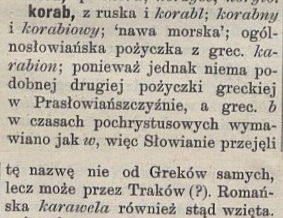
We should note another interesting point made by Meillet.  He claims that korab, another Slavic name for a boat is a borrowing.  Specifically, he notes that this is a borrowing from Greek (karabos) and perhaps one of the earliest of such borrowings from Greek to Slavic.

The reason for the “early” nature of this claim is that the Slavic clearly has a “b” pronunciation in there but the Greeks, by the 1st or 2nd century, began to pronounce their b’s as v’s so, if Slavs, who supposedly appear on the historical stage first in the 6th century, had borrowed this word from Greeks they should have borrowed it in the form korav (indeed, this is the source of the later caravel).  This has given a number of historians/etymologists problems.  Thus, Alexander Brueckner, for example, suggests that the name may have been borrowed earlier via an intermediary language.  He says perhaps the Slavs got this from the Thracians.  That is, in his view, it’s impossible for the Slavs to have been neighbors to the Greeks in the 1st or 2nd century but conceivable for them to have been located next to the Thracians.

The above argument ignores the possibility of Greek colonies on the Black Sea (see the story of the Geloni and Budini in Herodotus, for example, to imagine the possibilities) but let’s put that aside.

We aim to show here on just how little these arguments are based.  Each such theory allows its inventor to write his or her doctoral thesis no doubt but too often carries us merely sideways.

The Greek word is karabos.  But what does it mean?  Well, it means a “ship”, of course.  Yet the use of the word in Greek for a ship seems to postdate antiquity (it’s really a Byzantine concept it seems).  So where does the Greek word come from?

An article by Jukka Hyrkkanen and Erkki Salonen first observes that Greek etymological dictionaries are scanty on the origin but that, for the most part, they seem to point towards the “beetle” or “lobster” (hence, too, a scarab).

Then the authors note that such an explanation is “unconvincing” and suggest that the word is not even Greek.  And, indeed, some etymological dictionaries suggest the origin of the word may be Macedonian.  The authors go further and suggest similarities with Arabic!  Indeed, in Arabic there is a word qarib meaning “boat”.   But they do not stop there.  The Arabic word may have come from Aramaic and originally from?  They suggest another language of a Semitic (?) people skilled in navigation such as the Phoenicians.  But then they note that the word may also appear in Ugaritic (“to approach”) and Akkadian (with the meaning “to approach/to bring/to transport?”).  They can’t quite pin this down but note that their view is that it is very improbable that the word is Greek and think that it is, instead, a borrowing into Greek from some unspecified Middle Eastern – probably Semitic – language.

What about the Slavs?  It seems they are merely the excuse for the authors’ excursus designed to establish that the word is not Greek but a conclusion must be presented nevertheless.  So what do we find out?  The paper notes that it is possible that the Slavs borrowed this non Greek word from the Greeks (which, of course, we know from the above would indicate an early Slav-Greek contact) but also may have borrowed it from that mysterious naval Semitic (?) people hundreds of years before the Slavs first had contact with the sea.

Of course this too raises questions.  How? Did the naval travelers also travel on the rivers to reach these landlocked Slavs?

We will pause here and address Meillet’s other arguments subsequently.  For now, a reflection is in order.

Thoughts

If we must posit ocean travelers, must they be Semitic Phoenicians?  Why not the Veneti?  (In fact, is there a link between the two?).

Which brings us to another name for a “boat”.  We know that the Finns (and other “Uralic” speaking peoples such as the Veps, Estonians, etc) call the Slavs Venäjä.  This means, in effect, boat people.  Thus, “boat” in Finnish is vene (veneh in Veps).  

Does this mean that the name Veneti was passed to the Romans via Finns?  Perhaps the secret, hidden Finns or Scritifinni!?  Or… did the Germans get that name from the Finns but then this would suggest Finnic-Slavic contact before Germanic-Slavic contact.

Who knows.

The point is that the above kinds of arguments could be used to prove just about anything.

You want to know something interesting about boats?

Ok, so take чёлн [choln] or czółno – why does it sound so similar to a “canoe“?  We know that a “canoe” is a word derived from a certain language spoken in the Lesser Antilles islands.

In that same language we have another name for a small boat.  This is pirogue.  And yet we have also heard in the Old World of pirones.  Recently we mentioned such reference in our discussion of Aethicus Ister as in “… the Albanians, Maeoti, and Mazeti, people from the Ganges, and Turks all use these boats, and call them pirones in their barbarian tongue.”

What language is that?  What language brought us both canoe and pirogue?  Why, the Carib language, of course.  Does this have anything to do with the Arabic qarib, the Greek karabos or the Slavic korab?

To top it off we will note again that the Slavic word orkan is supposed to have come from the word hurricane which is supposed to have come from another Arawakan (Carib is an Arawakan language) language of the Taíno people – the Taíno an extinct and “poorly attested” language.

And yet, hundreds of years before Columbus, the great wind-swept Slavic temple on the island of Ruegen was inside the Slavic city of Arkona… (Ruegen itself has a Slavic etymology from ruga, that is, a “wrinkle” – compare the Italian and Latin name for the same).

And then we have these Slavic Veneti.

Holy Quetzalcoatl! (after all we already had the Algonquian language featured here; the continental Caribs referred to the Europeans as “spirits of the sea” – Palanakili.  Palana, apparently, means sea in their language).

Copyright ©2017 jassa.org All Rights Reserved

February 17, 2017

Altkeltisch

Published Post author

Jarilo” is supposedly a Slavic God.  No historic sources for this God exist but folk festivals in Belarus and eastwards (plus Serbia) are attested to have used the word Jarilo.  A possible connection is the God Gerovit mentioned in the lives of Otto which name may have referred to a Slavic Jarowit (pronounced Yarovit; the “Y” sound in Slavic was previously written with a “G”).

Which brings us to volume 2 of this curious book (Old Celtic Language Treasures):

It is here that we find Iarilla and, conveniently, Iariovidius.

The first is found in Vienne on the Iser and is ascribed to the tribe of the Allobroges.  Regarding the French Perigord and Vindalium which were nearby we wrote here.

(Incidentally, a similar name – Perigardi appears in Greece where, in the Chronicle of Morea, we read that the Turks “set out along the road straight along the tributary of the river Alpheios and went to Perigardi, in the direction of Vlyziri.  Now after they had arrived in Servia, Melik…” and that Sir Simon was “to take his own troops and those of the drones of Skorta and the troops of Kalamata and of Perigardi, of Chalandritza and also those of Vostitza, and to go to Isova, to the ford of Ptere…”  Virtually, all of these are Slavic names – incidentally, attesting to their presence in the Peloponnesus in the 13th century).

The second is believed to be “Venetic” and was found in Valle Policella, today’s Valpolicella just east of Lake Garda in the Veneto region of Italy.  There are other names that are curious when we think of Yassa of the Polish Gods or Jasion – both being associated with spring and fall fertility/agricultural rites (Polish wiosna – spring or jesien – fall).

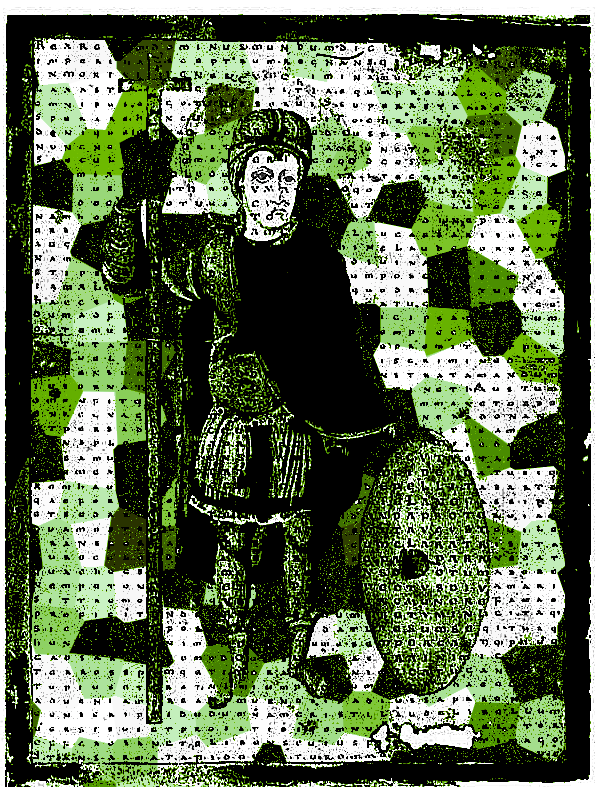
Here is the imprint of the actual picture (from Giuseppe Razzetti, Monumenti romani e medioevali di Marano, Valgatara e Sanfloriano disegnati per incarico del conte Giovanni Orti Manara (portion from the Erica Fazzini paper): Just on the same page we also found other interesting names, including Iassa, Iassia, Iassus, Iausus, Iarus, Iasir as well as others.

Some of these appear in relation to various Venetic names whereas others appear in other places such as Nijmegen (the oldest city in Holland – incidentally, an area of settled by the Batavians of Veleda fame).  Some have likely nothing to do with the Veneti (for example, the name Iulius Iausus).  Others that you can see but we did not mark may be related but that is uncertain (for example Iavvos or Iavus may be related to the Slavic jawa (pronounced yava) meaning consciousness, the conscious state or reality) but maybe not.

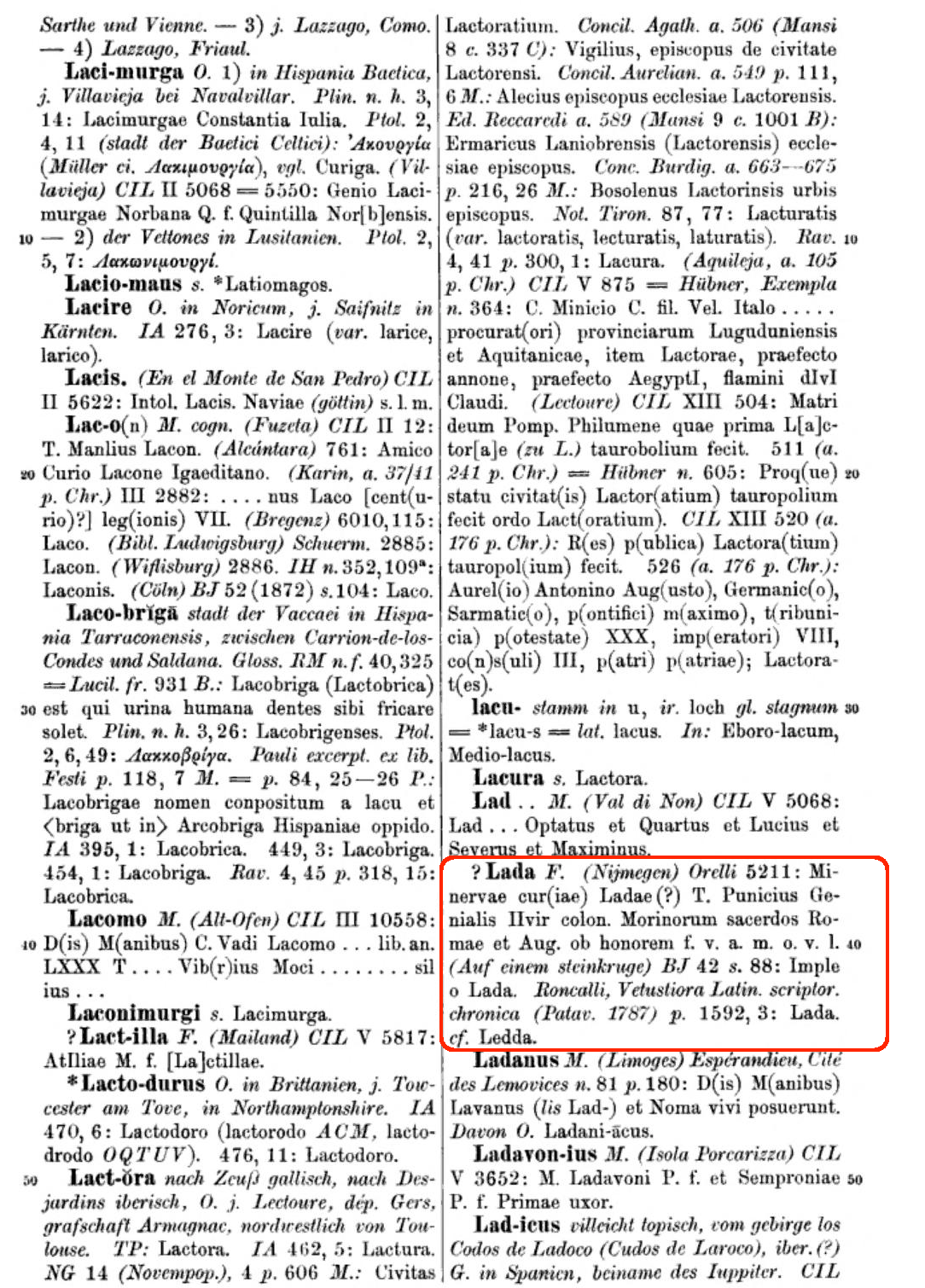
And speaking of Nijmegen, it is also the place where we find another mention of Lada in the inscription Minervae cur(iae) Ladae T. Punicius Genialis Ilvir coln. Morinorum sacerdos Romae et Aug. ob honorem:

This, as well as the other mention of Lada (Imple o Lada) we already discussed here.

(Incidentally, if you think Laba, the Slavic name of the Elbe comes from the German, just look at the number of words in this book that contain lab-, the word labia, by the way, expresses the river concept quite well and is, of course, present in many Indo-European languages.  This makes one think that Elbe, as in albius/white, may or may not be the right etymology).

What about Nia?  Well, no such name.  There is a Ni in an inscription near Polenzo (near Turin… Turin) and a Niati near Lyon.  Otherwise, there are various rivers named Nava (compare Krok going to “Nava”).

If you want to keep going you can consult other volumes where you will find, for example, Devana, a city of the Taizali tribe on Loch Daven (Devon?).

Incidentally, we were hardly the first to notice the above.  The following is from an 1894 Slovenian periodical Dom in Svet:

Copyright ©2017 jassa.org All Rights Reserved

February 13, 2017

Hüter am Rhein

Published Post author

An interesting study of Slavic place names on the Rhine* was conducted at the end of the 19th century.  These place names were assumed by the author – Hubert Marjan – to have appeared there by reason of the resettlement policies of Constantine the Great who in 334 supposedly resettled 300,000 Sarmatians somewhere in the Roman Empire, presumably including Gall.  According to other authors, the settlement took place under Constantius II in 359.  If some or all of these Sarmatians happened to speak Slavic then their settlement would have left a mark.

(* note – we have come across a view that the very name of the river is Slavic… how, well, in some old documents (including the Vita Louis) the river is repeatedly referred to as Hrenus and the suggestion is that the H was a G originally G>H, in which case the next step would be to change the “e” to an “a” and add an -ica so that we have granica/граница (Croat, Polish, Russian) or better yet hraniční (Czech) or hraničné (Slovak) (it’s different in Slovenian/Ukrainian).  That way the Rhine would the “border”.  Since the Slavs would presumably be on its Eastern side, they would neatly fit with the Suevi yet again.  That said, the above requires a number of steps which we are not convinced are justified.)

Whether or not this resettlement is true or, if true, whether or not it has any relation to the below data, the below data is interesting in and of itself.

Where are or were those places?

We put them on the map:

Most of them are in red.  (The blue square is a place the author did not associate with Slavs.  It is the town Graach which appears in documents first as Gracho, Gracha and Graca).

Here is the list (you would not have guessed them and we are not saying we agree with all of them as being Slavic (or with classifying others, not listed below, such as the above Gracho, not with Slavs)):

  • Trechirgau – Latin Trigorium, otherwise Trechere, Drikerigau, Trichire, Drachere, Trekere, Trechgere – “three mountains”;
  • Brodenbach – from brod, i.e., “ford”;
  • Sarmersheim, Simmern, Simmerbach – meaning “Sarmatian-“;
  • Traust – previously Trausrait from trusa, trusti  author compares with Truosnasteti in Sclavis (from the area of Meiningen).  Meaning “reeds” trstinatrskatростни́кtrichina*trъstina;
  • Riegenroth – from reka;
  • Windesheim – obvious from Venadi (presumably Venadi Sarmatae);
  • Strimmig – from stream – Indoeuropean (e.g., German Strom) but with the Slavic diminutive -ig as in -ik, strumyk – “little stream”; (compare the German forms Sterminaberg, Strimitz, Strimmelitz, Stremmen, Strummin – all Slavic);
  • Kleinich –  previously Clenniche, Cleniche.  From klen or klon;
  • Crastel – chrast, that is, “brushwood”;
  • Savershausen – from the tribe of the Savari;
  • Seibershausen – from sebru – “farmer”;
  • Rhaunen – previously Hruna which he ties to a Croatian Pagus Crauvati, Chrouvat, praedia… Chrouata et Runa by Knittenfeld in Austria;
  • Weithersheim – from vetr, vetoer, vjetar, etc;
  • Namedi – earlier Namedey, Namedy – from Nemci or Nemetes (or same?) or “Germans”;
  • Veitskopf – that is “Vit’s head”;
  • Künskopfe – “horses’ heads”;
  • Pfalzfeld – because of the discovery of this column which, however, may have looked like the below reconstruction before (note the heads on top – this detail comes from earlier descriptions); this column has been classified as Celtic:
  • Hoch-Simmer – from zima (compare ZImor in Bohemia); Same concept as Sniezka;
  • Nurburg – from Mons Nore – Slavic nora;
  • Hoch-Pochten – Puthena  from bohin or pogoda or others (this one seems highly suspect);
  • Saffenburg – from “frogs” – compare with other such names from clearly Slavic places such as Sabnica or Sabniza, Safen and Saffin – all referring to frogs;
  • Sehl – previously Sele; nearby mountain Soch;
  • Soch – mountain name from socha/sucha that is “dry” – he notes the reference the “completely uncultivated” mountain in 1144 (penitus incultus).
  • Cochem – previously Cuchuma, Cuhckeme, Cochomo, Cochma, Kuchema and others – compared with villa Cugme (Serb) on the Danube which was Schaffarik thought was related to the word kukma, that is comb (but compare the Gujarati village Kukma);
  • Sarmersbach – “Sarmatian stream”.  Here the author relies on spring celebrations which were recorded in the village and which seem to have involved young men going around, with a basket that had a spruce in it and collecting eggs.  They would go house to house and demand eggs of young ladies singing as follows: “Will das Mädchen nicht obstohn, Fein Liebchen fein! So wollen wir’s in die Blotz dröhn.”  The “Blotz” had been explained as referring to an “offering” (Gothic blotan or Ahd pluozan).  But the author compares this to bloto meaning “mud”, i.e., if you do not give us eggs we will throw you in the mud.  He further compares this to the dyngus of Poland and Silesia (not found elsewhere in Germany).
  • Mückeln – in the area there are (or were in the 19th century) many pagan burial sites that the locals called tumuli.  The author derives the name from the Slavic mogila (see also Mugilones) and cites Miklosich as showing similar names in the area of Magdeburg such as Müglenz, Muggel, Möchling, Mücheln, Muchil, Mügeln, Muggelink.
  • Ober-Wesel – Wesel meaning froh or “happy” vesel, Veselka, Veseloe, Vjessel  

These people belong to a local “Keltengruppe” – look at these faces :-).

Copyright ©2017 jassa.org All Rights Reserved

February 3, 2017

Thegan’s Deeds of Louis (the Pious) and its Few Slavs (or Suavs)

Published Post author

The following are the few Slavic excerpts from Thegan’s Deeds of Louis (the Pious) (778 – 840).  That “Vita” (Gesta Hludowici imperatoris) is one of the few (relatively) contemporary biographies written about Louis (the others – the Life of Louis (the Pious) and Carmina in honorem Hludowici Caesaris –  having been written, respectively, by the anonymous, so-called Astronomer and by Ermold) .  Thegan (before 800 – circa 850) was the bishop of Trier.

About twenty manuscripts of this work remain.  One of the oldest (from about 1090) is one where the scribe could not quite make up his mind how to spell Slavs.  In the earlier section we have Suavos and in the later we have Sclavos (the other manuscripts seem to have Sclavos in both places).

Louis

It is interesting to note (see below) how easily a “u” may become a “cl” (or vice versa).

Gesta Hludowici imperatoris

14. In the next year [815] of his reign he held his general assembly in the territory of Saxony and there he decreed many good things.  Danish legates came to him requesting peace; all who were in the surrounding pagan countries came to him.  Bernard came to him there, and Louis sent him back to Italy.  After Louis confirmed the confines of his kingdom in these territories, he returned to his seat in the palace at Aachen and there spent the winter.

15.  In the following year [816] Louis sent his army against the Slavs who lived in the east.  The Franks overcame them and were victorious by the gift of God.  That done, each of them returned to his own lands.

27.  In the following year [820] Louis sent his army against the eastern Slavs.  The leader of the Slavs was named Ljudovit.  The Franks put him to flight and laid waste to that land.  Returning from there, they went home.

34.  In the next year [825] Louis was at the palace at Aachen with his army and there legates of the Bulgars came bearing gifts.  Louis received them graciously and dismissed them to return to their own land.

Copyright ©2017 jassa.org All Rights Reserved

February 2, 2017

The Slawinia of Vita Willibaldi

Published Post author

According to the composer of his Vita, Hugeburc of Heidenheim (!), Bishop Willibald of Eichstätt (700 – 787) went on a pilgrimage to the Holy Land in the year 722.  During his journey he passed through the Peloponnese reaching the city of Monemvasia in the land of Slavinia (“….venerunt ultra mare Adria ad urbem Manamfasiam in Slawinia terrae.”)  Slavic presence in the Peloponnese is attested in numerous sources (such as the Scholium of Arethas of Caesaria, the Chronicle of Monemvasia, the much later Chronicle of Morea).  Here we present Hugeburc’s Vita Willibaldi (translation by C. H. Talbot).

As a point of further interest both Willibald (born in Wessex) and Hugeburc were Anglo-Saxons. Also Hugeburc (also Hygeburg or Huneberc) was a nun at the Abbey of Heidenheim.  She wrote the Vita at some point between 767 and 778.

“…So after the solemnities of Easter Sunday were over this restless fighter set off on his journey with two companions.  On their way they came to a town east of Terracina [Fondi] and stayed there two days.  Then, leaving it behind, they reached Gaeta, which stands at the edge of the sea. At this point they went on board a ship and crossed over the sea to Naples, where they left the ship in which they had sailed and stayed for two weeks. These cities belong to the Romans: they are in the territory of Benevento, but owe allegiance to the Romans.  And at once, as is usual when the mercy of God is at work, their fondest hopes were fulfilled, for they chanced upon a ship that had come from Egypt, so they embarked on it and set sail for a town called Reggio in Calabria. At this place they stayed two days; then they departed and betook themselves to the island of Sicily, that is to say, to Catania, where the body of St. Agatha, the virgin, rests.  Mount Etna is there.  Whenever the volcanic fire erupts there and begins to spread and threaten the whole region the people of the city take the body of St. Agatha and place it in front of the oncoming fiames and they stop immediately.  They stayed there three weeks. Thence they sailed for Syracuse, a city in the same country.  Sailing from Syracuse, they crossed the Adriatic and reached the city of Monembasia [Monemvasia], in the land of Slawinia, and from there they sailed to Chios, leaving Corinth on the port side.  Sailing on from there, they passed Samos and sped on towards Asia, to the city of Ephesus, which stands about a mile from the sea.  Then they went on foot to the spot where the Seven Sleepers lie at rest.  From there they walked to the tomb of St. John, the Evangelist, which is situated in a beautiful spot near Ephesus, and thence two miles farther on along the sea coast to a great city called Phygela, where they stayed a day.  At this place they begged some bread and went to a fountain in the middle of the city, and, sitting on the edge of it, they dipped their bread in the water and so ate. They pursued their journey on foot along the sea shore to the town of Hierapolis, which stands on a high mountain; and thence they went to a place called Patara, where they remained until the bitter and icy winter had passed.  Afterwards they sailed from there and reached a city called Miletus, which was formerly threatened with destruction from the waters.  At this place there were two solitaries living on ” stylites “, that is, colurnns built up and strengthened by a great stone wall of immense height, to protect them from the water. Thence they crossed over by sea to Mount Chelidonium and traversed the whole of it.  At this point they suffered very much from hunger, because the country was wild and desolate, and they grew so weak through lack of food that they feared their last day had come.  But the Almighty Shepherd of His people deigned to provide food for His poor servants.  Sailing from there, they reached the island of Cyprus, which lies between the Greeks and the Saracens, and went to the city of Pamphos, where they stayed three weeks. It was then Eastertime, a year after their setting out.  Thence they went to Constantia, where the body of St. Epiphanius rests, and they remained there until after the feast of St. John the Baptist…”

Copyright ©2017 jassa.org All Rights Reserved

January 29, 2017

Fragments of Muhammad al-Idrisi’s Tabula Rogeriana

Published Post author

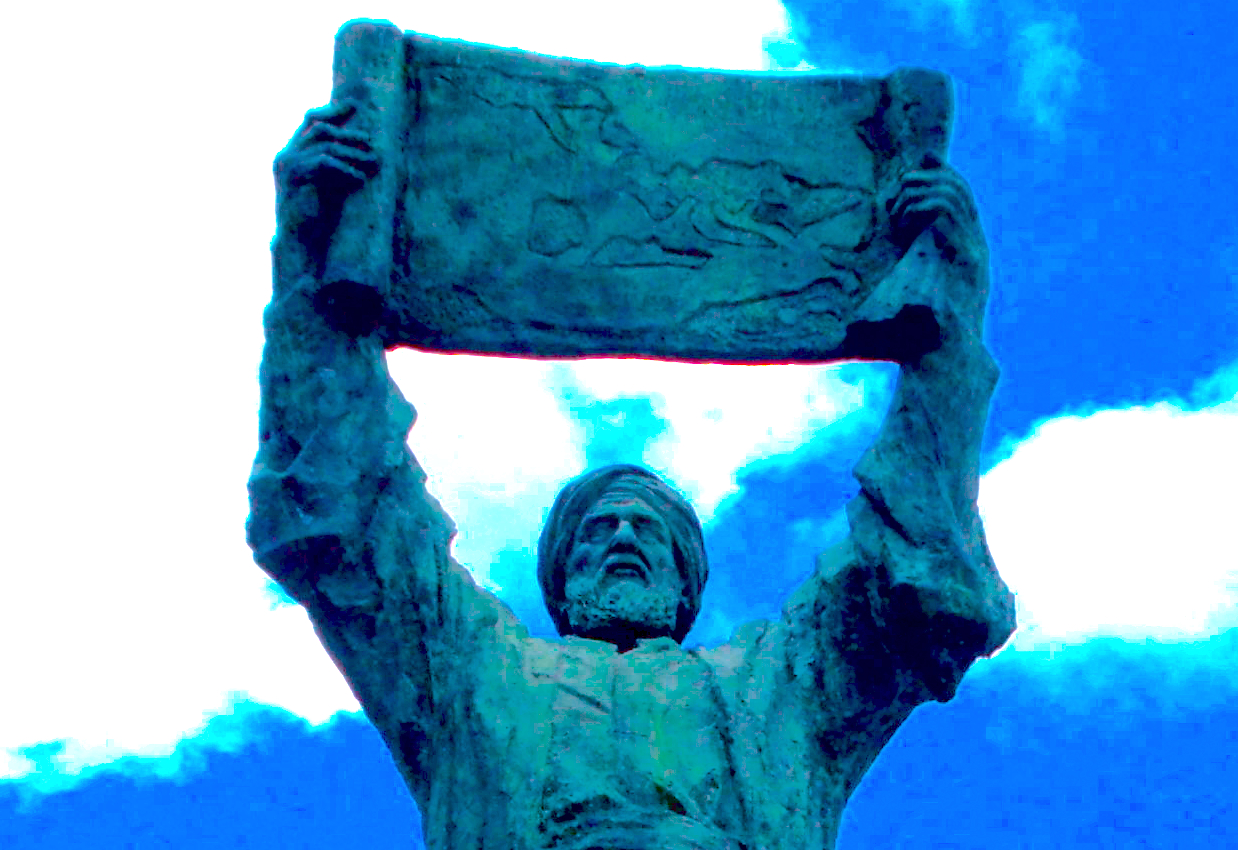
Muhammad al-Idrisi (1100 – 1165) born in Ceuta in Andalusian Spain was the Arab writer of a famous treatise on Geography that was loosely based on Ptolemy and updated through al-Idrisi’s time.  This, together, with the accompanying map has been referred to as the Tabula Rogeriana – a world map and description made by al-Idrisi for the Norman King of Sicily – Roger II in the year 1154.  The book, which was published in Paris in the year 1840, contains references to various Slavic countries in the description of the so-called “Sixth Clime.”  The sections referring to Central and Eastern Europe are found in the third section, fourth section and fifth section.  We may present them all at some point but for now we just present the description of Poland and Russia which is found at the end of the fourth section.

Sixth Clime
Section Four 

“… From Akli to Stlifanos, a large city which used to be even more important before, [it is] one day’s [travel].  We shall hereafter give an indication of the roads leading from this city to the neighboring countries.  As for Poland, a country of science and Greek [ar-Rum, i.e., Byzantine] wisemen, it is fertile, furrowed by streams, covered with towns and villages. The vine and the olive grow there as well as all species of trees and fruits. Its main cities are: Cracal, Djenazia, Anklaia, Serdawa, Neghrada and Chithow.*  They are all beautiful, flourishing and celebrated, especially because there live there men versed in the knowledge of sciences and of the Greek [Byzantine] religion and by skillful and intelligent workmen.  [As regards the city of] Cracal, Djenazia and the other towns we have just mentioned, they are filled with contiguous dwellings, possess very many resources and singularly resemble each other in their size and their appearance.  The objects which are manufactured there are nearly all of the same nature.  This county is separated from Saxony, Bohemia, and Russia by mountains which surround it on all sides.”

[* note: another reading has “Ikraku, Gnazna, Rtslaba, Srada, Ngrada, Stnu”]

Gniezno and Cracow shown in blue on the right (picture is upside down for ease of reading)

“The distances in Poland:”

“From Cracal to Masela, 130 miles
From Cracal to Djenazia, 80 miles
From Djenazia to Anclaia, 60 miles
From Anclaia to Zaca, 12 days
From Zaca to Bermowa, 180 miles
From Bermowa to Galisia, 200 miles”

“These last two countries belong to Russia”

Roger

“The principal rivers of Poland include Butent and Tessia [Tisza?]”

“They take their sources in the mountains which separate Poland from Russia, from north to south.  They flow towards the west, then unite and form a single stream which flows into the Danube to the west of Kawor [Sremski Karlovci?].”

“As for Russia, it is a vast country where there are few towns and scattered dwellings, so that to go from one region to another, one must travel immense distances through uninhabited places.   The Russians are in constant wars and disputes either among themselves or with their neighbors.  Among the cities of Russia included in this section are Sermeli, Zana, Barmounia and Galisia.  Among the cities of Russia included in this section are Sermeli, Zana, Barmunia and Galisia.  The first of these cities [Sermeli] is situated on the Dniestr, in the northern part of the course of this river which flows towards the east to Zana, a 12 day distance.  From Zana, a city on its [Dniestr’s] banks, to Barmouni, [it is a] 9 days’ [journey]. And from Barmuni to Galisia, 200 miles.”

Copyright ©2017 jassa.org All Rights Reserved

January 29, 2017

Iazyges

Published Post author

“But the Slavs and the Rus are one people.”  This quote from Nestor is one of a number where the word for people that is used is the same as the word for tongue, i.e., iazyk.  Iazyk thus means tongue and language and, previously in Eastern Slavic languages, also a people.  Nestor does the same for the Slavs more generally.  Interestingly, very little has been done to research whether this concept has any connection with the tribe of the Iazyges that lived by the Danube.  Although Nestor does not discuss Iazyges, he does follow the view that the Slavs came from the Danube.  Nearby dwelt too the Quadi who are understood to be a tribe of the Suevi and who had had long relations with the Iazyges.  Now, the few Iazyges names that we have do not suggest that they spoke Slavic (they were “Sarmatians” whatever that may mean).  But the concept of “tongue as people” may have been introduced into Nestor’s Slavic via the Iazyges.  By the 5th/6th century accounts of the Iazyges cease.

Copyright ©2017 jassa.org All Rights Reserved

January 26, 2017

The Slavs of Ibn al-Saghir’s Chronicle of Tahart

Published Post author

Moving West to East along the African coastline away from Al-Bakri’s Morocco and its Kingdom of Nekor, we next come to Tahart in Algeria in the Chronicle of Ibn al-Saghir which is one of two chronicles (the other being by Abu Zakariya) about the imams of Tahart (aka Tahert or Tihert, a city six miles west of today’s Tiaret) from the Rustamid dynasty.  The Rustamids were a Persian dynasty of the Ibāḍ complexion that ruled the Berber tribes in central Maghreb between 776/777 and 908/909.  Tahart was their capital.  The Rustamids appear to have been quite liberal with all kinds of cultures crossing their state (pre-Arab Christians (perhaps even Vandals and Alans?), Jews, etc).  It was also a prosperous seat of commerce (the writer of the Chronicle seems to have at one point in his life been a shopkeeper in a part of town called ar-Rahadina – perhaps a reference to the Radhanites).

The Chronicle (for lack of a better term) contains a few interesting mentions of the Slavs.  As a point of curiosity, its first edition was put together by a Slavic (Polish) Frenchman (born in Mascara, Algieria) – one Adolphe de Calassanti Motylinski  (Chronique d’Ibn Ṣaghir sur les imams Rostemides de TahertActes du 14e Congrès des Orientalistes (Algiers 1905), volume III/2; an earlier version in Bibliographie du Mzab, les livres de la secte abadhiteBulletin de correspondance africaine, (1885), volume III).  This was based on the only known “manuscript” copy that he located in M’Zab (the M’zabis are Ibāḍis so that may have helped the manuscript being preserved there – this copy was put together only in the 18th century by one Abu Bakr Ibn-Yusuf).  Motylinski supplemented this with a work that mentions pieces of Ibn al-Saghir’s Chronicle written by a 15th century writer al-Barradi (Kitab al-Gawahir al muntaqat).

So, thanks to the efforts of all these people in the middle of Algeria we can now read a little bit more about the Slavs!  The Slavs mentioned are those in Baghdad and in Tahart.  We also mention the ar-Rahadina quarter (in Tahart) references as these may have been named after the Radhanite merchants.

Incidentally, the M’Zab is a deep, narrow valley with five towns dominating it at different points.  The most important one is called… Ghardaïa (as per Wiki: Ghardaïa has its origins in a female saint named Daïa who lived in a cave (ghār) in the area before it blossomed into a town inhabited by Ibadite Muslims who came to escape persecution from Fatimite Muslims in the north).

Slavic Rebels in Baghdad

“When Aflah took over the reigns of government [872?], he proved himself to be full of energy and and decisiveness…  His son Abu ‘l-Jaqzan [ruled 874 – 894] was respected by all on account of his piety.  He begged his father to allow him to make a pilgrimage [to Mecca].  He left with a caravan and arrived at Mecca.  After he completed the ritual circling and runs [Tawaf], he was discovered by the agents of the Abbasids who had arrived [in the city] at the same time as he.  They were told that the son of the chief of as-Surat had arrived from Maghreb sent by his father so as to stock of the situation in the country and to send out his men in all directions [so as to make contact] with those people who held their views [of as-Surat] and tenets of their denomination, so as to prepare them for the time when his father would arrive from the Maghreb.”

“Abu ‘l-Jaqzan was carried off from Mecca together with a certain man from the Nafusa tribe who had been his servant and he came with him to Madinat as-Salam.  And the ruler at that time was al-Mutawakkil or some other ruler who lived at such time.  He gave the order to throw him [that is Abu ‘l-Jaqzan] in prison.  The one who told me this said: ‘I was told by my father repeating the words of Abu ‘l-Jaqzan ‘My imprisonment took place at the same time as that of the brother of the caliph who had been punished for reprimanding the caliph.’ and spoke further: ‘He gave the same order for each of us to be thrown into the same prison.  He also gave me a daily stipend of 120 dirrhems.’  And he spoke further: ‘These sums were paid to me for as long as I did not leave [the prison].  And when I finally left and they let me leave they said: ‘Think who should receive the stipend [for you, i.e., to take to you] that you’ve been receiving so that we do not lose track of you and your name does not get deleted from our records [as a person receiving/entitled to the money].”

“He spoke further: ‘The cause of my release, by the will of Allah, was that the caliph’s brother grew fond of me in prison and we became great friends.  He would not eat or drink anything without calling me over and I too repaid him the same.’  And he spoke: ‘While we remained so, we heard that matters took a new turn in the world and that there had been a revolution.  The caliph had been killed and my friend who had prison with me had been elevated [to caliph] in his place.'”

“[Abu ‘l-Jaqzan] spoke: ‘We did not even notice when Slavs entered our dwelling [prison] with soldiers and he [caliph’s brother] was taken [away from prison].'”

“The one who said this to us mentioned neither the name of the caliph who had been killed nor the caliph who took power [as a result of the revolution].”

“He spoke: ‘As soon as my companion had become the ruler and set up his government, I was set free from the prison and, on his orders, taken to the vezir, who had been ordered by the caliph to watch over me, treat me with dignity and take care of my needs until such time as I could be seen by the caliph…'”

“Thereafter, the caliph ordered the vezir to take care of me and prepare my equipment for the journey.  He ordered to give me a ten trade of fabric which was then pitched for me as well as money for my upkeep and clothes.  He also wrote letters for me addressed to the various governors resident in provincial capitals [ordering them] to take care of my safety, show me goodwill, deliver what I ask for and treat me with respect.  I began to set my matters in order and then got under way.'”

“As regards Aflah ibn ‘Abd al-Wahhab, when he found out that he had lost his son and that he had been kidnapped and taken to Baghdad, he was greatly saddened at this and long worried.  He lived since that time constantly in sorrow and grief until his death which occurred when his son was still prisoner in Baghdad.”

Slavic Servants in Tahart 

“One day I asked Suleiman who was a freedman of qadi Muhammad ibn ‘And Allah: ‘What reason is there for Muhammad ibn ‘And Allah to have shown such disgust at [his] post as qadi* and to have given up his seal and chest for books and [to dare] to speak so to Abu ‘l-Jaqzan as he had done.  And he answered: ‘May God reward you in the life to come my son!  This [is what took place]: We were sitting on a certain night after the last prayer.  He [Muhammad ibn ‘And Allah] easily preferred me to the others as regards serving him.  And when we remained so, there was a rapid knock on our door.  He said to me: ‘Get up Suleiman! I fear something happened and news comes in the name of the sultan.”’

“And he [the freedman Suleiman] spoke: ‘I opened the gates and found myself in the presence of a woman catching her breath who was accompanied by a Slav carrying a lamp.’  And he spoke: ‘I said: ‘what is it that you wish woman?  She answered: ‘I wish [to speak with] the qadi.’  So I returned to him and informed him of this.  And he said: ‘Bring her in.’  I brought her in.  When she stood before him, he said to her: ‘What do you wish woman and what brings you here at this hour?’  She answered: ‘Gladly.  Just now the servants sent by Zachariah, the son of the emir forced their way into my house and took in before my very eyes my daughter.  So I said to my son: ‘Get up and chase them!’  He answered: ‘I am afraid that they might kill me should I wish to do that. And if they themselves would not kill me, I am afraid that they will have some of their mercenaries lay an ambush for me or bandits serving them so as to kill me…” [so presumably she sought help with the qadi]

* Qadi meaning a magistrate or judge.

Radhanite Quarters?

“…At this I got up and said to him: ‘Let God grant you prosperity!  I own a store at ar-Rahadina where I buy and sell…”

“…One day when I as at a mosque in ar-Rahadina, a man who was an outstanding personality among the  Ibāḍites – Suleiman, who came from the Huwwara [tribe] – spoke to me thus…”

Copyright ©2017 jassa.org All Rights Reserved

January 23, 2017

All of Thietmar’s Slavs (Books I – IV)

Published Post author

Except for some excerpts, we have not presented here the famous Chronicle of Thietmar of Merseburg.  We begin to correct that now with the first four books (out of eight),  Here are the mentions of the Slavs in Books I – IV of the Chronicle of Thietmar.  The translation by David Warner is based on the manuscript at Dresden (available in facsimile which was prepared pre-WWII; the actual manuscript was destroyed in the bombing of that city) but with additions from the other manuscript in existence that of Brussels which seems to stem from the Corvey Abbey. The Dresden manuscript seems to have been prepared by Thietmar and his team and so is superior but is incomplete due to some pages having been destroyed already prior to the sixteenth century (hence they are not part of the facsimile).  The Brussels pieces are marked with italics as done by Warner.

Book I

Chapter 3

“Merseburg had its beginning with Henry who unified the city’s holdings, legally belonging to many at the time, and treaty added to them through his virtue and industry…  Born of the noble lineage of Otto and Hadwig, he grew from boyhood like a tree in secret.  Like a flower in early spring, moreover, he gradually revealed himself to be a warrior of good character.  His father sent him with a large army to that province which we Germans call Daleminzia but the Slavs call Lommatsch*.  After much destruction and burning, he returned victorious.  But I should now relate how that region acquired its name.  Lommatsch is a spring located not more than two miles from the Elbe.  It is the source of a pool which often produces marvels, so the local populace claims, and many others have verified this with their own eyes.  If a good peace is to be expected, and the earth does not falsely promise its fruits, it is covered with wheat, oats, and acorns.  This brings joy to the hearts of the populace which frequently gathers there.  When the savage storms of war threaten, it gives a clear indication of the outcome with blood and ash.  The entire population venerates and fears this pool more than the churches, albeit with dubious expectations, and this region, which extends from the Elbe up to the Chemnitz, derives its name from it.”

* note: David Warner when translating this chose to supply the appropriate modern place names rather than the archaic form used by Thietmar (here Glomaci). “Widukind notes that the defeated Daleminzi subsequently called on the Hungarians for aid.  As the first known raid by the Hungarians occurred in 906, it has been assumed that Henry’s campaign occurred in the same year,  As a king, Henry continued and even intensified his aggressive posture towards the Slavs and, by 929, had sufficiently dominated them that they could be forced to pay tribute.”

Chapter 4

“While returning from an expedition against the Bohemians, Bishop Arn of Wurzburg set up his tent near this river, in the region of Schkeuditz, on a hill by the road leading to the north.  As he changed the mass, he was surrounded by a hostile army.  After all his companions had been martyred, he too was offered to God, along with the host which had been consecrated to these sacrifice of praise.  This occurred in the year 892 of the Incarnation and in the times of Emperor Arnulf.  Nowadays, burning lights are often seen there and not even the Slavs doubt that these are the holy martyrs of God.  During his period of office, the aforementioned priest built a templet God in the city of Wurzburg and, in ten years, built nine churches on the same model within his bishopric…”

Chapter 10

“As I will be speaking of Otto, I think it unnecessary to discuss each of his father’s accomplishments.  The extent of King Henry’s dignity can be perceived in his son and, in any case, the brilliance of his life shines sufficiently in the writings of many others [presumably a reference to Widukind whose chronic forms the basis for this chapter].  But I will add certain things which I find particularly noteworthy.  He made the following regions pay tribute: Bohemia, Daleminzia, and the lands of the Abodrites, Wilzi, Hevelli, and Redarii.  They immediately rebelled and, inciting others to join them, attacked, destroyed and burned the burg Walsleben.  To avenge this, pour army convened and besieged the burg Lenzen.*  Meanwhile, they beat back and utterly defeated a counterattack by the burg’s defenders, allowing only a few to escape.  The burg was also taken.  Among our people, two of my great-grandfathers, both named Liuthar, fell with many others on 5 September.  They were distinguished men, the best of warriors, of illustrious lineage, and the honour and solace of the homeland.”

* “A Slavic burg located approximately 50 kilometers north-west of Havelberg, at a strategic crossing over the river Elbe.  The Saxons occupied it in 929, and in 948 it was assigned to to the bishops of Havelberg.  After the Slavic uprising of 983, it was occupied by the Abodrites.”

Chapter 16

“He [Henry I]* established a settlement on a then densely forested mountain next to the Elbe and built a burg there which he called Meissen from a certain brook which flowed from it in a northerly direction [928/929].  As is the custom today, he strengthened it with a garrison and certain other remeasures.  From here, he compelled the Milzeni, already subject to his will, to pay tribute.  Furthermore, after long besieging the burg Lebusa, of which I will speak more extensively later, he forced the residents to flee to a small inner fortress and then to surrender. From that day, om which he justly destroyed by fire, to the present, the burg has been uninhabited.  If, as many say, Henry enriched himself unjustly during his reign, may merciful God forgive him.”

* Henry I died in 936.

Book II

Chapter 2

[years 929-935] “Many adversities disturbed his fortunes.  For the wicked Boleslav [I], having killed his brother Wenceslaus, Duke of the Bohemians and faithful to God and the king, remained full of pride for a long time.  But afterwards, the king conquered him by force and placed him in the custody of his brother Henry, the duke of the Bavarians [i.e., in 950].  The Hungarians, once enemies of his father but long pacified, again invaded but quickly retreated [February 937].  No small amount of discord arose among our fellow countrymen and colleagues who incited Tammo, son of the king and Liudgard.  All of this because the office formerly possessed by Count Siegfried of Merseburg,m which he claimed for himself, had been given to Margrave Gero and, so it appeared, Tammo’s maternal inheritance was to be entirely taken away from hi,.  The king besieged his son in the Eresburg and tried to move him from his evil presumption both with threats and promises.  But then the army entered the captured city and drove the youth, exhausted by the fighting, to retreat to the church of Saint Peter where previously the ancient Irminsul had been worshipped.  At last, pierced from behind through a window by Maginzo’s lance, he died before the altar [28 July].  Later, in the second year of his reign, the king punished Maginzo with a cruel death.”

Chapter 12

“As these events were transpiring, the Slavs started a horrible war at the instigation of Counts Wichman and Ekbert under the leadership of Nacco and his brother Stoignew.  Lacking confidence in his own ability to defeat them, the commander, Herman, asked the king for help.  Energetic as he was, the latter took  a strong force and invaded those northern regions which, as scripture teaches, so often produce evil [Jerome 1:14].  There, the king had Stoignew beheaded, after capturing him in a wood in which he had hidden as his supporters fled.  He pursued the authors of this outrage, the brothers Wichman and Ekbert, sons of his maternal aunt…”

Chapter 14

“…Gero, margrave of the eastern march, subjugated Lausitz, Selpuli, and even obligated Miesco [I of Poland] and his subjects to pay tribute to the emperor.  Duke Herman also made Selibur [of the Wagri], Mistui [of the Abodrites], and their followers pay tribute to the emperor.”

Chapter 22

“The emperor summoned Richer, the third abbot of the church of Magdeburg – for Anno and Otwin, then bishops, had preceded him – and wanted to decorate him with the episcopal dignity.  But after examining a letter which had been secretly given to him, he changed his mind.  Instead, he chose the monk Adalbert of Trier who had been previously ordained bishop for Russia but expelled by the heathen.  Otto promoted that illustrious and much-tested father to the archiepiscopal dignity on 18 October, in the year 970 of the Incarnation, and with papal authority.  Then, he sent him to his see with great honour, ordering all the leading  men of Saxony to be with him at the next celebration of Christmas.  The archbishop was received with magnificence by the clergy and the whole populace.  During these feast days, he consecrated Boso as first pastor of the church of Merseburg, Burchard as foist overseer of the church of Meissen, and Hugh as first bishop of Zeitz.  Also present was Dudo, the first guardian of Havelberg who had been previously consecrated.  All of these promised obedience to him and to his successors and to each was conveyed his specific diocese.  Thietmar, first pastor of the church of Brandenburg who had been previously consecrated and Jordan first bishop of Poznan joined these brethren.”*

* Bishop Jordan of Poznan (968 – 984) arrived in Poland as part of the entourage of Dobrawa, wife of Mieszko I.

Chapter 29

“Meanwhile, the illustrious Margrave Hodo collected an army and attacked Miesco [Mieszko I] though the latter was faithful to the emperor and paid tribute for territory extending to the river Warta.  Only my father, Count Siegfried, then a young man and unmarried, came to his aid with warriors of his own.  When the battle began at Zehden, on the feast of John the Baptist, they were initially successful [24 June 972].  But then Mieszko‘s brother, Cidibur [Czcibor], attacked and killed all the best warriors, with the exception of the two counts.*  The emperor was very  disturbed when he learned this miserable news and sent representatives from Italy who ordered Hodo and Miesco to leave off their fighting and preserve the peace until he returned, or risk losing his favour.”

* This refers to the Battle of Cedynia.

Chapter 31

“From thence, he went to Quedlinburg to celebrate the upcoming feast of Easter with divine praise and earthly joy [23 March 973].  Here also, at the emperor’s order, Dukes Miesco and Boleslau, and legates of the Greeks, Beneventans, Hungarians, Bulgarians, Danes, and Slavs gathered along with all the leading men of the kingdom.  When all matters had been settled peacefully and gifts had been distributed, they went home satisfied.  But the emperor’s joy was disturbed when Duke Herman died there on 1 April.  While his son Bernhard was preparing to transport Herman’s body to Luneburg, he encountered Bishop Bruno of Verden, who was near by.  Because the bishop had placed the duke under the ban during his lifetime, the son tearfully asked that he might immediately grant absolution and permit burial in the church.  But his request was not granted.”

Chapter 37

For a portion of this chapter dealing with the Slavs see here.

Chapter 38

“Because i have already spoken briefly about Duke Conrad, the emperor’s son-in-law who was killed at the river Lech, I believe that it would be appropriate for me to reveal certain things which were not discussed at that time.  Much later, during a stay at Merseburg, the emperor learned from an informant that the Slavs at Zwenkau under lord Kuchawiz, whom he much esteemed, had possession of the duke’s armour.  With Kuchawiz‘s aid, a judicial duel was held and the losers were hanged at the emperor’s order.  Most of the booty was restored.  I do not know whether they took these things as murderers or, without guilt, discovered the duke’s death by chance.  In any case, they rightly paid with their lives for having presumed to keep this secret.”

Chapter 42

“In the days of the previously mentioned emperor, there was a certain count, named Hed, who built a church in Heeslingen in honour of the athlete of Christ Vitus.  Because he had no heir, he endowed it with the greatest part of his property and, after establishing a congregation of nuns there, placed the same abbey under the protection of Archbishop Adaldag of Bremen.  But alas, the two venerable matrons who were placed over this foundation – each named Wendelgard – died quickly…”

Book III

Chapter 1

“…The emperor looked upon the still impoverished bishopric of Merseburg with generous concern, giving to Bishop Giselher, whom he loved greatly, first the abbey in Pohlde and then the burg Zwenkau with all its appertinences, this for the service of Saint John the Baptist.  He also granted to him whatever lay within the walls of Merseburg, including the Jews, the merchants, and the mint; also the forest between the river Saale and the Mulde or rather between the districts of Siusuli and Pleissnerland; as well as Kohren, Nerchau, Pausitz, Taucha, Portitz, and Gundorf.  All of this was conveyed through a diploma which he confirmed with his own hand.”*

* The various back & forths regarding these lands conducted by bishops and emperors should not cause us to lose sight of the fact that the lands at the time consisted primarily of Slavic villages.

Chapter 4

“…By election and by the emperor’s grant, Warin was quickly amnointed in his place [as archbishop].”

Chapter 7

“In the year 976 of the Incarnation of the Lord, Henry, duke of the Bavarians, fled to Bohemia after being deprived of both his office and the communion of the church.  While he was residing there, with Duke Boleslav, the emperor attacked with a strong army, but gained nothing at all against these two.  Moreover, through the treachery of one of Boleslav‘s warriors, he lost a great troop of Bavarians who were coming to his aid had just set up camp next to the burg Pilsen.  In the evening, the Bavarians were washing themselves without having set a guard for security.  Suddenly, the mailed enemy arrived and cut them down as they ran naked to their tents and through the meadow.  The enemy returned with all of their booty, happy and unharmed.  Hearing of the loss of so many men, and knowing that no other route of rerun was accessible to him, the emperor went directly to his burg at Cham.  In the following, he brought the duke to submission as the latter sought refuge at Passau.  In the next year, Duke Henry, Count Ekbert, and Bishop Henry were accused before the emperor at Magdeburg.  Afterwards, they were captured and sent into a long exile.

Chapter 11

“While the emperor was still in Rome, Archbishop Adalbert, in the thirteenth year after his consecration, was traveling around Bishop Giselher’s dopes, teaching and confirming his flock – this because Giselher himself was then with the emperor.  He celebrated mass at Merseburg on 19 June and happily spent the following night in Corbetha with Hermuzo, an honorable layman.  The next morning, after arising, he complained bitterly of a severe headache.  He departed nonetheless.  When he had passed through the village of Zscherben, on the way to Freckleben, he began gradually to sink down on his horse and would have fallen to the ground had he not been supported by his companions…”

Chapter 16

“After receiving the emperor’s permission, Giselher came to Magdeburg, on 30 November, in the company of Bishop Dietrich of Metz.  Dietrich was a friend of the emperor and very dear to him.  He also belonged to that group of corrupt men who, in return for obscuring the truth, had accepted one thousand pounds of gold an silver from the archbishop.  One morning, at the emperor’s order, someone jokingly blessed Dietrich in the following manner: ‘May God satisfy you with gold in the hereafter since we here cab by no means do so!’ Then everything previously belonging to our church was wretchedly divided, as if in accord with the custom of the Slavs by which, after a family has been accused, its property is dispersed by being put up for sale.  Bishop of Zeitz received that part of our diocese which lay between the Saale, Elster, and Mulde rivers; and between the districts of Pleisse, Wethau and Teuchern; and including the villages of Possen and Pissen [Bishop Frederik of Zeitz was bishop circa 980 – circa 990].  Bishop Folkold of Meissen was given a piece which included the villages of Wechselburg and Lastau and pertained to eastern Schkeuditz, being bordered by the rivers Chemnitz and Elbe.  For himself, Giselher kept nine burgs, namely: Schkeuditz, Taucha, Wurzen, Puechen, Eilenburg, Dueben, Pouch, Loebnitz and Zoecheritz.  Documents which conveyed royal or imperial gifts he either burned or, by altering the name of the recipient, mad ether refer to his own church.  Payers of tribute, and everything that was supposed to belong to Merseburg, he intentionally scattered so that they might never be gathered together again.  He established an abbey at Merseburg itself and set over it Ohtrad, a venerable monk of the monastery of Saint John.  Later he gave it to Heimo who came front he same monastery.  But note, O reader, what came of this destruction!”

Chapter 17

“Margrave DIetrich’s arrogance so irritated peoples who had already accepted both Christianity and the status of tribute payer in regard to our kings and emperors, that their members unanimously decide to take up arm’s.  This turn of events was predicted to my father, Count Siegfried, in the following way.  In a dream, he saw a sky filled with dense clouds.  Astonished, he asked what it meant and a voice replied: ‘Now that prophecy must be fulfilled: ‘God allows the rain to fall both on the just and the unjust.” [Matthew 5:45]  The outrage began on 29 July, with the murder of the garrison and destruction of the cathedral at Havelberg.  Three days late, at the sounding of prime, the entire band of Slavs attacked the bishopric of Brandenburg, a see established beyond Magdeburg some thirty years previously.  Folkmar, the third bishop of that seem had already fled, and his defender, Dietrich, barely escaped with his warriors on the same day as the attack.  The clergy who remained were captured.  The second bishop, Dodilo, was dragged from his tomb.  He had been strangled by his own people and, though three years in the grave, his body and priestly vestments were as yet uncorrupted.  The greedy dogs then plundered him and carelessly threw him back again.  They also stole all of the church’s treasures and brutally spilled the blood of many.  Thus various cults of demonic heresy were venerated instead of Christ and his fisherman., the venerable Peter.  And not only the heathen praise this sorrowful change, but also Christians!”

Chapter 18 

“In those times, the church of Zeitz was captured and wasted by an army of Bohemians under the leadership of Dedi.  Its first bishop, Hugh, had already fled.  Afterwards, the Slavs devastated the monastery of Saint Lawrence at Calbe and pursued our people as if they were so many fleeing deer.  Our spirits were fearful because of our sins, but their spirits were strong.  Duke Mistui of the Abodrites burned and ravaged Hamburg which was formerly the residence of the bishop.  Yet all of the Christendom should piously note the miracle that Christ performed there from heaven.  A golden hand came down from the highest regions and, with outstretched fingers, reached into the middle of the fire.  This occurred in full view of all.  The army looked on in astonishment, and Mistui was both terrified and dumbfounded.  This incident was related to me by Avico who was then Mistui’s chaplain, but later became my spiritual brother.  We both came to the conclusion that God had, in this way, taken the relic up to heaven and, at the same time, terrified and put the enemy to flight.  Later, Mistui lost his mind and was held in chains. After being immersed in water that ha been blessed, he shouted: ‘Saint Lawrence is burning me!’ But before he could be freed, he died wretchedly.

Chapter 19

“By the time the Slavs had burned and pillaged all the burgs and villages as far as the river Tanger, there were more than thirty bands of warriors on foot and horseback.  Without sustaining any losses and aided by their Gods, they did not hesitate to ravage the rest of the region, as their blaring trumpets preceded them.  We did not remain unaware of these events.  Bishops Giselher and Hildeward joined with Margrave Dietrich and with the other counts: Rikdag, Hodo, Benizo, Frederick, Dudo, my father Siegfried, and many others.  At dawn, on Saturday, they heard mass together.  Then, after fortifying body and spirit with the sacrament of heaven, they confidently fell upon the approaching enemy and, except for a few who found refuge on a hill, completely annihilated them.  The victors praised God, marvelous in all his works, and the truthful word of the treater, Paul, was confirmed: There is neither prudence nor strength nor counsel against the Lord. [actually from Proverbs] Utterly abandoned were those who had once dared to reject God and stupidly chose to worship meaningless idols, which they themselves had made, rather than their own creator.  Unfortunately, as night approached and our forces made camp some distance await, the Slavs of whom I have spoken above furtively escaped.  The next day our people happily returned to their homeland, after sustaining only three casualties.  While on their way, or once they were at home, they were congratulated by everyone they encountered.”

Chapter 21

[this describes Otto’s campaign in Italy in July 982]

“Along with Duke Otto and several others, the emperor fled to the sea where, in the distance, he spotted a ship f the type known as a salandria.  He hurried out to it on a horse belonging to the Jew Calonimus but the ship’s crew refused to take him in and continued on their way.  Returning to the safety of the shore, he found the Jew still standing there, anxiously awaiting the fate of his beloved lord [or the return of his stolen horse :-)].  When the emperor saw that his enemies had also arrived on the scene, he sorrowfully asked this man: ‘What now will become of me?’  Suddenly, he noticed that a second salandria was following the first once, and realized that a among the ship’s occupants was a friend who might be expected to help him.  Once again, he urged his horse into the water hand hurried out to the ship where he was recognized only by his warrior Henry, whose Slavic name is Zolunta.  He was taken on board and placed in the bed of the ship’s commander.  Eventually, the commander also recognized him and asked if he was the emperor.  After denying out for some time, Otto finally conceded and declared: ‘Yes, it is I, reduced to this miserable state because of my sins.  But listen carefully to what we may now do together.  I have just lost the best men of my empire and, tormented by this sorrow, can never again set foot in this land and have no further desire to see those who have befriended it.  Only, let us go to the city of Rossano where my wife awaits my arrival.  We will take he and all the treasure, of which I have an unspeakable amount, and go to your emperor, my brother.  As I hope, he will be a loyal friend to me in my time of need.’  Delighted at this pleasant conversation, the ship’s commander hurried day and night to reach this place.  As they approached their destination, the warrior with the two names [i.e., Henry/Zolunta] was sent ahead to summon the empress and Bishop Dietrich, who accompanied her, and also to fetch the many treasure-lade pack animals.”

Chapter 24

“… In the year 983 of the Incarnation of the Lord, the emperor held court at Verona and Henry the Younger, having been released from exile, was made duke of the Bavarians.  And in this same year, the Slavs united in resistance to the emperor and Margrave Dietrich.  Also, the emperor’s son was unanimously elected lord.”

Book IV

Chapter 2

“After leaving Magdeburg, Henry went to Quedlinburg to celebrate the joyful feast of Easter.  The great men of the duchy also gathered there, and some who did not wish to come in person sent a representative who was to scrutinize everything carefully.  During the celebration, the duke’s supporters openly greeted him as king and he was honoured with divine laudes.  Dukes Miesco, Mistui and Boleslav converted there along with innumerable others and swore oaths confirming their support for him as king and lord.  Many others, not daring to violate their oath to the king, for fear of God, withdrew somewhat and hurried to the Asselburg where there allies, now openly plotting against the duke, were meeting.  These are their names: from the East, along with Duke Bernhard and Margrave Dietrich, there were the Counts Ekkehard, Binizo, Esiko, the count and priest Bernward, Siegefried and his son, the brothers Frederich and Ziazo; from that region also were the brothers Dietrich and SIgbert, Hoiko, the brothers Ekkehard and Bezeko, Brunig and his brother; and, at the order of Archbishop Willigis, the milites of Saint Martin, joined by a great multitude from the West.”

Chapter 5

“In the company of his supporters, Henry then sought out Boleslav [II], duke of the Bohemians, who had always been willing to help him, whatever the circumstances.  The duke receive him honorably and had his army conduct hiom from the boundaries of his territory through those of the territories of Nisan and Daleminzia as far as Muegeln.  Then, with our people coming to meet him, he proceeded to Magdeborn.  Meanwhile, one of Duke Boleslav of Bohemia‘s milites, Wagio, who had been among the trips which ac companied Henry, stopped at Meissen while making his way home.  After conversing with the inhabitants of the place, the had an intermediary invite Frederich, ally and warrior of that Margrave Rikdag, whip then resided at Merseburg, to meet with him for a discussion at a certain church outside of the city.  As he went out, however, the door closed after him.  Rikdag, guardian of that city and a celebrated warrior, was ambushed and killed by them, at a stream called Triebischbach.  The city was soon furnished with a garrison by Boleslav and it quickly accepted him both as lord and resident.”

Chapter 6

“At the instigation of the ever capricious people, Boleslav drove out Bishop Folkold, who then went to Archbishop Willigis and was accorded a friendly reception.  The bishop had nourished him as if he were his own son and, when sent to those eastern regions, had warmly recommended to Otto II that WIlligis succeed him as the king’s teacher.  WIlligis never forgot this favour and acknowledged it with all gratitude, especially now, when Folkold was in greatest need.  He ordered that Folkold be cared for and given every consideration, at Erfurt, a location the bishop himself had chosen.  After residing there [at Erfurt] for a long time, he was able to return to his own see after Margrave Rikdag died and was succeeded by the illustrious Ekkehard, and when Boleslav returned to his own lands [October/November 985].  Afterwards, he became Boleslav‘s close friend.  When he was in Prague, where he had celebrated Maundy Thursday and, on the following day, which is Good Friday, he was rightly proceeding with the memory of he divine passion, he was paralysed vt stroke and had to be carried away…”

Chapter 9

“The king celebrated the next fewest of Easter at Queldinburg where he was ministered to by four dukes: Henry at his table, Conrad as chamberlain, Henry ‘the Younger’ as cellarer, Bernhard as marshal [April 4, 986].  Boleslav and Miesco also came here with their followers and, after everything was taken care of, departed again, richly endowed with gifts.  In those days, Miesco commended himself to the king and, along with other gifts, presented him with a camel.  He also joined the king on two expeditions… The king did not cease to assault the Slavs with many harsh campaigns [June – July 986].  He also conquered certain peoples in the East, who presumed to rise up against him.  In the West he contended by force and guile to conquer an enemy which repeatedly took up arms and plundered far and wide.  It is unnecessary to describe Otto’s childhood, and it would take too long to recount what he accomplished with the advice of prudent counsellors.”

Chapter 11

“At that time, Miesco and Boleslav [II] had a falling out and did much damage to one another.  Boleslav called on the aid of the Liutizi who had always been loyal to him and to his forefathers. But Miesco sought help from Empress Theophanu.  She was then in Magdeburg and sent Giselher, archbishop of that place, and the counts, Ekkehard, Esiko, and Bizino, along with my father and another of the same name, and with Bruno, Udo, and several others.  With barely four weak bands, they set off for the region called Selpuli.  While under way, they stopped by a swamp, over which a long bridge extended.  On the previous day, one of Willo’s companions had been captured by the Bohemians as he was going ahead of the group to inspect his land.  Now, in the silence of night, he escaped and gave Count Binizo the first news of an imminent attack.  At his warning, our forced quickly roused themselves and prepared for battle.  They heard mass in the grey dawn, some standing, others on horseback; and, anxious about the outcome of the coming battle, left their encampment as the sun rose.”

Chapter 12

“Then, on 13 July, Boleslav came with troops and both sides sent out scouts.  From Boleslav‘s side, a certain miles named Slopan approached to inspect our forces.  After returning, his lord asked for his opinion regarding this army and whether or not he would be able do battle with it.  Indeed, his milites had demanded that none of our people be permitted to depart alive.  Slopan offered him the following assessment: ‘This army is small in number, but of the best quality and armed richly in iron.  It is possible for you to do battle with it, but should the victory fall to you, you will be so weakened that you will have to flee your enemy Miesco and will only escape his constant harassment with great effort, or perhaps not at all.  Moreover, you will acquire the Saxons as your enemy in perpetuity.  If you are defeated, it will mean your end and that of your entire kingdom.  There will remain no hope of resistance for you, surrounded everywhere by the enemy.’  Boleslav‘s fury was calmed by these words and, after peace had been concluded, he asked our leading men, who had come to attack him, if they would go with him to Miesco and, in the matter of restoring his property, put in a good word with that prince.  Our people agreed to this and Archbishop Giselher, Ekkehard, Esiko and Benizo went with him.  All the rest departed for their homes in peace.  Now, with the day turning to evening, all were relieved of their arms until an oath was sworn, after which they were returned.  Boleslav came with our people as far sat the Oder.  There, a messenger was sent to tell Miesco that his allies were in Boleslav‘s power.  If he were to return the lands he had seized, he would permit these men to depart unharmed, if not, all would die.  But Miesco responded to him in these words: ‘If the king wishes to rescue his people or avenge third eats, he may do so.  In any case, he would not give up anything for their sake.’  When Boleslav heard this, he plundered and burned the surrounding areas as much as he could but left all of our people unharmed.”

Chapter 13

 “Returning from there, he besieged a fortress called […] and, with no opposition from the occupants, he conquered it along with its lord, whom he ave to the Liutizi for decapitation.  Without delay, this sacrificial victim was offered to their supportive Gods in front of the city and all departed for home.  Boleslav knew that, without his help, our forces could not reach home without being attacked by the Liutizi.  Thus, he dismissed our people at dawn on the following day and warned them to move quickly.  As soon as their enemies learned of this, they were eager to go after them with a large band of chosen warriors.  Boleslav was barely able to restrain them with words such as these: ‘You who came to help me, see that you complete what you have undertaken.  Know that I took those men under my protection and dismissed them in peace; and, as long as I live, I will not suffer even one of them to be harmed today.  It would be neither honorable nor wise for us to turn close friends into open enemies.  I know of the hatred between you, but you will find much more suitable occasions for satisfying it.’  After calming the Liutizi with words such as these, he managed to detain them for two more days.  Then, after taking leave of one another and renewing their ancient alliance, they departed.  Now, those infidels chose two hundred warriors who followed our force which were few in number.  Our forces were soon informed of this by one of Margrave Hodo’s milites.  Immediately quickening their pace, they arrived in Magdeburg unharmed (thank God!), while their enemies labored in vain.” 

Chapter 18

“Meanwhile Archbishop Adaldag of Bremen died and was succeeded by Liawizo who, from his homeland between the Alps and Swabia, had followed there exiled Pope Benedict here and so had put forward a claim to this office before God and the king [29 April 988].  After there fortresses on the Elbe were restored, the Slavs were attacked and made subject to the king.  In the winter, a flood and a great wind did much damage.  Excessive heat did great damage to the crops and many people died from a savage pestilence…*”

* as in Annales Quedlinburgenses under 987 and 988.

Chapter 19

“…In the fourth year, a great pestilence broke out in the eastern regions along with famine and war [995].  Also the king attacked the Abodrites and ravaged the lands of the Wiltzi.”

Chapter 21

“…The preceding winter [994] had been harsh, unhealthy, cold, windy and unusually dry.  At this time, the Slavs were defeated.”

Chapter 22

“But because I have spoken above about the destruction of the church of Brandenburg, now I will briefly explain how it was subjected to the king for a time.  In our vicinity, there was a celebrated miles, named Kizo, who was treated by Margrave Dietrich in a manner that did not please him.  Because of this and because no other means were available to him, he went over to our enemies.  The latter, recognizing him to be entirely faithful to them in all things, commended the above-mentioned burg to him in order to harm us that much more.  But after being mollified by our flattery , he surrendered it and himself into the king’s power.  Thereafter, the Liutizi, burning with anger, attacked him there with every available warrior [October 995].  Meanwhile, the king was in Magdeburg.  When informed of the situation, he quickly sent all the forces he had with him: Margrave Ekkehard, my three maternal uncles, Frederick the count palatine, and my paternal uncle.  As they were arriving there together, along with their forces, they were dispersed by a ferocious enemy attack.  After a number of millets had been killed, one part of our orcs managed to reach the fortress, the remainder had to retreat.  Then, after assembling supporters from all sides, the king himself quickly went there.  The enemy was severely pressing the burg’s defenders, but when they saw our forces in the distance, they quickly abandoned their camp and fled.  Rejoicing in their liberation, the defenders sang Kyrie eleison, and those who were approaching responded with one voice.  The king provided the burg with a a garrison and, after his departure, held it for a long time.  Later, when Kizo came to Quedlinburg, he was deprived not only of his burg, but his wife and milites as well.  Afterwards, he received everything back, except for the burg.  The burg was placed in the power of one of his warriors called Boliliut, on whose advice all of this had been done though he was not then present.  But Kizo, the best of warriors, secretly tried to exact revenge in those regions and was killed, along with his supporters.”

Chapter 28

“In the beginning of the summer, Adalbert, bishop of the Bohemians, arrived.  He had received the name Woyciech at his baptism, the other name, at his confirmation, from the archbishop of Magdeburg.  He was educated in letters, in that same city, Ochtrich about whom we have already spoken.  As he was unable to separate his flock from the ancient error of wickedness through godly teaching, he excommunicated them all and came to Rome to justify himself before the Pope.  For a long time, wit the Pope’s permission, he lived an exemplary life according to the strict rule of Abbot Boniface.  With the same Pope’s permission, he later tried to subdue the Prussians, their thoughts still estranged from Christ, with the bridle of holy preaching.  On 23 April, pierced by a spear and beheaded, he alone received the best martyrdom, without a groan.  This occurred just as he himself had seen it in a dream and had predicted to all the brothers, saying: ‘I thought I saw myself celebrating mass and communicating alone.’ Seeing that he had now died, the authors of this wicked crime increased both their wickedness and the vengeance of God by throwing the blessed body in the water.  His head, however, they scornfully transfused with a stake.  They returned home with great joy.  After learning of this,  Boleslav, Miesco’s son, immediately purchased both the martyr’s celebrated body and his head.  In Rome, after the emperor had been informed, he humbly offered praises to God because, during his lifetime, he had taken such a servant for himself through the palm of martyrdom…”

Chapter 29

“After departing from Romania, the emperor visited our regions and, having learned of a rebellion of the Slavs, advanced with an armed force on Stoderania which is also called the land of the Hevelli [latter half of May 997].  After wasting these lands with fire and great plundering, he returned victorious to Magdeburg [post-20 August].  Because of this, a great multitude of our enemies attacked Bardengau, but were conquered by our forces.  Bishop Ramward of Minden took part in that battle.  Followed by the standard-bearers, he had taken up his cross in his hands and ridden out ahead of his companions, thereby greatly encouraging them for battle.  On that day, Count Gardulf died along with a few others, but among the enemy, a great number were killed.  There remainder fled after abandoning their booty.”

Chapter 38

“Let us recall to memory what wretched damage occurred to Archbishop Giselher because of his carelessness.  For the protection of our homeland, the emperor had the Arneburg reinforced with necessary defensive works and policed it in Giselher’s custody for a period of four weeks [early to mid-June 997]  Through some as yet unknown ruse, he was invited to a meeting with the Slavs and went out, accompanied only by a small entourage.  Some went ahead, while others remind in the fortress.  Suddenly, one of his companions announced that their enemies were bursting out of the woods.  After milites from both sides were joined in combat, the archbishop, who had been traveling in a cart, fled on a fast horse.  Only a few of his companions escaped death.  Thus, the victorious Slavs plundered the belongs of the dead in complete security – it was 2 July – and complained only that the archbishop had escaped.  In spite of the fact that his forces had been so severely cut up, Giselher guarded the fortress up tp the agreed upon day.  While he was returning home, in great sadness, he encountered my paternal uncle, Margrave Liuthar, in whose care the aforementioned burg was now to reside.  Without hesitation, he commended it to him and departed.  When the margrave arrived, he saw smoke and fire coming from the fortress.  A messenger was sent to request that the archbishop return, but without success and Liuthar himself tried to put out the fire, now raging in two different places.  When nothing came of theism he surrendered the portal, open to the enemy, and sadly returned home.  Afterwards, when complaints about him were brought before the emperor, he purged himself of any guilt by swearing an oath.  Nine days after the aforementioned slaughter, on 13 July, my mother, Cunegunde, died at burg Germersleben.”

Chapter 45

“When he arrived at Zeitz, the emperor was received in a manner appropriate to an emperor by Hugh II, third pastor of that see [circa 10 February].  Then he went by a direct route to Meissen where he was honorably received by Eid, the venerable bishop of this church, and by Margrave Ekkehard whom he regarded highly.  Then, having traversed the territories of the Milzeni, he was met as he arrived at the district of Diadesi by Boleslav whose name is interpreted as ‘greater praise’ not by merit but by old custom.  With great rejoicing, Boleslav offered the emperor hospitality at a place called Eulau.  It would be impossible to believe or describe how the emperor was then received by him and conducted to Gniezno.  Seeing the desired city from afar, he humbly approached barefoot.  After being received with veneration by Bishop Unger, he was led into the church where, weeping profusely, he was moved to ask the grace of Christ for himself through the intercession of Christ’s martyr.  Without delay, he established an archbishopric there, as I hope legitimately, but  without the consent of the aforementioned bishop to whose diocese the whole region is subject.  He committed the new foundation to Radim, the martyr’s brother, and made subject to him Bishop Reinbern of Kolobrzeg, Bishop Poppo of Krakow, and Bishop John of Wroclaw, but not Unger of Poznan.  And with great solemnity, he also placed holy relics in an altar which had been established there.”

Chapter 46

“After all issues nada been settled, the duke honoured Otto with rich presents and, what was even more pleasing, three hundred armored warriors.  When the emperor departed, Boleslav and an illustrious entourage conducted him to Magdeburg where they celebrated Palm Sunday with great festivity [24-25 March]…”

Chapter 55

“I cannot place in its correct order everything that ought to be treated within the context of this book.  In what follows, therefore, I will not be embarrassed to add a few recollections.  Indeed, I rejoice in the change of pace much as the traveller who, because of its difficult or perhaps from ignorance, leaves the course of the more direct road and sets out on some winding secondary path.  Hence, I will relate the remaining deeds of Miesco, the celebrated duke of the Poles, who has already been treated in some detail in the previous books.  He took a noble wife from the region of Bohemia, the sister of Boleslav the Elder.  Her life corresponded to her name – she was called Dobrawa in Slavic, which, in German, means ‘the good’.  For this one, faithful to Christ, and realizing that her husband was mired in various heathen errors, turned her humble spirit to the task of binding him to the faith as well.  She tried in every way to conciliate him, not because of the threefold appetite of this evil world but rather for the sake of the admirable and, to all the faithful, desirable fruit of future salvation.”

Chapter 56

“She sinned willingly for a while, that she might later be good for a long time.  For during Lent, which closely followed he marriage, though she intended to offer an acceptable tithe to God by abstaining from meat and through the affliction of he body, her husband asked and tried to coax her into giving up her plan.  She consented, thinking that he might therefore be more willing to listen to her on some other occasion.  Some say that she only ate meat during a single Lenten period, others say three.  Now, O reader, you have heard her sin, now also consider the attractive fruit of her pious will.  She labored for the sake of her husband’s conversion and was heard by the Creator in his kindness; and through his infinite goodness that most zealous persecutor came to his senses.  After being admonished frequently by his beloved wife, he vomited out the poison of his unbelief and, in holy baptism, wiped away the stain of his birth.  Immediately, members of his hitherto reluctant people followed their beloved head and lord and, after accepting the marriage garments, were numbered among the wards of Christ.  Jordan, their first bishop, labored much with them, while he diligently invited them by word and deed to the cultivation of the heavenly vineyard.  Then the couple rightly rejoiced, namely the man and the noble woman, and all who were subject to them rejoiced at their marriage in Christ.  After this, the good mother gave birth to a son who was very different from her and the misfortune of many mothers.  She named him Boleslav, after her brother.  He first revealed his innate evil to her and then raged against his own flesh and blood, as I will reveal in the following.”

Chapter 57 [977]

“But when his mother died, his father married Margrave DIetrich’s daughter, a nun at the convent called Calbe, without the approval of the church.  Oda was her name and great was her presumption.  She rejected her celestial spouse in favour of a man of war, which displeased all the pastors of the church but most of all her own bishop, the venerable Hildeward.  But the welfare of the land, and the need to strengthen the peace, kept this from leading to a break; rather it provided a healthy and continuous incentive for reconciliation.  For she increased the service of Christ in every way: many captives were returned to their homeland, prisoners were released form their chains, and the prisons of those who had been accused were opened.  O hope that God will forgive her the magnitude of her sin, since such love of pious deeds was revealed in her.  We read, however, that he who does not entirely abandon the evil he has begun, will try in vain to placate the Lord.  She bore her husband three sons: Miesco, Swentepulk and…  She passed her life there, highly honoured, until her husband’s death.  She was beloved among those with whom she lived and useful to those from whom she had come.”

Chapter 58

“But on May 25, in the year of the Incarnation 992, the tenth year of Otto III’s kingship, the aforementioned duke, now old and feverish, went from this place of exile to his homeland, leaving his kingdom to be divided by many claimants.  Yet, with fox-like cunning, his son Boleslav unified it once more in the hands of one ruler, after he had expelled his stepmother and brothers, and had their familiars Odilien and Przibiwoj blinded.  That he might be able to rule alone, he ignored both human and divine law.  He married the daughter of Margrave Rikdag, but later sent her away and took a Hungarian woman as his wife.  She bore him a son, named Bezprym, but he also sent her away.  His third wife was Emnilde, a daughter of the venerable lord, Dobromir.*  Faithful to Christ, she formed her husband’s unstable character completely for the better and strove unceasingly to wash away both of her sins through the generous dispersal of alms and abstinence.  She bore two sons, Miesco and another one whom the father named after his beloved lord.  She also produced three daughters of whom one was an abbess, the second married Count Herman, and the third the son of King Vladimir.  I will say more about them later.”

* Dobromir was probably a Milseni duke of the Lausitz (guess).

Copyright ©2017 jassa.org All Rights Reserved
January 22, 2017

Iasion or Jasion

Published Post author

The name Yassa appears both in the context of light (jasny) as also in the context of fertility concept (e.g., the English year or Slavic yar).  Both these meanings appear in the names for Fall and Spring (jesien and wiosna), in addition to appearing in the names of certain local Deities such as Gerovit (pronounced Yerovit).    What’s more this Deity is frequently mentioned in the fertility rites descriptions associated with spring/summer – a role similar to Dionyssus (Dio-nyssus or “our God”?).  In fact, the concept of the wondering Johnny was preserved in Polish folklore for many years as (Jaś Wędrowniczek) and in 1893 Johnny Walker became the Hero of Maria Konopnicka’s children’s poem “Of the Wondering Johnny” (O Janku Wędrowniczku):

What’s even more remarkable about the Slavic Yassa God is the similarity to the Greek Jasion (there are several persons named that in Greek Mythology in addition to the other (?) “J” – Jason but here we talk about the Jasion of Demeter fame).

In light of that we decided to list the appearances of Jasion in ancient sources.    Thankfully most of our work was already done by this excellent website.

Homer, Odyssey
5.125 ff (trans. Shewring) (Greek epic C8th B.C.)

“[Hermes commands Kalypso (Calypso) to release Odysseus:] Kalypso shuddered, and her words came forth in rapid flight : ‘You are merciless, you gods, resentful beyond all other beings; you are jealous if without disguise a goddess makes a man her bedfellow, her beloved husband . . . So it was when Demeter of the braided tresses followed her heart and lay in love with Iasion in the triple-furrowed field; Zeus was aware of it soon enough and hurled the bright thunderbolt and killed him.’”  [N.B. the cutting of three furrows was part of fertility rites performed to inaugurate the new agricultural year.]

Hesiod, Theogony
969 ff (trans. Evelyn-White) (Greek epic C8th or C7th B.C.)

“Demeter, bright goddess, was joined in sweet love with the hero Iasion in a thrice-ploughed fallow in the rich land of Krete (Crete), and bare Ploutos (Plutus, Wealth), a kindly god who goes everywhere over land and the sea’s wide back, and him who finds him and into whose hands he comes he makes rich, bestowing great wealth upon him.”

Hesiod, Catalogues of Women Fragment
102 (from Oxyrhynchus Papyri 1359 fr. 2) 

“Elektra (Electra) was subject to the dark-clouded Son of Kronos (Cronus) [Zeus] and bare Dardanos . . ((lacuna)) and Eetion . . ((lacuna)) who once greatly loved rich-haired Demeter. And cloud-gathering Zeus was wroth and smote him, Eetion, and laid him low with a flaming thunderbolt, because he sought to lay hands upon rich-haired Demeter.” [N.B. Eetion is an alternate name for Iasion.]

Pseudo-Apollodorus, Bibliotheca
3.138 (trans. Aldrich) (Greek mythographer C2nd A.D.)

“Elektra (Electra), the daughter of Atlas, and Zeus were the parents of Iasion and Dardanos (Dardanus). Now Iasion had a lust for Demeter and was hit by a thunderbolt as he was about to attack her.”

Diodorus Siculus, Library of History
5.48.2 ff (trans. Oldfather) (Greek historian C1st B.C.)

“There were born in that land [of Samothrake (Samothrace)] to Zeus and Elektra (Electra), who was one of the Atlantides, Dardanos and Iasion and Harmonia . . . Zeus desired that the other of his two sons [Iasion] might also attain honour, and so he instructed him in the initiatory rites of the mysteries [of Samothrake], which had existed on the island since ancient times but was at that time, so to speak, put in his hands; it is not lawful, however, for any but the initiated to hear about the mysteries. And Iasion is reputed to have been the first to initiate strangers into them and by this means to bring the initiatory rite to high esteem.  After this Kadmos (Cadmus), the son of Agenor, came in the course of his quest for Europe [i.e. his sister who had been abducted by Zeus] to the Samothrakians, and after participating in the initiation [into the Mysteries of Samothrake] he married Harmonia, who was the sister of Iasion and not, as the Greeks recount in their mythologies, the daughter of Ares. [N.B. The usual account was that Harmonia was given to Elektra mother of Iasion to raise as her own.]  This wedding of Kadmos and Harmonia was the first, we are told, for which the gods provided the marriage-feast, and Demeter, becoming enamoured of Iasion, presented him with the fruit of the corn, Hermes gave a lyre, Athene the renowned necklace and a robe and a flute, and Elektra the sacred rites of the Great Mother of the Gods [Rhea-Kyebele], as she is called, together with cymbals and kettledrums and the instruments of the ritual; and Apollon played upon the lure and the Mousai (Muses) upon their flutes, and the rest of the gods spoke them fair and gave the pair their aid in the celebration of the weding. After this Kadmos, they say, in accordance with the oracle he had received, founded Thebes in Boiotia, while Iasion married Kybele (Cybele) [here identified with Demeter] and begat Korybas (Corybas) [leader of the Korybantes]. And after Iasion had been removed into the circle of the gods, Dardanos and Kybele [Demeter] and Korybas conveyed to Asia the sacred rites of the Mother of the Gods and removed with them to Phrygia . . .  To Iasion and Demter, according to the story the myths relate, was born Ploutos (Plutus, Wealth), but the reference is, as a matter of fact, to the wealth of the corn, which was presented to Iasion because of Demeter’s association with him at the time of the wedding of Harmonia.

Now the details of the initiatory rite are guarded among the matters not to be divulged and are communicated to the initiates alone; but the fame has travelled wide of how these gods [the Kabeiroi (Cabeiri)] appear to mankind and bring unexpected aid to those initiates of their who call upon them in the midst of perils. The claim is also made that men who have taken part in the mysteries become both more pious and more just and better in every respect than they were before. And this is the reason, we are told, why the most famous both of the ancient heroes and of the demi-gods were eagerly desirous to taking part in the initiatory rite; and in fact Jason and the Dioskouroi (Dioscuri), and Herakles and Orpheus as well, after their initiation attained success in all the campaigns they undertook, because these gods appeared to them.”

Diodorus Siculus, Library of History
5.48.1 

“One of the inhabitants of the island [of Samothrake (Samothrace)], a certain Saon [probably the same as Iasion], who was a son, as some say, of Zeus and a Nymphe, but, according to others, of Hermes and Rhene, gathered into one body the peoples who were dwelling in scattered habitations and established laws for them.”

Strabo, Geography 7
Fragment 49 (trans. Jones) (Greek geographer C1st B.C. to C1st A.D.):

Iasion and Dardanos, two brothers [sons of Elektra (Electra)], used to live in Samothrake (Samothrace). But when Iasion was struck by a thunderbolt because of his sin against Demeter, Dardanos sailed away from Samothrake, went and took up his abode at the foot of Mount Ida, calling the city Dardania.”

Clement, Exhortation to the Greeks
2.12 (trans. Butterworth) (Greek Christian writer C2nd A.D.)

“[An early Christian critique of the pagan Mysteries:] A curse then upon the man who started this deception for mankind, whether it be Dardanos, who introduced the Mysteria for of the Meter Theon (Mother of the Gods); or Eetion [i.e. Iasion], who founded the Samothracian orgies and rites (orgiateletas).”

Pseudo-Hyginus, Fabulae
250 (trans. Grant) (Roman mythographer C2nd A.D.)

“Teams [of horses] which destroyed their drivers . . . Horses destroyed Iasion, son of Jove [Zeus] by Electra, daughter of Atlas.” [N.B. Presumably Iasion was killed when Zeus cast his lightning bolt, causing his horses to bolt in panic and throwing him from the chariot.]

Pseudo-Hyginus, Fabulae
270 

“Those who were most handsome. Iasion, son of Ilithius, whom Ceres [Demeter] is said to have loved.”

Pseudo-Hyginus, Astronomica
2.4

Hermippus [Greek writer C3rd B.C.?], who wrote about the stars, says that Ceres [Demeter] lay with Iasion, son of Thuscus. Many agree with Homer that for his he was struck with a thunderbolt. From them, as Petellides, Cretan writer of histories, shows, two sons were born, Philomelus and Plutus, who had but little Favour for one another. The latter, who was extremely rich, imparted no share of his substance to his brother, who being fore reduced, sold the small estate he had, bought two oxen with the price, and set about the cultivating of the ground, and was the first that applied himself to agriculture. His Mother Ceres, after having admired the Art which her son had invented, placed him among the stars, where he forms the Boötes, or the Artophylax.”

Pseudo-Hyginus, Astronomica
2.22

“[Constellation Gemini the Twins:] Others have called them Triptolemus, whom we mentioned before [i.e. as the constellation Ophiochus], and Iasion, beloved of Ceres [Demeter]–both carried to the stars.”

Ovid, Metamorphoses
9.421 ff (trans. Melville) (Roman epic C1st B.C. to C1st A.D.)

“A rumbling argument arose in heaven, the gods all grumbling why others should not be able to grant such gifts [the restoration of youth to the elderly, the sole prerogative of the goddess Hebe]. Aurora [Eos] grumbled at her husband’s [Tithonos’] age, and gentle Ceres [Demeter] that Iasion was going grey.”

Ovid, Amores
(trans.  A. S. Kline)
3.10

“Here comes the annual festival of Ceres: my girl lies alone in an empty bed.  Golden Ceres, fine hair wreathed with ears of wheat, why must your rituals spoil our pleasure All peoples, wherever, speak of your bounty, Goddess, no other begrudges good to humanity less.  Before you, the bearded farmers parched no corn, the word threshing-floor was unknown on the Earth, but oak-trees, the first oracles, carried acorns: these and tender herbs in the grass were our food. Ceres first taught the seeds to swell in the fields, and first with sickles cut the ripened sheaves: first bowed the necks of oxen under the yoke, and scarred the ancient earth with curved blade.  Can anyone believe she delights in lovers’ tears that right worship lies in torment and lonely beds? Still, though she loves fertile fields, she’s no rustic, nor does she have a heart bereft of love. The Cretans are witness – Cretans’ don’t always lie. Crete was proud to nurse the infant Jove. There, he who steers the world’s starry courses, sucked milk, with tender mouth as a little child. Proof from a mighty witness: witnessed by his praise. I think Ceres might confess to the charge I make. She saw Iasus on the slopes of Cretan Mount Ida [Viderat Iasium Cretaea diva sub Ida], slaughtering the game with unerring hand. She saw him, and flames pierced her to the marrow, from there, love, partly drove out her shame. Shame quelled by love: you could see parched furrows and the sowing itself gave the least of returns. Though the fields were struck with well-aimed mattocks, and the soil was broken with the curving plough, and the seed scattered evenly over wide acres, the farmers were cheated of their useless prayers. Deep in the woods the goddess of fertility lingered: the garland of wheat-ears slipping from her long hair. Only Crete was enriched by a fruitful year: Wherever the goddess showed herself, there was harvest: Ida itself, home of forests, was white with crops, and the wild boars reaped corn in the woods. Minos the law-giver prayed for more such years: he should have wished for Ceres’s love to last forever. Because you were sad on lonely nights, golden goddess, why should I be forced now to endure your rites?Why should I be sad, when your daughter’s found again, her fate to rule a kingdom second only to Juno’s?  This festive day calls for loving, and poetry, and wine: these are the gifts it’s right to carry to the gods.”

Ovid, Sorrows of an Exile (Tristia)
(Trans. E. J. Kenney)
2.1

“Outside, and Venus with the avenger placed.
Sitting in Isis’ fane she’ll ask why Juno
Drove her so far across the Ionian sea.
Endymion to the Moon, Venus to Anchises,
Iasion to Ceres linked will be.”

Conon, Narrations
21

“Dardanus and Jasion, both sons of Jupiter and Electra, daughter of Atlas, lived on the island of Samothrace.  Jasion, having tried to search the ghost of Ceres, was killed by a thunderbolt. Dardanus, terrified at what had just happened to his brother, put himself on a raft, for there were no ships yet, and passed through the country which is opposite to Samothrace, a bountiful and fertile land famous for Mount Ida which forms part of it.  There lived Teucer, son of the river Scamander and a Nymph.  The inhabitants were named Teucriens and land was called Teucrie. Teucer, after some conversation with Dardanus, gave him half his kingdom. The new Sovereign built a city in the very place where he had landed on his raft.  After Teucer died, Dardanus united the whole country under his dominion.”

Dionysius of Halicarnassus
Roman Antiquities 1.61 (Trans. Cary/Spelman)

“That the Trojans, too, were a nation as truly Greek as any and formerly came from the Peloponnesus has long since been asserted by some authors and shall be briefly related by me also.  The account concerning them is as follows.  Atlas was the first king of the country now called Arcadia, and he lived near the mountain called Thaumasius.  He had seven daughters, who are said to be numbered now among the constellations under the names of the Pleiades; Zeus married one of these, Electra, and had by her two sons, Iasus and Dardanus.  Iasus remained unmarried, but Dardanus married Chryse, the daughter of Pallas, by whom he had two sons, Idaeus and Deimas; and these, succeeding Atlas in the kingdom, reigned for some time in Arcadia.  Afterwards, a great deluge occurring throughout Arcadia, the plains were overflowed and for a long time could not be tilled; and the inhabitants, living upon the mountains and eking out a sorry livelihood, decided that the land remaining would not be sufficient for the support of them all, and so divided themselves into two groups, one of which remained in Arcadia, after making Deimas, the son of Dardanus, their king, while the other left the Peloponnesus on board a large fleet.  And sailing along the coast of Europe, they came to a gulf called Melas and chanced to land on a certain island of Thrace, as to which I am unable to say whether it was previously inhabited or not.  They ca;led the island Samothrace, a name compounded of the name of a man and the name of a place.  For it belongs to Thrace and its first settler was Samon, the son of Hermes and a nymph of Cylene, named Rhene.  Here they remained but a short time, since the life proved to be no easy one for them, forced to contend, as they were, with both a poor soil and a boisterous sea; but leaving some few of their people in the island, the greater part of them removed once more and went to Asia under Dardanus as leader of their colony (for Iasus had died in the island, being struck with a thunderbolt for desiring to have intercourse with Demeter), and disembarking win the strait now called the Hellespont, they settled in the region which was afterwards called Phrygia.  Idaeus, the son of Dardanus, with part of the company occupied the mountains which are now called after him the Idaean mountains, and there built a temple to the Mother of the Gods and instituted mysteries and ceremonies which are observed to this day throughout all of Phrygia.  And Dardanaus built a city named after himself in the region now called the Troad; the land was given to him by Teucer, the king, after whom the country was anciently called Teucris.  Many authors, and particularly Phanodemus, who wrote about the ancient lore of Attica, say that Teucer had come into Asia from Attica, where he had been chief of the deme called Xypete, and of this tale they offers many proofs.  They add that, having possessed himself of a large and fertile country with but a small native population, he was glad to see Dardanus and the Greeks who came with him, both because he hoped for their assistance in his wars against the barbarians and because he desired that the land should not remain unoccupied.”

in Venerem Anchises, in Lunam Latmius heros,
in Cererem Iasion, qui referatur, erit.
omnia perversae possunt corrumpere mentes;

According to Theoi.com here are some other sources:

OTHER SOURCES

Other references not currently quoted here: Servius ad Aeneid 1.384 & 3.15 & 3.167, Ovid Amores 3.25 [?], Scholiast ad Theocritus 3.30, Eustathius ad Homer 1528, Tzetzes ad Lycophron 29, Stephanus Byzantium s.v. Dardanos.

Copyright ©2017 jassa.org All Rights Reserved

January 19, 2017