Al-Bakri’s Village of the Slavs

Published Post author

We have for a long time been receiving requests for the text about the “village of the Slavs” (Qarjat as-Saqaliba) near Nokour in Morocco.  We oblige.  The village is mentioned by the great historian and geographer Al-Bakri (Abū ʿUbayd ʿAbd Allāh ibn ʿAbd al-ʿAzīz ibn Muḥammad ibn Ayyūb ibn ʿAmr al-Bakrī, or simply Al-Bakri), a Spaniard by birth who worked primarily in Cordoba.  Al-Bakri (circa 1014 – 1094) wrote a number of works but only two have survived:

  • Kitāb al-Masālik wa-al-Mamālik (“Book of Highways and of Kingdoms”), and
  • Mu’jam mā ista’jam

It is the Book of Highways and of Kingdoms that contains the famous passages about the Slavs front he work/embassy of Ibrahim ibn Ya’qub.  The relevant passages to the present query also appear there in the translation of William McGuckin (also Mac Guckin and MacGuckin), aka Baron De Slane Description de L’Afrique Septentrionale par Abou-Obeid-El-Bekri published in 1911 (previously also in 1859) and in the French translation of the same published in 1913.

The references are to ancient Nokour or Nekor where Said ibn Salih (864-916) was ruler at the time of these events.  For more not the Kingdom of Nekor see here.

“…The Maknassi (Miknaça) having refused to pay Saleh the taxes they owed him, the prince [Saleh] wrote them a threatening letter and, having sealed it, he put it in a sack, which he bound on the back of his donkey.   He then said to one of his trusted men: ‘Take this animal to the middle of the land of the Maknassi; leave it there with this bundle, and then return.’  The order was executed.  The Maknassi found the donkey, recognizing it as Saleh’s.  They examined the packet, and, after reading the letter which was there, held counsel together.  At first an attempt was made to cut the hocks of the donkey, and to persist in the rebellion, but afterwards they resolved to collect the whole sum of money, to put it on the animal’s back with a fine cloth cover [Mervienne (r)] and bring everything back to Saleh.  At the same time they demanded the forgetting of their past and in fact were forgiven for their insubordination.  Saleh ibn Said died after a reign of twenty-eight years.”

“Said, his younger son, to whom authority was given, had scarcely established himself in the government, that the Slavs belonging to his family by right of purchase came to demand their emancipation.  He replied, ‘You are our militia and our servants; You are just like free men, since you are not counted among things that are inherited and the law governing the division of inheritance is not applied to you.  Why, then, do you wish to be freed?'”

It’s somewhere over there

“In spite of these observations, they persisted in their demand, and on his refusal to satisfy them, they uttered rude insults and took as their leader his brother Obeid Allah and his uncle Abu Ali er-Rida.  Attacked by these rebels even in his own palace, Said, who was supported only by his pages and by the women of his family, fought them from the top of the castle and forced them to depart.  Expelled from the city by the populace, the insurgents went to post themselves at the village of the Slavs, a village situated above Nokour.”

“They stayed there for seven days, when Said, having finally put together a few troops, went out to attack them.  After a battle he overcame the mutineers and imprisoned his brother Obeid Allah and his uncle Er-Rida, whose daughter he had as a spouse.  El-Aghleb, Abu’l-Aghleb, and the other cousins ​​of Said who had taken part in the revolt, were sentenced to death.  Obeid Allah was sent to Mecca under guard, and remained there until the end of his days.”

“Seada-t-Allah, son of Harun and cousin of El-Aghleb, was indignant at these executions: ‘How is this!?’ said he, ‘Said kills my cousins ​​and leaves life to his brother and his uncle who were as guilty as El-Aghleb!’  And he set to work to get help from the [tribe of the] Beni Islites who lived about the mountain of Abu ‘Hacen [and] he succeeded in winning them over despite the fact that he was from Nokour (and did so without Said having any knowledge of the plot).  The Islites revolted then.”

Nekor was a lush kingdom

“[In response,] Said gathered his followers and went out with Seada-t-Allah to punish the rebels. When the battle was joined, Seada-t-Allah betrayed his leader and went with his own men over to the side of the enemy.  Said fled, after losing a thousand of his followers and abandoned his flags and drums to the conquerors.  Having shut himself up in Nokour, he withstood a siege against the Islites commanded by Seada-t-Allah.  Victorious [Said] succeeded in repelling them.  Having then taken prisoner Memun, son of Harun and brother of Seada-t-Allah, he took his life.  Then he devastated and burned the houses belonging to Seada-t-Allah who had escaped to Temcaman.  Some time later, Seada-t-Allah made peace with his sovereign and returned to Nokour.”

“Filled with bravery and audacity, he went out again, accompanied by all who relied on him, and penetrated into the territory belonging to the Botovis and the Beni Ourledi.  Having obtained from these tribes the possession of Coloue Djara, he placed himself at their head and then invaded the districts occupied by the Mernica and the Zenata.  After having killed many and subjected all this region, he returned to Nokour, where he never ceased to serve Said with fidelity.  Ahmad, son of Idris, son of Mohammed, son of Soleiman, son of Abd-Allah, son of El-Hacen, son of Adam, Ali, son of Abu Taleb.  The marriage was celebrated at Nokur, and Ahmed spent the rest of his days with his wife.”

Saqaliba warrior scouting party

Later we also read the following where there is a reference to an assassination which may have perpetrated by Slavs or just by slave pages:

“El-Cacem, son of Obeid Allah, left a large family, whose members remain among the Zenata. The posterity of Mohammed es-Chehid also inhabits the territory of Zenata.  Abu’l-Aish, son of Obeid Allah, left two sons, Hammoud and Yahya.  The posterity of this one lives Tazeghedera. Hammoud had three children:  El-Cacem, Ali and Fatema.  Ali obtained the caliphate of Andalusia in the year 1016/1017.  He was killed in a bath at the palace of Cordova by two Slav pages. The assassins were subjected to the death penalty.  He left two sons, Yahya and Idris, the first of whom was his successor, the designe and lord of the Maghreb.  The second had the city of Malaga.”  

Copyright ©2017 jassa.org All Rights Reserved

January 19, 2017

Maps of the Veneti – “The First Builders of a European Community”

Published Post author

Some of you have been asking regarding the Savli, Bor, Tomazic Veneti book and whether it shows any maps as regards the extent of the Veneti.  Here are some (we do not necessarily agree with them – by their own account (see top map), the authors seem to be understating (see bottom map) the extent of Venetic presence in Europe):

Copyright ©2017 jassa.org All Rights Reserved

January 18, 2017

Slavs in Space

Published Post author

Since Slavs now seem to be in control of most of the world (Ivanka is obviously a Slav as is Melania and, sadly, so is Merkel), the nagging question in the Slavic community has been, “well, what about other planets?”.

This is a bit off topic but we want to point out that – while we possess no special insight into which other planets or galaxies are controlled by Slavs – it is the case that the last person to have walked on the moon was a Slav.

Cernan takes control of the moon in the name of Svantopolk (Cernan and moon to scale)

This was US Navy Captain Eugene Andrew “Gene” Cernan (of Czech and Slovak descent) who recently passed away:

We have not even began to scratch the surface of signs of other Slavs in the ancestors of the other moon astronauts but thought we’d mention this one as an easy shoe in for Slavs in Space.

Copyright ©2017 jassa.org All Rights Reserved

January 17, 2017

Kitab al-Filahât al-Nabâtiyyah

Published Post author

Ibn Wahshiyyah the Nabataean was a 9/10th century Aramean writer from Iraq who managed to produce an extensive treatise on Nabatean agriculture (Kitab al-Filahât al-Nabâtiyyah) in which we find (oddly enough) mention of the Slavs (MS Leiden 303) as follows (first published by Avraam Yakovlevich Garkavi (Albert (Avraham Eliyahu) Harkavy) in 1870 in his Skazaniya musulmanskich pisateley o Slavyanach i russkich):

“I wonder at the Slavs who, despite their great ignorance and separation from all learning and wisdom, somehow managed it together to establish the custom that corpses must be burned, so that they leave neither a king nor any other man without cremating him after death.”

Slavic King funeral pyre – 9th century

This was written sometime in the first quarter of the 10th century.

Copyright ©2017 jassa.org All Rights Reserved

January 17, 2017

The Mention of the Veneti in the Codex Aesinas

Published Post author

Here is quick picture of the Codex Aesinas (found, appropriately, at Jesi) page of the Germania referring to the Veneti:

The context is below.

WARNING 
looking at this at any level of magnification may result in reader turning from quasi-normal into a monstrous, disfigured Nazi:

With that said for those who don’t mind getting  new prescription glasses, here is the same contextualized:

Copyright ©2017 jassa.org All Rights Reserved

January 15, 2017

Ansgar’s and Rimbert’s Slavs

Published Post author

Ansgar (801 – 865) was the archbishop of the Hamburg-Bremen and also the Apostle of the North and Patron of Scandinavia.  He preached all over but primarily at the trading town of Birka (circa 830) and was not very effective that he earned his own “Vita.”  That Life of Ansgar (Vita Ansgarii or Vita Anskarii) was written in the ninth century by his student and successor Rimbert and talks mostly about Scandinavians.  Nevertheless, Slavs do feature in it and we present chapters mentioning them here in the Robinson translation with some revisions by Dutton (notes are Robinson’s).

One interesting aspect here it the mention of “Welanao.”  Welanao (or Welnao) which, it is suggested below by Robinson, is now Münsterdorf on the part of the River Laba (Elbe) that is called the Stör (Sturia) in Schleswig-Holstein also hints at a Slavic “Weletabi” origin.  The Sturia is the same Northalbingian river after which the Sturmarians or Sturmarii (always accompanied by the Holzati) are named, as here in the Slavic Chronicle:

Tres autem sunt Nordalbingorum populi, Sturmarii, Holzati, Thetmarzi, nec habitu nec lingua multum discrepantes, tenentes Saxonum iura et cristianum nomen, nisi quod propter barbarorum viciniam furtis et latrociniis operam dare consueverint 

We read about them too in Adam of Bremen’s work.  They do not appear to have been Slavs by this time (see map below which, of course, is someone’s approximation).  On the other hand, Welanao may also have been called the Welna:

Another interesting aspect of this is that the Codex Monasteriensis (Codex archive publici Monasteriensis) is a 12th century manuscript that has a listing of peoples featuring the names “Siridevindum, Slavorum” (Chapter 13) and “Scridevindun, Slavorum” [or Scridiwindun or Scridewindin] (Chapter 23) suggesting that the Scritefinni were Wends but separate from Slavs.  The Scritefinni are a mysterious people that have naturally been identified with Finns although they also (mysteriously) kept appearing in texts describing Central Europe presenting a bit of a puzzle that no one ever successfully addressed.  The suggestion that they may have been Wends is fascinating.  In effect, they would have been Scrite Veneti (The “Hidden” Veneti?).   It is also possible that Siride-vindum refers to the Sorbs.  Although these mentions appear to be later interpolations, the fact that even later scriveners made such connections is of interest.

With those thoughts in mind here are the Slavs of Ansgar (or, really, of Rimbert).

Chapter 13

“In order that these arrangements should be permanently established the emperor sent Ansgar to the apostolic see, and by his messengers the venerable bishops Bernold [Bishop of Strassburg] and Ratold [Bishop of Verona, ob. 874.] and the illustrious count Gerold, he caused the whole matter to be made known to Pope Gregory [I.e. Gregory IV, 827-844] so that it might receive his confirmation. The Pope confirmed this, not only by an authoritative decree, but also by the gift of the pallium, in accordance with the custom of his predecessors, and he appointed him as his legate for the time being amongst all the neighbouring races of the Swedes and Danes,* also the Slavs and the other races that inhabited the regions of the north, so that he might share authority with Ebbo the Archbishop of Rheims, to whom he had before entrusted the same office.** At the tomb of the holy apostle Peter*** he publicly committed to him authority to evangelize these races. And, for fear lest anything that he had done should prove ineffectual in time to come, he smote with his curse any who should resist, or contradict, or in any way attempt to interfere with the holy intentions of the emperor and committed such an one to everlasting vengeance and the companionship of devils.****”

“As we have already said, the same office of legate had before been entrusted by Pope Paschal [Paschal I 817-824] to Ebbo, the Archbishop of Rheims. Ebbo himself, inspired by the Spirit of God, burned with eager desire to draw to the Christian fold the non­Christian races and specially the Danes whom lie had often seen at the palace and who, as he grieved to see, had been led astray by the wiles of the devil. In order to promote their salvation he longed to sacrifice himself and all that be possessed. The emperor had given him a place situated beyond the river Elbe, which was called Welanao,***** so that whenever he went into those parts he might have a place in which to stay. Accordingly he frequently went to this place and distributed much money in the northern districts in order that he might win the souls of the people; and he attached many to the Christian religion and strengthened them in the catholic faith.”

NOTES

* The Codex Monasteriensis reads, Farriae, Gronlondon, Islondon, Siridevindum, Slavorum necnon onmium septerntrionalium et orientalium nationom quocumque modo nominatarum delegavit. Et posi to capite et pectore super corpus et confessionem sancti Petri apostoli, sibi suisque successoribus vicem suam perpetuo retinendam publicamque euvangelizandi tribuit auctoritatem. The names mentioned must have been interpolated at a later time as Gronlondon, i.e., Greenland, was unknown in the time of Ansgar.

** Ebbo was appointed as Archbishop of Rheims by Ludovic in 816, and about the year 820 he went on a missionary visit to Denmark. In 821 he was sent by Ludovic to Rome and received from Paschal I. a special commission to preach in the northern territories. In 822 he returned to Denmark accompanied by Bishop Wilderic of Bremen, and was the means of converting a number of Danes. In 825 he brought about a good understanding between Horic and Harald, and thereby prepared the way for the conversion of the country. In 833 he espoused the cause of Lothair, and was ordered by the Emperor to retire to the monastery of Fulda. Later on, at the request of Ansgar, he received the bishopric of Hildesheim. He died in 851.

*** Ante corpus et confessionem sancti Petri. There is still an underground chapel in the Vatican entitled The Chapel of the Confession of St. Peter, under the altar of which are what are reputed to be the bones of the Apostle. In this chapel, Boniface had stood more than a century before, 723. cf., Baronii Annales, ix. an. 723.

**** For use of this form of cursing, see Chapter xxiii. ad. fin.

***** Now called Münsterdorf, On the bank of the River Sturia. This took its name from the monastery Novum monasterium (Neu­münster), founded by Vicelinus.

Chapter 15

“Meanwhile our lord and master diligently executed his office in the diocese that had been committed to him, and in the country of the Danes, and by the example of his good life he incited many to embrace the faith.* He began also to buy Danish and Slav boys and to redeem some from captivity so that he might train them for God’s service. Of these he kept some with him, whilst others he sent to be trained at the monastery of Turholt. There were also with him here belonging to your order some of our fathers and teachers, as a result of whose teaching and instructions the divine religion has increased amongst us.”

NOTES

* Adam of Bremen says that at this time a multitude of Danes and Northmen were converted as the result of Ansgar’s work: see Hist. I. 18, Beatis Anscharius nunc Danos nunc Transalbianos visitans, innumerabilem utriusque gentis multitudinem traxit ad fidem. Si quando vere persecutione barbarorum impeditus est ab studio praedicandi apud Turholt cum discipulis suis se retinuit.

Chapter 19

“‘…We must seek to ascertain therefore whether it is by the will of the gods that we are urged to make this attempt.’ As his words were in accord with their custom* they could not refuse to adopt the suggestion. Accordingly they sought to discover the will of the gods by casting lots and they ascertained that it would be impossible to accomplish their purpose without endangering their own welfare and that God would not permit this place to be ravaged by them. They asked further where they should go in order to obtain money for themselves so that they might not have to return home without having gained that for which they had hoped. They ascertained by the casting of the lot that they ought to go to a certain town** which was situated at a distance on the borders of the lands belonging to the Slavonians. The Danes then, believing that this order had come to them from heaven, retired from this place and hastened to go by a direct route to that town. Having made a sudden attack upon its people, who were living in quiet and peace, they seized it by force of arms and, having captured much spoil and treasure, they returned home. Moreover the king who had come with the object of plundering the Swedes, made peace with them and restored the money that he had recently received from them He remained also for some time with them as he wished to become reconciled to their nation. Thus did the good Lord, on account of the faith of his servant Herigar, free the people of this place from the attack of their enemies and restore to them their possessions. After these occurrences Herigar brought forward a proposal in a public assembly and advised that they should try more earnestly to ascertain who was God. ‘Alas, wretched people,’ he said, ‘ye now understand that it is useless to seek for help from demons who cannot succour those who are in trouble. Accept the faith of my Lord Jesus Christ, whom ye have proved to be the true God and who in His compassion has brought solace to you who have no refuge from sorrow. Seek not any more after superstitious worship, or to appease your idols by useless sacrifice. Worship the true God who rules all things in heaven and earth, submit yourselves to Him, and adore His almighty power.’  His own faith having been strengthened by the abounding goodness of the Lord, he was the more ready to come forward both publicly and otherwise, and at one time by reproach, at another time by persuasion, he declared unto them the power of the Lord and the benefits resulting from faith in Him. And thus he continued the good fight even to the end of his life.”

“When at length his good deeds were complete and his weakness had increased, having been commended to the mercy of God in the presence of the priest Ardgar, and having received the Holy Communion, he departed this life happily in Christ.*** Much more might be said concerning the constancy of his faith, but this must suffice, inasmuch as we desire our narrative to be brief.”

NOTES

* For reference to the custom of casting lots in order to ascertain the will of the gods, see Tacitus Germania Chapter X., see also Vita Willehadi, chap. iii.  In casting lots the Danes were accustomed to cut a branch from a fruit­bearing tree from which they broke off a number of small sticks. Having cut certain marks on these, they placed them on a spread­out cloth. The priest, or chief then picked up three of these sticks and, in accordance with the marks that he found on them, answered “yes” or ” no” to the question addressed to him.

** Dreves (p. 70 n.), suggests that this may have been Bineta [Vineta] in the island of Wollin. This town was destroyed by Northmen in the ninth century. Kruse suggests that the town was in the district of Novgorod. Geschichte des Ethnischen Volksstamms, p. 457

*** Herigar’s death apparently occurred towards the end of the year 851.

Chapter 23

“…From the contents of his written statement we find that matters are even as the pious king made known to us by his trusty messenger Bishop Salomon. We therefore, following in the steps of our predecessor, the great Bishop Gregory, and recognising that the arrangements made by his foresight were deserving of divine approval, have decided to sanction the wish expressed by the great chiefs, viz., the Emperor Ludovic, of sacred memory, and his most excellent son, who bore the same name, by a writing bearing apostolic authority and by the presentation of the pallium in accordance with the custom of our predecessors. In order that Ansgar may he authoritatively established as the first archbishop of the Northalbingians, and that his successors, who strive for the salvation of the nations, may be strong to resist the attack of the evil one, we appoint our son Ansgar as our legate* amongst all the surrounding races of Swedes, Danes** and Slavs, and amongst all others living in those parts, whichever the grace of God may open a way, and we grant him authority to preach the gospel openly…”

NOTES

* Codex Monasteriensis adds “et successoress ejus legatos.

** Codex Monasteriensis reads, Sueonum, Danorurn, Farriae, Norweorurn, Gronlondon, Islondon, Scridevindun, Slavorum necnon septentrionalium et orientalium naponurn quocumque modo nominatarum delegamus et sibi suisque successoribus vicem nostram perpetuo retinendam publicamque evangelizandi tribuimus auctoritatem.

Chapter 26

“When he awoke from this dream which he had three years before he was invited to rule over the Church at Bremen, he was assured by what had been said that it was his duty to go somewhere in the Lord’s name, but whither he knew not. When later on he came by order of the king to this church and learnt that it was consecrated in honour of St. Peter and found some there who would not willingly receive him, he remembered his vision, and because of it he agreed to undertake the charge of this diocese for, as he solemnly declared, he would not otherwise have been willing to do this. At the time when he had the above­mentioned monastery at Turholt, and the calling of the heathen was his care, in order that he might be able to help them he caused some boys whom he had bought from the Northmen or Slavs to be brought up in the same monastery so that they might be trained for the holy warfare. When this monastery was given to Raginar he took some of these boys and sent them out as his servants, and on this account the bishop was specially distressed. In a vision which he had soon afterwards, he appeared to have come to a certain house and to have found there King Charles and Raginar. It seemed to him that he reproached them in regard to these boys and said that be had arranged to train them for the service of Almighty God and not to act as servants to Raginar. When he said this, it seemed to him that Raginar lifted his foot and kicked his mouth, and when this happened he thought that the Lord Jesus Christ stood by him and said to the king and to Raginar, “To whom does this man whom ye treat so shamefully belong? Know that he has a Master and because of this you will not go unpunished.” When he said this they were terrified and affrighted, whereupon the bishop awoke. The divine vengeance which overtook Raginar showed how true was the revelation. For a little later he incurred the displeasure of the king and lost the monastery and everything that he had received from the king, nor did he ever regain his former favour.”

Birka

Copyright ©2017 jassa.org All Rights Reserved
January 14, 2017

Bible Studies

Published Post author

For those of you who find references to Peronne or Pyreenes or Greek (and Venetian!) pirouni/pirons interesting, here is a piece from Deuteronomy (33, 2):

“The Lord came from Sinai, and rose up from Seir unto them; he shined forth from Mount Paran, and he came with ten thousands of saints; from his right hand went a fiery law for them.”

and also Habakkuk (3, 3):

“God came from Teman, the Holy One from Mount ParanHis glory covered the heavens and his praise filled the earth. His splendor was like the sunrise; rays flashed from his hand, where his power was hidden.  Plague went before him;  pestilence followed his steps.  He stood, and shook the earth; he looked, and made the nations tremble.  The ancient mountains crumbled and the age-old hills collapsed— but he marches on forever.”

another interpretation has been something like:

“The Lord came from Sinai but His glory dawned unto them from Seir, and flashed forth from Mount Paran.”

Paran has been tentatively suggested as referring to a mountain near the river valley of Wadi Feiran (Ptolemy?).  Wadi Feiran is Sinai’s largest river.

Another identification that was suggested for Paran is Mount Serbal or Sinai.

We will leave aside the fact that wadi means river in Arabic and Hebrew and the connection (if any) with the Slavic voda/woda meaning water.

We note that Paran also appears in other places of the Bible as, for example, in the Desert of Paran.

(Piran was a name also of numerous Persian figures, including, apparently, the prince “Ultra” from Ammianus Marcellinus Book 27 which may have been a mistranslation of what the author took as Peran (Greek: beyond) to Latin (i.e., Ultra).  What Piran or Peran meant in ancient Iberian (from Armenia/Georgia not Spain), we do know know exactly.

Copyright ©2017 jassa.org All Rights Reserved

January 6, 2017

A Matter of Tithes

Published Post author

Saint Boniface born Winfrid, Wynfrith, or Wynfryth (675 – 754) was your typical proselytizing nutcase rampaging throughout Europe in the 8th century before being killed by Frisian freedom fighters.  We’ve already discussed his description (in a letter to King Ethelbald of Mercia) of the Slav marital fidelity here.  But Boniface being a good brother of the Church also left other correspondence.  And some people even wrote him back as in this letter from Pope Zachary.

Zach complete with a mole

Letter 87 
From Pope Zacharias (Pope 741-752)
to Boniface
November 4, 751

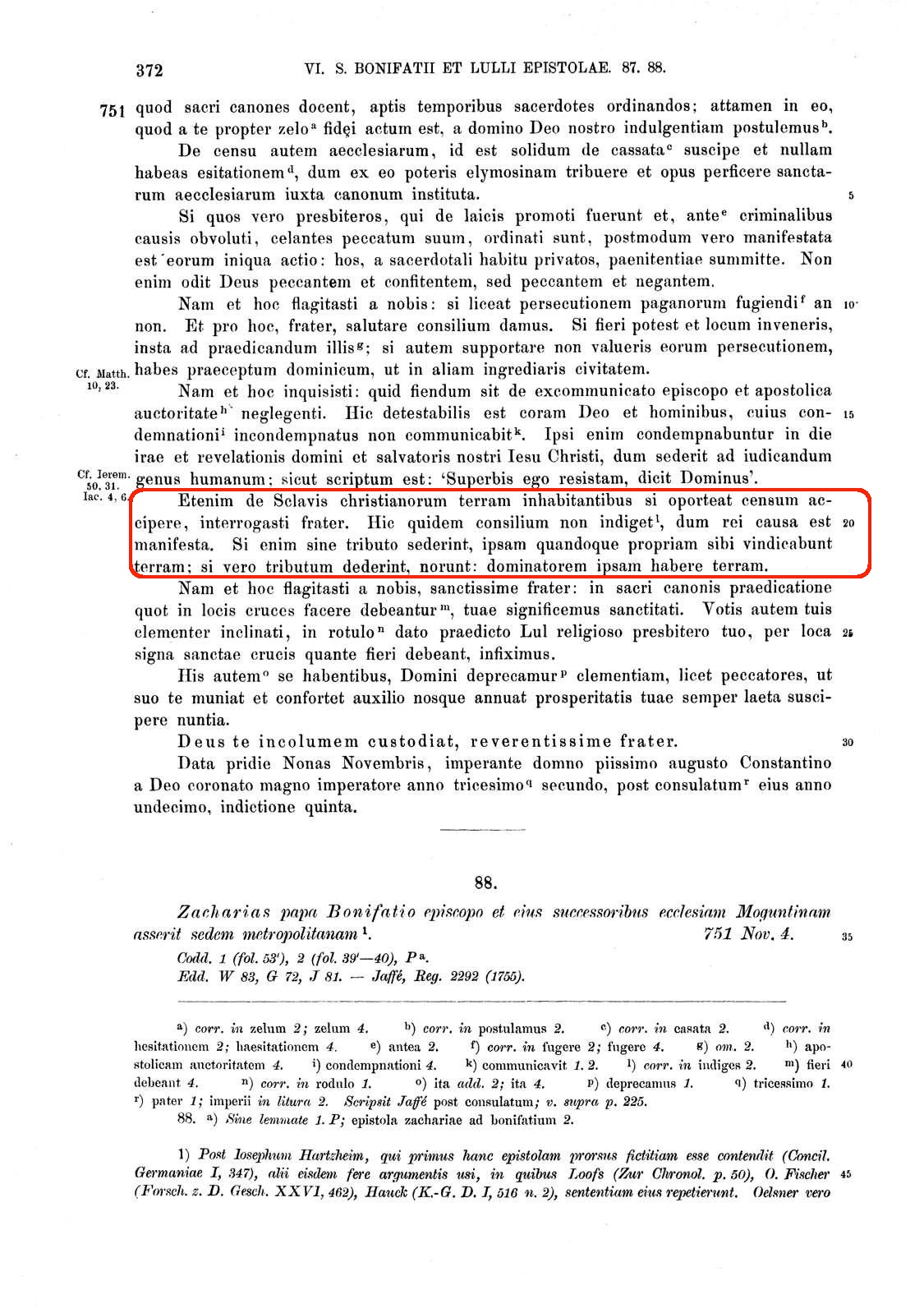
“You inquire my brother about the Slavs who live in the lands of the Christians* [and] whether they should be subject to tithes.  In this matter, no guidance is necessary for the thing is clear: if they may have sat there without paying tithes then they will also at some point believe, correctly, that this land is theirs; but if, on the contrary, they may have paid tithes, then they will know that the land has a [different] owner.”

* That is in lands where Church organization has been established.

(Etenim de Sclavis christianorum terram inhabitantibus si oporteat censum accipere, interrogasti frater.  Hic quidem consilium non indiget, dum rei causa est manifesta.  Si enim sine tributo sederint, ipsam quandoque propriam sibi vindicabunt terram; si vero tributum dederint, norunt: dominatorem ipsam habere terram.)

Boniface achieving long-sought martyrdom in Frisia

Copyright ©2017 jassa.org All Rights Reserved

January 5, 2017

George of Pisidia’s Slavs

Published Post author

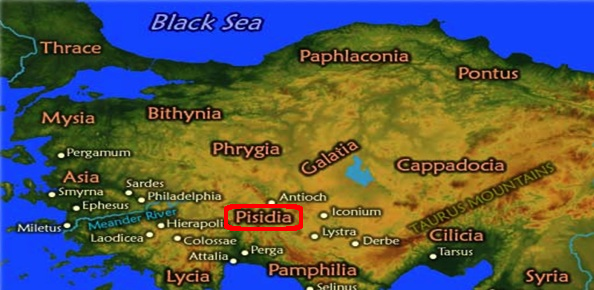
George Pisidia (Γεώργιος Πισίδης, (of Pisida in Latin) aka The Pisidian) was a Byzantine deacon and poet, born in… Pisidia.  He flourished during the 7th century AD.

From his poems we learn he was a Pisidian by birth, and a friend of Patriarch Sergius I of Constantinople and the Emperor Heraclius.  His earliest work, in three cantos, is De expeditione Heraclii imperatoris contra Persas, libri tres on Heraclius’ campaign against the Persians in 622.  His second work was Avarica (or Bellum Avaricum), an account of the Avar attack on Constantinople in 626.  Then came the Heraclias (or De extremo Chosroae Persarum regis excidio), a general survey of the exploits of Emperor Heraclius both at home and abroad down to the final overthrow of the Persian Chosroes in 627.  Some of his works may have been used by Theophanes the Confessor as a basis for his Chronographia.

Of interest to us, both the Avarica and the Heraclias contain some very early references to the Slavs (referring to them as Sthlawos).

Avarica
(or Bellum Avaricum)
written in 626

“Truly a tempest of our enemies came at us like the sea’s countless waves, throwing the sands of different barbarian tribes; For that summer an ominous wind sent forth onto our heads from all of Thrace a terrible snowstorm from many clouds gathered…”

“…Not one of these struggles was easy, as [they] all spattered [among us], [first] coming [as each was] from a variety of different causes intertwined together.  For the Slavs with the Huns and the Scythian* with the Bulgar, and from the other side a Medes** also with the Scythian conspiring, [each] different from one another in language and blood, yet though far from one another, from afar coming together, they raised one sword against us, demanding that we should fatuously take their deceit for steadfast fidelity…”

* Huns and Scythians meaning Avars.
** Medes meaning Persians.

“…And the barbarian [i.e., the Avar khagan] put his hordes of Slavs together with Bulgars onto ships, for he had canoes hallowed from tree trunks, and added a sea battle to that on land…”

Heraclias
(or De extremo Chosroae Persarum regis excidio)
written circa 627-629

“…And from beyond, from Thrace, clouds gathered again bringing us the thunder of war; and from one side the Scythian Charybdis silently went about marauding, and from the other, the Slavs like wolves ran out to sting us on land and sea.  The sea waves mixed with their blood after the battle seemed red to the eye, so much that this sight seemed like Perseus’ Gorgon [Medusa] terrible, and the whole world plunged in the depths…”

 Copyright ©2017 jassa.org All Rights Reserved

January 5, 2017

Gregory I the Great and His Letters

Published Post author

Pope Gregory the Great was Pope from 590 till 604.  He is most known today for the “Gregorian” chants, although the chants were not developed until the 8th/9th century and are merely attributed to him.  However, he was also known for Church reforms as well as the multitude of letters he wrote and which have been preserved (most recent edition The letters of Gregory the Great, translated, with introduction and notes, by John R.C. Martyn, 2004).  Among these letters there are two that mention the Slavs.

Letter to Callinicus Exarch of Italy
(May 599)
Book IX Letter 154

“In addition to the news of your victory over the Slavs, truly great joy was brought to me by the fact that Your Excellency sent to Saint Peter, the prince of the apostles, the deliverers of this letter from the island of Caprea [Capritana?], desiring to return to the Holy Church.  For if you bring under the yoke of the true Lord those of whom you know that they are enemies of God, the easier you will be able to defeat your [own] enemies; and the more honestly and piously you guard God’s matters amongst men, the more successful you shall be in your daily dealings with them.  Now as to your having desired that a copy should be shown me of he order that has been sent to you for the defense of the schismatic…”*

* The Exarch was a  Byzantine administrator.   This particular exarch was Callinicus or Gallicinus, the Exarch of Italy resident at Ravenna.  The reference to “Saint Peter, the prince of the apostles” is, of course, a reference to the seat of the Pope, i.e., the Vatican.  Insula Capreae was either a place between Tergeste and Piranum (see Ravenna Geography, Book 4, 31 and Book 5, 14) in Istria or an island at the mouth of the Piave river where Venice lies.

Letter to Maximus Bishop of Salona*
(July 600)
Book X Letter 15

“Venerable Brother, our common son, presbyter Veteranus, coming to Rome found me so weakened by attacks of the gout that I was in unable to find the strength to answer Your letter.  Nevertheless, I suffer much and fear [too] by reason of the pending threat to you from the tribe of the Slavs; I suffer for I am personally affected by what befalls you, and I fear, for by way of Istria they are beginning to make their way to Italy.  Furthermore, what shall I say of Julian the scribe, seeing that  see everywhere how our sins find us out, so as to cause us to be distributed by the nations from without any judges from within?  But be not at all saddened by such things, since those who shall live after us will see worse times…”

* Salona, nearby today’s Solin is about 2 miles from Split, Croatia on the Dalmatian coast.

Copyright ©2017 jassa.org All Rights Reserved

January 3, 2017