Na ja, Aus Vielen Eines

Published Post author

If the readers will forgive venturing into medieval as opposed to pre-historic times, I will mention an episode from Silesian history that, I suspect, may have been symptomatic of the progress of things throughout the so-called Germania Suavica. To be specific, it has often been said that for hundreds of years the Polish-German (or really Holy Roman Empire) border was one of the most peaceful in Europe. While the other parts of Poland and Lithuania experienced Muscovite, Tatar, Turk and Swedish raids, all you heard where Silesia (which was on the Empire side) met the rest of Poland were the sweet sounds of kumbaya.  There Poles, Germans, Jews and others lived in harmony that was the envy of the world. It was almost as harmonious and tolerant as Spain under the Umayyads.

Imagine my shock when I came across the following order issued on June 15th of the year 1495, by the then Bishop of Wrocław – at that point already known as the multicultural paradise of Breslau – the very European Johann Roth (born in Bavaria but, hey, to be fair, all Teutons south of north Sweden are likely carpetbaggers). The order required all Silesians living in the town of  Wójcice (Woitz) near Otmuchów (Ottmachau) to teach their children German first (rather than Polish) and required that all inhabitants learn German within five years or be chased out (von dann yagenn).

The bishop was complaining because Teutonic administrators had to use translators (Tolmetschenn) to communicate with the locals. Interestingly, the German word for “translator” – Dolmetscher – is likely of Suavic origin (referring to the Suavic tribe of the Daleminzier) (though a Hungarian etymology also exists).

The location of Wójcice (Woitz) is shown here:

Of course the order created a bit of a “chicken and the egg” problem since it was worded in German. Despite this difficulty, the gehorsame, fleissige & strebsame Suavic peasants appear to have met the bishop’s challenge and soon most of Lower Silesia was a’German reden (eventually leading to the creation of the BdV – the world’s only known political movement born almost entirely of Stockholm syndrome). While most of these same people’s progeny escaped in 1945, the Communists cleared the country of the rest – not paying much attention who they were really expelling.

Copyright ©2019 jassa.org All Rights Reserved

June 7, 2019

The Łada Sejm Letters

Published Post author

A series of other mentions of Łado or Łada are present in the correspondence of the various Polish and Lithuanian nobles with the Polish King during the time of the so-called Executionist Sejm (legislative gathering – if you want more context, read Robert Frost’s “The Making of the Polish-Lithuanian Union 1385-1569” which is volume 1 of the Oxford History of Poland-Lithuania). These letters include:

  • A letter dated Tuesday, the 14th December 1563
  • A letter dated Friday, the 21st of January, 1564

On the one hand these are late but on the other they signal that the Name was still known and used in songs and sayings, kind of like lelum polelum which probably from the Castor-Pollux pair of LalkiAlcis became a wistful exclamation in  drinking songs.

These letters (which appear to have been written to the Polish king – Sigismund Augustus) were published (by Adam Tytus Działyński) in 1856-1861 as the “Written Sources Regarding the Union of the Polish Crown and the Grand Duchy of Lithuania, Part II” (Źródłopisma do Dziejów Unii Korony Polskiej i W.X. Litewskiego: Część II) (oddly, only parts II and III seem to exist).

Adam Tytus Działyński


December 1563 Letter

This letter contains a reference to a song which mentions Łado. Interestingly this song is attributed by the writer of the letter to Jakub Uchański (1502 – 1581) the later Primate of Poland. He was born in Uchanie (Radwan coat of arms) in the Lublin area but was subsequently a bishop of Chełm (German Kulm) and it was then that he was sent with an embassy to the royal court and, apparently, sang a song the text of which is cited in this letter. The contents of the letter are not particularly relevant to the topic but I include the full letter for completeness or context.

Jakub Uchański

The text is as follows:

Polish: “Łado, łado. Będzie to z łaski miłego Pana Boga łado, nam wszem wiernym W.K.M. poddanym…”

English: “Łado, Łado. Let this be [come] from the grace of the Dear Lord Łado, for all of us your royal highness’ faithful servants…”

This is the Uchański tombstone in Łowicz with his coat of arms (Radwan).


January 1564 Letter

The contents of this letter are also not particularly relevant for our purposes but the sentence underlined below essentially states that because things went so splendidly that day:

Polish: “…tak że się prędko rozjachać możemy, ono nasze stare Łado zaśpiewawszy…”

English: “…we may quickly depart having [first] sang our old Łado…”

This letter may be by Stanisław Orzechowski.

Copyright ©2019 jassa.org All Rights Reserved

June 3, 2019

Time of Great Ideas

Published Post author

It is interesting to observe that every time you have a good idea, there well may be someone else who had it first.

I wrote about the fact that the River Odra (Oder) may have actually been previously referred to as the Vistula here and here and here among other places. Interestingly, the same idea was already brought up by the Polish historian Leszek Moczulski some years back. In his writing, the river had been mislabeled Vistula  by someone who previously may have heard of the Vistula and then, having crossed into Poland, noticed a river and thought that must be it. Mistakes happen in exploration as the “Native Americans” aka “Indians” can attest to.

I previously (here and here) also suggested that “Slavi” simply means “Z Łaby” that is “from the Elbe”. While this is a bit more farfetched it is intriguing and I was surprised to find out that this same idea had already circulated about in, I believe, the 18th century. I was not able to relocate it but if you recall where that is feel free to leave a post on the topic.

Copyright ©2019 jassa.org All Rights Reserved

June 2, 2019

Letter of Gregory III from A.D. 737 (or 739)

Published Post author


Pope Gregory III was best known for being the last pope born outside of Europe (though in Byzantine Syria so not exactly outside of European civilization) until the current jackass. Among his achievements was his prolific letter writing. One of these letters is a letter from 737 – 739 whose opening lines made made their way into Karl Jaromir Erben’s Regesta Diplomatica Nec Non Epistolaria Bohemiae Et Moraviae.

It was mentioned earlier too in Philipp Clüver’s Germania Antiqua in 1616 and by Philippus Jaffé in his Regesta Pontificum Romanorum… (Reg. at page 182, Nr. 1730). It is also mentioned in Migne’s Patrologiae Cursus Completus: Series Latina (vol. 89 at page 602).

It appears in full in Giovanni Domenico Mansi’s Sacrorum conciliorum nova et amplissima collectio (Tomus 12 at page 280).

It then appeared in MGH as letter number 43. It is present in several codices containing Gregory III’s letters, the oldest of which seems to be the Munich codex 8112 from the 9th century (this is labeled version 1). The Karlsruhe codex (Raststatt 22, Durlacher 94) is a 10th/11th century (that was labeled version 2) but it seems to contain only the end of the letter with the prior pages having been ripped out. The MGH lists a few others such as (version 3 does not contain this particular letter):

  • (version 4a) Montis Pessulanus H.3 (12th) (Montpellier)
  • (version 4b) Vaticanus 1340 (13th-14th)
  • (version 4c) Venetus S. Marci Zanetti CLXIX (15th)
  • (version 5) Codex Othloh the monk Trevirensis 93F (Codex of Othloh the monk)

An earlier codex, the Cottonian Otho A I from the 8th century apparently burned down in 1666.

Why is the letter so interesting? Well, as you can see above, the various manuscripts show several tribal names there amongst whom are:

  • Nistresos
  • Wedrecos (Wedrevos)
  • Lognaos
  • Suduodos

Some of these may, in fact, be Suavic which, I suspect, why Erben included it in his Register. For example, Wedrevos (in some variants) appears similar to the Suavic Odra, wydra, wiadro and similar words.  Suduodos sounds like Sudovi – a Baltic tribe. Nistra sounds Itallic frankly but may also be Greek/Thracian (compare with Ister) and do not forget the Slovak town of Nitra – the capital of the famous “Principality”. The Lognaos can perhaps have something to do with the Lugii/Łużyce/Lusatia though that’s a stretch. If these were Longaeos instead (more of a stretch) then we could have Lunsizi or maybe Lendizi. In any event, worth thinking about. If you want the MGH explanation, then see the page above in the footnotes (at least as of the 19th century variation).

The letter’s writing actually says the following (Munich codex):

Gregorius papa universis optimatibus et populo provinciarum germaniae. thuringis & hessis bor tharis & nistresis uuedreciis & lognais suduodis & graffeltis…

Munich 8112

German historians have tended to identify these with with various Teutonic tribes (for example, the Westphalians) but is that right? Sure, the Thuringi, Hessi and Gravelti may have been Teutonic but these other names? I am not so sure.

Two other things. There is also a letter in the same Register that was written by Gregory II that mentions Sarmatians in Constantinople – we’ll get back to that. Further, the letter itself (look at the language above in the MGH version) discusses all kinds of pagan superstitions which are interesting irrespective of whether they are Teutonic or Suavic.

Copyright ©2019 jassa.org All Rights Reserved

June 1, 2019

Once Again Regarding Harmonia’s Wedding

Published Post author

An interesting question about the nature of Łada has never been solved:

  • is Łada a Polish Goddess worshipped locally in Mazovia or is Łada the Polish (presumably male) God Mars?

The confusion stems from the fact that Długosz referred to Łada as a Mazovian Goddess in one place but as the Lechitic Mars in another.

Elsewhere, Łada is also referred to as the gardzyna that is “hero” or “champion” of Jassa. So we can also ask:

  • is Łada the Male War Champion or is Łada the Female War Champion.
  • And what is the connection to Jassa?

A solution to some of these questions may present itself if we acknowledge the fact that there may have been two Deities with a similar Name, look at the origin of the word ładny and rope in a bit of Greek mythology.

note: I’ve already written about some of this here but without focusing sufficiently on the “Łado – Ares” connection. What “Łado – Ares” connection? Keep reading.

Let’s begin:

Two Deities

First, there are actually two different Deities referred to in non-Polish Suavic songs – the female Łada and the male Łado. They are not siblings. Rather, they are typically shown as the bride (Łada) and the bridegroom (Łado). (It is from this set up that Brueckner, erroneously surmised that these Names merely merely mean “your beloved.”)

The “Orderly” Name

Second, the adjective ładny did not originally mean “pretty” as it does now. It meant “orderly” or “harmonious.” It originated with the word ład – which means, to this day, simply, “orderliness” or merely “order.”

Incidentally, the word jasny – that is “bright” – may come from – the name Jaś. 

The Greek Connections

Third, we have Greek mythology. Greek mythology, with all of its inconsistencies such as they are, presents us with an interesting name – twice. That name is Harmonia. I say twice because there are two Harmonias. Yet, each brings a tantalizing hint for the reconstruction of the Polish Pantheon:

  • Harmonia – The goddess of harmony and concord. In some tellings, she is the daughter of Ares and Aphrodite but there is also a version says that she was the daughter of Zeus and Electra and, the sister of Iasion (and Dardanos). In fact, it is at the wedding of this Harmonia that her brother Iasion succumbs to the lures of Demeter. This is the version related by Diodorus Siculus:

“There were born in that land [of Samothrake (Samothrace)] to Zeus and Elektra (Electra), who was one of the Atlantides [Pleiades], Dardanos (Dardanus) and Iasion and Harmonia . . . Kadmos (Cadmus), the son of Agenor, came in the course of his quest for Europe [Europa, his sister abducted by Zeus,] to the Samothrakians, and after participating in the initiation [into the mysteries of Samothrake] he married Harmonia, who was the sister of Iasion and not, as the Greeks recount in their mythologies, the daughter of Ares. This wedding of Kadmos and Harmonia was the first, we are told, for which the gods provided the marriage-feast, and Demeter, becoming enamoured of Iasion, presented him with the fruit of the corn, Hermes gave a lyre, Athene the renowned necklace and a robe and a flute, and Elektra the sacred rites of the Great Mother of the Gods [Rhea], as she is called, together with cymbals and kettledrums and the instruments of the ritual; and Apollon played upon the lyre and the Mousai (Muses) upon their flutes, and the rest of the gods spoke them fair and gave the pair their aid in the celebration of the weding. After this Kadmos, they say, in accordance with the oracle he had received, founded Thebes in Boiotia (Boeotia).”

(Diodorus Siculus, Library of History 5. 48. 2 (trans. Oldfather) (Greek historian C1st B.C.))

  • Harmonia – The nymph – who as such, would have been a possible candidate for the retinue of Dionysus or Pan (with either of whom, Iasion could be identified as a fertility/agricultural Hero) and by one account, the mother – by Ares – of the Amazons.  In fact, Apollonius Rhodius says the following:

“The Amazones of the Doiantian plain [by the river Thermodon on the Black Sea] were by no means gently, well-conducted folk; they were brutal and aggressive, and their main concern in life was war. War, indeed, was in their blood, daughters of Ares as they were and of the Nymphe Harmonia, who lay with the god in the depths of the Akmonian (Acmonian) Wood and bore him girls who fell in love with fighting.” 

(Argonautica 2. 986 ff (trans. Rieu) (Greek epic C3rd B.C.))

Synthesis

Łada was a Goddess – the sister of Jassa – and the wife of Łado. 

Łado was a God and and the husband of Łada.

Gardzyna – It may well be that Łado was a “War God” and, in that capacity also the gardzyna that is “hero” or “champion” of Jassa. But, if Łado was “Ares” then Łada as an “Amazon” could likewise be a powerful champion for Her Brother.

Finally, Demeter seems to be very much in the above telling the “Earth Goddess” Who is “ploughed” so to speak by Iasion. It is tempting to speculate that Demeter may be similar to the Goddess Marzanna who was identified by Długosz as Ceres – which is, of course, the Roman name for Demeter.

So we have a wedding between the “war pair” with the female being the sister of  Jassa – the Polish Jupiter. At that wedding Marzanna and Jassa just go and do their own thing. The actual names still in use in Polish peasant songs were, of course, Marysia and Jasień. Occasionally, there was also Kasienia or Kasia as Jasień‘s woman.

Now the only question is how does “Zeus” fit into this. My guess is that Piorun (Thor but also Tyr and Taranos) was simply an aspect of Jassa (Odin) that, at some point in time, became a “Storm” God in his own right, traveling the world as a “war hero” – quasi-Ares – Bohater, Багатур or Bagatyr. Thus, from Sarnicki we learn that:

“Rossi… de heroibus suis, quos Bohatiros id est semideos vocant, aliis persuadere conantur.”

Copyright ©2019 jassa.org All Rights Reserved
May 28, 2019

Ūsiņš Usenj Usen

Published Post author

Ūsiņš Who is most likely the same Deity as Jassa (jesień – fall or jesion – ash) was also subject to worship in Moscovy. Whether this was a relict of the Balts having previously occupied such territory or was a native Suavic belief or perhaps some even older recollection is uncertain. In any event, we have a report noted by Ivan Petrovich Sakharov (Skazania Russkago Naroda) and reproduced by V.J. Mansikka (Die Religion der Ostslawen) of an order issued in 1648 to the Voyevoda of Suisk that says the following:

“It has become known to us that in Moscow, especially in the Kreml and the neighborhoods of Kitay, Beliy and Zemlyanoy and outside of the city in cross streets and in the suburbs Cerniya and Yamskiya and in the alleys and cross streets, many people on Christmas Eve have called out “kaleda” and “Usenj” and on the eve of the Epiphany Day [January 5th/Candlemass?] they have called out “plug”… They also gather together for devilish merry-making from Christmas time till the Epiphany Day… And we ordered in Moscow and in the [other] cities and parts to strictly forbid that from now and henceforth people should not cry out “koleda” and “pluga” and “Usenj” in the alleys and in the cross streets and on the farms on Christmas Eve and on the eve of the Epiphany Day and should not sing devilish songs.”


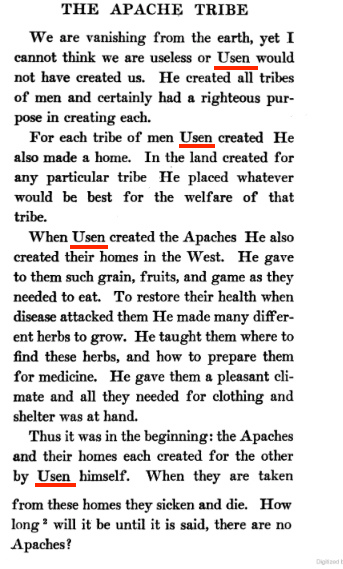
The koleda or kaleda obviously refers to the practice of carolers around the calends. The pluga is anybody’s guess. So we have Ūsiņš in Latvia and Usenj in Moscovy. Here is the really interesting part I leave you with. The following discussion of Usen – the Apache God – comes from the mouth of Geronimo – the most famous Apache chief:

Curiously, the Shoshone Creator God but also Hero is variously referred to as Isa, Issa, Esha, Eesha, Isha. Jessa? Jassa? For other interesting Suavic – Native American Indian connections see here.

Copyright ©2019 jassa.org All Rights Reserved

May 27, 2019

Ratzeburg Tithe Register of the Year 1230

Published Post author

The Ratzeburger Zehntregister (that is, the Ratzeburg tithe register) comes to us from the year 1230. It contains a list of possessions of the bishopric of Ratzeburg around Mecklenburg, Lauenburg and, interestingly, also Holstein. Many of these are mentioned for the first time. It is currently found in Landeshauptarchiv Schwerin. Over time it has been reproduced in the Mecklenburgischen Urkundenbuch.

Fascinatingly, this register caused a minor scandal when it was used by Dmitri Nikolajewitsch Jegorow to publish “Die Kolonisation Mecklenburgs im 13. Jahrhundert” (2 Bände, Breslau 1930) which essentially argued that most of the colonization of these areas was done by Suavic settlers.

The list of towns from the register is below. The Suavic names are in red although the list as usual may be both under and over inclusive. They constitute roughly half of the names on the list. This is certainly curious as the year 1230 was 600 years after the initial wars of the Franks with the Suavs of Samo. Beyond that the list comes from Wikipedia and I retained the rather inconsistent numbering system they have there (not sure what the original source for that system is but it is probably not Wikipedia).

Land Ratzeburg

Parish Schlagsdorf
1 Slaukestorp Schlagsdorf, Dorfkirche Schlagsdorf
2 M[e]chowe Mechow
3 Slaubrize Schlagbrügge
4 Mvltsan Molzahn
5 Villa Elisabet Villa Elisabet (eingegangen)
6 Vtechowe Utecht
7 Campowe Campow
8 Ripece Rieps
9 Ratistorp Schlagresdorf
Parish Carlow
10 uilla Kar[l]owe Carlow, Dorfkirche Carlow
11 slauico Karlowe Wendisch Carlow (in Carlow aufgegangen)
12 Demere Demern
13 Scethinkestorp Schaddingsdorf
14 Klokestorp Klocksdorf
15 Pogatse Pogez
16 Samekowe Samkow
17 Stove Stove
18 Rosenitze Rünz (heute: Groß und Klein Rünz)
19 Nescowe Neschow
20 Woytenthorp Woitendorf
Parish Mustin
21 Mustin Mustin

22 Lankowe Lankow
23 Dechowe Dechow
24 Tvrove Groß Thurow
25 slauico Tvrove Klein Thurow
26 Dvzowe Dutzow
27 Kitlist Kittlitz
28 Goldense Goldensee
29 Ekhorst Ekhorst (defunct; area called “Eichhorster Räumde” in 1777)
30 Rvkelin Röggelin
31 Gardense Gardensee (defunct; by Ziethen on Garrensee)
Parish Seedorf
32 Sethorp Seedorf, St.-Clemens-St.-Katharinen-Kirche

33 Tsachere Groß Zecher
34 slauico Tsachere Klein Zecher
35 Brisan Bresahn
36 Nienthorp Niendorf
37 slauico Sethorp Wendisch Seedorf (defunct)
38 Dargowe Dargow
Parish Sterley
39 [St]Ralige Sterley

40 Holembeke Hollenbek
41 Kerseme Kehrsen
42 nigrum stagnum Schwarzensee (later  empty space at Oldenburg)
43 utrvmque Salim Beide Salem (today there is only one Salem)
44 Cowale Kogel
45 Clotesvelde Klotesfelde (defunct; previously located on the way from Alt to Neuhorst)
Parish Gudow
46 [G]Odowe Gudow

47 Bandowe Bannau (defunct; on Bannauer Moor)
48 Lesten Langenlehsten
49 Mazleviz Maslevitz (eingegangen)
50 Sakkeran (today’s Segrahn comes from a 1564 settlement; the old towns of Segrahn and Wendisch Segrahn (52) are defunct)
51 Lvtowe Lütau (defunct; on the Lütauer See, lay SE of Mölln )
52 sclauicum Sakkeran Wendisch Segrahn (defunct; see 50)
53 Dargenowe Dargenow (defunct; within the area of Bergholz)
54 Besendale Besenthal
55 Tsarnekowe Sarnekow
56 GRambeke Grambek
57 DRvsen Drüsen (defunct; on the SW-end of the Drüsensee)
Parish Breitenfelde
58 [B]Redenvelde Breitenfelde

59 Woltersthorp Woltersdorf
60 Nienthorp Niendorf
61 antiquum Mulne Alt Mölln
62 Belowe Bälau
63 Borchardesthorp Borstorf
64 Logen Logen (defunct; by Mannhagen)
Parish Nusse
65 [N]vsce Nusse, Kirche Nusse
66 Walegotesvelde Walksfelde
67 Pokense Poggensee
68 Hagen Mannhagen
69 Stenborg Steinburg defunct; by Panten)
70 Kvcen Kühsen
71 Dvuense Duvensee
72 Panten Panten
73 Ritzerowe, Manowe, Bercroth, Coberch Ritzerau, Manau (defunct), Bergrade, Koberg
74 Klinkroth Klinkrade
75 Sirikesvelde Sirksfelde
76 sclauicum Sirikesvelde Wendisch Sirksfelde (defunct; subdistrict Sirksfelde)
77 Lvchove Lüchow
78 Zanzegnewe Sandesneben
79 Sciphorst Schiphorst
80 Linove Linau
81 Helle Helle (defunct)
Parish Berkenthin
82 [P]Arketin Berkenthin

83 Gvldenize Göldenitz
84 Ciresrode Sierksrade
85 Hakenbeke Hakenbek (defunct)
86 Climpove Klempau
87 slauicum Sarowe Klein Sarau
88 slauicum Parketin Klein Berkenthin (today there is only one Berkenthin)
Parish Krummesse
89 [C]rumesse Krummesse, Johanniskirche (Krummesse)

90 Scenkenberge Groß Schenkenberg
91 Cronesvorde Kronsforde
92 Stocheslestorp Stochelsdorf (defunct)
93 Nienmarke Niemark
94 Wulvestorp Wulfsdorf
95 Begenthorp Beidendorf
96 Gronove Groß Grönau
97 Sarowe Groß Sarau
98 Toradestorp Gut Tüschenbek
99 Blankense Blankensee
100 Valkenhus Falkenhusen
101 Scatin Schattin
Parish St. Georg (information is missing from the register)
102 Pogatse Pogeez
103 Ad sclav. Pogatse Holstendorf
104 Dvsnik Groß Disnack
105 Ad unam domum Einhaus
106 Hermannestorp Harmsdorf
107 Cvlpin Kulpin
108 Belenthorp Behlendorf
109 Ad minus Belenthorp Klein Behlendorf (defunct)
110 Ad maius Mancre Groß Anker
111 Ad minus Mancre Klein Anker (defunct)
112 Giselbrechtestorp Giesensdorf
113 Albrechtesvelde Albsfelde
114 Lankowe Lankau
115 Ad omnia allodia in monte Domäne Neuvorwerk (today south of the Ratzeburg train station)
Parish Schmilau
116 [S]milowe Schmilau
117 Dormin Dermin (defunct – sount and west part of today’s Ratzeburg subdistrict)
118 Borchvelt Raceburg Burgfeld Ratzeburg (defunct – north part of today’s subdistrict Ratzeburg)
Parish Büchen
119 Boken Büchen, Marienkirche (Büchen)

120 Brotne Bröthen
121 Vitsin Fitzen
Parish Mölln
122 Mvlne Mölln, St. Nicolai (Mölln)

123 Gvletse Gülze (defunct)
124 Pinnowe Pinnau (defunct)
125 Pezeke Pezeke (the old name for Marienwohlde)

Land Wittenburg

Parish Zarrentin
126 Tsarnetin Zarrentin, Kirche Zarrentin

127 Vilun Valluhn
128 Luttekowe Lüttow
129 Cvltsin Kölzin
130 Pampurine Pamprin
131 Scalize Schaliß
132 Bantin Bantin
Parish Neuenkirchen
133 Ad novam ecclesiam Neuenkirchen

134 Stenvelde Steinbeck
135 Melenteke Neuhof
136 Lassan Lassahn, St.-Abundus-Kirche (Lassahn)
137 Techin Techin
138 Tvrkowe Turkow (defunct)
139 Bosowe Boissow
140 Ad sclav. Nienthorp Wendisch Neudorf (defunct)
141 Campe Kampenwerder
Parish Döbbersen
142 Dobersche Döbbersen
143 Tessin Tessin
144 Stulniz Stöllnitz
145 Droneviz Drönnewitz
146 Bodin Boddin
147 Badowe Badow
148 Wozlize Woez
149 Rocut Raguth
150 Bentin Bentin
Parish Parum
151 Parem Parum

152 Dvmmere Dümmer
153 Scarsin Schossin
154 Molenbeke Mühlenbeck
155 Radelube Radelübbe
156 Chemelin Gammelin
157 Pogresse Pogreß
Parish Wittenburg
158 agri civitatis Wittenburg Wittenburg, St.-Bartholomäus-Kirche

159 Karwete Karft
160 Warsekowe Waschow
161 Ziklemarke Ziggelmark
162 Lesen Lehsen
163 Pvtselin
164 Bobecin Bobzin
165 Woltsowe Wölzow
166 Pvtlekowe Püttelkow
167 Lvzowe Dreilützow
168 Cerbeke Düsterbeck (empty space now)
169 Lvkkeuiz Luckwitz
Parish Hagenowe
170 Hagenowe Hagenow

171 Bakenthorp Bakendorf
172 Preceke Presek
173 Vis Viez
174 Potechowe Pätow
175 Todin Toddin
176 Mercrade Merkrade (defunct)
177 Dametze
178 Grancin Granzin
179 Tsabele Zapel
180 Scarbowe Scharbow
Parish Pritzier
181 Priscire Pritzier

182 Gorezlawe Gößlow
183 Wargeliz Warlitz, St. Trinitatis (Warlitz)
184 Goldeniz Goldenitz
185 Grabeniz Gramnitz
186 Scarbenowe Schwaberow
187 Cetsin Setzin
188 Zwechowe Schwechow
Parish Vellahn
189 Vilan Vellahn

190 Clodram Kloddram
191 Tramme Tramm (defunct)
192 Jesowe Jesow
193 Gansethorp Goosfeld
194 Melcohche Melkof
195 Dvssin Düssin
196 Bralizstorp Brahlstorf
197 Domeratse Dammereez
198 Bansin Banzin
199 Bolbruke Bollbrügge (defunct)
200 Panitz Penz (defunct)
201 Marsowe Marsow
202 Sekkevin Segefin (defunct)
Parish Körchow
203 Kurchowe Körchow

204 Kattemarke Helm
205 Zvabrowe Schwaberow
206 Zvre Zühr
207 Cvtsin Kützin
208 Predole Perdöhl
Parish Camin
210 Camin Camin

211 Doytin Doddin (defunct)
212 Golenbowe Goldenbow
213 Holthusen
214 Vitekowe Vietow
215 Cowale Kogel
216 Dadowe Dodow

Land Gadebusch

Parish Rehna

217 Bulowe Bülow
218 Warnekowe Warnekow
219 Lovetse Löwitz
220 Glatsowe Gletzow
221 Parport Parber
222 Nesowe Nesow
223 Ad sclav. Nesowe
224 Rene Rehna
225 Tvrbore Törber
226 Vitense Vitense
227 Woltsekenthorp Wölschendorf
228 Brutsekowe Brützkow
229 Ad sclav. Brutsekowe
230 Cochelestorp Köchelsdorf
231 Bansin Benzin
232 Hunnenthorp Hundorf (Groß/Klein?)
233 Kasthorp Kasendorf
234 Jeserits Jeese
235 Herbordeshagen
236 Prope Tvrbore nova uilla
237 Wedewenthorp Wedendorf
238 Ad aliud Wedewenthorp
239 Valkenhagen Falkenhagen
Parish Vietlübbe
240 Vitelube Vietlübbe, Dorfkirche Vietlübbe
241 Pvtrowe Paetrow
242 Rambel Rambeel
243 Hindenberge Hindenberg
244 Sclavic. Hindenberge
245 Strestorp Stresdorf
246 Vruwenemarke Frauenmark
247 Dargun Dragun
248 Rosenowe Rosenow
Parish Pokrent
249 Pokrente Pokrent, Dorfkirche Pokrent
Coselowe Kaeselow
Cvzowe Kützow?
Baleise Bleese?
250 Antiquum Pokrente Alt Pokrent
251 Rantsowe Renzow
Parish Gadebusch
252 agri civitatis Godebuz Gadebusch, Stadtkirche St. Jakob and St. Dionysius (Gadebusch)
253 Zvemin
254 Radegust Radegast
255 Wokenstede Wakenstädt
256 Ganzowe Ganzow
257 Malin Möllin
258 Metsen Meetzen
259 Holtthorp Holdorf
260 Germerstorp Jarmstorf
261 Bocholt Buchholz
262 Gustecowe Güstow
263 Parsowe Passow
264 Strestorp Stresdorf
Parish Roggendorf
265 Rokkenthorp Roggendorf, Dorfkirche Roggendorf
266 Brezen Breesen
267 Knesen Kneese
267a Ad Sclav. Knesen.
Parish Salitz
Zadewalz Groß Salitz, St. Marien (Groß Salitz)
Sclav. Sadewalz Klein Salitz
Crampiz Krembz

Land Schwerin

Parish Eichsen
248 a Exen Groß Eichsen, Johanniter-Kirche Groß Eichsen

Sconevelde Schönfeld
Windelerstorp Wendelstorf
Godin Goddin
Ad molendinum Mühlen Eichsen
Sevelde Seefeld
Wostemarke Wüstenmark
Rutnik Rüting

Land Dassow

Parish Dassow
271 Dartsowe Dassow, Nikolaikirche (Dassow)

272 Allodium militum Christi Vorwerk
273 Sethorp Seedorf
274 Bunesthorp Bünsdorf
275 Pricenthorp Prieschendorf
276 Uilla Thankmari Dönkendorf
277 Uilla Willehelmi Wilmstorf
278 Benekenthorp Benckendorf
279 Uilla Johannis Johannstorf
280 Uilla Volquardi Volkstorf
281 Woteniz Pötenitz
282 Erkense teutonicum Harkensee
283 Erkense sclavicum
284 Indago Thankmari Neuenhagen
285 Tankenhagen Tankenhagen
286 Indago advocati Voigtshagen
287 Rardolueshagen
288 Indago Woldemari
Parish Mummendorf
289 Mummenthorp Kirch Mummendorf / Hof Mummendorf, Dorfkirche Kirch Mummendorf

290 Tramme Tramm
291 Rodenberge Rodenberg
292 Poppenthorp Papenhusen
293 Ponatestorp Pohnstorf
294 Johannisvelt Hanstorf
295 Rucsin Roxin
296 Uilla Reinwardi Roggenstorf
297 in eisdem agris sclavica uilla
298 Uilla Tuscowe Teschow (part of Selmsdorf or Börzow?)
299 Bvrtsowe Börzow

Land Bresen

Parish Hohenkirchen
300 Ad altam ecclesiam Hohenkirchen, Dorfkirche Hohenkirchen

301 Walmanstorp Groß Walmstorf
302 Nova uilla
303 Ad parvum Walmanstorp Klein Walmstorf
304 Euerakkerstorp Everstorf
305 Uilla Hoyken Hoikendorf
306 Gramekowe Gramkow
307 Bekereviz Beckerwitz
Reimanstorp
Wicenthorp Hohen Wieschendorf
308 Mandrowe Manderow
309 Jastreviz Jassewitz
310 Marmotse
311 Nova uilla
Parish Proseken
312 Proceke Proseken Dorfkirche Proseken

313 Uilla Lamberti Landstorf
314 Wizok Wisch
315 Mirowe Zierow
316 Uilla Gerardi
317 Uilla Merzlaui
318 Gvgelowe Gägelow
319 Krukowe (Wismarsche Feldmark)
320 Damenhusen Dammhusen
321 Woytenthorp Weitendorf, Kapelle Weitendorf
322 Uilla Christofori Stoffersdorf
323 Uilla Walteri Woltersdorf
Parish Gressow
324 Gressowe Gressow, Dorfkirche Gressow

325 Sibus Zipphusen (empty space south of Barnekow)
326 Ad aliud Sibus Zippfeld (remains are east of Parkplatz Mölenbarg)
327 Barnekowe Barnekow
328 Coselowe Käselow
329 Tressowe Tressow
330 Quale Quaal
331 Krankowe Groß Krankow
332 Sclav. Krankowe Klein Krankow
333 Cimerstorp
334 Marquardusthorp Meierstorf
335 Plocekowe Plüschow
336 Uilla Thedolfi Testorf
337 Jamene Jamel
338 Rutnik Steinfort
339 Indago Fredeberni Friedrichshagen
Parish Beidendorf
340 Begenthorp Beidendorf, Dorfkirche Beidendorf

341 Uilla Lutheri Luttersdorf
342 Uilla Martini Martensdorf
343 Metenthorp Metelsdorf
344 Uilla Mauricii Schulenbrook
345 Uilla Clitse Klüssendorf
346 Uilla Zscarbuz Scharfstorf
347 Rambowe Rambow
348 Ad unum Stitene Stieten
349 Aliud Stitene
350 Ad tercium Stitene
351 Ad quartum Stitene
352 Uilla Zaviztorp Saunstorf
353 Cogchelestorp Köchelsdorf
354 Uilla Hermanni Harmshagen
Parish Grevesmühlen
355 Gnevesmulne Grevesmühlen, St. Nikolai

356 Natsenthorp Naschendorf
357 Minnowe Hilgendorf
358 Degetowe Degtow
359 Uilla Conradi
360 Vulnustorp
361 Poizcrowe Poischow(er Mühle)
362 Cristane Kastahn
363 Wotenist Wotenitz
364 Quastin Questin
365 Vilebeke Grevesmühlener Flur
366 Uilla Gozwini
Slaukestorp Schlagsdorf, Dorfkirche Schlagsdorf

Gostorf

367 Santekowe Santow
368 Ratnisvelt Grevesmühlener Flur
369 Lutteken Warnowe Warnow
370 Toradestorp Thorstorf
371 Woldenhagen Wohlenhagen

Land Klützerwald

Parish Klütz
372 Uilla Clutse Klütz, Marienkirche (Klütz)

373 Superior uilla Oberhof
374 Wittenburgerhagen Tarnewitzerhagen
375 Uilla Wartus Tarnewitz
376 Erpushagen Arpshagen
377 Indago prepositi Propsthagen?
Parish Damshagen
378 Thomashagen Damshagen, St.-Thomas-Kirche (Damshagen)

379 Bvrissowe Bössow
380 Porin Parin
381 Rolueshagen Rolofshagen
382 Cuzowe Kussow
383 Gvttowe Gutow
384 Ponatestorp Pohnstorf
385 Wulsin Welzin
386 Stellershagen Stellshagen
Parish Elmenhorst
387 Elmenhorst Elmenhorst, Dorfkirche Elmenhorst (Kalkhorst)

388 Wernekenhagen Warnkenhagen
389 Stenbeke Steinbeck
Parish Kalkhorst
390 Calchorst Kalkhorst, Dorfkirche Kalkhorst

Sconeberge Hohen Schönberg
Divelsbrok Brook

Land Jabel

[…]

Land Wehningen

390a Malke Malk
Brezegore Bresegard bei Eldena
Melgoz Malliß

Land Derzing
(the later Amt Neuhaus)

[…]

Land Sadelbande

Hohenhorn
391 Cornu Hohenhorn

392 Honwarde Hamwarde
393 Gvltsowe Gülzow
394 Tomene Thömen (today part of Krukow)
395 Wigershop Wiershop
396 Toschope Tespe (relocated to the opposite Elbmarsch) and Tesperhude (today part of Geesthacht)
397 Vventhorp relocated to the opposite Elbmarsch Avendorf
398 Crukowe Krukow
399 Crutsen, Hasledale, Sculendorp, Bertoldestorp Krüzen, Gut Hasenthal, Schulendorf, Bartelsdorf
Parish Siebeneichen
400 Soveneken (Ad septem Quercus) Siebeneichen

401 Tramme Tramm
402 Horgenbeke Hornbek
403 Gutzrade Güster
404 Wotartze Wotersen, defunct into Wotersen
405 Rosborch Roseburg
406 Nvssowe Nüssau
407 (Müssen) Müssen
408 Pampowe Pampau
409 Sabenize Sahms
410 Telekowe Talkau
411 Cankelowe Kankelau
412 Elmhorst Elmenhorst
413 Cemerstorp Cemerstorp (defunct)
414 Grabowe Grabau
415 Grove Grove
416 slauico Pampowe Wendisch (Klein) Pampau
417 Pvtrowe Pötrau
Parish Lütau
418 Lvtowe Lütau

419 Wutsetse Witzeeze
420 Dalthorp Dalldorf
421 Wizok Wizok (defunct)
422 Basdowe Basedow
423 Lantsaze Lanze
424 Bochorst Buchhorst
425 uilla Godescalci Villa Godescalci (defunct)
426 Volcmaresvelt Volkmarsfeld (defunct)
427 Albrechteshope Albrechtshop (defunct)
428 Snakenbeke Schnakenbek
429 Abenthorp Abbendorf (since1678 Juliusburg)
430 Coledowe Kollow
431 Borist Börse (defunct)
432 Wankelowe Wangelau
433 Lelecowe Lalkau (defunct)
Parish Hachede (Geesthacht)
434 Hagede Hachede (Geesthacht), till 1684 St.-Peter-Kirche, from 1685 St.-Salvatoris-Kirche (Geesthacht)

435 Wigershop Wiershop
436 Honwarde Hamwarde
437 Hasledale Krümmel (“krummes Hasledale” today part of Geesthacht, the village belonged to Hasenthal)
438 Besenhorst Besenhorst
439 Vorenthorp Fahrender (today part of Kröppelshagen-Fahrendorf)
440 Cornu Hohenhorn
441 Wort Worth
Parish Kuddewörde
442 Kuthenworden Kuddewörde
443 Grande Grande
444 Honvelde Hamfelde
445 Kerseborch Kasseburg
445a Vgenthorp Ödendorf
446 Manse Möhnsen
447 Rodenbeke Rotenbek

Land Boizenburg

448 Grancin Granzin
449 Gervin Greven (Mecklenburg)
450 (G)alin Gallin
451 N(iclesse) Nieklitz
452 C(.)temperowe Klemperow (defunct)
453 (N)ebande Nebein (defunct)
454 Tuscowe Tüschow
455 K(a)rr(entin) Karrentin
456 Bunserstorpe Groß Bengerstorf
457 Tessin Tessin b. Boizenburg
458 Darsenowe Dersenow
459 T(sar)nekest(orp) Zahrensdorf
460 Blugg(ere) Blücher
461 Lvttekemarc Lüttenmark
462 Leister(ue)rde Leisterförde
463 Benin Bennin

Copyright ©2019 jassa.org All Rights Reserved

May 25, 2019

Breviarium Sancti Lulli

Published Post author

The Breviarium sancti Lulli (aka Brevarium Lulli) is a list of the various properties claimed by the Hersfeld Abbey in Bad Hersfeld in the now federal state of Hesse.

The list refers to the ownership as of the time of the founding of the abbey in the days of Archbishop Lullus (710 – 786). It is part of the Hersfeld Capitulary – Liber de Libertatibus Locorum Hersfeldensium.

The Georg Landau edition from 1865

That book was written about A.D. 1150 and it contains a copy of the Breviarium that reflects a new redaction of the document from the end of the 9th century. It is one of the most important historical documents regarding Hesse and Thuringia from the time of the Carolingians. The document contains three tables listing:

  • royal gifts to the abbey (apparently through the year 802)
  • list of private possessions of the archbishop Lullus (up through the year 786)
  • gifts to the abbey from 776 to 815

That is, if the redaction is similar to the original then we have reflected in this 12th century work the state of affairs from the mid-8th century to the early 9th century. In any event, the list contains several interesting, possibly, Suavic names (others may also be Suavic so this is not an exclusive list):

  • Berisciza (Allendorf am Baerenschusse)
  • Jazaho (Nieder-Jossa)
  • Collide (Koelleda)
  • Seheshobite (Neuhausen)
  • Dribure (Trebra)
  • Bozilebo (Boesleben)
  • Vmisa
  • Juffelze (Giflitz)
  • Lizichesdorf (Lentzdorf)
  • Miluhesdorf (Milndorf)

There also other interesting names such as:

  • Suebada (Schwebda “an der Werra”) which recalls swoboda (though may mean “own Boden“)

Or:

  • Milinge (Mellingen, SE, as per Landau, of Weimar) which makes you think of those other Milingoi (Μηλιγγοί)

Most interesting the Suavs themselves are mentioned as belonging to the abbey. The Suavs come with your property if you own land in the following localities:

  • Bischhausen (near Neuental or, as Landau would have it, near Waldkappel?)
  • Muehlhausen (NE (really NW?) from Erfurt)
  • Remda (NW from Rudolfstadt)
  • Rudolfstadt
  • Buettstedt (N from Weimar)
  • Tuengeda (SW from Langensalza)
  • Schwabhausen (S of Gotha)
  • Rothenstein (on the Saale (Solawa) between Jena and Kahla)
  • Winningen (around Aschersleben)
  • Balgstedt (or Ballstädt?) (N of Gotha)
  • Zottelstedt (on the Ilm NW of Apolda)
  • Lentzdorf (E of Weida) (note this is called Lizichesdorf; note, too, Weyda > Wajda)
  • Rumsdorf (near Oldisleben)
  • Ramsdorf (near Taennich in the former county of Blankenhain)
  • Milndorf (Miluhesdorf) near Oldisleben
  • Drummaresdorf (unknown)
  • Vmisa (unknown)

Of course I was not able to highlight all of these but here are the ones that were easy (blue is the abbey, green are some uncertain places, red is the color of either the name mentioned or the place that, according to Landau, lies near the particular location).

Copyright ©2019 jassa.org All Rights Reserved

May 24, 2019

Rey’s Bylica

Published Post author

The Polish writer Nicholas Rey in his Postilla (written in 1557) attacked certain pagan customs (he became a Calvinist) that were treated as “Christian” by his contemporaries. Some of these clearly have a Christian (Catholic) provenance but others likely go back to pagan times and had been incorporated by the Church. Putting aside his attack, the list of such practices is quite interesting. For example, he mentions the custom of wearing bylica and jumping round fires on Saint John’s Day.  I will try to translate the full text but for now here is the Polish version.

Nuż, gdy przyjdzie jakie inne święto ku czci żywota Pańskiego a spraw świętych jego ustanowione, to już więc tam na dzień Bożego Narodzenia, nie będzieli kto całą noc wrzeszczał, drzwi nie wybijał a kiełbas nie nazbiera, albo kto całą noc kostki nie grając, szczęścia nie szuka, już jakoby tego święta nigdy nie święcił. W niedzielę mięsopustną, kto zasię nie oszaleje na urząd, jako ma być, twarzy nie odmieni, maszkar, ubiorów ku djabłu podobnych sobie nie wymyśli, już jakoby nie uczynił chrześciańskiej powinności dosyć. W środopostną niedzielę, kto się nie wyspowiada, już w rozpaczy chodzić musi, bo go papież nie przeżegnał. W kwietnią niedzielę, kto bagniątka nie połknął a dębowego Chrystusa do miasta nie doprowadził, to już dusznego zbawienia nie otrzymał. W wielki piątek, jeśli kto boso nie chodził, Judaszowi z Piłatem nie łajał, albo jeśli twarz umył, już męki Pańskiej nie wspomniał. W sobotę wielką ognia i wody naświęcić, bydło tem kropić i wszystkie kąty w domu poczarować, to też rzecz pilna. W dzień wielkanocny, kto święconego nie je, a kiełbasy dla węża, chrzanu dla płech, jarząbka dla więzienia, już zły chrześcijanin. A iż w poniedziałek i z panią po uszy w błoto nie wpadnie a we wtorek kiczką w łeb nie weźmie aż oko wylezie, to już nie uczynił dosyć powinności swojej. W dzień Bożego wstąpienia, kto Jezusa lipowego powrozem do nieba wciągnie a djabła z góry zrzuci a potem z nim po ulicach biega, to wielkie odpusty a przysługi sobie ku Panu Bogu otrzyma. W dzień ś. Jana bylicą się opasać a całą noc około ognia skakać i toć też niemałe uczynki miłosierne.


“…So if there come a holiday that is established to honor the Lord’s Life and His holy matters, such as Christmas, it is as if one does not celebrate the day of the Lord’s birth if he does not [also] yell all night, [does not] break down doors, [does not] collect sausages or if he does not spend all night seeking [his] luck in dice playing. [It is as if] one who on Sexagesima Sunday does not party as if ordered [to do so], does not alter his appearance putting on frightful face paints or [does not] create devil-like costumes to wear, is not sufficiently fulfilling his Christian duty. [And] whosoever on Laetare Sunday does not go to confession, must walk in despair that the Pope has not forgiven him. Who on Palm Sunday did not swallow a pussy-willow and did not carry an oaken Christ to town, did not obtain salvation for his soul.  On Good Friday, whosoever did not walk barefoot, did not chide Judas along with Pilate or who washed his face, [such a person] did not [properly] recall the Lord’s suffering [Passion]. It too is an urgent matter on Holy Saturday to consecrate fire and water, to sprinkle the same on cattle and all the corners of the dwelling to enchant [with the water]. On Easter Sunday whoever does not eat the consecrated [food] or does not save [hide] sausages for the snakes, horseradish for the flees or mountain-ash* for the prisoner, is thus a bad Christian. And whosoever on the [subsequent] Monday does not fall with his woman into mud and on Tuesday does not smack a head with a rod so [hard] that the eye should pop out, is not fulfilling his obligations. Who on the Feast of the Ascension pulls up a linden Jesus with a rope up into the heavens and who [also] pulls up the devil, drops him down and then runs around the streets with him, shall have obtained great indulgences for himself and shall have performed great services for the Lord. Who on Saint John’s day girds on artemisia** and skips around fire all night, that person has performed not inconsiderable works of mercy.”

Sorbus.
** Mugwort or, in Polish, bylica.

[this last version comes from the 1883 Haase edition but with corrections]

Copyright ©2019 jassa.org All Rights Reserved

May 12, 2019

Similarities

Published Post author

Some of these similarities may be a bit of a stretch but, some are curious.

Note that the image of a “church” can also be easily interpreted as the image of the rising Sun as here:

Further note on this…

The following is a pot that was found at Wyszogród in Mazovia. It is currently at the ethnographic Museum of the Vistula at Wyszogród (Muzeum Wisły w Wyszogrodzie). According to the work of Michał Auch  in his MA thesis “The Problems and State of Research on Early Medieval Pottery from Gdańsk Pomerania” (Problematyka i stan badań nad naczyniami wczesnośredniowiecznymi z terenu Pomorza Gdańskiego) this is a Suavic pot dated to the 7th century. Here is Auch’s picture of the same:

What drew everyone’s attention was the figure of a rider on it. But the rider picture was not the only interesting thing about the pot. As you can see here, the pot also features rather interesting “runes”, specifically, including the interesting “double 2” seen on the various spearheads from Central European area (where each “2’s” connection to the other “2” varies). Here is the picture from the museum website (obviously they want you to focus on these etchings):


Now, we will come back to the question of whether there is actually a rider here (there is a horse for sure or, perhaps, there are horses) but for now focus on the etchings:

Clearly, particularly the middle one resembles the “2s” in the above pictures. It seems hard not to think that this something other than lightning symbols – whether the spearhead signs were also lightning symbols is another matter. It seems to me that this maybe a symbol of the lightning “fork” whose Greek name is, of course, πιρούνι.

Copyright ©2019 jassa.org All Rights Reserved

May 10, 2019