Category Archives: Religion

Tacitus & Dlugosz

Published Post author

Tacitus

gaius

Cornelius Tacitus’ recent fame rests on the Germania but, of course, he wrote a lot more.  Such as his Histories and Annals:

Caesar avidas legiones quo latior populatio foret quattuor in cuneos dispertit; quinquaginta milium spatium ferro flammisque pervastat. non sexus, non aetas miserationem attulit: profana simul et sacra et celeberrimum illis gentibus templum quod Tāfanae vocabant solo aequantur.   Sine vulnere milites, quisemisomnos, inermos aut palantis ceciderant, excivit eacaedes Bructeros, Tubantes, Vsipetes, saltusque, per quos exercitui regressus, insedere.”

“Cæsar, to spread devastation more widely, divided his eager legions into four columns, and ravaged a space of fifty miles with fire and sword.  Neither sex nor age moved his compassion. Everything, sacred or profane, the temple too of Taefanae, as they called it, the special resort of all those tribes, was leveled to the ground.  There was not a wound among our soldiers, who cut down a half asleep, an unarmed, or a straggling foe. The Bructeri, Tubantes, and Usipetes, were roused by this slaughter, and beset the forest passes through which the army had to return.”

Tacitus, Annals I, 51 Codex Laurentianus 68,1

Dlugosz

gossius

Et quondam imperium Lechitarum in region vastissimas silvas et nemora continente fundari contigerate, quos Dianam a veteribus inhabitare et illorum nactam esse imperium proditum fuerat, Ceres autem mater et dea frugum, quarum satione regio indigebat, fingebatur, Diana lingua eorum Dzewana et Ceres Marzyana vocatae, apud illos in praecipuo cultu et veneratione habitae sunt.

“And because the state of the Lechites happened to arise in a country with many a wood and forest and such country was believed by the ancients to have been inhabited by Diana and that Diana was their [i.e., the ancient dwellers’ of Poland] mistress, whereas Ceres was seen as a mother and a goddess of plentiful harvests which the country needed, therefore these two goddesses: Diana which in their tongue was called Dziewanna and Ceres called Marzanna were especially venerated and worshipped”

Jan Dlugosz, Annales seu cronicae incliti Regni Poloniae

Copyright ©2015 jassa.org All Rights Reserved

December 11, 2015

Polish Gods Part III

Published Post author

We have previously written extensively about Polish Gods in Part I and Part II of this series (as well as other smaller articles).  We thought Part III may be in order.  This part describes the literature of the 16th century.  At this time the Polish-Lithuanian Commonwealth was at its strongest, Poland repurposed towards the East and, in consequence, stretching between the Baltic and the Black Sea and encompassing various non-Polish (and even non-Slavic) peoples (Lithuanians being only the most obvious ones).  In accordance with its new stature, the country was hungry for great literature or rather literature describing the country’s greatness.  Thus, whereas previously only a few chronicles had been written in Poland, in the 15th century Jan Długosz offered the first major revamp of that genre for Poland and in the next century a whole bunch of similar works came out.

In addition to deriving proud genealogies of the “Sarmatian” nation (that was the understanding back then), the chroniclers felt they had to mention a Polish mythology as well.  Much of their work was derivative of the earlier works we already discussed and, with time, the numbers of Polish Gods began to grow quite disproportionately to what the chroniclers could possibly have known of such deities.  Nevertheless, at the risk of boring the reader with some repetitiveness of description we include all such mentions/works from Poland’s “Golden Century”.  Further, because the Polish-Lithuanian Commonwealth occupied so many lands at the time, the authors felt it appropriate to include among the “Polish” Gods also Lithuanian, Latvian and Russian deities and customs – all Slavs and Balts under one roof.  In order to give a flavor of this we generally did not cut those traditions out and have maintained them here under the rubric “Polish Gods”.  Obviously, today we would view these slightly differently.

Finally, we note that the various topical and popular books published around this time occasionally also mentioned some Polish (and other) deities.  We already discussed one of these here.  We discuss another one below.

Here is a list of the various works containing descriptions of the divine that we present (here in chronological order of their original penning (not necessarily publication)):

  • Chronica Polonorum by Maciej of Miechow (1519)
  • Kronika wszystkiego swiata by Marcin Bielski (1551)
  • De origine et rebus gestis Polonorum libri XXX by Marcin Kromer (1555)
  • Postepek prawa czartowskiego by an anonymous author (1570)
  • Postylla by Jakub Wujek (1573)
  • Goniec cnoty do prawych szlachciców by Maciej Stryjkowski (1574)
  •  O początkach… sławnego narodu litewskiego, żemojdzkiego i ruskiego by Maciej Stryjkowski (manuscript from 1577)
  • Sarmatiae Europeae descriptio by Alessandro Guagnini (1578)
  • Kronika Polska, Litewska, Żmudzka i wszystkiej Rusi by Maciej Stryjkowski (1582)
  • Kronika polska Marcina Bielskiego nowo wydana by Joachim Bielski (1597)

To maintain some semblance of chronology but also of narrative we list these works by their author in the following order:

  • Maciej of Miechow
  • Marcin Bielski
  • Marcin Kromer
  • Anonymous Postepek author
  • Maciej Stryjkowski
  • Jakub Wujek
  • Alessandro Guagnini
  • Joachim Bielski

Maciej of Miechow (Miechowita)

(Chronica Polonorum, 1519)

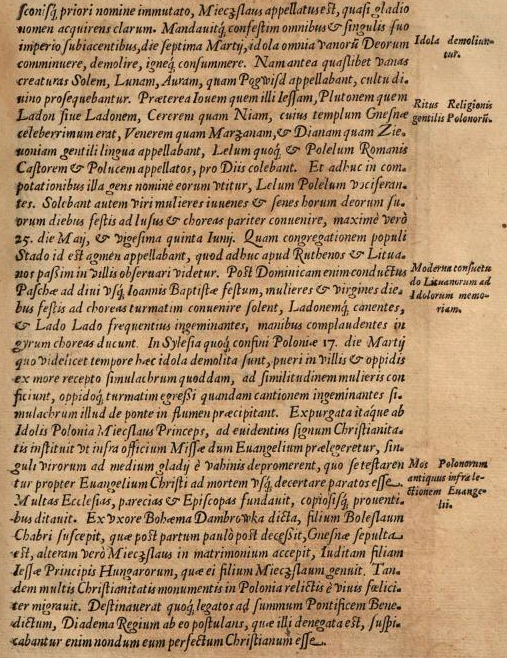
Maciej of Miechow (1457 – 1523) was born in a peasant family but managed to attend a local parish school, to earn a degree and to become a professor and then rector (for a record of eight times) of Jagiellonian University.  He was also a royal physician to Sigismund the Old and many other things.  His “Polish Chronicle” first came out in 1519 but was quickly censored due to unfavourable characterizations of certain members of the reigning Jagiellonian dynasty and after a “clean up” was reprinted in 1521 (pictures are from this latter version).  Maciej of Miechow was a proponent of the “Sarmatian” origin of Poles – rooting the “Sarmatian” era in Poland’s historiography.  This is what he had to say about the various Polish deities (note that although Maciej of Miechow did not shy away from critiquing Jan Długosz, he largely accepted Długosz’s description of Polish Gods throwing in a personal detail as well):

miechow

“Jove they named according to their language Jessa. Mars they called Leda. Pluto was called Nya. Venera they named Dzidzililya. The name for Diana was Dzeviana. Cerera was called Marzana.  They worshipped Pogoda. They venerated the light, gentle breeze that rustled in the ears [of grain] and in leaves and then turning into a whistle; they named it Pogwizd.  They venerated Leda, mother of Castor and Pollux, and the twins born of one egg [the dioscuri], which one can hear till this day listening to those who sing the oldest songs: ‘Lada, Lada, Ileli, Ileli, Poleli‘, clapping and hitting their hands.  They call Leda – and not Mars [note the inconsistency with above] – by the name of Lada (if I dare say so myself, based on the witness given by live reports of the same) and Castor they call Leli whereas Pollux [they call] Poleli.  I myself have, in my youth, witnessed three of such idols lying, partly broken, in the neighborhood of the Holy Trinity Church in Cracow – they have since been taken away.”

miechowitagods

(Iouem uulgari sermone Iessam nuncupabant; Martem apellarunt Ledam; Plutonem uocauerunt Nya; Venerem dixerunt Dzidzililya; Dianam nuncupabant Dzeuiana; Cererem uocarunt Marzana.  Adorabant Pogoda, quod sonat temperies.  Adorabant spiraculum, siue flatum tenuis aurae, per spicas frugum, et folia arborum silibantem, atque cum sibilo transientem. Vocantes numen eius Pogwisd.  Adorabant Ledam matrem Castoris et Pollucis, Geminos que ab uno ouo natos Castorem et Pollucem, quod auditur in hodiernam diem, a cantatibus uetustissima carmina: ‘Lada Lada, Ileli, Ileli, Poleli’ cum plausu et crepitu manuum. Ladam (ut ausim ex uiuae uocis oraculo dicere) Ledam uocantes, non Martem, Castorem Leli, Pollucem Poleli.  Ego in puericia mea uidi tria idola de praedictis in parte contracta, circa ambitum monasterii sanctae Trinitatis iacentia Graccouiae. Iamdudum sublata.)


Marcin Bielski

(Kronika wszystkiego świata, 1551)

Marcin Bielski (1495 – 1575) was (likely a self-taught) soldier, chronicler and poet.  His 1551 “Chronicle of All the World” Bielski with its patriotic depiction of the Poles became an instant hit with further printings in 1554 and 1564.  Although he never left the Roman-Catholic Church, Bielski was sympathetic towards the Protestant Reformation.  In later [only?] printings, he disputed Marcin Kromer’s assertions that Vandals were not the ancestors of Poles.

bielskielder1

Bielski first offers a description of the religions practices of the Slavs in the context of their pre-history:

“And at this time the Slavs continued still to praise the devils’ idols.  The only thing that was always good in this evil with them was that they did not see any hope for salvation in mortal man which others at this time did but only in God they held hope especially the one that governed thunders and rains and to this one they offered their goods.  They understood about fortune and not to have faith in men.  They lived in the fields in roomy tents.  They went to war on foot.  They had longbows to shoot with.  Both wives and husbands were of tall stature.  They did not know pleasures.  All their goods were for consumption only [to eat] as I’ve already written above.  The old Greeks called them Sporos that is spread out because they came into possession of many kingdoms [of others].”

bielski2
Two interesting points here:

  • This is almost verbatim from Procopius’ description of the Slavs, and
  • the word used for the “thunder” god of Procopius is – in the instrumental – spelled “Bodze” suggesting Bodz as a nominative – whether a connection could be drawn to Boda is doubtful but intriguing.

He then goes on to describe the Baptism of Poland:

“[Mi[e]szko] ordered all [the people] – the rich just as the poor that they should be baptized on the seventh day of March throwing into the fire the wooden idols and breaking the stone ones [and tossing them] into the water.  And so from that there derives the custom in Poland and in Silesia that on the seventh day of March they they dress up Marzana as a woman, walk out of the village  and drown her singing: ‘Death writhes about the fence, looking for trouble etc.’  Because before that they venerated Planets, weathers [pogoda], pogwizdz, heli, lada, Dziewana that is Diana or Marzanna and many similar ones.”

bielskielder3

Bielski picks up the Slav narrative of Procopius when describing the ancestors of the Poles (a more specific section after he first dealt with Slavs more generally).  Again much of this is found elsewhere:

bielskiprinting1564

“They venerated one God especially the one that governed thunder because thunder they feared.  And Mars too they took to be Holy and made offerings to him.  And also Pan, the god of the shepherds – and from this they called their superiors ‘pang’ [just as] we do today.  Mars they called Marz and thereafter our [Polish] people Marzana and they drowned it in water having dressed it up as a person – first  in Gniezno and then in villages throughout.”


Marcin Kromer 

(De origine et rebus gestis Polonorum libri XXX, 1555)

Marcin Kromer (1512-1589) was born to a mixed burgher-gentry German-Polish family.  He became secretary to King Sigismund August – the last Jagiellonian monarch of Poland-Lithuania and later the Bishop of Warmia.  He was an author of a number of books – the one most relevant for us here is the chronicle named “On the origin and deeds of the Poles in 30 Books”.  Kromer continued the Sarmatian trend as to the origins of the Poles.  He pointed too towards the people known as the Veneti.  Importantly, he was one of the first Polish writers officially to reject the “Vandalic” theory of Poles’ origin.  (He also rejected the “Illyrian” theory).

cromeri

Here is Kromer on Polish Gods:

“Among the Slavs and other northern nations the old sore of idolatry held sway the Iongest since I understand that due to their being far away and their being fierce it was not easy for good meaning men to reach these peoples and too armed men of faith did not journey so far [North].  The Poles and other Slavic nations thus honored as gods in their own way: Mars, Pluto, Cerera, Wenera, Diana naming them [as follows]: Jessa, Lada or Ladon, Nya, Marzana, Zezylia, Ziewonia. It is for these that the people understood to bless altars, columns, holy groves and priests.  It is to these that they gave offerings and butchered cattle.  In their praise, did the people celebrate annual holidays, meetings, feasts, dances, clap hands, sang and undertook other celebrations.  Even Długosz recalls (some few years after the introduction of Christian faith)  that he himself had experienced these idolatrous rites, saying that it was common for men and women, old and young to gather together for games and dances, exactly during our Pentecostal holidays and that they called these groups ‘stado’ as if these gatherings were flocks or herds.”

kromer1555-1

“For this reason, allegedly, Russia and Lithuania [to this day] preserve such a rite whereby they conduct dances, clap hands and [the words] Lado repeat.  Długosz mentions that there stood in Gniezno a church dedicated to Nya or Pluto.  The Poles had even more gods as, for example, Zywie, which one reads as the ‘virile’ [or ‘living]’ (or ‘air’); Pogoda, Pochwist, whom Maciej of Miechow calls the very air/wind, I explain as bad weather/air;  it is thus that the Mazurians call the strong early winds ‘Pochwistel‘.  There are those [Maciej of Miechow] who place Lel and Polel amongst them [Długosz’s gods], of whom we hear that even to this day on a drunken evening [people] recall and understand that they are Castor and Pollux.  And too Piorun, Striba [i.e., Stribog], Chors, Mokosh were venerated by the Rus as is shown by their annals [presumably Marcin Kromer means here the PVL].”

kromer1555-2

(Sedenim a Slavis, caeterisque Septentrionalis plagae populis diutius, que ab alijs getibus, inveterata illa de multis dijs opinio & superstitio retenta est, cum propter barbariem & seritatem, et equidem existimo, difficilis ad eos externis hominibus esset aditus: nec vero multu homines militiae & bellis dediti, de religione disquirerent. Colebant itaq pro dijs Poloni, & caeterae Slavici nominis gentes, praeciupe Iovem, Martem, Plutonem, Cererem, Venerem, Dianam: quos Iessam, Ladum sive Ladonem, Niam, Marzanam, Zizililiam, Zievanam sive Zevoniam, vocabant.  De hiseadem quae caeteri homines sere sentiebant: his delubra Iucosque dedicabant: jos simulachra et sacerdotes cosecrabant: his libabant, his imolabat: his sestos dies epulis, choreis, plausibus, catibus iusibusque varijs indulgentes, agebant. quem ritum sestorum dieru Dlugossus usque ad suam tempestate, aliquot post susceptam religione Christianam seculis perdurasse memorat.  Solitos em viros & mulieres, senes & iuvenes, ad iusus & choreas pariter convenire ijs diebus, quos nos Pentesosten vocamus: eumque coetum, Stado, quasi gregem vel armentum, appellatu esse.  Nec scio an hoc sit, quod Russi & Lituani, prefertim in pagis, adhuc retinent, dum Ladonem choreas ducentes, & manibus complodentes, ingeminant.  Fuisse vero Gnesnae sanctissimum Niae sive Plutonis templum, idem Dlugossus refert.  Ahaec autem Zivie, quasi tu dicas vitalis (aura nimirum) Pogoda, hoc est, serenu, sive temperies: Pochvist, quam Miechoviensis aura, nos intemperiem interpretamur, (indecque Pochviscela Masovijs adhic coeli intemperies dicitur) Polonis sij fuere.  Sunt qui hic addunt Lelum & Polelum, quos in conuiurijs & compotationibus appelari adhuc audimus, eosque Castorem & Pollucem esse autumant.  Piorunum autem, hoc est, fulme, & Stribum, & Chorsum, & Mocoslum Russi peculiariter colvere, ut proditum est eorum annalibus.  In hoc igitur errore & vana superstitioe hec natio diu perstitit.)

Maciej Błażewski (died about 1628) who translated Kromer’s book from Latin in 1611  (O sprawach, dziejach i wszystkich innych potocznościach koronnych polskich ksiąg XXX), also tries his hand trying to show the etymology of Pochwist/Pogwizd and further supplements the above with a little more information about the Russian version of Ladon (having interviewed Mikołaj Giedziński who had served as a soldier in Moscow (for the tsars)) and Perkunos.  You can find that here.


Anonymous Author

(Postępek prawa czartowskiego, 1570)

This popular book about the takeover of human lands by hordes of various devils came out in 1570 in Brest Litovsk.  The only known copy of the book itself resided in the Czartoryski Museum but we were not able to find a copy of the original printing.  Hence, here we include a copy from the 1892 edition by Artur Bemis.  This is, again, more of a popular morality story and the various “gods” mentioned below (described as “devils”) are clearly not gods at all and some, even if of a “godly” nature are not even Polish (e.g., Orkus).  Nevertheless, we present this curiosity here for the readers’ amusement.

postpke1

“To our Poland too did Lucifer send a second horde or moth [?] of devils to hunt.  And also many sisters [she-devils], and too to Russia, to Lithuania, to Moscovy and everywhere in the North [did he send] the Bachus’ horde, amongst which these are the leading companions:  Farel, Diabelus, Orkiusz, Opses, Loheli, Latawiec, Szatan, Chejdasz, Koffel, Rozwod, Smolka, Harab the Hunter, Ileli, Kozyra, Gaja, Ruszaj, Pozar, Strojnat, Biez, Dymek, Rozboj, Bierka, Wicher, Sczebiot, Odmieniec, Wilkolek [werewolf], Wesad, Dyngus* or Kiczka, Fugas.  ‘Our sisters too will go with you who as saints [gods] will be among the peoples’ [he said], that is: Dziewanna, Marzanna, Wenda, Jedza, Ossorya, Chorzyca, Merkana.”

* while Dyngus (or smigus-dyngus) is not normally considered a God in the Polish pantheon – rather a celebration associated with pre-Christian spring rites, there was a god named Mars Thingsus (Thincsus) as per a Northumberland (!) inscription.

(Do naszej tez Polski poslal druga horde albo cme czartow Lucyper na low, takze wiele siostr, takze i do Rusi, do Litwy, do Moskwy i wszedzie na polnocy wszytke Bachusowe horde, z ktorej sa przedniejszy ci towarzysze: Farel, Diabelus, Orkiusz, Opses, Loheli, Latawiec, Szatan, Chejdasz, Koffel, Rozwod, Smolka, Harab mysliewiec, Ileli, Kozyra, Gaja, Ruszaj, Pozar, Strojnat, Biez, Dymek, Rozboj, Bierka, Wicher, Sczebiot, Odmieniec, Wilkolek, Wesad, Dyngus albo Kiczka, Fugas.  Siostry tez nasze pojda z wami, ktore za jedne swiete beda u ludzi, to jest: Dziewanna, Marzanna, Wenda, Jedza, Ossorya, Chorzyca, Merkana.)

postepke1

And in the next chapter we have the following [Koffel’s name refers to a kufel, i.e., a beer stein):

“Koffel, the devil.  Coming from Bachus’ horde, that devil’s company over which Koffel was captain was great i numbers. He [Koffel] is the one who throws all the drunken revelries and leads all revelers into all kinds of evil, so that each of them, having drank some, would show their true colours, egging each on to be different in the morning and different [after drinking] in the evening.  Drunk, he calls other devils to his side who sing: ‘Hejdaz, Hala, Ilelu, Polelu’.  And should he get into a fight, even if he’s beaten, he screams that the fault was not with him but he’s won anyway.”

postepke2

(Koffel, czart.  Tez jest rota czartowska wielka zhordy Bachusowej, nad ktora rotmistrzem Koffel. Ten sprawuje pijanice wszystki i przywodzi je ku wszemu zlemu, tak aby kazdy swe kotki okazal, podpiwszy sobie, podusczajac, aby byl inszy po ranu, a inszy pod wieczor.  Upiwszy sie, wola drugich czartow do siebie, ktore zowia: ‘Hejdaz, Hala, Ilelu, Polelu’; a jesli sie powadzi, chocia go ubija, rzecze, iz on wygral i niewinien.)


Maciej Stryjkowski

(Goniec cnoty do prawych szlachciców, 1574)

Maciej Stryjkowski (1547- circa 1593) was born in Mazovia.  He was a traveler, a soldier (he served under Guagnini – see below), a protege of the Bishop of Samogitia, a notorious rhymer (his books and chronicles are thickly interspersed with simple rhyming passages) and ultimately a Catholic priest.  He wrote several books (being a priest helped him find the time) mostly having to do with Lithuania where he spent most of his time.  In his books Stryjkowski mentions various Polish, Lithuanian and Ruthenian or Russian gods numerous times.

One of these books is the “Messenger of virtue [sent] to the Righteous Nobles”.  Therein, in the chapter “About Polish kings and the origin od the famous Sarmatian nation” (O krolach polskich i wywodzie slawnego narodu sarmackiego) Stryjkowski includes the following passage:

goniec1

“Christ, you have the blind-born Mieszko
Brought to light, brought Poland to Holy Baptism,
It is you Grom, Ladon, Marzanna,
Pogwizd, Ziewanna gave way to”

goniec2

(Kryste tys Mieszka sleporodzonego
Oswiecil, Polskes przywiodl do krztu swego,
Tobie ustapil Grom, Ladon, Marzanna,
Pogwizd, Ziewanna)


Maciej Stryjkowski

(O początkach, wywodach, dzielnościach, sprawach rycerskich i domowych sławnego narodu litewskiego, żemojdzkiego i ruskiego, przedtym nigdy od żadnego ani kuszone, ani opisane, z natchnienia Bożego a uprzejmie pilnego doświadczenia, 1577)

Although Polish, Stryjkowski became a bit of a Lithuanian patriot and another chronicle is a testament to that feeling.   That book of Stryjkowski’s – one that was not published until the 20th century (Julia Radziszewska’s edition of 1978) – is his mouthful of a story “On the beginnings, origins, deeds, knightly matters and matters of hearth of the famous Lithuanian, Samogitian and Ruthenian nation, till now never obtained from anyone, nor written down, now with God’s inspiration and great experience [set down].”

stryryc1

In this manuscript, we first hear of “Lado” when the Lithuanian duke Gediminas greeted when entering some town (Kaniv?) in Russia by the commoners:

“Where the [commoners greeted him], according to custom, singing ‘a Lado Lado‘”

(Jak byl zwyczaj ‘a Lado Lado’ przyspiewalo)

304-1

Stryjkowski offers a more robust tale of ancient customs and beliefs just a few pages later when describing the establishment of the city of Vilnius by the Lithuanian Grand Duke Gediminas:

“And Gediminas marks with plough this town of his,
Indicating walls and where [to set] the two gates,
He measures squares for marketplaces and merchants,
And sets down the laws [rules] regarding the keeping of the peace and brotherhood.
Then a dark forest did he consecrate to the home/hearth gods
In the place, where today a workshop stands, to Vulcan’s thunders [groms],
For there were many snakes there, which [snakes] they venerated,
And each of them at home they fed with milk
To this end, he set an eternal fire/flame consecrated to these gods
And attached priests, so it [the fire] would always burn.
He too got tithes from all things”

306j

“And so the famous Vilnius did the famous Gediminas build
In this town, where there now stands the Church of Saint Stanislaw
built for that Saint bishop from the castle,
There stood an idol of Pioruns [plural] which [idol] they venerated,
And since his domain included fire, so with fire did they honour him,
And the second one after him, Ziemiennik the Earth god,
The giver of grain, to him they dedicated the dark woods.
Givoitis, the third idol, stood in the shape of a snake
And they believed he was the giver of a healthy [or bountiful] year.
Fire they called Znicz, which burned eternally
And whoever walked past it, had to feed it with wood.
They worshipped trees too as high gods,
And the sun and the moon they burned offerings to.
And when the sky turned cloudy so that the Sun was not to be seen,
Then no end there was to prayers and offerings.
And when the moon did not shine,
They said that the god of light is angry with us.
Snakes, lizards, vipers they took for house gods,
And they gave them all good things
Believing.  They kept these in the house and
offered them milk, honey and bread
And whosoever should cause them [these house gods] harm
So was he condemned to be judged buy the devil [czart].
And too, who should not have them in the house,
there he lost on health and possessions.”

307j

“And in the month of October, when they finished the harvest,
A feast they had, for which they brewed beer,
They sacrificed offerings of all things to their gods,
And for a week with their wives they lived off of these offerings.
And of each dish they put away a piece into every corner of the house,
Walgi, o musu Dziewos Ziemiennik‘ [our God Ziemiennik] they called out.
[compare with: ‘Musu kunigos dzidzis Vicienos’]
And also they did not cut grain [with a sickle] by the boundary [between different fields]
Leaving that [grain] for the Earth gods to eat.
Lelus and Polelus and Ladon they had as gods
And too they had those to saw fear when defending themselves at war.
And ‘Lelu, Lelu, my Lado, Lelu, Lado!
Sang a maidens’ flock [stado] while clapping their hands,
This dance we see even today they preserve,
From May all the way to July they dance with this ‘Lado’,
Lado, Lado‘ singing, on holy evenings
In Rus there are examples of the old faith’s idols,
The bodies of the dead with their most dear possessions they burned,
As I have mentioned above, and they washed them with honey [!].
And since they went from hardship to bliss did these [souls] travel, they played the bagpipes,
And beating the drums, around their burning ashes, did they jump in a dance.
And this [custom] Latvia still preserves in the Courland country,
That when a friend dies, they play for him singing,
(What I have myself seen) with these words: ‘Go already from here, you poor soul [nieboze],
to a [land] where the bad German cannot hurt and enslave you.
Whereas, the Ruthenians [Ukrainians] for the dead made graves,
In forests, in fields, and set stones on them.
Just as today in Kiev, Vitebsk, Kaniv,
In Bulgaria, in Thracia and at Moscow’s head
I saw great mounds of these famous Slavic princes,
and Perun they honored many years ago.
And these gods in Lithuania so they thought
that they are honouring true gods.
In Samogitia and Ruthenia these superstitions
Partly continue, the bows serve the unbelievers,
In Lawaryszki [Lavoriskes], there others worship snakes,
And they burn magics at dinnertime in November.
[this is a reference to Dziady, the days of the dead – which fell around All Saints Day]
But I went on a tangent, counting these idols,
Though it does not hurt to know old ancestors’ customs,
That Gediminas himself with [at] Vilnius at one time sponsored,
And two castles and a town on the [river] Vilnius he built.”

308j

(Zas Gedymin obwodzi radlem miasto swoje,
Znaczac mury i gdzie bram zakladac podwoje,
Día targów i kupiectwa rynki tez rozmierza,
I prawa ustawuje pokoju, przemierza.
Las potym ciemny bogom poswiecil domowym
W tym miejscu, gdzie dzis warsztat, gromom wulkanowym,
Bo wezow wielkosc byla tam, ktore chwalili,
A kazdy w domu swoim mlekiem ich karmili
K’temuż zaś ogień wieczny tym bogom poświęcił
I kapłany przystawił, by się zawżdy niecił.
Dziesięciny od wszystkich rzeczy też fundował.
Tak Wilno slawne slawny Gedymin zgruntowal

W tym miescie, gdzie dzis kosciol Stanislawowi
Zbudowany, swietemu z zamku biskupowi,
Tam stal balwan Piorunow, ktorego chwalili,
A iz mial ogien w mocy, ogniem go tez czcili,
A drugi wedle niego Ziemiennik, bog ziemny,
Zboza dawca, temuz las poswiecili ciemny.
Giwojtys, trzeci balwan, stal na ksztalt wezowy,
Ktory mu przywlaszczali, iz dawal rok zdrowy.
Ogien Znicz nazywali, ktory gorzal zawzdy,
Kto mimo szedl, musial nan drew przykladac kazdy.
Drzewa takze za bogi wysokie chwalili,
A sloncowi z miesiacem ofiary palili.
A gdy sie zachmurylo, iz nie widac slonca,
To juz modlom, ofiarom nie bylo konca.
Mowili iz sie na nas bog gniewa swiatlosci
Takze, gdy miesiac nocny nie dawal jasnosci.
Weze, jaszczorki, zmije za bogi domowe.
Mieli, iz im dawali rzeczy wszystkie zdrowe
Wierzac.  Tych kazdy w domu swym gospodarz chowal
Mleko, miod i pszeniczny im chleb ofiarowal,
A jesli zeby ktory krzywde im wyrzadzil,
Taki zaraz skaran byl, bo go czart osadzil.
Takze, kto by ich w domu nie mial, tam juz wszystki.
Rzeczy schodziły w zdrowiu, na ludziach dobytki.
A miesiąca oktobra, gdy skończyli żniwa,
Święto mieli, na które gotowali piwa,
Ofiary z wszelkich rzeczy bogom swoim bili,
A przez tydzien z zonami z onych ofiar zyli,
Kazdej potrawy w katy wszystki wprzod miotali,
‘Walgi, o musu Dziewos, Ziemiennik’ wolalali.
Takze na polu zboze nie zeli przy miedzy
Zostawiajac to bogom swym ziemnym dla jedzy
Lelusa z Polelusem i Ladona bogi
Tez mieli od wojennej obroncami trwogi.)

lado2
(I ‘Lelu, Lelu, Lado moja, Lelu, Lado!’
Tak spiewaly, z kleskanim reku niewiast stado.
Ten taniec jeszcze i dzis widzim zachowuja,
Od maja az do lipca z tym “Lado” tancuja,
‘Lado, Lado’ spiewajac, swiete tez wieczory
Na Rusi sa balwanow chwaly starej wzory,
Ciala zmarlych z najmilszym ich sprzetem palili,
Jakom wyszej namienil, a miodem ich myli.
A iz z nedze na rozkosz ida, w dudy grali,
A bebny bijac, kolo ich zglisk tancem skakali.
To jeszcze Lotwa w ziemi kurlandzkiej chowaja,
Iz gdy przyjaciel umrze, grajac mu spiewaja,
com sam widzial, w te slowa: ‘Juz idz stad, nieboze,
Gdzie cie krzywdzic, niewolic zly Niemiec nie moze.
Rusacy zas umarlym mogily sypali
W lesiech, w polach, a na nich kamienie stawiali.
Jak dziś koło Kijowa, Witebska, Kaniowa,
W Bułgaryjej, w Tracyjej i gdzie Moskwy głowa
Widziałem kopce wielkie onych książąt sławnych,
Słowieńskich, a Peruna chwalili z lat dawnych.
I te bogi, co Litwa tak on czas szaleli,
A iz bogom prawdziwym cześć czynią, mniemieli.
Tak w Zmodzi i na Rusi tych to zabobonów,
Po części jest, niewiernym służących pokłonów,
W Lawaryszkach tam jeszcze drudzy węże chwalą,
I czary przy obiadach na listopad palą.
Alem od rzeczy odszedl, liczac te balwany,
Jednak wiedziec nie wadzi starych przodkow stany,
Ktore Gedymin z Wilnem zaraz sam fundowal,
A dwa zamki i miasto nad Wilna zbudowal.)


Maciej Stryjkowski

(Kronika Polska, Litewska, Żmudzka i wszystkiej Rusi Która przedtym nigdy światła nie widziała, 1582)

“The Polish, Lithuanian, Samogitian and all Russian chronicle which till now has not seen the light of day” is perhaps Stryjkowski’s most important work.  It is a complication of the earlier works by Jan Długosz, Maciej Miechowita and others.  However, consistent with his Lithuanian and generally Eastern European patriotism Stryjkowski also includes passages clearly derived from Ruthenian or Russian chronicles too (most obviously the descriptions of Ruthenian/Russian Gods from the Primary Chronicle).

stryjk1

Interestingly, while in Vitebsk, Stryjkowski served under Alessandro Guagnini (see below) whom he later sued for allegedly having plagiarized Stryjkowski’s great chronicle in Guagnini’s “Description of European Sarmatia”.  Guagnini’s book was published in 1578.  In 1580 he lost the case brought by Stryjkowski (it went all the way to the Polish King).  Nevertheless, the Guagnini “Description” came out in 1581 again and continued to be published under his name.

Maciej Stryjkowski’s chronicle was finally published in 1582.   It contains passages regarding Polish (and other) divinities in the appropriately named chapter: “On ancient ceremonies or rather insanities of the Ruthenian/Russian, Polish, Samogitian, Lithuanian, Livlandian and Prussian idol worshipping citizens and [on] the varieties of the false gods.”  (O Starodawnych ceremoniach albo raczej szalenstwach ruskich, polskich, zmodzkich, litewskich, liflandskich i pruskich obywatelow balwochwalcow i roznosci bogow falszywych)

This is what Stryjkowski writes – note that we do not include the original publication language here since the readers can easily scan the pictures:

stryj2a

“But our Sarmatians, Poles, Ruthenians, Lithuania, Prussians mimicked these insanities, for these northern lands persisted longer in these errors.  By reason of their fierceness and animal cruelty, it was difficult for the Apostles and their messengers to come there with the teachings of the of the Gospel.  And too also our ancestors, being in those times the bravest nation in knightly [military] matters which took up all of their time, did not discuss [matters of] religion.  Thus, in the beginning Poles, Pomeranians, Mazurians these most important gods did have: Jove whom they called Jessa – this one they venerated as the all powerful and the giver of all goods; Pluto too, a hellish god whom they called Nia, they praised in the evening, asking for an earlier and better place in Hell and for rains or for calming of the weather; to this one there was a Church dedicated in Gniezno as Długosz testifies.  To Cerera the Earth goddess, the inventor of all grains, whom they called Marzana, to her too in Gniezno (as Vincent Kadlubek, Cracow bishop and the first Polish chronicler writes) there was a church built in Gniezno at great cost; where they offered in praise of her all kinds of tithes of grain after the harvest, asking that the next year’s harvest [also] be fruitful.  Venera they called the goddess of love Zizilia, to whom they prayed for fertility and all sorts of bodily pleasures they demanded from her.  Diana the goddess of the hunt in they tongue they called Ziewonia or Dziewanna.  Castor and Pollux too – the Roman deities – they venerated, who they called Lelus and Palelus – what even to this day amongst the Mazurians and Poles during feasts (when they’ve drunk some) we hear in the open when they Lelum po Lelum shout.  They venerated too the mother of Lel and Polel – Leda who, according to Greek faery tales, Jove – unable to get to her otherwise – turning himself into a swan did finally impregnate; [and] so she laid an egg from which Helen (for whom Troy perished) and Castor with molux (sic) – the twins – were born or hatched who afterwards were counted among the Gods.  And men and women, old and young, used to come together in one place for the Holy Days of these Gods of theirs so as to dance – which meeting they called ‘kupala’ especially on the 25th of the month of May and the 25th of June – [a custom] that to these times in Ruthenia/Russia and Lithuania they preserve.  From the Second Sunday [Sunday after Easter] until the Day of Saint John the Baptist women and maidens  come together for dances and holding hands they sing ‘Lado, Lado‘ and ‘My Lado‘, they repeat.  Singing to commemorate Leda or Ladona, the mother of Castor and Pollux, though the simple people do not know from whence this custom arose.  Also these strange lullabies about Saint Peter and holy evenings after the [day of the] birth of the Lord, all this comes from ancient pagan superstitions for I have seen the same myself with my own eyes in Turkey – in the year 1575, on December 20 when in our country the middle of Lent falls. [!?]”

striykovsky

“And the Poles also honored as a God the whistling wind which they called zywie; and also Pogoda, the God of clear, happy days; as Miechovius [Maciej of Miechow – see above] heard from his ancestors.”

“They also worshipped a second wind Pochwist which, as Miechovius writes (though Cromer [Marcin Kromer – see above] explains Pochwist as bad weather), the Mazurians even today call Pochwiscel – thus when such a wind should arise they fell and kneeled.”

“They honored too Ruthenian/Russian Gods, that is, Piorun, Strib, Mokosh, Chors and others whom Vladimir the king of all Rus (son of Svantoslav with a concubine) built many churches in Kiev (for his brothers slain in offering) and placed many idols/statues on the nearby mountains [hills].  And especially an idol for Piorun God of thunders, clouds and lightnings (who they worshipped the most) most exquisite he set up.  The body itself was elaborately made out of wood, his head from Silver, mustache from Gold and in his hand he held a stone in the shape of a striking thunder; and to honor him specially dedicated priests burned an oak fire which was called eternal and were it ever – by reason of the negligence of its guardians [i.e., the priests] – to go out, so would they be punished with a slit throat.  This [custom] the Lithuania, Samogitia and Old Prussians preserved.”

stryjkovskinew

“In this shape an image of this Piorun stood [also] in Great Novogrod.  And it was with great diligence as a God venerated in the place where now stands a Christian monastery called ‘Perunian’.  Later when all the Ruthenians/Russians accepted the Christian faith (in Greek custom) in the days of Vladimir Svantoslavovic [i.e., son of Svantoslav] in the year from the creation of the world (according to Ruthenian/Russian count) 6497 and from [the birth of] Christ 980 – as we have described the same earlier – they threw this idol from a bridge into the River Volkhov, as the Ruthenian/Russian Chronicles and Herebersteinus* following them (Folio 74), in  ‘Rerum Moscoviticarum Commentarii‘, attest.”

*Baron Sigismund von Herberstein, author of the above mentioned “commentaries” (1549)

“And Czechs and Bulgarians, Slavs our brothers honored these [unclear if pagan gods generally or the above gods] Gods but, singularly, they had Merot and Radamas [Radegost?].”

Later Stryjkowski describes (mostly copying Długosz) the “Baptism of Poland” as follows:

stryjkovskinew2

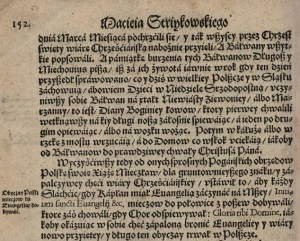
“The duke Mieclaw [Mieszko] ordered to let it be known [by town criers] in all towns and villages that each person, the nobility as also their subject and people of all stations under the threat of] having their throats slit and losing their possessions, on the seventh day of March they should baptize themselves.”
stryjk3

“And so all of them through the Holy Baptism accepted the Christian faith and they broke all the idols.  And, as a remembrance of these idols, Długosz and Miechovius write what was done every year when this day came – [a tradition] that they maintain even today in Great Poland and in Silesia.  For when mid-Lent Sunday comes, children having made an idol in the shape of the woman Ziewona or Marzanna that is Diana, the Goddess of the Hunt (which idol they used to venerate), they place it on a stick and carry it around singing sadly and one and the other [idol] praising or carrying it in a wagon.  Then, in a puddle or into a river from a bridge they throw it and run away to their houses as if from the idols towards the true glory of Lord Christ.”

On Jan Długosz’s decryption of Poland’s baptism, see here.


Jakub Wujek

(Postylla, 1573)

Jakub Wujek (1541-1597) was a Roman-Catholic Jesuit priest and a leading translator of the post-Council of Trent (i.e., “Counterreformational” Bible).  He also wrote  Postylla catholica  which contained many sermons.  In its Part 3: Sermon on the Day of Saint Adalbert our martyr, patron and apostle (Kazanie na dzien Wojciecha swietego, meczennika, patrona i apostola naszego) Wujek makes the following claims about Poland’s pagan past:

wojek1

1575 printing

“Our Poland was once in darkness covered when it venerated, instead of the lawful, live God, all kinds of devilries [such as] Jesses, Ladas, Nyas, Marzannas, Ziewannas, Zyzylas, Zywies, Pogodas, Pochwists, Lelipolelis, Pioruns, Gwiazdas [stars] and snakes.”

wojekz

(Byla kiedys Polska nasza ciemnosciami kiedy miasto prawego zywego Boga lada Dyabelstwa Iesz Lady Nije Marzany Ziewany Zyzylie Zywie Pogody Pochwisty Lelipoleli Pioruny Gwiazdy i Weze chwalila.)


Alessandro Guagnini

(Sarmatiae Europeae descriptio, 1578)

Alessandro Guagnini (1538-1614) was a Veronese soldier and chronicler in the service of the Polish-Lithuanian Commonwealth.  He became a naturalized citizen of the Commonwealth under the name “Gwagnin”.  As already mentioned, he was accused by his former subordinate Maciej Stryjkowski of having plagiarized Stryjkowski’s chronicle.  Be that as it may we include Guagnini’s description here as well.

sarmatiaguagnini1

After mentioning the destruction of the idols on the 7th of March, Guagnini goes on to describe their early worship (you can zoom in for the Latin version):

“Because before they worshipped  all kinds of created [physical] objects as Gods – the Sun, the Moon, the Air which they called Pogwisd.  Especially Jove who they called Jessa, Pluto who they called Lado[n], Cerere who they called Nia and whose church/temple stood in Gniezno, Venera who they called Marzana and Diana who they called Ziwonia, in the pagan tongue.  Also Lel and Polel that is the Roman Castor and Pollux were venerated as Gods.  And when they drink together so do they cry out their names ‘Lelum Polelum.'”

guaagnini2

Guagnini then mentions the games that men and women play between the 25th of May and 25th of June, i.e., stado which is, he says, still observed in Ruthenia/Russia and in Lithuania. He goes on to describe that after Easter till the feast of Saint John the Baptist women and maidens hold hands dancing in circles praising the name of Ladon (‘Lado, Lado‘).  Finally, he notes that in Silesia and on the border with Poland on the 17th of March villagers go around with an idol before throwing the same into a river (i.e., the Marzana rites).  


Joachim Bielski

(Kronika polska Marcina Bielskiego nowo wydana, 1597)

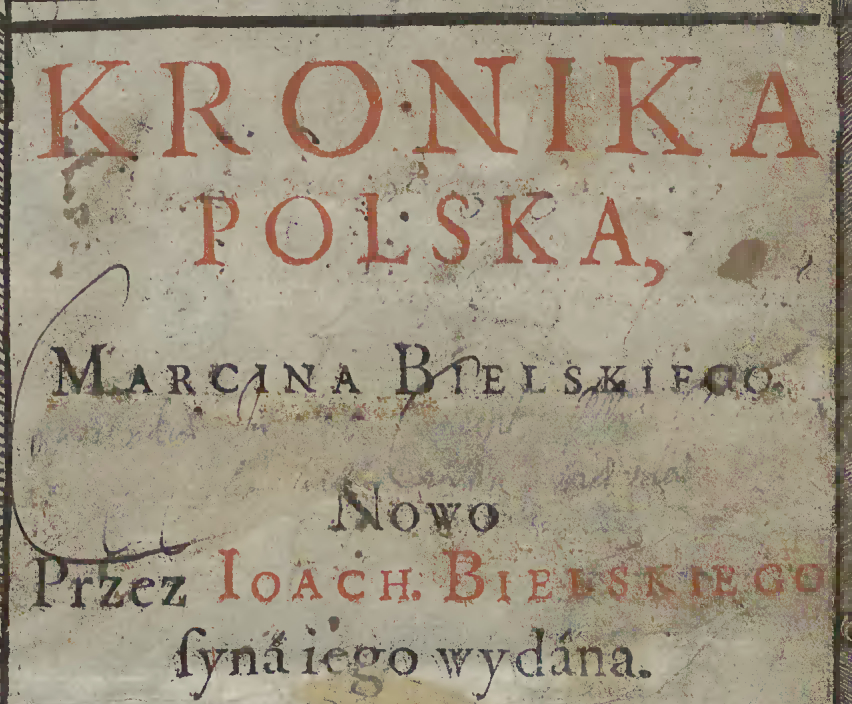
Joachim Bielski (circa 1540 – 1599) was the son of Marcin Bielski, as well as a parliamentarian, poet and the man who updated his father’s chronicle into the “Polish Chronicle of Marcin Bielski – newly issued by his son Joachim Bielski.  In addition to adding Polish histories up to the reign of Sigismund Vasa, Joachim toned down the various pro-Protestant passages in his father’s work.  (Joachim was not raised Catholic by his father but did later convert to Catholicism – whether this was partly caused by the growing Counter-Reformation, the fact that Joachim was working for the new King Sigismund Vasa (who was a staunch Catholic) or by personal beliefs is unknown.

iochanbielski
“The Poles having accepted the Christian faith destroyed the idol images in which they [previously] venerated devils as Gods.  Others they burned everywhere in towns and villages.  All the pagan prayers they and lost [destroyed] via edict or the duke’s command: setting a certain date for this, namely March 7th,  These idols, Miechowita [Maciej of Miechow] writes that he saw three of the same, broken and lying at the Church of the Holy Trinity in Cracow where they lay on the ground for a while.”

ioachim1

“In the reign of this Mieszko in Cracow on the Vistula – where today the convent of Saint Agnes stands – there was a pagan church from which Mieszko ordered all the devils’ idols to be tossed out and to [replace them with] carvings of the passion of the Lord Christ.”

“In my memory too, there was this custom in villages that on the White Sunday [Second Sunday – Sunday after Easter] they drowned an idol after [first] having put human clothes on a hemp or hay bundle.  And the whole village led this idol [away] to a nearby lake or puddle and there, having taken the clothes off, they tossed it into the water singing mournfully: ‘Death writhes about the fence, looking for trouble etc.’ Thereafter, they ran away from this place as fast as they could back home, whosoever should, however, fall so they got an augury that this one should die this year.  They called this idol Marzana as if it were the God Mars.  Just as Ziewanna was Diana; and Dzidzilia was the Goddess Venus; and Jessa was the God Iovis [Jove]; and Nia, the hellish God Pluto – these they venerated in accordance with pagan custom as Gods and they built them churches/temples, consecrated woods, established certain Holy Days, gave offerings and to honour them they gave feasts and dances.”

ioachim2“As Długosz writes, that even in his time about the time of the Green Holidays [Green Week/Pentecost/polish Zielone Świątki, german Pfingsten] people used to congregate in villages – men just as women and to engage in strange dances [in their honour] which they called in the common tongue Stado.  So too writes this Długosz that in Gniezno there stood for a long time a church of the Holy/Saint Nia.  They also had other live Gods that is Lel and Polel which some understand to be Castor and Pollux.  They venerated as a God too Zywot, Pogoda, Niepogoda (which they named Pochwist) and today they still call pochwiscil in Mazovia [note: Mazuria became Mazovia here].  They venerated too Piorun, especially Ruthenia/Russia [did] just as also Strib, Chorz, Mokosh.  And Pomeranians [venerated] Radogost and Swatewit and Prowe.  There too were many other pagan tomfooleries.”

Copyright ©2015 jassa.org All Rights Reserved
November 29, 2015

Yassni & Yesen Glosses in Mater Verborum

Published Post author

Here are the glosses in Mater Verborum (Glosa Salomonis) from the manuscriptorium on the topic of Yassni or Yesen.  As you can see they are right above (and refer to) Isis, i.e., the Egyptian goddess (see above lingua egipti).  The Mater Verborum does contain genuine Slavic (Czech) glosses.  However, as it been in the hands of the notorious forger Hanka, many of the glosses are believed to be his additions.  Telling the genuine glosses from the fake ones, however, has proven difficult.  Adolf Patera undertook this task and concluded that, among the fake ones, was also the above one referring to Yassni/Yesen, i.e., that this was an addition by Hanka.  Nevertheless, the Hanka  forgeries are themselves a story of great interest and, therefore, we include this gloss here.  Prior glosses referring to Slavic gods (not all of them from Mater Verborum! (though virtually all are believed to be forged)) are shown here.

iaziiaziThe corresponding Patera list is here:

patera

Copyright ©2015 jassa.org All Rights Reserved

September 14, 2015

Once More on Parkosz’s Nya

Published Post author

We’ve previously mentioned Jakub Parkoszowic and his Orthography Tractatus which includes a reference to the Goddess Nya.  We’ve noticed that the Tractatus has since been published (in 1985), which publication includes a facsimile so here are the relevant lines from that facsimile:

parkoszozz

parkoszo

“Every time there was a soft ‘n’ to be written, it was always written with the help of a double ‘y’ before the appropriate vowel…  This writing method was, however, inadequate to differentiate [from other situations], because between ‘Nya‘ which was the name of a [god/goddess/]idol and ‘nia’, a syllable found in the word ‘gniazdo’ [nest], there was no difference in writing).”

And here is a more recent version of the same:

Presumably, for this reason the word nÿabozhensthwo which is in one of the manuscripts does not cause us to rethink the meaning of nabożeństwo or “worship ceremony”.

Copyright ©2015 jassa.org All Rights Reserved

August 29, 2015

Pomeranian Gods Part III – Ottonis Vita Second Tour (Conclusion)

Published Post author

With this post we conclude the Life of Otto (for part I see here, for part II see here).

Ebbo IX

[Temples at Gutzkow]

“The Apostle of Pomerania, after spending the following week in spreading the knowledge of the faith and in handing on baptismal grace in this town, appointed over its inhabitants the devout priest John. He then made for another town called Chozegow [Gutzkow], which contained temples of great beauty and marvellous design, in the building of which the citizens of this town had spent three hundred talents.”

rooftop

Notice the chopper landing pad – recently installed for traveling priests of Triglav

“They offered our blessed father a very large sum of money if he would refrain from destroying them and would keep them whole and uninjured as an ornament to the place. This the man of God altogether refused to do, as he declared that he could by no means agree to preserve these sacrilegious buildings which after his departure would give rise to apostasy and be the cause of ruin to those who were weak. He said that he would not become responsible in the sight of God for this offense.”

Herbordus VII

[Temples at Gutzkow – Herbordus version]

“He then bade good bye to all the people (at Hologost), and having with much affection committed them to the Almighty God, he turned towards Gozgaugia [Gutzkow]. In this town was a temple of great size and beauty.  When the bishop spoke to its inhabitants concerning the Christian faith through an interpreter for the Duke had already left him on his own business they declared that they were prepared for anything if only their temple might remain intact, for it had been recently built at great expense, and they were very proud of it because it appeared to be an ornament to the whole town. They made attempts secretly and sent some men to try to soften the disposition of the bishop by gifts in the hope that the building might be preserved. Finally they asked that it might be altered and used as a church.”

temples

Otto did not see the value of keeping primitive pagan temples around

“But the bishop consistently maintained that it was unfitting that a building that had been erected and called by the name of a demon, and that had been profaned by indecent rites, should be transferred to the service of God: ‘For what concord has Christ with Belial?’* or ‘what hath the temple of God in common with an idol temple?’  He spake also a parable unto them,  ‘Do you sow your wheat on top of brambles and thorns?  I think not.  If then you root up the thorns and thistles from your fields in order that, when good seed has been sown, they may bring forth the wished-for crops, so is it right that this root of idolatry be utterly destroyed from among you in order that from the good seed of the gospel your hearts may bear fruit unto eternal life.’  With these and other similar words he continued day after day, in season and out of season, to entreat, denounce and accuse, till at length he so far influenced the minds of the pagans that they themselves with their own hands demolished the images and broke up this accursed building, concerning which the discussion had arisen.

* note: this does not mean that Slavs worshipped Belial (whether or not that is the same deity as Baal) – Otto’s exclamation is a quote from 2 Corinthians 6:15. 

Ebbo X

[The Guetzkow Gods Turn the Other Cheek]

“At the very time that he was destroying these shrines of marvellous workmanship in the town of Chozegow [Guetzkow] certain honourable messengers from Duke Adalbert arrived, who carefully examined his condition, and at the same time there came messengers from his own farms at Muecheln and Schidingen, who brought him the supplies that had been promised. When they perceived the grace of God and saw that the Church there was growing and becoming strong they were filled with great joy and with the consolation of the Holy Spirit.  And indeed it was a joyous sight when images of great size and marvellously sculptured, covered too with most beautiful designs, which many yoke of oxen could hardly move, had their hands and feet cut off, their eyes dug out and their nostrils mutilated, and were drawn down to a certain bridge to be burnt with fire, while the supporters of the idols stood by and with loud ejaculations exclaimed that help should be given to their gods and that the wicked subverters of their country should be cast down from the bridge and drowned.  Others who were of wise counsel protested that if these were indeed gods they should be able to defend themselves; inasmuch as they kept silence and could not even move out of their place except when drawn, it was clear that they altogether lacked feeling and actual life.

ottoswrath

Disappointed with the locals’ constant excuses, Otto decided to take matters into his own hands

The idol priests, however, endeavoured to stir up discord in order to secure their own gain. For, as we read in the prophet Daniel, dishes of food and drink of every kind and in great abundance were placed in front of these large projecting images, all of which the priests and their friends declared were consumed by the gods, though they had themselves secretly entered and taken them away.”

Ebbo XI

[The Attack of the Giant Flies and How They Fled to Rugia]

“But we must not omit to relate the miracle which was manifested while these shrines were being destroyed.  For, all of a sudden, whilst many people were standing by, flies of unusual size, such as were never before seen in that land, rushed from the ruins of the idols in such vast numbers that they darkened the whole of the district round the city and seemed to obscure the daylight by a hideous darkness, and, as by their fierce onslaught they distressed the eyes and lips of all, they caused to those who saw them no small horror.  When, however, they were driven away by violent slaps of the hand, they kept coming on with no less insistence, till at length as the believers sung aloud the praises of God and carried round the standard of the Cross, a detestable monster fled out of the open doors and with utmost speed made for the country of the barbarians who are called Ruthenians [he means Rugians].”

flypeople

The giant flies were powerless to stop the ardent faith of Otto and his acolytes

“In the opinion of all who were wise this portent clearly presaged the expulsion of the devils, of which Beelzebub, that is the man of flies, was chief, for these devils could not endure the grace of Christ which was brought by these new teachers, and when they were denied any resting place in these parts, they went to the Ruthenians [Rugians] who were still ensnared in pagan error.”

Ebbo XII

[Of Mizlaus, the Chief of Guetzkow]

When then the idol shrine had been destroyed and the people had been gathered into the bosom of Mother Church by the washing of regeneration, the holy preacher began to build a new church for Christ.  There came to its dedication the chief of this place called Mizlaus, who, at the conference that was held at Pentecost in Uznoim [Uznam], had with other chiefs received the grace of baptism, and to them the good bishop spoke through his interpreter Adalbert, who afterwards became a bishop.”

[there follows an account of Otto freeing Christian captives and Mizlaus trying to negotiate for one particularly valuable Danish hostage; then Otto prevents the invasion of Pomerania by the Poles of Boleslav III and mediates their peace treaty; after that it’s back to the business at hand]

Ebbo XV 

[Onto Stettin/Szczecin]

“The apostle of the Pomeranians, who wisely considered that the will of God was hereby revealed, but who judged the Ucranians [people on the River Ukra/Uker] unworthy to hear the word of salvation, directed his journey to the people of Szczecin/Stettin who, as we have already said, had apostatized from the faith, although many who were faithful to Christ and were his friends would have recalled him from this attempt.  For the idol priests had stirred up all the apostate people to seek with one accord his death.”

protesting

The idol priests were stirring up the apostates

He himself being eager for martyrdom and perceiving that none of his companions would venture to undertake this task, gathered together on a certain day his episcopal clothes, and placing them on his neck started on the journey alone, and seeing a boat that happened to be passing he paid his passage money and went on board with all speed.”

ibringyoulove

Otto just wanted to bring love

“When, in accordance with the divine will, Udalricus discovered what had happened, he immediately told his companions, who followed him with quick steps, the first being Adalbert the interpreter, who caught him up and compelled him to return, though he was unwilling and strove to resist. He groaned deeply, and bitterly deplored his capture, and said that he deserved now to have companions from amongst his attendants on this dangerous journey, whilst they, having regard to his great zeal, thought that it was wrong to recall him or to leave him unattended.”

sentries

Extraordinarily alert and singularly vigilant, the Szczecin sentries immediately spotted Otto’s group

“…Accordingly they embarked in a boat, and when they had come near to the town of Stettin/Szczecin those on the look out recognized the bishop and, having scanned him carefully, raised a great disturbance and cried out to the citizens that the former teacher of error had come, and that they ought to attack him with swords and clubs and treat him with indignity in order to vindicate the honour of their gods. When the servant of God had learned this through his interpreter, being fearless and armed with the ardour of his faith, he raised the standard of the cross, and having made himself ready by putting on his bishop’s dress contemplated going forth to meet them.  He first of all entered the church of the chief of the apostles, which he had built in front of the gate of this city, and offered to Christ the worship that was His due, and then awaited the onset of the barbarians and the completion of his life in Christ.  After a little while the people burst forth from the gates with a tumultuous noise, but when they beheld the servants of Christ singing the praises of God, they hesitated much and long and conferred amongst themselves as to what they should do, and at length, by God’s help, they were overcome with fear and retreated in confusion [and returned to the city] by the way by which they had come…”

Herbordus XIV

[Szczecinians Decide What to Do]

“And they began to be more kindly disposed and they said that reason rather than force was needed to decide whether these things should be accepted or rejected.  Then some who were wiser than the rest in reference to these matters secretly gathered together the priests, saying that it belonged to them to defend their own religion by suitable arguments.  Whilst they muttered these things among themselves they gradually departed one by one to their own homes. This happened on a Friday.”

Herbordus XVI

[And the Solution Is… Dvoeverie!] 

“The wicked priests, when in a certain year men and beasts suffered illness and death owing to the changes in the temperature, declared that this calamity was sent by the gods, and, with the consent of the people, they had broken down the bells and had begun to destroy the church of the blessed martyr Adalbert.  Whilst one of them was striking the altar with a mason’s hammer, he was suddenly struck by the Lord with languor and stupor, and as his hammer fell from his hand he too fell to the ground.”

priest

The priest’s hammer failed in front of the altar of Saint Adalbert

“When, after a long space, he had recovered his breath, he addressed the people who were standing by as one whose character had been reformed by the blow that had befallen him, and said, ‘It is in vain, O citizens, that we strive; the God of the Christians is strong and cannot be driven away by us. My advice is that we keep Him, but at the same time that we do not part with our ancient gods and that we build an altar for our gods next to His altar, so that by worshipping them all alike we may secure that He and they are equally propitious to us.’  What were the people to do? Terrified, as they were, by the portent, they approved the advice given them and, having impiously built an altar next to the altar of the Lord, they served God and devils even as the ancient historian says, ‘The people of Samaria worshipped the gods of the nations, but none the less served the Lord.'”

[this passage is basically Ebbo I as above]

Ebbo XV

[On the Pyramids of Szczecin]

“As the Sunday dawned in the early morning after the service of the Mass had been completed, Otto, the servant of God, having put on his episcopal headdress and with the standard of the cross borne in front of him, went forth to the multitude of the people in order to preach to them. He took with him Udalricus, who wore a dalmatic, as a deacon, and Adalbert who served as a subdeacon and others to assist in preaching.”

pyramids

The three aspects of Triglav departing in their pyramids by Otto’s command

“There were there some large pyramids surrounded by walls to a considerable height in pagan fashion. The good preacher ascended one of these pyramids with his companions, and through his interpreter Adalbert began to explain the way of truth to those who had gone wrong and to threaten them with eternal destruction if they did not turn from their apostasy.”

Ebbo XVI

[Wherein Otto Continues to Seek Martyrdom and, Again, Fails]

“As he was engaged in preaching the chief idol priest came running breathless and perspiring, and creeping in amongst the closely pressed crowd he struck the pyramid and with a great shout ordered the servant of God to be silent. He and his companions on the previous night had planned to effect the death of the bishop at the earliest dawn of Sunday, but by God’s providence he had been overcome with deep sleep and had been prevented from carrying out his purpose.  When he awoke, at the second hour of the day, and heard that the man of God was already preaching in an open assembly, he was extremely angry, and rushing thither ordered him to be silent. The servant of the Lord, however, continued stedfastly to carry out the work which he had begun. The idol priest endeavoured to restrain by his noisy and high-pitched shouts the gentle voice of Adalbert, the interpreter, and with a strong voice ordered the barbarians to transfix forthwith Christ’s preacher with the spears which, in accordance with the old custom of the Roman Quirites, they always carried.  When they were about to obey his commands and had raised their right hands aloft in order to strike him, influenced by divine power, they became stiff like stones, so that they could neither put down their spears nor open their mouths, but their hands remained suspended and immovable and seemed as though they were chained.”

frozen

The barbarians became instantly frozen

“When the unfortunate idol priest saw this, he was inflamed with anger and began to charge them with cowardice, and seizing a spear from one of them, he tried to transfix Christ’s servant. He too immediately became rigid, and overcome with shame turned to flee. When he was gone Otto made the sign of the cross and invoked a blessing upon the people, who, being forthwith released from their bonds, put down their right hands which held the arrows; whereupon the bishop gave thanks to God for this manifest miracle and entered the town with confidence; and when he saw that the central part of the church of St. Adalbert had been destroyed, he wept bitterly and, kneeling together with his companions, engaged in long and earnest prayer.  Meanwhile the barbarians, armed with swords and clubs, had gathered together and had surrounded the cloor of the church, seeking to kill God’s servants, but as a result of divine influence, they were suddenly overcome with trembling and turned to flee. Then the chief, Witscacus, who had once been delivered by Otto from his captivity with the Danes, intervened together with other friends of the bishop and begged him by any possible way to leave the city before he met his death by the treachery of the priests. The saintly bishop refused, saying, ‘It is for this purpose that I have come.'”

Herbordus XVIII

[Wherein Otto Continues to Seek Martyrdom and, Again, Fails – Herbordus Version]

“When all had become silent and most of them were eager to hear his discourse, one of the priests who was a man of Belial [again, author means Baal but this is obviously interpretatio Mesopotamica], and was passionate, fat and tall, rushed into the midst of the crowd, and brandishing his spear in his hand, advanced panting and gasping as far as the steps, and, raising his hand once and again, struck the top of the steps with preat violence. When a great clamour had arisen and o o strange words of abuse had been uttered, he demanded silence while he spoke, and his loud and raucous voice drowned the speech of the interpreter and of the bishop. Addressing the people he said, ‘O senseless, foolish and indolent people, why are ye deceived and bewitched?  Behold, your enemy and the enemy of your gods is here. For what do ye wait? Are they to suffer derision and injury for nothing?’  While all the people were advancing with spears in their hands, he said, ‘Let this day put an end to all his deception.’  Addressing them all, he spoke also to those individuals of whose evil disposition he was assured, calling them by their own names. Those who were inflamed with a spirit of madness and who were accustomed to act with rashness rather than with discretion, roused by the voice of the speaker, began to raise their spears, but while they were brandishing them in readiness to throw them, their limbs became rigid in the very act of throwing them, and, marvellous to relate, they were unable to throw their spears, to relax their right arms, or to move out of their places. They stood immovable, as images, a spectacle to the faithful and the pious. As many as were unbelieving and evil disposed and had fallen away from the Christian faith, and, continuing in their persistent folly in unbelief, had raised impious hands against God’s servant, stood suffering this punishment until the good had been strengthened in their faith, and in the case of the others by the punishment inflicted on their bodies the wickedness of their hearts had been corrected. The bishop, making use of the opportunity afforded by the miracle, said, ‘Ye see, my brothers, how great is the power of the Lord.  It is indeed, as I perceive, by divine power that you are held fast. Why do you not throw your spears?  Why not put down your right hands?  Why continue so long in one position?’ They however, whether through confusion or astonishment, made no reply. Then he continued, ‘Let your gods for whose religion ye contend help you if they can. Let this noisy priest of yours call upon the gods on your behalf, let him give you counsel or assistance. If he knows anything or can do anything, now is the time for action.’  The priest, however, stood amazed at the course which the events had taken and did not venture to mutter anything more. And when all were silent and held by a great fear, the bishop being moved with pity said, ‘thanks be to Thee, O Lord, Jesus Christ, who are wont to exercise Thy power and strength, when occasion arises, to terrify those who oppose and to protect Thy servants.  But, inasmuch as Thou art holy and compassionate, we pray that Thou wilt pardon the ignorance, or the temerity, of this people, and that with Thine accustomed pity Thou wilt restore to these the use of their bodies, of which by Thy restraining power they have been deprived.'”

martyrs

Otto welcomed a chance at martyrdom: “It is for this purpose that I have come.”

“When he had said this and had made the sign of the cross towards them, his speech produced an immediate effect. The bishop added also, ‘If hitherto you have been unwilling to listen, prove now by touch and feeling how great is the compassion of our God and how true is the faith which we declare unto you.’  He argued at length and with great force concerning the judgment and compassion of God and the uncertainty of this present life and the continuance of things that are eternal, and he instructed the sinners in Zion who were afraid, and when they had been overcome by the saving medicine of his eloquence, he gave them his blessing and dismissed the assembly. Descending then from the steps he visited, with the faithful believers who were zealous on behalf of God’s house,  the Church of St. Adalbert and, having first offered a solemn prayer, he destroyed the altar of abomination and, having broken it into small pieces, cast it out. Having then performed a service of cleansing and reconciliation he caused the broken parts of the church to be restored at his own expense.”

Ebbo XVI

[Democracy In Action]

“After fourteen days a general Conference was announced, at which the priests and people might arrive at a definite decision either to take upon them the yoke of Christ or to abjure it altogether.  On the appointed day the bishop ascended the hill of Triglav in the middle of the town where was the Duke’s dwelling place, and entered his large house which was a convenient place for this Conference. The chiefs together with the priests were present, and when silence was made the man of God said, ” The day that was fixed for our meeting has now come, and I, who eagerly desire your salvation, wish to hear from your own mouths whether you have decided to serve my Lord Jesus Christ, who is the true light, or the devil, who is the prince of darkness.” One of the priests answered, ‘It was not right that this Conference should have been delayed so long, inasmuch as in former time and now and always it is our determination to worship the gods of our fathers; do not therefore labour to no purpose, for thy speech has no place amongst us.'”

ottothing

Otto addressed the conference explaining that from now all will be well

“On hearing this the man of God said, ‘I perceive that Satan has destroyed your vision so that you cannot behold the true light. I am innocent of the blood of all of you, for I have not shunned to declare unto you the word of God in season and out of season.  But as you have cast away the yoke of my Lord Jesus Christ, I commit you to the power of Satan whom ye have chosen, so that, being delivered over with him to eternal destruction, you may possess that heritage where the worm clieth not and the fire is not quenched.’  Rising then from his place he took up his spiritual arms and placed his stole on his neck in order that he might bind them by his solemn curse.  When the chiefs saw this they were seized with timely fear, and prostrated themselves at his feet humbly, entreating him to suspend his curse, and to allow them a brief space of time in which to confer.  The good bishop at once agreed, and placing aside his stole he sat down. The chiefs then went out of the house, leaving the priests behind, and with one accord they abjured the uncleanness of their idolatry and accepted the faith of Christ.  First of all Witscacus, who was the man of chief rank amongst them, went in to the servant of God and delivered this opinion on behalf of them all. ‘Honourable father, I, together with the chiefs who rule this place, being inspired by God, have by a unanimous vote agreed that we banish to a distance from our lands these sacrilegious priests who have incited us to all evil, and that with ready mind we follow you as our leader and teacher on the way that leads to eternal salvation.'”

kicking

Exclusion from the pride was the lot of the local priest

“Then he turned to the priest who had spoken before and said, ‘Wretched and miserable man, what help did your gods render to me when I was closely fettered and guarded, and was already awaiting sentence of death, my companions having been cruelly strangled, and when I distinctly saw Otto, my lord and father, freeing me from my fetters and restoring me to the liberty for which I longed ? Is it not better for me to serve the living and true God who was my liberator, than to serve logs and stones which have neither life nor feeling? Go then with your companions whither you will, and beware that you appear no more in our territory, for inasmuch as our Lord Jesus Christ is King over us, there is no room for you and your idols in these parts.’ When they heard this all the idol priests rose up without delay and fled with haste, and none of them was afterwards seen in that place. The bishop thereupon rendered cordial thanks to God, and he and his companions began at once to destroy the idol temples.”

[elsewhere in the Vita it is told that Witscacus had been captured by the Danes and was able to escape after he saw Otto in a vision]

Ebbo XVIII

[The Nut at the Nut Tree] 

“There was a certain shrine situated at a distance to which the bishop had sent his faithful and beloved friend, the good priest Udalricus, in order that he might destroy it.  There were, however, a few persons who supported the worship of idols, and, when they saw him from the wall as he was coming thither, they tried to break his head by throwing stones and pieces of wood. By the help of God he avoided these and was uninjured, and returning to his father Otto he told him of their plots.  The man of God immediately raised the standard of the cross and binding on his episcopal headdress he proceeded without hesitation to undertake this perilous adventure.  The barbarians would not endure his presence and dispersed hither and thither, seeking to conceal themselves by flight.   When the shrine had been destroyed, and the man of God was returning he found a very large nut tree which was consecrated to the idol together with a fountain the water of which flowed beneath.”  

chopper

The bishop ordered the tree to be immediately chopped down

“He at once ordered his companions to cut it down, whereupon the people of Szczecin/Stettin came out and earnestly begged that it should not be cut down because the indigent man who was its guardian obtained his poor subsistence from its fruit.  They declared also with an oat. that by a general edict they would for ever prohibit the sacrifices which had been there offered to demons. The good teacher, influenced by the justice of their reasonings, acceded to this request.  While they were engaged in mutual discussion the barbarian who was the guardian of the tree suddenly came up and, approaching secretly from behind, struck a violent blow with an axe at the sacred head of the bishop. By divine providence he missed his aim and struck the axe with such force into the wooden floor of the bridge on which the bishop was standing that the difficulty of drawing it out again caused delay to the assailant.”

Ebbo XIX

[The Magnanimity of Otto]

“When the interpeter, Adalbert, saw this he was struck by so great a fear that he quickly snatched the axe from the hands of the barbarian and ran off. The others, overcome by unaccustomed horror, attacked the sacrilegious man and threatened him with death. The pious Otto, however, interfered to prevent the murderer from suffering any harm and procured for him, unworthy as he was, life and safety…”

Ebbo XX

[More Idol Priests and More Snares]

“When the inhabitants of Stettin/Szczecin had been confirmed in the faith and teaching of the Lord and the man of God was arranging to return to Uznoim/Uznam, the citizens of the town came to him and begged that by his intervention he would put an end to the dispute which at the instigation of the devil had broken out between them and the Duke Wortizlaus.  Whereupon he said, ‘I will do as you wish, but I desire that you should send messengers of honourable rank with me to bring back to you the terms of peace and, if the Duke has any just cause of complaint, to explain the points that may be raised.’  The people of Szczecin/Stettin immediately appointed messengers to accompany their good pastor, who also served as a guard to the bishop on the journey.  For two idol priests had laid snares in order to secure the death of the man of God, and had sent on secretly eighty-four soldiers to find and kill him on his return journey and to bring back to them his head fixed on a post.  But against the Lord is there no wisdom, no fortitude, no counsel.  For the holy Otto, being protected by divine providence, came forth unharmed, whilst the unbelievers fell into the snare and pit which they had prepared.”

nothingisover

The idol priests felt that “you don’t just turn it off”

“For in the absence of the good bishop the chief idol priest called together his friends and with exceeding joy bade them keep this day as a festival day for their gods, and he said, ” Our god whom that old deceiver has attempted to destroy has appeared to me, and has clearly announced that Otto’s head is to be cut off today, and sent to me today.” When he had given vent to this wild utterence with laughing voice, his neck was suddenly shattered by the devil and his head was bent back crosswise, in a horrible and pitiable manner, and his brain coming out of its place was dashed against the wall with a cruel impact. When his friends saw this they were struck with amazement and inquired of him the cause of this strange calamity. He cried out with a dreadful voice and at length exclaimed, ” It is because I have tried to ensnare the servant of God, and to separate you from the way of truth, that I have been terribly afflicted by God.” Having said this he expired and the place was thereupon filled with so dreadful an odour that as he was dying no one could stand there on account of the unbearable smell.  And as it is written, ‘When a pestilent man is punished the wise man will become wiser,’ so all the people, when they heard of his death, were more and more encouraged to persevere in the faith.  There was, however, one other idol priest who was not overcome with remorse, but began an altercation with the man of God and declared that his teaching would soon be done away with in those parts.  He endeavoured also to draw away from the true path all whom he could influence, and as a result he also perished soon afterwards by the judgment of God. For whilst for some urgent reason he was crossing the sea in a boat, he left the boat for a short time in order to retire to a neighbouring wood.  By divine providence it came about that some of his companions, armed with righteous zeal, followed him secretly, and when they had caught him in a cruel snare they hung him up in a closely wooded place. So his grief and his iniquity descended on his own head.   When then the eighty-four soldiers who, as we have said, had been sent on by that wicked idol priest had seen the man of God as he was sailing, they burst forth from their hiding place and demanded of him in a loud voice whither he was going.  The messengers from Szczecin/Stettin asked in return why they made this inquiry, but the others, recognizing the voices of their own friends and citizens, stopped and said that they had been unaware of their presence there.  They replied, ” The Lord’s bishop is going to put a stop to the discord that has long existed between us and the Duke, and for this reason we will not suffer any harm to molest him on his journey, but are prepared to suffer death on his behalf. If therefore you desire to consult your own interests, return as quickly as possible by the way by which you came.”

Herbordus XXIV

[Wicked Priests, Their Assassins and the Sea Battle with Otto]   

“The wicked priests, however, who were inspired by devils, as they could not act openly, tried to injure God’s servant by craft.  They accordingly brought together a great number of assassins, and invested the route by which he was leaving at the narrowest part where the ship would pass, having foretold, as though by divination, the death of the bishop to his friends, who were unaware of what was being done.  When they came to the spot the enemy seized their arms, laid hold on those who were climbing the ropes and attacked those who were sailing the boat, desiring above everything the bishop’s blood.”

ottobraver

Ignoring his own safety, Otto rushed to protect his companions

“But the people of Szczecin/Stettin and our men who were with the bishop seized their arms and jumped from the boat, and standing some on the land and some in the water bravely repelled force by force. When the fight had gone on for some time, those who had taken part in the ambuscade began to be recognized by the people of Szczecin/Stettin and fled in confusion from the scene of their crime.”

Ebbo XXI

[Otto Returns to Wolin]

“Thus, by divine providence, was the wicked design of the idol priest frustrated, whilst the servant of God drew near to the town of Julin [Wolin] which had formerly been initiated by him into the sacraments of the faith.”

Herbordus XXV

[Otto Returns to Wolin – Herbordus Version]

“When, by the help of God, the bishop arrived at Julin [Wolin] he met there with no opposition. For the people bore with patience all his remonstrances in reference to their apostasy, and other offences, and were ready to purge and improve their unworthy and evil actions and to amend their conduct in accordance with his teaching.”

Ebbo XXIII

[On the Rugians’ War on Pomerania]

“[T]he Ruthenians [Rugians], who were still bound in heathen error, when they heard of the conversion of the people of Stettin/Szczecinwere exceedingly angry because they had renounced their idols and submitted to the Christian law without reference to, or consultation with them, and they feared not to make war upon them.  When they had brought together their large army they occupied the river banks and stationed there one line of their men, who were equipped with noise-producing arms and who, with meaningless clamour, sought to find out where their God was and if he was able to succour those who called upon him.  The others, however, carried in front of them the standard of the Lord’s cross and put their opponents to flight at their first onslaught. On the following day they came back like dogs and again threatened war upon the Christians, but they were overcome in the same way and thrown into confusion and again turned to flight. On the third day, having been well nigh exterminated, they exclaimed that the God of the Christians was unconquerable, and that if He would spare them they would never again attempt any rash action. The Christians forbore and they speedily dispersed and returned one by one with great fear and confusion to their own homes. But the bishop, who thought it right to return good for evil, desired to teach the Christian laws to these Ruthenians, who had not feared to harass by war a newly converted people. They, however, hardened themselves against him and on several occasions declared by their messengers that if any of his companions should presume to approach the borders of Ruthenia (Rugia), for the sake of preaching the gospel, their heads would be cut off forthwith and they should be exposed to be torn by wild beasts.”

Herbordus 

[On the Rugians & the Danish Archbishop – Herbordus Version]

“This people (the Ruthenians [Rugians]), although on many occasions they were invited by different preachers to accept the faith, were never willing to do so as a body, but, whilst some believed, others did not believe. For the most part they lived according to pagan rites, and by choking like thorns the seeds of faith they did not suffer them to develop. Ruthenia is adjacent to the country of the Danes, and ought to be subject to the Danish archbishop. But when a people is engaged in spreading the catholic faith it is unnecessary for priests to quarrel over parish boundaries. As their hatred gradually increased the Ruthenians began to offer open opposition to the people of Stettin/Szczecin. First of all they kept their ships from their own shores, and later on by a unanimous decision they resolved that they should be regarded as enemies, and, as they had heard that Bishop Otto was to come to them for the purpose of preaching, they commanded him that he should never approach their territory. For, they said that he would find  with them nothing but bitter punishment and certain death. When Otto received this message he silently rejoiced and prepared himself for martyrdom, and he thought out and arranged everything and debated anxiously with himself whether he ought to go alone or accompanied by others to this feast.  Now there were at Julin [Wolin] amongst the followers of the bishop some good and prudent men from Stettin/Szczecin who knew the several districts and the customs of this race.  The bishop questioned these for some time, as he desired to learn whether they would be willing to conduct him thither.  They, however, told him much concerning the origin of the Ruthenian race, the fierceness of their dispositions, the instability of their faith, and their bestial conversation: they told him also that they ought to be subject to the Danish archbishop.  The bishop trusted that their conversion, if it could be secured, would be pleasing to the archbishop, and at the same time he considered that it was fitting that he should obtain his licence and permission before going to preach in his jurisdiction. Accordingly he sent from where he was the venerable priest Iwanus and some other messengers in a boat with letters and gifts to ask for his permission to preach.”

ruthenians

Furious at the Pomeranians’ conversion, the Rugians immediately put to sea to straighten things out

“The archbishop received them with the greatest joy and respect and treated them with the utmost kindness, asking them many questions concerning the position, the teaching and the work of the blessed Otto.  He was a good and honest man and loved to hear of things that were good: he was also learned and devout, though externally he possessed the rustic manners of the Slavonians [this is a Dane].  For it was the case with all the men of that country that, whilst living in prosperity and wealth, they seemed harsh, uncultivated and rustic. Their towns and camps had no walls or towers and were defended with woodwork and ditches. The churches too and the houses of the chief men were humble and poorly designed. The men’s pursuits were hunting, fishing, or the tending of cattle, and their whole wealth consisted of these last, for there was but little cultivation of the fields. In regard to food and dress they were by no means luxurious or elegant. Even our middle-class people were ostentatious when compared with them, and the priest Iwanus appeared to be a more important person than the archbishop himself.  And as he was a man of good speech and answered all inquiries in a careful  manner, he pleased the archbishop much, and he could not hear enough concerning Otto. For he had been known to him by report for many years and he was now glad and proud that he had present with him the worthy and distinguished messengers of the bishop, whose great and noble deeds he had heard spoken of in all directions.  Regarding the message sent to him he said that he could make no reply till, after a certain delay, he had consulted the chiefs and principal men amongst the Danes.  Iwanus and the messengers, thinking that this would occupy a long time, asked that they might be sent away, as they feared that the bishop might be distressed at their delay.  He very kindly agreed and he sent to the bishop letters, gifts and a fairly large boat filled with butter as a sign of affection and friendship, and said that he would consult with the chiefs as quickly as possible, and send a reply by his own messengers to his statement.  Whether he spoke falsely or candidly we did not discover, for, whilst we were spending several days awaiting his messengers, additional messengers from the district of Alamania and from the house at Bamberg arrived, who desired the return of the bishop [Otto] for great and urgent reasons.”

[Of course, it was the Danes that, in the end converted the people of Rugia.  For more on that see here]

Herbordus XXXI

[On the Rugians’ War on Pomerania – Herbordus Version]

“On many occasions the Ruthenians [Rugians] had reviled the men of Stettin/Szczecin and had assailed their territory with armed ships.  After they had been once again repulsed and would not abandon their attacks, the men of Stettin/Szczecin began with one accord to arm themselves and to meet those who came against them with united forces.  Why say more?  The Ruthenians were scattered with so great a slaughter and so many of them were taken away as slaves that those who were able to escape made no further attack upon the victors.  The men of Stettin/Szczecin, elated by this victory, rendered honour to the Lord Jesus Christ and to His servant Otto.  They no longer feared the Ruthenians, but having taken them as captives they forced upon them a humiliating and unworthy compact.”

Copyright ©2015 jassa.org All Rights Reserved

July 31, 2015

Pomeranian Gods Part II – Ottonis Vita Second Tour (Intro)

Published Post author

We have discussed Pomeranian Gods and the first mission (in 1124) of Otto of Bamberg here.  As previously indicated, the Pomeranians relapsed into paganism relatively quickly after his departure.  Consequently, as the idol priests were scheming their perfidies anew and trouble brewed on the horizon, Otto was needed once more.

Here is the story of a super force of Christian Crusaders determined to stamp out Slavic Gods once and for all.  Here is the story of Gerovit and Triglav.  Here is Otto’s 1128 Second Tour in the Lands of Pomerania.  As these passages are long, we present these as a two part series (i.e., the Life of Otto will have three parts).  Here is Part 2 of 3.

(It comes from Book III of the  Life of Otto.  The First Tour was previously described in Book II).

Ebbo I

[It’s Baaaaack! (And Pagan-er Than Ever!)]

“After our holy father Otto had come again in peace to his own place, on the completion of his first apostleship to the Pomeranian people, two of the best known towns, Julin [Wolin] and Stettin/Szczecin, moved by the envy of the devil, returned to their former sordid idolatry under the following circumstances.”

Ebbo I

[On the Lapse of Julin] 

“Julin, which had been founded by Julius Caesar and called after him, and in which his spear was kept, fixed on a column of great size in order to preserve his memory, was accustomed to hold a festival in honour of a certain idol at the beginning of the year, which was accompanied by dancing.”

gerovitaspristuso

The moment Otto left, the High Priest of Triglav ordered mandatory dancing rites to resume

[Vita Pruef. (II. 6) states that Otto offered fifty talents of silver for this lance in order to prevent the inhabitants from continuing to worship it.]

“When the town had been cleansed by the word of faith and the washing of baptism, and the people, moved by the holy bishop, began to burn the larger and smaller idols that were
in the open air, certain persons carried off secretly some small images adorned with gold and silver, little knowing how they were bringing about the destruction of their town, even as the unhappy Achan, when the city of Jericho was overthrown, stole a bar of gold weighing fifty shekels and a scarlet robe and two hundred shekels of silver, and as a result witnessed the punishment inflicted by the divine anger, and the loss that befel the Jewish people.  For when the people of the province had assembled with their accustomed eagerness to celebrate the idol festival to which I have referred, and were playing and feasting together with great pomp,
these men brought forth to the people, who had been weakened by their vain pleasures, the idols that they had before carried off, and invited them to resume their pagan rites.”

parties

Pagan rites resumed in no time

“By doing this they laid themselves open to divine reproof.  For when all the people were engaged in playing and dancing in heathen fashion the fire of God suddenly fell from heaven upon the apostate town and the whole town began to burn with such great violence that no one was able to rescue any of his property, but the people, in their desire to save their own lives, escaped by swift flight and with difficulty the raging conflagration.”

wrathofotto

The wrath of Otto was terrible but God’s was terribler yet

“When at length the town had been destroyed by the vehemence of the fire, the inhabitants on their return found that the church of St. Adalbert, which had been built by Otto his apostle, and the middle of which had been constructed by joining boards together in consequence of the lack of stones, had been preserved from the heat of the flames.  Marvelous to relate, the sanctuary, which had been covered over in a cheaper manner, that is with reeds, and which had a linen cloth spread out  underneath in order to prevent worms from reaching the altar, had remained entirely untouched by the fire.  When the people beheld this great miracle they cried aloud and offered to God exultant praise, for they declared that beyond all doubt this was the true God, inasmuch as amidst this fierce fire, which had even injured the stones, He had been able to preserve uninjured the screen of reeds that had been spread over His own altar.”

wolinwolin

God’s mercy was available to all though primarily to those who fled to the Christian church

“Accordingly the Christian priests were summoned, and the people openly repented and utterly abjured their idols, and having, as far as they were able, rebuilt their town, submitted with eager devotion to the yoke of Christ.  Thus the divine reproof wrought salvation in their land.”

Ebbo I

[On the Lapse of Szczecin/Stettin]

Szczecin/Stettin, their most extensive town, which was larger than Julin, included three hills in its circuit.  The middle one of these, which was also the highest, was dedicated to Triglav, the chief god of the pagans; its image had a triple head and its eyes and lips were covered with a golden diadem. The idol priests declared that their chief god had three heads because it had charge of three kingdoms, namely, heaven, earth and the lower regions, and that its face was covered with a diadem so that it might pretend not to see the faults of men, and might keep silence. When this most powerful town had been brought to the knowledge of the true God by the good bishop, the idol temples were destroyed by fire and two churches were built, one on the Triglav hill in honour of St. Adalbert [Wojciech], and the other outside the walls of the town in honour of St. Peter.”

triglavic

Triglav “hill” – this one in Slovenia

“Thereafter the churches of Christ appropriated the sacrifices which were before offered with great pomp and cost to the priests and the idol shrines.  On this account the idol priests were distressed and, when they saw that the benefits resulting from their former celebrations were decreasing, they sought for an opportunity to bring the people back to the worship of idols in order to secure their own gain.  It happened, moreover, that a great mortality occurred in the town, and, when the priests were questioned by the people, they said that they had met with this calamity because they had put away their idols, and that all of them would die suddenly if they did not try to appease their ancient gods by sacrifices and the accustomed gifts. In consequence of this declaration a public assembly was forthwith held, the idol images were sought out and the profane, idolatrous observances and ceremonies were performed again by the people, and the middle portions of the Christian churches were destroyed. And when the people, in their madness, approached the sanctuary they did not dare to go farther, but thus addressed, with wild clamour the chief idol-priest, ‘Behold we have accomplished our part, it is for you, in virtue of your office, to attack and to profane the person of the German God:’ whereupon he seized an axe, but when he had brandished it aloft with his right hand, he suddenly stiffened and fell back and with a lamentable cry complained of pain. When the people ran to him and inquired of its cause he groaned deeply and said, ‘Alas, how great is the power and the strength of the German God; who can resist Him?  How have I been struck down who dared to touch His sacred dwelling.’  When the people asked with amazement what they should do, the priest said, ‘Build here a house for your god next to the dwelling of the German God, and worship Him and your gods alike, lest perchance in His anger He bring speedy and sudden destruction to this place.’  They acted in accordance with his suggestion and continued in their error until the return of the holy apostle Otto.”

[there follows the story of the miraculous return of Wirtschachus or Witscacus the prominent pirate raider]

Ebbo III

[Otto Returns & Havelberg]

“When God’s chosen bishop [i.e., Otto – in case that hasn’t been clear] heard that an enemy had sown tares on top of the good seed, he would not suffer the people of Stettin/Szczecin to serve the Lord and idols and thus to halt [i.e., be suspended] between the two sides.  Having sought the blessing of the apostolic Lord, Honorius, and that of his serene majesty Lotharius, he arranged to approach once more the territories of the barbarians, with the double object of bringing back to the bosom of the Church those that had apostatized and of subjecting to the yoke of the faith another people called Uznoim (Usedom) which had not yet heard the name of Christ…”

“His first resting place was in a building belonging to the Church of Bamberg which is called Growze…”

“During the rest of Easter week he remained in the district belonging to the Churches of Schidingen [Scheidugen] and Muchelen [Mucheln]  and was employed in collecting the necessary provisions for his journey, after which he drew near to Magdeburg, the well-known capital of Saxony, where he was honourably received by his beloved archbishop Noribert.”

“But inasmuch as honourable reputation ever tends to’ beget jealousy (in others) this archbishop, who perceived that Otto had come from so great a distance for the sake of preaching the gospel, and who was compelled by a sense of shame because, though he was placed in a town belonging to pagan peoples, he had made no attempt to preach to them, being moved by envy desired to detain the good teacher for a time. Otto, however, being fervent in spirit, could not be enticed from the carrying out of his good design, and having sought the archbishop’s blessing, set out the next day for the diocese of Habelberg, which had at that time been so completely ruined by the incursions of the heathen that there remained in it hardly any who bore the Christian name.”

havelberg

Havelberg – the most wretched hive of scum and villainy on the Elbe

“On the very day of his arrival flags were placed around the town, which was engaged in celebrating a festival in honour of an idol called Gerovit. When the man of God perceived this, he was pricked to the heart on account of the great delusion of its people and refused to enter the walls of the town, but waited in front of the gate and, having summoned Wirikind, the ruler of the place, demanded of him why he permitted this idolatry to be practised.  He protested that the people had rebelled against their Archbishop Noribert because he had tried to subject them to hard servitude, and confessed that they could not be compelled to accept teaching from him, but were prepared to die rather than submit to such a burdensome servitude.  At the same time VVirikind besought the bishop that he would not refuse to explain to the people of the town their error, and said that they would listen much more eagerly to his advice than to the orders of the archbishop. Accordingly Otto stood on a lofty place in front of the gate and preached to all the people who had gathered together the saving word, and without difficulty persuaded them to abandon their sacrilegious festival.  Meanwhile they declared that if they were placed under another archbishop they would of their own free will gladly receive baptismal grace.”

Ebbo IV

[Moriz Barbarians – at Havelberg?]

“There was there a race of barbarians called Moriz.  When they had heard what the blessed bishop had to tell them, they sought of their own accord to be initiated by him into the sacraments of the faith. But he, being a prudent and wise man, directed them to go to their chief bishop Noribert, as he told them that it was unlawful for him to build on another man’s foundation, and that he had been summoned by the decree of the Pope, and by the letter of Wortizlaus the Duke of Pomerania to go to more distant races.  They, however, declared that they would not follow the Bishop of Magdeberg, inasmuch as he strove to inflict upon them a yoke of cruel servitude, but they promised that they would, with all humility, submit themselves to him, the pious servant of God, and would in all matters obey his commands. Seeing their devotion he replied very kindly that for the time being he would go to the races committed to his charge, but after the conversion of these to the faith, if they continued to desire it, with the authority and permission of the Pope and the approval of the archbishop Noribert he would readily pay them a visit.”

Ebbo V

[Timina/Demmin]

[this describes the campaigns of the Lutici/Veleti agains the Pomeranians (and Lothar III of Germany)]

“When he came to the town of Timina he found that great preparations for war had been made and that an incursion of the inhabitants of Leuticia had occurred.  For the Leuticians, whose town together with its temple had been recently burnt by the renowned king Lotharius in his zeal for justice, were endeavouring to lay waste the town of Timina [Demmin] and to enslave its citizens. These were vigorously resisting and were seeking aid from the Duke Wortizlaus.”

“… As the servant of God drew near they found no arms in his train, but instead the standard of the cross, and presently they recognized Otto, who was well known to them by report, and, running eagerly towards him, begged him to enter within the walls of their town.”

ottoarrives

The inhabitants quickly recognized Otto as he drew near

“He, however, refused to enter a town which had been defiled by idolatry, and remained in tents set up in front of the gate.  Meanwhile he summoned the chiefs of the people and with enticing words urged them to seek for the blessings of the Christian faith and of baptism.”

“… As soon as the light returned the Duke, with his armies, invaded the territories of the rebellious Leuticians and laid waste everything with fire and sword. Towards evening he  returned laden with many spoils, and conducted his beloved father Otto, with all due reverence, to Uznoim (Usedom), where he had a quiet interval in which to rest and preach.”

Herbordus II

[The Burning of Leuticia]

“About midday we saw that Leuticia was smoking in all directions. This showed that the army was engaged in spreading universal destruction.  Towards evening the Duke, who had accomplished his desire, returned, laden with much spoil, joyful and unharmed together with all his attendants. They divided the spoils whilst we were looking on, clothes, money, flocks and other articles of various kinds.  They also distributed amongst themselves the men whom they had captured.  There was weeping and lamentation and infinite grief when, in accordance with the method adopted for dividing them, a husband was separated from a wife and a wife from a husband, children from parents and parents from children, and were assigned to different masters.  Although all who were involved in this grief were pagans, the bishop, who was ever good and compassionate, pitied their condition and could not refrain from tears. The Duke, who was delighted with the success that he had obtained and with the arrival of the bishop, when he perceived what was his desire, gave order that some of the younger and weaker prisoners should be freed, and at the bishop’s suggestion he arranged that those who were grieved at being separated should remain together.

wortislavus

Otto convinced the victorious Wortislav to treat the Lutician POWs less harshly

And when he had heard the bishop he did many things and heard him gladly.  The bishop also ransomed many of the prisoners and, having seen that they were instructed and born again by baptism, he sent them away free. When then they had refreshed themselves by mutual conversation and had presented gifts to each other, the Duke departed to see to his own affairs.  Meanwhile we placed all our property on board the ships of Timina/Demmin and sailed on the River Pene/Peene/Piana for three days till we came to Uznoim/Uznam, the bishop going overland on foot with a few companions.”

“Without delay he proceeded to cut his Lord’s field with the ploughshare and to scatter the seed of faith; nor did he meet with any difficulty in his task, inasmuch as the teaching of salvation had already fallen like a refreshing shower upon that town, for the priests whom the good father had sent amongst this people to represent him had converted a great part of Uznoimia, and the remaining part was brought to the Lord by the bishop.”

Ebbo VII

[Wolgast]

“When then, after a short time had elapsed, all the chiefs in this town had been baptized, the bishop sent out the priests associated with him two and two to the other towns that lay before him, in order that they might announce to the people the conversion of the chiefs and his own approach. Two of these, namely Udalricus the holy priest of St. Egidius and Albwinus, who has been referred to before, the interpreter of the man of God, went to a very wealthy town called Hologost.  They were honourably received there by a matron, the wife of the prefect of the town, who washed their feet with the utmost devotion and humility and having placed a table before them refreshed them with lavish feasts, so that they marvelled and were amazed because in the kingdom of the devil they had met with so much humility and hospitality.  When at length their refreshment was completed, Albwinus addressed privately the matron and explained to her the reason for his coming, and told her how at the conference that had been held at Uznoim all the chief men had abandoned the defilement of idolatry and had been clothed with the grace of Christ.  When she heard this she was so frightened that she fell flat on the ground and remained for some time half dead.  When she had been revived with water Albwinus asked why she so dreaded the grace of God, when she ought the rather to rejoice that God had visited His people by sending to them so good a minister of the Word. She answered, ‘It was not for this reason that I shuddered, but my heart was distressed at the prospect of your death which is now imminent.  For the magistrates and all the people of this town have decreed that if you should appear here you should be killed without hesitation.  This house of mine, which was ever quiet and peaceful and showed hospitality to all strangers who came, must now be defiled with your blood.  In very truth, if one of the magistrates hears of your coming, my house will presently be surrounded and besieged, and, alas, unless I deliver you up, I and all those with me will be burnt.  Go then to the upper part of my house and hide, and I will send my servants with your equipment and horses to my farms which lie at a distance, and if any come to inquire I shall be able to shield you, as they will not find with me either your garments or your horses.'”

ottosmatron

The matron and her prefect husband kept the magistrates away

“They expressed their gratitude for her forethought and did as they were instructed.  As soon as the servants had taken away their horses and their garments the enraged people burst in and searched everything and demanded with violence that the strangers who had entered should be put to death. To them the matron said, ‘I admit that they entered my house, and when they had sufficiently refreshed themselves they departed with all speed. I cannot tell you who they were, or whence they came, or whither they were going. Follow them and perchance you may catch them.’ They replied, ‘If they have gone it is useless for us to follow them, but let them go their way, and if they appear here again, let them know that they will inevitably meet with their death.’  Thus, in accordance with the will of God, the search for them ceased and God’s servants Udalricus and Albwinus hid on the roof of this matron, who was as it were a second Rahab.”

Ebbo VIII

[A Case of a Tricky Priest]

“A certain idol priest was responsible for this search and tumult. When he heard the opinions expressed in regard to the new preaching, he adopted a crafty method of argument. Arraying himself in a robe taken from an idol shrine, and in some other spoils, he left the town secretly and made for a neighbouring wood where he terrified a peasant who was passing by by confronting him unexpectedly.”

trickster

Impressionable peasants were an all too easy target for the tricky priest

“When the peasant saw him arrayed in the vesture belonging to the idol he imagined that his chief god had suddenly appeared to him, and falling on his face, half dead with fright, he heard him say, ‘I am the god whom thou worshippest, be not afraid, but rise up quickly and go into the town and deliver my message to the magistrates and to all the people, and say that if they declare themselves disciples of that seducer who is staying with the Duke Wortizlaus at Uznoim, they shall speedily be delivered over to a most cruel death; moreover the town and its inhabitants shall perish.’  When the peasant had announced this with all speed to the citizens, they were united as one man in their endeavour to carry out the commands of their god.”

Herbordus IV

[A Tricky Priest – Herbordus Version]

“The report of what had been done soon spread throughout the whole province and divided asunder houses and villages; some persons declaring that it was good while others said that it was not good, but that their leaders had been led astray. The idol priests were a chief cause of the divisions that occurred, for they were distressed at what had been done, and realized that their own gains would cease if the worship of demons were to be abolished there. They tried therefore by every possible means to obstruct, and by means of visions, dreams, prodigies and various portents invented ingenious arguments.  A priest who served the idol in the town of Hologost [Wolgast], which it was announced the bishop proposed to visit next, entered a neighbouring wood at night and in a raised place alongside the path stood amongst dense foliage arrayed in his priestly garments, and in the very early morning he thus addressed a peasant who was going from the country to the market, ‘Alas, good man !'”

herboversion

In some versions of this story there were three peasants and the priest may have been gay

“The peasant, who looked towards the spot from which he had heard the voice, seemed to see in the thicket in the uncertain light someone dressed in white, and was afraid. The priest then said, ‘Stand and hear what I say:  I am your god, I, who clothe the plains with grass and the woods with foliage, the produce of the fields and the trees, the offspring of the flocks and everything that is of use to man are in my power.  I give these to my worshippers and take them from those who despise me. Tell then the inhabitants of the town of Hologost that they accept no foreign god who cannot help them, and that they suffer not to live the messengers of another religion who, I predict, will come to them.’  When the demon who had made himself visible had spoken thus to the astonished peasant, the impostor withdrew to the denser parts of the wood. The peasant, stupefied as though he had heard the voice of a god, fell prone upon the ground and worshipped. He then went into the town and proceeded to tell what he had seen.”

“Why say more ? The people believed him, and moved by the novelty of the portent, they surrounded him time after time and compelled him to keep on repeating the same story. Finally the priest, who seemed as though he were entirely ignorant, arrived and at first pretended to be indignant with him for telling a lie; he then began to listen attentively and to urge him to speak only that which was true, and not to try to influence the people by inventing what was untrue.  He, as became a simple peasant, stretched forth his hands, lifted his eyes to heaven, and even promised that he would point out the very place in which the vision had appeared. Then the priest turned to the people and with a deceptive sigh exclaimed, ‘This is what I have been saying for a whole year. What have we to do with a foreign god?  What have we to do with the religion of the Christians? Our god is rightly disturbed and angered if, after all the benefits he has conferred, we turn in our folly and ingratitude to another god. But, lest he be angry with us and kill us, let us be angry with and kill those who are come hither to lead us astray.'”

pitchforks

The townies were easily convinced

“His speech pleased them all and they definitely decided that if Bishop Otto or any of his companions should enter the town he should forthwith be killed. They came also to the wicked resolve that if anyone should receive them into his house in case they entered by night or secretly, he should be liable to a similar sentence. In arranging this they used many insulting words and blasphemously derided our religion.”

Ebbo VIII

[Temple of Gerovit at Wolgast]

“But, as we have already said, Divine providence helped to conceal its servants until on the following day Bishop Otto came, accompanied by the Duke, and brought them forth from their hiding place. But even on the very day on which the bishop came there occurred an attack upon God’s servants which was brought about through the envy of the devil. For when the day was drawing towards evening some of the bishop’s companions, who wanted to examine a shrine that existed in this town, proceeded to do so without due caution; whereupon some of the citizens, who thought that they wished to commit the shrine to the flames, assembled together and advanced to meet them with passionate gestures and a discordant clatter of arms.  Then the good priest Udalricus turned to his companions and said, ‘It is not without reason that these have assembled, but be assured that they are indeed bent on our destruction.’  When his companions heard this they went back and sought refuge in flight.  But one of them named Dietricus, who was in advance of them and had already approached the doors of the temple, not knowing where to turn, boldly entered the shrine itself and, seeing a golden shield fastened to the wall which had been dedicated to Gerovit their god of war, and which they considered it unlawful to touch, he seized the shield and went forth to meet them.”

whattheysaw

What the locals thought they saw

“They, like ignorant peasants, thought that their god Gerovit was advancing to meet them, and retired stupefied with amazement and fell to the ground. When Dietricus perceived their folly he threw away the shield and fled, thanking God that He had thought fit to deliver His servants out of their hands.”

Herbordus IV

[Temple of Gerovit at Wolgast – Herbordus Version]

“On entering the town (of Hologost) the bishop received the faithful and strenuous support of the Duke and, having scattered the seed of the gospel, was able to soften little by little the hard hearts of the unbelievers by the soothing ointment of his preaching.  Meanwhile some of our companions made fun of Udalricus and Albwinus, who had emerged from their hiding place, and joining us had related the events which had caused them fear.  And, as though to display their contempt for them, they began to show themselves bold, and, leaving their companions, as the bishop prolonged his discourse, they wandered into an idol temple. Certain ill disposed men in whose hearts idolatry still flourished, said, ‘Behold, these men are examining how they may burn our temples.’  They gathered together then in an open place carrying arms and clubs and blocked the way by which we appeared likely to come out. Udalricus, who stood and watched them from a distance, said, ‘Do you not see that it is for some purpose that these have assembled? For they are behaving riotously and they are all armed.’ Then recalling his former danger, he said, ‘I would not tempt my God so often.’  Turning round then he began to return to the place where he had left the bishop; the others followed him with the exception of a certain priest named Theoderic who had advanced some distance in front of them, and was already touching the doors of the temple.  The pagans, who had assembled, when they saw that they had come back from the path on which they had started, did not dare to follow them, but rushed, all of them, to kill the priest.  When he saw this, having no way by which he might turn from them, notwithstanding his terror he entered the temple itself. There was there hanging on the wall a shield, of great size and of marvellous workmanship, covered with sheets of gold, which no human being might touch, because there was in it something sacroscant and which betokened their pagan religion, so that it would never be moved out of its place save only in time of war. For, as we afterwards found, it was dedicated to their god Gerovit, who in Latin is called Mars, and the people were confident of success in every battle in which it went before them.  The priest, who was a man of keen intelligence, as he fled hither and thither in the temple in fear of death, looking for a weapon, or a place in which to hide, seized the shield, and laying the thong on his neck and with his left hand passed through the straps, rushed from the door into the midst of the raging crowd.”  

omores

And what really happened – even with his golden shield in tow, brother DIetricus hardly looked like Gerovit

“When the peasants beheld his strange armour some turned to flee, while others fell on the ground, as though they had been dead.  He threw away the shield and began to run towards the guest house to join his companions, and  ‘fear gave wings to his feet.’  When, gasping and pallid, he reached his own people the whole night was spent in the presence of all, and specially of the bishop and the Duke, in the pleasant task of telling of his fright and that of those who had been sent, and had been hidden for three days. Nevertheless the good father admonished his sons and disciples to act with caution in view of the stratagems of the secret Enemy.  He continued in this place disputing and persuading concerning the kingdom of God, until all the people had received the sacraments of the faith and had destroyed their temples and prepared the sanctuary of a church with an altar. When the bishop had consecrated this sanctuary he ordained John as their priest and exhorted them to go on with the building of the remainder of the church after he should have left them.”

[The next part of this series – Part III – will conclude passages from the Life of Otto (but not our list of sources on Pomeranian Gods!)

barnumus

Copyright ©2015 jassa.org All Rights Reserved

July 26, 2015

On Thietmar & Hennil

Published Post author

No one is quite sure whether the following fragment of Thietmar’s Chronicle has anything to do with Slavs or whether the locals in question were Franks or Saxons.  Nevertheless, as the anecdotes relayed by Thietmar immediately before and after (and which we might discuss at some future time) appear to relate to Slavic territories (towns mentioned in those being Silivellun and Rödlitz)  we quote this passage here just in case the Slavs are mentioned here as well:

“…One should scarcely be surprised to find that such portents occur in our regions. For the inhabitants rarely come to church and show little concern at the visits of their pastors. They worship their household gods and sacrifice to them, hoping thereby to obtain their aid. I’ve heard too of a certain staff to whose tip was attached an arm holding an iron ring.  This staff was carried about all the houses by a certain shepherd from the village and spoke to the staff thusly/saluted the staff whenever crossing a house’s threshold: ‘Be vigilant Hennil, be vigilant’.  For that was the name of this staff in the rustic tongue.  And the people celebrated thereafter to their delight, being of the mind in their foolishness that they are safe under the care of this staff.  They did not know the words of David: ‘Pagan idols are the work of human hands, etc.  Similar to them [i.e., the idols] are those who make them and all those who trust in them.'”

heinali

…Non est admirandum, quod in his partibus tale ostentatur prodigium. Nam habitatores illi raro ad ecclesiam venientes de suorum visitatione custodum nil curant. Domesticos colunt Deos, multumque sibi prodesse eosdem sperantes, his immolant. Audivi de quodam baculo, in cuius summitate manus erat, unum in se ferreum tenens circulum, quod cum pastore illius villae, in quo is fuerat, per omnes domos has singulariter ductus, in primo introitu a portitore suo sic salutaretur: ‘Vigila, Hennil, vigila!’ – sic enim rustica vocabatur lingua; et epulantes ibi delicate de eiusdem se tueri custodia stulti autumabant, ignorantes illud Daviticum: ‘Simulacra gentium opera hominum et caetera.  Similes illisjiunt facientes ea et confidentes hiis.’

Who was Hennil?  No one really knows as this reference is the single reference to such a guardian as far as we know.  Was he a deified Hunuil – a son of Ostrogotha (Getica, chapter 14)?  Maybe, which would, absent more, put him outside of the Slavic “pantheon”.  In the form that we hear of him in Thietmar, likely, he was a God that, perhaps, had something to do with shepherds.  In the book Die Wissenschaft des slavischen Mythus, JJ Hanusch thought as much liking Hunnil to the Honidlo or Honilo or Gonidlo of the Czechs and Serbs or the Goniglis of the Lithuanians.  On the feast day of this God, the shepherds would supposedly go visit all the houses in the village and so entrust the households to the protection of Hunil with the magic of the staff.  In return the shepherds would receive various presents from the inhabitants – a kind of “bless & treat” visit.  Thereafter, they would throw parties and dances to honor this God during which the various flocks would graze on their own without their shepherds (it’s unclear at what point after the party the shepherds would be ready to get back to work – give or take a couple of days).  This as per Hannusch but see also A Kuhn’s Maerkische Sagen und Maerchen.

vigila

Jacob Grimm believed that the name of the God could be derived from the Polish “hejnał” meaning the morning dawn [red] sky and later supposedly a song to the rising Sun.  However, the word hejnał seems to come from hajnala Hungarian word for dawn…  So were there Hungarians living in Germany at the time?  Perhaps not.  What is interesting, however, is that Hungarian is an Ugro-Finnic tongue and there clearly was an an Ugro-finnic influence in Central Europe that hints at an earlier occupation of the territory by those people.  Amongst examples suggesting this we may mention:

  • the Scridifinni – a people that seems to appear among many ancient and medieval authors (e.g., Jordanes, Procopius, Paul the Deacon or the Ravenna Cosmography);
  • various, arguably, Finnic names such as the Roxoalani (or Roxo-alainen); or
vepsians

Fearsome Veps people – almost as fearsome as the Sorbs

There will be much more to say about this in the future.

Copyright ©2015 jassa.org All Rights Reserved

July 22, 2015

Batavian Veleti Part I

Published Post author

We have touched upon Bede when discussing Easter and Jastarnia.  We now return to him to explore something else.  Something so silly that it could not possibly be true.

utrecht

Here’s Bede’s “Ecclesiastical History of the English People” Book 5, Chapter 11 which tells the story of “How the Venerable Swidbert in Britain, and Wilbrod at Rome, were ordained Bishops for Frisland.”  This was in A.D. 692-695:

Venerable Bede on Venerable Swidbert and Wilbrod 

English Version

“At their first Coming into Frisland, as soon as Wilbrord found he had leave given him by the prince to preach, he made haste to Rome, where Pope Sergius then presided over the apostolical see, that he might undertake the desired work of preaching the Gospel to the Gentiles, with his licence and blessing; and hoping to receive of him some relics of the blessed apostles and martyrs of. Christ; to the end, that when he destroyed the idols, and erected churches in the nation to which he preached, he might have the relics of saints at hand to put into them, and having deposited them there, might accordingly dedicate those places to the honor of each of the saints whose relics they were. He was also desirous there to learn or to receive from thence many other things which so great a work required. Having obtained all that he wanted, he returned to preach.”

“At which time, the brothers who were in Frisland, attending the ministry of the word, chose out of their own number a man, modest of behavior, and meek of heart, called Swidbert, to be ordained bishop for them. He, being sent into Britain, was consecrated by the most reverend Bishop Wilfrid, who, happening to be then driven out of his country, lived in banishment among the Mercians; for Kent had no bishop at that time, Theodore being dead, and Berthwald, his successor, who was gone beyond the sea, to be ordained, not having returned.”

“The said Swidbert, being made bishop, returned from Britain not long after, and went among the Boructuarians; and by his preaching brought many of them into the way of truth; but the Boructuarians being not long after subdued by the Ancient Saxons, those who had received the word were dispersed abroad; and the bishop himself repaired to Pepin, who, at the request of his wife, Blithryda, gave him a place of residence in a certain island on the Rhine, which, in their tongue, is called Inlitore; where he built a monastery, which his heirs still possess, and for a time led a most continent life, and there ended his days.”

“When they who went over had spent some years teaching in Frisland, Pepin, with the consent of them all, sent the venerable Wilbrord to Rome, where Sergius was still pope, desiring that he might be consecrated archbishop over the nation of the Frisons; which was accordingly done, in the year of our Lord’s incarnation 696. He was consecrated in the church of the Holy Martyr Cecilia, on her feastday; the pope gave him the name of Clement, and sent him back to his bishopric, fourteen days after his arrival at Rome.”

“Pepin gave him a place for his episcopal see, in his famous castle, which in the ancient language of those people is called Wiltaburg, that is, the town of the Wilts; but, in the French tongue, Utrecht. The most reverend prelate having built a church there, and preaching the word of faith far and near, drew many from their errors, and erected several churches and monasteries. For not long after he constituted other bishops in those parts, from among the brethren that either came with him or after him to preach there; some of which are now departed in our Lord; but Wilbrord himself, surnamed Clement, is still living, venerable for old age, having been thirty-six years a bishop, and sighing after the rewards of the heavenly life, after the many spiritual conflicts which he has waged.”

Latin Version

[the pictures are courtesy of MS 34 from the Herzog August Bibliothek in (appropriately named) Wolfenbuettel]

PRIMIS sane temporibus aduentus eorum in Fresiam, mox ut conperiit Uilbrord datam sibi a principe licentiam ibidem praedicandi, accelerauit uenire Romam, cuius sedi apostolicae tunc Sergius papa praeerat, ut cum eius licentia et benedictione desideratum euangelizandi gentibus opus iniret; simul et reliquias beatorum apostolorum ac martyrum Christi ab eo se sperans accipere, ut dum in gente, cui praedicaret, destructis idolis ecclesias institueret, haberet in promtu reliquias sanctorum, quas ibi introduceret; quibusque ibidem depositis, consequenter in eorum honorem, quorum essent illae, singula quaeque loca dedicaret. Sed et alia perplura, quae tanti operis negotium quaerebat, uel ibi discere uel inde accipere cupiebat. In quibus omnibus cum sui uoti compos esset effectus, ad praedicandum rediit.

Quo tempore fratres, qui erant in Fresia uerbi ministerio mancipati, elegerunt ex suo numero uirum modestum moribus, et mansuetum corde, Suidberctum, qui eis ordinaretur antistes, quem Brittaniam destinatum ad petitionem eorum ordinauit reuerentissimus Uilfrid episcopus, qui tum forte patria pulsus in Merciorum regionibus exulabat. Non enim eo tempore habebat episcopum Cantia, defuncto quidem Theodoro, sed necdum Berctualdo successore eius, qui trans mare ordinandus ierat, ad sedem episcopatus sui reuerso.

Qui uidelicet Suidberct accepto episcopatu, de Brittania regressus, non multo post ad gentem Boructuarorum secessit, ac multos eorum praedicando ad uiam ueritatis perduxit. Sed expugnatis non longo post tempore Boructuaris a gente Antiquorum Saxonum, dispersi sunt quolibet hi, qui uerbum receperant; ipse antistes cum quibusdam Pippinum petiit, qui interpellante Bliththrydae coniuge sua, dedit ei locum mansionis in insula quadam Hreni, quae lingua eorum uocatur In litore; in qua ipse, constructo monasterio, quod hactenus heredes possident eius, aliquandiu continentissimam gessit uitam, ibique diem clausit ultimum.

wilzen3

Postquam uero per annos aliquot in Fresia, qui aduenerant, docuerunt, misit Pippin fauente omnium consensu uirum uenerabilem Uilbrordum Romam, cuius adhuc pontificatum Sergius habebat, postulans. ut eidem Fresonum genti archiepiscopus ordinaretur. Quod ita, ut petierat, inpletum est, anno ab incarnatione Domini DCXCVI. Ordinatus est autem in ecclesia sanctae martyris Ceciliae, die natalis eius, inposito sibi a papa memorato nomine Clementis; ac mox remissus ad sedem episcopatus sui, id est post dies XIIII, ex quo in urbem uenerat.

wilzen2Z

Donauit autem ei Pippin locum cathedrae episcopalis in castello suo inlustri, quod antiquo gentium illarum uerbo Uiltaburg, id est Oppidum Uiltorum, lingua autem Gallica Traiectum uocatur; in quo aedificata ecclesia, reuerentissimus pontifex longe lateque uerbum fidei praedicans, multosque ab errore reuocans, plures per illas regiones ecclesias, sed et monasteria nonnulla construxit. Nam non multo post alios quoque illis in regionibus ipse constituit antistites ex eorum numero fratrum, qui uel secum, uel post se illo ad praedicandum uenerant; ex quibus aliquanti iam dormierunt in Domino. Ipse autem Uilbrord, cognomento Clemens, adhuc superest, longa iam uenerabilis aetate, utpote tricesimum et sextum in episcopatu habens annum, et post multiplices militiae caelestis agones ad praemia remunerationis supernae tota mente suspirans.

Old English Version

Incidentally, the Ecclesiastical History of the English People was such a hit that it was quickly translated into English (or rather Old English) and there are plenty of manuscripts here too – in fact, here is one – Historia ecclesiastica gentis anglorum (MS Kk.3.18) from the Cambridge University Library.  We include only the relevant manuscript text:

bedebedeZ


followed by a picture of the print of the Old English chapter where that text fits:

bedebede2

Initial Thoughts on the Veleti

There is, of course, more to this.  The Wilzen were, if these are the same, the ancient Veleti the Ur-Slavic tribe.  What we wrote before about them before is that they were:

  • listed as Veltae by Ptolemy in the second century A.D. on the shores of the Baltic:

Back from the Ocean, near the Venedicus bay, the Veltae dwell, above whom are the Ossi;

  • named as the “most prominent” of Slavs (?) by Einhard who says when speaking of Charlemagne’s conquests:

The Slavs, Estonians and other peoples live along the southern shore.  The Welatabi were the most prominent of these peoples and it was against them that the  king now took up war.  

They are of many different kinds [of Slavs].  They were once united under a king named Makha, who was from a group of them called Walitaba.

  • ditto the Arab geographer Masudi:

Among the different peoples who make up this pagan race, there is one that in ancient times held sovereign power.  Their king was called Majik and they themselves were known as Walitaba [Veleti].  In the past, all the Saqaliba recognized their superiority, because it was from among them that they chose the paramount ruler, and all the other chieftains considered themselves his vassals.

  • always stayed pagan – see our series on the Polabian Gods of which these were one part.

Masyus, king of the Semnones, and Ganna, a virgin (she was priestess in Celtica after Veleda), came to Domitian and having been honored by him returned. 

  • named in German Sagas, such as Theodoric’s Saga where there is a story of Ossantrix (on the Ossi see above quote from Ptolemy – see also Germania where they are described as Pannonians) who was King of the Wilzen – the same Ossantrix (perhaps by virtue of the “ash” name is identified by Jan Dlugosz as King Popiel.

Intermediate Thoughts on the Veleti

In fact, the Wilti (Wildi?) whenever they appear confuse people.  Their name sounds much like the Wild Ones or Wildlings raising the question of whether these WIlti were Slavs.

In fact, Ibrahim Bin Yaqub also says: “This group was of high status among them, but then their languages diverged, unity was broken and the people divided into factions, each of them ruled by their own king.”

On the other hand Einhard is unequivocal about their ethnicity:

After the insurrection [of duke Tasillo of the Bavarians who confronted Charlemagne at the River Lech in 787], [the king] declared war against the Slavs, whom we normally refer to as the Wilzi, but who are properly called Welatabi in their own language.

And the same is confirmed by Carolingian Annals which state under the year 789 that:

From Aachen a campaign was launched with the help of God into the land of the Slavs who were called Wilzi.

In the revised (R version!) of the Annals we also read that the chieftain of the Wilzi was called Dragawit.

(In some ways this is a unfortunate as the thankless task of trying to find “Slavs” among the Arabs where it is never quite certain whether the discussion is about a former “slave” or a Slav by ethnicity).

Final (For Now) Thoughts on the Veleti 

Be that as it may, the Batavian Wilzi do get rolled in with the Slavs by later Dutch Chronicles.  They were so curious that they were discussed by Safarik and debated by German historians of the Netherlands such as Kampe.  Their past was intertwined in some of the ancient tellings with the Romans, the Saxons and with Britain (we do know that there were “Wends” in Britain both from the ancient times but also from the later Viking attacks and, after all, even the Venerable Bede wrote in Jarrow – see the Slavic -ow ending – :-)).  It is also true that these stories mention the Suevi…

All that is to come.  In the meantime we leave you with this:

  • Just south of the Jeseniky Mountains (Asciburgen? Ash Mountains?) in the Czech Republic is the town of Zvole;
  • there are at least two other such names in the Czech Republik;
  • as well as one in Slovakia where there is a town of Zvolen;
  • and there is one in Poland;

ok, boring,

so what?

  • but there is also a Zwolle in the Netherlands…

zvolleOf course, this could and likely is just a coincidence.

But then again,

next to Zwolle,

there is the town of Assendorp.

assen

Copyright ©2015 jassa.org All Rights Reserved

July 11, 2015

Once More on William of Malmesbury

Published Post author

We have discussed William of Malmesbury’s contribution to Slavic mythology here.  So why come back to this text?  Well, the thing is, it’s not entirely clear that this text has anything to do with Slavs…  The text talks about two tribes: Vindelici and Leutici, of whom the Vindelici worship “fortune”.  The  Leutici have been interpreted as the Veleti/Luticians.  But what of the Vindelici?  It is, after all, the Vindelici who worshipped fortune not the Leutici…

malmesbury

The answer given seems to be “some other Polabian” Slavic tribe.  Wends of some other type.  One suggestion was that these were the Rugians, those worshippers of Svantovit of Arkona.  The reference to the horn of plenty in the passage would seem to confirm that (although the cornucopia is hardly a Slavic invention).  On the other hand, there are two issues here:

First, is the name Vindelici – this is a name that our readers should already be familiar with.  We wrote about them here when discussing Strabo and here when discussing certain Slavs.  They were the ones who lived on the River Lech and were attacked by Tiberius.  But, these Vindelici were Celts… or so we are told.  So is William of Malmesbury just confusing some Wendish/Slavic tribe with the Vindelici of old?

Second, there is the reference to the Suevi.  Henry III, we are told by William, “subdued the Vindelici and the Leutici, and the other nations bordering on the Suevi, who alone, even to the present day lust for the pagan superstitions.”  But the Suevi, if by these we mean the Schwaben, were, at the time, nowhere near the Slavs.  On the East they bordered Bavarians, on the North the Franks and Thuringians…  Of course, back in Tiberius’ day, the Vindelici would have lived right next to – what would later become Suebia/Allemania.

So what is the solution to this puzzle?

Were Vindelici still neighbors of the Schwaben in the 11th century – a thousand years after Tiberius allegedly finished them off at Lake Veneticus (i.e., Bodensee)?  Was the name Vindelici transferred to some other tribe?  Did William make a mistake?  Was there another tribe of Vindelici – independently bearing that name?

Or was the relation of the Vindelici and Suevi a little bit more complicated?  Were, perhaps the Vndelici also Suevi or, perhaps at least Suavi?  Did they get up after their rout by Tiberius and heard North?  Nestor does say that the Vlachs persecuted the Slavs and that was when the Slavs headed North… Could that memory have survived 1,000 years somehow despite the fact that the Slavic culture was at the time illiterate?  It seems unlikely.  And yet…

And who are these Suevi?  Could they be the North Suevi that we talked about here?  Or perhaps they are instead Slavs and William just confused the two concepts…

licikaviki

Holy Horse of… Svantovit?

Copyright ©2015 jassa.org All Rights Reserved

July 1, 2015

On Leibniz, Hammon, Swentebuek & Vitelubbe (& Radegast)

Published Post author

The name of Ebbekestorp appears in a number of German stories or, you will, legends usually describing a battle fought by the Germans against the Northmen or Danes.  However, one version of this story does not involve Northmen but rather Slavs.  It was compiled out of an ancient codex (with, as you’ll see below, some parts illegible) by Gottfried Wilhelm (Freiherr von) Leibniz (a Slavic name of the town, of course  – and yes “that” Leibniz) in the first volume of his collection on the ancient writers of Brunswick (Scriptores Rerum Brunsvicensium) in the year 1707.  (The story itself apparently derives from a 14th century Codex Antverpensis, the location of which is at this time unknown).

scriptoressesThere are two reasons why this story is interesting.  First, it lists some of the Polabian Slavic Gods that we have seen before and some that we have not, e.g., Swentebuek [Svantovit?] and Vitelubbe [appellative of Vitu lubi?].  Second, it is a story that comes from the town of Hamburg and it strongly hints at that town basically being Slavic or, at least, in Slavic country – you can decide yourself whether you think that Harucht and Herina – the ruling couple of Hamburg as per below – were Slavs (or just heathens).

Without further ado, here is the story of the Slavs of Hamburg and the martyrs of Ebbekestorp:

leibnitz


“This is what is written in the Chronicle of Charles the First [Charlemagne] who is called the Great.  A true Christian, God fearing, a zealot of the Christian faith, its defender and champion with all his strength.  Among his acts that commended the grace of God, he completed the conversion of Saxony, Thuringia, Westphalia, Hesse, Friesland, Slavonia, Holstein [Holtsacia?] with all their neighboring countries to the Catholic faith – acting both with illuminating teaching and [also] with a strong hand – so that the people left the errors of old and did not desert the Catholic faith but preserved it inviolate.”

“After his death, he was named the most serene Emperor Charles the Great but the strong hand was missing and false Christians, especially beyond the Elbe, left the Christian faith compelled by the enemy of the human race and again erected their idols that they had previously thrown out including, among others, of Hammon [Carthaginian/Phoenician (Venetian?) god], Swentebuek [Svantovit?], Vitelubbe, and Radegast.  This happened after the death of Charlemagne during the reign of Ludwig I who was Charles’ son.  For many years thereafter, the priests from [various] orders and priests outside of orders rebuked this apostasy and scolded it with all strength but with little success for this apostasy remained hidden to the neighboring countries and lands and because the Emperor Ludwig always remained concerned about the Church in Italy, France, Gall and the other above-named countries.  After his death his son Ludwig II followed him as Emperor.  In these days the errant evil of the Slavs showed itself clearer beyond the Elbe and began to be better known in the neighboring countries and lands for at that time they defied the scoldings and teachings of the priests of Christ even more and began to attack [these lands] with arms.  Back then there were in those lands many cities, namely Lauenburg, Razeborch, Old Stargard [?], Stettin among the other towns, castles and villages.”

(Hinc est quod in kronicis reperitur, Karolus primus, qui Magnus dictus est Vir Christianissimus verus Dei Cultor Christianaeque fidei Zelator, Defensor ac totis Viribus propugnator.  Inter caetera quae commendabilia Dei gratia suffragante perfecit Saxonoiam, Turingiam, Westfaliam, hassiam, frisiam, slavoniam, holtsaciam cum suis confiniis ad fidem catholicam doctrinis praedicationibus illuminatorum virorum pariter & armata manu convertit, ut relictis erroribus perpetuis temporibus ipsam catholicam fidem non desererent, sed inviolabiliter ipsam conservarent;  post mortem vero praenominati Karoli Magni Serenissimi Imperatoris quidam non veri Christiani sed falsi praecipue trans Albeam, quia potenti manu ad fidei Christianae susceptionem quodammodo compulsi sunt, fuadente generis humani totiusque nostrae salutis hoste crudelissimo susceptam fidem Christi relinquentes idola sua projecta Hammon scilicet Suentebueck, Vitelubbe, Radegast cum ceteris erexerunt & in loca sua pristina statuerunt & ut ante susceptam fidem relicto Deo vero coluerunt.  Haec facta sunt post mortem Karoli, sicut profertur tempore Ludowici primi, qui Karoli filius fuit.  Quam tamen Apostasiam religiosi plures & seculares Presibiteri Deum timentes annis pluribus redarguentes ac viribus totis corripientes, parum prosecerunt.  Quia multis annis haec Apostasia vicinis terris & regionibus occulta permansit & Serenissimus Imperator Lodowicus primus Veri Dei Cultor Christianaeque Religionis Amator in Italia, Francia, Gallia ceterisque superioribus partibus in hiisque pertinent ad sactae matris Ecclesiae profectum sollicitus perseveranter erat.  Quo feliciter in Domino defuncto fillius ejus qui Lodowicus secundus dictus est in imperio successit.  Hujus igitur temporibus apostatica malitia Slavorum trans Albeam lucidius apparuit, & cepit latius in vicinas partes ac provincias divulgari, quia tunc amplius correctiones & informationes Christi Sacerdotum contempserunt, & armatis in eos manibus violenter irruere ceperunt. Erant tunc temporis in illis partibus plures civitates Levenborch scilicet, Razeborch, antiqua Stargardia, Stedzyn cum ceteris opidis castris & villis:) 

leibnitz2


“Their inhabitants united themselves in an alliance and in mutual defense and fought back many of the foreign nations who raised themselves against them.  Among the most famous of these towns was Hochburg, today’s Hamburg…  Harucht was the lord of both castles – the one on this the south side of the Elbe where now the church of the Virgin Mary stands and the other on the North side around the river called Alster – and of the entire city.  His wife was named Herina.  They were both of nobleblood but they lived in the manner of pagans and were [only] elevated by earthly power…  A messenger was sent from a Christian people [of the land] to the Emperor Ludwig, the son of King Charles [but the chronicler means Ludwig II, Charlemagne’s grandson].  The Emperor followed the messenger with many knights and in his entourage there went the Pope Benedict, seven bishops – that is Theoderic of Winden, Dudo of Padeerborn, Anfrid of Utrecht, Reinbert of Hamburg and Erlorf of Berden – seven dukes [and] fifteen counts.  The Slavs could not resist their might, they sent out peace  messengers and, after peace was granted them, they [however] attacked the killed in many ways the God beloved people.  The Chirstians collected the corpses and brought them to Ebbekestorp in order to bury them there.  But the pagans, who knew nothing of God, carried many prisoners away and imprisoned them and place many heads of the slain martyrs on spikes and raised them as signs of victory on the battlements and the towers of the fortresses Stargard and Gdansk/Danzig…”

(Quorum inquilini data fide pacis inter se concordiae que foedera juraverunt; statuentes sibi mutuis auxilis quibuscunque necessitatibus aut causis incombentibus fortiter fideliterque subvenire; ut hoc modo pacis optata dulcedine retenta suas terras pacifice quieteque possiderent.  Et roboris eorum divulgata virtute nationes alienas insurgentes contra se potentius debellarent.  Inter has autem Civitates praenominatas & plures alias Hochburgh nunc Hamborch defamosioribus suit… duo magna & robusta castra, unum in parte Australi circa ALbeam, in illo loco, in quo nunc beata Maria Virginis est fundata pariter & consecrata Ecclesia: Aliud vero in parte Aquilonari circa flumen quod Alstria nuncupatur.  Eratque Dominus istorum castrorum toriusque Civitatis Harucht, contoralisque sua dicebatur Herina: Fueruntque pariter sanguine generosi, gentili tamen ritu viventes, potentia terrena sublimes … Imperatori Lodewico Karoli Regis Filio mittitur nuntius a populo Christiano, quem ipse cum ingenti sequitur militia in paganorum confinia; habens in Comitatu Papam Benedictum, Pontifices septem, Theodiricum Myndensem Episcopum, Dudonem Paderbornensem Episcopum, Drogonem Osnaburgensem Episcopum, Dodonem Mimigar devordensem Episcopum, Asfridum Trajectensem Episcopum, Rembertum Hamburgensem Episcopum, Erlorfum Verdensem Episcopum; Duces septem; Comites quindecim.  Quorum vim Slavi non ferentes praemittunt nuncios pacem petentes, sed data pace irruunt & dilectum Deo populum variis mortibus intermunt.  Christiani cadavera congerunt & in Ebbekestorp sepelienda convehunt.  Pagani vero Deum nescientes quosdam captivos abduzerunt & incarceraverunt, & multa capita caesorum martyrum hastis praesigentes in titulum victoriae super pinnaculum defixerunt, & super murum urbis, quae appellatur Stargart, altera vero Danzeke …)

Copyright ©2015 jassa.org All Rights Reserved

June 28, 2015