Category Archives: Origins

Whatever Remains, However Improbable

Published Post author

In all of our discussions we have steadily leaned towards the position that the “homeland” of the Slavs must be somewhere in the area where the Slavs – or some of them – are now.  What is more, it is likely to be rather centrally located within that vast area.  But weren’t “Germanic” tribes there, one might ask?  It may make sense to review some of the issues with the “East Germanic” theory, i.e., the theory that East German tribes lived in the area of, say, Poland, before vacating the space to the advancing Slavic hordes who came from, take your pick:

  • the Carpathian bend/Podolia/parts of Ukraine;
  • somewhere in Russia, possibly even East of the Urals; or
  • everyone’s favorite – the Pripet marshes;
bronchyo

“78 on the Cephalic Index and R1a1a! You know what that means Watson!” “Holmes… could it be!? One of the Lugii Omani this far North!?” “Elementary my dear Watson, elementary!”

Place Names Issues

The vastness of the lands of “Slavia” suggests that there ought to have been significant Germanic place name remains somewhere in the area.  However, evidence for such is scant.  While it has been asserted that there are many place names in the area that are neither Germanic nor Slavic, the Slavic names – this itself creates a difficulty with the theory of Slavic expansion.

If the Slavs came into territories that were emptied of peoples, they should have renamed the various rivers and streams with their own Slavic names.  Instead, it appears that they didn’t do that.  So how did they learn the names of these?

  • The standard answer has been that there was, in reality, no total “emptiness”, i.e., that Germania had not, in fact, been entirely emptied of all of its peoples, that, in other words, some Germanics remained and it was they who, in turn, passed the names to the incoming Slavs.

The argument is entirely plausible but there is a problem with using it to explain Slavic knowledge of Central European hydronymy.  The names passed on to the Slavs are not clearly Germanic.  They are, as we noted, at best described as “Old European” or Illyrian or whatever – but not Germanic.

  • So, the answer comes back, maybe these names were “Venetic” and the Veneti passed the names to the Germans who, in turn, passed them on to the Slavs?

This sounds at least somewhat plausible except that the Germans have their own names for the same places and those names are different from those of the Slavs and were different as far back in time as we can tell.  In other words, the Germans would have had to have 1) learned the names of the rivers, etc from the Veneti, 2) come up with their own versions of the same, and 3) passed the Venetic (but not the Germanic!) versions to the Slavs.  Is that probable?

  • But perhaps there is another way to solve this that fits current theories!  What if the Slavs learned of the same names directly from the mysterious Veneti?

The problem with this theory and, specifically, with fitting it into the framework of a pre-Slavic Germanic population, is obvious.  If the Slavs actually encountered the Veneti upon arrival in Central Europe they would have had to have encountered the remaining Veneti in greater numbers than the remaining Germans.  But if we assume that all of Central Europe was occupied by Germanic tribes from, at least the time of Caesar till the 500s we would then have had to assume also that 1) the Veneti survived as a separate people under the German “yoke” for over 500 years and 2) that while the various Germanic tribes left (or at least left in sufficient numbers to make the Veneti dominant once more), the Veneti stayed.

Of course, one can assume this to be the case.  However, if the Veneti could survive half a millennium of living under foreign rulers why not the Slavs?  (Certainly, the Sorbs have survived for (at least) 1,500 years in Germany).  In other words, various historians have previously proposed an “underlayer” of Slavs that existed and persisted in Central Europe despite at least some Germanic presence.  But this was rejected as being just too clever.   And indeed the burden of proof should reside with the Slavic “side” in this case.

Except… that as we can see from the above, this version of the “Germanic” theory necessarily relies on an even more convoluted argument about the original Veneti who are taken over by the Germanics but who persevere until the Germans leave and the Slavs arrive so as to hand the Venetic knowledge of local hydronymy to the Slavs only to then be quickly “absorbed” by the latter – in some unspecified way – into the Slavic populace (despite the fact that the same Veneti were never fully absorbed by the Germans).

It should be obvious by now that these  free-standing, independent but otherwise unrelated Veneti are easily made redundant here.  It is much simpler to assume that they – the Veneti – were, what we would today call Slavs, than to assume the above described convoluted fact pattern.

And there is Another Problem

With the mysterious Veneti 1) not being Slavs themselves but 2)  being a conduit for the Slavs’ “learning” local place and water names.

Take Poland.  Based on archaeological “cultures”, the present scholarship divides the country into a “Gothic” half (so-called Przeworsk group) and a “Vandalic” half (so-called Wielbark group) (never mind that the evidence for Vandals ever having set foot in Poland is suspect and highly circumstantial, i.e., virtually nonexistent – more on that later).  Let’s assume that both of these spoke the same language and that language was a Germanic (i.e., Scandinavian) language.  Procopius says as much (though he also calls these (and the Herules) peoples Sarmatians, showing again that  such terms as Sarmatia or Germania were basically geographical constructs.

So here we have Germanic tribes of:

  • Goths
  • Vandals
  • Lombards
  • Herules
  • let’s add Franks too.

But all the origin myths of these peoples are myths of having come from Scandinavia:

  • Goths – see Cassiodorus/Jordanes;
  • Lombards – see Paul the Deacon;
  • Franks – see Gregory of Tours (this one less certain but talk is of “bursting” into the province of Germany);
  • Vandals & Herules –  see Gregory of Tours/Cassiodorus/Jordanes and Procopius.

There is no reason not to believe the old chroniclers on this point.  During the Christian Era people usually tried to derive their origins from Adam and hence the Middle East.  There was no reason to bring up Scandinavia here unless that “vagina of nations” really did beget all these peoples.

But if these people really did come from Scandinavia, then who lived in Central Europe before they arrived?  Were Lugi Buri and Lugi Diduni also Germanic?

  • the answer that comes back is that either:
    • these were all Germanic and constituent parts of the Goths, Vandals, etc, or
    • they were some other Germanic tribes (and it’s unclear whether they too came from Scandinavia – obviously, if they had, then the question of who was there in Central Europe before them would still stand), or
    • they were Celts (the last refuge of a scoundrel).

(one might object that you can always ask about the “before” until you get back to Africa but the reality is that we are only asking because the Germanic explanations for these place names are nonexistent).

If this is so then the question arises what footprint did these Celts and Germans leave on the rivers, mountains and towns of the area?  A longer “Germanic” necessitates more of an impact.  But we still get close to none (the Goths might get Gdansk though).

So then were these Celts or Germanics responsible for the “Illyrian” or “Old European” topography or hydronymy of Central Europe?  This seems rather unlikely.  And that, in turn, means that such place and water names must have existed even before these Celts and Germanics.  But if that is true, how many thousands of years must the Veneti have survived the rule of these dominant peoples before all such Celts & Germanics were swept away and the Slavs arrived and the Veneti were able – in their final momentous act – pass their knowledge to the Slavs?

Possible?  This we would think is as close to impossible as you can get in history.

It would be much simpler to assume that:

  • while some tribes in Central Europe (e.g., Goths but also Vandals, Saxons and others on the above list) were Germanic speaking,
  • the rest (e.g., Lugii (Lechs? or Lusitians?), Rugiclei (later Slavic Rugii?), Sidones, Varisti, Viruni (later Slavic Varini?) Sudini (Balts?) or Adrabaecampi (those who camp on the Oder?)) – were not; and further
  • that the Goths and others (including non-Germanic tribes) were much like the later known roving warrior bands of Vikings – causing a lot of havoc but leaving a very small final footprint.  In fact, the same can be said of all of these:
    • Lombards – no one speaks German in Lombardy;
    • Vandals – ditto in Spain and Africa;
    • Franks – ditto in France;
    • Alans and Suebi – same;
    • Normans – same for Normandy (though they carried French but not Frankish German into Britain);
    • Herules – they’re back at Thule…

This seems to show that conquest does not necessarily mean assimilation of the host population if you do not have the numbers.  Remember, the children will be raised by the mothers who are taken from the local populace and, probably, taught the mothers’ language before the father comes back – if he does that at all.  Even if you stay you might need some semblance of a state in order to impose your language.  (And the fact that the locals themselves have different languages probably helps too (e.g., Spain and Portugal’s colonies or India during the Raj)).

But even that does not always work.  It does not take much to believe that the Rus were Scandinavian but does Russia speak Swedish?  Similarly, we’ve made the point before about the Mongols and their conquest of the Russians – the Mongol language is nowhere to be found in Kiev.  For other examples, just take a look at any late 19th century map of the world.  You’d think that virtually all lands were in the hands of the English, French, Germans, Dutch, Italians and Russians.  And yet, the map fails to account for the truth.  Even in South Africa where Dutch colonists’  roots reach the 17th century, the ethnic situation could not be described properly on any map.

Moreover, if the Scandinavian warrior bands had come from the North and pillaged and raped left and right (that was the way of life back then), what would the locals have done?  Academics speak of “reassessing”, “bargaining”, “changing affiliations”, attaching yourself to a “higher status ethnicity”.

But…

Assuming you did not want to 1) be killed or 2) be conquered and enslaved – what would you do?

!!!!!!!!!!!!!!!

R                    U                   N

!!!!!!!!!!!!!!!

In this telling of the story, the Slavs may well have ran away – only to come back later.  Of course, all of this is speculative but it is also logical.  People flee!  Where could they have fled?  How about to the East – into the Pripet Marshes knowing that the Goths were unlikely to head in there.  Or into the Carpathians (which may explain why there are so many Slavic hydronyms in the foothills of the same).  Or even West towards the Elbe.

Certainly, we have seen that the Suevi who were on the Rhine at the time of Caesar were forced towards the Elbe by the time of Tacitus.  And later we find them on the Danube and in Pannonia.

Put differently, the story of the Germans moving out and Slavs moving in seems not only wrong but almost excruciatingly simplistic for the realities of the situation.  We speak of the Voelkerwanderung  but history notes vast movements of peoples or warrior bands already before that time.  It was the sedentary situation that followed during the Dark Ages that was unusual – not the earlier motion of tribes/bands or what have you!  Just look at the movements of the Cimbri or of the Goths or of the Marcomanni or of the Suevi or of the Boii who were kicked out of Bohemia, etc.

Thus, while the Veneti were portrayed as the Western Slavs, they may yet turn out to be the Eastern Slavs with the Suevi being the Western component (and yet the Polabian Slavs – at least some of them – may well have been more of the Venetic/Eastern stock) and some other group, e.g., the Iazyges mixed in with the Suavi of Pannonia, the Southern.  And there is another obvious possibility – these slightly different origins might also be visible, to some extent, even within each country.

This would also explain why Suavia/Slavia substantially overlaps with the earlier Roman concept of Suevia…

But what of the Language

But didn’t the tribes of Germania speak a Germanic language?  Fair point, but let’s see what that really means:

First, as we already pointed out the Romans have used the word Germania to designate an area where northern folk lived.  To the Romans they would have appeared similar since the Romans judged them by their own looks, language, culture.  But would they appear so similar to one another?  In other words, there is really nothing to suggest that all the tribes there were similar in all respects – including language.  And, even if so, we do not know what that language was.

This brings us up to the second point.  The only attested language of the “Germanic” tribes of the time is Gothic.  Procopius says that the same language was spoken by Vandals and Herules – at least as of the 6th century.  What about the others?  Again, this is hardly clear.

It is true that there were what we think of as Germanic or if you will Scandinavian names in Central Europe.  Many of the leaders of Germanic tribes did in fact have Germanic “sounding” names.  This was even true of the Danubian Suavi (see Alaric and Hunninund) but was that always the case?  Earlier, around the turn of the millennium, we had Ariovistus and Veleda and Ganna and Masyus – were these Germanic names?  They sound (well, “look and sound”) Slavic or Baltic or maybe Avestani but not Germanic.  Had something changed in the meantime?

The obvious suggestion (of course, unprovable) is that the Suevi were pushed back East under pressure from the Romans but also under pressure from the continual migrations of Scandinavians.  Those that stayed were incorporated into the latter contingents and thus may have been “Germanized” but retained their tribal name.  As the Scandinavian warriors were interested in the riches of Rome and not the people who lived in between they pressed onwards towards the Roman frontiers.  But what remained in the back of this Hammer of Thor?

Moreover, names – for lack of records the only thing we have to establish ethnicity – are hardly a definitive clue.  To give just one family example, Boleslaw Chrobry was married to Emnild or Emnilda – from this marriage his surviving and known children included: Reglinda, Lambert (aka Mieszko II) and Otto.  Who was Emnild?  We do not know the mother but the father’s name was Dobromir.  And the mother had been German, that fact, given her father, would not have made Emnild not a Slav.

Put differently, while names are a hint of ethnicity they are not more than that and many names can be interpreted in various ways.  For example, Stillicho is a Vandal on his father’s side we are told.  What is a “licho” though?  Or Kniva – the “knife” – was it Kniva or Gniva which would be a Slavic name similar to Gnievko, i.e., the “angry one”.  Names, namely, are like clothes (or pots), they may indicate that a particular style is popular but styles change and not just because the population changes.  Many “Romans” with Roman names were, in fact, Germans.  After all not every Jacob in the world is Jewish nor every Patrick, Irish (in fact, a safe guess would be that most are not).

We are far from dismissing this but just observe that a level of caution is necessary in extracting blood relationships from names.

But weren’t the Langobards and the Angli also Suevi?  They were called that by Ptolemy.  But what of the much earlier Semnones?  And why must it be the case that all those perceived as Suevi speak the same language?

But what of the Suebi in Suebia?  The problem here is that we do not know who actually lived there in what was a Roman border province throughout the half millennium under examination.  After all the same are referred to as Alemanni – all men?  Meaning some sort of a melting pot?  Peoples often give their names to countries but when they get invaded, they may leave but the name stays.

(On the other hand, one must note that it is rarer (except maybe for the Huns – a particularly fearful name – useful to appropriate or to beat someone over the head with) that a name for one people is used while referring to another people – a constant claim of the “Germans transferred the Veneti ethnonym onto the Slavs” crowd.  That kind of name transference usually requires a people first to live somewhere long enough to give the name of that people to that province.  Then, should such original inhabitants be driven out or conquered, the newcomers will be named henceforth from the name of the province by the same name.  However, this transference typically goes people 1 > province > people 2.  It does not usually go people 1 > people 2.  Thus the Prussians first gave their name (though it wasn’t really theirs) to Prussia, before Prussia could give the same name to the new incoming German colonists who became “Prussian” but obviously weren’t such initially).

After All Ethnicity Is About

Family and blood and not merely language or kettles (or what car you drive!).

What you say?  Surely, only the obvious.  Unless you think that an Australian Aborigine should seek his ancestors in Nottinghamshire or an English colonist in Australia his ancestors in the outback (of course, with subsequent mixing both could become relevant).

Put differently, we care not whether the Slavs – in the sense of our ancestors – actually spoke Slavic.  We think they did (or spoke something like it) just based on probabilities but this is not a prerequisite to there being a Slavic family.

But what of Culture Collapse?

Yawn.  See here.  And, if that is not enough google “Mayan pyramids” and ask yourself who built them (hint: not aliens).

And This is Before You Even

Get into the question of whether you could explain some of the names of, e.g., rivers found in Central Europe using Slavic languages.  This is not the place for an extended discussion about etymology but we would just note these Polish river names that, allegedly, “cannot” be explained using Slavic – paired with some “aquatic” Polish words (these aren’t proposed etymologies just observations of possible cognates):

  • Warta (German Warthe) – but Polish wartka (swift – of a water current);
  • Wisła (Vistla, Vistula, German Weichsel) – but Polish wiosła (oars);
  • Odra (Viadua, Viadra, German Oder) – but Polish szczodra (generous/bountiful), modra (dark blue), wydra (otter), wiadro (bucket);

Similar words exist too in the Baltic languages.

But someone might object that all or many of these words are Indo-European so, of course, anyone could pull them out of the Indo-European hat and claim an association with a specific Slavic/Baltic word.

Of course, this is partly true… except that such an exercise is much, much harder with any Indo-European languages other than Slavic or Baltic ones – try it (we will give “otter”, of course!).

And Speaking of Wetness

We must once again mention Austeravia [pron. Ostrovia?] a place where there was plenty of what the Germans [?] called glaesum.  Now, clearly, Austeravia can’t be the same as ostrovia since, as every babe knows, river islands are an entirely different thing from ocean islands.

But was ostrów always just a “river” island for the Slavs?  It must have been because we know that the Slavs never lived close to the “Ocean”.  (Except those Veleti, as per Ptolemy, but of course they could not have been Slavs back then).  Ergo > go to Ergo.

And things never, ever change.

And głaz cannot be glaesum because glaesum must mean glass because amber is so much like glass that amber windows are surely right around the corner now.  And głaz, of course, means a large stone in Slavic and amber is small.  This is so obvious we admit to being embarrassed even to be talking nonsense like this (even thinking like this makes us quite upset at ourselves).

And things never, ever change.

Unless, of course, you are talking about an outmigration of millions of people followed by an immigration of millions of others.  That is, of course, not only possible but even entirely likely.

And Highness

Of the mountains and their Gods we spoke already and will again but for now mentioning this topic is enough.

Not to Mention

Though we will do so, yet again – that, given that most of geographic Germania was Suevia when the last Roman were able to closely examine it and that, when the fog of the Dark Ages finally lifted, most of the same country was now full of Slavs.  it is simply easier to assume that either:

  • language changed; or that
  • nothing changed and the Slavs were where they were before – more or less – five centuries earlier – likely as Suevi.

than to argue for a massive outmigration of Suevi and an immigration of Slavs.  Once again we note that, as per official historiography, all the Suevic groups which previously held virtually all of Germany, in the end amounted to 1) the smallest contingent in the host of the Vandals and Alans, to 2) the population of a relatively small Suebia and to 3) a few stray fighters at the battle of Nedao.

william

Of course, such a migration is possible (if unlikely).  However, even then the story may not be so simple.  For example, such a migration may have taken place combined with a significant portion of the locals, presumably Suevi but maybe also Lugi (Lechites?), remaining in place – again, current history writing seems inadequately simplistic for the likely realities of the situation.

Finally, About

The strange similarity of the words Sporoi, Germani and Semnones we have written previously here.   And about the name of the Saale being Solawa and being rather similar to the hypothetical river Suevus – the mother river of all Suevi – both in the sounds and also in the fact that one can derive the Slavs or Suoveane name directly from Souaveane, i.e., from Soława or Souava we wrote before too 

But wasn’t it the case that the River Suevus ended in the “Ocean”?  So Ptolemy claims but it is also possible that he assumed that all the rivers that he saw (since he was “looking” from “upstream”) must have ended – in his mind – in the Ocean, at least if they ran North.  If you can find one river which he describes as running into another river that he also mentions, please let us know – we haven’t been able to do so.  (In fact, other difficulties exist as, for example, the fact that Ptolemy appears to locate his river Suevus east of the Elbe – but then Cassius Dio (55.10a.2n) seems to think of the Saale/Solawa is the Elbe which would leave the “real” Elbe as something else – Suevus perhaps?).

And were the various tribes that seem to appear during antiquity but later continue on as Slavs really Slavicized Germanics?  The Veleti are the obvious one but the same may be said of the Varni or the Rani or, as we have discussed already, the Rarogi.  More on that later…

slavicists

Slavic historians, archeologists and linguists have boldly confronted our revelations

Copyright ©2015 jassa.org All Rights Reserved

July 29, 2015

On the Illyrian Veneti of Herodotus’ Book V

Published Post author

Herodotus (Ἡρόδοτος Hēródotos) was a Greek historian born in Halicarnasus, Caria (today: Bodrum, Turkey) circa 484 – who lived till circa 425 BC.

His “Histories” contain a description of the Scythians, the Sauromatae, Budini, Thyssagetae, Issedones and others, some of whom, it’s been suggested, may have had something to do with the Slavs.  But the Histories also contain an interesting reference to the Veneti (or Eneti) – the Adriatic Veneti, that is, but perhaps also the Illyrian Veneti, i.e., Veneti who were on the Adriatic Sea but not near Venice or Tergeste but rather south?  This is, of course, unclear.  About the Adriatic Veneti we wrote already here.

It’s only one reference so we also give you some more text around it to provide context.

herodotus

The History of Herodotus
By Herodotus 
Written 440 B.C.
translated by George Rawlinson

Book 5 (Terpsichore)

“The Thracians are the most powerful people in the world, except, of course, the Indians; and if they had one head, or were agreed among themselves, it is my belief that their match could not be found anywhere [much the same said of Slavs later], and that they would very far surpass all other nations.  But such union is impossible for them, and there are no means of ever bringing it about. Herein therefore consists their weakness. The Thracians bear many names in the different regions of their country, but all of them have like usages in every respect, excepting only the Getae, the Trausi, and those who dwell above the people of Creston.”

“Now the manners and customs of the Getae, who believe in their immortality, I have already spoken of. The Trausi in all else resemble the other Thracians, but have customs at births and deaths which I will now describe. When a child is born all its kindred sit round about it in a circle and weep for the woes it will have to undergo now that it is come into the world, making mention of every ill that falls to the lot of humankind; when, on the other hand, a man has died, they bury him with laughter and rejoicings, and say that now he is free from a host of sufferings, and enjoys the completest happiness.”

“The Thracians who live above the Crestonaeans observe the following customs. Each man among them has several wives; and no sooner does a man die than a sharp contest ensues among the wives upon the question which of them all the husband loved most tenderly; the friends of each eagerly plead on her behalf, and she to whom the honour is adjudged, after receiving the praises both of men and women, is slain over the grave by the hand of her next of kin, and then buried with her husband. [this too compare with the reports of the Slavs] The others are sorely grieved, for nothing is considered such a disgrace.”

“The Thracians who do not belong to these tribes have the customs which follow. They sell their children to traders. On their maidens they keep no watch, but leave them altogether free, while on the conduct of their wives they keep a most strict watch. Brides are purchased of their parents for large sums of money. Tattooing among them marks noble birth, and the want of it low birth. To be idle is accounted the most honourable thing, and to be a tiller of the ground the most dishonourable. To live by war and plunder is of all things the most glorious. These are the most remarkable of their customs.”

“The gods which they worship are but three, Mars, Bacchus, and Dian.  Their kings, however, unlike the rest of the citizens, worship Mercury more than any other god, always swearing by his name, and declaring that they are themselves sprung from him.”

“Their wealthy ones are buried in the following fashion. The body is laid out for three days; and during this time they kill victims of all kinds, and feast upon them, after first bewailing the departed. Then they either burn the body or else bury it in the ground. Lastly, they raise a mound over the grave, and hold games of all sorts, wherein the single combat is awarded the highest prize. Such is the mode of burial among the Thracians.”

“As regards the region lying north of this country no one can say with any certainty what men inhabit it. It appears that you no sooner cross the Ister than you enter on an interminable wilderness. The only people of whom I can hear as dwelling beyond the Ister are the race named Sigynnae, who wear, they say, a dress like the Medes, and have horses which are covered entirely with a coat of shaggy hair, five fingers in length.  They are a small breed, flat-nosed, and not strong enough to bear men on their backs; but when yoked to chariots, they are among the swiftest known, which is the reason why the people of that country use chariots. Their borders reach down almost to the Eneti upon the Adriatic Sea, and they call themselves colonists of the Medes; but how they can be colonists of the Medes I for my part cannot imagine. Still nothing is impossible in the long lapse of ages. Sigynnae is the name which the Ligurians who dwell above Massilia give to traders, while among the Cyprians the word means spears.”

“According to the account which the Thracians give, the country beyond the Ister is possessed by bees, on account of which it is impossible to penetrate farther. But in this they seem to me to say what has no likelihood; for it is certain that those creatures are very impatient of cold. I rather believe that it is on account of the cold that the regions which lie under the Bear are without inhabitants. Such then are the accounts given of this country, the sea-coast whereof Megabazus was now employed in subjecting to the Persians.”

Here is the same passage V, 9 from Godley’s translation:

“As for the region which lies north of this country, none can tell with certainty what men dwell there, but what lies beyond the Ister is a desolate and infinitely large tract of land. I can learn of no men dwelling beyond the Ister save certain that are called Sigynnae and wear Median dress.  Their horses are said to be covered all over with shaggy hair1 five fingers’ breadth long, and to be small, blunt-nosed, and unable to bear men on their backs, but very swift when yoked to chariots. It is for this reason that driving chariots is the usage of the country. These men’s borders, it is said, reach almost as far as the Eneti on the Adriatic Sea.  They call themselves colonists from Media. How this has come about I myself cannot understand, but all is possible in the long passage of time. However that may be, we know that the Ligyes who dwell inland of Massalia use the word “sigynnae” for hucksters, and the Cyprians use it for spears.”

Copyright ©2015 jassa.org All Rights Reserved

July 16, 2015

On the Julian Origin of Wolin

Published Post author

In our blog on Pomeranian Gods we cited the following text relating to the city of Wolin which comes, of course, from the Life of Otto the Bishop of Pomerania:

“Meanwhile Bernhard, the servant of God, inflamed with the desire of martyrdom, seized an axe and attempted to cut down an immense column which was dedicated to Julius Caesar, from whom the city of Julin took its name.”

wolinios

Wolin or Julin

We will return to Otto and his second tour of Pomerania later but, for now, as a preview we note that this motif continues in the second tour (Book III actually) as well, where the following description is included:

Julin, which had been founded by Julius Caesar and called after him, and in which his spear was kept, fixed on a column of great size in order to preserve his memory, was accustomed to hold a festival in honour of a certain idol at the beginning of the year, which was accompanied by dancing.”

julinuski

The shockingly pagan sight that revealed itself to Christians entering Julin

[The Pruefling monk’s version of the Life of Otto also states that Otto offered fifty talents of silver for this lance in order to prevent the inhabitants from continuing to worship it]

The Greater Poland Chronicles (GPCs) mention a background tale when discussing the legendary Lestko III (he came, as per the GPCs, after Lech, Krak and, of course, Lestko I and Lestko II):

“During the times of this Lestko [III], Julius Caesar when trying to bring the lands of the Slavs [Suavs?] under the Roman yoke, also invaded the lands of the Lechites.  The aforementioned Lestko, three times resisted him [Caesar] together with the bravest of the Lechites and in the three battles with the same wrought great slaughter among the armies of Julius Caesar.  He also defatted in battle the tyrant Crassus who led the Parthians and commanded that molten gold be poured into his mouth saying “You were thirsty for gold, and gold you shall drink.”  Julius Caesar while staying the area of Slavonia [Suavia?] connected this Lestko by marriage with his own sister Julia, giving him in dowry Bavaria.  This Julia, commanded by her husband had two mighty burgs [grads/grods/gorody] built – and one of them was named after her brother – that is Julius – now it is called Lubusz while the second she named Julin – which now is called Wolin.”

This story draws on many earlier references (e.g., Appian’s Illyrica where the Parthians are to have defeated Ceasar three times and also from Cicero’s Epistolae familiars) and contains (very skimpy) pieces of truth (e.g., Crassus had been Ceasar’s ally but was killed by the Persians – in some stories – using molten gold – rather than being a Parthian general).

A similar tale regarding Ceasar was told by Master Vincent Kadlubek (though here Lublin stands in the place of Wolin) who wrote that Lestek III/Leszek III was the ruler of the Getae (or Goths?) and the Parthians and then defeated Crassus and Julius Ceasar in three battles and that:

“Finally, Julius, desiring an alliance of blood [with Lech III], married his own sister Julia off to him.  She received as dowry from her brother [i.e.,. Ceasar] Bavaria and, as a wedding gift from her husband the province of Serbia [presumably of the Sorbs].  She founded two cities, one she commanded to be called – from her brother’s name – Julius, (now Lubusz) and one from her own name – Julia, now it is called Lublin.”

What to Make of This

We will return to Wolin/Julin and to to Otto later.  But, in the meantime what do we make of the above?

It is important to note that tales of towns being founded by Julius Caesar were quite common in Germany and in Britain.  It was a way for the locals to get themselves a connection to the ancient past for who, after all, would not feel ennobled by the notion of living in a city founded by Caesar himself!?  No doubt Kadlubek who travelled throughout Europe was aware of these stories.  Perhaps the writers of the GPCs were too or they simply copied Kadlubek’s ideas (the two texts, as can readily be seen above, are quite similar).

Be that as it may, the question remains how one ought to explain the report of the strange cult in the town of Julin?  Was the town actually known as Julin and the writers of the Life of Otto simply assumed that the town and hence too the “immense” column with the spear on the top (as per Book III) had to be connected to Caesar somehow?  Columns themselves were quite familiar a site in Magna Germania – e.g., the famous Irminsaeule of the Saxons that the Franks eventually brought down.  And, of course, there are reports of columns and statues from the Polabian Slavs themselves.  Certainly Caesar never journeyed far into Germania.

Blast From the Past

Or rather Julius Caesar did not.

But there was a caesar who travelled quite far into the lands of the barbarians.  We would not have known about this sojourn but for a single manuscript that was discovered in the early 16th century at the Murbach Abbey in Alsace.  The manuscript was in poor shape and, worse yet, it is now considered lost.

Thankfully, it was lost only after it was printed in 1520.  We refer, of course, to the work of Marcus Velleius Paterculus (circa 19 BC – circa AD 31).  Paterculus wrote his Historiae to cover most of then known history but completed it with the death of Octavian Augustus.  His History thus covers some of the most far out expeditions of the Romans against the Germani.

In particular, Velleius describes an expedition undertaken by Tiberius – the soon to be caesar – an expedition that reached far into Germany, past the river Lippe and, apparently, got as far as the Elbe/Laba.

romania1

This is the same Tiberius who earlier (15 BC-13 BC), as we know, together with his younger brother Drusus (who later fell of his horse west of the fraenkische Saale and was the father of Germanicus and the grandfather of Caligula), led the war against the Vindelici on Lake Constance, i.e., Lake Veneticus)].  After that campaign, Tiberius was sent to Pannonia (12 BC – 9 BC) and then was in Germany where, about 9 BC, he ordered over 40,000 Suevi and Sugambri moved to the left bank of the Rhein.  About 6 BC Tiberius retired to Rhodes apparently as a result of a falling out with Augustus and of marital difficulties.  Tiberius lived there for about 10 years only to return to duty in 4 AD.

It was then that Tiberius led a Roman army into Germany.  It was also then that his four Roman legions actually spent the winter in enemy territory (at Lippe).  They then pushed forwards towards the Elbe and defeated the Langobards and others with the help of a Roman fleet that apparently sailed up the Elbe to a rendezvous point with Tiberius.  He pushed up the river to receive the ambassadors of the Hermunduri and of the Semnones.  It seemed that all of Germania had finally been conquered by Rome. He was about to finish off the last remaining local power, i.e.,  that of Marobodus when a rebellion broke out in Pannonia which took Tiberius away from Germania between 6 AD – 9 AD.  During that time it took fifteen legions to crush the “Pannonians” (whoever they were).  As soon as that was done, news came of the defeat of Varus by a new German contingent under Arminius and Tiberius was needed in the West once more.

romania4

Roman winter camp somewhere deep in Germania

When the Gods finally called him to the highest office in the land, Tiberius was already 56 years old.  He became emperor upon Augustus’ death in AD 14.  However, then managed to reign for another 23 years before being succeeded by Caligula, Claudius and then Nero.  Tiberius even outlived the much younger Velleius.  [It was during Caesar Tiberius’ reign that a certain preacher from Bethlehem was (amongst others) crucified in Roman Palestine].

So to get back to Velleius Paterculus.

Importantly, unlike many of the other annalists and historiographers, Velleius actually served in the Roman army.  He was in Greece and Thrace and Asia.  He then served with Tiberius himself in Germany and in Pannonia between AD 4 and AD 12.  Thus, some of his reports including the one in question are eyewitness accounts.

So without further ado, here is Velleius Paterculus:

Velleius Paterculus’ History

104 On the same day Marcus Agrippa, to whom Julia had given birth after the death of Agrippa, was also adopted by Augustus; but, in the case of Nero, an addition was made to the formula of adoption in Caesar’s own words: ‘This I do for reasons of state.’  His country did not long detain at Rome the champion and the guardian of her empire, but forthwith dispatched him to Germany, where, three years before, an extensive war had broken out in the governorship of that illustrious man, Marcus Vinicius, your grandfather. Vinicius had carried on this war with success in some quarters, and in others had made a successful defence, and on this account there had been decreed to him the ornaments of a triumph with an honorary inscription recording his deeds.”

It was at this time that I became a soldier in the camp of Tiberius Caesar, after having previously filled the duties of the tribunate. For, immediately after the adoption of Tiberius, I was sent with him to Germany as prefect of the cavalry. Succeeding my father in that position, and for nine continuous years as prefect of cavalry or as commander of a legion I was a spectator of his superhuman achievements, and further assisted in them to the extent of my modest ability. I do not think that mortal man will be permitted to behold again a sight like that which I enjoyed, when, throughout the most populous parts of Italy and the full extent of the provinces of Gaul, the people as they beheld once more their old commander, who by virtue of his services had long been a Caesar before he was such in name, congratulated themselves in even heartier terms than they congratulated him.  Indeed, words cannot express the feelings of the soldiers at their meeting, and perhaps my account will scarcely be believed — the tears which sprang to their eyes in their joy at the sight of him, their eagerness, their strange transports in saluting him, their longing to touch his hand, and their inability to restrain such cries as “Is it really you that we see, commander?” “Have we received you safely back among us?” “I served with you, general, in Armenia!” “And I in Raetia!” “I received my decoration from you in Vindelicia!” “And I mine in Pannonia!” “And I in Germany!””


105  He at once entered Germany.  The Canninefates, the Attuarii, and Bructeri were subdued, the Cherusci (Arminius, a member of this race, was soon to become famous for the disaster inflicted upon us) were again subjugated, the Weser crossed, and the regions beyond it penetrated. Caesar claimed for himself every part of the war that was difficult or dangerous, placing Sentius Saturninus, who had already served as legate under his father in Germany, in charge of expeditions of a less dangerous character: a man many-sided in his virtues, a man of energy and action, and of foresight, alike able to endure the duties of a soldier as he was well trained in them, but who, likewise, when his labours left room for leisure, made a liberal and elegant use of it, but with this reservation, that one would call him sumptuous and jovial rather than extravagant or indolent. About the distinguished ability of this illustrious man and his famous consulship I have already spoken.  The prolonging of the campaign of that year into the month of December increased the benefits derived from the great victory. Caesar was drawn to the city by his filial affection, though the Alps were almost blocked by winter’s snows; but the defence of the empire brought him at the beginning of spring back to Germany, where he had on his departure pitched his winter camp at the source of the river Lippe, in the very heart of the country, the first Roman to winter there.”

romania3

There was no stopping them this time


106  Ye Heavens, how large a volume could be filled with the tale of our achievements in the following summer under the generalship of Tiberius Caesar! All Germany was traversed by our armies, races were conquered hitherto almost unknown, even by name; and the tribes of the Cauchi were again subjugated. All the flower of their youth, infinite in number though they were, huge of stature and protected by the ground they held, surrendered their arms, and, flanked by a gleaming line of our soldiers, fell with their generals upon their knees before the tribunal of the commander.  The power of the Langobardi was broken, a race surpassing even the Germans in savagery; and finally — and this is something which had never before been entertained even as a hope, much less actually attempted — a Roman army with its standards was led four hundred miles beyond the Rhine as far as the river Elbe, which flows past the territories of the Semnones and the Hermunduri.  And with this wonderful combination of careful planning and good fortune on the part of the general, and a close watch upon the seasons, the fleet which had skirted the windings of the sea coast sailed up the Elbe from a sea hitherto unheard of and unknown, and after proving victorious over many tribes effected a junction with Caesar and the army, bringing with it a great abundance of supplies of all kinds.”


107  Even in the midst of these great events I cannot refrain from inserting this little incident. We were encamped on the nearer bank of the aforesaid river, while on the farther bank glittered the arms of the enemies’ troops, who showed an inclination to flee at every movement and manoeuvre of our vessels, when one of the barbarians, advanced in years, tall of stature, of high rank, to judge by his dress, embarked in a canoe, made as is usual with them of a hollowed log, and guiding this strange craft he advanced alone to the middle of the stream and asked permission to land without harm to himself on the bank occupied by our troops, and to see Caesar. Permission was granted. Then he beached his canoe, and, after gazing upon Caesar for a long time in silence, exclaimed: “Our young men are insane, for though they worship you as divine when absent, when you are present they fear your armies instead of trusting to your protection. But I, by your kind permission, Caesar, have to‑day seen the gods of whom I merely used to hear; and in my life have never hoped for or experienced a happier day.” After asking for and receiving permission to touch Caesar’s hand, he again entered his canoe, and continued to gaze back upon him until he landed upon his own bank.  Victorious over all the nations and countries which he approached, his army safe and unimpaired, having been attacked but once, and that too through deceit on the part of the enemy with great loss on their side, Caesar led his legions back to winter quarters, and sought the city with this haste as in the previous year.”

[note: this is the piece that is quoted by Clemens in his Fontes historiae religions Germanicae so here I include the Latin as well:

CVII. Non tempero mihi, quin tantæ rerum magnitudini hoc, qualecumque est, inseram. Cum citeriorem ripam prædicti fluminis [sc. Albis] castris occupassemus, et ulterior armata hostium virtute [juventute?] fulgeret, sub omnem motum undecumque [motumque?] nostrarum navium protinus refugientium, unus e barbaris, ætate senior, corpore excellens, dignitate, quantum ostendebat cultus, eminens, cavatum ut illis mos est, ex materia conscendit alveum, solusque id navigi genus temperans ad medium processit fluminis et petiit, liceret sibi, sine periculo, in eam, quam armis temebamus, egredi ripam, ac videre Cæsarem. Data petenti facultas. Tunc [tum?] appulso lintre, et diu tacitus contemplatus Cæsarem, nostra quidem, inquit, furit iuventus, quæ, cum vestrum numen absentium colat, præsentium potius arma metuit, quam sequitur fidem. Sed ego, beneficio et [ac?] permissu tuo, Cæsar, quos ante audiebam, hodie vidi Deos: nec feliciorem ullum vitæ meæ aut optavi aut sensi diem. Impetratoque ut manum contingeret, reversus im naviculam, sine fine respectans Caesarem ripæ suorum appulsus est. Victor omnium gentium locorumque, quos adierat, Cæsar, [cum] incolumi inviolatoque, et semel tantummodo, magnâ cum clade hostium, fraude eorum tentato exercitu, in hiberna legiones reduxit, eâdem, quâ priore ammo, festinatione Urbem petens. 


108  Nothing remained to be conquered in Germany except the people of the Marcomanni…”

romania2

Bad Boys


Two Questions Remain 

First, the obvious.  If this really happened, could a story and a cult have survived until the 12th century?

Second, note the curious statement above that the Roman fleet joined with the army of Tiberius having sailed the Elbe “from a sea hitherto unheard of and unknown.”  If this was the North Sea then it certainly would have been a sea known to the Romans already.  And if it was some other sea, one that was till then truly unknown… well, then the river that was sailed up would not have been the Elbe (which empties into the North Sea).

Just sayin’.

For more on the Oder (but) as the Vistula – see here.

And here is the same text (courtesy of Duesseldorf’s Universitaets und Landesbibliothek) from the first printed edition (1520 – almost half a millennium ago!) of Marcus Velleius Paterculus.  Note that, as per the translators, the River Lippe is referred to here as Iuliae… So is it really the Lippe or is it some other river?  River Oder anyone?

paterculis1

paterculis2

Copyright ©2015 jassa.org All Rights Reserved

July 13, 2015

Batavian Veleti Part I

Published Post author

We have touched upon Bede when discussing Easter and Jastarnia.  We now return to him to explore something else.  Something so silly that it could not possibly be true.

utrecht

Here’s Bede’s “Ecclesiastical History of the English People” Book 5, Chapter 11 which tells the story of “How the Venerable Swidbert in Britain, and Wilbrod at Rome, were ordained Bishops for Frisland.”  This was in A.D. 692-695:

Venerable Bede on Venerable Swidbert and Wilbrod 

English Version

“At their first Coming into Frisland, as soon as Wilbrord found he had leave given him by the prince to preach, he made haste to Rome, where Pope Sergius then presided over the apostolical see, that he might undertake the desired work of preaching the Gospel to the Gentiles, with his licence and blessing; and hoping to receive of him some relics of the blessed apostles and martyrs of. Christ; to the end, that when he destroyed the idols, and erected churches in the nation to which he preached, he might have the relics of saints at hand to put into them, and having deposited them there, might accordingly dedicate those places to the honor of each of the saints whose relics they were. He was also desirous there to learn or to receive from thence many other things which so great a work required. Having obtained all that he wanted, he returned to preach.”

“At which time, the brothers who were in Frisland, attending the ministry of the word, chose out of their own number a man, modest of behavior, and meek of heart, called Swidbert, to be ordained bishop for them. He, being sent into Britain, was consecrated by the most reverend Bishop Wilfrid, who, happening to be then driven out of his country, lived in banishment among the Mercians; for Kent had no bishop at that time, Theodore being dead, and Berthwald, his successor, who was gone beyond the sea, to be ordained, not having returned.”

“The said Swidbert, being made bishop, returned from Britain not long after, and went among the Boructuarians; and by his preaching brought many of them into the way of truth; but the Boructuarians being not long after subdued by the Ancient Saxons, those who had received the word were dispersed abroad; and the bishop himself repaired to Pepin, who, at the request of his wife, Blithryda, gave him a place of residence in a certain island on the Rhine, which, in their tongue, is called Inlitore; where he built a monastery, which his heirs still possess, and for a time led a most continent life, and there ended his days.”

“When they who went over had spent some years teaching in Frisland, Pepin, with the consent of them all, sent the venerable Wilbrord to Rome, where Sergius was still pope, desiring that he might be consecrated archbishop over the nation of the Frisons; which was accordingly done, in the year of our Lord’s incarnation 696. He was consecrated in the church of the Holy Martyr Cecilia, on her feastday; the pope gave him the name of Clement, and sent him back to his bishopric, fourteen days after his arrival at Rome.”

“Pepin gave him a place for his episcopal see, in his famous castle, which in the ancient language of those people is called Wiltaburg, that is, the town of the Wilts; but, in the French tongue, Utrecht. The most reverend prelate having built a church there, and preaching the word of faith far and near, drew many from their errors, and erected several churches and monasteries. For not long after he constituted other bishops in those parts, from among the brethren that either came with him or after him to preach there; some of which are now departed in our Lord; but Wilbrord himself, surnamed Clement, is still living, venerable for old age, having been thirty-six years a bishop, and sighing after the rewards of the heavenly life, after the many spiritual conflicts which he has waged.”

Latin Version

[the pictures are courtesy of MS 34 from the Herzog August Bibliothek in (appropriately named) Wolfenbuettel]

PRIMIS sane temporibus aduentus eorum in Fresiam, mox ut conperiit Uilbrord datam sibi a principe licentiam ibidem praedicandi, accelerauit uenire Romam, cuius sedi apostolicae tunc Sergius papa praeerat, ut cum eius licentia et benedictione desideratum euangelizandi gentibus opus iniret; simul et reliquias beatorum apostolorum ac martyrum Christi ab eo se sperans accipere, ut dum in gente, cui praedicaret, destructis idolis ecclesias institueret, haberet in promtu reliquias sanctorum, quas ibi introduceret; quibusque ibidem depositis, consequenter in eorum honorem, quorum essent illae, singula quaeque loca dedicaret. Sed et alia perplura, quae tanti operis negotium quaerebat, uel ibi discere uel inde accipere cupiebat. In quibus omnibus cum sui uoti compos esset effectus, ad praedicandum rediit.

Quo tempore fratres, qui erant in Fresia uerbi ministerio mancipati, elegerunt ex suo numero uirum modestum moribus, et mansuetum corde, Suidberctum, qui eis ordinaretur antistes, quem Brittaniam destinatum ad petitionem eorum ordinauit reuerentissimus Uilfrid episcopus, qui tum forte patria pulsus in Merciorum regionibus exulabat. Non enim eo tempore habebat episcopum Cantia, defuncto quidem Theodoro, sed necdum Berctualdo successore eius, qui trans mare ordinandus ierat, ad sedem episcopatus sui reuerso.

Qui uidelicet Suidberct accepto episcopatu, de Brittania regressus, non multo post ad gentem Boructuarorum secessit, ac multos eorum praedicando ad uiam ueritatis perduxit. Sed expugnatis non longo post tempore Boructuaris a gente Antiquorum Saxonum, dispersi sunt quolibet hi, qui uerbum receperant; ipse antistes cum quibusdam Pippinum petiit, qui interpellante Bliththrydae coniuge sua, dedit ei locum mansionis in insula quadam Hreni, quae lingua eorum uocatur In litore; in qua ipse, constructo monasterio, quod hactenus heredes possident eius, aliquandiu continentissimam gessit uitam, ibique diem clausit ultimum.

wilzen3

Postquam uero per annos aliquot in Fresia, qui aduenerant, docuerunt, misit Pippin fauente omnium consensu uirum uenerabilem Uilbrordum Romam, cuius adhuc pontificatum Sergius habebat, postulans. ut eidem Fresonum genti archiepiscopus ordinaretur. Quod ita, ut petierat, inpletum est, anno ab incarnatione Domini DCXCVI. Ordinatus est autem in ecclesia sanctae martyris Ceciliae, die natalis eius, inposito sibi a papa memorato nomine Clementis; ac mox remissus ad sedem episcopatus sui, id est post dies XIIII, ex quo in urbem uenerat.

wilzen2Z

Donauit autem ei Pippin locum cathedrae episcopalis in castello suo inlustri, quod antiquo gentium illarum uerbo Uiltaburg, id est Oppidum Uiltorum, lingua autem Gallica Traiectum uocatur; in quo aedificata ecclesia, reuerentissimus pontifex longe lateque uerbum fidei praedicans, multosque ab errore reuocans, plures per illas regiones ecclesias, sed et monasteria nonnulla construxit. Nam non multo post alios quoque illis in regionibus ipse constituit antistites ex eorum numero fratrum, qui uel secum, uel post se illo ad praedicandum uenerant; ex quibus aliquanti iam dormierunt in Domino. Ipse autem Uilbrord, cognomento Clemens, adhuc superest, longa iam uenerabilis aetate, utpote tricesimum et sextum in episcopatu habens annum, et post multiplices militiae caelestis agones ad praemia remunerationis supernae tota mente suspirans.

Old English Version

Incidentally, the Ecclesiastical History of the English People was such a hit that it was quickly translated into English (or rather Old English) and there are plenty of manuscripts here too – in fact, here is one – Historia ecclesiastica gentis anglorum (MS Kk.3.18) from the Cambridge University Library.  We include only the relevant manuscript text:

bedebedeZ


followed by a picture of the print of the Old English chapter where that text fits:

bedebede2

Initial Thoughts on the Veleti

There is, of course, more to this.  The Wilzen were, if these are the same, the ancient Veleti the Ur-Slavic tribe.  What we wrote before about them before is that they were:

  • listed as Veltae by Ptolemy in the second century A.D. on the shores of the Baltic:

Back from the Ocean, near the Venedicus bay, the Veltae dwell, above whom are the Ossi;

  • named as the “most prominent” of Slavs (?) by Einhard who says when speaking of Charlemagne’s conquests:

The Slavs, Estonians and other peoples live along the southern shore.  The Welatabi were the most prominent of these peoples and it was against them that the  king now took up war.  

They are of many different kinds [of Slavs].  They were once united under a king named Makha, who was from a group of them called Walitaba.

  • ditto the Arab geographer Masudi:

Among the different peoples who make up this pagan race, there is one that in ancient times held sovereign power.  Their king was called Majik and they themselves were known as Walitaba [Veleti].  In the past, all the Saqaliba recognized their superiority, because it was from among them that they chose the paramount ruler, and all the other chieftains considered themselves his vassals.

  • always stayed pagan – see our series on the Polabian Gods of which these were one part.

Masyus, king of the Semnones, and Ganna, a virgin (she was priestess in Celtica after Veleda), came to Domitian and having been honored by him returned. 

  • named in German Sagas, such as Theodoric’s Saga where there is a story of Ossantrix (on the Ossi see above quote from Ptolemy – see also Germania where they are described as Pannonians) who was King of the Wilzen – the same Ossantrix (perhaps by virtue of the “ash” name is identified by Jan Dlugosz as King Popiel.

Intermediate Thoughts on the Veleti

In fact, the Wilti (Wildi?) whenever they appear confuse people.  Their name sounds much like the Wild Ones or Wildlings raising the question of whether these WIlti were Slavs.

In fact, Ibrahim Bin Yaqub also says: “This group was of high status among them, but then their languages diverged, unity was broken and the people divided into factions, each of them ruled by their own king.”

On the other hand Einhard is unequivocal about their ethnicity:

After the insurrection [of duke Tasillo of the Bavarians who confronted Charlemagne at the River Lech in 787], [the king] declared war against the Slavs, whom we normally refer to as the Wilzi, but who are properly called Welatabi in their own language.

And the same is confirmed by Carolingian Annals which state under the year 789 that:

From Aachen a campaign was launched with the help of God into the land of the Slavs who were called Wilzi.

In the revised (R version!) of the Annals we also read that the chieftain of the Wilzi was called Dragawit.

(In some ways this is a unfortunate as the thankless task of trying to find “Slavs” among the Arabs where it is never quite certain whether the discussion is about a former “slave” or a Slav by ethnicity).

Final (For Now) Thoughts on the Veleti 

Be that as it may, the Batavian Wilzi do get rolled in with the Slavs by later Dutch Chronicles.  They were so curious that they were discussed by Safarik and debated by German historians of the Netherlands such as Kampe.  Their past was intertwined in some of the ancient tellings with the Romans, the Saxons and with Britain (we do know that there were “Wends” in Britain both from the ancient times but also from the later Viking attacks and, after all, even the Venerable Bede wrote in Jarrow – see the Slavic -ow ending – :-)).  It is also true that these stories mention the Suevi…

All that is to come.  In the meantime we leave you with this:

  • Just south of the Jeseniky Mountains (Asciburgen? Ash Mountains?) in the Czech Republic is the town of Zvole;
  • there are at least two other such names in the Czech Republik;
  • as well as one in Slovakia where there is a town of Zvolen;
  • and there is one in Poland;

ok, boring,

so what?

  • but there is also a Zwolle in the Netherlands…

zvolleOf course, this could and likely is just a coincidence.

But then again,

next to Zwolle,

there is the town of Assendorp.

assen

Copyright ©2015 jassa.org All Rights Reserved

July 11, 2015

On Words Part II

Published Post author

We want to talk about words again (for Part I see here).

We’ve come across an interesting “Swebic” etymology in Wilhelm Obermüller‘s Deutsch-Keltisches, Geschichtlich-Geographisches Wörterbuch Volume 2 (published 1868).  The book is full of rather outrageous assertions.  Nonetheless, we thought why not review what Obermüller proposes and maybe we will find something interesting?  And so it was that we found this:

“Suebos is a Celtic word that means water forest (watery forest) or forest water from sua water and bosbus forest.”

This, of course, brought to our heads the thought we had about the Veneti, namely that the word wundan meant water in Old Prussian (see here) – as, indeed, does vanduo in Lithuanian.  And, a few paragraphs down below we came across this in Obermüller’s curious book:

“That the explanation (etymology) of water people is correct can also be seen in the fact that the Ravenna Geographer calls the Swebes Jani from ean water, thus the same [name] as the Eneti or Veneti.”

Not sure where the Jani comes from.

Then goes on to say:

“The Swebes fall in the same category [too] as the Finns, who also name themselves ‘water people’ from buinne.”

schwabenNow, the important thing here is that “water people” does not mean “living by the ocean or sea.”  Rather, a river might suffice or a lake.  This, of course, is not very descriptive and for good reason – most early clans and tribes obviously had to live by a source of fresh water (if you have to ask why, well…).  Thus, differentiating between people on this basis could only tell us that they were likely less advanced than those who could afford to live away from the rivers, e.g., because of aqueducts.

But when one thinks a bit more about this, the implications are quite interesting.  For example, where does the word rik as in Reich as in “kingdom” come from?  Could it be that originally it referred to a river?  After all, that word is Indo-European:

  • rives (Latin);
  • rith (Anglo-Saxon);
  • river (English);
  • řeka (Czech);
  • rieka (Slovak);
  • река, i.e., reka (Russian);
  • rio (Spanish);
  • rega, rego, reguerro (also… Spanish but only in Northwestern Spain);

So perhaps the first “kingdoms” or countries were just “realms” along rivers?  And hence all the Gallic rix‘s (Vercingeto-rix) and all the Germanic rik’s (Theude-ric) or Theude-rik)?

And speaking of rivers, what about these Suebi?

Isn’t the Slavic word for Elbe Labe?  Labe, yes, but better yet it is Łaba in Polish.   Łaba with our favorite “Ł”, i.e., to bring it back to the English pronunciation – “w”.  That is, in Polish, you would say, roughly, Waba.  The letter “z”, on the other hand, is directional meaning – in some contexts – “from where” you come from.  Now, apparently, in West Slavic languages, it was originally “iz” but this is not certain.

Now, if you ask where do you come from and the answer has to be “from Elbe”, you could say “Z Łaby” or “zwaby” or “swaby” but pronounced “suaby”.  (Łaby is the genitive case of Łaba – or, rather, it is the genitive case acting in place of the ablative case – which Polish does not have).  Of course, to accept this – putting aside etymological/linguistic objections – one would have to accept that the Suabi spoke Slavic or something close to that language.

So now we have:

  • Suabi as in “from the River Łaba (Elbe)“;
uebi

Wörterbuch der Altgermanischen Personen- und Völkernamen by Schönfeld

and, as per this discussion:

  • Suavi [or Sowaveanni] as in “from/of the River Soława (Saale)”;

At least these two rivers are real close!  So maybe these were really two different peoples?  One living on the Saale and the other on the Elbe?  However, even in that case, the Swebes would have had to be Slavic in order for the, e.g., Nemetes = Niemcy = Nemcy name to work.

polabin

Adam of Bremen (the letter “ł” did not (?) exist at the time)

hablab

“Albea seu Hab vel Lab” from the GPC in the Polish National Library – codex from the 15th century

Copyright ©2015 jassa.org All Rights Reserved

June 26, 2015

On the Adriatic Veneti

Published Post author

We’ve been asked to produce a more complete list of sources regarding the Adriatic Veneti than the few references from Polybius that we gave here.  We oblige (and incorporate the prior posting) by producing, as far as we know, all information that is out there on the Adriatic Veneti.

Most of these come from from Perseus except for (1) Polybius 2,17 which we show in two translations, the Dindorf from Perseus but also the W.R. Paton since that chapter has some specific ethnographic information that is relevant to the question of the language of the Veneti (that is the chapter we have previously shown) so two translations may be a better deal and (2) Strabo where we use Perseus and Horace Leonard Jones (Loeb).  We also provide these two Polybius translations to demonstrate how different these translations, and in fact all translations, may be and how much is left to the eye and mind of the translator.

The Fragments of Greek Historians are from Jacoby (who else?) as given by Brill.  We included the original Latin along with the translations here (but not the Brill commentary which you can look up yourself).

We also include Pliny’s entire discussion of “where does amber come from?” – a topic we previously briefly touched upon here.  That chapter brings together the Veneti (Adriatic), Pannonia, the Germans, “glæsum” and the island (ostrów?) of “Austeravia“.

As a side note, it is interesting how the Veneti along with the Boii and the Senones (from Sienna) appear in this early Roman historiography as Romans’ northern neighbors.  Tribes with similar names we learn of in later Roman history as well, the Sarmatian Veneti, the Boii in Bohemia and the Suevi Semnones.

Finally, note that for Strabo we do include Book 1, Chapter 3 as it talks of the Veneti traveling from Paphlagonia to the Adriatic but we do not include Book 3, chapter 2 as that seems to relate solely to the Paphlagonian Veneti in Paphlagonia – a topic for when we discuss the Paphlagonian Veneti.

In any event, hold on to your horses – this one is a long one.

triestetargeste

Τεργέστη – Targ yest (where the market is) – Eppensteiner? Or “mit einer banier rôtgevar, daß was mit wîße durch gesniten hûte nâch wendischen siten”?  Or both?

Polybius 

Histories Book 2 Chapter 17 

(W.R. Paton)

“The Etruscans were the oldest inhabitants of this plain at the same period that they possessed also the Phlegraean plain in the neighborhood of Capua and Nola, which, accessible and well known as it is to many, has such a reputation for fertility.  Those therefore who would know something of the dominion of the Etruscans should not look at the country where they now inhabit but at these plains and the resources they drew thence.  The Celts being close neighbors of the Etruscans and associating much with them, cast covetous eyes on their beautiful untry, and on small pretext, suddenly attacked them with a a large army and, expelling them from the plain of the Po, occupied it themselves.  The first settlers at the eastern extremity, near the source of the Po, were the Laevi and Lebecii, after them the Insubres, the largest tribe of all, and next these, on the banks of the river, the Cenomani.  The part of the plain near the Adriatic had never ceased to be in the possession of another very ancient tribe called the Veneti, differing slightly from the Gauls in customs and costume and speaking another language.  About this people the tragic poets tell many marvelous stories.  On the other bank of the Po, by the Apennines, the first settlers beginning from the west were the Anares and next them the Boii.  Next the latter, towards the Adriatic, were the Lingones and lastly, near the sea the Senones.  These are the names of the principal tribes that settled in the district.”

beltus

“They lived in unwalled villages, without any superfluous furniture; for as they slept on beds of leaves and fed on meat and were exclusively occupied with war and agriculture, their lives were very simple, and they had no knowledge whatever of any art or science.  Their possessions of cattle and gold, because these were the only things they could carry about with them everywhere according to circumstances and shift where they chose.   They treated comradeship as of the greatest importance, those among them being the most feared and most powerful who were thought to have the largest number of attendants and associates.”

Polybius 

Histories Book 2 Chapter 17 

(Theodorus Buettner-Wobst edition – after L. Dindorf)

“To continue my description. These plains were anciently inhabited by Etruscans, at the same period as what are called the Phlegraean plains round Capua and Nola; which latter, however, have enjoyed the highest reputation, because they lay in a great many people’s way and so got known. In speaking then of the history of the Etruscan Empire, we should not refer to the district occupied by them at the present time, but to these northern plains, and to what they did when they inhabited them. Their chief intercourse was with the Celts, because they occupied the adjoining districts; who, envying the beauty of their lands, seized some slight pretext to gather a great host and expel the Etruscans from the valley of the Padus, which they at once took possession of themselves. First, the country near the source of the Padus was occupied by the Laevi and Lebecii; after them the Insubres settled in the country, the largest tribe of all; and next them, along the bank of the river, the CenomaniBut the district along the shore of the Adriatic was held by another very ancient tribe called Venĕti, in customs and dress nearly allied to Celts, but using quite a different language, about whom the tragic poets have written a great many wonderful tales. South of the Padus, in the Apennine district, first beginning from the west, the Ananes, and next them the Boii settled. Next them, on the coast of the Adriatic, the Lingones; and south of these, still on the sea-coast, the Senones. These are the most important tribes that took possession of this part of the country.”

“They [all?] lived in open villages, and without any permanent buildings. As they made their beds of straw or leaves, and fed on meat, and followed no pursuits but those of war and agriculture, they lived simple lives without being acquainted with any science or art whatever. Each man’s property, moreover, consisted in cattle and gold; as they were the only things that could be easily carried with them, when they wandered from place to place, and changed their dwelling as their fancy directed. They made a great point, however, of friendship: for the man who had the largest number of clients or companions in his wanderings, was looked upon as the most formidable and powerful member of the tribe.”

Polybius 

Histories Book 2 Chapter 18

(Theodorus Buettner-Wobst edition – after L. Dindorf)

[B.C. 360-330 – Gallic invasion of Italy]

“In the early times of their [Gauls/Celts] settlement they did not merely subdue the territory which they occupied, but rendered also many of the neighbouring peoples subject to them, whom they overawed by their audacity. Some time afterwards they conquered the Romans in battle, and pursuing the flying legions, in three days after the battle occupied Rome itself with the exception of the Capitol.”

But a circumstance intervened which recalled them home, an invasion, that is to say, of their territory by the Venĕti. [see here 🙂]  Accordingly they made terms with the Romans, handed back the city, and returned to their own land; and subsequently were occupied with domestic wars. Some of the tribes, also, who dwelt on the Alps, comparing their own barren districts with the rich territory occupied by the others, were continually making raids upon them, and collecting their force to attack them.”

venetissimo

them runes

“This gave the Romans time to recover their strength, and to come to terms with the people of Latium.  When, thirty years after the capture of the city, the Celts came again as far as Alba, the Romans were taken by surprise; and having had no intelligence of the intended invasion, nor time to collect the forces of the Socii, did not venture to give them battle.”

“But when another invasion in great force took place twelve years later, they did get previous intelligence of it; and, having mustered their allies, sallied forth to meet them with great spirit, being eager to engage them and fight a decisive battle.”

“But the Gauls were dismayed at their approach; and, being besides weakened by internal feuds, retreated homewards as soon as night fell, with all the appearance of a regular flight.”

“After this alarm they kept quiet for thirteen years; at the end of which period, seeing that the power of the Romans was growing formidable, they made a peace and a definite treaty with them.”

Polybius 

Histories Book 2 Chapter 23

(Theodorus Buettner-Wobst edition – after L. Dindorf)

[B.C. 225 – invasion of Italy by the Gaesatian Gauls]

The Gaesatae [Gaesatian Gauls], then, having collected their forces, crossed the Alps and descended into the valley of the Padus with a formidable army, furnished with a variety of armour, in the eighth year after the distribution of the lands of Picenum.  The Insubres and Boii remained loyal to the agreement they had made with them: but the Venĕti and Cenomani being induced by embassies from Rome to take the Roman side, the Celtic kings were obliged to leave a portion of their forces behind, to guard against an invasion of their territory by those tribes. They themselves, with their main army, consisting of one hundred and fifty thousand foot, and twenty thousand horse and chariots, struck camp and started on their march, which was to be through Etruria, in high spirits.  As soon as it was known at Rome that the Celts had crossed the Alps, one of the Consuls, Lucius Aemilius Papus, was sent with an army to Ariminum to guard against the passage of the enemy, and one of the Praetors into Etruria: for the other Consul, Gaius Atilius Regulus, happened to be in Sardinia with his legions. There was universal terror in Rome, for the danger threatening them was believed to be great and formidable. And naturally so: for the old fear of the Gauls had never been eradicated from their minds. No one thought of anything else: they were incessantly occupied in mustering the legions, or enrolling new ones, and in ordering up such of the allies as were ready for service. The proper magistrates were ordered to give in lists of all citizens of military age; that it might at once be known to what the total of the available forces amounted. And such stores of corn, and darts, and other military equipments were collected as no one could remember on any former occasion. From every side assistance was eagerly rendered; for the inhabitants of Italy, in their terror at the Gallic invasion, no longer thought of the matter as a question of alliance with Rome, or of the war as undertaken to support Roman supremacy, but each people regarded it as a danger menacing themselves and their own city and territory. The response to the Roman appeal therefore was prompt.”

Polybius 

Histories Book 2 Chapter 24

(Theodorus Buettner-Wobst edition – after L. Dindorf)

[B.C. 225 – invasion of Italy by the Gaesatian Gauls]

“But in order that we may learn from actual facts how great the power was which Hannibal subsequently ventured to attack, and what a mighty empire he faced when he succeeded in inflicting upon the Roman people the most severe disasters, I must now state the amount of the forces they could at that time bring into the field.  The two Consuls had marched out with four legions, each consisting of five thousand two hundred infantry and three hundred cavalry. Besides this there were with each Consul allies to the number of thirty thousand infantry and two thousand cavalry. Of Sabines and Etruscans too, there had come to Rome, for that special occasion, four thousand horse and more than fifty thousand foot. These were formed into an army and sent in advance into Etruria, under the command of one of the Praetors. Moreover, the Umbrians and Sarsinatae, hill tribes of the Apennine district, were collected to the number of twenty thousand; and with them were twenty thousand Venĕti and Cenomani. These were stationed on the frontier of the Gallic territory, that they might divert the attention of the invaders, by making an incursion into the territory of the Boii. These were the forces guarding the frontier. In Rome itself, ready as a reserve in case of the accidents of war, there remained twenty thousand foot and three thousand horse of citizens, and thirty thousand foot and two thousand horse of the allies. Lists of men for service had also been returned, of Latins eighty thousand foot and five thousand horse; of Samnites seventy thousand foot and seven thousand horse; of Iapygians and Messapians together fifty thousand foot and sixteen thousand horse; and of Lucanians thirty thousand foot and three thousand horse; of Marsi, and Marrucini, and Ferentani, and Vestini, twenty thousand foot and four thousand horse. And besides these, there were in reserve in Sicly and Tarentum two legions, each of which consisted of about four thousand two hundred foot, and two hundred horse. Of the Romans and Campanians the total of those put on the roll was two hundred and fifty thousand foot and twenty three thousand horse; so that the grand total of the forces actually defending Rome  was over 150,000 foot, 6000 cavalry: and of the men able to bear arms, Romans and allies, over 700,000 foot and 70,000 horse; while Hannibal, when he invaded Italy had less than twenty thousand to put against this immense force.”

Dio Chrysostom

Discourses (The Eleventh Discourse Maintaining that Troy was not Captured)

“Then Antenor acquired dominion over the Heneti and the very best land about the Adriatic, while Aeneas became master of all Italy and founded the greatest city in the world.”

Strabo 

Geography, Book 1, Chapter 3

“Having remarked that the ancients, whether out on piratical excursions, or for the purposes of commerce, never ventured into the high seas, but crept along the coast, and instancing Jason, who leaving his vessels at Colchis penetrated into Armenia and Media on foot, he [Strabo is talking about Eratosthenes] proceeds to tell us that formerly no one dared to navigate either the Euxine or the seas by Libya, Syria, and Cilicia.  If by formerly he means periods so long past that we possess no record of them, it is of little consequence to us whether they navigated those seas or not, but if [he speaks] of times of which we know any thing, and if we are to place any trust in the accounts which have come down to us, every one will admit that the ancients appear to have made longer journeys both by sea and land than their successors; witness Bacchus, Hercules, nay Jason himself, and again Ulysses and Menelaus, of whom Homer tells us.  It seems most probable that Theseus and Pirithous are indebted to some long voyages for the credit they afterwards obtained of having visited the infernal regions; and in like manner the Dioscuri gained the appellation of guardians of the sea, and the deliverers of sailors.  The sovereignty of the seas exercised by Minos, and the navigation carried on by the Phœnicians, is well known. A little after the period of the Trojan war they had penetrated beyond the Pillars of Hercules, and founded cities as well there as to the midst of the African coast.  Is it not correct to number amongst the ancients Æneas, Antenor, the Heneti, and all the crowd of warriors, who, after the destruction of Troy, wandered over the face of the whole earth? For at the conclusion of the war both the Greeks and Barbarians found themselves deprived, the one of their livelihood at home, the other of the fruits of their expedition; so that when Troy was overthrown, the victors, and still more the vanquished, who had survived the conflict, were compelled by want to a life of piracy; and we learn that they became the founders of many cities along the sea-coast beyond Greece, besides several inland settlements…”

venetissiscus

“Those who desire to instil into us that more perfect freedom from [ignorant] wonder, which Democritus and all other philosophers so highly extol, should add the changes which have been produced by the migrations of various tribes: we should thus be inspired with courage, steadiness, and composure. For instance, the Western Iberians, removed to the regions beyond the Euxine and Colchis, being separated from Armenia, according to Apollodorus, by the Araxes, but rather by the Cyrus and Moschican mountains. The expedition of the Egyptians into Ethiopia and Colchis. The migration of the Heneti, who passed from Paphlagonia into the country bordering on the Adriatic Gulf.  Similar emigrations were also undertaken by the nations of Greece, the IoniansDoriansAchaians, and Æolians; and the Ænians, now next neighbours to the Ætolians, formerly dwelt near Dotium and Ossa [remember Gallic Ossismii or the Ossi on the Baltic Sea?] , beyond the Perrhæbi; the Perrhæbi too are but wanderers here themselves.  Our present work furnishes numerous instances of the same kind. Some of these are familiar to most readers, but the migrations of the Carians, the Treres, the Teucrians, and the Galatæ or Gauls, are not so generally known. Nor yet for the most part are the expeditions of their chiefs, for instance, Madys the Scythian, Tearko the Ethiopian, Cobus of Trerus, Sesostris and Psammeticus the Egyptians; nor are those of the Persians from Cyrus to Xerxes familiar to every one.  The Kimmerians, or a separate tribe of them, called the Treres, have frequently overrun the countries to the right of the Euxine and those adjacent to them, bursting now into Paphlagonia, now into Phrygia, as they did when, according to report, Midas came to his death by drinking bull’s blood.  Lygdamis led his followers into Lydia, passed through Ionia, took Sardis, but was slain in Cilicia. The Kimmerians and Treres frequently made similar incursions, until at last, as it is reported, these latter, together with [their chief] Cobus, were driven out by Madys, king of the ‘Scythians.  But enough has been said in this place on the general history of the earth, as each country will have a particular account.”

Strabo 

Geography, Book 1, Chapter 3 (alternate translation)

(Jones (Loeb))

“Not only might one disapprove of Eratosthenes for telling such a story, but also for this reason: after admitting that the exact details about the seas were not yet known even in his own time, and although he bids us not to be too ready to accept the authority of people at haphazard, and although he gives at length the reasons why we should believe no one who writes mythical tales about the regions along the Euxine and the Adriatic, yet he himself accepted the authority of people at haphazard.  So, for example, he believed that the Gulf of Issus is the most easterly point of the Mediterranean; whereas the point at Dioscurias in the extreme corner of the Euxine Sea is farther east by almost three thousand stadia, even according to Eratosthenes himself, if we follow the reckoning by stadia which he gives.  And when he describes the northernmost and extreme parts of the Adriatic Sea there is nothing fabulous about them from which he holds aloof.  And he has also given credence to many fables about the regions beyond the Pillars of Heracles, mentioning an island named Cerne and other countries which are nowhere pointed out today — matters about which I shall speak later on.  And although Eratosthenes has said that the earliest Greeks made voyages for the sake of piracy or of commerce, not, indeed, in the open sea, but along the coast — as did Jason, who actually abandoned his ships and, starting from the Colchians, penetrated as far as Armenia and Media — he says later on that in ancient times no one had the courage to sail on the Euxine Sea, or along Libya, Syria, or Cilicia.  Now if by “the ancients” he means those who lived in the times of which we of to‑day have no records, then I am in no wise concerned to speak about them, as to whether they made voyages or not.  But if he means men who are mentioned in history, then one would not hesitate to affirm that the ancients will be shown to have made longer journeys, both by land and by sea, than have men of a later time, if we are to heed what tradition tells us: for instance, Dionysus, and Heracles, and Jason himself; and, again, Odysseus and Menelaus, whose stories are narrated by the poet.  And again, it is doubtless because Theseus and Pirithous had the hardihood to make such long journeys as they made that they left behind them the reputation of having gone down to Hades, and that the Dioscuri were called “guardians of the sea” and “saviours of sailors.”  Again, the maritime supremacy of Minos is far-famed, and so are the voyages of the Phoenicians, who, a short time after the Trojan War, explored the regions beyond the Pillars of Heracles and founded cities both there and in the central parts of the Libyan sea-board.  As to Aeneas, Antenor, and the Enetians, and, in a word, the survivors of the Trojan War that wandered forth into the whole inhabited world — is it proper not to reckon them among the men of ancient times?  For it came about that, on account of the length of the campaign, the Greeks of that time, and the barbarians as well, lost both what they had at home and what they had acquired by the campaign; and so, after the destruction of Troy, not only did the victors turn to piracy because of their poverty, the still more the vanquished who survived the war.  And, indeed, it is said that a great many cities were founded by them along the whole sea-coast outside of Greece, and in some places in the interior too…”

“…Writers also add the changes resulting from the migrations of peoples, wishing to develop in us, to a still greater extent, that virtue of not marvelling at things (a virtue which is lauded by Democritus and all the other philosophers; for they put it in a class with freedom from dread and from perturbability and from terror).  For instance: the migration of Western Iberians to the regions beyond the Pontus and Colchis (regions which are separated from Armenia by the Araxes according to Apollodorus, but rather by the River Cyrus and the Moschican Mountains); and the migration of Egyptians to Ethiopia and Colchis; and that of Enetians from Paphlagonia to the Adriatic.  This is what took place in the case of the Greek tribes also — Ionians, Dorians, Achaeans, and Aeolians; and the Aenianians that are now neighbours of the Aetolians used to live about Dotium and Mt. Ossa among the Perrhaebians; and, too, the Perrhaebians themselves are emigrants.  And the present treatise is full of such instances.  A number of them, to be sure, are matters even of ready knowledge to most people, but the emigrations of the Carians, Trerans, Teucrians, and Galatians, and likewise also the expeditions of the princes to lands far remote (I refer to Madys the Scythian, Tearko the Ethiopian, Cobus the Treran, Sesostris and Psammitichus the Egyptians, and to Persians from Cyrus to Xerxes) are not likewise matters of off-hand knowledge to everybody.  And those Cimmerians whom they also call Trerans (or some tribe or other of the Cimmerians) often overran the countries on the right of the Pontus and those adjacent to them, at one time having invaded Paphlagonia, and at another time Phrygia even, at which time Midas drank bull’s blood, they say, and thus went to his doom.  Lygdamis, however, at the head of his own soldiers, marched as far as Lydia and Ionia and captured Sardes, but lost his life in Cilicia.  Oftentimes both Cimmerians and Trerans made such invasions as these; but they say that the Trerans and Cobus were finally driven out by Madys, the king of the Scythians.  Let these illustrations be given here, inasmuch as they involve matters of fact which have a bearing upon the entire compass of the world in general.”

Strabo

Geography, Book 5, Chapter 1

(Jones (Loeb))

“After the foothills of the Alps comes the beginning of what is now Italy. For the ancients used to call only Oenotria Italy, although it extended from the Strait of Sicily only as far as the Gulfs of Tarentum and Poseidonia, but the name of Italy prevailed and advanced even as far as the foothills of the Alps, and also took in, not only those parts of Ligustica which extend from the boundaries of Tyrrhenia as far as the Varus River and the sea there, but also those parts of Istria which extend as far as Pola.  One might guess that it was because of their prosperity that the people who were the first to be named Italians imparted the name to the neighbouring peoples, and then received further increments in this way until the time of the Roman conquest.  At some late time or other after the Romans had shared with the Italiotes the equality of civil rights, they decided to allow the same honour both to the Cisalpine Galatae and to the Heneti, and to call all of them Italiotes as well as Romans, and, further, to send forth many colonies amongst them, some earlier and some later, than which it is not easy to call any other set of colonies better…”

“…Taking the parts severally, however, we can speak as follows: as for the Alps, their base is curved and gulf-like, with the cavities turned towards Italy; the central gulf are near the Salassi, while the extremities take a turn, the one as far as Ocra and the recess of the Adriatic, the other to the Ligurian seaboard as far as Genua (the emporium of the Ligures), where the Apennine Mountains join the Alps.  But immediately at the base of the Alps there lies a considerable plain, with its length and its breadth about equal, namely, two thousand one hundred stadia; its southern side is shut in both by the seaboard of the Heneti and by those Apennine Mountains which reach down to the neighbourhood of Ariminum and Ancona; for these mountains, after beginning in Liguria, enter Tyrrhenia, leaving only a narrow seaboard, and then, withdrawing into the interior little by little, when they come to be opposite the territory of Pisa, bend towards the east and towards the Adriatic until they reach the regions round about Ariminum and Ancona, there joining in a straight line the seaboard of the Heneti. Cisalpine Celtica, accordingly, is shut in by these boundaries; and although the length of the seaboard, together with that of the mountains, is as much as six thousand three hundred stadia, the breadth is slightly less than one thousand.  The remainder of Italy, however, is narrow and elongated, terminating in two heads, one at the Sicilian Strait and the other at Iapygia; and it is pinched in on both sides, on one by the Adriatic and on the other by the Tyrrhenian Sea.  The shape and the size of the Adriatic are like that part of Italy which is marked off by the Apennine Mountains and by both seas as far as Iapygia and that isthmus which is between the Gulfs of Tarentum and Poseidonia; for the maximum breadth of each is about one thousand three hundred stadia, and the length not much less than six thousand.  The remainder of Italy, however, is all the country occupied by the Brettii and certain of the Leucani.  Polybius says that, if you go by foot, the seaboard from Iapygia to the strait is as much as three thousand stadia, and that it is washed by the Sicilian Sea, but that, if you go by sea, it is as much as five hundred stadia short of that. The Apennine Mountains, after joining the regions round about Ariminum and Ancona, that is, after marking off the breadth of Italy there from sea to sea, again take a turn, and cut the whole country lengthwise.  As far, then, as the territory of the Peucetii and that of the Leucani they do not recede much from the Adriatic, but after joining the territory of the Leucani they bend off more towards the other sea and then, for the rest of the way, passing throughout the centre of the territory of the Leucani and Brettii, end at what is called Leucopetra in the district of Rhegium.  Thus much, then, I have said about what is now Italy, as a whole, in a merely rough-outline way, but I shall now go back and try to tell about the several parts in detail; and first about the parts at the base of the Alps.”

“This country is a plain that is very rich in soil and diversified by fruitful hills.  The plain is divided almost at its very centre by the Padus; and its parts are called, the one Cispadana, the other Transpadana.  Cispadana is all the part that lies next to the Apennine Mountains and Liguria, while Transpadana is the rest.  The latter is inhabited by the Ligurian and the Celtic tribes, who live partly in the mountains, partly in the plains, whereas the former is inhabited by the Celti and Heneti.  Now these Celti are indeed of the same race as the Transalpine Celti, but concerning the Heneti there are two different accounts: Some say that the Heneti too are colonists of those Celti of like name who live on the ocean-coast; while others say that certain of the Heneti of Paphlagonia escaped hither with Antenor from the Trojan war, and, as testimony in this, adduce their devotion to the breeding of horses — a devotion which now, indeed, has wholly disappeared, although formerly it was prized among them, from the fact of their ancient rivalry in the matter of producing mares for mule-breeding.  Homer, too, recalls this fact: “From the land of the Heneti, whence the breed of the wild mules.”  Again, Dionysius, the tyrant of Sicily, collected his stud of prize-horses from here, and consequently not only did the fame of the Henetian foal-breeding reach the Greeks but the breed itself was held in high esteem by them for a long time.”

“Now this whole country is filled with rivers and marshes, but particularly the part that belongs to the Heneti.  And this part, furthermore, is also affected by the behaviour of the sea; for here are almost the only parts of Our Sea that behave like the ocean, and both the ebb-tides and the flood-tides produced here are similar to those of the ocean, since by them the greater part of the plain is made full of lagoons.  But, like what is called Lower Egypt, it has been intersected by channels and dikes; and while some parts have been relieved by drainage and are being tilled, others afford voyages across their waters.  Of the cities here, some are wholly island, while others are only partly surrounded by water.  As for all the cities that are situated above the marshes in the interior, the inland voyages afforded thereto by the rivers are wonderful, but particularly by the Padus; for not only is it the largest of these rivers but it is oftentimes filled by both the rains and the snow, although, as the result of separating into many streams near the outlets, the mouth is choked with mud and hard to enter. But even the greatest difficulties are overcome by experience…”

“… But Opitergium, Concordia, Atria, Vicetia, and other small towns like them are less hemmed in by the marshes, though they are connected with the sea by small waterways.  It is said that Atria was once an illustrious city, and that the Adriatic Gulf got its name therefrom, with only a slight change in the spelling.  Aquileia, which is nearest of all to the recess of the Gulf, was founded by the Romans as a fortress against the barbarians who were situated above it; and there is an inland voyage thither for merchant-vessels, by way of the River Natiso, for a distance of more than sixty stadia.  Aquileia has been given over as an emporium for those tribes of the Illyrians that live near the Ister; the latter load on wagons and carry inland the products of the sea, and wine stored in wooden jars, and also olive-oil, whereas the former get in exchange slaves, cattle, and hides.  But Aquileia is outside the boundaries of the Heneti.  The boundary between the two peoples is marked by a river flowing from the Alps, which affords an inland voyage of as much as twelve hundred stadia to the city of Noreia, near which Gnaeus Carbo clashed to no effect with the Cimbri.  This region has places that are naturally well-suited to gold-washing, and has also iron-works.  And in the very recess of the Adriatic there is also a temple of Diomedes that is worth recording, “the Timavum“; for it has a harbour, and a magnificent precinct, and seven fountains of potable waters which immediately empty into the sea in one broad, deep river.  According to Polybius, all the fountains except one are of salt water, and what is more, the natives call the place the source and mother of the sea.  But Poseidonius says that a river, the Timavus, runs out of the mountains, falls down into a chasm, and then, after running underground about a hundred and thirty stadia, makes its exit near the sea.”

“As for the dominion of Diomedes in the neighbourhood of this sea, not only the “Islands of Diomedes” bear witness thereto, but also the historical accounts of the Daunii and Argos Hippium, which I shall relate insofar as they may be historically useful; but I must disregard most of the mythical or false stories, as, for example, the stories of Phaethon, and of the Heliades that were changed into poplar-trees near the Eridanus (the Eridanus that exists nowhere on earth, although it is spoken of as near the Padus), and of the Electrides Islands that lie off the Padus, and of the guinea-fowls on them; for not one of these things is in that region, either.  It is an historical fact, however, that among the Heneti certain honours have been decreed to Diomedes; and, indeed, a white horse is still sacrificed to him, and two precincts are still to be seen — one of them sacred to the Argive Hera and the other to the Aetolian Artemis.  But some mythical elements, of course, have been added: namely, that in these sacred precincts the wild animals become tame, and deer herd with wolves, and they allow the people to approach and caress them, and any that are being pursued by dogs are no longer pursued when they have taken refuge here.  And it is said that one of the prominent men, who was known for his fondness for giving bail for people and was twitted for this, fell in with some hunters who had a wolf in their nets, and, upon their saying in jest that if he would give bail for the wolf, and agree to settle all the damage the wolf should do, they would set the wolf free from the toils, he agreed to the proposal; and the wolf, when set free, drove off a considerable herd of unbranded horses and brought them to the steading of the man who was fond of giving bail; and the man who received the favour not only branded all the mares with a wolf, but also called them the “wolf-breed” — mares exceptional for speed rather than beauty; and his successors kept not only the brand but also the name for the breed of the horses, and made it a custom not to sell a mare to outsiders, in order that the genuine breed might remain in their family alone, since horses of that breed had become famous.  But, at the present time, as I was saying, the practice of horse-breeding has wholly disappeared.  After the Timavum comes the seaboard of the Istrii as far as Pola, which belongs to Italy.  Between the Timavum and Pola lies the stronghold of Tergeste, at a distance of one hundred and eighty stadia from Aquileia.  As for Pola, it is situated in a harbour-like gulf which has isles with good mooring-places and with fruitful soil; it was founded in early times by those Colchians who were sent forth in quest of Medea, but failed in their undertaking and thus condemned themselves to exile: “which a Greek would call ‘the city of the exiles,’ ” as Callimachus has said, “but their tongue hath named it Polae.”  The Transpadane districts, then, are occupied both by the Heneti and by the peoples who extend as far as Pola; and, above the Heneti, by the Carni, the Cenomani, the Medoaci, and the Symbri; of these peoples, some were once enemies of the Romans, but the Cenomani and the Heneti used to help the Romans in their battles, not only before the campaign of Hannibal (I mean when the Romans were making war upon the Boii and the Symbri), but thereafter as well.”

“But the Cispadane peoples occupy all that country which is encircled by the Apennine Mountains towards the Alps as far as Genua and Sabata.  The greater part of the country used to be occupied by the Boii, Ligures, Senones, and Gaezatae; but since the Boii have been driven out, and since both the Gaezatae and the Senones have been annihilated, only the Ligurian tribes and the Roman colonies are left.  The Romans, however, have been intermingled with the stock of the Ombrici and also, in some places, with that of the Tyrrheni; for both these tribes, before the general aggrandizement of the Romans, carried on a sort of competition with one another for the primacy, and since they had only the River Tiber between them could easily cross over against one another.  And if, as I suppose, one of the two peoples went forth on a campaign against a third people, the other of the two conceived a contentious desire not to fail to make an expedition to the same places; and so, too, when the Tyrrheni had sent forth an army into the midst of the barbarians round about the Padus and had fared well, and then on account of their luxurious living were quickly cast out again, the other of the two made an expedition against those who had cast them out; and then, in turns, disputing over the places, the two, in the case of many of the settlements, made some Tyrrhenian and some Ombrican — the greater number, however, Ombrican, for the Ombrici were nearer.  But the Romans, upon taking control and sending settlers to many places, helped to preserve also the stocks of the earlier settlers.  And at the present time, although they are all Romans, they are none the less called, some “Ombri,” and some “Tyrrheni,” as is the case with the Heneti, the Ligures, and the Insubri.”

Strabo

Geography, Book 6, Chapter 3

(Jones (Loeb))

“From Barium to the Aufidus River, on which is the Emporium of the Canusitae is four hundred stadia and the voyage inland to Emporium is ninety. Near by is also Salapia, the seaport of the Argyrippini.  For not far above the sea (in the plain, at all events) are situated two cities, Canusium and Argyrippa, which in earlier times were the largest of the Italiote cities, as is clear from the circuits of their walls.  Now, however, Argyrippa is smaller; it was called Argos Hippium at first, then Argyrippa, and then by the present name Arpi.  Both are said to have been founded by Diomedes.  And as signs of the dominion of Diomedes in these regions are to be seen the Plain of Diomedes and many other things, among which are the old votive offerings in the temple of Athene at Luceria — a place which likewise was in ancient times a city of the Daunii, but is now reduced — and, in the sea near by, two islands that are called the Islands of Diomedes, of which one is inhabited, while the other, it is said, is desert; on the latter, according to certain narrators of myths, Diomedes was caused to disappear, and his companions were changed to birds, and to this day, in fact, remain tame and live a sort of human life, not only in their orderly ways but also in their tameness towards honorable men and in their flight from wicked and knavish men.  But I have already mentioned the stories constantly told among the Heneti about this hero and the rites which are observed in his honour.  It is thought that Sipus also was founded by Diomedes, which is about one hundred and forty stadia distant from Salapia; at any rate it was named “Sepius” in Greek after the “sepia” that are cast ashore by the waves.  Between Salapia and Sinus is a navigable river, and also a large lake that opens into the sea; and the merchandise from Sipus, particularly grain, is brought down on both.  In Daunia, on a hill by the name of Drium, are to be seen two hero-temples: one, to Calchas, on the very summit, where those who consult the oracle sacrifice to his shade a black ram and sleep in the hide, and the other, to Podaleirius, down near the base of the hill, this temple being about one hundred stadia distant from the sea; and from it flows a stream which is a cure-all for diseases of animals.  In front of this gulf is a promontory, Garganum, which extends towards the east for a distance of three hundred stadia into the high sea; doubling the headland, one comes to a small town, Urium, and off the headland are to be seen the Islands of Diomedes.  This whole country produces everything in great quantity, and is excellent for horses and sheep; but though the wool is softer than the Tarantine, it is not so glossy.  And the country is well sheltered, because the plains lie in hollows.  According to some, Diomedes even tried to cut a canal as far as the sea, but left behind both this and the rest of his undertakings only half-finished, because he was summoned home and there ended his life.  This is one account of him; but there is also a second, that he stayed here till the end of his life; and a third, the aforesaid mythical account, which tells of his disappearance in the island; and as a fourth one might set down the account of the Heneti, for they too tell a mythical story of how he in some way came to his end in their country, and they call it his apotheosis.”

Pomponius Mela

Description of the World (De situ orbis libri III) – 1.58, 1.59 & 1.61

“…Italy as a whole is narrow, and in some places much narrower than where it had begun.”

“Various peoples cultivate its interior.  The Carni and Veneti cultivate the left part up to Gallia Togata; the some Italic peoples – Picentines, Frentani, Dauni, Apulians, Calabri, and Sallentines.  To the right at the foot of the Alps are the Ligurians; at the foot of the Apennines, Etruria; after that, Latium, the Volsci, Campania, and, below Lucania, the Brutti.  Of the cities that are inhabited far from the sea, the wealthiest are, too the left side, Antenor’s Patavium, Mutina, and Bononia, colonies of the Romans; to the right, Capua, founded by the Tuscans, and Rome, long ago founded by shepherds, now a second book in itself if there is to be discussion on the topic.”

“On the shores, by contrast, Concordia is next after Tergeste.  Between them flows the Timavus, which rises from nine herds but debouches through a single mouth.  Then, not far from the sea, the Natiso River runs beside rich Aquileia…”

Titus Livius (Livy) 

The History of Rome (Ab Urbe Condita Libri) (Book 1, Chapter 1)

“To begin with, it is generally admitted that after the capture of Troy, whilst the rest of the Trojans were massacred, against two of them —Aeneas and Antenor —the Achivi refused to exercise the rights of war, partly owing to old ties of hospitality, and partly because these men had always been in favour of making peace and surrendering Helen.  Their subsequent fortunes were different. Antenor sailed into the furthest part of the Adriatic, accompanied by a number of Enetians who had been driven from Paphlagonia by a revolution and after losing their king Pylaemenes before Troy were looking for a settlement and a leader.  The combined force of Enetians and Trojans defeated the Euganei, who dwelt between the sea and the Alps and occupied their land.  The place where they disembarked was called Troy, and the name was extended to the surrounding district; the whole nation were called Veneti. Similar misfortunes led to Aeneas becoming a wanderer but the Fates were preparing a higher destiny for him. He first visited Macedonia, then was carried down to Sicily in quest of a settlement; from Sicily he directed his course to the Laurentian territory.  Here, too, the name of Troy is found, and here the Trojans disembarked, and as their almost infinite wanderings had left them nothing but their arms and their ships, they began to plunder the neighbourhood. The Aborigines, who occupied the country, with their king Latinus at their head came hastily together from the city and the country districts to repel the inroads of the strangers by force of arms.”

“From this point there is a twofold tradition. According to the one, Latinus was defeated in battle, and made peace with Aeneas, and subsequently a family alliance.  According to the other, whilst the two armies were standing ready to engage and waiting for the signal, Latinus advanced in front of his lines and invited the leader of the strangers to a conference.  He inquired of him what manner of men they were, whence they came, what had happened to make them leave their homes, what were they in quest of when they landed in Latinus’ territory.  When he heard that the men were Trojans, that their leader was Aeneas, the son of Anchises and Venus, that their city had been burnt, and that the homeless exiles were now looking for a place to settle in and build a city, he was so struck with the noble bearing of the men and their leader, and their readiness to accept alike either peace or war, that he gave his right hand as a solemn pledge of friendship for the future.  A formal treaty was made between the leaders and mutual greetings exchanged between the armies. Latinus received Aeneas as a guest in his house, and there, in the presence of his tutelary deities, completed the political alliance by a domestic one, and gave his daughter in marriage to Aeneas. This incident confirmed the Trojans in the hope that they had reached the term of their wanderings and won a permanent home.  They built a town, which Aeneas called Lavinium after his wife. In a short time a boy was born of the new marriage, to whom his parents gave the name of Ascanius.”

Titus Livius (Livy) 

The History of Rome (Book 5, Chapter 33)

“After the expulsion of that citizen whose presence, if there is anything certain in human affairs, would have made the capture of Rome impossible, the doom of the fated City swiftly approached. Ambassadors came from Clusium begging for assistance against the Gauls.”

coffee

The Veneti invented the coffee mug – though the first model fell flat

“The tradition is that this nation, attracted by the report of the delicious fruits and especially of the wine —a novel pleasure to them —crossed the Alps and occupied the lands formerly cultivated by the Etruscans, and that Arruns of Clusium imported wine into Gaul in order to allure them into Italy. His wife had been seduced by a Lucumo, to whom he was guardian, and from whom, being a young man of considerable influence, it was impossible to get redress without getting help from abroad.  In revenge, Arruns led the Gauls across the Alps and prompted them to attack Clusium.”

veneticsa

whereas v. 2’s complicated instruction manual frightened away potential purchasers

“I would not deny that the Gauls were conducted to Clusium by Arruns or some one else living there, but it is quite clear that those who attacked that city were not the first who crossed the Alps.  As a matter of fact, Gauls crossed into Italy two centuries before they attacked Clusium and took Rome.  Nor were the Clusines the first Etruscans with whom the Gaulish armies came into conflict; long before that they had fought many battles with the Etruscans who dwelt between the Apennines and the Alps.  Before the Roman supremacy, the power of the Tuscans was widely extended both by sea and land.  How far it extended over the two seas by which Italy is surrounded like an island is proved by the names, for the nations of Italy call the one the ‘Tuscan Sea,’ from the general designation of the people, and the other the ‘Atriatic,’ from Atriaa Tuscan colony. The Greeks also call them the ‘Tyrrhene’ and the ‘Adriatic.’  The districts stretching towards either sea were inhabited by them. They first settled on this side the Apennines by the western sea in twelve cities, afterwards they founded twelve colonies beyond the Apennines, corresponding to the number of the mother cities.  These [Etruscan] colonies held the whole of the country beyond the Po as far as the Alps, with the exception of the corner inhabited by the Veneti, who dwelt round an arm of the sea.  The Alpine tribes are undoubtedly of the same stock, especially the Raetii, who had through the nature of their country become so uncivilised that they retained no trace of their original condition except their language, and even this was not free from corruption.”

Titus Livius (Livy) 

The History of Rome (Ab Urbe Condita Libri) (Book 10, Chapter 2)

[303/302 BC – Greeks invade Italy]

“During the year a fleet of Greek ships under the command of the Lacedaemonian Cleonymus sailed to the shores of Italy and captured the city of Thuriae in the Sallentine country. The consul, Aemilius, was sent to meet this enemy, and in one battle he routed him and drove him to his ships.  Thuriae was restored to its former inhabitants, and peace was established in the Sallentine territory.  In some annalists I find it stated that the Dictator, Junius Bubulcus, was sent into that country, and that Cleonymus left Italy to avoid a conflict with the Romans.  He sailed round the promontory of Brundisium, and was carried up the Adriatic, where he had on his left the harbourless shores of Italy and on his right the countries occupied by the Illyrians, the Liburnians, and the Histrians, savage tribes chiefly notorious for their acts of piracy. He dreaded the possibility of falling in with these, and consequently directed his course inland until he reached the coasts of the Veneti.  Here he landed a small party to explore the neighbourhood.  The information they brought back was to the effect that there was a narrow beach, and on crossing it they found lagoons which were affected by the tide; beyond these level cultivated country was visible, and in the further distance hills could be seen.  At no great distance was the mouth of a river deep enough to allow of ships being brought up and safely anchored —this was the Meduacus.  On hearing this he ordered the fleet to make for that river and sail up-stream. As the river channel did not admit the passage of his largest ships, the bulk of his troops went up in the lighter vessels and came to a populous district belonging to the maritime villages of the Patavii, who inhabit that coast.  After leaving a few to guard the ships they landed, seized the villages, burnt the houses, and carried off the men and cattle as booty.  Their eagerness for plunder led them too far from their ships.  The people of Patavium were obliged to be always under arms owing to their neighbours, the Gauls, and when they heard what was going on, they divided their forces into two armies.  One of these was to proceed to the district where the invaders were reported to be carrying on their depredations; the other was to go by a different route, to avoid meeting any of the plunderers, to where the ships were anchored, about fourteen miles from the town.  The latter attacked the ships, and after killing those who resisted them, they compelled the terrified sailors to take their vessels over to the opposite bank.  The other army had been equally successful against the plunderers, who in their flight to their ships were intercepted by the Veneti, and, hemmed in between the two armies, were cut to pieces.   Some of the prisoners informed their captors that King Cleonymus, with his fleet, was only three miles distant. The prisoners were sent to the nearest village for safe-keeping, and some of the defenders got into their river boats, which were flatbottomed to allow of their passing over the shallows in the lagoons, whilst others manned the vessels they had captured and sailed down the river.  When they reached the Greek fleet they surrounded the large ships, which were afraid to stir and dreaded unknown waters more than the enemy, and pursued them to the mouth of the river. Some which in the confused fighting had run aground were captured and burnt.”

“After this victory they returned.  Failing to effect a successful landing in any part of the Adriatic, Cleonymus sailed away with barely a fifth part of his fleet undamaged.  There are many still living who have seen the beaks of the ships and the spoils of the Lacedaemonians hung up in the old temple of Juno in Patavium, and the anniversary of that battle is celebrated by a sham fight of ships on the river which flows through the town.”

Pliny the Elder 

Natural History – Book 3, Chapter 6

(Of Italy)

“Next comes Italy, and we begin with the Ligures, after whom we have EtruriaUmbriaLatium, where the mouths of the Tiber are situated, and Rome, the Capital of the world, sixteen miles distant from the sea. We then come to the coasts of the Volsci and of Campania, and the districts of Picenum, of Lucania, and of Bruttium, where Italy extends the farthest in a southerly direction, and projects into the [two] seas with the chain of the Alps which there forms pretty nearly the shape of a crescent. Leaving Bruttium we come to the coast of [Magna] Græcia, then the Salentini, the Pediculi, the Apuli, the Peligni, the Frentani, the Marrucini, the Vestini, the Sabini, the Picentes, the Galli, the Umbri, the Tusci, the Veneti, the Carni, the Iapydes, the Histri, and the Liburni.

Pliny the Elder

Natural History – Book 3, Chapter 22

(The Tenth Region of Italy)

“We now come to the tenth region of Italy, situated on the Adriatic Sea.  In this district are Venetia, the river Silis, rising in the Tarvisanian mountains, the town of Altinum, the river Liquentia rising in the mountains of Opitergium, and a port with the same name, the colony of Concordia the rivers and harbours of Romatinum, the greater and less Tiliaventum, the Anaxum, into which the Varamus flows, the Alsa, and the Natiso with the Turrus, which flow past the colony of Aquileia at a distance of fifteen miles from the sea. This is the country of the Carni, and adjoining to it is that of the lapydes, the river Timavus, the fortress of Pucinum, famous for its wines, the Gulf of Tergeste [Triest – apparently it means “targ jest” or “market place”], and the colony of that name, thirty-three miles from Aquileia.  Six miles beyond this place lies the river Formio, 189 miles distant from Ravenna, the ancient boundary of enlarged Italy, and now the frontier of Istria. That this region takes its name from the river Ister which flows from the Danube, also called the Ister, into the Adriatic opposite the mouth of the Padus, and that the sea which lies between them is rendered fresh by their waters running from opposite directions, has been erroneously asserted by many, and among them by Nepos even, who dwelt upon the banks of the Padus.  For it is the fact that no river which runs from the Danube discharges itself into the Adriatic.  They have been misled, I think, by the circumstance that the ship Argo came down some river into the Adriatic sea, not far from Tergeste; but what river that was is now unknown.  The most careful writers say that the ship was carried across the Alps on men’s shoulders, having passed along the Ister, then along the Savus, and so from Nauportus, which place, lying between Æmona and the Alps, from that circumstance derives its name.”

Pliny the Elder

Natural History – Book 3, Chapter 23

(Istria, its People and Locality)

Istria projects in the form of a peninsula. Some writers have stated its length to be forty miles, and its circumference 125; and the same as to Liburnia which adjoins it, and the Flanatic Gulf, while others make it 225; others again make the circumference of Liburnia 180 miles. Some persons too extend Iapydia, at the back of Istria, as far as the Flanatic Gulf, a distance of 130 miles, thus making Liburnia but 150 miles. Tuditanus, who subdued the Istri, had this inscription on his statue which was erected there: “From Aquileia to the river Titus is a distance of 1000 stadia.”

masvetiveri

Ma Sveti Veri!

The towns of Istria with the rights of Roman citizens are ÆgidaParentium, and the colony of Pola, now Pietas Julia, formerly founded by the Colchians, and distant from Tergeste [again, Triest – apparently it means “targ jest” or “market place”; but then what is Ateste below?] 100 miles: after which we come to the town of Nesactium, and the river Arsia, now the boundary of Italy. The distance across from Ancona to Pola is 120 miles.  In the interior of the tenth region are the colonies of CremonaBrixia in the territory of the CenomanniAteste belonging to the Veneti, and the towns of AcelumPataviumOpitergiumBelunum, and Vicetia; with Mantua, the only city of the Tuscans now left beyond the Padus.  Cato* informs us that the Veneti are descendants of the Trojans, and that the Cenomanni dwelt among the Volcæ in the vicinity of Massilia.  There are also the towns of the Fertini, the Tridentini, and the Beruenses, belonging to the RhætiVerona, belonging to the Rhæti and the Euganei, and Julienses to the Carni. We then have the following peoples, whom there is no necessity to particularize with any degree of exactness, the Alutrenses, the Asseriates, the Flamonienses with those surnamed Vanienses, and the others called Culici, the Forojulienses surnamed Transpadani, the Foretani, the Nedinates, the Quarqueni, the Taurisani, the Togienses, and the Varvari.  In this district there have disappeared—upon the coast—IramenePellaon, and PalsatiumAtina and Cælina belonging to the VenetiSegeste and Ocra [Ukra?] to the Carni, and Noreia to the Taurisci.  L. Piso also informs us that although the senate disapproved of his so doing, M. Claudius Marcellus razed to the ground a tower situate at the twelfth mile-stone from Aquileia.”

* Cato, i.e., Cato the Elder (234 BC – 149 BC), born Marcus Porcius Cato

nemasvetiveri

Ne Ma Sveti Veri?

“In this region also and the eleventh there are some celebrated lakes, and several rivers that either take their rise in them or else are fed by their waters, in those cases in which they again emerge from them. These are the Addua [remember Viadua?], fed by the Lake Larius, the Ticinus by Lake Verbannus, the Mincius by Lake Benacus, the Ollius by Lake Sebinnus, and the Lambrus by Lake Eupilis—all of them flowing into the Padus.”

“Cælius states that the length of the Alps from the Upper Sea to the Lower is 1000 miles, a distance which Timagenes shortens by twenty-two. Cornelius Nepos assigns to them a breadth of 100 miles, and T. Livius of 3000 stadia; but then in different places. For in some localities they exceed 100 miles; where they divide Germany, for instance, from Italy; while in other parts they do not reach seventy, being thus narrowed by the providential dispensation of nature as it were. The breadth of Italy, taken from the river Var at the foot of these mountains, and passing along by the Vada Sabatia, the Taurini, Comum, Brixia, Verona, Vicetia, Opitergium, Aquileia, Tergeste, Pola, and Arsia, is 745 miles.

Pompeius Trogus

Lost Historiae Philippicae‘s Table of Contents Regarding Volume 20

“The twentieth volume describes the accomplishments of Dionysios I of Sicily. How he undertook wars in Italy once the Carthaginians had been defeated. Here are found the origins of the Veneti and the Greeks and the Gauls who inhabit Italy.”

(vicensimo volumine continentur res gestae Dionysii Siculi patris. ut pulsis Poenis Italica bella sit molitus. inde repetitae origines Venetorum et Craecorum et Gallorum, qui Italiam incolunt.)

Justinus, Epitome 20.1.4-12

“[Dionysios] made all the Greeks of Italy his enemies.  These peoples occupied almost all of Italy at the time.  Indeed, many cities still show traces of Greek custom after such a great length of time.  For the Etruscans, who possess the coast of the lower sea, came from Lydia;  and Troy, having been captured and destroyed, sent the Veneti, who dwell near the upper sea, under the leadership of Antenor.  Adria also … is a Greek city;  Diomedes founded … Arpi.  Among the LiguriansPisa has Greek founders, and among the Etruscans Tarquinii was founded by Thesallians, also Spina among the Umbrians; the Perugians, too, take their origin from Achaeans.  And what am I to say of Caere? What of the Latin peoples, who are known to have been established by Aeneas?”

(omnesque Graeci nominis Italiam possidentes hostes sibi destinat, quae gentes … universam ferme Italiam ea tempestate occupaverant.  denique multae urbes adhuc post tantam vetustatem vestigia Graeci moris ostentant.  namque Tuscorum populi, qui oram Inferi maris possident, a Lydia venerunt, et Venetos, quos incolas Superi maris videmus, capta et expugnata Troia Antenore duce misit.  Adria quoque … Graeca urbs est;  Arpos Diomedes … condidit.  sed et Pisae in Liguribus Graecos auctores habent, et in Tuscis Tar- quinii a Thessalis et Spina in Umbris; Perusini quoque originem ab Achaeis ducunt. quid Caeren urbem dicam? quid Latinos populos, qui ab Aenea conditi videntur?)

Pliny the Elder Natural History – Book 26, Chapter 26

(Halus or Cotonea: Five Remedies)

“The plant halus, by the people of Gaul called “sil,” and by the Veneti “cotonea,” is curative of pains in the side, affections of the kidneys, ruptures, and convulsions. It resembles cunila bubula in appearance, and the tops of it are like those of thyme. It is of a sweet flavour, and allays thirst; the roots of it are sometimes white, sometimes black.”

[not clear whether this means Adriatic, Gallic or some other Veneti – but we include it here for the sake of completeness]

Pliny the Elder Natural History – Book 37, Chapter 11

(Amber: the Many Falsehoods That Have Been Told About It)

“Next in rank among the objects of luxury, we have amber; an article which, for the present, however, is in request among women only. All these three last-mentioned substances hold the same rank, no doubt, as precious stones; the two former for certain fair reasons; crystal, because it is adapted for taking cool drinks, and murrhine vessels, for taking drinks that are either hot or cold.  But as for amber, luxury has not been able, as yet, to devise any justification for the use of it.  This is a subject which affords us an excellent opportunity of exposing some of the frivolities and falsehoods of the Greeks; and I beg that my readers will only have patience with me while I do so, it being really worth while, for our own practical improvement, to become acquainted with the marvellous stories which they have promulgated respecting amber.”

“After Phaëthon had been struck by lightning, his sisters, they tell us, became changed into poplars, which every year shed their tears upon the banks of the Eridanus, a river known to us as the “Padus.” To these tears was given the name of “electrum,” from the circumstance that the Sun was usually called “elector.”  Such is the story, at all events, that is told by many of the poets, the first of whom were, in my opinion, ÆschylusPhiloxenusEuripidesSatyrus, and Nicander; and the falsity of which is abundantly proved upon the testimony of Italy itself.  Those among the Greeks who have devoted more attention to the subject, have spoken of certain islands in the Adriatic Sea, known as the “Electrides,” and to which the Padus, they say, carries down electrum.  It is the fact, however, that there never were any islands there so called, nor, indeed, any islands so situate as to allow of the Padus carrying down anything in its course to their shores. As to Æschylus placing the Eridanus in Iberia, or, in other words, in Spain, and giving it the name of Rhodanus; and as to Euripides and Apollonius representing the Rhodanus and the Padus as discharging themselves by one common mouth on the shores of the Adriatic; we can forgive them all the more readily for knowing nothing about amber when they betray such monstrous ignorance of geography.”

“Other writers, again, who are more guarded in their assertions, have told us, though with an equal degree of untruthfulness, that, at the extremity of the Adriatic Gulf, upon certain inaccessible rocks there, there are certain trees which shed their gum at the rising of the Dog-Star.  Theophrastus has stated that amber is extracted from the earth in LiguriaChares, that Phaëthon died in the territory of Hammon, in Æthiopia, where there is a temple of his and an oracle, and where amberis produced; Philemon, that it is a fossil substance, and that it is found in two different localities in Scythia, in one of which it is of a white and waxen colour, and is known as “electrum;” while in the other it is red, and is called “sualiternicum.”  Demostratus calls amber “lyncurion,” and he says that it originates in the urine of the wild beast known as the “lynx;” that voided by the male producing a red and fiery substance, and that by the female an amber of a white and less pronounced colour: he also informs us that by some persons it is called “langurium,” and that in Italy, there are certain wild beasts known as “languri.” Zenothemis, however, calls these wild beasts “langæ,” and gives the banks of the river Padus as their locality.  Sudines says, that it is a tree in reality, that produces amber, and that, in Etruria, this tree is known by the name of “lynx;” an opinion which is also adopted by Metrodorus.  Sotacus expresses a belief that amber exudes from certain stones in Britannia, to which he gives the name of “electrides.”  Pytheas says that the Gutones, a people of Germany, inhabit the shores of an æstuary of the Ocean called Mentonomon, their territory extending a distance of six thousand stadia; that, at one day’s sail from this territory, is the Isle of Abalus, upon the shores of which, amber is thrown up by the waves in spring, it being an excretion of the sea in a concrete form; as, also, that the inhabitants use this amber by way of fuel, and sell it to their neighbours, the Teutones. Timæus, too, is of the same belief, but he has given to the island the name of Basilia.

“Philemon says that electrum does not yield a flame.  Nicias, again, will have it, that it is a liquid produced by the rays of the sun; and that these rays, at the moment of the sun’s setting, striking with the greatest force upon the surface of the soil, leave upon it an unctuous sweat, which is carried off by the tides of the Ocean, and thrown up upon the shores of Germany.  He states, also, that in Egypt it is similarly produced, and is there called “sacal;” that it is found in India, too, where it is held as a preferable substitute for frankincense; and that in Syria the women make the whirls of their spindles of this substance, and give it the name of “harpax,” from the circumstance that it attracts leaves towards it, chaff, and the light fringe of tissues. According to Theochrestus, amber is thrown up by the tides of the Ocean, at the foot of the Pyrenæan range; an opinion adopted also by Xenocrates.  Asarubas, who has written the most recently upon these subjects, and is still living, informs us, that near the shores of the Atlantic is Lake Cephisis, known to the Mauri by the name of “Electrum;” and that when this lake is dried up by the sun, the slime of it produces amber, which floats upon the surface.  Mnaseas speaks of a locality in Africa called Sicyon, and of a river Crathis there, which discharges itself from a lake into the Ocean, the banks of which are frequented by birds which he calls “meleagrides” and “penelopes:” it is here that, according to him, electrum is produced, in manner above mentioned.  Theomenes says that near the Greater Syrtis are the Gardens of the Hesperides, and Lake Electrum: on the banks, he says, are poplars, from the summits of which amber falls into the water below, where it is gathered by the maidens of the Hesperides.”

Ctesias asserts that there is in India a river called Hypobarus, a word which signifies “bearer of all good things;” that this river flows from the north into the Eastern Ocean, where it discharges itself near a mountain covered with trees which produce electrum; and that these trees are called “siptachoræ,” the meaning of which is “intense sweetness.”  Mithridates says, that off the shores of Germany there is an island called “Serita,” covered with a kind of cedar, from which amber falls upon the rocks.  According to Xenocrates, this substance is called, in Italy, not only “succinum,” but “thieum” as well, the Scythian name of it, for there also it is to be found, being “sacrium:” others, he says, are of opinion that it is a product of Numidia.  But the one that has surpassed them all is Sophocles, the tragic poet; a thing that indeed surprises me, when I only consider the surpassing gravity of his lofty style, the high repute that he enjoyed in life, his elevated position by birth at Athens, his various exploits, and his high military command.  According to him, amber is produced in the countries beyond India, from the tears that are shed for Meleager, by the birds called “meleagrides!”  Who can be otherwise than surprised that he should have believed such a thing as this, or have hoped to persuade others to believe it?  What child, too, could possibly be found in such a state of ignorance as to believe that birds weep once a year, that their tears are so prolific as this, or that they go all the way from Greece, where Meleager died, to India to weep?  “But then,” it will be said, “do not the poets tell many other stories that are quite as fabulous?”  Such is the fact, no doubt, but for a person seriously to advance such an absurdity with reference to a thing so common as amber, which is imported every day and so easily proves the mendacity of this assertion, is neither more nor less than to evince a supreme contempt for the opinions of mankind, and to assert with impunity an intolerable falsehood.”

amberlikeses

Everyone likes that Roman amber

There can be no doubt that amber is a product of the islands of the Northern Ocean, and that it is the substance by the Germans called “glæsum;” for which reason the Romans, when Germanicus Cæsar [Pliny means Germanicus, the father of Caligula – see Paterculus] commanded the fleet in those parts, gave to one of these islands the name of Glæsaria, which by the barbarians was known as Austeravia.  Amber is produced from a marrow discharged by trees belonging to the pine genus, like gum from the cherry, and resin from the ordinary pine. It is a liquid at first, which issues forth in considerable quantities, and is gradually hardened by heat or cold, or else by the action of the sea, when the rise of the tide carries off the fragments from the shores of these islands. At all events, it is thrown up upon the coasts, in so light and voluble a form that in the shallows it has all the appearance of hanging suspended in the water. Our forefathers, too, were of opinion that it is the juice of a tree, and for this reason gave it the name of “succinum:” and one great proof that it is the produce of a tree of the pine genus, is the fact that it emits a pine-like smell when rubbed, and that it burns, when ignited, with the odour and appearance of torch-pine wood.”

Amber is imported by the Germans into Pannonia, more particularly; from whence the Veneti, by the Greeks called Eneti, first brought it into general notice, a people in the vicinity of Pannonia, and dwelling on the shores of the Adriatic Sea.  From this it is evident how the story which connects it with the Padus first originated;  and at the present day we see the female peasantry in the countries that lie beyond that river wearing necklaces of amber, principally as an ornament, no doubt, but on account of its remedial virtues as well; for amber, it is generally believed, is good for affections of the tonsillary glands and fauces, the various kinds of water in the vicinity of the Alps being apt to produce disease in the human throat.”

“From Carnuntum in Pannonia, to the coasts of Germany from which the amber is brought, is a distance of about six hundred miles, a fact which has been only very recently ascertained; and there is still living a member of the equestrian order, who was sent thither by Julianus, the manager of the gladiatorial exhibitions for the Emperor Nero, to procure a supply of this article. T raversing the coasts of that country and visiting the various markets there, he brought back amber, in such vast quantities, as to admit of the nets, which are used for protecting the podium against the wild beasts, being studded with amber.”

“The arms too, the litters, and all the other apparatus, were, on one day, decorated with nothing but amber, a different kind of display being made each day that these spectacles were exhibited. The largest piece of amber that this personage brought to Rome was thirteen pounds in weight.”

“That amber is found in India too, is a fact well ascertained.  Archelaüs, who reigned over Cappadocia, says that it is brought from that country in the rough state, and with the fine bark still adhering to it, it being the custom there to polish it by boiling it in the grease of a sucking-pig. One great proof that amber must have been originally in a liquid state, is the fact that, owing to its transparency, certain objects are to be seen within, ants for example, gnats, and lizards. These, no doubt, must have first adhered to it while liquid, and then, upon its hardening, have remained enclosed within.”

Vergil Aeneid, Volume 1 

[Contains the sentence: “Hic tanem ille urbem Patavia, sedesque locavit Teucrorum, et genti nomen debit, Armaque fixit Troia nunc placid composts pace quiescent” (Yet even there he built the city of Padua and established a Trojan settlement and gave the Nation [those Trojans who settled there] a new name).  According to John Connington, that name was probably Veneti, which was identified with Heneti.  James Henry disagrees]

Tacitus Annals Book 11, Chapter 23

“In the consulship of Aulus Vitellius and Lucius Vipstanus the question of filling up the Senate was discussed, and the chief men of Gallia Comata, as it was called, who had long possessed the rights of allies and of Roman citizens, sought the privilege of obtaining public offices at Rome. There was much talk of every kind on the subject, and it was argued before the emperor with vehement opposition. “Italy,” it was asserted, “is not so feeble as to be unable to furnish its own capital with a senate.  Once our native-born citizens sufficed for peoples of our own kin, and we are by no means dissatisfied with the Rome of the past.  To this day we cite examples, which under our old customs the Roman character exhibited as to valour and renown.  Is it a small thing that Veneti and Insubres have already burst into the Senate-house, unless a mob of foreigners, a troop of captives, so to say, is now forced upon us?  What distinctions will be left for the remnants of our noble houses, or for any impoverished senators from Latium?  Every place will be crowded with these millionaires, whose ancestors of the second and third generations at the head of hostile tribes destroyed our armies with fire and sword, and actually besieged the divine Julius at Alesia. These are recent memories. What if there were to rise up the remembrance of those who fell in Rome‘s citadel and at her altar by the hands of these same barbarians! Let them enjoy indeed the title of citizens, but let them not vulgarise the distinctions of the Senate and the honours of office.”

Copyright ©2015 jassa.org All Rights Reserved
June 18, 2015

Ubi Ister Oritur

Published Post author

Where is Lake Musianus?  We are told we don’t know (but we do).

How do we find it?  Well, in addition to Lake Musianus, Jordanes also discusses the Mursian swamps.  Mursian?  Well, it seems in some manuscripts also Musian (as with the Lake that “r” seems to find its way in there).  But where is the Musian (or Mursian) swamp?

musianus

Where the Ister originates says Jordanes.  What is Ister?  Pliny thought that it was the part of the Danube from the Iron Gates to the Black Sea.  But others did not.  Nor did Pliny write the Getica.  Jordanes wrote the Getica and he himself explained what he thought the Danube was and what the Ister was.  The word Ister appears four times in the Getica.  One of those times, Jordanes mentions “the farthest channel of the Ister, which is called the Danube all the way from mouth to source.”  Thus, Danube is the last part of the Ister but Ister is just the Danube to Jordanes – all of the Danube.

But where are the sources of the Danube?  And is there a lake and a swamp there?

maps

So to recapitulate:

“The abode of the Sclaveni extends from the city of Noviodunum and the lake called Mu(r)sianus to the Danaster, and northward as far as the Vistula.”

So one might call this post redundant.

Copyright ©2015 jassa.org All Rights Reserved

June 16, 2015

On the Danube Theories and the Suavi – Part VI – Cassiodorus

Published Post author

Here are some of the letters of Cassiodorus that deal with the province of Savia as it existed within the Ostrogothic Kingdom. In the Hodgkin translation (from 1886), Savia is in several places labeled by the translator as Suavia.  In the index, Hodgkin labels Savia as “Sclavonia” thinking the two to be the same.  In fact, it seems precisely because he thinks that Savia refers to the Slavs (or Slavs to Savia) that he seems to insert the “u” into “Suavia”.  If this view were right, this would be the first identification of the former Roman province of Savia as Slavonia (probably not Slovenia?).  We also note that the events in question occur sometime between 514 and 515.

cassiocasiodorus

The last letter below talks about the incursion of the Suevi into Venetia.  It seems unlikely that these intruders came from the much further removed province of Swabia within the Frankish Kingdom.  Rather, the Suevi appear to have come from Savia/Suavia which raid occurred in 536.

The standard version of history teaches that at neither of these dates were there to be any Slavs in Savia (because they only came in with the Avars at or after 568).   In fact, even the Lombards were probably not yet there as they supposedly entered Pannonia only in 546 under Walthari or Audoin (perhaps).

For the curious, the Latin version comes from the LatinLibrary.com and is not necessarily based off of the same manuscripts as the Hodgkin version (most of which seems to have come from the British Library collections).

Book 4, Letter 49

From: King Theodoric

To: all the Provincials and the Long-haired Men [Langobards], the Defensores and the Curiales residing in Suavia

Re: Fridibad to be Governor of Suavia, and to punish freebooters

Year: ?

“The King’s orders must be vigorously executed, that terror may be struck into the hearts of the lawless, and that those who have suffered violence may begin to hope for better days. Often the threat of punishment does more to quiet a country than punishment itself. Therefore, under Divine guidance, we have appointed Fridibad to be your Governor.”

“He will punish cattle-lifters with due severity, will cut off murderers, condemn thieves, and render you, who are now torn by presumptuous iniquity, safe from the daring attempts of villains. Live like a settled people; live like men who have learned the lessons of morality; let neither nationality nor rank be alleged as an excuse from these duties. If any man gives himself up to wicked courses, he must needs undergo chastisement.”

(UNIVERSIS PROVINCIALIBUS ET CAPILLATIS DEFENSORIBUS ET CURIALIBUS SISCIA VEL SAVIA CONSISTENTIBUS THEODERICUS REX Districtio semper subtrahi non debet regiae iussionis, ut et audaces metus comprimat et laceratos spes futura refoveat. plerumque enim denuntiata comminatio plus efficit quam poena componit. et ideo deo auspice Fridibadum locis vestris praeesse censuimus, qui abactores animalium legitima severitate coerceat, homicidia resecet, furta condemnet quietosque vos ab sceleratis ausibus reddat, quos nunc praesumptio iniqua dilacerat. vivite compositi, vivite bonis moribus instituti, nullum natio, nullum promeritus honor excuset. necesse est vindictae subiaceat qui pravis moribus obsecundat.)

Book 5, Letter 14

From: King Theodoric

To: Severi(a)nus, Vir Illustris

Re: Financial abuses in Suavia

Year: A.D. 514-515

“We send you to redress the long-standing grievances of the Possessores of the Province of Suavia, to which we have not yet been able to apply a remedy.”

“It appears that some of the chief Possessores are actually making a profit out of the taxes, imposing heavy burdens on their poorer neighbours and not honestly accounting for the receipts to us. See that this is put right, that the land-tax (assis publicus) is fairly and equitably reimposed according to the ability of each Possessor, and that those who have been oppressing their neighbours heal the wounds which they have made.”

“See also that a strict account is rendered by all Defensores, Curiales, and Possessores of any receipts on behalf of the public Treasury. If a Possessor can show that he paid his tax (tributarius solidus) for the now expired eighth Indiction (a.d. 514-515), and the money has not reached our Treasury, find out the defaulter and punish his crime.”

“Similarly with sums disbursed by one of the clerks of our Treasury, for the relief of the Province, which have not reached their destination.”

“Men who were formerly Barbarians, who have married Roman wives and acquired property in land, are to be compelled to pay their Indictions and other taxes to the public Treasury just like any other Provincials.”

“Judges are to visit each town (municipium) once in the year, and are not entitled to claim from such towns more than three days’ maintenance. Our ancestors wished that the circuits of the Judges should be a benefit, not a burden, to the Provincials.”

“It is alleged that some of the servants of the Count of the Goths and of the Vice-dominus (?) have levied black-mail on some of the Provincials. Property so taken must be at once restored and the offenders punished.”

“Enter all your proceedings under this commission in official registers (polyptycha), both for your own protection and for the sake of future reference, to prevent the recurrence of similar abuses.”

(SEVERINO V. I. THEODERICUS REX  Iustitiae ratio persuadet excedentes reprimere, ut ad cunctos possit quietis suavitas pervenire. nam quemadmodum aequabilitas agitur, si vires mediocrium consurgere non sinantur? provincialium itaque nostrorum saepius querela comperimus possessores idoneos Saviae non solum casarum suarum tributariam functionem in tenuem relisisse fortunam, verum etiam scelerato commercio aliquid exinde suis applicare compendiis, ut functio publica commoditas sit privata.  Hoc quidem per plurimos desideravimus corrigi, sed hactenus in tuam laudem videtur potuisse differri, quatenus fides haberetur acceptior, quando post multos neglegentes studium vestrum efficacissime comprobatis. atque ideo prudentia, qua notus es, universum possessorem considerata iustitia te iubemus inspicere et aequalitatem tributi hac ratione moderari, ut quae sub aliis facta est omni redemptione cassata pro pessessionum atque hominum qualitate assis publicus imponatur. sic enim et iustitia perficitur et vires nostrorum provincialium sublevantur. Eos autem, quos sine iussione nostra censum imposuisse constiterit et pro libito suo quorundam onera in alios proiecerunt, legum severitas insequatur, ut omnia illis detrimenta sarciant, quibus incompetenter damna fecerunt. illud quoque praecipimus inquirendum, ut inter defensores, curiales et possessores illatorum ratio vestigetur et quicquid ab octava indictione nuper exempta super tributarium solidum se possessor probaverit intulisse nec nostro aerario constat illatum aut in expensis necessariis, quae in provincia factae sunt, iusta ratione non claruerit erogatum, iniqua praesumptio modis omnibus corrigatur.  Hanc quoque partem non aestimes neglegendam, ut si hoc, quod tabularius a cubiculo nostro suscepit, rationabiliter non docetur expensum, ab iniusto retentatore reddatur. quid enim tam absurdum, nisi ut liberalitas nostra, quam universis proficere volumus, nunc a paucis furtivo compendio opprimatur?  Iudices quoque provinciae vel curiales atque defensores tam de cursu quam de aliis rebus illicita dicuntur possessoribus irrogare dispendia: quod te perquirere et sub ratione legum emendare censemus.  Antiqui barbari, qui Romanis mulieribus elegerunt nuptiali foedere sociari, quolibet titulo praedia quaesiverunt, fiscum possessi cespitis persolvere ac superindicticiis oneribus parere cogantur.  Iudex vero Romanus propter expensas provincialium, quae gravare pauperes suggeruntur, per annum in unumquodque municipium semel accedat: cui non amplius quam triduanae praebeantur annonae, sicut legum cauta tribuerunt. maiores enim nostri discursus iudicum non oneri, sed compendio provincialibus esse voluerunt.  Domestici comitis Gothorum nec non et vicedomini aliqua dicuntur provincialibus concinnatis terroribus abstulisse: quibus iustitia vestra in examinationem deductis, quicquid super hac parte inique gestum esse cognoverit, amotis dilationibus legaliter ordinabit.  His ergo ac talibus, quae ad utilitatem publicam vel provinciales pertinent, sub omni ratione discussis ea te per omnia volumus agere, quae nostrae mansuetudini non debeant displicere. illud sane providentia nostra respexit, ut omnibus a te sollicita atque aequabili indagatione compertis polyptychi iubeantur ascribi: quatenus et testimonia vestrae fidei clareant et nulla posthac, quae abrogari volumus, semina fraudis iterentur.)

Book 5, Letter 15 

From: King Theodoric

To: all the Possessores in Suavia

Re: Financial abuses in Suavia

Year: A.D. 514-515?

“Although our Comitatus is always ready to redress the grievances of our subjects, yet, on account of the length of the journey from your Province hither, we have thought good to send the Illustrious and Magnificent Severinus to you to enquire into your complaints on the spot. He is a man fully imbued with our own principles of government, and he has seen how greatly we have at heart the administration of justice. We therefore doubt not that he will soon put right whatever has been done wrong in your Province; and we have published our “oracles” [the previous letter, containing Severinus’ patent of appointment], that all may know upon what principles he is to act, and that those who have grievances against the present functionaries may learn their rights.’

(UNIVERSIS POSSESSORIBUS IN SAVIA PROVINCIA CONSTITUTIS THEODERICUS REX Licet cunctis laborantibus comitatus noster concedat deo auxiliante iustitiam et hinc remedia subiectis ad reliquas regni partes quasi a vivo fonte descendant, tamen frequenti aditione permoti ingeniosa pietate repperimus et aequitatem vobis concedere et fatigationem longi itineris abrogare, quia dulciora sunt beneficia, quae nullis difficultatibus obtinentur. Misimus itaque illustrem et magnificum Severinum nostris institutionibus eruditum, ut hoc apud vos gereret quod nobis semper placuisse cognovit. vidit enim quam honorabilis apud nos iustus habeatur, quemadmodum bonis actibus clementia nostrae serenitatis arrideat. exercet profecto quod nos aestimat gratanter accipere: nec potest amari rapacitas continenti principi nulla redemptione placitura. praesumenter ergo conveniat ad eum laesorum tumultus: speret remedium qualibet pressus iniuria.  Difficultatem vobis querelae summovemus, dum in ipsis cunabulis scelera commissa resecantur: sine aliqua formidine alieni tributi sarcina gravatus exclamet, accepturus remedium quod de legibus habet. sic enim confidimus, quia per eos, quos instituta nostra componunt, innocentibus detrimenta non veniant. qualia vero pro quiete vestra vel aequalitate tributorum disponenda censuimus, oracula nostra, quae dedimus ad supradictum virum illustrem Severinum, vulgata declarabunt, ut unusquisque unde supplicare debeat, evidenter agnoscat.)

Book 9, Letter  8

From: King Athalaric

To: Count Osuin (or Osum), Vir Illustris

Re: Osuin made Governor of Dalmatia and Savia  

Year: 526-534

“We reward our faithful servants with high honours, hoping thereby to quicken the slothful into emulation, when they ask themselves why, under such an impartial rule, they too do not receive promotion.  We therefore again entrust to your Illustrious Greatness the Provinces of Dalmatia and S(u)avia. We need not hold up to you the examples of others. You have only to imitate yourself, and to confer now again in your old age the same blessings on those Provinces which, as a younger man, you bestowed on them under our grandfather.”

(OSUIN V. I. COMITI ATHALARICUS REX  Propositi nostri est honestos labores palma remunerationis ornare, ut vicissitudine, qua provecti gaudent, desides mordeantur sibique imputare possint quod clementissimis temporibus iudicii nostri praemia non merentur. atque ideo illustrem magnitudinem tuam deo iuvante ad Delmatiarum atque Saviae provincias iterum credidimus destinandam, ut quicquid pro utilitatibus nostris esse cognoscis, aequabili ordinatione disponas populumque nobis devotum per tuam iustitiam facias esse gratissimum, quia dominorum laudibus applicatur, cum se probabiliter tractat electus.  Non exempla aliena perquiras: memor esto quae feceris et non indiges ammoneri. quid est enim quod de tua quisquam debeat actione dubitare, quando ipsis provinciis adhuc propria bona redolere cognoscis? quodam modo iam debitum est illi velle praestare, apud quem te scis fuisse laudabilem. oboedientibus enim iuste indulgetur animus et quos scimus memores bonorum, indubitanter eis denuo praebemus affectum. Aetas quidem tua provecta est, sed actus quoque maturior quid tibi nunc subripere valeat, in quo nec iuventus reprehensibilis fuit? sed haec in domni avi nostri regno fecisti: nunc talia demonstra, ut temporibus nostris reservasse videaris, quicquid probitatis addideris.)

Book 9, Letter  9

From: King Athalaric

To: all the Goths and Romans (in Dalmatia and Savia)

Re: Osuin made Governor of Dalmatia and Savia

Year: 526-534

“We send back to you the Illustrious Count Osuin, whose valour and justice you already know, to ward off from you the fear of foreign nations, and to keep you from unjust demands. With him comes the Illustrious Severinus, that with one heart and one mind, like the various reeds of an organ, they may utter their praiseworthy precepts.”

“As an act of grace on the commencement of our reign, we direct the Count of the Patrimony to remit to you all the super-assessment (augmentum) which was fixed for your Province at the fourth Indiction.”

“We also grant that when the aforesaid person [Severinus] returns to our presence, you may send suitable men with him to inform us of your financial position, that we may, by readjustment of the taxes, lighten your load if it be still too heavy. Nothing consolidates the Republic so much as the uninjured powers of the taxpayer.”

(UNIVERSIS GOTHIS SIVE ROMANIS ATHALARICUS REX Per provincias nobis deo praestante concessas tales viros cupimus destinare, qui sunt armis praediti et iustitia gloriosi, ut absit a vobis et extranearum gentium metus et calumniosis non pateatis insidiis, quia non minus est malum bellicum vitasse quam saeva discussionis evadere. ipsa est enim vera securitas, quae de nulla iudicis iniquitate formidat. atque ideo, quod deo auspice dictum sit, illustrem comitem Osuin et palatio nostro clarum et provinciis longa conversatione notissimum Dalmatiis decrevimus praesidere. cui pro utilitate nostra iubenti parere procurate, quoniam tantam eius estis iustitiam frequenter experti, ut et sine regia iussione ei deberetis priorum memores oboedire. habet enim proprium ius ille qui iustus est: nam etsi terrore minime potestatis erigitur, aequitate tamen suadente semper auditur. Simul etiam et virum illustrem Severinum ad vos aestimavimus dirigendum, ut compositi consona voluntate possint vobis laudanda praecipere. nam si disparibus calamis convenit unum melos edicere, multo magis viris prudentissimis aptum est iusta concordi voce suadere. Verum ut primordia nostra a praestitis inchoarent clementissimumque dominum in ipso regni limine sentiretis, per quartam indictionem quod a vobis augmenti nomine quaerebatur, illustrem virum comitem patrimonii nostri nunc iussimus removere. Hoc etiam insuper vobis concedentes, ut, cum deo propitio supra dictum virum ad nostra obsequia venire fecerimus, tales homines destinate, per quos possimus evidenter agnoscere, quemadmodum in futurum census doceatur impositus, ut, si gravatos vos esse cognoscimus, pro parte nobis qua visum fuerit considerata aequitate relevemus. ita fit ut habeatis spem et futuri beneficii, qui estis iam pro parte remedia consecuti. Quapropter servire vos convenit utilitatibus nostris, quando ea quae magis sperare precibus potuistis, ultro contulit munificentia principalis. sic enim tradente clementissimo nobis auctore didicimus, ut a subiectorum beneficiis non vacemus. disciplina videlicet imperandi est amare quod multis expedit, quoniam res publica nimium soliditatis accipit, si tributariorum facultas inlaesa constiterit.)

Book 12, Letter 7

From:  Senator, Praetorian Praefect Cassiodorus

To: Tax-Collector of the Venetian Province

Re: Remission of taxes on account of invasion by the Suevi

Year: A.D. 536

“A good Sovereign will always exert himself to repair fortuitous disasters, and will allow those who have paid their taxes punctually in prosperity, considerable liberty in times of barbaric invasion. On this ground, and on account of the incursions of the Suevi, the King grants for this year, the fifteenth Indiction, a discharge of all claims by the Fiscus preferred against A and B. And in all similar cases where you shall be satisfied that the property has really been laid waste by those Barbarians, you are at liberty to remit the taxes for this Indiction. Afterwards you will use all the ordinary methods, in order that you may be able to pay over the stipulated sum to the Royal Treasurer. But meanwhile the poor cultivator has the best of all arguments against paying you, namely, that he has nothing left him wherewith to pay. Thus is his calamity his best voucher for payment; and we do not wish that he who has been already alarmed by the arms of the robber should further tremble at the official robe of the civil servant.”

(CANONICARIO VENETIARUM SENATOR PPO  Sub clementia boni principis nihil constat licere fortuitis, quando sinistros casus corrigunt, qui praestare prosperrime censuerunt. nam quemadmodum ferret nudus saevam barbariem et districtum principem, quando spoliatus iure negat quod affluens inferre didicerat? atque ideo illi vel illi Sueborum incursione vastatis fiscum quintae decimae indictionis serenitas regalis indulsit, sicut te poterit instruere relecta praeceptio.  Unde oboedientiam commendantes a supradictis possessoribus de praediis, quae tamen cognoveris esse vastata, praesentis indictionis tributa non exigas: reliqua vero sollemni compulsione procura, ut constitutis temporibus arcario nostro residuam compleas quantitatem. cave ergo, ne gravior fias hostibus, si adhuc nudare velis exutos: chlamydes non pavescant, qui arma timuerunt: rapinas non sentiant post praedones. validas contra te apochas invenerunt: invictas securitates illis dedit calamitas sua: violentus abstulit quod quaerebas. cui nihil videtur relictum, a tributis constat esse liberatum.)

Copyright ©2015 jassa.org All Rights Reserved

June 13, 2015

On the Danube Theories and the Suavi – Part V

Published Post author

The famous Senator Cassiodorus on whose work Jordanes allegedly based his Getica also wrote of the Suebi.  Or, rather, like Jordanes in Getica and like Procopius in his Wars, of the Suavi.   Specifically, he wrote of the Suavi that have lived in the province of Suavia which appears to have been somewhere around Dalmatia – perhaps on the river Sava.  These Suavi, as we already discussed here, were participants in the Battle of Nedao in 454 and the one of the losers of the Battle of Bolia in 469-470?  Their kingdom was in Pannonia and the nearby area between those years.  They shared the space with the other victors of Nedao, i.e., the Herulians, the Sciri, the Rugii and the Sarmatian Iaziges.  Before we get to Cassiodorus, however, it may be helpful to review the situation on the Danube right after the collapse of the Hunnic Empire, or rather, right after the Battle of Nedao:

pannonias

(Mountainous regions in extra dark burgundy)

Of course, we know that the Ostrogoths eventually returned and other intruders, well, intruded (Odoacer’s forces from Italy and eventually the Lombards and then Avars) so that the results of the next reshuffling of the deck were as follows:

  • Rugian kingdom (somewhere in lower Austria – perhaps opposite of Noricum) – defeated in 469-470 at Bolia by the Ostrogoths; at war with Odoacer’s Kingdom from 476 to 486 when they are finally destroyed by his forces;
    • remainder attaches itself to the Amal Goths under Theodoric (coming from southern Balkans) heading to Italy (in 487/488) versus Odoacer;
    • their former lands are encroached upon around 488-489 by the Lombards coming from Bohemia/Middle Elbe area;
  • Herulian kingdom (southern Moravia) – (probably) defeated at Bolia by the Ostrogoths in 469-470;  then destroyed in 508 by the Lombards who enter Pannonia from the North
    • one group heads north to Scandinavia (past the “lands of the Slavs”);
    • another group flees to the Gepids then strikes a deal with Byzantines w/Anastasius  who gives them land somewhere on the Danube in the early 510s – they stay here till 540s or so and then send for a new king to Scandinavia; new fights with second preferred choice candidate vs Justinian’s choice so split again:
          • one group stays in with Byzantines – this group used by Byzantines to help Langobards versus the Gepids;
        • another group returns to the Gepids;
  • Gepid kingdom (old Hun Attila’s haunts in the East of the Pannonian plain) – kingdom survives Odoacer’s Kingdom, the Ostrogoths’ passage to Italy and exists past Theodoric’s death in 525.  However, then the Langobards move into Pannonia in 526-546 and in 552 the Gepids are defeated by them; the final coup de grace comes from the Avars in 567 – it is at this point that the Slavs are supposed to have entered Pannonia with the Avars as their overlords.
    • Nevertheless, as late as the 630s, Byzantines are said to have encountered Gepids in Pannonia;
  • Sciri (central Theiss/Tisza plain or maybe north of Danube’s bend) – these ancient tribe’s kingdom, if it can be called that, lasted till 468-469 when they were destroyed by the Ostrogoths (though killed their leader Valamir);
  • Suavi – (right (southern) bank of the Danube) – kingdom of the Suavi lasts till about the Battle of Bolia in 469-470;
    • Nevertheless, the province of Suavia and Suavians appear in Cassiodorus’ writings well into the sixth century in the year 514-536 – see here;
    • Furthermore, the Suavs are said to have been defeated by the Langobard Wacho sometime between 526/546 – 568 – see here;
  • Sarmatians – (likely on both sides of the Danube, perhaps along the Theiss/Tisza valley); unclear when the kingdom falls (Battle of Bolia 469-470?);

Thus, chronologically, we have (roughly given the quality of the sources) the following events and the following “kingdoms” go under:

  • 451 – Battle of Catalaunian Fields (somewhere in France);
  • 453 – death of Attila;
  • 454 – Battle of Nedao (in Pannonia) – Huns (and, likely, Ostrogoths who fought on the Huns’ side) defeated;
  • 468-469 – Sciri mostly destroyed by Ostrogoths;
  • 469-470? – Hunimund of the Suavi raids Gothic cattle; Thiudimir and the Goths defeat the Suavi/Suavs of Hunimund at Lake Balaton;
  • 469-470? – Battle of Bolia – Goths defeat Suavi/Suavs, (probably the) Heruli, rest of Sciri, probably Rugi and Sarmatians;
  • 476 – Odoacer deposes Romulus Augustulus – end of the Western Roman Empire;
  • 476-486 – Odoacer fights and defeats the Rugii;
  • 488/489 – Theodoric and his Ostrogoths enter Italy;
  • 488/489 – Lombards from Bohemia/Middle Elbe move past former Rugi kingdom into (northern?) Pannonia ;
  • 488-493 – Theodoric’s Goths versus Odoacer;
  • 493 – Odoacer killed by Theodoric;
  • 508 – Lombards crush the Heruli some of whom emigrate back to Scandinavia “past the countries of the Slavs“;
  • 510s – first mentions of Slavs in the East raiding the Eastern Roman Empire;
  • 526 – death of Theodoric;
  • 535-553 – Gothic War of Justinian and Belisarius – the Byzantines invade Italy;
  • 526-546 – Langobards under King Wacho move into Pannonia south of the Danube and defeat local Suavi/Suavs;
  • circa 549 – the Lombard heir HiIldigis flees “to the Slavs” (as per Procopius);
  • 567 – Avars (supposedly with Slavs) enter Pannonia;
  • 568 – Lombards under King Alboin leave Pannonia and enter Italy unopposed;

Copyright ©2015 jassa.org All Rights Reserved

June 12, 2015

On Polish Hydronymy – the River Świder

Published Post author

The name of the river Świder in Mazovia has been etymologically explained as meaning “water” or “to shine”.  These are supposed to have come from a prot-Slavic root świd which goes back to an Indo-European root.  Indeed świt also means dawn and there is, as we know,  lots of shining when the Sun rises.svieter

There is also the explanation which states that the river Świder’s name comes from the turning or meandering motion of the river or from the river eddies (świdry)

Curiously, świder also means (in Polish) a drill and świdrować means (in Polish)  to drill a hole.

ŚWIDRY FS3214 Wysokiej jakości stal Wygodne rączki z tworzywa, waga 2300g, dł.1220mm, średnica 14cm

The name świder appears in various town names in Poland.  It should then come as a surprise that Svidr is also the (Swedish) name for Odin (to be fair, Odin has many names!).  In the Prose Edda we learn that the name of Sweden (likely) is Svithjod which is (supposedly) a compound name made of Svidr (Odin) and thjod (people).

More mysteries.

Copyright ©2015 jassa.org All Rights Reserved
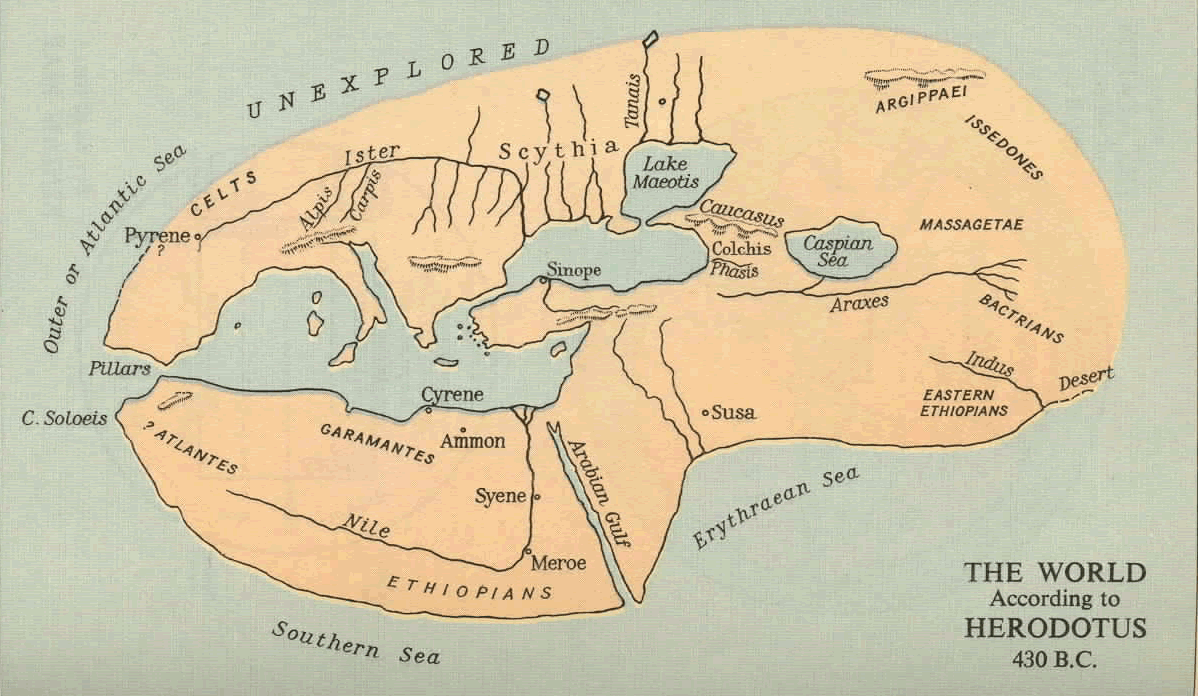
June 9, 2015