On Crazy Etymologies

Published Post author

Given the amount of interest in our prior article, we decided to put our musings on the etymology of Jassa or Jaś in a separate post here so that we can ask whether:

1) the reference is to asas as in “heights”, or to

2) the grumpy giant Thjasse (itself a corruption of Dedu Jasse?) of the Icelandic Sagas or to

3) the Celtic Esus (is Teutates – the Tu-tata? the “here dad” or is it the “volk dad” (or is that the same, e.g., *theudisk – tutejse?) and what of Taranus where taran means a “battering ram” or “to crush” to this day in some Slavic languages), or to

4) Istanu of the Hittites, or to

5) the Demi-God Iasion, consort of Demeter (Lada?), or to

6) the adventurer Jason, or to

7) the Hittite adventure Hupasiyas (Yas!), or whether

8) the Poles/Czechs/Slavs are Iazyges (yazik means “tongue” and Slovo means words so...but what of the Ossetians!?),or were

9) believers in the old Aessir (Odin & Co. are supposed to have come from Asia and to have fought the vans (Veneti)?), or were

10) worshippers of King David’s father Jesse (Yassa in, e.g., Arabic), and whether

11) this has something to do with Osos of Tacitus (“From the Gallic language spoken by the Gothinians, and from that of Pannonia by the Osians, it is manifest that neither of these people are Germans” or “Cotinos Gallica, Osos Pannonica lingua coarguit non ease Germanos”), and whether

12) Saint Jerome was onto something more when he made his Psalm 83 reference right after saying “and, alas for the commonweal, even the Pannonians [have invaded the Roman Empire] for Assur also is joined with them” (first listing Quadi, Vandals, Sarmatians, Alans, Gepids, Herules, Saxons, Burgundians and Allemani as the other invaders), and whether

13) Egypt (Osiris and Isis) (wait a minute didn’t our friend, Cornelius Tacitus himself say that the Suevi worshipped Isis, something that he could not explain?) Assyria (Ishtar) is where all this leads to, or

14) perhaps India with the Asuras, and is

15) Zoroaster involved somehow in any of this! (and what of Ahura Mazda?), or is

16) Genghis Khan behind all of this with his Yassa code of laws (but is that word a Mongol or Turkic one?), and

17) when the inhabitants of Ukraine and Poland were taken captive into yassir, is it somehow relevant that yassir  meant carrying away but also… harvest (but maybe only of people? but what if originally only of certain people such as Slavic people?, e.g., also yasla/yaselka – carrying devices as also in a wooden manger), and

18) what of Mount Ossa (with Zagora at its foot) just by Mount Olympus, and

19) are there any other wacky ideas (Arafat anyone?)? How about Boris Rybakov’s observation of a lizard worship (among the Ilmen Slavs?) in the Rus?  (yashchur, yasher) which he noted was also present in Lithuania and sounded to him a bit like the Polish Yassa?  Perhaps the lizard or dragon was Yassa?  There is an earlier (Sumerian?) Deity – Ištaran – associated with “justice” but also with having a bright visage and, more frequently, with a snake (dragon?) and ” whose logogram was dMUŠ, or dMUŠ.TUR, ‘snake’ and ‘little snake’ respectively.” (Wiggermann F.A.M.). Yash and Yashchur? (Jas, jaszczur?). Here is a picture from Rybakov’s book showing the various yasher carvings:

ribakov

And we know the Dacians were (perhaps) Gets – see below picture re: Anglosaxon version of yet/get) and were carrying dragons on their banners (Sauromatae?); others, including Romans later, too; and what, speaking of Russia, what about that lake there up north?

 Thoughts

Up front we ought to come clean and say that we do not believe most of these have any relevance at all to Jassa or Yassa and we make them here to show the absurdity of drawing connections everywhere you can.  See for example this prior post on the same topic here.

Because this word is a rather simple one in its construction, it is hardly surprising that  it appears in many different places in the world in different contexts.  Had the Slavs’ God’s name were Merovingian and there were a separate reference to a Merovingian in, say, China then we would be duly impressed and willingly to consider the craziest hypotheses.  However, that is not the case with the syllable yas or jas.  (Even were some of these deities somehow related, we ought to point out that it is not necessarily the case that they derive one from another as opposed to from some original deity name).

On the other hand, while Aleksander Brueckner explained the Polish God JesseJesze, Yassa or Yessa  as an appelative of “let it be”, “let it happen” (imploring), this is hardly dispositive and one need only point out that the name of Dadzhbog, “let God give” is also a form of an appelative and is an attested God name in Russia (see PVL).

brueckner

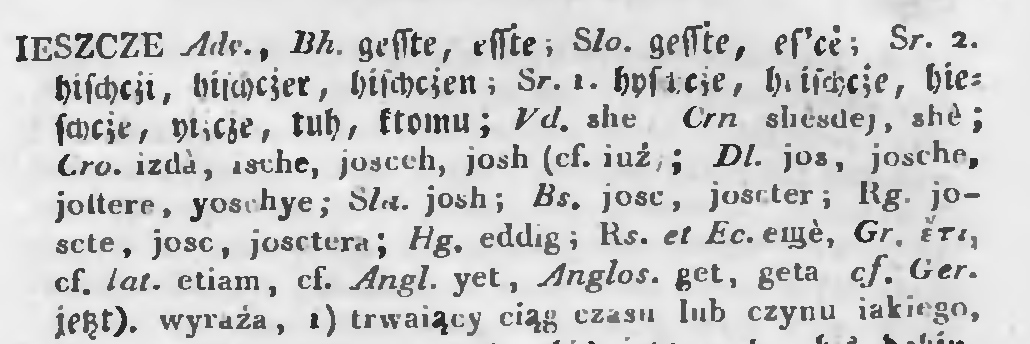
Here is the redoubtable Linde with his 1807 Polish language dictionary on the similar word “jeszcze” meaning, roughly, “yet”:

ourfriendlygeta

A note on the abbreviations: Dl. means Dalmatian, Rg. means Ragussan (i.e., from Dubrovnik), Bs. means Bosnian, Cro. means Croatian, Crn. means Carinthian (i.e., some dialect of Slovenian), Vd. means Windish or Styrian (another Slovenian dialect).  The others are obvious (and some are interesting, such as Angl. which obviously means English and Anglos. meaning Anglosaxon)

Further, “let it be” or, more likely, “there is” is a well known reference to a number of deities (see the general Indoeuropean, “is”, “ist” or “jest” as the source ultimate) – and examples from the Middle East are obvious.

All that said, there is an interesting reference to a similar deity name that likely is related to Jassa if only by virtue of geographical closeness and it comes from the Polish region of Kaszuby.

Copyright ©2015 jassa.org All Rights Reserved

February 22, 2015

On the Discipline of Linguistics

Published Post author

We are reminded to use a safety or trigger word before discussing unpleasant or difficult topics – to protect the fragile minds of our readers.  We do not think a word can have the desired protective “alert” effect.  So from now on we will use a “safety picture” – this one – which will signify an upcoming quasi-cerebral section (quasi because this is a blog not a textbook – readers with 90 plus IQs will not notice anything):

thinkinghurts

WARNING: head explosion danger ahead! Consult your physician, have cold compresses on standby and if proceeding at all, for God’s sakes read slowly!!!

Linguistics is an interesting discipline with much to say about language formation, history, etc.  However, we are moved to point out that linguistics is not, as some would have it, a science.  It is no more than the study of patterns, which patterns may or may not be there in reality.  It should then be obvious that the linguists’ “laws” or “rules” are nothing of the sort.  They are in fact merely observations that may, if they are well laid out, more often than not, inform our assessment of some unknown quantity.  Their usefulness should be appreciated for they come against the backdrop of pre-19th century beliefs in the essential randomness of language development.  But, at the same time, their predictions should never be stated with the hubris of absolute certainty, deserving instead, and depending on the scenario, a good mark to the extent they produce more likely than not results in the observable realm of language.  As regards, the languages of the past, however, we must not forget that the linguists’ predictions can almost never be actually tested (we say almost never because one can imagine scenarios where some new artifact hitherto unknown comes to light and proves or sinks the validity of some prediction).  Even physics admits the existence of essentially random events via the propositions of quantum dynamics and linguistics, if anything, should be humbler than physics and certainly humbler than its professors frequently make it out to be.

That is to state the obvious.  But another observation here is, we think, useful.  Linguists live in their own world and seek to establish their propositions for reasons of their own.  To achieve that they frequently borrow from historians and archeologists without analyzing what the “other-disciplinary crutch” they just borrowed actually rests on.  When historians and archeologists look for their own crutch by, in turn, relying on linguists statements (and they should all fess up because, loathe that they may be to admit it, they – being all academics – actually do borrow from across the intra disciplinary aisle) it may happen that both sides come to realize, too late, that there is, in fact, no crutch there at all.

As we have seen already, historians have asserted that linguistics may help us determine the location of the “homeland” of the Slavs.  These ingenious folks took a look at certain words and, seeing as some of them were described by their colleagues the linguists as Germanic, classified them too as such and proceeded in turn to appropriate areas where such words may have relevance for the Germanic tribes and conversely exclude from those areas the Slavs.  This logic has its evident problems such as, for example, assuming the assumption as to the nature of a given word is correct, one must further assume no existence in the remote past of a similar Slavic word that then was not replaced by a Germanic one for a variety of reasons.  Nonetheless, as no one can be expected to prove a negative we are willing to let such considerations be put aside initially.  There is however another problem here.  The linguists themselves are interested only in linguistics and they look to the historians to help them with their own assumptions.  This raises what is a classic “chicken and the egg” problem.

Sometimes, the linguists can own the entire chicken/egg problem themselves even without resorting to other disciplines.  To give one recent example from the otherwise very interesting “The Germanic loanwords in Proto-Slavic” book by Saskia Pronk-Tiethoff:

“In view of the probable location of the Proto-Slavic and the Proto-Germanic homelands, it is highly unlikely that the contacts between the Slavic and Germanic tribes started before the time the Proto-Slavs began to spread into central Europe and onto the Balkans, and before the time the Goths had moved into the Pontic area.  It can therefore be excluded that any Slavic loanwords were borrowed into Proto-Germanic, for when the first contacts came about, Proto-Germanic as a linguistic unity had ceased to exist.  If it is possible to prove or put a convincing case for Proto-Slavic loanwords in Germanic, these must therefore be words that were either borrowed into Gothic or into West Germanic (or possibly even into Northwest Germanic); if an alleged loan-word is attested in all branches of Germanic, the word is hardly likely to stem from Slavic.”*

In other words, if you want to determine the homeland of the Slavs, you cannot use linguistics to do that.  Why?  Because linguistics cannot answer what was borrowed from what without relying on assumptions about the location of such a “homeland.”

So… take a word a version of which appears in all Germanic languages.  Say, buk for our notorious beech tree.

This word is Germanic in origin.

Why?

Because it cannot have come from Slavic.

Why?

Because it is in all Germanic languages and therefore must have been in Proto-Germanic.

So what?

Well, Slavs did not live close enough to Germans when there was in existence one proto-Germanic language so Slavic > Germanic cannot have occurred.

How do we know that?

Because Slavs do not have their own word for a beech tree.

But don’t they have buk?

No, silly – we’ve already explained that this is a Germanic word (see above).

End of story.

So what does this actually look like? Like this:

[S-T at 4.1.4 discussing “Proto-Slavic” homeland: “Proto-Slavic inherited the word[s] for beech… which was borrowed from Germanic – see 5.2” below and, therefore, according to her, the proto-Slavic homeland must have been to the East of the beech line – so now we know where the proto-Slavic homeland was]

[S-T at 5.2 discussing “beech”: “The word could have been borrowed by the Slavs in connection with the writing on slabs of beechwood… Alternatively, the borrowing might be connected to the spread of the Slavs from their original homeland to the west [as we know this location was established at 4.1.4 above]”; S-T then talks here about the Kaliningrad/Elbe-Odessa line and concludes regarding buk: “origin: Germanic” – stating that the only thing that is yet unknown is which Germanic language the borrowing was made from]

This kind of an issue is more easily determinable (assuming you are willing to scratch your head for a moment) but S-T’s other gymnastics actually require some effort to look behind the curtain.  She says, for example, that Slavic did not have its own marine vocabulary citing Schenker’s work.  If you actually trouble yourself, however, and shell out some cash or visit a library, you will note that Schenker does make this claim but… (perhaps this should be obvious?) cites precisely no one for the proposition (it seems that the claim can be traced back to Meillet and we will deal with that in due time).

* This is merely a flavor of the problem.  One may also ask why the word could not have been Proto-Indo European? (Supposedly, amongst other reasons because we know that there are no beech trees in the East and we know that the PIEs migrated from the East.  But did they? We get into the same quandary here).

One too may ask why a Slavic word could not have spread to all Germanic languages after contact was made (In whatever century – even if only in 5th/6th)?

Now, there are other reasons why buk may be Germanic but they are irrelevant to the above illustration which could have been done with any number of other words.

Copyright © 2015, jassa.org All Rights Reserved

February 19, 2015

On the Mountains of Jassa

Published Post author

Note to our readers:

Yes, we will continue with the Polabian Gods’ description and we have a Pomeranian project coming too BUT in the meantime we have a desire to make a brief detour (more to come later on this too).  A detour that leads us far North – or does it?

Hrubyhruby

Hrubý Jeseník (Tall Jesenik) range – the tower in the background is at the highest point known as Praded (grandfather, old man or old…God) (Interestingly, the range also contains such peaks as Keprnik – so that too is not a German word)

The Saga of Hervor & King Heidrek the Wise is an Icelandic saga.  It comes to us in a variety of manuscripts and versions.

One English translation is Nora Kershaw’s 1921 translation under the title of “The Saga of Hervor and Heithrek” (Hervarar Saga og Heiðreks) (so-called manuscript R).

Another is Christopher Tolkien’s 1960 translation of “The Saga of King Heidrek the Wise” (Saga Heiðreks konúngs end vitra) (so-called manuscript H).

Finally, there is the more recent Peter Tunstall’s 2005 translation titled “The Saga of Hervor & King Heidrek the Wise” which itself is a composite of (1) “The Saga of Hervor and Heithrek” (Hervarar Saga og Heiðreks) and of (2) “The Saga of King Heidrek the Wise” (Saga Heiðreks konúngs end vitra).

There are several interesting things about these texts.

First, to get this out of the way, they contains a bagful of names that have made it to J.R.R. Tolkien’s writings.  Tolkien was into the Old English language and Anglo-Saxon myths in general (e.g., Beowulf translation).  If you ever asked yourself where Balin or Gimli come from or, for that matter Boromir and Faramir, these kinds of sagas are it.  (To a Slav, the -mirs and -ins may sound vaguely Slavic and we will have more to say about that later when we discuss -mir’s, -mer’s, -gast’s and -gost’s).  In any event, his son Christopher enjoyed similar topics and, as noted above, also came up with his own translation of the saga in question here.

(Interestingly, although the Tolkien family is usually described as coming to Britain from Germany, his last name is neither English nor German.  For our best guess, together with the requisite German connection, see the village of Tołkiny (German Tolkynen – both from Old Prussian) deep in former East Prussia and today’s Poland).

Second, the sagas although written down much later (earliest manuscripts from the 13th century) deal with what is, in effect, pre-history.  They speak of the Gothic struggle against the Huns, for example.  It is highly unlikely that their writers were using and “improving” on Ammianus Marcellinus, Jordanes, Procopius and the like.   Consquently, they are a window into a time and place which remained largely untouched and unobserved by the Roman writers who, naturally, were only concerned with the various barbarian tribes once those got too close to the Roman frontiers.

Third, there are several interesting Slavic “connections” or at least “hooks”.  The chronicles talk about Gardarike, a term that may be Russia but also may be Pomerania (which was called that by the Scandinavians by reason of all the grads or gards on its shores – e.g., the various Stargards – this what one might have thought were a purely Slavic term (grad, grod, gorod) itself presents problems – e.g., see As-gard…).  Also, in a number of places, there are references to Harvaða mountains, which have been identified with the Harvati, i.e., the Croats and which – may – be the Carpathians (there were also the residences of the Carpi though (as well as the Avari…)).  Thus, we have:

Norse:

“Hinn mælti: ‘Taktu sverðit undan höfðafjölinni ok fá mér,” en sá tók ok brá ok sneið höfuð af fiskinum, ok þá kvað hann vísu: “Þess galt hún gedda fyr Grafár ósi, er Heiðrekr var veginn und Harvaða fjöllum.”

English (Kershaw):

“And he took it and unsheathed it, and cut off the fish’s head, and then spoke a verse:

This pike at the mouth of the river
Has paid the penalty
For the slaughter inflicted on Heithrek,
‘Neath the Mountains of Harvath”

English (Tunstall):

“And he took it and drew it and cut the head off the fish, and then he chanted a verse:

The price was paid
by the pike at Grave River,
when Heidrek was slain
under Harveth Fells.

Other Interesting Things

But there is another interesting aspect of all of this and it is in the following language:

Old Norse:

“Angantýr kvað:

“Kenndu at Dylgju ok á Dúnheiði, ok á þeim öllum Jassarfjöllum; þar opt Gotar gunni háðu ok fagran sigr frægir vágu.”

Nú reið Gizurr í brott ok þar til, er hann kom í her Húna. Hann reið eigi nær en svá, at hann mátti tala við þá. Þá kallar hann hári röddu ok kvað:

“Felmtr er yðru fylki, feigr er yðarr vísir, gnæfar yðr gunnfáni, gramr er yðr Óðinn.” Ok enn:  “Býð ek yðr at Dylgju ok á Dúnheiði orrostu undir Jassarfjöllum; hræ sé yðr at hái hverjum, ok láti svá Óðinn flein fljúga, sem ek fyrir mæli.””

English (Kershaw): 

“King Angantyr replied:

“Challenge them to battle at Dylgia and on Dunheith, and upon all the heights of Jösur, where the Goths have often won renown by glorious victories!”

Then Gizur rode away until he came to the host of the Huns. He rode just within earshot, and then called loudly, crying:

Your host is panic stricken, And your prince is doomed to fall; Though your banners are waving high in the air, Yet Othin is wroth with you all. Come forth to the Jösur Mountains, On Dylgia and Dunheith come fight; For I make a sure boast, In the heart of your host The javelin of Othin will light!

English (Tunstall):

“Angantyr said:

“Point them to Dylgja and to Dun Heath direct them and mark out all the Mounts of Jass;
there Goths often have given battle and fine victory they, famous, gained.”

Now Gizur rode off till he came to the army of the Huns. He rode no nearer than he needed to talk to them. Then he calls out in a loud voice and said:

“There’s fear on your forces, fey are your generals; the battle-banner above you looms; wrath with you is Odin.” And also: “I offer you at Dylgja and on Dun Heath I offer a fight under the Jassar Fells. A corpse be to you on every horse. May Odin let the javelin fly just as I decree.”

 Commentary on Jassarfjöll [um]:

Tolkien:

“These mountains have not been identified.  It has been suggested that their name is identical with that of the Gesenke, the mountains in norther Moravia, and that both the Norse and German forms of this name are corruptions of Slavonic Jesenik meaning “ash-mountain.”

What are “ash” mountains?  Well, they are not volcanoes (unless we are way off geographically (or chronologically! 🙂 ). They are not even “ashen” mountains.  They are simply mountains covered with ash trees (old English “æsc“).  And therein lies the problem for anyone making a reference to these mountains as such – ash in Germanic does not have a “j”.

Botany intrudes once again

Botany intrudes once again

Why are we even talking about ash trees?  Probably because those who interpreted these words were looking to Ptolemy’s mention of Asciburgius Mountains in his section on Germania (he also mentions a town of Asciburgium (also in Germany).  Ptolemy places these mountains right next to the Sudeten (Sudety).  This makes sense except that the Sudeten of Ptolemy may not be the current Sudeten.  Or are they?

Thus, where (it seems) ash or the like is indicated in the same saga, the author has no problem using the Germanic spelling:

Ok er þeir bræðr koma í Sámsey, sjá þeir, hvar tvau skip liggja í höfn þeiri, er Munarvágr hét. Þau skip hétu askar. Þeir þóttust vita, at Hjálmarr mundi þessi skip eiga ok Oddr inn víðförli, er kallaðr var Örvar-Oddr. Þá brugðu Arngríms synir sverðum ok bitu í skjaldarrendr, ok kom á þá berserksgangr. Þeir gengu þá sex út á hvárn askinn. En þar váru svá góðir drengir innan borðs, at allir tóku sín vápn, ok engi flýði ór sínu rúmi, ok engi mælti æðruorð.

(And when the brothers come to Samsey, they see two ships lying in the cove which is called Munway. Those ships were the kind called ‘ashes’. They thought these ships must belong to Hjalmar and Odd. Then Arngrim’s sons drew their swords and bit on their shield-rims, and the berserk-state came on them. Then six of them went out onto each of the ashes. And there were such good warriors on board there that they all took up their weapons, and no one fled from his post, and no one uttered a word of fear.)

[What are “ash” ships (ashen?) as in the above paragraph, is a separate question – thankfully, it seems so far, not for us].

However, the Slavic word for “ash” is jesion which obviously does have the advantage of having an a “J” in it.  The mountains then would be mountains such as the Hrubý Jeseník (German Hohes Gesenke or Altvatergebirge – see above picture discussing the peak Praded) range or the Nízký Jeseník (German Niederes Gesenke).  These are in the Eastern Sudeten Mountains (in Moravia).

samuel

The 1812 (Polish) Linde definition (thank you for the contribution!)

(That the Slavs sometimes kept or added their “J”s is evident from, e.g., jeden vs. eins.  But see Icelandic giant Thjasse (did someone say “giant”? Like a Riese?  Like Riesengebirge?). They also kept the “D”s.  About jeden (Czech, Pol) odin (Ukr, Rus) and Chris Hemsworth’s father Odin, we will, of course, have a lot more to say later… as too about other numerals, e.g., which Slavic numeral is related to et cetera? 🙂 Too easy, no points for this one!)

That there may have been a battle between Goths and Huns we also learn from Widsith’s “Bard’s Tale” poem:

Wulfhere sohte ic ond Wyrmhere; ful oft þær wig ne alæg, þonne Hræda here ymb Wistlawudu heardum sweordum wergan sceoldon ealdne eþelstol ætlam leodum.

(I visited Wulfhere and Wyrmhere; there battle often raged in the Vistula woods, when the Gothic army with their sharp swords had to defend their ancestral seat against Attila’s host.)

That the Jeseniks are close to the sources of the Vistula is, of course, quite correct:

jesenik

Jesenik on the left, Vistula sources on the right

The trouble is that, according to official chronology, there should have been no Slavs in Moravia at the time the Goth-Hun battle took place (or if there were any at all, they would have, perhaps, come with the Hun army which means that no one would have cared what they named the mountains in their tongue).

And so here we are.

Zeitschrift für Erdkunde, etc (from 1847):

This suggests the “hilly” terrain next to the village Jeser in Pomerania… With all due respect “hilly” terrain seems a bit underwhelming for the site of such a mountain battle (we can believe the Huns, in their short reign, made it to Moravia but Pomerania seems a bit of a stretch).

Afterthought

Note also that some Slavic “nationalist” historians disputed the location of these Jassar mountains in the Sudeten.  The reason seems to be that that would have meant admitting that Goths had been in Poland/Moravia or close enough.  Consequently, they looked for name Jassar further east, as in the Bieszczady or even further around Ossetia where the Gothic kingdom would have ended and where various Sarmatian tribes included the Iazyges and other similar sounding tribes (that some of these tribes may have, in fact, reached Poland did not seem to have bothered them).  For the same reason, the same historians placed Gardarike as far East as possible, leaving all of Poland, Belarus and Ukraine free of their domination (e.g., insisting that Palteskia means Polotsk and not, for example, Pultusk).

palteskia

The famous Hauksbok with Palteskia, Pulina land and Polena (to the east of which is Reidgota land and, thereafter, Hunland)

(BTW, the Hauksbok does not contain the references to Jassarfjöllum since it ends in the middle of Gestumblindi’s riddles leaving what happened later to other manuscripts)

What they did not seem to see, however, was the potential connection of the Sudeten Mountains with a, possible, pre-Germanic stratum (of whatever type but tied to Poles), assuming one were willing to read Jassarfjöllum as a case of (so to speak) singular possessive, as in Jassa’s Mountains (e.g., Stary Ded or Altvater).

(And aren’t these Jesenik mountains close to the R-Iesen Gebirge (Krkonoše or should it be Craco- or Krakonose!?), so maybe these latter ones are the Jassarfjöllum! Ok, so we are getting out of control here – time to stop)

answers

Lucas of Great Kozmin’s eerily ancient answer???

For more see here regarding Polish Gods and here regarding crazy etymologies.

Copyright ©2015 jassa.org, All Rights Reserved

February 14, 2015

On Svantovit (or Fortune) in the Writing of William of Malmesbury

Published Post author

We have presented the writings of Saxo Grammaticus on Arkona/Svantevit (and will continue to do so). In the meantime, however, we would like to respond to some readers inquiring as to whether other sources regarding the Ruegen God exist.

malmeski

Gorgeous calligraphy but not the relevant pages (we do not have the relevant ones in manuscript format)

Indeed they do. Here is one written by William of Malmesbury (c 1095 – c 1143). William has been seen as one of Britain’s greatest medieval scholars after Bede (the Venerable – on whose work William patterned his own and to whom we will return in the future when discussing Easter). In his monumental work, Chronicle of the Kings of England, William stated the following when discussing the Germans and their Emperor Henry (Chapter XII Of King Harold and Hardecanute discussing the years):

“This emperor [Henry III] possessed many and great virtues; and nearly surpassed in military skill all his predecessors: so much so, that he subdued the Vindelici and the Leutici, and the other nations bordering on the Suevi, who alone, even to the present day, lust after pagan superstitions: for the Saracens and Turks worship God the Creator, looking upon Mahomet not as God, but as his prophet. But the Vindelici worship fortune, and putting her idol in the most prominent location, they place a horn in her right hand, filled with Greek term we call “hydromel”. Saint Jerome proves, in his eighteenth book on Isaiah, that the Egyptians and almost all the eastern nations do the same. Wherefore on the last day of November, sitting around in a circle, they all taste it; and if they find the horn full, they applaud with loud clamors: because in the ensuing year, plenty with her brimming horn will fulfill their wishes in everything: but if it be otherwise, they lament. Henry made these nations in such a wise tributary to him, that upon very solemnity on which he wore his crown, four of their kings were obliged to carry a cauldron in which flesh was boiled, upon their shoulders, to the kitchen, by means of levers passed through rings.”

(Erat imperator multis et magnis virtutibus praeditus, et omnium pene ante se bellicosissimus, quippe qui etiam Vindelicos et Leuticios subegerit, ceterosque populos Suevis conterminos, qui usque ad hanc diem soli omnium mortalium paganas superstitiones anhelant; nam Saraceni et Turchi Deum Creatorem colunt, Mahumet non Deum sed ejus prophetam aestimantes. Vindelici vero Fortunam adorant; cujus idolum loco nominatissimo ponentes, cornu dextrae illius componunt plenum potu illo quem [variant: quod] Graeco vocabulo, ex aqua et melle, Hydromellum vocamus. Idem sanctus Hieronymus Aegiptos et omnes pene Orientales fecisse, in decimo octavo super Isaiam libro confirmat. Unde ultimo die Novembris mensis, in circuitu sedentes, in commune praegustant; et si cornu plenum invenerint, magno strepitu applaudunt [variant: plaudentes], quod eis futuro anno pleno copia cornu resdponsura sit in omnibus; si contra, gemunt. Hos ergo ita Henricus tributarios effecerat, ut, omnibus sollempnitatibus quibus coronabatur, reges eorum quatuor, lebetem quo carnes condiebantur, in humeris suis, per anulos quatuor vectibus ad coquinam vectitarent)

Incidentally, the reason this story even appears in the English writing is because King Harthacnut (son of Cnut/Canute the Great) gave away his sister Gunhilda to marry Henry III, the Holy Roman Emperor.  The siblings were obviously also great-grandchildren of Mieszko I (since Cnut’s mother was Mieszko’s daughter Świętosława).  Thus, interestingly, all these people were Polish.

Copyright ©2015 jassa.org All Rights Reserved

February 12, 2015

Einhard on the Slavs

Published Post author

Einhard, the biographer of Charlemagne, is one of the principal sources of knowledge about the life and times of Karl der Grosse (Vita Karoli Magni).  He knew Charlemagne and his court intimately (he may have also gotten to know intimately Charlemagne’s daughter).

So the question arises what information was conveyed by him about the Slavs?  Well, not much.

Some of it is in Chapter 12, some in Chapter 14 and a few mentions in Chapter 15.  The  first story told is that of Charlamagne’s campaign against the Welatabi “on behalf of” the Obotrites.  (Perhaps this was the time of King Majik mentioned as the ruler of all Slavs in the Muslim writings that we saw earlier?).  Then there is mention in passing that the Danes had earlier subjugated the Obotrites.  Then we learn that the Saale (Solawa/Solava…) separates the Sorbs from the Thuringians.  Finally, there is some interesting anthropological information on the Slavs and their main tribes.

Chapter 12 of Vita Karoli Magni

English:

“After the insurrection [of duke Tasillo of the Bavarians who confronted Charlemagne at the River Lech in 787], [the king] declared war against the Slavs, whom we normally refer to as the Wilzi, but who are properly called Welatabi in their own language.  In that war the Saxons fought as auxiliaries alongside the other peoples who were ordered to march in the king’s army, but the obedience [of the Saxons] was insincere and lacking in complete commitment.  That war came about because they [the Slavs] were constatntly harassing and attacking the Abotrites, who had once allied themselves with the Franks.  They [the Slavs] were not inclined to listen to the commands [of Charlemagne].”

“A certain gulf [i.e., the Baltic] with an unknown length and a width no more than a hundred miles wide and in many places [much] narrower runs from the western ocean towards the east. Many peoples live around this sea.  In fact, the Danes and the Swedes, whom we call Northmen, live along the northern shore [of the sea].  The Slavs, Estonians and other peoples live along the southern shore.  The Welatabi were the most prominent of these peoples and it was against them that the  king now took up war.  He beat them and brought them under his control in the one and only campaign he personally waged [against them], that from that point on they never thought of refusing to obey his commands.”

vitakaroli

St. Gallen, Stiftsbibliothek, Cod. Sang. 547 Parchment from Cloister of St. Gall · about 1200 – This is on page 656

Latin:

His motibus ita conpositis, Sclavis, qui nostra consuetudine Wilzi, proprie vero, id est sua locutione, Welatabi dicuntur, bellum inlatum est. In quo et Saxones velut auxiliares inter ceteras nationes, quae regis signa iussae sequebantur, quamquam ficta et minus devota oboedientia, militabant. Causa belli erat, quod Abodritos, qui cum Francis olim foederati erant, adsidua incursione lacessebant nec iussionibus coerceri poterant.

Sinus quidam ab occidentali oceano orientem versus porrigitur, longitudinis quidem inconpertae, latitudinis vero quae nusquam centum milia passuum excedat, cum in multis locis contractior inveniatur. Hunc multae circumsedent nationes; Dani siquidem ac Sueones, ques Nordmannos vocamus, et septentrionale litus et omnes in eo insulas tenent. At litus australe Sclavi et Aisti et aliae diversae incolunt nationes; inter quos vel praecipui sunt, quibus tunc a rege bellum inferebatur, Welatabi. Quos ille una tantum et quam per se gesserat expeditione ita contudit ac domuit, ut ulterius imperata facere minime rennuendum iudicarent.

Chapter 14 of Vita Karoli Magni

English:

“Charlemagne’s final war was the one taken up against the Northmen who are called Danes.  First they had operated as pirates, but then they raided the coasts of Gaul and Germany with larger fleets.  Their king, Godefrid, was s filled with vain ambition, that he vowed to take control of all Germany.  Indeed, he already thought of Frisia and Saxony as his one provinces and had first brought the Abotrites, who were his neighbors, under his power and made them pay tribute to him.  He even bragged that he would soon come to Aachen, where the King [Charlamagne] held court, with a vast army.  Some stock was put in his boast, although it was idle, for it was believed that he was about to start something like this, but was suddenly stopped by death.  For he was murdered by one of his own attendants and, thus, both his life and the war he had begun came to a sudden end.”

Abotrites

page 657

Latin:

Post quod et Saxonicum suae prolixitati convenientem finem accepit. Boemanicum quoque et Linonicum, quae postea exorta sunt, diu durare non potuerunt. Quorum utrumque ductu Karoli iunioris celeri fine conpletum est. Ultimum contra Nordmannos, qui Dani vocantur, primo pyraticam exercentes, deinde maiori classe litora Galliae atque Germaniae vastantes, bellum susceptum est. Quorum rex Godofridus adeo vana spe inflatus erat, ut sibi totius Germaniae promitteret potestatem. Frisiam quoque atque Saxoniam haud aliter atque suas provincias aestimabat. Iam Abodritos, vicinos suos, in suam ditionem redegerat, iam eos sibi vectigales fecerat. Iactabat etiam se brevi Aquasgrani, ubi regis comitatus erat, cum maximis copiis adventurum. Nec dictis eius, quamvis vanissimis, omnino fides abnuebatur, quin potius putaretur tale aliquid inchoaturus, nisi festinata fuisset morte praeventus. Nam a proprio satellite interfectus et suae vitae et belli a se inchoati finem acceleravit.

Chapter 15 of Vita Karoli Magni

English:

“Previously the so-called eastern Franks had occupied no more than part of Gaul bounded by the Rhine, the Loire, the [Atlantic] ocean, and the Balearic sea and that part of Germany bounded by Saxony, the Danube, Rhine and Saal (the river that divides the Thuringians and the Sorbs).”

vitakarolis

page 657 giveth

Latin:

Nam cum prius non amplius quam ea pars Galliae, quae inter Rhenum et Ligerem oceanumque ac mare Balearicum iacet, et pars Germaniae, quae inter Saxoniam et Danubium Rhenumque ac Salam fluvium, qui Thuringos et Sorabos dividit, posita a Francis qui Orientales dicuntur incolitur…

English:

“… Then he subordinated and made tributary all the rough and uncivilized peoples inhabiting Germany between the Rhine and Vistula rivers, the ocean and the Danube.  They almost all speak a similar language, but are very different from each other in customs and appearance.  Among these peoples the Welatabi, Sorbs, Obotrites and Bohemians are of special importance, and he came into armed conflict with all of them.  Other peoples [living there], who far outnumbered them, simply surrendered.”

vitakarolissimus

page 657 keeps on giving

Latin:

…deinde omnes barbaras ac feras nationes, quae inter Rhenum ac Visulam fluvios oceanumque ac Danubium positae, lingua quidem poene similes, moribus vero atque habitu valde dissimiles, Germaniam incolunt, ita perdomuit, ut eas tributarias efficeret; inter quas fere praecipuae sunt Welatabi, Sorabi, Abodriti, Boemani – cum his namque bello conflixit -; ceteras, quarum multo maior est numerus, in deditionem suscepit.

Copyright ©2015 jassa.org All Rights Reserved

February 12, 2015

On the Rarogi

Published Post author

We all “know” that the Slavs are latecomers.  Or, at least, all the academics “know” that.  With that preconception in mind we begin here a new series that looks at this claim in more detail by examining instances of strange names or places that seem to gainsay the above made claim.  Nothing conclusive, of course, just some investigation with a looking glass.

initiallannerraroguso

Frequently, the claim is made that the Venethi/Veneti/Venedi name as applied to the Slavs is simply a carryover of the old name, most likely by the Germans, onto their new neighbors, the incoming Slavs.  Most people will admit that some Venethi may have been Slavicize din the process as, for that matter, may have been some remaining Restgermanen.  What is interesting, however, is that other instances appear where the same claim would have to be made.  That is, certain Slavic tribes, seem to have the same names as the Germans or Celts who allegedly preceded them.  In some cases, this may be explained by the fact that the geography of a given place necessarily preserved the name for the newcomers.  Think of the Rugians, for example.  Assuming the name Rugen remains in use then the people who live there are Rugians, whether they are the “original” Germanic Rugii or the new Slavic Rugii (aka Ranii).  But there are other instances of the same phenomenon which are not so easily explained.  So let us focus on one of them here.

Of the Rauraci

Ceasar, in his De Bello Gallico, mentions in Book I Chapter 5 and Chapter 29, the following Celtic peoples: Helvetii, Tulingi, Latobrigi, Rauraci and Boii (the last of whom are, we are to believe, the Celtic people, whose name gave name to the country of Bohemia).  Specifically, he says, when discussing this Celtic rebellion:

“After his death [that of Orgetorix of the Helvetii], the Helvetii nevertheless attempt to do that which they had resolved on, namely, to go forth from their territories.  When they thought that they were at length prepared for this undertaking, they set fire to all their towns, in number about twelve – to their villages about four hundred – and to the private dwellings that remained; they burn up all the grain, except what they intend to carry with them; that after destroying the hope of a return home, they might be the more ready for undergoing all dangers.  They order every one to carry forth from home for himself provisions for three months, ready ground.  They persuade the Rauraci, and the Tulingi, and the Latobrigi, their neighbors, to adopt the same plan, and after burring down their towns and villages, to set out with them: and they admit to their party aunited to themselves as confederates the Boii, who had dwelt on the other side of the Rhine, and had crossed over into the Norican territory, and assaulted Noricia.”

This was Chapter 5 so now for Chapter 29, where Ceasar mentions certain lists that the Romans found in the Helvetii camp that showed the strength of the individual tribes of this venture:

“Of all which items the total was [the following number of heads]: Of the Helvetii 263,000, of the Tulingi… 36,000, of the Latobrigi… 14,000, of the Rauraci… 23,000, of the Boii… 32,000…”

Appropriately enough the Rauraci are also listed on the Tabula Peutingeriana:

peutingerianarauraciThere they are sitting comfortably around Lake Geneva at Lausanne – close to Lake Constance with its Bregentz and Vindelici.  A similarly named Reruiges are further North:

revriges

(There are other interesting names on this map, e.g., Rutenii, Radriani or, for that matter, Veliati)

Of the Reregi

Adam of Bremen has this to say in his Book II Chapter 18 description of Slavia which is “a very large province of Germany [which is] inhabited by the Winuli who at one time were called Vandals”:

“Then come the Abodrites, who now are called Reregi, and their city is Mecklenburg.”

(Deinde secuntur Obodriti, qui nunc Reregi vocantur, et civitas eorum Magnopolis. )

bremensis(Except, it does not quite say that, rather it says: “Deinde secuntur Obodriti, qui altero noie Reregi vocantur, et civitas eorum Magnopolis.” That is “Obotrites who are also called Reregi”.  Same concept)

Further in Book III, Chapter 19:

“Now all the Slavic peoples who belonged to the diocese of Hamburg practices the Christian religion devoutly under that prince; that is, the Wagiri and Abodrites and Reregi and Polabingi [Polabians]; likewise the Linguones, Warnavi, Kicini, and Circipani, as far as the Pane River which in the privileges of our Church is called the Peene.”

(Igitur omnes populi Sclavorum, qui ad Hammaburgensem respiciunt dyocesim, sub illo principe christianam fidem coluerunt devote, hoc est Waigri et Obodriti vel Reregi vel Polabingi, item Linoges, Warnabi, Chizzini et Circipani, usque ad Panem fluvium, quem nostrae privilegia ecclesiae vocant Penem.)

bremensisrauroci

These reference are made only in Adam’s work and some have speculated that they are based on a confusion with a trading place Rerk/Reric that was earlier mentioned by Einhard (whom Adam expressly relied on) or some other author of the Reichsannalen (under the years 808/809 as Emplorium Reric) but the suggestion that somehow Adam was fooled into thinking that Rerk  must have meant that there was or ought to have been a tribe of the same or similar name seems hollow.

Of Rarog

There are two things that are interesting about this name.  First, the Raurici/Reregi name is not one which one might say is easily, coming off the tongue so to speak, replicated, or, to put it a bit differently, it is not a name that one might think could be independently invented in different times and places.  But, you might say, we already have two similar names on the Tabula and, in any event, as we mentioned before, perhaps the same name was applied to a different people (i.e., the later Slavic one).

There is, however, a second interesting thing about this or a similar name.  Rarog or Raróg has a Slavic etymology.  It means a type of a falcon (or, etymologically, of a raven).  What’s more it is falcon that seems to have a religious connotation to Slavs.  Further, rarog, like Svarog or tvarog are words that are undoubtedly Slavic and are ancient (see Aleksander Brückner’s comment that it is a Slavic “ur-word”).

twolannerrarogus

Coincidence?

Copyright ©2015 jassa.org All Rights Reserved

February 11, 2015

Polabian Gods Part Va – Saxo Grammaticus on the Temple at Arkona

Published Post author

There are four surviving fragments of Gesta Danorum (i.e., that’s it as regards manuscripts – that we know of).  One of them is the Plesner fragment which covers a few pages out of Book 14 of the chronicle.  Although this fragment contains no mention of Slavic Gods it does discuss Slavs themselves.

frag3

We include it here along with the corresponding pages from the 1839 edition of the work (for easier reading).  Other than that, since the Latin version can easily be obtained here, we present the text in the English language.

Introduction

The events described here are occurring in 1168, after the conversion of Pomerania, after the so-called Wendish Crusade and after the fall of the Obotrite Duke Niklot.  Pressed on all sides, Arkona stood alone.  Almost exactly 100 years earlier (1067), Rethra was destroyed.  A hundred or so years later it was going to be the turn of the Baltic Prussians.

plesner1

Specifically, Saxo’s Book 14, discusses in detail the Danes’ various murderous expeditions led by King Valdemar or by Bishop Absalon against Ruegen (as well as against the Norwegians and Pomeranians) finally coming to coup de grace at Arkona where the Ranii (also pressed by the German Saxons from the South) simply ran out of people to defend their town against the Danes (and, in this case, too the recently Christian (see story of Bishop Otto which is to come) Slavic Pomeranians who, after their conversion, were required to accompany the Danes (and apparently did a splendid job).  We do not delve into the expeditions themselves in detail – instead we focus on the religious aspects of the text and events at and immediately after the siege of Arkona.

plesner2

Because of the length of Saxo’s description, we break it up into several chapters (of our own making).  Here is Chapter 1, let’s call it “The Temple at Arkona “.

frag1

frag2

The Temple at Arkona

“The King [Valdemar I the Great of Denmark] now attacked Ruegen in different places and won booty everywhere but did not find an occasion to fight and desiring the enemy’s blood he began to besiege Arkona.”

Kap Arkona | RŸgen

Arkona – had the Ranii warning sign been in Danish, perhaps things would have turned out differently

“This town lies on top of a tall cliff and is well fortified from the East, South and North, not by men but by nature, for the steep sides of the cliff rise, as if walls, so high that no arrow could reach the top.  From these three sides it is also protected by the sea, but from the Western side it is surrounded by a wall that is fifty elbows tall, of which the lower part is made out of earth but the top part was of wooden construction reinforced/filled in with [torfus].  On the North side there is a stream, which the locals would reach by means of a reinforced path, which Erik [II] Emune in his time blocked, so that he defeated them during the siege not just by a force of arms but also by denying them water.”

vikingnefariousness

Danish Vikings used all kinds of nefarious distractions while they attacked the Arkonians

“In the middle of the town there was an open space, on which there stood a wooden temple built in an unusually intricate manner, which temple was greatly venerated, not only on account of its grandeur but also by reason of the fact that it contained a statue of a God.  From the outside the temple drew one’s gaze due to a variety of well-sculpted [pictures/effigies/statues?] which, however, were primitively and carelessly painted over.  There was only one entrance but the temple itself was divided into two separate parts, of which the external one run along the walls and had a red ceiling, whereas the internal one was supported by four pillars and in lieu of walls it had curtains and was not touching/did not have common parts with the external part save the ceiling itself and certain logs.”

templeoutsi

Temple Outside

“In the temple there stood the aforementioned statue of superhuman proportions.  It had four heads and that many necks, of which two were turned towards the front and two towards the back.  And likewise of the two heads turned front and also the two heads looking back, one looked left and the other right. [The statue’s] face was clean-shaven as regards the beard and its hair was cut indicating that the artist who sculpted the statue had in mind the custom [of shaving/hair styling] common among the Rugii.”

svantowitus

Temple Inside

“In its right hand the statue held a horn crafted of different metals, which horn was filled once a year by the priest and from the behavior of the drink he foretold the quality of the next year’s harvest.  The left arm of the statue was bent and pressed against the side.  The tunic reached its legs which were made of different types of wood and so intricately/discretely attached to the knees that only a careful inspection revealed the connections.  The feet were standing entirely on the floor but that on which it [the state] stood was hidden in the ground.  Nearby one could see a bridle and a saddle as well as other insignia, of which especially astounding was an unusual huge sword, whose scabbard and hilt were made out of silver and splendidly ornamented by wonderful craftsmanship.”

realistic

“The worship of the God took place in the following manner: once a year, when the harvest was coming to an end, the entire people of the island assembled in front of the temple, offerings were made of cattle and a solemn meal was eaten to honor the Gods.  The priest, who, not following the usual custom of most people of this country, had a long hair and a beard and, usually on the day before the holiday went to the temple, whose doorstep only he had the right to cross, to clean and carefully prepare everything, whereby he had to hold his breath, so that every time he needed to draw air he had to rush to the door, so that the God would not be contaminated by some man breathing in his presence/near him.”

Waiting at temple gates during a "big cake year"

Waiting at temple gates during a “big cake year”

“The following day, when the people camped out by the temple doors, the priest took the horn from the statue’s hand and carefully examined it to see whether the drink in it was evaporating, which was taken to be a warning that the harvest would be poor the next year, in which case he [the priest] obligated the people to save something of their current harvest for next year.  If the drink did not disappear, that foretold a bountiful year.  Thus, depending on what the horn predicted, he ordered the people either to save their harvests or to use them till they be sated.  Next he poured the wine as an offering at the feet of the statue, filled the horn anew and pretended as if he had drunk to honor him [the God], while at the same time he asked with lofty words for success/good luck for himself and the people of the country, for riches and for victory, and after that he brought the horn to his lips and drank all of it in one gulp, and thereafter he filled the horn again and placed it in the statue’s right hand.”

svantevitstein

Altenkirchen (between Arkona and Glowe, i.e., head) Church has this stone “built-in” with cornucopia, the horn of plenty on hand

“There was also there as an offering an oval-shaped honey cake which stood almost as tall as a man.  The priest would place it between himself and the people and asked thereafter whether they could see him [from behind the cake].  When they answered him, he then wished them that next year they should not see him, whereby the meaning of this was such that he did not mean death to himself or the people but rather that the next year should be bountiful [i.e., and the cake bigger].”

They could not see him that year

They could not see him that year

“Next he blessed his people in the name of their God, told them that they should honor Him with frequent offerings, which he expected as a the right payment for [their] victories on the land and sea.  And when this was done, they spent the rest of the day on a great feast, where they ate the offerings [for the God], so that that which was consecrated for the God they themselves ate.  At this feast, it was believed pleasing to the God to get drunk and as a sin to remain sober.”

“To support the religion’s needs every man and woman had to pay annually one coin, and God also received one third of the booty that they plundered for they believed that they should thank Him for His help.  He was also given three hundred horses and that many warriors who fought for Him and who had to give to the priest all of their booty whether it was captured  with weapons or stolen; for this money that came there for that reason, he commanded the making of all kinds of precious ornaments and adornments for the temple, which he kept in locked chests, in which in addition to lots of money there were kept too rich clothes, which were entirely destroyed by passage of time, as also the many offerings, some from the people and some from individual persons, which were given to them/to the temple to obtain happiness and success.”

templetreasure

not wasting gold on crucifixes here

All of the Slavic lands venerated this God by paying [tribute to Him], and even the neighboring kings gave offerings to Him, not paying attention to the committed sacrilege [of so doing].  Among others, the King of Denmark Svend Grathe [Sweyn III – killed by Valdemar after Sweyn attempted to kill Valdemar and others] donated a wonderfully crafted cup so as to gain the favor of the God, for which sacrilege he then paid by his unlucky demise.  This God had too other temples in the different places, but none was so venerated as the one at Arkona.”

“He also had his own holy white horse and it was seen as sacrilege to rip a hair from his mane or tail, and no one other than the priest was permitted to feed him or ride him, so that this divine animal should not lose its dignified appearance, by reason of it being frequently used.  The Rugii believed that on this horse, Svantovit – that is the how they named the God – would ride when he fought against the enemies of his Holiness, and they saw special proof of this in that, in spite of the fact that during the night he remained in the stables, in the morning he was often wet and sweaty, as if he had come straight from battle and rode a long way [back].”

tristarhorse

Svantovit horse approaching after a night out

“They also read warnings from the horse’s behaviour in the following way: when war was intended with one country or another, it was the custom of the temple attendants to stick six spears into the ground in pairs of two where the shafts of each such pair would cross and where the spear pairs would be equidistant.  When the troop was to march out, the priest gave a solemn prayer and thereafter he led the horse in a harness from the [temple] foyer and led so that he had to jump in front of [or through] the spears.  Should the horse lift the right leg ahead of the left, they took that to mean that the war will be successful.  But should he have raised only one time [i.e., once out of the three] the left leg as the first, they gave up on their expedition and would not even raise anchors until such time that they saw him [the horse] jumping three times through the spears in such a manner that they took to be a good omen [i.e., right leg ahead of the left].”

settingout

When the auguries were good, it was time to set sail

“Also when they were to set out in other matters, they took the augury from the first encountered animal.  If the augury was favorable, they rode further happy, if it were not they then quickly went back home.  It was also not unknown to them to throw lots, they threw, namely, on their lap three pieces of wood as lots, they were white on one side and black on the other and white meant luck and black meant misfortune.  Even the women did not avoid such practices.  When they sat at a fire sometimes they drew random lines in the ash and counted them together.  If the number was even they believed that that portended good fortune, when it was odd, though, they took that as a bad sign.”

shipwrecks

Arkona is also the site of over 300 (confirmed) shipwrecks

Copyright ©2015 jassa.org All Rights Reserved

February 7, 2015

Reports of the Slavs from Muslim Lands Part V – Testimony of Masudi on Slavic Gods and Temples

Published Post author

The below is is taken from the same Masudi report (in “The Meadows of Gold”) as discussed previously here.  Now, however, we focus on religion in more depth.  (BTW the locations of the various temples, as shown in the pictures, are purely speculative – we lay no claim on knowing whether these correspond to any of the temples mentioned by Masudi).

There are two translation sources here.  Most of the passages come from the Paul Lunde edition (including a portion that mentions a town administrator – Ahmad ibn Kuyah – one has to ask the question whether Ahmad’s father (or some other relative) wasn’t in fact Kuy as in the legendary founder Kiyev).  That section is supplemented by a separate translation of another paragraph.

The other section on the temples comes from Chapter 66 of the Prairies d’or (French translation with an Arabic edition) aka Muruj al-dhahab by Barbier de Meynard and Pavet de Courteille published in 1861-1877.

***

Lunde translation – chapter 11 (The Khazars)

“The king, his court and all those of the Khazar race practice Judaism, to which the king of the Khazars was converted during the reign of Harun al-Rashid.  Many Jews from Muslim and Byzantine cities came to settle among the Khazars, particularly since Romanus I, the king of the Byzantines in our own time, 332/943, forced the Jews in his kingdom to convert to Christianity.  Further on in this volume we shall give the history of the rulers of Byzantium, which we shall set out in order, and shall speak of this king as well as the two other rulers who shared power with him.  A great number of Jews therefore fled from the land of the Byzantines and sought refuge with the Khazars.  This is not the place to speak of the conversion of the Khazar ruler to Judaism, as we have already discussed this subject in our previous works.” 

“The pagans who live in this country belong to many different races, among which are the Slavs and the Rus, who live in one of the two parts of the city.  They burn their dead on pyres along with the deceased’s horses, arms and equipment.  When a mans dies, his wife is burned alive with him, but if the wife dies before he husband, the man does not suffer the same fate.  If a man dies before marriage, he is given a posthumous wife.  The omen passionately want to be burned because they believe they will enter paradise.  This is a custom, as we have already mentioned, that is current in India but with this difference: there, the woman is not burned unless she give her consent.”  

“As regards the pagans in this land (Khazar Khaganate), there are different peoples/races that are pagan – amongst them the Slavs (Saqaliba) and the Rus (Rus).  They live in the same part of this city (the capital).  They burn their dead together with their beasts of burden/animals, their weapons and armor and their jewelry.  When a man dies his woman is also burnt with him alive; but when the wife dies her man is not burnt with her.  And when an unmarried [man] dies, he is married after his death.  The women want to be burnt [of their own volition] to be able to enter paradise with their spouse…” [this is the same passage as paragraph above – just different translation]

“The Muslims are dominant in the land of the Khazars because they make up the king’s army.  They are known by the name Arsiya.  They originally came from the region around Khwarizm, and settled in the Khazar kingdom a long time ago, shortly after the appearance of Islam, when they fled the double ravages of famine and plague that devastated their homeland.  These are strong, courageous men, in whom the king of the Khazars places his confidence in the wars which he wages.  When they established themselves in his kingdom they stipulated, among other things, that they be allowed the free exercise of their religion, that they might have mosques and publicly give the call to prayer, and that the king’s chief minister should be chose tom among their number.  In our days the one who occupies this post is a Muslim named Ahmad ibn Kuyah.  He has made an agreement with the king where by he and his army will not fight against Muslims, but will march into battle against the infidel.  Today, around 7000 of them serve as the king’s mounted archers.  They carry a shield and wear helmets and chain mail.  They also have lancers equipped and armed like other Muslim soldiers.”

“They also have their own qadis.  It is a rigid custom in the Khazar capital that there should be seven judges: two for the Muslims; two for the Khazars, who make their decisions in accordance with the Torah; two for the Christians, whom make theirs according to the Gospels; and one for the Slavs, Rus and other pagans.  This latter judge follows the pagan law, which is the product of natural reason.  When a serious case comes up that the judges cannot decide, the parties involved consult the Muslim qadis and obey the decision made in accordance with Islamic law.  The king of the Khazars is the only ruler of these eastern countries to have a paid army.  All the Muslims who live the  country are known as Arsirya.”

“The Rus and the Slavs, who are pagans as we have said, sever as mercenaries and slaves of the king.  Besides the Arsirya there are a certain number of Muslim merchants and artisans who have emigrated to the is country because of the justice and security with which the king rules.  In addition to the congregational mosque, whose minaret towers over the king’s palace, there are many other mosques to which are attached schools where the Qur’an is taught to children.  if the Muslims and the Christians united, the king would have no power over them.”

***

Meynard/Courteille edition – chapter 66

“The Slavs have many temples.  One of these buildings lies on a mountain, of which the Philosophers/wisemen say that it is one of the tallest mountains in the world.  This building is famous on account of its architecture, on account of the different types of and different colors of [precious] stones and on account of the elaborate [games/rites or mechanisms] [that take place or are] on its top, and also too because the rising Sun appears in those elaborate mechanisms [reflects?], likewise because of the jewels and works of art that are brought there and through which the future is shown [oracular devices], and likewise, because of these jewels accidents can be prevented upfront, and finally because of the voices that one hears from the top [of the building] and the effect that these [voices/sounds] have.”

temple

Who knew?

“Another building was built further by one of their kings on a black mountain.  It is surrounded by wonderful waters of different colours and uses and [which waters] have many uses.  They have there a great God statue there in the shape of a man who has taken on the look of an old man.  In his hand he has a staff with which he raises the bones of the dead [skeletons?] from the crypts.  Under his right foot there are figures of different types of ants [?] and under the other, there are black birds [garabib/garabin], also figures of ravens [crows/kruki?] and others, so too different and strange figures Abyssinians and blacks [Zanzibarians?].”

[oh yes, a bent staff of a priest or judge is called a krakula as one of our readers correctly notes]

krokus

Cracow’s Krak or Krakus mound – from its top you can see the sun rise over the Wanda mound on May 2nd and August 10 – about a quarter of a year apart – looking the other way from Wanda we get November 4 and February 6 and therefore… something  – similarly situated mounds are in the Przemysl area

“A further building they have on a mountain surrounded by sea.  It is built out of red coral and emeralds.  In the middle is a huge dome, under which there is a statute of a God with limbs made out of four different precious stones, green chrysolite, red ruby, yellow carnelian and white crystal and the head is made out of red gold.  Opposite from him there stands another God statue with the shape of a young woman who is shown offering him [the first God] gifts and fragrances. One used to ascribe this building to a ruler they [Slavs] had had in the distant past.  We have reported about him, about his rule in the lands of the Slavs, his machinations and wiles, [which he employed] in order to win their hearts, so as to rule them and bewitch them – and that despite the evil of the character of the Slavs and their contrarian predisposition, how we have shown above in our book.”

arkona2

Arkona – surrounded by the sea – on the peninsula of Wittow – the mountain may be (stretching here) “Gora” or today’s Bergen auf Rügen

Here is the Meyer version (clickable as always, of course):

Copyright ©2015 jassa.org All Rights Reserved

February 4, 2015

Polabian Gods Part IV – Helmold on Rugians/Ranii

Published Post author

The most interesting discussions of the religion and polity of the Rugians aka Ranii are found in Saxo Grammaticus‘ Gesta Danorum (Deeds of the Danes) or the Knytlinga Saga (and others) – to each of which we will get in due time.  However, there are other sources on the topic and Helmold does not fail to mention them in his Chronica Slavorum.  We previously presented his depiction of the various other Slavic tribes, purposely leaving out the Ranii as deserving their own chapter.  Now we come to these sea dwellers of the island of Ruegen.  We follow the same pattern as previously, giving the English version and the Latin one, for the simple reason that a searchable Latin version is (slightly) difficult to access and present in order.

Arkona – the remaining portion of the temple walls is visible

We leave the etymologies of Arkona, Svantevit for another time – noting only that if Arkona comes from orkan (as in storm, strong wind) then orkan‘s own etymology out of the Mayan or Carib huracan may be put to bed… unless the Vikings sailed to the Caribbean too.

(There were other tribes in history who bore the name Rugii, namely a Germanic tribe, that wend its way down south (and it is of that tribe that Odoacer – the man who overthrew the last emperor of Rome – may have been).  We do not discuss here the connection, if any, between the Slavic Ranii and these other Rugians – a topic also for another day, we believe).

Helmold Book 1 Chapter 2

(De Civitate Iumneta – Of the City of Iumneta [Wolin])

English:

“Ranii that is Rugii are a mighty Slavic people who alone among the Slavs has a king; without talking with these people, no public matter may be undertaken for they are afraid of them [this people] on account of the favor that they [Ranii] have with the Gods or rather demons, who they worship.  These are the peoples of the Winulli [Wends – Winuli are a name of a Scandinavian tribe or perhaps…] who are spread out among the different regions and provinces and islands of the sea.  All those peoples who are dedicated to worshipping idols, always on the move and moving about, engaged in sea piracy.”

Latin:

Rani, qui et Rugiani, gens fortissima Slavorum, qui soli habent regem, extra quorum sententiam nichil agi de publicis rebus fas est, adeo metuuntur propter familiaritatem deorum vel pocius demonum, quos maiori pre ceteris cultura venerantur.  Hii igitur sunt Winulorum populi diffusi per regiones et provincias et insulas maris.  Omne hoc hominum genus ydolatriae cultui deditum, vagum semper et mobile, piraticas exercentes predas.

Helmold Book 1 Chapter 6

(De conversione Ruianorum – Of the Conversion of the Rugians/Rugii)

English:

“[One should not wonder that the worthiest priests and evangelists, [Saint] Ansgar [of Birka Sweden fame], [Saint] Rembert/Rimbert and the sixth Unni [i.e., the sixth of the Unnis – must have been a popular name], who shone brightly with eagerness of converting nations, they, when it came to the Slavs, gave up in their attempts [to convert them], and neither they themselves nor [other] priests did not, as it seems to be written, pick any fruits [of conversion] among them [the Slavs].  This has happened so, not on account of any delinquency on the part of the missionaries, whose mind was given to the conversion of peoples so much so that they did not spare either treasure or their lives, but rather on account of the extraordinary stubbornness of this nation/people [Slavs].”

Latin:

Non caret igitur admiratione, quod dignissimi presules et ewangelici predicatores, Anscarius, Reimbertus et sextus in ordine Unni, quorum in conversione gentium ingens claruit studium, Sclavorum curam tantopere dissimulaverint, ut nec per se nec per ministros aliquem in eis fructum fecisse legantur.  Effecit hoc, ut estimo, populi huius invincibilis duritia, non autem predicatorum torpor, quibus animus circa vocationem gentium adeo fuit affectus, ut nec opibus nec vite pepercerint.

English:

“An old tale tells that during the times of Ludwig the German/Ludwig II, there came out of Corbey monks shining with holiness, who desiring the salvation of the Slavs, sacrificed themselves to tell the Word of God despite the dangers that awaited them and even death itself.  After having traversed many Slavic countries, they came to these who are called Ranii or Rugianii [Rugii/Rugians] and who live in the middle of the sea.  There is the hive of errors, there is the capital of idolatry.  While telling among them the Word of God with deep faith, they won over the entire island and founded there a house of prayer to honor our Lord and Saviour Jesus Christ and so as to horn our Saint Vitus, the patron of Corvey.  But later, when God allowed things to change, the Ranii fell away from the faith and expelling the priests and Christians, they changed the religion into a superstition.  They honor Saint Vitus namely, who we consider a martyr and a servant of Christ, as a God, placing the creature higher than the Creator.  There is no barbarity under the sun, which should generate a greater disgust among Christians and priests.   They glorify the name of Saint Vitus to whom they’ve built a temple and a statue with the greatest grandeur, according him primacy among the Gods.  There all the Slavs come to seek answers/auguries, there they send offerings every year.  Merchants who happen to arrive at these places do not receive permission to trade [to buy/sell] until they first make offerings to this God of some expensive items from their merchandise – only then can they display their wares publicly in the market.  Their priest they honor no less than [their] king.  From that time, when they first fell away from the faith, this superstition has lasted among the Ranii to this day.”

Latin:

Tradit enim veterum antiqua relatio, quod temporibus Lodewici secundi egressi fuerint de Corbeia monachi sanctitate insignes, qui Sclavorum salutem sitientes impenderunt se ipsos ad subeunda pericula et mortes pro legatione verbi Dei.  Peragratisque multis Slavorum provinciis pervenerunt ad eos qui dicuntur Rani sive Rugiani et habitant in corde maris.  Ibi fomes est errorum et sedes ydolatriae. Predicantes itaque verbum Dei cum omni fiducia omnem illam insulam lucrati sunt, ubi etiam oratorium fundaverunt in honorem domini ac salvatoris nostri Iesu Christi et in commemoracionem sancti Viti, qui est patronus Corbeiae.  Postquam autem, permittente Deo mutatis rebus, Rani a fide defecerunt, statim pulsis sacerdotibus atque Christicolis religionem verterunt in supersticionem.  Nam sanctum Vitum, quem nos martirem ac servum Christi confitemur, ipsi pro Deo venrantur, creaturam anteponentes creatori.  Nec est aliqua barbaries sub celo, quae Christicolas ac sacerdotes magis exorreat; solo nomine sancti Viti gloriantur, cui etiam templum et simulachrum amplissimo cultu dedicaverunt, illi primatum deitatis specialiter attribuentes.  De omnibus quoque provincis Slavorum illic responsa petuntur et sacrificiorum exhibentur annuae soluciones.  Sed nec mercatoribus, qui forte ad illas sedes appulerint, patet ulla facultas vendendi vel emendi, nisi prius de mercibus suis deo ipsorum preciosa quaeque libaverint, et tunc demum mercimonia foro publicantur.  Flaminem suum nonminus quam regem venerantur.  Ab eo igitur tempore, quo primo fidei renuntiaverunt, haec supersticio apud Ranos perseverat usque in hodiernum diem.

Helmold Book 1 Chapter 36

(De Interfectione Rugianorum – Of the Defeat of the Rugii)

English:

“These Ranii who are also called by some Runii, they are a cruel nation, living in the middle of the sea, and especially given to idolatry.  They lead all the Slavs/are the most important of all the Slavs, they have a king and a most famous temple.  Thus, on account of the special veneration of this temple, in which veneration they take first place, they impose their yoke on others but themselves refuse it, being safe by reason of the inaccessibility of the place [i.e., their location]; and the people that their arms conquer they force to pay tribute to temple.  They respect their archpriest more than their king and where he/fates [archpriest after determining the fates?] tells them so they send their armies.  After received victory they  take the gold and the silver to the treasury of their God, dividing the rest amongst themselves.”

Latin:

Sunt autem Rani, qui ab aliis Runi appelantur, populi crudeles, habitantes in corde maris, ydolatriae supra modum dediti, primatum preferentes in omni Slavorum nacione, habentes regem et fanum celeberrimum.  Unde etiam propter specialem fani illius cultum  primum veneracionis locum optinent, et cum multis iugum imponant, ipsi nullius iugum paciuntur, eo quod inaccessibiles sint propter difficultates locorum.  Gentes, quas armis subegerint, fano suo censuales faciunt; maior flaminis quam regis veneracio apud ipsos est  Qua sors ostenderit, exercitum dirigunt.  Victores aurum et argentum in erarium Dei sui conferunt, cetera inter se partiuntur.

Helmold Book 1 Chapter 38

(Expeditio Sclaroum in terram Ruianorum – Slavic expeditions in the Country of the Rugii)

English:

“When the Rugii saw the might of the men [of the Saxons], they were terribly afraid and they sent their priest to sue for peace.”

[ultimately, the price of peace was 4,400 marks]

Latin:

Videntes igitur Rugiani impetum viri timuerunt timore magno miseruntque flaminem suum, qui cum ipso de pace componeret.

Helmold Book 1 Chapter 52

(De Ritu Sclavorum – Of the Customs of the Slavs)

English:

“Among Slavic Gods of different shapes the one that shines brightest is Svantevit, the God of the country of the Rugii, as more accurate/successful in his answers [i.e., as an oracle].  In comparison with Him, the Others they treat as if they be demigods.  Therefore, to show special veneration for Him,   they sacrifice, usually  once a year, one Christian chosen by fate.  Besides this, from all of the Slavic countries they send there [to Ruegen/Rugia] offerings such as they determine [in those countries or maybe at the Svantevit temple?].  With special veneration and  diligence do they care to serve the temple itself.  For they do not easily permit oaths and do not permit people to enter the circle of the temple even when enemies should come.”

[presumably, this meant that the walled temple with its guards was nevertheless not in the business of offering a sanctuary]

Latin:

Inter multiformia autem Slavorum numina prepollet Zuantevith, deus terrae Rugianorum, utpote efficacior in responsis, cuius intuitu ceteros quasi semideos estimabant.  Christicolam, quem sors acceptaverit, eidem litare consueverunt.  Quin et de omnibus Slavorum provinciis statutas sacrificiorum impensas illo transmittebant.  Mira autem reverentia circa fani dilligentiam affecti sunt; nam neque iuramentis facile indulgent neque ambitum fani vel in hostibus temerari paciuntur.

Helmold Book 2 Chapter 12

(De Zvantevit Ruianorum simulachro – Of Svantevit)

English:

“In those days Waldemar [the first], the Danish King assembled a great army and many ships, so as to set out to the country of the Rugii, which he desired to bring under his power.  He was helped by dukes Kazimir and Boguslaw, the Pomeranian dukes as well as by Pribislav the Obotrite duke – for the duke [Saxon] ordered the Slavs to help the Danish King, wherever he should turn his arm to conquer foreign nations.  And the Danish King was lucky and, with a strong hand, he established his rule over the Rugii and so as to save their lives, they gave everything to him that he demanded.  He ordered then to bring forth that certain ancient statue of Svantevit, which was worshipped by all the Slavic peoples and ordered to put a leash/rope on his neck and to pull it between the warriors [his warrior] to be witnessed by the eyes of the Slavs and after having it chopped to pieces to toss into the fire.  He destroyed too the temple with all of its holy relics and looted its rich treasury.  He ordered the Slavs too to rid themselves of their errors in which they were born and to worship the true God.  He gave, therefore, monies for the raising of churches and they built twelve of them in the land of the Rugii and he established priests so that they should school the people as to what belongs to God.  The bishops present there were Absalon from Roskilde and Berno [Apostle of the Obotrites] from Magnopolis [Mecklenburg].  They helped the King with eagerness to imbue the veneration of our God among a people so godless and deceptive.  The duke of the Rugii was at that time Jaromarus who having heard about the true worship of God and the Catholic faith, rushed towards accepting holy baptism, ordering also the others of his people that they should renew themselves in the holy baptism.  After becoming a Christian, he was so strong in the faith, so constant in the telling of God’s Word, that one might say that Christ had called forth a new Paul, who taking on evangelical responsibilities, brought a stubborn nation that raged with animal wildness, partly with constant preaching of the Word of God, partly with threats, [to turn away] from their inborn savagery onto the new faith.”

Latin:

In tempore illo congregavit Waldemarus, rex Danorum, exercitum grandem et naves multas, ut iret in terram Rugianorum ad subiugandum eam sibi.  Et adiumverunt eum Kazemarus et Buggezlavus, principes Pomeranorum, et Pribizlavus princeps Obotritorum, eo quod mandasset dux Sclavis ferre auxilium regi Danorum, ubicunque forte manum admovisset subiugandis exteris nationibus.  Prosperatum est igitur opus in manibus regis Danorum, et obtinuit terram Rugianorum in manu potenti, et dederunt ei pro sui redemptione quicquid rex imposuisset.  Et fecit produci simulachrum illud antiquissimum Zuantevith, quod colebatur ab omni natione Sclavorum, et iussit mitti funem in collo eius et trahi per medium exercitum in oculis Sclavorum, et frustatim concisum in ignem mitti.  Et destruxit fanum cum omni religione sua et erarium locuples diripuit.  Et precepit, ut discederent ab erroribus suis, in quibus nati fuerant, et assumerent cultum veri Dei.  Et dedit sumptus in edificia ecclesiarum, et erecte sunt duodecim ecclesie in terra Rugianorum et constituti sunt sacerdotes, qui gererent populi curam in hiis que Dei sunt.  Et affuerunt illic pontifices Absalon de Roschilde et Berno de Magnopoli.  Hii adiuverunt manus regis cum omni diligentis, ut fundaretur cultus comus Dei nostri in natione prava atque perversa.  Erat autem tunc temporis princeps rugia norum vir nobilis laremarus, qui audita veri Dei cultura et fide catholica alacriter ad baptisma convolavit, precipiens omnibus suis etiam, secum sacro baptismate renovari.  Ipse vero factus christianus tam in fide firmus, quam in predicatione erat stabilis, ut secundum Paulum iam a Christo vocatum videress, qui fungens vice apostoli gentem rudem et beluina rabie sevientem partim predicatione assidua, partim minis ab innata sibi feritate ad nove conversationis religionem convertebat.

English:

“From all the Slavic lands namely, divided into countries and duchies, alone only the nation of the Rugii, more stubborn than the others, up until our time was left in the darkness of unfaith, being unaccessible for anyone on account of the sea which surrounds it from all sides.  A dark legend tells that Ludwig [the German/Ludwig II] son of Karl [Charlemagne] gave the land of the Rugii to Saint Vitus in Corbey, for he himself was the founder of that abbey [i.e., Abbey of Corvey].  From there came those who spread the Word of God and those, as they say, converted to the holy faith the people of [the isle of] Rugia, that is the Ranii and there they built a temple under the calling of Saint Vitus the martyr, to whose veneration this country was given.  But later, when the Ranii, who are also called the Rugii, when circumstances changed, rejected the light of truth, their error became greater still than the earlier one.  For Saint Vitus, who we pronounce a servant of the Lord, the Ranii began to honor as God and built a great statue to him, preferring to serve the creation rather than the Creator.  This superstition took on such a force that Svantevit God of the Land of the Rugii took, among all the Gods of the Slavs, the foremost place.  For he shone with the brightest victories [presumably in battle] and his auguries were the [most accurate?].  For this reason, even in our time, not just the country of the Wagrii but all the Slavic countries sent their an annual tribute, attesting that He is the God of Gods.  Their king is of less importance to them than their priest.  For the priest studies [the God’s] answers and fortune telling/auguries.  The priest’s standing depends on the auguries but the king’s and his people’s standing depends on him [the priest].”

Latin:

De omni enim natione Sclavorum, que dividitur in provincias et principatus, sola Rugianorum gens durior ceteris in tenebris infidelitatis usque ad nostra tempora perduravit, omnibus inaccessibilis propter maris circumiacentia.  Tenuis autem fama commemorat, Lodewicum, Karoli filium, olim terram Rugianorum obtulisse  beato Vito in Corbeia, eo quod ipse fundator extiterit cenobii illius.  Inde egressi predicatores gentem Rugianorum sive Ranorum ad fidem convertisse feruntur, illicque oratorium fundasse in honore Viti martyris, cuius venerationi provincia consignita est.  Postmodum vero ubi Rani, qui et Rugiani, mutatis rebus a luce veritatis aberrarunt, factus est error peior priore, nam sanctum Vitum, quem nos servum Dei confitemur, Rani pro deo colere ceperunt, fingentes ei simulachrum maximum, et servierunt creature potius quam creatori.  Adeo autem hec superstitio apud Ranos invaluit, ut Zvantevit deus terre Rugianorum inter omnia numina Sclavorum primatum obtinuerit, clarior in victoriis, efficacior in responsis.  Unde etiam nostra adhuc etate non solum Wagirensis terra, sed omnes Sclavorum provincie, illuc tributa annuatim transmittebant, illum deum deorum esse profitentes.  Rex apud eos modice estimationis est comparatione flaminis.  Ille enim responsa perqurit et eventus sortium explorat.  Ille ad nutum sortium, porro rex et populus ad illius nutum pendent.

English:

“Among the many different offerings, the priest would, on occasion, bring a Christian to sacrifice, while convincing the people that the Gods like this type of blood especially.  It happened a few years back that there came together a great number of merchants.  For in [October/November?] when the winds blow with great strength, a great number of herring appear there and then the merchants have free access so long as they pay the God of this land the levies that are  due him.  There was there at the time, a certain Gottschalk, God’s servant from Bardevich, who had been invited so as to, with so many people [being there and then] in attendance, do God’s service. That [the fact of Gottschalk’s presence”] did not remain hidden from this barbarous priest, who, having called the king and the people, told them, that the Gods were greatly angered, and that their anger cannot be assuaged but with the blood of the priest [i.e., Gottschalk], who dared to hold foreign religious rites among them.  Then a mob of the frightened barbarian people calls onto the merchants and asks them that they should surrender the priest so as to bring him as an offering to appease [their] God.  When the Christians refused the people offered them one hundred marks.  But when they failed to get the priest handed over, they began to try force and, the next day, they declared a war.  Then the merchants, having half-loaded their boats, went on their way and having set their sails out towards friendly winds they saved themselves and the priest from terrible danger.”

Latin:

Inter varia autem libamenta sacerdos nonnunquam hominem christianum litare solebat, huiuscemodi cruore deos omnino delectari iactitans.  Accidit ante paucos annos, maximam institorum multitudinem eo convenisse piscationis gratia.  In Novembri enim flante vehementius vento multum illic hallec capitur, et patet mercatoribus liber accessus, si tamen ante deo terre legitima sua persolverint.  Affuit tunc forte Godescalcus quidam sacerdos Domini de Bardewich, invitatus ut in tanta populorum frequentia ageret ea que Dei sunt.  Nec hoc latuit diu sacerdotem illum barbarum, et accersitis rege et populo ninciat, irata vehementius numina, nec aliter posse placari nisi cruore sacerdotis qui peregrinum inter eos sacrificium offerre presumpsisset.  Tunc barbara gens attonita convocat institorum cohortem, rogatque sibi dari sacerdotem, ut offerat deo suo placabilem hostiam.  Renitentibus christianis, centum marcas offerunt in munere.  Sed cum nil proficerent, ceperunt intentare vim et crastina bellum indicere.  Tunc institores onustis iam de captura navibus, nocte illa iter aggressi sunt, et secundis ventis vela credentes tam se quam sacerdotem atrocibus ademere periculis.

English:

“Although the Ranii were marked more than other Slavs with a greater hate towards Christians and their country was a hive of superstition they also shone brightly with many an inborn virtue.  For their hospitality is the greatest and they give proper respect towards their parents.  Also, there are no paupers or beggars amongst them.  For if there was among them a feeble or decrepit man they immediately gave him into the care of one of his descendants/relatives who was obligated to care for him with all the humanity.  Hospitality and caring for parents/elders are the  foremost virtues of the Slavs.  Also the country of the Rugii is fertile and full offish and wild animals.  The main city of this country is called Archona [Arkona].”

Latin:

Quamvis autem odium christiani nominis et superstitionum fomes plus omnibus Sclavis apud Ranos invaluerit, pollebant tamen multis naturalibus bonis.  Erat enim apud eos hospitalitatis plenitudo, et parentibus debitum exhibent honorem.  Nec enim aliquis egenus aut mendicus apud eos aliquando reprrtus est.  Statim enim, ut aliquem inter eos aut debilem fecerit infirmitas aut decrepitum etas, heredis cure delegatur plena humanitate fovendus.  Hospitalitatis enim gratia et parentum cura primum apud Sclavos virtutis locum optinent.  Ceterum Rugianorum terra ferax frugum, piscium atque ferarum est.  Urbs terre illius principalis dicitur Archona.

Further Thoughts 

Regarding the Saint Vitus of Corvey legend (which is found in Saxo’s Gesta Danorum and which Helmold relates twice), it is difficult to know what to think.  We note that the story is plausible seeing as no other Vitus’ were present as gods anywhere else in Slavic lands.  On the other hand, it is also possible that Saint Vitus was popular simply because his name was similar to Svantevit.  Also, as told in Saxo, there was the worship of Rugevit, so we would have to assume that the worship of Saint Vitus had “split” into two – possible, of course, but that represent an additional curveball that needs explaining.  The etymology of Svatevit is a separate topic which we will take up at a later time.

Copyright ©2015 jassa.org All Rights Reserved

February 4, 2015

Polabian Gods Part III – Helmold on the Wagrii, Obotrites and Redarii

Published Post author

Helmold of Bosau (i.e., presbyter Bozoviensis) was a 12th century parish priest at, yes you guessed it, Bosau.  Bosau was in the Slavic country of Wagria and is in today’s Schleswig-Holstein (yes, that is how far (and further) did the Slavs reach).  It was while residing there, starting probably in 1164, that Helmold wrote his Chronicle of the Slavs (Chronica Slavorum) which was a continuation Adam of Bremen’s work (in effect since it included significant chunks of the latter’s Deeds of the Bishops of Hamburg) and detailed the events of the area through the year 1171.  It was later continued by Arnold of Luebeck through the year 1209.  A copy of Arnold’s chronicle resides now at, among other places, Trier.

hangouts

Helmold was here (photo by Hans Wolters)

In any event, Helmold’s Chronicle contains several interesting passages about Slavs’ reIigion.  We begin with a description of Helmold’s travel through Wagria – a region where Helmold’s own church at Bosau was located.  We note that already a few miles north of Bosau he mentions the town of Plön with its seat of the Slavic God Podaga (and later the seat of a German V1 factory).  In the below passages he also discusses the Sacred Grove of Prove (as the God of the Aldenburg country in Wagria) and mentions Ziva (as the God of the Polabians (terra Pelaborum)) and Cernobog (who, perhaps, was all the Slavs’ “bad” god).  The Wagrii were members of the Obotrite confederation (though perhaps not always).  The Polabians may also have fallen in with that group.

aufnahmepodagas

Plöner See today – the white building may be a Temple of Podaga

We note, however, that in a number of instances Helmold also brings ups Radegast of the Redarii whom we already know from Adam but Helmold calls Radegast the God of the Obotrites.  The Redarii who we think of as members of the Liutizi may have shared their God with the Obotrites apparently – or perhaps they changed confederations by the time of Helmold.  Further, since the Radegast passages appear to some extent to be copies of Adam of Bremen’s work, Helmold follows Adam with that name of the God – from the much earlier Thietmar we know the God’s name was, more likely, Svarozic.

tempelhoffer

Plöner See has an island with a most suggestive name (for a Teuffelsinsel check out Galenbecker See)

In any event, the spellings cited above we retain in the English sections for consistency – the Latin version contains the original spellings which differ from time to time and we record them as they were in the text.

The only sections of Slavic religion that appear in Helmold and that we do not include here are the passages about the Ranii and their Rugian Svantovit – we will return to those later.

BTW We dedicate this to those Germans who are not really (just) Germans – so that they may know something about their ancestors (interestingly, someone recently thought it relevant to note that, on the male side only 20% of Germans have the “Slavic” R1a DNA – one might say, however, that, considering that even in Ukraine and Poland R1a is only about 50% of the male population, this could mean that as many as 40% of male Germans are direct lineal descendants of Slavs – the number is likely somewhere in between these two – of course, that does not include indirect Slavic descendants or those who can trace their ancestry to Slavs through the female line, etc).

PloenBosau

Bosau & Ploen

Chronica Slavorum Book I Chapter 2 

(De Civitate Iumneta – Of the City of Iumneta [Wolin])

English:

“Beyond the calmly flowing Oder, and beyond various Pomeranian peoples, on the Western side we come to the country of the Winili, those namely that are called Dolenzii or Redarii.  Their city is named Rethra, a hive of idolatry.  There a great temple was built to honor idols, among whom the greatest is Radegast.  His statue has ornaments of gold and his bed is bedecked with scarlet. The town itself has nine gates and is surrounded by a deep lake.  A wooden bridge is used to traverse it but which is only made available to those who bring offerings or those seeking answers/oracular advice.”

slavicbridge

Rethra Bridge – yet another example of Slavic technology years ahead of its time

Latin:

Post Odere igitur lenem meatum et varios Pomeranorum populos ad occidentalem plagam occurrit Winulorum provincia, eorum qui Tholenzi sive Redarii dicuntur.  Civitas eorum vulgatissima Rethre, sedes ydolatrie.  Templum ibi magnum constructum demonibus, quorum princeps est Redegast. Simulacrum eius auro, lectus eius ostro paratus.  Civitas ipsa novem habet portas undique lacu profundo inclusas.  Pons ligneus transitum prebet, per quem tantum sacrificantibus aut responsa petentibus via conceditur.

Chronica Slavorum Book I Chapter 21

(Pugna Tholenzorum – War of the Dolenzii)

English:

“Redarii or Dolenzii desired to rule other Slavic tribes on account of their ancient city and their famous temple, in which one can see the Radegast statue, ascribing to themselves the honor or leadership for other Slavic peoples often come to them to receive judgments [of the God] and to bring annual offerings.”

statue

Fearsome Radegast statue

Latin:

Siquidem sive Riaduri Tholenzi propter antiquissimam urbem et celeberrimum illud fanum, in quo simulachrum Radigast ostenditur, regnare volebant, ascribentes sibi singularem nobilitatis honorem, eo quod ab omnibus populis Slavorum frequentarentur propter responsa et annuas sacrificiorum impensiones.

Chronica Slavorum Book I Chapter 47

(De Penitenthia Northalbingorum – Of the Penitence of Northalbingians)

[Vicelin, a priest accompanying Bishop Adalbert on his trip to Hamburg arrives with the bishop in Meldorf; there finding that the Northalbingians [Nordalbingians] appear to be Christian in name only, the bishop sends Vicelin to fix things up]

English:

“There are three nations of the Northalbingians: Sturmarii (Sturmars), Holzatii (Dreviane) and Thetmarzii – and they do not differ from one another in their customs or their speech, and they follow Saxon laws and call themselves Christians, but by reason of their neighboring pagans/barbarians they began to thieve and rob…  When he [Vicelin] arrived at his destination, he saw the town and found the fields to be overgrown with useless bushes/weeds, and too the inhabitants to be wild and unenlightened, not knowing naught of religion aside from this that they were called Christians.  For there was among them the veneration of groves and streams and many other superstitions… In his pious carefulness he began to visit the local churches, teaching the people the knowledge of salvation, setting aright those who were lost, bringing together those who quarreled, and also destroying groves and other godless rites.”

slavicchiefs

The similarities between the Sturmarii, Holzatii and Thetmarzii were striking

Latin:

Tres autem sunt Nordalbingorum populi, Sturmarii, Holzati, Thetmarzi, nec habitu nec lingua multum discrepantes, tenentes Saxonum iura et cristianum nomen, nisi quod propter barbarorum viciniam furtis et latrociniis operam dare consueverint… Cumque pervenissent ad locum destinatum, perspexit habitudinem loci campumque vasta et sterili mirica perorridum, preterea accolarum genus agreste et incultim, nichil de religione nisi nomen tantum Christianitabis habentes.  Nam lucorum et fontium ceterarumque supersticionum multiplex error apud eos habetur… Cepitque pia sollicitudine circumiacentes visitare ecclesias, prebens populis monita salutis, errantes corrigens, concilians dissidentes, preterea lucos et omnes ritus sacrilegos destruens.

Chronica Slavorum Book I Chapter 52

(De Ritu Sclavorum – On Slavic customs)

English:

[In the year 1131] “When the Obotrite King Canute died who was called Lavardus, his place was taken by Pribislav and Niklot, who divided the country into two parts: one ruled the country of the Wagrii and the Polabians and the other of the Obotrites.  They were two terrible monsters and great persecutors of the Christians.  And there was in these days in all of Slavia a worship of idols and errors of various superstitions.  For other than sacred groves and home Gods [uboze, the later skshaty], the first and foremost worship was accorded to: Prove, the God of the Aldenburg country, Ziva the goddess of the Polabians and Radegast, the God of the land of the Obotrites.   Priests were consecrated to serve them, various offerings were brought to them and  all kinds of religious veneration was done onto them.  The priest according to the auguries determined when the ceremonies to honor these Gods should take place and on then came people with wives an children and made offerings to the Gods with cattle and sheep and many too with people who were Christians, for their blood, as they explained, was particularly pleasing to the Gods.   After killing the cattle, the priest tasted its blood so as to become better able to receive God’s judgment/decision/augury – for many of them believe that devilish spirits are more easily called forth when one uses blood.  After the offering/sacrifice the people begin to feast and party.  There is among the Slavs a strange superstition: during the feasts and drinking/debauchery, they carry a sacrificial skull and pour into it, in the name of the Gods, that is the good and the bad, words not to say of blessings but of curses – they believe namely that if fortune from the good God comes thus also does misfortune comes from the bad and, therefore, they name the bad one Diabol or Cernobog, that is black god.”

slavicpriest

A priest of Prove was expected to meditate at least twice a day

Latin:

Invaluitque in diebus illis per universam Slaviam multiplex ydolorum cultura errorque supersticionum.  Nam preter lucos et penates, quibus agri et opida redundabant, primiet precipui erant Prove deus Aldenburgensis terrae, Siwa dea Pelaborum, Radigast deus terrae Obotritorum.  His dicati erant flamines et sacrificiorum libamenta multiplexque religionis cultus.  Porro sollemptnitates diis dicandas sacerdos iuxta sortium nutum denuntiat, conveniuntque viri et mulieres cum parvulis mactantque diis suis hostias de bobus et ovibus, plerique etiam de hominibus Christianis, quorum sanguine deos suos oblectari iactitant.  Post cesam hostiam sacerdos de cruore libat, ut sit efficacior oraculis capescendis.  Nam demonia sanguine facilius invitari multorum opinio est. Consummatis iuxta morem sacrificii populus ad epulas et plausus convertitur.  Est autem Slavorum mirabilis error; nam in conviviis et compotacionibus suis pateram circumferunt, in quam conferunt, non dicam consecracionis, sed execracionis verba sub nomine deorum, boni scilicet atque mali, omnem prosperam fortunam a bono deo, adversam a malo dirigi profitentes.  Unde etiam malum deum lingua sua Diabol sive Zcerneboch, id est nigrum deum, appellant.  

giveup

After many a titanic battle, Zcerneboch aka Cernobog eventually unconditionally surrendered (or was it just a ruse?)

English:

“Further, do the Slavs have an inborn cruelty which cannot be sated.  They are impatient at peace and for that reason do they cause a constant turmoil in nearby countries on land and sea.  And Christians do they execute in a multitude of ways that it is even difficult to report on this.  For some of them they would rip out their innards and twist around a pole, others they crucified, mocking the symbol of our salvation.  For the greatest criminals they condemn to a death on the cross while those that they take prisoner for ransom they torment with such tortures and bind so tightly that who does not know of this, would scarcely believe it/give faith to this.”

torturous

Slavs never tortured anyone who didn’t have it coming to them (or so they say)

Latin:

Fuit preterea Sclavorum genti crudelitas ingenita, saturari nescia, impatiens ocii, vexans regionum adiacentia terra marique.  Quanta enim mortium genera cristicolis intulerint, relatu difficile est, cum his quidem viscera extorserint, palo circumducentes, hos cruci affixerint, irridentes signum redemptionis nostre.  Sceleratissimos enim cruci subfigendos autumant; eos autem quos custodie mancipant pecunia redimendos, tantis torturis et cinculorum nodis plectunt, ut ignoranti vix opinabile sit.

Chronica Slavorum Book I Chapter 69

(De Hartwico Archiepiscopo – Of Archbishop Hartvig)

English:

“From there [the new town Luebeck!] he [Bishop Hartvig] went to Aldenburg [Stargard], where there was once the seat of the bishopric and he was received by the people ofof this country who worshipped Prove as a God.  The name of the priest who was the head of these superstitions was Mike, and the duke of the country was Rochel who was from the line of Cruto [or Cruco…], an idolater and a great pirate.  So the God’s bishop began to show the pagans the path to salvation, that is Christ, telling them to abandon their idols and hurried to the bath of rebirth.” [presumably, he meant baptism but with these priests who knows…]”

proveianpriest

Helmold had evidence indicating that Mike, the local Priest of Prove, was into animal rites

Latin:

Inde progrendies visitavit Aldenburg, ubi sedes quondam episcopalis fuerat, et receptus et a barbaris habitatoribus terrae illius, quorum deus erat Prove.  Porro nomen flaminis, qui preerat supersticioni eorum, erat Mike.  Sed et princeps terrae vocabatur Rochel, qui fuerat de semine Crutonis, ydolatra et pirata maximus.  Cepit igitur pontifex Dei proponere barbaris viam veritatis, quae Christus est, adhortans eos, ut relictis ydolis suis festinarent ad lavacrum regeneracionis.”

 Chronica Slavorum Book I Chapter 71

(De Nicloto – Of Niklot)

English:

“In those days, when the duke was absent, there arrived at Lunenburg Niklot, duke of the Obotrites and met the duchess Clementia and complained to her and to the duke’s friends that Kicini and Circipani were beginning to slowly rise against him and refuse to pay even the most basic tribute.  Therefore, count Adolf was selected to ride with Holzati and Sturmari [other Slavic tribes] to help Niklot and to halt the arrogance of the rebels.  So the count went out there with over two thousand elite warriors.  Niklot also brought forth the armies of the Obotrites and together they went to the country of the Kicini and the Circipanni and plundered all of the enemy’s lands, destroying everything with fire and sword.  There was famous temple there too and it together with all the Gods and all that belonged to the veneration of idols, they destroyed.  The locals seeing that they did not have the strength to resist this, bought themselves out/bought their freedom with a great amount of money, and the unpaid tribute they made up in full and then some.”

templefires

Rethrascant – main temple suspiciously on fire – a recurrent issue in the Berlin area

Latin:

In diebus autem, quibus dux aberat, venit Niclotus, princeps terre Obotritorum, ad domnam Clementiam ductricem Lunenburg, et conquestus est in facie eius et amicorum ducis, quia Kicini et Circipani paulatim rebellare ceperint et obniti tributis iuxta morem persolvendis.  Et destinatus est comes Adolfus et populus Holzatorum et Sturmariorum, ut adiuvarent Niclotum et coercerent rebellionem contumacium.  Abiitque comes cum duobus milibus et amplius electorum.  Niclotus quoque contraxit exercitum de Obotritis, et abierunt pariter in terram Kicinorum et Circipanorum, et pervagati sunt terram hostilem, omnia vastantes igne et gladio.  Fanum quoque celeberrimum cum ydolis et omni superstitione demoliti sunt.  Videntes autem indigene, quia non essent eis vires resistendi, redemerunt se immensa pecunia, defectumque vectigalium integraverunt cum cumulo.

Chronica Slavorum Book I Chapter 83/84

(Conversio Pribizlai – Conversion of Pribislav)

English:

“At this duke’s [Pribislav/Przybyslaw of Aldenburg of (?) the Wagrii tribe] house we [Helmold is traveling with a Bishop and other company] stayed that night and also the next day and night and thereafter we set out deeper into Sclavonia to visit a noble by the name Thessemar, who had invited us.  It happened then that on our way there we came to a wood which was the only one in this country; the country otherwise being a great plain.  There we saw among very old trees holy oaks dedicated to the God of this land Prove, surrounded by a courtyard that was ring fenced by a wooden fence which had two gates.  For in addition to house Gods [most likely Helmold is referring to the house spirits such as uboze] and idols, which all the towns had, this was the holiest place in the country and it had an archpriest, holidays and many different sacrificial rites.  There on the second day of each week the people of that country together with the priest and the duke assembled for judgments.  Entrance into the courtyard was forbidden to all except for the priest and those who brought sacrifices or those that were in danger of death [presumably meaning the gravelly ill], those they never forbade from entering.”

svantovituspriester

The archpriest liked to scare the kids with his beloved fake heart trick

Latin:

Manentes autem apud regulum nocte illa cum die ac nocte subsequenti transivismus in ulteriorem Slaviam, hospitaturi apud potentem quendam, cui nomen Thessemar; is enim nos accersierat.  Accidit autem, ut in transitu veniremus in nemus, quod unicum est in terra illa, tota enim in planiciem sternitur.  Illic inter vetustissimas arbores vidimus sacras quercus, quae dicatae fuerant deo terrae illius Proven, quas ambiebat atrium et sepes accuratior lignis constructa, continens duas portas.  Preter penates enim et ydola, quibus singula oppida redundabant, locus ille sanctimonium fuit universae terrae, cui flamen feriaciones et sacrificiorum varii ritus deputati fuerant.  Illic omni secunda feria populus terrae cum regulo et flamine convenire solebant propter iudicia.  Ingressus atrii omnibus inhibitus nisi sacerdoti tantum et sacrificare volentibus, vel quos mortis urgebat periculum, his enim minime negabatur asilum.

English:

“The Slavs have such great veneration for their holly relics that the temple surroundings may not be tarnished by blood, even at times of war.  Oaths they only reluctantly permit, for the making of an oath for the Slavs is the same as in effect deceiving.  The Slavs worship their Gods in different ways, for not all agree to the same pagan rites.  Some place idols in temples of fantastic shapes as, for example, the Ploen idol that is called Podaga; other Gods live in woods and groves as, for example, Prove the Aldenburg God and of such Gods there is also many an effigy.  Many they carve with two, three or more heads.”

polycephalicgods

Slavic polycephallic gods hands down packed more of a punch

Latin:

Tantam enim sacris suis Slavi exhibent reverentiam, ut ambitum fani nec in hostibus sanguine pollui sinant.  Uraciones difficillime admittunt, name iurare apud Slavos quasi periurare est ob vindicem deorum iram.  Est autem Slavis multiplex ydolatriae modus, non enim omnes in eandem supersticionis consuetudinem consentiut.  Hii enim simulachrorum ymaginarias formas pretendunt de templis, veluti Plunense ydolum, cui nomen Podaga, alii silvas vel lucos imhabitant, ut est Prove deus Aldenburg, quibus nullae sunt effigies expressae.  Multos etiam duobus vel tribus vel eo amplius capitibus exsculpunt.

English:

“However, among all the differently shaped Gods to whom they offer their fields, forests, sadness and their happiness, they believe too that there is one God, who in the heavens rules other Gods, that He exceeds the Others with his might, that he troubles Himself only with heavenly matters, that the Others fulfill only the tasks appointed by Him, that they come from His blood and that each is the greater the close He is to that God of Gods.”

strangebeing

Hemold, just as Procopius before him, thought the Slavs basically worshipped the same as Christians

Latin:

Inter multiformia vero deorum numina, quibus arva, silvas, tristicias atque voluptates attribunt, non diffitentur unum deum in celis ceteris imperitantem, ilum prepotentem celestia tantum curare, hos vero distributis officiis obsequentes de sanguine eius processisse et unumqueque eo prestantiorem, quo proximioren illi deo deorum.

English:

“When we arrived at this grove and place of godlessness, the Bishop convinced us that we bravely should destroy this grove.  Therefore, jumping off the horse, I cracked open with a rod the embroidery/trinkets/insignia on the front gates and when we entered the courtyard we destroyed the entire fence around these holy trees and from this pile of wood we made a pyre, set it on fire, though fearful that we should be assaulted by the locals, though god watched over us.  Thereafter, we set out on our way to the house of Thessemar who received us with great splendor.”

conflictinggoals

Helmold found that his deep-rooted environmentalism ocassionately seemed to conflict with his religious zeal

Latin:

Venientibus autem nobis ad nemus illud et profanacionis locum adhortatus est nos episcopus, ut valenter accederemus ad destruendum lucum.  Ipse quoque desiliens equo contrivit de conto insignes portarum frontes, et ingressi atrium omnia septa atrii congessimus circum sacras illas arbores et destrue lignorum iniecto igne fecimus pyram, non tamen sine metu, ne forte tumultu incolarum [lapidibus] obrueremur. Post hec divertimus ad hospitium, ubi Thessemar suscepit nos cum grandi apparatu.]”

English:

“Yet the cups of the Slavs were neither sweet nor pleasant to us for we saw chains and all kinds of tortures meted out to Christians brought from Dennmark.  We saw there God’s priests [i.e., Christian priests] who were so famished on account of their imprisonment and whom the bishop neither with force nor pleading could help.”

Latin:

Nec tamen dulcia vel iocunda nobis fuerant Sclavorum pocula, eo quod videremus compedes et diversa tormentorum genera, que inferebantur christicolis de Dania asvectis.  Aspeximus illic sacerdotes Domini captivitatis diutina detentione maceratos, quibus episcopus nec vi nce prece subvenire poterat.

English:

“Next Sunday all the people in the country gathered together for a market day at Luebeck and the bishop arriving there taught the people to throw away the idols and to honor the only God who is in the Heavens and accepting the grace of the holy baptism to give up bad acts that is the robbery and murder of Christians.  When he concluded his speech to the people, Pribislav [came forth and], speaking for all of them said as follows: ‘Your words honorable bishop are God’s words and they lead to us our salvation.  But how can we enter upon this path when we are surrounded by so much evil?  If you truly wish to understand our sad plight, listen patiently to my words: for the people who you see here are your people and it is only right that we should tell you of our terrible plight and then it will be incumbent upon you to suffer with us.  For our dukes are so strict with us/mistreat us so, that on account of exploitation by taxes/tribute and servitude, we prefer death to this life.  For even in this year we the denizens of this small piece of land have paid the duke 1000 marks and then to the count [of Holstein] we paid the same and even that is not enough  for every day they persecute us and exploit us until our complete ruination.  How can we then adopt this new religion so as to build churches and accept baptism when everyday we dream of escaping?  But if only we could flee!  Should we cross the Trave [Travna] – there the same tragedies [befall people], should we walk towards the river Peene [Pena/Piana], there the same thing [happens].  What is then left to us, but to leave our lands and to move towards the sea and to live in fishermen’s huts?  Or will it be our fault, when expelled from our fatherland, we should disturb matters on the sea and take from the Danes or merchants sailing on the sea that which is necessary to keep us alive?  Will this not be the fault of the dukes who force us to do this?’  And the bishop answered so: ‘That our dukes till now have poorly treated your people, therein lies nothing strange.  For they do not believe it to be a great sin to deal so with idolaters and people who do not honor God, so why don’t you escape to Christianity and surrender to your Maker, to whom [even] the great ones who carry the [matters of the] world do bend their necks.  Do not the Saxons and other peoples who are called Christian live their lives in peace happy with their lawful taxes? You alone, different from others in faith, from others too suffer robbery.’  And Pribislav answered so ‘if the duke and  you so desire that we should along with the count the same religion possess, then give us the rights that the Saxons enjoy as to our lands and taxes, and then will we eagerly become Christians, build churches and pay the due Peter’s Pence.'”

pribislav

Pribislav and his major domo telling the bishop the way it is

Latin:

Proxima die dominica convenit universus populus terre ad forum Lubicense, et veniens ldomnus episcopus habuit verbum exhortationis ad plebem, ut relictis ydolis, colerent unum Deum, qui est in celis, et percepta baptismatis gratia, renunciarent operibus malignis, predis scilicet et interfectionibus christianorum.  Cumque perorasset ad plebem, innuentibus ceteris, ait Pribizlavus: ‘Verba tua, o verabilis pontifex, verba Dei sunt et saluti nostre congrua.  Sed qualiter ingrediemur hanc viam, tantis malis irretiti?  Ut enim intelligere possis afflictionem nostram, accipe patienter verba mea; populus enim quem aspicis, populus tuus est, et iustum est nos tibi pandere necessitatem nostram.  Porro tui iurus erit compati nobis.  Principes enim nostri tanta severitate grassantur in nos, ut propter vectigalia et servitutem durissimam melior sit nobis mors quam vita.  Ecce hoc anno nos, habitatores brevisiimi anguli huius, has mille marcas duci pesolvimus, porro comiti tot centenaria, et necdum evicimus, sed cotidie emungimur et premimur usque ad exinamnitionem.  Quomodo ergo vacabimus huic religioni novi, ut edificemus ecclesias, et percipiamus baptisma, quibus cotidiana indicitur fuga?  Si tamen locus esset quo diffugere possemus.  Transeuntibus enim Travenam, ecce similis calamitas illic est, venientibus ad Penem fluvium, nichilominus adest. Quid igitur restat, quam ut omissis terris feramur in mare, et habitemus cum gurgitibus?  Aut que culpa nostra, si pulsi patria, turbaverimus mare, et accepermius viaticum a Danis sive institoribus, qui mare remigant?  Nonne principum erit hec noxa, qui nos propellunt?’  Ad hec domnus episcopus ait: ‘Quod principes nostri hactenus abusi sunt gente vestra, non est mirandum, non enim multum se delinquere arbitantur in ydololatris et in hiis qui sunt sine Deo.  Quin potius recurrite ad ritum christianitatis, et subicite vos Creatori vestro, sub quo curvantur qui portant orbem.  Nonne Saxones et cetere gentes que christianum nomen habent, degunt cum tranquillitate, contenti legitimis suis? Vos vero soli, sicut ab omnium discrepatis cultura, sic omnium patetis direptioni.  Et ait Pribizlavus: ‘Si domno duci et tibi placet, ut nobis cum comite eadem sit culture ratio, dentur nobis iura Saxonum in prediis et reditibus, et libenter erimus christiani, edificabimus ecclesias, et dabimus decimas nostras.‘”

English:

“As soon as he [priest Bruno] arrived at Aldenburg, he began God’s work with great fervor and he called the Slavic people to the grace of rebirth, throwing down the groves and wiping out unholy rituals… The Slavs were also forbidden to give oaths under trees, streams or stones and to bring those who were accused of crimes to the priest to examine him [his guilt] using iron or a plowshare.”

[refers to trial by fire – European laws recognized truth seeking trials by fire, water and, of course, by having the two parties just whack each other – this is in response to the Slavs having crucified a certain Dane accused of something, which the priest was witness to]

pomeraniangroves

Now obsolete

Latin:

Statim enim, ut venit Aldenburg, aggressus est opus Dei cum magno fervore et vocavit gentem Slavorum ad regenerationis gratiam, succidens lucos et destruens ritus sacrilegos…  Et inhibiti sunt Slavi de ceto iurare in arboribus, fontibus, et lapidibus, sed offerebant criminibus pulsatos sacerdoti, ferro vel vomeribus examinandos.

Copyright ©2015 jassa.org All Rights Reserved
January 28, 2015