Of Moses (Khorenatsi)

Published Post author

The Armenian historian Moses/Movses Khorenatsi (no, not one of those), i.e., Moses of Khoren (or Kohren) supposedly lived at the turn of the 4th and 5th century.  We say “supposedly” because all you have to do is “google” his name and you will see that there are plenty of opinions dating his work to a much later period (i.e., 9th or even 10th century).  In particular, it seems the manuscript may have been “touched up” sometime between 900-950 (or, as some claim, perhaps even Moses lived in the 9th or 10th century).

Where national antiquity is involved, there are, of course, plenty of folks who beg to differ.

mosestheman

We do not intend to get in the middle of this controversy.  But we do not have to for our purposes.

If the earlier dates can be correct then we have in Moses’ History of Armenia the first ever mention of Slavs – before even Procopius and Jordanes.  However, even if the later dating is the correct one his testimony is relevant as a Slavic antiquity nonetheless.  (Of course, the fact that Slavs are mentioned may provide more evidence to those arguing for a later dating).

In any event, we follow here the text of the Slovanské Starožitnosti of Pavol Jozef Šafárik who thought it worthy to include this text (to be fair to Safarik, he did so before the whole controversy about dating Khorenatsi surfaced at the end of the 19th century).

This is what Moses writes:

“Tragacoc ascharhn harawelic galow Dahmadioh, ar jeri Sarmadioh.  Jew uni Tragia pokr ascharhs hing, jew mii [mi?] mjec, horum jen Sglawajin [or Sglawacuoc in some manuscripts] askk jotn.  Oroc pochanag mdin Kutk.  Uni ljerins [ljeries?] jew kjeds jew kahaks jew [jewzs?] lidzs [lid?] ghzis jew zercanig mairakahakn Gonsdandinubaulis.”

Yes, this is not in the original Armenian alphabet; here is the “original”:

armeniannnnnn

meaning:

“The land of the Thracians lies to the East of Dalmatia, next to Sarmatia.  Thracia has five smaller regions and one big one, in which there are seven Slavic nations/tribes.  Into their lands there came the [Goths or nations]. It also has mountains, rivers, cities, lakes and islands and a happy capital city Constantinople.”

The above is from a 1736 Historiae Armenica Libri III (i.e., in three books) by Mosis Chorenensis published in London by William and George Whiston (first publication with any sort of a translation).  Here is the full page:

geografia

Thoughts

The seven Slavic tribes (or generations?) that were conquered by the Bulgars in 678 are mentioned also by Theophanes and Anastasius, Byzanthine authors.  In some other editions there appears, erroneously it seems, 25 in lieu of 7.

With regards to the “Goths”, the word used in Kutk, which may mean Goths or it may mean “nations” which could, in the latter case, then also mean the Bulgars.  And isn’t interesting that award vaguely like Goth can mean simply “peoples” or “nations” (even if it is in Armenian).

armenianslavs

Too lazy to learn Glagolithic? Try this! First printed edition ever – from Amsterdam

Copyright ©2015 jassa.org All Rights Reserved

March 21, 2015

On the Ravenna Cosmography

Published Post author

The Ravenna Cosmography is a medieval work of geography that is one of the few such undertakings of the Middle Ages.  Most people think it can be dated to the late 7th, early 8th century, probably about the years 650-750.  It was created by an anonymous drafter, probably a monk, in the, yes you guessed it, the Italian city of Ravenna.

sclav

Now, Ravenna itself is an interesting place and was an even more interesting place back in the medieval day.  It became the capital of the Western Roman Empire in 402 and continued as such after the Empire’s collapse, i.e., it was the capital of the kingdom of Odoacer until his execution by Theoderic (who apparently killed Odoacer himself at a peace celebration) in 493 and remained the capital of the Ostrogothic Kingdom until its collapse in 553 when it was recovered for the Eastern Roman Empire by Justinian (or more precisely by Belisarius for Justinian), as was described in the Gothic War by Procopius.  It was here at Ravenna at the court of Theoderic that Cassiodorus supposedly wrote his Gothic History which later served as the model for Jordanes’ own version of Getica.

ravvvennaias

After 553, the city and central Italy remained in Byzantine hands, just barely, pressed on all sides by the Lombards.  Formally, the territory was called the Exarchate of Ravenna and it continued in that form until 751 when the Lombards decided to kill Eutychius, the last Exarch.  The Pope called in the Franks who then drove out the Lombards and gave (Pippin the Younger at Quierzy) Ravenna to the Popes creating the seed of the Papal states.  Later the Franks, under Charlemagne took a significant amount of treasure and artifacts back to to the Carolingian capital of Aachen (which, presumably, is where one ought to look for Cassiodorus’ lost works – or Ravenna – or Constantinople).

In any event, in the Cosmography, the anonymous geographer (cosmographer?) divides the world into sections based on the hours of a clock, i.e., dividing the world into twenty four hours.      The twelve hours constituting European parts begin with (this is all in Book I):

  • Hour 1 – Western most slice containing western Germania, its dominant Franks as well as the Brits;
  • Hour 2 – then we come to Germania of the Frisians;
  • Hour 3 – then to Saxony;
  • Hour 4 – the Northmen, Denmark, the Alps being the country of the River Elbe where the Maurungani dwelt previously (?), Datia minor and major (?), then Gepidia where now the Huns live (i.e., the Avars), then Illyria/Dalmatia;
  • Hour 5 – here live Sciridifrinorum (Sciri?) vel Rerefenorum (?);
  • Hour 6 – finally, brings us to our friends the Slavs:

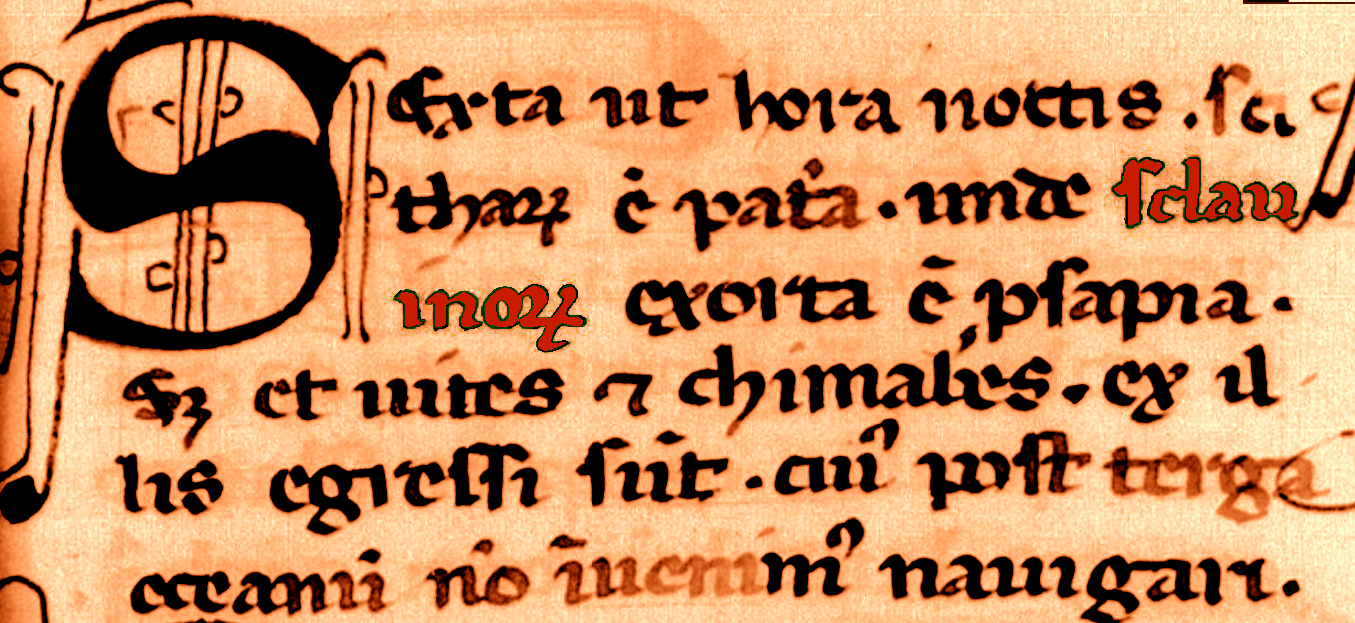
Sexta ut hora noctis Scytharum est patria, unde Sclavinorum exorta est prosapia; sed et Vites et Chimabes ex illis egressi sunt.  Cuius post terga Oceanum non invenimus navigari.

porcheronz

1688 Placido Porcheron edition

“The sixth hour of the night is the country of the Scythians, wherein arose the people of the Slavs; And from them there came the Vites and Chimabes, in the back of whom the ocean becomes not navigable.”

2z

  • Hour 7 – is the hour of the Sarmatians and of the Carpi (from whom the war went out (?));
  • Hour 8 – is where the Roxolani originated and the ancient Scythians on some island (?) called by Jordanes Scanza (!) prior home to Goths and Danes and Gepids (?);
  • Hour 9 – is where the Amazons are;

Etc, Etc.

In Book IV, a more specific description of Europe follows.  This too is shown in multiple parts, as follows (East to West, roughly):

First, we have Scythia/Khazaria; then Abasgia (Abkhazia) – home of the Alans; then Licania Bosforania on the Black Sea; then comes part IV which says more or less the following:

Item ad partem septentrionalem iuxta Oceanum confinalis praefatae maioris Scythiae ponitur patria quae dicitur Colchia Circeon, Melanglinon, Bassarinon.  Quae Colchia Circeon in omnibus eremosa esse dinoscitur. De qua patria enarravit Pentesileus philosophus.  Item iuxta Oceanum confinanlis praefatae regionis Colchiae est patria quae dicitur ab antiquis Amazonum, postquam eas de Caucasis montibus exisse legimus.  De qua patria subtilius agunt supra scriptus Pentesileus et Marpesius atque Ptolomaeus rex Aegyptiorum Macedonum, philosophi.  Item iuxta Oceanum est patria quae dicitur Roxolanorum, Suaricum, Sauromatum. Per quam patriam inter cetera transeunt flumina quae dicuntur, fluvius maximus qui dicitur Vistula, quia nimis undosus in Oceano vergitur, et fluvius qui nominatur Lutta.  De qua patria enarravit supra scriptus Ptolomaeus rex et philosophus.  Cuius patriae post terga infra Oceanum supra scripta insula Scanza invenitur.

Which, roughly, means that in the North near the Ocean, Greater Scythia continues and we have various other countries, including the country of the Amazons,  then also near the Ocean the country of the Roxolans, Suaricum (of the Swedes?) and Sarmatians.  Through that country passes the River Vistula and also the River Lutta (?).  All of this corresponds to the above hours 9, 8 and 7.

ravenna

Then in part V, we have the countries in front of Roxolania, e.g., Sithrogorum, Campi Campanidon (?), Getho Githorum, Sugdabon, Fanaguron and what appears to be the Maeotian (Mursian?) Swamp.  Parts VI through X are rather uninteresting (Thrace, Moesia and Greece) and then we get to part XIV and learn about, among others, Dacia aka Gepidia where now the Avars live.  Further, we have a discussion of Carnech country (Julian Alps as attested by Marcomirus, the Gothic philosopher) which presumably means Carinthia.  We also get to Gallia which has such rivers, among others, as Saruba (Zaruba = Zaręba = a place where bushes were cut down or, maybe, something about Sorbs, Serbs?, today: Saravus), Bleza (today: Blies), Nida (today: Nied), which, at the Rhodanus (hmmm… Rodan?), also include Duba and Saganna, etc.  Then in the Venetian provinces we have rivers such as Sile (today: Silis) and Plave (today: Piave) and so it goes. In Portugal we have towns such as Mirtilin, Besurin, Serpas (some continue to be there to this day! Are the Sueves responsible for these names?).

Now, take a look at the above and look at the map that was put together for an edition of the Cosmography (above).  Isn’t it strange that the sixth hour where the Slavs are does not contain the River Vistula (which is, in effect, in the seventh or maybe even (as per the above picture), the eight hour)?  Who is on the Vistula?  Roxolani, Suarices (!?) and Sauromates.

(Now, the Suavi, with an “-a”, are listed separately (from the Sclavins listed in Book IV) but in an area roughly corresponding to the third hour and hence the person who drew the above picture places them in that general area).

(There are three manuscripts of the Cosmography, all significantly removed from the autograph, and none seems readily available so we use here “relatively recent” printing from 1860 that is more easily available.  The manuscripts are the Codex Vaticanus Urbinas 961, Codex Parisinus Bibliotheque Imperial 4794, Codex Basiliensis F.V.6.)

Copyright ©2015 jassa.org, All Rights Reserved

March 20, 2015

On the English Language

Published Post author

Since we quoted from the Geschichte der Deutschen Sprache in the previous post, it seems fair to also quote from another linguistic source and, since we quoted from a 19th century source, let us also quote from another 19th century source.  The book in question is Robert Gordon Latham’s “The English Language”.  Latham had many talents but his foremost appears to be in ethnology.  Here is Latham regarding the Slavic displacement of the original Germanic population. (Latham generously gives this displacement 500 years from the time of Tacitus to the 6th century but these days, the displacement is posited to have occurred only in the 6th-7th centuries):

fearfulness

“Lastly, Saxon as in England, the oldest geographical terms are Keltic; some of the original names of the rivers and mountains remanining unchanged.  The converse is the case in Transabingian Germany.  The older the name the more surely it is Slavonic.”

“So much for the extent of the assumed displacement.  It must have been the greatest and the most absolute of any recorded in history.”

“It must also have taken place with unparalleled rapidity.  By supposing that the assumed changes set in immediately after the time of Tacitus, and that as soon as that writer had recorded the fact that Poland, Bohemia, and Courland were parts of Germania, the transformation of these previously Teutonic areas into Slavonic ones, began, we have a condition as favorable for a great amount of changes as can fairly be demanded.  Still it may be improved.  The last traces of the older population may be supposed to have died out only just before the time when the different areas became known as exclusively Slavonic; an assumption which allows the advocate of the German theory to stay that, had our information been a little earlier, we should have found what we want in the way of vestiges, fragments, and effects of the antecedent non-Slavonic aborigines.  Be it so.  Still the time is short.  Bohemia appears as an exclusively Slavonic country as early as A.D. 625.  Is the difference between these areas and the time of Tacitus sufficient?”

“Undoubtedly a great deal in the way of migration and displacement may be done in five hundred years, and still more in seven hundred; yet it may be safely said that, under no circumstances whatever, within the historical period, has any known migration equalled the rapidity and magnitude of the one assumed, and that under no circumstances has the obliteration of all signs of an earlier population been so complete.”

How could the displacement inferred from this utter obliteration have taken place?  Was it by a process of ejection, so that the presumed immigrant Slavonians conquered and expelled the original Goths.  The chances of war, when we get to the historical period, run the other way; and the first fact which we know concerning those selfsame Slavonians who are supposed to have dispossessed the Germans in the third and fourth centuries, is that, in the ninth, the Germans dispossessed them.”

“If this view will not suffice, let us try another.  Let us ask if it may not be the case, that, when those Germans, who are admitted to have left their country in great numbers, migrated southwards, they left vast gaps in the population of their original areas, which the Slavonians from behind filled up, even by the force of pressure; since geography abhors a vaccuum as much as nature is said to do.”

“I will not say that this view is wholly unsupported by induction.  Something of the kind may be found amongst the Indians of North America, where a hunting-ground abandoned by one tribe is appropriated by another.  The magnitude, however, of such vacuities is trifling compared with the one in question.”

“History only tells us of German armies having advanced southwards.  The conversion of these armies into national migrations is gratuitous.”

Copyright ©2015 jassa.org All Rights Reserved

March 17, 2015

On Haensel and Gretel

Published Post author

Maerchen?

Since some may think our musings on the subject to be little more than faery tales, it seems appropriate to continue this discussion by bringing in an expert on both linguistics and faery tales, Mr. Jacob Grimm.  Here is what he has to say on the matter in his Geschichte der Deutschen Sprache:

“…Sueven and Slaven appear to be the same word.  Caesar, Strabo, Tacitus, Ptolemy write Suevi  Σοηβοι [Soeboi/Soevoi] or Σουηβοι [Soueboi/Souevoi].”

[Here it is worth mentioning that the Greek “v” letter did not initially exist though later the Greek beta “β” began to change into a “v” sound; it seems – though is not certain – that during the time of Caesar and later it would have been a “v”, hence Suevi and not Suebi – even though the letter used to spell the name is “b”; that said, the “b” pronunciation continues in Schwaben – and that is in German…]

But should a main tribe of the Germans be called by the same name as the Slavs who, while originally related, nevertheless are always different from us?  I would like to explain myself.  The name Suevi is admittedly Slavic and means, as we just saw [here Grimm refers to an earlier discussion regarding the West and East Slavic svoboda and the South Slavic sloboda, i.e., freedom], the “free [ones]”; the name was given by Sarmatians in the East to their German neighbors, just as in the West the name Germans [was given to the Germans] by the Belgians and Galls.  Later, it is possible, that the same nice name was either chosen by the Slavs for themselves or was received back [for the Slavs] from their German neighbors, an in a strange irony it was from the subjugated Slavs the concept and name of servitude (sclavi, italian schiavi), that originally referred to freedom.  Conversely, the Germans began to gradually use the name of their own people Vandali, Vindili in the form Veneti Vinidi Winidi with respect to their Slavic neighbors, the German Sueven, however, retained the [Slav-given] name [of Suevi] and hardened it merely into the Gothic Svebos (?) or Old High German Suapa or Anglo-Saxon Svaefas, like already in Greek, [e.g.,] it was written Σοηβοι for Suevi.  The designation Sloveni seems to be predominantly rooted among the Southern Slavs, just as they prefer sloboda to svoboda.  The Byzantines Procopius, Agathias and so forth [i.e., and others], work into the Σχλαβοι [Sklaboi/Sklavoi] Σχλαβηνοι [Sklabenoi/Sklavenoi] a “C” [i.e., a “k” sounding letter] Sclavi Sclaveni, which is, however, rejected in the Slavic spelling.  It appears incorrect to derive the name Slovenen from slava gloria or slovo word, or from [some] unknown place name, as Schafarik believes.  Thus our Sueven are also not so named after the river Suevus, [though] this one [river is] rather [named] after them…

[Grimm then goes on, among other things, to describe the switch between SV and SL and the similarity among words such as sweet and sladky [in Czech] though noting (without seeing the relevance of) the Polish (but also Sorbia) słodki (i.e, with an “ł” being the lower-case version of “Ł” and pronounced suodkee) before continuing as follows] 

“But which of the two forms is the older one?  Since in Sanskript svapnas and svadus show up, [whereas] svoboda is older and closer to svoi than sloboda, [and] also Suevus is older than Slavus, I give the greater age to the “V”.  From the aspirated [consonant] comes the liquid [consonant], just as from the “S” [comes] the “R”.  Conversely, the “L” is older than the Roman[/Latin?], Dutch and Serbian dissolution into “I” or “U”.”

Thoughts

So what does all of this mean? Putting aside the “K” inserted by the Greeks between the “S” and the “L” it seems that the Slavs that attacked the Byzantines spoke a Southern Slavic (in today’s sense) dialect.  Ok, anything else?

Well, Svevi is older than Slevi.  But what about Souevi?  Grimm, to our eyes, seems unclear on this point.  If we go by Sanskript, it may be younger than Svevi but perhaps older than Slevi.  But even this much is not clear.

What about Grimm’s explanation for the name’s acquisition?  First, Grimm seems to assume that the Sarmatians spoke Slavic (as we understand that to be today).  This may or may not be the case – perhaps something between Slavic and Iranian?  Beyond that the assumptions he makes seems highly improbable.

It is probably the case that the name Germani comes to the Romans from the Galls and the Belgae (this may be rather relevant).  The Romans had known the Galls from forever having suffered their invasions of Italy before retiring the same favour.  However, the Roman intercourse with the Sarmatians – even if we by that name mean the Yaziges or some tribe along the same ethnicity – at the time of Caesar seems not nearly as robust.  Therefore, it is unconvincing to propose a Sarmatian source for the name – at least, it is unconvincing, for the Romans to acquire the name from the Sarmatians.

And we know the Belgae and Galls called the Germans Germani.  So it seems that the name may well have been of the Germans’ own making.

But how does Grimm think the same name ended up being applied to the Slavs? Let’s quote him again:

“Later, it is possible, that the same nice name was either chosen by the Slavs for themselves or was received back [for the Slavs] from their German neighbors.”

So it seems Grimm thinks either the Slavs (whoever they were before – Sarmatians?) now coveted the name for themselves – so in a way stole it (or took it back if you will) or the Germans gave the name to the Slavs (gave back? shared?).  While fearsome names may later be borrowed (e.g., Hungarians wanting to be called after Huns – but their own name Magyar or the Avars wanting to be called after the Avari – their own original name being?), it stretches credulity to think that a group of people speaking the same language came into the space occupied by the Suevi previously and either appropriated their name or received it back.  As for the first proposition, the preponderance of the usage of Slav – from the deepest Russia to the Elbe – seems to speak against a local borrowing (which would then have to be spread to many other tribes all across the current “Sarmatiandom” (?), i.e.,  the “future” Slavdom).  The second point is even more easily dismissed since we already know that the Germans called their Eastern neighbors Wends, presumably, because the Slavs either were or appeared in the same place as the earlier-attested Veneti.

So, again, what does this all mean?

We would be the last to provide any conclusive and indisputable answers. But, since we are on a roll, let us take a look at the meaning of the word Suevi as commonly explained by the etymological establishment.

Etymologists trace the meaning to the reconstructed (of course) Proto-Germanic *swēbaz, meaning *swē- one’s own –baz [people?].  Alternatively, they reconstruct an even earlier Indo-European root of –swe again meaning one’s own.  [Suevi being not the only case, see too, for example, Swedes]

All this effort seems to have been on the right track since we have merely to glance at a Polish (or Sorbian) dictionary to discover that, indeed, -svoi does appear there as in swój (svui pronunciation) or swoi (svoi pronunciation) meaning, indeed, “one’s own” (singular and plural).

The sun is rising suggesting mercilessly that it is time to stop for now.  We leave you with a picture from Haensel & Gretel that famous Grimm faery tale.  In Polish the story’s name is Jaś i Małgosia – this title itself is rather a pro po, both by reason of the Grimm connection and by reason of the titular hero’s (sorry ladies, this time we skip Małgosia) – Jaś, you see is a common name in Polish folklor but what really confounded Polish ethnologists was the fact that, while they believed the name to be a diminutive of Jan, i.e., John, the peasants appeared to be using the name as a freestanding regular one with no diminutive intentions visible on the horizon.

jassamalgossa

Hermen, sla dermen, sla pipen, sla… wait, what?

Copyright ©2015 jassa.org All Rights Reserved

March 16, 2015

On Hydronymy of Germania

Published Post author


quellen

End of the Line?

Ok, we resisted going here for a while.  But, in good fun, let us try an exercise of “where do Slavs come from” without invoking the Venethi/Venedi/Veneti…  Or even without invoking some of the allegedly “Celtic” tribes.  Can we do that and not revert back to some Ural/Pripet Marshes silliness?

Turns out we can – at least for fun… Or is it?  You decide.  To do that we must ask… who were the “Germanic Tribes” that populated (or moved through) vast parts of Europe.  Could some of them have been Slavs?

It turns out that the question is nontrivial.  For example, there is a long history of back and forth about certain tribes and whether they were Celtic or Germanic.  The only reason no one has (recently) undertaken the same with the Slavs is that the Slavs are not supposed to be in Germania until the 6th century at the earliest.

But what do we mean by that?  What do we mean by Slavs here?  Well, people who later formed the core or maybe a portion of the Slavic tribes known to history.  People who did not speak a Germanic language (or what we think of as Germanic) but something different – perhaps not a Slavic language but something closer to Slavic and out of which Slavic arose than to Germanic language.

We must first observe that the German name “Germani” was not German per se.  It was a Latin word that was derived from Gaulish (or so it is thought).  Could it be then that the subsequent names containing –manni (Alemanni?  Marcomanni) are “Gaulish” too?  And who are these Gauls then?  For they seem to be speaking, if this is true, a proper German dialect?

Putting aside the Gauls, what language did their neighbors, these Germanic tribes speak then?  Turns out we do not know.  Let us be clear about this.  Of all the old Germanic languages only Gothic is attested and the primary source for this is Ulfilas’ Bible.  All the other evidence for the Germanic or non-Germanic nature of any tribe comes from personal names of the various chieftains.  Now those names sometimes sound Germanic and sometimes not.  In general, they get very much more Germanic, however,  once the Goths make their appearance.

Now the Goths clearly spoke a Germanic language.  Although… the funny thing is that Germanic language seems closer to Slavic than various West Germanic languages.  Perhaps that is because the Slavs were part of the Gothic Imperium.  Perhaps.  But it is also the case that Scandinavian languages in general seem much closer to Slavic than proper German.  Compare the various Polish -skis with the same -sk in Swedish.  For example, isn’t it odd that that Polska, the Polish name for Poland sports the same suffix as Svenska, the Swedish word meaning Swedish?  And that both are adjectives?  We will return to this topic.  But now for the topic at hand.

What would such a theory of Slavic Germans look like?

 On the Name of the Slavs

The Slavic name is often presented as meaning either (a) glory/glorious or (b) relating to words.

As regards the first theory, it is supposed to be a self-congratulatory remark on the fame of the bearers of the same.  In fact, it is true that “slava” does mean fame.  However, in some West Slavic languages, notably Polish, the word is chwala – pronounced hvaua.  Slava, notably pronounced in Polish suava, means fame.  Both are very ancient although chwala/hvaua may be older.

The other theory of the “word” is often brought up.  The word for word in Slavic languages is “slovo” which in Polish is pronounced suovo.  As a strong point in the theory’s favour it is pointed out that in all Slavic languages the word for Germans is Niemcy/Nemcy or, supposedly the “dumb” ones, i.e., the ones who do not speak the language.  What language?  Well, the language, namely Slavic.  There is are several problems with this theory.  For one, it presupposes that the earliest or at least most-important non-Slavic speakers the Slavs encountered were the Germans and not various Iranian tribes, Balts, Greeks, etc.  For that there is little evidence from your usual historiography (but see below).  That is to say, no other non-Slavic speakers that were or are neighbors to the Slavs are called “dumb” – even ones whose language is arguably further away on the language tree from Slavic than Germanic dialects would be.  The other problem here is that the Czech Němec, the Polish Niemiec, the Slovak Nemec, the Polabian Nemëc or the Kashubian Miemc or any of the South or East Slavic “German” names does not mean dumb as in mute.  The Czech term is němý, the Polish term is niemy, the Slovak term is nemý etc.  (BTW several other ones translate, interestingly enough, into glupi meaning intellectually challenged, with the same double meaning as in the English dumb.

So where does the “c” come from?

(hint: t > c)

There is another objection to either of these impressive theories.  Any such meaning would be unusual for Slavic tribes – most of whose designations seem to be based on toponymy, hydronymy or similar geographic concepts.  This is particularly so with Slavic words with an –ene ending.  In fact, we are hardly the first to notice this as a number of scholars have sought for the topographical feature – most likely in their view a river – that would seal the answer to the question of where do Slavs come from.  Thus, for example, the linguist Max Vasmer says that *-ěninъ*-aninъ only occurs in place names so that *slověne would likely be derived from such a place name – “most likely” a hydronym.  Maybe a river?

No such river – at least no such river of any sufficiently large magnitude has been found yet, however.  And our scholars were anything but lazy we ought to point out.  Thus, the various “nationalist” scientists searched within their respective countries’ jurisdictions.  The Poles covered most of the Bug-Oder realm.  The Czechs diligently searched the Bohemian lands.  The Slovenes, Serbs and Croats their own countries and, just to be sure, Hungary (former Pannonia – you never know).  The Russians and Ukrainians went through all of Russia and Ukraine.  The Belorussians made their contribution scouring Volhynnia.  The Germans, being most diligent of all, of course, searched with a comb from their favourite Pripet Marshes all the way to the Urals and beyond.  No success so far, though we are told the German search may be nearing Alaska so we may have our answer soon (after all Alaska does have an -ska in it – some even claim it’s a Russian word (but maybe Swedish… dope!) – so that could be it after all!).

Taking heed of the advice of a fictional but rather perceptive English detective and his time-worn advice, we are inclined to ask whether our scholars have by now eliminated all the impossibilities and whether whatever may remain to be looked at, in all its glorious improbability, must nevertheless be the sought after truth?

 The Current State of Play

Here is the current state of thinking on European history.  In the time of the great Ceasar, the time of Cornellius Tacitus and the time of Claudius Ptolemy (from the 40s B.C. all the way through 150 A.D.) Germany was occupied by Germanic tribes (well, duh!).  Then other Germanic tribes showed up in the third century, namely the Goths.  They caused all kinds of trouble but were eventually contained.  But only until the Huns showed up.  The Huns drove the Goths through the Roman lines and the Goths and Huns ravaged Rome and each other until various Germanic Kingdoms sprung up only to be beaten down one by one by the Byzantines and, eventually, the Arabs.  In the meantime all of former Germania emptied itself of its peoples so that those sneaky Slavs used this opportunity to move in and modern Europe was born (until the Germans begin their Reconquista with the Drang Nach Osten, a process that takes us through most of history until its recent, no doubt temporary, set back).

On the Letter “Ł”

The letter “Ł” exists in only a few languages.  It exists in Polish, Kashubian, Upper and Lower Sorbian and the Latin versions of Ukrainian and Belorussian.  Also in the Vilamovian (Wilmesaurisch) dialect of German.  In Navajo (!)  Oh yes, and in the current Venetian dialect of Italy (we just can’t get away from the Venetians it seems).  In Polish it was proposed first by Jakub Parkoszowic (we know Jacob from his study of Polish orthography which also happens to mention the Goddess Nia – you can read more about that here).  In fact, the “Ł” is also the unofficial car bumper sticker for “Łuzyce”, i.e., Lusatia/Lausitz (on the Sorbian cars only, of course).

The sound that the letter “Ł” is supposed to represent is closest to the English “w” but can also be represented by “uo” or “ue” or “ua”.  The Russian “Л л” or “э л” gets at the same point but sometimes it is pronounced like a  normal “L l”.  Other Cyryllic alphabets have the same split use of those letters.

Curiously, though it is the “Ł” sound not the “L” sound that is present in the, e.g., Polish pronunciation of the word “Slav”.  Thus, for example, in Polish the word “Slav” is “Słowianin” which is pronounced Swoveaneen or, if you prefer this spelling, Suoveaneen.  

Now in English it is not uncommon to get frightened of the above “Ł” sound and just change into the next closest letter, i.e., “L”.  That, however, changes its sound for the unaware reader and obfuscates analytics.

Oh, and one other thing, apparently, in the 15th-16th century the “Ł” sound was in use among the Polish commoners whereas the nobility used “L”.  Curious.

What can you do with all of this water? 

Now, of course, there is a river in Germany (three in fact) that goes by the name Saale.  That name is German.  The Slavic version of the (Saxon) Saale is Soława which is pronounced Souava. This version is attested in many different sources such as the Annales Polonorum (or Wincenty of Kielce aka Wincenty z Kielczy referring to the same incident: et in media Solaua columpnam figens ferream fines limitauit).

chrabridicityr

Flumine Solave in Annales Polonorum

Supposing (just for a moment) that some Slavic tribe did manage to in the vicinity of the Souava and were to be named after the Slavic name for that river, what would that name look like? Souaveane? Then Suoveane?

That can’t possibly be it though.  Let us look at the ever giving Wikipedia.  In fact, given the difficulty of the subject in front of us, let us make sure that we look at the one Wikipedia that delivers the truth, the whole truth and nothing but the truth (not the English one).

So what can we learn about this curious river name from the German Wikipedia?  Well, we learn that the name has something may have something to do with the German Saal or really sul meaning salt and with ava.  Now, there are saltworks in the Halle region which would explain the salt connection.  But there are a few “disturbances” in the Force or glitches in the Matrix.

Sul may well have been a German word for salt but now it is Salz.  Slavic, however, currently calls salt sul,  as the town on the Saale by the name of Suhl may attest.  And what does one do with suhl (e.g., Polish sól but pronounced suhl)?  Well, one salts or soli.

Moreover, not all the German Saale rivers may be explained by a salty connection.  Just this one.     On the Slavic side of the ledger, however, Soława/Souava refers only to this Saale and to the Frankian Saale but the latter name is not attested in Slavic languages at any early time, i.e., may represent a transfer from the Souava simply by reason of the fact that the Germans called both rivers Saale.

Well, if the Slavic word has something to do with saltworks then the Slavs must have only named the river after those saltworks were set up.  And before that the river was no doubt called Saale – a river name that the stubborn Slavs refused to adopt (Slavs are notorious for not adopting German river names and coming up with their own – the iron rule that hydronims last through all kinds of Voelkerwanderungen obviously is a rule that Slavic roving bands do not follow – wonder why that is).

In any event, we can no doubt show the arrival of the industrious Germans, followed by the naming of the river (Saale), then the establishment (by the aforementioned Germans) of the saltworks, then the arrival of the Slavs (no doubt as laborers for the German saltworks (salt mines?)) and the appearance for the first time of the Slavic Soława/Souava name.

Unfortunately, it seems that the saltworks were present in the area even before the birth of Christ and the first attested name for the river is a Slavic one – specifically attested by our friend Ibrahim-ibn-Yaqub in 973 as S-lava. (No Yaqub did not have a “Ł” available in his letter repertoire).  Specifically, he wrote:

“Nubgrad (Novigrad) is a fort built of stone and lime, and it is on the Slawah into which falls the river Bode.  And from Nubgrad to Mallahat al-Yahud [the saltpans of the Jews? Salzmunde? In any event, we got our salt] which is on the Slawah river, is thirty miles.  From there to the fort of Burjin [Wuerzen], which is on the River Muldawah… and from it to edge of the forest is twenty-five miles; from its beginning to its end is forty miles, through mountains and forests.”

(yes, there is a Sala listed by Strabo between which and the Rhine Drusus Germanicus fell off his horse but that was the Fraenkische Saale, a different river).

But what of the –ava?  It is an Old-Germanic or at least Gothic word for what?  Water?  Of course,  see auwa, ouwa, ahva, aha =  Wasser!

Aha!

Now you know that Agua is really a German word!

Maybe, but only inasmuch as similar words surface, so to speak, in all European languages including in various Slavic languages, e.g., Murava, Ostrava, oh yes, also “Muldawah” and Moldava (see above).

Scheisse! (Pardon us!)

Aha, we got it!  What if we looked at the authors of antiquity!?  No doubt the name Saale will pop up right away!

Let’s look at Ptolemy.  No Saale here.

Strange, though, there is a river here that sounds somewhat like Souava or Suava.  Its name is Suevus in Ptolemy.  But that can’t be it – for one thing the Saxon Saale runs into the Elbe (Slavic Łaba, albis = lebed = swan?), whereas Ptolemy says the Suevus has a mouth so it empties into… into what?  The Ocean of course.  Or does it?  But we know Suevus is the Oder or the Vistula or something like that.

Now, of course there are other examples of the -a to -us switch in the Roman tongue.  E.g., Drava > Dravus, Sava > Savus, so Souava > Souavus does not seem to be a major stretch.

Be that as it may, this (Suevus) was the river near which the most Germanic of the Germans dwelt in antiquity – the Suevi, Suavi or Suebi.  And we know that this great and populous nation occupied virtually all of Germany and certainly all of the various parts of Germany that were later occupied by the newcomers from the Pripet Marshes (or better yet from beyond the Urals), the not so great but, admittedly, also just as populous Slavic tribe of Suoveane (or as we like to spell them to make sure they do not look too much like the Suevi, the Slovene).

In order to dispel all this confusion, it seems that we have to write something about the Mighty German Tribe of the Suevi.

Copyright ©2015 jassa.org All Rights Reserved

March 15, 2015

Polabian Gods Part Vb – Saxo Grammaticus on the Siege of Arkona

Published Post author

We continue here with the story of the Danish invasion of Ruegen in 1168 as told by Saxo Grammaticus.  The first part is to be found here.

The King Has a Feeling

“The [Danish] King was filled with a desire of destroying their fortifications no less than he wanted toe stroy the pagan cult which was present in this town; he believed, namely that if he were able to tame Arkona, then all of paganism  on Rugia would be destroyed for he had no doubt that so long as this statue stood, it was easier for him to conquer the country’s fortifications than to defeat the pagan cult.  In order to bring the siege to a quicker end, all of his warriors greatly labored on his orders to bring from nearby forests many a tree trunk that could be used to build siege engines.  Whereas the engineers began to build [the siege engines], he appeared among them saying that their hard labors won’t bring any benefits and that the town will fall in their hands faster than they expected.  When he was asked why he thinks this, he answered that he arrived at this conclusion for the following reason.  He said that the Rugians at one time were conquered by Charlemagne and they were then ordered to pay tribute to the Abbey (of Saint Vitus) in Corvey, who became known thanks to his martyr’s death; but when Charlemagne died, they immediately dropped the enslaving yoke and returned to paganism; they then supposedly raised at Arkona this statue that they called Saint Vitus [i.e., Svantevit] and on whose worship they used all the money that earlier had been sent to Saint Vitus at Corvey with whom/which they now wanted nothing to do, for they said, that they were satisfied with the Saint Vitus [i.e., Svantevit] that they had at home and they felt no desire to subordinate themselves to some foreign [one].  Therefore, Saint Vitus, given that his day was drawing closer [i.e., the day of the feast of Saint Vitus]  will destroy their walls as a penalty for them having portrayed him in such a barbarous way; they have earned his wrath for they have established a blasphemous cult in lieu of a holy commemoration [of his].  This was not revealed to him in a dream, said the King nor did he arrived at this conclusion from analyzing any occurrence that may have happened, but rather he only had this strong conviction/feeling that this is what had to happen.”

But His Warriors Are More Pragmatic

“Such prophesy generated more doubt than belief in it, and because the island on which Arkona stood that was called Wittow was separated from Rugia by only a thin strait that was only so wide as a small river and it was feared that the Arkonians could get reinforcements by this path, people were sent there so as to guard the ford and prevent the enemy from crossing.  With the rest of the army he [the King] besieged the city paying careful attention to pace the catapults close to the walls.  Absalon was tasked with dividing the people and telling them where they should set up camp and in order to do this he measured the country between both shores exactly.”

And the Arkonians Are More Impressed with Their Banner

“In the meantime the Arkonians filled the gate with a great quantity of earth so as to make it harder for the enemy to attack it and they blocked access to it with a wall made of turf and this filled them with such confidence that they neglected to post warriors in the tower over the gate but only hanged there several banners and pennants.  One of their insignia that stood by reason of its color and of its size was called Stanica and the Rugians venerated this banner with such great reverence as almost all of their Gods taken together, for when it was carried in front of them they believed that they had sufficient might so as to challenge both gods and men and that there was not a thing they could not [lawfully?] do then [with the banner at their front] if they so should choose to such as plunder towns, destroy altars, commit dishonorable acts and to turn houses on Rugia into ruins.  They were so tremendously supersticious when it came to this rag that they ascribed to it more authority and power than to a kingly [banner] and they venerated it as a divine standard, and even those who had been harmed [by the bearers of it] gave the banner great reverence and honor, irrespective of hoe much harm it brought them.”

nottakingthisseriously

BTW Note that the Stanica banner is also mentioned by Thietmar in his description of the temple at Radogost/Riedegost.

Copyright ©2015 jassa.org All Rights Reserved

March 13, 2015

On the Bavarian Geographer – Suevi non sunt nati sed seminati?

Published Post author

Researching early Slavic tribal names and histories is a rather difficult task for the simple reason that outside of Fredegar, Einhard, Paul the Deacon (and, possibly, Porphyrogenetus) or the various Carolingian annals’ mentions, very few sources regarding the same exist prior to the late 10th century.    What the above contain, in turn, is very little.  Therefore, speculation about  Slavic tribal polities is necessarily mostly that – speculation.  One example of an exhaustive, though rather skimpy, source is the so-called Note of the Bavarian Geographer.  Discovered in 1772 in the Bavarian Prince Elector’s library by the nosy Louis-Gabriel Du Buat-Nançay (the French ambassador to the Saxon Court), it dates to the 9th century (probably the first half of it) and was published in 1796 by Jan Potocki the Polish archeologist (and, if this may not prove redundant, eccentric).  It was Potocki that called it a note of the “Bavarian” geographer although it is unlikely that the writer was Bavarian (more likely Frankish) and even less likely that he was a geographer (most likely a spy or scout).  So the French spy found a note by his predecessor-in-trade.

What is interesting about this note is that it lists not just the nearby Polabian Slavic tribes that we know from the much later writings of Thietmar, Adam of Bremen, Helmold and Saxo Grammaticus but it also lists tribes populating portions of Poland, the Czech lands and, more generally, contains a “Description of cities and lands north of the Danube” (Descriptio civitatum et regionum ad septentrionalem plagam Danubii).  Although the note says nothing other than the name of the tribe and a measure of its relative strength expressed by the number of “civitates”, i.e., cities/towns that such tribe possesses, of some of these tribes it is the only witness to their existence.

Looking at this from the viewpoint of Polish historiography, it contains no mention of any Polans or Mazovians (though does contain Vislans and the Slenzans of Silesia).  Neither does it mention Croats anywhere nor, probably, any Eastern Slav tribes.   On the other hand, it does mention the Sorbs, what appear to be Bohemian tribes and the Prussians.  Some of these names are obvious, the others’ association with known tribal entities is more tentative and yet others only leave us scratching our heads.  Also note that researchers believe that there were perhaps two different source documents – therefore, we break up the piece below into two separate parts roughly corresponding to the two (proposed) pieces.

Without further ado here is the Bavarian Geographer:

Part I

“Description of cities and lands north of the Danube.  These are they who reside closer to the borders of Denmark. who are called Nortabtrezi, where the region has 53 cities divided among their dukes.  Vuilci who have 95 cities and 4 regions.  Linaa are people who have 7 cities. Near them reside those whom they call Bethenici and Smeldingon and Morizani, who have 11 cities. And next to them are those who are called Hehfeldi, who have 8 cities. And next to them is the country called [of the ] Surbi, [in] which country there are many [people], and they have 50 cities.  And next to them are the ones who are called Talaminzi who have 14 cities.  Beheimare who have 15 cities.  Marharii have 11 cities.  The country of the Vulgarii is immense and the people plenty [and] they have 5 cities, because there is a great multitude of them and it is not [the work] of the cities to have them [?]  There is a people who are called Merehanos, they have 30 cities.  These are the countries that terminate/end at our borders.”

bavaraieins

(Descriptio civitatum et regionum ad septentrionalem plagam Danubii.   Isti sunt qui propinquiores resident finibus Danaorum, quos uocant Nortabtrezi, ubi regio, in qua sunt civitates LIII, per duces suos partite.  Vuilci in qua civitates XCV et regiones IIII.  Linaa est populus, qui habet civitates VII.  Prope illis resident, quos vocant Bethenici et Smeldingon et Morizani, qui habent civitates XI.  Juxta illos sunt, qui vocantur Hehfeldi, qui habent civitates VIII.  Juxta illos est regio, quae uocatur Surbi, in qua regione plures sunt, quae habent ciuitates L.  Juxta illos sunt quos uocantur Talaminzi qui habent ciuitates XIIII.  Beheimare in qua sunt ciuitates XV.  Marharii habent ciuitates XI.  Vulgarii regio est inmensa et populus multus habens ciuitates V, eo quod mutitudo magna ex eis sit et non sit eis opus ciuitates habere.  Est populus quem uocant Merehanos, ipsi habent ciuitates XXX.  Iste sunt regiones, que terminant in finibus nostris.)bavaraizwei

bavaraitrei

Part 2

“These are the ones that reside next to them.  Osterabtrezi in whose [country] there are more than 100 cities.  Miloxi who have 67 cities.  Phesnuzi have 70 cities. Thadesi more than 200 towns.  Glopeaniwho have 400 cities or even more.  Busani have 231 cities.  Sittici country is immense with many towns and people.  Stadici have 516 cities an infinite people.  Sebbirozi have 90 cities.  Unlizi a populous people have 318 cities.  Neriuani have 78 cities.  Attorozi have 148, a very fierce people.  Eptaradici have 263 cities.  Vuillerozi have 180 cities.  Zabrozi have 212 cities. Znetalici have 74 cities.  Aturezani have 104 cities.  Chozirozi have 250 cities.  Lendizi have 98 cities.  Thafnezi have 257 cities.  Zeriuani, that is the only kingdom, to have arisen from all of the nations of the Slavs, and the origin, as they claim, they lead.  Prissani, 70 cities.  Velunzani, 70 cities.  Bruzi are many on all sides from the Enisa [Ems? Neisse? Enns (Danube tributary)?] to the Rhine.  Vuizunbeire.  Caziri 100 cities.  Ruzzi.  Forsderen.  Liudi.  Fresiti.  Serauici.  Lucolane.  Ungare.  Vuislane.  Sleenzane, 15 cities.  Lunsici 30 cities.  Dadosesani 20 cities.  Milzane, 30 cities.  Besunzane, 2 cities.  Verizane, 10 cities.  Fraganeo 40 cities.  Lupiglaa 30 cities.  Opolini 20 cities.  Golensizi 5 cities.”

[we conclude with the note at the bottom of the page]

“Sueui are not born but sown [?].  Beire are not called Bavarians, but Boiarii from the river Boia.”

(Isti sunt, qui iuxta istorum fines resident.  Osterabtrezi in qua ciuitates plus quam C sunt.  Miloxi, in qua ciuitates LXVII.  Phesnuzi habent ciuitates LXX.  Thadesi plus quam CC urbes habent.  Glopeani, in qua ciuitates CCCC aut eo amplius.  Zuireani habent civitates CCCXXV.  Busani habent ciuitates CCXXXI.  Sittici regio inmensa, populis et urbibus munitissimis.  Stadici in qua ciuitates DXVI populusque infinitus.  Sebbirozi habent ciuitates XC.  Unlizi populus multus, ciuitates CCCXVIII.  Neriuani habent ciuitates LXXVIII.  Attorozi habent CXLVIII, populus ferocissimus.  Eptaradici habent ciuitates CCLXIII.  Vuillerozi habent ciuitates CLXXX.  Zabrozi habent ciuitates CCXII.  Znetalici habent ciuitates LXXIIII.  Aturezani habent ciuitates CIIII.  Chozirozi habent ciuitates CCL.  Lendizi habent ciuitates XCVIII.  Thafnezi habent ciuitates CCLVII.  Zeriuani, quod tantum est regnum, ut ex eo cuncte gentes Sclauorum exorte sint, et originem, sicut affirmant, ducant.  Prissani, ciuitates LXX.  Velunzani, ciuitates LXX.  Bruzi plus est undique, quam de Enisa ad Rhenum.  Vuizunbeire.  Caziri, ciuitates C. Ruzzi.  Forsderen.  Liudi.  Fresiti.  Serauici.  Lucolane.  Ungare.  Vuislane.  Sleenzane, ciuitates XV.  Lunsici ciuitates XXX.  Dadosesani ciuitates XX.  Milzane, ciuitates XXX.  Besunzane, ciuitates II.  Verizane, ciuitates X.  Fraganeo ciuitates XL.  Lupiglaa ciuitates XXX.  Opolini ciuitates XX.  Golensiz ciuitates V.  Sueui n[on] s[unt] nati s[ed] seminati.   Beire non dicuntur Bauarii, s[ed] Boiarii a Boia fluvio.)

bavaraiavierasta

A few interesting things to note:

1) Zeriuani, “that is the only kingdom, to have arisen from all of the nations of the Slavs, and the origin, as they claim, they lead.”  Who are these?  Serbs (Surbi) have already been listed above so they do not really fit this role (though repeats of some of these tribes are possible).  Perhaps Severians but which ones (in Russia or on the Danube – there were two)?

Or perhaps, this has something to do with the man that the Armenian historian Mosis Chorenensis aka Moses Khorenatsi’s (Moses of Khoren) wrote about as Zerovanus (Moses wrote many interesting things – we will be back to him), a Bactrian king who was by others (Berosus) seen as the same as Zoroaster.

2) Bruzi “are many on all sides from the Enisa [Ems? Neisse? Enns (Danube tributary)?] to the Rhine.”  This makes little sense unless either Rhine means something else than the Rhine or we are placing Prussians, if that is who they are, between the Enns and the Rhine, i.e., basically in today’s Netherlands.

3) Sometimes German names are used while at other times Slavic but Osterabtrezi is in a “Slavic section” – does it mean Eastern Abotrites?  Or those Abotrites who worship Oster?

4) And then there is the below little note (written by?):

“Sueui are not born but sown [?]. Beire are not called Bavarians, but Boiarii from the river Boia.”

bavaraiafunfta

which brings us to the Suevi… but we will not tackle them yet.

BTW the above is the only known existing copy of this listing.

Copyright ©2015 jassa.org All Rights Reserved

March 8, 2015

Description of Slavia in Adam of Bremen

Published Post author

We have discussed previously Adam of Bremen’s History of the Archbishops of Hamburg-Bremen in the context of Polabian religion as well as regarding the Rarogi.  However, Adam’s work also touches upon other aspects of Polabian Slavs and his description of the Slavs is worth discussing on its own.  In the following we include a description of Slavia – that “region of Germany” where Slavs live with the exception of two fragments – one is what we already discussed regarding religion and which you may find here; the other is the description of Wolin or Jumneta which we leave for another time.

We note first that Adam understood Slavs to mean chiefly Wends, i.e., western-most or Polabian Slavs.  Other Slavs already had their separate names and states and as such were distinguished by Adam from the Polabian “Rest-Slavs”, so, crudely, to speak, that inhabited the lands between the Oder and the Elbe (and beyond).

In the section references we use the alternative numbering system (the book numbers are the same) used in some manuscripts.

[BTW the reference to the Winuli (Winnulis, Wimulis, Vinnulis, Vinulis) is curious and likely a mistake (Adam also calls Winuli, Vandals – which clearly is a mistake) in that that is the old name of the Lombards/ Langobarden as per Paul the Deacon.   See also Benedict from Monte Soratte (previously, Monte Soracte) (aka Benedict of Soracte) in his 968 (?) Chronicle (Chapter 36 (SS, III, 717) as per MGH (the truthfulness of a lot of Benedict’s work has been put in some doubt); apparently the Winuli are separate from the Wilini also mentioned by Adam]

Book II
Section 14

“To the archbishopric of Magdeburg was subjected all Slavia as far as the Peene River.  There were five suffragan bishoprics.  Of these Merseburg and Zeitz were established on the Saale River, Meissen on the Elbe, Brandenburg and Havelberg farther inland.  The sixth bishopric of Slavia is Oldenburg.  Because it is nearer to us, the emperor put it under the jurisdiction of the archbishop of Hamburg.  For it our archbishop consecrated as the first bishop Ebrachar or Egward, whom in Latin we call Evagrius…”

intorostes

Section 15

“We have also found that the boundaries of Saxony across the Elbe were drawn by Charles and other emperors as follows:  The first extends from the east bank of the Elbe up to the rivulet which the Slavs call Boize.  From that stream the line runs through the Delvunder wood up to the Delvenau River.  And so it goes on to the Hornbecker Muehlen-Bach and to the source of the Bille, thence to Liudwinestein and Weisbirken and Barkhorst.  Then it passes on through Suederbeste to the Trave woods and again through this forest to Blunk.  Next it goes to the Tensfelder Au and ascends directly up to the ford called Agrimeswidil.  At that place, too, Burwid fought a duel with a Slavic champion and slew him; and a memorial stone has been put in that spot.  Thence the line runs up, going to the Stocksee, and thus on to the Zwentifeld lying to the East as far as the Schwentine River itself.  Along the latter stream the Saxon boundary goes down to the Scythian Lake and to the sea they call the Eastern Sea.”

firstpages

Section 17

“Thus far Einhard: but since the Slavs are mentioned so many times we do not think it improper to say something about the nature and peoples of Slavia by way of an historical survey, especially since it is related that nearly all the Slavs were at that time converted to the Christian religion though the efforts of our archbishop Adaldag.”

Section 18

“Slavia is a very large province of Germany inhabited by the Winuli who at one time were called Vandals.  It is said to be ten times larger than our Saxony, especially if you count as part of Slavia Bohemia and the expanses across the Oder, the Poles, because they differ neither in appearance nor in language.  Although this region is very rich in arms, men and crops, it is shut on all sides by fast barriers of wooded mountains and rivers.  In breadth it extends from south to north, that is, from the Elbe River to the Scythian Sea.  And in length it appears to stretch from our diocese of Hamburg, where it begins, toward the east and, spread in boundless expanses, reaches clear to Bavaria, Hungary and Greece.  There are many Slavic people, of whom the first, beginning in the west, are the Wagiri, neighbors of the Transalbingians.  their city is Oldenburg by the sea.  Then come the Abotrites, who now are called Reregi, and their city is Mecklemburg.  In our direction too, are the Polabingi, whose city is Ratzeburg.  Beyond them live the Linguones and Warnavi.  Farther on dwell the Chizzini and Circipani, whom the Peene River separates from the Tholenzi and from the Retharii and their city of Demmin.  There is the end of the diocese of Hamburg.  There also are other Slavic peoples, who live between the Elbe and the Oder; such as the Heveldi, who are seated by the Havel River, and the Doxani, Leubuzi, Wilini, and Stoderani, besides many other.  Among them the Retharii, centrally located are the mightiest of all.  Their city, very widely known as Rethra, is a seat of idolatry…”

middleones

[for a description of the next part see here]

Section 19

“Beyond the Leutici, who are also called Wilzi, one comes to the Oder River, the largest stream in the Slavic region.  At its mouth, where it feeds the Scythian marshes, Jumne, a most noble city, affords, a very widely known trading center for the barbarians…”

[a description of Jumne/Wolin follows – we will discuss it later so we skip it for now]

pagefinal

Section 19 (continued)

“From that city it is a short passage in one direction to the city of Demmin, which is situated at the mouth of the Peene River, where the Rugiani also live.  The other one reaches the province of Semland, which the Prussians occupy.  The journey is such that it takes seven days to go from Hamburg or the Elbe River to the city of Jumne by land; for by the sea route one boards ship at Schleswig or Oldenburg to get to Jumne.  From that city it is fourteen days’ sail up to Ostrogard of Russia.  The largest city of Russia is Kiev, rival of the scepter of Constantinople, the brightest ornament of Greece.  Now, as was said before, the Oder River rises in the depths of the Moravian forest, where our Elbe also has its source.  At first not a great distance from each other, these rivers follow different courses.  For the one, that is the Oder, tending toward the north, passes through the midst of the Winuli  peoples [medios Winulorum populos] until it passes by Jumne, where it divides the Pomeranians from the Wilzi.  But the other, that is the Elbe, rushing toward the west, waters in the uppermost course the country of the Bohemians and the Sorbs; midway in its course it divides the pagans from the Saxons; in its lower part it divides the dioceses of Hamburg from that of Bremen and sweeps into the British Ocean.”

Section 20

“These remarks about the Slavs and their country may suffice, because through the valor of the great Otto they were all at that time converted to Christianity.  Now we shall address our pen to what was done after the emperor’s death and in the remaining years of our archbishop.”

Copyright ©2015 jassa.org All Rights Reserved

March 4, 2015

On the Venerable Bede, Jastarnia, Yesterday and Facing the Past or Future

Published Post author

invulnerable

The Venerable One at Work – unbeknownst to His Venerm, He was about to cause some future controversy

 On the Most Venerable Bede

The English and very Venerable Bede (circa AD 672/3 – AD 735) was one of the most famous and accomplished medieval scholars.  In point of fact he was so significant a figure and so respected that to this day we call him the Venerable Bede (it could be that in combination with the fact that Bede just seems too short a name for a monk of any stature).

He was respected in his day and age (7th/8th centuries).

He was respected in the 11th and 12th centuries our esteemable (but note not “Esteemable”) William of Malmesbury relied heavily on Bede in constructing his own works.

And the relevance of Bede continues to this day!  It seems he has been at the center of a feud over the meaning of Easter between normal Christians on the one hand and fundamentalist Christians/fundamentalist atheists on the other hand.  The relevant passages are about the word Easter and its origin and are in the work called Of the Reckoning of Time (De temporum ratione), specifically in Chapter XV entitled “Of the Months of the English” (De meniscus Anglorum) in which Bede tackles the origin of the English month names, relating the original name for April to be Easter-monat, which he then derives from the name of an alleged Anglo-Saxon goddess Eostre leading the self-righteous in our society (and our society lately abounds in the self-righteous) to point out the rather obvious that Easter has pagan roots and then claim that those ever so-silly Christians had no idea how foolish they were.  Boohoo.  Here is what Bede actually says:

venerabilisintroaascationsis

“In the days of old the English people, for it did not seem fitting to me that I should speak of other nations’ observance of the year and yet be silent about my own nation’s – calculated their months according to the course of the Moon.  Hence, after the manner of the Greeks and the Romans [the months] take their name from the Moon, for the Moon is called mona and the month month.”

(Antiqui autem Anglorum populi (neque enim mihi congruum videtur, aliarum gentium annalem observantiam dicere, et meae reticere) iuxta cursum lunae suos menses computavere; unde et a luna Hebraeorum et Graecorum more nomen accipiunt. Si quidem apud eos luna mona, mensis monath appellatur).

“The first month, which the Latins call January, is Giuli; February is called Solmonath; March Hrethmonath [sic – see below]; April, Eosturmonath; May, Thrimilchi; June, Litha; July, also Litha; August, Wodmonath; September, Halegmonath; October, Winterfilleth; November, Blodmonath; December, Giuli, the same name by which January is called.  They began the year on the 8th kalends [December 25th], when we celebrate the birth of the Lord.  That very night, which we hold so sacred, they used to call by the heathen word Modranecht, that is, mother’s night”, because (we suspect) of the ceremonies they enacted all that night.”

(Primusque eorum mensis, quidem Latini Januarium vocant, dicitur Giuli. Deinde Februarius Sol-monath, Martius Rhed-monath, Aprilis Eostur-monath, Maius Thrimylchi, Junius Lida, Julius similiter Lida, Augustus Vueod-monath, September Haleg-monath, Oktober Vuinter-fylleth, November Blod-monath, December Giuli, eodem Januarius nomine, vocatur.  Incipiebant autem annum ab octavo Calendarum Januariarum die, ubi nunc natale Domini celebramus. Et ipsam noctem nunc nobis sacrosanctum, tunc gentili vocabulo Modranicht, id est, matrum noctem, appellabant, ob causam, ut suspicamur. ceremoniarum quas in ea pervigiles agebant).

“Whenever it was a common year, they gave three lunar months to each season.  When an embolismic year occurred (that is one of 13 lunar months) they assigned the extra month to summer, so that three months together bore the name “Litha”; hence they called [this embolismic] year “Thrilithi”. It had four summer months, with the usual three for the other seasons. But originally, they divided the year as a whole into two seasons, summer and winter, assigning the six months in which the days are longer than the nights to summer, and the other six to winter.  Hence they called the month in which the winter season began “Winterfilleth”, a name made up from winter and “full Moon”, because winter began on the full Moon of that months.”

(Et quotiescunque communis esset annus, ternos menses lunares singulis anni temporibus dabant. Cum vero embolismus, hoc est, XIII mensium lunarium annus occurreret, superfluum mensem aestati apponebant, ita ut tunc tres menses simul Lida nomine vocarentur, et ob id annus ille Thri-lidi cognominabatur, habens IV menses aestatis, ternos ut semper temporum caeterorum. Item principaliter annum totum in duo tempora, hyemis, videlicet, et aestatis dispartiebant, sex illos menses quibus longiores noctibus dies sunt aestati tribuendo, sex reliquos hyemi. Unde et mensem quo hyemalia tempora incipiebant Vuinter-fylleth appellabant, composito nomine ab hyeme et plenilunio, quia videlicet a plenilunio eiusdem mensis hyems sortiretur initium).

“…Hrethmonath is named for their Goddess Hretha [but see Rheda [Rod?] below], to whom they sacrificed at this time.  Eosturmonath has a name which is now translated “Paschal month”, and which was once called after a Goddess of theirs named Eostre, in whose honor feasts were celebrated in that month.  Now they designate that Paschal season by her name, calling the joys of the new rite by the time-honored name of the old observance…”

venerabilis

Eostre oh Eostre, where does thou come from?

(Rhed-monath a deo illorum Rheda, cui in illo sacrificabant, nominatur; Eostur-monath, qui nunc paschalis mensis interpretetur, quondam a dea illorum quae Eostre vocabatur, et cui in illo festa celebrabant, nomen habuit, a cuius nomine nunc paschale tempus cognominant; consueto antiquae observationis vocabulo gaudia novae solemnitatis vocantes).

With that behind us, let us reinsert ourselves into this “debate”, if only tangentially and with all due attention paid rather more to those matters that actually do concern us – those of the Slavs.

On Jastarnia

There is a small town on the Hel peninsula on the Bay of Gdansk.  At various times in its history it was referred to as Osternese (1582; Kossina, incorrectly, sticks in a 1532), Hesternest (1599), Hesternia (1627), Jasternia (1664) and now Jastarnia.   Now the area in the past was (and some portions of it continue to be) populated by those Pomeranians who go by the name of Kaszubs.  And at Easter, the Kaszubs celebrate Jastry instead of the Polish Swieta Wielkanocne (the Holidays of the Great Night – here too there is no Pascha).  Now most people agree that that is a reference to the German Ostern (i.e., Easter).  Well, there were Germans in Gdansk and the surrounding area.  There were Scots, Dutchmen, etc.  Some of them may well have lived in Jastarnia so if the locals became Polonized or simply took over the German name, that seems like nothing that is very exciting or unusual -so far.  So let’s go on further.

jaestarniaskis

Jastarnia

The Hel Peninsula is called that because of the tiny town called Hel at its tip.  Now, its name supposedly derives from Hel, the Germanic goddess of the underworld.  So we have some deities finally.  Maybe.  The Polish etymology points “dune” or to helasz as in “to get away” (as in “get the hell out” or did you think that was a reference to an actual Hell?).  The Linde Dictionary  – that is The Dictionary of the Polish Language (from 1807) by Samuel Bogumił Linde – puts it this way:

helasz1

“Hellaway from land – don’t spare the oars”

The name of the town was originally Gellen or, perhaps, Gellin (as per a Danish Chronicle about a Danish King’s Valdemar II Victorious’ ship that floundered about there in 1192 – his dad was the guy who took Arkona for the Danes).

Perhaps though it is a German name.  German hell means “light” or “bright” – presumably there was fire and brimstone involved in the Germanic underworld as in most well functioning underworlds.  But perhaps the word hell means not the bright goddess of the underworld Hel per se but simply “bright”?  But bright what or who?

hela

Nowhere else to run but straight into Eostre’s arms?

And here we come to the light.

The Kaszubian word jastny (also in old Czech) means the same as jasny in Polish (i.e., light, bright) or hell in German. Ok… so?

letopis

So Jastarnia may also refer to brightness.  Ok?

ceskei

And it may refer to Ostern/Easter.

That is to say, it may mean both bright/light and Easter.  Easter may be a celebration of light.  Whose light?  Well, Jassa‘s of course.  We do know “Chiason sive Jassen” was connected by the Czech author with Sol, i.e., a solar cult.  And Jasny does mean bright/light in Polish which seems an easy etymological fit for Yasse of Lucas of Great Kozmin and Jan Dlugosz.

Further, there is a concept of Jastrebog i.e., Jastergod in Kaszubian (and among the Polabian Slavs too).  For example, the below states as follows:

Jastrebog

Jastrebog, but also Jutrobog [on that see below], the name of a hillock in the district (Gaupago) of Wejherowo, lying between the villages of Linia and Miloszewo.  And that is proof, that these here lands from many a century are Polish, before a German foot stood here, ha! even before Christianity arrived in these parts.  Jutroboh, vel Jutrzyboh, vel Jutrzejboh, according to mythology the brother of Juternica, both the children of Swiatovid and Nocena, twins and a couple [ywww], mean the light that fights the shadows in the dawn.  To honor Jutrzebog the town of Juterboh was built on the Saxon border.”

The above text comes from the Little Kaszubian Dictionary from 1875.

jasterbog1875

Now, we do not think that the “mythology” referred to above is exactly backed up by anything (perhaps folk tales?  the author-priest does not say) and would even be inclined to dismiss a lot of it.  On the other hand, the information about the hill of Jastrebog, seems plausible.  And there are other Kaszubian dictionaries that mention the same hillock and, explicitly loop in Easter such as the following Kaszubian Comparative Dictionary:

jastershorter

which notes:

jastre

“Jastry – Easter, jastrzany – of Easter; Jastrzebog – the name of a hillock in the district (Gaupago) of Wejherowo,.  Compare Old Slavic utrojutro, za ustra, Lithuanian, auszra, Polish jutrojutrznia, Polabian jeutreJutrobohJutrzejboh [on that see below] – deus solis orientis; German Ostra-alee – East street, Old German ostara, German Ostern.”

The same dictionary offers the following explanation for the town name Jastarnia:

heisternest

“Jastarniaa village on the Hel Pensinsula, German Heisternest; the German etymologists derive the from HeisterHaster – Elster and nest.  Which name was the original, Polish or German?  The origin of Jastarnia from “asterjaster” [i.e., aster the flower] does not seem likely to me; a more likely derivation would be from a German name from ElsterHasterAlster – magpie, because those kinds of birds were there [at Jastarnia] and continue to be there, while asters [flowers] were never there and continue not to be [there].  Also compare the following words: [goes to Jastry – see above]”

And the German town of Jüterbog continues to exist having been first mentioned under the year 1007 by our very own friend Thietmar of Merseburg as Jutriboc.

wappenstelling

No Wendish or pagan connections here – move along now!

Now, whether that is a reference to a deity or to a “bok”, i.e., Slavic word for a “side” or to a Germanic “bach”, i.e.,  “stream” is a separate question (though Bach seems a stretch and even if it were a Bach, a question would have to be answered whether it was Jaster‘s/Jutro‘s Bach).

Here is an explanation from Linde again:

Iuterbok

“Iuterbok – Serbian town within the borders of Lower Lusatia, so called after Iutroboh, that is the Goddess of dawn, who the Sorbs counted among their Gods”.

And then there is this:

juterbok

coincidence?

In any event, as regards Jastarnia at least, the German writers describe it as a hive of superstition (Aberglaube), seemingly supporting its pagan roots

For example, so writes the redoubtable Carl Joseph Hübner in the the bestselling “Polens Ende, historisch, statistisch und geographisch beschrieben (mit vier (!) Kupfern und eine Landkarte)” published and republished in 1797-1807:

aberglaube1807

And to top it off with Hel, the town itself was for the longest time a pirate heaven.  In fact, it was raided by the Teutonic Knights (at the request of the Hanseatic League) in the 14th century once the knights had helped themselves to Gdansk.  Apparently, that did not stop the pirate activity and, eventually, the city was claimed by the sea – interestingly, the approximate date of this event is known (or at least it is claimed that it is known) and it is 1560 – specifically at Green Holidays (Zielone Swiatki), i.e., at Pentecost the sea destroyed the old pirate heaven…  We have written about Pentecost so much already that we will not repeat ourselves here but we urge you to peruse prior postings.  Apparently, a visitor to Hel in the 18th century saw the remains of an old church and the name Michel Tuba inscribed on the stone.  Whatever that may mean, we, at least, do not even pretend to know.

Consequently, it seems plausible to suggest that ancient (relatively speaking) Polish Slavs worshipped Jassa while there Pomeranian cousins (or Kaszub Poles, if you prefer) worshipped Jasterbog.  And the latter name also provides a clear (under the circumstances) connection with Easter which connects with Eostre further proving Jassa‘s and Jasterbog‘s divine connections.  

What can Jastarnia mean then?

How about Oster-nese or flipping it Nase-oster, i.e.,  “nase” (i.e., our) Jaster.

osternese

If you write it in Gothic script, it looks more authoritative

On Yesterday

There is another interesting thing about all of this – namely, yesterday:

iutro

Linde – you just can’t get enough of this stuff

In Slovenian tomorrow is “jutri”.  In Polish “jutro”.  In Czech “zitra”.  In Croatian & Serbian “sutra” and in Russian/Ukrainian “zavtra”.  These seem slightly different.

The Sorb language has both “jutře”, folkl. “zajtra”.  So maybe the s’ and z’s are just vernacular (or maybe their Slavic is a bit different for some interesting (?) reason – think Porphyrogenitus).

Now the Sorb language also has the concept of “raniši kraj”, or just “ranje”.  Which means… the East (Morgenland) (the West in German would be Abendland).

(Now, Ranie or Ranii were a tribe of Ruegen as we already discussed and, oh by the way, they appear in Jordanes’ Getica as a Germanic tribe: “Sunt quamquam et horum positura Grannii, Augandzi, Eunixi, Taetel, Rugi, Arochi, Ranii, quibus non ante multos annos Roduulf rex fuit, qui contempto proprio regno ad Theodorici Gothorum regis gremio convolavit et, ut desiderabat, invenit. Hae itaque gentes, Germanis corpore et animo grandiores, pugnabant beluina saevitia.”)

Getting back on point.  East.  We’re heading East.  In Russian it is vostok, i.e., to stick out (versus West, zapad, i.e., to fall down).  The other Slavic languages generally have some similar version of  (e.g., Serb and Croatian, istok zapad) though Polish and Ukrainian are slightly different (Wschod/Skhid & Zachod/Zakhid – coming up and going down not sticking out & falling) with Sorb (and to some extent Czech & Slovak) again straddling the fence.

(Incidentally, ostry means sharp.  In many ways it is similar to East and its meaning.  Why? How so? Because of the sharpness of the rising Sun.  Similarly, ostrow means an island in Slavic.  Why? Because it is like a cut in the surface of the water).

Trying to get back to our point again:

The prior day is “yesterday” in English (this one is not a revelation) and is “gestern” in German. But in Slavic languages, a cognate “jutro” is the subsequent day.  (However, another cognate appears to be the Slavic “vecer” pronounced vecher, which means evening and also presumably vechoray, meaning yesterday).  So that the Germanic language would see the East/Eostre behind their backs, yesterday.  In Slavic, however, the East/Jaster would come tomorrow.  So does that mean that the Slavs were heading East but the Germans West?  And, if so how did they meet (assuming they did not go all the way around)?

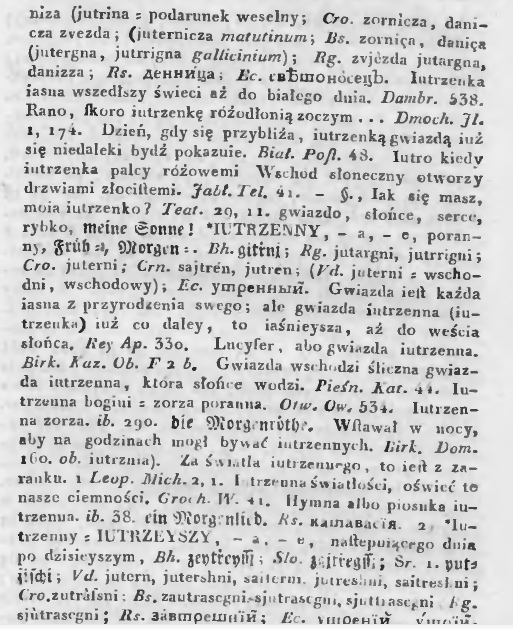
Once more we hop on to Linde re: Jutrzenka, i.e. Morning Star (in Windish Juterniza – cognate to Jastarnia?):

iuterozenkasko1

justernica2And what does that mean for “gestern”‘s and “yesterday”‘s relationship with “stern” and “star,” respectively? jastarnia has a “star” in it but in Slavic “star” is g- or -h or “zvezda”.  But “stari” or “stara” or “staro” means “old”.  Interesting, isn’t?

So was Jassa/Jessa the divine light and the divine morning and the God of the spring (see vesna, wiosna)?  Or was that just Jaster? And was Eostre, the Goddess of both the spring and the morning.  All of them being divinities of the awakenings?

Copyright ©2015 jassa.org All Rights Reserved
February 28, 2015

Of the Main Veneti – Polybius

Published Post author

triestetargeste

Τεργέστη – Targ yest (where the market is) – Eppensteiner? Or “mit einer banier rôtgevar, daß was mit wîße durch gesniten hûte nâch wendischen siten”?

Polybius 2.17

“The Etruscans were the oldest inhabitants of this plain at the same period that they possessed also the Phlegraean plain in the neighborhood of Capua and Nola, which, accessible and well known as it is to many, has such a reputation for fertility.  Those therefore who would know something of the dominion of the Etruscans should not look at the country where they now inhabit but at these plains and the resources they drew thence.  The Celts being close neighbors of the Etruscans and associating much with them, cast covetous eyes on their beautiful untry, and on small pretext, suddenly attacked them with a a large army and, expelling them from the plain of the Po, occupied it themselves.  The first settlers at the eastern extremity, near the source of the Po, were the Laevi and Lebecii, after them the Insubres, the largest tribe of all, and next these, on the banks of the river, the Cenomani.  The part of the plain near the Adriatic had never ceased to be in the possession of another very ancient tribe called the Veneti, differing slightly from the Gauls in customs and costume and speaking another language.  About this people the tragic poets tell many marvelous stories.  On the other bank of the Po, by the Apennines, the first settlers beginning from the west were the Anares and next them the Boii.  Next the latter, towards the Adriatic, were the Lingones and lastly, near the sea the Senones.”

Copyright ©2015 jassa.org All Rights Reserved

February 27, 2015