Making Things Simpler

Published Post author

This excerpt is from a 1987 article in “Slovene Studies” by Jakov Bačić of Astoria, Queens, New York City – all of which you can peruse here. Bačić seems to have developed this idea while writing his PhD dissertation at Columbia University (see Jakov Bacic “The emergence of the Sklabenoi (Slavs), their arrival on the Balkan Peninsula, and the role of the Avars in these events: Revised concepts in a new perspective”).

zala

However, oddly, he seems not to have been aware of the fact that his additional step of converting a Solava > Sava would be unnecessary if one were to look for an actual, uncorrupted Solava.  Or, as we think, Souava.

And where more perfect to look but where the ancient River Suevus used to flow… Of course, all of this could just be one frothy coincidence.

Copyright ©2015 jassa.org All Rights Reserved

November 19, 2015

King Burisleif & His Daughters in Jomsvikinga Saga

Published Post author

One of the more interesting references to the Slavic Wends appears in the early 13th century Icelandic work “The Saga of the Jomsvikings” (Jomsvikinga Saga).  There we find out about the close relations between the Wends and the Viking pirates of Jomsborg.  Jomsborg is – probably – Wolin; also known as Vineta (Wineta) for its Wends.  We shall have more to say about Vineta later.  However, for now let us show what the writers of this saga had to say about the Wendish King Burisleif and his daughters.  They are not the main characters (as the title suggests that honor falls to the Viking pirates) but the fact that the mythical (?) founder of Jomsborg – Palnatoki – chose to establish that fortress on the coast of Wendland means that the Wends come up in the story.

wecomeinpeace

We come in peace

Note that the name Burisleif is unusual.  Most likely, it is a “Scandinavization” of Boleslav but this is not certain.  “Sleif” probably does refer to “Slav” but, as we discussed, “bury” is a Slavic word (as well as the prefix of Burebista – the leader of the uprising against Romans who rebelled in the East at the same time as Ariovistus did in the West) and, indeed, also the name of the Lugii Buri.  On the other hand the names of the daughters of King Burisleif: Astrid, Gunnhild and, possibly, Geira are Norse “Scandinavizations”.  That said, the three daughters of Burisleif are certainly reminiscent of the three daughters of the Czech founder Krok (Libuse, Tetka, Kazi).

The question of whether Burisleif really was a Wendish King remains unresolved.  Some believe he was a Polabian King, others suggest a purely mythical figure, yet others think him to be a composite of the Polish rulers Mieszko and Boleslaw.  It is interesting that one of the Jomsvikings’ leaders – Sigvaldi – comes from Zealand (Seeland or Sjaland) in Denmark which is the most likely candidate for the quasi-mythical province of Selentia the reference to which – as being conquered by Boleslaw the Brave – is found in the Gallus Anonymous Chronicle.

selentia

As regards the storyline, the Wends first appear after Palnatoki, the fearsome marauder, leaves the North Sea and decides to build a new fortress in Wendland.  So let us begin that story (in this we follow the Lee Hollander translation from the Icelandic – the Norse version is from the 1824 Carl Christian Rafn edition).

 Book 12

The Founding of Jomsborg

“Then they all return to their ships and felt to rowing, and got away; nor did they stop till they were back home in Wales. But king Svein and his men continued with the funeral feast, and he was galled with the turn events had taken.”

“The summer after, Alof, Palnatoki’s wife, felt ill and died. And then he was content no longer to stay in Wales, and he set Bjorn the Welchman to rule the land for him.  He himself left with thirty ships and took to harrying in Scotland and Ireland [i.e., to piracy on the sea and robbery on land].  And this course he pursued for three years, acquiring great wealth and fame [or notoriety].  The fourth summer, Palnatoki sailed east to Wendland with forty ships.”

arrivalinwentela

“A king ruled there at that time whose name was Burisleif.  He learned of Palnatoki’s approach and was ill pleased to have him harry there because he was well-nigh always victorious and add more fame then any other man.  So the king sent messengers inviting him to the court and offering him friendship.  And to his invitation he added the offer of a district in is land called Jom, if Palnatoki would rule and settle there and defend the King’s land.”

“Palnatoki accepted this offer and settled there with his all his men.  And soon he had a great and strong fortification made.  A part of it jetted out to see, and in that part that was the harbor, begin off to accommodate 300 warships, so that the ships could be locked within the fortification. With a great skill a gate was designed with the stone arch above it and before it on iron particles which could be locked from inside the harbor.  And on top of the stone arch that was a great stronghold, and within the stronghold were catapults. The whole fort was cold Jomsborg.”

Then Palnatoki established laws for Jomsborg, with the assistance of wise men, to the need that the renown of the men of Jomsborg should spread most widely and their power should wax greatly.  The first of their laws…”

[We hear that Palnatoki lays down the rather spartan laws for the Jomsvikings.  Book 13 then introduces Sigvaldi, the son of Harold, the earl of Zealand (Seeland).  It tells how Sigvaldi (with his brother Thorkel) set out to join the Jomsvikings and, after robbing the lands of Veseti, the ruler of Bornholm, did in fact manage to do so (though half the brothers’ crew was rejected).  In the meantime, Veseti raided Harold and Harold raided Veseti.]

[The Danish King Svein was initially frustrated by the feuding parties but, to avoid an all out war, he eventually interceded at the Iseyrar assembly (Thing on Seeland – but what of the name of this “thing”?; remember ysaya lado ylely ya ya?) in Book 14.  We note that the sons of Veseti were Bui and Sigurd Cape.  Whether Palnatoki, Veseti and Bui are Norse names we leave to the reader to ponder.]

veseti

iseyrar1

iseyar2

[By Book 15, Bui and Sigurd also join the Jomsvikings (with two thirds of their crews) as does Veseti’s grandson Vagn (who was twelve at the time – though by nine he had already killed three men) whose men overcame Sigvaldi’s men in proving their prowess.]

Book 16

Of Palnatoki’s death and Sigvaldi’s Ambition

“This continued for three years, until Vagn was fifteen years old.  Then Palnatki took sick.  He sent messengers to King Burisleif to come to him.  And when the king arrived Palnatki said: ‘I am thinking, Sir King, that this will be my last sickness.’  The king said: ‘In that case it is my advice that you choose some one in your stead to look after matter as you have done and that he be chieftain in the fort and that the company stay here as before.’  Palnatoki said that all in all Sigvaldi was the man best fitted to take command, ‘yet it seems to me that all of them fall somewhat short of what I have been.’  The king said: ‘Often your counsels have benefitted us, and now I shall follow your last one.  Let all laws stand as before in the fort.'”

“Sigvaldi was by no means loath, and in fact mightily pleased, to assume command.”

“Then Palnatoki gave his kinsman Vagn half of his earldom in Wales to govern under the guardianship of Bjorn the Welshman, and commended him to the special care of the company.  And shortly thereafter Palnatoki died, and that was felt by all to be a great loss.”

 “Sigvalid had administered the laws but a short while when breaches in the discipline began to occur.  Women stayed at Jomsborg two or three nights at a time; and men remained away longer from the fort than when Palnatoki lived.  Also there were mailings once in a while and even some killings.”

“King Burisleif had three daughters.  The oldest was called Astrid and she was both exceedingly beautiful and exceedingly wise.  Another was called Gunnhild, and the third was Geira – she who later married King Olaf Tryggvason.  Sigvaldi came to King Burisleif and presented this proposition: he would remain no longer in the fort, unless he was given the king’s daughterAstrid in marriage.”

geirageirageira

“‘It is my intention,’ said the king, ‘to marry her to someone of more princely rank than yours; yet I need you in the fort.  We shall take it all under advisement.'”

“He sought his daughter Astrid and asked her whether it suited her wishes to be married to Sigvaldi.  Astrid replied: ‘To say the truth, it would never be my choice to marry Sigvaldi.  Therefore, if he is to win my hand, he must relieve us of all the tribute this land has been paying the Danish king before he may enter the marriage bed with me.  There is a second condition too: he must lure King Svein here so that you will have him in your power.'”

“Then Burisleif made this clear to Sigvaldi, who was nevertheless bent on marrying Astrid.  The upshot was that he accepted the conditions, and they made a binding agreement about it.  He was to fulfill the conditions before the first days of Yule or the agreement would be null and void.”

Book 17

Sigvaldi Captures King Svein

[The book first tells how Sigvaldi, pretending to be sick, kidnaps King Svein of Denmark and brings him to Jomsborg where, nevertheless, the vikings throw a feast for the king]

“Afterwards, Sigvaldi told King Svein that he had asked, on his behalf for the hand of that daughter of King Burisleif whose name was Gunnhild and who was the most beautiful: ‘and to me he has betrothed her sister, Astrid.  Now I shall journey to him to carry through this business for you.'”

“The king asked him to do so.  Thereupon Sigvaldi set out with one hundred and twenty of his men and had a conference with King Burisleif.  Sigvaldi pointed out that now he had fulfilled the conditions for marrying Astrid.  And the king and he laid their plans together, whereupon Sigvaldi returned to Jomsborg.”

“King Svein asked how his suit was progressing.  Sigvaldi said that it depended altogether on King Svein himself: ‘whether you, Sir King, will remit all of King Burisleif‘s tribute to you – then he will give you the hand of his daughter.  Besides, it would be more fitting to your honor and his if the king whose daughter you marry does not have to pay you tribute.'”

“And so persuasive was Sigvaldi in his representations that the king was willing to accept this condition.  The day for the marriage feast was agreed ohm and both weddings were to be  in the same day.  King Sveinthen proceeded to the feast, followed by all the Jomsvikings, and it was so splendid that no one remembered a more glorious one ever celebrated in Wendland.”

“The first evening, both brides wore their head coverings low over their faces; but the morning after, both brides were gay and had their faces uncovered.  And now King Svein examined their countenances, for he had seen neither one before.  Sigvaldi had said that Gunnhild was the more beautiful; but it did not seem so to the king,a nd he realized that Sigvaldi had not told him the truth.  And now he grasped Sigvaldi’s designs.  However, he made the best of a bad bargain.  And when the feast came to an need the king sailed home with his bride, and had with him thirty ships and a great host of men and many valuable gifts.  Sigvaldi journeyed to Jomsborg with his bride, and the Jomsvikings with him.”

jomsvikinga

Copyright ©2015 jassa.org All Rights Reserved

November 15, 2015

On Burkana, the Fabaria

Published Post author

Let’s go back to Pliny the Elder for a moment.  Pliny wrote the following in his “Natural History:” (4.27) as follows (from the John Bostock translation):

“We must now leave the Euxine to describe the outer portions of Europe.  After passing the Riphæan mountains we have now to follow the shores of the Northern Ocean on the left, until we arrive at Gades.  In this direction a great number of islands are said to exist that have no name; among which there is one which lies opposite to Scythia, mentioned under the name of Raunonia, and said to be at a distance of the day’s sail from the mainland; and upon which, according to Timæus, amber is thrown up by the waves in the spring season.  As to the remaining parts of these shores, they are only known from reports of doubtful authority.  With reference to the Septentrional or Northern Ocean; Hecatæus calls it, after we have passed the mouth of the river Parapanisus, where it washes the Scythian shores, the Amalchian sea, the word ‘Amalchian’ signifying in the language of these races, frozen.  Philemon again says that it is called Morimarusa or the “Dead Sea” by the Cimbri, as far as the Promontory of Rubeas, beyond which it has the name of the Cronian Sea.  Xenophon of Lampsacus tells us that at a distance of three days’ sail from the shores of Scythia, there is an island of immense size called Baltia, which by Pytheas is called Basilia.  Some islands called Oönæ are said to be here, the inhabitants of which live on the eggs of birds and oats; and others again upon which human beings are produced with the feet of horses, thence called Hippopodes. Some other islands are also mentioned as those of the Panotii, the people of which have ears of such extraordinary size as to cover the rest of the body, which is otherwise left naked.”

plins

The source of the confusion

“Leaving these however, we come to the nation of the Ingævones, the first in Germany; at which we begin to have some information upon which more implicit reliance can be placed. In their country is an immense mountain called Sevo, not less than those of the Riphæan range, and which forms an immense gulf along the shore as far as the Promontory of the Cimbri.  This gulf, which has the name of the ‘Codanian,’ is filled with islands; the most famous among which is Scandinavia, of a magnitude as yet unascertained: the only portion of it at all known is inhabited by the nation of the Hilleviones, who dwell in 500 villages, and call it a second world: it is generally supposed that the island of Eningia is of not less magnitude.  Some writers state that these regions, as far as the river Vistula, are inhabited by the Sarmati, the Venedi, the Sciri, and the Hirri, and that there is a gulf there known by the name of Cylipenus, at the mouth of which is the island of Latris, after which comes another gulf, that of Lagnus, which borders on the Cimbri.  The Cimbrian Promontory, running out into the sea for a great distance, forms a peninsula which bears the name of Cartris.  Passing this coast, there are three and twenty islands which have been made known by the Roman arms: the most famous of which is Burcana, called by our people Fabaria, from the resemblance borne by a fruit which grows there spontaneously.  There are those also called Glæsaria by our soldiers, from their amber; but by the barbarians they are known as Austeravia and Actania.”

hooves

A number of things are interesting about this passage.  But before we can say anything of relevance let us start by noting what Pliny is talking about.  He says that he wants to “follow the Northern Ocean on the left” until he comes to Gades – which most think means the Spanish port of Cadiz.   And indeed the first above paragraph appears to take the view of a traveller on the “left” side of the ocean, i.e., where the coast is on the left and the ocean/water on the right as you move forward.  For that reason, it may be thought that the Amalchian Sea (Morimarusa) – consistent with Tacitus’ stagnant northern sea – is the northern Baltic. Perhaps the Gulf of Bothnia or of Finland or of Riga or some combination of these.  Continuing with this line of thinking we have the Cronian Sea as, perhaps, the Curonian Lagoon.  Whether the Amalchian Sea and the island of Baltia have anything to do with the Gothic ruling houses of the Amali and Balti, we leave up to the reader.  As also the question of whether the island of Raunonia could somehow refer to the Rani tribe.  We will note, however, that, after the above description Pliny deviates into the land of myth where some people have horse hooves and others have huge ears.

ears

But what happens then?

Pliny says that “[l]eaving these however, we come to the nation of the Ingævones, the first in Germany; at which we begin to have some information upon which more implicit reliance can be placed.”  This is odd in that the “first” nation in Germany should have been the Istævones – at least if one were coming from the East, i.e., from Scythia.  The Ingævones dwelt on the fringes of the Northern Ocean, yes, but probably roughly around Belgium and Holland/Frisia.  At least that is where Tacitus places them.

So what is going here?

Of course, we can’t be sure for certain but it appears that Pliny has jumped to the coast of the North Sea – to, perhaps, somewhere near to the coast of Holland – and is now moving eastwards.

Let’s keep reading.

If we leave Mount Sevo (Suevus?) for another time and proceed on we hear about Pliny telling us about the Codanian Gulf – a gulf that is “filled with islands the biggest of which is Scandinavia.”  Here the “Co-danian” Gulf could be interpreted to mean, roughly, the Danish Gulf.   And indeed the Danish coast is full of islands that today constitute Denmark and it is also the coast closest to Scandinavia.

Here Pliny meanders describing Scandinavia and its Hilleviones before noting that some writers state “that these regions, as far as the river Vistula, are inhabited by the Sarmati, the Venedi, the Sciri, and the Hirri.”

Point 1: If indeed we are moving West to East then the words of regions “as far as the river Vistula” suggest that some form of Sarmati, the Veneti and the Sciri plus Hirri would have lived – likely moving from the southwest towards the northeast – up to the river Vistula.  If Vistula is the river we call today the Vistula* then we have the Veneti west of the Vistula.

But what about the report of the Sarmati?  Don’t they live in Sarmatia?  And don’t we know that Sarmatia is east of the Vistula?  Well, Sarmatia may be east of the Vistula but the people of Sarmatia do not become non-Sarmatians should they be found elsewhere (see the complaints of the writers of late antiquity about the invading Sarmatians (e.g., Alans) in Gaul, Italy, Spain, etc).  Indeed, the “Sarmatian” Iazyges did not live in Sarmatia but rather south of Pannonia – which also points to us beginning with the Sarmatians in the south and working our way up – past the Veneti – north to the Sciri and Hirri.

Incidentally, the Hirri are not known elsewhere, whereas we find the Sciri in the most ancient times – apparently in the west first and then rather eastwards and then somewhere around Pannonia – one can only say that they were all over the map (e.g., the Verona list from the early 4th century mentions them alongside the following peoples: “… Vandali Sarmatae Sciri Carpi Scythae Gothi Indii (!) …”).  Whether the Sciri were also related to the Finnic peoples is another mystery (Scrithifinni? – whether these have anything to do with the Polish word “skryty” as in “hidden” is yet another one).

* Although even if the Vistula were really the Oder, the above supposition could still prove correct (though it certainly would get tight in there!).

Moving on.

Then Pliny describes the “Cimbrian Promontory, running out into the sea for a great distance, [which] forms a peninsula which bears the name of Cartris.”  Now, the Cimbrian Promontory is commonly understood to be the Jutland Peninsula – forming the greater part of Denmark.  When Pliny then says that “passing” this coast, there are 23 islands known by the Roman arms could he possibly be talking precisely about the islands on the East side of Jutland?  If so, then his “most famous” isle of Burcana (aka Fabaria) could not be the island of Borkum.

But, you say, “Borkum” fits – it kind of sounds like Burcana.

It does.

Point 2: But so does Arkona.

If in the past Arkona were the name of the entire island of Ruegen – and not just the name of the Cape on Ruegen.

Which raises a question.  What does “from the resemblance borne by a fruit which grows there spontaneously” mean?  Does it mean that the island looks like a fruit?   Or does it mean simply that the island is known by the “fruit” that is grown there?  It would be strange if an island were both a hotspot for “fruit” production and also were to look like that fruit  – but hey stranger things have happened.

And what is that “fruit”?  That “fruit” is supposedly the bean but this is not certain.

Did beans grow on Borkum?  Did they on Ruegen?  Not recently but 2,000 years ago!

And if we go with the second version of this interpretation – the visual one – what looks more like the “fruit” after which Burcana was also named Fabaria – Borkum or Arkona?  Well, is this a reference to a bean or to something else?

This is how they look – today (!); the challenger:

bean1

the current champion:bean2

and the real thing (if that is the thing!):

On the “looks” Borkum probably takes the prize but let’s not be so shallow…

In fact, it is also here – on the Baltic – that we would find the island Austeravia/Actania aka Glæsaria – so named for its amber.  That Austeravia should be on the Baltic can be argued either based on its Germanic etymology – pointing towards the “East” – or its Slavic one – pointing towards “ostrow”, i.e., “island” (supposedly only a “river” island but why that limitation?).  Furthermore, the same follows from the mention of amber.  (Although – as a matter of fact – amber may be found on the North Sea (and indeed in Sweden, the Netherlands and England), its primary “washing” grounds in antiquity were thought to be in the Baltic).

Pliny continues by noting in the next chapter: “The whole of the shores of this sea as far as the Scaldis, a river of Germany, is inhabited by nations, the dimensions of whose respective territories it is quite impossible to state, so immensely do the authors differ who have touched upon this subject.”  Thus, it seems impossible to use what follows to help us gauge the veracity of our musings.

PS we refuse to so much as even touch Pliny’s “Cylipenus”.  And, for more on Pliny and the Veneti see here.

Copyright ©2015 jassa.org All Rights Reserved

November 9, 2015

Armorican Mistifications

Published Post author

We’ve already discussed the strange place names in Bretagne.  In fact, more than once.  But things get stranger yet.

That Breton is not a Slavic language is not something that is up for discussion.  And yet, we do have these strange signs:

yezhek

That div means two as against the Slavic dva should not be surprising given the Indo-European nature of both types of languages.  But yezh means language as compared with, e.g., the Polish język is strange.  As per the infallible Wikipedians, the latter is derived from the Proto-Indoeuropean *dn̥ǵʰwéh₂s whereas the former comes from the Proto-Celtic *yaxtī.  Presumably the Proto-Celtic should be derived from the Proto-Indoeuropean.  Yet, the Celtic descendants of  *dn̥ǵʰwéh₂s are more on the “tongue” side, e.g., Old Irish tengae or, in fact, the Breton teod.  So where did the yezh come from?  

Incidentally, the -ek is an adjectival suffix – meaning it turns a noun into an adjective – in this case the noun yezh (language) into an adjective yezhek (lingual).  The addition of div (two) as a prefix turns this into divyezhek, meaning, of course, “bilingual”.  What is bilingual?  Well, in the above example the classes (Klasou).  The Slavic equivalent would be -owy/-owa/-owo.  And yet, even given all that, it is strange to see

  • klasou divyezhek
  • klasy dwujęzyczne or klasy dwujęzykowe

Compare that with bilingues.  Which of these look more related with one another?

Nor are these the only examples.  Take for example the phrase “what will you have to eat?”  In Breton it seems that “petra az po da zebriñ?” means “what would you like to eat?”  That is, to eat  in this case is zebriñ.  Now, in every Western Slavic language this word is reminiscent of “panhandle” or, to “beg for alms”, e.g., the Czech žebrat.  Of course, one can also beg for food.  (Brueckner derives all these from the German seffr meaning “wanderer” but is he right?  A “sufferer”?)  Another connection may be to “collect” or “take”, e.g., Polish zbierać.

Or take this genitive case example:

yezehk

And what of this:

armorica

as compared with this:

armorica2

Hardly a perfect match and yet, there is something to be said for this.  For the full map see here.

There are many such examples that are difficult to explain either geographically (the Germanic languages and the Latin French separate Slavic languages from Breton) or by reference to common Indo-European roots (see above).  Were the Veneti cloven asunder and all that remains in the West are these few words/phrases?  Or are the “true” Veneti the ones in Bretagne and what we are seeing in the East are merely the remnants?

vannes

Copyright ©2015 jassa.org All Rights Reserved

November 8, 2015

Wends in Denmark?

Published Post author

That the Polabian Slavs raided the Danes and the Danes raided the Polabian and Pomeranian Slavs is not exactly news.  However, the Danes – unlike the Germans – never settled Slavic territories and Slavs, certainly, never settled Danish territories.

Or did they?

Mit einer banier rôtgevar,
daß was mit wîße durch gesniten
hûte nâch wendischen siten

sitten

Huh?

Well, we did write already about potential Veleti Slav presence in Holland here and here and, most recently, here.  So why not Denmark?

We have previously briefly mentioned the German place names with the suffix -levo or -lebo in our discussion of the North Suavi.  That such suffixes are not only Slavic but also Germanic may perhaps be inferred from that discussion.  Further proof for this seems to be shown by a presence of similar suffixes also in Denmark.  Specifically, the suffix – slev or -lev is present all over Denmark as in, e.g., Haslev or Brandelev. See this map.

levslev

On the other hand, we note that such forms of suffixes, apparently once common in parts of Germany and currently present in Denmark do not appear anywhere in Sweden (except the very, very south) or Norway.  Does that mean anything?

And then there are the -ovs.  If one were to find an -ov or -off or -ow ending in eastern Germany, the presumption would be that it is Slavic.  But in Denmark?  See, for example, Nakskov or Klodskov or Bøgeskov.  But we know that skov means forest in Danish…  Thus, Askov may mean ash forest?  So what does this mean then?

That Bøgeskov is a purely Danish name?

Does that then mean that Pskov in Russia is a purely Danish name too?

But, one might say, the Slavic endings -skov are few in number – instead, they are mostly of the form –ov, -ow, -off.  Thus, we have the German Pankow.  Ok, but what about  Mørkøv or Måløv? That is with an ø.  Ok, but what about Taulov?

Here are the -ovs (mostly -skovs):

ov

But they are not alone.  Thus we have:

  • Kramnitze (typical Slavic -itz ending) or
  • Gorke, or
  • a number of “Wend” names like Vindeby

Here is Kramnitze:

kramnitze

But one can say, that is just one place and it is directly across from the Wendland territories in today’s eastern Germany.  One place name does not prove anything major – perhaps it was a lone settlement.

True, that is possible.  Or maybe it was one of the few left where the name survived?

Here are the names that have a rather “Wendish” sound (e.g., Vindesby):

veneten

On top you can see Vendsyssel – Wendish syssel (ancient Scandinavian administrative subdivision – whether it has anything to do with the Slavic tribe of Susli/Susili is another matter).  That name suggests a Wendish source but it could be Vandalic too as its name varied throughout history:

  • Wendila (Adam of Bremen)
  • Wendel (Ailnoth of Canterbury)
  • Vendill (Icelandinc sagas)
  • Wændlesysæl, Wendelsysel, Wændil (King Valdemar’s census book)

Another possibility, of course, is that the Vandals were “Scandinavianized” Wends… After all Gallus Anonymous claims that Boleslaw Chrobry aspired to “Selentia” which can, perhaps, be equated with the island of Seeland which, in turn, was likely the home of the Silingaeans (who may have become Vandals at some point).  Now, Seeland is not Vendsyssel, of course.  But who knows what secrets Denmark holds – after all, it was the main route of Scandinavians into “continental” Europe.

For more information on this fascinating topic see the following:

  • Stednavne af slavisk oprindelse på Lolland, Falster og Møn” (i.e., “Slavic city names on the islands of Lolland, Faster and Mon”) by Friederike W. Housted (1994) which you can order from here;
  • “Venderne på Lolland-Falster” (“Wends on Lolland-Falster”) also by Friederike W. Housted (2002) in Jensen, A.-E. (editor) “Venner og fjender. Dansk-vendiske forbindelser i vikingetid og tidlig middelalder” (“Friends and Enemies – the Danish-Wendish connections during the Viking Age and in the early Middle Ages”), 28-32. Naestved;
  • “Historie, arkaeologi og vendere – hvad kilderne ikke siger om Svantevits tempel i Arkona og om venderne i Danmark” (“History, archaeology and the Wends – what sources do not say about the Svantevit temple on Arkona and the Wends in Denmark”) by Poul Grinder-Hansen (2002) in Jensen, A.-E. (editor) “Venner og fjender. Dansk-vendiske forbindelser i vikingetid og tidlig middelalder”, 5-16. Naestved.

A more comprehensive list of sources can be found in Jens Ulriksen’s short report “The Late Iron Age and Early Medieval Period in the Western Baltic

Copyright ©2015 jassa.org All Rights Reserved
November 1, 2015

Isidore on Suevi, Veneti and Slavs

Published Post author

Isidore of Seville (560 A.D. – 636 A.D.) was one of the Church fathers and most revered writers of the early medieval period.  We should then ask what did he have to say on the Slavs and the Suevi.

isidorussevillus

Slavs

As for the Slavs, there appears to be only one Isidorian reference – in his Cronica Maiora (ironically, considered to be a minor work).  There, he says;

“Heraclius has completed five years of his imperial rule. At the beginning, the Slavs took Greece from the Romans; the Persians took Syria, Egypt, and many provinces”.  This appears to be a reference to events in the Byzantine Empire of either A.D. 615 – 616 or A.D. 625 – 626.  The “five” above sometimes is a “sixteen”.  Given that the so-called Continuation mentions a similar even in the 653rd year and we know that the Spanish Era had a 38 year difference from normal counting, the year would seem to be 615/616.

Suevi

Regarding the Suevi, however, Isidore has considerably more to say.  First of all, Isidore wrote the famous “History of the Kings of the Goths, Vandals and Suevi” (Historia de regibus Gothorum, Vandalorum et Suevorum) describing the Gothic, Vandalic, Suevic (and, occasionally, Alanic) conquest of Roman Spain (or, more accurately, of the Iberian Peninsula).  To the extent this work talks about the Suevi, it deals entirely with the Suevi of Spain/Portugal.

Second, in the aforementioned Cronica Maiora, Isidore says of the same Iberian Suevi that “[t]he Suevi, held by King Leovigild, were subjected by the Goths.”  The reference here is to the Visigothic king Leovigild (Liubagilds) (ruling 568 – 586) who first tried to defeat the Suevi in 576 (but the then Suevic King Miro (it’s claimed to be a “Germanic” name so don’t get too excited) negotiated peace) and who was finally able to achieve this goal in 585 (incorporating the Suevic kingdom into the Visigothic one).

Third, Isidore mentioned the Suevi in his most famous work – the Etymologies, where (at Book II, ii, 98) he says that:

“[t]he Suevi were a segment of the Germanic nation at the northern frontier.  Of them, Lucan (Civil War, 2.51) says: ‘across the Elbe and the Rhein pour the fair-haired/blonde Suevi from the extreme north.’  Many have reported that there were a hundred villages and communities of Suevians.  The Suevi are thought to have been named from Mount Suevus, which forms the eastern boundary of Germania and whose territory they occupied.”

Lucan

Incidentally, Lucan actually says: “Fundat ab extreme flavos aquiline Suebos Albis et indomitum Rheni caput”

Thus, here, for the first time we see that Isidore is referencing not the “Western” or Iberian Suevi known to him from Spain and Portugal but the ancient Suevi of Germania.

Ancient?

Well, in his Etymologies Isidore also comes to the geography of the world and Europe specifically.  Here he makes the following comment (at Book XIV, iv, 3):

“The first region of Europe is lower Scythia, which begins in the Maeotian swamps (i.e., the Sea of Azov), stretching between the Danube and the northern Ocean up to Germania.  And this land is called Barbarica in general usage on account of the barbaric people by whom it is inhabited.  Its first part is Alania, which touches the Maeotian swamps; after this Dacia, where Gothia is; then Germania, where the Suevi inhabit the greater part.

(Europa autem in tertiam partem orbis divisa incipit a flumine Tanai, descendens ad occasum per septentrionalem Oceanum usque in fines Hispaniae; cuius pars orientalis et meridiana a Ponto consurgens, tota mari Magno coniungitur, et in insulas Gades finitur.  Prima Europae regio Scythia inferior, quae a Maeotidis paludibus incipiens inter Danubium et Oceanum septentrionalem usque ad Germaniam porrigitur; quae terra generaliter propter barbaras gentes, quibus inhabitatur, Barbarica dicitur. Huius pars prima Alania est, quae ad Maeotidis paludes pertingit; post hanc Dacia, ubi et Gothia; deinde Germania, ubi plurimam partem Suevi incoluerunt.)

“Where the Suevi inhabit the greater part”?  If Isidore is writing this to describe the state of affairs around 636, then we have to ask the question: was he right?  Did the Suevi really occupy the “greater part” of Germania at the beginning of the 7th century?

Perhaps not.

Even though Isidore seems to be describing the situation in his own time, this passage appears to be lifted close to verbatim from Paul Orosius‘ “Against the Pagans” which was written in 416-417, i.e., at the beginning of the 5th century.  Here Orosius said (at Book 1, 2):

“I shall now wander with my pen through what man knows of Europe.  Europe begins in the east at the Riphaean mountains, the river Tanais, and the Maeotid marshes.  Its border runs along the shore of the Northern Ocean to Gallia Belgica and the river Rhine in the West.  It then comes down to the Danube, which is also called Hister.  This river runs from the south towards the east and ends in the Euxine Sea.  On its east is Alania, in its centre Dacia, where Gothia is also found, then comes Germany, the greater part of which is held by the Sueves (where the Suevi possess the largest part).” [A.T. Fear translation (CUA translation)]

(Nunc Europam in quantum cognitioni hominis conceditur stilo pervagabor.  A montibus Rhipaeis ac flumine Tanai Maeotidisque paludibus, quae sunt ad orientem, per litus septentrionalis oceani usque ad Galliam Belgicam et flumen Rhenum, quod est ab occasu, deinde usque ad Danubium, quem et Istrum vocant, qui est a meridie et ad orientem directus Ponto excipitur, ab oriente Alania est, in medio Dacia, ubi et Gothia, deinde Germania est, ubi plurimam partem Suevi tenent.)

We shall return to the immeasurable parts of Germania that were inhabited by the Suevi, of course.  For now, however, we may want to ask a more modest question: was the largest/greater part of Germania occupied by the Suevi even in Orosius’ time?  Were we to answer this question in the affirmative, the answer would be less shocking than the same answer referencing Isidore’s own time.  Considering the lack of information regarding the Suevi for such a long time, such an answer would, nevertheless, be quite surprising.  It would, if correct, establish the Suevi (and not the Goths, Vandals or Alans) as the primary people of Germania – at the beginning of the fifth century – notwithstanding all that by then would have happened there since Caesar’s encounters with Ariovistus and since the Marcomannic Wars.

If, so then surely Orosius would not have been referring just to the tiny remnants of the Suebi in the form of the Swabians?

Final Thoughts

We leave you with the relevant passages (118 – 120 with some lead-in) from Isidore’s Cronica Maior along with (in brackets) the latest (e-Spaniatranslation based on the edition of José Carlos Martín (2003) (there are two versions of the manuscripts, hence the two versions in brackets).  The manuscript below is from the St. Gallen, Stiftsbibliothek (Cod. Sang. 133).

As a final teaser, note the reference to the events from the time of the Emperor Phocas (Byzantine Emperor 602 – 610) where Isidore tells us: “the Prasini and the Veneti waged civil war throughout the east and Egypt and prostrated themselves with mutual slaughter.”  The e-Spania translation states that “[t]his is a reference to civil strife between different circus factions in the east.”  The “circus factions” are the teams competing at the Hippodrome of Constantinople but this conclusion is strange.  Why the circus teams of the “greens” (Prasini) or “blues” (Veneti) should have fought outside of the Hippodrome “in the East” and also in Egypt (!?) is less than clear.  Of course, the alternative solution, i.e., that these are somehow references to Prasini (whoever they were) and Veneti, as in, the tribe of the Veneti (perhaps some Slavs) would be only mildly less confusing (at least as regards the “Egyptian” reference).

That the Veneti means “the Blues” is itself interesting as, as we have pointed out before, the word Wundan referred to “water” – in the Old Prussian tongue (and the same is vanduo in Lithuanian).

Cronica Maiora
(Selected Sections)

115. Justinian ruled for thirty-nine years. Receiving the heresy of the Acephali, he compelled every bishop in his kingdom to condemn the three chapters of the Council of Chalcedon. In Alexandria, the Theodosian and Gaianan heresies appeared. In Spain the Roman “miles” was invaded by the tyrant Athanagild. The patricius Belisarius triumphed wonderfully over the Persians. From there he was sent by Justinian to Africa and destroyed the people of the Vandals. Also in Italy, Totila, king of the Ostrogoths, was overcome by Narses, the Roman patricius. At the same time, the body of St. Anthony the monk, discovered by divine revelation, was taken to Alexandria and buried in the church of St. John the Baptist.

[5761 Justinian reigns 39 years.  The patrician Belisarius remarkably triumphed over the Persians.  Who then, having been sent to Africa by Justinian, destroyed the people of the Vandals.  At the same time the body of Saint Antony the monk, having been discovered by divine revelation, is taken to Alexandria and is interred in the church of Saint John the Baptist.]

[5765 Justinian reigns 40 years.  He, admiring the heresy of the Acefali, compels all the bishops in his kingdom to condemn the three chapters of the council of Chalcedon.  The Theodosian and Gaianan heresy arise in Alexandria.   In Africa the Vandals were destroyed by Belisarius.  The Roman soldier enters Spain due to Athanagild.  Also, in Italy, Totila, King of the Ostrogoths, is overcome by Narses, the Roman patrician.  At the same time the body of Saint Antony the monk, having been discovered by divine revelation, is taken to Alexandria and is interred in the church of Saint John the Baptist.]

116. Justin the younger ruled for eleven years. He destroyed those who had spoken out against the Synod of Chalcedon and ordered the effigy of the 150 fathers to be burned by the people in the time of sacrifice. The Armenians first received the faith of Christ at that time. The Gepids were extinguished by the Lombards. At the same time Martin, bishop of Braga in Galicia, was regarded as illustrious in prudence and the teaching of the Catholic faith. The patricius Narses, after he had overcome King Totila of the Goths in Italy in the time of the Augustus Justinian, was frightened by the threats of the empress Sophia, wife of Justin, and so invited the Lombards from Pannonia and introduced them into Italy. At that time Leovigild, king of the Goths, brought back, under the power of his kingdom, certain regions of Spain that were rebelling against him.

[5772 Justin the Younger reigned 11 years.  Afterwards, the patrician Narses, under Justinian Augustus, overcame Totila, King of the Goths in Italy. Very frightened by the threats of Sofia Augusta, wife of Justin, he invited the Lombards from Pannonia and introduced them into Italy.  At this time Leovigild, King of the Goths, by conquering certain rebellious regions of Spain for himself, rendered [them] into the power of his kingdom.]

[5776  Justin the Younger reigned 11 years.  He destroyed those things which had been published against the synod of Chalcedon and he ordered that the profession of faith of the 150 fathers would be celebrated by the people at the time of the offering.  Then the Armenians first take up Christianity.  The Lombards extinguish the Gepids.  At the same time Martin, Bishop of Dumium, preaches in Gallaecia in the doctrine of the faith.]

117. Tiberius ruled for seven years. The Lombards, expelled by the Romans, entered Italy. The Goths were divided into two by Hermenegild, son of King Leovigild, and they were devastated with mutual slaughter.

[5779 Tiberius reigned 7 years.  The Goths, having been divided into two by Hermenegild, son of King Leovigild, are devastated by mutual slaughter.]

[5782  Tiberius reigned 7 years.  After the Romans had been driven away, the Lombards came into Italy.  The Goths, having been divided into two by Hermenegild, son of King Leovigild, are devastated by mutual slaughter.]

118. Maurice ruled for twenty-one years. The Suevi, held by King Leovigild, were subjected by the Goths. The Goths were also converted to the Catholic faith, having been summoned by that most religious prince, Reccared. The Avars, fighting against the Romans, were defeated more by gold than by iron. Thrace was seized by the Huns. At this time, Leander excelled in the teaching of the faith and the sciences for the conversion of the Gothic people in Spain.

[5800 Maurice reigned for 21 years.  The Sueves, having been prevailed over by the Goths, are made subject by King Leovigild.  Also, at the same time the Goths, being leaned on by Reccared, the princeps, are turned back to the Catholic faith.  The Avars, fighting against the Romans, are driven out more with gold than with the sword.]

[5803  Maurice reigned for 21 years.  The Sueves, having been prevailed over by the Goths, are made subject by King Leovigild of the Goths.  Also, at the same time the Goths, being encouraged by Reccared, the most religious princeps, are converted to the Catholic faith.  At this time bishop Leander is considered outstanding in Spain for his knowledge and faith.]

119. Phocas ruled for eight years. Made emperor as the result of a military revolt, he killed the emperor Maurice and many of the nobles. In his time the Prasini and the Veneti waged civil war throughout the east and Egypt and prostrated themselves with mutual slaughter. In addition, very grave battles were fought against the republic of the Persians, in which the Romans were forcefully beaten and lost many provinces up to the Euphrates River as well as, they say, Jerusalem.

sangallensisa

[5808 Phocas reigned 8 years.  He, having been made emperor by a military revolt, killed Maurice Augustus and many of the nobles.  n his time the Greens and Blues made civil war throughout the East and Egypt and exhausted each other by mutual slaughter.  Also, most serious Persian wars were stirred up against the republic. By which, when the Romans had been strongly subdued, they lost many provinces and Jerusalem itself.]

[5811  Phocas reigned 8 years.  He, having been made emperor by a military revolt, killed Maurice Augustus and many of the nobles.  The Greens and Blues made civil war throughout the East and Egypt.  Also, most serious Persian wars are raised against the Romans. By which, when the Romans had been strongly subdued, they lost certain Eastern parts.]

120. Heraclius has completed five years of his imperial rule. At the beginning, the Slavs took Greece from the Romans; the Persians took Syria, Egypt, and many provinces. Also in Spain, Sisebut, king of the Goths, took certain cities from the same Roman “militia” and converted the Jews subject to his kingdom to the faith of Christ.

pagefinale

[5813 Thereafter Heraclius completes the fifth year of his rule.  In Spain Sisebut, the most glorious princeps of the Goths, made many cities of the Roman military subject to himself by fighting.  And he converted the Jews who were the subjects of his kingdom to Christianity.]

[5827  Heraclius completes the sixteenth year of his imperium. At the start of whose [reign] the Slavs took Greece from the Romans, the Persians Syria and Egypt and many provinces.  Also, in Spain Sisebut, king of the Goths, took many of the cities of the same Roman military  and he converted the Jews who were the subjects of his kingdom to Christianity.]

Continuation

In the so-called Continuation of Isidore there is the following entry (same as above):

“In his days, in the year 653* of our era and the fourth of his rule, the Slavs take Greece.”

* This actually refers to 615 [?].  The “his” is Heraclius.

Copyright ©2015 jassa.org All Rights Reserved

October 26, 2015

And Now For Some Fun

Published Post author

Maurits Gysseling was a Dutch-Belgian linguist who, along with Hans Kuhn, was a proponent of the so-called “Nordwestblock” theory.  The theory, very roughly, states that the Northwest “block” (somewhere in Belgium) of the continent consisted of peoples that were neither Germanic nor Celtic – at least linguistically but who became “Germanized” at the beginning of the Christian Era.  In this respect, Kuhn speculated that the language may have had an affinity with the Venetic.  Others thought it was Raetic or Illyrian/Old European or something between Germanic and Celtic.  This is – roughly – in tune with Ernst Wilhelm Förstemann’s statement that there are portions of West Germany/Netherlands where there are no Germanic (meaning Nordic/Teutonic) place names.

Given our discussion about the Batavian Veleti, intrigued we thought this was of some interest and decided to have some fun.  The results of that “fun” are below.

However, before we go there, let’s note that if you too want to learn about the toponyms of Western Europe, you can access here Gysseling’s Toponymisch Woordenboek van België, Nederland, Luxemburg, Noord-Frankrijk en West-Duitsland (vóór 1226).

Since this was strictly for fun we did not engage in a detailed study.  Nevertheless, here are some things we looked up as plotted on the map below:

  • names containing Wenden, e.g., Vendin-Le-Vieil or Vendin-Les-Bethune or Breden > former Wenden – these are marked with a blue square;
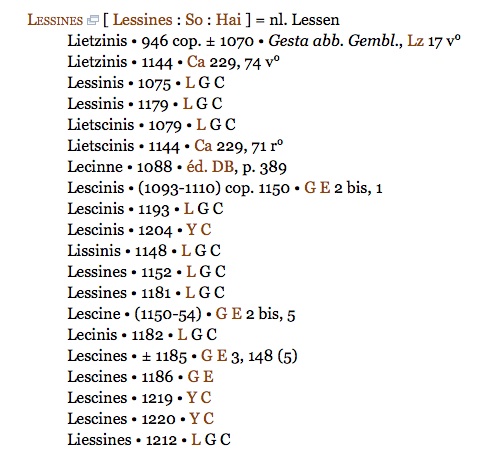
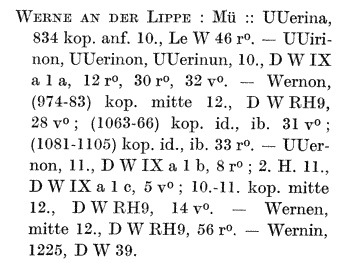
  • two names (that’s for starters – someone should really go up and down the river) that we noticed on the River Lippe (Lippa) that is Werne an der Lippe > former  Werina (Uuerina) and Kamen > former Camine – these are marked with a purple circle;
  • names of a “forest” nature such as Lesquin > former Lechin/Lescin, Lessines, Lessy, Quœux-Haut-Maînil (also Maisnil) > former Lesin/Lisin, etc. – these are in red;
  • other place names with the -in ending (for more of those see here, of course) – these are in navy blue squares/diamonds;
  • finally, we could not resist to throw in Barlin and Moskou > see the yellow stars;

We are not, of course, suggesting that all or any of these are Slavic (e.g., Dublin, Michelin, Peppin or, for that matter, Rabin!) – nevertheless, this is an interesting exercise.

veleti

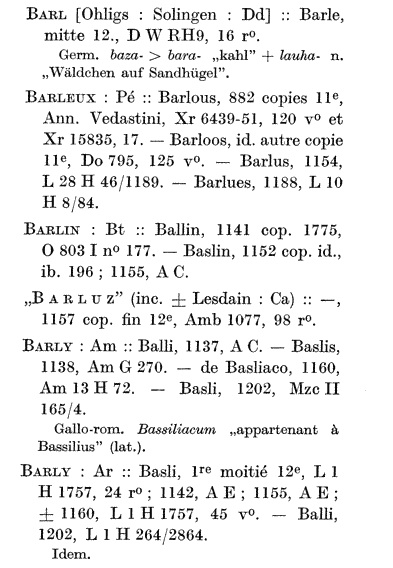
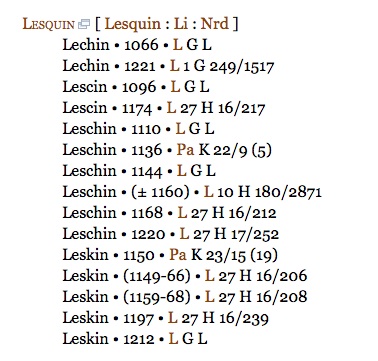
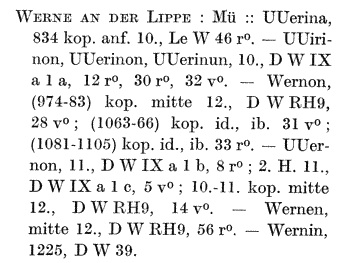
Here are Gysseling’s descriptions of the above – he also gives the current name and the source documents with approximate (or exact) dates.  You can get more info (including the meaning of the non-obvious acronyms at the address above). 
Barlin

Kamen
Quœux-Haut-Maînil lessy lesquin liusna

vendin

wenden

Werina

If you want to try something interesting, you can plot the following – we did and there were simply too many place names.

Velzen

Copyright ©2015 jassa.org All Rights Reserved

October 17, 2015

On the Brothers Germani, Vennad, Veljet

Published Post author

For the proposition that Slav-Teutonic relations were not always just hostile (or at least not any more hostile than intra-Teutonic and intra-Slav relations we have to look no further than the Greater Poland Chronicle (end of the 13th century) where we read the following passages.  They also contain an interesting (if rather unlikely) interpretation of the name germani – later fully appropriated by the “Teutons”:

“It is worth knowing that Slavs and Teutoni are said to descend from two brothers, John and Russ [or Kuss] [themselves] descendants of Japheth, in accordance with what Isidore says in the first volume of his Etymologies and what Martin says in his Roman Chronicle.”*

slavi1

(Scire autem dignum est, quod Slavi et Theutonici a duobus germanis, Japhet nepotibus, Jano et Russz, dicuntur habuisse originem, prout Isidorus in primo libro etymologiarum, et Martinus in Cronica romana videntur declarasse.)

* These names come from Genesis.  As for Isidore he says nothing about Slavs or Germans in volume I of his Etymologies.  The various nations are discussed first in volume V – where, however, Isidore does not mention Slavs.  He does mention the Sarmatians, the Alani, Alemanni, Lombards and Vandals before discussing the “Germanic” nations including, in their own section, the Suevi. (Book IX, 2, 98).  The reference to “Martin” is to Martin of Opava or Martin of Poland (Martinus Polonus) and his Chronicon pontificum et imperatorum.

“And now also to explain the name Germanorum.  The name comes from “german” because the one and the other is bound together with the blood of brotherhood [i.e., is related].  For “gerzmo” is a certain type of tool, in which two cattle are united pulling behind them a plough or a wagon.  And so too the Teutoni who have countries neighboring the Slavs, frequently interact with them and there are in the world no other nations who are so pleasant and friendly to one another as the Slavs and the Teutoni.  So too, from the Latin speakers comes the name Ducz [Deutsch], from which later comes Teutoni and Slavus from which comes the name Slavs, and then germane, that is brothers.”

slavi2

(Item alia interpretatio Germanorum.  Dicitur a german, quia unus alterum fraternitatis consanguineitate attingebat.  Nam gerzmo est quoddam instrumentum, in quo duo boves simul juncti trahendo aratrum seu plaustrum incedunt.  Sic et Theutonici, cum Slavis regna contingua habentes, simul conversatione incdent, nec aliqua gens in mundo est sibi tam communis et familiaris, velut Slavi et Theutonici.  Sic etiam per Latinos Ducz a quo Theutonici, et es Slavus a quo Slavi, germani qui et fratres, sunt appellati etc.)

Of course, Venäjä in Finnish refers to Suavs (supposedly by way of the Teutons: “from Proto-Germanic *winidaz“). Curiously, though, in Estonian, the words for “brother/brothers” are vend/vennad. In Finnish, this is veli/veljet which, of course, sounds like Veltae/Wieleci/Veleti.

Copyright ©2015 jassa.org All Rights Reserved

October 16, 2015

On Words Part III – How You Say or the Polish Letter “Ł”

Published Post author

Recently, a friend of the site has raised an issue with the pronunciation of the word Suevi (or for that matter Suebi).  To the extent the “ue” was not pronounced as a “v”, it seems to have been pronounced as a “u”.  However, it has been claimed that the Slavic letter “Ł” – or rather the sound which the letter is currently understood to represent, i.e., the sound that in English would be written as a “w” – did not originally exist in Slavic languages.

In particular, it has been claimed that:

  1. Eastern and Southern Slavs pronounce their corresponding “Ł” sounds as “L”s.
  2. the aristocratic and sophisticated members of high society – the Polish elites – refused to adopt it up until after World War II (when they also happened to have been heavily thinned out).
  3. instead, what is today pronounced in Poland as a Suav or Swav was – as in most southern and eastern Slavic languages – previously pronounced Slav; and, the “w” sound in its current Polish form developed only “in the last quarter of the 16th century“; in fact, the great Polish writer Jan Kochanowski called the “w” pronunciation pejoratively “wałczenie”

What is the relevance of this?

Put simply, if the Suevi were pronounced Suevi (i.e., with a “u”, a claim we assume as true for purposes of this piece) but if Slavs were pronounced Slavs (i.e., with an “l”) and not Suavs then the notion that the two words were related – except in the more distant sense as set out by Jacob Grimm – would seem overturned.

Let’s take a look at these claims – starting with the easiest ones.

Zugegeben

Claim 1 is not really debatable.  Current pronunciation of the word “Slav” in Eastern and Southern Slavic languages – and pronunciation of the same sound in those languages as far back as we can see – is indeed an “l” pronunciation.  This, however, should surprise no one.  After all the Greeks did write Sclavi – indicating that the Slavs that invaded Byzantium were Eastern Slavs.

In fact, some people in Eastern Poland (e.g., around Białystok) still pronounce the L “dentally”, i.e., have the tongue touch the upper teeth in pronouncing their “Ł”s (although the dental pronunciation is waning and remains – among Polish speaking peoples – primarily among ethnic Poles living in Belarus, Ukraine and Russia (but, apparently and curiously, not in the northern portions of the former USSR, e.g., not in Lithuania)).

Claim 2 is partly true – a large portion of the Polish nobility did pronounce the “Ł” as an “L” and so did the “classically trained” pre-WWII Polish actors.  However, that fact, in and of itself, does not show which is the “more Polish” or “more correct” pronunciation…

What of Claim Number 3?

The other claims, however, are much more problematic.  For example, it struck us as rather curious to pin point the alleged change from an “l” pronunciation to a “w” pronunciation so exactly to the “last quarter of the 16th century”.  Are we really to believe that the vast majority of the peasant population of Poland suddenly got up and changed how they pronounced a particular letter?  Presumably not.  Presumably the process should have been gradual.

But there is no evidence for a gradual process that has been developed.  What we see instead is an “l” pronunciation among the upper classes and people in Eastern Poland and a “w” pronunciation among the lower classes elsewhere in Poland.  (Add to that a potential “w” pronunciation among some of the Wends of Germany and among a portion of Polish nobles).

So what “happened” at the end of the 16th century that people are so focused on?

It turns out nothing that should be of relevance.

In order to formulate a response, however, one first has to go back to the facts…

Where are the Facts?

A good source for the facts is a proponent of the view that the “w” pronunciation was not the original one – Zenon Klemensiewicz.  Klemensiewicz provides a nice summary of the sources of the literature on this topic in his “History of the Polish Language” (Historia języka polskiego).

walcanaei

“[There was change in the articulation of the phoneme ‘ł ‘ a the turn of the 16th and 17th century expressed in the disappearance of the dental pronunciation, which with time led to the pronunciation by a significant portion of Poles of the ‘l’ as a ‘u’.]  The oldest signs of this “wałczenie” was discovered by A. Brückner in”Maciej Rywocki’s Peregrination Books (1584-1587)” (Archive for the Literature and Education in Poland, vol. XII, pp 177-257) and noted the same in the Etymological Dictionary under the entry ‘Narzecza’ [i.e., dialects].  We also find it in the documents of the Cracow Archive from the year 1588.  Kochanowski in Polish Orthography says about the ł “barbarum”, which suggests that he is talking about the ‘wałczone’ ł, which, indeed, would sharply contrast [in pronunciation] with the liquid ‘l’.  At the beginning of the 17th century we also find signs of wałczenie  in Maciek’s Peregrinations from the year 1612, e.g., okoo = okołopszezegnau, poetry.  [The spread of the pronunciation of the letter ‘ł’ as a ‘u’ falls into the New Polish Age [he means 1750-1939]].”

Note: As regards Klemensiewicz’s lead-in or his, last sentence, we can only say that the review of the literature shows them to be clearly unsubstantiated.  His reference to the “articulation of the phoneme ł” is also misleading in that, as we will see, the question in the 15th and 16th centuries was not of phonemes but rather of whether the letter “l” – which represented two phonemes “l” and “ł” – should be split into two different letters and, if so, how should these be written.

Nevertheless, Klemensiewicz’s source summary is helpful and we rely on it.

What are the Facts?

In 1584, a young gentleman – Maciej Rywocki – probably from Mazuria along with three of his friends and a servant set out for a three-year long trip to Italy.  He was no doubt one of many young scions of wealthy families who were sent to educate themselves in the arts and culture of post-Rennaissance Italy.  What those young gentlemen actually planned to achieve in Italy (and on the way there) when their parents’ ears were a distance away, was, of course, quite a different matter.

ksiegi peregrynackie

Rywocki, was unique, however, in three respects.  First, he – unlike some of the other “peregrines” – wrote down his adventures in a manuscript.  Second, the manuscript survived.  Third, the manuscript was deemed interesting enough, for one Jan Czubek, to publish it in print in 1910 under the pompous title “Maciej Rywocki’s Peregrination Books (1584-1587)”.

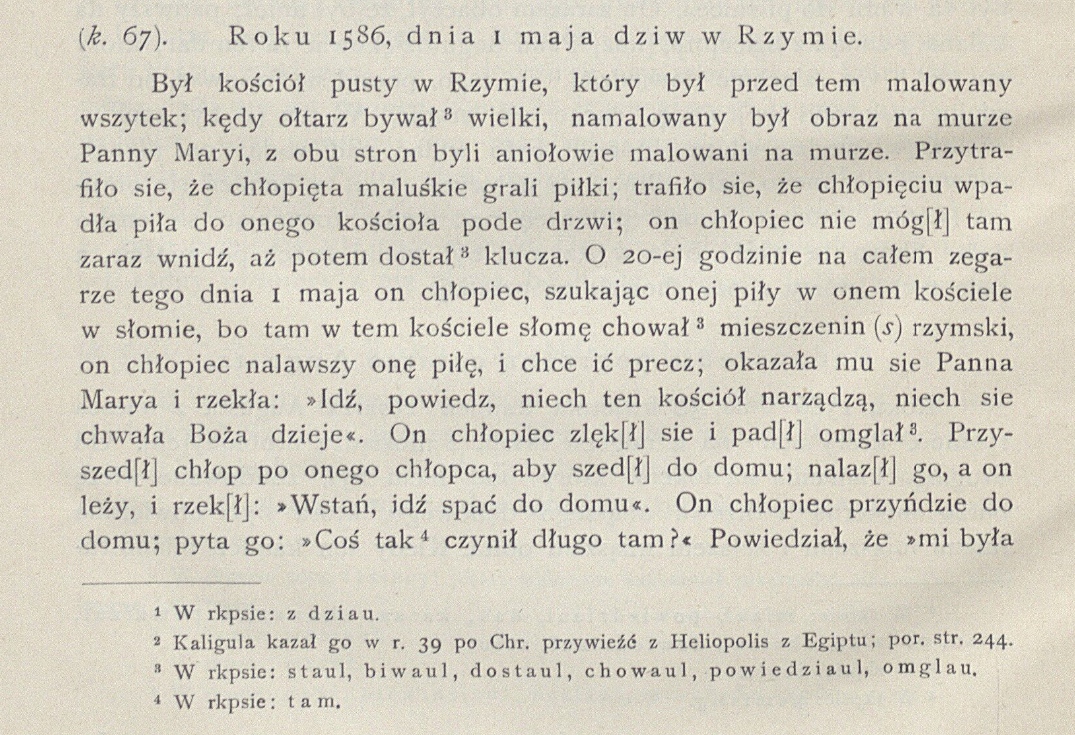
The published work describes how – on sheet 67 of the manuscript – Rywocki and his companions came across a mighty memorial stone placed in honour of Augustus.  Rywocki also describes on the same page below a miracle whereby a boy who lost a ball (which fell into a local church) saw the Virgin Mary appear to him.  In both of these descriptions – of the stone and of the church miracle – Rywocki spells  what in the literary language of the day presumably should have been an “l” as a “ul” instead.  This same “phenomenon” appears in other parts of the manuscript.

omglau

The published work and – perhaps too – the manuscript were examined by the Polish linguist and literary historian Aleksander Brückner.   Brückner published his great Polish etymological dictionary in 1927 and, under the definition of the word “narzecze” (roughly, “dialect”) he stated the following to describe a process that had been referred to before as “wałczenie” – that is the replacement (or rather alleged replacement) of the “l” sound by the “w” sound:

brucknr

“Another aspect [of dialects], wałczenie, the [bi]labial pronunciation of the liquid ł [as opposed to dental], even more widespread [than mazurzenie], newer [why?], in the 16th century among the peasants constantly mocked [by whom Brückner does not say], it [i.e., this aspect of the peasant dialects] does not appear in the literary language (maybe in Mazur Rywocki’s [writing] who wrote in the year 1584 omglau, posłau, kardynau, etc.).”

bruckner2

Thus, Brückner claims that wałczenie was a “linguistic development”  That it was “newer” than mazurzenie.  That it was not reflected in the Polish literary language (by this he means that it was not reflected in the orthography of the day) except, perhaps, for the first time in 1584 in Rywocki’s writing (Brückner calls Rywocki a “Mazur”, i.e., a man from Mazuria).

Several things come to mind.

First, Brückner nowhere (at least not that we know of) shows why either of these dialectic aspects was a “development” from the “proper” Polish or Slavic in the first place.  Absent some other evidence, the only way to make this claim it seems is to assume that the Eastern/Southern Slavic languages were more ancient than the Western ones.  But that, in turn, may presuppose the direction of Slavic migrations – a question that (as our friend points out) we are trying to answer here in the first place.

Second, Brückner does not say that this development “occurred” in 1584 or in the “last quarter of the 16th century”.  He merely notes that the earliest evidence of the process in the literary language was – in his view – the Rywocki manuscript/book.  This is in stark contrast with claims that the “l” became a “w” sound “in the last quarter of the 16th century”.

Third, as to the geographic scope of these phenomena.  Brückner says that wałczenie was an even more widespread aspect of Slavic dialects than mazurzenie.  What does he mean by “widespread”?   Does he mean among the populace in the regions in question (wherever they may have been) or does he mean it more in a geographic sense?

Well, earlier in the same paragraph Brückner states that mazurzenie is itself quite “widespread.”  It is absent in Great Poland and in Kashubia, southern Silesia and also absent from the literary language.  This leaves – for Poland – Little Poland (around Cracow) and Mazovia (around Warsaw) as well as, obviously, Mazuria (i.e., southern portion of East Prussia).  But Brückner states that this process of mazurzenie is not exclusively Polish and that it covered entire Pomerania “even beyond the Elbe (and there it is found already around the year 1000), so also Old Prussia (in the 13th century) and Latvia, and reaches to Great Novogrod.”  If we take Brückner at his word and assume that wałczenie was even more widespread (in the same geographic sense that he just discussed for mazurzenie) than mazurzenie, then given what he wrote we are unsure of how even to limit wałczenie‘s geographic scope.

Fourth,  as to the chronology.  Brückner claims  that mazurzenie was already present around the year 1000 in Polabia…  (Assuming this to be true (he does not say here in which portions of Polabia), we cannot, however, conclude that it moved West to East from there for the simple reason that the state of knowledge at the edges of the Frankish Empire was greater than further East).  Brückner does not tell us here why  wałczenie is supposed to be younger (and how much younger) than mazurzenie.  But even if it were younger, given Brückner’s dates we could assume a time as early as the 11th century…  Certainly the end of the 16th century may simply be a time when the pronunciation started appearing among the upper classes of society as well or at least in the literary language – to the extent Rywocki’s diaries may be seen as that.

But there is more.  Given the lack of significant West-Slavic literary samples from before the 16th century and, even more importantly, given the free-for-all nature of Polish grammar and orthography at the time, there is very little that can be said of how written letters were actually pronounced and whether such pronunciation differed geographically, across socio-economic classes, etc.

All that we can really say here was that wałczenie could have been in place – using Brückner’s own assertions:

  • chronologically – maybe since the 11th century but, realistically, as far back as we are able to look.
  • geographically – unspecified, but covering a “more widespread” geographic area than mazurzenie which covered Little Poland, Mazovia, Mazuria, entire Pomerania as far as the Elbe/Laba (with the possible exception of Kashubia (Kashubian language does have an “ł”), Old Prussia, Latvia and Rus as far as Veliky Novgorod
    • whether and to what extent there was a territorial correspondence between these two aspects of “dialects” is not clear from Brückner’s description.

Put differently, there is no specific reason to believe based on the review of the above that the Polish (or Polabian or north-western Russian) peasantry pronounced the word “Slav” as anything other than “Swav” or “Suav” at any time for which we have sources.

Wałczenie a la Barbarum 

But maybe there are some other reasons to think wałczenie first appeared “in the last quarter of the 16th century”.  Here we come to the Kochanowski assertion.

And, what did Jan Kochanowski say about wałczenie?  Well, we have not found the term in Kochanowski…  (BTW it is not clear (to us) where it comes/originates from).

What Kochanowski did say (as Klemensiewicz correctly notes – see above) was that there was a second pronunciation of the letter L and that it was barbarum.  He did so in a book on Polish orthography called “The New Polish Character and Polish Orthography” issued in 1594 which he co-authored with Lukasz Gornicki (i.e., Łukasz (!) [Ogończyk] Górnicki) and Jan Januszowski.

orthography

There Kochanowski states the following under the heading for the letter “L”:

Polish:

L. L, dwoje: jedno łacińskie, które tak pisać: ladaco, lód, wilk, ktokolwiek. Drugie barbarum, które tak pisać: kłótka, łaskawy, łakomy.”

English:

L. L, two different ones: one is Latin, which should be written as follows: ladaco, lód, wilk, ktokolwiek.  The second barbarum, which should be written as follows: kłótka, łaskawy, łakomy.”

If you look closely you will see what he is talking about – Kochanowski says that the Latin L should be written curling towards the upper right whereas the “barbarum” L should be written with a dash starting at the top of the letter and then heading towards the lower left:

jpg1jpg2

Kochanowski does not say how the “barbarum” L was pronounced, though it is clear that it was pronounced differently from the Latin L.

What is more interesting than what Kochanowski wrote is what his co-author Januszowski wrote.  Januszowski says that he does not like the different ways the same letter is used (i.e., the different pronunciations being associated with one letter).  But he says that (rather than what Kochanowski suggests (i.e., the curling right or the dashing left) which, in Januszowski’s view, may easily result in misspellings because the differences between the Kochanowski suggestions are so negligible), that we should instead leave the Latin l and L as they are and use a second l/L, a “Polish one” with a line through it, i.e., ł or, if capitalized, Ł.

Januszowski also notes that the third author –  Lukasz Gornicki (whose name would be most affected by these changes) – prefers to write – in lieu of the “Polish ł” – a double ll together.

A few points:

  • In none of this is there a suggestion of:
    • how the the letter Ł should actually be pronounced aside from the fact that it is pronounced differently than L;
    • the relative age of the pronunciation of either sound – or even any claim which is the newer one (barbarum simply meant the uncouth, non-Latin pronunciation).
  • Moreover, the fact that:
    • Kochanowski calls the Ł (w?) sound barbarum suggests not just that it was the uncouth, non-Latin pronunciation but that it was the older one, perhaps retained from the past by the peasantry (other than in the East perhaps) – this is because the lower classes, sheltered more from cosmopolitan influence – are more likely to preserve their ancient customs, rites and, yes, pronunciations;
    •  Januszowski calls the Ł a “Polish” letter hints also that the underlying sound itself which the letter was meant to represent may have been local.

Thus, based on this early book on orthography we are inclined to suggest that – notwithstanding Klemensiewicz and Brückner – the “w” pronunciation was at least as ancient as the “l” pronunciation with the difference (at least as far as the eye can see) being more geographic than chronological.  If one were to extrapolate from the above, one could tentatively associate the North and Northwest of Slavdom (Suavodom?) with the “w” and the East, the Southeast and the South with the “l”.

(Of course, the chronology of all of these is likely to be very complicated but we can say “at least for all practical purposes relevant here” – e.g., what the pronunciation may have been 4,000 years ago is anyone’s guess).

Wałczenie a la Parkoszowic

We also note that the question of how to spell some of these sounds was already tackled by our friend  (see here and here) Jakub Parkoszowic in his much earlier (circa 1440) treatise on orthography (this was a first known attempt to standardize Polish orthography):

1mention

“{ll} And so also the ‘l’ sometimes hardens, sometimes weakens, for example, [in] list it is a letter [used] for [the word] ‘leaf’ [but] listh is a part of a leg; lis that is a ‘fox’ [but also] lisz that is a ‘bold person’; despite the fact that all else remains the same, [the ‘l’] is once harder once softer; so [also] at the end [of a word], For example, Staal that is ‘steel’ [and] staal [that] is ‘he stood’.”

Note: Parkoszowic calls:

  • the “Latin L/l” a “soft L/l”; and
  • today’s “Ł/ł” (i.e., pronounced today as “u” a “ue/ua” or “w”) a “hard L/l”.

thus, stal as in ‘steel’ is pronounced as it looks in English (“softly”) but stał is pronounced ‘stau’.  

He continues further in the text:

2mention

“And let also the hard ‘l’ be written without the dash.  For example, lapka, lekce, liszego losze ludzy lothka.  But let the weak ‘l’ be written with a dash at the top.  For example, laasz, lis, loch, lesch, ludze, ląnkawka.”

Finally, he says:

3mention

“And so also with ‘l’.  If we decide to represent the soft ‘l’ by using [after it] a double ii [he means a ‘y’ so that the whole thing is written ‘ly’], in some cases that will be appropriate, in others absolutely not.  Thus, lyschka that is a ‘fox’, lysska is a ‘caterpillar’, lysth is a ‘leaf’.  Whereas, in accordance with what has been said above – each vowel that is written with two letters should be pronounced as a long [vowel], in all the above examples [the vowel] is a short one.  This is the first example of nonsense [in the current orthography].”

Note: Parkoszowic means that if we indicate the soft (Latin) ‘L’ by writing a ‘y’ after the ‘L’ then the impression would be that the vowel that follows the ‘L’ should be a long one (e.g., leeeeeeeeaf) which is wrong at least in some cases.  Thus, in fixing the pronunciation of the ‘L’ we give the subsequent vowel is to be pronounced.

“And also if one adds a double y to an ‘l’ that occurs at the end of a word then hat will result in a confusion of meanings.  For example, staal that is ‘steel’.  If after the ‘l’ one were to write a ‘y’, we would get staaly, which means ‘they stood’.  So where is [what happened to] our ‘steel’?  If we were to write without the ‘y’, then we would have  stal that is ‘he stood’.  That’s the other problem.”

“It would be better to express the difference [in pronunciation], if we were to write the hard ‘l’ without a dash, [but] with a ‘staff’ [instead]; hence, staał łyssy, that is ‘he stood [i.e., became] bald’ [current Polish: stał [się] łysy – ‘he became bald’]; whereas, the soft ‘l’ without adding the ‘y’ [such as] stal that is ‘steel’, listh that is ‘leaf’, luud that is people.”

Note: Thus, Parkoszowic in his treatise (written circa 1440) opted, in resolving the issue of a double pronunciation of the letter ‘L/l” to:

  • keep the “Latin” L/l as an L/l everywhere (no changes there); and
  • to create an additional letter – Ł/ł – to represent the “w/ue/ua” sound (as in Suevi or Suavi).  That additional letter would not have a dash going towards lower left on top but rather have a line or “staff” through it.  A century and a half later, years later in choosing the same “staff” crossing an ‘L’ to represent the “hard L”, Jan Januszowski would agree with Parkoszowic (Kochanowski, as we saw above, preferred the dash).

Conclusion

Based on our review of the sources, it seems the above claim 3 has absolutely no basis in any of the sources we saw or that are cited by its proponents.

rocznk

Consequently, we feel confident once again to reiterate that – at least among Western and Northern Slavs – the “L” was pronounced as a “ue” as far back as anyone can see.  The only exception to that seem to have been portions of the nobility.  We are willing to be convinced otherwise, of course but are not holding our collective breaths.

reve

Stefan Kulbakin making the same point in the Slavic Review

Copyright ©2015 jassa.org All Rights Reserved
October 13, 2015

On the Tropaeum Alpium

Published Post author

We have previously discussed the Vindelici on a number of occasions.  For example here and here.  As we mentioned, Tiberius (who was not yet emperor) defeated them in 15 B.C. Circa 12 B.C. – 6 B.C., the then reigning emperor (sort of), Augustus had a monument built to celebrate “his” victories (i.e., including those of Tiberius) against various Alpine tribes – including the Vindelici.  The monument – called Tropaeum Alpium – stands (notwithstanding partial destruction on orders of Louis XIV) still in the French commune of La Turbie – near to Monaco.

tropeium

The Tropaeum Alpium is interesting to us because it lists the “four nations of the Vindelici” (among a plethora of others) and because those names – or at least some of them – sound oddly familiar.

trophy1

“The four nations of the VINDELICI:
·· COSUANETES
·· RUCINATES
·· LICATES
·· CATENATES”

top2

VINDELICORVM GENTES.QVATTVOR.COSVANETES.RVCINATES.LICATES.CATENATES.

(note that this is the common interpretations – however, it is also possible that the four above names have nothing to do with the Vindelici and that the “four nations of the Vindelici” are actually unnamed, i.e., that the four above names are simply the four names that merely follow on the inscription the Vindelician tribes which are, again, otherwise unnamed).

Pliny the Elder gives the following summary of the inscription in his Natural History:

IMP · CAESARI DIVI FILIO AVG · PONT · MAX · IMP · XIIII · TR · POT · XVII · S · P · Q · R · QVOD EIVS DVCTV AVSPICIISQVE GENTES ALPINAE OMNES QVAE A MARI SVPERO AD INFERVM PERTINEBANT SVB IMPERIVM P · R · SVNT REDACTAE · GENTES ALPINAE DEVICTAE TRVMPILINI · CAMVNNI · VENOSTES · VENNONETES · ISARCI · BREVNI · GENAVNES · FOCVNATES · VINDELICORVM GENTES QVATTVOR · COSVANETES · RVCINATES · LICATES · CATENATES · AMBISONTES · RVGVSCI · SVANETES · CALVCONES · BRIXENETES · LEPONTI · VBERI · NANTVATES · SEDVNI · VARAGRI · SALASSI · ACITAVONES · MEDVLLI · CENNI · CATVRIGES · BRIGIANI · SOGIONTI · BRODIONTI · NEMALONI · EDENATES · VESVBIANI · VEAMINI · GALLITAE · TRIVLLATI · ECDINI · VERGVNNI · EGVITVRI · NEMATVRI · ORATELLI · NERVSI · VELAVNI · SVETRI

best2

Strabo says the following (Geography IV, 6.8):

“Next, in order, come those parts of the mountains that are towards the east, and those that bend round towards the south: the Rhaeti and the Vindelici occupy them, and their territories join those of the Elvetii and the Boii; for their territories overlook the plains of those peoples. Now the Rhaeti reach down as far as that part of Italy which is above Verona and Comum (moreover, the “Rhaetic” wine, which has the repute of not being inferior to the approved wines of the Italic regions, is made in the foothills of the Rhaetic Alps), and also extend as far as the districts through which the Rhenus runs; the Lepontii, also, and Camuni, belong to this stock. But the Vindelici and Norici occupy the greater part of the outer side of the mountain, along with the Breuni and the Genauni, the two peoples last named being Illyrians. All these peoples used to overrun, from time to time, the neighbouring parts, not only of Italy, but also of the country of the Elvetii, the Sequani, the Boii, and the Germans. The Licattii, the Clautenatii, and the Vennones proved to be the boldest warriors of all the Vindelici, as did the Rucantii and the Cotuantii of all the Rhaeti.”

Thus, according to Strabo, the Tropaeum Alpium‘s Licates (Licatti) would be Vindelici.   But the Rucinates (Rucanti) would be Rhaeti.  Perhaps the Cosvanetes are Vindelici (if they correspond to Vennones) or Rhaetii (if they correspond to Cotuantii) . The Catenates are either Vindelici (Clautenatii) or Rhaeti (Cotunatii).  The Cotuantii obviously suggest the Antes.

As we all know Noricum was right next to Rhaetia and Nestor explicitly bills the Slavs as Noricans.

Now, all of this is very interesting and – slightly – odd since the much, much later Greater Poland Chronicle (aka Chronica longa seu magna Polonorum*) contains the following assertion:

“Per praemissa autem quatuor regna slavonica, videlicet Pannoniorum, Lechitarum, Ruthernorum et Czechorum seu Bohemorium designata habent.”

Which translates to:

“They have designated for themselves four kingdoms, namely, known by their names of Pannonians, Lechites, Ruthenes, and Czechs called Bohemians.”

praemissa

Polish National Library

* The “Greater Poland Chronicle” is a bit of a misnomer.  It was written in Great(er) Poland but the actual title refers to the long or great chronicle of the Poles.

Whether one could reasonably associate the Licates with the Lechites and the Rucinates with the Ruthenes is a question.  Whether the Czechs could pick up the Cosvanetes or Catenates is another.

Copyright ©2015 jassa.org All Rights Reserved

October 13, 2015