Athleta Christi

Published Post author

The tomb of Boleslaw the Great (aka the Brave) was located in the Poznan cathedral.  This much we know from the Greater Poland Chronicle.  The cathedral itself was upgraded in the then popular “Gothic” style by Casimir the Great in the 14th century.  The first (? see below) mention of an inscription on the upgraded tomb dates to 1422 and is found in a document dealing with the feud between the Teutonic Knights and the King of Poland (it is a witness statement on behalf of the Polish King by one George Merkil, a notary of Poznan).  According to the subsequent testimony of Jan Dlugosz (in the “Lives of Bishops of Poland” or Vitae episcoporum Poloniae), it was Casimir who included this inscription regarding the deeds of his predecessor:

[Casimirus] sarcophagos Regum humiles et solo sequatos, petrosa mole super imposita erexit, delitescentesque umbras, ne in perpetuam residerent oblivionem, vindicatas illustravit, et Posnaniensi ecclesiae vasa aurea et argentes dono data reliquit.”  

vita

The first edition of the text – it was previously thought (again see below) – came from 1490 when Stanislaw Streczaka a Benedictine monk from Tyniec mentioned it in his copy of the Gesta Romanorum (the manuscript was in Lviv where it was apparently destroyed in a fire in 1848).

poznaniensises

what is believed to be the actual tomb underneath the Poznan Cathedral

In any event the tomb was moved in the second half of the 18th century and in 1790 was destroyed when a portion of the cathedral tower fell off.  Once the tomb was destroyed (metaphor?) and the Polish state partitioned (over the years 1772-1795), suddenly everyone became interested in what that inscription said.

A number of authors were discussing it (Lubienski, Starowolski, Hartknoch, Zalaszowski, Czacki, Sarnicki, Naruszewicz) before Joachim Lelewel really made a study of it.  Here it is:

“In this grave there rests
a chieftain, a noble dove
You were called Chrobry
may you be eternally blessed
Though from a pagan father,
yet your mother was a believer
Drops of holy water caused
that you became God’s servant
When you hair was cut
it was laid in Rome
From then among conflict
you were Christ’s athlete
You won [many] lands
and made many wars
Distinguished chief
praise to you, stout Boleslaw
Thus the kingdom of Slavs
Goths,* and too of Poles
The Emperor did raise higher
so thou need not be a duke
And [in turn] many gifts you
you gave [him]
You gave to him
[for] riches/wealth you had aplenty
And to give you fame
did Otto give you the crown
For your great deeds
may you find salvation. Amen”

athleta

Athleta Christi showing the (old) Prussians the (not yet royal) finger

(Hic iacet in tumba
princeps generosa columba
Chabri tu es dictus

sis in evum benedictus
Perfido patre
tu es, sed credula matre
Fonte sacro lotus
servus Domini puta totus
Precidens comam
septeno tempore, Romam
Tu possedisti
velut verus adleta Cristi
Vicisti terras
faciens bellas quoque guerras
Inclite dux
tibi laus, strenue Boleslaus
Regni Sclavorum
Gottorum sue Polonorum
Cesar precellens
a te ducalia pellens
Plurima dona sibi
que placiere tibi
Hinc detulisti
quia divicias habuisti
Ob famamque bonam
tibi contulit Otto coronam
Propter luctamen
slt tlbl saLVs Amen)

And in Lelewel’s version (with a Polish translation) (note that the lines are differently ordered here):

lelewelz

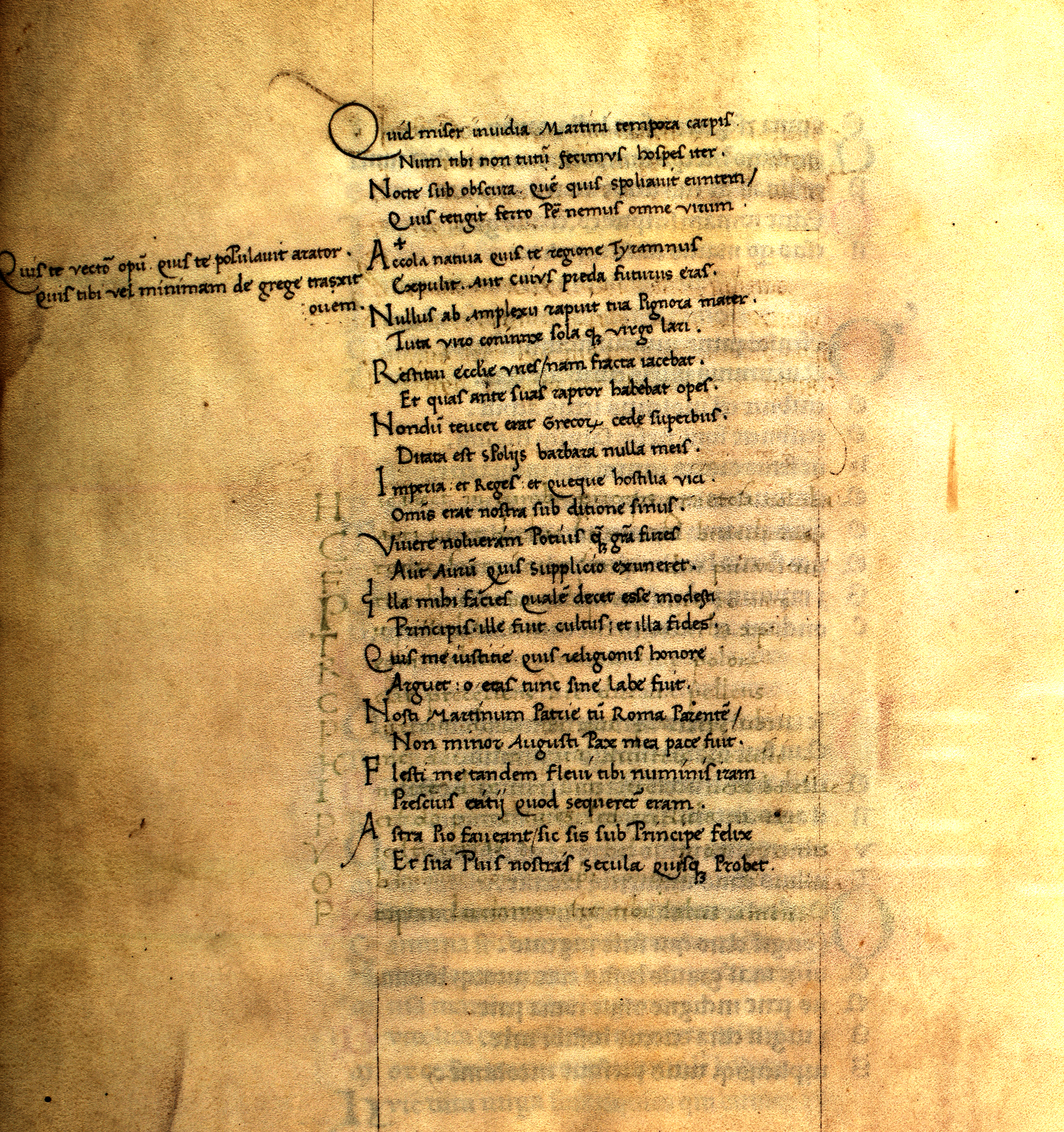
At the time of Lelewel’s writing the oldest copy was thought to be one from 1490.  Interestingly, older versions appeared later – most recently one that was discovered by Wojciech Mischke (an art historian) and that has been dated to the beginning of the 15th century.  How Mischke discovered it should be a subject of independent study.  The language appears in the Codex HM 1036, of the Huntington Library in San Marino (California not Italy) but “appears” is a bit of a tongue in cheek joke.  It barely appears.  Or rather, it was erased and overwritten with a poem praising Pius II (who was Pope between 1458-1464).  We can only assume that someone who tried to read the remains of the writing understood enough of what it said so as to bring in a Polish medievalist like Mischke for a consult (another mystery). You can see it here (folio 206):

stranges

What is interesting, however, too was that there is apparently another writing earlier than the Chrobry inscription that is visible underneath.  Here is the back of that page (folio 205) where you can see it peeking through an Epigram of Martial:

strangezt
 Other pictures of the manuscript can be found here.

huntington

* So what about these Goths?  That Goths conquered the Veneti is evident from Getica itself.  A memory of Goths was preserved all over Eastern Europe (much like Vandals in Central Europe).  Numerous examples abound:

  • Gallus Anonymous speaks of the Sarmatians as Getae – probably meaning the Prussians (The Slavic lands… begin with the Sarmatians who are also known as Getae/Goths)
  • Kadlubek speaks of the Prussians as Getae during the events surrounding the Polish pagan rebellion of the 1030s
  • The Greater Poland Chronicle speaks of the Getae as Russians during the same events
  • The Chronicle of the Priest of Dukla discusses the Goths basically as a variant of Slavs
  • Various Frankish Annals (Borna duke of the Guduscani) refer to certain Slavic tribes in the Balkans as Goths
  • Then you have the above inscription, which probably refers to the Prussians, etc

Here is the Bielowski description in Polish:

bielowksi

Copyright ©2016 jassa.org All Rights Reserved


February 8, 2016

Of Beer & Loincloths

Published Post author

Diodorus Siculus (Diodorus of Sicily) was an ancient Greek historian who lived about 60-30 BC.  He wrote several interesting works among them, quite naturally, a history (more precisely, a work called the “Historical Library”).

zyth

Book V of that history contains interesting descriptions of northern Europe (including of Britain).  You can view the whole write up here.  For our purposes, however, we will be content to present only three fragments that relate to Gaul:

26 “Furthermore, since temperateness of climate is destroyed by the excessive cold, the land produces neither wine nor oil, and as a consequence those Gauls who are deprived of these fruits make a drink out of barley which they call zythos or beer, and they also drink the water with which they cleanse their honeycombs.”

29 “Certain of them despise death to such a degree that they enter the perils of battle without protective armour and with no more than a girdle about their loins.”

32 “And now it will be useful to draw a distinction which is unknown to many: The peoples who dwell in the interior above Massalia, those on the slopes of the Alps, and those on this side the Pyrenees mountains are called Celts, whereas the peoples who are established above this land of Celtica in the parts which stretch to the north, both along the ocean and along the Hercynian Mountain, and all the peoples who come after these, as far as Scythia, are known as Gauls; the Romans, however, include all these nations together under a single name, calling them one and all Gauls.”

The three interesting points are as follows:

Beer

First, the barley drink, i.e., beer is mentioned here as a Gallic drink named zythos.

Now, zythos is supposed to be an Egyptian type of beer not Gallic.  It is certainly true that in Book I of the same work Diodorus says the following:

34 “The Egyptians also make a drink out of barley which they call zythos, the bouquet of which is not much inferior to that of wine.”

Similarly, the Talmud notes (42b) as follows:

“What is Egyptian Zithom? —  Rabbi Joseph learned that it is a concoction made of a third part barley, a third part safflower, and a third part salt.  Rabbi Papa omitted barley and substituted wheat.  And your token is ‘sisane.’ They soaked these ingredients, then roasted them, ground them and then drank them.  From the Passover sacrifice until Pentecost, they who are constipated are relieved, while they who are diarrhoeic are bound.  But for an invalid and a pregnant woman it is dangerous.”

However, the earlier source is Diodorus by far (the Babylonian Talmud was not completed, at the earliest, until around 500 AD). And he also says that the Galls use the same term as we saw above.  In neither place does Diodorus say whether the word is originally Gallic or Egyptian or of some other origin.  However, the Greek ζύθος may have cognates in both Greek versions of “leaven” and in “yeast”.  If this is the case then it is also possible that the word is northern in origin – perhaps brought to Egypt with the armies of Alexander the Great.  (The Egyptians by all accounts did know beer – what they called it, however, is an entirely different matter).  Thus, perhaps, zythos was a Gallic or otherwise northern European name.

Moreover, as the above quotation notes it may not have been just a barley drink.  A much earlier source,  Theophrastos (circa 371 – about 287 BC) in his History of Plants apparently says that the term covers “those beverages, which were prepared, like those made of barley and wheat, of rotting fruits.”  Consequently, it seems that the term encompassed more than just barley drinks.

It is curious then that the Slavic word for “secale” – e.g., żyto (Po) or žito (Czech) – should sound so similar.  Aleksander Brueckner has very little to say about the etymology of this rather important word referring only to “life”, i.e., život/życie).

(Incidentally 1, the Greeks also knew kamon which was Dalmatian beer.  Whether that has anything to do with kamos of the Huns we leave to you but Priscus did say when visiting Attila’s camp: “In the villages we were supplied with food – millet instead of corn – and medos as the natives call it. The attendants who followed us received millet and a drink of barley, which the barbarians call kamos.”)

(Incidentally 2, sources relate that the consumption of zythos won’t result in “punishment” of karat[h] or “cutting off” – כרת – why Slavic – an IndoEuropean language – should have the same word for punishment – kara – as Hebrew, we leave to speculation noting only that other “weighty” words may also be similar such as the word for “good” – dobri).

Loins & Loincloths

Barbarian warriors, no doubt, often fought without armour and with pitiful protections.  Nevertheless, the above description of the Galls cannot help but bring to mind the later description of the Slavs by Procopius:

“Indeed, some of them do not wear even a shirt or a cloak, but gathering their trews up as far as to their private parts they enter into battle with their opponents.”

Galls & Celts

Diodorus’ division of the “Galls” into “Galls proper” and the more southern Celts should be of great interest to us as should the remark that the Romans have ignored such differences calling all these barbarians by the same name “Galls.”  See here for possible connections.

Copyright ©2016 jassa.org All Rights Reserved

February 7, 2016

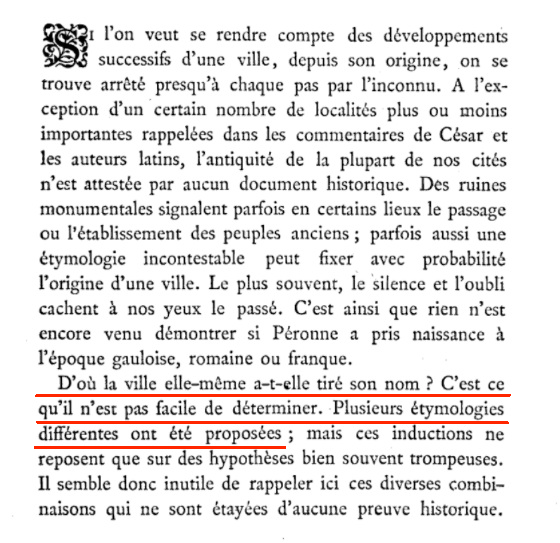
“C’est ce qu’il n’est pas facile de determiner” and other potpourri

Published Post author

Zeeuwen or Seeland is a region of the Netherlands.  We were previously debating the possibility of it being yet another candidate (along with Seeland in Denmark) for the Selencia of Gallus Anonymous.  What’s interesting is that the name Zeeuwen may have come from the name Suevi.  Or at least one researcher suggested that as a possibility.  That researcher was Maurits Gysseling, a name we came across already in the past.  He is the man who thought that BC the language of Gallia Belgica was neither Germanic nor Celtic but rather some “other” Indo-European language (the so-called “Northwest Block” theory).

Here are his musings from the “Toponymisch Woordenboek van België, Nederland, Luxemburg, Noord-Frankrijk en West-Duitsland”:

s

As you can see, Gysseling does not make up his mind on this point, nor, in fairness, would it be easy to do so.  Nevertheless, intrigued, we took a look at the passage he refers to in Annales Vedastini (Annals of Saint Vaast).  These annals are of interest also because of the location of the Abbey of Saint Vaast in Arras which is in Pas-de-Calais in the north of France – an area which has a number of interesting town names.

z1

Annales Vedastini 880

Anno DCCCLXXX

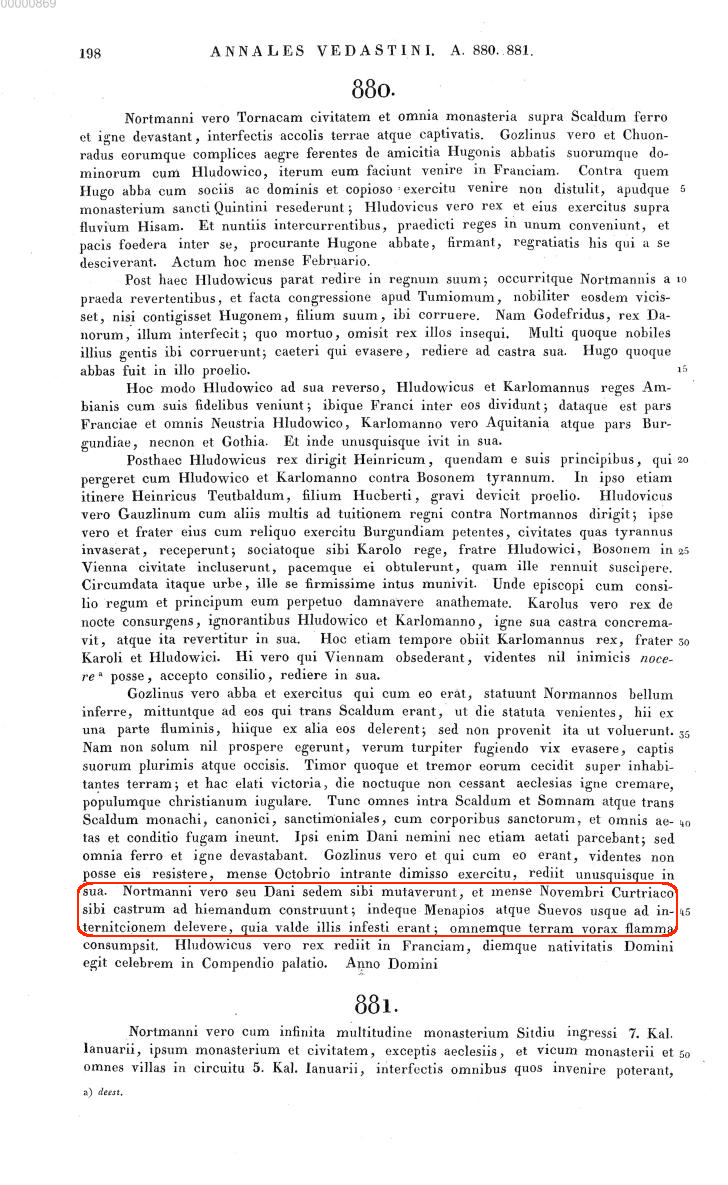
Anno Domini *DCCCLXXX. Nortmanni vero Tornacam civitatem et omnia monasteria supra Scaldum ferro et igne devastant, interfectis accolis terrae atque captivatis. Gozlinus vero et Chuonradus eorumque complices aegre ferentes de amicitia Hugonis abbatis suorumque dominorum cum Hludowico iterum eum faciunt venire in Franciam. Contra quem Hugo abba cum sociis ac dominis et copioso exercitu venire non distulit, apudque monasterium sancti Quintini resederunt, Hludowicus vero rex et eius exercitus supra fluvium Hisam, et nuntiis intercurrentibus praedicti reges in unum conveniunt et pacis foedera inter se procurante Hugone abbate firmant, regratiatis his qui a se disciverant. Actum est hoc mense Februario.

Post haec Hludowicus parat redire in regnum suum, occurritque Nortmannis a praeda revertentibus. Et facta congressione apud Timiomum nobiliter eos vicisset, nisi contigisset Hugonem filium suum ibi ruere. Nam Godefridus rex Danorum illum interfecit. Quo mortuo omisit rex illos insequi. Multi quoque nobiles illius gentis ibi corruerunt, caeteri, qui evasere, rediere ad castra sua. Hugo quoque abbas fuit in illo proelio.

Hoc modo Hludowico ad sua reverso, Hludowicus et Karlomannus reges Ambianis cum suis fidelibus veniunt, ibique Franci inter eos dividunt, dataque est pars Franciae et omnis Neustria Hludowico, Karlomanno vero Aquitania atque pars Burgundiae necnon et Gothtia; et inde unusquisque ivit in sua.

Post haec Hludowicus rex dirigit Heinricum quendam e suis principibus, qui pergeret cum Hludowico et Karlomanno contra Bosonem tyrannum. In ipso etiam itinere Heinricus Teutbaldum filium Hucberti gravi devicit proelio. Hludowicus vero Gauzlinum cum aliis multis ad tuitionem regni contra Nortmannos dirigit. Ipse vero et frater eius cum reliquo exercitu Burgundiam petentes civitates, quas tyrannus invaserat, receperunt. Sociatoque sibi Karolo rege, fratre Hludowici, Bosonem in Vienna civitate incluserunt, pacemque ei obtulerunt, quam ille rennuit suscipere. Circumdata itaque urbe ille se firmissime intus munivit. Unde episcopi cum consilio regum et principum eum perpetuo damnavere anathemate. Karolus vero rex de nocte consurgens, ignorantibus Hludowico et Karlomanno, igne sua castra concremavit, atque ita revertitur in sua. Hoc etiam tempore obiit Karlomannus rex, frater Karoli et Hludowici. Hi vero qui Viennam obsederant videntes nil inimicis posse . ., accepto consilio, rediere in sua.

Gozlinus vero abba et exercitus qui cum eo erat statuunt Nortmannos bellum inferre. Mittuntque ad eos qui trans Scaldum erant, ut die statuta venientes, hi ex una parte fluminis hique ex alia eosque delerent. Sed non provenit ita ut voluerunt. Nam non solum nil prospere egerunt, verum turpiter fugiendo vix evasere, captis suorum plurimis atque occisis. Timor quoque et tremor eorum cecidit super inhabitantes terram, et hac elati victoria die noctuque non cessant aecclesias igne cremari populumque Christianum iugulari. Tunc omnes intra Scaldum et Sumnam atque trans Scaldum monachi, canonici, sanctimoniales cum corporibus sanctorum et omnis aetas et conditio fugam ineunt. Ipsi enim Dani nemini nec etiam aetati parcebant, sed omnia ferro et igne devastant. Gozlinus vero et hi qui cum eo erant videntes non posse eos resistere, mense Octobrio intrante dimisso exercitu, rediit unusquisque in sua. Nortmanni vero seu Dani sedem sibi mutaverunt et mense Novembris Curtriaco sibi castrum ad hiemandum construunt.  Indeque Menapios atque Suevos usque ad internitionem delevere, quia valde illis infesti erant.  Omnemque terram vorax flamma consumpsit. Hludowicus vero rex rediit in Franciam diemque nativitatis Domini egit celebrem in Compendio palatio.

Suffice it to translate only the last part:

“The Northmen or Danes moved their camp in the month of November and they built a fort in Kortrijk to spend the winter there.  And then they [that is the Northmen] razed the land of the Menapii and the Suevi for they were very hostile to them.  And the eager flames devoured the entire country.”

Since we know where Kortrijk is we also know where, approximately, the Menapii (a Belgic tribe – whatever that means) and Suevi must have been:

kortrijk

At the very least this was rather interesting.  As previously discussed here some of the names in the area with the -in ending seemed similar to the -in endings in the east but they were hardly conclusive of a Slavic presence in the area (even if suggestive).

That the Suevi must have in part lived in this area alongside the Frisians we also know from Tacitus’ Agricola (28):

“The same summer a Usipian cohort, which had been levied in Germany and transported into Britain, ventured on a great and memorable exploit. Having killed a centurion and some soldiers, who, to impart military discipline, had been incorporated with their ranks and were employed at once to instruct and command them, they embarked on board three swift galleys with pilots pressed into their service. Under the direction of one of them—for two of the three they suspected and consequently put to death—they sailed past the coast in the strangest way before any rumour about them was in circulation. After a while, dispersing in search of water and provisions, they encountered many of the Britons, who sought to defend their property. Often victorious, though now and then beaten, they were at last reduced to such an extremity of want as to be compelled to eat, at first the feeblest of their number, and then victims selected by lot. Having sailed around Britain and lost their vessels from not knowing how to manage them, they were looked upon as pirates and were intercepted, first by the Suevi and then by the Frisii. Some who were sold as slaves in the way of trade and were brought through the process of barter as far as our side of the Rhine, gained notoriety by the disclosure of this extraordinary adventure.”

(A reference to the Suevi appears also in the curious story of “Indian” sailors.  Here they are Boii (in Pomponius Mela’s description) and Suevi (in Pliny’s).  That the Boii too may have been Suevi seems to have occurred to no one.  The similarity of these nautical stories also seems to have been hardly explored).

So we started poking around a little bit more but, notwithstanding some nearby place names (e.g., Lessines) and some river names), there were no major breakthroughs.

But then we came across the following:

pironche

And further down this:

peronnes

Now, again, this was the area (or close enough to the area) of the various -ins such as these (shown in red, see, e.g., Wavrin) so we were intrigued that this was where these various Perunnes were appearing (in blue):

v

Consequently, we were eager to get an explanation for the Peronnes. Picking one of these the Péronne in the Somme department, we tried to see how old this place was.  Strangely, it seems it is quite ancient with the first mention being already in the 6th century as Peronam urbem regiam by the poet Venantius Fortunatus (c. 530–c. 600/609).  This was easy to confirm in the MGH where we have the full “Life of Radegunde” including the aforementioned reference in the form “in Perunna villa”:

selencia

About the same time we have the mention of the town in a November 10, 585 edict of the Burgundian king Guntram:

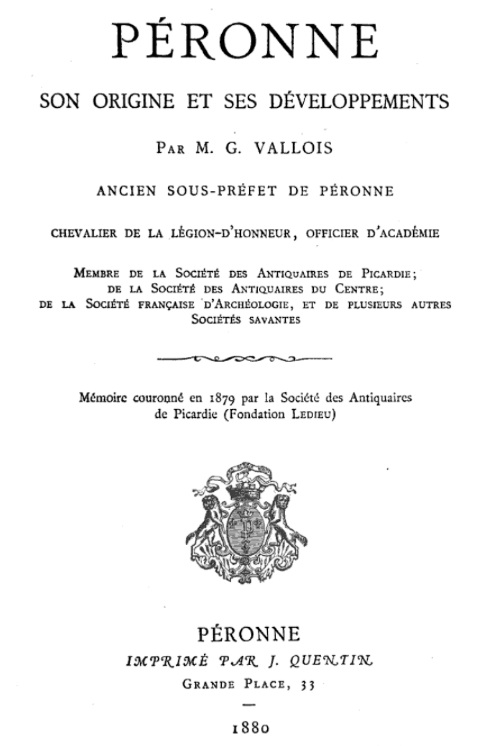
So the town is quite old and the name is quite old.  In fact, the town is so old that in 1880 it even got to have a book written about it:

est

In that book the author begins, of course, with discussing the etymology of the name and, right from the start, there are snags!

nest

But there were other Perunian names in France.  Here they are along with the original Kortrijk location:thorstagCertainly, many of these have nothing to do with Slavs. Perhaps they refer to the fibula, the leg bone that was earlier referred to as the perone.  In fact, that continues to exist and be used in Italian, Spanish and other Romance languages (and Basque apparently).

Of course, one can ask whether the fibula looks like a thunderbolt but we leave that to you (or thunderbolt like a fibula):

fibilias

Slavic fibulae take on a whole new meaning

For the Dutch Veleti see here and here.  If you want to get really “far out” check out the fibula description in Basque:

euskaraSorburua means source meaning seemingly in other instances too “original” – so now we have the Sorbs – the original people…

To come full circle, note that Safarik thought that Venantius Fortunatus in one of his poems meant Veleti (in the Netherlands) when he talked about Vascos (i.e., Basques).  Was there a difference back then?  Note too that the below poem, again, mentions together the Suevi and Frisians suggesting that Suevi (also) lived in northwest Germany.  Perhaps in the neighborhood of the River Leda or the River Lippa.

fortunatusCopyright ©2016 jassa.org All Rights Reserved

February 3, 2016

Winnili and Venelli

Published Post author

We have previously observed that Adam of Bremen places the Winnuli on the Odra during historic times, which if true would certainly refer to Slavs.  However, Winnili is, as per Paul the Deacon, the “old” name of the Langobards.  How are these to be reconciled?  A few observations are in order.

First, interestingly the name is perhaps related to the Gothic vinja that is “pasture”.  Whether that also tells us something about the Veneti is unknown.

Second, it is not at all impossible that the Scandinavian invaders renamed (like the Rus renaming the Polyane, with their own name Rus).

Third, the name is remarkably similar to that of the Venelli/Unelli.

“[The Veneti] fortify their towns, convey corn into them from the country parts, bring together as many ships as possible to Venetia, where it appeared Caesar would at first carry on the war. They unite to themselves as allies for that war, the Osismii, the Lexovii, the Nannetes, the Ambiliati, the Morini, the Diablintes, and the Menapii; and send for auxiliaries from Britain, which is situated over against those regions.” (Julius Caesar, On the Gallic War, Book 3, 9).

“[Caesar] sends Q. Titurius Sabinus his lieutenant, with three legions, among the Unelli, the Curiosolitae, and the Lexovii, to take care that their forces should be kept separate from the rest. He appoints D. Brutus, a young man, over the fleet and those Gallic vessels which he had ordered to be furnished by the Pictones and the Santoni, and the other provinces which remained at peace; and commands him to proceed toward the Veneti, as soon as he could. He himself hastens thither with the land forces.” (Julius Caesar, On the Gallic War, Book 3, 11).

It is the Venelli/Unelli that are led by their chieftain Viridovic (rather not Viridovix).

conquistas

A number of tribal names should be interesting on the map here:

  • Venelli
  • Veneti (of course)
  • Ossismii (the “last” ones, e.g., ostatni)
  • Lexovii (“x” like “h”?)
  • Lingones
  • Bellovaci (white cow tribe or pretty cow tribe :-))
  • Morini (people who live by the sea – see Slavic more = sea; note also the -in suffix)
  • Eburones (Lugi Buri connection?)
  • Senones (similar to Suevi Semnones?)
  • Nervii (aside from the connection to the river Narew, there is the obvious connection to the town of Narva which is, apparently, of Veps origin – meaning “waterfall”; on the genetic similarity between the Veps people and the Poles of all people, see here)
  • Lemovices – note that the Lemovi are present – on the Baltic (!) right next to the Rugii in Germania.
  • Vellavi
  • Ruteni (!)
  • Namnetes/Nemetes

(We are not touching the Diablintes).  We are by no means suggesting that these tribes were somehow Slavic (e.g., Namnetes/ Nemetes!) – nevertheless, the similarity of some names is at least interesting.  There is also an interesting North-bias to these names.

Note that similarly interesting names also appear among the Celts in Italy (including Boii like the Boii of Bohemia and the Senones and, of course, the Taurini with the town of Torino named after them).

Copyright ©2016 jassa.org All Rights Reserved

January 31, 2016

Alexander & the Veneti

Published Post author

We haven’t done much with the Paphlagonian Veneti lately so here is a little piece from the History of Alexander the Great by Quintus Curtius Rufus (or, if you will, Historiarum Alexandri Magni Macedonis Libri Qui Supersunt, that is, “All the Books That Survive of the Histories of Alexander the Great of Macedon”).

french

Medieval French edition – colourful, if perplexing

Rufus was most likely a first century historian and is a mystery man himself.  Nothing is known of him other than the fact that he wrote the above referenced book (some people suggest that Quintus Curtius Rufus was a pseudonym).  Be that as it may, here is the passage of interest (from the John C. Rolfe translation):

Book 3, chapter 1, paragraphs 22-24

“And now he had arrived at the city of Ancyra, from which, after having numbered his forces, he entered Paphlagonia; next to this were the Heneti, from whom some believe that the Veneti derive their origin.  All this region yielded to Alexander, and gave hostages and obtained freedom from the obligation of paying tribute, which they had not rendered even to the Persians.  Calas was made governor of that region, and Alexander himself, taking the troops that had lately arrived from Macedonia, made for Cappadocia.”

quintususe

Quinti Curtii Rufi de rebus gestis Alexandri Magni libri decem : duo priores et finis decimi desiderantur (Codex Parisiensis 5716)

(Iamque ad urbem Ancyram ventum erat, ubi numero copiarum inito Paphlagoniam intrat: huic iuncti erant Heneti, unde quidam Veneto trahere originem credunt.  Omnnis haec regio paruit regi; datisque obsidibus, tributum, quod ne Persis quidem tulisswent, pendere ne cogerentur impetraverunt.  Calas huic regioni praepositus est: ipse, adsumptis qui ex Macedonia nuper advenerant, Cappadociam petiit.)

The reference to the Heneti as being the origin of the (Adriatic) Veneti is the same reference that is made in the musings of Strabo where he speculates that the Adriatic Veneti are likely to have come instead from Bretagne.

Copyright ©2016 jassa.org All Rights Reserved

January 29, 2016

Scla-vi-Scla-vi-Scla-vi-Scla…

Published Post author

If you want to get a quick answer where the Sclavi come from, all you have to do is close your eyes and say that name really fast over and over again.

BTW the same works for the Suavi.

🙂

Incidentally, if the Romans and Greeks inserted the “c” between the “S” and the “l” of “Sclavi because they found the “sl” sound hard to pronounce (as a lot of academics believe), wouldn’t it make sense that the “c” in Viscla was also inserted between the “s” and the “l”?  And if so aren’t we dealing here with an original sound that is the same as the Sclavi sound?

Note that Vistula had different spellings such as Viscla but also Vistla.  And ithe “t” there may have played a similar role as the “c”.  But what of “Sclabi”?  Well, the “b” and “v” sounds have changed.  Thus we have Suevi but also Suebi and also Suavi. Indeed we even have a Bisula designation for the Vistula in Jordanes’ Getica.

Copyright ©2016 jassa.org All Rights Reserved

January 28, 2016

Of Spain, Suevi, Iacetani and Napoleon

Published Post author

A reader forwarded to us a link to the Wikipedia page on the Suevi where one of the editors happily said the following;

“ALLARIZ BEARIZ MONDARIZ In Galicia there are different villages with names ending in IZ, like Allariz and Beariz (Ourense) and Mondariz (Pontevedra), which origin comes from the Swebian tribe. Allaritz, Bearitz, Mondaritz….like Austerlitz.”

Like Austerlitz indeed.

So, let us take a look at Austerlitz.  Austerlitz is, without a doubt, a German name.  It would seem to be a name that is completely unrelated to the Slavic name of the town.

But two interesting things come up right from the start here.

First, the current name of the town is – now – Slavkov u Brna (which, in Polish, is Sławków, i.e., its pronunciation is Suavkuv).

The Czech name literally means Slavkov by Brno, i.e., the Czech city of Brno (known in German as Brünn).  (We will not touch the topic of whether this Brno has some connection to Bern in the Switzerland and other similarly named cities… for now).

So that’s a quasi-Slav (Suevic?) connection.

Ok, whatever.

Second, and more importantly, the Czech name also seems to be a relatively new one and an older Czech name may have been Novosedlice (a name found already in Cosmas’ Chronicle of the Czechs).  It is, supposedly, from that Novosedlice that Austerlitz comes from.  If so, then Austerlitz is merely a corruption/mispronounciation of Sedlice or Sedlitz.

slavics

“Town stays Slavic & your Reich’s kaputt”

Ok, ok.

But there is something else.  Let’s look at the claims about Allariz, Beariz and Mondariz.  Allariz still stands as Allariz.  And so does Beariz and so does Mondariz.  Here they are in blue:

suebi

But are -iz and -itz endings Suevic?  Well, the stems certainly could be Germanic, e.g., Allariz may be from Alaric.  On the other hand, were place names with such suffixes to be found in East Germany they would likely be classified as Slavic.  Add to that that where they’d be classified as German it would be in West Germany.  But in West Germany such names appear only in certain areas – towards the south – not in west central or north and certainly not in Scandinavia.  They’d be found somewhere in between the Slavic and the ancient Vindelician area.  That itself is, or at least should be, interesting.

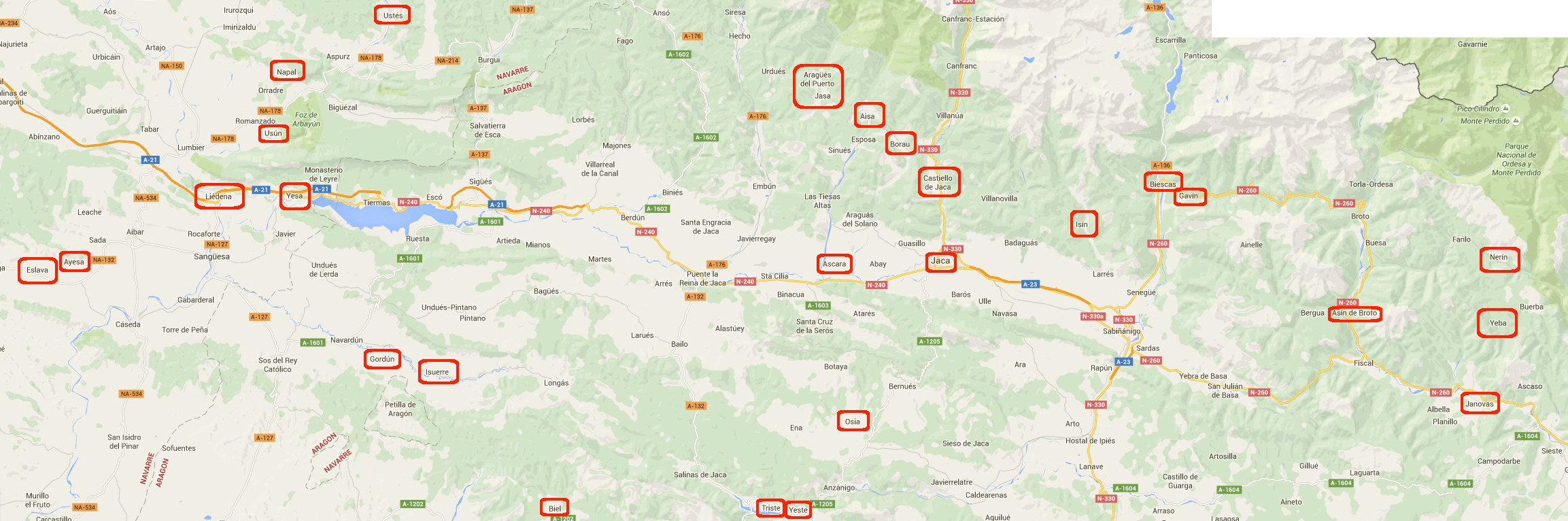
However, there is more, there are other places with -iz and indeed even -itz (!) in Spain.  Are these also Suevic?  The problem is that they are nowhere near the former Suevic kingdom.  For example, take a look at these with special notice of the cluster just north of Pamplona and into France:

biarritzes

Are these all Basque?  The largest concentration just north of Pamplona is really in Navarre.  There are Basques in Navarre, for sure.  Indeed, the first King of Pamplona was called Eneko (Íñigo) Arista and was Basque.  But the rest of Basque country (Navarre currently is not in Basque country) contains such names only sporadically.

BTW what are these green stars you ask?  They are other interesting names such as:

  • Grocin
  • Zubiri
  • Eslava, and our favourites:
  • Liedena, which just happens to be right next to
  • Yesa

And there are more…

spain

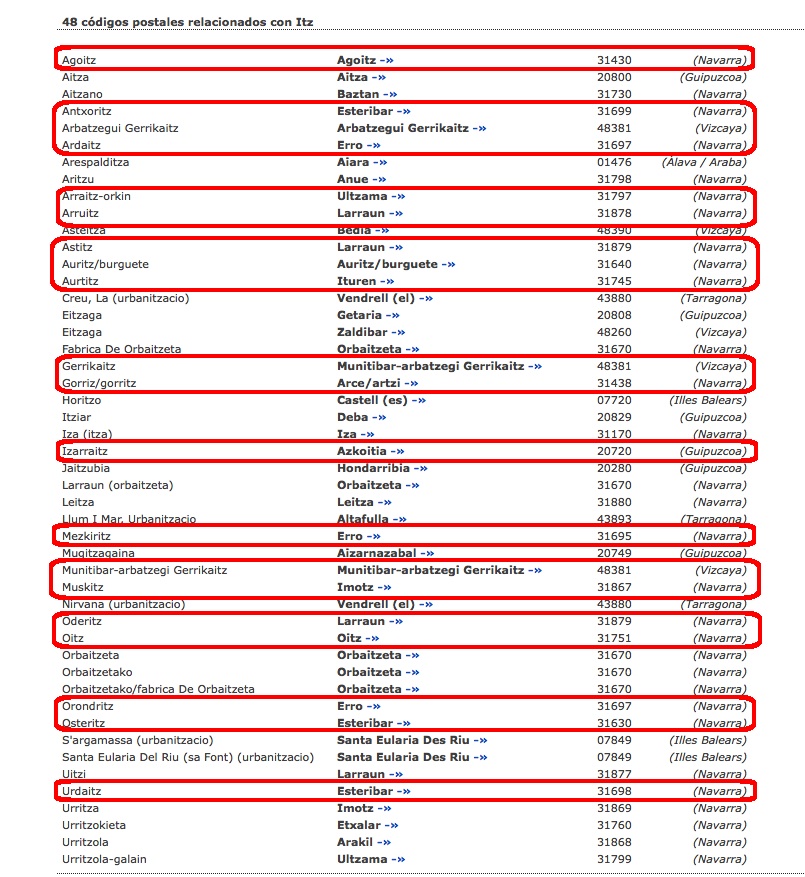
This Navarre bias is demonstrated here too if you use the Buscador tool to look for -itz suffixes which gives you this (we mark the pure -itzes not, e.g., -itzu or -itza – though if you look closely those too are primarily in Navarre) (Vizcaya is Bizkaia or the current administrative province of Basque country):

gorrtitz

Apparently, these references may be a sign of the former tribe of the Iacetani.

iasetani

For more of this you can look at the Venetic area about Bretagne.  As far as we know the only major recent effort to compare Slavic and Basque languages was in the “Veneti: First Builders of European Community” book which. while not the clearest in exposition, is certainly more than worth reading.

Copyright ©2016 jassa.org All Rights Reserved

January 28, 2016

More on H2O

Published Post author

Now that we are done with our venting (so to speak) we look for additional topics.  Before we get there, some off the top remarks, however:

Those who have followed our Water of Jassa here and here as well as our little puzzle, will enjoy our threading these topics together.  For your amusement, note that the River Thames on which sits the town of London, etc., was, apparently, also known as Thame-Issa.  Why?  It seems that this is result of the River Thame combining with the River Isis – hence Thame & Issa.  A part of it was, according to one , called *(p)lowonida (the Indo-European roots *pleu- “flow” and *-nedi “river”?  See the rivers Nida).  And a potsherd found nearby bears the name Tamesubugus fecit – that is, supposedly, the name of someone Tamesubugus who made the original pot.  Actually, what it says is TΛ·MII·SV·BV·GVS·FII·[…]  The II is supposed to be an “e” and hence “fe” and hence “fecit”.  Oddly, we know a River Bug from the Belorussian border.  Whether it means something like “God” because of its similarity with Bog is to be doubted (does Bug have anything to do with beugen (what you do when you run but also when you bend the knee in front of  a deity) rather than the Iranian bhaga?  So many possibilities.

There is also the question of the city on the river Bug, i.e., Brest – former Brest Litovsk (to distinguish it from other Brests in Slavic lands of which there are plenty).

Of course, there is also another Brest – unsurprisingly in Bretagne.  Are all those Brests Slavic/Suavic/Venetic?

slaviamaxima

If you’re reading this you have a dirty mind

And that’s before we even get to Dover – a Celtic word having something to do with water.  Fair enough, but wouldn’t we then suspect a reconstructed (hypothetical) Celtic *dubro– in the city of Dubrovnik too (rather than having anything to do with oaks)?

And what of Londonbyrig? The brig is supposedly like a “borough” or “burgh” and is Saxon.  But weren’t there Angles there too?  You know, the Suevi Angli?  Does it have anything to do with the shore (berg)?  Maybe, although this is hard to tell since most burghs would have been built on a river or lake to access water.

For this reason the question of whether -ava really means water is also tangly and needs a “fresh” look.

Copyright ©2016 jassa.org All Rights Reserved

January 25, 2016

The History of Menander the Guardsman

Published Post author

Following the 1984 R.C. Blockley  translation, here are the mentions of the Slavs in the History of Menander the Guardsman.  We present here only the passages describing the Slavs.  Thus, for example, the mention of Usdibad the “Gepid leader” will require a separate examination (see Fragments 12, 5; 12, 6) (Ústí nad Labem anyone?).

Menander’s work remains in fragments from various sources such as the Suda (Σοῦδα), a 10th century Byzantine encyclopedia, the Excerpta of Constantine Porphyrogenitus and the so-called Greek Anthology.  The “history” continues the History of Agathias Scholasticus of Myrina with Menander covering the years 558-582.

The city of Sirmium is now within Sremska Mitrovica in Serbia.  The city of Singidunum is now Belgrade also in Serbia.

menanter

A different Menander

Fragment 20, 2

(between 576-578)

“… While time was passing and envoys of both states were engrossed in these discussions and the status of the war in the East remained unclear , in the fourth year of there gin of Tiberius Constantine Caesar it happened in Thrace that the nation of the Slavs to the number of 100,000 devastated Thrace and many other areas.”

Fragment 21

(576-578?)

“Greece was being plundered by the Slavs, and a succession of dangers was threatening there on all sides.  [presumably the above mentioned Slavic invasion of Greece in 576-578]  Since Tiberius did not have a force strong enough to resist even a part of the invaders (and certainly not the whole horde of them) and since he was unable to face them in battle because the Roman armies were occupied with the wards in the East, he sent an embassy to Baian the chief of the Avars.  At the time he was not hostile towards the Romans, and, indeed, from the very beginning of Tiberius’ reign had wished to be friendly with our state.  Tiberius, therefore, persuaded him to make war on the Slavs, so that all of those who were laying waste to Roman territory would be drawn back by the troubles at home, choosing rather to defend their own lands.  They, they would cease to plunder Roman territory, preferring to fight for their own.”

“The Caesar, then, sent this embassy to him, and Baian agreed to his request.  John, who at this time was governor of the isles and in charge of the cities of Illyricum, was sent to assist him.*  He came to the land of Pannonia and transported Baian himself and the Avar forces to Roman territory, ferrying the multitude of barbarians in the so called ‘large transports.’  It is said that about sixty thousand armored horsemen were brought across to Roman territory.  From there Baian crossed Illyricum, reached Sythia and prepared to recross the Danube in the so-called ‘double-sterned’ ships.**  When he gained the far bank, he immediately put fire to the villages of the Slavs and laid waste their fields, driving and carrying off everything, since non of the barbarians there dared to face him, but took refuge in the thick undergrowth of the woods.”

*A.H.M. Jones has him as the quaestor exercitus (under whose control fell Moesia II, Scythia and the Aegean Isles) and praetorian prefect of Illyricum

** This is what Blockley says of this itinerary: ‘Contary to the view of Hauptmann and most scholars, I do not hunk that Menander meant to suggest that Baian crossed the Danube to Roman territory and then recrossed it.  It is possible that Baian ha been established in Pannonia since about 571, and in the present passage Menander’s language when noting John’s arrival in Pannonia suggests that he had left Roman territory.  Also it would seem a very foolish action to ferry the Avars across the Danube to an area which they were known to covet, when they could more safely and conveniently have been taken across from Dacia further down the river, were they not already in Pannonia.  Thus, John probably ferriedBaian across the Save and then back across the Danube to attack the Slavs.  (It is clear from the fragment that the bridges over the Save between Sirmium and Singidunum were down, as one would expect since the river was effectively the front line, Simrum being an isolated bridgehead supplied by water [on the possible existence of a bridge up river to Dalmatia see note 316 of the book]).’

iumris

[and now back to Menander]

“The Avar attack on the Slavs arose not only out of the embassy from the Caesar and the desire of Baian to return a favour to the Romans in exchange for the great generosity which the Caesar had shown to him, but also because Baian was hostile to them out of a personal grievance.  For the leader of these Avars had sent to Daurentius and the chiefs of his people ordering them to obey the commands of the Avars and to be numbered amongst their tributaries.  Dauritas and his fellow chiefs replied, ‘What man has been born, what man is warmed by the rays of the sun who shall make our might his subject?  Others do not conquer our land, we conquer theirs.  And so it shall always be for us, as long as there are wards and weapons.’  Thus boasted the Slavs, and the Avard replied with a like arrogance.  After this came abuse and insults, and because they were barbarians with their haughty and stubborn spirits, a shouting match developed.  The Slavs were so unable to restrain their rage that they slew the envoys who had come to them, and Baian received a report of these doings from others.  As a result he nursed his grievance for a long time and kept his hatred concealed, angered that hey had no become his subjects not to mention that he had suffered an irreparable wrong at their hands.  Moreover, thinking both to win favour with Caesar and that he would find the land full of gold, since the Roman Empire had long been plundered by the Slavs,  whose own land has never been raided by any other people at all…”

Fragment 25, 1

(circa 579)

” When in this year Baian as usual sent Targitius [Targitios] to the Emperor to receive the agreed payment [which was 80,000 nomismata per year] and when Targitius had returned to him with the gold and the merchandise which he had bought with some of the money, then the Khagan of there Avars, without seeking an excuse or a pretext or even troubling to invest a false charge against the Romans, suddenly with a most barbarous lack of shame brokee the treaty which he had made with Tiberois immediately after he had become Caesar. With his whole army he came to the Save between Sirmium and Singidunum and began to bridge the river, having as his object the city of Sirmium, which he wished to capture.  Fearing that he would be prevented from bridging the river by the Romans who were guarding SIngidunum and being wary of their long expertise and skill with the ships that sailed on the river, he wished to complete his undertaking before his designs became known.  Therefore, he brought together on the Danube in Upper Pannonia many huge ships and he built large troop-translports not according to shipwrights’ standards but from what was available ton the spot.  He loaded them with many soldiers and oarsmen, who rowed not in rhythm but in a barbarously uncoordinated manner, and sent the vessels en masse down the river, while he with the whole army marched by way of the island of Sirmium and breached the river Save.”

“The Romans in these cities were thrown into consternation, and, when they realised what the aim was, the general at Singidunum, whose name was Sethus, sent to the Khagan and asked him what his purpose was in coming to the river Save while there was a firm peace and friendship between him and the Romans.  He also said that if he tried to bridge the river absolutely without the Emperor’s permission he would not stand idly by.  The Khagan replied that he wished to build the bridge not with any designs against the Romnas, but in order to attach the Slavs.   When he and crossed the river and reached, he would again cross the Danube agains the Slavs if the Roman Emperor had a large number of vessels ready for him for the crossing.  He pointed out that he and done this earlier to please the Roman Emperor and had freed and returned to the Romans many tens of thousands of captives from Roman territory who were in slavery amongst the Slavs.  Now, he said, he had been injured by the Slavs who had refused to pay him the yearly tribute due from them and had killed the Avar envoys sent to them.***  For these reasons he had come to the Save.  To this end he told Sethus to receive envoys from him and send them on to the Emperor in order that they might ask him to make ready the vessels on the Danube for the Khagan since he intends to cross over to attack the Slavs.  He said that he was ready to swear the oaths that were the strongest amongst the Romans and the Avars that he was not planning any harm to the Romans or the city of Sirmium but that he wished to consort a bridge for an attack upon the Slavic nation.”

*** see above

“These assurances were believed neither by Sethus nor by the Romans in Singidnum.  However, they did not consider that they had an adequate force since they had few soldiers available and many of the swift warships were absent because the movement of the Avars had happened suddenly and nepxpectedly.  Movereover, the Khagan was beginning to threaten and aver that he himself was abiding by the terms of the peace with the Romans and that he would not cease to work on the bridge since he was proceeding against the Slavs, the enemies of both himself and the Romans.  Furthermore, if any Roman dared to hurl one weapon against those working to build the bridge, they should be clear that they were the first to break the treaty and since as a result whey would have provoked the Avar nation to war, they could not complain at whatever the Roman Empire sufferered at their hands.”

“Having these fears, the authorities in Singidunum asked Baian to swear the oaths.  He immediately drew his sword and swore the oaths of the Avars, invoking against himself and the whole Avar nation the sanction that, if he planned to build the bridge over the Save out of any design against the Romans, he and the whole Avar tribe should be destroyed by the sword, heaven above and God in the heavens should send fire against them, the mountains and the forests around fall upon them and the river Save overflow its banks and drown them.  Thus were the barbarian oaths sworn by the Khagan. ‘Now,’ he said, ‘I wish to swear the Roman oaths,’ and he also asked what they held to be a sure and binding guarantee that if one who swore bu it broke his oath, he would not escape the wrath of God.  The archbishop of Singidunum, through those who were acting as intermediaries, immediately proferred him the holy books.  He, most treacherously concealing his intent, stood up from his throne, pretended to receive the books with great fear and reverence. threw himself on the ground and most fervently swore by the God who had spoken the words on the holy parchment that nothing of what he had said was a lie.  Thereupon Sethus received his envoys and sent them off to the Emperor Tiberius in the capital.”

“While the envoys were still on the road to the imperial city and the Emperor was still to hear the news, the Khagan meanwhile did not relax his efforts but with all zeal and a large workforce (for thee whole Avar army, as it were, joined in the work) continued to build the bridge over the river, wishing the bridge to be completed before the Emperor should learn of his plan and attempt to stop what he was doing.”

Fragment 25, 2

(circa 579)

“The envoys of the Avars reached the capital and asked the Emperor to make read the shops for the Khagan and the Avar army which would cross the Danube to attack the Slavs.  They said that the Khagan, enthused with friendship towards him was building a bridge on the river Save and wished to destroy the Slavs, the common enemies of himself and the Romans.  Then they delivered their message, immediately the Emperor realised clearly the aim and intent of the Khagan, that he was building the bridge because he wished to take Sirmium and wanted to cut off the transportation of supplies so that the might starve the city into surrender.  [Trusting in the peace treaty with the Avars, Tiberius had not laid up adequate supplies in the city.]  The Emperor did not have an army available – I do not mean and army capable of opposing the Avar horde, since he lacked even a tiny force – because all the military units were occupied with the war against the Persians in Armenia and Mesopotamia.  He, therefore, pretended that he did not recognize what the Khagan was planning and said that he too was eager that they attack the Slavs, who were causing much damage to the Roman Empire.  However, this was not a good time fro the Avars to make an attack, since the Turks were encamped at Cherson and they would quickly hear of the Avars crossed the Danube.  IT would be better if they withdrew and postponed their assault.  He himself would shortly learn the intentions of the Turks and where they proposed to attack, and he would pass on this information to the Khagan.”

“The Avar envoy was aware that this story had been purposely put together by the Emperor, who hoped by confronting them with fear of the Turks to diver them from their object.  They envoy, who was the major advocate continually urging war with the Romans, seemed to go along and agreed to refer the whole matter to the Khagan.  He departed the capital with many gifts for what he promised to do.  But it happened that while he was crossing Illyricum with his small Roman escort he was killed by Slavs who were raiding the area.”

“Only a few days had passed when suddenly another envoy from the Khagan, whose name was Solakh, arrived at the capital.  When he was granted an audience with the Emperor he declared boldly and with a complete lack of shame, ‘I think it is a waste of words to inform you that the river Save has now been cut by a bridge.  To inform those who know if what is very clear to them merely brings blame upon the speaker.  Since in future food or any other assistance cannot be brought to the city of Sirmium by river, there is no strategy which will protect the Romans there unless a Roman army comes large enough to drive the Avar army away by force and break the bridge.  The Emperor ought not make war upon the Avars and the Khagan of the Avars over one worthless city (or rather’a jar’, which is the expression he used), but should withdraw from it unharmed all the soldiers and civilian occupants other with all of their movables and leave the city stripped and deserted for the Khagan.  The Khagan fears at present the Romans are pretending to adhere to the peace treaty only until they settle the war with the Persians.  When they have settled that, then they will throw their whole army against the Avars, having Sirmium as a very suitable bridgehead agains them and being separated by no river or any other obstacle.  For it is clear and most obvious that, at a time when there was a secs peace between the Emperor and the Avars, he did not surround the city of Sirmium with such strong walls for their benefit.'”

“The envoy continued that the Khagan was satisfied with the gifts sent each year to him by the Emperor; for gold, silver and silken clothes were valuable commodities.  However, since life was more valuable and desirable that all of these, he had been worrying about this and reflecting that many of the  peoples who before times had come to this land had first been enticed with such gifts by the Romans, who in e need had attacked and destroyed them utterly.  Therefore, he would not abandon his attempt for gifts under threats or through any other pressure at all, until he had taken the city of Sirmium and was in possession of the whole isle of Sirmium, which, as a former possession of the Gepids, most justly belonged to him. since they had been conquered by the Avars, with the result that what had been theirs rightly belonged to him rather than to the Romans.”

“This declaration caused consternation and threw the mind of the Emperor into a terrible turmoil of anger and grief.  Nevertheless, as best he could, he summoned the appropriate words and replied, ‘It is clear to every single person that the Khagan has outflanked us not through force or bravery of his troops or through wisdom, but by scorning the treaty of peace and God by whom he swore.  But, I think, his treater will bring him no more gains.  I should rather betroth to him one of m two daughters than willingly surrender the city of Sirmium.  Even if he should take it by force, I, while awaiting the retribution of God whim he has so insulted, shall bnever consent to abandon any part of the Roman state.'”

“With these words he dismissed the embassy and prepare to defend the city as best he could under the circumstances.  Since, as I have already said, he did not have even a small army, he sent out generals, counts and tribunes, some through Illyricum, some through Dalmatia, to hold they city with the aid of garrison troops.”

Copyright ©2016 jassa.org All Rights Reserved
January 25, 2016

Statuta dioecesis Cracoviensis

Published Post author

That names of former gods were invoked in Polish Christian ceremony and that various pre-Christian ceremonies and customs survived the Baptism of Poland, we know from many sources.  Here are the 1408 statutes of the Cracow (& Sandomierz?) diocese.   These statutes contain prohibitions dealing with practices such as sorcery/fortunetelling, invocations of pre-Christian Gods at Christian events (around the Pentacost again) and practices around Christmas (calends).

scriptores

The source for these is a publication by Bolesław Ulanowski in the Archive of the Historical Commission volume 5 (as printed in Scriptores Rerum Polonicarum volume 13). The manuscript is in the collection of the Cracow Cathedral library and may perhaps one day be viewable here.

Part I

Of Fortune-Telling

“Also we prohibit, lest anyone or some damnably [should] presume to tell and assert fortune-telling and divinations; when [to] no one does this [behaviour] appear to be harmful but [rather] beneficial [and if they say that] it is not a sin, those who say that, err in the faith.”

(De sortilegiis.  Item prohibemus, ne aliquis vel aliqua dampnabiliter presumat dicere et asserere sortilegia et divinaciones, quando nulli videntir esse in dampnum sed in profectum, non esse peccatum, quia hoc est dicere in fide errare.)

Part II

Of the Pagan Ritual Hitherto Preserved By Christians

“And, it is not without great contempt for the divine name that certain Christian cults presume to practice idolatry, especially at the time that the Holy Spirit with his gifts [asks].  Therefore, we prohibit pagan songs at the time of the Pentacost, in which the names of idols are invoked and venerated, but [with] all the strength of Christ’s faithful should be pointed out and excluded to diminish idolatry and to strengthen the Catholic faith being conducive to their welfare.”

(De ritu paganico hucusque seruato per christianos.  Item non sine magno contemptu nominis divini aliqui specie christiani cultim ydolatrie presumunt exercere, presertim tempore quo spiritus sanctus cum suis donis est querendus.  Ideo prohibemus, ne tempore Pentecosthen fiant cantus paganisci, in quibus ydola invocatur et venerantur, sed totis viribus populus Christi fidelis inducatur et arceatur ad dimittenda ydolatica et ad amplecantanda fidei katholice congrua et saluti eorum proficua facienda.)

Part III

Of the Carolling* Done By the Commoners

“Also at the instigation of the devil perverse men fell into the custom of walking among people before, during and after Christmas and at whatever other time [per columbacianem], where they would commit many murders, thefts and many other crimes.  We therefore prohibit such things from happening in the future; and you should restrain your parishioners from the above.”

kalends

No fighting and everyone ends up at the manger – that’s the public version

(De columbacione per laicos exercenda etc. Item ex instinctu dyaboli et hominum peruersorum abusu uenit in consuetudinem aput laycos ante, citra et post festum Natiuitatis domini et quocunque alio tempore ambulare per columbacianem, ubi contiugunt multa homicidia, furta et alia plura crimina.  Nos igitur prohibemus, ne de cetero talia fiant; et vos rectores animarum vestros subditos a predictis curetis cohibere.)

* These were the people walking around villages kalendae or calends (going back to the Latin “first of the month).  See also: Welsh Calennig.  These were very much like the English carolers.  Earlier on the same topic we also have Bishop Nanker’s order against similar practices from 1323 entitled De columbacionis solucione.

statuta

More on similar happenings in Croatia here and here more on similar (but later – circa 1420) prohibitions from Greater Poland (the above presumably refer to practices around Cracow, i.e., in Little Poland).

Copyright ©2016 jassa.org All Rights Reserved

January 23, 2016