Westpolen

Published Post author

We’ve previously described here the curious case of the town of Soest.  However, what can be said about Soest can also be said about other places in Westphalia.  Take, for example, Osnabrück.  What is the origin of that name?

One theory holds that the oldest version of the name – Osenbrugge* – was a reference to a bridge (German Brücke) and that the Osen was a reference to German Gods, i.e., Asen.

* note:  elsewhere Asnabruggensi

First off, there is the interesting matter that the German Brücke seems like it should be related to the Slavic bereg (Берег) meaning “shore” (also related probably German Berg meaning “mountain”.  Either “bridge” or “shore” would be a fitting description of the settlement’s location.  However, on balance, brugge seems closer to Brücke

But what about the “Asen”?  Apparently, someone who knows a lot about water names – particularly Slavic ones –  Jürgen Udolph (the author of, among other titles, Die Stellung der Gewässernamen Polens innerhalb der alteuropäischen Hydronymie) – stated in an interview for the Norddeutscher Rundfunk (NDR) that the name *Osna or a similar form was once  the name of a portion of the run of the River Hase* and that, later, it was renamed Hase.  According to this version, the name *Osna would have survived in the name of the city of Osnabrück, which would mean something like “a bridge over the river Osna.”

* note: Regarding the river Hase, it appears in 763 as Hassa (elsewhere Assa).  Those who’d like to connect it to Tacitean Chasuarii will, however, find a gap of seven centuries.  In German Hasa or Hassa is supposed to mean “grey” – similar to “hazy”.

Haven’t heard this interview so can’t say for sure how far Udolph took this but one has to observe that Osna is actually the first reported name of the Polish Silesian town of Ośno Lubuskie.  The name of that town before WWII was a German Drossen but the name (as far back as we can tell) is Slavic.  It was written as civitas forensi Osna in 1252 in the report on the possessions of the bishopric Lebus (Polish/Slavic Lubusz).  In the same document,the other towns listed as belonging to the Osna grant are such Slavic towns as Boriza and Boleseouiz. Indeed, in 1856 the Landbuch der Mark Brandenburg und des Markgrafthums Nieder-Lausitz expressly admitted that the town’s name was likely Slavic and even provided an etymology noting that the place was probably named by the “immigrant Slavs” – eingewanderte Slawen:

As late as 1350, the name of the town was still reported as Osna.

One observation that also deserves making is that the combination of:

  • vowel > s > n > vowel

is a rather Slavic combination.  Take, for example, jasna (“light”) or vesna/wiosna (“spring”) or, for that matter, sosna (“pine”)  

While it is true that similar combinations appear in France too – as an example you have the name Chesney – it is striking that the appearance of such French names seems limited to the northwest of the country – just slightly East of where would have expected to find the Gallic Veneti.

Further, there is also the Ptolemaic tribe of the Ossi who lived close to the Wilzi/Welatabi (note that the Dietrich of Bern saga features a “king of the Wiltzi” named Ossantrix).

Just for kicks you can open the Westfälisches Urkunden-Buch which has a rather nice list of early Westfallian documents.  There are plenty of German/Nordic names but there are a number of place names which, again, seem rather Slavic as these names and fragments:

  • Ysin-burg, Lippia (yes, the same one as this), Bure
  • in fluuuio Uuisura, in pago Uimodia nuncupato, cui confinis est uilla Liusci uocata
  • in ducatu Budinisuelt
  • in pago Logni
  • Uualanae
  • Chestinacha

And there are plenty of others even more interesting.

So the question that has to be posed is “how far have these Slavs really eingewandert“?

For more on this question see here and here and here and here and here and, of course, here.

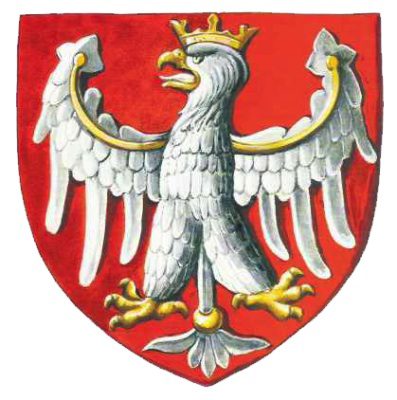
We leave you with the coat of arms of the town of Osnabrück (for more on such rosettes, see here):

Copyright ©2017 jassa.org All Rights Reserved


June 13, 2017

Marwazī’s Account

Published Post author

Here is an 1130 (?) account of the Arab court physician Sharaf al-Zamān Ṭāhir Marwazī or Marvazī (circa 1056/57– circa 1130) on the Slavs based on the 1942 Vladimir Minorsky translation (adapted by Paul Lunde and Caroline Stone along with most of the below notes).   Marwazī was (as the short version of the name suggests) a native of Merw (Persian: Marv), Khorasan in Persia (in today’s Turkmenistan).  His known work is Nature of Animals (Kitāb Ṭabāʾiʿ al-Ḥayawān al-Baḥrī wa-al-Barrī) which, presciently, includes as its first section a chapter on humans.  There he discusses the [Volga] Bulgars and Slavs and the Rus (the first portion of that discussion is a copy of Ibn Rusta).  Here are those excerpts.

The Bulgars and the Far North

“In the northern direction lies the country of Bulghar; it lies between the west and the  north, inclining towards th ePole, and is three months distant from Khwarazm.  These [people] have two cities, one called Suvar and the other called Bulghar; between the two cities is a distance of two days’ journey, along the bank of a river and through very dense forests, in which they fortify themselves against their enemies.  The trees are mostly khadang [birch?], but there are also hazels.  They are Muslims, and make war on the infidel Turks, raiding them, because they are surrounded by infidels.  There are in their forests fur bearing animals, such as grey squirrels, sable and so on.  The latitude of their territory is very considerable, so much so that in summer their day is extremely long and their night extremely short, so shot tin fact that the interval between twilight and dawn is not sufficient for cooking a pot [of meat].”

“At a distance of twenty days from them, towards the Pole, is a land called Isu [Wisu], and beyond this a people called Yura; these are a savage people, living in forests and mixing with other men, for they fear that they may be harmed by them.  The people of Bulghar journey to them, taking wares, such as clothes, salt and other things, in contrivances drawn by dogs over the heaped snows, which [never] clear away.  It is impossible for a man to go vover these snows, unless he binds on to his feet the thigh bones of oxen, and takes in his hands a pair of javelins which he thrusts backwards into the snow, so that his feet slide forward over the surface of the ice; with a favorable wind [?] he will travel a great distance by the day.  The people of Yura trade by means of signs and dumb show, for they are wild and afraid of [other] men.  Form them are imported excellent sable and other fine furs; they hunt these animals, feeding on their flesh and wearing their skins.”

“Beyond these are a coast-dweling people who travel far over the sea, without any [definite] purposes and intention; they merely do this in order to boast of reaching [such and such a remote] locality.  They are a most ignorant and stupid tribe, and their ignorance is shown by the following.  They sail in ships, and whenever two [of their] boats meet, the sailors lash the two together, and then they draw their swords and fight.  This is their form of greeting.  They come from the same town, perhaps from the same quarter, and there is no kind of enmity or rivalry between them; it is merely that this is their custom.  When one of the parties is victorious, they [then] steer the two ships together.  In this sea is the fish whose tooth is used in hafting knives, swords and suchlike.*  Beyond them is a Black Land which cannot be crossed.  As for the sea route, the voyager sailing towards the Pole reaches a part where there is no night in the summer and no day in the winter; the sun rotates visibly over the land for six months, circling the horizon like the revolution of a millstone; the whole year consists of one day and one night.”

* note: “Narwhal and walrus horn, called khutu, was much prized for its durability and was the preferred material for knife handles.”

The Slavs

“The Slavs are a numerous people, and between their territories and the territories of the Pečenegs is a distance of ten days, along steppes and pathless country which thick trees and [abounding] in springs.  They inhabit these forests.  They have no vines, but possess much honey.  They tend swine, and burn their dead, for they worship fire.  They grow mostly millet, and have a drink prepared from honey.  They have different kinds of pipes, including one two cubits long.  Their lute is flat and has eight strings but no peg-bx, while its pegs are level.  They have no great wealth.  Their weapons are javelins and spears, and they have fine bucklers.  Their head chieftain is called suit, and he has a deputy called shrih.*  The king has [riding] beasts and on their milk he feeds.  The town in which he resides is called Khazrat, where they hold a market for three days in every month.  Among them the cold is so severe that they dig deep underground dwellings which they cover with wood, and heat with the steam [produced by the burning of] dung and firewood.  There they remain during their winter season.  In the winter the Majghari [Magyars] raid them, and as a result of their mutual railings they have many slaves.”

* note: “suwit… shrih: suwit: must represent the first element in the name Svetopolk; shrih (sh.rih in the manuscript) has not been satisfactorily explained.”

The Rus

“The Rus live in an island in the sea, its extent being a distance of three days in either direction.  It has words an forests, and is surrounded by a lake.  They are very numerous, and look to the sword to provide them with a livelihood and profession.  When one of their menfolk dies, leaving daughters and sons, they hand his property to the daughters, giving the sons only a sword for they say: ‘Your father won his property by the sword; do you[r best and] imitate him and follow him in this.'”

“And in this way their education was effected, until they became Christians during the year 912*  When they entered [the fold of] Christianity, the faith blunted their swords, the door of their livelihood was closed to them, they returned to hardship and poverty, and their livelihood shrank.  Tgeb tget desired to become Muslims, that it might be lawful for them to makre raids and holy war, and so make a living by retrying to some of their former practices.  They therefore sent messengers to the ruler of Khwarazm, four ins men of their king; for they had an independent king called Vlaidmir, just as the king of the Turks is called khagan and the king of the Bulghars yiltawar.**  Their messengers came to Khwarazm and delivered their message, The Khwarazmshah was delighted at their eagerness to become Muslims, and sent someone to them to teach them the religious laws of Islam.  So they were converted.”

“They are strong and powerful men, and go on foot into far regions in order to raid; they also sail boats on the Khazar Sea [Caspian], seizing ships and plundering goods.  They sail to Constantinople win the Sea of Pontus, in spite of the chains in the gulf.***  Once they sailed into the Sea of Khazar and became master of Bardha’a for a time.  Their valor and courage are well-known, so that any one of them is equal to a number of any other nation.  If they had horses and were riders, they would be a great scourge to mankind.”

* note: “Vladimir converted in 988; probably a copyist’s mistake.”
** note: “The text reads b.t.ltw, Ibn Falan’s yiltawar, the title of the Bulghar king.  It is clear from this passage that Marwazi thought ‘Vladimir’ was a title, not a personal name.”
*** note: chains laid by the Byzantines to prevent ships passing.

Copyright ©2017 jassa.org All Rights Reserved

June 11, 2017

The Astronomer’s Slavs

Published Post author

One of the principal sources for the times of Louis the Pious is the so-called Astronomer‘s “The Life of Emperor Louis” or Vita Hludovici (the others include Thegan as well as Ermoldus Nigellus that is Ermold or Ermoald the Black).  It was written sometime after 840.

Here are the Slavic excerpts from that work.  The translation is that of Thomas Noble (and the notes are his).  (Note that we do not include references to place names that might have an etymology suspiciously resembling Slavic such as Triburi, that is, “three forests” (Drevergau) not necessarily “drei Höfe”; Vlatten (“probably of Celtic origin” as in Vlatos = the ruler… but certainly not from Wladyka); or the River Cisse flowing into the Loire; or monastery at Vadala (San Salvador de la Valeda in Berga near Barcelona? Or Vandala? Or Veleda?).

Chapter 25

“…The emperor then ordered the Saxon counts and the Abotrits, who had formerly submitted themselves to the lord Charles, to give aid to Harald, so that he could be restored to his own kingdom.  Baldric was deputized to carry this message.  When they had crossed the Eider River, they entered the land of the Northmen in a place called Sinlendi.  Although the sons of Godfred had abundant forces and two hundred ships, they did not wish to come close and give battle.  Both forces withdrew, and our men destroyed and burned everything they encountered, and what is more, they received forty hostages from that same people.  Having done this, they returned to the emperor in a place called Paderborm, where he had gathered all his people in a general assembly [July 815] .  To that same place came the princes of the eastern Slavs and all their most important men*…”

[* note: “Other sources specify Abotrits, Sorbs, Wilzi, Bohemians, and Moravians.” The wording used is Quo in loco principes Sclavorum orientalium omnes primoresque venerunt]

Chapter 26

“After the emperor spent the harsh winter in restful health and calm success, and with the approach of summer’s most welcome charms, those who are called the eastern Franks and the counts of the Saxon people were sent by him against the Slavic Sorbs, who were said to have withdrawn from his authority.  With Christ’s help their attempt was suppressed very quickly and easily…”

Chapter 27

“…While he was staying in that palace [Aachen], he also received the envoy of Emperor Leo of Constantinople, whose name was Nicephorus.  Apart from friendship and alliance, the legation treated the boundaries of the Dalmatians, Romans, and Slavs.  But because they [the Slavs] were not present, nor was Cadalo [margrave of Friuli], the prefect of those border regions, and because without them affairs could not be brought into order, Albgar was sent to Dalmatia to pacify and organize the situation, along with Chadalo, the prince of those very same borderlands…”

Chapter 29

“…With these things already properly ordered, the emperor then, in that assembly, wished for his firstborn son Lothar, to be, and to be called, co-emperor, and he sent forth two of his sons, Pippin into Aquitaine and Louis into Bavaria, so that people might know whose authority they ought to obey.  Immediately, a defection of the Abotrits was announced to him.  They had come to an understanding with the sons of Godfred and were disturbing Saxony beyond the river Elbe.  The emperor sent adequate forces against them, and with God’s favor their movement was stopped…”

Chapter 30

“…The emperor, for the purpose of avenging their [the Bretons’] insolence, assembled a military force from all sides and headed for the Breton frontier.  He held a general assembly at Vannes [August or September 818], entered the province, an with little time or effort devastated everything until Murman [Breton leader], while he was attacking the baggage train, was killed by a certain keeper of the royal horses named Coslus [see Ermoldus Nigellus for more].  All of Brittany was conquered with him, gave up, and surrendered to whatever conditions the emperor might wish to impose, in the end, future servitude..  The Bretons gave and accepted hostages – who they were and hoe many, he decided – and he organized the whole land according to his will.”

Chapter 31

“…Meanwhile, the envoys of other peoples were there too, that is, of the Abotrits, Goduscani, and Timotani,* who had recently renounced an alliance with the Bulgars and associated themselves with us.  And the envoys of Liudewit [Croat leader rebelled in 819 and was murdered in 823], the commander of lower Pannonia, were there also accusing Cadalo [margrave of Friuli], falsely as it turned out, of being unbearably cruel to them.  All these were heard, dealt with, and dismissed, and the emperor moved on to that very palace where he planned to spend the winter.   While he was there, King Slaomir of the Abotrits was paraded before him by the Saxon leaders.  Since he was accused of defection and could not answer the charge, he was sent into exile, and his kingdom was given to Ceadrag, a son of Thrasco.**”

[* note: These are the south Abotrits “who lived on the north bank of the middle Danube.  The Goduscani lived on the Croatian-Dalmatian coast.  The Timotiani lived along the Serbian-Bulgarian frontier.  These people were pressured by the recent expansion of Bulgaria.”]

[** “Slaomir had mirdered Thrasco in 809 or 810 and the, from about 816 or 817, shared rule over the Abotrits with Ceadrag”]

Chapter 32

“…In the following summer [819], his people came to him in the palace of Ingelheim.  There he received the messengers from his army that had been sent to suppress the open treachery of Liudewit, but that affair remained more or less unresolved.  Indeed, puffed up by arrogance on account of his actions, Liudewit, through his envoys, laid before the emperor certain demands that, if the emperor were prepared to fulfill them, would lead him to return to his former obedience to Louis’ commands.  But these seemed pointless to him, and so he tossed them aside and did not accept them.  Liudewit decided to remain disloyal, and he associated with himself in perfidy whomever he could.  Indeed, after the return of the army from the frontiers of Pannonia, and while Liudwit was still in opposition, Duke Cadalo of the Friuli succumbed to fever and lived his last day.  Baldric took his place. When he first came into the provide and entered the lands of the Carinthians, he put the forces of Liudewit to flight near the river Drava with only a few men.  Harrying the rest, he compelled them all to leave his territory.  Chased out by Baldric, Liudewit confronted Borna, the duke of Dalmatia, who was camped on the Kupa River.  Borna had been deserted because of the treater or the fear of the Goduscani – it is not clear which – and he escaped the impending reckoning of accounts safe and sound only by using a force of personal bodyguards.  Later on he dealt with those who had deserted him.”

“Meanwhile Liudewit entered Dalmatia again, in the following winter. and he tried to destroy everything by cutting down with the sword every living thing and by setting fire to every inanimate thing.  Since Borna was unable to meet his attack, he looked for a way to harm him by cunning.  He did no declare open war on him but harassed him and his army with sneak attacks such that Liudewit was ashamed and sorry that he haas undertaken such things.  With three thousand of his soldiers killed and many horses and lots of equipment of various kinds destroyed, he was forced by Borna to leave the region.  The emperor, who was them at Aachen, heard all these things most joyfully…”

Chapter 33

“In that same palace, with winter [January 820] coming on, the emperor gather together an assembly of his people.  At that time Borna, who complained bitterly about the attack of Liudewit, received form the emperor substantial forces to help him grind down Liudewit’s land.  The forces were int he first place divided into three, and they devastated almost all the land under his authority by fire and sword, but Liudewit protected himself by the heights of a certain fortress and would not come forth to fight or to talk.  After these forces returned home, the people of Carniola and certain of the Carinthians who had give over to Liudewit surrendered to our duke Baldric…”

Chapter 34

“In this year the lord emperor spent the winter [820/821] season in Aachen.  In that same winter, im February, an assembly was held at Aachen, and three armed bands were dispatched to lay waste the land of Liudewit…In the midst of these things, Borna lost his life, and the emperor made his nephew Ladasclao his successor…”

Chapter 35

“…At the same time, he sent an army from Italy into Pannonia against Liudewit, Since he was unable to maintain himself there, he left his own city [Sisak as per the Carolingian Annals] and went to a certain chieftain of Dalmatia and was admitted to his city.  Then, however, he turned the gables on his host, brought him grief, and subjected the city to his own domination.  And although he would neither fight nor talk with our men, nevertheless he sent envoys to say that he had made a mistake and he promised that he would come to the lord emperor…”

“…With these things taken care of, he spent the autumn, hunting in the way of the kings of the Franks, and to pass winter, he sought out a place across the Rhine whose name is Frankfurt.  There he ordered an assembly of the neighboring peoples to come together, of all of those, that is, who lived beyond the Rhine and who obeyed the command of the Franks.  He discussed with them everything that appeared to contribute to the public good, while he took thought suitably for the affairs of each.  In that same meeting, a legation of the Avars appeared bearing gifts*…”

[* note: apparently last ever contemporaneous mention of the Avars]

Chapter 36

“In that same estate, that is, Frankfurt, after winter had ended, the emperor in May held an assembly of the eastern Franks, the Saxons, and of the other peoples who bordered on them.  There he brought to a fitting end a struggle between two brothers who were fiercely contending for the kingship.  They were WIlzi by birth, sons of King Liubi, and their names were Milegast and Celeadrag.  When their father, Liubi, declared war on the Abotrits, he was killed by them, and the kingdom was conveyed to the firstborn,  But when he showed himself to be more sluggish in the administration of the kingdom than the situation demanded, the favor of the people shifted on behalf  of the younger son.  They came into the emperor’s presence on account of this altercation.  He investigated, discovered the will of the people, and declared the younger to be chief.  The emperor endowed both with ample gifts, bound them by oaths, and dismissed them as friends, both to himself and to each other…”

“…In that same assembly the death of the tyrant Liudewit was announced.  He was killed by some trickery.  The emperor dissolved this assembly and called for another one at Compiegne in the autumn [of 823].”

Chapter 39

“Later the emperor ordered an assembly to be celebrated by his people in May [of 825] at Aachen.  While it was meeting, a legation from the Bulgarians, who had for a long time lived in Bavaria according to his instructions, was brought in to be heard.  They were especially concerned about the boundaries to be observed between the Bulgarians and the Franks after the establishment of the peace.  Present as well, and promising submission and obedience with many words, were not a few leaders of the Bretons, among whom was Wiomarc’h, who seemed to exceed the others in authority, the very one who had by reckless boldness and stupid audacity gone so far as to provoke the emperor to send a expedition into those regions to suppress his insolence.  Therefore, when he said that he regretted his deeds and that he would commit himself loyally to the emperor, he was received mercifully by him in his usual fashion – for he was always accustomed to bestow clemency – and he, along with totters of his countrymen, was endowed with gifts.  He was allowed to go home. But later, not unmindful of his customary perfidy yet forgetful of all that he had promised an dog the good things that he ha experienced, he did not miss a chance to complain about his neighbors, the emperor’s faithful men, and to harass them with persistent harm.  So it happened that, overwhelmed by the men of Lambert, he met the end of all his evils and the term of his life in his own house.”

“So, having dismissed the envoys of the Bulgarians and of the Bretons, the emperor went off hunting in the wilds of the Vosges, believing that he could do that until the month of August, when he would return to Aachen to hold an assembly, as he had planned.  At that time he ordered that the peace which the Northmen were seeking be confirmed in October…”

“…When the envoys of the Bulgarians returned from that assembly bearing the emperor’s letters, their king received what was written with little pleasure, because he had not obtained what he had sought.  With a certain irritation he sent back that same messenger and demanded that either a common boundary be established or he would, with whatever force he could muster, see to his own frontiers.  But then the rumor spread that the king who had made such demands had lost his kingdom, so the emperor retained the envoy for a bit, until he could send Bertric, the count of the palace, who learned that what was going around was false.  Having learned the truth he dismissed the envoy with that affair still unfinished.”

Chapter 40

“…On the first of June [of 826] the emperor came to Ingelheim and an assembly pif his people met him there, just as he had instructed…  Moreover, two dukes, Ceadrag of the Abotrits and Tunglo of the Sorbs, when they were accused and the verdict did not appear clear enough, were chastised and sent home…”

Chapter 42

“In February of the following winter [in 828], there was a public assembly at Aachen… Also a charge was lodged and investigated against Duke Baldric of the Friuliu, that on account of his laxity and carelessness the Bulgarians had wasted our land.  He was expelled from his duchy, and his power was divided among four of his counts.  But, then, the spirit of the emperor was most mild by nature, and he was always eager to request mercy for those who had sinned…”

Copyright ©2017 jassa.org All Rights Reserved
June 6, 2017

The Venni, Vindices and Veneti of the Later Roman Empire

Published Post author

One of the complaints about the connection of the Slavs as Veneti of Jordanes and the Veneti of Pliny, Tacitus, Ptolemy or Strabo (Vindelici) is that there is a wide gap in time between the appearance of the latter (1st-2nd century) and the time when the former are identified with the Slavs (6th century).

But is that so?  It seems that what is rather true is that the people who make such claims are not familiar with Roman literature and other works of the middle and late imperial period.  We have pointed out some of those sources before but let’s rehash and a few other ones.

Notitia Dignitatum
395-433 A.D.

The Notitia mentions the Vindices:

These may be Vindelici or Veneti but, of course, those may well be one and the same tribe.

Tabula Peutingeriana
late 4th – early 5th century

In addition to the Veneti in Gaul, the Tabula Peutingeriana mentions three Venetic tribes including the Venadis Sarmatae somewhere north but also the Venedi on the Danube.  The first location is apparently the one mentioned by Ptolemy, Tacitus and Pliny and where we find Slavs later on.  The second is where the Slavs make their first appearance under that name (in Procopius and in Jordanes who makes the connection between Slavs and Veneti).

 Epiphanus’ Treatise on the Twelve Stones
circa 394 A.D.

Most of the Greek original of this work is preserved in an early Latin translation which is reflected in the Collectio Avellana.  In there we find the following passage (CSEL vol. 2):

“In the entire northern region which the ancients used to call Scythia, there are Goths, Danes [?],  Venni* and also Arii up to the German and Amazon regions.”

Scythiam vero soliti sunt veteres appellare cunctam septentrionalem plagam, ubi sunt Gothi et Dauni, Venni quoque et Arii usque ad Germanorum Amazonarumque regionem.

* On the “Venni” see below.

Hippolitus’ Chronicle
pre 235 A.D.

This chronicle tells us that “When looking to the north, these are the nations of Japheth scattered from Media as far as the Western Ocean: Medes, Albanians, Garganians, Errians, Armenians, AMazones, Coli, Korzanians, Dennagenians, Capadocians, Paphlagonians, Mariandyni, Tabareni, Chalybes, Mosynoeci, Sarmatians, Sauromatae, Maeotians, Scythians, Crimeans, Thracians, Bastarnae, Illyrians, Macedonians, Greeks, Ligurians, Istrians, Venni*, Daunians, Iapygians, Calabrians, Osci, Latins who are Romans, Gauls who are Celts, Lygistini, Celtiberians, Iberians, Gauls, Aquitannians, Illyricians, Basantians, Curtanians, Lusitanians, Vaccaei, Conii, Britons who live on islands.”

* Οὐεννοί – The German historian Josef Markwart (or Josef Marquart) noted that the Venni are the Veneti.

Copyright ©2017 jassa.org All Rights Reserved

June 3, 2017

Bishop John’s Interesting Note

Published Post author

For those familiar with the Slavic sun worship (Svarog? Jason?) and fire (Svarozic as Brueckner would have it?) as well as the tales of a holy horse at Arkona (compare also the horse coins of the VIndelici), the following piece of information may be interesting.  It comes from the Chronicle of Bishop John of Nikiu (Chapter 95) and talks about the Persian king Hurmuzd IV (Hormisdas) who reigned in Persia 578-590:

“The unhappy man was addicted to the worship of demons; moreover, he compelled Christians to worship fire and the sun.  And the horses also that pastured on grass were objects of his worship.”

Earlier in (Chapter 5)  John says the following under the title of “Concerning the beginning of the building of Babylon, and those who worship the image of the horse as a god, and the beginning of the chase and the eating of animal food.”

“And after [Cainan] the Indians composed (it), and there was a man from India, named Qantûrjûs [Gandubarius or Andubarius], an Ethiopian of the race of Ham, who was named Cush [author’s conflation].  He begat Afrûd, that is, Nimrod, the giant.  He it was that built the city of Babylon.  And the Persians served him and worshipped him as a god, and named him after the name of the stars of heaven and called him Orion, that is, Dabarah.*  And he was the first to hunt and eat the flesh of animals.”

Dabarah is an Ethiopic transcription of the Arabic word for Orion.

It is also worth point out that among the names that circulate in the Sassanid Empire at the time of Hurmuzd are such names as:

  • Bozorgmehr-e Bokhtagan (Middle Persian: Wuzurgmihr ī Bōkhtagān), also known as Burzmihr, Dadmihr and Dadburzmihr who was the Qārinwand. (The Karenas, Karan-Vands, Qarinvand dynasty or Karen-Pahlevi, claimed descent from Karen, a figure of folklore and son of the equally mythical “Kaveh the Blacksmith”)
  • Vistahm
  • Vinduyih (Middle Persian: Windôē)
  • Bahrām Chōbīn aka Mihrevandak

Note also the similarities in these names to those of the “Paratarajas” of Baluchistan.

Further note that “Vandak” apparently meant “servant”.  Mihrevandak means “servant of Mihr” or Mithra.  Whether a “Vand” means, therefore, the same as a “Serv” is an interesting question.  Though, apparently, such a “servant” would be of some divinity.

For added kicks, Mithra was a “yazata” which, as per the gods of Wikipedia, in turn, is “an Avestan language word  meaning ‘a being worthy of worship’, ‘an object of worship” or “a holy being’.” Incidtentally, yaz– means “to worship, to honor, to venerate. The word yasna means “worship, sacrifice, oblation, prayer”.

The translation is by R. H. Charles.  As he notes: “John of Nikiu was probably born about the time of the Mohammedan invasion of Egypt. He was the Coptic bishop of Nikiu and ‘rector’ of the bishops of Upper Egypt who took part in the election of the successor of John of Samnûd in 690 A.D. In 696 he was appointed administrator general of the Monasteries, but was later deposed from these offices on the ground that he had abused his powers.  His Chronicle, though even imperfectly preserved, is of immense value to historians of Egypt.”

Copyright ©2017 jassa.org All Rights Reserved

June 1, 2017

Laverca

Published Post author

The Suevi occupied portions of Portugal for quite some time.  One might ask what their cultural influence on Portugal has been?

Take the dictionary.

If you ask what Portuguese words may be Suevic, only very few are mentioned (and then too we are told that some of these may be not Suevic but Gothic).  The words in question include:

  • britar, to break (stones),
  • lobio, vineyard [now obsolete], and
  • laverca, lark

Let’s put aside britar and lobio and ask what is the source of laverca?  We are told that it comes either from Suevic *lâwerka, or from Gothic *laiwerko.  Both of these words appear to be “reconstructions” (signaled by *) meaning they have never been actually attested in that form in Gothic or any other language.  

Of Suevic we know nothing so there is nothing to compare the word to.

Now lark appears in English and other Germanic languages.

What is a “lark”?  The Online Etymology Dictionary tells us it is a “songbird of the Old World, early 14c., earlier lauerche (c. 1200), from Old English lawerce (late Old English laferce), from Proto-Germanic *laiw(a)ikon (source also of Old Saxon lewerka, Frisian liurk, Old Norse lævirik, Dutch leeuwerik, German Lerche), a word of unknown origin.”

More noteworthy is the use of the word in Scottish – laverock.

Old English and Old Norse forms suggest a contracted compound, perhaps meaning “treason-worker,” but “nothing is known in folklore to accont for such a designation” [OED]. Noted for its early song and high flying (in contrast to its low nest). When the sky falls, we shall catch larks was an old proverb mocking foolish optimism.

Some sources are nevertheless quite certain of the word’s origin.  Here is Britannica:

Others are less certain such as this 1957 piece from the Archivum Linguisticum (volume 9):

Or this 1977 piece from the Zeitschrift fuer Romanische Philologie (volume 93):

As for English, there are actually two “larks” in English (three, if you count the obscure 18th century use of the word to mean “a small boat”). The older “lark” is a small bird (also known as both the “laverock” and the “skylark”) famed for its melodious call and its love of flying at great heights. The name “lark” comes from the Old English “lawerce,” which came in turn from Germanic roots. Oddly, some of the earlier forms of “lark,” especially those found in Old Norse, imply that the original meaning of the word “lark” was related to “treason” in some way. There may be some rationale for this to be found in some folktale somewhere (“The Tale of the Perfidious Lark”?), but so far it’s a mystery and probably nothing to worry about. After all, a batch of the little birdies has been known as “an exaltation of larks” since the 15th century, which certainly beats “a murder of crows” in the avian public-relations department.

The other sort of “lark,” the one meaning “a lighthearted adventure, a spree, an impulsive action,” is of much more recent vintage, first appearing in the 19th century (“My mother … once by way of a lark, invited her to tea,” 1857). A “lark” is a brief but daring departure from routine, a flight of fancy, a bit of forbidden fun or a harmless prank, and “to lark” since the early 18th century has meant “to frolic or play.” The generally positive tone of this “lark” fits well with one theory of its source, namely that it is simply a reference to the light, soaring flight of the “lark” bird. A related verb of the same meaning, “skylarking,” apparently originated aboard sailing ships, and was used to describe crewmen roughhousing in the upper rigging of the ship’s masts, probably by analogy to the soaring flight of actual “skylarks.”

But it’s also possible that “lark” in this “frolic” sense came from a source unrelated to the “lark” bird. Some authorities point to the English dialectical verb “lake” or “laik,” meaning “to leap, play, spring up,” dating back to Old English and derived from Germanic roots. The transition from “lake” to “lark” would, in this theory, be explained by the particularities of pronunciation in southern England, where “r” sounds tend to creep into words lacking the actual letter. Of course, the similarity of the result to the name of the “lark” bird no doubt also played a role in the spread of this “lark.”

In any event… the Portuguese/Galician word is supposed to have been derived from Suevic.  The Slavic name for a lark is skowronek meaning, literally, “what a little crow”.  (It is of a male gender.  If it were female it’d be skowronka.)

But here are the interesting things about lawerka or laverca.

First, is the suffix.  The -erca or -erka suffix is quite common in Slavic.  It is (usually) used to express a diminutive of a female word whose suffix is –ra:

  • siekiera > siekierka
  • fujara > fujarka
  • manierka, stolarka, miarka

And so forth.  In fact, you can construct new words like that that normally lack a diminutive (wiar > wiarka).  Notice that if the base suffix is -ara > -arka but if it is era > erka and lawerka would be in that second group.

No matter the source/stem of the word, the suffix looks Slavic.

Second, there was (is?) a place name in Slovenia by exactly this name.  Specifically, it seems to have been located between Ljubljana (Laibach) and Gottschee (Kočevje).  Was (is?) it of Gothic or Slavic origin?

This piece is from Karl Baedeker’s “The Eastern Alps…”

In fact the place seemed to have been well known to travelers in the region.

But maybe Portuguese/Galician also have the same -ercas?

Copyright ©2017 jassa.org All Rights Reserved

May 28, 2017

Lollus of the Borderlands

Published Post author

It has been assumed that Germanic gods were Odin/Wotan, Thor and the like.  But their worship in Germany proper is attested only poorly.  On the other hand, during the Enlightenment, German amateur anthropologists and folklore collectors began to write down and study local folk tales, myths and superstitions.  The most well-known of this bunch are, of course, the Brothers Grimm.  However, already many years before them, folklore research was well under way in Germany.

Some of the more curious discoveries in the Main include references to old German Gods.  Many of these have been discarded as untrustworthy but they nevertheless merit mention.  This is particularly so since – whether or not they were actual Gods – their names suggest a Slavic origin and, thus, a Slavic presence far West of the Elbe.

Such names include Germanic Krodo (perhaps related to the Polish Krotoszyn/Krotoschin?), the Sorbian Flins but also, among a number of Thuringian Gods, Jecha, Ostara, Cisa and Biel (a Sun God!) and others.

Take Lollus described usually as a Frankish agricultural God.  Apparently, a statue or a figurine was discovered at some point near Schweinfurt (originally mentioned as Suinuurde in about 720 – what does it really refert to?).

The statue was of a youth with curly hair who holds his stretched out tongue in his right hand and a bucket of corn (mixed with wine?) in the left.  According to the tale, he was worshipped along with the Goddess Diana in a holy grove on the shore of the river Main.  The locals are supposed to have given him grape offerings (Dionysus?).  Saint Killian the Irish monk had the effigy of Lollus thrown into the Rhein but… after Killian perished a martyr’s death, a new statue was cast and worshipped.  The name of the God survives in the name of a square in Schweinfurt called the little Lollein.  A second effigy of the God was found in the wall of a churchyard at Lellenfeld near Eichstadt.

The first to report the figure’s discovery was Johann Laurentius in his chronologic Swinfurtensia in the 1600s (though an earlier 16th century letter may have mentioned the same).  He reported that even in his day the place where the Lollus was worshipped previously was called the Löhle or Lölle.

(Then the story appeared many other folklore works – in Johann Heinrich Bockreuß’ (or Bochris’) the Elder’s (1687-1716) Miscellanea lipsiensia, ad incrementum rei litherariæ edita volume 3 (1716) (edited by Karl Friedrich Pezold), in Johann Wilhelm Englert’s Dissertatio historico-theologica Franconiam in tenebris Ethnicismi et in luce Christianismi sistens…, in Johann Georg Sulzer’s Charaktere der vornehmsten Dichter aller Nationen, volume 7 (1803); in Heinrich Christian Beck’s the Chronik der Stadt Schweinfurt (1836) and in many other authors).

The name Lollus appears also as Lullus, Loellus and Lallus.

Whether he may have something to do with the Polish Lel (or Polel)  is an obvious question.

Another question is whether the name could have something to do with Tacitus’ Alcis.

Yet another question can be asked whether this has something to do with “dolls.”  A lalka is a doll in Polish (as also in Slovene and among some East Slavs).  Was the name “dolls” originally applied just to little idols?

In some Slavic languages a similar word indicates a familial relationship.  Thus:

  • lola means father (Polabian, portions of Ukraine/Belarus)
  • lela means aunt and lelak uncle (Bulgarian/Balkan and portions of Ukraine/Belarus)

Note also that a laluś in Polish is a boyish dandy who cares about his looks a bit too much (with all the same connotations as in English).

A more nuanced question could be asked why is it that in the Frankish dialect Loell or Lolli refers to someone who can’t speak well.  Why does that matter?  Because lulac means to try to put to sleep (and or ululac means to put to sleep).  This is, of course, in some unknown way cognate with a “lullaby” and the English “lull” as in a peaceful pause.

But, interestingly, in Polish the same meaning of “not being able to speak well” is expressed but the word ululany which just means someone who is way drunk.  That someone like that won’t speak well is, of course, obvious (it seems to be the opposite of the Latin ululare, that is, to howl).  That Lel/Polel were also described as bar drinking expressions in the Polish late Renneisance is also interesting (in fact, the much later Brueckner is on the record for claiming that these were not deity names but merely drinking shouts).  And so we may come all the way to Jas, Dionyssus or Bacchus.

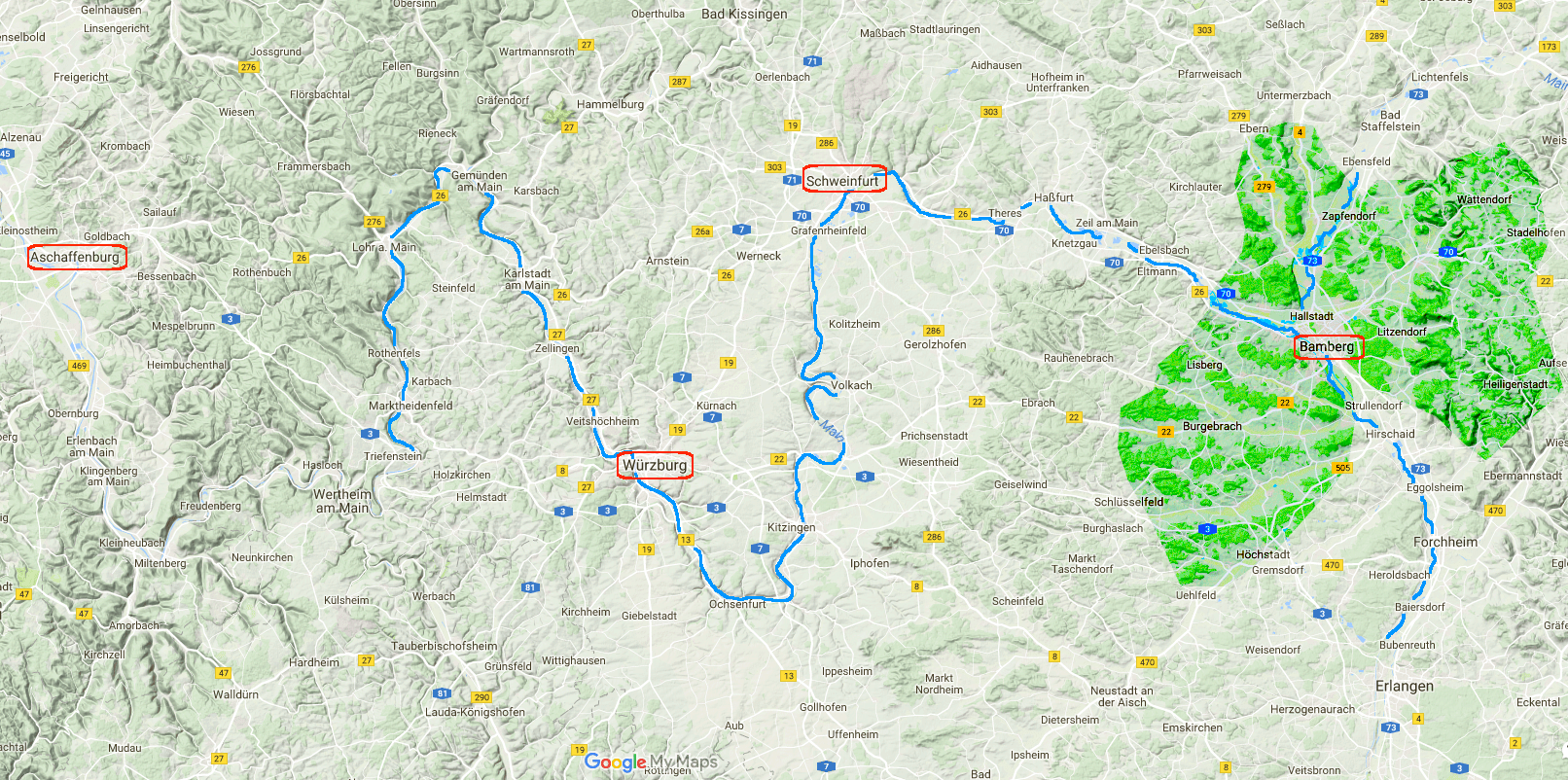
About the Main and Regnitz Wends we already wrote here.  About Würzburg we wrote here.  About Bamberg here.  About the River Jossa/Jassa in the vicinity of Aschaffenburg, here.  Here is a map showing these places in relation to Schweinfurt with the terra Slavorum in rough outline.

And here is another German map of Slavic place names – the roughly same highlighted area, this time in the western portion of the map.Make of it what you want but something tells us that at least some of the Slavs did not come from the East.

Interestingly, in 1990 halfway between Bamberg and Munich, in Kemathen – which these days is  a part of the town of Kipfenberg (Landkreis Eichstätt) there was discovered a Germanic warrior grave from about 420-450.  In it was found this belt (picture from Ludwig Wamser’s book). 

While the rosette is a common symbol, this type was particularly popular as a protection symbol in Polish houses.  Check these out from the Podhale region.

Starry Detour

Incidentally, if the rosettes above remind you of the asterisk symbol, you should know that an asterisk is derived from Greek for “little star”.  On the star of Jastarnia see here.  The interesting thing about stars is that Balto-Slavic languages have a very different word for them:

  • gwiazda (Polish)
  • żwai(g)zdē (Lithuanian)

Interestingly, in Prussian swaigstan meant “light” (Polish światło). Even more interestingly, stara in Slavic means “the old one” (female gender).  Whether this goes to something meaning “stars” or has more to do with old people lacking a certain flexibility (compare “to stare” or “stiff) is another matter.

Back to Our Stary, err… Story

Finally, it is also interesting that a lelek refers to a stork in parts of Poland (lelek is also a separate type of bird – the nightjar.  The more typical name for stork (nowadays German Storch) is bocian (compare that with Latin buteo and Germanic buse and busart (!)).

Copyright ©2017 jassa.org All Rights Reserved

May 27, 2017

Suffice it to Say

Published Post author

It is interesting that the word “he” appears in these two base forms in Indo-European languages:

  • El (Portuguese, Spanish, French)
  • On (Slavic)

Note that Germanic (other than German which seems just confused) languages are a bit different here using some form of “that” (compare Latvia ).  Also Italian, Lithuanian and Estonian slip into an “s”.

It is also curious that “El” is a Middle Eastern god and is a suffix in some of those deities’ names, whereas -on is a suffix in many Eastern and Southern European names and Deity names (Jasion,  Pieron).  Of course, -on is a suffix in other names too whose origin is uncertain (Simon) and Slavs construct new words using -on as a suffix even now (kujon).  Of course, -on as a suffix appears in other countries as well.

Copyright ©2017 jassa.org All Rights Reserved

May 24, 2017

On Herbert’s Recorded Miracles

Published Post author

We cannot emphasize enough that telavic mythology has not been thoroughly explored.  The major studies of sources have produced plenty of material but missed some items.  Note that a lot of these items are not well known even in their respective countries of production.  This can be said of the mentions of Slavic religious practices by:

We were guided to yet another such find just recently.  A scholar of the Jagiellonian University* from Kielce – Michał Łuczyński with a translation by Małgorzata Kruszelnicka – published an article  in 2009 wherein he notes a reference to Slavic religion in  Herberti turrium sardiniae archiepiscopal De miraculis libri tres (Herbert Archbishop of Torres in Sardinia – Of the Miracles in Three Books).  The specific reference is to a confrontation between a Christian monk and a Slavic pagan “demon”.

[* Incidentally, it was also a scholar of the Jagiellonian University – Maria Kowalczyk (or Kowalczykówna) – who discovered the most ancient references to Polish Gods in in the sermons of Lucas of Great Kozmin (see “Wróżby, czary i zabobony w średniowiecznych rękopisach Biblioteki Jagiellońskiej,” 1979).  Like Szacherska’s work, this was ignored, except in Stanisław Bylina’s 1993 article (“The Church and Folk Culture in Late Medieval Poland” in Acta Poloniae Historica vol 68, page 27), until  the Leszek Kolankiewicz’s (a theatrical scholar!) book “Dziady” brought it back to light in 1999.   Łuczyński’s article came out in 2009 – ten years after Kolankiewicz’s book so it seems something is brought to light every ten years – we’ll take it.]

This story is only present in three manuscripts of the Miracles where (as Chapter 93) it is referred to as: Quomodo zabulus in scemate regio se ipsum ydalatris ostendebat or “How the devil revealed himself to idolaters in [some] unattractive country.” (elsewhere aka De converso, qui vidit ante conversionem dyabolum ydolatris se ostendere in scemate regio)

The same was previously also noted by a Danish writer in the 1930s (exact source now escapes memory), by Stella Maria Szacherska in 1968 in her work Rola klasztorów duńskich w ekspansji Danii na Pomorzu Zachodnim u schyłku XII wieku (“The role of Danish monasteries in Denmark’s expansion in Western Pomerania at the end of the 12th century”) and, more recently, in 2005 by  Gabriela Kompatscher Gufler (Herbert von Clairvaux und sein Liber miraculorum: die Kurzversion).  For other mentions of this work, you can see Łuczyński’s article in Mythologia Slavica, volume 16, 2013, page 69.

Note that the Miracles appear in Migne’s Patrologia Latina – volume 185 (starting on p. 1272) but do not contain the aforesaid adventure.  This is because the Migne version used the most common manuscript version.  Interestingly, even that version contains a reference to Slavs in Book Three, Chapter 36 (which corresponds to Chapter 94 of the version containing the Quomodo story) (though that story of the Slavs has been interpreted to refer to Prussia instead in Wiener’s work which was also accepted by Marian T.W. Łodyński).  Because the Slav portion appears right after the Quomodo story we showcase both here (For the Quomodo story we use the Łuczyński/Kruszelnicka translation with some alterations – for example, scemate regio probably refers to an unattractive country not to “regal gowns”).  

So who was Herbert?  We are talking about Herbert of Clairvaux (circa 1130 – circa 1181) Monk at Clairvaux (1153–68/9), abbot of Mores in Champagne; but later also archbishop of Sassaria or Porto Torres, Sardinia (circa 1181).  To be clear he did not perform the miracles in his “Miracles”.  Rather his book is a composition of stories regarding others’ miracles put together by Herbert.  In the case of the Quomodo story Herbert notes that it was relayed to him by Henry of Clairvaux but the name of the protagonist monk remains unknown.

How the devil revealed himself to idolaters in [some] unattractive country
[Chapter 93]

“This is [the story] that the dignified-looking Henry, once a monk of Claraevallis, now an abbot residing in Denmark for many years, told us – [a story of] a noble monk from his abbey.  The monk in question, now still wearing holy gowns, in his youthful years went to the pagan land mentioned above* for the purpose of [carrying on of] negotiations.”

[* note – if above refers to the prior Chapter 92, that would be the same as Migne’s Book III, Chapter 35 in which indeed a “ad terram paganorum” does appear.  Since nothing says that that is a Slavic country, It is also, therefore, possible that this story also does not have anything to do with Slavs though, given, the timing of composition, that is unlikely – given that in the 12th century the only openly pagan European countries would have been parts of Slavic lands and Baltic regions – but the Christianization of the Baltics did not start in earnest till the 13th century and also those lands were further from Denmark which is the residence of the abbot conveying the story]

“However, in that territory there is an unclean statue inhabited by a most frightening God, who answers many calls and who is worshipped by the local inhabitants solely out of fear.  Sometimes he made himself visible and appeared as if a tyrant with a terrifying countenance and voice and he made these unhappiest people worship him by means of threats and beatings.  Furthermore, on that God’s order, he frequently sent diseases, disasters, infertility and other plagues and aroused fear in the unfaithful.”

“[But] if it had ever appeared that he was giving up those criminal acts or that he was acting more gently, [then] he was regarded as the deliverer of blessings.  Every year, on specified days they [these people] used to arrive festively at his temple from everywhere and they used to feast together although their participation was dishonorable [from a Christian view]. They used to set up a separate table and set it lavishly with delicious dishes, and all that used to be devoured in an invisible way by the gluttonous spirit. Then, when they [the people] saw everything had been eaten, they themselves ate joyfully because they thought the tipsy deity would be favourable to them.”

“One day, when they gathered in one place, the young Christian [I] mentioned before happened to be there. Suddenly, the well-known spirit appeared, decorated with royal ornamentation, sat down on his throne and spoke to them in a proud and contemptuous way.  Yet, those lamentable people mocked at by that shameless deity stood terrified at the sight of him and worshipped him.  When the young Christian saw it, he understood that it was the devil turned into an angel of light.  He felt fear of Satan and, calling the name of Christ, he secretly made a sign of the cross . He did not dare, however, to make the sign of the cross openly on his forehead due to a great number of people being there.  Having noticed what he did secretly, the wild deity spoke to him in his native language: ‘Hey, you deceitful Christian, tell me what you are plotting in secrecy.  Hiding under the cloak, you have made the hateful sign of the cross on your chest.  Are you also making an attempt to throw me out of my temple?  I had left the place from which you came to [come to?] my land.  I hid in the sea escaping from your cross and now that I have returned, you do not allow me to find shelter from your cross in my own temples.  You have eaten my food, you have armed against me with your signs and once again you are expelling me against my will from my domicile like an ungodly traitor’.”

“When the pagans heard the demon’s voice, they hardly understood the conversation and they were very surprised at who participated in the conversation and what it was about.  The alarmed young Christian who heard and who understood the speech, hid in the crowd because he was weak and inexperienced in his faith to such a degree that he was afraid he would be captured by the infidels and punished with death.  However, once the demon disappeared, the crowd dispersed, the young man’s wonderment diminished and [instead] what he saw and heard helped him to deepen his Christian faith.  Soon, when he returned to his native land, he went to the abbey mentioned above, where he [continued] in the service of God, and he revealed to the abbot and to the other monks what had happened to him, in order to strengthen them spiritually.”

“What else can be said: if the power of the Cross is so great that a Christian of small faith furtively and fearfully made the sign of cross [and that] caused the rulers of darkness to escape, what do you think [then] happens when men of virtue and missionaries strong in faith arrive with what is the word of God?  How many piles of corpses they created, what great multitudes of pagans they gained [for the faith] in a short time, they discovered it [all] in the words of truth which are in the Psalm: ‘A thousand fall by your side, and ten thousand to your right. And in the Ministerial Book: Five of you will chase a hundred, and a hundred will chase ten thousand. God wishes this kind of [bountiful] harvest in order to send harvesters to reap. Harvest is plentiful, but [there are] very few harvesters.  However, those very few harvesters who came from all over are blessed profusely and they reap the harvest of souls for God.  As a result, thousands of pagans only just baptized, in a short time grow in number more and more to such a degree that the bishops and metropolitans are appointed in many cities and God’s grapevine is spread far and wide among barbaric people, who [previously] may have heard the name of wine but [until then]  did not taste [that] wine.”

Quomodo zabulus in scemate regio se ipsum ydalatris ostendebat
aka De converso, qui vidit ante conversionem dyabolum ydolatris se ostendere in scemate regio

Vir venerabilis Hainricus, quondam monachus Claraeuallis et nunc iam per annos plurimos abbatizans in regione Danensi, de quodam honesto monasterii sui converso tale aliquid nobis significavit.  Predictus itaque frater dum adhuc secularem habitum gereret, in iuvenili aetate perrexit ad negociandum in supradictam terram paganorum.  Est autem in illis locis symulacrum inmundum, in quo demon atrocissimus habitans et responsa plurima prestans pro solo timore ab illis incolis excolebatur. Siquidem interdum visibiliter seipsum ostendens, quasi tyrannus aliquis vultu et voce terribilis apparebat atque miserrimos homines illos minis ac verberibus illatis ad suam reverenciam imperiose cogebat. Preterea morbos, clades, sterilitates atque similia ex divina permissione inducens frequenter, terrorem suum super infidelibus populis incuciebat. Si quando vero ab huiusmodi malignacionibus cessare aut micius agere videbatur, magni beneficii largitor tenebatur.  Statutis quoque diebus in anno soliti erant undique ad phanum ipsius sollempniter convenire et pollutis sacrificiis participando convirare. Aliam vero e regione mensam laucioribus epulis copiose refertam seorsum apponebant, que videlicet omnia spiritus ille gulosus plerumque adveniens avida voracitate invisibiliter absorbebat. Cumque universa consumpta conspicerent, tunc et ipsi letanter epulabantur, quia crapulanti numinis gratiam iam secure prestolabantur.  Quadam itaque die, convenientibus in unum, contigit et interesse prefatum illum iuvenem christianum. Et ecce repente apparuit ibi notifer ille spiritus imperialibus ornamentis fantastice redimitus, qui residens in throno suo in superbia et in abusione concionabatur ad illos. Porro miserandi homines illi tanta demonis impudencia ludificati in aspectu eius obstupescebant et execrando prodigio divinitatis honorem impendebant. At vero iuvenis christianus cum talia cerneret, intelligens esse diabolum in angelum lucis transfiguratum, exhorruit a facie maligni et invocans nomen Christi adhibita pectori suo manu signum crucis latenter impressit. Neque enim audebat se propter gentilium multitudinem in fronte signare. Ferum tamten spiritus nequam quae facta fuerant in abscondito linceis oculis deprehendens materna iuvenis lingua allocutus est eum dicens: Eia, perfide christiane, decito mihi, quid est, quod in abscondito machinaris? Ut quid nunc in pectore tuo operiente te pallio crucem illam idibilem figurasti? Numquid etiam de phano meo eicere me queris? Ex quo venisti ad terram meam, ego inde exivi ac fugiendo crucem tuam usque nunc in pelago latitavi et nunc tandem sero reversus, ne pateris me a facie crucis tue saltem in delubris meis habere refugium? Nunc enim saturatus epulis meis armatus es contra me signaculis tuis iterumque me de statione mea tanquam proditor impius violenter expellis. Cum ergo barbari illi homines hanc vocem demonis audirent et minime loquelam intelligerent, satis superque mirabantur, quid diceret aut cui loqueretur. At vero iuvenis audiens et intelligens pavidus in turba latitabat, quia fragilis adhuc et fide tenellus teneri ab infidelibus atque ad supplicium protrahi metuebat. Disparente autem demone solutoque conventu cum grandi admiracione recessit et ex hiis, quae viderat et audierat, multum in fide christiana profecit. Postmodum autem cum ad natalem patriam repedasset, in supradicto monasterio se convertit, ubi religiose conversando domino militare curavit et ea, quae sibi acciderant, ad multorum edificacionem abbati et fratribus indicavit. Si quid nos ad ista dicemus: Si tanta est virtus et gloria crucifixi, ut ante pusillanimem et modice fidei christianum propter signum crucis et trepide et latenter inpressit, principes tenebrarum ita diffugerent, quid putamus fieret, si viri virtutum et fortes in fide predicatores cum gladio spiritus, quid est verbum Dei, accederent. Et quantas hostium strages darent, quantas gentilium turbas in brevi acquirerent, vere cito cognoscerent de verbo veritatis, quid legitur in psalmo: Cadent a latere tuo mille et d[ecem] m[ilia] a[d] d[exteris] tuis. Et in Levitico: Persequentur quinque de vobis – centum alienos, et centum ex vobis – decem milia. Pro huiusmodi ergo rogandus est dominus messis, ut mittat operarios in messem suam. Messis est enim multa et operarii autem pauci. Verum tamen ipsi pauci, immo ut verius dicam, paucissimi, qui in partibus illis reperiuntur in missis undique; falcibus predicationis cum tanta benedictionis habundantia et animarum fruges Domino colligunt et ut nimia paganorum milia nuper in brevi tempore baptizata cottidie magis ac magis multiplicentur et adeo ut episcopi atque metropolitani in civitatibus plurimis nunc de novo creentur et vinea domini Sabbaoth in populis barbaris, qui vini forsitan nomen antea audierant, vinum tamen non biberant, hodie longe lateque propagetur.

The Introduction of the Christian faith in Slavonia, demons scatter from it with horrible noise, as if defeated in battle by an army, and they are routed and put to flight
Chapter 94 (also Migne, Book 3, Chapter 36)

“In the country of Slavonia, the greater part of which has only recently been converted to Christianity, many Cistercian monasteries have already been founded.  Furthermore, the monks who toil daily there for the Lord on converting the heathens received the power to baptize [them] from the Supreme Pontiff.”

“It happened that some of these brothers, who were invited from certain of the faithful, one day came to one of the neighboring villages, baptizing a multitude of pagans in it, [a village] which had recently received the faith and which and which required a regeneration of grace.”

“And the prior night, before they reached this [village], there is a huge noise to be heard from [that place] and a great roar, as if [made] by a great army resonating during the entire night time in the streets and squares of that town; seemingly, as if another army made a powerful assault and finally defeated [the first] from the back and left in a great upheaval.  Moreover, the locals fleeing heard the noise and flights sounds [but] not seeing anyone became dismayed and greatly frightened not knowing what this new thing was or what malice [?] it portended.”

“The next day the monks who arrived at the village baptized there throngs [of people] of [men and women].  But at this time it was made known to the faithful that the noises of the prior night were nothing other than legions of demons complaining and fleeing the Lord for they were not able to withstand the angels and the coming of the Holy Spirit.  Truly many are consoled in the presence of the Lord and especially so the newly-baptized who were saved from eternal damnation.”

Christiana fide in Sclavoniam inducta, diffugiunt ex ea daemones cum horrendo strepitu, velut exercitus praelio victi, et fusi ac fugati

In regione Sclavoniae, quae noviter est ad fidem Christianam conversa magna ex parte, plurima jam Cisterciensis Ordinis monasteria constat esse fundata.  Porro monachi illi qui ibidem Domino serviunt, ob quotidianam conversionem gentilium baptizandi potestatem a sumno pontifice acceperunt.  Factum est autem ut aliqui. de fratribus illis, a quibusdam fidelibus invitati, statuta die venirent ad unam de proximis viltis, paganorum multitudinem in ea baptizaturi, quae nuper fide recepta regenerationis gratiam flagitabat.  Praecedenti ita que nocte, antequam illuc pervenissent, auditus est ibi sonus et fremitus ingens, quasi exercitus grandis, toto tempore noctis per vicos et plateas ejusdem villae perstrepentis, qui velut ab alio exercitu forteter impugnatus, tandemque superatus, terga vertere, atque cum magna turbulentia exire videbatur.  Porro homines loci, recedentium strepitum et fugam communiter audientes, et personam aliquam non videntes, stupebant ac metuebant, nimirum ignorantes quae ista novitas esset aut quid boni malive portenderet.  In crastinum autem venientes monachi ad eamdem villam, baptizaverunt ibi promiscui sexus turbam copiosam.  Tunc vero cunctis fidelibus manifeste innotuit quod tumultus ille nocturnus nihil aliud exstitit, nisi daemonum legiones, ab obsessis hominibus increpante Domino fugientes; qui beatorum angelorum praesentiam, et sancti Spiritus adventum sustinere non poterant.  De qua videlicet re multum in Domino consolatu sunt universi, praecipue vero neophyti illi qui ab immunda damnatione fuerant liberati.

Copyright ©2017 jassa.org All Rights Reserved

May 15, 2017

Modelski & the Franks

Published Post author

You ask where is the rest of the Teofil Modelski’s article (parts 1 & 2 being here) on the Opusculum‘s Lechia?  (No translation… too much of a pain in the ass).

Well, here is part 3 of 5:

Here is part 4:

And finally part 5:

Copyright ©2017 jassa.org All Rights Reserved

May 12, 2017