Category Archives: Religion

Going Back to Those Polish Rosettes

Published Post author

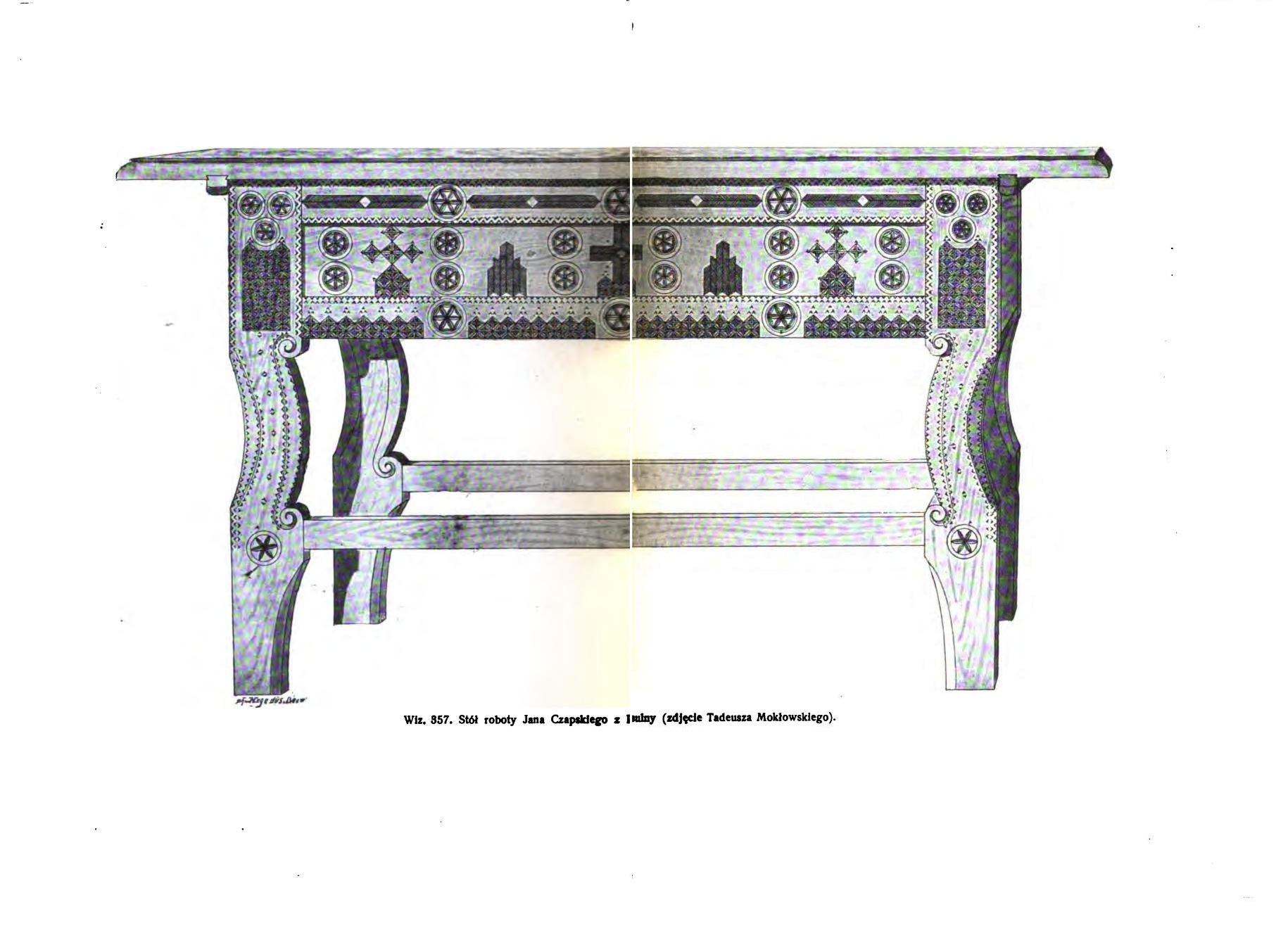
Regarding the rosette sign from the territories (or former territories) of Poland, here are a few examples from the “Folkart in Poland” (Sztuka Ludowa w Polsce) by Kazimierz Mokłowski from 1903. For other examples you can see here. Of course, if you really want to see rosettes, check out Romania – the place is full of them.


Violin from Bilgoraj

On the left we have the Bilgoraj violin. On the right another string instrument – the so-called Lithuanian klawec from East Prussia

.


Chest from Ivano-Frankivsk (Stanisławów)


Pomeranian Chairs

These chairs’ rosettes are not the usual hexapetal rosettes but they are quite similar so I also include them.


Jabłonowo Prayer Stand

This is from a bóżnica – a Jewish temple. Note that the symbol is, of course, also represented in other Jewish art such as the Magdala Stone.


Ivano-Frankivsk (Stanisławów) Table


Another Table
(more 
contemporary)


Podhale Spoon Holder

These are so-called łyżniki – spoon racks. If you look closely, you will see the same hexapetal rosette.


Sosrębs From Little Poland (Bogusza near Grybów in the Nowy Sącz Area) and Great Poland (Gniezno Area)

sosręb is a beam holding up a roof. It was common in Poland to carve images of the rosette in such beams. Below you have examples from Bogusza (near Grybów in the Nowy Sącz area), Gniezno (from the local collegiate church!) and from Kłecko (near Gniezno).

The final example is from Kniahynyn (Knihin) in the Ivano-Frankivsk (Stanisławów) area. Though this sosręb does not feature a rosette – rather a type of a cross made up of triangles.

The Gniezno sosręb is from 1750. The Kłecko sosręb is from 1733. The Knihinin sosręb is from 1886.


Lviv (Lwów/Lemberg) Sosrębs

This sosręb dates to 1669,

And this sosręb dates to 1690.


Huculsko or Huculszczyzna

This sosręb is from Huculsko or Huculszczyzna – today’s Ukrainian Гуцу́льщина. The text also describes other examples from other places in Poland (e.g., Pomerania).


Here are a few rings from Moszyński’s Suavic Folk Culture – the one on the right features a similar rosette motif:

Copyright ©2019 jassa.org All Rights Reserved

September 1, 2019

In Defense of P(io/e)run?

Published Post author

I have never been a fan of “Perun” as an “all-Suavic” God. The reason is simple. Outside of the Eastern Suavs of Kiev and the Balts (Perkunas), references to Perun are nonexistent. In Poland, you have Yassa who may be viewed the same as the titular Svantovit of Arkona. In some Western Suavic lands you have Svarozic. That much is attested. Of course, the Perun word comes form a Suavic (likely all the way back to PIE) word. Thus Piorun > Perun > Perkunas (Perku-nas?). But this is merely a word for an obviously unnerving atmospheric phenomenon. That the Suavs, like many other people, should associate thunder and lightning with a divinity is not surprising and perhaps even quite expected but there is a long way from that to having a “specialized” thunder God whose primary (and perhaps only) aspect is that thunder. That such a dedicated God of Thunder may have arisen among the Eastern Suavs even independent of any Scandinavian influence is naturally possible but, if so, there is no evidence of this God being worshipped among the other – western – Suavs (a better candidate there is Tyr/Taranus whose name seems to have survived in, for example, the Polish taran and perhaps also tija known from the statuta breviter).  I have also questioned whether the God found in the famous passage by Procopius was in fact Piorun/Perun or Someone Else (the maker of lightning – not thunder!) – specifically, “Jassa” that is Iasion. I have not, however, questioned the underlying truth of the passage, that is that the God mentioned by Procopius was a genuine Suavic God.

Let’s give that passage again (History of Wars, Book 7, 14):

“For they believe that one god, the maker of the lightning, is alone lord of all things, and they sacrifice to him cattle and all other victims.”

Now, however, here come Florin Curta and Bartłomiej Szymon Szmoniewski who in their “The Velestino Hoard” book make the following surprising statement:

“It is now generally accepted that, far from being a genuine description of Slavic religion, Procopius’ account is in fact an attempt to present Slavic paganism as comparable if not similar to Greek pagan mythology. The reference to the god of thunder is therefore to Zeus, not to Perun, who was unknown to both Procopius and the sixth-century Sclavenes he described in his Wars. See Aleksander Loma, ‘Procopius about the supreme god of the Slavs (Bella VII 14, 23): Two critical remarks…’ To Jerzy Strzelczyk… Perun was unknown to the Slavs before the tenth century, when Thor of the Norse mythology was introduced by Varangians to Rus. For a critique of attempts to ‘read’ into Procopius much later sources pertaining to the religion of the Slavs, see Judith Kalik and Alexander Uchitel, Slavic Gods and Heroes…” 

The prolific Curta – an archeologist and not a historian – has made his career out of asserting that the Byzantines “created” the Suavs. I’ve critiqued this bizarre suggestion on linguistic, historical and genetic grounds before (see here). Its worst sin, as discussed, is that it is merely a retread of the same deconstructionist theories circulated earlier about the Germans (that the Romans “created” the Germans in the same sense). All these theories make as much sense as claiming that humans created the “elephant identity” by calling these big eared creatures with their funny trunks by the name “elephants”.

What is interesting about the above passage, however, are the (once again given Curta’s involvement) exaggerated claims it makes.

If Curta and Szmoniewski were writing a Wikipedia entry, the Wikipedia editors would no doubt have met the assertion of “It is now generally accepted that…” with the notorious “[by whom?]”.

Presumably, the “general acceptance” of the fact that Procopius’ God was Zeus (!) is derived solely from Loma. The main problem and, shall we say, the quintessential one,  is that Loma says nothing of the sort. Here is the referenced article:

As you can see Loma makes no connection between the God mentioned by Procopius and Zeus.

Now Curta and Szmoniewski do not claim that they pulled this “the Christian Bishop Procopius is talking about Zeus” thing out of their asses. They could have done that but that’s not what they say.

No, no. They say that this proposition is a “generally accepted” proposition.

They then give one source (Loma who is a Serbian philologist) who, as it happens, does not support their “generally accepted” proposition but, in fact, says something else (his article is primarily concerned with the correct reading of the passage rather than its subsequent interpretation) and leave quite open the possibility that the reference is to Perun.

Although the authors cite the Polish historian Strzelczyk for an entirely different proposition (that Perun was Varangian in origin), I did not check whether he somehow could be used to salvage their initial claim.  Feel free to try that on your own.

As for Uchitel and Kalik, two Israeli academics of unrelated matters, the main value of their heavily negativistic booklet (much of it a retread of Brueckner’s own deconstructionist ideas) is the very timid criticism of Curta’s theories…

(Specifically, they say, ‘well, maybe Byzantines may have constructed the Slavic identity but surely someone spoke the Slavic language before that ‘construction’ happened so… where did those people live?’ Which seems a more than reasonable question to ask, even if ever so timidly.)

I am willing to assume this is not bad faith but merely extreme laziness in proofreading propelled by a heavy dose of wishful thinking on the part of the authors. On the other hand, given Curta’s other theories, one might say, enough is enough. Whatever the root cause, how does this crap get published? Don’t these guys have editors who would check their foonotes and challenge their assertions? Or do they just run this through a spell check and off to the printers we go.

Finally, to leave you with something more interesting to think about regarding “Zeus” and Piorun – check this out.

Copyright ©2019 jassa.org All Rights Reserved

August 16, 2019

Gawiński’s Sobótki

Published Post author

The longest night of the year – so-called “Saint John’s” Eve – was also an occasion to perform ancient rites. Those typically involved making wreaths and garlands for the ladies followed by late night gatherings and the setting of fires usually in the fields (going ku-pole) or on hilltops. Next came the dancing around these fires. Young women lead those gatherings and young men joined later. They would then couple up and dance around the fires and, often, jump through them – sometimes together. Some of the older records (Lucas of Great Kozmin) also mention dances with swords (“I recall that in youth I read in a certain chronicle that there were in Poland Gods and from those days to our times such rites come that, young women [in his time] dance with swords, as if in offering to the pagan Gods, and not to [the] God, as well as [dances of] young men with swords and sticks, which they then hit about…”). (see here).

The wreaths would typically be made of bylica (artemisia or mugwort) though other plants were utilized as well, including  piołun (common wormwood also a type of artemisia), dziurawiec (Saint John’s wort), leszczyna branches (hazel), mięta (mint), ruta (ruta or rue), biedrzeniec (pimpinella) or czarny bez (black elderberry) were seen as having beneficial powers on this day. Of course, the most coveted was the fern flower – a mythical flower much like the four-leafed clover. Women would take venture naked into the woods, most often with their male companions, in search of this flower. As I understand it, few had found the flower though some had had an altogether good time nevertheless.

In a related custom, the wreaths (wianki – pronounced “vianki”) would often end up being placed on the surface of local rivers and sent gently floating with the current. Frequently, they would also carry an attached candle so that they remained visible from afar. While women would float the wreaths on water, young men would light small fires on the river banks. These custom continued even into the 18th and 19th centuries when inhabitants in Warsaw would gather on the banks of the Vistula to send their wreaths on the way to the sea while cheering them on from the local bridges. Local potentates would also give out small gifts to the public on the occasion and the common people would exchange presents amongst themselves. The last Polish king – Stanisuav Poniatowski – was recorded attending these events. Sometimes the plants were forgotten and other means were used to float a fire; for example, in Pomerania, local inhabitants would place small barrels full of tar on the water surface and set them on fire, watching them head out to the Baltic.

Such gatherings were known in Poland as sobótki (diminutive for “sabbaths”) or palinoce (pronounced palinotze) aka palinocki (pronounced “palinotzki”) (that is “burning nights”). The rituals are alluded too already in the 11th century by Thietmar who describes Mount Ślęża in Silesia. That same mountain would be referred to as sobotka in the 13th century. The clergy typically bemoaned such pre-Christian relicts and forbade them as we have described previously:

  • Bishop Andrzej Łaskarz Statutes (1420s): “Prohibit too the nightly dances that take place during days of the sabbath (sobotki or kupalnocki in the summer) and on the days of the Saints John the Baptist and Saints Peter and Paul, for there are fornications and adultery and incest committed in those times.” (see here); or
  • Royal Decree of Casimir IV (1468): populi multitudo sexus utriusque assolet de consuetudine confluere, ubi tubarum, timpanorum. fistularum, aliorumque musicorum generum exercicia adhibentur, chorearum ceterorumque jocorum plausus exercentur…” (see here); or
  • Marcin of Urzędów (circa 1500 – 1573): “For this reason these pagan [maidens] dedicated this herb to her and when the day [of Diana/Artemis] was celebrated some hung it up around houses while others girded it on: and this was done on the twenty fourth day of the moon [month] June, on our day of Saint John: and so they [the ladies] lit fires in the night, danced, praying and honoring the devil.  [And] this pagan custom they [women] refuse to forsake to this day, for so they make offerings of this herb hanging it and girding it on.  And they honour holidays of this devil [i.e., Diana/Artemis] by making sabaths [sobotki], burning fires, kindling fires with planks [sticks], so that there should be the right devilish holiness: there they sing devilish songs, obscene/filthy while dancing.” (see here);

Many Polish writers wrote about these customs quite affectionately – among them the 16th century poet Jan Kochanowski and the 17th century poet Jan Gawiński.

Kochanowski wrote about the custom in his “Saint John’s Song About Sobótka” which features twelve maidens (see this website for the whole thing in Polish) whereas Jan Gawiński wrote the following in his twelve months’ compilation (featured in June of course):

“Saint John the Baptist hath come, hence they burn the sabbaths and round these they sing and dance the village lasses. Don’t abolish their rites. What has come to us through the ages and withstood centuries, must continue through the ages yet.”

Jan święty Chrzciciel przyszedł, więc palą sobótki a koło nich śpiewając skaczą wiejskie młódki. Nie znoście ich zwyczajów. Co nas z wiekiem doszło i wiekom się ostało, trzeba by w wiek poszło. 

Curiously, in describing the customs of the month of December, Gawiński speaks of the daughter (Mary) giving birth to the father (Jesus). This convoluted concoction also smacks of pre-Christian beliefs where he Earth (Demeter, perhaps Marzanna-Ceres) gave birth to Jasion (Iasion) who then – in June (that is on “Saint John’s” Eve) would fertilize the same Earth before he withered in the winter only to be reborn (with the “invincible” Sun) in December again. Once again I recommend James Frazer’s “The Golden Bough”.

Copyright ©2019 jassa.org All Rights Reserved

August 12, 2019

Ūsiņš, Usenj, Usen, Jeuseņš, Jasień, Jasio, Jasinek, Iasion, Jason?

Published Post author

The Latvian “light” God is Ūsiņš (see here and here) but Ūsiņš appears in Latvian role in other forms – specifically as Jeuseņš (excuse the mangling of the Latvian alphabet – will try to clean it up later):

For example (all from Haralds Biezais’ Lichtgott der alten Letten):

Tecit skrinit iz piguli!
Jau Jeuseņš joj pigula:
Jau Jeuseņš pigula.
Pices üles ozüte.
Buteleite kuldena,
Treis glazeites reikleite,
Pa licena kabata,
Pa licena kabata.

Or:

Eita broli, paleidit
Jeuseņam padzidit:
Vista ula nudejuse,
Visu dinu kacenoj.
Zirgs nudersa lila gubu
J vardena nasceja.

Or:

Jeuseņ, Jeuseņ, a beus lobs jüstena(s)!
Saimeniks bogotais, lobu zirgu globötojs,
Lobu zirgu globötojs, globöj zirgu globotoj(e)s
Dzersim olu, ulavusim!
Visu zirgu globösim!
Pigulä jösim, pigulä jösim!

Now compare this with the Polish Jasień:

Jedzie, jedzie, mój Jasień kochany ku zielony dąbrowie,
Rozpuścił sobie te złote piórecka kónikowi po głowie.
A nie tak ci mi zal tych złotych piórecek, com sobie je rozpuścił,
A najbardziej żal moja Marysiu, com ciebie opuscil.
A jedzie, jedzie mój Jasień kochany, ku tej Bozej męce,
Co na mnie spojrzy, co się obejrzy, załamuje ręce.

There are literally of dozens of other examples like this from all over Poland and, as noted above in the links, similar, occurrences take place in northern Russia . Other Polish forms are Jas(io) or Jasinek/Jasienek (diminutive) (“A Jasienek za jabłuszka dziękuje, a Kasinka małe dziecię A Jasinek na koniku wywija, a Kasinka małe dziecie powija.”). All of which, for the Latvians and the Poles brings us back to Iasion. And, if you want to see the Greek interpretation (which in the Greek form made its way back again to the Slovenes), see here.

Copyright ©2019 jassa.org All Rights Reserved

August 6, 2019

Wadon of the Suavi in the Life of Columban

Published Post author

We’ve already discussed “The Life of Columban” in the context of the Suavs/Wends here.

But what of the Suavi? They are mentioned there as well as and, interestingly, with their God Wodan or Odin.

Below we bring up this “Odin” once again… or is it Wadon?

The pictures are, same as in the original posting referred to above, from the oldest codex of the abbey of Saint Gall (MS 553). Contrary to MGH, the name is not Vodano but Uadono. From that name it is an easy leap to Łado & Łada. And so here we are.

The English translation is, as in the original posting, by Dana Carleton Munro.


Book I

“At length they arrived at the place designated, which did not wholly please Columban ; but he decided to remain, in order to spread the faith among the people, who were Swabians. Once, as he was going through this country, he discovered that the natives were going to make a heathen offering. They had a large cask that they called a cupa, and that held about twenty-six measures, filled with beer and set in their midst. On Columban’s asking what they intended to do with it, they answered that they were making an offering to their God Wodan (whom others call Mercury). When he heard of this abomination, he breathed on the cask, and lo! it broke with a crash and fell in pieces so that all the beer ran out. Then it was clear that the devil had been con- cealed in the cask, and that through the earthly drink he had proposed to ensnare the souls of the participants. As the heathens saw that, they were amazed and said Columbrn had a strong breath, to split a well-bound cask in that manner. But he reproved them in the words of the Gospel, and commanded them to cease from such offerings and to go home. Many were converted then, by the preaching of the holy man, and turning to the learning and faith of Christ, were baptized by him. Others, who were already baptized but still lived in the heathenish unbelief, like a good shepherd, he again led by his words to the faith and into the bosom of the church.”


…Ad destinatum deinde perveniunt locum. Quem peragrans vir Dei non suis placere animis aiet, sed tamen ob fidem in gentibus serendam inibi paulisper moraturum se spondit. Sunt etenim inibi vicinae nationes Suaevorum. Quo cum moraretur et inter habitatores loci illius progrederetur, repperit eos sacrificium profanum litare velle, vasque magnum, quem vulgo cupam vocant, qui XX modia amplius minusve capiebat, cervisa plenum in medio positum. Ad quem vir Dei accessit sciscitaturque, quid de illo fieri vellint. Illi aiunt se Deo suo Vodano* nomine, quem Mercurium, ut alii aiunt, autumant, velle litare. Ille pestiferum opus audiens vas insufflat, miroque modo vas cum fragore dissolvitur et per frustra dividitur, visque rapida cum ligore cervisae prorumpit; manifesteque datur intellegi diabolum in eo vase fuisse occultatum, qui per profanum ligorem caperet animas sacrificantum. Videntes barbari, stupefacti aiunt magnum virum Dei habere anhelitum, qui sic possit dissolvere vas ligaminibus munitum; castigatusque euangelicis dictis, ut ab his segregarentur sacrificiis, domibus redire imperat. Multique eorum tunc per beati viri suasum vel doctrinam ad Christi fidem conversi, baptismum sunt consecuti; aliosque, quos iam lavacro ablutus error detinebat profanus, ad cultum euangelicae doctrinae monitis suis ut bonus pastor ecclesiae sinibus reducebat.

* Vadono (A1a), Wodano (A1b), Woda (A2)

Copyright ©2019 jassa.org All Rights Reserved

July 13, 2019

Lelum Polelum

Published Post author

The earliest recorded mention of the Polish lelum, polelum comes from the “Prayer Book of Sister Constance” (Modlitewnik Siostry Konstancji) which seems to have been put together in 1527 (at least, that is, according to Jerzy Samuel Bandtkie aka Bandtke the famous Polish philologist, linguist and historian). It is a copy of earlier (probably end of 15th or early 16th century) books. The prayer book itself was mostly handwritten it seems but also, apparently, contains some printed material. It is stored in the Jagiellonian Library though was published by Władysław Wisłocki (1841-1900) in 1882. From there it came to the attention of Brueckner and others.

In the prayer book, the saying lelum polelum seems to mean as much as “easily” or “without effort.” Wisłocki  gives the full sentence as:

“But who should receive it [the glory of eternal life] for free leli poleli, without suffering anything, without performing any good deeds?”

„A któż ją daremno otrzyma (chwałę żywota wiecznego) leli poleli, nic nie cierpiąc, nic dobrego nie działając?”

As to who this sister Constance was, your guess is as good as anyone’s.

Of course, lelum polelum, continues to be a favorite of many a Suav with some Suavic warriors being particularly fond of it.

 Copyright ©2019 jassa.org All Rights Reserved

July 6, 2019

The History of Leo the Deacon

Published Post author

The History of Leo the Deacon” contains a significant amount of information regarding the Varangian Rus and their wars with the Byzantines. We are not going to give all that here but we will include a passage that discusses some religious customs of the Rus. Some of this made its way into Karl Meyer’s “Fontes historiae religionis Slavicae.” It’s not clear whether these religious customs are customs of the Suavs or of the Rus. My bet is on the latter. For example, the killing of the chickens is similar to that described earlier by Constantine Porphyrogennetos as being done by the Rus. Alternatively, there are also apparently similar customs amongst the Hungarians, Mongols and Tatars. Nevertheless, since Meyer saw it fit to include this in his book, we will include it here as well. Note that the History itself is a 10th century book. The English translation is from Alice-Mary Talbot and Denis F. Sullivan edition. The events described below date back to 971 when  John Tzimiskes defeated Svyatoslav of Kiev (whose parents were Igor and Olga) who was roaming through Bulgaria.


Book IX

6. Elated by this victory, the Rus’ issued forth from the city the next day, and drew up their ranks on the batdefield; and the Romans also were arrayed in close order and in a deep formation and went to meet them. At this point Anemas, one of the imperial bodyguards and son of the leader of the Cretans, caught sight of Ikmor, second in command of the Scythian army after Sphendosthlavos and ranked immediately after him, a huge and vigorous man, who was frenziedly attacking with a company of infantry following him and killing large numbers of Romans; and Anemas was incited by his innate prowess, and drew the sword which was hanging at his side and turned his horse this way and that, and goaded it with his spurs, and headed toward Ikmor. And he overtook him and struck him in the neck; and the Scythian’s head and right arm were severed and dashed to the ground. As he fell, a cry mingled with lamentation arose from the Scythians; and the Romans attacked them. They could not withstand the enemy assault, but, grievously distressed by the death of their general, raised their shields, covering their shoulders, and withdrew to the town; and the Romans pursued them and slaughtered them. When night fell, since the moon was nearly full, they [the Rus’] came out on the plain and searched for their dead; and they collected them in front of the city wall and kindled numerous fires and burned them, after slaughtering on top of them many captives, both men and women, in accordance with their ancestral custom.  And they made sacrificial offerings by drowning suckling infants and chickens in the Istros, plunging them into the rushing waters of the river.  For they are said to be addicted to Hellenic mysteries,  and to make sacrifices and libations to the dead in the Hellenic fashion, having been initiated in these things either by their own philosophers, Anacharsis and Zamolxis, or by the comrades of Achilles. For Arrian says in the Periplous that Achilles, son of Peleus, was a Scythian, from a small town called Myrmekion located by Lake Maeotis; and that he was banished by the Scythians because of his harsh, cruel, and arrogant temperament, and then went to live in Thessaly. Clear proofs of this story are the style of his clothing with a brooch, and his fighting on foot, and his red hair and grey eyes, and his reckless and passionate and cruel temperament, on account of which Agamemnon reproached and mocked him, speaking as follows: “Always is strife dear to you and wars and battles!” For the Tauroscythians are still acccustomed to settle their disputes with killing and bloodshed. That this people is reckless and warlike and mighty, and attacks all the neighboring peoples, is attested by many people, among them the holy Ezekiel, who alludes to them when he says as follows: “Behold, I will bring upon you Gog and Magog, the ruler of the Rosy. But this is enough about the sacrifices of the Taurians

7. Then, since day was already dawning, Sphendosthlavos assembled a council of nobles, called a komentoh in their language. When they were all gathered round him, and had been asked by him what the course of action should be, some advised that they should embark on their boats in the middle of the night and steal away by any means whatsoever; for they were not able to contend with ironclad horsemen, and besides they had lost their best warriors, who had encouraged the army and sharpened their mettle. Others counseled, on the contrary, that they should come to terms with the Romans [that is the Byzantines], and receive pledges in return, and thus save the remaining army. For they could not easily escape by ship, since the fireships were keeping watch over the transports on both sides of the Istros, so that they could immediately set fire to all of them, if they attempted to sail out on the river. Sphendosthlavos groaned deeply and bitterly, and said: “If we now yield ignobly to the Romans, gone will be the glory that has attended upon the arms of the Rus, as they have effortlessly overwhelmed neighboring peoples, and enslaved whole lands without bloodshed. Rather, let us again manifest the valor of our ancestors, and, remembering that up till now the might of the Rus has been unvanquished, let us fight ardently for our safety. For it is not our custom to return to our fatherland as fugitives, but either to be victorious and live, or to die gloriously, after displaying deeds [worthy] of brave men.” Such was the advice of Sphendosthlavos.

8. This also is said about the Tauroscythians, that never up until now had they surrendered to the enemy when defeated; but when they lose hope of safety, they drive their swords into their vital parts, and thus kill themselves. And they do this because of the following belief: they say that if they are killed in battle by the enemy, then after their death and the separation of their souls from their bodies they will serve their slayers in Hades. And the Tauroscythians dread such servitude, and, hating to wait upon those who have killed them, inflict death upon themselves with their own hands. Such is the belief that prevails among them. But then, after listening to the words of their leader, out of love for life they decided to choose danger for the sake of their own safety, and spiritedly drew up to oppose the Roman forces.

Copyright ©2019 jassa.org All Rights Reserved

July 3, 2019

Medieval Connections or More Likely Lack Thereof

Published Post author

It is interesting to note how the same symbols crop up in different contexts. To illustrate here are some samples from an article by Piotr Kotowicz.


Here is an axehead from Over Hornbæk in Denmark:

And here is a mason’s mark from Saint Peter’s collegiate church in Kruszwica, Poland (full disclosure: I flipped it to match 🙂 ):


Here is an axehead from Pień in Poland: 

And here is the “infamous” urn from Biała, Poland (3rd-4th century) that “proved” to the Nazis that their ancestors had beaten the Poles to, well, Poland (it was found by Poles pre-WWII):

Another similar motif appears on an urn from Wąchock:

Similar symbols were found in England (in this case, again, as masonry marks!) and on pottery as early as the Sintashta culture.


Now, part of the problem here is that these symbols are not exactly that difficult to come up with which means that they likely repeat themselves quite independently. Of course, the closer people live, the more likely it is that they will try to steal each other’s artistic ideas too. For these reasons, the “meaning” of these things might be entirely different depending on the location and time.

Copyright ©2019 jassa.org All Rights Reserved

June 7, 2019

The Łada Sejm Letters

Published Post author

A series of other mentions of Łado or Łada are present in the correspondence of the various Polish and Lithuanian nobles with the Polish King during the time of the so-called Executionist Sejm (legislative gathering – if you want more context, read Robert Frost’s “The Making of the Polish-Lithuanian Union 1385-1569” which is volume 1 of the Oxford History of Poland-Lithuania). These letters include:

  • A letter dated Tuesday, the 14th December 1563
  • A letter dated Friday, the 21st of January, 1564

On the one hand these are late but on the other they signal that the Name was still known and used in songs and sayings, kind of like lelum polelum which probably from the Castor-Pollux pair of LalkiAlcis became a wistful exclamation in  drinking songs.

These letters (which appear to have been written to the Polish king – Sigismund Augustus) were published (by Adam Tytus Działyński) in 1856-1861 as the “Written Sources Regarding the Union of the Polish Crown and the Grand Duchy of Lithuania, Part II” (Źródłopisma do Dziejów Unii Korony Polskiej i W.X. Litewskiego: Część II) (oddly, only parts II and III seem to exist).

Adam Tytus Działyński


December 1563 Letter

This letter contains a reference to a song which mentions Łado. Interestingly this song is attributed by the writer of the letter to Jakub Uchański (1502 – 1581) the later Primate of Poland. He was born in Uchanie (Radwan coat of arms) in the Lublin area but was subsequently a bishop of Chełm (German Kulm) and it was then that he was sent with an embassy to the royal court and, apparently, sang a song the text of which is cited in this letter. The contents of the letter are not particularly relevant to the topic but I include the full letter for completeness or context.

Jakub Uchański

The text is as follows:

Polish: “Łado, łado. Będzie to z łaski miłego Pana Boga łado, nam wszem wiernym W.K.M. poddanym…”

English: “Łado, Łado. Let this be [come] from the grace of the Dear Lord Łado, for all of us your royal highness’ faithful servants…”

This is the Uchański tombstone in Łowicz with his coat of arms (Radwan).


January 1564 Letter

The contents of this letter are also not particularly relevant for our purposes but the sentence underlined below essentially states that because things went so splendidly that day:

Polish: “…tak że się prędko rozjachać możemy, ono nasze stare Łado zaśpiewawszy…”

English: “…we may quickly depart having [first] sang our old Łado…”

This letter may be by Stanisław Orzechowski.

Copyright ©2019 jassa.org All Rights Reserved

June 3, 2019

Once Again Regarding Harmonia’s Wedding

Published Post author

An interesting question about the nature of Łada has never been solved:

  • is Łada a Polish Goddess worshipped locally in Mazovia or is Łada the Polish (presumably male) God Mars?

The confusion stems from the fact that Długosz referred to Łada as a Mazovian Goddess in one place but as the Lechitic Mars in another.

Elsewhere, Łada is also referred to as the gardzyna that is “hero” or “champion” of Jassa. So we can also ask:

  • is Łada the Male War Champion or is Łada the Female War Champion.
  • And what is the connection to Jassa?

A solution to some of these questions may present itself if we acknowledge the fact that there may have been two Deities with a similar Name, look at the origin of the word ładny and rope in a bit of Greek mythology.

note: I’ve already written about some of this here but without focusing sufficiently on the “Łado – Ares” connection. What “Łado – Ares” connection? Keep reading.

Let’s begin:

Two Deities

First, there are actually two different Deities referred to in non-Polish Suavic songs – the female Łada and the male Łado. They are not siblings. Rather, they are typically shown as the bride (Łada) and the bridegroom (Łado). (It is from this set up that Brueckner, erroneously surmised that these Names merely merely mean “your beloved.”)

The “Orderly” Name

Second, the adjective ładny did not originally mean “pretty” as it does now. It meant “orderly” or “harmonious.” It originated with the word ład – which means, to this day, simply, “orderliness” or merely “order.”

Incidentally, the word jasny – that is “bright” – may come from – the name Jaś. 

The Greek Connections

Third, we have Greek mythology. Greek mythology, with all of its inconsistencies such as they are, presents us with an interesting name – twice. That name is Harmonia. I say twice because there are two Harmonias. Yet, each brings a tantalizing hint for the reconstruction of the Polish Pantheon:

  • Harmonia – The goddess of harmony and concord. In some tellings, she is the daughter of Ares and Aphrodite but there is also a version says that she was the daughter of Zeus and Electra and, the sister of Iasion (and Dardanos). In fact, it is at the wedding of this Harmonia that her brother Iasion succumbs to the lures of Demeter. This is the version related by Diodorus Siculus:

“There were born in that land [of Samothrake (Samothrace)] to Zeus and Elektra (Electra), who was one of the Atlantides [Pleiades], Dardanos (Dardanus) and Iasion and Harmonia . . . Kadmos (Cadmus), the son of Agenor, came in the course of his quest for Europe [Europa, his sister abducted by Zeus,] to the Samothrakians, and after participating in the initiation [into the mysteries of Samothrake] he married Harmonia, who was the sister of Iasion and not, as the Greeks recount in their mythologies, the daughter of Ares. This wedding of Kadmos and Harmonia was the first, we are told, for which the gods provided the marriage-feast, and Demeter, becoming enamoured of Iasion, presented him with the fruit of the corn, Hermes gave a lyre, Athene the renowned necklace and a robe and a flute, and Elektra the sacred rites of the Great Mother of the Gods [Rhea], as she is called, together with cymbals and kettledrums and the instruments of the ritual; and Apollon played upon the lyre and the Mousai (Muses) upon their flutes, and the rest of the gods spoke them fair and gave the pair their aid in the celebration of the weding. After this Kadmos, they say, in accordance with the oracle he had received, founded Thebes in Boiotia (Boeotia).”

(Diodorus Siculus, Library of History 5. 48. 2 (trans. Oldfather) (Greek historian C1st B.C.))

  • Harmonia – The nymph – who as such, would have been a possible candidate for the retinue of Dionysus or Pan (with either of whom, Iasion could be identified as a fertility/agricultural Hero) and by one account, the mother – by Ares – of the Amazons.  In fact, Apollonius Rhodius says the following:

“The Amazones of the Doiantian plain [by the river Thermodon on the Black Sea] were by no means gently, well-conducted folk; they were brutal and aggressive, and their main concern in life was war. War, indeed, was in their blood, daughters of Ares as they were and of the Nymphe Harmonia, who lay with the god in the depths of the Akmonian (Acmonian) Wood and bore him girls who fell in love with fighting.” 

(Argonautica 2. 986 ff (trans. Rieu) (Greek epic C3rd B.C.))

Synthesis

Łada was a Goddess – the sister of Jassa – and the wife of Łado. 

Łado was a God and and the husband of Łada.

Gardzyna – It may well be that Łado was a “War God” and, in that capacity also the gardzyna that is “hero” or “champion” of Jassa. But, if Łado was “Ares” then Łada as an “Amazon” could likewise be a powerful champion for Her Brother.

Finally, Demeter seems to be very much in the above telling the “Earth Goddess” Who is “ploughed” so to speak by Iasion. It is tempting to speculate that Demeter may be similar to the Goddess Marzanna who was identified by Długosz as Ceres – which is, of course, the Roman name for Demeter.

So we have a wedding between the “war pair” with the female being the sister of  Jassa – the Polish Jupiter. At that wedding Marzanna and Jassa just go and do their own thing. The actual names still in use in Polish peasant songs were, of course, Marysia and Jasień. Occasionally, there was also Kasienia or Kasia as Jasień‘s woman.

Now the only question is how does “Zeus” fit into this. My guess is that Piorun (Thor but also Tyr and Taranos) was simply an aspect of Jassa (Odin) that, at some point in time, became a “Storm” God in his own right, traveling the world as a “war hero” – quasi-Ares – Bohater, Багатур or Bagatyr. Thus, from Sarnicki we learn that:

“Rossi… de heroibus suis, quos Bohatiros id est semideos vocant, aliis persuadere conantur.”

Copyright ©2019 jassa.org All Rights Reserved
May 28, 2019