Category Archives: Religion

All of Thietmar’s Slavs (Books I – IV)

Published Post author

Except for some excerpts, we have not presented here the famous Chronicle of Thietmar of Merseburg.  We begin to correct that now with the first four books (out of eight),  Here are the mentions of the Slavs in Books I – IV of the Chronicle of Thietmar.  The translation by David Warner is based on the manuscript at Dresden (available in facsimile which was prepared pre-WWII; the actual manuscript was destroyed in the bombing of that city) but with additions from the other manuscript in existence that of Brussels which seems to stem from the Corvey Abbey. The Dresden manuscript seems to have been prepared by Thietmar and his team and so is superior but is incomplete due to some pages having been destroyed already prior to the sixteenth century (hence they are not part of the facsimile).  The Brussels pieces are marked with italics as done by Warner.

Book I

Chapter 3

“Merseburg had its beginning with Henry who unified the city’s holdings, legally belonging to many at the time, and treaty added to them through his virtue and industry…  Born of the noble lineage of Otto and Hadwig, he grew from boyhood like a tree in secret.  Like a flower in early spring, moreover, he gradually revealed himself to be a warrior of good character.  His father sent him with a large army to that province which we Germans call Daleminzia but the Slavs call Lommatsch*.  After much destruction and burning, he returned victorious.  But I should now relate how that region acquired its name.  Lommatsch is a spring located not more than two miles from the Elbe.  It is the source of a pool which often produces marvels, so the local populace claims, and many others have verified this with their own eyes.  If a good peace is to be expected, and the earth does not falsely promise its fruits, it is covered with wheat, oats, and acorns.  This brings joy to the hearts of the populace which frequently gathers there.  When the savage storms of war threaten, it gives a clear indication of the outcome with blood and ash.  The entire population venerates and fears this pool more than the churches, albeit with dubious expectations, and this region, which extends from the Elbe up to the Chemnitz, derives its name from it.”

* note: David Warner when translating this chose to supply the appropriate modern place names rather than the archaic form used by Thietmar (here Glomaci). “Widukind notes that the defeated Daleminzi subsequently called on the Hungarians for aid.  As the first known raid by the Hungarians occurred in 906, it has been assumed that Henry’s campaign occurred in the same year,  As a king, Henry continued and even intensified his aggressive posture towards the Slavs and, by 929, had sufficiently dominated them that they could be forced to pay tribute.”

Chapter 4

“While returning from an expedition against the Bohemians, Bishop Arn of Wurzburg set up his tent near this river, in the region of Schkeuditz, on a hill by the road leading to the north.  As he changed the mass, he was surrounded by a hostile army.  After all his companions had been martyred, he too was offered to God, along with the host which had been consecrated to these sacrifice of praise.  This occurred in the year 892 of the Incarnation and in the times of Emperor Arnulf.  Nowadays, burning lights are often seen there and not even the Slavs doubt that these are the holy martyrs of God.  During his period of office, the aforementioned priest built a templet God in the city of Wurzburg and, in ten years, built nine churches on the same model within his bishopric…”

Chapter 10

“As I will be speaking of Otto, I think it unnecessary to discuss each of his father’s accomplishments.  The extent of King Henry’s dignity can be perceived in his son and, in any case, the brilliance of his life shines sufficiently in the writings of many others [presumably a reference to Widukind whose chronic forms the basis for this chapter].  But I will add certain things which I find particularly noteworthy.  He made the following regions pay tribute: Bohemia, Daleminzia, and the lands of the Abodrites, Wilzi, Hevelli, and Redarii.  They immediately rebelled and, inciting others to join them, attacked, destroyed and burned the burg Walsleben.  To avenge this, pour army convened and besieged the burg Lenzen.*  Meanwhile, they beat back and utterly defeated a counterattack by the burg’s defenders, allowing only a few to escape.  The burg was also taken.  Among our people, two of my great-grandfathers, both named Liuthar, fell with many others on 5 September.  They were distinguished men, the best of warriors, of illustrious lineage, and the honour and solace of the homeland.”

* “A Slavic burg located approximately 50 kilometers north-west of Havelberg, at a strategic crossing over the river Elbe.  The Saxons occupied it in 929, and in 948 it was assigned to to the bishops of Havelberg.  After the Slavic uprising of 983, it was occupied by the Abodrites.”

Chapter 16

“He [Henry I]* established a settlement on a then densely forested mountain next to the Elbe and built a burg there which he called Meissen from a certain brook which flowed from it in a northerly direction [928/929].  As is the custom today, he strengthened it with a garrison and certain other remeasures.  From here, he compelled the Milzeni, already subject to his will, to pay tribute.  Furthermore, after long besieging the burg Lebusa, of which I will speak more extensively later, he forced the residents to flee to a small inner fortress and then to surrender. From that day, om which he justly destroyed by fire, to the present, the burg has been uninhabited.  If, as many say, Henry enriched himself unjustly during his reign, may merciful God forgive him.”

* Henry I died in 936.

Book II

Chapter 2

[years 929-935] “Many adversities disturbed his fortunes.  For the wicked Boleslav [I], having killed his brother Wenceslaus, Duke of the Bohemians and faithful to God and the king, remained full of pride for a long time.  But afterwards, the king conquered him by force and placed him in the custody of his brother Henry, the duke of the Bavarians [i.e., in 950].  The Hungarians, once enemies of his father but long pacified, again invaded but quickly retreated [February 937].  No small amount of discord arose among our fellow countrymen and colleagues who incited Tammo, son of the king and Liudgard.  All of this because the office formerly possessed by Count Siegfried of Merseburg,m which he claimed for himself, had been given to Margrave Gero and, so it appeared, Tammo’s maternal inheritance was to be entirely taken away from hi,.  The king besieged his son in the Eresburg and tried to move him from his evil presumption both with threats and promises.  But then the army entered the captured city and drove the youth, exhausted by the fighting, to retreat to the church of Saint Peter where previously the ancient Irminsul had been worshipped.  At last, pierced from behind through a window by Maginzo’s lance, he died before the altar [28 July].  Later, in the second year of his reign, the king punished Maginzo with a cruel death.”

Chapter 12

“As these events were transpiring, the Slavs started a horrible war at the instigation of Counts Wichman and Ekbert under the leadership of Nacco and his brother Stoignew.  Lacking confidence in his own ability to defeat them, the commander, Herman, asked the king for help.  Energetic as he was, the latter took  a strong force and invaded those northern regions which, as scripture teaches, so often produce evil [Jerome 1:14].  There, the king had Stoignew beheaded, after capturing him in a wood in which he had hidden as his supporters fled.  He pursued the authors of this outrage, the brothers Wichman and Ekbert, sons of his maternal aunt…”

Chapter 14

“…Gero, margrave of the eastern march, subjugated Lausitz, Selpuli, and even obligated Miesco [I of Poland] and his subjects to pay tribute to the emperor.  Duke Herman also made Selibur [of the Wagri], Mistui [of the Abodrites], and their followers pay tribute to the emperor.”

Chapter 22

“The emperor summoned Richer, the third abbot of the church of Magdeburg – for Anno and Otwin, then bishops, had preceded him – and wanted to decorate him with the episcopal dignity.  But after examining a letter which had been secretly given to him, he changed his mind.  Instead, he chose the monk Adalbert of Trier who had been previously ordained bishop for Russia but expelled by the heathen.  Otto promoted that illustrious and much-tested father to the archiepiscopal dignity on 18 October, in the year 970 of the Incarnation, and with papal authority.  Then, he sent him to his see with great honour, ordering all the leading  men of Saxony to be with him at the next celebration of Christmas.  The archbishop was received with magnificence by the clergy and the whole populace.  During these feast days, he consecrated Boso as first pastor of the church of Merseburg, Burchard as foist overseer of the church of Meissen, and Hugh as first bishop of Zeitz.  Also present was Dudo, the first guardian of Havelberg who had been previously consecrated.  All of these promised obedience to him and to his successors and to each was conveyed his specific diocese.  Thietmar, first pastor of the church of Brandenburg who had been previously consecrated and Jordan first bishop of Poznan joined these brethren.”*

* Bishop Jordan of Poznan (968 – 984) arrived in Poland as part of the entourage of Dobrawa, wife of Mieszko I.

Chapter 29

“Meanwhile, the illustrious Margrave Hodo collected an army and attacked Miesco [Mieszko I] though the latter was faithful to the emperor and paid tribute for territory extending to the river Warta.  Only my father, Count Siegfried, then a young man and unmarried, came to his aid with warriors of his own.  When the battle began at Zehden, on the feast of John the Baptist, they were initially successful [24 June 972].  But then Mieszko‘s brother, Cidibur [Czcibor], attacked and killed all the best warriors, with the exception of the two counts.*  The emperor was very  disturbed when he learned this miserable news and sent representatives from Italy who ordered Hodo and Miesco to leave off their fighting and preserve the peace until he returned, or risk losing his favour.”

* This refers to the Battle of Cedynia.

Chapter 31

“From thence, he went to Quedlinburg to celebrate the upcoming feast of Easter with divine praise and earthly joy [23 March 973].  Here also, at the emperor’s order, Dukes Miesco and Boleslau, and legates of the Greeks, Beneventans, Hungarians, Bulgarians, Danes, and Slavs gathered along with all the leading men of the kingdom.  When all matters had been settled peacefully and gifts had been distributed, they went home satisfied.  But the emperor’s joy was disturbed when Duke Herman died there on 1 April.  While his son Bernhard was preparing to transport Herman’s body to Luneburg, he encountered Bishop Bruno of Verden, who was near by.  Because the bishop had placed the duke under the ban during his lifetime, the son tearfully asked that he might immediately grant absolution and permit burial in the church.  But his request was not granted.”

Chapter 37

For a portion of this chapter dealing with the Slavs see here.

Chapter 38

“Because i have already spoken briefly about Duke Conrad, the emperor’s son-in-law who was killed at the river Lech, I believe that it would be appropriate for me to reveal certain things which were not discussed at that time.  Much later, during a stay at Merseburg, the emperor learned from an informant that the Slavs at Zwenkau under lord Kuchawiz, whom he much esteemed, had possession of the duke’s armour.  With Kuchawiz‘s aid, a judicial duel was held and the losers were hanged at the emperor’s order.  Most of the booty was restored.  I do not know whether they took these things as murderers or, without guilt, discovered the duke’s death by chance.  In any case, they rightly paid with their lives for having presumed to keep this secret.”

Chapter 42

“In the days of the previously mentioned emperor, there was a certain count, named Hed, who built a church in Heeslingen in honour of the athlete of Christ Vitus.  Because he had no heir, he endowed it with the greatest part of his property and, after establishing a congregation of nuns there, placed the same abbey under the protection of Archbishop Adaldag of Bremen.  But alas, the two venerable matrons who were placed over this foundation – each named Wendelgard – died quickly…”

Book III

Chapter 1

“…The emperor looked upon the still impoverished bishopric of Merseburg with generous concern, giving to Bishop Giselher, whom he loved greatly, first the abbey in Pohlde and then the burg Zwenkau with all its appertinences, this for the service of Saint John the Baptist.  He also granted to him whatever lay within the walls of Merseburg, including the Jews, the merchants, and the mint; also the forest between the river Saale and the Mulde or rather between the districts of Siusuli and Pleissnerland; as well as Kohren, Nerchau, Pausitz, Taucha, Portitz, and Gundorf.  All of this was conveyed through a diploma which he confirmed with his own hand.”*

* The various back & forths regarding these lands conducted by bishops and emperors should not cause us to lose sight of the fact that the lands at the time consisted primarily of Slavic villages.

Chapter 4

“…By election and by the emperor’s grant, Warin was quickly amnointed in his place [as archbishop].”

Chapter 7

“In the year 976 of the Incarnation of the Lord, Henry, duke of the Bavarians, fled to Bohemia after being deprived of both his office and the communion of the church.  While he was residing there, with Duke Boleslav, the emperor attacked with a strong army, but gained nothing at all against these two.  Moreover, through the treachery of one of Boleslav‘s warriors, he lost a great troop of Bavarians who were coming to his aid had just set up camp next to the burg Pilsen.  In the evening, the Bavarians were washing themselves without having set a guard for security.  Suddenly, the mailed enemy arrived and cut them down as they ran naked to their tents and through the meadow.  The enemy returned with all of their booty, happy and unharmed.  Hearing of the loss of so many men, and knowing that no other route of rerun was accessible to him, the emperor went directly to his burg at Cham.  In the following, he brought the duke to submission as the latter sought refuge at Passau.  In the next year, Duke Henry, Count Ekbert, and Bishop Henry were accused before the emperor at Magdeburg.  Afterwards, they were captured and sent into a long exile.

Chapter 11

“While the emperor was still in Rome, Archbishop Adalbert, in the thirteenth year after his consecration, was traveling around Bishop Giselher’s dopes, teaching and confirming his flock – this because Giselher himself was then with the emperor.  He celebrated mass at Merseburg on 19 June and happily spent the following night in Corbetha with Hermuzo, an honorable layman.  The next morning, after arising, he complained bitterly of a severe headache.  He departed nonetheless.  When he had passed through the village of Zscherben, on the way to Freckleben, he began gradually to sink down on his horse and would have fallen to the ground had he not been supported by his companions…”

Chapter 16

“After receiving the emperor’s permission, Giselher came to Magdeburg, on 30 November, in the company of Bishop Dietrich of Metz.  Dietrich was a friend of the emperor and very dear to him.  He also belonged to that group of corrupt men who, in return for obscuring the truth, had accepted one thousand pounds of gold an silver from the archbishop.  One morning, at the emperor’s order, someone jokingly blessed Dietrich in the following manner: ‘May God satisfy you with gold in the hereafter since we here cab by no means do so!’ Then everything previously belonging to our church was wretchedly divided, as if in accord with the custom of the Slavs by which, after a family has been accused, its property is dispersed by being put up for sale.  Bishop of Zeitz received that part of our diocese which lay between the Saale, Elster, and Mulde rivers; and between the districts of Pleisse, Wethau and Teuchern; and including the villages of Possen and Pissen [Bishop Frederik of Zeitz was bishop circa 980 – circa 990].  Bishop Folkold of Meissen was given a piece which included the villages of Wechselburg and Lastau and pertained to eastern Schkeuditz, being bordered by the rivers Chemnitz and Elbe.  For himself, Giselher kept nine burgs, namely: Schkeuditz, Taucha, Wurzen, Puechen, Eilenburg, Dueben, Pouch, Loebnitz and Zoecheritz.  Documents which conveyed royal or imperial gifts he either burned or, by altering the name of the recipient, mad ether refer to his own church.  Payers of tribute, and everything that was supposed to belong to Merseburg, he intentionally scattered so that they might never be gathered together again.  He established an abbey at Merseburg itself and set over it Ohtrad, a venerable monk of the monastery of Saint John.  Later he gave it to Heimo who came front he same monastery.  But note, O reader, what came of this destruction!”

Chapter 17

“Margrave DIetrich’s arrogance so irritated peoples who had already accepted both Christianity and the status of tribute payer in regard to our kings and emperors, that their members unanimously decide to take up arm’s.  This turn of events was predicted to my father, Count Siegfried, in the following way.  In a dream, he saw a sky filled with dense clouds.  Astonished, he asked what it meant and a voice replied: ‘Now that prophecy must be fulfilled: ‘God allows the rain to fall both on the just and the unjust.” [Matthew 5:45]  The outrage began on 29 July, with the murder of the garrison and destruction of the cathedral at Havelberg.  Three days late, at the sounding of prime, the entire band of Slavs attacked the bishopric of Brandenburg, a see established beyond Magdeburg some thirty years previously.  Folkmar, the third bishop of that seem had already fled, and his defender, Dietrich, barely escaped with his warriors on the same day as the attack.  The clergy who remained were captured.  The second bishop, Dodilo, was dragged from his tomb.  He had been strangled by his own people and, though three years in the grave, his body and priestly vestments were as yet uncorrupted.  The greedy dogs then plundered him and carelessly threw him back again.  They also stole all of the church’s treasures and brutally spilled the blood of many.  Thus various cults of demonic heresy were venerated instead of Christ and his fisherman., the venerable Peter.  And not only the heathen praise this sorrowful change, but also Christians!”

Chapter 18 

“In those times, the church of Zeitz was captured and wasted by an army of Bohemians under the leadership of Dedi.  Its first bishop, Hugh, had already fled.  Afterwards, the Slavs devastated the monastery of Saint Lawrence at Calbe and pursued our people as if they were so many fleeing deer.  Our spirits were fearful because of our sins, but their spirits were strong.  Duke Mistui of the Abodrites burned and ravaged Hamburg which was formerly the residence of the bishop.  Yet all of the Christendom should piously note the miracle that Christ performed there from heaven.  A golden hand came down from the highest regions and, with outstretched fingers, reached into the middle of the fire.  This occurred in full view of all.  The army looked on in astonishment, and Mistui was both terrified and dumbfounded.  This incident was related to me by Avico who was then Mistui’s chaplain, but later became my spiritual brother.  We both came to the conclusion that God had, in this way, taken the relic up to heaven and, at the same time, terrified and put the enemy to flight.  Later, Mistui lost his mind and was held in chains. After being immersed in water that ha been blessed, he shouted: ‘Saint Lawrence is burning me!’ But before he could be freed, he died wretchedly.

Chapter 19

“By the time the Slavs had burned and pillaged all the burgs and villages as far as the river Tanger, there were more than thirty bands of warriors on foot and horseback.  Without sustaining any losses and aided by their Gods, they did not hesitate to ravage the rest of the region, as their blaring trumpets preceded them.  We did not remain unaware of these events.  Bishops Giselher and Hildeward joined with Margrave Dietrich and with the other counts: Rikdag, Hodo, Benizo, Frederick, Dudo, my father Siegfried, and many others.  At dawn, on Saturday, they heard mass together.  Then, after fortifying body and spirit with the sacrament of heaven, they confidently fell upon the approaching enemy and, except for a few who found refuge on a hill, completely annihilated them.  The victors praised God, marvelous in all his works, and the truthful word of the treater, Paul, was confirmed: There is neither prudence nor strength nor counsel against the Lord. [actually from Proverbs] Utterly abandoned were those who had once dared to reject God and stupidly chose to worship meaningless idols, which they themselves had made, rather than their own creator.  Unfortunately, as night approached and our forces made camp some distance await, the Slavs of whom I have spoken above furtively escaped.  The next day our people happily returned to their homeland, after sustaining only three casualties.  While on their way, or once they were at home, they were congratulated by everyone they encountered.”

Chapter 21

[this describes Otto’s campaign in Italy in July 982]

“Along with Duke Otto and several others, the emperor fled to the sea where, in the distance, he spotted a ship f the type known as a salandria.  He hurried out to it on a horse belonging to the Jew Calonimus but the ship’s crew refused to take him in and continued on their way.  Returning to the safety of the shore, he found the Jew still standing there, anxiously awaiting the fate of his beloved lord [or the return of his stolen horse :-)].  When the emperor saw that his enemies had also arrived on the scene, he sorrowfully asked this man: ‘What now will become of me?’  Suddenly, he noticed that a second salandria was following the first once, and realized that a among the ship’s occupants was a friend who might be expected to help him.  Once again, he urged his horse into the water hand hurried out to the ship where he was recognized only by his warrior Henry, whose Slavic name is Zolunta.  He was taken on board and placed in the bed of the ship’s commander.  Eventually, the commander also recognized him and asked if he was the emperor.  After denying out for some time, Otto finally conceded and declared: ‘Yes, it is I, reduced to this miserable state because of my sins.  But listen carefully to what we may now do together.  I have just lost the best men of my empire and, tormented by this sorrow, can never again set foot in this land and have no further desire to see those who have befriended it.  Only, let us go to the city of Rossano where my wife awaits my arrival.  We will take he and all the treasure, of which I have an unspeakable amount, and go to your emperor, my brother.  As I hope, he will be a loyal friend to me in my time of need.’  Delighted at this pleasant conversation, the ship’s commander hurried day and night to reach this place.  As they approached their destination, the warrior with the two names [i.e., Henry/Zolunta] was sent ahead to summon the empress and Bishop Dietrich, who accompanied her, and also to fetch the many treasure-lade pack animals.”

Chapter 24

“… In the year 983 of the Incarnation of the Lord, the emperor held court at Verona and Henry the Younger, having been released from exile, was made duke of the Bavarians.  And in this same year, the Slavs united in resistance to the emperor and Margrave Dietrich.  Also, the emperor’s son was unanimously elected lord.”

Book IV

Chapter 2

“After leaving Magdeburg, Henry went to Quedlinburg to celebrate the joyful feast of Easter.  The great men of the duchy also gathered there, and some who did not wish to come in person sent a representative who was to scrutinize everything carefully.  During the celebration, the duke’s supporters openly greeted him as king and he was honoured with divine laudes.  Dukes Miesco, Mistui and Boleslav converted there along with innumerable others and swore oaths confirming their support for him as king and lord.  Many others, not daring to violate their oath to the king, for fear of God, withdrew somewhat and hurried to the Asselburg where there allies, now openly plotting against the duke, were meeting.  These are their names: from the East, along with Duke Bernhard and Margrave Dietrich, there were the Counts Ekkehard, Binizo, Esiko, the count and priest Bernward, Siegefried and his son, the brothers Frederich and Ziazo; from that region also were the brothers Dietrich and SIgbert, Hoiko, the brothers Ekkehard and Bezeko, Brunig and his brother; and, at the order of Archbishop Willigis, the milites of Saint Martin, joined by a great multitude from the West.”

Chapter 5

“In the company of his supporters, Henry then sought out Boleslav [II], duke of the Bohemians, who had always been willing to help him, whatever the circumstances.  The duke receive him honorably and had his army conduct hiom from the boundaries of his territory through those of the territories of Nisan and Daleminzia as far as Muegeln.  Then, with our people coming to meet him, he proceeded to Magdeborn.  Meanwhile, one of Duke Boleslav of Bohemia‘s milites, Wagio, who had been among the trips which ac companied Henry, stopped at Meissen while making his way home.  After conversing with the inhabitants of the place, the had an intermediary invite Frederich, ally and warrior of that Margrave Rikdag, whip then resided at Merseburg, to meet with him for a discussion at a certain church outside of the city.  As he went out, however, the door closed after him.  Rikdag, guardian of that city and a celebrated warrior, was ambushed and killed by them, at a stream called Triebischbach.  The city was soon furnished with a garrison by Boleslav and it quickly accepted him both as lord and resident.”

Chapter 6

“At the instigation of the ever capricious people, Boleslav drove out Bishop Folkold, who then went to Archbishop Willigis and was accorded a friendly reception.  The bishop had nourished him as if he were his own son and, when sent to those eastern regions, had warmly recommended to Otto II that WIlligis succeed him as the king’s teacher.  WIlligis never forgot this favour and acknowledged it with all gratitude, especially now, when Folkold was in greatest need.  He ordered that Folkold be cared for and given every consideration, at Erfurt, a location the bishop himself had chosen.  After residing there [at Erfurt] for a long time, he was able to return to his own see after Margrave Rikdag died and was succeeded by the illustrious Ekkehard, and when Boleslav returned to his own lands [October/November 985].  Afterwards, he became Boleslav‘s close friend.  When he was in Prague, where he had celebrated Maundy Thursday and, on the following day, which is Good Friday, he was rightly proceeding with the memory of he divine passion, he was paralysed vt stroke and had to be carried away…”

Chapter 9

“The king celebrated the next fewest of Easter at Queldinburg where he was ministered to by four dukes: Henry at his table, Conrad as chamberlain, Henry ‘the Younger’ as cellarer, Bernhard as marshal [April 4, 986].  Boleslav and Miesco also came here with their followers and, after everything was taken care of, departed again, richly endowed with gifts.  In those days, Miesco commended himself to the king and, along with other gifts, presented him with a camel.  He also joined the king on two expeditions… The king did not cease to assault the Slavs with many harsh campaigns [June – July 986].  He also conquered certain peoples in the East, who presumed to rise up against him.  In the West he contended by force and guile to conquer an enemy which repeatedly took up arms and plundered far and wide.  It is unnecessary to describe Otto’s childhood, and it would take too long to recount what he accomplished with the advice of prudent counsellors.”

Chapter 11

“At that time, Miesco and Boleslav [II] had a falling out and did much damage to one another.  Boleslav called on the aid of the Liutizi who had always been loyal to him and to his forefathers. But Miesco sought help from Empress Theophanu.  She was then in Magdeburg and sent Giselher, archbishop of that place, and the counts, Ekkehard, Esiko, and Bizino, along with my father and another of the same name, and with Bruno, Udo, and several others.  With barely four weak bands, they set off for the region called Selpuli.  While under way, they stopped by a swamp, over which a long bridge extended.  On the previous day, one of Willo’s companions had been captured by the Bohemians as he was going ahead of the group to inspect his land.  Now, in the silence of night, he escaped and gave Count Binizo the first news of an imminent attack.  At his warning, our forced quickly roused themselves and prepared for battle.  They heard mass in the grey dawn, some standing, others on horseback; and, anxious about the outcome of the coming battle, left their encampment as the sun rose.”

Chapter 12

“Then, on 13 July, Boleslav came with troops and both sides sent out scouts.  From Boleslav‘s side, a certain miles named Slopan approached to inspect our forces.  After returning, his lord asked for his opinion regarding this army and whether or not he would be able do battle with it.  Indeed, his milites had demanded that none of our people be permitted to depart alive.  Slopan offered him the following assessment: ‘This army is small in number, but of the best quality and armed richly in iron.  It is possible for you to do battle with it, but should the victory fall to you, you will be so weakened that you will have to flee your enemy Miesco and will only escape his constant harassment with great effort, or perhaps not at all.  Moreover, you will acquire the Saxons as your enemy in perpetuity.  If you are defeated, it will mean your end and that of your entire kingdom.  There will remain no hope of resistance for you, surrounded everywhere by the enemy.’  Boleslav‘s fury was calmed by these words and, after peace had been concluded, he asked our leading men, who had come to attack him, if they would go with him to Miesco and, in the matter of restoring his property, put in a good word with that prince.  Our people agreed to this and Archbishop Giselher, Ekkehard, Esiko and Benizo went with him.  All the rest departed for their homes in peace.  Now, with the day turning to evening, all were relieved of their arms until an oath was sworn, after which they were returned.  Boleslav came with our people as far sat the Oder.  There, a messenger was sent to tell Miesco that his allies were in Boleslav‘s power.  If he were to return the lands he had seized, he would permit these men to depart unharmed, if not, all would die.  But Miesco responded to him in these words: ‘If the king wishes to rescue his people or avenge third eats, he may do so.  In any case, he would not give up anything for their sake.’  When Boleslav heard this, he plundered and burned the surrounding areas as much as he could but left all of our people unharmed.”

Chapter 13

 “Returning from there, he besieged a fortress called […] and, with no opposition from the occupants, he conquered it along with its lord, whom he ave to the Liutizi for decapitation.  Without delay, this sacrificial victim was offered to their supportive Gods in front of the city and all departed for home.  Boleslav knew that, without his help, our forces could not reach home without being attacked by the Liutizi.  Thus, he dismissed our people at dawn on the following day and warned them to move quickly.  As soon as their enemies learned of this, they were eager to go after them with a large band of chosen warriors.  Boleslav was barely able to restrain them with words such as these: ‘You who came to help me, see that you complete what you have undertaken.  Know that I took those men under my protection and dismissed them in peace; and, as long as I live, I will not suffer even one of them to be harmed today.  It would be neither honorable nor wise for us to turn close friends into open enemies.  I know of the hatred between you, but you will find much more suitable occasions for satisfying it.’  After calming the Liutizi with words such as these, he managed to detain them for two more days.  Then, after taking leave of one another and renewing their ancient alliance, they departed.  Now, those infidels chose two hundred warriors who followed our force which were few in number.  Our forces were soon informed of this by one of Margrave Hodo’s milites.  Immediately quickening their pace, they arrived in Magdeburg unharmed (thank God!), while their enemies labored in vain.” 

Chapter 18

“Meanwhile Archbishop Adaldag of Bremen died and was succeeded by Liawizo who, from his homeland between the Alps and Swabia, had followed there exiled Pope Benedict here and so had put forward a claim to this office before God and the king [29 April 988].  After there fortresses on the Elbe were restored, the Slavs were attacked and made subject to the king.  In the winter, a flood and a great wind did much damage.  Excessive heat did great damage to the crops and many people died from a savage pestilence…*”

* as in Annales Quedlinburgenses under 987 and 988.

Chapter 19

“…In the fourth year, a great pestilence broke out in the eastern regions along with famine and war [995].  Also the king attacked the Abodrites and ravaged the lands of the Wiltzi.”

Chapter 21

“…The preceding winter [994] had been harsh, unhealthy, cold, windy and unusually dry.  At this time, the Slavs were defeated.”

Chapter 22

“But because I have spoken above about the destruction of the church of Brandenburg, now I will briefly explain how it was subjected to the king for a time.  In our vicinity, there was a celebrated miles, named Kizo, who was treated by Margrave Dietrich in a manner that did not please him.  Because of this and because no other means were available to him, he went over to our enemies.  The latter, recognizing him to be entirely faithful to them in all things, commended the above-mentioned burg to him in order to harm us that much more.  But after being mollified by our flattery , he surrendered it and himself into the king’s power.  Thereafter, the Liutizi, burning with anger, attacked him there with every available warrior [October 995].  Meanwhile, the king was in Magdeburg.  When informed of the situation, he quickly sent all the forces he had with him: Margrave Ekkehard, my three maternal uncles, Frederick the count palatine, and my paternal uncle.  As they were arriving there together, along with their forces, they were dispersed by a ferocious enemy attack.  After a number of millets had been killed, one part of our orcs managed to reach the fortress, the remainder had to retreat.  Then, after assembling supporters from all sides, the king himself quickly went there.  The enemy was severely pressing the burg’s defenders, but when they saw our forces in the distance, they quickly abandoned their camp and fled.  Rejoicing in their liberation, the defenders sang Kyrie eleison, and those who were approaching responded with one voice.  The king provided the burg with a a garrison and, after his departure, held it for a long time.  Later, when Kizo came to Quedlinburg, he was deprived not only of his burg, but his wife and milites as well.  Afterwards, he received everything back, except for the burg.  The burg was placed in the power of one of his warriors called Boliliut, on whose advice all of this had been done though he was not then present.  But Kizo, the best of warriors, secretly tried to exact revenge in those regions and was killed, along with his supporters.”

Chapter 28

“In the beginning of the summer, Adalbert, bishop of the Bohemians, arrived.  He had received the name Woyciech at his baptism, the other name, at his confirmation, from the archbishop of Magdeburg.  He was educated in letters, in that same city, Ochtrich about whom we have already spoken.  As he was unable to separate his flock from the ancient error of wickedness through godly teaching, he excommunicated them all and came to Rome to justify himself before the Pope.  For a long time, wit the Pope’s permission, he lived an exemplary life according to the strict rule of Abbot Boniface.  With the same Pope’s permission, he later tried to subdue the Prussians, their thoughts still estranged from Christ, with the bridle of holy preaching.  On 23 April, pierced by a spear and beheaded, he alone received the best martyrdom, without a groan.  This occurred just as he himself had seen it in a dream and had predicted to all the brothers, saying: ‘I thought I saw myself celebrating mass and communicating alone.’ Seeing that he had now died, the authors of this wicked crime increased both their wickedness and the vengeance of God by throwing the blessed body in the water.  His head, however, they scornfully transfused with a stake.  They returned home with great joy.  After learning of this,  Boleslav, Miesco’s son, immediately purchased both the martyr’s celebrated body and his head.  In Rome, after the emperor had been informed, he humbly offered praises to God because, during his lifetime, he had taken such a servant for himself through the palm of martyrdom…”

Chapter 29

“After departing from Romania, the emperor visited our regions and, having learned of a rebellion of the Slavs, advanced with an armed force on Stoderania which is also called the land of the Hevelli [latter half of May 997].  After wasting these lands with fire and great plundering, he returned victorious to Magdeburg [post-20 August].  Because of this, a great multitude of our enemies attacked Bardengau, but were conquered by our forces.  Bishop Ramward of Minden took part in that battle.  Followed by the standard-bearers, he had taken up his cross in his hands and ridden out ahead of his companions, thereby greatly encouraging them for battle.  On that day, Count Gardulf died along with a few others, but among the enemy, a great number were killed.  There remainder fled after abandoning their booty.”

Chapter 38

“Let us recall to memory what wretched damage occurred to Archbishop Giselher because of his carelessness.  For the protection of our homeland, the emperor had the Arneburg reinforced with necessary defensive works and policed it in Giselher’s custody for a period of four weeks [early to mid-June 997]  Through some as yet unknown ruse, he was invited to a meeting with the Slavs and went out, accompanied only by a small entourage.  Some went ahead, while others remind in the fortress.  Suddenly, one of his companions announced that their enemies were bursting out of the woods.  After milites from both sides were joined in combat, the archbishop, who had been traveling in a cart, fled on a fast horse.  Only a few of his companions escaped death.  Thus, the victorious Slavs plundered the belongs of the dead in complete security – it was 2 July – and complained only that the archbishop had escaped.  In spite of the fact that his forces had been so severely cut up, Giselher guarded the fortress up tp the agreed upon day.  While he was returning home, in great sadness, he encountered my paternal uncle, Margrave Liuthar, in whose care the aforementioned burg was now to reside.  Without hesitation, he commended it to him and departed.  When the margrave arrived, he saw smoke and fire coming from the fortress.  A messenger was sent to request that the archbishop return, but without success and Liuthar himself tried to put out the fire, now raging in two different places.  When nothing came of theism he surrendered the portal, open to the enemy, and sadly returned home.  Afterwards, when complaints about him were brought before the emperor, he purged himself of any guilt by swearing an oath.  Nine days after the aforementioned slaughter, on 13 July, my mother, Cunegunde, died at burg Germersleben.”

Chapter 45

“When he arrived at Zeitz, the emperor was received in a manner appropriate to an emperor by Hugh II, third pastor of that see [circa 10 February].  Then he went by a direct route to Meissen where he was honorably received by Eid, the venerable bishop of this church, and by Margrave Ekkehard whom he regarded highly.  Then, having traversed the territories of the Milzeni, he was met as he arrived at the district of Diadesi by Boleslav whose name is interpreted as ‘greater praise’ not by merit but by old custom.  With great rejoicing, Boleslav offered the emperor hospitality at a place called Eulau.  It would be impossible to believe or describe how the emperor was then received by him and conducted to Gniezno.  Seeing the desired city from afar, he humbly approached barefoot.  After being received with veneration by Bishop Unger, he was led into the church where, weeping profusely, he was moved to ask the grace of Christ for himself through the intercession of Christ’s martyr.  Without delay, he established an archbishopric there, as I hope legitimately, but  without the consent of the aforementioned bishop to whose diocese the whole region is subject.  He committed the new foundation to Radim, the martyr’s brother, and made subject to him Bishop Reinbern of Kolobrzeg, Bishop Poppo of Krakow, and Bishop John of Wroclaw, but not Unger of Poznan.  And with great solemnity, he also placed holy relics in an altar which had been established there.”

Chapter 46

“After all issues nada been settled, the duke honoured Otto with rich presents and, what was even more pleasing, three hundred armored warriors.  When the emperor departed, Boleslav and an illustrious entourage conducted him to Magdeburg where they celebrated Palm Sunday with great festivity [24-25 March]…”

Chapter 55

“I cannot place in its correct order everything that ought to be treated within the context of this book.  In what follows, therefore, I will not be embarrassed to add a few recollections.  Indeed, I rejoice in the change of pace much as the traveller who, because of its difficult or perhaps from ignorance, leaves the course of the more direct road and sets out on some winding secondary path.  Hence, I will relate the remaining deeds of Miesco, the celebrated duke of the Poles, who has already been treated in some detail in the previous books.  He took a noble wife from the region of Bohemia, the sister of Boleslav the Elder.  Her life corresponded to her name – she was called Dobrawa in Slavic, which, in German, means ‘the good’.  For this one, faithful to Christ, and realizing that her husband was mired in various heathen errors, turned her humble spirit to the task of binding him to the faith as well.  She tried in every way to conciliate him, not because of the threefold appetite of this evil world but rather for the sake of the admirable and, to all the faithful, desirable fruit of future salvation.”

Chapter 56

“She sinned willingly for a while, that she might later be good for a long time.  For during Lent, which closely followed he marriage, though she intended to offer an acceptable tithe to God by abstaining from meat and through the affliction of he body, her husband asked and tried to coax her into giving up her plan.  She consented, thinking that he might therefore be more willing to listen to her on some other occasion.  Some say that she only ate meat during a single Lenten period, others say three.  Now, O reader, you have heard her sin, now also consider the attractive fruit of her pious will.  She labored for the sake of her husband’s conversion and was heard by the Creator in his kindness; and through his infinite goodness that most zealous persecutor came to his senses.  After being admonished frequently by his beloved wife, he vomited out the poison of his unbelief and, in holy baptism, wiped away the stain of his birth.  Immediately, members of his hitherto reluctant people followed their beloved head and lord and, after accepting the marriage garments, were numbered among the wards of Christ.  Jordan, their first bishop, labored much with them, while he diligently invited them by word and deed to the cultivation of the heavenly vineyard.  Then the couple rightly rejoiced, namely the man and the noble woman, and all who were subject to them rejoiced at their marriage in Christ.  After this, the good mother gave birth to a son who was very different from her and the misfortune of many mothers.  She named him Boleslav, after her brother.  He first revealed his innate evil to her and then raged against his own flesh and blood, as I will reveal in the following.”

Chapter 57 [977]

“But when his mother died, his father married Margrave DIetrich’s daughter, a nun at the convent called Calbe, without the approval of the church.  Oda was her name and great was her presumption.  She rejected her celestial spouse in favour of a man of war, which displeased all the pastors of the church but most of all her own bishop, the venerable Hildeward.  But the welfare of the land, and the need to strengthen the peace, kept this from leading to a break; rather it provided a healthy and continuous incentive for reconciliation.  For she increased the service of Christ in every way: many captives were returned to their homeland, prisoners were released form their chains, and the prisons of those who had been accused were opened.  O hope that God will forgive her the magnitude of her sin, since such love of pious deeds was revealed in her.  We read, however, that he who does not entirely abandon the evil he has begun, will try in vain to placate the Lord.  She bore her husband three sons: Miesco, Swentepulk and…  She passed her life there, highly honoured, until her husband’s death.  She was beloved among those with whom she lived and useful to those from whom she had come.”

Chapter 58

“But on May 25, in the year of the Incarnation 992, the tenth year of Otto III’s kingship, the aforementioned duke, now old and feverish, went from this place of exile to his homeland, leaving his kingdom to be divided by many claimants.  Yet, with fox-like cunning, his son Boleslav unified it once more in the hands of one ruler, after he had expelled his stepmother and brothers, and had their familiars Odilien and Przibiwoj blinded.  That he might be able to rule alone, he ignored both human and divine law.  He married the daughter of Margrave Rikdag, but later sent her away and took a Hungarian woman as his wife.  She bore him a son, named Bezprym, but he also sent her away.  His third wife was Emnilde, a daughter of the venerable lord, Dobromir.*  Faithful to Christ, she formed her husband’s unstable character completely for the better and strove unceasingly to wash away both of her sins through the generous dispersal of alms and abstinence.  She bore two sons, Miesco and another one whom the father named after his beloved lord.  She also produced three daughters of whom one was an abbess, the second married Count Herman, and the third the son of King Vladimir.  I will say more about them later.”

* Dobromir was probably a Milseni duke of the Lausitz (guess).

Copyright ©2017 jassa.org All Rights Reserved

January 22, 2017

Iasion or Jasion

Published Post author

The name Yassa appears both in the context of light (jasny) as also in the context of fertility concept (e.g., the English year or Slavic yar).  Both these meanings appear in the names for Fall and Spring (jesien and wiosna), in addition to appearing in the names of certain local Deities such as Gerovit (pronounced Yerovit).    What’s more this Deity is frequently mentioned in the fertility rites descriptions associated with spring/summer – a role similar to Dionyssus (Dio-nyssus or “our God”?).  In fact, the concept of the wondering Johnny was preserved in Polish folklore for many years as (Jaś Wędrowniczek) and in 1893 Johnny Walker became the Hero of Maria Konopnicka’s children’s poem “Of the Wondering Johnny” (O Janku Wędrowniczku):

What’s even more remarkable about the Slavic Yassa God is the similarity to the Greek Jasion (there are several persons named that in Greek Mythology in addition to the other (?) “J” – Jason but here we talk about the Jasion of Demeter fame).

In light of that we decided to list the appearances of Jasion in ancient sources.    Thankfully most of our work was already done by this excellent website.

Homer, Odyssey
5.125 ff (trans. Shewring) (Greek epic C8th B.C.)

“[Hermes commands Kalypso (Calypso) to release Odysseus:] Kalypso shuddered, and her words came forth in rapid flight : ‘You are merciless, you gods, resentful beyond all other beings; you are jealous if without disguise a goddess makes a man her bedfellow, her beloved husband . . . So it was when Demeter of the braided tresses followed her heart and lay in love with Iasion in the triple-furrowed field; Zeus was aware of it soon enough and hurled the bright thunderbolt and killed him.’”  [N.B. the cutting of three furrows was part of fertility rites performed to inaugurate the new agricultural year.]

Hesiod, Theogony
969 ff (trans. Evelyn-White) (Greek epic C8th or C7th B.C.)

“Demeter, bright goddess, was joined in sweet love with the hero Iasion in a thrice-ploughed fallow in the rich land of Krete (Crete), and bare Ploutos (Plutus, Wealth), a kindly god who goes everywhere over land and the sea’s wide back, and him who finds him and into whose hands he comes he makes rich, bestowing great wealth upon him.”

Hesiod, Catalogues of Women Fragment
102 (from Oxyrhynchus Papyri 1359 fr. 2) 

“Elektra (Electra) was subject to the dark-clouded Son of Kronos (Cronus) [Zeus] and bare Dardanos . . ((lacuna)) and Eetion . . ((lacuna)) who once greatly loved rich-haired Demeter. And cloud-gathering Zeus was wroth and smote him, Eetion, and laid him low with a flaming thunderbolt, because he sought to lay hands upon rich-haired Demeter.” [N.B. Eetion is an alternate name for Iasion.]

Pseudo-Apollodorus, Bibliotheca
3.138 (trans. Aldrich) (Greek mythographer C2nd A.D.)

“Elektra (Electra), the daughter of Atlas, and Zeus were the parents of Iasion and Dardanos (Dardanus). Now Iasion had a lust for Demeter and was hit by a thunderbolt as he was about to attack her.”

Diodorus Siculus, Library of History
5.48.2 ff (trans. Oldfather) (Greek historian C1st B.C.)

“There were born in that land [of Samothrake (Samothrace)] to Zeus and Elektra (Electra), who was one of the Atlantides, Dardanos and Iasion and Harmonia . . . Zeus desired that the other of his two sons [Iasion] might also attain honour, and so he instructed him in the initiatory rites of the mysteries [of Samothrake], which had existed on the island since ancient times but was at that time, so to speak, put in his hands; it is not lawful, however, for any but the initiated to hear about the mysteries. And Iasion is reputed to have been the first to initiate strangers into them and by this means to bring the initiatory rite to high esteem.  After this Kadmos (Cadmus), the son of Agenor, came in the course of his quest for Europe [i.e. his sister who had been abducted by Zeus] to the Samothrakians, and after participating in the initiation [into the Mysteries of Samothrake] he married Harmonia, who was the sister of Iasion and not, as the Greeks recount in their mythologies, the daughter of Ares. [N.B. The usual account was that Harmonia was given to Elektra mother of Iasion to raise as her own.]  This wedding of Kadmos and Harmonia was the first, we are told, for which the gods provided the marriage-feast, and Demeter, becoming enamoured of Iasion, presented him with the fruit of the corn, Hermes gave a lyre, Athene the renowned necklace and a robe and a flute, and Elektra the sacred rites of the Great Mother of the Gods [Rhea-Kyebele], as she is called, together with cymbals and kettledrums and the instruments of the ritual; and Apollon played upon the lure and the Mousai (Muses) upon their flutes, and the rest of the gods spoke them fair and gave the pair their aid in the celebration of the weding. After this Kadmos, they say, in accordance with the oracle he had received, founded Thebes in Boiotia, while Iasion married Kybele (Cybele) [here identified with Demeter] and begat Korybas (Corybas) [leader of the Korybantes]. And after Iasion had been removed into the circle of the gods, Dardanos and Kybele [Demeter] and Korybas conveyed to Asia the sacred rites of the Mother of the Gods and removed with them to Phrygia . . .  To Iasion and Demter, according to the story the myths relate, was born Ploutos (Plutus, Wealth), but the reference is, as a matter of fact, to the wealth of the corn, which was presented to Iasion because of Demeter’s association with him at the time of the wedding of Harmonia.

Now the details of the initiatory rite are guarded among the matters not to be divulged and are communicated to the initiates alone; but the fame has travelled wide of how these gods [the Kabeiroi (Cabeiri)] appear to mankind and bring unexpected aid to those initiates of their who call upon them in the midst of perils. The claim is also made that men who have taken part in the mysteries become both more pious and more just and better in every respect than they were before. And this is the reason, we are told, why the most famous both of the ancient heroes and of the demi-gods were eagerly desirous to taking part in the initiatory rite; and in fact Jason and the Dioskouroi (Dioscuri), and Herakles and Orpheus as well, after their initiation attained success in all the campaigns they undertook, because these gods appeared to them.”

Diodorus Siculus, Library of History
5.48.1 

“One of the inhabitants of the island [of Samothrake (Samothrace)], a certain Saon [probably the same as Iasion], who was a son, as some say, of Zeus and a Nymphe, but, according to others, of Hermes and Rhene, gathered into one body the peoples who were dwelling in scattered habitations and established laws for them.”

Strabo, Geography 7
Fragment 49 (trans. Jones) (Greek geographer C1st B.C. to C1st A.D.):

Iasion and Dardanos, two brothers [sons of Elektra (Electra)], used to live in Samothrake (Samothrace). But when Iasion was struck by a thunderbolt because of his sin against Demeter, Dardanos sailed away from Samothrake, went and took up his abode at the foot of Mount Ida, calling the city Dardania.”

Clement, Exhortation to the Greeks
2.12 (trans. Butterworth) (Greek Christian writer C2nd A.D.)

“[An early Christian critique of the pagan Mysteries:] A curse then upon the man who started this deception for mankind, whether it be Dardanos, who introduced the Mysteria for of the Meter Theon (Mother of the Gods); or Eetion [i.e. Iasion], who founded the Samothracian orgies and rites (orgiateletas).”

Pseudo-Hyginus, Fabulae
250 (trans. Grant) (Roman mythographer C2nd A.D.)

“Teams [of horses] which destroyed their drivers . . . Horses destroyed Iasion, son of Jove [Zeus] by Electra, daughter of Atlas.” [N.B. Presumably Iasion was killed when Zeus cast his lightning bolt, causing his horses to bolt in panic and throwing him from the chariot.]

Pseudo-Hyginus, Fabulae
270 

“Those who were most handsome. Iasion, son of Ilithius, whom Ceres [Demeter] is said to have loved.”

Pseudo-Hyginus, Astronomica
2.4

Hermippus [Greek writer C3rd B.C.?], who wrote about the stars, says that Ceres [Demeter] lay with Iasion, son of Thuscus. Many agree with Homer that for his he was struck with a thunderbolt. From them, as Petellides, Cretan writer of histories, shows, two sons were born, Philomelus and Plutus, who had but little Favour for one another. The latter, who was extremely rich, imparted no share of his substance to his brother, who being fore reduced, sold the small estate he had, bought two oxen with the price, and set about the cultivating of the ground, and was the first that applied himself to agriculture. His Mother Ceres, after having admired the Art which her son had invented, placed him among the stars, where he forms the Boötes, or the Artophylax.”

Pseudo-Hyginus, Astronomica
2.22

“[Constellation Gemini the Twins:] Others have called them Triptolemus, whom we mentioned before [i.e. as the constellation Ophiochus], and Iasion, beloved of Ceres [Demeter]–both carried to the stars.”

Ovid, Metamorphoses
9.421 ff (trans. Melville) (Roman epic C1st B.C. to C1st A.D.)

“A rumbling argument arose in heaven, the gods all grumbling why others should not be able to grant such gifts [the restoration of youth to the elderly, the sole prerogative of the goddess Hebe]. Aurora [Eos] grumbled at her husband’s [Tithonos’] age, and gentle Ceres [Demeter] that Iasion was going grey.”

Ovid, Amores
(trans.  A. S. Kline)
3.10

“Here comes the annual festival of Ceres: my girl lies alone in an empty bed.  Golden Ceres, fine hair wreathed with ears of wheat, why must your rituals spoil our pleasure All peoples, wherever, speak of your bounty, Goddess, no other begrudges good to humanity less.  Before you, the bearded farmers parched no corn, the word threshing-floor was unknown on the Earth, but oak-trees, the first oracles, carried acorns: these and tender herbs in the grass were our food. Ceres first taught the seeds to swell in the fields, and first with sickles cut the ripened sheaves: first bowed the necks of oxen under the yoke, and scarred the ancient earth with curved blade.  Can anyone believe she delights in lovers’ tears that right worship lies in torment and lonely beds? Still, though she loves fertile fields, she’s no rustic, nor does she have a heart bereft of love. The Cretans are witness – Cretans’ don’t always lie. Crete was proud to nurse the infant Jove. There, he who steers the world’s starry courses, sucked milk, with tender mouth as a little child. Proof from a mighty witness: witnessed by his praise. I think Ceres might confess to the charge I make. She saw Iasus on the slopes of Cretan Mount Ida [Viderat Iasium Cretaea diva sub Ida], slaughtering the game with unerring hand. She saw him, and flames pierced her to the marrow, from there, love, partly drove out her shame. Shame quelled by love: you could see parched furrows and the sowing itself gave the least of returns. Though the fields were struck with well-aimed mattocks, and the soil was broken with the curving plough, and the seed scattered evenly over wide acres, the farmers were cheated of their useless prayers. Deep in the woods the goddess of fertility lingered: the garland of wheat-ears slipping from her long hair. Only Crete was enriched by a fruitful year: Wherever the goddess showed herself, there was harvest: Ida itself, home of forests, was white with crops, and the wild boars reaped corn in the woods. Minos the law-giver prayed for more such years: he should have wished for Ceres’s love to last forever. Because you were sad on lonely nights, golden goddess, why should I be forced now to endure your rites?Why should I be sad, when your daughter’s found again, her fate to rule a kingdom second only to Juno’s?  This festive day calls for loving, and poetry, and wine: these are the gifts it’s right to carry to the gods.”

Ovid, Sorrows of an Exile (Tristia)
(Trans. E. J. Kenney)
2.1

“Outside, and Venus with the avenger placed.
Sitting in Isis’ fane she’ll ask why Juno
Drove her so far across the Ionian sea.
Endymion to the Moon, Venus to Anchises,
Iasion to Ceres linked will be.”

Conon, Narrations
21

“Dardanus and Jasion, both sons of Jupiter and Electra, daughter of Atlas, lived on the island of Samothrace.  Jasion, having tried to search the ghost of Ceres, was killed by a thunderbolt. Dardanus, terrified at what had just happened to his brother, put himself on a raft, for there were no ships yet, and passed through the country which is opposite to Samothrace, a bountiful and fertile land famous for Mount Ida which forms part of it.  There lived Teucer, son of the river Scamander and a Nymph.  The inhabitants were named Teucriens and land was called Teucrie. Teucer, after some conversation with Dardanus, gave him half his kingdom. The new Sovereign built a city in the very place where he had landed on his raft.  After Teucer died, Dardanus united the whole country under his dominion.”

Dionysius of Halicarnassus
Roman Antiquities 1.61 (Trans. Cary/Spelman)

“That the Trojans, too, were a nation as truly Greek as any and formerly came from the Peloponnesus has long since been asserted by some authors and shall be briefly related by me also.  The account concerning them is as follows.  Atlas was the first king of the country now called Arcadia, and he lived near the mountain called Thaumasius.  He had seven daughters, who are said to be numbered now among the constellations under the names of the Pleiades; Zeus married one of these, Electra, and had by her two sons, Iasus and Dardanus.  Iasus remained unmarried, but Dardanus married Chryse, the daughter of Pallas, by whom he had two sons, Idaeus and Deimas; and these, succeeding Atlas in the kingdom, reigned for some time in Arcadia.  Afterwards, a great deluge occurring throughout Arcadia, the plains were overflowed and for a long time could not be tilled; and the inhabitants, living upon the mountains and eking out a sorry livelihood, decided that the land remaining would not be sufficient for the support of them all, and so divided themselves into two groups, one of which remained in Arcadia, after making Deimas, the son of Dardanus, their king, while the other left the Peloponnesus on board a large fleet.  And sailing along the coast of Europe, they came to a gulf called Melas and chanced to land on a certain island of Thrace, as to which I am unable to say whether it was previously inhabited or not.  They ca;led the island Samothrace, a name compounded of the name of a man and the name of a place.  For it belongs to Thrace and its first settler was Samon, the son of Hermes and a nymph of Cylene, named Rhene.  Here they remained but a short time, since the life proved to be no easy one for them, forced to contend, as they were, with both a poor soil and a boisterous sea; but leaving some few of their people in the island, the greater part of them removed once more and went to Asia under Dardanus as leader of their colony (for Iasus had died in the island, being struck with a thunderbolt for desiring to have intercourse with Demeter), and disembarking win the strait now called the Hellespont, they settled in the region which was afterwards called Phrygia.  Idaeus, the son of Dardanus, with part of the company occupied the mountains which are now called after him the Idaean mountains, and there built a temple to the Mother of the Gods and instituted mysteries and ceremonies which are observed to this day throughout all of Phrygia.  And Dardanaus built a city named after himself in the region now called the Troad; the land was given to him by Teucer, the king, after whom the country was anciently called Teucris.  Many authors, and particularly Phanodemus, who wrote about the ancient lore of Attica, say that Teucer had come into Asia from Attica, where he had been chief of the deme called Xypete, and of this tale they offers many proofs.  They add that, having possessed himself of a large and fertile country with but a small native population, he was glad to see Dardanus and the Greeks who came with him, both because he hoped for their assistance in his wars against the barbarians and because he desired that the land should not remain unoccupied.”

in Venerem Anchises, in Lunam Latmius heros,
in Cererem Iasion, qui referatur, erit.
omnia perversae possunt corrumpere mentes;

According to Theoi.com here are some other sources:

OTHER SOURCES

Other references not currently quoted here: Servius ad Aeneid 1.384 & 3.15 & 3.167, Ovid Amores 3.25 [?], Scholiast ad Theocritus 3.30, Eustathius ad Homer 1528, Tzetzes ad Lycophron 29, Stephanus Byzantium s.v. Dardanos.

Copyright ©2017 jassa.org All Rights Reserved

January 19, 2017

Life of Saint Emmeram of Regensburg

Published Post author

Saint Emmeram died a martyr’s death about 652 (but maybe as late as 715) (at Ascheim).  His gallant heroics concerning the fair maiden (or not so much) Uta earned him a Vita written about him – the Vita et passio Sancti Haimhrammi Martyri which was probably written by Bishop Arbeo of Freising circa 770.

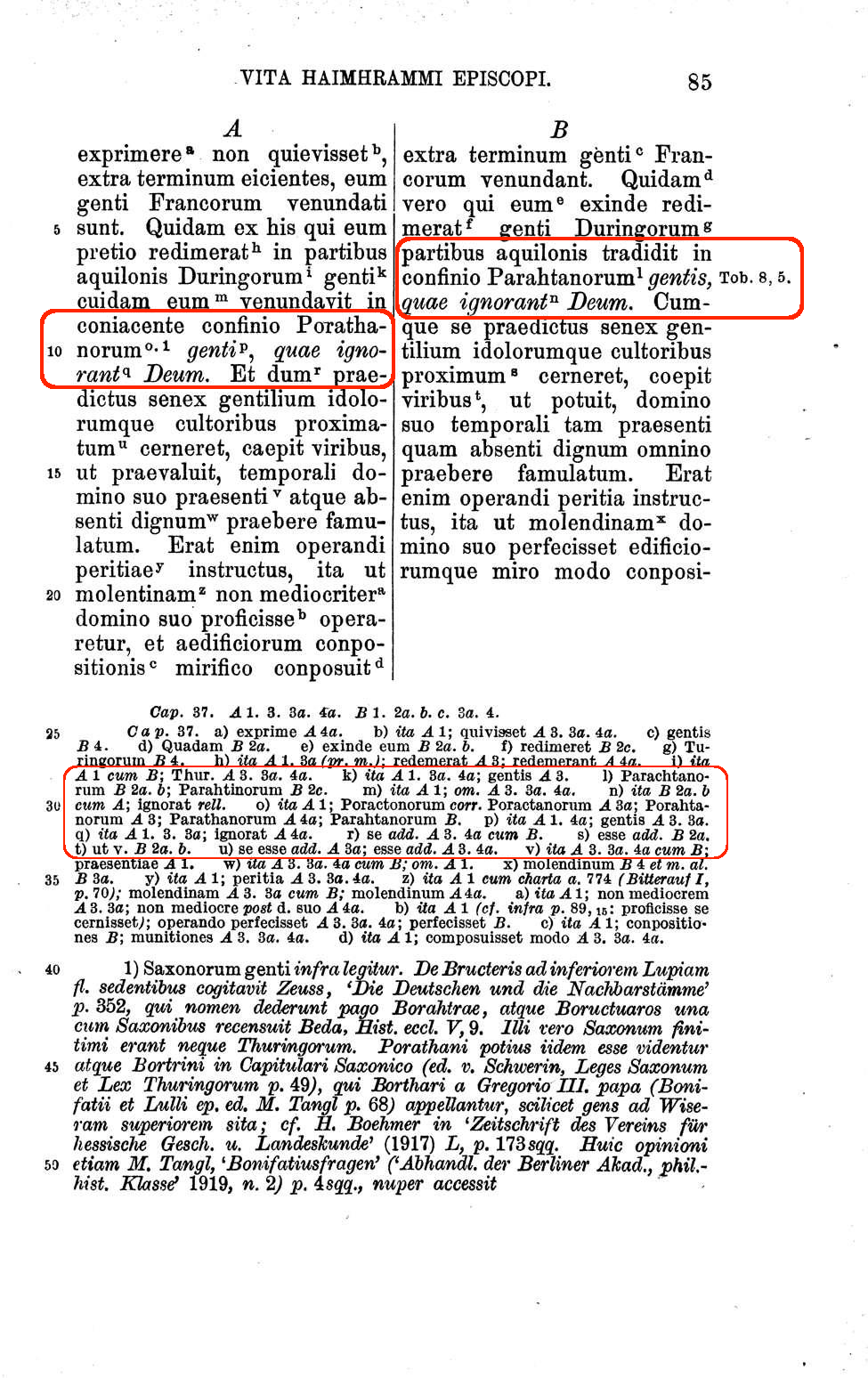
The Vita mentions the mission of Saint Emmeram to the lands of the Thuringians and the Porathanorum, a people “ignorant of God”:

Quidam vero qui ehm exinde redimerat genti Duringorum partibus aquilonis tradidit in confinio Parahtanorum gentis, quae ignorant Deum.  Cumque se praedictus senex gentilium idolorumque cultoribus proximum cerneret, coepit viribus, ut potuit, domino suo temporali tam praesenti quam absenti dignum omnino praebere famulatum.” [version B below]

It seems that the Po-rathanorum were the same as the Ratanz-winidi of whom we spoke earlier.  The Po- is the Slavic prefix indicating “by” as in Po-meranians or Po-labians.  The Po-rathanorum were the Slavs who lived by the Ratanz River (today’s Regnitz).

It is possible that Arbeo was projecting his own time onto that of over a century earlier of course but the fact that he also mentions the Thuringians who were largely pagan too then suggests otherwise.

 We will have more to say about the Slavs of the Bamberg area but for now we will leave you with this thought: Bamberg seems to have been named for the nearby Babenburg.  Babenburg seems to have been settled as early as 600 A.D.  And why is it called Babenburg?  Google archaeological finds in the area – you might come across sculptures such as these Three Fellas (discovered in 1858 – anyone tell you that?):

Did we mention that Saint Emmeram died at Ascheim?

Copyright ©2016 jassa.org All Rights Reserved

December 29, 2016

Indiculus and the Slavs?

Published Post author

The Indiculus superstitionum et paganiarum is, what appears to be, a table of contents for a work that was either never composed or, if composed, is currently lost.  It was written sometime between 740 – 770 in Germany.  The titles serve to shed a bit of light on the topic of German (not Germanic as in ancient and not Nordic as in Scandinavian) paganism immediately before the intense Christianization campaigns of Charlemagne among the Saxons and others.  It exists in only one copy at the Vatican (MS 577).

What is particularly interesting about this work is that, in between the Latin, it features a few words of uncertain meaning which have commonly been viewed as Germanic but whose exact translation has been uncertain.  The list has been intensely studied by various linguists and anthropologists but, so far, as with so many such things, views differ and no solution to the puzzle appears commonly accepted.  The four words are dadsisasnimidasnodfyr and yrias.

It is generally accepted that they are or must be Germanic – most likely Dutch or Frisian.  Right above the Indiculus is the Old Saxon Baptismal Vow (somewhat similar in format to the later Slavic Freising Manuscripts vows) so a Saxon connection of sorts may also be present.  Indeed, nodfyr sounds/looks Germanic.  But what is interesting are the other words.

  1. De sacrilegio ad sepulchra mortuorum. – “Of sacrilege at the graves of the dead”
  2. De sacrilegio super defunctos id est dadsisas. – “Of sacrilege over the departed, that is, ‘dadsisas'”
  3. De spurcalibus in Februario. – “Of the swinish feasts in February”
  4. De casulis id est fanis. – “Of the little houses, that is sanctuaries”
  5. De sacrilegiis per aecclesias. – “Of sacrilegious acts in connection with churches”
  6. De sacris siluarum quae nimidas vocant. – “Of the sacred rites of the woods which they call ‘nimidas'””
  7. De hiis quae faciunt super petras. – “Of those things which they do upon the stones”
  8. De sacris Mercurii, vel Iovis. – “Of the sacred rites of Mercury and of Jupiter”
  9. De sacrificio quod fit alicui sanctorum. – “Of the sacrifice which is offered to any of the saints”
  10. De filacteriis et ligaturis. – “Of amulets and knots”
  11. De fontibus sacrificiorum. – “Of the fountains of sacrifices”
  12. De incantationibus. – “Of incantations”
  13. De auguriis vel avium vel equorum vel bovum stercora vel sternutationes. – “Of auguries, the dung or sneezing of birds or of horses or of cattle”
  14. De divinis vel sortilogis. – “Of diviners or sorcerers“
  15. De igne fricato de ligno id est nodfyr. – “Of the fire made by friction from wood, that is, the ‘nodfyr'””
  16. De cerebro animalium. – “Of the brains of animals”
  17. De observatione pagana in foco, vel in inchoatione rei alicuius. – “Of the observance of the pagans on the hearth or at the inception of any business”
  18. De incertis locis que colunt pro sacris. “Of undetermined places which they celebrate as holy”
  19. De petendo quod boni vocant sanctae Mariae. – “Of the bed-straw which good folk call Holy Mary’s”
  20. De feriis quae faciunt Jovi vel Mercurio. – “Of the days which they make for Jupiter and Mercury”
  21. De lunae defectione, quod dicunt Vinceluna. – “Of the eclipse of the moon – what they call, ‘Triumph, Moon!'””
  22. De tempestatibus et cornibus et cocleis. – “Of storms, and horns, and snail shells”
  23. De sulcis circa villas. – “Of furrows around villas”
  24. De pagano cursu quem yrias nominant, scissis pannis vel calciamentis. – “Of the pagan course which they call ‘yrias,’ with torn garments or footwear” 
  25. De eo, quod sibi sanctos fingunt quoslibet mortuos. – “Of this that they feign for themselves that dead persons of whatever sort are saints”
  26. De simulacro de consparsa farina. – “Of an idol made of dough”
  27. De simulacris de pannis factis. – “Of idols made of rags”
  28. De simulacro quod per campos portant. – “Of an idol which they carry through the fields”
  29. De ligneis pedibus vel manibus pagano ritu. – “Of wooden feet or hands in a pagan rite”
  30. De eo, quod credunt, quia femine lunam comendet, quod possint corda hominum tollere juxta paganos. – “Of this: that they believe that women command the moon that they may be able to take away the hearts of men, according to the pagans”

***

There are at least three interesting things about this list

First, already in 1841 the Polish historian and ethnographer A. Maciejowski in his Pagan Relics in Poland (Biblioteka Warszawska) claimed that the dadsisas are nothing other than the Slavic dziady, that is, a day or days of celebration for the dead ancestors.

This was described as fantastic by Čeněk Zíbrt  in his study of the Indiculus titled Seznam pověr a zvyklostí pohanských z VIII. věku: Indiculus superstitionum.

Nevertheless, Zíbrt did not specify, except in very general terms, why this must be so. The dadisas obviously remind us of the dziady lamentations as in the famous work by Adam Mickiewicz.  The mystical and religious aspects of Slavic theatrical productions was “recently” explored by Kolankiewicz who presents a fascinating revitalization of the Dlugosz pantheon as part of his exposition (albeit he gets Quija wrong – there is no such God).

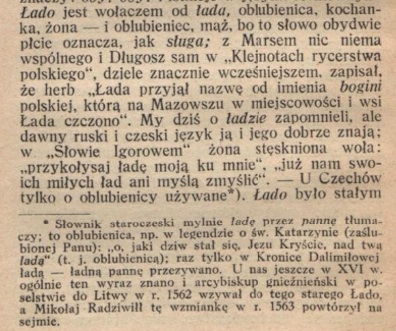
Second, there are other similarities with Slavic paganism here.  For example, looking at the ‘Of the little houses, that is sanctuaries” heading, one is hard pressed not to think of the atque scenes presented on the stage of the stanky.  Or the yrias which suggest the Jare Gody being, roughly, spring fertility festivals – incidentally, the word “year” has the same origin.  And were the “sacred rites of Mercury and of Jupiter” rites to Jesza/Yassa whom Dlugosz identified with Jove.  What a “course” is supposed to mean in this context or how the torn garments or footwear play into all of this is unclear.  Likewise, fountains, auguries, divinations all appear in Slavic folklore.  The carrying of an idol “through the fields” reminds us of Marzana processions.  The idol of dough seems, if anything, Indian and hence, perhaps, Venetic as this Ganesh idol:

Third, there is a separate matter of the word dziady, dziad being similar to Ukrainian дiд (did) or Russian дед (ded). It is curious that the Germanic word for dead, i.e., dead/tot/död should be so similar to the Slavic word for “old man” or “grandfather” or, more broadly, “ancestor’s ghost” (for example, the dedky or dietky of Dalimil’s Chronicle the concept of which is already found (in Latin) in the Cosmas Chronicle).  This is perfectly illustrated by the German translation of Mickiewicz’s Dziady as Todtenfeier:

Bruckner’s etymologies of these words will not solve this riddle though he notes too that didko or ditko meant the devil or house spirit in Ruthenian (Ukrainian):

Of course, the notion that dziady should be the same as Germanic dadsisas further muddies the water as to what is Slavic and what is Germanic since in this ritual the Germanic meaning of dead and the Slavic meaning of ancestor each also incorporate the other meaning.  For the Slavic “ancestor” word the additional “dead” meaning was always implicit but for the Germanic general “dead” to be used to name an “ancestor worship” rite just as the Slavic one is rather novel.

Copyright ©2016 jassa.org All Rights Reserved

December 26, 2016

Scythian Gods of Callimachus

Published Post author

An interesting fragment from Filippo Buonaccorsi‘s (1437 – 1496) “The Life of Zbigniew Oleśnicki” (Vita et mores Sbignei cardinals).  (Oleśnicki was the one who commissioned Jan Długosz’s (1415 – 1480) annals).  This Vita was never published and remains in manuscript form at the Jagiellonian Library.  

However, an edition of it came out published by Ludwik Finkel (also published as part of Monumenta Poloniae Historica volume 6).

The first portion of the book contains an interesting description of the Poles as well as an explanation of their pagan beliefs.  It is not clear where Buonaccorsi (aka “Callimachus”) got this information from.  However, he was describing Oleśnicki’s family and claimed that the family – whose coat of arms was “Dębno” – must have been established by a Scythian warrior Deombrotus.  Deombrotus having been a Scythian teacher of the Poles…  Thus, by extension, the learned Oleśnicki was descended from the first Polish Scythian wiseman.

From the Okulski armorial

The relevant parts state the following:

“The family Dembno likely got its surname from Deombrotus having distorted his name somewhat, though those who do not know such ancient history, conjecture that the name arose later from an oak tree of remarkable height…”

[Because a dąb (damb or demb) means “oak” – interestingly, see also the name of Mons Jasonius aka Mount Damavand but also Mount Dembavend in Moses Khorenatsi’s work!]

and further:

“[He, i.e., Deombrotus once he took over the Poles] instructed them to venerate Vesta whom the Scythians call Labiti, Ceres whom they call Apia and Jove/Jupiter who is known as Jasde among them.  The wisemen/mages thought that these gods are: fire, earth and air.  But over time the Poles corrupted the Scythian names and said Lada in place of LabitiMia in lieu of Apia [and] Iesse rather than Jasde.  He introduced too certain ways of divining from the leaves of a linden tree which, having divided such leaves into three parts, they wrap around their fingers…”

The “Scythian” gods are actually based on a passage from Herodotus:

“They worship only the following gods, namely, Vesta, whom they reverence beyond all the rest, Jupiter, and Tellus, whom they consider to be the wife of Jupiter; and after these Apollo, Celestial Venus, Hercules, and Mars. These gods are worshipped by the whole nation: the Royal Scythians offer sacrifice likewise to Neptune. In the Scythic tongue Vesta is called Tabiti, Jupiter (very properly, in my judgment) Papaeus, Tellus Apia, Apollo Oetosyrus, Celestial Venus Artimpasa, and Neptune Thamimasadas. They use no images, altars, or temples, except in the worship of Mars; but in his worship they do use them.”

Thus, Herodotus has Vesta named Tabiti – not, as Callimachus would have it, Labiti.  How Labiti may have become Lada, Callimachus does not say.  Further, while Tellus corresponds to Ceres and, as per Herodotus, Apia (i.e., Earth), it is not clear how Apia should then have become the Polish Nia.  Finally, Herodotus never mentions Jasde but rather Papaeus.

Neither Herodotus nor anyone else mentions Deombrotus the Scythian (Callimachus provides a genealogy for Deombrotus connecting him with some Herodotian Scythian figures).

And so here we are.

The above is Finkel’s print edition.  The below may be Finkel’s handwriting (it’s not the actual autograph).

Copyright ©2016 jassa.org All Rights Reserved

December 7, 2016

On the Pagan Rebellion

Published Post author

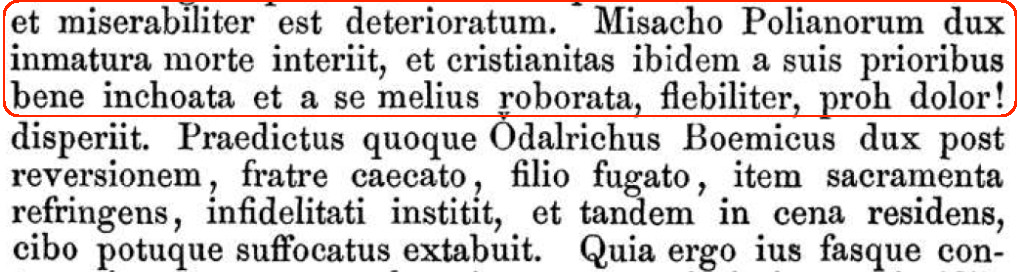
On July 13, 1024 Boleslaw Chrobry’s great rival, the German Emperor Henry II passed away.  The next Easter (either on April 18 or April 23, 1025), Boleslaw crowned himself king (most probably in Gniezno).  He too would pass away shortly (on June 17, 1025) but the deed was done.  Poland was a kingdom and it was up to Boleslaw’s son Mieszko II to continue the legacy.

The Unhappy Reign of Mieszko II

Mieszko II was crowned king most likely already by Christmas 1025.  At that time the German throne was held by Conrad II.  At first Conrad had to deal with some opposition in Swabia and Lotharingia and it appears that West Germans tried to get Mieszko energized about helping them.  Unfortunately for Mieszko, by the time he launched his campaign against Conrad (in 1028), the latter had already dealt with his internal opponents (sometime in 1027).  Mieszko’s invasion of Saxony in January 1028 was largely a success (apparently he took huge numbers of hostages) but it only served to refocus the Emperor on the East.

eszk

Mieszko II

Conrad began his counterattack in 1029 wanting to finally deal with his meddlesome Polish neighbors.  To do that he raised a truly giant army and set out for Poland.  However, at first things did not go so well for him.  The German advance crossed the Polish border at the river Solawa (Saale) and entered Milsko and Luzyce (today’s Meissen and Lausitz).  But the army never reached Poland proper getting stuck and coming apart at Budisin (Bautzen).  In 1030, in turn, the Emperor’s attention was diverted by the Hungarians who decided that they wanted to have Bavaria for themselves.

imperator

Conrad II

From then on things went south for Mieszko.  The Hungarians and Germans concluded a peace treaty in 1031.  Conrad tried his hand against Poland again.  But this time he did not go it alone. For starters, he’d drawn in the Czechs.  They had previously been humiliated by Mieszko’s father, Boleslaw who conquered most of Bohemia and Moravia and made it part of his realm.  Since then the Czechs revolted on Mieszko’s watch and under their duke Udalrich were ready to assist the Germans.  Moreover, Conrad coordinated with the leader of Kievan Rus, Yaroslav.  Since the Rus had been defeated by Boleslaw as well, they too were ready to help out and recover some of their lost lands.  Furthermore, both the Germans and the Rus brought with them each a son of Boleslaw’s.  With the Germans came Otto, Boleslaw’s youngest son (named after Otto III the Red).  With the Rus there came Bezprim, Boleslaw’s oldest son.  Although Mieszko II was clearly his father’s choice to succeed him, he was not the only contender.  He likely had kicked his brothers out of his kingdom after his father’s death but that only wounded their pride and so they sought help abroad.

olri

Oldřich (Udalrich)

Mieszko sought refuge.  Because of a temporary break between Conrad and Udalrich, his best bet seemed to be to go to Bohemia.  Udalrich had already met Mieszko and indeed had imprisoned him back in 1014 when Mieszko tried to win Udalrich over to an alliance.  But Udalrich was not ready to risk everything for the now weak Mieszko.  Mieszko’s father, Boleslaw, had blinded Udalrich’s brother (Boleslaw III) and now, allegedly in revenge, Udalrich had Mieszko castrated.  The Rus recovered some of the lands they’d previously lost to the Germans.  Milsko and Luzyce went to the Germans.  The Polish crown was sent to Germany either by Bezprim or by Mieszko’s wife (whom he left in Poland).  Bezprim was installed as a duke and Otto may have gotten a piece too.  The Pomeranians revolted.  In the meantime, Mazovia apparently also separated from the rest of Poland under the leadership of one Maslaw or Mieclaw (Mieszko II’s former cup bearer).

slav

Yaroslav

This situation was not stable, however.  Bezprim was apparently not the most beloved leader and, it seems, was quickly murdered by local opposition.  Mieszko was released by Udalrich but was forced to go see the Emperor at Merseburg.  There, he was forced to confirm the Emperor’s overlordship as well as agree to have his younger brother Otto get Silesia and to have Dietrich (another grandson of Mieszko I) obtain possession of another part of the country.

But things did not turn out so badly for Mieszko (other than the whole castration thing).  Apparently, full of energy he used the Emperor’s to reclaim Polish lands if not the crown.  About 1033 both Otto and Dietrich die or disappear.  How that came about you can speculate just as well yourself.  The Rus, satisfied with their prior land grab, did not intervene without German help.  Thus, Mieszko was able to reunify the country briefly before his own death (apparently of natural causes) in 1034.

And then we come to a bit of a hole in history.

What Happened Next?

What happened next is, to put it mildly, very unclear.  There is a suggestion (happily jumped on by all kinds of conspiracy theorists and various reflexively anti-Catholic personas) that next in line to the throne was Mieszko’s oldest son, Boleslaw.  Boleslaw’s very existence, however, has been questioned (hence, he is called Boleslaw the “Forgotten”).  As per the conspiracy theorists, Boleslaw’s being “forgotten” is a result of a vast nefarious Catholic conspiracy to erase his memory from the list of Polish rulers.  Why would the Church do that?  Well, the theory goes because Boleslaw’s faith was Slavic-rite or maybe he was even a pagan (anything but Catholic).  There are a number of sources that provide some support for the existence of a Boleslaw but they are either very late (such as the Greater Poland Chronicle – see below) or the support they provide is only very indirect.  We will perhaps get back to this controversy to discuss it in detail.  For now, suffice it to say, that it is highly unlikely that such a ruler (not mentioned by the rather meticulous German annalists or by any of the Czech, Russian or Hungarian sources) existed.  On balance, it is more likely that the next Polish ruler really was Casimir the “Restorer”.

Nevertheless, Casimir did not take charge of Poland in 1034.  Between 1034 and 1039 a lot of things happened though information regarding these things is scant.  For one thing, we know that Udalrich’s son, duke Bretislaw ascended the Czech throne in 1034.  By 1037 he had made his way to Poland leveling both Gniezno and Poznan and taking the bones of Saint Adalbert (Wojciech) to Prague.  Casimir had fled Poland earlier and had been held in Hungary.  He was only released in 1038 when the Hungarian throne changed hands.  He then went to see his mother in Germany and, apparently against her advice and that of the Emperor, decided to return to Poland taking with him about “500 knights.”  It was that group that effectively reconstituted the Polish realm building alliances inside the country, routing the Mazovians and defeating the Pomeranians.

But let’s get back to 1034 – 1039.  These are the years of the so-called “pagan rebellion.”

What we know is, well, very little.  Nevertheless, it seems that in light of the total collapse of rule in 1034, secessionism and foreign invasions, some form or a rebellion took place against whatever then remained of the Piasts’ authority.  Whether the rebellion had more of a “class” dimension or was more of a religious character is unclear.  It was probably some combination of both.

The written sources are scant and likely, some of them, wrong.  Let’s break this up a bit.

The Year 1022

The first mention of a “pagan” revolt comes in the year 1022 and it appears in two places.  Cosmas of Prague and the much later Jan Dlugosz.

Cosmas notes laconically in Book I of his Chronicle of the Czechs under the year 1022:

“A persecution of Christians was carried out in Poland.”

cosm

Cosmas

This would have put, at least this, “pagan” revolt during the reign of Boleslaw Chrobry (died 1025) rather than after the death of Mieszko II.

Possible?

cosma

Sure, but the problem with Cosmas is that, writing almost a hundred years after the events in question his knowledge of them seems highly distorted.  For example, he ascribes many of the deeds of Boleslaw Chrobry to his father Mieszko I.  Not only that, he does not even know some Czech matters.  Thus, he claims that Uldrich was the son of Boleslaw III of Bohemia, rather than, as we know, the latter’s brother.  It is, therefore, highly unlikely that such a small detail would have been gotten right by Cosmas.

Cosmas does later (in Book II) discuss the Czechs invasion of Poland in the year 1037 but says nothing at that time about any pagan or other rebellion.

Another source for an earlier rebellion is  Jan Dlugosz who does have an entry under 1022 that characterizes the events in a similar but slightly different way:

“…For some among the nobles, incited by satan, found giving sheaf tithes and the fulfillment of Christian duties to be burdensome, which complaints were made especially by those who having been raised in the errors of paganism grew weary of the yoke of the true faith of Christ; [and] after much scheming they decided to return to the old life of impiety and idolatry, to fail to timely pay their tithes, nor to attend churches, to throw out, in fact, priests and God’s servants from the temples.  And when Boleslaw the Polish king found out about this, he would not, this fervent evangelist of the Catholic faith, allow this smoldering rebellion to grow but nipped it in the bud; sending out squadrons of knights he captured the ringleaders and some of them he ordered beheaded while others he had flogged; and only those that had less guilt, having been seduced by others’ persuasion, did he spare any punishment.”

A slight problem with Dlugosz, of course, is that he writes even later in the 15th century and, for all we know, may have relied here on Cosmas.

The Year 1025 (or 1030?)

Nestor’s “Primary Chronicle” (PVL) mentions under the year 1030 the following:

1030 or year 6538:

“… At this same time, Boleslav the Great died in Poland, and there was a revolt in the Polish country.  The people arose and killed the bishops, the priests, and the boyars, and there was rebellion among them.”

pavl

He goes on to say that in the “year 1031 (or 6539)] Yaroslav and Mstislav collected a large force and marched into Poland.  They recaptured the cities of Cherven, and ravaged the Polish country side.  They also captured many Poles and distributed them as colonists in various districts.  Yaroslav located his captives among the Ros’, where they live to this day.”

rosl

Since Nestor places this event immediately after Boleslaw Chrobry’s death and since Chrobry died in 1025, it seems reasonable to assume that some sort of a pagan rebellion took place at that point.

Unless, of course, Nestor also confused Boleslaw Chrobry with Mieszko II.

The Year 1034

The Greater Poland Chronicle (GPC) places these events after Mieszko II’s death.  Although the chronicler gets the year wrong (1033 versus 1034), he seems nevertheless to associate the “pagan” rebellion with the time immediately before Casimir the Restorer took charge.

kpreal1

GPC

The GPC says:

“After he [Mieszko II] died in the year of Our Lord 1033, his firstborn son Boleslaw* came to rule.  But after this one was crowned, he caused his mother many indignities.  His mother, who came from an excellent family, not being able to endure his wickedness, taking her little son Casimir, returned to her homeland to Saxony, to Brunswick and placing her son there to study was said to have entered some convent.  Whereas Boleslaw, on account of his cruelty and monstrosity of deeds that he committed, poorly ended his life and, though honoured with a royal crown, is not counted among the kings and princes of Poland.”

* Boleslaw the (Previously) Forgotten or Boleslaw the Made-Up depending on your point of view.

kpreal2

GPC

“After his death, there arose in the Polish country much turmoil and many wars, rather internal than external.  But when the Polish state – by reason of [these] wars – fell almost completely , the great lords of the country set out immediately on a journey to Saxony to their Lady, the queen with the aim of finding their Lord, Casimir.”

kpbi

“From her they learned that she had sent him to Paris to study the liberal arts where, while spending time there and working, he took on the oath of Saint Benedict at the Cluney Abbey.  Rushing to him, they beheld that he had already been ordained a deacon.”

In accord with this dating are the Hildesheim Annals which have the following entry under the (correct) year 1034:

misa

The famous Hildesheim Annals entry (Paris MS)

“Mieszko the duke of the Poles died prematurely and Christianity there so well begun by his predecessors and by him [Mieszko II] even strengthened, alas, lamentably perished.”

misacho

(the same entry is also in the Magdeburg Annals)

Other Sources

Gallus Anonymous does speak of a pagan rebellion.  He does not say when it took place but does place it after the death of Mieszko II and after the expulsion of Casimir the Restorer from Poland.   Thus, it seems that we are looking at 1034 – 1036.  Since he discusses these events before the Czech invasion of 1037 we can tentatively say no later than that year.  Perhaps.

Here is Gallus’ Chapter 19: 

“At this time kings and dukes neighboring Poland, each in his own turn violated her and took towns and border castles or, after the taking, burn them down.  And so exposed to so many sorrows and painful defeats, she was treated even shabbier and more abominably by her own inhabitants.  For the slaves rose against masters, freedmen against the nobles, announcing themselves as nobles in turn, taking their [nobles’] wives and beds and most cruelly persecuting the same [nobles].”

gallus1

Gallus

gal1

“Renouncing too the Catholic faith, which we are unable to mention without shedding many a tear, they rebelled against the bishops and priests, and some of these, in their eyes being more prominent/honorable, they put to the sword; and some others, as if deserving a more ignoble death, they had stoned.  In the end, by reason of foreign causes as too by reason of her own inhabitants, did Poland suffer such ruin, that she was almost completely deprived of riches and people.  It was then that the Czechs destroyed Gniezno and Poznan and took the body of Saint Adalbert.  And those who managed to flee the hands of the enemies or who were escaping the rebellion of their serfs, made their way across the River Vistula to Mazovia.*  And the aforementioned cities remained abandoned so long that in the Church of Saint Adalbert as well as at Saint Peter’s wild animals set up their dens…”

gallus2

Gallus

* Of course, Mazovia too was going to rebel under Maslaw (or Mieclaw) the recently repurposed cup bearer.

gal2

There is not else on the pagan rebellion.  Thietmar’s Chronicle only reaches the year 1018.  Kadlubek’s Chronicle is silent.  There is another Bohemian source and some Russian sources (preserved in much later books) but they all add little else to the topic.  Nevertheless, a “pagan” rebellion was altogether possible.  A similar rebellion took place in Bohemia between 921 and 935 and, of course, the Great Slav Uprising of 983 in Polabia had not only anti-Frankish/Saxon but also anti-Christian character.

Copyright ©2016 jassa.org

November 30, 2016

Signs of Lada – Part III

Published Post author

We have previously written about signs throughout Europe of the Goddess Lada (see here and here).  Aleksander Brückner famously derided the idea of Lada being a Goddess, instead claiming that the word simply meant “my love” or “my dearest” or “wife” (in male form lado, also husband).  We have addressed this issue here and, specifically, here showing that Brückner’s arguments really do not shed any light regarding the question of the divinity of Lada.
bruck1

On one thing, however, Brückner was potentially right about is that in Eastern Suavdom, the name lada really did mean “my love” and “wife”.

What is interesting is that the name appears outside of Europe.  Specifically, in Anatolia where, in today’s Turkey, there was once a region called Lycia.

anatolia

Several books came out in the 19th century regarding the Lycian language mostly keying off of the various inscriptions found there.  For example:

  • “The Lycian inscriptions” by Moriz W. J. Schmidt, or
  • “Neue lykische Studien” by the same author.

lycian

It turns out that the same name Lada appears in these Lycian inscriptions and, there, it does mean “wife.”  Although other Lycian words do not bear an immediate similarity to Suavic, the fact that this one word should have the exact same meaning as the East Suavic lada is peculiar.

lada

Carl Pauli (Altitalische Forschungen)

Gattin means “wife” or “spouse” in German so there you have it.

Thus, lada has the same meaning in Suavic and Lycian languages.  Query then the nature of the Lycian language.

(Incidentally, a town named Liada also appears between Nicomedia and Ancyra in the Itinerarium Burdigalense – a pilgrim’s itinerary dated to the year 333.  As another point of interest, there is, in the same segment of that journey, also a mention of a town named Malogardis – little grod – which has been interpreted as Manegordus.)

How is that the same term means the same thing in Suavic and Lycian languages?  The languages seemingly do not contain that many other connections but then does this mean that the Lycians spent time in Suav lands or Suavs in Lycian lands to have made this borrowing?

Incidentally, this is not the only such connection. Vasmer lists others: the “Chaldian” (Χαλδία) lute „woman” and the Avaric (NE Caucasus) tladi also “woman”. For more information you can see the writings of Kretschmer and Trubeckoj. The cause of the similarities? Vasmer thinks just chance.

Copyright ©2016 jassa.org All Rights Reserved

November 26, 2016

More Manuscripts of the Pentacostal Postilla Number 2

Published Post author

Some readers have been asking us to show more detailed manuscript pages of the Pentacostal Postilla no. 2 by Lucas from Great Koźmin (currently Koźmin Wielkopolski).  We have displayed some already here but are happy to provide more from another manuscript (preserving the original spelling in the title headings:

“Lado, Yassa‘ et attendere” [?]

1z“LadoYassaNya”

2z“No Lada, no Yassa, noy Nya”

3z

As mentioned a number of times previously, there are only three Gods mentioned here.

Copyright ©2016 jassa.org All Rights Reserved
November 7, 2016

On Cutlery

Published Post author

We’ve spoken about some interesting and apparently “inexplicable” names in France here.  How did Perunnes become Perunnes?  But here is another interesting fact.  The word for “fork” in Italian is forchetta.  But in Venetian it is piron.  This is supposedly derived from Greek where fork is πιρούνι (piroúni).  Even if that is the case, isn’t it strange?

zeus

Copyright ©2016 jassa.org All Rights Reserved

July 29, 2016

Wipo’s Champions

Published Post author

One on one combat appears as a solution to wider bloodshed in a number of places.  As per Gregory of Tours we know that the Vandal champion fought the Suevi-Alemann champion and lost (the Vandals then left Spain, as per the story).  In the Slavic area there was the duel at Agrimeswidil between Burwid and a Slav champion as reported by Adam of Bremen.

But there was another (or was it?) duel of the champions – this one between a Saxon Christian and a Slav heathen.  And this time the advantage was the Slav’s.  The story is told by Wipo of Burgundy (circa 995 – circa 1048) in his “The Deeds of Conrad II” (Gesta Chuonradi II).  The champion’s duel takes place in the broader context of the Empire’s war against the Lutizi in 1035 or so.  As Wipo observes, the Slavic champion prevailed because, notwithstanding being a pagan, “truth” was on his side.  (As in his book, he also discusses Piasts and other Slavs, we will return to Wipo later).

h3

Henry

note: King (at the beginning of the story, actually Duke of Bavaria) Henry is Henry III or Henry the Black or the Pious who was emperor in the years 1046 – 1056.  Conrad II was his father and was emperor from 1027 to 1039.  After his death, Henry ruled as king and then, startin in 1046, as emperor.

Chapter 33
How King Henry Subdued the Slavs
Quod rex Heinricus Sclavos subiugavit 

(about 1033 or 1035)

“In the meantime, while the Emperor [Conrad II] was in Burgundy, engaged in the matters in the matters discussed above,  his son King Henry [the future Henry III], though still in his childhood years, oversaw matters of state in Bohemia and other Slavic countries; and he subjugated strenuously Udalrich the duke of Bohemia and many others who had resisted many emperors; and he returned to meet his father, the double victory bringing double joy to the people.”

(Interea, dum haec quae superius dicta sunt imperator in Burgundia faceret, filius suus Heinricus rex, licet in puerilibus annis, non segnius rei publicae consuluit in Bohemia et in caeteris regionibus Sclavorum; ubi et Uodalricum ducem Bohemiae et reliquos quam plures caesari adversantes strenue subiugavit, et redeunti patri occurrens, de duplici victoria duplex gaudium populis effecerat.)

“Then he assembled Saxon troops against those who are called Liutizi who were once almost Christian but now through the wickedness of apostasy are all pagans [but] the emperor came and miraculously stopped the conflict.  At that time there were many conflicts and incursions between the Saxons and the pagans.  When the emperor came he began to inquire as to when the peace that had been inviolate for so long [among them] had been destroyed.  The pagans claimed that it was the Saxons that first breached the peace and that, if the emperor were to permit it, they would show it in a trial by combat.  And so too the Saxons (though their claim was unjust) to refute the pagans likewise accepted single combat in front of the emperor.  The emperor consulted their leaders and, acting incautiously, permitted this trial by duel.  At once two fighters met, each chosen by his own [men].  A Christian supported by faith alone (but without any good works is dead, to be honest, for he has not seriously considered that God, who is the truth, decides all in the true court, he, who lets his sun rise over the good and the evil, who lets it rain over the just and the unjust) began the combat bravely.  The heathen, though, who had before his eyes only the consciousness of truth for which he fought, resisted strongly.  At the end the Christian was wounded by the heathen and fell.

champ

The Slavic champion came better prepared that day

(Deinde collectis copiis de Saxonia, super eos qui Liutizi vocantur, quique olim semicristiani, nunc per apostaticam nequitiam omnino sunt pagani, imperator venit, ibique conflictum implacabilem mirabiliter diremit.  Inter Saxones enim et paganos fiebant ea tempestate multae dissensiones et incursiones.  Cumque caesar veniret, coepit quaerere, ex qua parte pax, quae diu inviolata inter eos fuerat, prius corrumperetur.  Dicebant pagani, a Saxonibus pacem primitus confundi, idque per duellum, si caesar praeciperet, probari.  Econtra Saxones ad refellendos paganos similiter singulare certamen, quamvis iniuste contenderent, imperatori spondebant.  Imperator, consulentibus principibus suis, licet non satis caute ageret, hanc rem duello diiudicari inter eos permisit.  Statim duo pugiles congressi sunt, uterque a suis electus.  Christianus in sola fide, quae sine operibus iustitiae mortua est, confidens, et non diligenter attendens, quod Deus, qui veritas est, omnia in vero iudicio disponint, qui solem suum oriri super bonos et malos facit, qui pluit super iustos et iniustos, audacter pugnare coepit.  Paganus autem solam conscientiam veritatis, pro qua dimicabat, prae oculis habens, acriter resistebat.  Postremo christianus a pagano vulneratus cecidit.)  

wars

Confirmation of same events from the Chronicon Suevicum Universale

“As a result of this the pagans became so haughty and audacious that, had the Emperor not been there, they would have immediately attacked the Christians; but the Emperor built the castle Wirbin in order to prevent their incursions and he garrisoned the same and he obligated the leaders of Saxony to unanimously resist the heathens [both] through an oath and the imperial command.  Then he returned to Francia.”

(Ex qua re pagani in tantam elationem et audaciam venerunt, ut, nisi imperator adesset, continuo irruerent super christianos; sed imperator ad compescendas incursiones eorum construxit castrum Wirbinam, in quo praesidia militum locabat, et principies Saxoniae, ut unanimiter resisterent paganis, sacramento et imperiali iussione constringebat.  Deinde reversus est in Franciam.)

“But in the following year, that castle was taken by the heathens through trickery and a great part of our men [garrisoned there] were killed.  Angered by this, the Emperor returned with an army to the Elbe River.  But since the pagans were defending the passage, the Emperor had a part of his army cross the river at a different ford.  And after the enemies were forced to flee, he invaded the country from the now freed up river bank and humbled them so greatly, by [causing] immense destruction and devastation everywhere, with the exception of those places that were impregnable, that from then on they paid the Emperor Konrad the tribute imposed on them by the prior emperors and even more.”

(Sequenti vero anno idem castrum a paganis dolo captum est, et plures nostrorum qui in eo erant ab eis occisi sunt.  Hinc commotus imperator, iterum cum copiis usque Albim fluvium venit.  Sed cum pagani transitum prohiberent, imperator per aliud vadum fluvii partem exercitus latenter transmisit; et ita fugatis hostibus, ipse per ripam liberam regionem ingrediens, immensis devastationibus et incendiis ubique, nisi in locis inexpugnabilibus, sic humiliavit eos, ut censum ab antiquis imperatoribus propositum et iam auctum Chuonrado imperatori postea persolverent.)

c2

Conrad on the throne

“The Emperor Conrad struggled much [both] before and at that time with the peoples of the Slavs; about which one of ours had created a kind of summary [breviarium] which he later presented to the Emperor.  There, one reads, how the Emperor, from time to time, stood up to his waste in these swamps, where he himself fought and urged his warriors onwards, and how he, after his victory over the heathens, and on account of their unspeakable superstition, massacred the same [heathens] terribly.”

(Multum enim laboravit Chuonradus imperator prius et tunc in gente Sclavorum; unde quidam de nostris quoddam breviarium versifice fecit, quod postea imperatori praesentavit.  Ibi legitur, qualiter imperator interdum in paludibus usque gemora stabat, pugnans ipse et exhortans milites ut pugnarent, et victis paganis nimis acriter tucidabat eos pro quadam superstitione illorum nefandissima.)

“For it is told that the heathens had, at one time, lampooned a wooden crucifix of our Lord Jesus Christ in unspeakable ways, for they spat on it and hit it with a fist; eventually, they ripped out his eyes and ripped off his hands and feet.  In order to punish this, the Emperor had a great deal of the captured heathens, just for this one figure of Christ, mutilated in similar ways and in killed in various ways.  It is for this reason that the Emperor is called in this poem the Avenger of the Faith and compared with the Roman Emperors Titus and Vespasian, who in order to avenge the Lord [!], exchanged thirty Jews for one gold piece, just as the Jews exchanged the Lord for just as many coins.  The Emperor returned [to Francia] and, to the extent he found any, he dispersed all the remaining obstacles in the Empire with his imperial might.  In the same year Adalbert, the duke of the Carinthians, who fell out of favor with the Emperor, lost his duchy and was banished ”

(Nam fertur, ut quodam tempore efficiem ligneam crucifixi domini nostri Iesu Christi scelerato ludibrio habuissent pagani, et in eam spuerent atque colaphis caederent; ad extremum oculos eruebant, manus et pedes truncabant.  Haec ulciscens imperator, de captis paganis maximam multitudinem pro una effigie Christi simili modo truncavit et varia morte delevit.  Idcirco in eisdem versibus caesar ultor fidei vocatur, et Romanis principibus Tito et Vespasiano comparatur, qui in ultionem Domini triginta Iudaeos pro uno nummo commutaverant, cum Iudaei Christum pro totidem denariis vendiderint.  Reversus imperator, quicquid obstaculi in regno invenit, imperiose disiecit.  Eodem anno Adalbero dux Carantanorum imperatoris gratiam perdens, ducatum amisit et in exilium misss est.)

Copyright ©2016 jassa.org All Rights Reserved

July 17, 2016