Category Archives: Origins

Isidore on Suevi, Veneti and Slavs

Published Post author

Isidore of Seville (560 A.D. – 636 A.D.) was one of the Church fathers and most revered writers of the early medieval period.  We should then ask what did he have to say on the Slavs and the Suevi.

isidorussevillus

Slavs

As for the Slavs, there appears to be only one Isidorian reference – in his Cronica Maiora (ironically, considered to be a minor work).  There, he says;

“Heraclius has completed five years of his imperial rule. At the beginning, the Slavs took Greece from the Romans; the Persians took Syria, Egypt, and many provinces”.  This appears to be a reference to events in the Byzantine Empire of either A.D. 615 – 616 or A.D. 625 – 626.  The “five” above sometimes is a “sixteen”.  Given that the so-called Continuation mentions a similar even in the 653rd year and we know that the Spanish Era had a 38 year difference from normal counting, the year would seem to be 615/616.

Suevi

Regarding the Suevi, however, Isidore has considerably more to say.  First of all, Isidore wrote the famous “History of the Kings of the Goths, Vandals and Suevi” (Historia de regibus Gothorum, Vandalorum et Suevorum) describing the Gothic, Vandalic, Suevic (and, occasionally, Alanic) conquest of Roman Spain (or, more accurately, of the Iberian Peninsula).  To the extent this work talks about the Suevi, it deals entirely with the Suevi of Spain/Portugal.

Second, in the aforementioned Cronica Maiora, Isidore says of the same Iberian Suevi that “[t]he Suevi, held by King Leovigild, were subjected by the Goths.”  The reference here is to the Visigothic king Leovigild (Liubagilds) (ruling 568 – 586) who first tried to defeat the Suevi in 576 (but the then Suevic King Miro (it’s claimed to be a “Germanic” name so don’t get too excited) negotiated peace) and who was finally able to achieve this goal in 585 (incorporating the Suevic kingdom into the Visigothic one).

Third, Isidore mentioned the Suevi in his most famous work – the Etymologies, where (at Book II, ii, 98) he says that:

“[t]he Suevi were a segment of the Germanic nation at the northern frontier.  Of them, Lucan (Civil War, 2.51) says: ‘across the Elbe and the Rhein pour the fair-haired/blonde Suevi from the extreme north.’  Many have reported that there were a hundred villages and communities of Suevians.  The Suevi are thought to have been named from Mount Suevus, which forms the eastern boundary of Germania and whose territory they occupied.”

Lucan

Incidentally, Lucan actually says: “Fundat ab extreme flavos aquiline Suebos Albis et indomitum Rheni caput”

Thus, here, for the first time we see that Isidore is referencing not the “Western” or Iberian Suevi known to him from Spain and Portugal but the ancient Suevi of Germania.

Ancient?

Well, in his Etymologies Isidore also comes to the geography of the world and Europe specifically.  Here he makes the following comment (at Book XIV, iv, 3):

“The first region of Europe is lower Scythia, which begins in the Maeotian swamps (i.e., the Sea of Azov), stretching between the Danube and the northern Ocean up to Germania.  And this land is called Barbarica in general usage on account of the barbaric people by whom it is inhabited.  Its first part is Alania, which touches the Maeotian swamps; after this Dacia, where Gothia is; then Germania, where the Suevi inhabit the greater part.

(Europa autem in tertiam partem orbis divisa incipit a flumine Tanai, descendens ad occasum per septentrionalem Oceanum usque in fines Hispaniae; cuius pars orientalis et meridiana a Ponto consurgens, tota mari Magno coniungitur, et in insulas Gades finitur.  Prima Europae regio Scythia inferior, quae a Maeotidis paludibus incipiens inter Danubium et Oceanum septentrionalem usque ad Germaniam porrigitur; quae terra generaliter propter barbaras gentes, quibus inhabitatur, Barbarica dicitur. Huius pars prima Alania est, quae ad Maeotidis paludes pertingit; post hanc Dacia, ubi et Gothia; deinde Germania, ubi plurimam partem Suevi incoluerunt.)

“Where the Suevi inhabit the greater part”?  If Isidore is writing this to describe the state of affairs around 636, then we have to ask the question: was he right?  Did the Suevi really occupy the “greater part” of Germania at the beginning of the 7th century?

Perhaps not.

Even though Isidore seems to be describing the situation in his own time, this passage appears to be lifted close to verbatim from Paul Orosius‘ “Against the Pagans” which was written in 416-417, i.e., at the beginning of the 5th century.  Here Orosius said (at Book 1, 2):

“I shall now wander with my pen through what man knows of Europe.  Europe begins in the east at the Riphaean mountains, the river Tanais, and the Maeotid marshes.  Its border runs along the shore of the Northern Ocean to Gallia Belgica and the river Rhine in the West.  It then comes down to the Danube, which is also called Hister.  This river runs from the south towards the east and ends in the Euxine Sea.  On its east is Alania, in its centre Dacia, where Gothia is also found, then comes Germany, the greater part of which is held by the Sueves (where the Suevi possess the largest part).” [A.T. Fear translation (CUA translation)]

(Nunc Europam in quantum cognitioni hominis conceditur stilo pervagabor.  A montibus Rhipaeis ac flumine Tanai Maeotidisque paludibus, quae sunt ad orientem, per litus septentrionalis oceani usque ad Galliam Belgicam et flumen Rhenum, quod est ab occasu, deinde usque ad Danubium, quem et Istrum vocant, qui est a meridie et ad orientem directus Ponto excipitur, ab oriente Alania est, in medio Dacia, ubi et Gothia, deinde Germania est, ubi plurimam partem Suevi tenent.)

We shall return to the immeasurable parts of Germania that were inhabited by the Suevi, of course.  For now, however, we may want to ask a more modest question: was the largest/greater part of Germania occupied by the Suevi even in Orosius’ time?  Were we to answer this question in the affirmative, the answer would be less shocking than the same answer referencing Isidore’s own time.  Considering the lack of information regarding the Suevi for such a long time, such an answer would, nevertheless, be quite surprising.  It would, if correct, establish the Suevi (and not the Goths, Vandals or Alans) as the primary people of Germania – at the beginning of the fifth century – notwithstanding all that by then would have happened there since Caesar’s encounters with Ariovistus and since the Marcomannic Wars.

If, so then surely Orosius would not have been referring just to the tiny remnants of the Suebi in the form of the Swabians?

Final Thoughts

We leave you with the relevant passages (118 – 120 with some lead-in) from Isidore’s Cronica Maior along with (in brackets) the latest (e-Spaniatranslation based on the edition of José Carlos Martín (2003) (there are two versions of the manuscripts, hence the two versions in brackets).  The manuscript below is from the St. Gallen, Stiftsbibliothek (Cod. Sang. 133).

As a final teaser, note the reference to the events from the time of the Emperor Phocas (Byzantine Emperor 602 – 610) where Isidore tells us: “the Prasini and the Veneti waged civil war throughout the east and Egypt and prostrated themselves with mutual slaughter.”  The e-Spania translation states that “[t]his is a reference to civil strife between different circus factions in the east.”  The “circus factions” are the teams competing at the Hippodrome of Constantinople but this conclusion is strange.  Why the circus teams of the “greens” (Prasini) or “blues” (Veneti) should have fought outside of the Hippodrome “in the East” and also in Egypt (!?) is less than clear.  Of course, the alternative solution, i.e., that these are somehow references to Prasini (whoever they were) and Veneti, as in, the tribe of the Veneti (perhaps some Slavs) would be only mildly less confusing (at least as regards the “Egyptian” reference).

That the Veneti means “the Blues” is itself interesting as, as we have pointed out before, the word Wundan referred to “water” – in the Old Prussian tongue (and the same is vanduo in Lithuanian).

Cronica Maiora
(Selected Sections)

115. Justinian ruled for thirty-nine years. Receiving the heresy of the Acephali, he compelled every bishop in his kingdom to condemn the three chapters of the Council of Chalcedon. In Alexandria, the Theodosian and Gaianan heresies appeared. In Spain the Roman “miles” was invaded by the tyrant Athanagild. The patricius Belisarius triumphed wonderfully over the Persians. From there he was sent by Justinian to Africa and destroyed the people of the Vandals. Also in Italy, Totila, king of the Ostrogoths, was overcome by Narses, the Roman patricius. At the same time, the body of St. Anthony the monk, discovered by divine revelation, was taken to Alexandria and buried in the church of St. John the Baptist.

[5761 Justinian reigns 39 years.  The patrician Belisarius remarkably triumphed over the Persians.  Who then, having been sent to Africa by Justinian, destroyed the people of the Vandals.  At the same time the body of Saint Antony the monk, having been discovered by divine revelation, is taken to Alexandria and is interred in the church of Saint John the Baptist.]

[5765 Justinian reigns 40 years.  He, admiring the heresy of the Acefali, compels all the bishops in his kingdom to condemn the three chapters of the council of Chalcedon.  The Theodosian and Gaianan heresy arise in Alexandria.   In Africa the Vandals were destroyed by Belisarius.  The Roman soldier enters Spain due to Athanagild.  Also, in Italy, Totila, King of the Ostrogoths, is overcome by Narses, the Roman patrician.  At the same time the body of Saint Antony the monk, having been discovered by divine revelation, is taken to Alexandria and is interred in the church of Saint John the Baptist.]

116. Justin the younger ruled for eleven years. He destroyed those who had spoken out against the Synod of Chalcedon and ordered the effigy of the 150 fathers to be burned by the people in the time of sacrifice. The Armenians first received the faith of Christ at that time. The Gepids were extinguished by the Lombards. At the same time Martin, bishop of Braga in Galicia, was regarded as illustrious in prudence and the teaching of the Catholic faith. The patricius Narses, after he had overcome King Totila of the Goths in Italy in the time of the Augustus Justinian, was frightened by the threats of the empress Sophia, wife of Justin, and so invited the Lombards from Pannonia and introduced them into Italy. At that time Leovigild, king of the Goths, brought back, under the power of his kingdom, certain regions of Spain that were rebelling against him.

[5772 Justin the Younger reigned 11 years.  Afterwards, the patrician Narses, under Justinian Augustus, overcame Totila, King of the Goths in Italy. Very frightened by the threats of Sofia Augusta, wife of Justin, he invited the Lombards from Pannonia and introduced them into Italy.  At this time Leovigild, King of the Goths, by conquering certain rebellious regions of Spain for himself, rendered [them] into the power of his kingdom.]

[5776  Justin the Younger reigned 11 years.  He destroyed those things which had been published against the synod of Chalcedon and he ordered that the profession of faith of the 150 fathers would be celebrated by the people at the time of the offering.  Then the Armenians first take up Christianity.  The Lombards extinguish the Gepids.  At the same time Martin, Bishop of Dumium, preaches in Gallaecia in the doctrine of the faith.]

117. Tiberius ruled for seven years. The Lombards, expelled by the Romans, entered Italy. The Goths were divided into two by Hermenegild, son of King Leovigild, and they were devastated with mutual slaughter.

[5779 Tiberius reigned 7 years.  The Goths, having been divided into two by Hermenegild, son of King Leovigild, are devastated by mutual slaughter.]

[5782  Tiberius reigned 7 years.  After the Romans had been driven away, the Lombards came into Italy.  The Goths, having been divided into two by Hermenegild, son of King Leovigild, are devastated by mutual slaughter.]

118. Maurice ruled for twenty-one years. The Suevi, held by King Leovigild, were subjected by the Goths. The Goths were also converted to the Catholic faith, having been summoned by that most religious prince, Reccared. The Avars, fighting against the Romans, were defeated more by gold than by iron. Thrace was seized by the Huns. At this time, Leander excelled in the teaching of the faith and the sciences for the conversion of the Gothic people in Spain.

[5800 Maurice reigned for 21 years.  The Sueves, having been prevailed over by the Goths, are made subject by King Leovigild.  Also, at the same time the Goths, being leaned on by Reccared, the princeps, are turned back to the Catholic faith.  The Avars, fighting against the Romans, are driven out more with gold than with the sword.]

[5803  Maurice reigned for 21 years.  The Sueves, having been prevailed over by the Goths, are made subject by King Leovigild of the Goths.  Also, at the same time the Goths, being encouraged by Reccared, the most religious princeps, are converted to the Catholic faith.  At this time bishop Leander is considered outstanding in Spain for his knowledge and faith.]

119. Phocas ruled for eight years. Made emperor as the result of a military revolt, he killed the emperor Maurice and many of the nobles. In his time the Prasini and the Veneti waged civil war throughout the east and Egypt and prostrated themselves with mutual slaughter. In addition, very grave battles were fought against the republic of the Persians, in which the Romans were forcefully beaten and lost many provinces up to the Euphrates River as well as, they say, Jerusalem.

sangallensisa

[5808 Phocas reigned 8 years.  He, having been made emperor by a military revolt, killed Maurice Augustus and many of the nobles.  n his time the Greens and Blues made civil war throughout the East and Egypt and exhausted each other by mutual slaughter.  Also, most serious Persian wars were stirred up against the republic. By which, when the Romans had been strongly subdued, they lost many provinces and Jerusalem itself.]

[5811  Phocas reigned 8 years.  He, having been made emperor by a military revolt, killed Maurice Augustus and many of the nobles.  The Greens and Blues made civil war throughout the East and Egypt.  Also, most serious Persian wars are raised against the Romans. By which, when the Romans had been strongly subdued, they lost certain Eastern parts.]

120. Heraclius has completed five years of his imperial rule. At the beginning, the Slavs took Greece from the Romans; the Persians took Syria, Egypt, and many provinces. Also in Spain, Sisebut, king of the Goths, took certain cities from the same Roman “militia” and converted the Jews subject to his kingdom to the faith of Christ.

pagefinale

[5813 Thereafter Heraclius completes the fifth year of his rule.  In Spain Sisebut, the most glorious princeps of the Goths, made many cities of the Roman military subject to himself by fighting.  And he converted the Jews who were the subjects of his kingdom to Christianity.]

[5827  Heraclius completes the sixteenth year of his imperium. At the start of whose [reign] the Slavs took Greece from the Romans, the Persians Syria and Egypt and many provinces.  Also, in Spain Sisebut, king of the Goths, took many of the cities of the same Roman military  and he converted the Jews who were the subjects of his kingdom to Christianity.]

Continuation

In the so-called Continuation of Isidore there is the following entry (same as above):

“In his days, in the year 653* of our era and the fourth of his rule, the Slavs take Greece.”

* This actually refers to 615 [?].  The “his” is Heraclius.

Copyright ©2015 jassa.org All Rights Reserved

October 26, 2015

And Now For Some Fun

Published Post author

Maurits Gysseling was a Dutch-Belgian linguist who, along with Hans Kuhn, was a proponent of the so-called “Nordwestblock” theory.  The theory, very roughly, states that the Northwest “block” (somewhere in Belgium) of the continent consisted of peoples that were neither Germanic nor Celtic – at least linguistically but who became “Germanized” at the beginning of the Christian Era.  In this respect, Kuhn speculated that the language may have had an affinity with the Venetic.  Others thought it was Raetic or Illyrian/Old European or something between Germanic and Celtic.  This is – roughly – in tune with Ernst Wilhelm Förstemann’s statement that there are portions of West Germany/Netherlands where there are no Germanic (meaning Nordic/Teutonic) place names.

Given our discussion about the Batavian Veleti, intrigued we thought this was of some interest and decided to have some fun.  The results of that “fun” are below.

However, before we go there, let’s note that if you too want to learn about the toponyms of Western Europe, you can access here Gysseling’s Toponymisch Woordenboek van België, Nederland, Luxemburg, Noord-Frankrijk en West-Duitsland (vóór 1226).

Since this was strictly for fun we did not engage in a detailed study.  Nevertheless, here are some things we looked up as plotted on the map below:

  • names containing Wenden, e.g., Vendin-Le-Vieil or Vendin-Les-Bethune or Breden > former Wenden – these are marked with a blue square;
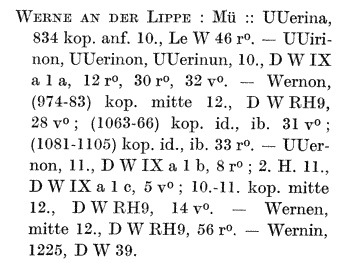
  • two names (that’s for starters – someone should really go up and down the river) that we noticed on the River Lippe (Lippa) that is Werne an der Lippe > former  Werina (Uuerina) and Kamen > former Camine – these are marked with a purple circle;
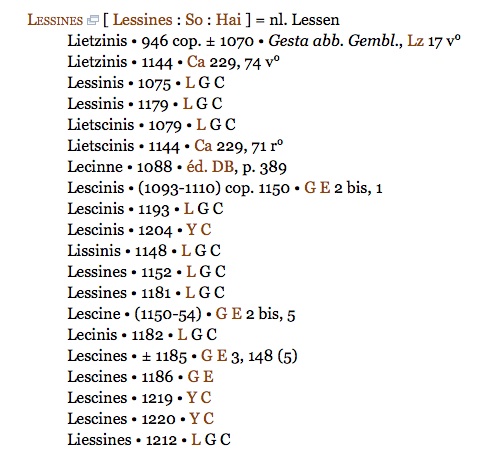
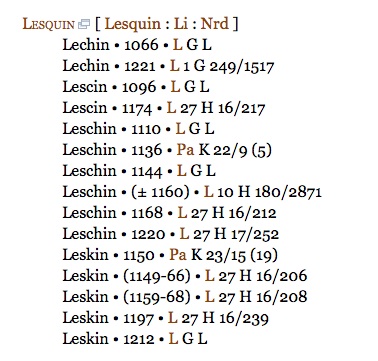
  • names of a “forest” nature such as Lesquin > former Lechin/Lescin, Lessines, Lessy, Quœux-Haut-Maînil (also Maisnil) > former Lesin/Lisin, etc. – these are in red;
  • other place names with the -in ending (for more of those see here, of course) – these are in navy blue squares/diamonds;
  • finally, we could not resist to throw in Barlin and Moskou > see the yellow stars;

We are not, of course, suggesting that all or any of these are Slavic (e.g., Dublin, Michelin, Peppin or, for that matter, Rabin!) – nevertheless, this is an interesting exercise.

veleti

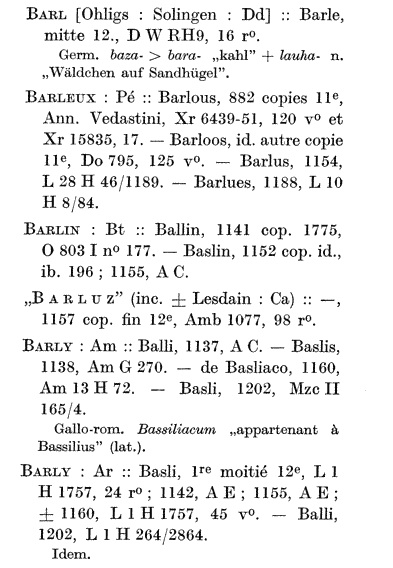
Here are Gysseling’s descriptions of the above – he also gives the current name and the source documents with approximate (or exact) dates.  You can get more info (including the meaning of the non-obvious acronyms at the address above). 
Barlin

Kamen
Quœux-Haut-Maînil lessy lesquin liusna

vendin

wenden

Werina

If you want to try something interesting, you can plot the following – we did and there were simply too many place names.

Velzen

Copyright ©2015 jassa.org All Rights Reserved
October 17, 2015

Once Again on Slavs – Part I

Published Post author

As we have discussed many times before, given man’s infinite capacity for hubris, each age of man proclaims its own truth as the most rational, scientific and – most importantly – final.  By extension, each such age also proclaims the truths of the past as wrong, outdated and altogether passé.

Looking from the outside (to the extent that is possible! we try though!) one might be tempted to ask whether current truths are only those truths that are currently “trending” – often with no serious foundation or reason – other than the logic of a snowball heading down hill.

But the beauty of the story of the snowball and the hill is that the former eventually runs out of the latter.  Now, this may be a result of exhaustion or, if you will, gravity and friction.  But it also may be a result of someone noticing that there was no hill or no snowball in the first place and that what we were witnessing was an elaborate parlour trick (or, less kindly, con job).  Since the magician is unlikely to be motivated to show his hand, we are forced – if we suspect something ain’t right – to reason our way to calling him out on his illusion.

Which brings us exactly to the heart of the matter as regards the whole “Origin of the Slavs” debate.  We’ve previously looked at how what is taught as history may be rooted not so much in truth but in current political preferences.  Let’s now look at several other similarly delicious aspects of this debate.

  • First, let’s look at the effect of the relative balance of power (economic, military, cultural, etc) determines how one perceives history.  We have an excellent example from the German approach to the “Origin of the Slavs” question.
  • Second, we will look (again) at how different assumptions about history translate into different interpretations of facts that might – absent such assumptions – have resulted in entirely new theories.  Here the example of the Suavi-Slavi incongruity being ignored or molded to fit preexisting notions about the past will be of interest.  Another example will have to do with the heavily politicized (strange, isn’t it!?) question of the ethnic nature of the Aesti.
  • Third, we will look at the final refuge of the scoundrels – the redefinition of the debate.  Here we have an excellent example of linguistic prestidigitation when we ask the mainstream historians and archeologists to tell us what do they mean exactly by “Slavs”.
  • Fourth, we will ask about the implication of answers that differ from the ones that we are regularly being served up – both in the context of German self-perception and in the context, to come full circle, of today’s status of the “European project” – a project that the Germans (but also many others) hold near and dear – at whatever price.

Let’s begin, with the first aspect – our carrot & stick theory of German perception of the history of the Slavs.  (We will continue with items 2, 3 as well as 4 in subsequent entries).

Germans on the Origin of the Slavs

German “Elitist” Theories

stick

Eastern Hypothesis

In the 19th century we had the, let’s call it, Eastern hypothesis.  German scientists, confident in the rise of a strong, industrialized and unified Germany had to explain why so many inhabitants of the Empire were not speaking German.  They, therefore, came up with the Eastern hypothesis which, basically makes some or all of the following points:

  1. Central Europe was “originally” Germanic (Eastern Germanic but nevertheless);
  2. Germans left.
  3. Slavs were newcomers who arrived from the East – probably with the Huns but maybe even with the (in larger numbers) or pushed forth by, the Avars.
  4. Where in the East the mass of Slavs came from was irrelevant (or, at least, it was irrelevant for so long as the German Empire was not claiming those Eastern lands) with the proposed homelands ranging from the Pripet Marshes to somewhere beyond the Urals.
  5. The German Drang Nach Osten, therefore was not only a civilizational mission but a form of Reconquista where the Germans (never mind which) were returning to their Eastern homelands (which, just happened to be one of many German homelands but never mind that).
  6. The formation of the Slavic state was the work of Germanic peoples (Vikings from the North but the Germans of Germany were content with that as they always looked up to their Nordic “cousins” as “purer” versions of themselves – perhaps a certain sense of inadequacy).

(On the other hand, 19th century and early 20th century Slavic historians, of course, denied all six of the above postulates.)

This view of Germans and Slavs was picked up on by the Nazis (although whole heartedly only after it become clear that Poles and Czechs would not be drawn into a crusade against the Soviet Union).  It was a view whose strongest expression, therefore, occurred in times of relative German strength.  Put simply, whenever Germany was strong it could define history however it liked to and exclude others from its past just as it was actually excluding others from the present.

Eastern-light Hypothesis

After the war the Eastern view, for obvious reasons, mostly fell out of favor.  Nevertheless, it perseveres today in an “Eastern-light” version where postulates 1, 2 and 3 are still clung onto, postulate 4 is rarely mentioned, 5 is never mentioned in polite company and 6 is (with the exception of the old Rus state – where it actually does seem to apply) nowadays agreed to have been wrong.

This much for the German “mainstream”.

German Theories of “Inclusion”

carrot

But the German (far) right always had a different theory in its pocket.

A theory that seems to be strongest whenever Germany is relatively weak militarily.  This theory is one that is – with one exception – actually quite similar to the 19th century Slavic theory.  This is what we would call the “Inclusive” theory.  According to this view:

  1. Central Europe was “originally” Germanic (Eastern Germanic but nevertheless);
  2. Germans, for the most part, did not leave.
  3. Slavs were newcomers from somewhere but their numbers were – relatively – small.
  4. Where in the East the Slav conquerors came from is irrelevant.
  5. The German Drang Nach Osten was a mission of national reawakening (some versions of this actually deny Germany colonization in any large numbers).
  6. As to the leadership of the early Slav states, there are two variations here depending on whether the “Nordic” theory is too tempting for the given professor of this view or not:
    • “basic version” – no, they were foreign (Slavic) oppressors of the Germanic populace.
    • “convoluted version” – yes, the leadership of the new states was largely Nordic (though, as a “bone” to the locals, perhaps they do not have to have come from Scandinavia – they could have been local);

The crux of this theory is that the vast majority of the Slavs are, in fact, Germans though some (unspecified) percentage may be “Slavs” – whatever that means.  For more of this type of thinking look at Walther Steller or, more recently, Jochen Wittmann.

unicorns

(The “Daglinger” are Wittmann’s invention – based on the Dagome Iudex document and a stray reference to another Dagons in the Baltic area found in a Scandinavian saga).

Basic Inclusion

The “basic” version of this theory basically posits the Slavs as arrivals in the 6th century  and later who took over and who “Slavicized” the local German populace.

This theory is basically a variation on the mainstream Eastern-light theory which  – grudgingly – admits that some Germanic population may have survived in Central Europe and was later Slavicized.  This acknowledgment itself is a response to criticism of the mainstream Eastern theories from the so-called Slavic “autochtonists”.  Those historians raised the issue of how was it possible for the Slavs to have inherited toponyms and hydronyms which are – allegedly – not Slavic if the entire population of Central Europe was posited to have been replaced.  The answer that came back was that, well, not everyone left so some – small relatively to the newcomers – percentage of the Slavic population could have Germanic ancestors.  Let’s call this variation of the mainstream Eastern-light theory, the “Eastern-light with small Germanic survival” (confused yet?).

As the autochtonists immediately pointed out, this mainstream response, of course, presented many problems.  For one thing, the “small” Germanic “rest-population” would have had to have survived across vast swaths of Central Europe since the phenomenon of – allegedly – “non-Slavic” names was not local in its occurrence.  This suggested that a rather large component of the “new” Slavs was composed of a “preexisting” population.  Second, the inherited names were vastly non-Germanic – which suggested that – whatever original population did survive, such a population was not Germanic.  This seems to have been confirmed by the fact that “real” Nordic names for the various place and water names did exist – but they had not become part of the Slavic dictionary (e.g., ancient Vistla, Viscla, Vistla > Polish Wisła (with pronunciation of Visua or Viswa) whereas the German word is Weichsel).

The “basic inclusive” theory basically turns the mainstream “Eastern-light with small Germanic survival” theory on its head.  Whereas proponents of the latter theory might say that, say 10-20% of the Slavic population (but evenly spread out over Central Europe!) was Germanic, the “inclusive” Germanic theory would say that that percentage was closer to a range of 70-90% (depending on how “inclusive” one wanted to get).

The problem with the “basic inclusive” theory, of course, is that it does not answer how the local Germanic population would have become so thoroughly conquered and Slavicized with so few Slavs arriving.  A corresponding situation in the Kievan Rus developed entirely differently with the Swedish (probably) Rus conquerors becoming thoroughly Slavicized in the span of a couple of generations.

Of course, the “basic inclusive” theory could “solve” this problem by simply varying the relative percentages of the “Germanic autochtons” and the “Slavic conquerors” but obviously to do this it would have to give up some of its boldest claims (i.e., of predominantly Germanic local population).  In the end, if it were to claim that the 10% of local Germans were Slavicized by 90% of the population which was new and Slavic, the theory would look no different than the above “Eastern-light with small Germanic survival” theory.

Convoluted Inclusion

What about the version of the inclusive theory that is slightly, shall we say, convoluted?  Well, in this version, the leadership of the new Slavic states is Nordic.  This is much like postulate 6 of the German elitist theory of the 19th century but the difference appears to be (we say appears because these theories are, let’s say, “not entirely worked out) that the majority (?) of the population appears to be Germanic too.  The Slavs are, thus, reduced to nonexistence.

The obvious problem with this theory is that it cannot (given its assumption as to what it means to be Germanic – i.e., it means Nordicism) explain how the same vast swaths of Central Europe that we mentioned above suddenly started to speak Slavic languages.

Now, there is, of course, a way to salvage even this theory but it is unlikely to be a way that the theory’s proponents would appreciate the solution proposed.

Other Versions of Inclusion?

We conclude by noting that something akin to the above “inclusive” theories exists even outside of German “far-right” thought.

For one thing, as already noted above, the Eastern-light Hypothesis already admits that some – small – percentage of current Slavs can trace their ancestry to a pre-Slavic – presumably Germanic – population.

Even the 19th century brought forth some version of the inclusive theories – in amateur form – as this article (featuring a “Gothic” incarnation of the idea) in The Open Court magazine titled “The Poles and their Gothic Descent” indicated:

gothic

Of course, this brought a vigorous response from Polish-American press with the result that the editors of The Open Court were put on the defensive publishing a follow-up “apologia that was not an apologia” under the title “Slav and Goth“.

apologias

But even some mainstream scholars may be willing (?) to go a little further than the mainstream.  Thus, even though we previously picked on his shoddy scholarship regarding the Vandals, we would be remiss if we did not quote Herwig Wolfram on the subject of Slavs here:

“We cannot describe the phenomenon of Slav expansion in conventional historical categories, let alone explain it.  A silent revolution [eh, those assumptions!] took place from the end of the fifth century to the beginning of the seventh century in large parts of eastern and central Europe between the Baltic Sea and the Aegean, and nobody can really say how half of Europe could become Slavic in such a  short period of time.  After the end of the tribal migrations, Germania was, if anything, smaller than before, if we subtract the losses in the east [i.e., he means to the Slavs!] from the gains in the west and south [i.e., he means the kingdoms of the Goths, Franks, Lombards, etc – this is a false equivalence because these tribes – like the Rus later – lost their original language and became fully – and relatively quickly – assimilated by the local population)].  Over the period of half a millennium, the empire was able to Romanize only part of the land under its rule.  By contrast, in only a few generations Slavicization had a much more lasting success, which was more than the result of a mere migration and also far exceeded any imperial policy, let alone military conquest… Perhaps the ‘obscure progression of the Slavs’ [from Lucien Musset] can best be characterized as follows: the Germanic bearers of tradition and their warrior bands departed from the region east of the Elbe, and a Slavic identity seems to have emerged among the Germanic-Sarmatian peasant population left behind.  However, this did not take place in a continuous sweep from east to west, as certain areas were passed by and became Slavic only at a later time.”  [emphasis ours]

Of course, if one goes along with this, there are only two things that remain to be asked.  One is: Which Germanic and which Sarmatian peasants became “Slavicized?”  The most likely answer to this question, we’ve already given here when discussing the Suevi and the Sarmatian connection.  (The follow up question of what those Sarmatian “Iazyges” (?) tribes could have been called is, no doubt, too difficult for most of today’s historians to answer…)

pannonia

Ptolemy mentions the same in the second century

pannonias2

And the situation in the fifth century

The more difficult question is the second one: How did this happen?  This is a much harder question to answer, seemingly because it relies for its existence on an assumption which stubbornly refuses to go away.

So Now What?

Ok… so some Slavs may, indeed, feel flattered by being courted and sign another Volksliste (for another “divide and conquer” strategy, feel free to see also the Austrian concept of Windische).

However, none of these “inclusive” folks want consider where this kind of thinking ultimately leads and who the people previously known as Germans may well have been…

Copyright ©2015 jassa.org All Rights Reserved

October 12, 2015

On Plaumorati

Published Post author

Saskia Pronk-Tiethoff in her very interesting book “The Germanic Loanwords in Protoslavic” discusses also the word “plough”.  This word appears in all Slavic languages in the following forms:

  • pług – in Polish (pronounced pwoog in English in English pronounciation);
  • pluh – in Czech, Slovak and Ukrainian;
  • płuh – in Upper Sorbian (pwooh);
  • pług – in Lower Sorbian (pwoog);
  • plaug – in Polabian;
  • plug – in Russian (ploog), Serbo-Croatian and Slovene (accent differs);

Of course, in Cyryllic alphabets the word is written плуг.

The same word appears in Germanic languages, e.g.:

  • pflug – German;
  • plough – English;
  • ploeg – Dutch;
  • phluog – Old High German;
  • pfluoc – Middle High German;
  • plog – Old English – in the meaning of plough of land!;
  • plöch – Old Frisian;
  • plovum – Langobardic (see Edictus Rothari, chapter 288; also Leges Baiuwaiorum);

The word is not Germanic or, at least, not proto-Germanic (if such a language existed) since it is not attested in Gothic.  On the other hand, Gothic has the word hoha for plough which seems to correspond to the Slavic socha/sokha.  Finally, in addition to plug and soha, Slavic also has radło/rádlo which corresponds to the ard plough.  In general, these instruments are understood to be slightly different.  Thus:

  • radło (rádlo/pа́ло/орало) – ard plow – the most ancient of “ploughs” (note the Germanic/Slavic ard/rad shift, e.g., Ardogast/Radogast);

radolo

  • socha (sokha/cохaard plow with two ards (or rads);

radlo

  • plug – plough, much heavier, using metal and typically equipped with wheels;

plough

Where Did Ploughs Come From?

The first mention of the word is quite ancient and seems to have been made by Pliny the Elder in his Natural History – a veritable almanac of knowledge.  The form given by Pliny is plaumorati.  The passage follows:

Pliny, Natural History 18,48 (or 18, 172 by lines)

“Ploughshares are of various kinds. The coulter is the iron part that cuts up the dense earth before it is broken into pieces, and traces beforehand by its incisions the future furrows, which the share, reversed, is to open out with its teeth.  Another kind—the common ploughshare—is nothing more than a lever, furnished with a pointed beak; while another variety, which is only used in light, easy soils, does not present an edge projecting from the share-beam throughout, but only a small point at the extremity. In a fourth kind again, this point is larger and formed with a cutting edge; by the agency of which implement, it both cleaves the ground, and, with the sharp edges at the sides, cuts up the weeds by the roots. There has been invented, at a comparatively recent period, in that part of Gaul known as Rhætia, a ploughshare with the addition of two small wheels, and known by the name of “plaumorati.”  The extremity of the share in this has the form of a spade: it is only used, however, for sowing in cultivated lands, and upon soils which are nearly fallow. The broader the plough-share, the better it is for turning up the clods of earth. Immediately after ploughing, the seed is put into the ground, and then harrows with long teeth are drawn over it.  Lands which have been sown in this way require no hoeing, but two or three pairs of oxen are employed in ploughing.  It is a fair estimate to consider that a single yoke of oxen can work forty jugera of land in the year, where the soil is light, and thirty where it is stubborn.”

Vomerum [“spades”] plura genera: culter vocatur inflexus praedensam, priusquam proscindatur, terram secans futurisque sulcis vestigia praescribens incisuris, quas resupinus in arando mordeat vomer. alterum genus est volgare rostrati vectis. tertium in solo facili, nec toto porrectum dentali, sed exigua cuspide in rostro.  latior haec quarto generi et acutior in mucronem fastigata eodemque gladio scindens solum et acie laterum radices herbarum secans. non pridem inventum in Raetia Galliae duas addere tali rotulas, quod genus vocant plaumorati. cuspis effigiem palae habet.  serunt ita non nisi culta terra et fere nova. latitudo vomeris caespites versat. semen protinus iniciunt cratesque dentatas supertrahunt. nec sarienda sunt hoc modo sata, sed protelis binis ternisque sic arant. uno boum iugo censeri anno facilis soli quadragena iugera, difficilis tricena iustum est.

Plaumorati

(On the Plaum)

The word plaumorati has caused a rather long discussion as to its meaning and origin.  Most people think it’s a compound word and that the first part is simply “plow”.  But is it?

Plough or plug has a “g” in it.  Not an “m”.  In this respect it has been asserted that the form plovum was the original form.

However, it is our understanding that:

  • the combination of “pl” is unusual in Langobardic;
  • several explanations have been given for the shift from “g” to “v” and, obviously, if that is true, then there is really no question that plug or plog came before *plovum (and, If so, there may have been a plug even at the time of the plaumorati; and, if so, then plaumorati would not even refer to a plough); and,
  • in any event, today’s cognate words may, apparently, be derived from other “original” forms (not just plovum) – even following the linguist’s own rules;
    • forms such as *ploda and plodum; such forms existed in Latin and, interestingly, in the region of Trentino which just happens to lie right next to the region of Veneto;trento

What is even more interesting in Trentino, the word *ploda meant harvest (see W. Foerster Der Pflug in Frankreich on page 12; Schneller, Die romanischen Volksmundarten in Suedtirol, page 165).

Remarkably, plon/plony means the same thing in Slavic languages (or płód/płódy which may have meant the same thing before it meant “fetus”).   That is one Slavic similarity.

plon1

Another may be seen if we look at the “m” – where does the “m come from? One suggestion could be lemiesz meaning the piece of the plough that actually cuts the soil:  ploughschema

lemiesz

Yet another if we ignore the “m” may be plewa/plewić meaning weed/get the weeds out.

plewa1

All this fits better if we con side that Pliny is not talking about ploughs but rather about ploughshares.

ploughshare

Whether a lemiesz used to be a plemiesz we do not know.  However, plemie means tribe and plemnik means, ahem, seed.  Consequently, it would not be unreasonable that the “p” dropped at some point.

Plaumorati 

(On the -Orati)

As to where the division should take place and what the second part of the word means, there is much disagreement.  Here are some common theories as to the origin of the word – they are basically divided into two groups:

The first is a “wheeled plough”: 

  • plograt – the ancient Gallic for a plough-wheel; as in Geraet/grat;
  • plaustra rati – Latin;
  • plaum radt – Belgic plaum (a plough) and rat or radt  (a wheel);
  • plaum ratum – more generally Celtic plaum, plovum (plough) and ratum (wheel);
  • plaugorati – although no such form has been recorded, some German scholars “created” or emendated a Germanic form plaumgorati – meaning, along the same lines, a wheeled plough (whether the name Much was itself, in this case, an emendation of the Slavic mucha, i.e., fly, we do not know (the word appears too in French… and in Swabian));

The second group is the  “Raetian plough”: 

  • ploum Raeti – Raeitian plough – Who were the Raetians?  We are told either Celts or Illyrians.

Both of these make sense since wheels and Raetia seem to be involved here.  And yet, another suggestion has also been made, as follows:

  • plaustrum aratri, plaustrum rastri, plaum aratri  – that is a plough wagon in Latin where the aratri/rastri is the plough/rake and plaustrum is the wagon; that is, the aratri is referring to the raking or ploughing action.

But, should it then be aratrum?

And here is the thing… 

Can the orati refer to anything other than wheels and Raetians?

orac

orac1z

rataj

Oddly enough, orać or orat, i.e., with an “o” is a Slavic verb for “to plough” (e.g., orka – the act of ploughing, oracz but also (!) rataj – ploughman or tiller) (same as, e.g., Spanish arar) and orati could be either:

  • an adjective for the kind of device, i.e., a ploughing device; or
  • genetive plural for whose device this is, i.e., tillers’ device.

Now, we are not suggesting that Raetians were Slavs but, one would think, that the above facts would, at least, merit mention in academic literature.  But they do not.  Why?  Conspiracy?  We think not.  We think the reasons are quite mundane:

  • conservatism – historians who occupy themselves with such topics do not even admit the possibility of Slavic speakers in Raetia at the time; and
  • dilettantism – the same people are ignorant of the above fact – for one thing, to the extent, they have any familiarity with Slavic words at all, they are typically familiar with Russian and in Russian the word does not really exist in this form;

Let’s note another interesting fact.

Piast of the Plough or Piast of the Wheel?

The Polish archfather – Piast – was said in the early tellings of his legend to have been an oracz, i.e., a ploughman.

ploughman

Piast in a plaumorati featuring the traditional Venetic red-white color scheme

But in later tales he becomes a wheelwright.

wheeelwright

Piast the Wheelwright working on a large order for the Tonka Corporation

Was this an intentional “ennobling” of Piast’s heritage?  Or was there some sort of a mistake or misreading of the word “rat” or “rad” (as in wheel)?

(He is referred to Ckosisconis which suggests either that his father’s name was Choscisco (whom some Germans historians tried to connect with the Hasdingi on account of the long hair…) or, perhaps, that it was Kosisco, meaning something to do with the kosa, i.e., scythe).

And then there is palluchos in Accadian…

Copyright ©2015 jassa.org All Rights Reserved

September 9, 2015

On Widsith and Its (Few) Wends

Published Post author

Since we have been discussing Anglo-Saxon contributions to Slavic history with the work of King Alfred we decided to continue on that path and mention “Widsith”.  The Old Anglo-Saxon poem from the Exeter Book has been preserved in only one manuscript copy – the tenth-century, so-called, Codex Exoniensis (Exeter Cathedral Library MS 3501).  We include the entire poem here. Here are some interesting points:

  • The poem contains a reference, or maybe two, to the Wends amongst its list of European peoples that the traveller in question claims to have visited.
  • It also contains a reference to the River Vistula where the Goths, allegedly, fought the Huns (a topic found also in Hervarar Saga og Heiðreks and in the tale of Ossantrix which we will discuss later).
  • It contains references to what may be the tribes of Wiolane ond Wilna which smacks of Wolin or Wislane (not to mention Vilnius!)
  • Finally, it is noteworthy, we think, that:
    • the Hreðcyning sounds awful like Horodcyning, i.e., in the sense of gard, grod, horod in the Ukrainian language and of Gardarike (as opposed explaining this with “riding” (!) Goths) (see also the Czech hrad “castle” in Prague) and that
    • the greatest “getter” of things and honors is a guy named Hwala – the same word literally at least as the Polish word for “honour” or “glory” (i.e., chwała – though, Alexander Brueckner believes chała or fała to have been the older forms – we did not follow up on this (yet)). (this is actually Wala in the text but, most people think it has been correctly emended to Hwala).
Widsithboc
Widsið maðolade,      wordhord onleac,
se þe monna mæst      mægþa ofer eorþan,
folca geondferde;      oft he on flette geþah
mynelicne maþþum.      Him from Myrgingum 

Widsith spake,      unlocked his word-hoard,
He who among men      had travelled most in the world,
through peoples and nations;      he had often in the hall                                               earned valuable treasures [rewards].      He came [of] from the Myrgings [tribe?]

[5]

æþele onwocon.      He mid Ealhhilde,
fælre freoþuwebban,      forman siþe
Hreðcyninges      ham gesohte
eastan of Ongle,      Eormanrices,
wraþes wærlogan.      Ongon þa worn sprecan: 
of noble blood.      He together with Ealhhilde,
the friendly weaver [webber] of peace,      went for the home [the seats]
of the Hrethan [=horod = gard = gród?] King [Hreðcyning]      he sought
[from?] east of the Angles,      Ermanaric,
wrathful oathbreaker [?].      He began to speak:
10
‘Fela ic monna gefrægn      mægþum wealdan!
Sceal þeodna gehwylc      þeawum lifgan,
eorl æfter oþrum      eðle rædan,
se þe his þeodenstol      geþeon wile.
þara wæs [H]wala      hwile selast, 

‘I have queried [fela = viel, wiele] many men      [who] ruled [wielded] many tribes [?] 
Each ruler should         live according to custom,
to be ruler after others        his [countries/wisely?] rule [rædan = rada]
if he, his ruler’s throne [þeodenstol = Stuhl, stołek]      wants [wills] to get
There [in that] was Hwala         for a while [=chwile] the best [of all],

15
ond Alexandreas      ealra ricost
monna cynnes,      ond he mæst geþah
þara þe ic ofer foldan      gefrægen hæbbe.
ætla weold Hunum,      Eormanric Gotum,
Becca Baningum,      Burgendum Gifica. 
and Alexander      the richest [greatest] ruler
of the clans of man,      and he got the most [throve the most]
of [all] those [that] I over the world      have queried
Ætla [Attila] ruled [weold=wield=władać]  the Huns      Ermanaric [ruled] Goths,
Becca [ruled] Banings,      Gifica [ruled] Burgundians


20
Casere weold Creacum      ond Celic Finnum,
Hagena Holmrygum      ond Heoden Glommum.
Witta weold Swæfum,      Wada Hælsingum,
Meaca Myrgingum,      Mearchealf Hundingum.
þeodric weold Froncum,      þyle Rondingum, 
Caesar ruled Greeks      and Celic [ruled]  Finns,
Hagena [ruled] Holmrygas      and Heoden [ruled] Gloms.
Witta ruled Suevi,      Wada [ruled] Hælsings [Helsinki!?],
Meaca [ruled] Myrgings      Mearchealf [ruled] Hundings.
Theodric ruled Franks      Thyle [ruled] Rondings,
25
Breoca Brondingum,      Billing Wernum.
Oswine weold Eowum      ond Ytum Gefwulf,
Fin Folcwalding      Fresna cynne.
Sigehere lengest      Sædenum weold,
Hnæf Hocingum,      Helm Wulfingum, 
Breuca [ruled] Brondings, Billing [ruled] Werns [Warni?]
Oswine ruled Eows      Ytas/Yts [were ruled by] Gefwulf,
Fin [ruled] Folcwaldings Frisian [?] clans.
Sigehere longest      [the] Sea-Danes ruled,
Hnæf [ruled] Hocings      Helm [ruled] Wulfings,
30
Wald Woingum,      Wod þyringum,
Sæferð Sycgum,      Sweom Ongendþeow,
Sceafthere Ymbrum,      Sceafa Longbeardum,
Hun Hætwerum      ond Holen Wrosnum.
Hringweald wæs haten      Herefarena cyning. 
Wald [ruled] Woingas,      Wod [ruled] Thuringians,
Saeferth [ruled]  Sycges,      Ongendtheow [ruled] Swedes [?],
Sceafthere [ruled] Ymbres,      Sceaf [ruled] Langobards,
Hun [ruled] Haetwares,      and Holen [ruled]  Wrosnes.
Hringwald was called      the king of the Herefarens.
35
Offa weold Ongle,      Alewih Denum;
se wæs þara manna      modgast ealra,
no hwæþre he ofer Offan      eorlscype fremede,
ac Offa geslog      ærest monna,
cnihtwesende,      cynerica mæst. 
Offa ruled Angles,      Alewih Danes,
That was of those men      the bravest of all,
however [but] he [could] not over Offa       obtain rule [earlship],
and Offa won [in battle, i.e., geschlagen]      the first of men
while still being [wesen] a boy [Knecht]     the greatest of kingdoms.
40
Nænig efeneald him      eorlscipe maran
on orette.      Ane sweorde
merce gemærde      wið Myrgingum
bi Fifeldore;      heoldon forð siþþan
Engle ond Swæfe,      swa hit Offa geslog. 
No one [Nænig = nikt] of the same age as him [even-old]      honored earlship
in battle.      [With] one sword
[he] marked the border      against [the] Myrgings
by Fifeldore;      held forth hence [since]
by Angles and Suevi      as it Offa won.
45
Hroþwulf ond Hroðgar      heoldon lengest
sibbe ætsomne      suhtorfædran,
siþþan hy forwræcon      wicinga cynn
ond Ingeldes      ord forbigdan,
forheowan æt Heorote      Heaðobeardna þrym. 
Hrothwulf ond Hrothgar      held longest
peace together      uncle and nephew [or nephew & uncle]
after [since then] they drove away [forth]      [the] Viking kin [peoples]
and Ingeld’s      spearpoint [vanguard] humbled [?],
forced at Heorot      Heathobards’ trim [i.e., cut them down to size]


50
Swa ic geondferde fela      fremdra londa
geond ginne grund.      Godes ond yfles
þær ic cunnade      cnosle bidæled,
freomægum feor      folgade wide.
Forþon ic mæg singan      ond secgan spell, 
So I fared [wondered] much [viel, wiele]     [in] foreign lands
through wide countries [grounds* – Earth]      Good and evil
there I got to know      of my people impoverished [=bieda!]
[from my] free kinsmen far      I followed [served far and] wide
Henceforth I’d like to sing      and tell [my] tale      
* the fact that the Earth here is titled “grund”, inclusive of “rund”, “round” is reason enough to think about things anew!
55
mænan fore mengo      in meoduhealle
hu me cynegode      cystum dohten.
Ic wæs mid Hunum      ond mid Hreðgotum,
mid Sweom ond mid Geatum      ond mid Suþdenum.
Mid Wenlum* ic wæs ond mid Wærnum      ond mid wicingum. 
To speak before a multitude      in the mead-hall
how me noblemen      [generosity] showed/gifts bestowed
I was with the Huns      and with Hreth[an]goths
with Swedes and with Geats      and with South-Danes.
With Winnuli I was and with Warnians      and with vikings.
* Unclear, perhaps people from Vendsyssel in Denmark or the Winuli as in the later Langobards
60
Mid Gefþum ic wæs ond mid Winedum      ond mid Gefflegum.
Mid Englum ic wæs ond mid Swæfum      ond mid ænenum.
Mid Seaxum ic wæs ond Sycgum      ond mid Sweordwerum.
Mid Hronum ic wæs ond mid Deanum      ond mid Heaþoreamum.
Mid þyringum ic wæs      ond mid þrowendum,* 
With Gifthas I was and with Wends      and with Gefflegs.
With Angles I was and with Suevi      and with aenenas.
With Saxons I was and with Sycgs      and with Swordsmen.
With Hronas I was and with Deans      and with Heatho-Reams.
With Thuringians I was      and with Throwends,
* Your guess is as good as ours; it has been suggested that there are the people of Trondheim but this seems just a guess as the “d” is nowhere to be found and why they should be -wendum is unclear
65
ond mid Burgendum,      þær ic beag geþah;
me þær Guðhere forgeaf      glædlicne maþþum
songes to leane.      Næs þæt sæne cyning!
Mid Froncum ic wæs ond mid Frysum      ond mid Frumtingum.
Mid Rugum ic wæs ond mid Glommum      ond mid Rumwalum. 
And with Burgundians,      there I got wring/crown
me there Guthhere gave me      a glittering jewel [?]
to pay for [my] song      [he was] not [a] sluggish king!
With Franks I was and with Frisians      and with Frumtings.
With Rugians I was and with Glommas      and with Romans [Rome-Welsh]
70
Swylce ic wæs on Eatule      mid ælfwine,
se hæfde moncynnes,      mine gefræge,
leohteste hond      lofes to wyrcenne,
heortan unhneaweste      hringa gedales,
beorhtra beaga,      bearn Eadwines. 
Likewise I was in Italy      with Aelfwine*
he had of all mankind,      that I queried [i.e., met on my journeys]
the lightest hand      glory to work
the most generous heart      rings [booty] to give out [geteil = divide, give out]
brightest trinkets [bracelets jewels]      the bear cub [bairn] of Eadwine’s.
* the Langobard king who went with his people from Pannonia to Italy in 568
75
Mid Sercingum ic wæs      ond mid Seringum;
mid Creacum** ic wæs ond mid Finnum      ond mid Casere,
se þe winburga      geweald ahte,
Wiolane ond Wilna,***      ond Wala rices.
Mid Scottum ic wæs ond mid Peohtum      ond mid Scridefinnum; 
With Saracens [?] I was      and with Serings*;
with Greeks** I was and with Finns      and with Caesar,
he [who] vineyards      had ruled,
Wiolane and Wilna      and the riches of the [Welsh or Romans]?
With Scots I was and with Picts      and with Scridefins****
* Syrians?
** This typically is translated as Greeks although (as in Orosius) the temptation of Cracow beckons – above the poem talks about Caesar (if that is who Caser is) ruling the same so presumably this means the Byzantine Emperor
*** No one knows what these words are and whether they are tribal names or other nouns – one suggestion has been that they are Wallachs Walach-girls, i.e., Welsh as the  Romans were called by the Scandinavian tribes
**** These appear in many, many sources (e.g., Ravenna Geography, Procopius, Jordanes, Paul the Deacon).


80
mid Lidwicingum ic wæs ond mid Leonum      ond mid Longbeardum,
mid Hæðnum ond mid Hæleþum      ond mid Hundingum.
Mid Israhelum ic wæs      ond mid Exsyringum,
mid Ebreum ond mid Indeum      ond mid Egyptum.
Mid Moidum ic wæs ond mid Persum      ond mid Myrgingum, 
with Lidvikings [peoples’ vikings!?]* I was and with Leonas      and with Langobards
with Heathens and with Herethas**      and with Hundings.
With Israelites I was      and with Assyrians [?],
with [H]ebrews and with Indians [?]      and with Egyptians.
With Medes I was and with Persians      and with Myrgings,
* e.g., Ludvig
** because sometimes emendated to Hæreþum – perhaps the Haroudes of Ptolemy
85
ond Mofdingum      ond ongend Myrgingum,
ond mid Amothingum.      Mid Eastþyringum ic wæs
ond mid Eolum ond mid Istum      ond Idumingum.
Ond ic wæs mid Eormanrice      ealle þrage,
þær me Gotena cyning      gode dohte; 
and Mofdings      and against Myrgings
and with Amothings.      With East-Thuringians I was
and with Eols [?] and with Esti      and Idumings.
And I was with Ermanaric      all the time,
there me Goth king      goods gave/with goods benefitted me/did well for me;      
90
se me beag forgeaf,      burgwarena fruma,
on þam siex hund wæs      smætes goldes,
gescyred sceatta      scillingrime;
þone ic Eadgilse      on æht sealde,
minum hleodryhtne,      þa ic to ham bicwom, 
he gave me a bracelet/ring,     ruler of town peoples
on them six hundred was [it’s worth was?]    [in] hammered/forged/molten gold
coin treasures      reckoned by shillings;
That I [to] Eadgils     as property [present] gave,
my lord protector     when I came [bicwom] home,
95
leofum to leane,      þæs þe he me lond forgeaf,
mines fæder eþel,      frea Myrginga.
Ond me þa Ealhhild      oþerne forgeaf,
dryhtcwen duguþe,      dohtor Eadwines.
Hyre lof lengde      geond londa fela, 
a present to my sire,      for he had given me land,
my father’s home,     ruler of Myrgings.
And me that Ealhild        a second [bracelet/ring/treasure] gave,
a noble queen of many hosts,     daughter of Eadwine.
Praise of her spread     through many lands,
100
þonne ic be songe      secgan sceolde
hwær ic under swegle      selast wisse
goldhrodene cwen      giefe bryttian.
ðonne wit Scilling      sciran reorde
for uncrum sigedryhtne      song ahofan, 
Then [when?] I in song      should say
where I under the sky*      I knew the best
gold bedecked queen      giving out gifts.
Then with Scilling      with clear voices
before our lord      we raised a song,
* compare swell (then too Vogel = bird) with Slavic swar (heat), Swarozic, but also Schwartz (black as in burned) or Tschernobog]
105
hlude bi hearpan      hleoþor swinsade,
þonne monige men,      modum wlonce,
wordum sprecan,      þa þe wel cuþan,
þæt hi næfre song      sellan ne hyrdon.
ðonan ic ealne geondhwearf      eþel Gotena, 
loud by the harp      the words sounded,
then many men,      of golden spirit,
spake words,      that they [who] well [should] know
that they never [such a] song      performed nor heard.
then I speedily wandered      through the lands of the Goths,     
110
sohte ic a gesiþa      þa selestan;
þæt wæs innweorud      Earmanrices.
Heðcan sohte ic ond Beadecan      ond Herelingas,
Emercan sohte ic ond Fridlan      ond Eastgotan,
frodne ond godne      fæder Unwenes. 
I sought company      there of the best;
that was [of] the house      of Ermanaric.
Hethca I sought and Beadeca      and the  Herelings,
Emerca sought I and Fridla*      and  Ostrogotha,
wise and worthy**      father of Unwen.
*these two – Emerca and Fridla – are the afore-mentioned Herelings or Harlungs
** or good (compare Polish godny with which we went here as, somehow, better-fitting)     
115
Seccan sohte ic ond Beccan,      Seafolan ond þeodric,
Heaþoric ond Sifecan,      Hliþe ond Incgenþeow.
Eadwine sohte ic ond Elsan,      ægelmund ond Hungar,
ond þa wloncan gedryht      Wiþmyrginga.
Wulfhere sohte ic ond Wyrmhere;      ful oft þær wig ne alæg, 
Secca sought I  and Becca,      Seafola and Theodric,
Heathoric and Sifeca,      Hlithe and Incgentheow.
Eadwine sought I and Elsa,        Aegelmund and Hungar,
and the splendid fate(s)        of the With-Myrgings.
WuIfhere sought I and Wyrmhere;       full oft there war [did] not cease,
120
þonne Hræda here      heardum sweordum
ymb Wistlawudu      wergan sceoldon
ealdne eþelstol      ætlan leodum.
Rædhere sohte ic ond Rondhere,      Rumstan ond Gislhere,
Wiþergield ond Freoþeric,      Wudgan ond Haman; 
then the Hraeth army,      [with] harsh swords
about the Vistula wood [or spear-tip?]      they had to defend
old country’s seat      against Attila’s people.
Raedhere sought I and Rondhere,      Rumstan and Gislhere,
Withergyld and Freothric,      Wudga and Hama;


125
ne wæran þæt gesiþa      þa sæmestan,
þeah þe ic hy anihst      nemnan sceolde.
Ful oft of þam heape      hwinende fleag
giellende gar      on grome þeode;
wræccan þær weoldan      wundnan golde 
Nor were they comrades      there the worst to me [they were not bad]
though them I [as] the last     should name
Full oft of that host [heap]     [there] whining/whistling [did] fly
[a] yelling/screaming spear/javelin      on fierce/furious* peoples
wonderers there ruled      by wounded gold [?]
* Grome – presumably, the same original as the Slavic grom as in “thunder”
130
werum ond wifum,      Wudga ond Hama.
Swa ic þæt symle onfond      on þære feringe,
þæt se biþ leofast      londbuendum
se þe him god syleð      gumena rice
to gehealdenne,      þenden he her leofað.’ 
husbands and wives,      Wudga and Hama.
So I that ever found      on these voyages,
that he is loved the most      by landspeople
to whom God gives     [the] rule [over] men
to hold,      while he here lives.’


135
Swa scriþende      gesceapum hweorfað
gleomen gumena      geond grunda fela,
þearfe secgað,      þoncword sprecaþ,
simle suð oþþe norð      sumne gemetað
gydda gleawne,*      geofum unhneawne,** 
So wondering      [and traveling about are] destined
the people’s [men’s] singers      [and] to travel/walk [through] many lands
speaking [their] need,      saying a word of thanks,
ever south or north      meeting someone
knowing in songs [as in, a connoiseur]      of gifts unsparing/generous
* interestingly, “wise”/”knowing” here is similar to the Slavic word for head, i.e., “glova”
** un-hneaw – curious if there is a relation to hovat (i.e., hide) in Slavic (someone who does not hide stuff, i.e., generous)
140
se þe fore duguþe wile      dom aræran,
eorlscipe æfnan,      oþþæt eal scæceð,
leoht ond lif somod;      lof se gewyrceð,
hafað under heofonum      heahfæstne dom.
he who before his men wants      his fame [?] to air
rulership to achieve,      until all scatters,
light and life together;      glory he achieves,
has under heaven,      the most lasting fame.

exterbook2223

Go see the original at the Exeter Cathedral

Copyright ©2015 jassa.org All Rights Reserved

September 2, 2015

On Ukras

Published Post author

This is the river Wkra (pronounced Vkrah) in Mazovia, Poland:

wkras1

This is the river Uecker in Brandenburg and Mecklenburg-Vorpommern, Germany:

wkras2

The German river Uecker is, nowadays, called Wkra in Polish.  The reason for this appears to be that:

A) the assumption is that the Uecker does not have a Slavic etymology,

B) the river Uecker, however, must have had a prior Slavic name, and

C) as noted above, there is a river Wkra in Poland (i.e., Wkra to the rescue!).

So, it seems, in search of a Slavic name, Polish geographers, at some point relabeled the Uecker as Wkra in Polish.  The result of this too has been that the Slavic tribe which previously lived in the area and which was previously named Ukrani in literature, has now also been relabeled (in Polish literature) as Wkrzanie – at least in Poland (if you can’t pronounce that, you’re not the only ones).

But the tribe was never called Wkrzanie before nor the river Wkra.  Historical sources list them as Ukrani or Wuucri.  They also list the German river as Ukra

So why do this?  Or, to put it differently, what’s wrong with Ukra?

It has been suggested by German historians too that the Uecker was the original name which preceded the Ukrani so that the arriving Slavic tribe derived its name from the existing, presumably Germanic, river name Uecker.  Presumably, in response to this claim, i.e., that the source of the Ukra name was a German name (Uecker) and that, since Slavs lived in that area in the middle ages, the name could not have been Ukra but must have been something “Slavic” sounding, the river was renamed (again, by Poles only) into Wkra.

Silliness

What is astounding about “Slavicizing” the name Uecker into Wkra (to match the Mazovian river Wkra) now (since 19th century) is that it effectively ignores the quite real previous name of the river, i.e., Ukra or the quite real prior name of the tribe, i.e., Ukrani – never Wkrzanie.

What’s more, this process is not just astounding but also quite silly.  There are at least two reasons for that.

First of all, if Polish Slavicists do not feel like defending the Slavic nature of the name Ukra (because of Uecker) then they should just accept the name as Germanic and move on – after all weren’t there some Germanic tribes in that area?

Second, there is no reason to think that Ukra was not the original name or that it is not Slavic.  Rather, the Uecker seems to have been an adaptation of the earlier Ukra.

Third, what makes all this even sillier is that the Mazovian/Polish river Wkra may not have been called that originally…  And it gets better!  Some etymologists appear to claim that the river Wkra in Poland was previously also called the Ukra!  If so, then it is likely that Ukra or something along these lines was the name for all these rivers.  (Despite the fact that locals apparently believed (?) that the Mazovian Wkra was named that way because it meanders so much (“wkręcić“)).  These folks claim that the name was Ukra and referred to the Polish (or Slavic) word “kra“, i.e., a “floe” or floating ice.  “Krai” may also mean “to cut”.

Whichever the answer to this riddle, it certainly is the case that Slavic languages contain plenty of “ukr” sounds.

Thus, for example, U-kraine…  Hmmmm, perhaps Ukrainians moved from East to West!  But is there an Ukra river in the Ukraine?  Nothing apparent.  But maybe they named the rivers they encountered Ukras after their old homeland?  But we know that can’t be right because the name Ukraine is far younger and denotes “borderland”, does it not?  Except that the “u” does not really fit or make sense – something that could perhaps be more easily understood if there had been an Ukra in the Ukraine or if the Ukrainians had come into Ukraine from a country containing the river Ukra… (i.e., Ukrani > Ukranzi > Ukrainzi)

The reason for the “ukr” or “ucr” sounds in Slavic is because the “u” is a de facto prefix for a whole host of words beginning with “kr” – or “cr”, if you will.  No similar combinations are apparent in Germanic languages (of course “kr” and “cr” are frequent, e.g., Kramer).  And that is why Uecker does not seem to be the original but rather a German attempt to deal with the pronunciation of Ukra.

By the way, the same may be said for “o” as in “Okra” (on the Slavs, Suavi and the German River Ocker or Slavic Okra see here).

Digressive Intermission

Now, if you allow a digression, we would like to point out that one of the first things that surprises anyone researching pre-Slavic antiquities is that, while the suffix -mir may be Slavic, the names ending with -mer or -mar are not considered Slavic but Germanic.  This should not be that surprising, however, because all Indo-European languages  contain some levels of similarity.  But the situation is worse than that.  The suffix -mir may also be Germanic.  Thus, for example, we have the Ostrogothic Pannonian Kings Theodemir, Valamir and, even, that most Slavic “sounding” Videmir.  With all this we begin to question whether “Boromir” is Slavic either! (Gondor does not sound Slavic, even if Bor-o-mir does!).

The reason why one can reject the Slavic derivation of these names is not only because they were Goths and Goths spoke an East Germanic tongue but also because the prefixes of these names – at least in the case of Theodemir and Valamir – cannot be explained in any Slavic language. (Videmir could be but, after all, they were Goths!).

Which  Brings Us to the Point

What is the Germanic etymology of the following name: Ukromir of the Chatti or Batti (in which case he would have been Batavian)?  Mind you, the sources speak of Ukromir – not of Ueckermir or of Ueckermar or, even, as the table below shows and as Dahn would have it – Ukromer.

erminos

The table is useful in that it also presents Ukromir’s daughter – Ramis – the etymology of whose name is “uncertain” as you can see.  Further, it shows the names of some very interesting relatives of our Ukromir.

For Ukromir/Ucromir, see, e.g., Strabo (Geography, 7, 1):

“In dealing with these peoples distrust has been a great advantage, whereas those who have been trusted have done the greatest harm, as, for instance, the Cherusci and their subjects, in whose country three Roman legions, with their general Quintilius Varus, were destroyed by ambush in violation of the treaty.  But they all paid the penalty, and afforded the younger Germanicus a most brilliant triumph — that triumph in which their most famous men and women were led captive, I mean Segimuntus, son of Segestes and chieftain of the Cherusci, and his sister Thusnelda, the wife of Armenius, the man who at the time of the violation of the treaty against Quintilius Varus was commander-in‑chief of the Cheruscan army and even to this day is keeping up the war, and Thusnelda’s three-year‑old son Thumelicus; and also Sesithacus, the son of Segimerus and chieftain of the Cherusci, and Rhamis, his wife, and a daughter of Ucromirus chieftain of the Chatti, and Deudorix, a Sugambrian, the son of Baetorix the brother of Melo.  But Segestes, the father-in‑law of Armenius, who even from the outset had opposed the purpose of Armenius, and, taking advantage of an opportune time, had deserted him, was present as a guest of honour at the triumph over his loved ones. And Libes too, a priest of the Chatti, marched in the procession, as also other captives from the plundered tribes — the Caülci, Campsani, Bructeri, Usipi, Cherusci, Chatti, Chattuarii, Landi, Tubattii.  Now the Rhenus is about three thousand stadia distant from the Albis, if one had straight roads to travel on, but as it is one must go by a circuitous route, which winds through a marshy country and forests.”

strabo

And here is the “probable” explanation.  (BTW doesn’t Much come from mucha? (incidentally, that is the Suevic/Swabian name for a fly – well, Mugg (see, e.g., Muggeseggele), but so is it in French too la mouche or Latin – musca))

unwahrscheinlich

Copyright ©2015 jassa.org All Rights Reserved
August 30, 2015

Not Even Wrong

Published Post author

Piotr Kaczanowski, was the head of the Jagiellonian University’s history department (though himself an archeologist – we guess, he was a man of many interests).

He was a student of the unlamented Kazimierz Godłowski and the apple did not fall far from the tree.  In one of the more recent articles whose translation was forwarded to us, Kaczanowski wrote the following about a recent archaeology conference designed to prove, once and for all, that Slavs (Poles and others) must have come from somewhere else and that Poland was previously populated by Vandals…  Given our recent investigation of the matter, we found such a definitive conclusion to be troubling.  It appeared to be based on no evidence known to us (or anyone else, it seems).  So we were curious about this article.  We review portions of it here.

Vandalizing Polish History

We give voice to Kaczanowski (commentary, as always, in red):

“The Lugii are identified [by whom he does not say] with the Przeworsk culture which existed in southern and central Poland for over 600 years…”

Not sure where he got the 600 years but let’s not quibble – so far so good…

“The name of the Lugii is assumed [by whom?] to come from the Celtic language because of Celtic names of towns such as Lugudunum, Lugidunum or the Celtic God Lug.”

But where were these towns?  Also, why is “dunum” an exclusively Celtic name?  Was Go-dunum, then a Celtic town?  Do we have Celts at the Baltic?  Or did the Goths live in Celtic towns?  Or, are we simply dealing with a situation where the name of the town is known second-hand from another tribe?)

And why stop there!  There is always the Russian river Luga – were Celtic Lugii all the way up there too? 

Also, what is the evidence for the existence of the Celtic God Lug?  Well, there is the God Lugh – a trickster (Loki?) – in Ireland.  Is there any reason to believe that the Celtic God Lugh was worshipped in Poland?  Would it not be simpler to assume that Lugii simply meant what the word still means in Croatian – groves?  

And if we assume Celts in Poland and Celts in Ireland, why can’t we assume, as the same people, Veneti in Poland, Veneti on the Adriatic and Veneti in county Gwynedd? (one might be a touch snide and point out that Wales is closer to Poland than Ireland…) 

But then he says what he really wants to say (i.e., the Celts are not really good enough for him):

“The Przeworsk culture, however, cannot be seen as a Celtic culture.  It arose, it is true among other cultures based on their contributions [really!?], but its people were certainly part of some other, non-Celtic ethnic group.  The written sources mention too other peoples, which lived in the basins of the Odra and the Vistula in the first two centuries after christ. Based on the information conveyed by Ptolemy one can judge that, in the basin of the Odra there lived the Burgundians.  Their presence in the Polish lands is confirmed by a later author, the sixth century Ostrogoth Jordanes, in a passage,  probably relating to the events of the third century.”

Ptolemy does place the Burgundians somewhere along the Oder – possibly extending to the Vistula.  But Jordanes does not mention where the Burgundians lived. The incident that Kaczanowski is referring to is (we think) the incident of the attack on the Burgundians by the Gepids  who, as per Jordanes, dwelt on an island at the mouth of the Vistula.  But no such islands currently exist so it is not clear what this means.  And, as we have argued before, it is at least possible, that the names of the Vistula and Oder have been mixed up by ancient writers.  And, elsewhere when discussing the Gepid embassy to the Goths, Jordanes states that the Gepid king complains of the need for more Lebensraum since he is “hemmed in by rugged mountains and dense forests.”  No such mountains exist anywhere near the Baltic.  Were the Gepids claiming all of Central Europe then, hemmed in by the Carpathians?  The Alps?  

All that notwithstanding, Jordanes does not say anywhere where the Burgundians then dwelt when they were attacked by the Gepids.  Or who the Burgundians were (though apparently not kin to the Gepids or Goths – and Romans, apparently, also used this term in a non-ethnic sense of “city dwellers”).  

Not to mention that Jordanes may have been of Alan not Goth heritage, ahem – but why quibble.

“According to other information of Ptolemy’s one can assume that, there lived along the Oder, most likely in Silesia, another Germanic tribe, the Silingae.”

As we have repeatedly stated, Ptolemy does not say anything of the sort.  Kaczanowski wants Ptolemy to say that but that is about it.   Also, Ptolemy does not say anywhere that the Burgundians were a Germanic tribe in the sense that Kaczanowski is using the name.  Unless, of course, one thinks that the Amerikaner are also a Germanic “tribe” because their name comes from Amerigo Vespucci.

“Archaeology delivers data indicating that, within the Przeworsk culture, there existed also Vandalic tribes.  And written sources confirm that around the year 170, during the Marcomannic Wars… Vandal tribes of Hasdings, Lacrings and Victofals, journeying somewhere from the North, reached the borders of Dacia.”

This is just BS with, likely, a healthy mix of “untruths.”

First, archaeology is not a Goddess – it is an academic discipline.  Archeologists may or may not believe something but, if they do, they should own up to their beliefs rather than pretending that some unbiased “Archeology” necessitates some findings.  Moreover, on the archeology of Przeworsk see here.

Second, there is nothing Vandalic about pots and pans discovered in Poland or Moravia.  And, if there is or should be, Kaczanowski does not say what it is.  Nor does he say what he means by that statement.  Who are his Vandals?  Would he answer: “the people who made this pottery”?  If so then the circle closes.  If not, then we need something more to designate these as “Vandalic”.  

(Note also that people have problem questioning whether a pot is “Slavic” but if the assertion is “it’s Germanic” – no one questions that.  After all, Germanic tribes lived in those areas so these pots must be Germanic.  And how do we know that Germanic tribes lived there if we do not have any written evidence of it?  Why, it’s the pots and pans of course!  Didn’t we just say they were Germanic!?)

Third, the written sources, say nothing about a “journey” of the Vandals or about the Vandals “reaching” Dacia.  They merely state that certain tribes – some (not all) of whom were – centuries later – “identified” as Vandals invaded the Roman province of Dacia (and not around 170 but in 171… but ok).

(Note that here we move from BS to what seem to be Kaczanowski’s ‘untruths’ (we would say ‘lies’ although we admit the possibility that, notwithstanding him being the head of Jagiellonian University’s history department, he was ignorant of the written sources – maybe their history department is just not very good)).

On the Veneti

After having concluded that the Celts – but especially the Vandals – most assuredly did live in Poland, Kaczanowski goes on also to inform us that the Veneti, were – maybe – located in northern Poland, on the lower Vistula, but, “most probably” were not Slavs.  Instead, they were:

“some other Indoeuropean people whose expansion must have covered enormous parts of Europe, the witness to which fact may be the names of that people strewn among greatly separated lands.  Further, the written sources of the first and second century clearly indicate, that in Central and Eastern Europe there were two separate peoples called by the name Veneti/  One, according to Pliny and Ptolemy on the shore of the Baltic, representing probably a people of Western Baltic stock, that is the future Prussians.  The second, known from Tacitus, located by this author to the East of our [oddly, he seems to mean “Polish” by this] lands.”

“The Slavs appear on the pages of history relatively late.  For the first time they are mentioned, without a doubt, by Jordanes who lived in the sixth century.  His report deal with events occurring in the fourth century when the Slavs had been conquered by the Goths.  This fact allows us to assume that they lived somewhere in Eastern Europe…”

The problems with this half-assed argument are so huge that one could write an essay just on these few paragraphs.

Enormous Spaces

Kaczanowski seems to assume that the Slavs could not have been the Veneti because there were different mentions of the Veneti all over the map of Europe, i.e., Venetis’ expansion, in Kaczanowski’s words, “covered enormous parts of Europe.”

Assuming, however, that the Veneti were a single people, and that single people did cover vast swaths of Europe at a time one has to ask why must it follow that this could not have been Slavs?

(BTW this is not, a priori, necessary, a single wandering people could also pop up in different places – the English were in India and in Gibraltar but not everywhere in between).

Indeed, just below that paragraph, Kaczanowski actually quotes Jordanes’ to assert that the Slavs themselves covered “enormous spaces” – but assumes this was only in really, really Eastern Europe.

So it seems, as a matter of logistics, the Slavs, like the Veneti, could, in Kaczanowski’s view, have covered “enormous spaces” – just not in Western Europe.  Even if one believes that, that belief hardly follows from the sources Kaczanowski cites.

Single People or Many Peoples

Kaczanowski asserts that these “other Indoeuropean” Veneti people must have been a single people (and, as per above, that they were not Slavs).

Why all the Veneti must have been a single and same people is left unclear – elsewhere, for example, some historians have argued that the Veneti name was a German appellation of all Eastern European dwellers (if true, this would mean such people were not necessarily of the same ethnicity but itself has the problem of not accounting for Veneti in Paphlagonia, the Adriatic or Bretagne).

Indeed, a paragraph below that assertion, Kaczanowski goes on to say that there were two different Veneti in Eastern Europe – a portion of the Balts (the Ptolemaic Veneti) and, what he seems to think, were the Slavs (the Tacitean and Jordanian Veneti – but these were really, really East he thinks!).  Thus, he seems to then argue that the Veneti did not, in fact, mean a single people… even though a paragraph earlier he argued the opposite.

What this looks like is someone for whom the Ptolemeic Veneti of the Baltic were not East enough but the Veneti of Tacitus (and Jordanes – again, see below) were – or could be.

To the extent Kaczanowski relies on Tacitus and Jordanes against Ptolemy, such reliance is misplaced.

To give just a few regarding Tacitus:

  • it is absolutely unclear where Tacitus locates the Veneti – we know that they are located “where Suevia” ends.  Where Suevia ends for Tacitus is itself not clear (that could mean as far West as the Elbe and the Oder) and it is possible that Tacitus did not know where the Veneti actually were.
  • there is zero evidence that the Veneti of Tacitus were different from the Veneti of Ptolemy.
  • the Veneti of Ptolemy, whose Geography is far more detailed – in matters of geography (vide name of the book) – than Tacitus’ ethnographic study, are located squarely on the Baltic Sea – e.g., he mentions the Venetic Bay which, by the way, one could argue was the entire Baltic Sea.

Jordanes, on the other hand, describes the Veneti as being all over Central Europe, north of the Danube, but says little about how far North they reach (source of the Vistula at least).  What’s more, if the Musian Lake really is Lake Constance/Bodensee then we would have his Slavs – in the sixth century – pretty much where they were in the centuries following.

The statement that written “sources clearly indicate” that there were two Veneti peoples in Central-Eastern Europe is BS of the smelliest kind.

And creating two people out of one is hardly the simplest solution and why that should be the case is left unclear – other than the fact that Ptolemy has the Veneti on the Baltic Sea, where Kaczanowski does not want them to be…

Kaczanowski points to the Stavanoi, Suebenoi and Serbs of Ptolemy as people that could be “with high likelihood” (where that high likelihood comes from is unclear) “connected” (whatever that means)  with the Slavs.  However, the information about such peoples comes from Ptolemy and neither Tacitus nor Jordanes says anything about the Veneti being any of these people or any of these people being Veneti.  On the other hand, Ptolemy – Kaczanowski’s source for this information – locates the Veneti on the Baltic.

The silliness continues, of course:

Why are the Slavs of Jordanes “without a doubt” current Slavs?

Were the names of these Slavs really Slavic (whatever that means)?  What language did they speak?  The truth is that one can just as easily argue that these people were not the Slavs who live in most of Europe today.  They appear to have come from Eastern Europe and may have been the offspring of Eastern Slavs – but were they related to Western Slavs?  To Southern Slavs?  For the most part they seem to have colonized the approaches to the Byzantine Empire and then, largely, been absorbed into the local population.  Thus, even if they were – possibly – “brothers & sisters” they were not the ancestors of the vast majority of modern Slavs (though may have been the ancestors of some modern Greeks, Turks, Romanians and, of course Bulgarians).

Why does the assertion by Jordanes that the Veneti were conquered by the Goths mean in Kaczanowski’s view that this must have happened far away from the Baltic?

Weren’t the Goths on the Baltic before they spread to the Ukraine?  And does not Ptolemy locate the Veneti on the Baltic?  Or, if Kaczanowski really believes that the Baltic Veneti were not Slavs, why are the Veneti conquered by Goths the “Slavic” Veneti and not the Baltic ones?

There is only so much dishonest and stupid we can deal with so we won’t test the reader’s patience with the remaining portion of his writing (including an archeological survey of Vandalic trinkets).

In any event, Kaczanowski concludes that:

“the run of the [archeological] conference, the discussions that took place there, as too the substance of the published excerpts from it, indicate uniformly, that the opponents of the so-called “allochtonist” “Kraków School” do not possess any actual arguments that would speak against the Eastern European [i.e., somewhere in the Pripet Marshes?] cradle of the Slavs.”

Kossina and Kaczynowski

Left to Right, Godłowski, Kossina and Kaczanowski – as they looked in better days

The only thing that can qualify as even worse junk science that we came across recently is Herwig Wolfram’s description of the origins of the Vandals. (We guess, the Vandals, even after all these years, bring out the worst in people).

The Perp’s Other Affiliations

Kaczanowski was a member of the Board of an organization about whose mission, we wrote previously – let us recite what they say about themselves:

“There is urgent [sic] need for a thorough new study of the cultural, social, ethnic, demographic and environmental transition observed in Central Europe during the Migration Period… Input from our Project is expected to essentially alter views commonly accepted in archaeology, late Antiquity and early medieval history, palaeodemography and palaeobotany, especially, on the causes and course of settlement in Central Europe on the turn of Antiquity and Middle Ages, demographic and ethnic processes, the extent of colonisation, destruction and regeneration of the natural environment. We expect a significant impact on the public in and outside Poland, particularly, their sense of identity which has its roots in the Migration Period, the time of the first medieval states established over the ruins of the Roman Empire and its periphery.  The fictitious “proto-Slav past” of Poland will now be replaced with hard facts.  By broadcasting the research results, both in traditional form (conferences, publications and exhibitions) and especially, in an interactive form (e.g., presentations on the web, including social networking sites, and also, during themed picnics), and through mass media, we expect to promote interest, especially of the younger generation, in past changes in civilisation for a better understanding of the modern age.

(this is from the National Center for Science – this center is located in Poland but which “nation” it refers to is a matter of debate)

And Why That Matters

As per today’s New York Times, the “German Foreign Minister Frank-Walter Steinmeier and Vice Chancellor Sigmar Gabriel, took the unusual step of publishing a 10-point action program for Europe to avoid an open rift on migration policy.  Brussels is not at fault, a senior German government official said Monday. Rather it is up to individual governments in the 28 European Union member states to persuade their publics to take in refugees and treat them well.”

krakow

Members of the Krakow School of Polish archeology attend a meeting with their boss

In other words, the European governments are not supposed to serve their own people but rather to take on new people (the same people that other European governments do not want). Or, put differently, the low-breeding German establishment with its Lügenmedien (German compound words are second to none!) do not want anymore migrants because they fear social upheaval and plan to dump them everywhere else, including, in Central Eastern Europe.  Of course, these migrants do not really want to be in the poorer parts of the continent but once you put them in shelters and provide government assistance, the whole thing will be institutionalized.  If Polish assistance could be made higher than German, a further incentive could be created.  Of course, Central Europe can’t afford this but the German government may be willing to pay.

Given the relative birthrates and wealth gaps, was this not foreseeable?  And if it was did not the Germans foresee it (this is a rhetorical question – people have been talking about these kinds of issues for decades).  And if they have, have they acted to soften up Central European publics’ resistance to the concept?  And, if so, when did they start acting? 1989?  How was such softening done?  By putting influential historians, archeologists, etc, on the bandwagon?  How?

Reports are being made public wherein European agencies admit they cannot cope with the number of nutcases in their countries… Hardly surprising.  Central Europeans have the distinct advantage – this time – to have gotten a clear warning.  If experience of Western Europe is not something that can teach them to take care of themselves, nothing will.  And they will, likely, not get another chance.

Final Thoughts

To be clear, we are not offended by the notion of the Slavs coming from somewhere East (in fact, we have recent posts such as this one suggesting some “Eastern” connections), from America or from Mars – but – this must be based on honest review of sources and not on the perceived needs of current politics, considerations of international relations, personal biases, axes that people want to grind or other, even less savory causes.

May Lugh or Loki have mercy on Kaczanowski’s soul.

Copyright ©2015 jassa.org All Rights Reserved

August 25, 2015

On the Waters of Jassa

Published Post author

We have previously discussed the “Jassa” mountains and gave a teaser of the “Far North” reach of the Jassa name.

However, it is a fact that the name Jassa or variations thereof appear in northern Belarus and Russia and we thought we ought to mention such appearances.  They are interesting not just because they seem to be captured in the name of a Polish Deity but because such names appear in many, many other places.

To start with we have the rivers:

  • River Jessa (Ecca) (Belarus) which turns into the Ulla which, as is speculated below, may have been called Jassa during the “Polish times”, i.e., before the partitions of Poland.  The Ulla river ultimately joins the Daugava.
jessa2

from Ivan Fedorovich Shtukenberg’s Hydrographie des Russischen Reiches (1844)

Jessa River has the additional curious feature that it starts its run very close to Lake Sialiava (Sialaveanie!?):

sialiava

  • River Issa which (Russia) which starts around Sebezh and continues North until it becomes part of the Velikaya (which, in turn, heads towards Pskov).

issa1

All together now:

jessenintro

Then we have the lakes:

  • Lake Lacha (aka Jassa) – that, as mentioned above, we’ve already discussed here.
  • Lake Yassy – forms a nice triangle with the aforementioned rivers.

jessen2

The problem with these names is that they look like signs of “Iranian” Alans (their description by Ammianus Marcellinus does not resemble today’s Iranians) who have been, usually, seen as related to the Ossetian peoples.  We’ve been accustomed to seeing Iassi in Romania (and people named that also in Hungary) but that is because we can pretty much trace their arrival from historical sources.  Likewise, we are not shocked by seeing the Yassy name also in Tatarstan as here:

jessen3

After all, Alans were supposed to have lived on the fringes of Europe – becoming, by virtue of their location, the first victims of the Huns so this, kind of, makes sense (and may be a “Tatar” appellation too).  We even get Lake Essey far East in Central Siberia:

jessen4

But we are not aware of any Alans (and, yes, they were the ones that joined with the Vandals and Suevi on their way to Africa) this far Northwest in European Russia.  Alans were supposed to have been horse riders of the steppe (perhaps related to their Western cousins (?) the Yazyges) – not travelers through the deeply forested lands of Northern Belarus and Russia.

The same was noticed by others before, e.g., Heinrich Kunstmann:

kunstmann1

Kunstmann’s “Die Slawen”

kunstmann2

What gives?

Perhaps the name has nothing to do with the Alans? (in case you are wondering, the Alan chieftain names, such as we have records of, do not sound, at all, Slavic, e.g., Sangiban of Jordanes or Goar of Gregory of Tours).  Perhaps these river names were some sort of border indications of where the Mongol Yassa rule began?  But that word was derived from Dzyassik and, in any event, the Mongols didn’t reach that far, at least not for very long.

The name Jassa appears in many contexts as seen here (and many others).

Here are the known paths of those Alans who headed to Africa (including their part in the Vandalic kingdom and their part (supposed) in the sack of Rome):

alauni

And maybe there were different Alans?  Maybe, there is something to palanioru(m), Palania or Alanos, quos dicunt Sclavos really referring to the Alans (just as the uhlan cavalry seems to)?  And there are other hypotheses that are more “appropriately” northern, e.g., Alainen sounds vaguely… Finnish (meaning employee, subordinate, ancillary!).

Copyright ©2015 jassa.org All Rights Reserved

August 25, 2015

Alfred’s “Orosius” & Its North European Geography

Published Post author

King Alfred of Wessex (871-899) was a true Renaisance man and this too quite a few hundred years before the Renneissance.  He ran England, fought Viking invaders and in spare time wrote and translated ancient tomes.  Amongst his works was, until recently, thought to be a translation (into Old English) of Paulus Orosius’ (375 till after 418) book “History Against the Pagans” (Historiarum Adversum Paganos).  That book (or books, since there are, technically, seven such books) contains a version of the history of the world (as per Orosius) up until the sack of Rome by Alaric in 410.  (There are now some who question whether Alfred (who did write books) was the translator of Orosius).

Whether it was Alfred or someone else, the fact is that the Old-English Orosius also contains a 9th century imprimatur on Orosius, namely, a geographical section describing the continents as known at the time of Alfred.  Here we have the first medieval references to lands of Northern Europe, including those then occupied by the Slavs.  Tacked onto that geography are also the stories of the journeys of Ohthere north of Norway into the White Sea and of Wulfstan along the Pomeranian coast to the trading emporium at Truso.

maporosius

We will, of course, return to Ohthere and Wulfstan in their own time.  In the meantime, however, let us look at what the good king Alfred wrote about the lands and tribes of Northern Europe.  These are from Book I, Chapters 11 and 12.  The latter we broke up into four pieces to make it easier for the reader to follow.  Each piece is further subdivided into the Old-English, English and general observations sections.  A copy of the relevant text from the Lauderdale manuscripts precedes the Old-English version.  The references to Slavic or likely Slavic tribes or localities are in red.  Note too that the Old-English text contains three letters no longer in use:

  • Þ þ – “thorn” – basically a “th”;
  • Ð ð – “eth” – roughly the same “th”;
  • Æ æ – “ash – representing a middle sound between “a” and “e”;

Finally, we note that there are only two surviving manuscripts of Alfred’s Orosius.  The so-called Lauderdale manuscripts (aka the Tollemache or Additional 47967) and the Cotton Tiberius B.i.  The first may have been written in Alfred’s time (and court) or in the first half of the 10th century.  The second has been dated to the early 11th century.  Both of these manuscripts (as per above references) reside in the British Library.  The British Library is woefully behind France, Germany, Austria, Switzerland, Poland and the Czechs in their digitization efforts so only certain pages are available online.  The below is a montage of the Lauderdale and the Cotton manuscripts taken from the Bosworth (1859) & Sweet editions (1883). We lean towards the latter, e.g., we use lond rather than land following Sweet (and ie rather than ea).

Chapter 11

orosius11

Old English

“Nu wille we ymb Europe lond-gemære reccan, swa mycel swa we hit fyrmest witon. — Fram þære ea Danais, west od Rin da ea, (seo wyld of þæm beorge þe man Alpis hæt, and yrnd þonne nord-ryhte on þæs garsecges earm, þe þæt land utanymblid, þe man Bryttannia hæt); — and eft sud oþ Donua þa ea, (þære æwylme is neah þære ea Rines, and is siddan east yrnende wid [norþan] Creca land ut on þone Wendel-sæ); — and nord oþ þone garsecg, þe man Cwen-sæ haet: binnan þæm sindon manega deoda; ac hit man hæt eall, Germania.”

English

“Now we will speak as much as we know about the boundaries of Europe from the river Don westward to the river Rhine (which springs from the mountains called Alps and then runs right north into the arm of the ocean that lies around the country called Britain) and again south to the river Danube (whose spring is near the river Rhine and which afterwards runs east by the country north of Greece into the Mediterranean Sea) and north to the ocean which is called the White Sea within there are many nations but they call it all Germania.”

Observations

Obviously quite an interesting text for many reasons.  Note that the Anglo-Saxon words used are much closer – both in meaning and in form – to similar Slavic words:

  • reccan – to speak – today’s remnant of that being reckon with “I reckon” originally probably meaning no more than something like “I say”; see, e.g., Polish rzekac or Czech rikat;
  • witon – to know – today’s German wissen; see, e.g., Slovenian vedeti (to know) but also videti (to see) – same concept, obviously; also same as Svante-vit – the name of the Rugian God and, maybe, as Ario-vistus;
  • manega deoda – many peoples/nations – today’s German manche or Englich many; previously too Gothic manags; see, e.g., Polish/Russian, etc mnogi/mnogo (numerous, plentiful) or, for that matter mnożyć (g >ż as in Bóg > Boży), i.e., to multiply; thus you can see that the “g”, common to all these languages was dropped from English/German but remains in Slavic languages.  Deoda itself is likely related to leuda as in Slavic lud;

As regards some geographic names, Creca land is not Cracow but Greece or, really, by that time, the Byzantine Empire (but, of course, there could always be an unexplored link (!between the Slavs and the Greeks).  Wendel-sæ (Sea of the Vandals) is not the Baltic Sea but the Mediterranean Sea.  Finally, note the priceless statement regarding Germania being the home of many nations – in the 9th century at least.

Chapter 12

Section I

orosius12-1

1) Old English

“Þonne wyð nordan Donua æwylme, and be eastan Rine syndon East-Francan; and be suþan him sindon Swæfas, on oþre healfe þære ie [same as Bosworth’s ea] Donua.  and be suþan him and be eastan sindon Bægware [Bosworth uses Bægð-ware], se dæl þe man Regnesburg [Bosworth Regnes burh] hætt.  and ryhte be eastan him sindon Bæme [Bosworth – Beme], and eastnorþ sindon Þyringa(s).  and be norþan him sindon Eald-Seaxan, and be norþanwestan him sindon Frysan.  and be westan Eald-Seaxum is Ælfe-muþa þære ie, and Frysland.”

1) English

“Then to the north from the spring of the Danube and to the east of the Rhine are the East Franks and to the south of them are the Suabians on the other side of the river Danube.  To the south and to the east are the Bavarians that part which is called Ratisbon.  Right to the east of them are the Bohemians and north east are the Thuringians.  To the north of them are the Old Saxons and to the north west of them are the Friesians.  To the west of the Old Saxons is the mouth of the river Elbe and Friesland.”

1) Observations

Not much here.  The Bohemians are obvious.  The Swæfas are the “modern” Germanic Swabians.

Chapter 12

Section II

orosius12-2

2) Old English

“and þonan, west-norð is þæt lond þe mon Ongle hæt, and Sillende and sumne dæl Dene.  and be norþan him is Afdrede and eastnorþ Wilte, þe mon Hæfeldan hætt.  and be eastan him is Wineda lond, þe mon hætt Sysyle, and eastsuþ, ofer sum dæl, Maroara.  and hie Maroara habbað bewestan him Þyringas, and Behemas, and Begware healfe; and be suþan him on oþre healfe Donua þære ie is þæt land Carendre suþ oþ þa beorgas þe mon Alpis hæt.”

2) English

“From thence north west is the country called Anglen and Zealand and some part of Denmark.  To the north are the Afdrede and north east the Wylte who are called Haefeldan.  To the east of them is the country of the Wends who are called Sysyle; and south east at some distance the Moravians.  These Moravians have to the west of them the Thuringians and Bohemians and part of the Bavarians.  To the south of them on the other side of the river Danube is the country Carinthia lying south to the mountains called the Alps.

2) Observations

The Afdrede are most likely the Slavic Obotrites perhaps on the River Wirra (today’s Werra, a tributary of the Wesser) about the future town of Bremen (see “in Vulgmodia in loco Bremon vocato super fluvium Viraam” – wir is obviously a Slavic word).

The Wilte are the Veleti of whom we wrote copiously before.

The Sysyle are the Susli/Suseli/Susły mentioned along with the Sorbs in a revolt of 869 or 874 (as per the Fulda Annals) and later too by Otto III (985) who wrote about the main towns of the Suseli. Elsewhere, it has been claimed that the name Shesil engraved in runes refers to the Susli.   Also, the ode of Harald the Valiant mentions a “tour” by Harald’s ships of Sicily – though some suspect the Susli country is meant.  This is unlikely as the Vikings did in fact take Sicily itself (as did the Vandals earlier).  There is also a reference in one of Snorri’s Sagas to the Syslo kind who, allegedly, put an end to the Swedish King Yngvar (Ynglinga Saga chapter 16) – there is no proof that such a king ever existed.  Much of this derives from the suppositions of Forster (who also sees the Susli as coming as far East as the Esti/Osti – presumably, he thinks, in Estonia – but see below not that topic).

The Moravians (like the Bohemians) need no introductions.

Finally, Carinthia was the seat of the Slavic Carantani since at least the time of Samo (indeed, at least one source claims Samo was Carinthian) but by 745 fell into the hands of the Franks.  The Carinthinians are the ancestors of southern Austrians and of Slovenes.

Chapter 12

Section III

orosius12-3

3) Old English

“To þæm ilcan beorgan licgað Begwara landgemæro and Swaefa.  Þonne be eastan Carendran londe, begeondan þæm westenne, is Pulgara land. and be eastan þæm is Creca land.  and be eastan Maroara londe is Wisle lond.  and be eastan þæm sint Datia, þa þe iu wæron Gotan.  Be norþaneastan Maroara sindon Dalamentsan and be eastan Dalamentsan sindon Horigti.  and be norþan Dalamentsan sindon Surpe;  and be westan him Sysyle.  Be norþan Horoti is Mægþa land; and be norþan Mægþa londe Sermende oþ þa beorgas Riffen.”

3) English

“To the same mountains extend the boundaries of the Bavarians and of the Suabians and then to the east of the country Carinthia beyond the desert is the country of the Bulgarians and to the east of them the country of the Greeks.  To the east of the country Moravia is [the country of the Wisle or Vislaland] and to the east of them are the Dacians who were formerly Goths.  To the north east of the Moravians are the Dalamensan, and to the east of the Dalamensan are the Horithi, and to the north [?] of the Dalamensan are the Surpe and to the west of them are the Sysele.  To the north of the Horiti is Maegtha-land and north of Maegtha-land,  are the [Sarmatians?] even to the Rhipaean mountains.”

3) Observations

The Pulgara land reference is an obvious to the Bulgarians, the former Turkic people who by the 9th century (in fact much earlier) had taken over the Slavic tribes of the Black Sea.

Wisle lond or Wisle land designates the country of the Vistula (presumably not the Oder by this time!)  Whether that country formed an independent polity at the time or whether it was just a geographical description is uncertain.  In the Anglo-Saxon poem Widsith we have the “wood of Wistla” – Wistlawudu (“ymb Wistlawudu wergan sceoldon“) but not much else.  However, that poem refers to a much earlier time.  Nevertheless, the tribe of the Vistulians – in the form Vuislane – is mentioned by the Bavarian Geographer.  And there is the letter from Methodius to the “duke in Vislech” from the tenth century, suggesting a polity did arise there in the 9th century – presumably around Cracow – perhaps even before Gniezno.

The Dalamensan are likely the tribes of the Tollensee – the Redarii.  This was the tribe of the Rethra/Redegost temple – a member (at some point) of the Veleti confederation.

Continuing on: the Horigti or Horoti are likely the Croatians of White Croatia – presumably somewhere in Poland.  Into the speculation of whether these (and indeed the Croats) were the same as the earlier Harudes/Harudi of Caesar we will not go into now (though some suspect that the Harudes came from the region around Lake Constance, i.e., Lake Venetos).  Incidentally, the Cotton manuscript has Horithi and Horiti, respectively.  Apparently, neither scribe was able to keep a name spelling straight even for a few lines.

The Surpe are the Sorbs of White Serbia/Sorbia.

Finally, the mysterious Maegtha-land, as the name may suggest (if you believe it refers to the German Mägd, as in English maid, meaning also “servant girl” or, just girl) may refer to :

  • the mysterious City of Women of Ibrahim ibn Ya’qub which according to him was located somewhere “West of the Rus”;
  • the land of the Amazons from the Ravenna Geography (though that was in Hour 9 whereas the Slavs feature in hour 6) and many ancient sources (a survey for another time).

Whether that place of Amazons has anything to do with the Polish central region of Mazovia where, according to Jan Dlugosz, long after the baptism of Poland, people worshipped the Goddess Lada is uncertain.  (Later sources point to south-central Poland too; on Lada, generally, see also here).

The Sermende seems to mean “the Sarmatians” – whether that covers people belonging to a specific set of tribes (Alans?) or is simply an ancient use of the term, we do not know.

Chapter 12

Section IV

orosius12-4

4) Old English

“Be westan Suþdenum is þæs garsecges earm þe þe liþ ymbutan þæt land Brettania; and be norþan [him] is þæs sæs earm þe mon hæt Ostsæ; and be eastan him and be norþan sindon Nortðdene, ægþer ge on þæm maran landum ge on þæm iglandum; and be eastan him sindon Afdrede; and be suþan him is Ælfe muþa þære ie and Ealdseaxna sum dæl. Norðdene habbað be norþan him þone ilcan sæs earm þe mon hæt Ostsæ, and be eastan him sindon Osti þa leode; and Afrede be suþan.  Osti habbað be norþan him þone ilcan sæs earm, and Winedas, and Burgendan; and be suþan him sindon Hæfeldan.  Burgendan habbað þone (ilcan) sæs earm be westan him; and Sweon be norþan; and be eastan him sint [Sarmatians?], and be suþan him Surfe.  Sweon habbað be suþan him þone sæs earm Osti; and be eastan him [Sarmatians?] ; and be norþan him ofer þa. westenne is Cwenland; and be westannorþan him sindon Scridefinnas; and be westan Norþmenn.”

4) English

“To the west of the South-Danes is the arm of the ocean, which lies around the country of Britain; and to the north of them is the arm of the sea called the Baltic [Ostsee]; and to the east and to the north of them are the North-Danes, both on the continent and on the islands: to the east of them are the Afdrede; and to the south of them is the mouth of the river Elbe with some part of the Old Saxons.  The North-Danes have to the north of them the same arm of the sea called the Baltic [Ostsee]: to the east of them are the Osti population and the Afdraede to the south.  The Osti have, to the north of them, the same arm of the sea, and also the Wends and Burgundians; and to the south are the Haefeldan.  The Burgundians have the same arm of the sea to the west of them, and the Swedes [Sweones] to the north: to the east of them are the Sarmatians, and to the south the Sorbs.  The Swedes [Sweones] have, to the south of them, the Estonian arm of the sea; and to the east of them the Sarmatians: to the north, over the wastes, is Cwén-land, and to the north-west are the Scride-Finns, and to the west the Northmen.”

4) Observations

As a geographic/linguistic curiosity we should mention that the name for the Baltic Sea, i.e., the Ostsee may not in fact mean East-Sea.  Rather, it is possible that the name derives from the people who populated its shores – the Osti.  If so, then the “Westsee” name for the North Sea would simply be an indication of the ignorance of the origin of the name for the Baltic – though an ignorance that made sense in this case and “fit”, so to speak.

Most likely these people are the same as the Esti – a people mentioned by Tacitus and many others (including, as Esti, the traveling Wulfstan about whom we have written and will write again).  However, there have been many controversies surrounding the question and some have tried to place the Osti – whether or not these be the same as the Esti) at the mouth of the Oder river (or is that the Vistula?) – were that the case then their interactions with the Susli may have taken place (on the Susli see above).

The Haefeldan are the Hevellians, which, here presumably (see above) means the same as the Veleti (“Wylte who are called Haefeldan”).

The listing of the Sorbs as Surfe is likely not an indication of their favorite pastime.

Copyright ©2015 jassa.org All Rights Reserved

August 3, 2015

On Guthalus sive Visculus

Published Post author

One of the interesting aspects of the geographic description of Northern Europe by Pliny the Elder in his Natural History is in the following passages in Book IV:

“Some writers state that these regions, as far as the river Vistula, are inhabited by the Sarmati, the Venedi, the Sciri, and the Hirri…  The more famous rivers that flow into the ocean are the Guttalus, the Vistillus or Vistula, the Albis, the Visurgis, the Amisius, the Rhine, and the Mosa. In the interior is the long extent of the Hercynian range, which in grandeur is inferior to none.” 

quidam haec habitari ad Vistlam usque fluvium a Sarmatis, Venedis, Sciris, Hirris tradunt… amnes clari in oceanum defluunt Guthalus, Visculus sive Vistla, Albis, Visurgis, Amisis, Rhenus, Mosa. introrsus vero nullo inferius nobilitate Hercynium iugum praetenditur.

At first glance nothing is out of place.

However, what is strange, if you look again, is that the river Guttalus comes first in the list of rivers.  Why is that strange?  Well, because the river had been identified with the River Oder.  “So what?” you say.  Well, the question is why should it be the Oder?

There are three reasons for this.  The first two are a reflection of the above text of Pliny’s:

1) The only major river in the area otherwise – supposedly – not on this list would be the Oder; and

2) we know what every other river on the list is.

Hence, the river Guttalus must be the Oder.

So what is strange about this being the Oder?  Well, if you look at the list again, you will note that the list generally runs East to West – except for the Oder/Guttalus which, apparently, comes ahead of the Vistula.   So that the list goes: Oder > E (Vistula) > W two “spaces” (Elbe) > W (Weser) > W (Ems) > W (Rhine) > W (Meuse/Maas).

The third reason comes from another author of antiquity, Gaius Julius Solinus (about third century) who wrote in his Polyhistor (chapter 21) that:

“The interior of [Germania] is cut through by the Elbe, the Guttalus, the Vistula, major rivers that flow into the Ocean.”

De internis ejus partibus, Albis, Guthalus, Vistula, amnes latissimi praecipitant in Oceanum.

polihistoriz

So Solinus would have gotten this right in his West to East list.  However, it appears that Solinus’ work was rooted in Pomponius Mela’s Geography and in the above Natural History of Pliny.  The former did not write about the river Guttalus and the latter’s description is much more detailed as can be seen above.

For this reason some folks have tried to find another location for the River Guttalus and specifically a location East of the Vistula.  For example, one such candidate has been the Pregel/Prieglius and others have also been suggested.  If the Vistula, however, is understood to have been the border of Germania with Sarmatia then this approach would put the Guttalus rather deep into Sarmatia.  On the other hand, you could look at this as just expanding Germania – and Germania always likes to expand.

Nevertheless, the majority approach has been to assume that Pliny was just careless here and that the Guttalus really is the Oder.

Thoughts

Obviously, other possibilities exist.  In particular, we observe that those who have previously been eager to locate the Goths at the mouth of the Vistula seem now to have forgotten that urge and insist on the Oder being Guttalus.  And yet, at the mouth of the Vistula we have today the city of Gdansk (as well the city of Gdynia).  Now, the names of these are Slavic but the root is highly suggestive.  Highly suggestive of the Goths.  (This would not necessarily mean that the Goths ruled the area but it could mean that Gothic trading emporia (like the earlier/later Truso) were located there or, simply, that the Goths came into port there to trade).

So was Guttalus just another name for the Vistula?  If so, then we would have a solution to our puzzle and Pliny’s carelessness (or ignorance, take your pick) would have been been shown to be nonexistent, a modern world’s misunderstanding of the great man’s writing.

The price for this solution, however, is that the nomenclature surrounding the river Vistula is getting busy indeed.  Pliny already has “Visculus sive Vistla” and now too Guttalus.  All for the same river.  A worthy river, we admit, but, nevertheless, three names as opposed to only one for the mighty Rhine seems a bit much.

There is another possibility.  It is possible, of course, to show that:

  • Guttalus is its own river separate from the “Visculus sive Vistla”; and that
  • one need not look for the Guttalus in former East Prussia or further Northeast; and that
  • Pliny really did go East to West for all his listed rivers.

But the admittance of such a possibility requires a kind of a paradigm shift.

We would have to admit the possibility that today’s Vistula was once called Guttalus and that today’s Oder was yesterday’s Vistula.  Of course, this would shift the eastern boundary of the Roman concept of Germania and the western boundary of the Roman concept of Sarmatia westwards.  It would also put the Goths deep in Sarmatia – though, of course, they eventually ended up even deeper on the Black Sea.  For more on this see here.

Copyright ©2015 jassa.org All Rights Reserved
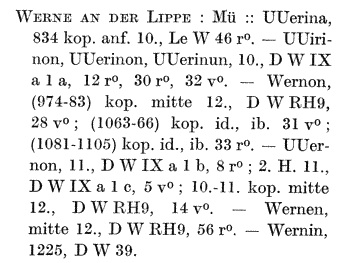
August 1, 2015