Category Archives: Origins

Signs of Lada – Part III

Published Post author

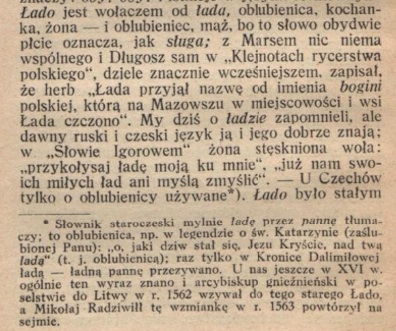
We have previously written about signs throughout Europe of the Goddess Lada (see here and here).  Aleksander Brückner famously derided the idea of Lada being a Goddess, instead claiming that the word simply meant “my love” or “my dearest” or “wife” (in male form lado, also husband).  We have addressed this issue here and, specifically, here showing that Brückner’s arguments really do not shed any light regarding the question of the divinity of Lada.
bruck1

On one thing, however, Brückner was potentially right about is that in Eastern Suavdom, the name lada really did mean “my love” and “wife”.

What is interesting is that the name appears outside of Europe.  Specifically, in Anatolia where, in today’s Turkey, there was once a region called Lycia.

anatolia

Several books came out in the 19th century regarding the Lycian language mostly keying off of the various inscriptions found there.  For example:

  • “The Lycian inscriptions” by Moriz W. J. Schmidt, or
  • “Neue lykische Studien” by the same author.

lycian

It turns out that the same name Lada appears in these Lycian inscriptions and, there, it does mean “wife.”  Although other Lycian words do not bear an immediate similarity to Suavic, the fact that this one word should have the exact same meaning as the East Suavic lada is peculiar.

lada

Carl Pauli (Altitalische Forschungen)

Gattin means “wife” or “spouse” in German so there you have it.

Thus, lada has the same meaning in Suavic and Lycian languages.  Query then the nature of the Lycian language.

(Incidentally, a town named Liada also appears between Nicomedia and Ancyra in the Itinerarium Burdigalense – a pilgrim’s itinerary dated to the year 333.  As another point of interest, there is, in the same segment of that journey, also a mention of a town named Malogardis – little grod – which has been interpreted as Manegordus.)

How is that the same term means the same thing in Suavic and Lycian languages?  The languages seemingly do not contain that many other connections but then does this mean that the Lycians spent time in Suav lands or Suavs in Lycian lands to have made this borrowing?

Incidentally, this is not the only such connection. Vasmer lists others: the “Chaldian” (Χαλδία) lute „woman” and the Avaric (NE Caucasus) tladi also “woman”. For more information you can see the writings of Kretschmer and Trubeckoj. The cause of the similarities? Vasmer thinks just chance.

Copyright ©2016 jassa.org All Rights Reserved

November 26, 2016

Semno(n) of the Logiones

Published Post author

A famous passage in Zosimus (Historia Nova, Book I, 67, 3 in its only surviving manuscript) discusses (as we mentioned previously) a leader of the Legii/Lugii – here in Zosimus written Logi – Semno and we’ve already mentioned this and the leader’s names obvious similarity with names such as Semovit (Siemovit) or Samo:

zosimos

The emperor terminated several other wars, with scarcely any trouble; and fought some fierce battles, first against the Logionesa Germanic nation, whom he conquered, taking Semno their general, and his son, prisoners. These he pardoned upon submission, but took from them all the captives and plunder they had acquired, and dismissed, on certain terms, not only the common soldiers, but even Semno and his son.

But one thing that we did not point out is that the Greek accusative singular is written Σεμυωνα – in Latin Semuona. [maybe Σεμνωνα Semnona]

semn

1590 Sylburg edition

The assumption in reconstructing the nominative version of the name is that the Greek writer (Zosimus) added the “n” to a base of Semuo to fit a name ending with -n into an accusative case (to avoid having to write Semuoa).  But working solely from the accusative Semuona, can we necessarily conclude that the nominative was Semuo?  Or is it simpler to reconstruct the nominative as Semuon?  If Semuon were the nominative would the  accusative have been Semuonona?  And if not, and if it instead would have been Semuona then isn’t it simpler to assume the base nominative as Semuon (rather than Semuo plus a Zosimus fix of adding an -n?).

While Semuo may have been Germanic or Slavic, Semuon sure sounds more Slavic (or Greek). That suffix would make the name similar to a number of Slavic or Greek names with an -on ending (for example, Jason but also Zenon and so forth); incidentally, on means “he” in Slavic).  Now, if such a name – Semuon – were to appear in Slavic lands in the 11th century it would be interpreted as the Slavic Siemion which, in turn, supposedly, goes back to the Hebrew Simon.

probus

The Emperor Probus

But two things are of interest:

First, we are not talking about the 11th century but about the year 279.

Second, and this is where things get really interesting, there is a question as to whether Simon is a Hebrew name at all or whether it is Greek.  The events above took place at the end of the 3rd century and it is unlikely that any Germanic (or Slavic) prince would be boasting a Hebrew name at that point in time.  This suggests that Simon or something like it may have been an Indoeuropean name.  Whether that name – at some point in time – also found its way (probably with some Indoeuropeans) into the Middle East or whether it independently arose in the Middle East is a separate matter.

As for the rabbit hole we’re in, cognate words likely include semensome, etc.

pomegranate

A rimon

Finally, note the slight connection between the Lugii and the Semnones as shown by Strabo:

“…for after his return from Rome this man, who before had been only a private citizen, was placed in charge of the affairs of state, for, as a youth he had been at Rome and had enjoyed the favour of Augustus, and on his return he took the rulership and acquired, in addition to the peoples aforementioned, the Lugii (a large tribe), the Zumi, the Butones, the Mugilones, the Sibini,18 and also the Semnones, a large tribe of the Suevi themselves. (Strabo’s Geography, Book 7, chapter 1, 3).”

The derivation of the Mugilones name from the Slavic mogila is well known, notwithstanding Vasmer’s half-hearted critique.

Copyright ©2016 jassa.org All Rights Reserved

November 20, 2016

The Two Lakes

Published Post author

What do Lake Geneva and Lake Constance have to do with the Slavs?  At first, these (mostly) Swiss lakes appear to have very little to do with the Slavic peoples.  Indeed, the question may itself seem ridiculous.  And yet, there are a number of strange connections that, we think, may help solve some of the puzzle about the ancient composition of Europe.

satellitez

Let’s first start with the names.  Oddly they seem to relate to the story of Wanda and the “Lemannic” tyrant.

The Lemannic antagonist of Wanda is supposed to refer to an Alemannic – meaning German – opponent.  Kadlubek had studied in France and would have known the French term for Germans, i.e., Allemands.  The name, according to Agathias (or Quadratus), was supposed to mean “all men”.

And yet, Kadlubek uses the term Lemannic – not Alemannic.

The name Wanda has both a water connotation (wendka – fishing rod, wendzic – to smoke [a fish], i.e., get the water out) and an obvious connection to the Veneti (and, maybe, Vandals).

The fact that Lake Geneva was earlier called Lake Lemanus and Lake Constance (or Bodensee) was earlier called Lake Veneticus is another curious fact.

The fact that Jordanes speaks of Slavs as living as far as Lake Musianus and that Lake Veneticus is as late as the 17th century attested as being named Lake Musianus adds further aura of mystery.

Then you have the fact that the Alemanni supposedly never referred to themselves as such.  Instead, they went by Suevi (as per Walahfrid Strabo).  On the strange connections between Slavs and Suevi/Suavi, we’ve written ad nauseum.

And we know that Tiberius routed out the Vindelici out of the area.  We also know that the Vindelici may simply refer to those Vindi that lived by the River Lech and that the Vindelici may have bee a tribe of Liburnians.  (We know too that the Suevi used Liburnian ships in their worship of “Isidi”).

Further, the River Lech that runs near the ancient seats of the Vindelici just so happens to share its name with the eponymous founder of the Lechites, i.e., Poles, Pomeranians, etc.

And, of course, the Slavs are also known as Wends.

Going down this path, Lake Geneva (Lemanus) is named after the city of Geneva – the earlier Genava of Caesar.  Genava shares its etymological roots with Genoa (Genova) in Italy (Genova aka Stalia aka Zena in Ligurian).  Although Genoa was not in the (historically attested) lands of the Veneti, it was close…

We will leave for you the connection (if any) between the Ligurians and Liburnians.

Whether Lemanus may have a Slavic etymology (lemiesz – see Plaumorati) we also leave as a homework assignment.

Copyright ©2016 jassa.org All Rights Reserved

October 28, 2016

Solaris

Published Post author

We already discussed some of the similarities between Slavic and other (or are they?) idols like the Krieger aus Hirschlanden here.  But take a look at the famous Światowid from Zbruch again here:

wits

and compare it with the so-called Taanach Cult Stand from Israel:

asherahz

The Światowid steele features a sun disk or solar symbol just like the Taanach column (albeit at a lower tier and mostly eroded) but the disk was hidden and an empty space is visible to the naked eye.

At least one scholar has suggested that the empty space in the second tier (from the bottom) of Taanach steele was meant to represent the concept of the incorporeal YHWH.  This is similar to the representation of God in the Jerusalem Temple which we are told the presence of God was marked simply by an empty space with two cherubim keeping guard.  See here for more.  Apparently, YHWH was initially also a Sun God.

Interestingly, it was the American author – Alexander Del Mar – that first suggested a connection between the Veneti and solar worship (allegedly via their God Jasius or Jason).  While some of his suggestions are a little bit unhinged, others appear quite interesting.

Copyright ©2016 jassa.org All Rights Reserved

October 23, 2016

Are Poles Autochtonous to Poland?

Published Post author

This question has been asked numerous times and some Poles obsess about it.  Based on everything that we’ve seen, the answer currently seems to be a qualified ‘yes’.

Why a ‘yes’ and why ‘qualified’?

cropped-picture2.png

Well, let’s start at the beginning.  First, of all, who do we mean by Poles?  This is simply the genetic nation.  Basically, the ‘Polish-looking’ population.  What does that mean though?  Well, you can extrapolate to saying the generally white, more specifically, ‘Eastern European’ population of Poland with their relatives (and, of course, their biological descendants, wherever in the world located).  Of course, there were some additions to (and subtractions from) that gene pool over historical time but the fundamental fabric of it has not really changed.  The description of Slavs given by Procopius (hair not too blonde, not too dark) still holds approximately true for Slavs everywhere and so too for Poles.

Virtually all of that nation, as with most Slavic nations, is derived from the peasant-farmers who had lived there over the course of the last millennium.  But what about before that?

Here we come to our qualified yes.

First of all, there is the technical question of the first usage of the name Poles for the nation that we described above.

On the one hand, it is true that the name ‘Poles’ does appear in relation to pre-10th century periods in the Nestor Chronicle and in certain Scandinavian documents.  On the other hand, the Nestor Chronicle was written in the early 12th century and it uses the name to refer to the Eastern (Kievan) Poles* whereas the antiquity of the tradition of the Scandinavian sources is debatable.

[* Interestingly though for anyone familiar with the eagle nest of the Lech legend, the Norse name hreiðr – which some connect with the Hreiðgoths of Hreiðgotaland – means “nest”.  The fact that the Western Poles had their early capital at Gniezno (meaning “nest”) while Gnezdovo was a major Slavic (Eastern Polanian?) and Viking site in Russia seems suspicious.  Add to that the fact that the Slavic for “burg” was gard or gord but also horod (see Horodło/Городло) and that the concept of a “home” or “nest” and a protected enclosure (as in a burg) are quite obviously related and you cannot help but wonder what this all means.  For more fun note that rod is also the name for clan or family just as ha-rod is the name for nation.  Since the latter is related to “birthing” it is not too much of a stretch to tie that too to the “nest”.  For more fun yet just see the Lombard king name Lethuc]

bezg

All in all, we can accept that the name ‘Poles’ – as relating to the inhabitants of present-day Poland – appears for the first time around the turn of the millennium.  That said, however, not much of an inference can be drawn from the fact that first attested use is so late.  

While some BS purveyors have claimed that the name was “invented” around the year 1000 in conjunction with the state-building activities of the Piast dynasty, such a claim is pure speculation.  For one thing, there are very few sources regarding Polish territories prior to the 11th century.  Consequently, given such source material paucity, one cannot reasonably equate the first attested appearance of the name with any “invention” of it (and the fact that the name was very likely used for Eastern Polans around Kiev speaks against attributing it to the Piasts’ creativity). (Take the name “Germans”.  It was clearly not “invented” the first time some Roman mason etched the name Germani in Italian stone).  

More importantly, even an invention of the name would have no relevance to the issue any more than the invention of the Polish state.  The ancestors of the American Anglo-Saxons existed before the name Americans ever became known and the history of that “American” people certainly did not begin only in 1787 with the creation of the modern American state (Jamestown was founded in 1607 – interestingly, the first Poles and Germans arrived there just a year later) .

So too with the Poles.  It appears the same people (whatever may have been their name) lived in the territories of Piast (and today’s) Poland not only around year 1000 but also around the year 1 and, likely, a thousand years before.  Hints of this appear not only in the historiography (Legii, Lechites, Licikaviki) of the region but also in the anthropological studies and, most recently, in genetic studies.  We will not get into detail regarding the same here.  Nevertheless, population continuity of the Central European Plain since at least 1000 BC may – tentatively – be assumed.  (The same may also be true of other Slavs (Belarussians, Ukrainians, Slovenes (they had their own Veneti too) and, maybe, Czechs and Slovaks)).

What this does not mean is that the people who lived in Poland were Poles by name.  It also does not mean that these people spoke the same language as they speak today (or as they spoke a millennium ago).  It further does not mean that other tribes (or warrior bands) did not pass through “Polish” territory or that these bands did not form their own “states” on that territory (or bring their own language?).  Nor does it mean, in the longer horizon, that these “Poles” did not come “out of Africa” (that’s a separate discussion in any event) or even that they were the “first” humans in Poland.

But it does mean, again, that more or less the same people – by blood – have lived in the same geographic space as far back as we can tell (and, more obviously, the nation, as defined above, must have had a northern Urheimat since the lighter hair and skin are unlikely to have come with the original migrants from Africa).

Thus, it seems more than likely that the people of Biskupin were, after all, what we could call proto-Poles.

Copyright ©2016 jassa.org All Rights Reserved

October 17, 2016

What’s in a “mir”?

Published Post author

Several Slavic monarchs had the name Kazimir or Casimir.  But what does Casimir mean?

If you make the mistake of seeking answers in Wikipedia, you will learn that the prefix Kazi– means “to ruin” or “destroy” and since the suffix –mir supposedly means “peace” we have a “ruiner of peace”.  While one can appreciate the quandary of new parents facing a crying baby, it still seems cruel for anyone to give that name to a newborn.

In other words, this smacks of BS.

We have the ending –mir in Germanic languages where we are told the suffix refers to “fame”.  And we are told that that suffix means “fame” whether it comes in the flavor of –mir or –mar or –mer.  Once again a lot of flexibility is afforded to the Germanic languages (3 vowel suffixes are all Germanic but only 1 Slavic (which may also be Germanic BTW)).

aria

Wassup!?

So what does the name Ariamir mean?  Well, Ario, supposedly means “eagle”.  Except, another explanation is “army” (*harjazHeer).  So which is it?

And what happened to the “h”?  We are told that the “h” got dropped by the Romans.  Ok, but Ariomir was his own king in Portugal – did his Germanic parents also drop the “h”?

In any event, what does Ariamir mean then? “eagle famous”? “warrior/army famous”?

Let’s try it from a different angle.

bulla

Could the Germanic and Slavic names have a common origin/meaning?

Ario

Ario or Aria may well refer to the Earth/Erde or orać (to plough, obviously, the Earth).  Orać comes from the “Proto-Slavic *orati (which, supposedly, comes from Proto-Indo-European *h₂erh₃-, however that may be pronounced).   The Earth may also refer to “people” (hence the mystical and (now) infamous Aryans) as in gathering the people from the given area (here is that prefix again).  The same may also refer to an army in the sense of a throng so gathered.

Mir

The Slavic mir may mean “peace”.  In Russian it means “world” also.   The peace is established by a ruler, however.  Thus, mir could mean “king”.  This would explain Ariamir as a king of the people (or of the Earth).

Kaz

What does Kazimir mean then?

The prefix kaz may refer to ordering or ruling (kazat), as in na-kaz or roz-kaz, za-kaz.  Thus, you have the “ordering/ruling king/ruler/boss”.

The Proof?

As proof of this theory (or at least of the fact that the alternate theory makes no sense), we can look to the Bull of Gniezno (we had some names from it featured here).  It is a document from 1136 that lists dozens of Polish names.  The full list can be found here.  There are several mirs on the list.  Note that if mir really means “peace” or even “world” the names make little sense:

  • Tangomir – presumably Tęgomir – a name also possessed by a duke of the Stodorans in the Xth century and reminiscent of the name Tuga in the legend about the arrival of the Croats.  Tęgi to this day means “strong” – “strong ruler” is a much more probably name than “strong peace” or “strong world” – the latter does not make any sense.
  • Vsemir – this has been translated as the “whole world” as in Vesmir.  Except, who names (even a very fat) baby that way?  Vsemir, is much more likely to mean “of all ruler” or “the ruler of all”.
  • Nemir – not a king – sorry but there are other career options.  Given how often kings and dukes fell in medieval Europe, this name could well have been a blessing bestowed by the parents.

Likewise, “Vladimir” would not mean the ruler of the world (as ambitious parents might be inclined to name their baby) but rather the ruling king/boss/leader.

This approach is also consistent with viewing these as an adjective + noun pair. All of those are just descriptive of the kind of mir the child is expected to be.  And this includes Ariamir – “Earth/people ruler.”  (as to Ariovist see here).

As to those mirs that serve as a prefix, they just have to be interpreted as “kingly” and you have, for example, a “kingly Suav” (Mirosuav or Miroslav).  Whether Miranta has something to do with Miranda and miraculous we will leave for another time.

We also note that a version of mir appears in Suevic, Gothic, Slavic and even Eastern names (as seen for, example, in the alleged (because the only evidence for their existence are coins) rulers of Balachistan (Yolamira, Bagamira, Hvaramira but also Mirahvara and Miratakhma) who were named the Pāratarājas). Interestingly, the Behistun inscription refers to the Gimirri who were, perhaps, the Cimmerians.

Copyright ©2016 jassa.org All Rights Reserved

September 27, 2016

The Strange Story of Alexander Brückner

Published Post author

Alexander Brückner (1856-1939) was born to a family of a minor Austrian official in Brzeżany in the Austro-Hungarian partition of the then-former Polish state.  He studied in Lviv and then, in 1881, moved to Berlin where he spent the rest of his life researching Slavic topics.  He is most famous for rediscovering the Holy Cross Sermons (Kazania świętokrzyskie) in the Petersburg Library (probably taken during the partitions of Poland – if not earlier).

Brückner worked hard and generated numerous works which to this day serve as excellent compilations of ancient sources.  He had an encyclopedic knowledge of facts and contributed copiously to publications such Archiv für slavische Philologie.  He wrote an etymological dictionary of the Polish language.

That’s on the plus side.

Under a looking glass, however, a less flattering portrait emerges of a nimble careerist and a loyal citizen of the Prussian state; a man whose reputation is besmirched with chauvinistic, borderline racist, tendencies; an arrogant man whose vast erudition was too often mistaken for intelligence and whose debating style consisted of a spectrum running from disdainful scoffing, through harsh sneers towards outright derision.

A man trapped by his arrogance but, perhaps, too by other circumstances.

We have discussed some of his failings here and here but, given his role, more needs to be said.

A Political Creature

To an outside observer it might have seemed that Brückner spent his entire life avoiding any involvement with political causes.  Some people thought that this aloofness can be excused by Brückner’s desire to remain above the fray for the sake of appearing unbiased in his research – the quest for the the truth and all that.

The reality was that Brückner was very much aware of the limits of free speech in Berlin and understood that the relationship of the German governments to the Slavic peoples within their borders in the 19th century was a very real political issue.  Before he was appointed to his position at Berlin University he had to give a loyalty oath explicitly promising that he would not agitate for the Polish independence cause and, for the most part, he stayed true to that promise.

Thus, in his writings he complained about the state of Polish democracy before the Polish partitions.  He thought the “republic of nobles” ridiculous and responsible for its own downfall.  While that view was hardly original with much truth to it, Brückner seemed blind to the fact that the ridiculousness of that republic’s political system had been continuously enhanced and largely maintained by Poland’s neighbors.  Instead, in Brückner’s writings, Poland deserved its fate.  Although Brückner bemoaned the barbarism of Russia, it wasn’t so much the barbarism of the act of partitions but rather the barbarism that followed.  In other words, Poland deserved its fate but it did not deserve to be under Russian domination.  Poland had to be fixed but the Russians weren’t the ones who could do it right.  This view produced one giant blind spot as Brückner was, in effect, excusing any Prussian (i.e., German) (or Austrian) culpability for the Polish collapse and endorsing continued German occupation.  German barbarism was better, in his mind, or was not barbarism at all.  Yet, while Russia certainly grabbed most of the land area of the old Polish-Lithuanian Commonwealth, most of the historic lands of the Polish Piast kingdom ended up going to Prussia and Austria – not to the Russian Empire.

When it suited him, Brückner was not above getting dirty and raising his voice in support of Slavic causes.  It just so happened that this “suited him” at those times when it also “suited” the German imperial government.

Thus, when World War I started, he was asked by Wilhelm Feldman (who was born into a Chassidic Jewish family and seemed to exhibit more concern for Poland than Brückner) to help lead an effort to convince the German government of the usefulness of creating an independent Poland, Brückner refused, claiming that, having kept his aloofness from all things political, he would not be trusted by the Polish minority in Germany.  This may well have been true but then he also claimed that the Germans were completely uninterested in anything Polish – which given the politics of the day was clearly false.  Moreover, Brückner went on to express outrage at the fact that the Warsaw Poles did not rise up against the Russians after the German defeat of the Russian armies at Tannenberg, claiming that this showed that Warsaw has been “russified” and to top it off spoke about the “ingratitude” of the inhabitants of Poznan to Germany.

When, however, later in the war the German Kaiser and the Habsburgs declared that they would reconstitute a Poland as a puppet state out of the provinces of the Russian Empire that the Germans and Austro-Hungarians took over, Brückner, as a loyal citizen of Imperial Germany, did take up the mantle of selling this to the Polish populace, though in a way that was less noteworthy for its few meagre squeaks on the topic of Polish independence than for an impeachment of Imperial Russia:*

“And once again it is shown that, stronger than race, it is culture and common development that binds peoples onto one another.  Poland is set between two worlds; with the eastern one connected through a problematic blood- and real language-unity; but through history, culture and belief completely separated from it; strongly divided from the western [world] by blood and language and yet indivisibly connected with it through a common development, traditions and faith so that it harvests today the fruit of its persistence.”

[* note: this comes from his ambitiously titled pamphlet “Slavs and the War” which, in turn, was a version of a lecture he gave under the same title, i.e., Die Slawen und der Weltkrieg]

welt

Thus, according to Brückner, while the Poles shared blood and language with the Russians, the Poles themselves were culturally closer to the Germans.  And since, in Brückner’s mind the war was, to cut to the chase, between German civilization and Russian barbarism (the English, the French and others were almost bystanders in Brückner’s telling), the Poles – so Brückner – could be made part of that civilization as a sort of a younger brother, perhaps along with other “smaller” nations that, more or less, could coexist with the Imperial Teutons.  In some ways this was a pro-Polish (and pro-Slavic) pamphlet in that it correctly pointed out the abuses of Imperial Russia.  But in other ways it clearly showed a path for the Poles (and other “small” Slavs) only as an appendage of Germany.

It was clear that Brückner said as much as the German government would have wanted him to say and nothing more.  While he was opposed to the Kulturkampf policies of Bismarck, Brückner nevertheless continued to have a blind spot as to Germany the size of Jupiter’s GRS.  (See also Maria Rhode’s essay in Kollegen, Kommilitonen, Kämpfer: europäische Universitäten im Ersten Weltkrieg).

Anyhow, events began to move faster than anyone anticipated and once Pilsudski’s legions refused to swear allegiance to the Kaiser, and Poles started asking about former Polish provinces on German territory, Brückner was no longer seen agitating for Poland.

Unser Mann in Berlin

After the war Brückner, refused offers of employment from universities in Warsaw, Poznan and Vilnius and remained in Berlin.  One might view this as an academic choice (Germany was, even after World War I, the center of the world’s academic life).    And having been called a “Stockpole” by some of his German colleagues, Brückner also seemed like a sympathetic case of a representative of the Polish cause in Germany.   In fact, some in Poland might have thought this a better result – viewing Brückner as “our man in Berlin”.

Indeed, Brückner was seen as our man in Berlin but he was seen that way too by various German scholars.  For them he was “ours” – our Slavist – that was better than the “Slavic” Slavists.  Some of them enjoyed using “their” guy to stick it to the “irrational” Slavs.

Here is one citation where the writer claims that:

“one of our best Slavists, Prof. Brückner in Berlin, responded to a letter query presented to him with staunch firmness against the derivation of the word from the Slavic.”

gegen

Just to be clear about this “controversy”: The word was the name of the Thuringian Forest during the Middle Ages.  It was LoibaLeubaLeube.  And the question was whether it was Slavic.  A much  more balanced view appears in Reinhold Schottin‘s “Die Slawen in Thüringen” where, as we wrote previously, the author concludes:

louva1

“What a difference of opinion!  I can’t see why one wants to force this name to be a German one since, after all, it it was used in an avowedly Slavic territory, was explicitly called a Slavic word by the Braunweiler monk, and otherwise it is commonly found even today in many previously Slavic words – but not in purely German areas.”

louva2

Why was Schottin, a German, able to write the above whereas Brückner, who so often is made into an honorary Pole, was so entscheiden that the word could not be Slavic?  See below for his argument regarding the monk.

This is not to say that Brückner always took the “German side” (he did not), it is merely to note that his view of German culture and his personality made him far less “scientific” or “objective” than he wanted to portray himself as.

A Culturalist Snob

Brückner’s role in Prussian academia – whether conscious or not – was more of a “good cop” to the “bad cop” of Kulturkampf and related endeavors.

He clearly regarded Germany to be the carrier of Kultur in those days and various Germanic peoples to have been the carriers of Kultur throughout history.  The smaller nations of Europe could partake in this German enterprise but only as hangers-on.  His language would make most of today’s observers rather uncomfortable.

Thus, when discussing Ketrzynski’s work, he mockingly criticized the latter’s methods (without, which is characteristic of Brückner, actually saying specifically why) concluding that:

[with such methods] one can also try to show that Mecca and Medina were Slavic; no land in the world would be safe from this Slavic plague.

He then went on to dismiss Ketrzynski’s etymologies seemingly on the grounds that “one has to look at the totality of the circumstances,” i.e., on no specific grounds at all:

But the modern German research does not limit itself to doubtful etymologies, or the explanation of controversial places in Tacitus (for example, over the name of the Germanen) or interpolations (for example, in the famous Pythaeus fragment).  To the philological work attaches itself too, for example in the works of [Gustaf] Kossina, the archeological [work], the taking into account of the, still otherwise not understandable [with philology] or silent, discoveries of prehistory.

It is hardly believable that Brückner was unaware of Kossina’s theories of the Slavic Unkultur or his theories on the German “Aryan” race or his completely results-oriented research (interestingly, Kossina never actually did any field work).  And yet, of all the German archeologists he cited Kossina.  Why?  Only two options present themselves.  Either Brückner really thought Kossina was right or, more likely (Brückner clearly wasn’t that dumb), he wanted to use this as an opportunity to ingratiate (redeem?) himself with the German academic establishment (after all, these were the days during which the dean of German historians – Mommsen – stated that “Czech skulls were “impervious to reason, but … susceptible to blows” and called Czechs the “apostles of barbarism“).

Either reason makes Brückner look like a smaller man than he should have been.

kossina

Kabitzsch and Kossina – oh, so German-sounding

(In 1919 Kossina supposedly sent a copy of his book “The Vistula Area, an ancient homeland of the German people” to the participants of the Versailles Conference in order to emphasise that territory claimed for the new Polish state should be German.  The fact that, as his name indicates, Kossina was Polish himself (a Germanized Mazurian) – your basic self-hater type, makes him the aptest case for the use of the Polish word gnida – look it up).

But Brückner’s borderline racism (and, apparent, dullwittedness) continued unabated when he stated:

Even ‘documented’ information must not be given weight sometimes; if Qazwini places Soest and Paderborn in Slavic country, then we know, what we should think of such imprecision of the Arabs; his report is worthless.

What exactly Brückner means by the imprecision of “the Arabs”?

And his engagement with his “fellow” Poles was not the only questionable use of language in the service of politics by the apolitical Brückner.  Employing language reminiscent of later Nazis, he had no qualms about calling the Ukrainians an “ethnographic mass” which was incapable of forming its own state.  (“Der ‘Ukrainische’ Staat: Eine politische Utopie,” Das Neue Deutschland, March 13, 1915, 157-160).

He was disdainful too of the culture of the Balts and Finns.  He wrote:

It is revealed that Slavs, Lithuanians and Finns borrowed from the Goths words that were many and important, [these words] established the appearance of a new, different and higher element.

If there is a common thread here it is that of Brueckner’s dismissive view of all the “little peoples”.  All of which raises a question:  Why should someone who was so dismissive of much of the cultures he studied, keep studying these cultures?

An Overreaching Etymologist

Brückner went on to claim that kuningas and mekus were Gothic borrowings in Finnish, Estonian, Lithuanian and Polish.  That the former appears related to the Scythian kagan and the latter’s etymology has been disputed ever since the above type of claim was made (most recently, see Lewicki) should show, at the very least, that Brückner accepted the teachings of German scholarship at face value.  That, at the same time, he spent his life picking holes (most often with dismissive arguments along the lines of the above “because I said so”) in the theories of those scholars that disagreed with his positions, is telling even of a certain peculiarity of character or of something worse.

Brückner also claimed that mleko was a Gothic borrowing; if one accepts that tree name borrowings are suggestive of the answer to the question of “where the Slavs came from”, one would have to conclude, following Brückner’s “dairy” assertion, that the original Slavs were not mammals at all – perhaps lizardmen, hence Sauromatae?

A Cantankerous Old-Young Man

Brückner’s personality drove his debating style which was full of ornate word choices and hot air that, more often than not, signified little.

Thus, in the above discussion where Brückner calls Qazwini’s report “worthless” one can’t help notice a peculiar line of argumentation, one that always reaches its intellectual crescendo with the phrase “because I said so”.

Thus Brückner wrote when discussing Ketrzynski:

If a history of an abbey from the 14th century calls the Westphallian Ruhr ‘Rura australis sue slavica,’ I will not begin to guess from where this crazy [word] combination may have come from.

Read: “These facts are beneath me so I will not even address them”.

Further on he says:

Just as little am I impressed with the other cited places, for example about the Saale: ‘flume quod slavica lingua Sale dicitur’ from the Annals of Reinhardsbrunn – what should this in the best case prove?

Err…. well, that the “German” name “Saale” is itself of Slavic origin?  But hey, what does that matter? 

Coming back to the mention of Slavs in Thuringia, Brückner says:

False is the report of the Braunweiler monk who claims of the Thuringian forest: ‘in saltu Sclavorum qui iuxta linguam eorum Lovia (Levia, as per Pertz) dicitur quique infinitam ursorum nutrit multitudinem,‘” 

Read: contemporary accounts are only value when they do not clash with my views.

Moreover:

That Suevi were Germans and could only have been Germans, we know from Caesar and Tacitus and no false etymology will shatter our conviction, at least if we should not altogether give up our reliance on these sources.

This is of course just plain dumb…

First of all, it is clear and  does not dispute that in both Caesar’s and Tacitus’ minds the Suevi were “Germans”.  What Ketrzynski is saying however is that by Germans Caesar and Tacitus understood everyone East of the Rhine (and some West) and north of the Alps.  Neither Caesar nor Tacitus say anything about the biological or linguistic nature of these “Germans” that would make it impossible for them to have been today’s Slavs (or at least most of them).

We know today that the name “Germany” was not an ethnic but rather geographic name.  Those that we – today – call “Germans” have consistently referred to themselves as Deutsche – but never (until recently) as Germans.  If tomorrow the Belgians were to try and appropriate the name “European” for themselves, and we went along with this, we would nevertheless not then suddenly conclude that the rest of the denizens of the European continent must have wondered into it at some point recently in the process displacing the native European (i.e., Belgian) population that used to stretch from Spain to the Urals.

Of course, the situation with “Germans” may be worse than that…  If Ketrzynski is right, a better parallel may be that of the Prussians.  The Teutonic (i.e., Deutsch) Knights’ state became Prussia and its citizens became Prussians – notwithstanding the fact that the Baltic Prussians had largely been exterminated or assimilated by the very same people who then picked up their name.  In the 19th century Prussians were Germans but clearly that was not the case before the 14th.  If Brueckner in the 19th century were to find someone in Prussia who spoke Baltic Prussian, presumably he would have concluded that, at some point, a strange new people must have entered Prussia (probably not from the Pripet marshes because that’s reserved for the Slavs but maybe from beyond the Urals) settling among the German Urbevoelkerung… Indeed, Ketrzynski concluded his work by noting with genuine surprise it seems, that there must have been a time “when there were no Germans [meaning Nordics/Deutsche] in Germany”.

Second, as we pointed out before, no one is claiming that you have to throw out Tacitus and Caesar as sources.  This is another one of Brueckner’s red herring arguments.  If tomorrow we were to conclude that the Mona Lisa is not in fact Leonardo’s depiction of Lisa del Giocondo but of some other woman (or of Leonardo!), that obviously does not mean that the painting is now somehow to be thrown into the garbage chute!

Finally, Brueckner’s appeal to his “conviction” appears to be evidence of his belief in what the truth is rather than a measured, rational judgment.  The questioning of that belief seems like an affront to him and so he won’t believe some Ketrzynski.

This is a reaction not of a scientist or scholar but of someone who is a member of a cult who fits all facts that he hears into his preconceived cultish matrix of truth for the alternative would, literally, blow his mind… We all do that to some extent – use new facts merely to confirm our preconceived notions but we expect rather more from people who try to present themselves as our scholars.

All this brings to mind the words of Theodor Pösche:

I have brought up the words of Tacitus.  But I am being reproached that words and names mean nothing.“,

Indeed.  If the facts don’t fit the theory, ignore the facts.

In all of the above statements Brückner does not even try to address the arguments – he just says:

  • “I will not begin to guess from where this crazy [word] combination may have come from”
  • “Just as little am I impressed with the other cited places”
  • “What should this in the best case prove?”
  • “False is the report of the Braunweiler monk who claims”

Brückner seemed to have believed that the point of someone else’s scholarly work was supposed to have been not so much to contribute to scholarly discourse and establish a case as to impress him – Brückner – the final arbiter of all things.

If he did not approve of something, all he had to say was:

“Balderdash!”

A Noble Soul or a Man in Fear?

There is another curious aspect of Brückner’s life.  For the longest time he refused to marry.  Then, suddenly, he married his housekeeper.

Why?

We are told that he thought he got her pregnant.

Ok, so a noble (or just plain decent) gesture?

Perhaps.

(We might quibble that a person in a position of authority should avoid abusing that authority by entering into a relationship with a subordinate but that would be applying today’s standards to the behaviours of yesteryear).

She – described as a simple woman (and hardly a model) – seems to have been an unlikely intellectual or physical companion of a man of Brückner’s stature (in the last days of his life, she apparently had a lot of her family spend time at hers and Brückner’s house – a number of which visitors turned out to be Nazis or Nazi supporters – whom Brückner, by all accounts, could not stand).

But there is something else.

Read the above one more time.

Wait, how is that again?

He thought he got her pregnant?

Would he have married her just based on what he thought?  Wouldn’t he have waited to see if she was actually pregnant?  (And assuming, for some strange reason, he would not have, wouldn’t he try to divorce her after he found out about the false alarm?)

What if there was another reason to marry her?

This is speculation, of course, but an unmarried man back in the Germany of early 20th century might have raised questions.  Questions, the answers to which, we today shrug our shoulders over but which answers – back then – might have resulted in loss of academic position and, certainly, loss of status.  Would such a risk have been acceptable for someone as career focused and driven as Brückner was?  Was he a homosexual and his wife then just his beard?

lespion

Did she blackmail him into a marriage to get a stable life out of this deal?  Would the Preußische Geheimpolizei have been aware of any of this?

What would they have done with such information regarding the West’s most prominent Slavist?

Brueckner r with Stanisław Kot l (Kot was married with two daughters so this is probably nothing)

Copyright ©2016 jassa.org All Rights Reserved
September 26, 2016

Zijn of niet Zijn

Published Post author

If anyone thinks that the above title is from some unknown South Slavic language, they are, of course, mistaken.  What he have here with “zijn of niet zijn” are the words of Hamlet, i.e., “to be or not to be.”  Or “být či nebýt” or”biti ali ne biti”.  The “zijn” obviously is the same as the German “sein”, i.e., “to be” with German phrase rendered “sein oder nichtsein.”

And yet, put this way (the Dutch way) it bears a curious resemblance to the Slavic “žít“, i.e., “to live”.  About the Dutch connections we wrote here:

 Copyright ©2016 jassa.org All Rights Reserved    

September 26, 2016

Hiding In Plain Sight?

Published Post author

We have spoken here of the many appearances of the Yassa, Jesza, Jaster, Eostre, Jasion (the demi-God but also name Slavic for “autumn”), Jason or Yasser thoughout history.  In Slavic languages the word may be cognate with the words for “being,” e.g., jest as in “[he/she/it] is” (English is, German ist, etc) or for brightness, e.g., jasny (but also jastny) or jawa (consciousness, being).

In light of this (so to speak), it is curious that “I Am that I Am” has been translated as such.  Put differently, ehyeh ašer ehyeh could be translated as ehyeh Ašer ehyeh.  In this way, the conjunction “that” that renders the above almost cabalistic and “mystical” gives way to a real name.  That Ašer is a name (“happy one”) and otherwise appears in the Bible (Tribe of Ašer) would support this interpretation.  Aser is typically placed on the Phoenician (?Venetian?) coast near the city of Tyre.  Further, there have been suggestions that the name of this tribe may be of Assyrian or other origin (Astarte or the Egyptian Isis, etc).

Of course, all of this is pure speculation.

Copyright ©2016 jassa.org All Rights Reserved

September 26, 2016