Category Archives: Origins

Maps of the Veneti – “The First Builders of a European Community”

Published Post author

Some of you have been asking regarding the Savli, Bor, Tomazic Veneti book and whether it shows any maps as regards the extent of the Veneti.  Here are some (we do not necessarily agree with them – by their own account (see top map), the authors seem to be understating (see bottom map) the extent of Venetic presence in Europe):

Copyright ©2017 jassa.org All Rights Reserved

January 18, 2017

Kitab al-Filahât al-Nabâtiyyah

Published Post author

Ibn Wahshiyyah the Nabataean was a 9/10th century Aramean writer from Iraq who managed to produce an extensive treatise on Nabatean agriculture (Kitab al-Filahât al-Nabâtiyyah) in which we find (oddly enough) mention of the Slavs (MS Leiden 303) as follows (first published by Avraam Yakovlevich Garkavi (Albert (Avraham Eliyahu) Harkavy) in 1870 in his Skazaniya musulmanskich pisateley o Slavyanach i russkich):

“I wonder at the Slavs who, despite their great ignorance and separation from all learning and wisdom, somehow managed it together to establish the custom that corpses must be burned, so that they leave neither a king nor any other man without cremating him after death.”

Slavic King funeral pyre – 9th century

This was written sometime in the first quarter of the 10th century.

Copyright ©2017 jassa.org All Rights Reserved

January 17, 2017

The Mention of the Veneti in the Codex Aesinas

Published Post author

Here is quick picture of the Codex Aesinas (found, appropriately, at Jesi) page of the Germania referring to the Veneti:

The context is below.

WARNING 
looking at this at any level of magnification may result in reader turning from quasi-normal into a monstrous, disfigured Nazi:

With that said for those who don’t mind getting  new prescription glasses, here is the same contextualized:

Copyright ©2017 jassa.org All Rights Reserved

January 15, 2017

Bible Studies

Published Post author

For those of you who find references to Peronne or Pyreenes or Greek (and Venetian!) pirouni/pirons interesting, here is a piece from Deuteronomy (33, 2):

“The Lord came from Sinai, and rose up from Seir unto them; he shined forth from Mount Paran, and he came with ten thousands of saints; from his right hand went a fiery law for them.”

and also Habakkuk (3, 3):

“God came from Teman, the Holy One from Mount ParanHis glory covered the heavens and his praise filled the earth. His splendor was like the sunrise; rays flashed from his hand, where his power was hidden.  Plague went before him;  pestilence followed his steps.  He stood, and shook the earth; he looked, and made the nations tremble.  The ancient mountains crumbled and the age-old hills collapsed— but he marches on forever.”

another interpretation has been something like:

“The Lord came from Sinai but His glory dawned unto them from Seir, and flashed forth from Mount Paran.”

Paran has been tentatively suggested as referring to a mountain near the river valley of Wadi Feiran (Ptolemy?).  Wadi Feiran is Sinai’s largest river.

Another identification that was suggested for Paran is Mount Serbal or Sinai.

We will leave aside the fact that wadi means river in Arabic and Hebrew and the connection (if any) with the Slavic voda/woda meaning water.

We note that Paran also appears in other places of the Bible as, for example, in the Desert of Paran.

(Piran was a name also of numerous Persian figures, including, apparently, the prince “Ultra” from Ammianus Marcellinus Book 27 which may have been a mistranslation of what the author took as Peran (Greek: beyond) to Latin (i.e., Ultra).  What Piran or Peran meant in ancient Iberian (from Armenia/Georgia not Spain), we do know know exactly.

Copyright ©2017 jassa.org All Rights Reserved

January 6, 2017

A Matter of Tithes

Published Post author

Saint Boniface born Winfrid, Wynfrith, or Wynfryth (675 – 754) was your typical proselytizing nutcase rampaging throughout Europe in the 8th century before being killed by Frisian freedom fighters.  We’ve already discussed his description (in a letter to King Ethelbald of Mercia) of the Slav marital fidelity here.  But Boniface being a good brother of the Church also left other correspondence.  And some people even wrote him back as in this letter from Pope Zachary.

Zach complete with a mole

Letter 87 
From Pope Zacharias (Pope 741-752)
to Boniface
November 4, 751

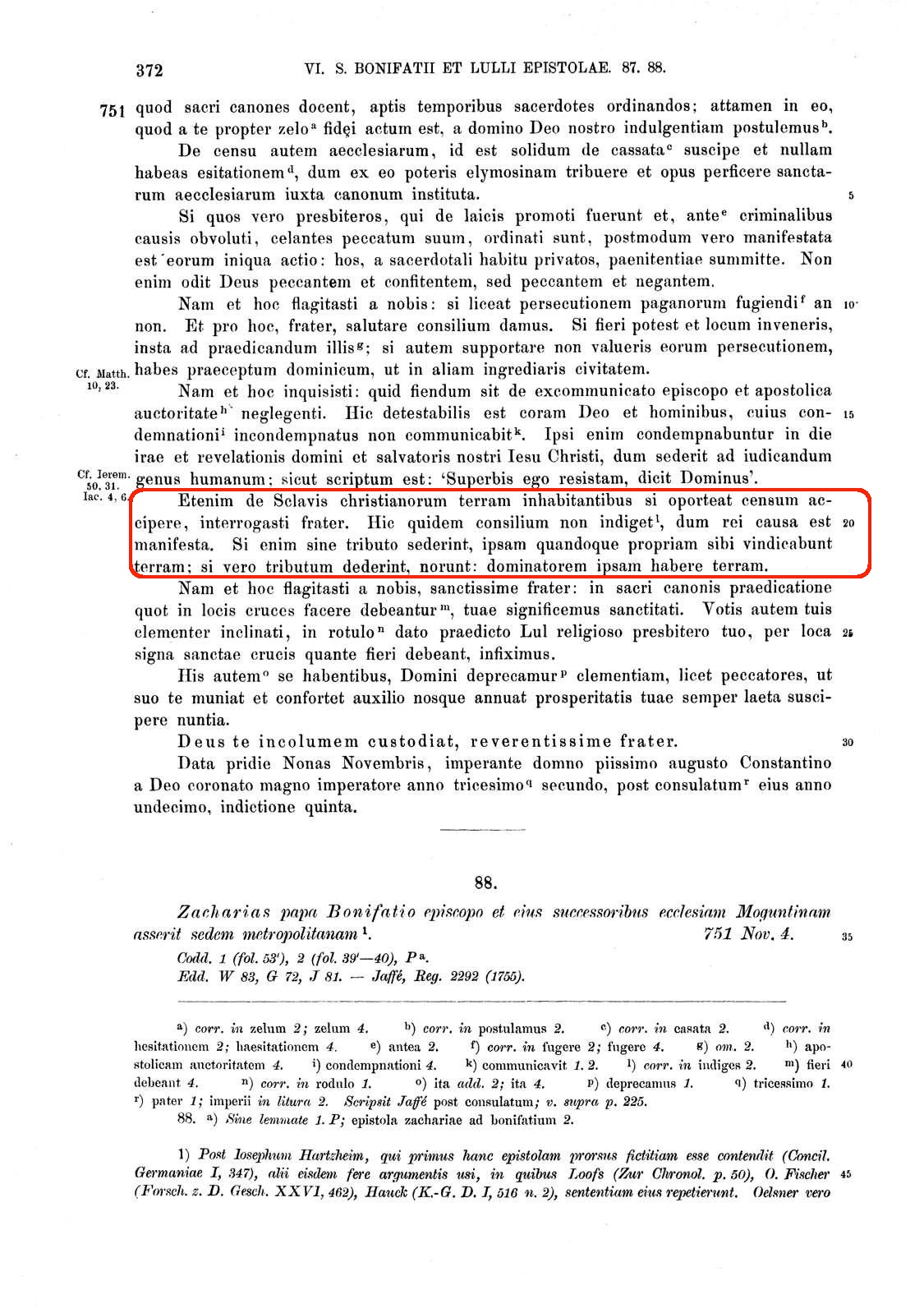
“You inquire my brother about the Slavs who live in the lands of the Christians* [and] whether they should be subject to tithes.  In this matter, no guidance is necessary for the thing is clear: if they may have sat there without paying tithes then they will also at some point believe, correctly, that this land is theirs; but if, on the contrary, they may have paid tithes, then they will know that the land has a [different] owner.”

* That is in lands where Church organization has been established.

(Etenim de Sclavis christianorum terram inhabitantibus si oporteat censum accipere, interrogasti frater.  Hic quidem consilium non indiget, dum rei causa est manifesta.  Si enim sine tributo sederint, ipsam quandoque propriam sibi vindicabunt terram; si vero tributum dederint, norunt: dominatorem ipsam habere terram.)

Boniface achieving long-sought martyrdom in Frisia

Copyright ©2017 jassa.org All Rights Reserved

January 5, 2017

Al-Balādhurī’s Slavs

Published Post author

Returning to more topical topics, we want to introduce Aḥmad Ibn Yaḥyā al-Balādhurī was a ninth-century Persian (probably) historian who traveled throughout the Middle East before penning his masterpieces.  One of those was  Kitab Futuh al-Buldan (The Book of the Conquests of Lands) where there are a few mentions of Slavs.  We chose not to include some other interesting passages (such as the one where he mentions the desert of Varta).

“They say that Salman ibn Rabi’a al Bahili served in the army of Abu Ubayda with Abu Uman a-Sudajj ibn Aglan, a co,pinion of the Prophet – let God’s blessing and care be with him.  He stopped at a certain fortress near Qurus, which [fortress] has since been named after him and is known as the Fortress of Salman.  Then he returned from Syria together with auxiliary forces for Sad ibn Abi Waqqas who at the time was in Iraq.”

“They also say that Salman ibn Rabi organized an expedition against the Byzantine Empire after taking Iraq but before his expedition to Armenia.  He set up camp nearby this fortress and left from the side of Maras.  For this reason it was named after him.”

“This Salman and Ziyad were descended from these Slavs, who were settled at the border by Marwan ibn-Muhammad.*  I myself heard someone who claimed that this Salman came from the Slavs and that this fortress was named after him.  God knows best.”

* This is the last Umayyad caliph, Marwan II (caliph 744 – 750) Perhaps these were Slavs settled there by Byzantines in the 7th century who then joined the Arabs and resettled (?) on the Muslim side or they may have been made prisoner by Marwan during his invasion of Khazaria in 737.

Another fragment is as follows:

“Then when the year 756-757, he ordered to populate the town of al-Massisa.  The walls of this town had been thrown down in the course of various campaigns and the few inhabitants who still dwelt there, lived deep inside the town.  Therefore, he built the town walls and placed people there in the year 757-758… Then he relocated to al-Massisa the inhabitants of al-Husus who were Persians, Slavs and Christians – Nahateians, and those who had been previously settled in that town [al-Husus] by Marwan* and he gave them in this [new] town land to compensate them for their old dwellings, according to their size [i.e., the bigger the prior dwelling the, bigger the new].  He leveled their old dwellings, helped them build anew and gave their old lands and houses [in al-Husus] to the garrison.”

*   They’d been settled there by al-Mansur not Marwan.

Also:

“They say Salman went towards the place where ar-Rass joins al-Kurr beyond al-Bardig.  He crossed al-Kurr and conquered Qabala… Then he was meat by the Khagan together with his horsemen beyond Narh al-Balangar and [Salman], may God have mercy on him, was killed together with four thousand Muslims… Ibn Guman al-Bahili says of Salman and of Qutayba ibn Muslim: ‘We have two graves: a grave in Balangar* and a grave in Sinistan’…”  

* or Bulungur – see below; the last portion of this passage is found in Kitab Uyun al-Akhbar of Ibn Qutaybah

And too:

“Marwan ibn-Muhammad was nominated [by Hisam ibn And al-Malik] a ruler at the frontier and took up his abode at Kasak/Kisal.  He built a city in this country which city lies forty phrasings from Bardha’ah and twenty from Taflis.  Marwan then entered the country of al-Khazar next to Bab al-Lan and made Said ibn-Zafir as-Sulami abu-Yazid, accompanied by the kings of al-Jibal [or “of the mountains”], enter it from the side of al-Bab wa-l-Abwab.  Then Marwan made an incursion on the Slavs who were in the land of al-Khazar and captured twenty thousand families whom he settled in Khakhit.  When they later put their leader to death and took to flight, Marwan pursued and slaughtered them.* They say that when the great leader of the al-Khazar received news of the size of the peoples/army with which Marwan entered into his country and with what number and strength they are going against him, this news frightened his heart and filled it with fear.  When [Marwan] he came closer, he sent an emissary to him asking him either to convert to Islam or to war.  [The leader of al-Khazar] replied: ‘I accept Islam.  Sent me someone who can explain it to me.’  He did this and he converted to Islam, and Marwan agreed to confirm him [as leader of] his kingdom.  [Then] Marwan went out with a throng of people from amongst al-Khazar and settled it between as-Samur. and as-Sabiran, in the plain of the land of al-Lachs [Lezgins?].” 

* Some people think these were Volga Kama Bulgars who became Muslim or Burtas or Suvars (Chuvash).  Others that these were Slavic warriors working for the khagan.   Since these are explicitly mentioned as Slavs and as families, neither of these suggestions seems correct (though at least some of those Bulgars may have spoken Slavic by then).  It’s not clear whether this “leader” was a Slavic (much like the Byzantines had selected rulers for the Slavs – the Slav Nevonlos – Nevolnost!?) one or an Arab or Khazar one – either way he was probably one imposed by (or at least acceptable to) the Arabs.

Later too:

“I was told by Ahmad ibn Salman al-Bahili who learned this from as-Sahmi who, in turn, learned this fro, his masters, that Salman ibn Rabi’a invaded Syria together with Abu Uman as-sudsy ibn Aglan al Bahili… Then he went to Iraq with reinforcements, hurrying to al-Quadisiya and was witness to that battle.  [Then] he spent [time] in Syria and he was killed in Bulungur.”*

* or Balangar – see above

Further:

“So it is said by Garir: ‘‘if Bisr wanted it, t hen beyond his doors there would be guarding access to them black foreigners or red [humrSlavs.  But Bisr enabled access to his doors to those whose rare visits bring him fame and payment.’”*

* this passage is also found in Kitab Uyun al-Akhbar of Ibn Qutaybah

Copyright ©2016 jassa.org All Rights Reserved

December 18, 2016

The Slavic Accents of Aethicus Ister?

Published Post author

Speaking of Scythians…

The Cosmography of Aethicus Ister is a rambling work of frequent digressions and unexpected tangents.  It was written probably in the first half of the 8th century but may have been written slightly earlier.  The author calls himself Hieronymous (or Jerome) and claims to be describing the travels of “Aethicus the Istrian” around Europe and beyond.

No Slavs – under that name – appear in this Cosmography but certain “Slavic” accents do pop up in most unexpected ways.  We list (some of) them here (generally following the Michael Herren translation).

Vinnosi of Germania

The book lists the Vinnosus as one of the peoples of Germania that stretches from the Rhine to the mythical Riphaean mountains (Urals?).  Although it is not clear whether the Vinnosus refers to the Winidi/Veneti, the placement of that people between the Danus and the Rifeos seems to suggests the very swath of land (from the Elbe to the Urals) that – at the time of the writing of the book – would already have been largely occupied by a people we, today, call Slavs, i.e., the Veneti/Wends.  Here is that list from Chapter 29:

“Likewise, too, the Vafri, Friconti, Murrini, Alapes, Turks, Alani, Meotae, Huns, Frisians, Danes, Vinnidi, Riphaeans, and Olches, whom the folk in those parts call orci, very filthy peoples leading the most foul life – worse than all the kingdoms of the world – without a god, or law, or rituals.  Moreover, all the districts of those lands are called Germania, because the <peoples> are immense in body and are monstrous races, hardened by the most savage folkways; moreover, they are indomitable, bearing cold and hardship better an all <other> peoples.  He claims that there are one hundred districts between the inhabitable and uninhabitable <regions> front he River Rhine to Ocean, numerous islands, and the Meotidan Swamps.”

Sic et Vafros, Fricontas, Murrinos, Alapes, Turchus, Alanus, Meotas, Chugnos, Frigis, Danus, Vinnosus, Rifeos, Olches quos uulgus in illis regionibus ‘Orcus’ appellant, gentes spurcissimas ac uita inmundissima degentes ultra omnia regna terrarum, sine deo, sine lege uel caerimonias.  Name et illarum regionum pagi omnes Germania est appellata, eo quod <gentes. sint inmania corpora inmanesque nationes, seuissimis moribus duratae; adeo indomiti, frigore et rigore ferentes ultra omnes gentes.  Centum pagos dicit esse inter <plagas> habitabiles et inhabitabiles a Reno fluuio usque oceanum, insolas plurimas et Meotidas paludes.

Jason and Paron

The fact that Piorun or Perun was worshipped in the Eastern Slavic lands from Novgorod to Kiev is attested numerous times (whether this was just the invading Rus’ Thor or Lithuanian Perkunas is another matter altogether on which much ink has been spilled and we will not get into that here).  We also know that in the historic West of Slavdom, the Slavs worshipped Svantevit, Svarozic, Gerovit and the like.  In the “middle”, in Poland, Bohemia and Moravia the names of the Gods were yet different.  Here we have Jassa,  Lada, Nia, Devanna and the like.

The diversity of worship has led some researchers to conclude that Slavs did not have one overarching pantheon.  This is probably true (which BTW also indicates how unlikely the Slavs’ late spread from a hypothetical small area really is).

But Aethicus Ister puts some names together that we haven’t seen together before (or at least not in the same way) when he brings Jason and Paron (calling him “Pluto” which would make Paron/Perun to be the same as the Polish Nia) into one story in Chapter 97:

“Naxos and Melos and these islands are islands of the Cyclades, and the very round Isle of Melon as well, which is very fertile; Jason, Pluto or Paron, and Pharius were born there.  The carnelian is found there, a stone superior to marble and more beautiful in its variety; nevertheless, it is not counted among the precious stones.  Chios is an outstanding island of the Cyclades, where indeed lovely and most excellent mastic is found.”

Naxon et Melos et ipsae insolae Cicladum insolaque Melon rotundissima adeo et fertilis, ubi Iason et Plutonem uel Paronem et Pharium editos.  Ibi inuenitur sarda lapis marmoribus praestantior et uariate pulchrior, tamen inter gemmas non reputatur.  Cion insola Clicladum optima, nimpe ubi pretiosus mastix et ualde probatissimus inuenitur. 

This fragment actually comes from Isidore’s Etymologies where we read at 14.6.27-29 where Iasion (not Jason) is the grandfather of Pareantus:

“27. The island of Naxos is named after Dionysius [the god of wine], as if it were Dionaxos, because it surpasses all others in the fertility of its vines.  It lies eighteen [Roman] miles from Delos.  Once upon a time Jupiter is said to have proceeded from there to fight the Titans.  28. Melos is the roundest island among all of the Cyclades; wherefrom its name is derived [malum, Latin for “round fruit”].  29. History says that Iasion had two sons, Philomelus and Plutus, and that Philomelus gathered Pareantus, who gave his name to the island and the city of Paros; first it was called Minoia then Paros.  Vergil writes of it [Aeneid 3.126]: ‘And snow-white Paros,’ for it produces the whitest marble, but when considered as a gemstone, the cheapest.”

Thus Aethicus (or Jerome really) substituted Jason for Iasion and Paron for Pareantus (note that the word “parent” may have the same etymology).  The connection between Jason and Jasion is something that is worth exploring.  But the form Paron also seems to indicate that the writer – the mysterious Jerome may have found it a convenient one.  Note too that these two names may refer to one God – thus, in Heinrich Gottlob Gräve‘s 1839 work Volkssagen und volksthümliche Denkmale der Lausitz we see a Deity under the name Ossopirno (as a lightning entity – compare this to the famous passage from Procopius) – though also Perkun (as a thunder (and lightning) entity) as well as Perdoito (as a wind entity):

Later in the text Jerome brings up a similar name where he says at Chapter 45:

“Lydia first produced inventors of ships.  The magician Pyrronius built a raft in Lydia in ancient times so that he might have knowledge of all the purple garments and all the beautiful things that are contained in the islands of the Mediterranean.  Whence too, Lydia [has] all the brilliant, great and outstanding purple-dyers as [does] Cyprus and the Cyclades, [who] are regarded as outstanding even now.  Other peoples and nations in the region [have] rafts joined together by beams and poles.”

Naium inuentores primum Lidia protulit.  Pyrronius magus antiquissimo tempore ratem in Lidia fabricauit, donec sciret purpora et omnia pulcherrima quae in insolas maris Magni habentur.  Vnde et omnis Lidia purporarias magnas et inclitas sicut Ciprus et Ciclades [quae] usque nunc praeclaras habetur.  [Habent] et ratiaras aliae gentes et in circuitum nationes ex tignis asserebusque connexum.

Lydia is a portion of Anatolia.  It’s close to Lycia, of course.  A type of boat called pirones also appears in Chapter 57 (aside from vagiones):

“…Indeed, the Albanians, Maeoti, and Mazeti, people from the Ganges, and Turks all use these boats, and call them pirones in their barbarian tongue.  These are more useful than corsairs; nevertheless, they are found nowhere in the Mediterranean…”

…Nam Albani, Meoti, Mazeti, Gangines, Tulchi has naues utuntur et was pirones in barbarica lingua appelant.  Vtiliores enim quam dromones; eas attamen in Mediterraneo mare nusquam reperiuntur…

Another people mentioned are the Murinos/Murinus somewhere about Parthia.  Whether these were “Moors” or, more likely, “sea-people” (compare the Morini of France perhaps mentioned above as Murrinos) is uncertain.

Jerome the Scythian and His Ozechy

Jerome who writes about Aethicus the Istrian but calls himself a Scythian (Nationi Scitica) does not say more about his background.  By his time “Istria” would certainly have been held by Slavs and Scythia was a term for all the lands north of the Danube with the exception of Germania.  Where, however, the border between the earlier Scythia and the later Germania lay cannot be determined because, as noted before, the people who wrote of these things had neither the knowledge nor, more importantly, any authority to enforce an international standard as to the answers to such questions.  Was the writer a Slav?  Probably not.  Was he acquainted with the “Scythian” tongues? Perhaps.

Curiously, Jerome concludes his book with a puzzling alphabet shown below.  For each letter he shows a representative word that begins with that letter.  Whether the omega‘s – “o’s” – sample word – ozechy – really refers to “nuts”. we leave to the readers. 

Perhaps it was this that much later may have become one of the bases for the assertion that the Glagolitic alphabet was invented by Saint Jerome (circa 347 – 420) as argued by Angelo Rocca in 1591.

Jerome had been born on the border of Dalmatia and Pannonia and is classified as “Illyrian.”

Copyright ©2016 jassa.org All Rights Reserved
December 15, 2016

Slavs of Ibn Qutaybah

Published Post author

Ibn Qutaybah (circa 823/828 – circa 883/889) was a Persian scholar during the Abbasid Caliphate.  He wrote several works two of which contain brief mentions of Slavs.  We present those here.  Note that similar passages to the first and the third here are also present in Al-Balādhurī’s work Kitab Futuh al-Buldan. 

Kitab Uyun al-Akhbar

“A certain poet says of Bisr ibn Marwan*… ‘if Bisr wanted it, then beyond his doors there would be guarding access to them black foreigners or red [humrSlavs.**  But Bisr enabled access to his doors to those whose rare visits bring him fame and payment.'”

* an Ummayad prince – younger son of caliph Marwan ibn Abd al-Hakam –  died in 694.

** hagib meaning chamberlains (for Slavic chamberlains, see, e.g., Masudi , BGA VIII, p 328).

(Brockelman edition)

Kitab al-maʿārif

“As regards Japhet, among his descendants are Slavs, Burgan and al-Isban.*  Their dwellings lay in the country ar-Rum [Byzantine Empire] before the Byzantines arose.  To his descendants there also belong the Turks, Khazars, Jagog and Magog.”

* Bulgars and Spaniards.

And too:

“[Salman ibn Rabi’a al-Bahili*… was killed in Bulungur in the land of the Turks during true caliphate of Utman.  They say too that Bulungur belongs to Armenia…  Guman al-Bahili says: ‘ two graves: a grave in Balangar and a grave in upper China [Sinistan]’…”  

*  Al-Balādhurī claims him to be a Slav

(Wuestenfeld edition)

Copyright ©2016 jassa.org All Rights Reserved

December 15, 2016

Who lived in the Vistula neighborhood?

Published Post author

A friend of the site asked specifically what the ancient authors say about the peoples in the neighborhood of the Vistula.  We’ve written about this numerous times but, why not, let’s do it again in one place.

Summarizing what we know about the Vistula neighborhood, we should first note that it is not clear which river is meant by the Vistula

Second, the concepts of “Germania”, “Sarmatia” or “Scythia” themselves are ill-defined in these works.

Third, note that the reports of these authors span half a millennium (from Pomponius Mela’s reports to Jordanes’).  As these authors themselves make clear, the situation in the lands of Germania, Sarmatia, Scythia was hardly static during this period.

With that said, here is, we think, where we are on the sources:

Pomponius Mela

Sarmatia is “separated by the Vistula River from the places that follow [Scythia?]” and “its people are very close to the Parthians in dress and in weaponry, but the rougher the climate, the cruder the disposition.”

Pliny

“Eningia is of not less magnitude. Some writers state that these regions, as far as the river Vistula, are inhabited by the Sarmati, the Venedi, the Sciri, and the Hirri”

Tacitus

[Tacitus never mentions the river Vistula]

Semones/Semnones, Suarines, Narisci, Legii (including Alii or Harii, Helve[t]ones, Manimos, Helisios, Naharuli/Nahanaruali)

somewhere in Carpathian mountains: Cotini or Gotini, Ossi/Boii?

somewhere at the ocean: Lemovii, Rugii, Gotones

further East? Venedi, Bastarnae

Ptolemy

“It [Sarmatia?] is terminated in the west by the Vistula river”

on the Ocean:  Rugiclei “up to the Vistula river”, Greater Venedae, Veltae, Ossi

away from the “Ocean” and more on the West side:

Suevi Semnones, Buguntae/Burguntae? “who inhabit from [the Suevus] to the Vistula”, Lingae, Lugi Omani, Lugi Diduni, Calucones, Camavi, Corconti, Lugi Buri “up to the head of the Vistula river”, Sidones, Cotini?

away from the “Ocean” and more on the East side:

“Lesser races inhabit Sarmatia near the Vistula river.  Below the Venedae are” the Gythones, Finni, Sulones, Phrungundiones, Avarini “near the sources of the Vistula river”, Ombrones, Anartophracti, Burgiones, Arsietae, Saboci, Piengitae, Biessi “near the Carpathian mountains”

 away from the “Ocean” and even more on the East side:

Galindae, Sudini and Stavani

Tabula Peutingeriana

Bur, Sarmati, Vagi, Solitubi?, Nes Sarmatarum, Amaxobii Sarmate, Lupiones Sarmate, Venadis (Venavis?) Sarmatae

Jordanes

Spali* around “Oium”?

* “z pali”, i.e., “from the fields”, i.e., Polanie?

“On the west [of Scythia] are the Germani and the river Vistula.”

“beginning at the source of the Vistula, the populous race of the Venethi dwell, occupying a great expanse of land. Though their names are now dispersed amid various clans and places, yet they are chiefly called Sclaveni and Antes.  The abode of the Sclaveni extends from the city of Noviodunum and the lake called Mursianus to the Danaster, and northward as far as the Vistula.”

“But on the shore of Ocean, where the floods of the river Vistula empty from three mouths, the Vidivarii dwell, a people gathered out of various tribes. Beyond them the Aesti, a subject race, likewise hold the shore of Ocean. To the south dwell the Acatziri, a very brave tribe ignorant of agriculture, who subsist on their flocks and by hunting.”

Copyright ©2016 jassa.org All Rights Reserved

December 14, 2016

Between Rhine and Danube

Published Post author

Looking at the Peutinger Map from West to East (i.e., from the mouth of the Rhine along the top) we have the following tribes/country names:

  • Chamavi Qvielpranci
    • (below those) Haci Vapivarii
    • (below those) Canepstini
  • Francia
  • Burcturi
  • Suevia
  • Alemannia
  • Armalusi
  • Marcomanni
    • (below those) Vanduli
  • Quadi/Iutungi
  • Bur
  • Sarmate
  • Vagi
  • Solitubi 
  • Nes Sarmatarum
  • Amaxobii Sarmate
  • Lupiones Sarmate
  • Venadis (Venavis?) Sarmatae
  • Alpes Bastarnice
  • Blastarni
  • Dacpetoporiani – below those & river Agalingus:
    • Piti
    • Gaete
    • Bagae
    • Venedi 

Then we come to the mouth of the Danube.

Versiona Americana

In terms of other “Sarmatae” elsewhere we also have:

  • Roxulani Sarmate
  • Sasone Sarmatae
  • Svani Sarmatae

Another interesting thing is the Lupiones.  Lupiones Sarmate appear just West of the Venadis Sarmatae.  Are these the Legii/Lugiones?  Perhaps.  Is the “p” really a “g” then?

Maybe.

by Ìsydor Ìvanovyč Šaranevyč

But one can’t help but notice the similarity of the Lupiones to Lupus, i.e., wolf.  These people may, therefore, be the same as the later attested “Wiltzi”.  Although the Wiltzi (or Veletae aka Lutizi) name has not been satisfactorily explained (it has apparently been derived also from the “Wild Ones” – since wolves (wilki) are wild the classic chicken/egg problem arises), the suggestion that it is based on a “wolf-name” is patently reasonable as many tribes assumed “animal” names.  The Veltai also appear in the same area in Ptolemy’s Geography whereas the Veliate appear in southern France (albeit with another Slavic connection).

Copyright ©2016 jassa.org All Rights Reserved

December 10, 2016