Category Archives: Polabians

The Sacramentary of Henry II – Bamberg Anno Domini 1059

Published Post author

The year was 1059.  Bolesław II the Bold had been duke of Poland for a year now having taken over from his father Casimir the Restorer who passed away in 1058.  Whatever pagan rebellion may have happened in the 1020s and 1030s in Poland was long over.  Poland was once again “Christian” even if worship of the Old Gods persisted for hundreds of years more.  Its southern neighbor, Bohemia had not had major issues with “pagans” since at least 935.

And yet…

Henry II’s Sacramentary

To the southwest of Bohemia, in Upper Franconia, on April 13, 1059 a diocesan synod was taking place at Bamberg and what was firmly on the bishops’ minds were Slavs and, especially, Slav paganism.  It would seem that as late as 1059, the Bamberg province was still predominantly Slavic and largely pagan.

The synodal notes from that meeting were noticed by Philipp Jaffé in time for his edition of Monumenta Bambergensia in 1869 and were later reedited by Erich von Guttenberg,  They reside in the first few folios of the Sacramentary of Henry II’s.  (This is the same Henry II who as Emperor from 1002 till 1024 was engaged in three wars with Bolesław I the Great).  The sacrementary was given by Henry II to the Bamberg Cathedral and resided there as part of the Treasury until the Napoleonic Wars.

Henry II had a special relationship with the Bamberg Archbishopric as he was instrumental to setting it up back in 1007 at the synod in Frankfurt where one of the main reasons for setting up the Bamberg bishopric in the first place (from pieces of bishoprics Würzburg (founded 741) and Eichstätt (founded 745-746)) was the conversion of the Slavs.

Bamberg Slavs

We have previously looked a bit at some of those “Bamberg” Slavs who were known as the Moinu-Winidi and Ratanz-Winidi.  They may have been mentioned in the Life of Saint Emmeram as residing in the area about the year 650.

We’ve also come across them when examining Charlemagne’s Order to Bishop Bernwelf regarding missionary activity to the Slavs of the River Main and Regnitz.  That was about the years 793-794.

Some of the trading emporia established by the Carolingians were located in the nearby Slav area as well as discussed in the Double Capitulary of Thionville (aka the Diedenhofener Kapitular Karls des Grossen).  That was in 805.

Slavs were mentioned too – as a people from whom the bishopric was allowed to collect taxes – in a document issued by Arnulf of Carinthia in 889. That document is allegedly a reconfirmation of the same rights to be found in the foundational documents of the bishopric of Würzburg from the year 741 – see here.

They are also mentioned in the documents from the Frankfurt Synod establishing the Bamberg Bishopric in the year 1007 – another topic for later discussion.

For now, here is a simple document mentioning what happened at the Bamberg synod in 1059.

(This is just a sampling of the documents and these same Bamberg Slavs are further mentioned in various land deeds and diplomata throughout the 8th, 9th, 10th and 11th centuries). (The last mention of the Bamberg Slavs appears to be from 1111).

The Bamberg Synod
April 13, 1059

In nomine sanctae et individuae trinitatis.  Notum sit omnibus tam praesentis aetatis quam futurae posteritatis, qualiter ego Guntharius quintus Babenbergensis episcopus propter multimoda meae aecclesiae negocia synodum universorum mihi subiectorum tenui.

Erat enim  plebs huius episcopii, utpote ex maxima parte Sclavonica, ritibus gentilium dedita, abhorrens a religione Chistiana, tam in cognatarum conubiis quam in decimationum contradictione decretis patrum omnino contraria.  Quapropter communi omnium iudicio confirmatum est, ut, qui sponte canonicis decretis nollent obedire, compellerentur intrare; et qui canonice banno constrictus non decimaret, bonis suis a domino suo abdicaretur, donec resipiscere compelleretur.

Huic synodo Eberhardus comes, Wirzeburgensis advocatus, superveniens, decimationes quasdam novalium nostrorum per prolocutorem suum Aepelin de Constat Wirzeburgensi aecclesiae expostulavit.  Sed emo advocato Wolframmo per prolocutorem suum Kaezelinum de Hamfenfeld respondente ac domno Meinardo cartam de eadem re coram omnibus perlegente, synodali iudicio expostulatio illa infirmata est et supradicta decimatio nostrae aecclesiae adiudicata, sucit ego meique fideles protestati sunt domnum nostrum imperatorem Heinricum huius episcopii terminos suo praedio a Wirzeburgensi aecclesia commutasse.

Hii autem sunt testes, qui huic synodo interfuerunt: Herimannus huius Babenbergensis aecclesiae praepositus, qui canonice interrogatus omnium assensu iudicium fecit; Poppo decanus; Kazelin, Penno, Luizo, Adelunc, Gozbreht, Hartunic, Gundolt, Icco, Uodalric, Gunzo, Hartuuic; Meinnard scolasticus; Adalbero decanus de Duristat; Huno, Arnold de Sieslice, Oze de Stafelestein, Sigelo, Ruothart, Nencer, Adalbreht, Uodalric et fere omnis clerus Babenbergensis aecclesiae.

Laici autem isti erant: Cuono palatinus comes, Pertolt et Fridericus filius eius, Gotescalc et Frideric filius eius, Eppo de Nuheim, Gozuuin comes, Adalbreht de Vorst, Sterchere comes, Gozwin comes, Reginboto comes et filius eius Diemar, Kraft comes, Immo, Walpoto.

Iudices isti affuerunt: Gumpreht et filius eius Meingoz, Heriman et Volferat, Ebo, Vocho, Aescuuin, Adelolt de Trubaha et frater eius Hemmo, Erbo de Wizenaha.

Ministeriales autem isti: Wiccer, Mazelin, Arnolt de Sichendorf, Teimo, Toticho et frater eius Babo, Deipolt et alii plures quos nominare longum est.

Acta Idibus Aprilis indictione IIII, anno dominicae incarnationis MLVIII, anno episcopatus domni Guntharii III.

Copyright ©2018 jassa.org All Rights Reserved

July 8, 2018

The Fulda Donation

Published Post author

In a deed from the year 824 issued at Fulda we have the following interesting language testifying to the presence of Slavs on the River Main at that time (consistent with other reports from the area):

“I, in the name of God, Nidgoz, deliver to Saint Boniface, whose body rests in the sacred Fulda monastery where the venerable man Hrabanus is abbot and presides over a community of monks, given that I want to forever, for the remedy of the soul of Huswart, to deliver whatever property I have in the village which is called Thurpfilin, which lies on the bank of the river Main, in the country of the Slavs, on the condition that, from the present day the aforesaid abbot and then his successors, thanks to the charity of Huswart, and for all their uses, should own, hold and possess – [and Huswart’s] descendants relinquish perpetual possession – without any impediment or hindrance from others.”

“Done in the monastery of Fulda, on the 11th year of the reign of the Emperor Louis [the Pious], in the month of February, on the 16th of that month, in front of these witnesses: Nidgoz, who asked for this document to be produced, Abolt, Bernolf, Erming, Masso, Herirat, Nandgis, Gerperaht, Nordpraht, Gadumar, Hruodolf, the unworthy deacon who wrote down this document.”


Ego, in Dei nomine Nidgoz, trado ad sanctum Bonifatium, qui in monasterio Fulda sacro requiescit corpore, ubi vir venerabilis, Hrabanus abbas, multitudini praeest monachorum, traditum que in perpetuum esse volo, ob remedium animae Huswarti, quicquid proprietatis habeo in villa, quae vocatur Thurpfilin [aka Thurphilun/Thurpfilun], iuxta ripam fluminis Moin, in regione Sclavorum, ea conditione, ut à die praesente tam praedictus abbas, quàm successores eius, in eleemosynam Huswartes, & in ipsorum utilitatem, habeant, teneant, atque possideant, suisque posteris perpetuo possidendum relinquant, absque ulla contradictione vel impedimento aliorum. Actum in monasterio Fulda, anno XI. regni Hludouici Imperatoris mense Februario, die XVI. eiusdem mensis, eoram istis testibus, signum Nidgozi, qui hanc traditionis chartulam fieri rogavit, signum Albolti, signum Bernolfi , Ermingi, signum Massonis, Herirati, signum Nandgisi, Gerperahti, signum Nordprahti, Gadumari. Hruodolf, indignus subdiaconus, iussus scripsit.


The language seems to indicate that Huswart had died and that his soul needed some help on the way to Heaven. So, in order to help this Huswart, his some/all of his possessions in the form of the village of Thurpfilin “in the land of the Slavs” were donated to the Fulda monastery by a certain Nidgoz. Huswart’s heirs were thereby deprived of their inheritance but, hey, it was a good cause. What the relationship of Nidgoz was to Huswart is, of course, unclear but, at least in the optimistic version, Nidgoz was a relative of Huswart’s.  Interestingly, Nidgoz as well as several of the other names listed above such as Masso, Gadumar could have been Suavic. Were the Suavs trying to turn their village to the Fulda Abbey, perhaps because they did not get along with Huswart or with his progeny? Or was this simply intra-Frankish business?

In any event, this is found in the Corpus Traditionum Fuldensium (number 343) under the name Traditio bonorum in villa Thurphilun as well as in Book II (number 126) of the earlier Pistorius publication Rerum germanicarum scriptores in the subpart Traditiones Quae Continentur in Libris III Fuldensium under the name Traditio bonorum in villa Turphfilin. The same was also in the Codex diplomaticus Fuldensis published by Dronke.

Thurphilun or Turphfilin is probably the same as Dörfleins northwest of Bamberg. You can see other Slavic names on the map below Drasen, Schesslitz (Sieslice), Lesau?

This map is from the Atlas nouveau portatif à l’usage des militaires, collèges et du voyageur…. Tome 2 by monsieur Georges-Louis Le Rouge.

Copyright ©2018 jassa.org All Rights Reserved

July 3, 2018

All the Wends of Saxo Grammaticus – Prologue, Book I, Book II

Published Post author

Here are some interesting excerpts from Saxo Grammaticus’ Gesta Danorum that touch upon Wends, Russians (Rus?), Skrittifinni as well as Kurlanders.


Prologue

The inner bend of the Ocean pierces Denmark and passes on to border the southern quarter of Gotaland in a broad curve; the outer increases in breadth as it streams eastwards along the coastline of northern Norway till it is walled by an unbroken arc of land. It terminates in a sea which our ancestors called Gandvik. Between Gandvik and the waters to the south there is a thin strip of mainland situated between the lapping seas; if this natural barrier had not been created against the almost meeting waves, the tides, surging together in a channel, would have made an island of Sweden and Norway. Within the eastern area of these countries live the Skritfinns. In their passion for hunting, these people habitually transport themselves in an unusual manner, having to trace slippery roundabout routes to reach the desired haunts in remote parts of the mountains. No cliff stands too high for them to surmount by some skilfully twisting run. For first they glide out of the deep valleys by the feet of precipices, circling this way and that, frequently swerving in their course from a direct line until by these tortuous paths they achieve the destined summit. They normally use certain animal skins instead of money to trade with their neighbours.

Book I

Chapter 4

13. After destroying the Swedish king, Sigtrygg, Gram desired to strengthen his possession of this empire won in war; when Svarin, governor of Gotaland, was suspected of aspiring to the throne, he challenged him to armed combat and subdued him; then Svarin’s brothers, seven born in wedlock and nine from a concubine, sought to revenge his death in an unequal contest, but they were annihilated.

Chapter 6

7. An aged man with only one eye happened to take pity on the lonely Hadding, robbed of his nurse, and brought him into friendship with a pirate, Liser, by establishing a covenant between them. Now our ancestors, when they meant to strike a pact, would sprinkle their combined blood in their footprints and mingle it, so as to strengthen the pledge of their fellowship. When this was effected and Liser and Hadding were bonded together in closest association, they declared war on Loker, lord of the Kurlanders. However, they were defeated and Hadding in his flight was taken on horseback by the old man to his home. There, after he had refreshed him with the aid of a soothing potion, he told him that his body would become reinvigorated and strong. He demonstrated his prophetic advice by singing…

10. After being captured by Loker and finding the whole course of events happen to him exactly as prophesied, he conducted a military attack on Handvan, king of the Hellespont, in the stronghold of Dunaburg.* Handvan was entrenched behind impregnable defence works and used the fortifications rather than a battle line for resistance. Since they could not surmount the parapet by assault, Hadding caused various species of birds whose habitat was there to be taken by skilled fowlers, and had burning fungi attached beneath their wings; when they sought the refuge of their nests again they set the city completely alight. The townsfolk in rushing about to extinguish the blaze left the gates undefended. He took Handvan in the attack, gave him the opportunity of ransom by paying his own weight in and, although he was entitled to do away with his enemy, to grant him life; thus he tempered his ferocity with mercy.

[*note: Daugavpils]

Book II

Chapter 1

4. Enriched by his treasure-trove the king was able to equip hlmselt with a fleet and sail into the territories of the Kurlanders. Their king Dorn, fearing a catastrophic war, is reported to have addressed this speech to his troops: ‘Chieftains as we are faced by a foreign enemy furnished with the arms and wealth of almost the whole western world, we must strive for a sensible delay before fighting and keep him under the powerful grip of starvation. Such a malady is internal. It will be extremely difficult for him to vanquish this peril within his own people. Starving men are easily resisted. More effectively than with weapons we shall test our foes by making them fast, and drive home no sharper lance than famine. Having little to eat will supply a canker to gnaw at their strength. A plentiful armoury is undermined by a lack of food. This can hurl our missiles for us as we sit here, can undertake the duties and functions of battle for us. In this way we may cause danger without danger to ourselves. We shall be able to let their blood without shedding ours. One ought to conquer an adversary at one’s ease. Who would prefer a struggle with unnecessary casualties? Who would aim to undergo punishment when he could fight scot-free? The outcome of an engagement will be more fortunate if Hunger wages war first. With him as our general let us take the earliest opportunity to strike…

5. Acting accordingly, Dorn destroyed everything that he was uncertain of being able to defend, and so far anticipated the enemy’s wrath in devastating his land that he left nothing intact for the invaders to seize. Then, taking the majority of his forces inside a town of tested strength, he allowed himself to be blockaded. Frothi was not sure whether he could storm it and therefore gave orders for several ditches of unusual depth to be dug within his camp, the earth to be secretly carted in baskets and dumped in the river near the city walls. He took care to keep Dorn ignorant of his device by covering the pits with a of turf, intending that the ground should cave in before the unsuspecting enemy and as a result they should plunge forward and be destroyed. After this he simulated a panic and his men from the lines for a short while. The people from the town bore hard on the camp, could gain no footing anywhere, and pitched headlong into the trenches, where Frothi?s men rained down their spears and massacred them.

6. Journeying from there he came upon Trann, prince of the Russians; preparatory to spying out his naval forces Frothi made a large number of spikes out of sticks and loaded them into a coracle. After rowing up to the enemy fleet at night, he bored the bottoms of their ships with an auger. Then, to prevent a sudden inrush of the sea he plugged the gaping holes with the pins he had provided, temporarily repairing the damage he had caused. When, however, he believed there were enough perforations to sink the fleet, the bungs were removed to give quick access to the waters, upon which he speedily crowded his own vessels round the enemy’s. Harassed by a double danger, the Russians were not sure whether to combat weapons or water. Their ships were foundering even as they battled to defend them against their foes. Yet the crisis from within was more desperate, for while they were actually unsheathing their blades in the gangways, they were having to retreat before the waves. The wretches were assailed on two fronts at once. So, they were doubtful whether swifter salvation lay in swimniing or fighting. This new and fateful emergency interrupted them in the midst of the conflict. The single attack carried twin deaths, two related ways of destruction. It was impossible to tell whether sword or sea offered greater hazard. The waves lapped up quietly and overtook ley beat off the weapons, and, conversely, they were enfolded the waters. The ocean wash was polluted with the spraying of blood.

7. After this victory over the Russians Frothi once more sought his own country. But when he learnt that the envoys he had dispatched to Russia to demand tributes had been savagely murdered by the treacherous inhabitants, in anger he followed up this twofold by putting the city of Rotala* under very tight siege. Lest its capture be retarded by the intervening river, he channelled the total water into a number of fresh courses, and where there had been a bed of unmeasured depth made passable fords; he only stopped when its rapid flood had been diminished through drawing it off into the various runnels so that it propelled its streams in a gentler flow, hemming it into winding conduits which gradually thinned into shallows. When the river had thus been brought under control, the town, deprived of its’ natural defence, fell before the unobstructed incursion of his troops. This task accomplished, he conveyed his army to the city of Paltisca.** Since he believed it was invincible by force, he exchanged warfare for deception. Letting only a very few individuals into the secret, he found a dark, hidden retreat and, to assuage the enemy’s apprehension, had it publicly proclaimed that he was dead. In order to gain verisimilitude they celebrated his funeral and erected a barrow. His soldiers, who were now made party to the ruse, mourned as they attended their leader’s supposed last rites. Hearing the report, the city’s ruler, Vespasius, thought the war as good as won; consequently he kept such slack, negligent guard that his adversaries were given the chance to break in and he was slaughtered amid his games and relaxations.

[*note: Ridala, Estonia?]

[**note: Polotsk or Pultusk?]

8. Once the city was taken, Frothi’s mind aspired to an Eastern empire and he advanced against the bastions of Handvan. Alerted by the memory of how Hadding had sent his city up in flames, he rid every house of its resident birds so that there should be no risk of similar damage being inflicted. Frothi, however, had a new trick up his sleeve. Exchanging clothes with the maidservants, he disguised himself as a young female warrior and went to the town as a deserter, shedding his masculine appearance and impersonating a woman. After conducting a complete and careful reconnaissance he sent an attendant the next day to order his army to station themselves by the walls; he would personally ensure that the gates were opened. That was how the sentinels were tricked; buried in sleep the city was torn apart, paying for its complacency with annihilation and finding its own indolence more grievous than the enemy’s valour. In military affairs you may observe nothing more ruinous than men dozing in comfort, carefree, relaxed, unobservant, unwarrantably self-confident.

9. When Handvan saw his country’s fortunes utterly overturned, he loaded his regal wealth onto ships and sank them in the open sea, to enrich the waves before his foes, though it would have been more satisfactory to capture his adversaries’ goodwill by gifts of money than grudge mankind the advantage of its use. Later, on Frothi’s sending emissaries to request the hand of his daughter, he replied that a victor should take care not to be corrupted by his triumphal success and so become haughty; rather he should remember to spare the vanquished, respect their former splendour, now overthrown, and learn to value the earlier prosperity of those whose fortunes had suffered. He should be cautious not to seize empire where he sought kinship and, if he desired to honour someone through marriage, should not at the same time sully him with mean degradation, for in his fervent greed he was liable to taint the dignity of the union. By the good breeding of his words he simultaneously made the conqueror his son-in-law and preserved the freedom of his realm.

Chapter 2

10. Meanwhile a man called Ubbi who had long been married to Ulfhild, Frothi’s sister, after administering Denmark as a deputy, traded on his wife’s noble rank and took the kingdom into his own possession. For this reason Frothi was forced to abandon his Eastern campaigns and fought a hard battle in Sweden against Svanhvita [Hadding’s daughter], his other sister. In this he was beaten, but having boarded a skiffat night he steered secretly through twisting channels to try to find an approach to the enemy’s fleet so that he could bore holes in it. But he was intercepted by his sister, who demanded to know why he was rowing silently and pursuing such a circuitous route; however, he brought her interrogation to a halt by a similar mode of questioning. She too had embarked at the same hour of night on a lone excursion, coming and going on a gently winding course. She reminded her brother that he had once bestowed on her the freedom to marry and requested that, as he had given her this right of matrimonial independence on the eve of his expedition against the Russians, he should now allow her to enjoy the husband she had taken and after the event validate the match he had sanctioned. Swayed by such reasonabTe entreaties, Frothi made peace with Regner and at her petition forgave the insult which he felt he had received through his sister’s skittish behaviour. They also presented him with the same number of men they had caused him to lose, delighting him with this handsome gift, which compensated for his humiliating setback.

Chapter 3

1. While this was going on, the idea occurred to Frothi of making an attack on Friesland, since he was anxious to display to onlookers in the West the glory he had won in his conquest of the East. His first clash as he marched for the Ocean was with a Frisian pirate, Vitte; Frothi ordered his comrades to take the initial brunt of their enemy’s attacks passively, merely by making a barrier of their shields, and told them not to launch their own missiles till they perceived that the rain of hostile javelins had died out completely. The more keenly the Frisians flung these, the more patiently were they borne by the Danes, making Vitte believe that Frothi’s submissiveness rose from a desire for a truce. Then the battle trumpet brayed loudly and shafts flew off, hissing fiercely. Once the unwary Frisians had run out of weapons, the Danes poured down their spears and overcame them. They fled, hugging the coast, and were slaughtered among the serpentine twists of the canals. Afterwards Frothi’s fleet penetrated the Rhine, where he laid hands on the outlying districts of Germany. Making again for the Ocean, he assailed the Frisian fleet, which had run on to the tortuous shoals, and added carnage to shipwreck.

Chapter 5

2. His sons were Roi and Helgi. The former is remembered for his foundation of Roskilde, whose population was enlarged and size increased later by Sven, well known for his epithet of Forkbcard. Roi was short and lean, Helgi taller. In dividing the kingdom with his brother, Helgi obtained sway over the sea and with his navy attacked and subjugated Skalk, king of the Wends. When he had reduced it to the status of a province, he sailed up and down surveying the various coastal inlets. Although his disposition was savage he matched ferocity with lechery. He threw himself so readily into sensual delights that you could hardly judge whether he was fired more by despotism or lust, On the island of Thuro he raped a virgin, Thora, who afterwards gave birth to a daughter she named Yrsa.

Chapter 7

5. Biarki was woken by his words; he promptly roused his groom, Skalk, and spoke to him thus:

‘Arise, lad, and fan the flames up hard; rake the hearth with a stick and clear the thin ashes. Strike up the sparks, rekindle the dying embers, entice the cinders to yield their smothered blaze. Force the languid fire to bring forth its light, and make the coals glow red with dry tinder. It will help to stretch one’s fingers towards the warmth. In aiding a friend your hands must unfreeze, fully dispel the unhealthy pallor induced by cold.’

Copyright ©2018 jassa.org All Rights Reserved

June 24, 2018

Convergence of Fire and Water

Published Post author

There are not that many mentions of Wodan in the continental Germanic literature. One of the more famous ones is the one from the Life of Columban by Jonas of Bobbio. The mention of the Slavs in that work was already discussed here. But the same work talks of the Swabians and their worship of Wodan – a practice that Saint Columban was, of course, upset with. The manuscripts use the following words for the case:

  • Vodano
  • Vadono
  • Wodano
  • Woda

Now, woda means, of course, “water” in Slavic – an interesting form of the above Wodan name. More on that topic here.

At the same time, it is interesting to notice that the Lueneburg Slavs or, if you will, Wends who were also known as the Drevané, Drzewianie, Draväno-Polaben or Drevanen had a similar term for “fire”Karol Arnošt Muka observes that these Slavs took the word for fire and, as was common for words otherwise beginning with a vowel, added a “w” (pronounced “v”) in front.  Thus agni or ogień becomes gin. What is even more interesting, however, is that the pronunciation of this then became actually wüdjin.

Copyright ©2018 jassa.org All Rights Reserved

May 30, 2018

Hauksbókian Geography

Published Post author

The Hauksbók (written, mostly by Haukr Erlendsson, between 1302 – 1310) contains an interesting geographical compendium which has in it a description of Central and Eastern Europe. The geography of this list is similar to several other descriptions of the same area found in Nordic writing.

There is a kingdom there that is called Ruthenia. We call it Gardariki.T here are there these main cities: Muron, Rostov, Suzdal, Syrnes [Gnezdovo?], Gadar [Gorodok?], Polotsk [Pultusk?]*, Kiev. There settled first Magog, the son of Japhet, the son of Noah. Close to Gardariki are located these lands: Karelia, Reval, Tavastia/Häme, Vironia, Estonia, Livland, Kurland, Ermland/Warmia, Poland, Wendland. Wendland is westernmost Denmark.** To the east of Poland lies Reidgotaland and then Hunaland. The kingdoms of Germany are called…

[*note: elsewhere referred to as Palteskjuborg]

[**note: the most straightforward reading here suggests that Wendland is to the West of Denmark. (Rather than this is the westernmost of the lands mentioned). This could be a reference to the Wends in what is today’s Netherlands – that is the Wiltzi.]

I þui riki er þat er Ruzcia heitir. þat kollum ver Gardariki. Þar ero þessir hofud gardar. Moramar. Rostofa. Surdalar. Holmgardr. Syrnes. Gadar. Palteskia. Koenugardr. þar bygdi fyst. Magon sonr Iafeths Noa sonar. Hia Garda riki liggia lond þessi. Kirialir. Refalir. Tafeistaland. Virland. Eistland. Lifland. Kur land. Erm land. Pulina land. Vindland. er vestast nest Danmork. En austr fra Polena er Reidgota land. oc þa Hunland. Germania riki heitir…

Note too, the reference above to Taphana which is Taprobane on Sri Lanka and notice the similarity with the goddess Taephana (Tāfanae as rendered by Tacitus).

Copyright ©2018 jassa.org All Rights Reserved

April 22, 2018

Regensburg Slavs

Published Post author

The Benedictine Prüfening Abbey (Kloster Prüfening) near Regensburg was established in 1119 by Otto of Bamberg.  Its papers have been published as Monumenta Prifligensia in the Monumenta Boica.  Here is one example of Slavic place names from the abbey’s Codex Traditionum:

Thus, you have:

  • Vronowe
  • Hembur
  • Stadala
  • Grula
  • Swecenberg
  • Koserokesruith
  • Gembach

Copyright ©2018 jassa.org All Rights Reserved

April 18, 2018

All the Wends of Saxo Grammaticus – Book VIII

Published Post author

This book contains two particularly interest episodes: the fight of Harald of the Danes against the Swedes and Goethar and the rule of Jarmarik. Each of those contains plenty of references to the Wends and “kings” of the East. There is also a mention of the Lombards’ founding myth which seems to come from Paul the Deacon although Saxo adds his own spin. Of course, all of this is told from the perspective of a praiser of the Danish monarchy so majority of the storytelling, even if roughly accurate, should be taken with a grain oof salt.


Chapter 1

1. Starkath as well as being a chief pillar of the Swedish war was the first to relate its history in an eloquent compostion in Danish, though it was handed down by word of mouth rather than in writing. Since it is my resolve to describe in Latin the sequence of events which he set out and related according to our country’s custom in the vernacular, I shall start by reviewing the most eminent nobles on either side. I am not seized with any desire to comprehend the entire host, a body which could not even be counted precisely. First my pen shall recount those who stood on Harald’s side, shortly after, the men who served under Ring.

Chapter 2

1. Of the captains who flocked to Harald, the most illustrious are known to have been Sven and Sam, Ambar and Elli, Rathi of Funen, Salgarth, and that Roi whose length of beard gave him his famous nickname. In addition there were Skalk of Scania and Alf, Aggi’s son, who were joined by Olvir the Broad and Gnepia the Old. Also among their number was Garth, the founder of Stangby.

2. Then there were Harald’s kinsmen, Blend, from far-off Iceland. and Brand, whom they called Crumb, together with Torfi and Tyrving, Teit and Hialti. These sailed to Lejre, their bodies equipped for war, excelling in strength of intellect and matching their tail stature with well-trained spirits; they were versed in shooting missiles from long-bows or crossbows, would commonly take on the enemy man to man and could dexterously weave poems in their native speech. So assiduously had they cultivated mind and body.

3. From Lejre, Hort and Burgar went out, as well as Belgi and Begath. Bari and Toll accompanied them.

4. From Schleswig issued Haki Scarface and Tummi the Voyager under their leaders Hetha and Visna, whose female bodies Nature had endowed with manly courage. Vyborg too, instilled with the same spirit, was attended by Bo, Bram’s son, and Brat the Jutlander, who were both longing for the fray. In the same troop were the Englishman Orm, Ubbi the Frisian, Ari the One-eyed, Alf, and Goetar. After these we must count Dal the Fat and Duk from Wendish territory.

5. Visna was a woman hard through and through and a highly expert warrior; her chief followers among the band of Wends who thronged about her are known to have been Barre and Gnisli. The remainder of this company bore small shields in front of their bodies and used very long swords; these sky-coloured shields they pushed round behind them in time of war or gave to their bearers, so that, having cast away all protection from their breasts and exposed their persons to every danger, they would plunge into the fight with blades drawn. Among them the most shining lights were Tolke and Imme. After these, Toki, born in the province of Julin, is known to fame together with Otrik, called the Young.

6. Now Hetha, encircled by ready comrades, brought to the war a century [‘s worth] of armed men. Their captains were Grimar and Grenzli; next, Ger of Livonia, Hama and Hunger, Humli and Biari are remembered as the most courageous of the princes; these would very often wage duels successfully and far and wide win outstanding victories. So the two women I have mentioned, graceful in battle gear, led their land forces to combat. Thus the Danish troops streamed together company by company.

7. The kings from the North were equally talented though differing in their allegiance, some defending Harald, a portion [his opponent] Ring. Those who had joined Harald’s side were Omi and Osathul, Hun, Hasten and Hithin the Slender, Dag, surnamed Grenski, and the Harald whose father was Olaf; from the province of Hadeland, Har and Herlef and Hothbrod, whose nickname was the Unbridled, enlisted in the Danish camp; from the region of lmsland came Hunki and Harald and, journeying from the north to meet them, Haki and sons of Bemuni, Sigmund and Saerk. The king had extended his patronage to all these warriors in a generous and friendly fashion;  held  in highest honour by him, they received swords chased with gold and the choicest spoils of war.

8. The sons of old Gandalf had also arrived, intimate acquaintances of Harald through their long-standing dependence on him.

9. So thickly did the Danish navy crowd the seas that it seemed as if a bridge had been built connecting Zealand with Scania. The closepacked throng of vessels provided a short cut for anyone who wanted to walk from one province to the other. Not wishing the Swedes to be caught unprepared for war, Harald sent envoys to Ring to make public the breach of peace between them with an open announcement of hostilities; the same men were also instructed to prescribe a site for battle.

Chapter 3

1. Such was the list of Harald’s fighting men; Ring’s party comprised Ulf, Aggi, Vind, Egil the One-eyed, Goetar, Hildir, Guthi, Alf’s son, Styr the Strong, and Sten, who dwelt near the marshes of Vaenern.

2. With them were Gerth the Glad and Glum from Vaermland.

3. Next in the reckoning came Saxi Fletter and Sail the Goeta, both from near the Goeta aelv.

4. Thorth the Hobbler, Thrond Big-nose, Grundi, Othi, Grinder, Tovi, Kol Biarki, Hoegni the Clever, and Rok the Swarthy spurned the fellowship of the masses and formed a single detachment away from the rest of the company.

5. Besides these we may count Rani, whose father was Hild, Liuthbuthi, Sven of the Shorn Crown, Rethir the Hawk, and Rolf the Wife-lover; pressing close to them were Ring, Atil’s son, and Harald who hailed from the district of Toten.

6. These were joined by Valsten from the Vik, Thorulf the Thick, Thengil the Tall, Hun, Sylfa, Birvil the Pale, Burgar, and Skum.

7. But the bravest had come from Telemark, men with maximum courage and a minimum of pride; Thorlaf the Unyielding, Thorkil from Gotland, Gretir the Unjust, hungry for attack, and, hard on their heels, Haddir the Tough and Roald Toe.

8. Those remembered as arriving from Norway were Thrond of Trondelag, Toki of More, Rafn the White,  Hafvar, Biarni, Blig, whom men called Snub-nose, Biorn from the district of Sogn, Findar of the Fjords, Bersi, who came from the town of Falu, Sigvarth Swinehead, Erik the Storyteller, Halsten Harki, Rut the Irresolute, and Erling, nicknamed the Snake.

9. From the province of Jaeren Odd the Englishman, Alf the Farwanderer, Enar Big-belly, and Ivar, named Thruvar, set out.

10. From Iceland came Mar Red-head, evidently born and bred in the place called Midfjord village, Glum the Aged, Grani of Bryndal and Grim, who originated in Skagafjord, from the town of Skaer; after that we should take note of Berg the Seer, who brought his companions Bragi and Rafnkel.

11. The most valiant of the Swedes were Ari, Haki, Kaevle-Karl, Krok the Countryman, Guthfast, and Gummi of Gislemark. Indeed, they were kinsmen of the divine Fro and faithful confederates of the gods. The four sons of Alrik, Ingi, Oli, Alver, and Folki, entered Ring’s service, men of ready hand and quick counsel, who cherished their leader in close friendship; these too traced the origin of their race from the god Fro. Also among their number was Sigmund from the town of Sigtuna, a champion of the marketplace, a master in transactions of buying and selling. Then came Frosti, whom they named Oil-lamp, and his comrade from the town of Uppsala, Alf the Proud, who was a skilful javelin-thrower and used to march in the forefront of the battle line.

12. Oli had a bodyguard of seven kings, prompt to lend their strength and advice, namely Holti, Hendil, Holm, Levi, and Hamar with the additional enrolment of Regnald the Ruthenian, grandson of Rathbarth, and Sigvald, who clove the high seas with eleven light ships. Lesi, conqueror of the Pannonians, gilded a fast galley and fitted it with a golden sail. Thryrik rode on a ship with prow and stern twisted into the likeness of a dragon. Tryggi and Tvi-Vivil, sailing separately, brought with them twelve vessels.

13. In Ring’s navy was to be found a total of two thousand five hundred ships. The Gotland flotilla was waiting for the Swedish fleet in the harbour called Garne. Ring therefore led the troops on land, while Oli was ordered to command the naval forces. A site, between Vik and Vaerend, and a time were appointed for the Goetar to encounter the Swedes. You could then see the prows everywhere furrowing the waves, and spreading canvas blocked one’s view of the ocean. The Swedish fleet enjoyed a prosperous voyage, so that it sailed earlier to the location of battle while the Danes were still struggling against foul weather. Ring disembarked his soldiers and, along with those he had brought himself by the overland route, prepared to deploy them by companies in battle array. When they started to spread out rather loosely over the countryside, it was discovered that one wing extended all the way to Vaerend. The king, on horseback, went the rounds of his host, who were disordered in their ranks and stations, and positioned in the van the ablest and best equipped under the leadership of Oli, Regnald, and Tvi-Vivil; then he pressed the remainder of his army into two wings in a sort of arc shape. He detailed Ingi and the other sons of Alrik together with Tryggi to keep an eye on the right, while he instructed the left to take their orders from Lesi. The outlying companies and squadrons were formed mainly from a close-knit troop of Kurlanders and Estlanders. In the rear stood a line of slingers.

Chapter 4

1. Meanwhile the Danish fleet, now that clement breezes were blowing, sailed uninterruptedly for seven days till it came to the town of Kalmar. You would have been amazed to observe the sea everywhere studded with craft blown before the wind and their sails stretched along the yards cutting out the prospect of the sky. The navy, in fact, had been swelled by Wends, Livonians, and seven thousand Saxons. Scanian leaders and guides, well acquainted with the terrain, were assigned to those who were making their way over dry land.

2. When the Danish forces came upon the waiting Swedes, Ring who had instructed his men to bide patiently while Harald arranged his companies in formation, forbade them to blow the battle signal till they perceived the enemy king settled in his chariot near the standards; he said he trusted that troops who depended on a blind general could easily collapse. If greed for another’s empire had seized hold of Harald in his declining years, he was as witless as he was sightless; such a person could not be satisfied with his wealth, even though, were he to consider his age, he ought to be pretty well content with a tomb. The Swedes were under strong compulsion to fight for their freedom, fatherland, and children, whereas their foes had undertaken this war solely through foolhardy arrogance. On the opposing side, moreover, there were actually very few Danes; the majority who stood in the enemy line were Saxons and other girlish peoples. Consequently Swedes and Norwegians should reflect how vastly superior the multitudes of the North had always been to Germans and Wends. Their army, compounded not of solid military timber, so it seemed, but the slimy dregs of humanity, would prove contemptible. This harangue fired high the spirits of his soldiers.

[after this speech by Ring, the battle takes place and despite great losses inflicted upon the Swedes and Goetar, the Danes lose as Odin at this time betrays Harald who perishes]. 

Chapter 6

2. Yet Oli was addicted to cruelty and played the tyrant so iniquitously that all who had found Hetha’s reign ignominious repented of their previous scorn. Twelve chieftains, either stirred by their country’s adversities or alienated from Oli through some earlier cause, began to devise a plot against his life. Among these twelve were Lenni, Atil, That, and Vithn, the last being connected with the Danes by birth, even though he was a commander among the Wends.

Chapter 7

5. At that same time the maiden Rusla, surpassing a woman’s temperament in her strenuous military activities, had had frequent clashes with her brother Thrond for the throne of Norway. As she could not bear the idea of Omund lording it over the Norwegians, she declared war on all who had given their allegiance to the Danes. When a messenger informed Omund of this, he selected his finest soldiers to quell the rising. But Rusla overcame them and, waxing proud from her victory, her heart transported with extravagant hopes, she set her sights on nothing less than securing the sovereignty of Denmark. First she attacked stretches of Holland, where 0moth and Tola were sent over by their king to meet her; defeated, she ran from the fight and withdrew to her fleet. She then made away over the water with only thirty ships, the rest having been seized by the enemy. While his sister was steering clear of the Danes, Thrond confronted her with his troops, but suffered defeat and was robbed of his whole army, so that he only escaped by travelling on foot over the Dovrefjell without a single companion. So Rusla, though shortly beforehand she had yielded to the Danes, by conquering her brother turned her flight into triumph.

6. Discovering this, Omund first dispatched Omoth and Tola by a short, secret route to rouse the people of Telemark against Rusla’s domination and then took a large navy across to Norway himself. The result was that the common people ejected Rusla from the realm; when the Danes appeared among the islands where she had expected safe refuge, she turned tail without offering resistance. The king hotly pursued her, intercepted her fleet at sea, and destroyed it amid general slaughter; his adversaries suffered almost total annihilation, yet he returned from his conquest with no lives lost and bearing handsome booty. Rusla, however, slipped away with a small number of other vessels, her boat, rowed at high speed, furrowing the waves. While managing to evade the Danes, she ran into her brother, who cut her to pieces. Unforeseen dangers often have more effectual power to harm us, and in many cases the situation makes the evils we fear less more perilous than those we feel threatened by. After Thrond had been granted the governorship for eliminating his sister and the remamder compelled to pay tribute, the king returned to his own country.

7. During this period Thori and Beri, the most energetic of Rusla’s soldiers, were freebooting in Ireland. Becoming acquainted with the death of their mistress, which they had long ago sworn to revenge, they purposefully sought out the king and issued a summons to incite him into combat. At one time it was considered a dishonour for kings to decline such provocations. For the fame of our ancient princes was gauged more by prowess in arms than by riches. Omoth and Tola approached the king to offer to meet his challengers in battle. Omund praised them warmly but at first refused to accept their aid, wishing to avoid disgrace. Finally, however, he yielded to the persistent entreaties of his followers and consented to try his fortune through others’ hands. Tradition tells how Beri fell in the contest, while Thori withdrew from the fight gravely injured. The king first cured the latter of his wounds, shortly afterwards accepted his fealty, and then made him jarl of Norway. Later on, when envoys were dispatched to levy the usual tribute from the Wends not only did they massacre the envoys, but attacked Omund with a Wendish force in Jutland; he overthrew seven kings in the one encounter, a victory which reestablished his customary right to the impost.

Chapter 8

9 [Starkath speaks to Hathar]:

‘By heaven, you didn’t seek to strip me of my sword
on that day when in utmost peril I became
thrice conqueror of Oli’s son. Truly
amid that gathering this hand could break a sabre
or rend any obstacle, so weighty was its blow.
What of the time when first I taught them to run
on wood-shod feet down the shore of Kurland, that path
strewn with countless spikes? When I purposed
to enter those fields thick with iron caltrops,
I armed their torn soles underneath with pattens.
Then I killed Hama, who met me with massive strength;
soon together with Vin, son of the chieftain
Flebak, I crushed the Kurlanders and those races
reared in Estland and in Semgallia. Later,
attacking Telemark I came away with my crown
bloodstained and bruised from the strokes of hammers,
battered by the tools of smiths. Here I first learnt
what power is contained in the implements of anvils
and how much spirit lies in the common people.
The Teutons too were punished at my hand,
when I felled your sons, Sverting, over their cups,
men who were guilty of Frothi’s wicked murder,
the master I avenged. No lesser deed was wrought
when for a precious maid I slaughtered seven
brothers in a single contest, where the wasted
ground, in which the parched sod never gives
birth to new grass, witnessed my entrails escaping.
Soon we subdued Kaerer the commander, as he
designed a war at sea, his ships crammed
with superlative soldiers. Then I dealt death to Vaske,
punished the shameless smith by puncturing his buttocks,
and destroyed Visin with my sword though he blunted weapons
from his snowy cliffs. Next I defeated the four
sons of Ler and the champions of Biarmaland.
After seizing the king of the Irish people,
I ravaged Dublin’s wealth; my courage shall always
remain vivid, from the trophies of Bravalla.
What more? My valiant achievements surpass number,
and if I try to recount and celebrate in their
entirety the feats of this hand, I give up; the total
sum transcends description; my performance
defeats reporting, nor can speech correspond with my actions.’

Chapter 9

[note from Fisher & Friis-Jensen: “The story of King Jarmerik has certain features in common with that of the Ostrogoth leader Ermanaric, who died in 375, but it is not possible to say what kind of sources Saxo may have known. Ermanaric also became a protagonist in Anglo-Saxon and Norse heroic poetry and some of Saxo’s motifs may have reached him through poems.”]

4. Goetar, assuming the business had proceeded under Sigvarth’s instigation, prepared to make armed reprisal for the crime. When Sigvarth had been attacked and defeated by him in Halland and his sister captured by his opponents, he retreated to Jutland. Afterwards he won as much esteem through subduing a mob of Wends, who had ventured battle without a commander, as he had incurred disgrace by fleeing. Nevertheless the same company he had beaten when they were leaderless very soon forced him to yield them victory in Funen after they had found a chief. Though he fought them repeatedly in Jutland, it was with scant success. As a result he was divested of Scania and Jutland, and retained merely the central parts of his kingdom like fragments of a consumed body without the head. His son Jarmerik went as spoil to the enemy along with his two very young sisters; one was sold to the Norwegians, the other to the Germans, for in those days marriageable girls were frequently put up for auction.

5. Thus the Danish kingdom, so bravely extended, decked so gloriously by our forebears, enhanced by so many conquests, through one man’s lassitude sank from the highest splendour of its fortunes and the summit of prosperity to the shame of delivering the tribute it had once exacted. Sigvarth, whose fighting efforts had so often been futile and guilty of odious retreats, could not bear, after the many noble endeavours of his ancestors, to hold the erratic rudder of state and see his country in such a shameful plight; he therefore lost no time in organizing a brilliant soldier’s death for himself, in case an extension of life caused him to lose his last rags of reputation. To recall his mishaps was torture for him, while desire to jettison his grief made him averse to his own safety. The light of day became loathsome, so much did he yearn to wipe out the dishonour. He therefore massed his troops for battle and declared open war on Sime, who governed Scania under Goetar. Prosecuting this with a stubborn, foolhardy strength, he killed Sime and ended his own life, spreading utter carnage among his adversaries; even so, his country could not be freed from the burden of rendering tribute.

Chapter 10

1. Meanwhile Ismar, king of the Wends, had thrown Jarmerik with Gunni, a foster-brother of his own age, into prison, where he lived the life of a captive. Eventually he was released and set to till the fields as an agricultural labourer. Because of the extremely practical way he handled the job he was transferred to be manager of the royal slaves. His honest zeal for the work led to his adoption among the flock oflsmar’s retainers. When by the standards of the court he displayed a surpassing elegance in his manners, he soon moved into the circle of the king’s friends and thence to be his prime favourite, having climbed, as it were, from the lowliest position to the highest pinnacle of esteem on the rungs of his own merits. To avoid spending his youth in spineless inactivity, he accustomed himself to warlike pursuits, augmenting his natural gifts by hard application. Everyone found Jarmerik a likeable character except the queen, who was suspicious of the young man’s temperament.

2. There came an unexpected report that the king’s brother was dead. Ismar meant to give his body a magnificent burial and, to make the funeral honours more splendid, prepared a feast with royal ceremony. But Jarmerik, who at other times was assigned household responsibilities along with the queen, began to contemplate escape, for which the king’s absence seemed to promise opportunity. He realized that even placed amid this wealth he was only a wretched slave of the king’s and his very breath was, so to speak, a loan dependent on another’s goodwill. Apart from that, though he enjoyed pride of place at court, he reckoned freedom preferable to luxury, and burned with a huge longing to revisit his homeland and become acquainted with his kindred. Knowing that the queen had planted adequate guards to stop any prisoners escaping, he saw to it that what he could not attain by force he should rise to through artifice. Consequently he wove a basket of rushes and osiers of the kind that countrymen used to construct in a man’s shape in order to scare birds from the corn, and put a live dog inside; then he removed his clothes and draped the dummy with them to give it a more plausible human likeness. Next he broke open the king’s personal coffers, purloined the treasure, and hid it in places known only to himself.

3. Meanwhile Gunni was instructed to keep his friend’s absence secret; he brought the basket into the palace, goaded the dog into barking, and, when the queen asked him what was happening, replied that Jarmerik was making this racket because he had lost his wits. Misled by the figure’s delusive appearance, she ordered him to throw the madman out of the house. Gunni carried the effigy outside and put it to bed just as if it were his frenzied companion. Towards nightfall he led the guards on to make merry and drink copious draughts of wine at their feasting; when they had fallen asleep, he chopped off their heads and attached them to their groins to make their deaths more unsightly. The queen, roused by the din and anxious to find out the cause, rushed to the doors. As she poked her head out rather unwarily, Gunnl all of a sudden stabbed her with his sword. Collapsing to the floor with a mortal wound, she turned her eyes up to her assassin and said: ‘If I’d been allowed to stay alive, you wouldn’t have got away from this land unpunished, for all your tricks and presences.’ A flood of such threats poured from the dying woman upon her killer.

4. Then Jarmerik together with Gunni, his partner in this famous enterprise, went to the tent in which the king was holding the funeral banquet for his brother; since everyone had been overcome with liquor, they stealthily set it ablaze. However, as the flames spread more extensively, some of the inmates shook off their drunken stupor, untied their horses, and, having discovered who the fire-raisers were, gave chase. The young men at first rode off on beasts they had found, but when their mounts were eventually worn out by the long gallop, the two continued their flight on foot. They were very nearly caught when a river proved their salvation. They had previously sawn through to the middle of the timbers on the bridge to delay pursuit, so that it was now unable to bear loads and on the verge of collapse; this they circumvented and purposely drew off into the dark depths of the water. The Wends, hot on their trail, little foresaw the danger and, incautiously weighting the bridge with their steeds, were unseated and pitched headlong into the river when the boards gave way. As they were swimming clear and making for the bank, they found their path blocked by Gunni and Jarmerik, who either drowned or slaughtered them. With excellent cunning these youths brought off a feat beyond their years, carrying out their intelligent plan efficiently, not like escaped slaves but elders gifted with wisdom. When they came to the coast they stole a random boat and sailed out to the open sea. The pursuing barbarians caught sight of them in the vessel and tried to halloo them back, promising that if they returned, they would become rulers, since an ancient ordinance of the state prescribed that a king’s slayers should succeed to his throne. For a long’while the constant shouts of the Wends deafened their receding ears with these seductive promises.

5. During that period Sigvarth’s brother Buthli was governing the Danes as regent; when Jarmerik returned they compelled Buthli to resign the realm to him and descend from monarch to private citizen. At the same time Goetar accused Sibbi of raping his sister and executed him. Sibbi’s relatives, deeply upset by his death, ran wailing to Jarmerik and promised they would join him in attacking Goetar to avenge their kinsman. Nor were they negligent in fulfilling these pledges. With their aid Jarmerik overthrew Goetar and attained possession of Sweden. Now that he exerted control over two nations, he felt enough confidence in his increased power to attempt battle with the Wends. After capturing forty prisoners he hanged them, each with a wolf tied to his body. He wished to inflict on his enemies a method of punishment at one time reserved for murderers of kinsfolk, to make it plain to observers, from their juxtaposition with such savage creatures, what cruel predators these people were on the Danes. Once he had subdued their territory, he stationed garrisons at suitable points.

6. From there he set out to wreak havoc in Samland, Kurland, and many countries in the East. With the king thus occupied, the Wends reckoned they had a fine opportunity to revolt against him and, having butchered their overlords, ravaged Denmark. On the voyage back from his raiding, Jarmerik chanced to intercept their fleet and annihilated it, an achievement which adorned his previous record of victories. The way he put their nobles to death was pitiful to watch: first piercing their shins with thongs he straight away secured them to the hooves of monstrous bulls; when hunting dogs were set on these animals, they dragged the victims pell-mell through mud and mire. This incident took the edge off the Wends’ spirits and henceforth they acknowledged the king’s rule in fear and trembling.

7. Jarmerik, enriched with the plunder of so many races, wished to make a dwelling which would be safe from ransack; therefore he erected a building of wonderful workmanship on top of a high cliff. He gathered clods of earth to construct a mound, threw in piles of stones for the foundations, and encircled the bottom with a rampart, the middle with balconies, the top with battlements; and all round he posted permanent sentinels. Massive gates at the four points of the compass allowed free access. In this magnificent mansion he collected all the accoutrements of his wealth. When he had settled his home affairs in this way, he once more turned his ambition to matters abroad. Soon after beginning his voyage he encountered at sea four brothers, hardened and zealous pirates from the Hellespont, and lost no time before tackling them in a naval battle. This was waged for three days till he called it off, having settled for betrothal with their sister, together with half the tribute they imposed on those they had vanquished.

8. Following this, Bikki, son of the Livonian king, escaped from captivity under the brothers I have just mentioned and came to Jarmerik still nursing the memory of an outrage, for he had once been robbed of his own brothers by this Danish ruler. Jarmerik received him kindly and in a short time Bikki became the sole confidant of all his secrets. As soon as he perceived that the monarch responded to his advice on every topic, in his role of consultant he incited Jarmerik to the most execrable deeds and drove him to commit shameful crimes. By pretending subservience he sought to discover some device for injuring him. He particularly stirred him against his nearest relations. In this way he endeavoured to achieve fraternal revenge by treachery where he was unable to do it forcibly. Eventually the king renounced virtue for squalid vices and through the savage acts prompted by his insidious guide made himself generally hated. The Wends also rose in rebellion against him. To quash it, Jarmerik captured the leaders, thrust ropes through their calves, and had them torn apart by horses dragging in opposite directions. The execution of the nobles by dismembering was his method of penalizing their stubborn tempers. This measure kept the Wends obedient in their state of unvaried, firm subjugation.

Chapter 13

[note: this is the story of the Lombards]

1. Whether it was because the ground had had insufficient rainfall or been baked too hard, the seed, as I mentioned before, lay dormant and the fields bore only sparse crops; the region, starved of food, was worn down by a weary famine, nor was there any help available to stave off hunger while provisions were so inadequate. At the instigation of Aio and Ibor a motion was passed that old people and infants should be killed, then all who were too young to carry arms be evicted from the realm and the country given over solely to the able-bodied, so that no one but capable soldiers or farmers should stay to dwell at their hearths under the roofs of their forefathers. When these two men brought the news to their mother, Gambaruk, she saw that the authors of the nefarious decree had grounded their own safety on this crime; condemning the assembly’s decision, she denied that it needed the murder of kindred to rescue them from their predicament and declared that it would be a more decent scheme and desirable for the good of their souls and bodies, if they preserved the duty owed to parents and children and selected by lot those who should leave the land. Were this to fall on the aged and infirm, stronger individuals should offer to go into exile in their stead, voluntarily undertaking to endure this burden on behalf of the weak. Such men were not entitled to live who had the heart to buy life with wickedness and impiety, who would persecute their parents and children by such an atrocious edict, who were prepared to administer cruelty instead of affection. Finally, all those in whom love of their own existences weighed more than devotion to their families deserved nothing but ill of their country.

2. The majority voted in favour of this new proposal when it was reported back to the assembly. Everyone’s fate was thrown into the urn and all who were marked out by lot were pronounced exiles. In the end those who had been unwilling to bow to necessity of their own accord were forced to obey the dictate of chance. First they voyaged to Blekinge, then sailed past Moere and put in at Gotland, where, according to Paul [the Deacon], prompted by the goddess Frigg, they are said to have adopted the name of Langobards, whose race they later founded. Eventually they steered their way to Ruegen, left the boats, and began to journey overland; they traversed a great extent of the earth, fighting and plundering as they went, and, after spreading carnage far and wide, finally sought a home in Italy, where they changed the ancient name of the people for their own.

Chapter 16

5. Meanwhile Charlemagne, king of the Franks, after smiting Germany in war, compelled it to adopt the Christian religion and submit to his jurisdiction. Learning of this, Gotrik attacked the peoples who lived on the banks of the Elbe and tried to bring Saxony back to its old acknowledgement of his rule,* even though the inhabitants were happier to accept Charlemagne’s yoke and the armed might of the Holy Roman Empire in preference to that of Denmark. At that time Charlemagne had withdrawn his conquering troops across the Rhine and therefore held back from encounter with this unfamiliar enemy, just as though the river’s intervening barrier restrained him. Although he meant to recross the Rhine and settle the Gotrik business, he was summoned by Leo, the pope of Rome, to defend his city and obeyed the command; his son Pepin was entrusted with the responsibility of carrying on the fight against Gotrik so that, while Charlemagne was dealing with a faraway adversary his son would conduct this operation he had begun against a neighboring foe. Since he was torn with a double anxiety and his powers divided it was necessary to provide a suitable solution on both front.

[*note: “In 808 Godfred invaded the territories of the Abotrites, who lived in northern Germany to the east of the Elbe. A Danish fleet later launched an attack on the islands and coast of Frisia (Friesland, but Godfred’s ambition to fight Charlemagne was cut short when he was murdered by a retainer in 810.”]

Copyright ©2018 jassa.org All Rights Reserved
April 14, 2018

Glomuzi

Published Post author

If you iook at Wikipedia entries on the Lemovii, you will be treated to a statement that they were a “Germanic tribe” and that they were “probably” identical with the Glommas.  Why ought this be so? Well, both “Lemovii” and “Glommas” translate to “the barking” ones (!) This last piece comes from the Reallexikon der germanischen Altertumskunde, most recently published by Johannes Hoops and the Walter de Gruyter publishing house in 2001 (and originally authored by the likes of Herbert Jankuhn from the SS).

So let’s work with this and ask: Were Lemovii a Germanic tribe?

Lemovii are only mentioned by Tacitus… but Glommas appear in many sources.

Thus, for example, let’s take a look at what Widsith says:

Caesar ruled Greeks      and Celic [ruled]  Finns,
Hagena [ruled] Holmrygas      and Heoden [ruled] Gloms.
Witta ruled Suaevi,      Wada [ruled] Hælsings [Helsinki!?],
Meaca [ruled] Myrgings      Mearchealf [ruled] Hundings.
Theodric ruled Franks      Thyle [ruled] Rondings,

Casere weold Creacum      ond Celic Finnum,
Hagena Holmrygum      ond Heoden Glommum.
Witta weold Swæfum,      Wada Hælsingum,
Meaca Myrgingum,      Mearchealf Hundingum.
þeodric weold Froncum,      þyle Rondingum, 

But here is the interesting thing.  We know who the “Gloms” were.

The Gloms or Glommas cannot be any other people than the Slavic tribe of Glomacze (aka Golomacze or, importantly, Dolomici) which lived between the Elbe and Mulde.

They make an appearance in Thietmar’s Chronicle where, in Book I (Chapter 3), Thietmar says:

“His father sent him with a large army to that province which we Germans call Daleminzia but the Slavs call Glomaci.  After much destruction and burning, he returned victorious.  But I should now relate how that region acquired its name.  Glomuzi/Glomuci* is a spring located not more than two miles from the Elbe.  It is the source of a pool which often produces marvels, so the local populace claims, and many others have verified this with their own eyes…”

The holy waters area today

Isque a patre suo in provintiam, quam no Teutonice Deleminci vocamus, Sclavi autem Glomaci appellant, cum magno exercitu, devastata eadem multum atque incensa, victor rediit.  Sed qualiter pagus ste nomine hoc signaretur, edicam.  Glomuzi/Glomuci* est fons, non plus ab Albi quam duo milaria positus, qui unam de se paludem generans, mira, ut incolae pro vero asserunt oculisque approbatum est a miltis sepe operatur…

* depends on which manuscript you’re looking at.  I include all the name variations here.

In Book X Thietmar continues by noting that:

“He made the following regions pay tribute: Bohemia, Daleminzia, and the lands of the Abodrites, Wilzi, Hevelli, and Redarii.  They immediately rebelled and, cinciting others to join them, attacked, destroyed, and burned the burg Walsleben.  To avenge this, our army convened and besieged the burg Lenzen…”

Has regiones sibi fecit tributarias: Boemiam, Deleminci/Delemcici, Apodritas, Wilti/Wilthi, Hevellum/Hevellun et Redarios.  Qui statim rebelles aliosque ad hec concitantes. urbem Wallislevo/Wallislovo oppugnant, destruunt et incendunt.  Ad hoc vindicandum noster convenit exercitus, et Lunzini/Luncini* civitatem obsidens…

* Lenzen on the Loecknitz “in the country of the Linones.”

The country itself is named again in Book 4, Chapter 5:

“In the company of his supporters, Henry then sought out Boleslav [II], duke of the Bohemians, who had always been willing to help him, whatever the circumstances.  The duke receive him honorably and had his army conduct hiom from the boundaries of his territory through those of the territories of Nisan [Misnians] and Daleminzia as far as Muegeln…”

Post haec Heinricus Bolizlavum, ducem Boemiorum, in cunctis suimet necessitatibus semper paratum, cum suis adiit honorificeque ab eo succeptus cum exercity eiusdem a finibis suis per Niseni/Miseni et Deleminci pagos usque ad Mogelini/Mogelin* ducitur…

* Alt-Muegeln an der Doellnitz.  That this Mogelini/Mogelin is likely to have much to do with Ptolemy’s Mogilones should be obvious to anyone who can see.

Finally, we have Book V, Chapter 36 where we learn that:

“…In one day, the whole fertile region of Glomize was ravaged with fire and sword and had its inhabitants abducted.”

Notus hic pagus Glomize, optime tum excultus, in una hac die igne, gladio et habitatorum eductine flebiliter desolatur.

For more of Book V see here.

So from Thietmar we learn that Daleminzi was a German name but Glomuzi was a Slavic name. If this is true (and there is no reason to doubt Thietmar on this point) then an important conclusion has to follow and that is:

  • the Glommum of Widsith must be a Slavic tribe and, in fact, a Slavic speaking tribe

Moreover, if the Glommas are the same as the Lemovii (Glemovii?) then:

  • the Lemovii were Slavic and on the Baltic in the time of Tacitus.

Since the Lemovii were apparently Suevi then the question is:

  • why should the Suevi not have been Slavs.

Note also that in Widsith we first learn that “Heoden Glommum, Witta weld Swæfum”. In other words, these appear right next to each other. Moreover, while Heoden is not a Slavic name, Witta or Vitas or Wit is either a Slavic name or a Baltic name – the Germanic name would usually expect to show a “d” (as in Wido, or, for that matter, Widsith, and so forth – but you do have the Frisian (?) pirate Vitthon) – though even with a “d” this could be a Slavic name.    

So either most of that is true or the Reallexikon is wrong about identifying the Lemovii with the Glommas. (It is also possible that the Glommas of Widsith are different than the Glomuzi/ /Glomacze but this seems rather implausible given the similarity of names and the generally similar location (Central Europe) for both).

There is another claim.  That Thietmar was wrong and that the very name – Glomuzi – is not, after all Slavic.  Why? Well, because there is a river in Norway (the country’s longest and widest) called the Glomma or Glåma.

Except that there is another possibility. That that name too is Slavic. For example, the Glomma runs into the Øyeren lake. Now I do not know what the possible etymology of that name is except to say that looks mighty like the Russian name for a lake – озеро. I would say maybe that has something to do with the Jæren district (provincia Yathricabut that happens to be in Rogaland which is further West. Soon we will conclude that the Stavanger had something to do with the Stavanoi or Procopius…


As for the Glomacze themselves – if we are to follow Thietmar and assume that they are the same as the Daleminzi – then they were first mentioned in 805 in what became the Chronicle of Moissac:

Anno 805 Karolus imperator misit filium suum Karolum regem cum exercitu magno ad Cichu-Windones*; et alium exercitum cum Adulfo et Werinario, id est cum Bajoariis; tertium vero transmisit cum Saxonibus super Hwerenofelda et Demelchion. Et ibi pugnaverunt contra regem eorum nomine Semela et vicerunt eum, et ille dedit duo filios eius pro fidelitate…  

[*note – incidentally, that is also the first mention of the Czechs under that name]

Their final conquest began in 928.

Copyright ©2018 jassa.org All Rights Reserved


April 11, 2018

Witsays of the Vits

Published Post author

According to the so-called Copenhagen manuscript “Wendischer Aberglaube”, the Drevani/Holzati had an interesting word for “Das Gesicht” – that is a “face”.  This word was “Witsay”.

Now this is very interesting because it provides an explanation for the word face – specifically, it seems related to “witay” (or witaj) meaning “to welcome.”  Of course, you would welcome someone by “facing” them and you would also welcome them (verbally) by “using” your face.


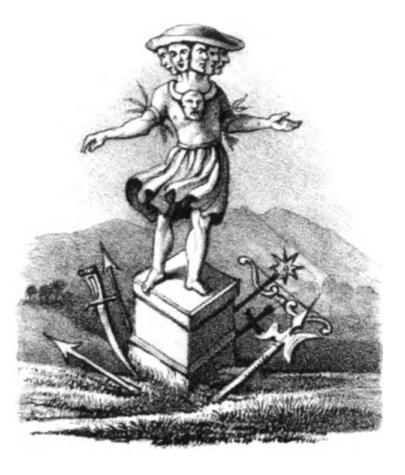
Another interesting part of this is that it might explain the word “vit”. Vit in Slavic has traditionally been understood as a “lord.” Hence, we have, for example, Rugevit meaning the “Lord of Rugen”. But all idols of Rugen were known for their polycephaly and hence for having multiple faces. The word is also related to “vid” meaning “to see” (both of which are, for what should be obvious reasons, related as well). Thus, Svantevit, Rugevit, Porevit could also refer to the “faces” of these idols with the “lord” meaning being secondary. Porenut would not fall under this description unless, of course, we were to read “Porenut” as a misspelling of “Porenvit” where the “u” was really a “vi”.

Copyright ©2018 jassa.org All Rights Reserved

April 3, 2018

The Religious Rites of the Slavs (et Ceteræ Nationes) in the Lex Baiuwaiorum

Published Post author

An interesting mention regarding the religious practices of Slavs in Oberfranken from (probably) 1025 – 1032 was noted already by Ketrzynski, Boguslawski and Brueckner but has somehow failed to make its way to the list of Slavic religious literature compendia (it does not appear in Meyer). It was discovered and published by Heinrich Amann and later republished by Richard Dove (in his work regarding synodal courts that is the so-called “Sendgerichte”). The relevant manuscripts are from the collection of Burchard of Worms and contain, principally, his Decreta but also this pagan rite description as an attachment.  The “Slavic” text appears, for certain, in the Freiburg and also in the Eistaedt version.  There may be other versions of this as well. Apparently, the Slavs were being upbraided for making idolatrous food offerings (the so-called trebo) or eating those same offerings – presumably as part of some sort of ritual.  They or “other folk” (et ceteræ nationes), meaning, presumably, the Saxons, were also reprimanded for burying their dead in pagan hillocks called hougir rather than in Christian cemeteries.  (Incidentally, Trebbia is also a river in the Emilia Romagna province in northern Italy south of Piacenza). These Saxon burial customs were already mentioned in the Paderborn (Paderbrunn) Capitulary from 785 (?) so the persistence of such practices (assuming this report was not already out of date) over two centuries later seems quite impressive. The below is courtesy of the Freiburg Universitätsbibliothek (Hs 7). The text typically appears as part of the Lex Baiuwaiorum – for example, in the Monumenta Germaniae Historica.

„Statutum est, qualiter Sclavi et ceteræ nationes, qui nec pacto nec lege salica utuntur, post perceptam baptismi gratiam constringendi sint, ut divinis sacerdotumque suorum obtemperent præceptis. Quia secundum canonicam diffinitionem ecclesiasticis jusjurationibus inplicitis cura accusandi proclamandique scelera committitur, quæ infra omnem parochiam illam, cujus diocesani sunt, perpetrantur; summa diligentia observandum est, ut nullus divinæ legis transgressor, licet alterius conditionis vel parochiæ sit, in synodica stipulatione reticeatur. Quodsi qnis, cujuscunque sit gentis, nationis vel linguæ, contemto dei omnipotentis timore , ita irreverens deprehensus fuerit post hujusmodi sacramentum, ut jurata per quodcunque ingenium sive excusationem aut dissimulationem notitiæ violare præsumat; a cujuscunque nationis vel linguæ viris, nobilibus tantum et numero testimonio congruentibus, perjurii vel alicujus criminls inpetitus fuerit noxa, penitus, quia unius legis et gentis non sunt, objectione remota, aut vindictæ perjurii subjaceat, aut se impetita suspicione igniti ferri judicio expurget. Quodsi temeritatis obstinatia in neutro sanctæ dei ecclesiæ satisfacere voluerit, a liminibus et communione ejusdem sanctæ dei ecclesiæ habeatur disclusus et exlex, quousque resipiscendo canonicis obtemperaverit institutis. Præterea festivitates dominicas ceterasque anni solemnitates observandas, in parochiali ecclesia a sacerdote indictas quicunque aliquo opere temerare praesumpserit, vel quicquid tunc laborare praeter id, quod ad domesticum apparatum ejusdem diei indiget; vel qui legltlma jejunia, hoc est quadragesimam et IV. tempora et vigilias esu carnium contaminaverit; aut qui idolothita, quod trebo dicitur, vel obtulerit aut manducaverit; aut qui mortuos non in atrio ecclesiae sed ad tumulos, quod dicimus more gentilium hougir, sepelierit; aut decimas dare noluerit; aut qui a sacerdote in ecclesia bannitus fuerit ad placitum episcopi sive archipresbyteri, et venire contempserit; canonicis induciis sacerdos eum pro hujusmodi praavaricatione et negligentia ad poenitudinem invitet. Quod si contempserit, exactor publicus id. (id est) centurio aut suus vicarius cum sacerdote pergat ad domum hujusmodi praesumptoris, et de sua facultate tanti aliquid precii, bovem sive aliud aliquid tollat, propter quod protervus constringatur, ut humiliatus a sua pravitate resipiscat. Quod ipsum in ecclesiastica sacerdotis potestate locatum maneat, donec transgresor ab inconcultato (inculpato?) crimine aut expurgando aut pænitendo satisfaciat. Quodsi infra spacium unius septimanae ita resipuerit, sibi sublatam recipiat suppellectilem. Si vero ad finitas inducias contumax venire distulerit, etiam si postmodum pœnitentiae se subdiderit, propter neglectas autem inducias sit in arbitrio sacerdotis, depositum in ecclesiasticos usus servare aut repetenti condonare. Quod si quispiam tam male pertinax invenitur, ut nec omnipotentis dei territus timore, nec jactura vel opum damno attenuatus ab hujusmodi sceleris obstinatia ad resipiscendum coerceri possit, decretum est ab ecclesia , exclusum humana privari communione, et tunc demum si sit fiscalinus colonus, omnia, quæcunque possidet, a rei puplicæ ministro infiscentur, et in dominicam redigantur potestatem. Siquis autem in suo vel in alterius prædio ita scelerosus exstiterit, simili modo cum centurione dominus ejusdem prædii, quæcunque habuerit, ab illo auferat, suæque vendicet potestati. Si vero ipse centurio aut dominus hoc agere neglexerit, sit ipse, quod est, quem rebus fovet et tuetur, excommunicatus, et tamen nihilominus per ducem aut comitem expulsus, illius infiscentur substantiæ.“

Copyright ©2018 jassa.org All Rights Reserved

March 29, 2018