Category Archives: Polabians

What Widukind’s “Deeds of the Saxons” Has to Say Regarding the Slavs – Part I

Published Post author

Widukind (Witikindus) of Corvey (circa 925-935 – circa after 973) , the author of the Deeds of the Saxons has much to say about the Slavs.  He was perhaps, named after Wittekind (Child of the wood”?)  the Saxon war hero who fought against the Franks during the Saxon Wars (777-785) and lost… then converted to Christianity and, as per the Vita Liudgeri (biography of Saint Ludger), subsequently accompanied Charlemagne on the latter’s campaign against the Veleti and their leader Dragovit.

wits

1577 edition

Although we’ve already mentioned some references (e.g., to the Licikaviki of Mieszko), we thought we should also discuss other mentions of the Slavs.  The following comes from the Bernard and David Bachrach translation of Res gestae Saxonicae.  We present it here in several parts.

vitu

author?

Book I

17.  Regarding King Henry

“…From his youth, Henry [I] devoted every bit of his strength to bringing glory to his people, and to strengthening peace.  When the father saw the wisdom of the youth, and his exceptional judgment, he dispatched Henry with a Saxon levy and the ducal military household against  the Daleminzi, whom he himself had fought for many years.  The Daleminzi were not able to withstand Henry’s attack and summoned against him the Avars, whom we now call the Hungarians, a people that is exceptionally brutal in war.” [906?]

…nam maximum ei ab adolescentia studium erat in glorificando gentem suam et pacem confirmando in omni potestate sua. Pater autem videns prudentiam adolescentis et consilii magnitudinem reliquit ei exercitum et militiam adversus Dalamantiam, contra quos diu ipse militavit. Dalamanci vero inpetum illius ferre non valentes conduxerunt adversus eum Avares, quos modo Ungarios vocamus, gentem belli asperrimam.

19.  The Hungarians were confined by Charlemagne, but were set free by Arnulf

“The Hungarians were defeated by Charlemagne, driven across the Danube river, enclosed within a huge wall, and prohibited from raiding other peoples in their customary manner.  However, during the reign of Arnulf [887-899], this work was undone, and a path was opened up for them to renew their killing since the emperor angered Zwentibold, the king of the Moravians [Svatopluk I, 870 or 871-894].  The great slaughter and tremendous injuries inflicted by the Hungarians on the Frankish empire are attested by the cities and regions that remain desolate up to the present day.  We judge it useful to provide information about this people so that your highness will understand the kind of people against whom you grandfather and father fought, and from what kind of enemies almost all of Europe has been liberated by strength of your grandfather’s and father’s widow and under their banners.”

Victi autem a Magno Karolo et trans Danubium pulsi ac ingenti vallo circumclusi, prohibiti sunt a consueta gentium depopulatione. Imperante autem Arnulfo destructum est opus, et via eis nocendi patefacta, eo quod iratus esset imperator Centupulcho regi Marorum. Deinde quantam stragem quantamque iniuriam imperio Francorum fecerint, urbes ac regiones adhuc desolatae testantur. Haec ideo de hac gente dicere arbitrati sumus, ut possit tua claritas agnoscere, cum qualibus avo tuo patrique certandum fuerit, vel a quibus hostibus per eorum providentiae virtutem et armorum insignia tota iam fere Europa liberata sit.

20.  How the Hungarians devastated Saxony,

“The Hungarian army, mentioned above, was guided by the Slavs and inflicted great slaughter in Saxony.  After taking huge quantities of booty, they returned to Dalminzia and met another Hungarian army there.  The second Hungarian army threatened to make war on the allies of the first army because they refused to provide help to them,* while leading the first army to such great plunder.  So it happened that Saxony was laid waste a second time by the Hungarians.  The first army awaited the second in Daleminzia, and by their presence caused such a dearth of food that they [Daleminzi] were forced that year to leave their own homes and serve other nations to obtain sustenance.”

* apparently the Slavic Daleminzi did not want to help this second Hungarian army notwithstanding the fact that they helped the first.

Predictus igitur exercitus Ungariorum a Sclavis conductus, multa strage in Saxonia facta et infinita capta preda, Dalamantiam reversi obvium invenerunt alium exercitum Ungariorum; qui comminati sunt bellum inferre amicis eorum, eo quod auxilia eorum sprevissent, dum illos ad tantam predam duxissent.  Unde factum est, ut secundo vastaretur Saxonia ab Ungariis, et priori exercitu in Dalamantia secundum expectante, ipsa quoque in tantam penuriae miseriam ducta sit, ut aliis nationibus eo anno relicto proprio solo pro annona servirent.

35.  How King Henry used his nine years of peace.

“…After Henry had accustomed his subjects to this legal obligation and discipline, he immediately attacked the Slavs who are called the Hevelii.  First, Henry wore them down with numerous battles.  Then he established his encampment on the ice during the coldest part of the winter.  Finally, through hunger, iron, and cold, he captured the fortress of Brandenburg [Brennaburg].  Then having captured the entire region along with this fortress, Henry turned his banners against Daleminzia where his father long before had placed him in command of an army.  There he besieged a fortress called Gana,* and finally captured it after twenty days.  Henry distributed the booty from the fortress among his soldiers.  All of the adults were killed, while the youths and maidens were led off as slaves.  After this, Henry marched to Prague, the fortress of the Bohemians, with his entire army.  He received the surrender of the king of the Bohemians.  Certain miraculous stories are told about this king, but we think that it is better to remain silent about them because we have no proof that they happened.  He was the brother of Boleslav who remained loyal and helpful to the emperor as long as he lived.  So Henry made the Bohemians tributaries and returned to Saxony.”

* This may be a fortress between Hof and Stauchitz on the river Jahna about southwest from  Riesa.  That Ganna was the seeress in Germania after Veleda we know from Tacitus.  Ganna, Ganna and Poganie…

Tali lege ac disciplina cum cives assuefaceret, repente irruit super Sclavos qui dicuntur Hevelli, et multis eos preliis fatigans, demum hieme asperrima castris super glaciem positis cepit urbem quae dicitur Brennaburg fame ferro frigore. Cumque illa urbe potitus omnem regionem signa vertit contra Dalamantiam, adversus quam iam olim reliquit ei pater militiam; et obsidens urbem quae dicitur Gana, vicesima tandem die cepit eam. Preda urbis militibus tradita, puberes omnes interfecti, pueri ac puellae captivitati servatae. Post haec Pragam adiit cum omni exercitu, Boemiorum urbem, regemque eius in deditionem accepit; de quo quaedam mirabilia predicantur, quae quia non probamus, silentio tegi iudicamus. Frater tamen erat Bolizlavi qui quamdiu vixit imperatori fidelis et utilis mansit. Igitur rex Boemias tributarias faciens reversus est in Saxoniam.

corvt

Corvey abbey today

36.  Regarding the Redarii and how they were defeated.

“And so after the following neighboring peoples were made tributaries by King Henry, namely the Obodrites, Wilzi, Hevelli, Daleminzi, Bohemians, and Redarii, and peace had been established, the Redarii rebelled.  They mobilized a huge force and attacked a stronghold called Walsleben, which they captured, killing everyone living there, comprising a great multitude.  All of the barbarian nations were inspired by this act, and dared to rebel as well.”

Cumque vicinae gentes a rege Heinrico factae essent tributariae, Apodriti, Wilti, Hevelli, Dalamanci, Boemi, Redarii, et pax esset, Redarii defecerunt a fide, et congregata multitudine inpetum fecerunt in urbem quae dicitur Wallislevu ceperuntque eam, captis et interfectis omnibus habitatoribus eius, innumerabili videlicet multitudine. Quo facto omnes barbarae nationes erectae iterum rebellare ausae sunt.

“In order to repress the ferocity of the barbarians, the expeditionary levy as well as a force of professional soldiers were dispatched under the command of Bernhard, who already held authority over the province of the Redarii.  Thietmar also was dispatched to join the legate as a colleague.  They were ordered to besiege the stronghold called Lenzen.”

Ad quarum ferocitatem reprimendam traditur exercitus cum presidio militari Bernhardo, cui ipsa Redariorum provincia erat sublegata, additurque legato collega Thiatmarus, et iubentur urbem obsidere quae dicitur Lunkini.

“On the fifth day of the siege, which was a Friday, scouts announced that an army of barbarians was not far off, and that the barbarians had decided to launch an attack on the Saxon encampment that night.  After this had been confirmed by many others, the people believed the report, since it was corroborated.  When the people had gathered around the tents of the legate, he issued orders following the advice that had been given to him that very hour by his colleague.  The men were to remain prepared through the night in order to prevent a barbarian assault on their camp.”

Quinto obsidionis die venere custodes exercitum barbarorum non longe esse adnuntiantes, et quia nocte contigua inpetum in castra facere decrevissent. Cumque plures eadem confirmarent, populus fidem paribus dabat dictis. Et cum conventus esset populi circa tentoria legati, eadem hora collega dictante precepit, ut per totam noctem parati essent, ne qua forte irruptio barbarorum in castra fieret.

“When the large group of defenders  had been ordered to stand down, emotions in camp were very mixed.  Some were melancholy and others were happy.  Some dreaded the battle and others were looking forward to it.  The fighting men moved between hope and fear according to the nature of their personalities.  In the meantime, the day went by, and the night was much darker than usual because of a huge rainstorm,.  Thus, by God’s will, the evil plan of the barbarians was thwarted.”

Cum autem dimissa esset multitudo, in castris variavere moestitia pariter atque laetitia, aliis bellum formidantibus, aliis autem desiderantibus; et pro qualitate morum inter spem metumque versabantur bellatores. Interea dies transit, et nox solito tenebrosior cum ingenti pluvia adest nutu divino, quatinus consilium pessimum inpediretur barbarorum.

“As had been ordered, the Saxons remained armed throughout the night.  Then at first light, after the signal had been given, they all received the sacrament.  Then each man promised under oath, first to the commanders, and then to each other, that they wiuld do their duty in the resent battle.  After the sun rose, for fine clear weather had returned after the rain storm, they raised their banners and marched out of camp. ”

Ut ergo iussum est, tota nocte illa armati erant Saxones, et primo diluculo dato signo sacramentoque accepto, primum ducibus, deinde unusquisque alteri operam suam sub iuramento promittebat ad presens bellum. Orto autem sole – nam post pluviam clara redit serenitas -, erectis signis procedebant castris.

“The legate, who was in the first rank, launched an attack against the barbarians.  But he was not able to overcome the innumerable enemy with his small force.  When he teruned to the army, he reported that the barbarians did not have many mounted men. However, because of their enormous number of men on foot, and because the rain the previous night had created such an obstacle, the enemy could not be drawn to engage in battle against his own mounted troops.”

In prima quidem fronte legatus in barbaros inpetum faciens, sed cum pauci non prevalerent adversus innumerabiles, reversus est ad exercitum referens, quia barbari non plures haberent equites, peditum vero innumerabilem multitudinem et nocturna pluvia in tantum inpeditam, ut vix ab equitibus coacti ad pugnam procederent.

“As the sun blazed down on the wet clothing of the barbarians, and made steams rise up to the sky, the people of God gained hope and faith as the brihgteness and serenity of His countenance shined around them.  Then the signal was given, and the legate urged on the legions that charted with a great shout against the enemy.  When it became clear that the great number of the enemy would not allow the Saxons to drive through them, they struyck then on the left and right with their weapons.  Whenever they*  were  able to separate some of them** from their fellows, they killed them all.”

* Saxons
** Slavs

Igitur sole cadente in humida vestimenta barbarorum, fumum ascendere fecit usque in caelum, spem fiduciamque prestans Dei populo, cuius faciei claritas atque serenitas circumfulsit illos. Igitur dato signo et exhortante legiones legato cum clamore valido irruunt in hostes. Cumque nimia densitate iter pertranseundi hostes non pateret, dextra laevaque ferro erumpentes, quoscumque a sociis secernebant, neci dabant.

“As the battle intensified with many dead on each side, and the barbarians still managing to maintain their formation , the legate ordered his colleague to provide support to the legions.  So Thietmar dispatched a commander with fifty heavily armed mounted troops against the enemy’s flank and disrupted their entire formation.  From this point on, the enemy faced only flight and death.  When they had been slaughtered through the fields, some of the survivors attempted to flee to the fortress.  But the colleague prevented them from doing this, so they entered a nearby lake.  So it happened that of this enormous multitude, almost all were killed by the sword or drowned in the lake.  None of the foot soldiers survived, and just a few of the enemy mounted troops.  The battled ended with the defeat of all of their adversaries.”

Cumque iam bellum gravaretur, et multi hinc atque inde caderent, et adhuc barbari ordines tenerent, legatus collegam, ut legionibus auxilio esset, expostulat. Ille vero prefectum cum quinquaginta armatis lateri hostili inmisit et ordines conturbavit; ex hoc caedi fugaeque tota die hostes patebant. Cum ergo per omnes agros caederentur, ad urbem vicinam fugere temptabant. Collega autem hoc eis precavente, proximum mare ingressi sunt, et ita factum est, ut omnis illa nimia multitudo aut gladio consumeretur aut in mari mergeretur. Nec peditum ullus superfuit, equitum rarissimus, deponiturque bellum cum casu omnium adversariorum

“There was a huge burst of joy following the victory.  Everyone praised the commanders, and each of the soldiers praised his fellows.  Even the cowards enjoyed some praise, as often happened when there is such good fortune.  The next day, they marched to the aforementioned fortress.  The defenders lay down their arms and asked only for their lives.  They received this.  The unarmed men were ordered to depart the city.  However, the slaves, and all of the money along with the wives, children and goods of the king of the barbarians were carried into captivity.  On our side, two men named Liuthar died, along with manny other noblemen.  The legate, his colleague, and other commanders returned to Saxony as victors.  They were received honorably by the king and given all due praise since with God’s favor and mercy their small forces had gained a magnificent victory.  The next day, all of the captives, as they had promised, were beheaded.”*

* As the editors note, “[t]his is the first reference to the beheading of captives, and it is not clear whether it refers to the slaves and royal family taken at Lenzen, to the captives taken in the battle, or to both.”

Ingens interea oritur laetitia ex recenti victoria, dum omnes laudant duces, unusquisque vero militum predicat alium, ignavum quoque, ut in tali fortuna solet fieri. Postera autem luce movent signa urbi prefatae; urbani vero arma deponunt, salutem tantummodo deposcunt ac merentur. Inermes igitur urbe egredi iussi; servilis autem conditio et omnis pecunia cum uxoribus et filiis et omni suppellectili barbarorum regis captivitatem subibant. Ceciderunt etiam ex nostris in illo prelio duo Liutharii et alii nobiles viri nonnulli. Igitur legatus cum collega et aliis principibus Saxoniam victores reversi honorifice a rege sunt suscepti satisque laudati, qui parvis copiis divina. favente clementia magnificam perpetraverint victoriam. Nam fuere qui dicerent barbarorum ducenta milia caesa. Captivi omnes postera die, ut promissum habebant, obtruncati.

38.  The king’s speech and how he defeated the Hungarians in an open battle.

“…After these events, the Hungarian legates came to the king to receive their customary gifts.  But they departed from him to return to their own land empty-handed.  When they heard this, the Avars did not delay.  They hurried to enter Saxony with a large hostile force.  They took the route through Daleminzia and sought help from the old friends.  But they*, knowing that the Hungarians were hurrying to Saxony, and that the Saxons were ready to fight them, gave a very fat dog to the Hungarians as their gift.  The Hungarians did not have time to avenge this insult as they were hurrying on to a different fight.  For quite a while the Daleminzi pursued their ‘friends’ while mocking them…”

* Daleminzi.

“…Post haec legati Ungariorum adierunt regem pro solitis muneribus, sed ab eo spreti in terram suam vacui sunt reversi. Haec audientes Avares, nichil morati cum gravi hostilique manu festinant intrare Saxoniam. Et iter agentes per Dalamantiam ab antiquis opem petunt amicis. Illi vero scientes eos festinare ad Saxoniam Saxonesque ad pugnandum cum eis paratos, pinguissimum pro munere eis proiciunt canem. Et cum non esset iniuriam vindicandi locus ad aliam pugnam festinantibus, cum ridiculosa satis vociferatione longius prosequuntur amicos…”

corvei

Corvey on a map from 1620

Copyright ©2016 jassa.org All Rights Reserved

June 5, 2016

Slavs Being Drung Nach Westen

Published Post author

After publishing his study “About the Slavs who once lived between the Rhine and the Elbe, Saale and Czech borderlands”  (O Słowianach, mieszkających niegdyś między Renem a Łabą, Salą i czeską granicą), Wojciech Kętrzyński went on a book tour and gave a speech regarding the reasons for having written his pamphlet.  A portion of that speech is worth quoting here:

***************

k1

“It is well known that there is currently a debate as to when the Slavs settled the wide spaces they currently hold, for according to theories proposed by Deutsche scholars all of Central Europe was previously held by Deutsche nations.*  There was, thus, no room for the Slavs, who could only have moved into these spaces [according to the Deutsche theories] once the Deutsche left them, which is supposed to have happened in the 6th, though maybe already in the 4th century A.D.”

[* note: Kętrzyński uses the Slavic word niemiecki for the common English adjective “German”.  For the sake of clarity, we thought of retaining the usage of the word “German” in this translation.  In light of Ketrzynski’s arguments, however, at least in this article it seemed hardly fair to let a people who’ve always called themselves just Deutsche appropriate the word German or Germanic entirely for themselves.]

“From the Slavic side there was frequently opposition to such a theory, though [such opposition] was not always effective.  So too the little pamphlet of this author “Die Lygier” [“The Lugians” though it should be “The Legianslegiorum!], published in 1868, had the same goal and the same result, i.e., it remained completely unaddressed.  To this day one opinion meets another opinion though the Deutsche are in ascendance for they fight using linguistic evidence, which tend to impress, for no one can challenge them [i.e., without also assailing linguistic theories]; it is on such [linguistic theories] that they build their hypotheses and to fit   such [linguistic] theories do they correct the [writings of] ancient authors; and yet linguistic evidence, in and of itself, cannot serve to establish a sufficient historical proof but rather can only be an additional, auxiliary argument.”

“It is for this reason that the author believed, that the entire matter should be placed on a new foundation which in the here mentioned work I’ve tried to do.”

***************

k2

“It has been known for quite a long time that the Elbe and Saale as also the Czech [Bohemian] border did not separate the Slavic and Deutsch peoples but that even beyond this line towards the West there exist Slavic place names.  It is for this reason that the author decided to collect them all in one place, taking into account primarily the suffix itz [Deutsch] ica, ici, ice [Slavic], as also names such as Winden, Wenden and those containing them, which the Deutsch scholars too have agreed indicate Slavic settlements.”

“The author was able in the process to gather together approximately 800 such names between the Rhine and the above-mentioned [Elbe-Saale] line, between the North Sea and the Alps; their placement has been shown on 4 maps.”

Deutsche scholars explain this phenomenon in two ways: 1) they claim that they [the Deutsche] so love foreign names [!] that they immediately Ge-deutsch them as their own; 2) usually, however, they assert that these were Slavic colonies, formed under orders of the Deutsch masters, among the Deutsche.”

“As regards the first point, the author shows [in his pamphlet] that Deutsche, everywhere where they encountered the Slavs (and also too in places where the Slavs had not been conquered by the Deutsche) they Ge-deutsched local place names, the proof of this stretches from Czechia, to Silesia to West Prussia and so forth, as it is also shown in the current behaviour of Deutsche regarding Polish place names.”

“Villages, founded by war prisoners and other unfree peoples in areas that were supposedly purely Deutsch could not have had Slavic names since what a place was called was in the oldest times determined by the surroundings [peoples?], later still by the lord and owner but a slave without any rights could neither force his will nor his language onto the locally dominant peoples/nation.”

“Villages, even in otherwise Slavic parts, that were founded by unfree Slavs but established for a Deutsch master, received Deutsche names.”

“Thus, if such place names could not have come about during the time of Deutsche dominance over the Slavs, their origin must predate such time…”

***************

The talk given by Kętrzyński continues but for the purposes of this post, we do not need to continue with it.  Suffice it to say that the same Deutsche arguments that so annoyed Kętrzyński over a century ago are to this day made by various German scholars.  So, for example, we have this from Roland Steinacher’s brief summary (Wenden, Slawen, Vandale, Eine fruehmittelalterliche pseudologische Gleichsetzung und Ihre Nachwirkungenof his longer doctoral theses:

ashh

“Such toponyms are to be found also far removed from the Slavic settlement area and show the settlement of Slavic servants by Frankish landowners.”

Steinacher, like his predecessors over a century ago, neither disputes the Slavic character of such villages nor offers proof for the old theory that these were “new” settlements of Slavic war captives.  Of course, that theory is based on nothing other than the supposition that this must be the case because the alternative (Ketrzynski’s, i.e., that these were remnants of Slavic villages dating to Roman and pre-Roman times) would upend at least two centuries (but not much more – pre-19th century scholars displayed a more modest approach and showed less blind certitude!) of German scholarship.

Incidentally, Steinacher is also an author of a new book about the Vandals which, thankfully, begins its tale in the 4th century.  Here he appears mildly wistful but, in the end, mostly resists the urge to write his Vandalic history in the subjunctive:

wielk“If one could factually establish a connection between the Vandili of Plinius and Tacitus and the Przeworsk culture, were these peoples connected with those who hundreds of years later appeared on the Danube and the Rhein and eventually conquered Carthage, then the Vandals would have had a long pre-history.  But such connections are not provable.”

As we know, there is no mention of Vandals, as a people, by Tacitus and Pliny’s slim mention of Burgundians (though in all but one Ptolemaic manuscript – Buguntians without an “r”!) provides only the most ephemeral evidence of Vandals being in Poland (as opposed to somewhere in the Elbe area – which, if they came from Vendsyssel, would seem the logical place to put them).  In any event, Steinacher, notwithstanding his silly repetition of the “merry Slavic captives” theory, scores here a touch above Wolfram whose work on the topic is in the realm of historical fiction.

Copyright ©2016 jassa.org All Rights Reserved

June 4, 2016

The Gods and Holy Places of the Knýtlinga Saga

Published Post author

Knýtlinga saga (The Saga of Cnut’s Descendants) is an Icelandic saga written in the 1250s, which covers a long period of Denmark’s history (from the early 10th century story of Harald Gormsson “Bluetooth” till the end of the 12th).  The Cnut or Canute of the saga is probably the legendary Harthacnut (Cnut I or Canute I).  (The alternative title might be the Lives of the Kings of the Danes – not to be confused with Saxo’s Gesta Danorum).

The story most likely came to Iceland by virtue of the efforts of Óláfr Þórðarson (the nephew of the famed Icelandic writer Snorri).  Óláfr traveled to Norway and then Denmark where he stayed at the court of Valdemar II (the son of Valdemar I who had conquered Arkona).  If  Þórðarson is really the author of the Knýtlinga saga then the pagan references in the Knýtlinga saga (as the saga itself obviously) are younger than Saxo Grammaticus’ chapters in Gesta Danorum (Saxo died about 40 years before the assumed composition date of the Knýtlinga saga) which we presented here.  Nevertheless, spending time at the Danish court may have given Óláfr an opportunity to access additional sources or hear more tales.

In the saga, Svantovit is represented as Svanteviz but five other Gods are also mentioned: the trio of Rinvit, Turupid and Puruvit – corresponding, presumably to Rugievit, Porenut and Porevit;  but also Pizamar (in Jasmund) and Tjarnoglofi, the Rugian’s God of War (who “went” with them on military expeditions – recall Thietmar’s discussion (at 8, 64) of the Veletian campaign alongside the Germans where the Slavic Goddess had been “disrespected” by a German commanded and the Emperor had to figure out a way to placate his allies).  Neither Pizamar nor Tjarnoglofi are mentioned elsewhere.  Whether the latter had anything to do with Thietmar’s Cernobog or with the famous Pomeranian Triglaf (described, for example, here and here and here; other sources elsewhere on this site) or was (either as a result of a conscious decision of the local religious leaders or the confusion of the Danes in telling the stories) a combination of the two, we do not even begin to guess.  Whether Boka (Böku) is another deity or just a sacred grove of some unspecified God, we likewise do not know.

The English translation of the saga is connected with another Canute – Canute IV (circa 1042 – 10 July 1086) who was king of Denmark and later got himself canonized and became the patron saint of Denmark.  His path led, of course, via martyrdom.  Specifically, Canute died during a peasant revolt which broke out on (appropriately) Vendsyssel.  The King escaped to Saint Alban’s priory at Odense where the peasant rebels caught up with him and made him a martyr in 1086.  The 900th anniversary of Canute’s death was celebrated in 1986 by the city of Odense (where he is buried at Odense Cathedral) as a major event.  As part of the celebrations, the town notables convinced two professors, Hermann Pállsson (of Iceland) and Paul Edwards (a professor with varied interests at the University of Edinburgh – where the two professors probably met) to translate the Knýtlinga saga into English.  Pálsson and Edwards translation is the only known English translation to date.

viks

With all that in mind here is the invasion of Arkona as told in the Knýtlinga saga (as regards the Slavic Gods we follow the translators and give the Old Norse version below):

English

Section 101
King Eirik in Wendland

“King Eirik the Unforgotten, once he felt secure in his kingdom, was harsh and severe with the people of Denmark.  His own brother, Harald Kesja, and two of his sons Eirik had put to death along with many other friends of King Nikulas.  It was one year after the death of King Nikulas that Harald Kresja was killed.”

“A year later, King Eirik took his army to Wendland, plundering far and wide and causing great havoc.  He took a town called Arkona where the people were heathen, but by the time he left they had the whole population of the town baptized before he returned to Denmark.  But immediately the king had gone they renounced the faith and returned to the offering and sacrifice and other heathen practices.”

Section 121
Plundering in Wendland

“Towards the end of winter, Valdimar raised yet another levy for a seafaring expedition and sailed to Rugen.  They went ashore at Strele to a certain sacred grove called Boka where they set fire to and burnt everything apart from the people and the cattle, which they drove to the ships.  Then they went to another part of Valong and burnt the place down, then to Vik where they set everything ablaze all the way to the market place.  From there they rowed over to Hiddensee and lay there at anchor for twenty days, resting.”

“After that,  the king asked Absalon to sail on ahead , while he and the Jutes moved up to Strele. When dusk began to fall, the bishop rowed with his troops past the king over to Parez, then set up to a town called Gartz, where the Wends confronted them and at once began to attack the bishop by a certain lake.  It was a great battle and many fell in it but the bishop won the victory.  Eleven hundred men had been killed on the side of the Wends, but only one man on the bishop’s, though two of the bishop’s men died by drowning in a swimming match.  Later the bishop rode out to his ships.  As they were cantering aboard, King Valdimar came up to ask what they had been working at and the bishop told him.  The king gave him generous thanks for this victory and then they all travelled together to Strele.  The Isle-Danes had by now laid hands on a great deal of booty, and the Jutes were envious, saying that the Isle-Danes took everything while the Jutes lost everything but they did not risk saying this in the king’s hearing.”

“Afterwards the king went with an army to Jasmund and harried there, killing a chieftain called Dalemar and seizing all the people there and cattle.  Next they went to Hiddensee where the Rugians came to the king begging for mercy: they handed over hostages, paid him all the tribute he asked for, and swore their allegiance.  After that, the king went back to Denmark.”

Section 122
Pagan Idols in Wendland

“King Valdimar gave his son Kristoforus authority in Jutland: he was a powerful man ad had a dukedom at Hedeby and associated districts.”

“While he ruled over the kingdom, King Valdimar was always a busy man, having led eight expeditions to Rugen [Rugia] before winning control of it.”

“One winter around the time of Lent, Duke Kristoforus and Bishop Absalon went to Svold River and set everything ablaze as far as Tribuzis so that the place lay desolate for many years after.  They remained weather-bound for twenty days in the River Svold with a fearful gale but then they got a favourable wind and sailed back home.”

“After this, everything was quiet for three years until the Rugians once again broke the agreement made earlier.  So King Valdimar had to make yet another levy for an expedition by sea, sailing to Rugen and arriving on Whit Sunday to take the town of Arkona, mentioned earlier.  Then Tetizlaf, King of the Rugians, and his brother Jarmar, and all their leading men came to King Valdimar, surrendering themselves and their country into his power and telling he could do whatever he wished with them.  Then the king told them to embrace Christianity, for the land had been heathen ever since they renounced the Christian faith they received when Eirik the Unforgotten had them baptized on the conquest of the town of Arkona, as described earlier.  They said they would now do as the king and Bishop Absalon had asked.”

“Then the king ordered Soni Ebbason and others with him to go into the town of Arkona to the temple there, cut down the god called Svantaviz, drag it out of the town and plunder the temple of anything valuable.  As the townspeople feared the angrier of the god they would not dare cut him down, but bishop Svein and Soni Ebbason came and cut down the god, then put a rope round his neck and forced the Rugians themselves to drag him outside.  Once he was out, the heather were all amazed that he was unable to help himself and had less faith  in him than before.  After that, men came up and hacked him apart and burned him under their cauldrons; then the Rugians realised they had been deceived and no longer believed in him.  Bishop Absalon and all the clergy converted the people to Christianity, baptizing thirteen hundred ain one day, and when they left, the people agreed to give their obedience to the king and the bishop.”

“Next morning the king went to the place called Gartz and had three idols cut down, called Rinvit, Turupid and Puruvit.  These idols caused strange things to happen: if any man had intercourse with a woman inside the town the two were stuck together like dogs and were unable to go free until they left the town.  On the day their idols were destroyed, nine hundred people converted to Christianity and eleven graveyards were consecrated.  A great deal of wealth was taken from the gods, gold and silver, silks and furs and costly fabrics, helmets and swords, tailcoats and all kinds of weapons.  The fifth god was called Pizamar from a place called Jasmund, and was destroyed by fire,  There was also Tjarnaglofi, their god of victory who went with them on military campaigns.  He had a moustache of silver and resisted longer than the others buyt they managed to get him there years later.  Altogether, they christened five thousand on this expedition.  King Valdimar, Bishop Absalon and all the troops now returned home.”

Old Norse

Section 101

Herferð Eiríks konungs 

Eiríkr eymuni var harðr ok stirðr við fólk alt í Danmörk, þegar hann þóttiz festaz í ríkinu; hann lét drepa Harald kesju, bróður sinn, ok sonu hans II ok marga aðra vini Níkuláss konungs. Þat var einum vetri eptir fall Níkuláss konungs, er Haraldr kesja var drepinn.

1
En vetri síðar fór Eiríkr konungr til Vinðlands með her sinn ok herjaði þar víða ok vann þar mikit hervirki; hann vann þar stað þann, er Arkún heitir; þat fólk var heiðit, er þann stað bygði. Eiríkr konungr fór svá þaðan, at þeir tóku áðr við kristni, er eigi váru drepnir af heiðnum mönnum, ok lét konungr kristna alt fólk í staðinum; fór hann síðan heim til Danmerkr. En þegar konungr var í brottu þaðan, þá köstuðu þeir aptr kristni ok efldu síðan blót ok heiðinn sið.

2

Section 121

Frá Valdimar konungi 

En er vetrinn leið af, bauð Valdimarr enn út leiðangri ok fór til Réinga ok lögðu upp á Strælu við blótlund einn, er heitir Böku, ok brendu þar alt ok bældu, en tóku fólk ok fé ok fóru til skipa með. Ok þá lögðu þeir upp á annan veg á Valung ok brendu þar ok fóru þaðan til Víkr ok brendu landit alt til torgs þeirra.Þaðan reru þeir til Heðinseyjar ok lágu þar II nætr ok hvílduz. Þá bað konungr Absalón biskup fyrri fara, en konungr ok Jótar lögðuz þá upp við Strælu;

3

en er røkkva tók, reri biskup upp með sínu liði fram um konunginn til Parez ok reið síðan upp til borgar þeirrar, er heitir Garðz, en þar kómu Vinðr í móti þeim ok réðu þegar til orrostu við biskup ok börðuz við vatn eitt; þar varð mikil orrosta ok mannfall mikit, ok hafði biskup sigr, en þar fell af Vinðum XI hundruð manna, en einn maðr af biskupi; en II menn fóruz á kafi af biskups mönnum, er reyndu sund með sér fyrir kapps sakir. Síðan reið biskup út til skipa sinna, en er þeir hleyptu hestunum út á skipin, þá kom Valdimarr konungr þar ok spurði, hvat þeir hefði sýslat, en biskup sagði honum. Konungr þakkaði fögrum orðum sigr þenna, ok fara síðan allir samt til Strælu. Eylendingar höfðu nú fengit hlutskipti mikit, en Jótar lögðu þar öfund á ok sögðu, at Eylendingar fengu alls, en Jótar misstu; en þeir þorðu þó eigi at mæla þetta, svá at konungr heyrði. Eptir þat fór konungr með herinn til Ásund ok herjaði þar; þar drápu þeir höfðingja þann, er Dalemarr hét, ok tóku þar fólk alt ok fé ok fóru síðan til Heðinseyjar. Þar kómu Réingar til móts við konung ok báðu sér miskunnar ok settu honum gísla ok gáfu honum skatta slíka, sem hann kvað á, ok játuðu konungi hlýðni. Fór konungr heim til Danmerkr eptir þetta.

4

Section 122

Valdimarr konungr gaf Kristófóró syni sínum ríki á Jótlandi; hafði hann hertogadóm í Heiðabœ ok þat ríki, sem þar fylgir; hann var ríkr maðr. Valdimarr konungr hafði jafnan starfsamt, meðan hann réð ríkinu; hann hafði VIII leiðangra til Réinga, áðr hann vann landit. Einn vetr um föstu fór Kristófórús hertogi ok Absalón biskup til Svöldrs ok brendu þar alt upp til Tribuzis, svá at þar lá autt marga vetr síðan; þá lágu þeir XX nætr veðrfastir í ánni Svöldr í óveðrani miklu ok fengu síðan byr ok fóru heim.  Eptir þetta stóð kyrrt III vetr, áðr* Réingar rufu enn þá sætt, sem fyrr var gör. Þá bauð Valdimarr konungr enn út leiðangri ok fór til Réinga ok kom þar at hvíta sunnudegi ok vann borgina Arkún, er fyrr var nefnd. Þá kom til Valdimars konungs Tétizláfr, er var konungr þeirra, ok Jarmarr, bróðir hans, ok allir enir beztu menn af Réingum ok gáfu þá landit ok sjálfa sik í vald Valdimars konungs ok báðu hann gera af slíkt, er hann vildi. Þá bauð konungr þeim at taka við kristni, þvíat þar var jafnan heiðit, síðan þeir köstuðu aptr kristni, þá er Eiríkr konungr eymuni lét skíra þá, þá er hann vann borgina Arkún, sem fyrr var sagt; þeir sögðuz nú gera vildu, sem konungr beiddi ok Absalón biskup.

5

Þá kvaddi konungr til Sóna Ebbason ok menn með honum at ganga í borgina Arkún ok til hofs þess, er þar var, ok bað hann höggva niðr goðit, er Svanraviz* [or Svaravist?] hét, ok draga þat út af borginni, en ræna hofit öllu, því er fémætt er; en þeir, er fyrir váru í borginni, þorðu eigi at draga hann út, ok hrædduz þeir mjök reiði hans. Þá gekk til Sveinn biskup ok Sóni Ebbason ok hjoggu niðr goðit; síðan lögðu þeir reip um háls honum ok neyddu Réinga sjálfa at draga hann út; en er hann kom út, undruðuz allir heiðingjar, er hann mátti þá ekki hjálpa sjálfum sér, ok trúðu minnr á hann en fyrr.

6

Þá gengu menn til ok klufu hann í sundr ok brendu hann undir kötlum sínum. Sá þá Réingar, at þeir váru sviknir, ok trúðu ekki á hann síðan. En Absalón biskup ok allir lærðir menn kristnuðu fólkit ok skírðu XIII hundruð einn dag, ok fóru svá þaðan, at þeir játuðu konungi hlýðni ok svá biskupi. En um morgininn eptir fóru þeir konungr til þess staðar, er Karenz heitir, ok lét hann þar höggva niðr þrjú skurðgoð, er svá hétu: Rinvit, Turupið ok Puruvit; en skurðgoð þessi gerðu svá mikil undr, at þegar, ef nökkurr maðr átti samlag við konu innan borgar, þá loddu þau saman sem hundar, ok eigi losnuðu þau, fyrr en þau kómu út af borginni. En þann dag, er þessi skurðgoð váru brend, þá kristnuðu þeir IX hundruð ok vígðu XI kirkjugarða. Þar tóku þeir mikit fé af goðunum, bæði gull og silfr, silki og pell ok guðvef, hjálma ok sverð, brynjur ok allskonar vápn. Et fimmta goð hét Pizamarr; hann var á Ásund, svá heitir einn staðr; hann var ok brendr.

7

Þá hét ok Tjarnaglófi, hann var sigrgoð þeirra, ok fór hann í herfarar með þeim; hann hafði kanpa af silfri; hann helz lengst við, en þó fengu þeir hann á þriðja vetri þar eptir; en þeir kristnuðu alls á landinu V þúsundir í þeirri ferð. Eptir þat fór Valdimarr konungr heim ok Absalón biskup ok allr herrinn.

Copyright ©2016 jassa.org All Rights Reserved

May 30, 2016

The Vandals of Henry Huntingdon

Published Post author

The Chronicle of Henry the Archdeacon of Huntingdon (circa 1088 – circa 1157), i.e., Historia Anglorum (The History of the English) is not a well known source of Slavic information but it does contain some bits here and there.  (Note it is a different history from Matthew Paris’ later namesake book).

historia

For example, there is this report at the beginning of Book V which potentially refers to the Wends (as Vandals):

“In the early days of the English church religion flourished with so much lustre, that kings and queens, nobles and bishops, as I have before related, resigned their dignities, and entered into the monastic life.  But in process of time all piety became extinct, so that no other nation equalled them for impiety and licentiousness; as especially appears m the history of the Northumbrian kings.  This unpiety was not only manifest in the royal annals, but extended to every rank and order of men.  Nothing was held disgraceful except devotion, and innocence was the surest road to destruction. The Almighty, therefore, let loose upon them the most barbarous of nations, like swarms of wasps, and they spared neither age nor sex; viz. the Danes [Dacos] and/with Goths [Gothis], Norwegians [Norwagenses] and/with Swedes [Suathedis], Vandals [Wandalos] and/with Frisians [Fresis].  These desolated this country for 230 years, from the beginning of the reign of King Ethelwulf [King of Wessex from 839 to 858], until the time of the arrival of the Normans under the command of King William.  France also, from its contiguity to England, was often invaded by these instruments of the divine vengeance, as it richly deserved. With these explanations I will now resume the course of my history. [continues with AD 837]”

alanos

And this one in Book VI, which has Vandals but has been interpreted as an attack (dated to 1019 AD) on the Wends:

“In the this year of his reign, Canute, with an army composed both of English and Danes, went over to Denmark to war with the Vandals.  He had come up with the enemy and was prepared to give battle the day following, when Earl Godwin, who commanded the English troops, made a night attack on the enemy’s camp, without the king’s knowledge.  Taking them by surprise, he made great slaughter and entirely routed them.  At daybreak the king, finding that the English were gone, supposed that they had either taken flight or deserted to the enemy.  However, he marshaled his own force for the attack, but when he reached the camp, he found there only the corpses of the slain, blood, and booty.  Whereaupon he ver afterwards held the English the highest honour, considering them not inferior to the Danes.  After this he returned to England.”

alanos

(The above are from Thomas Forester’s 1853 translation; Latin version from Thomas Arnold’s 1879 edition).

Copyright ©2016 jassa.org All Rights Reserved

May 18, 2016

Saint Sturm and the Ever-So-Attractive Slavs

Published Post author

Here is an excerpt from the Life of Saint Sturm (705-779?) the Abbot of Fulda (Vita s. Sturmi abates Fuldensis) regarding Sturm’s trip up the Fulda river on a mission from Saint Boniface (same one who cut down the Holy Oak of Donar).

sturmy

Sturm’s mission was to discover a suitable place where Boniface could found a monastery.  Sturm was a young  Bavarian noble who was excited to join Boniface in a life of monastic joy.  Before that joy, however, the young virtuous Bavarian would be sorely tempted.

The year of our story is somewhere between 736 and 744:

“[7] Then one day, while he was traveling , he came to the merchant road that leads from Thuringia to Mainz.  At a place where the road crosses over the river Fulda, there was a large multitude of Slavs who discovered the same river swimming in its streams, washing their bodies and snorkeling; their nude bodies made the ass [on which Sturm was riding] tremble in fear and even the man of God found their smells frightening as they mocked the servant of the Lord.  And when they wished to do him harm, they were stopped by divine power.  One of them who was their interpreter asked him where he was going. And he answered he was going to the hills in the wilderness.” 

frightening

Slavs’ bathing naturally frightened the gentle Sturm

(Tunc quadam die dum pergeret, pervenit ad viam, quae a Turingorum regione mercandi causa ad Magontiam pergentes ducit; ubi platea illa super flumen Fuldam vadit, ibi magnam Sclavorum multitudinem repreit eiusdem fluminis alveo natantes, lavandis corporibus se immersisse; quorum nuda corpora animal cui praesidebat pertimescens, tremere coepit; et ipse vir Dei eorum foetorem exhorruit, qui more gentilium servum Domini subsannabant, et cum eum laedere voluissent, divina potentia compressi et prohibiti sunt.  Unus autem ex illis qui erat ipsorum interpres, interrogavit eum quo tenderet?  Cui ille respondit, in superiorem partem eremi se fore iturum.)

kirche

Sturm felt much safer in the Fulda church

In case you were concerned what happened to Sturm: he followed the course of the river into the wilderness until he was able to find an appropriate place for the founding of the Fulda abbey.  Here Saint Boniface laid the foundations of the monastery (named after the Fulda river) and Sturm was made its first abbot.

fultz

Location of Fulda in Germany

And they all lived happily ever after.

Well, not exactly, after Boniface was killed by Frisian highwaymen, Sturm got into a fight with Lull or Lullus, the successor to Boniface as archbishop of Mainz over who would keep the old man’s bone.  Sturm won the relics but got bitchslapped by Lullus who complained about him to Pepin king of the Franks.  Although Sturm was exiled he managed to get back into graces with Pepin and came back to run the monastery.

Problems continued for Sturm afterwards as the pagan Saxons attacked Fulda and Sturm and his fellow monks were forced to flee into the forest.  But then the Saxons left, the monks came back, Sturm died and the Saxons were slaughtered by Charlemagne.  Then Eigil of Noricum wrote the Life of Saint Sturm which is the work cited above.

And after that everyone lived happily ever after (except the local Slavs, of course).

monastery

The monastery’s unconventional design was intended to keep any eye on the Saxons and the Slavs

For more on the topic see the C. H. Talbot edition in “The Anglo-Saxon Missionaries in Germany, Being the Lives of SS. Willibrord, Boniface, Leoba and Lebuin together with the Hodoepericon of St. Willibald and a selection from the correspondence of St. Boniface.”

Copyright ©2016 jassa.org All Rights Reserved

April 30, 2016

Widukind on Slavic Saturn with Some Miscellany

Published Post author

We have had something to say about Widukind, the chronicler of the Saxons (Res gestae saxonicae sive annalium libri trespreviously.  And we will have more to say later.  However, for now, we note a curious passage in Book III, chapter 68 (chapter 66 of the same book mentions the Licikaviki) that mentions a bronze idol of… Saturn (father of Jupiter) captured from the Slavs – possibly at Stargard/Oldenburg – by “Duke” Hermann Billung.

The cast of characters includes:

  • Duke Hermann Billung – a servant of Emperor Otto I for Saxony and margrave of the so-called Billung March from 936 to 973 (though never officially a “duke”/Herzog).  He was the younger brother of Wichmann the Elder.
  • Wichmann the Elder – although not mentioned in the below tale, it was Wichmann the Elder’s outrage at having his younger brother Hermann be named „princeps militia“ (military leader) of the East Saxon areas, that caused him to rebel against Otto I – a rebellion soon suppressed.
  • Wichmann the Younger – together with his half-brother Egbert, he continued his father’s rebellion against his uncle duke Hermann and to aid him in this he went to the Slavs.
  • Duke (King) Mistivoj (Mistav) – duke of the Obodrites, perhaps the son of Nakon/Nacco; although he fought against the Saxons, he lost and became their ally which, perhaps, led to the Saxons favouring him in his conflict with Selibur (who was the duke of the Wagrians but also perhaps Mistav’s brother).  Later in life he participated in Otto II’s campaigns against the Saracens in Italy and, according to both Thietmar and Helmold, turned on the Germans in 983 during the Great Slav Uprising.
  • Duke (King) Zelibor (Selibur) – duke of the Wagrian Slav portion of Obodrite Confederation – perhaps the brother of Mistav (and hence, perhaps, the son of Nakon).  He allied with Wichmann the Younger against  Hermann Billung.  Apparently, he thought he should have been made duke (or, if you will, king) of all the Obodrites.

Sidenote 1: 

Mistav/Mistivoj’s daughter Tove became the second wife of Harald Bluetooth of Denmark.  She (and Mistav/Mistivoj) are mentioned on the so-called Sønder Vissing Runestone where it says: Tōfa lēt gørva kumbl, Mistivis dōttiR, øft mōður sīna, kona Hara[l]ds hins gōða, Gōrms sonar (or “Tofa, the daughter of Mistivoj, the wife of Harald the Good, son of Gorm, had this monument raised for her mother.”  What Mistivoj’s wife’s (and Tove’s mother’s) name was, however, we do not know.

vissing1Sidenote 2: 

It is possible that Sweyn Forkbeard was the child of Harald with Tove.  Sweyn Forkbeard fathered Cnut the Great with another Slavic princess – Świętosława (Sigrid the Haughty or Gunhild of Wenden). If so, then Cnut would have been Slavic on his father’s side as well.  It is also possible that Świętosława was the sister of Cnute (which name she would not have borne unless a connection existed to Slavs in the family); see “Santslaue soror CNVTI regis nostri”  in the Hyde Register, i.e., “Liber vitae of the New Minster and Hyde Abbey Winchester” (British Library Stowe MS 944):

SantslauesororCNVTIregisnostri

That is all just background and now for the story:

basel1

Once again, the 1532 Basel edition

Deeds of the Saxons

Book III, Chapter 68 Regarding two minor kings and Wichmann

(Bernard & David Bachrach translation)

“There were two minor kings under the jurisdiction of Duke Hermann who had inherited enmity toward each other from their fathers.  One was named Selibur and the other Mistav.  Selibur ruled the Wagrians.  Mistav ruled the Obodrites.  They frequently brought accusations against each other.  Finally, however, Selibur was convicted after an investigation by the duke, and condemned to pay fifteen talents of silver.  Taking this fine very badly, Selibur decided to raise arms agains the duke.  But since he did not have sufficient forces to fight against him, Selibur sent a messenger to ask Wichmann for aid against the duke.  Wichmann, who thought that there was nothing more pleasant than to have some means of troubling his paternal uncle, immediately set out with is companions to join with the Slav.  However, as soon as Wichmann gained entry into the stronghold, it was immediately laud under siege by the enemy, who surrounded it with a wall.  An army commanded by the duke also besieged the fort.  In the meantime, whether by chance or by prudent counsel, Wichmann left the stronghold along with a few others, pretending as if they were going to seek aid from the Danes.”

“Within a few days, the food for the fighting men and the fodder for the baggage animals began to give out.  There were those who said that the Slav had only undertaken a sham rather than a true war.  It seemed incredible that a man, who had been accustomed to war from his youth, could have made such bad preparations.  They argued that this was, instead, a plan conceived by the duke so that he might be able to overcome his nephew by whatever possible means, so that he could recover him safely in his fatherland rather than allowing him to perish utterly among the pagans.  So the garrison, burdened by hunger and by the stink of their cattle, was forced to exit the stronghold.”

“The duke spoke bitterly to the Slav about his treachery, denounced him as wretched because of his actions.  The duke then received this response from the Slav: ‘Why do you accuse me of treachery?’ he said.  ‘Behold, here are men whom neither you nor your lord emperor were able to overcome.  They stand here unarmed because of my treachery.’  The duke was silent after receiving this answer.  He deprived the Slav of the lands that he held under the duke’s authority.  The duke then handed this territory with full authority to the son of the Slav, whom the duke darker had received as a hostage.  The duke imposed a range of punishments on Wichmann’s soldiers, and gave booty from the stronghold as a gift to his open soldiers.  On hi victorious return to the fatherland, the duke brought forth an idol of Saturn made of bronze, which he had found among the other spoils in the fort, as a great spectacle for his people.”

basel2better

(LXVIII. De duobus regulis et Wichmanno.

Erant duo subreguli Herimanno duci, inimicitiae a patribus vicariae relicti; alter vocabatur Selibur, alter Mistav. Selibur preerat Waaris, Mistav Abdritis. Dum invicem quam saepe accusantur, victus tandem ratione Selibur condempnatus est quindecim talentis argenti a duce. Eam dampnationem graviter ferens arma sumere contra ducem cogitavit. Sed cum ei belli copiae non sufficerent, missa legatione postulat presidium ab Wichmanno contra ducem. Ille nichil iocundius ducens, quam aliquam molestiam inferre posset patruo, cito cum sociis adest Sclavo. Ut autem suscipitur in urbem Wichmannus, statim urbs obsidione vallatur ab inimico. Ductus quoque exercitus a duce urbem obsedit. Interim, casu nescio an prudenti consilio, Wichmannus cum paucis urbem est egressus, quasi ad extra[143]henda sibi de Danis auxilia. Pauci dies intererant, dum victus bellatoribus et pabulum iumentis defecerat. Fuerunt etiam qui dicerent Sclavum speciem quidem belli gessisse, non verum bellum. Incredibile omnimodis fore hominem a puero bellis assuetum bellicas res tam male preparatas habuisse; sed id consilii machinatum ducem, ut quoquo pacto posset nepotem vinceret, ut saltem in patria salutem recuperaret, quam inter paganos penitus perdidisset. Fame itaque urbani ac foetore pecorum aggravati urbe egredi sunt coacti. Dux Sclavum austerius alloquens de perfidia et nequam eius actibus arguit, hocque ab eo responsi accepit: «Quid me», inquit, «de perfidia arguis? Ecce, quos nec tu nec dominus tuus imperator vincere potuistis, mea perfidia inermes assistunt.» Ad haec dux conticuit, eum suae ditionis regione privans, filio ipsius, quem antea obsidem accepit, omni ipsius potestate tradita. Milites Wichmanni variis poenis afflixit, urbis predam suis militibus donavit, simulacro Saturni ex aere fuso, quod ibi inter alia urbis spolia repperit, magnum spectaculum populo prebuit victorque in patriam remeavit.)

Copyright ©2016 jassa.org All Rights Reserved

January 19, 2016

King Burisleif & His Daughters in Jomsvikinga Saga

Published Post author

One of the more interesting references to the Slavic Wends appears in the early 13th century Icelandic work “The Saga of the Jomsvikings” (Jomsvikinga Saga).  There we find out about the close relations between the Wends and the Viking pirates of Jomsborg.  Jomsborg is – probably – Wolin; also known as Vineta (Wineta) for its Wends.  We shall have more to say about Vineta later.  However, for now let us show what the writers of this saga had to say about the Wendish King Burisleif and his daughters.  They are not the main characters (as the title suggests that honor falls to the Viking pirates) but the fact that the mythical (?) founder of Jomsborg – Palnatoki – chose to establish that fortress on the coast of Wendland means that the Wends come up in the story.

wecomeinpeace

We come in peace

Note that the name Burisleif is unusual.  Most likely, it is a “Scandinavization” of Boleslav but this is not certain.  “Sleif” probably does refer to “Slav” but, as we discussed, “bury” is a Slavic word (as well as the prefix of Burebista – the leader of the uprising against Romans who rebelled in the East at the same time as Ariovistus did in the West) and, indeed, also the name of the Lugii Buri.  On the other hand the names of the daughters of King Burisleif: Astrid, Gunnhild and, possibly, Geira are Norse “Scandinavizations”.  That said, the three daughters of Burisleif are certainly reminiscent of the three daughters of the Czech founder Krok (Libuse, Tetka, Kazi).

The question of whether Burisleif really was a Wendish King remains unresolved.  Some believe he was a Polabian King, others suggest a purely mythical figure, yet others think him to be a composite of the Polish rulers Mieszko and Boleslaw.  It is interesting that one of the Jomsvikings’ leaders – Sigvaldi – comes from Zealand (Seeland or Sjaland) in Denmark which is the most likely candidate for the quasi-mythical province of Selentia the reference to which – as being conquered by Boleslaw the Brave – is found in the Gallus Anonymous Chronicle.

selentia

As regards the storyline, the Wends first appear after Palnatoki, the fearsome marauder, leaves the North Sea and decides to build a new fortress in Wendland.  So let us begin that story (in this we follow the Lee Hollander translation from the Icelandic – the Norse version is from the 1824 Carl Christian Rafn edition).

 Book 12

The Founding of Jomsborg

“Then they all return to their ships and felt to rowing, and got away; nor did they stop till they were back home in Wales. But king Svein and his men continued with the funeral feast, and he was galled with the turn events had taken.”

“The summer after, Alof, Palnatoki’s wife, felt ill and died. And then he was content no longer to stay in Wales, and he set Bjorn the Welchman to rule the land for him.  He himself left with thirty ships and took to harrying in Scotland and Ireland [i.e., to piracy on the sea and robbery on land].  And this course he pursued for three years, acquiring great wealth and fame [or notoriety].  The fourth summer, Palnatoki sailed east to Wendland with forty ships.”

arrivalinwentela

“A king ruled there at that time whose name was Burisleif.  He learned of Palnatoki’s approach and was ill pleased to have him harry there because he was well-nigh always victorious and add more fame then any other man.  So the king sent messengers inviting him to the court and offering him friendship.  And to his invitation he added the offer of a district in is land called Jom, if Palnatoki would rule and settle there and defend the King’s land.”

“Palnatoki accepted this offer and settled there with his all his men.  And soon he had a great and strong fortification made.  A part of it jetted out to see, and in that part that was the harbor, begin off to accommodate 300 warships, so that the ships could be locked within the fortification. With a great skill a gate was designed with the stone arch above it and before it on iron particles which could be locked from inside the harbor.  And on top of the stone arch that was a great stronghold, and within the stronghold were catapults. The whole fort was cold Jomsborg.”

Then Palnatoki established laws for Jomsborg, with the assistance of wise men, to the need that the renown of the men of Jomsborg should spread most widely and their power should wax greatly.  The first of their laws…”

[We hear that Palnatoki lays down the rather spartan laws for the Jomsvikings.  Book 13 then introduces Sigvaldi, the son of Harold, the earl of Zealand (Seeland).  It tells how Sigvaldi (with his brother Thorkel) set out to join the Jomsvikings and, after robbing the lands of Veseti, the ruler of Bornholm, did in fact manage to do so (though half the brothers’ crew was rejected).  In the meantime, Veseti raided Harold and Harold raided Veseti.]

[The Danish King Svein was initially frustrated by the feuding parties but, to avoid an all out war, he eventually interceded at the Iseyrar assembly (Thing on Seeland – but what of the name of this “thing”?; remember ysaya lado ylely ya ya?) in Book 14.  We note that the sons of Veseti were Bui and Sigurd Cape.  Whether Palnatoki, Veseti and Bui are Norse names we leave to the reader to ponder.]

veseti

iseyrar1

iseyar2

[By Book 15, Bui and Sigurd also join the Jomsvikings (with two thirds of their crews) as does Veseti’s grandson Vagn (who was twelve at the time – though by nine he had already killed three men) whose men overcame Sigvaldi’s men in proving their prowess.]

Book 16

Of Palnatoki’s death and Sigvaldi’s Ambition

“This continued for three years, until Vagn was fifteen years old.  Then Palnatki took sick.  He sent messengers to King Burisleif to come to him.  And when the king arrived Palnatki said: ‘I am thinking, Sir King, that this will be my last sickness.’  The king said: ‘In that case it is my advice that you choose some one in your stead to look after matter as you have done and that he be chieftain in the fort and that the company stay here as before.’  Palnatoki said that all in all Sigvaldi was the man best fitted to take command, ‘yet it seems to me that all of them fall somewhat short of what I have been.’  The king said: ‘Often your counsels have benefitted us, and now I shall follow your last one.  Let all laws stand as before in the fort.'”

“Sigvaldi was by no means loath, and in fact mightily pleased, to assume command.”

“Then Palnatoki gave his kinsman Vagn half of his earldom in Wales to govern under the guardianship of Bjorn the Welshman, and commended him to the special care of the company.  And shortly thereafter Palnatoki died, and that was felt by all to be a great loss.”

 “Sigvalid had administered the laws but a short while when breaches in the discipline began to occur.  Women stayed at Jomsborg two or three nights at a time; and men remained away longer from the fort than when Palnatoki lived.  Also there were mailings once in a while and even some killings.”

“King Burisleif had three daughters.  The oldest was called Astrid and she was both exceedingly beautiful and exceedingly wise.  Another was called Gunnhild, and the third was Geira – she who later married King Olaf Tryggvason.  Sigvaldi came to King Burisleif and presented this proposition: he would remain no longer in the fort, unless he was given the king’s daughterAstrid in marriage.”

geirageirageira

“‘It is my intention,’ said the king, ‘to marry her to someone of more princely rank than yours; yet I need you in the fort.  We shall take it all under advisement.'”

“He sought his daughter Astrid and asked her whether it suited her wishes to be married to Sigvaldi.  Astrid replied: ‘To say the truth, it would never be my choice to marry Sigvaldi.  Therefore, if he is to win my hand, he must relieve us of all the tribute this land has been paying the Danish king before he may enter the marriage bed with me.  There is a second condition too: he must lure King Svein here so that you will have him in your power.'”

“Then Burisleif made this clear to Sigvaldi, who was nevertheless bent on marrying Astrid.  The upshot was that he accepted the conditions, and they made a binding agreement about it.  He was to fulfill the conditions before the first days of Yule or the agreement would be null and void.”

Book 17

Sigvaldi Captures King Svein

[The book first tells how Sigvaldi, pretending to be sick, kidnaps King Svein of Denmark and brings him to Jomsborg where, nevertheless, the vikings throw a feast for the king]

“Afterwards, Sigvaldi told King Svein that he had asked, on his behalf for the hand of that daughter of King Burisleif whose name was Gunnhild and who was the most beautiful: ‘and to me he has betrothed her sister, Astrid.  Now I shall journey to him to carry through this business for you.'”

“The king asked him to do so.  Thereupon Sigvaldi set out with one hundred and twenty of his men and had a conference with King Burisleif.  Sigvaldi pointed out that now he had fulfilled the conditions for marrying Astrid.  And the king and he laid their plans together, whereupon Sigvaldi returned to Jomsborg.”

“King Svein asked how his suit was progressing.  Sigvaldi said that it depended altogether on King Svein himself: ‘whether you, Sir King, will remit all of King Burisleif‘s tribute to you – then he will give you the hand of his daughter.  Besides, it would be more fitting to your honor and his if the king whose daughter you marry does not have to pay you tribute.'”

“And so persuasive was Sigvaldi in his representations that the king was willing to accept this condition.  The day for the marriage feast was agreed ohm and both weddings were to be  in the same day.  King Sveinthen proceeded to the feast, followed by all the Jomsvikings, and it was so splendid that no one remembered a more glorious one ever celebrated in Wendland.”

“The first evening, both brides wore their head coverings low over their faces; but the morning after, both brides were gay and had their faces uncovered.  And now King Svein examined their countenances, for he had seen neither one before.  Sigvaldi had said that Gunnhild was the more beautiful; but it did not seem so to the king,a nd he realized that Sigvaldi had not told him the truth.  And now he grasped Sigvaldi’s designs.  However, he made the best of a bad bargain.  And when the feast came to an need the king sailed home with his bride, and had with him thirty ships and a great host of men and many valuable gifts.  Sigvaldi journeyed to Jomsborg with his bride, and the Jomsvikings with him.”

jomsvikinga

Copyright ©2015 jassa.org All Rights Reserved

November 15, 2015

On Words Part III – How You Say or the Polish Letter “Ł”

Published Post author

Recently, a friend of the site has raised an issue with the pronunciation of the word Suevi (or for that matter Suebi).  To the extent the “ue” was not pronounced as a “v”, it seems to have been pronounced as a “u”.  However, it has been claimed that the Slavic letter “Ł” – or rather the sound which the letter is currently understood to represent, i.e., the sound that in English would be written as a “w” – did not originally exist in Slavic languages.

In particular, it has been claimed that:

  1. Eastern and Southern Slavs pronounce their corresponding “Ł” sounds as “L”s.
  2. the aristocratic and sophisticated members of high society – the Polish elites – refused to adopt it up until after World War II (when they also happened to have been heavily thinned out).
  3. instead, what is today pronounced in Poland as a Suav or Swav was – as in most southern and eastern Slavic languages – previously pronounced Slav; and, the “w” sound in its current Polish form developed only “in the last quarter of the 16th century“; in fact, the great Polish writer Jan Kochanowski called the “w” pronunciation pejoratively “wałczenie”

What is the relevance of this?

Put simply, if the Suevi were pronounced Suevi (i.e., with a “u”, a claim we assume as true for purposes of this piece) but if Slavs were pronounced Slavs (i.e., with an “l”) and not Suavs then the notion that the two words were related – except in the more distant sense as set out by Jacob Grimm – would seem overturned.

Let’s take a look at these claims – starting with the easiest ones.

Zugegeben

Claim 1 is not really debatable.  Current pronunciation of the word “Slav” in Eastern and Southern Slavic languages – and pronunciation of the same sound in those languages as far back as we can see – is indeed an “l” pronunciation.  This, however, should surprise no one.  After all the Greeks did write Sclavi – indicating that the Slavs that invaded Byzantium were Eastern Slavs.

In fact, some people in Eastern Poland (e.g., around Białystok) still pronounce the L “dentally”, i.e., have the tongue touch the upper teeth in pronouncing their “Ł”s (although the dental pronunciation is waning and remains – among Polish speaking peoples – primarily among ethnic Poles living in Belarus, Ukraine and Russia (but, apparently and curiously, not in the northern portions of the former USSR, e.g., not in Lithuania)).

Claim 2 is partly true – a large portion of the Polish nobility did pronounce the “Ł” as an “L” and so did the “classically trained” pre-WWII Polish actors.  However, that fact, in and of itself, does not show which is the “more Polish” or “more correct” pronunciation…

What of Claim Number 3?

The other claims, however, are much more problematic.  For example, it struck us as rather curious to pin point the alleged change from an “l” pronunciation to a “w” pronunciation so exactly to the “last quarter of the 16th century”.  Are we really to believe that the vast majority of the peasant population of Poland suddenly got up and changed how they pronounced a particular letter?  Presumably not.  Presumably the process should have been gradual.

But there is no evidence for a gradual process that has been developed.  What we see instead is an “l” pronunciation among the upper classes and people in Eastern Poland and a “w” pronunciation among the lower classes elsewhere in Poland.  (Add to that a potential “w” pronunciation among some of the Wends of Germany and among a portion of Polish nobles).

So what “happened” at the end of the 16th century that people are so focused on?

It turns out nothing that should be of relevance.

In order to formulate a response, however, one first has to go back to the facts…

Where are the Facts?

A good source for the facts is a proponent of the view that the “w” pronunciation was not the original one – Zenon Klemensiewicz.  Klemensiewicz provides a nice summary of the sources of the literature on this topic in his “History of the Polish Language” (Historia języka polskiego).

walcanaei

“[There was change in the articulation of the phoneme ‘ł ‘ a the turn of the 16th and 17th century expressed in the disappearance of the dental pronunciation, which with time led to the pronunciation by a significant portion of Poles of the ‘l’ as a ‘u’.]  The oldest signs of this “wałczenie” was discovered by A. Brückner in”Maciej Rywocki’s Peregrination Books (1584-1587)” (Archive for the Literature and Education in Poland, vol. XII, pp 177-257) and noted the same in the Etymological Dictionary under the entry ‘Narzecza’ [i.e., dialects].  We also find it in the documents of the Cracow Archive from the year 1588.  Kochanowski in Polish Orthography says about the ł “barbarum”, which suggests that he is talking about the ‘wałczone’ ł, which, indeed, would sharply contrast [in pronunciation] with the liquid ‘l’.  At the beginning of the 17th century we also find signs of wałczenie  in Maciek’s Peregrinations from the year 1612, e.g., okoo = okołopszezegnau, poetry.  [The spread of the pronunciation of the letter ‘ł’ as a ‘u’ falls into the New Polish Age [he means 1750-1939]].”

Note: As regards Klemensiewicz’s lead-in or his, last sentence, we can only say that the review of the literature shows them to be clearly unsubstantiated.  His reference to the “articulation of the phoneme ł” is also misleading in that, as we will see, the question in the 15th and 16th centuries was not of phonemes but rather of whether the letter “l” – which represented two phonemes “l” and “ł” – should be split into two different letters and, if so, how should these be written.

Nevertheless, Klemensiewicz’s source summary is helpful and we rely on it.

What are the Facts?

In 1584, a young gentleman – Maciej Rywocki – probably from Mazuria along with three of his friends and a servant set out for a three-year long trip to Italy.  He was no doubt one of many young scions of wealthy families who were sent to educate themselves in the arts and culture of post-Rennaissance Italy.  What those young gentlemen actually planned to achieve in Italy (and on the way there) when their parents’ ears were a distance away, was, of course, quite a different matter.

ksiegi peregrynackie

Rywocki, was unique, however, in three respects.  First, he – unlike some of the other “peregrines” – wrote down his adventures in a manuscript.  Second, the manuscript survived.  Third, the manuscript was deemed interesting enough, for one Jan Czubek, to publish it in print in 1910 under the pompous title “Maciej Rywocki’s Peregrination Books (1584-1587)”.

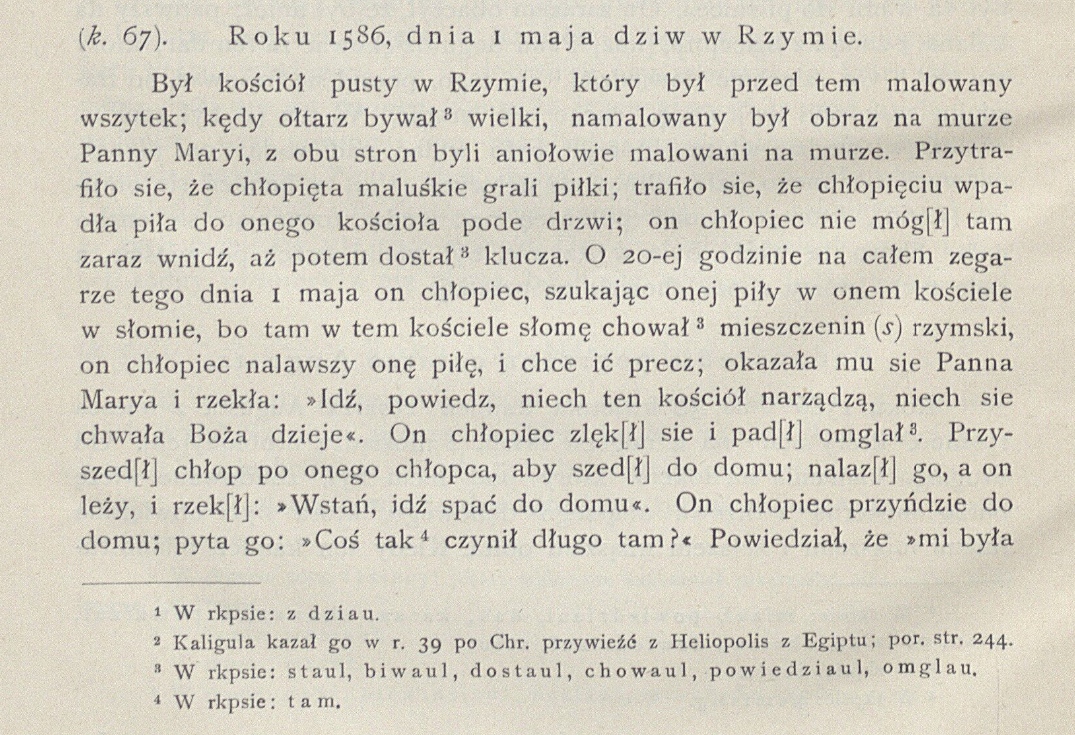
The published work describes how – on sheet 67 of the manuscript – Rywocki and his companions came across a mighty memorial stone placed in honour of Augustus.  Rywocki also describes on the same page below a miracle whereby a boy who lost a ball (which fell into a local church) saw the Virgin Mary appear to him.  In both of these descriptions – of the stone and of the church miracle – Rywocki spells  what in the literary language of the day presumably should have been an “l” as a “ul” instead.  This same “phenomenon” appears in other parts of the manuscript.

omglau

The published work and – perhaps too – the manuscript were examined by the Polish linguist and literary historian Aleksander Brückner.   Brückner published his great Polish etymological dictionary in 1927 and, under the definition of the word “narzecze” (roughly, “dialect”) he stated the following to describe a process that had been referred to before as “wałczenie” – that is the replacement (or rather alleged replacement) of the “l” sound by the “w” sound:

brucknr

“Another aspect [of dialects], wałczenie, the [bi]labial pronunciation of the liquid ł [as opposed to dental], even more widespread [than mazurzenie], newer [why?], in the 16th century among the peasants constantly mocked [by whom Brückner does not say], it [i.e., this aspect of the peasant dialects] does not appear in the literary language (maybe in Mazur Rywocki’s [writing] who wrote in the year 1584 omglau, posłau, kardynau, etc.).”

bruckner2

Thus, Brückner claims that wałczenie was a “linguistic development”  That it was “newer” than mazurzenie.  That it was not reflected in the Polish literary language (by this he means that it was not reflected in the orthography of the day) except, perhaps, for the first time in 1584 in Rywocki’s writing (Brückner calls Rywocki a “Mazur”, i.e., a man from Mazuria).

Several things come to mind.

First, Brückner nowhere (at least not that we know of) shows why either of these dialectic aspects was a “development” from the “proper” Polish or Slavic in the first place.  Absent some other evidence, the only way to make this claim it seems is to assume that the Eastern/Southern Slavic languages were more ancient than the Western ones.  But that, in turn, may presuppose the direction of Slavic migrations – a question that (as our friend points out) we are trying to answer here in the first place.

Second, Brückner does not say that this development “occurred” in 1584 or in the “last quarter of the 16th century”.  He merely notes that the earliest evidence of the process in the literary language was – in his view – the Rywocki manuscript/book.  This is in stark contrast with claims that the “l” became a “w” sound “in the last quarter of the 16th century”.

Third, as to the geographic scope of these phenomena.  Brückner says that wałczenie was an even more widespread aspect of Slavic dialects than mazurzenie.  What does he mean by “widespread”?   Does he mean among the populace in the regions in question (wherever they may have been) or does he mean it more in a geographic sense?

Well, earlier in the same paragraph Brückner states that mazurzenie is itself quite “widespread.”  It is absent in Great Poland and in Kashubia, southern Silesia and also absent from the literary language.  This leaves – for Poland – Little Poland (around Cracow) and Mazovia (around Warsaw) as well as, obviously, Mazuria (i.e., southern portion of East Prussia).  But Brückner states that this process of mazurzenie is not exclusively Polish and that it covered entire Pomerania “even beyond the Elbe (and there it is found already around the year 1000), so also Old Prussia (in the 13th century) and Latvia, and reaches to Great Novogrod.”  If we take Brückner at his word and assume that wałczenie was even more widespread (in the same geographic sense that he just discussed for mazurzenie) than mazurzenie, then given what he wrote we are unsure of how even to limit wałczenie‘s geographic scope.

Fourth,  as to the chronology.  Brückner claims  that mazurzenie was already present around the year 1000 in Polabia…  (Assuming this to be true (he does not say here in which portions of Polabia), we cannot, however, conclude that it moved West to East from there for the simple reason that the state of knowledge at the edges of the Frankish Empire was greater than further East).  Brückner does not tell us here why  wałczenie is supposed to be younger (and how much younger) than mazurzenie.  But even if it were younger, given Brückner’s dates we could assume a time as early as the 11th century…  Certainly the end of the 16th century may simply be a time when the pronunciation started appearing among the upper classes of society as well or at least in the literary language – to the extent Rywocki’s diaries may be seen as that.

But there is more.  Given the lack of significant West-Slavic literary samples from before the 16th century and, even more importantly, given the free-for-all nature of Polish grammar and orthography at the time, there is very little that can be said of how written letters were actually pronounced and whether such pronunciation differed geographically, across socio-economic classes, etc.

All that we can really say here was that wałczenie could have been in place – using Brückner’s own assertions:

  • chronologically – maybe since the 11th century but, realistically, as far back as we are able to look.
  • geographically – unspecified, but covering a “more widespread” geographic area than mazurzenie which covered Little Poland, Mazovia, Mazuria, entire Pomerania as far as the Elbe/Laba (with the possible exception of Kashubia (Kashubian language does have an “ł”), Old Prussia, Latvia and Rus as far as Veliky Novgorod
    • whether and to what extent there was a territorial correspondence between these two aspects of “dialects” is not clear from Brückner’s description.

Put differently, there is no specific reason to believe based on the review of the above that the Polish (or Polabian or north-western Russian) peasantry pronounced the word “Slav” as anything other than “Swav” or “Suav” at any time for which we have sources.

Wałczenie a la Barbarum 

But maybe there are some other reasons to think wałczenie first appeared “in the last quarter of the 16th century”.  Here we come to the Kochanowski assertion.

And, what did Jan Kochanowski say about wałczenie?  Well, we have not found the term in Kochanowski…  (BTW it is not clear (to us) where it comes/originates from).

What Kochanowski did say (as Klemensiewicz correctly notes – see above) was that there was a second pronunciation of the letter L and that it was barbarum.  He did so in a book on Polish orthography called “The New Polish Character and Polish Orthography” issued in 1594 which he co-authored with Lukasz Gornicki (i.e., Łukasz (!) [Ogończyk] Górnicki) and Jan Januszowski.

orthography

There Kochanowski states the following under the heading for the letter “L”:

Polish:

L. L, dwoje: jedno łacińskie, które tak pisać: ladaco, lód, wilk, ktokolwiek. Drugie barbarum, które tak pisać: kłótka, łaskawy, łakomy.”

English:

L. L, two different ones: one is Latin, which should be written as follows: ladaco, lód, wilk, ktokolwiek.  The second barbarum, which should be written as follows: kłótka, łaskawy, łakomy.”

If you look closely you will see what he is talking about – Kochanowski says that the Latin L should be written curling towards the upper right whereas the “barbarum” L should be written with a dash starting at the top of the letter and then heading towards the lower left:

jpg1jpg2

Kochanowski does not say how the “barbarum” L was pronounced, though it is clear that it was pronounced differently from the Latin L.

What is more interesting than what Kochanowski wrote is what his co-author Januszowski wrote.  Januszowski says that he does not like the different ways the same letter is used (i.e., the different pronunciations being associated with one letter).  But he says that (rather than what Kochanowski suggests (i.e., the curling right or the dashing left) which, in Januszowski’s view, may easily result in misspellings because the differences between the Kochanowski suggestions are so negligible), that we should instead leave the Latin l and L as they are and use a second l/L, a “Polish one” with a line through it, i.e., ł or, if capitalized, Ł.

Januszowski also notes that the third author –  Lukasz Gornicki (whose name would be most affected by these changes) – prefers to write – in lieu of the “Polish ł” – a double ll together.

A few points:

  • In none of this is there a suggestion of:
    • how the the letter Ł should actually be pronounced aside from the fact that it is pronounced differently than L;
    • the relative age of the pronunciation of either sound – or even any claim which is the newer one (barbarum simply meant the uncouth, non-Latin pronunciation).
  • Moreover, the fact that:
    • Kochanowski calls the Ł (w?) sound barbarum suggests not just that it was the uncouth, non-Latin pronunciation but that it was the older one, perhaps retained from the past by the peasantry (other than in the East perhaps) – this is because the lower classes, sheltered more from cosmopolitan influence – are more likely to preserve their ancient customs, rites and, yes, pronunciations;
    •  Januszowski calls the Ł a “Polish” letter hints also that the underlying sound itself which the letter was meant to represent may have been local.

Thus, based on this early book on orthography we are inclined to suggest that – notwithstanding Klemensiewicz and Brückner – the “w” pronunciation was at least as ancient as the “l” pronunciation with the difference (at least as far as the eye can see) being more geographic than chronological.  If one were to extrapolate from the above, one could tentatively associate the North and Northwest of Slavdom (Suavodom?) with the “w” and the East, the Southeast and the South with the “l”.

(Of course, the chronology of all of these is likely to be very complicated but we can say “at least for all practical purposes relevant here” – e.g., what the pronunciation may have been 4,000 years ago is anyone’s guess).

Wałczenie a la Parkoszowic

We also note that the question of how to spell some of these sounds was already tackled by our friend  (see here and here) Jakub Parkoszowic in his much earlier (circa 1440) treatise on orthography (this was a first known attempt to standardize Polish orthography):

1mention

“{ll} And so also the ‘l’ sometimes hardens, sometimes weakens, for example, [in] list it is a letter [used] for [the word] ‘leaf’ [but] listh is a part of a leg; lis that is a ‘fox’ [but also] lisz that is a ‘bold person’; despite the fact that all else remains the same, [the ‘l’] is once harder once softer; so [also] at the end [of a word], For example, Staal that is ‘steel’ [and] staal [that] is ‘he stood’.”

Note: Parkoszowic calls:

  • the “Latin L/l” a “soft L/l”; and
  • today’s “Ł/ł” (i.e., pronounced today as “u” a “ue/ua” or “w”) a “hard L/l”.

thus, stal as in ‘steel’ is pronounced as it looks in English (“softly”) but stał is pronounced ‘stau’.  

He continues further in the text:

2mention

“And let also the hard ‘l’ be written without the dash.  For example, lapka, lekce, liszego losze ludzy lothka.  But let the weak ‘l’ be written with a dash at the top.  For example, laasz, lis, loch, lesch, ludze, ląnkawka.”

Finally, he says:

3mention

“And so also with ‘l’.  If we decide to represent the soft ‘l’ by using [after it] a double ii [he means a ‘y’ so that the whole thing is written ‘ly’], in some cases that will be appropriate, in others absolutely not.  Thus, lyschka that is a ‘fox’, lysska is a ‘caterpillar’, lysth is a ‘leaf’.  Whereas, in accordance with what has been said above – each vowel that is written with two letters should be pronounced as a long [vowel], in all the above examples [the vowel] is a short one.  This is the first example of nonsense [in the current orthography].”

Note: Parkoszowic means that if we indicate the soft (Latin) ‘L’ by writing a ‘y’ after the ‘L’ then the impression would be that the vowel that follows the ‘L’ should be a long one (e.g., leeeeeeeeaf) which is wrong at least in some cases.  Thus, in fixing the pronunciation of the ‘L’ we give the subsequent vowel is to be pronounced.

“And also if one adds a double y to an ‘l’ that occurs at the end of a word then hat will result in a confusion of meanings.  For example, staal that is ‘steel’.  If after the ‘l’ one were to write a ‘y’, we would get staaly, which means ‘they stood’.  So where is [what happened to] our ‘steel’?  If we were to write without the ‘y’, then we would have  stal that is ‘he stood’.  That’s the other problem.”

“It would be better to express the difference [in pronunciation], if we were to write the hard ‘l’ without a dash, [but] with a ‘staff’ [instead]; hence, staał łyssy, that is ‘he stood [i.e., became] bald’ [current Polish: stał [się] łysy – ‘he became bald’]; whereas, the soft ‘l’ without adding the ‘y’ [such as] stal that is ‘steel’, listh that is ‘leaf’, luud that is people.”

Note: Thus, Parkoszowic in his treatise (written circa 1440) opted, in resolving the issue of a double pronunciation of the letter ‘L/l” to:

  • keep the “Latin” L/l as an L/l everywhere (no changes there); and
  • to create an additional letter – Ł/ł – to represent the “w/ue/ua” sound (as in Suevi or Suavi).  That additional letter would not have a dash going towards lower left on top but rather have a line or “staff” through it.  A century and a half later, years later in choosing the same “staff” crossing an ‘L’ to represent the “hard L”, Jan Januszowski would agree with Parkoszowic (Kochanowski, as we saw above, preferred the dash).

Conclusion

Based on our review of the sources, it seems the above claim 3 has absolutely no basis in any of the sources we saw or that are cited by its proponents.

rocznk

Consequently, we feel confident once again to reiterate that – at least among Western and Northern Slavs – the “L” was pronounced as a “ue” as far back as anyone can see.  The only exception to that seem to have been portions of the nobility.  We are willing to be convinced otherwise, of course but are not holding our collective breaths.

reve

Stefan Kulbakin making the same point in the Slavic Review

Copyright ©2015 jassa.org All Rights Reserved

October 13, 2015

Wulfstan (& Ohthere) on the Wends (and a little bit on the Esti)

Published Post author

We’ve discussed chapters 11 & 12 of King Alfred’s Orosius which chapters deal with Europe’s geography previously.  What follows those chapters are accounts of:

  • the explorations by Ohthere who sailed along the Norwegian coast all the way to the White  Sea (chapters 13-19);
  • the trip of Wulfstan who travelled from Denmark to the Prussian town of Truso (chapter 20), and
  • the customs of the Esti, by which the writer of Alfred’s book meant the various Baltic tribes (chapters 21-23).

We will get back to Esti (Balts) later (they appear in Tacitus, Jordanes, Cassiodorus and Alfred’s Orosius) as they provide useful clues to the location and identity of the Veneti.  With one exception we will not spend time on Ohthere as his trip was not through Slavic lands.  But we do want to give the full (a shorter version was previously discussed here) account of Wulfstan as he travelled to Truso along the entire Pomeranian coast and so we do that here (we also note the one mention of the Wends in the Ohthere account at the end of chapter 19).  As with the Geography section before, we first give the Old English versions followed by the English.

As before, a reminder on the Old English letters is in order:

  • Þ þ – “thorn” – basically a “th”;
  • Ð ð – “eth” – roughly the same “th”;
  • Æ æ – “ash – representing a middle sound between “a” and “e”;

sweonla

Chapter 19

Ohthere’s Account – Last Section

Old English 

“And of Sciringes heale he cwæð þæt he seglode on fif dagan to þæm porte þe mon hæt æt Hæþum; se stent betuh Winedum, and Seaxum, and Angle, and hyrð in on Dene. Ða he þiderweard seglode fram Sciringes heale, þa wæs him on þæt bæcbord Denamearc, and on þæt steorbord widsæ þry dagas;  and þa, twegen dagas ær he to Hæþum come, him wæs on þæt steorbord Gotland, and Sillende, and iglanda fela.  On þæm landum eardodon Engle, ær hi hider on land coman.  And hym wæs ða twegen dagas on ðæt bæcbord þa igland þe in Denemearce hyrað.”

English

“From Sciringes heal he said that he sailed in five days to the trading-town called Hedeby, which is situated among Wends, Saxons and Angles and belongs to the Danes. When he sailed there from Sciringes heal he had Denmark to port and the open sea to starboard for three days. Then two days before he arrived at Hedeby he had Jutland and Sillende and many islands to starboard. The Angles lived in these districts before they came to this land.  On the port side he had, for two days, those islands which belong to Denmark.”

othetherewulfstani

11th century MS BL Cotton Tiberius B.i

Chapter 20

Wulfstan’s Account

Old English 

“Wulfstan sæde  þæt he gefore of Hæðum, þæt he wære on Truso on syfan dagum & nihtum, þæt þæt scip wæs ealne weg yrnende under segle.  Weonoðland him wæs on steorbord, & on bæcbord him wæs Langaland, & Læland, & Falster, & S[c]oneg; & þas land eall hyrað to Denemearcan.  & þonne Burgenda land wæs us on bæcbord, & þa habbað him sylf cyning. Þonne æfter Burgenda lande wæron us þas land, þa synd hatene ærest Blecingaeg, & Meore, & Eowland, & Gotland on bæcbord; & þas land hyrað to Sweon.  & Weonodland wæs us ealne weg on steorbord oð Wislemuðan.  Seo Wisle is swyðe mycel ea, & hio tolið WitlandWeonodland;  & þæt Witland belimpeð to Estum; & seo Wisle lið ut of Weonodlande, & lið in Estmere; & se Estmere is huru fiftene mila brad.  Þonne cymeð Ilfing eastan in Estmere of ðæm mere ðe Truso standeð in staðe, & cumað ut samod in Estmere, Ilfing eastan of Estlande, & Wisle suðan of Winodlande.  & þonne benimð Wisle Ilfing hire naman, & ligeð of  þæm mere west & norð on sæ; for ðy hit man hæt Wislemuða.  Þæt Estland is swyðe* mycel, & þær bið swyðe manig burh, & on ælcere byrig bið cyningc; & þær bið swyðe mycel hunig, & fiscað; & se cyning & þa ricostan men drincað myran meolc, & þa unspedigan & þa beowan drincað medo.  Þær bið swyðe mycel gewinn betweonan him; & ne bið ðær nænig ealo gebrowen mid E’stum, ac þær bið medo genoh.”

swyðe as in “very, exceedingly or severely” – see, for example, the River Swider.

English

“Wulfstan said that he travelled from Hedeby, arriving in Truso after seven days and nights, the boat running under sail the whole way.  To starboard he had Weonodland, to port Langaland, Laeland, and Falster and Skane [?].  All these lands belong to Denmark.   And then we had Burgenda land [Bornholm?] to port, where the people have their own king. Then after Burgenda land [Bornholm] we had on our port side the lands which are called Blekingey, and Meore, and Eoland [Oeland] and Gotland, and these lands belong to the Swedes.  And we had Weonodland to starboard, the whole of the way to the mouth of the Wisle [Vistula] [i.e.,Wislemuðan].  This Wisle [Vistula] is a very large river and she separates Witland and Weonodland;  Witland belongs to the Este.  The Wisle [Vistula] flows out of Weonodland and into Estmere; and the Estmere is indeed [here?] fifteen miles wide.  The Ilfing flows into Estmere from the lake on the shore of which the town of Truso stands, and they flow together into Estmere, the Ilfing east of [out of the East from?] Estland and the Wisle [Vistula] south of [out of the South from?]** Weonodland.  And there Wisle [Vistula] deprives the Ilfing of its name and lies/flows north-west towards the sea as from then on the [estuary] is known as the Wislemuda [Vistula estuary].  This Estland is very large and has many fortified settlements [burgs], and in each of these there is a king.  And there is a great deal of honey and fishing.  And the king and the most powerful men drink mare’s milk, the poor men and the slaves drink mead. There is very much strife among them.  And there is no ale brewed among the Este but there is plenty of mead.”

** The translations correct this to say that the Ilfing flows west and the Vistula north but the text says the opposite – we provide an alternative form of reading as in “out of”.


shiffern
A Description of the Esti follows thereafter as to which we shall have more to say later.

Copyright ©2015 jassa.org All Rights Reserved

September 28, 2015

On Tryglav in Brandenburg

Published Post author

We have previously made reference to a Leibniz’ edition of Scriptores Rerum Brunsvicensium, a book that is a compilation of various documents of out of the Duchy of Brunswick.  There we discussed the mention in volume I of the same of the Polabian Gods Hammon, Swentebuek, Vitelubbe  and Radegast.  Well, Hammon, is a questionable one even though mentioned there.

scriptoresses

In any event, the same compilation also mentions – in volume II – the Pomeranian three-headed God Tryglav as part of the Fragmentum genealogiae ducum Brunsvicensium et Luneburgensium (that is, the genealogical fragments regarding the dukes of Brunswick and Luneburg).  Here, however, he is mentioned as a God worshipped in Brandenburg.  We now include that other reference here with a translation, of course.

fragmentum

Huius temporibus fuit in Brandenburg rex Henricus, qui Slavice dicebatur Pribezlaus, qui Christianus factus, Idolum, quod in Brandenburgh fuit, cum tribus capitibus, quod Tryglav Slavice dicebatur, et pro Deo colebatur, et alia Idola destruxit, et idololatriam et ritum gentis sue detestans, cum filium non haberet, Adelbertum Marchionem, dictum Ursum, haeredem sui instituit principatus.

“At this time, there was in Brandenburg King Henry, whom the Slavs called Pribislav, who became a Christian and he destroyed the idol that had three heads and was worshipped as a God in Brandenburg and that the Slavs called Tryglav and other idols and idolatries and rites among his peoples that he detested; when he did not have a son, Albert called the Bear inherited [the March of  Brandenburg].”  

Pribislav was the last Slavic duke of the Hevelian Wends.  Henry was likely his baptismal name.  Without an heir he gave the Brandenburg area to his son-in-law in 1129.  That son-in-law’s father was Albert the Bear who subsequently took over the area after Pribislav/Henry died in 1150.

brunsvicensis2

The same story appears in Tractatus de urbe Brandenburg and in the Brandenburg Chronicle.  These mention the three headed god but not his name.  Whether it be true that the Saxons too worshipped Tryglav, whether the Polish duke Iaszon/Jaczon/Jacze has anything to do with Jassa and who the Zucham were we leave to the readers.

kroniken

Copyright ©2015 jassa.org All Rights Reserved

September 6, 2015