Category Archives: Religion

Polabian Gods Part Vd – Peace Comes to Arkona

Published Post author

We continue with Saxo’s narrative:

The Negotiations

“When all hope had left the inhabitants of the city and all that was before their eyes was death and destruction, one of them that was [fighting] at the breastwork, yelled loudly at Absalon and demanded to speak with him.  Absalon asked to go to the quietest quarter of the city, away from all the noise and spilled blood and there he asked the man what was it that he wanted.  He then called upon Absalon, adding great gesticulation to his words, for a halt to the Danes’ attack such that he inhabitants could [properly] surrender [i.e., presumably until the fire was put out].  To which Absalon answered that there could be no talk of the stopping of the attack unless they [the Arkona denizens] should first stop putting out the fire.  The Slavs agreed to this condition and thereafter Absalon immediately brought the other man’s plea to the King.”

absalonpeaceful

Absalon offering peace

“The King ordered all his commanders recalled from the field so as to take counsel with them in this matter; and Absalon said then that they should do what the Slavs asked for for the longer the whole thing lasted, the less likely it was that the inhabitants could put out the fire and if they won’t be able to do that then the fire will defeat them even if the Danes were not involved in that; so that even if they  did nothing, by letting the fire spread destruction they will have achieved that which they could not have achieved by their own strength.  Despite the fact that they refrained from the battle for some time, one could not call them idle for without endangering themselves, they let other forces fight on their side.”

arkoniaacceptance

Arkonian commander agreeing with the peace proposal “in concept”

[yes, we know this passage does not entirely make sense]

The Church Partakes of the Terms  

“This advice found general approval and the King made peace with the Arkonians on the condition that the statue should be handed over together with all of the temple’s treasury and that all the captured Christians should be set free without ransom and that the Christian rite should be adopted just as it was practiced in Denmark.  All the land that had been given to the God/idol [i.e., all of the temple’s lands] were to henceforth benefit the Christian Church [instead].  And should conditions demand it, the populace were to follow the Danes when called upon and could not refuse this military service when the King should order it so.  Furthermore, they were supposed to pay an annual tribute in the amount of forty silver coins for each pair of oxen and to deliver this many hostages to ensure that they should meet these conditions.”

The Plebes Don’t Get It

“When the warriors who were eager for blood and booty heard of this there was great commotion and bitterness among them and they began loudly complaining that their reward for victory was taken from them now when they were so close to getting it such that they received nothing for their great effort other than wounds and scars and also complaining about the fact that their right to vengeance was not given them, which [right] they thought was due them, for all the harms caused them by the enemy which enemy they now had almost defeated; now, they said, one ought to think about their welfare for they could now with harry an effort [finally] take retribution against [the Arkonians] for all of their [the Arkonians’]  raids and all the tragedies which the others [Arkonians] caused in Denmark.  They threatened to leave the King for he refused them permission to take the city and preferred a paltry sum of cash in lieu of a great victory.”

The King Makes a Strategic Withdrawal From His Own Camp While Absalon Talks

(And Talks)

“The King who got angry at such talk, left the camp with his commanders so as to be away from all this whining and yammering and he asked them [the commanders] if they thought that they ought to accept the surrender of the city or to give it as a reward to the troops.  When these called upon Absalon that he should sayeth what he thinks, he observed that one could take the fortress though not without a lengthy siege.  For he [Absalon] knew well, and so said, that the people will take his words unkindly but that he would rather cause them displeasure by giving wise and useful advice than to endanger their welfare by foolishly agreeing with them/meeting their expectations [as to his advice].  Even were the fire kindled rather by God’s miracle than by a man’s hand [here he seems to be denying that the young Dane set the fortifications on fire but rather attributing this to a fortuitous divine judgment], should turn the tallest portion of the walls into ash which top part was made of wood and turf, so the lowest part of the wall, which was of stouter construction, will remain and that part was so tall that it would not have been easy to get at the enemy.  One needed to consider too that the inhabitants of the town had fixed almost all the places that had earlier been consumed by fir, by filling the missing pieces with clay and that the flames not only brought harm to them but also served as cover for their fury hindered the Danes in their assault inasmuch as it hindered these others in their defense.  And further he observed that should mercy not be given to the Arkonians then as a result the other towns of the Rugians – by hard necessity driven to bravery – will resist them the stronger the greater should be their desperation; if, on the other hand, they should learn that peace has been agreed to with Arkona it will be easier for [the other Rugia cities] to follow that example and they will think about survival and when one is able to have the better [outcome] of taking many cities with one battle rather than pigheadedly remaining at the siege of one, one ought not to reject the surrender proposal.  Though [he said] should a majority have a different opinion then, in any event, the hostages should be sent back unharmed so that no one could say that they were maltreated and that the Danes, contrary to their own customs, deceitfully broke their own promises.”

Absalon’s Boss Weighs In 

“With this opinion agreed to Archbishop Eskil [of Lund] for he said that the commoners should listen to their lords not the lords to the commoners and that it would not do for the high-born to take direction from the low[-born].  And, further, that one could not achieve a more desired outcome/victory than the forcing of a pagan people not only to pay tribute but also to accept Christianity.  He explained to them too that it would be better to help the Arkonians against other enemies [e.g., Saxons] than, in obstinacy, deprive them of their lives, for having your enemies bend their knees to you is better than killing them for mercy is better than cruelty.  And further that it is better to conquer many towns with one battle than to prefer the storming of one rather than the taking of all.”

“In so setting out the matter he convinced the commanders of the rightfulness of his and Absalon’s opinion and the King, thanks to them [Absalon, Eskil and, maybe, the turned commanders], grew stronger in his intention to ignore the discontentment of his warriors.  Absalon now ordered them to go and get something decent to eat while he himself began the preparations for the accepting of the hostages of whom a part was children and a part parents for they [the parents] received the right to be held hostage in the place of the children until the next day.”

Copyright ©2015 jassa.org All Rights Reserved

April 3, 2015

Polabian Gods Part Vc – Meanwhile at the (Continuing) Siege of Arkona

Published Post author

We continue here with another installment of the siege of Arkona (yes, in English) as told by our friend Saxo Grammaticus.  The prior parts are here as well as here.

The Soldiers Prepare While the Youth Cannot Bear to Be Contained

“In the meantime the army began all kinds of works demanded by a siege; some were building sheds for the horses, others raised tents and undertook different necessary things.  While the King, by reason of the great heat that was present during the day, took quiet refuge in his tent, Danish boys, who in their excitement dared to approach the fortified wall, began to sling stones at the fortifications.”

vikinglittles

Viking children were ever so cute

“The Arkonians seemed rather amused by these ideas and refrained from using weapons against such play so that they preferred to look at the boys rather than to chase them away.”

taunting

The Arkonians continued to be unimpressed

“There also appeared there young men who began to compete with the boys in provoking the inhabitants in the same way [i.e., by slinging stones].  And these [the inhabitants] became bored with idly watching and forced to do so grabbed their weapons.  More of the youth now dropped their work and ran so as to relieve their companions but the knights viewed all this as children’s play.”

Playing with Fire or Things Get out of Hand

“Thus, something that in the beginning had no importance and that would not otherwise deserve mention, quickly escalated into a violent fight which could not be any longer ignored and child’s play grew into a serious battle amongst men.  The earth that filled up the gate collapsed in the meantime somewhat and there a hole or a fissure was formed therein such that there became a large opening between the tower and the turf wall.  This was noticed by an unusually brave young man, of whom truthly not much more is known, and he noticed that a good occasion arose to bring about what had been planned all along; he asked his companions that they should help him climb up and should they do that, so would the city be immediately taken and  victory achieved.  When they asked him how they could be helpful to him, he said that they should stick their spears in-between the turf patches so that he could climb up on them as if on a ladder.  When he so made his way upwards and saw that inside this hole he could be sure that the enemies could not cause him harm, then he demanded some straw that he could set on fire.”

M8DCAAW FE002

The brave young Dane’s idea saved countless (Danish) lives

“When they asked him whether he had something to start the fire with, he answered that he did have fire steel and flint and told them that they should help him get down once the fire starts up.  When they looked for something to start the fire with, that which they looked for just happened into their hands.  There came there someone with a wagon full of straw that was meant to be used for something entirely different.  They took this from him and tossed bundles of straw to each other and passed them on spears up to this young man and soon the entire hole was filled with straw and all this happened without any danger for the tower was entirely abandoned.  The inhabitants, namely, had no idea what was happening there and the enormous size of the tower also served to deceive them and the wide piles of earth on each side served to provide cover for the Danes.  When the fire started and the tower stood in flames, the one who had set the fire and so took the first step towards giving his companions victory, climbed, with their aid, down.”

Oh, Crap

“When the inhabitants noticed smoke they were so shocked by this unexpected danger that they did not know whether they should rush to put out the fire or to attach the enemy and when they finally calmed down then with all their strength they went to fight the fire and began to try to put it out without paying attention to the enemy, whereas the Danes tried to impede their firefighting efforts and they tried to keep the fire going with the same determination as the others were fighting it. ” 

arkonafire

Arkona – main temple complex on fire (the head priest’s horseless carriage WAS saved – a bittersweet solace)

“When the Arkonians finally ran out of water, they poured milk onto the flames, but the more they poured, the more did the flames erupt and so the result of all this was that the fire was rapidly spreading.”

Absalon Takes Charge

“All these screams and yells roused the King to come out of the camp and see what was happening there and when he saw how things stood he was confused and could not judge rightly whether this fire would be of importance/helpful to taking the city and therefore he asked Absalon, what they should be doing.  He [Absalon] asked the King not to get involved in child play, and not to jump into something prematurely, before the whole matter has been examined, and asked strongly for permission for him to go and investigate closer to see if the fire could help him [the King] take the town.”

helmetskis

Absalon (left) takes charge at Arkona

“He [Absalon] then left without delay to investigate the situation and approached the gate only wearing a helm and carrying a shield, and he called on the young men who were trying to storm the gate for them to spread the fire.  Those now fueled the fire from all sides so that the columns and supports became engulfed in flames and the floor of the tower burned down and flame rose to the top and turned all the banners of [their] God and other insignia into ash.”

The King Casually Enjoys the Slaughter From a Distance

“When Absalon reported all this to the King, he [the King] ordered, upon Absalon’s urging, to surround the city and [then] the King] sat down on a chair to outside the camp to watch the fighting.”

kingofvikings

Given his age King Valdemar mostly enjoyed sitting, watching and playing with… but that children is another story

“A certain brave young Danish man was hellbent on reaching the earthwork first ahead of the others and when he was mortally wounded he made it seem as if he had jumped down [from storming the ramparts?] of his own volition rather than being tossed down [by the enemy] so that it is difficult to say whether he earned greater glory fighting or dying.  The Pomeranians who had the privilege to fight in front of the King also showed uncommon bravery attacking the town under the leadership [of their dukes] Kazimir and Boguslav and King looked at them with admiration and satisfaction seeing them fight so wonderfully.”

“When the Rugians were thus twice placed in danger many fell to the fire whereas others fell to the spear and no one could tell whether they should be more afraid of the fire or of the enemy, but some forsook their own welfare and defended the town with such firmness and relentlessness that they did not succumb until the burning ramparts lay in ruins and those who fell on the city’s walls were consumed by the same flames as if on a common pyre;”

arkonafinal

The times they were different

“for they harbored such great love for the walls of their native city that they much preferred to fail together with them than to live through their collapse.”

Copyright ©2015 jassa.org All Rights Reserved

March 28, 2015

On the Far North

Published Post author

We have mentioned that the God Jassa seems to have been worshipped among the Ilmen Slavs (the name does sound vaguely Finnish, maybe?).  Lake Ilmen far in the (European) Russian North.  Further North and East is Lake Onega.  if you go a bit further East you get to a town called Kargopol.  It sits on the River Onega which empties into the White Sea.  The river starts, however, at another lake, not too far from Kargopol.  Here is a copy of a 19th century Gazetteer of the World (Volume 5) that describes the name of that lake.

lagoyasayo

In fact, the same is confirmed by a 1720 French map of the region (Yacz):

yacz1720

A 1568 Italian one seems less clear on the point (Ossoisera?):

anothermap1568

Interestingly, the lake’s current (or perhaps alternative?) name appears to be Ozero Lacha or Lach Lake.   Maybe one name is Slavic and the other Ugro-Finnic?  Perhaps.

lachareally

We are aware that “jassa” in North Saami (in Skolt Saami it is jocc or jece) means a patch of snow (up in the mountains in the summer) (see, for example, “On Germanic-Saami contacts and Saami prehistory” by Ante Aikio.  (Ante… Antes… Antes.  Hmmmm!) so there is a perfectly legitimate Saami explanation.  But someone might claim that a summer patch of snow does seem “light” i.e., “jasny” in comparison to whatever it lies on.

But we also know that Norwegian Sami also refer to lakes that are not quite lakes but not quite puddles either as “jassa” (see the Book of Informatics by Gammack, Hobbs and Pigott) and this is after all a lake.  But the Saami do not live that far south (this actually is south for the Saami!).  And as for the Lacha – well, for one thing, Kargopol was at one point besieged by a Polish-Lithuanian army so maybe that’s the source of the name or maybe it comes from Łacha or something like that.

Of course, all of this is more that likely.

On the other hand, it may be that it is not Saami that we should be focusing on but the Veps people.  After all it is the Veps people that live in the area of Lake Lacha.  You might say, ok, so what?  Well, there is something interesting in a 2014 genetic study of Europeans by Peter A. Underhill, et al.  That study has become a focus of many a discussion but we will not try to engage in polemics regarding the study’s main findings.  Rather we merely point out this curious diagram found on the pages of the Underhill study.  It shows the relative closeness (within the R1a group) of the various Slavic and certain other peoples (really geographic locations).  They are so close that they need to blow out the box in the lower left corner to show differences between them.  Makes sense?  Now look closer at “Poland” and what’s next to it.

underhill

That’s kind of a fun fact of the day.

Copyright ©2015 jassa.org All Rights Reserved

March 27, 2015

Polabian Gods Part Vb – Saxo Grammaticus on the Siege of Arkona

Published Post author

We continue here with the story of the Danish invasion of Ruegen in 1168 as told by Saxo Grammaticus.  The first part is to be found here.

The King Has a Feeling

“The [Danish] King was filled with a desire of destroying their fortifications no less than he wanted toe stroy the pagan cult which was present in this town; he believed, namely that if he were able to tame Arkona, then all of paganism  on Rugia would be destroyed for he had no doubt that so long as this statue stood, it was easier for him to conquer the country’s fortifications than to defeat the pagan cult.  In order to bring the siege to a quicker end, all of his warriors greatly labored on his orders to bring from nearby forests many a tree trunk that could be used to build siege engines.  Whereas the engineers began to build [the siege engines], he appeared among them saying that their hard labors won’t bring any benefits and that the town will fall in their hands faster than they expected.  When he was asked why he thinks this, he answered that he arrived at this conclusion for the following reason.  He said that the Rugians at one time were conquered by Charlemagne and they were then ordered to pay tribute to the Abbey (of Saint Vitus) in Corvey, who became known thanks to his martyr’s death; but when Charlemagne died, they immediately dropped the enslaving yoke and returned to paganism; they then supposedly raised at Arkona this statue that they called Saint Vitus [i.e., Svantevit] and on whose worship they used all the money that earlier had been sent to Saint Vitus at Corvey with whom/which they now wanted nothing to do, for they said, that they were satisfied with the Saint Vitus [i.e., Svantevit] that they had at home and they felt no desire to subordinate themselves to some foreign [one].  Therefore, Saint Vitus, given that his day was drawing closer [i.e., the day of the feast of Saint Vitus]  will destroy their walls as a penalty for them having portrayed him in such a barbarous way; they have earned his wrath for they have established a blasphemous cult in lieu of a holy commemoration [of his].  This was not revealed to him in a dream, said the King nor did he arrived at this conclusion from analyzing any occurrence that may have happened, but rather he only had this strong conviction/feeling that this is what had to happen.”

But His Warriors Are More Pragmatic

“Such prophesy generated more doubt than belief in it, and because the island on which Arkona stood that was called Wittow was separated from Rugia by only a thin strait that was only so wide as a small river and it was feared that the Arkonians could get reinforcements by this path, people were sent there so as to guard the ford and prevent the enemy from crossing.  With the rest of the army he [the King] besieged the city paying careful attention to pace the catapults close to the walls.  Absalon was tasked with dividing the people and telling them where they should set up camp and in order to do this he measured the country between both shores exactly.”

And the Arkonians Are More Impressed with Their Banner

“In the meantime the Arkonians filled the gate with a great quantity of earth so as to make it harder for the enemy to attack it and they blocked access to it with a wall made of turf and this filled them with such confidence that they neglected to post warriors in the tower over the gate but only hanged there several banners and pennants.  One of their insignia that stood by reason of its color and of its size was called Stanica and the Rugians venerated this banner with such great reverence as almost all of their Gods taken together, for when it was carried in front of them they believed that they had sufficient might so as to challenge both gods and men and that there was not a thing they could not [lawfully?] do then [with the banner at their front] if they so should choose to such as plunder towns, destroy altars, commit dishonorable acts and to turn houses on Rugia into ruins.  They were so tremendously supersticious when it came to this rag that they ascribed to it more authority and power than to a kingly [banner] and they venerated it as a divine standard, and even those who had been harmed [by the bearers of it] gave the banner great reverence and honor, irrespective of hoe much harm it brought them.”

nottakingthisseriously

BTW Note that the Stanica banner is also mentioned by Thietmar in his description of the temple at Radogost/Riedegost.

Copyright ©2015 jassa.org All Rights Reserved

March 13, 2015

On the Venerable Bede, Jastarnia, Yesterday and Facing the Past or Future

Published Post author

invulnerable

The Venerable One at Work – unbeknownst to His Venerm, He was about to cause some future controversy

 On the Most Venerable Bede

The English and very Venerable Bede (circa AD 672/3 – AD 735) was one of the most famous and accomplished medieval scholars.  In point of fact he was so significant a figure and so respected that to this day we call him the Venerable Bede (it could be that in combination with the fact that Bede just seems too short a name for a monk of any stature).

He was respected in his day and age (7th/8th centuries).

He was respected in the 11th and 12th centuries our esteemable (but note not “Esteemable”) William of Malmesbury relied heavily on Bede in constructing his own works.

And the relevance of Bede continues to this day!  It seems he has been at the center of a feud over the meaning of Easter between normal Christians on the one hand and fundamentalist Christians/fundamentalist atheists on the other hand.  The relevant passages are about the word Easter and its origin and are in the work called Of the Reckoning of Time (De temporum ratione), specifically in Chapter XV entitled “Of the Months of the English” (De meniscus Anglorum) in which Bede tackles the origin of the English month names, relating the original name for April to be Easter-monat, which he then derives from the name of an alleged Anglo-Saxon goddess Eostre leading the self-righteous in our society (and our society lately abounds in the self-righteous) to point out the rather obvious that Easter has pagan roots and then claim that those ever so-silly Christians had no idea how foolish they were.  Boohoo.  Here is what Bede actually says:

venerabilisintroaascationsis

“In the days of old the English people, for it did not seem fitting to me that I should speak of other nations’ observance of the year and yet be silent about my own nation’s – calculated their months according to the course of the Moon.  Hence, after the manner of the Greeks and the Romans [the months] take their name from the Moon, for the Moon is called mona and the month month.”

(Antiqui autem Anglorum populi (neque enim mihi congruum videtur, aliarum gentium annalem observantiam dicere, et meae reticere) iuxta cursum lunae suos menses computavere; unde et a luna Hebraeorum et Graecorum more nomen accipiunt. Si quidem apud eos luna mona, mensis monath appellatur).

“The first month, which the Latins call January, is Giuli; February is called Solmonath; March Hrethmonath [sic – see below]; April, Eosturmonath; May, Thrimilchi; June, Litha; July, also Litha; August, Wodmonath; September, Halegmonath; October, Winterfilleth; November, Blodmonath; December, Giuli, the same name by which January is called.  They began the year on the 8th kalends [December 25th], when we celebrate the birth of the Lord.  That very night, which we hold so sacred, they used to call by the heathen word Modranecht, that is, mother’s night”, because (we suspect) of the ceremonies they enacted all that night.”

(Primusque eorum mensis, quidem Latini Januarium vocant, dicitur Giuli. Deinde Februarius Sol-monath, Martius Rhed-monath, Aprilis Eostur-monath, Maius Thrimylchi, Junius Lida, Julius similiter Lida, Augustus Vueod-monath, September Haleg-monath, Oktober Vuinter-fylleth, November Blod-monath, December Giuli, eodem Januarius nomine, vocatur.  Incipiebant autem annum ab octavo Calendarum Januariarum die, ubi nunc natale Domini celebramus. Et ipsam noctem nunc nobis sacrosanctum, tunc gentili vocabulo Modranicht, id est, matrum noctem, appellabant, ob causam, ut suspicamur. ceremoniarum quas in ea pervigiles agebant).

“Whenever it was a common year, they gave three lunar months to each season.  When an embolismic year occurred (that is one of 13 lunar months) they assigned the extra month to summer, so that three months together bore the name “Litha”; hence they called [this embolismic] year “Thrilithi”. It had four summer months, with the usual three for the other seasons. But originally, they divided the year as a whole into two seasons, summer and winter, assigning the six months in which the days are longer than the nights to summer, and the other six to winter.  Hence they called the month in which the winter season began “Winterfilleth”, a name made up from winter and “full Moon”, because winter began on the full Moon of that months.”

(Et quotiescunque communis esset annus, ternos menses lunares singulis anni temporibus dabant. Cum vero embolismus, hoc est, XIII mensium lunarium annus occurreret, superfluum mensem aestati apponebant, ita ut tunc tres menses simul Lida nomine vocarentur, et ob id annus ille Thri-lidi cognominabatur, habens IV menses aestatis, ternos ut semper temporum caeterorum. Item principaliter annum totum in duo tempora, hyemis, videlicet, et aestatis dispartiebant, sex illos menses quibus longiores noctibus dies sunt aestati tribuendo, sex reliquos hyemi. Unde et mensem quo hyemalia tempora incipiebant Vuinter-fylleth appellabant, composito nomine ab hyeme et plenilunio, quia videlicet a plenilunio eiusdem mensis hyems sortiretur initium).

“…Hrethmonath is named for their Goddess Hretha [but see Rheda [Rod?] below], to whom they sacrificed at this time.  Eosturmonath has a name which is now translated “Paschal month”, and which was once called after a Goddess of theirs named Eostre, in whose honor feasts were celebrated in that month.  Now they designate that Paschal season by her name, calling the joys of the new rite by the time-honored name of the old observance…”

venerabilis

Eostre oh Eostre, where does thou come from?

(Rhed-monath a deo illorum Rheda, cui in illo sacrificabant, nominatur; Eostur-monath, qui nunc paschalis mensis interpretetur, quondam a dea illorum quae Eostre vocabatur, et cui in illo festa celebrabant, nomen habuit, a cuius nomine nunc paschale tempus cognominant; consueto antiquae observationis vocabulo gaudia novae solemnitatis vocantes).

With that behind us, let us reinsert ourselves into this “debate”, if only tangentially and with all due attention paid rather more to those matters that actually do concern us – those of the Slavs.

On Jastarnia

There is a small town on the Hel peninsula on the Bay of Gdansk.  At various times in its history it was referred to as Osternese (1582; Kossina, incorrectly, sticks in a 1532), Hesternest (1599), Hesternia (1627), Jasternia (1664) and now Jastarnia.   Now the area in the past was (and some portions of it continue to be) populated by those Pomeranians who go by the name of Kaszubs.  And at Easter, the Kaszubs celebrate Jastry instead of the Polish Swieta Wielkanocne (the Holidays of the Great Night – here too there is no Pascha).  Now most people agree that that is a reference to the German Ostern (i.e., Easter).  Well, there were Germans in Gdansk and the surrounding area.  There were Scots, Dutchmen, etc.  Some of them may well have lived in Jastarnia so if the locals became Polonized or simply took over the German name, that seems like nothing that is very exciting or unusual -so far.  So let’s go on further.

jaestarniaskis

Jastarnia

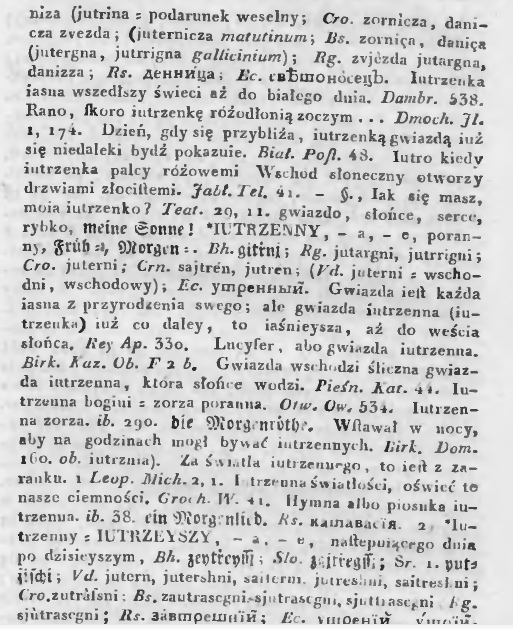
The Hel Peninsula is called that because of the tiny town called Hel at its tip.  Now, its name supposedly derives from Hel, the Germanic goddess of the underworld.  So we have some deities finally.  Maybe.  The Polish etymology points “dune” or to helasz as in “to get away” (as in “get the hell out” or did you think that was a reference to an actual Hell?).  The Linde Dictionary  – that is The Dictionary of the Polish Language (from 1807) by Samuel Bogumił Linde – puts it this way:

helasz1

“Hellaway from land – don’t spare the oars”

The name of the town was originally Gellen or, perhaps, Gellin (as per a Danish Chronicle about a Danish King’s Valdemar II Victorious’ ship that floundered about there in 1192 – his dad was the guy who took Arkona for the Danes).

Perhaps though it is a German name.  German hell means “light” or “bright” – presumably there was fire and brimstone involved in the Germanic underworld as in most well functioning underworlds.  But perhaps the word hell means not the bright goddess of the underworld Hel per se but simply “bright”?  But bright what or who?

hela

Nowhere else to run but straight into Eostre’s arms?

And here we come to the light.

The Kaszubian word jastny (also in old Czech) means the same as jasny in Polish (i.e., light, bright) or hell in German. Ok… so?

letopis

So Jastarnia may also refer to brightness.  Ok?

ceskei

And it may refer to Ostern/Easter.

That is to say, it may mean both bright/light and Easter.  Easter may be a celebration of light.  Whose light?  Well, Jassa‘s of course.  We do know “Chiason sive Jassen” was connected by the Czech author with Sol, i.e., a solar cult.  And Jasny does mean bright/light in Polish which seems an easy etymological fit for Yasse of Lucas of Great Kozmin and Jan Dlugosz.

Further, there is a concept of Jastrebog i.e., Jastergod in Kaszubian (and among the Polabian Slavs too).  For example, the below states as follows:

Jastrebog

Jastrebog, but also Jutrobog [on that see below], the name of a hillock in the district (Gaupago) of Wejherowo, lying between the villages of Linia and Miloszewo.  And that is proof, that these here lands from many a century are Polish, before a German foot stood here, ha! even before Christianity arrived in these parts.  Jutroboh, vel Jutrzyboh, vel Jutrzejboh, according to mythology the brother of Juternica, both the children of Swiatovid and Nocena, twins and a couple [ywww], mean the light that fights the shadows in the dawn.  To honor Jutrzebog the town of Juterboh was built on the Saxon border.”

The above text comes from the Little Kaszubian Dictionary from 1875.

jasterbog1875

Now, we do not think that the “mythology” referred to above is exactly backed up by anything (perhaps folk tales?  the author-priest does not say) and would even be inclined to dismiss a lot of it.  On the other hand, the information about the hill of Jastrebog, seems plausible.  And there are other Kaszubian dictionaries that mention the same hillock and, explicitly loop in Easter such as the following Kaszubian Comparative Dictionary:

jastershorter

which notes:

jastre

“Jastry – Easter, jastrzany – of Easter; Jastrzebog – the name of a hillock in the district (Gaupago) of Wejherowo,.  Compare Old Slavic utrojutro, za ustra, Lithuanian, auszra, Polish jutrojutrznia, Polabian jeutreJutrobohJutrzejboh [on that see below] – deus solis orientis; German Ostra-alee – East street, Old German ostara, German Ostern.”

The same dictionary offers the following explanation for the town name Jastarnia:

heisternest

“Jastarniaa village on the Hel Pensinsula, German Heisternest; the German etymologists derive the from HeisterHaster – Elster and nest.  Which name was the original, Polish or German?  The origin of Jastarnia from “asterjaster” [i.e., aster the flower] does not seem likely to me; a more likely derivation would be from a German name from ElsterHasterAlster – magpie, because those kinds of birds were there [at Jastarnia] and continue to be there, while asters [flowers] were never there and continue not to be [there].  Also compare the following words: [goes to Jastry – see above]”

And the German town of Jüterbog continues to exist having been first mentioned under the year 1007 by our very own friend Thietmar of Merseburg as Jutriboc.

wappenstelling

No Wendish or pagan connections here – move along now!

Now, whether that is a reference to a deity or to a “bok”, i.e., Slavic word for a “side” or to a Germanic “bach”, i.e.,  “stream” is a separate question (though Bach seems a stretch and even if it were a Bach, a question would have to be answered whether it was Jaster‘s/Jutro‘s Bach).

Here is an explanation from Linde again:

Iuterbok

“Iuterbok – Serbian town within the borders of Lower Lusatia, so called after Iutroboh, that is the Goddess of dawn, who the Sorbs counted among their Gods”.

And then there is this:

juterbok

coincidence?

In any event, as regards Jastarnia at least, the German writers describe it as a hive of superstition (Aberglaube), seemingly supporting its pagan roots

For example, so writes the redoubtable Carl Joseph Hübner in the the bestselling “Polens Ende, historisch, statistisch und geographisch beschrieben (mit vier (!) Kupfern und eine Landkarte)” published and republished in 1797-1807:

aberglaube1807

And to top it off with Hel, the town itself was for the longest time a pirate heaven.  In fact, it was raided by the Teutonic Knights (at the request of the Hanseatic League) in the 14th century once the knights had helped themselves to Gdansk.  Apparently, that did not stop the pirate activity and, eventually, the city was claimed by the sea – interestingly, the approximate date of this event is known (or at least it is claimed that it is known) and it is 1560 – specifically at Green Holidays (Zielone Swiatki), i.e., at Pentecost the sea destroyed the old pirate heaven…  We have written about Pentecost so much already that we will not repeat ourselves here but we urge you to peruse prior postings.  Apparently, a visitor to Hel in the 18th century saw the remains of an old church and the name Michel Tuba inscribed on the stone.  Whatever that may mean, we, at least, do not even pretend to know.

Consequently, it seems plausible to suggest that ancient (relatively speaking) Polish Slavs worshipped Jassa while there Pomeranian cousins (or Kaszub Poles, if you prefer) worshipped Jasterbog.  And the latter name also provides a clear (under the circumstances) connection with Easter which connects with Eostre further proving Jassa‘s and Jasterbog‘s divine connections.  

What can Jastarnia mean then?

How about Oster-nese or flipping it Nase-oster, i.e.,  “nase” (i.e., our) Jaster.

osternese

If you write it in Gothic script, it looks more authoritative

On Yesterday

There is another interesting thing about all of this – namely, yesterday:

iutro

Linde – you just can’t get enough of this stuff

In Slovenian tomorrow is “jutri”.  In Polish “jutro”.  In Czech “zitra”.  In Croatian & Serbian “sutra” and in Russian/Ukrainian “zavtra”.  These seem slightly different.

The Sorb language has both “jutře”, folkl. “zajtra”.  So maybe the s’ and z’s are just vernacular (or maybe their Slavic is a bit different for some interesting (?) reason – think Porphyrogenitus).

Now the Sorb language also has the concept of “raniši kraj”, or just “ranje”.  Which means… the East (Morgenland) (the West in German would be Abendland).

(Now, Ranie or Ranii were a tribe of Ruegen as we already discussed and, oh by the way, they appear in Jordanes’ Getica as a Germanic tribe: “Sunt quamquam et horum positura Grannii, Augandzi, Eunixi, Taetel, Rugi, Arochi, Ranii, quibus non ante multos annos Roduulf rex fuit, qui contempto proprio regno ad Theodorici Gothorum regis gremio convolavit et, ut desiderabat, invenit. Hae itaque gentes, Germanis corpore et animo grandiores, pugnabant beluina saevitia.”)

Getting back on point.  East.  We’re heading East.  In Russian it is vostok, i.e., to stick out (versus West, zapad, i.e., to fall down).  The other Slavic languages generally have some similar version of  (e.g., Serb and Croatian, istok zapad) though Polish and Ukrainian are slightly different (Wschod/Skhid & Zachod/Zakhid – coming up and going down not sticking out & falling) with Sorb (and to some extent Czech & Slovak) again straddling the fence.

(Incidentally, ostry means sharp.  In many ways it is similar to East and its meaning.  Why? How so? Because of the sharpness of the rising Sun.  Similarly, ostrow means an island in Slavic.  Why? Because it is like a cut in the surface of the water).

Trying to get back to our point again:

The prior day is “yesterday” in English (this one is not a revelation) and is “gestern” in German. But in Slavic languages, a cognate “jutro” is the subsequent day.  (However, another cognate appears to be the Slavic “vecer” pronounced vecher, which means evening and also presumably vechoray, meaning yesterday).  So that the Germanic language would see the East/Eostre behind their backs, yesterday.  In Slavic, however, the East/Jaster would come tomorrow.  So does that mean that the Slavs were heading East but the Germans West?  And, if so how did they meet (assuming they did not go all the way around)?

Once more we hop on to Linde re: Jutrzenka, i.e. Morning Star (in Windish Juterniza – cognate to Jastarnia?):

iuterozenkasko1

justernica2And what does that mean for “gestern”‘s and “yesterday”‘s relationship with “stern” and “star,” respectively? jastarnia has a “star” in it but in Slavic “star” is g- or -h or “zvezda”.  But “stari” or “stara” or “staro” means “old”.  Interesting, isn’t?

So was Jassa/Jessa the divine light and the divine morning and the God of the spring (see vesna, wiosna)?  Or was that just Jaster? And was Eostre, the Goddess of both the spring and the morning.  All of them being divinities of the awakenings?

Copyright ©2015 jassa.org All Rights Reserved
February 28, 2015

On Crazy Etymologies

Published Post author

Given the amount of interest in our prior article, we decided to put our musings on the etymology of Jassa or Jaś in a separate post here so that we can ask whether:

1) the reference is to asas as in “heights”, or to

2) the grumpy giant Thjasse (itself a corruption of Dedu Jasse?) of the Icelandic Sagas or to

3) the Celtic Esus (is Teutates – the Tu-tata? the “here dad” or is it the “volk dad” (or is that the same, e.g., *theudisk – tutejse?) and what of Taranus where taran means a “battering ram” or “to crush” to this day in some Slavic languages), or to

4) Istanu of the Hittites, or to

5) the Demi-God Iasion, consort of Demeter (Lada?), or to

6) the adventurer Jason, or to

7) the Hittite adventure Hupasiyas (Yas!), or whether

8) the Poles/Czechs/Slavs are Iazyges (yazik means “tongue” and Slovo means words so...but what of the Ossetians!?),or were

9) believers in the old Aessir (Odin & Co. are supposed to have come from Asia and to have fought the vans (Veneti)?), or were

10) worshippers of King David’s father Jesse (Yassa in, e.g., Arabic), and whether

11) this has something to do with Osos of Tacitus (“From the Gallic language spoken by the Gothinians, and from that of Pannonia by the Osians, it is manifest that neither of these people are Germans” or “Cotinos Gallica, Osos Pannonica lingua coarguit non ease Germanos”), and whether

12) Saint Jerome was onto something more when he made his Psalm 83 reference right after saying “and, alas for the commonweal, even the Pannonians [have invaded the Roman Empire] for Assur also is joined with them” (first listing Quadi, Vandals, Sarmatians, Alans, Gepids, Herules, Saxons, Burgundians and Allemani as the other invaders), and whether

13) Egypt (Osiris and Isis) (wait a minute didn’t our friend, Cornelius Tacitus himself say that the Suevi worshipped Isis, something that he could not explain?) Assyria (Ishtar) is where all this leads to, or

14) perhaps India with the Asuras, and is

15) Zoroaster involved somehow in any of this! (and what of Ahura Mazda?), or is

16) Genghis Khan behind all of this with his Yassa code of laws (but is that word a Mongol or Turkic one?), and

17) when the inhabitants of Ukraine and Poland were taken captive into yassir, is it somehow relevant that yassir  meant carrying away but also… harvest (but maybe only of people? but what if originally only of certain people such as Slavic people?, e.g., also yasla/yaselka – carrying devices as also in a wooden manger), and

18) what of Mount Ossa (with Zagora at its foot) just by Mount Olympus, and

19) are there any other wacky ideas (Arafat anyone?)? How about Boris Rybakov’s observation of a lizard worship (among the Ilmen Slavs?) in the Rus?  (yashchur, yasher) which he noted was also present in Lithuania and sounded to him a bit like the Polish Yassa?  Perhaps the lizard or dragon was Yassa?  There is an earlier (Sumerian?) Deity – Ištaran – associated with “justice” but also with having a bright visage and, more frequently, with a snake (dragon?) and ” whose logogram was dMUŠ, or dMUŠ.TUR, ‘snake’ and ‘little snake’ respectively.” (Wiggermann F.A.M.). Yash and Yashchur? (Jas, jaszczur?). Here is a picture from Rybakov’s book showing the various yasher carvings:

ribakov

And we know the Dacians were (perhaps) Gets – see below picture re: Anglosaxon version of yet/get) and were carrying dragons on their banners (Sauromatae?); others, including Romans later, too; and what, speaking of Russia, what about that lake there up north?

 Thoughts

Up front we ought to come clean and say that we do not believe most of these have any relevance at all to Jassa or Yassa and we make them here to show the absurdity of drawing connections everywhere you can.  See for example this prior post on the same topic here.

Because this word is a rather simple one in its construction, it is hardly surprising that  it appears in many different places in the world in different contexts.  Had the Slavs’ God’s name were Merovingian and there were a separate reference to a Merovingian in, say, China then we would be duly impressed and willingly to consider the craziest hypotheses.  However, that is not the case with the syllable yas or jas.  (Even were some of these deities somehow related, we ought to point out that it is not necessarily the case that they derive one from another as opposed to from some original deity name).

On the other hand, while Aleksander Brueckner explained the Polish God JesseJesze, Yassa or Yessa  as an appelative of “let it be”, “let it happen” (imploring), this is hardly dispositive and one need only point out that the name of Dadzhbog, “let God give” is also a form of an appelative and is an attested God name in Russia (see PVL).

brueckner

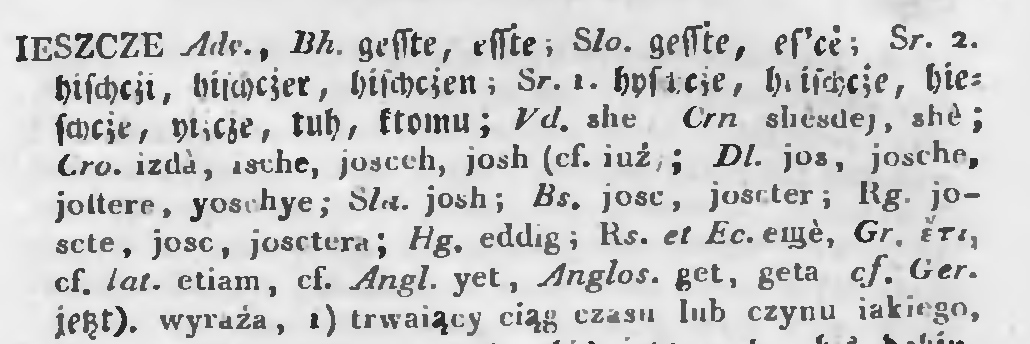
Here is the redoubtable Linde with his 1807 Polish language dictionary on the similar word “jeszcze” meaning, roughly, “yet”:

ourfriendlygeta

A note on the abbreviations: Dl. means Dalmatian, Rg. means Ragussan (i.e., from Dubrovnik), Bs. means Bosnian, Cro. means Croatian, Crn. means Carinthian (i.e., some dialect of Slovenian), Vd. means Windish or Styrian (another Slovenian dialect).  The others are obvious (and some are interesting, such as Angl. which obviously means English and Anglos. meaning Anglosaxon)

Further, “let it be” or, more likely, “there is” is a well known reference to a number of deities (see the general Indoeuropean, “is”, “ist” or “jest” as the source ultimate) – and examples from the Middle East are obvious.

All that said, there is an interesting reference to a similar deity name that likely is related to Jassa if only by virtue of geographical closeness and it comes from the Polish region of Kaszuby.

Copyright ©2015 jassa.org All Rights Reserved

February 22, 2015

On the Mountains of Jassa

Published Post author

Note to our readers:

Yes, we will continue with the Polabian Gods’ description and we have a Pomeranian project coming too BUT in the meantime we have a desire to make a brief detour (more to come later on this too).  A detour that leads us far North – or does it?

Hrubyhruby

Hrubý Jeseník (Tall Jesenik) range – the tower in the background is at the highest point known as Praded (grandfather, old man or old…God) (Interestingly, the range also contains such peaks as Keprnik – so that too is not a German word)

The Saga of Hervor & King Heidrek the Wise is an Icelandic saga.  It comes to us in a variety of manuscripts and versions.

One English translation is Nora Kershaw’s 1921 translation under the title of “The Saga of Hervor and Heithrek” (Hervarar Saga og Heiðreks) (so-called manuscript R).

Another is Christopher Tolkien’s 1960 translation of “The Saga of King Heidrek the Wise” (Saga Heiðreks konúngs end vitra) (so-called manuscript H).

Finally, there is the more recent Peter Tunstall’s 2005 translation titled “The Saga of Hervor & King Heidrek the Wise” which itself is a composite of (1) “The Saga of Hervor and Heithrek” (Hervarar Saga og Heiðreks) and of (2) “The Saga of King Heidrek the Wise” (Saga Heiðreks konúngs end vitra).

There are several interesting things about these texts.

First, to get this out of the way, they contains a bagful of names that have made it to J.R.R. Tolkien’s writings.  Tolkien was into the Old English language and Anglo-Saxon myths in general (e.g., Beowulf translation).  If you ever asked yourself where Balin or Gimli come from or, for that matter Boromir and Faramir, these kinds of sagas are it.  (To a Slav, the -mirs and -ins may sound vaguely Slavic and we will have more to say about that later when we discuss -mir’s, -mer’s, -gast’s and -gost’s).  In any event, his son Christopher enjoyed similar topics and, as noted above, also came up with his own translation of the saga in question here.

(Interestingly, although the Tolkien family is usually described as coming to Britain from Germany, his last name is neither English nor German.  For our best guess, together with the requisite German connection, see the village of Tołkiny (German Tolkynen – both from Old Prussian) deep in former East Prussia and today’s Poland).

Second, the sagas although written down much later (earliest manuscripts from the 13th century) deal with what is, in effect, pre-history.  They speak of the Gothic struggle against the Huns, for example.  It is highly unlikely that their writers were using and “improving” on Ammianus Marcellinus, Jordanes, Procopius and the like.   Consquently, they are a window into a time and place which remained largely untouched and unobserved by the Roman writers who, naturally, were only concerned with the various barbarian tribes once those got too close to the Roman frontiers.

Third, there are several interesting Slavic “connections” or at least “hooks”.  The chronicles talk about Gardarike, a term that may be Russia but also may be Pomerania (which was called that by the Scandinavians by reason of all the grads or gards on its shores – e.g., the various Stargards – this what one might have thought were a purely Slavic term (grad, grod, gorod) itself presents problems – e.g., see As-gard…).  Also, in a number of places, there are references to Harvaða mountains, which have been identified with the Harvati, i.e., the Croats and which – may – be the Carpathians (there were also the residences of the Carpi though (as well as the Avari…)).  Thus, we have:

Norse:

“Hinn mælti: ‘Taktu sverðit undan höfðafjölinni ok fá mér,” en sá tók ok brá ok sneið höfuð af fiskinum, ok þá kvað hann vísu: “Þess galt hún gedda fyr Grafár ósi, er Heiðrekr var veginn und Harvaða fjöllum.”

English (Kershaw):

“And he took it and unsheathed it, and cut off the fish’s head, and then spoke a verse:

This pike at the mouth of the river
Has paid the penalty
For the slaughter inflicted on Heithrek,
‘Neath the Mountains of Harvath”

English (Tunstall):

“And he took it and drew it and cut the head off the fish, and then he chanted a verse:

The price was paid
by the pike at Grave River,
when Heidrek was slain
under Harveth Fells.

Other Interesting Things

But there is another interesting aspect of all of this and it is in the following language:

Old Norse:

“Angantýr kvað:

“Kenndu at Dylgju ok á Dúnheiði, ok á þeim öllum Jassarfjöllum; þar opt Gotar gunni háðu ok fagran sigr frægir vágu.”

Nú reið Gizurr í brott ok þar til, er hann kom í her Húna. Hann reið eigi nær en svá, at hann mátti tala við þá. Þá kallar hann hári röddu ok kvað:

“Felmtr er yðru fylki, feigr er yðarr vísir, gnæfar yðr gunnfáni, gramr er yðr Óðinn.” Ok enn:  “Býð ek yðr at Dylgju ok á Dúnheiði orrostu undir Jassarfjöllum; hræ sé yðr at hái hverjum, ok láti svá Óðinn flein fljúga, sem ek fyrir mæli.””

English (Kershaw): 

“King Angantyr replied:

“Challenge them to battle at Dylgia and on Dunheith, and upon all the heights of Jösur, where the Goths have often won renown by glorious victories!”

Then Gizur rode away until he came to the host of the Huns. He rode just within earshot, and then called loudly, crying:

Your host is panic stricken, And your prince is doomed to fall; Though your banners are waving high in the air, Yet Othin is wroth with you all. Come forth to the Jösur Mountains, On Dylgia and Dunheith come fight; For I make a sure boast, In the heart of your host The javelin of Othin will light!

English (Tunstall):

“Angantyr said:

“Point them to Dylgja and to Dun Heath direct them and mark out all the Mounts of Jass;
there Goths often have given battle and fine victory they, famous, gained.”

Now Gizur rode off till he came to the army of the Huns. He rode no nearer than he needed to talk to them. Then he calls out in a loud voice and said:

“There’s fear on your forces, fey are your generals; the battle-banner above you looms; wrath with you is Odin.” And also: “I offer you at Dylgja and on Dun Heath I offer a fight under the Jassar Fells. A corpse be to you on every horse. May Odin let the javelin fly just as I decree.”

 Commentary on Jassarfjöll [um]:

Tolkien:

“These mountains have not been identified.  It has been suggested that their name is identical with that of the Gesenke, the mountains in norther Moravia, and that both the Norse and German forms of this name are corruptions of Slavonic Jesenik meaning “ash-mountain.”

What are “ash” mountains?  Well, they are not volcanoes (unless we are way off geographically (or chronologically! 🙂 ). They are not even “ashen” mountains.  They are simply mountains covered with ash trees (old English “æsc“).  And therein lies the problem for anyone making a reference to these mountains as such – ash in Germanic does not have a “j”.

Botany intrudes once again

Botany intrudes once again

Why are we even talking about ash trees?  Probably because those who interpreted these words were looking to Ptolemy’s mention of Asciburgius Mountains in his section on Germania (he also mentions a town of Asciburgium (also in Germany).  Ptolemy places these mountains right next to the Sudeten (Sudety).  This makes sense except that the Sudeten of Ptolemy may not be the current Sudeten.  Or are they?

Thus, where (it seems) ash or the like is indicated in the same saga, the author has no problem using the Germanic spelling:

Ok er þeir bræðr koma í Sámsey, sjá þeir, hvar tvau skip liggja í höfn þeiri, er Munarvágr hét. Þau skip hétu askar. Þeir þóttust vita, at Hjálmarr mundi þessi skip eiga ok Oddr inn víðförli, er kallaðr var Örvar-Oddr. Þá brugðu Arngríms synir sverðum ok bitu í skjaldarrendr, ok kom á þá berserksgangr. Þeir gengu þá sex út á hvárn askinn. En þar váru svá góðir drengir innan borðs, at allir tóku sín vápn, ok engi flýði ór sínu rúmi, ok engi mælti æðruorð.

(And when the brothers come to Samsey, they see two ships lying in the cove which is called Munway. Those ships were the kind called ‘ashes’. They thought these ships must belong to Hjalmar and Odd. Then Arngrim’s sons drew their swords and bit on their shield-rims, and the berserk-state came on them. Then six of them went out onto each of the ashes. And there were such good warriors on board there that they all took up their weapons, and no one fled from his post, and no one uttered a word of fear.)

[What are “ash” ships (ashen?) as in the above paragraph, is a separate question – thankfully, it seems so far, not for us].

However, the Slavic word for “ash” is jesion which obviously does have the advantage of having an a “J” in it.  The mountains then would be mountains such as the Hrubý Jeseník (German Hohes Gesenke or Altvatergebirge – see above picture discussing the peak Praded) range or the Nízký Jeseník (German Niederes Gesenke).  These are in the Eastern Sudeten Mountains (in Moravia).

samuel

The 1812 (Polish) Linde definition (thank you for the contribution!)

(That the Slavs sometimes kept or added their “J”s is evident from, e.g., jeden vs. eins.  But see Icelandic giant Thjasse (did someone say “giant”? Like a Riese?  Like Riesengebirge?). They also kept the “D”s.  About jeden (Czech, Pol) odin (Ukr, Rus) and Chris Hemsworth’s father Odin, we will, of course, have a lot more to say later… as too about other numerals, e.g., which Slavic numeral is related to et cetera? 🙂 Too easy, no points for this one!)

That there may have been a battle between Goths and Huns we also learn from Widsith’s “Bard’s Tale” poem:

Wulfhere sohte ic ond Wyrmhere; ful oft þær wig ne alæg, þonne Hræda here ymb Wistlawudu heardum sweordum wergan sceoldon ealdne eþelstol ætlam leodum.

(I visited Wulfhere and Wyrmhere; there battle often raged in the Vistula woods, when the Gothic army with their sharp swords had to defend their ancestral seat against Attila’s host.)

That the Jeseniks are close to the sources of the Vistula is, of course, quite correct:

jesenik

Jesenik on the left, Vistula sources on the right

The trouble is that, according to official chronology, there should have been no Slavs in Moravia at the time the Goth-Hun battle took place (or if there were any at all, they would have, perhaps, come with the Hun army which means that no one would have cared what they named the mountains in their tongue).

And so here we are.

Zeitschrift für Erdkunde, etc (from 1847):

This suggests the “hilly” terrain next to the village Jeser in Pomerania… With all due respect “hilly” terrain seems a bit underwhelming for the site of such a mountain battle (we can believe the Huns, in their short reign, made it to Moravia but Pomerania seems a bit of a stretch).

Afterthought

Note also that some Slavic “nationalist” historians disputed the location of these Jassar mountains in the Sudeten.  The reason seems to be that that would have meant admitting that Goths had been in Poland/Moravia or close enough.  Consequently, they looked for name Jassar further east, as in the Bieszczady or even further around Ossetia where the Gothic kingdom would have ended and where various Sarmatian tribes included the Iazyges and other similar sounding tribes (that some of these tribes may have, in fact, reached Poland did not seem to have bothered them).  For the same reason, the same historians placed Gardarike as far East as possible, leaving all of Poland, Belarus and Ukraine free of their domination (e.g., insisting that Palteskia means Polotsk and not, for example, Pultusk).

palteskia

The famous Hauksbok with Palteskia, Pulina land and Polena (to the east of which is Reidgota land and, thereafter, Hunland)

(BTW, the Hauksbok does not contain the references to Jassarfjöllum since it ends in the middle of Gestumblindi’s riddles leaving what happened later to other manuscripts)

What they did not seem to see, however, was the potential connection of the Sudeten Mountains with a, possible, pre-Germanic stratum (of whatever type but tied to Poles), assuming one were willing to read Jassarfjöllum as a case of (so to speak) singular possessive, as in Jassa’s Mountains (e.g., Stary Ded or Altvater).

(And aren’t these Jesenik mountains close to the R-Iesen Gebirge (Krkonoše or should it be Craco- or Krakonose!?), so maybe these latter ones are the Jassarfjöllum! Ok, so we are getting out of control here – time to stop)

answers

Lucas of Great Kozmin’s eerily ancient answer???

For more see here regarding Polish Gods and here regarding crazy etymologies.

Copyright ©2015 jassa.org, All Rights Reserved

February 14, 2015

On Svantovit (or Fortune) in the Writing of William of Malmesbury

Published Post author

We have presented the writings of Saxo Grammaticus on Arkona/Svantevit (and will continue to do so). In the meantime, however, we would like to respond to some readers inquiring as to whether other sources regarding the Ruegen God exist.

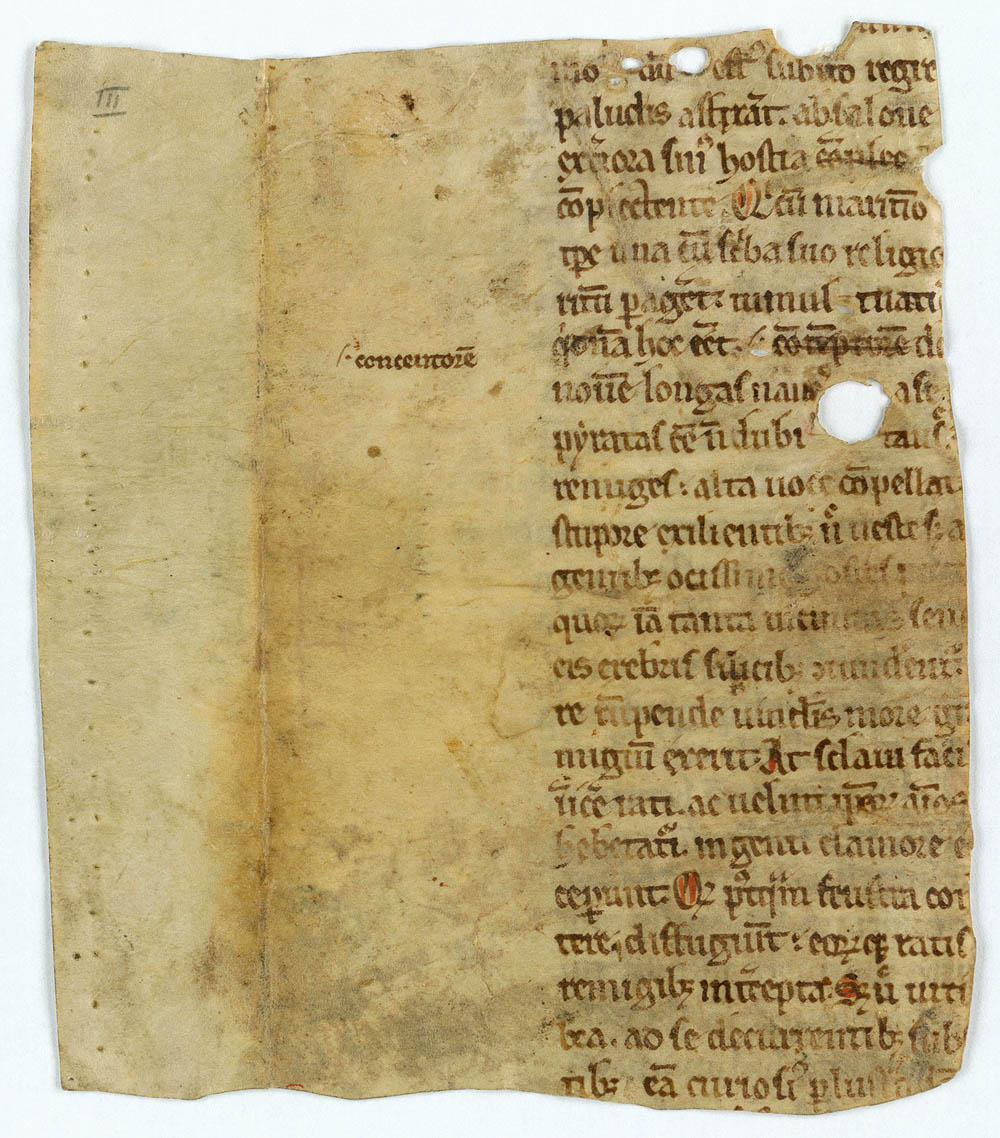
malmeski

Gorgeous calligraphy but not the relevant pages (we do not have the relevant ones in manuscript format)

Indeed they do. Here is one written by William of Malmesbury (c 1095 – c 1143). William has been seen as one of Britain’s greatest medieval scholars after Bede (the Venerable – on whose work William patterned his own and to whom we will return in the future when discussing Easter). In his monumental work, Chronicle of the Kings of England, William stated the following when discussing the Germans and their Emperor Henry (Chapter XII Of King Harold and Hardecanute discussing the years):

“This emperor [Henry III] possessed many and great virtues; and nearly surpassed in military skill all his predecessors: so much so, that he subdued the Vindelici and the Leutici, and the other nations bordering on the Suevi, who alone, even to the present day, lust after pagan superstitions: for the Saracens and Turks worship God the Creator, looking upon Mahomet not as God, but as his prophet. But the Vindelici worship fortune, and putting her idol in the most prominent location, they place a horn in her right hand, filled with Greek term we call “hydromel”. Saint Jerome proves, in his eighteenth book on Isaiah, that the Egyptians and almost all the eastern nations do the same. Wherefore on the last day of November, sitting around in a circle, they all taste it; and if they find the horn full, they applaud with loud clamors: because in the ensuing year, plenty with her brimming horn will fulfill their wishes in everything: but if it be otherwise, they lament. Henry made these nations in such a wise tributary to him, that upon very solemnity on which he wore his crown, four of their kings were obliged to carry a cauldron in which flesh was boiled, upon their shoulders, to the kitchen, by means of levers passed through rings.”

(Erat imperator multis et magnis virtutibus praeditus, et omnium pene ante se bellicosissimus, quippe qui etiam Vindelicos et Leuticios subegerit, ceterosque populos Suevis conterminos, qui usque ad hanc diem soli omnium mortalium paganas superstitiones anhelant; nam Saraceni et Turchi Deum Creatorem colunt, Mahumet non Deum sed ejus prophetam aestimantes. Vindelici vero Fortunam adorant; cujus idolum loco nominatissimo ponentes, cornu dextrae illius componunt plenum potu illo quem [variant: quod] Graeco vocabulo, ex aqua et melle, Hydromellum vocamus. Idem sanctus Hieronymus Aegiptos et omnes pene Orientales fecisse, in decimo octavo super Isaiam libro confirmat. Unde ultimo die Novembris mensis, in circuitu sedentes, in commune praegustant; et si cornu plenum invenerint, magno strepitu applaudunt [variant: plaudentes], quod eis futuro anno pleno copia cornu resdponsura sit in omnibus; si contra, gemunt. Hos ergo ita Henricus tributarios effecerat, ut, omnibus sollempnitatibus quibus coronabatur, reges eorum quatuor, lebetem quo carnes condiebantur, in humeris suis, per anulos quatuor vectibus ad coquinam vectitarent)

Incidentally, the reason this story even appears in the English writing is because King Harthacnut (son of Cnut/Canute the Great) gave away his sister Gunhilda to marry Henry III, the Holy Roman Emperor.  The siblings were obviously also great-grandchildren of Mieszko I (since Cnut’s mother was Mieszko’s daughter Świętosława).  Thus, interestingly, all these people were Polish.

Copyright ©2015 jassa.org All Rights Reserved

February 12, 2015

Polabian Gods Part Va – Saxo Grammaticus on the Temple at Arkona

Published Post author

There are four surviving fragments of Gesta Danorum (i.e., that’s it as regards manuscripts – that we know of).  One of them is the Plesner fragment which covers a few pages out of Book 14 of the chronicle.  Although this fragment contains no mention of Slavic Gods it does discuss Slavs themselves.

frag3

We include it here along with the corresponding pages from the 1839 edition of the work (for easier reading).  Other than that, since the Latin version can easily be obtained here, we present the text in the English language.

Introduction

The events described here are occurring in 1168, after the conversion of Pomerania, after the so-called Wendish Crusade and after the fall of the Obotrite Duke Niklot.  Pressed on all sides, Arkona stood alone.  Almost exactly 100 years earlier (1067), Rethra was destroyed.  A hundred or so years later it was going to be the turn of the Baltic Prussians.

plesner1

Specifically, Saxo’s Book 14, discusses in detail the Danes’ various murderous expeditions led by King Valdemar or by Bishop Absalon against Ruegen (as well as against the Norwegians and Pomeranians) finally coming to coup de grace at Arkona where the Ranii (also pressed by the German Saxons from the South) simply ran out of people to defend their town against the Danes (and, in this case, too the recently Christian (see story of Bishop Otto which is to come) Slavic Pomeranians who, after their conversion, were required to accompany the Danes (and apparently did a splendid job).  We do not delve into the expeditions themselves in detail – instead we focus on the religious aspects of the text and events at and immediately after the siege of Arkona.

plesner2

Because of the length of Saxo’s description, we break it up into several chapters (of our own making).  Here is Chapter 1, let’s call it “The Temple at Arkona “.

frag1

frag2

The Temple at Arkona

“The King [Valdemar I the Great of Denmark] now attacked Ruegen in different places and won booty everywhere but did not find an occasion to fight and desiring the enemy’s blood he began to besiege Arkona.”

Kap Arkona | RŸgen

Arkona – had the Ranii warning sign been in Danish, perhaps things would have turned out differently

“This town lies on top of a tall cliff and is well fortified from the East, South and North, not by men but by nature, for the steep sides of the cliff rise, as if walls, so high that no arrow could reach the top.  From these three sides it is also protected by the sea, but from the Western side it is surrounded by a wall that is fifty elbows tall, of which the lower part is made out of earth but the top part was of wooden construction reinforced/filled in with [torfus].  On the North side there is a stream, which the locals would reach by means of a reinforced path, which Erik [II] Emune in his time blocked, so that he defeated them during the siege not just by a force of arms but also by denying them water.”

vikingnefariousness

Danish Vikings used all kinds of nefarious distractions while they attacked the Arkonians

“In the middle of the town there was an open space, on which there stood a wooden temple built in an unusually intricate manner, which temple was greatly venerated, not only on account of its grandeur but also by reason of the fact that it contained a statue of a God.  From the outside the temple drew one’s gaze due to a variety of well-sculpted [pictures/effigies/statues?] which, however, were primitively and carelessly painted over.  There was only one entrance but the temple itself was divided into two separate parts, of which the external one run along the walls and had a red ceiling, whereas the internal one was supported by four pillars and in lieu of walls it had curtains and was not touching/did not have common parts with the external part save the ceiling itself and certain logs.”

templeoutsi

Temple Outside

“In the temple there stood the aforementioned statue of superhuman proportions.  It had four heads and that many necks, of which two were turned towards the front and two towards the back.  And likewise of the two heads turned front and also the two heads looking back, one looked left and the other right. [The statue’s] face was clean-shaven as regards the beard and its hair was cut indicating that the artist who sculpted the statue had in mind the custom [of shaving/hair styling] common among the Rugii.”

svantowitus

Temple Inside

“In its right hand the statue held a horn crafted of different metals, which horn was filled once a year by the priest and from the behavior of the drink he foretold the quality of the next year’s harvest.  The left arm of the statue was bent and pressed against the side.  The tunic reached its legs which were made of different types of wood and so intricately/discretely attached to the knees that only a careful inspection revealed the connections.  The feet were standing entirely on the floor but that on which it [the state] stood was hidden in the ground.  Nearby one could see a bridle and a saddle as well as other insignia, of which especially astounding was an unusual huge sword, whose scabbard and hilt were made out of silver and splendidly ornamented by wonderful craftsmanship.”

realistic

“The worship of the God took place in the following manner: once a year, when the harvest was coming to an end, the entire people of the island assembled in front of the temple, offerings were made of cattle and a solemn meal was eaten to honor the Gods.  The priest, who, not following the usual custom of most people of this country, had a long hair and a beard and, usually on the day before the holiday went to the temple, whose doorstep only he had the right to cross, to clean and carefully prepare everything, whereby he had to hold his breath, so that every time he needed to draw air he had to rush to the door, so that the God would not be contaminated by some man breathing in his presence/near him.”

Waiting at temple gates during a "big cake year"

Waiting at temple gates during a “big cake year”

“The following day, when the people camped out by the temple doors, the priest took the horn from the statue’s hand and carefully examined it to see whether the drink in it was evaporating, which was taken to be a warning that the harvest would be poor the next year, in which case he [the priest] obligated the people to save something of their current harvest for next year.  If the drink did not disappear, that foretold a bountiful year.  Thus, depending on what the horn predicted, he ordered the people either to save their harvests or to use them till they be sated.  Next he poured the wine as an offering at the feet of the statue, filled the horn anew and pretended as if he had drunk to honor him [the God], while at the same time he asked with lofty words for success/good luck for himself and the people of the country, for riches and for victory, and after that he brought the horn to his lips and drank all of it in one gulp, and thereafter he filled the horn again and placed it in the statue’s right hand.”

svantevitstein

Altenkirchen (between Arkona and Glowe, i.e., head) Church has this stone “built-in” with cornucopia, the horn of plenty on hand

“There was also there as an offering an oval-shaped honey cake which stood almost as tall as a man.  The priest would place it between himself and the people and asked thereafter whether they could see him [from behind the cake].  When they answered him, he then wished them that next year they should not see him, whereby the meaning of this was such that he did not mean death to himself or the people but rather that the next year should be bountiful [i.e., and the cake bigger].”

They could not see him that year

They could not see him that year

“Next he blessed his people in the name of their God, told them that they should honor Him with frequent offerings, which he expected as a the right payment for [their] victories on the land and sea.  And when this was done, they spent the rest of the day on a great feast, where they ate the offerings [for the God], so that that which was consecrated for the God they themselves ate.  At this feast, it was believed pleasing to the God to get drunk and as a sin to remain sober.”

“To support the religion’s needs every man and woman had to pay annually one coin, and God also received one third of the booty that they plundered for they believed that they should thank Him for His help.  He was also given three hundred horses and that many warriors who fought for Him and who had to give to the priest all of their booty whether it was captured  with weapons or stolen; for this money that came there for that reason, he commanded the making of all kinds of precious ornaments and adornments for the temple, which he kept in locked chests, in which in addition to lots of money there were kept too rich clothes, which were entirely destroyed by passage of time, as also the many offerings, some from the people and some from individual persons, which were given to them/to the temple to obtain happiness and success.”

templetreasure

not wasting gold on crucifixes here

All of the Slavic lands venerated this God by paying [tribute to Him], and even the neighboring kings gave offerings to Him, not paying attention to the committed sacrilege [of so doing].  Among others, the King of Denmark Svend Grathe [Sweyn III – killed by Valdemar after Sweyn attempted to kill Valdemar and others] donated a wonderfully crafted cup so as to gain the favor of the God, for which sacrilege he then paid by his unlucky demise.  This God had too other temples in the different places, but none was so venerated as the one at Arkona.”

“He also had his own holy white horse and it was seen as sacrilege to rip a hair from his mane or tail, and no one other than the priest was permitted to feed him or ride him, so that this divine animal should not lose its dignified appearance, by reason of it being frequently used.  The Rugii believed that on this horse, Svantovit – that is the how they named the God – would ride when he fought against the enemies of his Holiness, and they saw special proof of this in that, in spite of the fact that during the night he remained in the stables, in the morning he was often wet and sweaty, as if he had come straight from battle and rode a long way [back].”

tristarhorse

Svantovit horse approaching after a night out

“They also read warnings from the horse’s behaviour in the following way: when war was intended with one country or another, it was the custom of the temple attendants to stick six spears into the ground in pairs of two where the shafts of each such pair would cross and where the spear pairs would be equidistant.  When the troop was to march out, the priest gave a solemn prayer and thereafter he led the horse in a harness from the [temple] foyer and led so that he had to jump in front of [or through] the spears.  Should the horse lift the right leg ahead of the left, they took that to mean that the war will be successful.  But should he have raised only one time [i.e., once out of the three] the left leg as the first, they gave up on their expedition and would not even raise anchors until such time that they saw him [the horse] jumping three times through the spears in such a manner that they took to be a good omen [i.e., right leg ahead of the left].”

settingout

When the auguries were good, it was time to set sail

“Also when they were to set out in other matters, they took the augury from the first encountered animal.  If the augury was favorable, they rode further happy, if it were not they then quickly went back home.  It was also not unknown to them to throw lots, they threw, namely, on their lap three pieces of wood as lots, they were white on one side and black on the other and white meant luck and black meant misfortune.  Even the women did not avoid such practices.  When they sat at a fire sometimes they drew random lines in the ash and counted them together.  If the number was even they believed that that portended good fortune, when it was odd, though, they took that as a bad sign.”

shipwrecks

Arkona is also the site of over 300 (confirmed) shipwrecks

Copyright ©2015 jassa.org All Rights Reserved

February 7, 2015

Reports of the Slavs from Muslim Lands Part V – Testimony of Masudi on Slavic Gods and Temples

Published Post author

The below is is taken from the same Masudi report (in “The Meadows of Gold”) as discussed previously here.  Now, however, we focus on religion in more depth.  (BTW the locations of the various temples, as shown in the pictures, are purely speculative – we lay no claim on knowing whether these correspond to any of the temples mentioned by Masudi).

There are two translation sources here.  Most of the passages come from the Paul Lunde edition (including a portion that mentions a town administrator – Ahmad ibn Kuyah – one has to ask the question whether Ahmad’s father (or some other relative) wasn’t in fact Kuy as in the legendary founder Kiyev).  That section is supplemented by a separate translation of another paragraph.

The other section on the temples comes from Chapter 66 of the Prairies d’or (French translation with an Arabic edition) aka Muruj al-dhahab by Barbier de Meynard and Pavet de Courteille published in 1861-1877.

***

Lunde translation – chapter 11 (The Khazars)

“The king, his court and all those of the Khazar race practice Judaism, to which the king of the Khazars was converted during the reign of Harun al-Rashid.  Many Jews from Muslim and Byzantine cities came to settle among the Khazars, particularly since Romanus I, the king of the Byzantines in our own time, 332/943, forced the Jews in his kingdom to convert to Christianity.  Further on in this volume we shall give the history of the rulers of Byzantium, which we shall set out in order, and shall speak of this king as well as the two other rulers who shared power with him.  A great number of Jews therefore fled from the land of the Byzantines and sought refuge with the Khazars.  This is not the place to speak of the conversion of the Khazar ruler to Judaism, as we have already discussed this subject in our previous works.” 

“The pagans who live in this country belong to many different races, among which are the Slavs and the Rus, who live in one of the two parts of the city.  They burn their dead on pyres along with the deceased’s horses, arms and equipment.  When a mans dies, his wife is burned alive with him, but if the wife dies before he husband, the man does not suffer the same fate.  If a man dies before marriage, he is given a posthumous wife.  The omen passionately want to be burned because they believe they will enter paradise.  This is a custom, as we have already mentioned, that is current in India but with this difference: there, the woman is not burned unless she give her consent.”  

“As regards the pagans in this land (Khazar Khaganate), there are different peoples/races that are pagan – amongst them the Slavs (Saqaliba) and the Rus (Rus).  They live in the same part of this city (the capital).  They burn their dead together with their beasts of burden/animals, their weapons and armor and their jewelry.  When a man dies his woman is also burnt with him alive; but when the wife dies her man is not burnt with her.  And when an unmarried [man] dies, he is married after his death.  The women want to be burnt [of their own volition] to be able to enter paradise with their spouse…” [this is the same passage as paragraph above – just different translation]

“The Muslims are dominant in the land of the Khazars because they make up the king’s army.  They are known by the name Arsiya.  They originally came from the region around Khwarizm, and settled in the Khazar kingdom a long time ago, shortly after the appearance of Islam, when they fled the double ravages of famine and plague that devastated their homeland.  These are strong, courageous men, in whom the king of the Khazars places his confidence in the wars which he wages.  When they established themselves in his kingdom they stipulated, among other things, that they be allowed the free exercise of their religion, that they might have mosques and publicly give the call to prayer, and that the king’s chief minister should be chose tom among their number.  In our days the one who occupies this post is a Muslim named Ahmad ibn Kuyah.  He has made an agreement with the king where by he and his army will not fight against Muslims, but will march into battle against the infidel.  Today, around 7000 of them serve as the king’s mounted archers.  They carry a shield and wear helmets and chain mail.  They also have lancers equipped and armed like other Muslim soldiers.”

“They also have their own qadis.  It is a rigid custom in the Khazar capital that there should be seven judges: two for the Muslims; two for the Khazars, who make their decisions in accordance with the Torah; two for the Christians, whom make theirs according to the Gospels; and one for the Slavs, Rus and other pagans.  This latter judge follows the pagan law, which is the product of natural reason.  When a serious case comes up that the judges cannot decide, the parties involved consult the Muslim qadis and obey the decision made in accordance with Islamic law.  The king of the Khazars is the only ruler of these eastern countries to have a paid army.  All the Muslims who live the  country are known as Arsirya.”

“The Rus and the Slavs, who are pagans as we have said, sever as mercenaries and slaves of the king.  Besides the Arsirya there are a certain number of Muslim merchants and artisans who have emigrated to the is country because of the justice and security with which the king rules.  In addition to the congregational mosque, whose minaret towers over the king’s palace, there are many other mosques to which are attached schools where the Qur’an is taught to children.  if the Muslims and the Christians united, the king would have no power over them.”

***

Meynard/Courteille edition – chapter 66

“The Slavs have many temples.  One of these buildings lies on a mountain, of which the Philosophers/wisemen say that it is one of the tallest mountains in the world.  This building is famous on account of its architecture, on account of the different types of and different colors of [precious] stones and on account of the elaborate [games/rites or mechanisms] [that take place or are] on its top, and also too because the rising Sun appears in those elaborate mechanisms [reflects?], likewise because of the jewels and works of art that are brought there and through which the future is shown [oracular devices], and likewise, because of these jewels accidents can be prevented upfront, and finally because of the voices that one hears from the top [of the building] and the effect that these [voices/sounds] have.”

temple

Who knew?

“Another building was built further by one of their kings on a black mountain.  It is surrounded by wonderful waters of different colours and uses and [which waters] have many uses.  They have there a great God statue there in the shape of a man who has taken on the look of an old man.  In his hand he has a staff with which he raises the bones of the dead [skeletons?] from the crypts.  Under his right foot there are figures of different types of ants [?] and under the other, there are black birds [garabib/garabin], also figures of ravens [crows/kruki?] and others, so too different and strange figures Abyssinians and blacks [Zanzibarians?].”

[oh yes, a bent staff of a priest or judge is called a krakula as one of our readers correctly notes]

krokus

Cracow’s Krak or Krakus mound – from its top you can see the sun rise over the Wanda mound on May 2nd and August 10 – about a quarter of a year apart – looking the other way from Wanda we get November 4 and February 6 and therefore… something  – similarly situated mounds are in the Przemysl area

“A further building they have on a mountain surrounded by sea.  It is built out of red coral and emeralds.  In the middle is a huge dome, under which there is a statute of a God with limbs made out of four different precious stones, green chrysolite, red ruby, yellow carnelian and white crystal and the head is made out of red gold.  Opposite from him there stands another God statue with the shape of a young woman who is shown offering him [the first God] gifts and fragrances. One used to ascribe this building to a ruler they [Slavs] had had in the distant past.  We have reported about him, about his rule in the lands of the Slavs, his machinations and wiles, [which he employed] in order to win their hearts, so as to rule them and bewitch them – and that despite the evil of the character of the Slavs and their contrarian predisposition, how we have shown above in our book.”

arkona2

Arkona – surrounded by the sea – on the peninsula of Wittow – the mountain may be (stretching here) “Gora” or today’s Bergen auf Rügen

Here is the Meyer version (clickable as always, of course):

Copyright ©2015 jassa.org All Rights Reserved

February 4, 2015