Category Archives: Origins

The Runic Spear of Rozwadów

Published Post author

Rozwadów is a town southeast of Sandomierz on the river San. Nowadays it’s basically a suburb  of Stalowa Wola. In 1932 local workers discovered a cremation grave with pieces of a spear there. The spear was one of the few that had inscriptions on it including some form of writing. The Polish archeologist Marcjan Śmiszko published a study of the spear in the Polish publication Archeological News (Wiadomości Archeologiczne), the oldest Polish archeological journal. Śmiszko thought he discovered the word KRLUS on the spear. What does KRLUS mean? A number of hypotheses were put together (and repeated mindlessly by others). Mees, Pallych and then Garbacz came up with their theories. Most recently, an interpretation of the writing has been put forth translating it as either: [i]k (e)r(u)ls, or [i]k (e)rlas. Both are “East Germanic”. But what does this spear actually look like?

Well, the spear picture is available in the original Śmiszko article:

Here is the flip side which does not contain writing but only symbols:

This is Śmiszko’s interpretation of the same:

In case it’s not obvious, there is no IK ERULS, or IK ERLAS or even KRLUS. There is instead just the following – RPA. In the first instance the “R” is a regular curved Latin “R” – not a runic “R” at all. The  supposed *laguz rune looks more like a “P” – though admittedly – maybe it’s an “L” but this is far from clear.  Finally, the “A” is also quite like a Latin “A”. Nothing special here.

But what about the alleged “k” (*kaunan) or the “s” (*sōwilō)? They are impossible to see in the above. Here is a highlighted version for better visibility – even here, it’s not clear whether they really are runes – they may be small etchings or just represent damage to the artifact.

Note too  how much smaller they are than the other letters.  The spear is damaged but yet somehow these much smaller “letters” manage to “fit” which suggests that whatever they are, they were not part of the original inscription. But, hey, you can see what you want if you are desperately looking to see if you can locate some runic letters.

Copyright ©2018 jassa.org All Rights Reserved

October 28, 2018

Rosettes & Other Such Symbols

Published Post author

Continuing on the topic of rosettes (see here and here and here for earlier iterations, including a version with the God Esus). Here are some late antiquity rosettes (in the Bavarian artifact alongside alternating swastikas whatever their meaning may have been back then).


Kemathen (Kipferberg) Warrior
(Krieger aus Kemathen)
Germany (Bavaria)
early to mid 5th century?

This has been classified as the “first Bavarian”. Strictly as a matter of looking at a where this warrior died, I suppose that’s true.

Note that Kemathen pops up all over south German geography. You have:

  • Kemathen (Kipferberg)
  • Kematen Bad Feilnbach
  • Kemathen (Arnstorf)
  • Kematen an der Ybbs (Austria)
  • Kematen in Tirol (Austria)
  • Kematen an der Krems (Austria)
  • Kematen am Innbach (Austria)

The etymology of this is unclear but (perhaps like the Polish kmieć, kmiotekkmiotównakmiotowickmiotaszekkmiecy that Brueckner brings up) it comes from the Latin comites or, maybe, the Latin comites has the root as these words (compare with »kmetones regni« cited by Brueckner) – basically, a wealthy villager – originally, perhaps, meaning a war companion (who then settled down).


Zamość
Poland
first half of the fifth century?

This pic and the next one come from the “Barbarian Tsunami” presentation which, while fancifully named, fails to prove that any such tsunami actually took place in north central Europe.


Zagórzyn
Poland
second quarter of the fifth century?

Note that the non-highlighted cross (Sun symbol?) on the left side is the same as is shown (there highlighted in yellow) in the Kemathen picture.

Similar rosettes have been seen in a number of places around the world.

Interestingly, for the above also as part of the so-called Vermand treasure (which also included Stars/Shields of David, symbols that, quite interestingly, were adopted rather late as a symbol of Judaism). These had been interpreted as Sarmatian (for more on that you can check out Deborah Schorsch’s “The Vermand Treasure: A Testimony to the Presence of the Sarmatians in the Western Roman Empire”). But Vermand had been sacked in 406 by the “Vandals, Suevi and Alans” so the question is of the dating of that treasure.


As a follow up, here is another – this time eight-pedaled – rosette from a belt buckle – now in Cracow (likely from Mokra, Silesia):

And here are some other examples (can’t recall from which article) from Cecele, Siemiatycze (“Wielbark”), Mokra again (“Przeworsk”) and Tiszaladány, Hungary:

Note that the combination of the eight- or six-pedaled rosette with the swastika has a long history as well with examples from Mycenaean, Greek (for example, on the Dipylon krater in the National Archeological Museum in Athens; simpler solar symbols along with swastikas can be seen on a chariot artifact from Dupljaj or Duplaj in Serbia) and Armenian cultures. Finally, note this piece from the useful nutjobs at Ahenenerbe.

This is supposedly “Westgothic”, which may actually be true given that the rosette ended up being highly popular in Visigothic Spain.

Copyright ©2018 jassa.org All Rights Reserved

October 26, 2018

Strangers in Africa

Published Post author

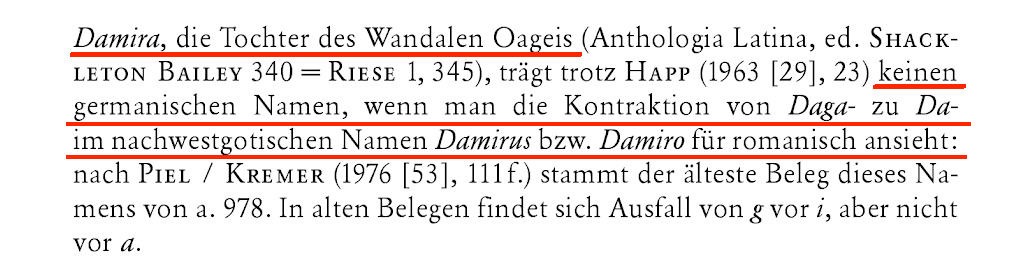
How tough it is to separate Suavic from Germanic names in practice (since most of the former, oddly, seem to be encompassed by experts within the latter), you can see from the following (Anthologia latina) funerary epitaph about the passage of the infant Damira, the daughter of [O]aegis[l]:

The inscription itself comes from Africa and yet Damir is a Suavic name. On the little that is known of Vandalic see here. For another strangely Slavic name from Dacia, see here.

Damira may well be Suavic but also may be Turkic or Hebrew (‘long live the world’! That is itself crazy because it would suggest Suavic – Hebrew connections) – also recall the Venetian opera Damira Placata). Strangely, in Egypt there is a town called Damira (which had a Jewish community) in the Nile delta just southwest of a town called Shirbin (or Sherbin) (Serbin?).

Oageis’ is itself a strange name but seems more Germanic than Slavic. Oageis[l]?  Compare this with the flipped letters in Geisa-.

Was her mother Suavic?

This is from Albrecht Greule (that Oageis was a “Vandal” is, of course, just an assumption):

Copyright ©2018 jassa.org All Rights Reserved

October 26, 2018

Strela

Published Post author

Ok to oblige some of our readers. Here is Mount Strela just south of Lake Veneticus (i.e., the Bodensee).

The word strzała present in Polish is described by Brueckner as an Ur-word and present among all Slavs – but not Balts. According to the definition currently plastered in Wiktionary, the Slavic word comes from the  Proto-Slavic *strěla, from Proto-Indo-European *strel-*strēl-, from *ster- (line, streak, stripe; jet, spurt; beam).

A variant also exists in a German version as in strahlen meaning “radiate” with Strahl meaning a “ray.” The Wiktionary would view it as coming from Middle High German strāle, from Old High German strāla, from Proto-Germanic *strēlaz, *strēlō (arrow, ray, beam), from Proto-Indo-European *strēl-, *strēlā- (arrow, beam). Compare Dutch straal, English streak. But… this word does not appear to frequent the Scandinavian languages nor did it exist in Gothic and, eventually, seems to have been supplanted by the word “arrow.” As to “arrow” the Online Etymological Dictionary has this to say:

arrow (n.) – early 14c., from Old English arwan, earlier earh “arrow,” possibly borrowed from Old Norse ör(genitive örvar), from Proto-Germanic *arkhwo (source also of Gothic arhwanza), from PIE root *arku-, source of Latin arcus (see arc (n.)). The ground sense would be “the thing belonging to the bow.” Meaning “a mark like an arrow” in cartography, etc. is from 1834. A rare word in Old English. More common words for “arrow” were stræl (which is cognate with the word still common in Slavic and once prevalent in Germanic, related to words meaning “flash, streak”) and flaflan (the -n perhaps mistaken for a plural inflection), from Old Norse, a North Germanic word, perhaps originally with the sense of “splinter.” Stræl disappeared by 1200; fla became flo in early Middle English and lingered in Scottish until after 1500. To add to that the German language word for an arrow today is Pheil.” 

It is curious that in Slovene strela refers to the lightning flash. It seems that this definition is closest to what one might imagine is happening on top of a mountain. That is to say, lightning strikes mountains rather than arrows. Of course, one can keep both meanings if one proposes that the arrows are those of a Lightning God such as Yassa. (Note that Piorun aka Perun was not strictly speaking a God of Lightning but of Thunder – but Piorun or Perun can be brought into this as well – note that piron in Venetian and πιρούνι (piroúni) in Greek each refers to a “fork” which is exactly what lightning looks like – see here).

Finally, note that in Portuguese and Galician you have estrela meaning “star”. In Spanish you have estrella although the double l is pronounced differently (like a “y”).  The “star” explanation (which is likely cognate too with the stary meaning “old” and with ostry meaning “sharp” (think how you squint your eyes)  in Slavic).

For completeness, note that the official explanation of the name is from the Latin striga or Romansh stria – both meaning a “witch.” It is interesting to think of witches streaking (!) on lightning (in lieu of broomsticks – seems faster and, well, flashier) but stryga is also present in Slavic languages also meaning “witch”.

I personally, like the arrow of lightning explanation better than a star explanation as it seems more believable in the context of a mountain. A Slavic etymology seems more than probable given the proximity to the Slovenes and the presence of a number curiously Slavic looking place names nearby.

Copyright ©2018 jassa.org All Rights Reserved    

October 26, 2018

Ksiądz or Xšaça

Published Post author

The Polish word ksiądz refers to a priest but it has other related meanings. For example, its diminutive, księżyc means the Moon. That is a little ksiądz. But why would the moon be called the little priest? Well, it does not. As Brückner correctly points out, the word ksiądz referred to a duke, prince or lord and, hence księżyc refers to a little duke, lord or, yes, prince. The “big” duke, prince, lord, etc., was, supposedly, the Sun – Brückner’s magnus dominus.

Maybe. But what Brückner gets wrong is the derivation of the word. He says that the Slavic as well as Baltic (kuni(n)gas) and Finnish (kunigas) come from the German König, that is “king”. Oddly, he also observes, that that name is not present in Gothic. Whatever the merits of Brückner’s derivation of the Lithuanian or Finnish etymology of their kuningases, the Slavic word just does not seem to fit. In fact, the Slavs may well have a term for a ruler that is derived from or at least similar to the German (and Finnish, Baltic). It is kniaź where the g > ź, probably.

But what about the Polish ksiądz? Well, the answer may be found on the borders of ancient Persia in the famous Behistun (or Behistan) inscription. That inscription celebrates the victories of Darius over local rebels. This is the inscription that famously features placenames such as Asagarta which has been interpreted to mean Sagartia but also to be a potential shoe-in candidate for a namesake of Asgard. There, in Persian lands we see the word xšaça be used in a number of places. The University of Texas at Austin has a great linguistics department and, more relevantly, an excellent website that discusses some old languages and the below text comes from there. 

<xšaça-> ‘kingship, sovereignty, kingdom‘ — [Pokorny kþē(i)-, kþə(i)- :: to gain, acquire, possess]

41- ašiyava utā Pārsa utā Māda utā aniyā dahyāva xšaçam hauv

42 – agarbāyatā Garmapadahya māhyā IX raucabiš θakatā āha avaθā xšaçam

50 – tyam magum xšaçam dītam caxriyā kārašim hacā daršam atarsa

59 – dahyāuš Mādaiy avadašim avājanam xšaçamšim adam adīnam vašnā

60 – Auramazdāha adam xšāyaθiya abavam Auramazdā xšaçam manā frābara

Copyright ©2018 jassa.org All Rights Reserved

October 20, 2018

R1a in Europe

Published Post author

This is about a year old and likely needs to be supplemented plus the author was apparently mostly focused on R1b plus some items there seem a bit off. Nevertheless, it’s a cool summary for people interested in the arrival of R1a in Europe (highlighted – purple dots but slightly different than the R1b-U106 purple dots). Note that these R1as are not necessarily ancestral to Balto-Slavic clades of R1a – nevertheless they indicate the appearance of the various R1a cousins. All of this was assembled by Iain McDonald at the University of Manchester and you can find the full presentation here.


Copyright ©2018 jassa.org All Rights Reserved

October 20, 2018

#streberfail

Published Post author

A reader had sent me a copy of the Barbarian Tsunami booklet regarding “migrations” in Poland. I haven’t had a chance to go through this in detail but a cursory glance at some of the nonsense described therein is not encouraging. Aside from the poor translation of the Polish, the writing is that of ideologically-constrained dilettantes.

Basically, the theme is that during the Communist times, the political mantra was that Poland had been occupied from times immemorial by Slavs and the organizers of this project resented that. Now, that Poland is democratic, the organizers are free to spread their own theories which – they claim – are based on facts. Those theories suggest the presence of Germanic tribes in Poland and that the Slavs came from somewhere else. These new theories are also based on facts and are politically unbiased because we live in a world where we have democracy and truth, politics does not exist and truth can finally emerge from its hibernation… yadda yadda yadda.

I will have more to say about that but here are some pearls of fancy that were made up by the drafters of this silliness. (Note that these guys are much more cavalier in identifying every object they find with a very specific ethnic group than any archeologist in the West would dare now do):


“A much less known fact and one that we find very exciting is that the peoples involved the most in the upheaval – Goths, Vandals, Herules, Gepids and Burgundians – had issued from the lands between the Odra and the Vistula.”

Not one shred of evidence about any of this – at least as regards Vandals, Herules or Gepids. By the fourth century, all these people are recorded in Ukraine – not Poland. With the possible exception of some portion of the Goths who likely landed from Scandinavia somewhere around Gdansk (or just maintained an emporium there?)  and, if you believe Ptolemy, Burgundians, none of these peoples can be placed in Poland. 


“Among the best known materials are those discovered within the complex of settlements at Gąski-Wierzbiczany in Kuiavia, a central place of the Vandals. Some of these are discussed below by Marcin Rudnicki.”

I am curious how these guys know that these were “Vandal” sites (and central sites no less!). I mean, they could just as easily have been Japanese or Aztec “sites”.


“The same year, the Vandals settled in southern and central Poland, and on the upper Tisa River, the Alans and Suebians living on the middle Danube, burst into Gaul, which they cruelly plundered for a full three years and then moved to Spain.”

This run-on sentence is pure bullshit. First of all there is no evidence of any tribes that could be called Vandals anywhere in Poland with the – possible – exception of very southern Poland.  The only, and indeed, the first, place that any Vandals are actually recorded is the Tisa. I understand the reference to the “upper” as trying to “move” the Vandals closer to Poland.  

Secondly, there is zero evidence from whence the Vandals, Alans and Suevi that entered Gall came from other than, presumably, somewhere east of the Rhine (since they had to cross it). 

Third, we don’t even know who exactly crossed the Rhine but it seems it was a hell of a lot of different peoples. Jerome gives the following list: 

  • “Quadi, Vandals, Sarmatians, Alans, Gepids, Herules, Saxons, Burgundians, Alemanni and the armies of the Pannonians”

Fourth, putting aside that the above list does not actually list any Suebi, if we were to include Suebi, we probably should write (like the ancient writers) Suevi and not Suebi (like the ossified 19th century Prussian historians). 

Fifth, “cruelly plundered” seems like a bit of rhetoric better fitting a Christian or Roman eyewitness of the events rather than a detached scientist.


“Having issued from the lands in the Odra and the Vistula drainage basin the Germanic Goths, Vandals, Gepides, Herules and Burgundians would go on play an important part in the emergence of a new, medieval Europe. It would be incorrect to say that the Migration Period brought destruction only; it was also the beginning of a new order on our continent.”

“Having issued from the writer’s feverish imagination” would have been better said.


“The Przeworsk culture people were mostly Vandals, but presumably included some Lugians, a group which a few centuries earlier had established a powerful organised society which contributed to the emergence of the Przeworsk culture.”

This is an almost verbatim plagiarism of Herwig Wolfram’s failed attempt to reconcile the fact that Poland was, in fact, occupied by the Lougi/Legii with his enormous desire to place the Vandals there instead. Wolfram’s attempt was pulled out of his ass. Now it looks like we have someone trying to make a carbon copy of that watery turd.  


“There is evidence from archaeology as well on the presence in the Kraków-Częstochowa Upland (Polish Jura) in late 4th and early 5th century of the Vandals (the Przeworsk culture people) but also, of Gothic immigrants from the territory of present-day Ukraine.”

Again, how is Przeworsk “Vandalic”? I’d really like to know. Artifacts? Even assuming these artifacts were Scandinavian in (ethnic) origin, it’s a far cry to suggest that they must have been Vandalic given that Vandals are not recorded in Poland… But, if, as I suspect, the idea is to inculcate Poles with the notion that they are immigrants in their own homeland, then why not skip the Vandalic middleman and go straight to the heart of the matter? After all there are tons of Arab dirhams found all over Poland. Why not declare that this is evidence of massive Arab presence in Poland in the middle ages?  (rab > rob > worker?)

One thing about that paragraph does deserve some attention. The author suggests a (presumably return in his telling) migration of Goths to Poland from Ukraine. It would behoove scientists to look at the question (particularly given the centum character of Tocharian and recent R1b finds among Sarmatians) of whether the Goths and other Scandinavians may indeed have come – relatively late – from the Pontic Steppe. 


“Recent finds from western Lesser Poland suggest the arrival in late 4th and early 5th century to this region also of a group of Goths from the territory of present-day Ukraine. Finds displaying Hunnic traits, like burials excavated at Jakuszowice and Przemęczany, show that in the early Migration Period the western region of Lesser Poland was under the control of the nomads and their allies. Presumably, this situation was accepted by groups of Vandals still living there.”

Again, no Vandals. But if there had been Vandals there, then, yeah, I am sure they would have “accepted this situation.” Assuming they desired to continue living there (or just living). The author seems almost apologetic in explainng why and how his übermensch Vandals “accepted” the overlordship of “nomads and their allies.”


“Echoes of these events are to be found in the written record. The bulk of the population of the Przeworsk culture may safely be identified with the Vandals.”

Whenever I see phrases such as “there is no doubt” or “may safely be assumed” I get this gnawing feeling that nothing could be further from the truth. But, hey, maybe it’s just paranoia…


“Presumably, the Vandals who remained in their homeland in Poland, are those immortalised by Procopius of Caesarea. He noted that in 439–477, the reign of king Geiseric, the Vandals in Africa received an embassy of their compatriots still residing in their ancestral abodes come to sure that the former had no intention of returning North. In this context highly intriguing are some references which recur in the early medieval written record. In his hagiography of Saint Ulrich written in 983–993, Gerhard of Augsburg repeatedly refers to Mieszko I as the duke of the Vandals (dux Wandalorum, Misico nomine). What could be the source of this piece of intelligence recorded in the late 10th century? Could it be that the descendants of the Vandals had actually survived in central Poland, or – as some historians claim – had the provost of the Augsburg Cathedral simply misspelt the German name Wenden (Slavs)? For an answer to this and many other questions we have to look to the future.”

As I’ve written before… assuming that such an embassy did in fact take place and Procopius did actually find out about it, the “ancestral abodes” of the Vandals would much more likely have been in places such as:

  • Spain
  • France
  • Romania/Hungary (even Czechia)

All places in which Vandals had been living for over 2 centuries before. But, if we must look further in time and, if in fact there was such a thing as Vandals back then, then I would look in Scandinavia – not Poland. 

As regards the fact that half a millennium later Gerhard of Augsburg thought Poles were Vandals (and others thought they were Goths or Sarmatians or Illyrians), well, I would refer these fine archeologists to Roland Steinacher’s Phd thesis or his little write up Wenden, Slawen, Vandalen. Eine frühmittelalterliche pseudologische Gleichsetzung und ihr Nachleben bis ins 18. bis ins 21. Jahrhundert. 

In any event, it seems to me that the Vandals may well have been named after the Wends whose territories – likely in East Germany – they may have occupied.

Copyright ©2018 jassa.org All Rights Reserved
October 17, 2018

Mine is the Sunlight, Mine is the Morning

Published Post author

In thinking about the Polish Jove Jassa, we came, repeatedly, into contact with the rosette symbol. This is not too surprising because the rosette, particularly the leafed rosette, has appeared throughout centuries all over the world, usually as a religious symbol. Perhaps the earliest rosette symbol is from these Mycenean coins (1600 BC) from some female graves:

For more cool rosette pics, see here. Also a blog devoted to Spanish (!) Asatru has this interesting post (trying to connect the rosette as the hexapedal star with the Visigoths) – see here.

There was, however, little to connect the God of Light with the rosette (or Flower of Life) other than speculation. The thing that seemed most convincing to me, at least in terms of Polish etymologies is the that the Polish name for ash is jesion and this is the picture of an ash (or jesion) leaf:

Now, jesion, again, means ash and an ash is is an ash and askr Yggdrasil is in Norse mythology, the World Tree which is probably an ash and is very similar to the “tree of life.” For more on Yggdrasil as a “star” (gwez or gwozd) tree see here. Now, there is the fact that the above rosette is also called the Flower of Life.

But all of that is speculation. Then, however, is this fine inscription from, of all places, Cherchell, Algeria (that city being, interestingly, an important conquest of the Vandals):

PEREGRINVS[—
QVODESVS*FVIT*IVBEN[—

or, perhaps:

Peregrinus [—] | quod Esus fuit iuben[s—].

Now, I am not sure I see it but if the above interpretation is right (this means “Peregrinus (name or perhaps just ‘A Traveller’) who worshipped Esus”) then this is direct connection between the rosette and Esus. For more on this see here.

Notice that the writer of this blog, correctly, notes that the above symbol looks like a “sand dollar” but can’t be a sand dollar because a sand dollar has five arms or slits not six. This is correct. But the rosette that has six arms or petals is the Flower of Life which is what this image seems to look like.

You can also get more data from this book (which featured this inscription originally): Philippe Leveau, Nouvelles inscriptions de CherchelBAA, t. VII, 1, 1977-1979, p. 111-192. Note that Leveau also wrote rather recently this interesting article: Ésus en Afrique : à propos d’une inscription fragmentaire de Caesarea Mauretaniae commémorant l’exécution d’une injunction d’Ésus; which you can see here.

It is curious that various scholars have suggested that the Polish God Yassa has a Tatar, Uralic/Finno-Ugric, Germanic (Aesir) or even a Celtic origin. In the Celtic religion there was the God Esus (primarily known from Lucan though also on two pillars in France/Germany as well as, perhaps, from an incantation).

Here is a nice rosette which clearly shows these rays or slits as leaves:

In Poland, the symbol also frequently appears on coins (for example from Pyrzyce).

Curiously, the symbol also appears in connection with the Star of David (which, also, was a common symbol before becoming associated with Judaism). That David could be read Da-vid and that Vid/Vit means “lord” and Dadzbog essentially means “May God Give” is curious as well. Here are some rosettes and Stars of David from the Coptic area. These are from a work by the Germanized Polish art historian’s Josef Strzygowski’s “Coptic Art” (Koptische Kunst). He sees these as “Arabic” but given his rather loose methodology, perhaps another look is warranted.

However, note that the geometry of this is not altogether that difficult or unique as explained in this article.

Copyright ©2018 jassa.org All Rights Reserved

October 10, 2018

Rankings

Published Post author

Thought it would be fun to rank some of the Polish rulers up until the time prior to the creation of the Jagiellonian monstrosity. So here it goes – the are all Piasts and only those who realistically held or were hoping to hold most of Poland. I did not mention some others that lasted too short. I did not mention those that are considered legendary (possible but we know little of them outside of Gallus Anonymous). Władysław I Herman did not make the top 10 (or, put differently, he was the worst of all these lot):


  1. Władysław I the Short (6th Polish King)
    • plus – brought together most of the country; got himself crowned king
    • minus – none
  2. Bolesław I the Great (1st Polish king)
    • plus – kicked ass – established western Polish frontier on Souava (Saale) west of the Elbe; temporarily broke the Varangian hold on Kiev; got himself crowned king
    • minus – overstretched his realm; did not provide a solid foundation post-demise
  3. Mieszko II (2nd Polish King)
    • plus – made peace with the Veleti; gave all to preserve father’s kingdom
    • minus – well, the whole country kind of fell apart
  4. Bolesław II the Bold  (3rd Polish King)
    • plus – tried to kick ass; tried to control the magnates and church hierarchy
    • minus – picked too many fights
  5. Mieszko I 
    • plus – built and formalized the state; was wise enough not too piss off too many people
    • minus – failed to win over other Suavic tribes; remained subservient to the Frankish kingdom
  6. Casimir I the Restorer
    • plus – managed to restore the state
    • minus – everything else
  7. Przemysł II (4th Polish King)
    • plus – won the Polish crown after over two centuries; helped Władysław I the Short
    • minus – managed to be knocked off way too early
  8. Casimir III (7th Polish King)
    • plus – built out state infrastructure
    • minus – gave up on Silesia, expanded eastwards creating a weird country shape with an Orthodox population, spent too much time partying instead of planning for succession
  9. Bolesław III Wrymouth
    • plus – tried to kick ass as if he were Bolesław I the Great
    • minus – kicked ass more like Bolesław II the Bold; altogether too much ass kicking without cementing the country; most importantly, his lesson from his war against his brother Zbigniew was all wrong and resulted in the partition of the country
  10. Zbigniew
    • plus – fought with Bolesław III Wrymouth against their father’s lackeys
    • minus – lost to Bolesław III Wrymouth so never got the chance to do more

Copyright ©2018 jassa.org All Rights Reserved

October 1, 2018

Mythologies

Published Post author

I always laugh when I hear complaints about the paucity of information regarding Slavic mythology. The question I have is “as compared to what?”

There are several phases of the study of religion & customs. First, there is the initial appearance of stories. These stories get passed around and are told to the next generations. They vary with the storyteller, morph and change widely. This is the organic phase.

Second, there comes a time where a polity arises. If the polity’s citizens are in some percentage literate then the stories get written down. This could be done by local writers or poets as arts develop in this pagan polity. This could also be done by government sanctioned scribes who are hired to present the officially approved version of the stories (perhaps tying them to the local dynasty’s claims on the throne). Either way, when such writers write the folk stories down, they necessarily have to choose which versions to write down, what to emphasize, what to downplay or outright omit. The inhabitants of the polity may believe such myths, may just enjoy them or, importantly, may simply value them for as part of their heritage.

Third, there may come a time when the old myths are no longer commonly widely believed and the polity may have even chosen a new direction in terms of official mythology. Yet there may still exit people who value these old wives’ tales and stories. These then become ethnographers and scriveners of the old ways. Thus, we have the birth of mythography.

In the Slavic case, there clearly was a vibrant phase I and for the last few hundred years we have also enjoyed phase III. However, most Slavic countries did not experience a phase II – a pagan society into a state form with a decent level of literacy. If you don’t write it down, it’s like it didn’t happen. After all which IE societies did preserve their mythologies? Well, we have:

  • Greek myths
  • Roman myths
  • Persian and Indian myths (or, in the latter case, still functioning religions!) in the East

But that’s about it.

Slavic (?) idol from Germany with the ever present drinking horn (cornucopia)

There is not much more preserved Celtic mythology than Slavic mythology. There is no Germanic mythology. You might object that we have Germanic mythology but the reality is that what has come down to us is not Germanic from Germany, it’s not even Scandinavian. What we have is basically Icelandic. In that one remote part of Europe one or two guys decided to act as anthropologists and wrote some old stories down. We think that other Scandinavians had similar myths. We think that, by extension, so did continental Germans but there is literally no proof of this. It’s possible. With some Scandinavians it may even be likely but it’s hardly certain. The reason for this that neither Celts nor Germanics nor Scandinavians developed literate pagan state structures. But for the efforts of Snorri Sturluson we would have no inkling of Icelandic mythology. And his mythology is not mythology – it was too late for that even in Iceland – it’s mythography. Snori was an anthropologist, an ethnographer, perhaps a historian but not a believer or representative of a pre-Christian government writing the official version of state religion.

In fact, the famous Fontes historiae religionis slavicae, collected by Karl Meyer was the fourth Fontes volume of ancient myths published in the 20s and 30s. The others dealt with Persians (volume 1),  Egyptians (volume 2 – multiple parts), Germans (volume 3), Celts (volume 5), primitive and pre-IE religions (volume 6) and Indian (volume 7). Some of these come in multiple parts (the Celtic volume has three parts) but others do not. The Slavic pamphlet does not look shabby in comparison with these others. (Note that the sources are those sources that were written in Greek or Latin only).

Copyright ©2018 jassa.org All Rights Reserved

October 1, 2018