Category Archives: Origins

On Haensel and Gretel

Published Post author

Maerchen?

Since some may think our musings on the subject to be little more than faery tales, it seems appropriate to continue this discussion by bringing in an expert on both linguistics and faery tales, Mr. Jacob Grimm.  Here is what he has to say on the matter in his Geschichte der Deutschen Sprache:

“…Sueven and Slaven appear to be the same word.  Caesar, Strabo, Tacitus, Ptolemy write Suevi  Σοηβοι [Soeboi/Soevoi] or Σουηβοι [Soueboi/Souevoi].”

[Here it is worth mentioning that the Greek “v” letter did not initially exist though later the Greek beta “β” began to change into a “v” sound; it seems – though is not certain – that during the time of Caesar and later it would have been a “v”, hence Suevi and not Suebi – even though the letter used to spell the name is “b”; that said, the “b” pronunciation continues in Schwaben – and that is in German…]

But should a main tribe of the Germans be called by the same name as the Slavs who, while originally related, nevertheless are always different from us?  I would like to explain myself.  The name Suevi is admittedly Slavic and means, as we just saw [here Grimm refers to an earlier discussion regarding the West and East Slavic svoboda and the South Slavic sloboda, i.e., freedom], the “free [ones]”; the name was given by Sarmatians in the East to their German neighbors, just as in the West the name Germans [was given to the Germans] by the Belgians and Galls.  Later, it is possible, that the same nice name was either chosen by the Slavs for themselves or was received back [for the Slavs] from their German neighbors, an in a strange irony it was from the subjugated Slavs the concept and name of servitude (sclavi, italian schiavi), that originally referred to freedom.  Conversely, the Germans began to gradually use the name of their own people Vandali, Vindili in the form Veneti Vinidi Winidi with respect to their Slavic neighbors, the German Sueven, however, retained the [Slav-given] name [of Suevi] and hardened it merely into the Gothic Svebos (?) or Old High German Suapa or Anglo-Saxon Svaefas, like already in Greek, [e.g.,] it was written Σοηβοι for Suevi.  The designation Sloveni seems to be predominantly rooted among the Southern Slavs, just as they prefer sloboda to svoboda.  The Byzantines Procopius, Agathias and so forth [i.e., and others], work into the Σχλαβοι [Sklaboi/Sklavoi] Σχλαβηνοι [Sklabenoi/Sklavenoi] a “C” [i.e., a “k” sounding letter] Sclavi Sclaveni, which is, however, rejected in the Slavic spelling.  It appears incorrect to derive the name Slovenen from slava gloria or slovo word, or from [some] unknown place name, as Schafarik believes.  Thus our Sueven are also not so named after the river Suevus, [though] this one [river is] rather [named] after them…

[Grimm then goes on, among other things, to describe the switch between SV and SL and the similarity among words such as sweet and sladky [in Czech] though noting (without seeing the relevance of) the Polish (but also Sorbia) słodki (i.e, with an “ł” being the lower-case version of “Ł” and pronounced suodkee) before continuing as follows] 

“But which of the two forms is the older one?  Since in Sanskript svapnas and svadus show up, [whereas] svoboda is older and closer to svoi than sloboda, [and] also Suevus is older than Slavus, I give the greater age to the “V”.  From the aspirated [consonant] comes the liquid [consonant], just as from the “S” [comes] the “R”.  Conversely, the “L” is older than the Roman[/Latin?], Dutch and Serbian dissolution into “I” or “U”.”

Thoughts

So what does all of this mean? Putting aside the “K” inserted by the Greeks between the “S” and the “L” it seems that the Slavs that attacked the Byzantines spoke a Southern Slavic (in today’s sense) dialect.  Ok, anything else?

Well, Svevi is older than Slevi.  But what about Souevi?  Grimm, to our eyes, seems unclear on this point.  If we go by Sanskript, it may be younger than Svevi but perhaps older than Slevi.  But even this much is not clear.

What about Grimm’s explanation for the name’s acquisition?  First, Grimm seems to assume that the Sarmatians spoke Slavic (as we understand that to be today).  This may or may not be the case – perhaps something between Slavic and Iranian?  Beyond that the assumptions he makes seems highly improbable.

It is probably the case that the name Germani comes to the Romans from the Galls and the Belgae (this may be rather relevant).  The Romans had known the Galls from forever having suffered their invasions of Italy before retiring the same favour.  However, the Roman intercourse with the Sarmatians – even if we by that name mean the Yaziges or some tribe along the same ethnicity – at the time of Caesar seems not nearly as robust.  Therefore, it is unconvincing to propose a Sarmatian source for the name – at least, it is unconvincing, for the Romans to acquire the name from the Sarmatians.

And we know the Belgae and Galls called the Germans Germani.  So it seems that the name may well have been of the Germans’ own making.

But how does Grimm think the same name ended up being applied to the Slavs? Let’s quote him again:

“Later, it is possible, that the same nice name was either chosen by the Slavs for themselves or was received back [for the Slavs] from their German neighbors.”

So it seems Grimm thinks either the Slavs (whoever they were before – Sarmatians?) now coveted the name for themselves – so in a way stole it (or took it back if you will) or the Germans gave the name to the Slavs (gave back? shared?).  While fearsome names may later be borrowed (e.g., Hungarians wanting to be called after Huns – but their own name Magyar or the Avars wanting to be called after the Avari – their own original name being?), it stretches credulity to think that a group of people speaking the same language came into the space occupied by the Suevi previously and either appropriated their name or received it back.  As for the first proposition, the preponderance of the usage of Slav – from the deepest Russia to the Elbe – seems to speak against a local borrowing (which would then have to be spread to many other tribes all across the current “Sarmatiandom” (?), i.e.,  the “future” Slavdom).  The second point is even more easily dismissed since we already know that the Germans called their Eastern neighbors Wends, presumably, because the Slavs either were or appeared in the same place as the earlier-attested Veneti.

So, again, what does this all mean?

We would be the last to provide any conclusive and indisputable answers. But, since we are on a roll, let us take a look at the meaning of the word Suevi as commonly explained by the etymological establishment.

Etymologists trace the meaning to the reconstructed (of course) Proto-Germanic *swēbaz, meaning *swē- one’s own –baz [people?].  Alternatively, they reconstruct an even earlier Indo-European root of –swe again meaning one’s own.  [Suevi being not the only case, see too, for example, Swedes]

All this effort seems to have been on the right track since we have merely to glance at a Polish (or Sorbian) dictionary to discover that, indeed, -svoi does appear there as in swój (svui pronunciation) or swoi (svoi pronunciation) meaning, indeed, “one’s own” (singular and plural).

The sun is rising suggesting mercilessly that it is time to stop for now.  We leave you with a picture from Haensel & Gretel that famous Grimm faery tale.  In Polish the story’s name is Jaś i Małgosia – this title itself is rather a pro po, both by reason of the Grimm connection and by reason of the titular hero’s (sorry ladies, this time we skip Małgosia) – Jaś, you see is a common name in Polish folklor but what really confounded Polish ethnologists was the fact that, while they believed the name to be a diminutive of Jan, i.e., John, the peasants appeared to be using the name as a freestanding regular one with no diminutive intentions visible on the horizon.

jassamalgossa

Hermen, sla dermen, sla pipen, sla… wait, what?

Copyright ©2015 jassa.org All Rights Reserved

March 16, 2015

On Hydronymy of Germania

Published Post author


quellen

End of the Line?

Ok, we resisted going here for a while.  But, in good fun, let us try an exercise of “where do Slavs come from” without invoking the Venethi/Venedi/Veneti…  Or even without invoking some of the allegedly “Celtic” tribes.  Can we do that and not revert back to some Ural/Pripet Marshes silliness?

Turns out we can – at least for fun… Or is it?  You decide.  To do that we must ask… who were the “Germanic Tribes” that populated (or moved through) vast parts of Europe.  Could some of them have been Slavs?

It turns out that the question is nontrivial.  For example, there is a long history of back and forth about certain tribes and whether they were Celtic or Germanic.  The only reason no one has (recently) undertaken the same with the Slavs is that the Slavs are not supposed to be in Germania until the 6th century at the earliest.

But what do we mean by that?  What do we mean by Slavs here?  Well, people who later formed the core or maybe a portion of the Slavic tribes known to history.  People who did not speak a Germanic language (or what we think of as Germanic) but something different – perhaps not a Slavic language but something closer to Slavic and out of which Slavic arose than to Germanic language.

We must first observe that the German name “Germani” was not German per se.  It was a Latin word that was derived from Gaulish (or so it is thought).  Could it be then that the subsequent names containing –manni (Alemanni?  Marcomanni) are “Gaulish” too?  And who are these Gauls then?  For they seem to be speaking, if this is true, a proper German dialect?

Putting aside the Gauls, what language did their neighbors, these Germanic tribes speak then?  Turns out we do not know.  Let us be clear about this.  Of all the old Germanic languages only Gothic is attested and the primary source for this is Ulfilas’ Bible.  All the other evidence for the Germanic or non-Germanic nature of any tribe comes from personal names of the various chieftains.  Now those names sometimes sound Germanic and sometimes not.  In general, they get very much more Germanic, however,  once the Goths make their appearance.

Now the Goths clearly spoke a Germanic language.  Although… the funny thing is that Germanic language seems closer to Slavic than various West Germanic languages.  Perhaps that is because the Slavs were part of the Gothic Imperium.  Perhaps.  But it is also the case that Scandinavian languages in general seem much closer to Slavic than proper German.  Compare the various Polish -skis with the same -sk in Swedish.  For example, isn’t it odd that that Polska, the Polish name for Poland sports the same suffix as Svenska, the Swedish word meaning Swedish?  And that both are adjectives?  We will return to this topic.  But now for the topic at hand.

What would such a theory of Slavic Germans look like?

 On the Name of the Slavs

The Slavic name is often presented as meaning either (a) glory/glorious or (b) relating to words.

As regards the first theory, it is supposed to be a self-congratulatory remark on the fame of the bearers of the same.  In fact, it is true that “slava” does mean fame.  However, in some West Slavic languages, notably Polish, the word is chwala – pronounced hvaua.  Slava, notably pronounced in Polish suava, means fame.  Both are very ancient although chwala/hvaua may be older.

The other theory of the “word” is often brought up.  The word for word in Slavic languages is “slovo” which in Polish is pronounced suovo.  As a strong point in the theory’s favour it is pointed out that in all Slavic languages the word for Germans is Niemcy/Nemcy or, supposedly the “dumb” ones, i.e., the ones who do not speak the language.  What language?  Well, the language, namely Slavic.  There is are several problems with this theory.  For one, it presupposes that the earliest or at least most-important non-Slavic speakers the Slavs encountered were the Germans and not various Iranian tribes, Balts, Greeks, etc.  For that there is little evidence from your usual historiography (but see below).  That is to say, no other non-Slavic speakers that were or are neighbors to the Slavs are called “dumb” – even ones whose language is arguably further away on the language tree from Slavic than Germanic dialects would be.  The other problem here is that the Czech Němec, the Polish Niemiec, the Slovak Nemec, the Polabian Nemëc or the Kashubian Miemc or any of the South or East Slavic “German” names does not mean dumb as in mute.  The Czech term is němý, the Polish term is niemy, the Slovak term is nemý etc.  (BTW several other ones translate, interestingly enough, into glupi meaning intellectually challenged, with the same double meaning as in the English dumb.

So where does the “c” come from?

(hint: t > c)

There is another objection to either of these impressive theories.  Any such meaning would be unusual for Slavic tribes – most of whose designations seem to be based on toponymy, hydronymy or similar geographic concepts.  This is particularly so with Slavic words with an –ene ending.  In fact, we are hardly the first to notice this as a number of scholars have sought for the topographical feature – most likely in their view a river – that would seal the answer to the question of where do Slavs come from.  Thus, for example, the linguist Max Vasmer says that *-ěninъ*-aninъ only occurs in place names so that *slověne would likely be derived from such a place name – “most likely” a hydronym.  Maybe a river?

No such river – at least no such river of any sufficiently large magnitude has been found yet, however.  And our scholars were anything but lazy we ought to point out.  Thus, the various “nationalist” scientists searched within their respective countries’ jurisdictions.  The Poles covered most of the Bug-Oder realm.  The Czechs diligently searched the Bohemian lands.  The Slovenes, Serbs and Croats their own countries and, just to be sure, Hungary (former Pannonia – you never know).  The Russians and Ukrainians went through all of Russia and Ukraine.  The Belorussians made their contribution scouring Volhynnia.  The Germans, being most diligent of all, of course, searched with a comb from their favourite Pripet Marshes all the way to the Urals and beyond.  No success so far, though we are told the German search may be nearing Alaska so we may have our answer soon (after all Alaska does have an -ska in it – some even claim it’s a Russian word (but maybe Swedish… dope!) – so that could be it after all!).

Taking heed of the advice of a fictional but rather perceptive English detective and his time-worn advice, we are inclined to ask whether our scholars have by now eliminated all the impossibilities and whether whatever may remain to be looked at, in all its glorious improbability, must nevertheless be the sought after truth?

 The Current State of Play

Here is the current state of thinking on European history.  In the time of the great Ceasar, the time of Cornellius Tacitus and the time of Claudius Ptolemy (from the 40s B.C. all the way through 150 A.D.) Germany was occupied by Germanic tribes (well, duh!).  Then other Germanic tribes showed up in the third century, namely the Goths.  They caused all kinds of trouble but were eventually contained.  But only until the Huns showed up.  The Huns drove the Goths through the Roman lines and the Goths and Huns ravaged Rome and each other until various Germanic Kingdoms sprung up only to be beaten down one by one by the Byzantines and, eventually, the Arabs.  In the meantime all of former Germania emptied itself of its peoples so that those sneaky Slavs used this opportunity to move in and modern Europe was born (until the Germans begin their Reconquista with the Drang Nach Osten, a process that takes us through most of history until its recent, no doubt temporary, set back).

On the Letter “Ł”

The letter “Ł” exists in only a few languages.  It exists in Polish, Kashubian, Upper and Lower Sorbian and the Latin versions of Ukrainian and Belorussian.  Also in the Vilamovian (Wilmesaurisch) dialect of German.  In Navajo (!)  Oh yes, and in the current Venetian dialect of Italy (we just can’t get away from the Venetians it seems).  In Polish it was proposed first by Jakub Parkoszowic (we know Jacob from his study of Polish orthography which also happens to mention the Goddess Nia – you can read more about that here).  In fact, the “Ł” is also the unofficial car bumper sticker for “Łuzyce”, i.e., Lusatia/Lausitz (on the Sorbian cars only, of course).

The sound that the letter “Ł” is supposed to represent is closest to the English “w” but can also be represented by “uo” or “ue” or “ua”.  The Russian “Л л” or “э л” gets at the same point but sometimes it is pronounced like a  normal “L l”.  Other Cyryllic alphabets have the same split use of those letters.

Curiously, though it is the “Ł” sound not the “L” sound that is present in the, e.g., Polish pronunciation of the word “Slav”.  Thus, for example, in Polish the word “Slav” is “Słowianin” which is pronounced Swoveaneen or, if you prefer this spelling, Suoveaneen.  

Now in English it is not uncommon to get frightened of the above “Ł” sound and just change into the next closest letter, i.e., “L”.  That, however, changes its sound for the unaware reader and obfuscates analytics.

Oh, and one other thing, apparently, in the 15th-16th century the “Ł” sound was in use among the Polish commoners whereas the nobility used “L”.  Curious.

What can you do with all of this water? 

Now, of course, there is a river in Germany (three in fact) that goes by the name Saale.  That name is German.  The Slavic version of the (Saxon) Saale is Soława which is pronounced Souava. This version is attested in many different sources such as the Annales Polonorum (or Wincenty of Kielce aka Wincenty z Kielczy referring to the same incident: et in media Solaua columpnam figens ferream fines limitauit).

chrabridicityr

Flumine Solave in Annales Polonorum

Supposing (just for a moment) that some Slavic tribe did manage to in the vicinity of the Souava and were to be named after the Slavic name for that river, what would that name look like? Souaveane? Then Suoveane?

That can’t possibly be it though.  Let us look at the ever giving Wikipedia.  In fact, given the difficulty of the subject in front of us, let us make sure that we look at the one Wikipedia that delivers the truth, the whole truth and nothing but the truth (not the English one).

So what can we learn about this curious river name from the German Wikipedia?  Well, we learn that the name has something may have something to do with the German Saal or really sul meaning salt and with ava.  Now, there are saltworks in the Halle region which would explain the salt connection.  But there are a few “disturbances” in the Force or glitches in the Matrix.

Sul may well have been a German word for salt but now it is Salz.  Slavic, however, currently calls salt sul,  as the town on the Saale by the name of Suhl may attest.  And what does one do with suhl (e.g., Polish sól but pronounced suhl)?  Well, one salts or soli.

Moreover, not all the German Saale rivers may be explained by a salty connection.  Just this one.     On the Slavic side of the ledger, however, Soława/Souava refers only to this Saale and to the Frankian Saale but the latter name is not attested in Slavic languages at any early time, i.e., may represent a transfer from the Souava simply by reason of the fact that the Germans called both rivers Saale.

Well, if the Slavic word has something to do with saltworks then the Slavs must have only named the river after those saltworks were set up.  And before that the river was no doubt called Saale – a river name that the stubborn Slavs refused to adopt (Slavs are notorious for not adopting German river names and coming up with their own – the iron rule that hydronims last through all kinds of Voelkerwanderungen obviously is a rule that Slavic roving bands do not follow – wonder why that is).

In any event, we can no doubt show the arrival of the industrious Germans, followed by the naming of the river (Saale), then the establishment (by the aforementioned Germans) of the saltworks, then the arrival of the Slavs (no doubt as laborers for the German saltworks (salt mines?)) and the appearance for the first time of the Slavic Soława/Souava name.

Unfortunately, it seems that the saltworks were present in the area even before the birth of Christ and the first attested name for the river is a Slavic one – specifically attested by our friend Ibrahim-ibn-Yaqub in 973 as S-lava. (No Yaqub did not have a “Ł” available in his letter repertoire).  Specifically, he wrote:

“Nubgrad (Novigrad) is a fort built of stone and lime, and it is on the Slawah into which falls the river Bode.  And from Nubgrad to Mallahat al-Yahud [the saltpans of the Jews? Salzmunde? In any event, we got our salt] which is on the Slawah river, is thirty miles.  From there to the fort of Burjin [Wuerzen], which is on the River Muldawah… and from it to edge of the forest is twenty-five miles; from its beginning to its end is forty miles, through mountains and forests.”

(yes, there is a Sala listed by Strabo between which and the Rhine Drusus Germanicus fell off his horse but that was the Fraenkische Saale, a different river).

But what of the –ava?  It is an Old-Germanic or at least Gothic word for what?  Water?  Of course,  see auwa, ouwa, ahva, aha =  Wasser!

Aha!

Now you know that Agua is really a German word!

Maybe, but only inasmuch as similar words surface, so to speak, in all European languages including in various Slavic languages, e.g., Murava, Ostrava, oh yes, also “Muldawah” and Moldava (see above).

Scheisse! (Pardon us!)

Aha, we got it!  What if we looked at the authors of antiquity!?  No doubt the name Saale will pop up right away!

Let’s look at Ptolemy.  No Saale here.

Strange, though, there is a river here that sounds somewhat like Souava or Suava.  Its name is Suevus in Ptolemy.  But that can’t be it – for one thing the Saxon Saale runs into the Elbe (Slavic Łaba, albis = lebed = swan?), whereas Ptolemy says the Suevus has a mouth so it empties into… into what?  The Ocean of course.  Or does it?  But we know Suevus is the Oder or the Vistula or something like that.

Now, of course there are other examples of the -a to -us switch in the Roman tongue.  E.g., Drava > Dravus, Sava > Savus, so Souava > Souavus does not seem to be a major stretch.

Be that as it may, this (Suevus) was the river near which the most Germanic of the Germans dwelt in antiquity – the Suevi, Suavi or Suebi.  And we know that this great and populous nation occupied virtually all of Germany and certainly all of the various parts of Germany that were later occupied by the newcomers from the Pripet Marshes (or better yet from beyond the Urals), the not so great but, admittedly, also just as populous Slavic tribe of Suoveane (or as we like to spell them to make sure they do not look too much like the Suevi, the Slovene).

In order to dispel all this confusion, it seems that we have to write something about the Mighty German Tribe of the Suevi.

Copyright ©2015 jassa.org All Rights Reserved

March 15, 2015

On the Bavarian Geographer – Suevi non sunt nati sed seminati?

Published Post author

Researching early Slavic tribal names and histories is a rather difficult task for the simple reason that outside of Fredegar, Einhard, Paul the Deacon (and, possibly, Porphyrogenetus) or the various Carolingian annals’ mentions, very few sources regarding the same exist prior to the late 10th century.    What the above contain, in turn, is very little.  Therefore, speculation about  Slavic tribal polities is necessarily mostly that – speculation.  One example of an exhaustive, though rather skimpy, source is the so-called Note of the Bavarian Geographer.  Discovered in 1772 in the Bavarian Prince Elector’s library by the nosy Louis-Gabriel Du Buat-Nançay (the French ambassador to the Saxon Court), it dates to the 9th century (probably the first half of it) and was published in 1796 by Jan Potocki the Polish archeologist (and, if this may not prove redundant, eccentric).  It was Potocki that called it a note of the “Bavarian” geographer although it is unlikely that the writer was Bavarian (more likely Frankish) and even less likely that he was a geographer (most likely a spy or scout).  So the French spy found a note by his predecessor-in-trade.

What is interesting about this note is that it lists not just the nearby Polabian Slavic tribes that we know from the much later writings of Thietmar, Adam of Bremen, Helmold and Saxo Grammaticus but it also lists tribes populating portions of Poland, the Czech lands and, more generally, contains a “Description of cities and lands north of the Danube” (Descriptio civitatum et regionum ad septentrionalem plagam Danubii).  Although the note says nothing other than the name of the tribe and a measure of its relative strength expressed by the number of “civitates”, i.e., cities/towns that such tribe possesses, of some of these tribes it is the only witness to their existence.

Looking at this from the viewpoint of Polish historiography, it contains no mention of any Polans or Mazovians (though does contain Vislans and the Slenzans of Silesia).  Neither does it mention Croats anywhere nor, probably, any Eastern Slav tribes.   On the other hand, it does mention the Sorbs, what appear to be Bohemian tribes and the Prussians.  Some of these names are obvious, the others’ association with known tribal entities is more tentative and yet others only leave us scratching our heads.  Also note that researchers believe that there were perhaps two different source documents – therefore, we break up the piece below into two separate parts roughly corresponding to the two (proposed) pieces.

Without further ado here is the Bavarian Geographer:

Part I

“Description of cities and lands north of the Danube.  These are they who reside closer to the borders of Denmark. who are called Nortabtrezi, where the region has 53 cities divided among their dukes.  Vuilci who have 95 cities and 4 regions.  Linaa are people who have 7 cities. Near them reside those whom they call Bethenici and Smeldingon and Morizani, who have 11 cities. And next to them are those who are called Hehfeldi, who have 8 cities. And next to them is the country called [of the ] Surbi, [in] which country there are many [people], and they have 50 cities.  And next to them are the ones who are called Talaminzi who have 14 cities.  Beheimare who have 15 cities.  Marharii have 11 cities.  The country of the Vulgarii is immense and the people plenty [and] they have 5 cities, because there is a great multitude of them and it is not [the work] of the cities to have them [?]  There is a people who are called Merehanos, they have 30 cities.  These are the countries that terminate/end at our borders.”

bavaraieins

(Descriptio civitatum et regionum ad septentrionalem plagam Danubii.   Isti sunt qui propinquiores resident finibus Danaorum, quos uocant Nortabtrezi, ubi regio, in qua sunt civitates LIII, per duces suos partite.  Vuilci in qua civitates XCV et regiones IIII.  Linaa est populus, qui habet civitates VII.  Prope illis resident, quos vocant Bethenici et Smeldingon et Morizani, qui habent civitates XI.  Juxta illos sunt, qui vocantur Hehfeldi, qui habent civitates VIII.  Juxta illos est regio, quae uocatur Surbi, in qua regione plures sunt, quae habent ciuitates L.  Juxta illos sunt quos uocantur Talaminzi qui habent ciuitates XIIII.  Beheimare in qua sunt ciuitates XV.  Marharii habent ciuitates XI.  Vulgarii regio est inmensa et populus multus habens ciuitates V, eo quod mutitudo magna ex eis sit et non sit eis opus ciuitates habere.  Est populus quem uocant Merehanos, ipsi habent ciuitates XXX.  Iste sunt regiones, que terminant in finibus nostris.)bavaraizwei

bavaraitrei

Part 2

“These are the ones that reside next to them.  Osterabtrezi in whose [country] there are more than 100 cities.  Miloxi who have 67 cities.  Phesnuzi have 70 cities. Thadesi more than 200 towns.  Glopeaniwho have 400 cities or even more.  Busani have 231 cities.  Sittici country is immense with many towns and people.  Stadici have 516 cities an infinite people.  Sebbirozi have 90 cities.  Unlizi a populous people have 318 cities.  Neriuani have 78 cities.  Attorozi have 148, a very fierce people.  Eptaradici have 263 cities.  Vuillerozi have 180 cities.  Zabrozi have 212 cities. Znetalici have 74 cities.  Aturezani have 104 cities.  Chozirozi have 250 cities.  Lendizi have 98 cities.  Thafnezi have 257 cities.  Zeriuani, that is the only kingdom, to have arisen from all of the nations of the Slavs, and the origin, as they claim, they lead.  Prissani, 70 cities.  Velunzani, 70 cities.  Bruzi are many on all sides from the Enisa [Ems? Neisse? Enns (Danube tributary)?] to the Rhine.  Vuizunbeire.  Caziri 100 cities.  Ruzzi.  Forsderen.  Liudi.  Fresiti.  Serauici.  Lucolane.  Ungare.  Vuislane.  Sleenzane, 15 cities.  Lunsici 30 cities.  Dadosesani 20 cities.  Milzane, 30 cities.  Besunzane, 2 cities.  Verizane, 10 cities.  Fraganeo 40 cities.  Lupiglaa 30 cities.  Opolini 20 cities.  Golensizi 5 cities.”

[we conclude with the note at the bottom of the page]

“Sueui are not born but sown [?].  Beire are not called Bavarians, but Boiarii from the river Boia.”

(Isti sunt, qui iuxta istorum fines resident.  Osterabtrezi in qua ciuitates plus quam C sunt.  Miloxi, in qua ciuitates LXVII.  Phesnuzi habent ciuitates LXX.  Thadesi plus quam CC urbes habent.  Glopeani, in qua ciuitates CCCC aut eo amplius.  Zuireani habent civitates CCCXXV.  Busani habent ciuitates CCXXXI.  Sittici regio inmensa, populis et urbibus munitissimis.  Stadici in qua ciuitates DXVI populusque infinitus.  Sebbirozi habent ciuitates XC.  Unlizi populus multus, ciuitates CCCXVIII.  Neriuani habent ciuitates LXXVIII.  Attorozi habent CXLVIII, populus ferocissimus.  Eptaradici habent ciuitates CCLXIII.  Vuillerozi habent ciuitates CLXXX.  Zabrozi habent ciuitates CCXII.  Znetalici habent ciuitates LXXIIII.  Aturezani habent ciuitates CIIII.  Chozirozi habent ciuitates CCL.  Lendizi habent ciuitates XCVIII.  Thafnezi habent ciuitates CCLVII.  Zeriuani, quod tantum est regnum, ut ex eo cuncte gentes Sclauorum exorte sint, et originem, sicut affirmant, ducant.  Prissani, ciuitates LXX.  Velunzani, ciuitates LXX.  Bruzi plus est undique, quam de Enisa ad Rhenum.  Vuizunbeire.  Caziri, ciuitates C. Ruzzi.  Forsderen.  Liudi.  Fresiti.  Serauici.  Lucolane.  Ungare.  Vuislane.  Sleenzane, ciuitates XV.  Lunsici ciuitates XXX.  Dadosesani ciuitates XX.  Milzane, ciuitates XXX.  Besunzane, ciuitates II.  Verizane, ciuitates X.  Fraganeo ciuitates XL.  Lupiglaa ciuitates XXX.  Opolini ciuitates XX.  Golensiz ciuitates V.  Sueui n[on] s[unt] nati s[ed] seminati.   Beire non dicuntur Bauarii, s[ed] Boiarii a Boia fluvio.)

bavaraiavierasta

A few interesting things to note:

1) Zeriuani, “that is the only kingdom, to have arisen from all of the nations of the Slavs, and the origin, as they claim, they lead.”  Who are these?  Serbs (Surbi) have already been listed above so they do not really fit this role (though repeats of some of these tribes are possible).  Perhaps Severians but which ones (in Russia or on the Danube – there were two)?

Or perhaps, this has something to do with the man that the Armenian historian Mosis Chorenensis aka Moses Khorenatsi’s (Moses of Khoren) wrote about as Zerovanus (Moses wrote many interesting things – we will be back to him), a Bactrian king who was by others (Berosus) seen as the same as Zoroaster.

2) Bruzi “are many on all sides from the Enisa [Ems? Neisse? Enns (Danube tributary)?] to the Rhine.”  This makes little sense unless either Rhine means something else than the Rhine or we are placing Prussians, if that is who they are, between the Enns and the Rhine, i.e., basically in today’s Netherlands.

3) Sometimes German names are used while at other times Slavic but Osterabtrezi is in a “Slavic section” – does it mean Eastern Abotrites?  Or those Abotrites who worship Oster?

4) And then there is the below little note (written by?):

“Sueui are not born but sown [?]. Beire are not called Bavarians, but Boiarii from the river Boia.”

bavaraiafunfta

which brings us to the Suevi… but we will not tackle them yet.

BTW the above is the only known existing copy of this listing.

Copyright ©2015 jassa.org All Rights Reserved

March 8, 2015

Of the Main Veneti – Polybius

Published Post author

triestetargeste

Τεργέστη – Targ yest (where the market is) – Eppensteiner? Or “mit einer banier rôtgevar, daß was mit wîße durch gesniten hûte nâch wendischen siten”?

Polybius 2.17

“The Etruscans were the oldest inhabitants of this plain at the same period that they possessed also the Phlegraean plain in the neighborhood of Capua and Nola, which, accessible and well known as it is to many, has such a reputation for fertility.  Those therefore who would know something of the dominion of the Etruscans should not look at the country where they now inhabit but at these plains and the resources they drew thence.  The Celts being close neighbors of the Etruscans and associating much with them, cast covetous eyes on their beautiful untry, and on small pretext, suddenly attacked them with a a large army and, expelling them from the plain of the Po, occupied it themselves.  The first settlers at the eastern extremity, near the source of the Po, were the Laevi and Lebecii, after them the Insubres, the largest tribe of all, and next these, on the banks of the river, the Cenomani.  The part of the plain near the Adriatic had never ceased to be in the possession of another very ancient tribe called the Veneti, differing slightly from the Gauls in customs and costume and speaking another language.  About this people the tragic poets tell many marvelous stories.  On the other bank of the Po, by the Apennines, the first settlers beginning from the west were the Anares and next them the Boii.  Next the latter, towards the Adriatic, were the Lingones and lastly, near the sea the Senones.”

Copyright ©2015 jassa.org All Rights Reserved

February 27, 2015

On Crazy Etymologies

Published Post author

Given the amount of interest in our prior article, we decided to put our musings on the etymology of Jassa or Jaś in a separate post here so that we can ask whether:

1) the reference is to asas as in “heights”, or to

2) the grumpy giant Thjasse (itself a corruption of Dedu Jasse?) of the Icelandic Sagas or to

3) the Celtic Esus (is Teutates – the Tu-tata? the “here dad” or is it the “volk dad” (or is that the same, e.g., *theudisk – tutejse?) and what of Taranus where taran means a “battering ram” or “to crush” to this day in some Slavic languages), or to

4) Istanu of the Hittites, or to

5) the Demi-God Iasion, consort of Demeter (Lada?), or to

6) the adventurer Jason, or to

7) the Hittite adventure Hupasiyas (Yas!), or whether

8) the Poles/Czechs/Slavs are Iazyges (yazik means “tongue” and Slovo means words so...but what of the Ossetians!?),or were

9) believers in the old Aessir (Odin & Co. are supposed to have come from Asia and to have fought the vans (Veneti)?), or were

10) worshippers of King David’s father Jesse (Yassa in, e.g., Arabic), and whether

11) this has something to do with Osos of Tacitus (“From the Gallic language spoken by the Gothinians, and from that of Pannonia by the Osians, it is manifest that neither of these people are Germans” or “Cotinos Gallica, Osos Pannonica lingua coarguit non ease Germanos”), and whether

12) Saint Jerome was onto something more when he made his Psalm 83 reference right after saying “and, alas for the commonweal, even the Pannonians [have invaded the Roman Empire] for Assur also is joined with them” (first listing Quadi, Vandals, Sarmatians, Alans, Gepids, Herules, Saxons, Burgundians and Allemani as the other invaders), and whether

13) Egypt (Osiris and Isis) (wait a minute didn’t our friend, Cornelius Tacitus himself say that the Suevi worshipped Isis, something that he could not explain?) Assyria (Ishtar) is where all this leads to, or

14) perhaps India with the Asuras, and is

15) Zoroaster involved somehow in any of this! (and what of Ahura Mazda?), or is

16) Genghis Khan behind all of this with his Yassa code of laws (but is that word a Mongol or Turkic one?), and

17) when the inhabitants of Ukraine and Poland were taken captive into yassir, is it somehow relevant that yassir  meant carrying away but also… harvest (but maybe only of people? but what if originally only of certain people such as Slavic people?, e.g., also yasla/yaselka – carrying devices as also in a wooden manger), and

18) what of Mount Ossa (with Zagora at its foot) just by Mount Olympus, and

19) are there any other wacky ideas (Arafat anyone?)? How about Boris Rybakov’s observation of a lizard worship (among the Ilmen Slavs?) in the Rus?  (yashchur, yasher) which he noted was also present in Lithuania and sounded to him a bit like the Polish Yassa?  Perhaps the lizard or dragon was Yassa?  There is an earlier (Sumerian?) Deity – Ištaran – associated with “justice” but also with having a bright visage and, more frequently, with a snake (dragon?) and ” whose logogram was dMUŠ, or dMUŠ.TUR, ‘snake’ and ‘little snake’ respectively.” (Wiggermann F.A.M.). Yash and Yashchur? (Jas, jaszczur?). Here is a picture from Rybakov’s book showing the various yasher carvings:

ribakov

And we know the Dacians were (perhaps) Gets – see below picture re: Anglosaxon version of yet/get) and were carrying dragons on their banners (Sauromatae?); others, including Romans later, too; and what, speaking of Russia, what about that lake there up north?

 Thoughts

Up front we ought to come clean and say that we do not believe most of these have any relevance at all to Jassa or Yassa and we make them here to show the absurdity of drawing connections everywhere you can.  See for example this prior post on the same topic here.

Because this word is a rather simple one in its construction, it is hardly surprising that  it appears in many different places in the world in different contexts.  Had the Slavs’ God’s name were Merovingian and there were a separate reference to a Merovingian in, say, China then we would be duly impressed and willingly to consider the craziest hypotheses.  However, that is not the case with the syllable yas or jas.  (Even were some of these deities somehow related, we ought to point out that it is not necessarily the case that they derive one from another as opposed to from some original deity name).

On the other hand, while Aleksander Brueckner explained the Polish God JesseJesze, Yassa or Yessa  as an appelative of “let it be”, “let it happen” (imploring), this is hardly dispositive and one need only point out that the name of Dadzhbog, “let God give” is also a form of an appelative and is an attested God name in Russia (see PVL).

brueckner

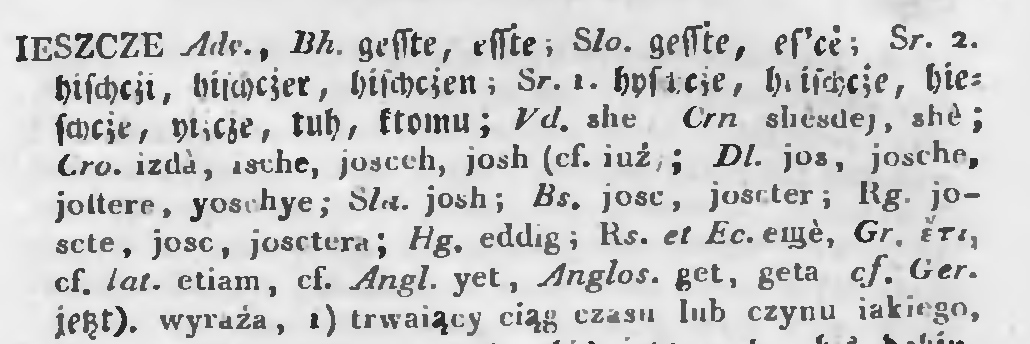
Here is the redoubtable Linde with his 1807 Polish language dictionary on the similar word “jeszcze” meaning, roughly, “yet”:

ourfriendlygeta

A note on the abbreviations: Dl. means Dalmatian, Rg. means Ragussan (i.e., from Dubrovnik), Bs. means Bosnian, Cro. means Croatian, Crn. means Carinthian (i.e., some dialect of Slovenian), Vd. means Windish or Styrian (another Slovenian dialect).  The others are obvious (and some are interesting, such as Angl. which obviously means English and Anglos. meaning Anglosaxon)

Further, “let it be” or, more likely, “there is” is a well known reference to a number of deities (see the general Indoeuropean, “is”, “ist” or “jest” as the source ultimate) – and examples from the Middle East are obvious.

All that said, there is an interesting reference to a similar deity name that likely is related to Jassa if only by virtue of geographical closeness and it comes from the Polish region of Kaszuby.

Copyright ©2015 jassa.org All Rights Reserved

February 22, 2015

On the Mountains of Jassa

Published Post author

Note to our readers:

Yes, we will continue with the Polabian Gods’ description and we have a Pomeranian project coming too BUT in the meantime we have a desire to make a brief detour (more to come later on this too).  A detour that leads us far North – or does it?

Hrubyhruby

Hrubý Jeseník (Tall Jesenik) range – the tower in the background is at the highest point known as Praded (grandfather, old man or old…God) (Interestingly, the range also contains such peaks as Keprnik – so that too is not a German word)

The Saga of Hervor & King Heidrek the Wise is an Icelandic saga.  It comes to us in a variety of manuscripts and versions.

One English translation is Nora Kershaw’s 1921 translation under the title of “The Saga of Hervor and Heithrek” (Hervarar Saga og Heiðreks) (so-called manuscript R).

Another is Christopher Tolkien’s 1960 translation of “The Saga of King Heidrek the Wise” (Saga Heiðreks konúngs end vitra) (so-called manuscript H).

Finally, there is the more recent Peter Tunstall’s 2005 translation titled “The Saga of Hervor & King Heidrek the Wise” which itself is a composite of (1) “The Saga of Hervor and Heithrek” (Hervarar Saga og Heiðreks) and of (2) “The Saga of King Heidrek the Wise” (Saga Heiðreks konúngs end vitra).

There are several interesting things about these texts.

First, to get this out of the way, they contains a bagful of names that have made it to J.R.R. Tolkien’s writings.  Tolkien was into the Old English language and Anglo-Saxon myths in general (e.g., Beowulf translation).  If you ever asked yourself where Balin or Gimli come from or, for that matter Boromir and Faramir, these kinds of sagas are it.  (To a Slav, the -mirs and -ins may sound vaguely Slavic and we will have more to say about that later when we discuss -mir’s, -mer’s, -gast’s and -gost’s).  In any event, his son Christopher enjoyed similar topics and, as noted above, also came up with his own translation of the saga in question here.

(Interestingly, although the Tolkien family is usually described as coming to Britain from Germany, his last name is neither English nor German.  For our best guess, together with the requisite German connection, see the village of Tołkiny (German Tolkynen – both from Old Prussian) deep in former East Prussia and today’s Poland).

Second, the sagas although written down much later (earliest manuscripts from the 13th century) deal with what is, in effect, pre-history.  They speak of the Gothic struggle against the Huns, for example.  It is highly unlikely that their writers were using and “improving” on Ammianus Marcellinus, Jordanes, Procopius and the like.   Consquently, they are a window into a time and place which remained largely untouched and unobserved by the Roman writers who, naturally, were only concerned with the various barbarian tribes once those got too close to the Roman frontiers.

Third, there are several interesting Slavic “connections” or at least “hooks”.  The chronicles talk about Gardarike, a term that may be Russia but also may be Pomerania (which was called that by the Scandinavians by reason of all the grads or gards on its shores – e.g., the various Stargards – this what one might have thought were a purely Slavic term (grad, grod, gorod) itself presents problems – e.g., see As-gard…).  Also, in a number of places, there are references to Harvaða mountains, which have been identified with the Harvati, i.e., the Croats and which – may – be the Carpathians (there were also the residences of the Carpi though (as well as the Avari…)).  Thus, we have:

Norse:

“Hinn mælti: ‘Taktu sverðit undan höfðafjölinni ok fá mér,” en sá tók ok brá ok sneið höfuð af fiskinum, ok þá kvað hann vísu: “Þess galt hún gedda fyr Grafár ósi, er Heiðrekr var veginn und Harvaða fjöllum.”

English (Kershaw):

“And he took it and unsheathed it, and cut off the fish’s head, and then spoke a verse:

This pike at the mouth of the river
Has paid the penalty
For the slaughter inflicted on Heithrek,
‘Neath the Mountains of Harvath”

English (Tunstall):

“And he took it and drew it and cut the head off the fish, and then he chanted a verse:

The price was paid
by the pike at Grave River,
when Heidrek was slain
under Harveth Fells.

Other Interesting Things

But there is another interesting aspect of all of this and it is in the following language:

Old Norse:

“Angantýr kvað:

“Kenndu at Dylgju ok á Dúnheiði, ok á þeim öllum Jassarfjöllum; þar opt Gotar gunni háðu ok fagran sigr frægir vágu.”

Nú reið Gizurr í brott ok þar til, er hann kom í her Húna. Hann reið eigi nær en svá, at hann mátti tala við þá. Þá kallar hann hári röddu ok kvað:

“Felmtr er yðru fylki, feigr er yðarr vísir, gnæfar yðr gunnfáni, gramr er yðr Óðinn.” Ok enn:  “Býð ek yðr at Dylgju ok á Dúnheiði orrostu undir Jassarfjöllum; hræ sé yðr at hái hverjum, ok láti svá Óðinn flein fljúga, sem ek fyrir mæli.””

English (Kershaw): 

“King Angantyr replied:

“Challenge them to battle at Dylgia and on Dunheith, and upon all the heights of Jösur, where the Goths have often won renown by glorious victories!”

Then Gizur rode away until he came to the host of the Huns. He rode just within earshot, and then called loudly, crying:

Your host is panic stricken, And your prince is doomed to fall; Though your banners are waving high in the air, Yet Othin is wroth with you all. Come forth to the Jösur Mountains, On Dylgia and Dunheith come fight; For I make a sure boast, In the heart of your host The javelin of Othin will light!

English (Tunstall):

“Angantyr said:

“Point them to Dylgja and to Dun Heath direct them and mark out all the Mounts of Jass;
there Goths often have given battle and fine victory they, famous, gained.”

Now Gizur rode off till he came to the army of the Huns. He rode no nearer than he needed to talk to them. Then he calls out in a loud voice and said:

“There’s fear on your forces, fey are your generals; the battle-banner above you looms; wrath with you is Odin.” And also: “I offer you at Dylgja and on Dun Heath I offer a fight under the Jassar Fells. A corpse be to you on every horse. May Odin let the javelin fly just as I decree.”

 Commentary on Jassarfjöll [um]:

Tolkien:

“These mountains have not been identified.  It has been suggested that their name is identical with that of the Gesenke, the mountains in norther Moravia, and that both the Norse and German forms of this name are corruptions of Slavonic Jesenik meaning “ash-mountain.”

What are “ash” mountains?  Well, they are not volcanoes (unless we are way off geographically (or chronologically! 🙂 ). They are not even “ashen” mountains.  They are simply mountains covered with ash trees (old English “æsc“).  And therein lies the problem for anyone making a reference to these mountains as such – ash in Germanic does not have a “j”.

Botany intrudes once again

Botany intrudes once again

Why are we even talking about ash trees?  Probably because those who interpreted these words were looking to Ptolemy’s mention of Asciburgius Mountains in his section on Germania (he also mentions a town of Asciburgium (also in Germany).  Ptolemy places these mountains right next to the Sudeten (Sudety).  This makes sense except that the Sudeten of Ptolemy may not be the current Sudeten.  Or are they?

Thus, where (it seems) ash or the like is indicated in the same saga, the author has no problem using the Germanic spelling:

Ok er þeir bræðr koma í Sámsey, sjá þeir, hvar tvau skip liggja í höfn þeiri, er Munarvágr hét. Þau skip hétu askar. Þeir þóttust vita, at Hjálmarr mundi þessi skip eiga ok Oddr inn víðförli, er kallaðr var Örvar-Oddr. Þá brugðu Arngríms synir sverðum ok bitu í skjaldarrendr, ok kom á þá berserksgangr. Þeir gengu þá sex út á hvárn askinn. En þar váru svá góðir drengir innan borðs, at allir tóku sín vápn, ok engi flýði ór sínu rúmi, ok engi mælti æðruorð.

(And when the brothers come to Samsey, they see two ships lying in the cove which is called Munway. Those ships were the kind called ‘ashes’. They thought these ships must belong to Hjalmar and Odd. Then Arngrim’s sons drew their swords and bit on their shield-rims, and the berserk-state came on them. Then six of them went out onto each of the ashes. And there were such good warriors on board there that they all took up their weapons, and no one fled from his post, and no one uttered a word of fear.)

[What are “ash” ships (ashen?) as in the above paragraph, is a separate question – thankfully, it seems so far, not for us].

However, the Slavic word for “ash” is jesion which obviously does have the advantage of having an a “J” in it.  The mountains then would be mountains such as the Hrubý Jeseník (German Hohes Gesenke or Altvatergebirge – see above picture discussing the peak Praded) range or the Nízký Jeseník (German Niederes Gesenke).  These are in the Eastern Sudeten Mountains (in Moravia).

samuel

The 1812 (Polish) Linde definition (thank you for the contribution!)

(That the Slavs sometimes kept or added their “J”s is evident from, e.g., jeden vs. eins.  But see Icelandic giant Thjasse (did someone say “giant”? Like a Riese?  Like Riesengebirge?). They also kept the “D”s.  About jeden (Czech, Pol) odin (Ukr, Rus) and Chris Hemsworth’s father Odin, we will, of course, have a lot more to say later… as too about other numerals, e.g., which Slavic numeral is related to et cetera? 🙂 Too easy, no points for this one!)

That there may have been a battle between Goths and Huns we also learn from Widsith’s “Bard’s Tale” poem:

Wulfhere sohte ic ond Wyrmhere; ful oft þær wig ne alæg, þonne Hræda here ymb Wistlawudu heardum sweordum wergan sceoldon ealdne eþelstol ætlam leodum.

(I visited Wulfhere and Wyrmhere; there battle often raged in the Vistula woods, when the Gothic army with their sharp swords had to defend their ancestral seat against Attila’s host.)

That the Jeseniks are close to the sources of the Vistula is, of course, quite correct:

jesenik

Jesenik on the left, Vistula sources on the right

The trouble is that, according to official chronology, there should have been no Slavs in Moravia at the time the Goth-Hun battle took place (or if there were any at all, they would have, perhaps, come with the Hun army which means that no one would have cared what they named the mountains in their tongue).

And so here we are.

Zeitschrift für Erdkunde, etc (from 1847):

This suggests the “hilly” terrain next to the village Jeser in Pomerania… With all due respect “hilly” terrain seems a bit underwhelming for the site of such a mountain battle (we can believe the Huns, in their short reign, made it to Moravia but Pomerania seems a bit of a stretch).

Afterthought

Note also that some Slavic “nationalist” historians disputed the location of these Jassar mountains in the Sudeten.  The reason seems to be that that would have meant admitting that Goths had been in Poland/Moravia or close enough.  Consequently, they looked for name Jassar further east, as in the Bieszczady or even further around Ossetia where the Gothic kingdom would have ended and where various Sarmatian tribes included the Iazyges and other similar sounding tribes (that some of these tribes may have, in fact, reached Poland did not seem to have bothered them).  For the same reason, the same historians placed Gardarike as far East as possible, leaving all of Poland, Belarus and Ukraine free of their domination (e.g., insisting that Palteskia means Polotsk and not, for example, Pultusk).

palteskia

The famous Hauksbok with Palteskia, Pulina land and Polena (to the east of which is Reidgota land and, thereafter, Hunland)

(BTW, the Hauksbok does not contain the references to Jassarfjöllum since it ends in the middle of Gestumblindi’s riddles leaving what happened later to other manuscripts)

What they did not seem to see, however, was the potential connection of the Sudeten Mountains with a, possible, pre-Germanic stratum (of whatever type but tied to Poles), assuming one were willing to read Jassarfjöllum as a case of (so to speak) singular possessive, as in Jassa’s Mountains (e.g., Stary Ded or Altvater).

(And aren’t these Jesenik mountains close to the R-Iesen Gebirge (Krkonoše or should it be Craco- or Krakonose!?), so maybe these latter ones are the Jassarfjöllum! Ok, so we are getting out of control here – time to stop)

answers

Lucas of Great Kozmin’s eerily ancient answer???

For more see here regarding Polish Gods and here regarding crazy etymologies.

Copyright ©2015 jassa.org, All Rights Reserved

February 14, 2015

On the Rarogi

Published Post author

We all “know” that the Slavs are latecomers.  Or, at least, all the academics “know” that.  With that preconception in mind we begin here a new series that looks at this claim in more detail by examining instances of strange names or places that seem to gainsay the above made claim.  Nothing conclusive, of course, just some investigation with a looking glass.

initiallannerraroguso

Frequently, the claim is made that the Venethi/Veneti/Venedi name as applied to the Slavs is simply a carryover of the old name, most likely by the Germans, onto their new neighbors, the incoming Slavs.  Most people will admit that some Venethi may have been Slavicize din the process as, for that matter, may have been some remaining Restgermanen.  What is interesting, however, is that other instances appear where the same claim would have to be made.  That is, certain Slavic tribes, seem to have the same names as the Germans or Celts who allegedly preceded them.  In some cases, this may be explained by the fact that the geography of a given place necessarily preserved the name for the newcomers.  Think of the Rugians, for example.  Assuming the name Rugen remains in use then the people who live there are Rugians, whether they are the “original” Germanic Rugii or the new Slavic Rugii (aka Ranii).  But there are other instances of the same phenomenon which are not so easily explained.  So let us focus on one of them here.

Of the Rauraci

Ceasar, in his De Bello Gallico, mentions in Book I Chapter 5 and Chapter 29, the following Celtic peoples: Helvetii, Tulingi, Latobrigi, Rauraci and Boii (the last of whom are, we are to believe, the Celtic people, whose name gave name to the country of Bohemia).  Specifically, he says, when discussing this Celtic rebellion:

“After his death [that of Orgetorix of the Helvetii], the Helvetii nevertheless attempt to do that which they had resolved on, namely, to go forth from their territories.  When they thought that they were at length prepared for this undertaking, they set fire to all their towns, in number about twelve – to their villages about four hundred – and to the private dwellings that remained; they burn up all the grain, except what they intend to carry with them; that after destroying the hope of a return home, they might be the more ready for undergoing all dangers.  They order every one to carry forth from home for himself provisions for three months, ready ground.  They persuade the Rauraci, and the Tulingi, and the Latobrigi, their neighbors, to adopt the same plan, and after burring down their towns and villages, to set out with them: and they admit to their party aunited to themselves as confederates the Boii, who had dwelt on the other side of the Rhine, and had crossed over into the Norican territory, and assaulted Noricia.”

This was Chapter 5 so now for Chapter 29, where Ceasar mentions certain lists that the Romans found in the Helvetii camp that showed the strength of the individual tribes of this venture:

“Of all which items the total was [the following number of heads]: Of the Helvetii 263,000, of the Tulingi… 36,000, of the Latobrigi… 14,000, of the Rauraci… 23,000, of the Boii… 32,000…”

Appropriately enough the Rauraci are also listed on the Tabula Peutingeriana:

peutingerianarauraciThere they are sitting comfortably around Lake Geneva at Lausanne – close to Lake Constance with its Bregentz and Vindelici.  A similarly named Reruiges are further North:

revriges

(There are other interesting names on this map, e.g., Rutenii, Radriani or, for that matter, Veliati)

Of the Reregi

Adam of Bremen has this to say in his Book II Chapter 18 description of Slavia which is “a very large province of Germany [which is] inhabited by the Winuli who at one time were called Vandals”:

“Then come the Abodrites, who now are called Reregi, and their city is Mecklenburg.”

(Deinde secuntur Obodriti, qui nunc Reregi vocantur, et civitas eorum Magnopolis. )

bremensis(Except, it does not quite say that, rather it says: “Deinde secuntur Obodriti, qui altero noie Reregi vocantur, et civitas eorum Magnopolis.” That is “Obotrites who are also called Reregi”.  Same concept)

Further in Book III, Chapter 19:

“Now all the Slavic peoples who belonged to the diocese of Hamburg practices the Christian religion devoutly under that prince; that is, the Wagiri and Abodrites and Reregi and Polabingi [Polabians]; likewise the Linguones, Warnavi, Kicini, and Circipani, as far as the Pane River which in the privileges of our Church is called the Peene.”

(Igitur omnes populi Sclavorum, qui ad Hammaburgensem respiciunt dyocesim, sub illo principe christianam fidem coluerunt devote, hoc est Waigri et Obodriti vel Reregi vel Polabingi, item Linoges, Warnabi, Chizzini et Circipani, usque ad Panem fluvium, quem nostrae privilegia ecclesiae vocant Penem.)

bremensisrauroci

These reference are made only in Adam’s work and some have speculated that they are based on a confusion with a trading place Rerk/Reric that was earlier mentioned by Einhard (whom Adam expressly relied on) or some other author of the Reichsannalen (under the years 808/809 as Emplorium Reric) but the suggestion that somehow Adam was fooled into thinking that Rerk  must have meant that there was or ought to have been a tribe of the same or similar name seems hollow.

Of Rarog

There are two things that are interesting about this name.  First, the Raurici/Reregi name is not one which one might say is easily, coming off the tongue so to speak, replicated, or, to put it a bit differently, it is not a name that one might think could be independently invented in different times and places.  But, you might say, we already have two similar names on the Tabula and, in any event, as we mentioned before, perhaps the same name was applied to a different people (i.e., the later Slavic one).

There is, however, a second interesting thing about this or a similar name.  Rarog or Raróg has a Slavic etymology.  It means a type of a falcon (or, etymologically, of a raven).  What’s more it is falcon that seems to have a religious connotation to Slavs.  Further, rarog, like Svarog or tvarog are words that are undoubtedly Slavic and are ancient (see Aleksander Brückner’s comment that it is a Slavic “ur-word”).

twolannerrarogus

Coincidence?

Copyright ©2015 jassa.org All Rights Reserved

February 11, 2015

Is the Oder the New Vistula?

Published Post author

We have raised this question before but we think it is worth enunciating it a bit so we will do it through the words of the chroniclers – one separated by a millennium of history.

vistula

Vistula?

 Helmold

[Partially Following Adam of Bremen]

“The second river, that is the Oder/Odra heads towards the North and cuts across the land of the Vinulli [Winnuli/Wends] and separates the Pomeranians from the Wilzi [Veleti].  At the mouth of this river, where it hits the sea, there was once a most illustrious city Winneta [Vinneta or Vinneda]… [description of the town and its fall follows] There one can witness a sea in three parts.  This island [on which the city stood] is cut through by three mouths of the river – one of them, as they say, is extraordinarily green, the second white and third is always covered in storms.”

Adam of Bremen

“Beyond the Leutici, who are alsoc called Wilzi, one comes to the Oder River, the largest stream in the Slavic region.  At its mouth where it feeds the Scythian marshes, Jumne, a most noble city, affords a very widely known trading center… There Neptune may be observed in a threefold mood: that island is washed by the waters of three straits, one of which they say is of a very green appearance; another rather whitish; the third rages furiously in perpetual tempests.”

Jordanes

“This island [Scandza] lies in front of the river Vistula which rises in the Sarmatian mountains and flows through its triple mouth into the northern Ocean in sight of Scandza, separating Germany and Scythia…”

“This land, I say, -namely, Scythia, stretching far and spreading wide, – has on the east the Seres [Serbs?], a race that dwelt at the very beginning of their history on the shores of the Caspian Sea.  “On the west are the Germans and the river Vistula…”

“Near their left ridge, which inclines toward the north, and beginning at the source of the Vistula, the populous race of the Venethi dwell, occupying a great expanse of land.  Though their names are now dispersed amid various clans and paces, yet they are chiefly called Sclaveni and Antes.  The abode of the Sclaveni extends from the city of Noviodunum and the lake called Mursianus to the Danaster, and northward as far as the Viscla…”

“But on the shore of Ocean, where the floods of the river Vistula empty from three mouths, the Vidivarii dwell, a people gathered out of various tribes.  Beyond them the Aesti, a subject race, likewise hold the shore of Ocean.  To the south dwell the Acatziri…”

“These Gepidae were then smitten by envy while they dwelt in the province of Spesis on an island surrounded by the shallow waters of the Visclae.  This island they called in the speech of their fathers, Gepodoios; but it is now inhabited by the race of the Vividaria, since the Gepidae themselves have moved to better lands.  The Vividarii are gathered from various races into this one asylum, if I may call it so, and thus they form a nation.”

[in some manuscripts, Vidivarii [Vindi-varii?]]

 Ptolemy

“and the mouths of the Vistula river, the head of the river, the source which is to the west and is said to be towards the Albis [Elbe]“.

[yes, the source of the Oder is much closer to the source of the Elbe than is the source of the Vistula]

“Those that inhabit Germany on the other side of the river Rhine… and after these the Rugiclei up to the Vistula river….”

[yes, the Rugian island is west of the Oder]

Question

So: Is it the case that Visculus sive Vistla as Pliny would have it?  Or maybe Visculus does sive Vistla but the Latin/Greek authors use the term erroneously when thinking of the Oder?

Copyright ©2015 jassa.org All Rights Reserved

January 23, 2015

On the Story of Samo

Published Post author


Of all the stories about the early Slavs, the story of Samo’s state is perhaps the most curious.  The story comes in two parts.  First, Samo, apparently a Frankish merchant, heads off to the Slavs who are in middle of a rebellion against the Avars and leads them to victory over the former overlords.

samo1mghmgh

First Samo story courtesy of MGH

Then he reigns over them for many years leading them to further glory by refusing to submit to and ultimately defeating the army of the Frankish King Dagobert.

samo2mghmgh

Part two from MGH

There is, perhaps, only one and only one source for this story of the “first” Slavic polity –  Book IV of the Fredegar’s Chronicle.  We will now present the entire Samo story and all the other parts of that book that relate to Wends, Slavs and Samo (though the principal years that relate to the two episodes are 623 and 630 in chapters 48 and 68, respectively).  We note first that Samo was not the first recorded Slavic king with his own kingdom as the southern Slavs had had several (and that is not even counting Boz of the Antes) quasi-states with their (explicitly noted by the chroniclers) own territory before Samo rolled in, as already mentioned here.  Further, it behooves us to say that “traces” of Samo may have survived outside of the chronicles – a topic which we will come back to later in this post – for now the story of Samo, in full, as related by Fredegar (manuscript pictures: Bibliotheque National de France, Latin manuscript 10910). (The years are given after the chronicle – some commentators question, e.g., whether the revolt happened in 623 or only after the Avar defeat at Constantinople in 626).

austrasia

The countries in question

 Samo in Fredegar’s Chronicle

sammovocatisburg1

Book IV, Section 48 (Year 623)

English:

samo1“In the fortieth year [of the rule of Chlothar?/Theuderich?], a certain Samo of the nation of the Franks from Sennonago [Sens in France? Soignies in Belgium?] together with a group of merchants went to trade with the Slavs who are called Wends.  The Slavs had at that point already risen up against the Avars that were known as Huns and their King Khagan.  Already in the olden days were the Wends used by the Huns as the so-called befulci [besulci?] so that when the Huns took the field against a nation, they themselves would stand in muster in front of their camp but the Wends would fight.  If the Wends won, the Huns would come forth to claim the booty; but if the Wends lost, they would regroup/gather new forces with the Huns’ help/protection.  They were called besulci by the Huns because they walked before the Huns and had to endure a double battle in any combat.”  [this may refer to the “motivational” influence of the Avars behind the Wends back]

samo2

“Each year, the Huns came to the Slavs, to spend the winter with them; then they took the wives and daughters of the Slavs and slept with them, and among the other mistreatments [already mentioned] the Slavs were also forced to pay levies to the Huns.  But the sons of the Huns, who were [then] raised with the wives and daughters of these Wends could not finally endure this oppression anymore and refused obedience to the Huns and began, as already mentioned, a rebellion.  When now the Wendish army went against the Huns, the [aforementioned] merchant Samo accompanied the same.  And so the Samo’s bravery proved itself in wonderful ways and a huge mass of Huns fell to the sword of the Wends.  Since these recognized Samo’s bravery they elected/raised him [to be] their king and he ruled happily thirty-five years long.  Many battles did the Wends fight under his rule and each time thanks to him did they remain victors.  Samo had twelve Wendish wives with whom he raised twenty-two sons and twenty-five daughters.”

samo3

Latin:

Anno 40 regni Chlotharii, homo quidam, nomine Samo, natione Francus, de pago Sennonago plures secum negotiantes ascivit, ad exercendum negotium in Sclavos , cognomento Winidos, perrexit. Sclavi jam contra Avares, cognomento Chunos , et regem eorum Gaganum coeperant rebellare. Winidi Befulci Chunis fuerant jam ab antiquitus, ut cum Chuni in exercitu contra gentem quamlibet aggrediebant, Chuni pro castris adunato illorum exercitu stabant, Winidi vero pugnabant; si vero ad vincendum praevalebant, tunc Chuni praedas capiendum aggrediebant; sin autem Winidi superabantur, Chunorum auxilio fulti vires resumebant. Ideo Befulci vocabantur a Chunis, eo quod duplici in congressione certaminis vestita praelia facientes ante Chunos praecederent Chuni ad hiemandum annis singulis in Selavos veniebant; uxores Selavorum et filias eorum stratu sumebant; tributa super alias oppressiones Sclavi Chunis solvebant. Filii Chunorum, quos in uxores Winidorum et filias generaverant , tandem non sufferentes hanc malitiam ferre et oppressionem, Chunorum dominationem negantes, ut supra memini, coeperant rebellare. Cum in exercitu Winidi contra Chunos fuissent aggressi, Samo negotians, de quo memoravi superius, cum ipsis in exercitu perrexit, ibique tanta ejus fuit utilitas, ut mirum fuisset, et nimia multitudo de Chunis gladio Winidorum trucidata fuisset. Winidi cernentes utilitatem Samonis, eum super se eligunt regem, ubi triginta quinque annos regnavit feliciter. Plura praelia contra Chunos suo regimine Winidi gesserunt, suo consilio et utilitate Winidi semper superarunt. Samo duodecim uxores ex genere Winidorum habebat, de quibus viginti duos filios et quindecim filias habuit.

Book IV, Section 58 (Year 628)

[speaking of Dagobert in the seventh year of his reign]

English:

“…And so great was the fear that he aroused among all the people that they all in humility submitted to his rule and even peoples, who lived on the border to the Avars and the Slavs willingly requested that he come to [rule over] them and he hoped confidently that the Avars and the Slavs and the other peoples all the way to the borders [of the Byzantine Kingdom] to rule…”

Latin:

“...Timorem vero sic fortem sua concusserat utilitas, ut jam devotione arriperent suae se tradere ditioni, ut etiam gentes, quae circa limitem Avarorum et Sclavorum consistunt, eum prompte expeterent, ut ille post tergum eorum iret feliciter, et Avaros et Sclavos caeterasque gentium nationes usque manum publicam suae ditioni subjiciendum fiducialiter spondebat…

Book IV, Section 68 (Year 630) 

English:

samo4

“In this year, merchants trading in Samo’s kingdom were killed and their property robbed by the Slavs that went by the name Wends.  This was the reason behind the falling out between Dagobert and the King of the Slavs Samo.  Dagobert sent an emissary Sycharius to Samo with the demand, to intervene, on account of the murder and theft committed by his [subjects/ people] on the Frankish merchants, as justice would demand it.  Because Samo did not even want to see Sycharius and would not let [Sycharius] before him, therefore, [Sycharius] put on Slavic garb and appeared before Samo and proclaimed to [Samo] all that he was supposed to proclaim. [i.e., he made the above-described demands for justice to be dispensed by Samo]  But Samo did not, for such are the pagan and haughty ways of bad people, recompense/undo what his [subjects/people] had done, and only committed himself to conduct judicial proceedings to resolve these and similar disputes between the two sides.  To that Sycharius replied in unfortunate words/threats, as is the manner of boisterous emissaries, which words/threats he was not empowered [by Dagobert] to use, that Samo and his entire people were  subjects of Dagobert’s.  Hurt [by these words] the King replied: “The country that we possess and we ourselves are Dagobert’s but only if he wants to keep friendship with us.”  To which Sycharius said: “It is not possible, that Christians, servants of God, should be friends with dogs.”  And then Samo replied: “If you are servants of God and we are God’s dogs then it is permitted us when you continually act against His will that we bite you.”  And with these words they threw Sycharius out.”

samo5

“When Dagobert found out about this he raised a great army out of all Austrasia [northern France – province of the Merovingian Empire] against Samo and the Wends and sent it to take the field divided in three parts.  At the same time, the Langobards raided [a/the] Slavic country to support Dagobert.  The Slavs prepared themselves to resist but the Alemanic army under Duke Crodobert  on a victory over them [Slavs] in the place where it breached their territory, and so too the Langobards won a victory; and both, Alemans and Langobards led away with them a huge multitude of prisoners.  But as the Austrasians headed towards Wogastisburg, where the main force of the Wendish forces was, there came to a three-day long battle, in which the greater part of Dagobert’s army fell to the sword, and leaving all their tents and all their belongings behind they went fleeing home.  Since that time, the Wends raided Thuringia and other Frankish provinces.  Yes, even Dervanus, the duke of the Sorbs, a people of the Slavic tribes, who until then to the Frankish Kingdom belonged, went over to Samo.  And by the way the Wends did not win their victory over the Franks thanks to their bravery but rather on the account of bad faith of the Austrasiers since they hated Dagobert for having constantly exploited them.”

samo6

Latin:

Eo anno Sclav, cognomento Winidi, in regno Samonis negotiantes, Francorum cum plurimam multitudinem interfecissent et rebus exspoliassent, hoc fuit initium scandali inter Dagobertum et Samonem regem Sclavinorum . Dirigensque Dagobertus Sicharium legatarium ad Samonem, petens ut negotiantes quos sui interfecerant, et res quas illi cite usurpaverant cum justitia faceret emendare Samo nolens Sicharium videre, nec ad se eum venire permitteret; Sicharius vestes indutus ad instar Sclavinorum cum suis ad conspectum pervenit, Samoni universa quae injuncta habebat nuntiavit. Sed ut habet gentilitas et superbia pravorum, nihil a Samone quae sui admiserant est emendatum, nisi tantum placita vellens instituere, ut de his et aliis intentionibus, quae inter has partes ortae fuerant, justitia redderetur in invicem. Sicharius, sicut stultus legatus, verba improperii quae injuncta non habuerat, et minas adversus Samonem loquitur, eo quod Samo et populus regni sui Dagoberto deberent servitium. Samo respondens jam saucius [Clar., caucius] dixit: Et terram quam habemus Dagoberti est, et nos sui sumus, si tamen nobiscum disposuerit amicitias conservare. Sicharius dicens: Non est possibile, ut Christiani Dei servi cum canibus amicitias collocare possint, Samo e contrario dixit: Si vos estis Dei servi, et nos sumus Dei canes, dum vos assidue contra ipsum agitis, nos permissum accepimus vos morsibus lacerare. Ejectus est Sicharius de conspectu Samonis. Cum haec Dagoberto nuntiasset. Dagobertus superbiter jubet de universo regno Austrasiorum contra Samonem et Winidos movere exercitum: ubi tribus turmis phalangae super Winidos exercitus ingreditur, etiam et Langobardi solatione Dagoberti idemque hostiliter in Sclavos perrexerunt. Sclavi his et aliis locis e contrario praeparantes, Alamannorum exercitus cum Chrodoberto duce in parte qua ingressus est victoriam obtinuit. Langobardi itidemque victoriam obtinuerunt; et plurimum numerum captivorum de Sclavis Alamanni et Langobardi secum duxerunt. Austrasii vero cum ad castrum Wogastisburc , ubi plurima manus fortium Winidorum immoraverant, circumdantes, triduo praeliantes, plures ibidem de exercitu Dagoberti gladio trucidantur, et exinde fugaciter omnes tentoria et res quas habuerunt relinquentes, ad proprias sedes revertuntur. Multis post haec vicibus Winidi in Thoringiam et reliquos vastando pagos in Francorum regnum irruunt. Etiam et Deruanus dux gentis Urbiorum , qui ex genere Sclavinorum erant, et ad regnum Francorum jam olim aspexerant, se ad [Al., se et] regnum Samoni cum suis tradidit. Istamque victoriam quam Winidi contra Francos meruerunt, non tantum Sclavinorum fortitudo obtinuit, quantum dementatio Austrasiorum, dum se cernebant cum Dagoberto odium incurrisse, et assidue exspoliarentur.

Book IV, Section 72 (Year 630) 

English:

“In the same year there arose a great discord in Pannonia in the Kingdom of the Avars that are called Huns.  There was a quarrel between an Avar and a Bulgar over the succession to the throne.  Both collected huge armies and fought with one another.  Finally, the Bulgars lost.  Nine thousand of them with wives and children were driven then out of Pannonia and turned now to Dagobert to give them permanent places to live within the country of the Franks.  Dagobert bade them for the time being to spend the winter by the Bavarians until he had time to take counsel with the Franks what should happen with them next.  Once they have settled in the houses of the Bavarians, he issued, after the council of the Franks, an order to the Bavarians that they should in one night, each in his own house, kill these Bulgars together with their women and children.  And that order was immediately carried out by the Bavarians so that only Alciocus with 700 men, women children survived from the Bulgars and saved themselves by escaping to the territory of the Wends where he with his people lived for many years with Wallucus, the duke of the Wends.”

Latin:

Eo anno in Abarorum , cognomento Chunorum, regno in Pannonia surrexit vehemens intentio, eo quod de regno certarent, cui deberetur ad succedendum, unus ex Abaris et alius ex Bulgaris; collecta multitudine uterque in invicem pugnarunt. Tandem Abari Bulgaros superant. Bulgaris superatis, novem millia virorum cum uxoribus et liberis de Pannonia expulsi, ad Dagobertum expetunt, petentes ut eos in terra Francorum ad manendum reciperet. Dagobertus jubet eos ad hiemandum Bajoarios recipere, dummodo pertractaret cum Francis quid exinde fieret. Cumque dispersi per domos Bajoariorum ad biemandum fuissent, consilio Francorum Dagobertus Bajoariis jubet ut Bulgaros illos cum uxoribus et liberis unusquisque in domo sua in una nocte Bajoarii interficerent, quod protinus a Bajoariis est impletum. Nec quisquam ex illis remansit Bulgaris, nisi tantum Altioeus cum septingentis viris, et uxoribus cum liberis, qui in marca Winidorum salvatus est. Post haec cum Walluco duce Winidorum annis plurimis vixit cum suis.

Book IV, Section 74 (Year 631) 

English:

“In the tenth year of the rule of Dagobert it was reported to him that an army of Wends raided Thuringia.  He left, therefore, with his forces from Metz and crossed the Ardennes towards Mainz in order to cross the Rhein there.  In addition to dukes and counts he also had the choicest cohort of brave men from Neustrien and Burgundy.  There appeared now emissaries of the Saxons in front of Dagobert asked him to exempt them form the taxes that they [noarmally] paid to the [Frankish] state.  In exchange for that they promised with great zeal and success to defend [against the Wends] and the Franksih country on the Wendish border to protect.  Dagobert fulfilled this request, after a/the council of the Neustrasier and the Saxon emissaries gave their promise, in accordance with their custom by hitting [their] weapons, for the entire Saxon nation.  Though, the promise was not successful, the taxes that they used to pay remained unpaid in accordance with Dagobert’s order.  Chlotar the Old had required them to pay annual taxes of 500 cows which taxes Dagobert now exempted them from.”

Latin:

Anno 10 regni Dagoberti, cum ei nuntiatum fuisset exercitum Winidorum Thoringiam fuisse ingressum, cum exercitu de regno Austrasiorum de Mettis urbe promovens, transita Ardenna, Magantiam magno cum exercitu aggreditur , disponens Rhenum transire, scaram de electis viris fortibus de Neuster et Burgundia cum ducibus et grafionibus secum habens. Saxones missos ad Dagobertum dirigunt, petentes ut eis tributa quae fisci ditionibus dissolvebant indulgeret: ipsi vero eorum studio et utilitate Winidis resistere spondent, et Francorum limitem de illis partibus custodire promittunt. Quod Dagobertus, consilio Neustrasiorum adeptus, praestitit Saxonibus qui his petitionibus suggerendum venerant. Sacramentum, ut eorum mos erat , super arma placata [Al. placita] pro universis Saxonibus firmant. Sed parum haec promissio sortitur effectum, tamen tributum Saxones, quod reddere consueverant, praeceptione Dagoberti habent indultum. Quingentas vaccas inferendales annis singulis a Chlothario seniore censiti reddebant, quod a Dagoberto cassatum est.

Book IV, Section 75 (Year 632) 

English:

“The eleventh year of the reign of Dagobert.  Since the Wends on the orders of Samo continued their wild raids and would often come raiding out of their own country into the Frankish Kingdom and devastated Thuringia and other provinces, therefore, did Dagobert come to the town Metz and made, after a determination of the clergy and the nobles of his country, his son Sigebert into King of Auster and gave him the town Metz as his seat.  And to the Bishop of Koln Chunibert and to Duke Adigisel he left the affairs in Sigebert’s Kingdom and palace.  He also left a sufficient treasury for his son and granted him all that his high honor required.  All these nominations he reaffirmed with specially prepared certificates.  From that time was the Frankish Kingdom through the zeal of the Austrasier sufficiently protected.”

Latin:

Anno 11 regni Dagoberti, cum Winidi jussu Samonis fortiter saevirent, et saepe transcenso eorum limite regnum Francorum vastandum, Thoringiam et reliquos pagos ingrederentur, Dagobertus Mettis urbem veniens, cum consilio pontificum seu et procerum, omnibusque primatibus regni sui consentientibus, Sigibertum filium suum in Austeris regem sublimavit, sedemque Mettis civitatem habere permisit. Chunibertum Coloniae urbis pontificem, et Adalgiselum ducem palatium et regnum gubernandum instituit. Thesaurum quod sufficeret filio tradens, condigne, ut decuit, eum hujus culmine sublimavit, et quodcunque eidem largitus fuerat, singillatim praeceptionibus roborandum decrevit. Deinceps Austrasii eorum studio limitem et regnum Francorum contra Winidos utiliter defensasse noscuntur.

Book IV, Section 77 (Year 633) 

English:

“Radulf, the son of Chamar, whom Dagobert made Duke of Thuringia, fought many times against the Wends, defeated them and expelled them.  This made him arrogant and he took every opportunity to act in a hostile manner towards Duke Adalgisel and already then was preparing to rebel against King Sigebert.  He acted according to the proverb: ‘He who loves war, always looks for/thinks of conflict.'”

Latin:

Radulfus dux illius Chamari, quem Dagobertus Thoringiae ducem instituit, pluribus vicibus cum exercitu Winidorum dimicans, eosque victos vertit in fugam. Hujus victoriae superbia elatus, et contra Adalgiselum ducem diversis occasionibus inimicitias tendens, paulatim contra Sigibertum jam tunc coeperat rebellare. Sed, ut dictum est, sic agebat: Qui diligit rixas, meditatur discordias.

Book IV, Section 87 (Year 640) 

English:

[In this year Radulf came to open rebellion.  Sigebert crossed the Rhine to attack him and initially won but then suffered a great loss at a battle at Radulf’s wood-protected camp that stood overlooking the river Unstrut.  Thereafter, Sigebert was allowed to withdraw and go home.  And, thereupon…]

“Radulf full of overconfidence/arrogance called himself King of Thuringia, became friends with the Wends and had a peaceful relationship with the other neighboring peoples.  Officially, he recognized Sigebert’s as his sovereign but in practice he opposed stingily/at every turn his rulership.”

Latin:

“Radulfus superbia elatus ad modum regis in Thoringia se esse censebat, amicitias cum Winidis firmans, caeterasque gentes, quas vicinas habebat, cultu amicitiae obligabat. In verbis tamen Sigiberto regimen non denegabat, sed in factis fortiter ejusdem resistebat dominationi.”

Conclusion 

No one knows what happened to Samo.  If you look at the “learned” sources they will say that he ruled until 658.  There is, however, no proof of this.  All we  know is that Fredegar said Samo came to power in 623 and ruled for 35 years.  That and only that is the source of the year 658.  In Fredegar’s chronicle no mention is made of Samo after the events of the year 632 where his Wends were raiding Thuringia.  Fredegar’s Chronicle ends on the year 642 and that is, as they say, that.

However, there are other interesting signs of Samo’s story to be found elsewhere.

znojmo3

The good old days

One example given is the Saint Catherine’s rotunda in the town of Znojmo.  Its frescoes (oldest in the Czech Republic)  date to 1134 (the rotunda is about 100 years older) and show the ancient rulers of the Czech lands (Znojmo is in Moravia but more or less).

znojmo2

Look up!

The first name shown is Zamo (the next three cannot be read and then we get Moimir I, the first historical ruler of  Great Moravia – between c 820-846).

samossamos

yes, it’s not the best picture

You can look at the rotunda here.

samosamo

The man in question

And then there are the names of some of the (legendary) Polish rulers, e.g. Siemo-wit or Ziemo-mysl.

There is, of course, also the question of the meaning of befulci which we will not touch save to say the meaning seems to be basically “cannon fodder”.

Then there is the question of the location of Wogastisburg.  While a lot of people are pointing at the Czech Republic, the constant mention of the Thuringians and Wends suggests a different answer perhaps.  One that points to the Veleti or Obodrites – it is in the territory of these that we find today’s Wolgast (or maybe it’s Znojmo…).  In any event, let us “REMEMBER [THE VICTORY AT] WOGASTISBURG!”

vocastisburg

Oh, yes, and there is the issue of the origin of the name Samo (which, interestingly, translates roughly into “by myself”)

Copyright ©2015 jassa.org All Rights Reserved
January 20, 2015

Reports of the Slavs from Muslim Lands Part IV – Masudi’s Account

Published Post author

Masudi, born in Baghdad became a world traveler and an author of a history book (under the rather confusing name of “The Meadows of Gold” (or, more fully, “The Meadows of Gold and Mines of Precious Gems”).  He wrote it between 941-956 (first edition in 943) in Egypt where he chose to settle.  Masudi died in 957 – eight years before Ibrahim Ibn-Ya’qub arrived at Otto I’s court in Magdeburg.  Although the below discusses some religious practices of the [seemingly, East] Slavs, we leave a wider discussion of the topic for later.  Finally, we include the Paul Lunde translation of the same separately at the back.

From Masudi

(c 943)

“The Saqaliba are descended from Madhay, the son of Japheth, the son of Noah and all the Saqaliba peoples derive their origins and trace their genealogies back to him, or at least this is the opinion of most of those who have devoted themselves to the question.  The Saqaliba dwell in the North, whence they have spread westwards.”

[this seems to suggest that at least some Slavs moved West from East; on the other hand, below Masudi seems to have his East-West confused as he suggests the Rus and Slavs extend eastwards from the Khazar Khaganate]

“The Saqaliba are divided into several different peoples who war among themselves and have kings.  Some of them belong to the Christian faith, being of the Jacobite sect, while the others are pagans and have no scripture and know nothing of divine law.”

[Jacobite, presumably meaning the Syrian Church]

allthetribes

The clan leaders of the Slavs – in front Majik of the Walitaba (unclear who backstabbed him)

“Among the different peoples who make up this pagan race, there is one that in ancient times held sovereign power.  Their king was called Majik and they themselves were known as Walitaba [Veleti].  In the past, all the Saqaliba recognized their superiority, because it was from among them that they chose the paramount ruler, and all the other chieftains considered themselves his vassals.”

[although this may seem far-fetched, if we take into account that M-dzh-k is a reconstruction, one might ask whether this could be a form of M-sh-c or M-sh-k, i.e., Mieszko – this would not be impossible though highly unlikely as in the 940s Mieszko I was very young and likely not even yet a chieftain and we also do not have evidence of earlier Mieszkos in the same area (though we also have no earlier evidence at all of that area); for a discussion of the same topic in Ibrahim‘s account (he uses the name Makha) see here]

“Among the Saqaliba peoples of the second rank should be mentioned in the following order: the Istrana, whose king in our own times is called Basqlabij; then the Dulaba, whose present king is called Wanjslaf.  Next are the Namjin, whose king is called Gharand; among all the Saqaliba these are the bravest and the best horsemen.  After, come the Manabin, whose king is called Ratimir; the Sarbin, a Saqaliba people much feared for reasons that it would take too long to explain and whose deeds would need much too detailed an account.  They have no particular religious affiliation.  Then there is the people called the Murawa and another known as the Kharwatin, and yet another called the Sasin, then the Khashanin and the Baranijabin.  The names of some of their kings which we have given are in fact dynastic titles.  The Sarbin, whom we have just mentioned, have the custom of burning themselves alive when a king or chieftain dies.  They also immolate his horses.  These people have customs similar to those of the Indians.”

[Tribes’ names mentioned above require some explanation:

– Istrana – difficult to do anything with this one; the Ister was the Danube, of course; maybe these were a tribe from the Dniester region such as the Tivercians; but the Venethi enthusiasts should also note that Istrana is a town in the Venetian country of Italy;

– Dulaba – the Dulaba were presumably the Dulebians mentioned in the PVL as being abused by the Avars and then dwelling “along the Bug where the Volhynians now are”;

– Namjin – the name might suggest Germans (Nemcy) especially given the name of the leader – Gharand (or maybe Goran?); this should not be that surprising since Masudi also lists the Sasin – possibly Saxons and the Turks (Hungarians) as Slavs; some have speculated that the reference is to Bavarians; it is interesting that these may be rendered in the Slavic suggesting a Slavic source;

– Manabin – other translations include mayin and maghanin – nonetheless, we can only throw our hands up in the air and say whaaaa?;

– Sarbin – ok, easy – Serbs of one type or another;

– Murawa – presumably the Moravians;

– Kharwatin – presumably the Croatians/Croats;

– Sasin – German Saxons or Cesi (Czechs)?;

– Khashanin – Kashubs? Those who live near Koszalin?;

– Baranijabin – we give up – other than to say that the town of Baranovichi is in Western Belarus] 

“Earlier in this work, we briefly mentioned this while discussing the Caucasus/the town Qabh [?] and the Khazars, we remarked that in the land of the Khazars there are, as well as the Khazars themselves, a Saqaliba and a Rus population and that these last [last or last two?] also immolate themselves.  These Saqaliba and other related peoples extent to the East rather than to the West.”

“The foremost of the Saqaliba kings is Aldayr, whose domains include great cities and much cultivated land, vast troops and countless armies.  Muslim merchants make their way to his capital with all kinds of merchandise.”

altair

Slav Chief of Chiefs Altair (r) uses the Force to repel an Avar Berserker (l)

[Aldayr – Askold & Dir?; or is it really aldair as in aeldar as in chieftain? Or al-Ta’ir, the flying one or the flying eagle (see the Star Aquila)? Or, perhaps it is Aldir?]

“After this, on the borders of this Saqaliba king, comes the king of al-afragh [Prague?], who has a gold mine, towns, extensive well-cultivated lands, numerous soldiers and a large population.  He is at war with the Byzantines, the Franks, the Bazkard [Bashkirs but here are meant the Hungarians seeing as that (Urals) is where they (or rather the ruling class) likely came from] and other nations besides the hostilities among them are continuous.  Neighboring this king is the king of the Turks.  These people are the handsomest, the most numerous and the most warlike of all.  The  Saqaliba comprise many different peoples and are very far-flung, but this work is not the place for a detailed description and classification of them.”

“I began by mentioning the king whose suzerainty has been recognized by all the other rulers since ancient times, that is to say Majik, king of the Walitaba, who are the original, pure-blooded Saqaliba, the most highly honored, and take precedence over all the other branches of the race.      Later, dissent having established itself among these peoples, their original organization was destroyed and the various families formed isolated groups, each choosing a king, as we have said above.  An account of all these events would take too long, all the more so, since I have already related them in a general way and with great detail in my earlier works, the Historical Annals and the Intermediate History.”

***

This is the Paul Lunde translation of the same: Chapter 9 (The Slavs):

“The Slavs are descended from Madhay, the son of Japhet, the son of Noah, and all the Slavic peoples derive their origins and trace their genealogies back to him, or at least this is the opinion of most of those who have devoted themselves to the question.  They dwell in the north, whence they have spread westwards.”

“The Slavs are divided into several different peoples who war among themselves and hav kings.  Some of them belong to the Christian faith, being of the Jacobite set, while the others are pagans and have no scripture and know nothing of divine law.”

“Among the different peoples who make up this pagan race, there is one that in ancient times held sovereign power.  Their koing was called Majik, and they themselves were known as Walitaba [Wiltzes?].  In the toast, all the Slavs recognized their superiority, because it was from among them that they chose the paramount ruiler, and all the other chieftains considered themselves his vassals.”

“Among the Slavic peoples of the second rank should be mentioned in the following order: the Istrana, whose king in our own times is called Basqlabij [Vaclav?]; then the Dulaba [western Dulabians?], whose present king is called Wanjslaf.  Next are the Namjin [‘Niemczyn, ‘Germans’] whose king is called Gharand [Conrad]; among all the Slavs these are the bravest and the best horsemen.  After, come the Manabin, whose king is called Ratimir; the Sarbin [the Serbs], a Slavic people much feared for reasons that it would take too long to explain and whose deeds would need much too detailed an account.  They have no particular religious affiliation.”

“Then there is the people called the Murawa [the Moravians] and another known as the Kharwatin [the Croats], and yet another called the Sasin [either the Saxons or the Czech ‘Cacin’], then the Khashanin and the Baranijabin.  The names of some of their kings which we have given are in fact dynastic titles.”

“The Sarbin, whom we hav just mentioned, have the custom of burning themselves alive when a king or chieftain dies.  They also immolate his horses.  These people have customs similar to those of the Indians.”

“In the land of the Khazars there are, as well as the Khazars themselves, a Slav and a Rus population and that these last also burn themselves.  These Slav and other related peoples extend to the east rather than to the west.”

“The foremost of the Slav kings is the ruler of Aldayr, whose domain include great cities and much cultivated land, vast troops and countless armies.  Muslim merchants make their way to his capital with all kinds of merchandise.”

“After this, on the borders of this Slavic king, comes the king of al-Afragh [Prague], who has a gold mine, towns, extensive well-cultivated lands, umerous soldiers and a large population.  He is at war with the Byzantines, the Franks, the Bazkard [the Magyars] and other nations besides; the hostilities among them are continuous.”

“Neighbouring this Slavic king is the king of the Turks.  These people are the handsomest, the most numerous and the most warlike of all.  The Slavs comprise many many different peoples and are very far-flung, but this work is not the place for a detailed description and classification of them.”

“I began by mentioning the king whose suzerainty has been recognized by all the other rulers since ancient times, that is to say Majik, king of the Walitaba, who are the original, pure-blooded Slavs, the most highly honoured and take precedence over all the other branches of the race.”

“Later, dissent having established itself among these peoples, their original organization was destroyed and the various families formed isolated groups, each choosing a king, as we have said before.  An account of all these events would take too long, all the more so since I have already related them in a general way and with great detail in my earlier works, the Historical Annals and the Intermediate History.”

***

And here are some other references from the main Lunde/Stone translation from  their main edition on the Abbasids:

[volume VII: 323-324 of Les Prairies d’or by Barbier de Meynard and Pavet de Courteille, Paris 1861-77; s 3015]

“Ahmad ibn Muhammad ibn al-Mu’tasim was poclaimed Caliph the day Mun-tasir died, that is, Sunday, the 5th of Rabi’ II 248 ah [862 AD]. He was known as Abu al-Abbas. His mother was a slave of Slavic origin, named Mukhariq.”  

[volume VIII: 147-150 of Les Prairies d’or by Barbier de Meynard and Pavet de Courteille, Paris 1861-77; s 3288]

“I have spoken in my Historical Annals of the eunuchs from the Sudan, the Slavic countries, Byzantium and China – for the Chinese, like the Byzantines, will castrate several of their children. I have discussed, in the same work, the contradictions in character of eunuchs which result from the removal of this member and what nature causes to occur in them when that happens, as has often been confirmed and described.”

Copyright ©2015 jassa.org All Rights Reserved

January 20, 2015