Category Archives: Origins

Theories of Theodor Pösche

Published Post author

The following exchange took place in August 1878 at the general conference (assembly) of the German anthropological society in Kiel.  It was reprinted in the Correspondenz-Blatt der deutschen Gesellschaft ruer Anthropologie, Ethnologie und Urgeschichte – volumes 10 and 11 in November 1878.

Berichte

(The same exchange was summarized in the Archiv fuer Anthropologie, volume 11.  Later it also sparked a response from Carl Platner (against Pösche naturally) in Zeitschrift fuer Ethnologie, volume 16.  An excerpt from the former we show below.  As to the latter, we will return to Platner’s arguments later).referate

 Mr.  Pösche:

“First of all, I feel induced to thank Professor Virchow for his highly instructive lecture and know that [in so doing] I will be expressing the view of all gathered; but I would like not to miss this opportunity to add something.”

[note: Theodor Friedrich Wilhelm Pösche (1825-1899) was a German author from the Sorb area (born in Zöschen, Leuna) who fled to the US after the events of 1848; he later returned to Germany and represented the US government in certain of its dealings with Bismarck.  Ironically, Pösche’s other writings on the “Arians” were later selectively used by the Nazis]

“Professor Virchow had made it clear through several expressions which he used that he shares entirely the commonly held view of German academics that everything pre-Slavic in the eastern part of today’s Deutschland, is Germanic.  A number of statements [made by Virchow] have indicated this.  But I wish to record an objection to this view which nowadays is commonly held. To say it bluntly [curtly]: whoever picks up Tacitus’ Germania, should, in lieu of Suevi, read Slavi.”

“This viewpoint does not originate with me but rather with a gentleman of great merit who 50 years ago had published a whole slew of works, from that 70 year old man resident of Hanover, that is from Mr. von Wersebe.  If one wants to know a biographical fact that is otherwise unavailable, reaches for [Heinrich] Pierer’s encyclopedia.  The newest edition available to me, had, strangely, no mention of Mr. von Wersebe – a man who had published  five to six volumes relating to the oldest deutsche history.  I would like to examine this matter in a little bit more detail.”

[note: August von Wersebe (1751-1831) – German historian.  He was among a number of German historians who previously (prior to the emergence of the German Empire) expressed the same view regarding the Suevi-Slav identity.  There may be something to Pösche’s conspiracy theory since – while Pösche has one – von Wersebe has not yet gotten his own Wikipedia page – in German or any other language…]

wersebe1

No Enthaltung and no Wikipedia page

“In the History of the German Language, Jacob Grimm mentions with disgust the viewpoint that the Slavs already in the times of Tacitus sat there where we later find them.  But the same learned Jacob Grimm establishes a new proof for the correctness of this viewpoint, in that he shows that Suevi and Slavi are only dialectically different, since even today ‘freedom’ is known in some Slavic dialects as sloboda but in others svoboda.  The first place where Mr. von Wersebe expresses this view, is in his book about the districts between the Weser and the Saale.”

[note: ironically, Pösche seems to have been unaware that the River Saale’s first recorded name was Souava and that this is indeed a Slavic name].

“But now there is another thing and Professor Virchow already mentioned the thing, as it appears to me, a new factual evidence for the correctness of this view.  Those are the temple rings, that we find only among the Slavs.  I connect these with the mention by Tacitus which alludes to a  hairstyle peculiar to the Suevi, who wore a hair knot bound on top of the middle of their head.  I believe the temple rings served the function of holding the hair together in the knot.”
rings

[note: the rings in question were later found in Suevic places and, perhaps, in portions of Scandinavia, and, therefore, declared “Germanic” as well as Slavic.  However, this kind of appropriation (though common) does not – in this specific case – answer the question of the rings’ “ethnic belonging” since the question at hand is precisely the question of Suevic ethnicity.  To say that they were also Suevic and, therefore, not Slavic is merely to provide a circular response.  A much more relevant objection may be that the temple rings appear to have been worn by women – the hairstyle mentioned by Tacitus, however, seems to have been male.  Tacitus himself also mentions no specific means of holding the “Suevic knot” together.  For a more recent find of seemingly similar type see here (“Mixed with these remains were gold rings likely worn on the hair”)].

slawen

“I do not wish to hold up the meeting further.  I will close by saying that I am ready to stand by and completely represent the view expressed by Wersebe more than 50 years ago –  that the Suevi were Slavs and that already at the end of the first century A.D. they lived there, where we later find them, that is also here [the proceeding took place in Kiel] till the easternmost Holstein – so long as my strength lasts.  I wish at the same time to repay the debt of honour to the man, who more than 50 years ago announced such important truth for our oldest history and [who] to this day remains unmentioned/ignored.”

Mr. Virchow

“I would like to at first note that the ungratefulness vis-a-vis Mr. von Wersebe is not entirely general.  One must only differentiate between his different works.  I personally am very thankful in relation to his work about the colonization of North Germany and have cited it many times.”

wersebe2

The offending text

“However, a different matter arises, when we ask whether the position of Tacitus should, by means of a simple rewriting of a word, be turned to mean its opposite.  This is not merely a philosophical question. In this respect I should point out that  all these peoples that Tacitus mentions in our parts did not remain in their seats; they appear, bit by bit, in the course of further wanderings in areas more to the West and to the South but everywhere where they so appear, they show themselves not as Slavs but as Germans.  Not one of these tribes that we view as our predecessors, that we must designate as originally autochtonous to our areas, is ever in the old works differentiated from the Germanics.  Wherever they are shown to us, they are shown/described as Germanic peoples.”

[note: Virchow does not really address the question here.  These tribes are described as “German” because they came from “Germania”.  Elsewhere, other – what we would call “Germanic” – tribes are described as Sarmatian because they came into the Roman world from “Sarmatia” (for example, see Procopius’ description of the Goths where they, Gepids and Vandals are linked even to the  Melanchlaeni of Scythia (previously located west of Tanis/Don!))]

“The more one delves into the specifics, the more one becomes convinced that all, that has been preserved about them from ancient times, provides a certain homogenous picture, in which these tribes united themselves with the remaining/other Deutsche.  When you look for the old seats of the Longobards, the Vandals, the Semnones and the Burgundians, where do you come to?  You come finally till the Wertha, to Silesia, to the March, Brandenburg, to the shores of the Elbe – yes, admittedly where we doubtless find Slavs later.  But does it follow, that the Longobards and Burgundians were themselves Slavs?  Certainly not.  The Langobards sat in the Barden district, which later was also Slavic.  I think, however, you will not for this reason want to make Langobards into Slavs.” 

[note: the problem with this argument is that – outside of people called the Burgundians – it is difficult to establish the presence of any so-called Germanic tribes in any of today’s Slavic areas – except temporarily.  Specifically, virtually all the Origina Genti of the Langobards or Goths point towards Scandinavia.  The Vandals left no such stories but their presence in Silesia or elsewhere in Poland also cannot be established from known sources.  And if all these people were in fact such wanderers from Scandinavia then the obvious question is: who lived in the Central European areas that they entered from the North?  And what happened to these original inhabitants?  It is undisputed that all of the Nordic tribes eventually ended up marching south – towards Rome – thus we know that, e.g., Pannonia was the Langobards’ base of operations for many years – and yet no one claims that the Langobards were native to Pannonia or that no one lived in Pannonia before they arrived.  One might also note that even the Burgundians could – with some eyebrow raising – be explained as Slavic – after all their name just means city dwellers but city dwellers come from a city, from is “z” or “s” in Slavic and town – in Latin and, perhaps, ancient Venetic – would have been an urbs – and so we come to the Z-urbs or Sorbs… 🙂 ]

Mr.  Pösche:

“Gentlemen! In the beginning I have to say that I only spoke of ingratitude when discussing this one paper of Mr. Wersebe and not in general.  Against Doctor Montelius I must say that I tried to be as brief as possible and, therefore, forgot to say that I believe the Langobards and all these Vandalic peoples in the majority to have been Slavs.  I accept the view of Šafárik.  This one had stated that the Vandals were Germanized Slavs, that the Germanic elements in all these peoples were invasive [elements that  appeared] when the Germans broke into Slavic lands, that all the the Langobardic and Vandalic peoples – the great mass of the population – are Slavs initially.  but the nobility among them I believe was Germanic.  Little by little had the great mass of the population adopted the Germanic language.  I do not wish to forget to mention that Paul the Deacon describes a portrait of old Langobardic kings, and there, it occurs to me, that the Kings wore their hair on the side, which was probably held in place by means of temple rings.”

[note: Montelius spoke just after Pösche’s first statement – he generally relied on the perceived similarities between various archeological finds to support Virchow’s position; as regards the rings, consistent with the above discussion, Pösche is implying that these would have been Slavic customs because temple rings were typical of Slavs. See above note for a discussion of this]

“I would ask to be able to mention something else regarding Tacitus.  Professor Virchow and Doctor Montelius will agree with me:  The Veneti of Tacitus were probably the Wends!  But now Tacitus says: ‘I am unsure whether to count the Veneti among the Germans’ or not.  Finally, however, he decides to count them among the Germans ‘because they fight on foot and because they have fixed homes.’  Now, gentlemen, the Slavs also have fixed homes and also fight on foot.  Here we have the criterion upon which Tacitus makes his decision though he himself doubts [the correctness] of the basis for his decision.  You have to admit that these [decision] bases are not solid.  Therefore, [just] because they fought on foot and had fixed habitations  they could never be viewed as Germans!  You avowedly view the Veneti to be the Wends [i.e., Slavs] but when you then claim the Suevi to be Deutsche, then you are obliged to count the Wends too among the Germans!”

[note: Pösche’s point, more simply stated, is that 1) the Veneti were Slavs and 2) their mode of life was such that they were counted among the Germans (as per Tacitus).  It follows that the ethnicity of the Suevi – the biggest Germanic group of all – can likewise not be established with certainty.  At least not based on Tacitus.  His point about the Suevi is simply that their lifestyle and manner of fighting was exactly the same and yet these were counted by his colleagues – without hesitation – as Germans].

Mr. Mehlis:

“Regarding the use of names, I would like to say a few words against the position of Mr. Pösche.”

“One can argue quite well using names.”

“With names one can create a SYSTEM.”

[note: Mehlis seems to be saying “that sneaky Pösche – so clever with his names and words!”]

“But I believe, that anthropology should be governed not by names but by FACTS.  I believe, that in this context the authority of Messrs.  Virchow and Montelius (which [authority] has proven the GERMANIC CHARACTER of a whole range of finds, which [finds] extend far in the abodes to the East till the Oder and the Vistula, which abodes the classical authors have IN FACT been named as the ABODES OF GERMANICS) will suffice, so as to lead us back to the land of FACTS.”

“A few more words about the well-known claim of [Jacob] Grimm’s in the German Grammar [book], that the word Suevi should be the same as Slavi.  Until now, no one has dared to step up against Grimm’s authority.  The correctness of this claim can be shown quite well that even the Suevi were called Slavi by their neighbors.”

[note: this assertion seems entirely made up – to our knowledge, Slavs never called Germans (or Swabians) by the name Slavs.]

“And the explanation of this name giving can be even better if we observe the analogical situation with the Celts who called their eastern neighbors ‘Germans’.  Also the name ‘Germans’  is derived by a row of authorities too long to mention, from Celtic roots ‘ger; ‘guer‘ and ‘man‘ = that is a ‘yeller/screamer’ or from ‘gais‘ and ‘man‘ = that is a ‘speerman’ = ‘Ger-man’; and when we in the East of Germany find this same name given by the Slavs [to the Germans], this is explained by the analogous Western name giving by the Celts.  I believe, that this analogous name giving process is the most suitable, to resolve this argument about names.”

[note: It is not clear what Mehlis means by this. He seems to be saying that the name “German” was a western Celtic name for the Deutsche but had been appropriated in the East by the Slavs to name the same Deutsche.   This is intended as an apparent analogy to the “Slavic” Suevi name which, Mehlis implies, was an eastern Slavic name for the Deutsche that was then adopted in the West for the same Deutsche.

This is rather a stretch.  For one thing, the name “German” was never adopted in the East – rather it makes a late and limited appearance in Russia only most likely due to German influence during the imperial period.  Even there the older name Nemec continues in existence.  Moreover, just because something happened once in an era of broader communication of the 18th and 19th centuries does not mean it happened before in the much more insular era B.C.  Surely, Mehlis is not suggesting that the Suevi name was brought West by Slavic visitors to Celtic courts of Gaul…]

 Mr.  Pösche:

“I have to confess that things are not clearer to me now.  I have brought up the words of Tacitus.  But I am being reproached that words and names mean nothing.  But that cannot be.  When a reliable writer names names, that has meaning and [is] not merely empty noise.  With respect to the Germanic antiquities in the East which Professor Virchow mentions, I have heard nothing of them in his lecture today; but I would like to know nevertheless, whether Germanic antiquities were ever found there.  That would be of relevance [methinks].  You try to establish an analogy there between the process of naming [peoples] in the West and East of Deutschland, and there you claim that it was the Germans that, if I understood correctly, gave the Slavs their own name.  But “Slavs” is demonstrably a name which they [the Slavs] have used to call themselves.  So long as you have not brought up evidence, I must nevertheless take exception [and] to believe in the truth.”

[note: Mehlis’ argument, if we follow it at all, seems to be slightly different – that Slavs named their German neighbors Suevi and, he implicitly assumes, that the Slvs then transferred that naming to the Celts; this, as discussed above however, seems even more untenable than the argument that Pösche thinks Virchow is making]

german

Copyright ©2016 jassa.org All Rights Reserved

March 14, 2016

A Degree of Separation?

Published Post author

The word “slave” has previously been derived from Slav.  Slave, however, would be a new word resulting from the slave trade in Slavs in the middle ages.  Antiquity did not know the word “slave”.  In particular, the Latin word for “slave” had previously been “servus”.  But this too appears strange inasmuch as a connection seems to exist between the names Slavs and Serbs – albeit, obviously, not all Slavs are Serbs.  To add to the mystery, the word Slav has historically among the Western “Slavs” been pronounced “Suavianin” – a remarkable pronunciation given that Procopius and Jordanes referred to what must have been Suebi as Suavi. On the etymological connection (noted by no less than an authority than Jacob Grimm) between Suevi and Suavs/Slavs we have written previously.

elbe

So where do we go from here?

There was a theory by Edward Romuald Bogusławski (there were at least two Bogusławskis) that the Slavs were basically the servants/slaves/lower classes of the Suevic confederacy who then took over the name of the tribe once the upper classes hit the dirt in the various Suevic wars.  If this were to be the case, their ethnic background could have been Suevic but also as diverse as that of the peoples conquered by the Suevi, i.e., “Germanic” (?) in the north, Celtic (?) in the south, Venetic (?) in the east (or far west?) or Pannonian or “Sarmatian” or Baltic (Aestic) in the east.

One could further extrapolate from this and posit that the Servi were those Suevic captives (whether Suevic or otherwise) that fled – perhaps eastwards across the Elbe – encountering there, perhaps, the Veneti.  That would make the remaining Suevi (i.e., the Suavs/Slavs) much like the later Cossacks fleeing the feudal oppression of the magnates to the Wild Fields of the Zaporozhian Sich…  And what of language? Was there one language of the Suevi?  Tacitus suggests yes but he also says that the Suevi are not one nation…  What does he mean by that?

Here is an interesting quote from Meisterlin’s Cronographia Augustensium (Chronik von Augsburg or Chronicle of Augsburg) which says: est gens Sevorum qui nunc Suevi dicuntur

Strange

We have mentioned before the interesting connection between the Suevi and, what seem like,  the Sorbs by bringing up Vibius Sequester’s sentence (see also here):

Albis Germaniae Suevos a Cerveciis dividiit: mergitur in Oceanum.

(Elbe of Germany divides the Suevi from the Cervecii and empties into the Ocean)

It is a bit strange, given the above sentence, that the Suevi were previously separated from “other Germans” and the Suevi freemen from the Suevic “Servi” in another way (in the words of Tacitus):

Insigne gentil obliquera crinem, nodoque substringere.  Sic Suevi a ceteris Germanis: sic Suevorum ingenui a servis separantur.

(It is the special characteristic of this nation to comb the hair sideways and fasten it below with a knot. This distinguishes [separates] the Suevi from the rest of the Germans; this, among the Suevi, distinguishes the freeman from the slave)

germane

Prisoner’s head – from a bronze figure found at Vindobona (aka Vienna)

Copyright ©2016 jassa.org All Rights Reserved

March 13, 2016

The More Things Change

Published Post author

In the spirit of reconciliation and in an attempt at finding common ground we decided to review some of the ethnographic descriptions of the “Germans” in Julius Caesar’s Galllic Wars and in Tacitus’ Germania (and also in his Annals) and compare these with sources we have on the “Slavs”.  We arrange these topically.

Only one conclusion may be drawn, of course, the Germanic cultural impact on the Slavs has been just incredible.

German Looks

wanker1

Germans wear Adidas

“Hence a family likeness pervades the whole, though their numbers are so great: eyes stern and blue; ruddy hair; large bodies, powerful in sudden exertions…”

[Tacitus]

Slavic Looks

wanker2

Slavs wear Nike

“For they are all exceptionally tall and stalwart men, while their bodies and hair are neither very fair or blonde, nor indeed do they incline entirely to the dark type, but they are all slightly ruddy in color.”

[Procopius]

Germanic Kryptonite

fleeing1

This beetish German is fleeing the Sun’s Chariot – his eyes have already burned out black

“[Their bodies are] impatient of toil and labor, least of all capable of sustaining thirst and heat. Cold and hunger they are accustomed by their climate and soil to endure.”

[Tacitus]

Slavic Kryptonite

svarog

A Slav desperately trying to shield his face from the scorching rays of Svarog the Slavic Sun God

“The cold even when it is intense, is healthful to them, but the heat destroys them.  They are unable to travel to the country of the Lombards because of the heat, for the hear there is fierce and they perish.”

[Ibrahim Ibn Yaqub]

Germanic Density of Settlement

germanhouses

Sporadic Germanic dwellings dot the dreary landscape

“It is well known that the nations of Germany have not cities, and that they do not even tolerate closely contiguous dwellings. They live scattered and apart, just as a spring, a meadow, or a wood has attracted them. Their village they do not arrange in our fashion, with the buildings connected and joined together but every person surrounds his dwelling with an open space, either as a precaution against the disasters of fire, or because they do not know how to build.”

[Tacitus]

Slavic Density of Settlement

“They live in pitiful hovels which they set up far apart from one another”

slavichouses

Slavic hovels appear among the plains only sporadically

“… for they were both called Spori [i.e., spores or “germlings”] in olden times, because, I suppose, living apart one man from another, they inhabit their country in a sporadic fashion.”

[Procopius]

Germanic Lodgings

winter

Germanic peasants go underground for the winter

“…They also dig subterraneous caves, and cover them over with a great quantity of dung. These they use as winter-retreats, and granaries; for they preserve a moderate temperature”

[Tacitus]

Slavic Lodgings

slavicwinterhouse

Slavic peasants made their way under already in the fall

“The extreme cold which afflicts the country is so harsh that the inhabitants are forced to construct underground dwellings, roofed with wood like a church and completely covered with earth.”

[Ibn Rusta]

Germanic Wanderings

germanhiker

Typical Germanic Wanderers

nor are they [Suevi] permitted to remain more than one year in one place for the purpose of residence.”

[Julius Caesar]

Slavic Rovings

slavichiker

Typical Slavic rover

“as a general thing, every man is constantly changing his place of above.”

[Procopius]

Germanic Funerals 

germanicfire

Intense Germanic funeral pyre

“Their funerals are without parade.  The only circumstance to which they attend, is to burn the bodies of eminent persons with some particular kinds of wood. Neither vestments nor perfumes are heaped upon the pile:  the arms of the deceased, and sometimes his horse,  are given to the flames. The tomb is a mound of turf.”

another version of same:

“In their funerals there is no pomp they simply observe the custom of burning the bodies of illustrious men with certain kinds of wood.  They do not heap garments or spices on the funeral pile.  The arms of the dead man and in some cases his horse are consigned to fire.”

[Tacitus]

Slavic Funerals

slavicfire

Calm, slow-moving Slavic funeral pyre

“They burn their dead.  When a woman dies, they cut her hands and face with a knife.  The day after the funeral of a man, after he has been burned, they collect the ashes and put them in an urn, which is buried on a hill.”

[Ibn Rusta]

Germanic Hospitality

germanhospitality

All strangers are welcome in Germany (even complete strangers)

No people are more addicted to social entertainments, or more liberal in the exercise of hospitality.  To refuse any person whatever admittance under their roof, is accounted flagitious.  Every one according to his ability feasts his guest: when his provisions are exhausted, he who was late the host, is now the guide and companion to another hospitable board. They enter the next house uninvited, and are received with equal cordiality. No one makes a distinction with respect to the rights of hospitality, between a stranger and an acquaintance. The departing guest is presented with whatever he may ask for; and with the same freedom a boon is desired in return.”

[Tacitus]

Slavic Hospitality

Vice President Joe Biden dips a piece of bread in salt as part of a welcoming ceremony upon the Vice President's arrival in Kyiv, Ukraine, Monday, July 20, 2009. Official White House Photo by David Lienemann

Every traveler receives a loaf of bread and three Slavic women

“They are kind and hospitable to travelers in their country and conduct them safely from one place to another, wherever they wish.”

“If the stranger should suffer some harm because of his host’s negligence, the one who first commended him will wage war against that host, regarding vengeance for the stranger as a religious duty.”

[Maurice’s Strategikon]

Germanic Sword Dances

germanic

Germanic women wanted to partake too

“They have only one kind of public spectacle, which is exhibited in every company. Young men, who make it their diversion, dance naked amidst drawn swords and presented spears.”

[Tacitus]

Slavic Sword Dances

slavic

In the taste of dancing well known to Slavic men

“I recall that in youth I read in a certain chronicle that there were in Poland Gods and from those days to our times such rites come that, young women [in his time] dance with swords, as if in offering to the pagan Gods, and not to [the] God, as well as [dances of] young men with swords and sticks, which they then hit about…”

[Lucas of Great Koźmin]

Germanic Auguries

No people are more addicted to divination by omens and lots. The latter is performed in the following simple manner. They cut a twig from a fruit-tree, and divide it into small pieces, which, distinguished by certain marks, are thrown promiscuously upon a white garment. Then, the priest of the canton, if the occasion be public; if private, the master of the family; after an invocation of the gods, with his eyes lifted up to heaven, thrice takes out each piece, and, as they come up, interprets their signification according to the marks fixed upon them. If the result prove unfavorable, there is no more consultation on the same affair that day; if propitious, a confirmation by omens is still required…”

priestofodin

Odin’s priests conducted strange auguries

“… it is peculiar [i.e., unique] to them to derive admonitions and presages from horses also.  Certain of these animals, milk-white, and untouched by earthly labor, are pastured at the public expense in the sacred woods and groves.”

[Tacitus]

Slavic Auguries

“After these magics/readings they cover the auguries with green grass/turf and after sticking into the ground in the form of a cross two spear tips/shafts, they walk through them a horse while making penitent gestures – a horse that they consider to be of the most importance and that they revere as something that is holy.  Throwing the auguries which they already used in divination, they take up again the augury through this as if holy animal.  If both of the auguries produce the same sign, then these tribes follow that answer in their deeds, and if not then they stop with sadness whatever undertaking.”

[Thietmar]

“[Svantovit] also had his own holy white horse and it was seen as sacrilege to rip a hair from his mane or tail, and no one other than the priest was permitted to feed him or ride him…”

priestofsvantovit

Svantovit’s priests’ auguries were odder still

“They also read warnings from the horse’s behaviour in the following way: when war was intended with one country or another, it was the custom of the temple attendants to stick six spears into the ground in pairs of two where the shafts of each such pair would cross and where the spear pairs would be equidistant.  When the troop was to march out, the priest gave a solemn prayer and thereafter he led the horse in a harness from the [temple] foyer and led so that he had to jump in front of [or through] the spears.  Should the horse lift the right leg ahead of the left, they took that to mean that the war will be successful.  But should he have raised only one time [i.e., once out of the three] the left leg as the first, they gave up on their expedition and would not even raise anchors until such time that they saw him [the horse] jumping three times through the spears in such a manner that they took to be a good omen [i.e., right leg ahead of the left].”

“Also when they were to set out in other matters, they took the augury from the first encountered animal.  If the augury was favorable, they rode further happy, if it were not they then quickly went back home.  It was also not unknown to them to throw lots, they threw, namely, on their lap three pieces of wood as lots, they were white on one side and black on the other and white meant luck and black meant misfortune.  Even the women did not avoid such practices.  When they sat at a fire sometimes they drew random lines in the ash and counted them together.  If the number was even they believed that that portended good fortune, when it was odd, though, they took that as a bad sign.”

[Saxo Grammaticus]

“This emperor [Henry III] possessed many and great virtues; and nearly surpassed in military skill all his predecessors: so much so, that he subdued the Vindelici and the Leutici, and the other nations bordering on the Suevi, who alone, even to the present day, lust after pagan superstitions: for the Saracens and Turks worship God the Creator, looking upon Mahomet not as God, but as his prophet. But the Vindelici worship fortune.”

[William of Malmesbury]

Germanic Religion

“The Germans differ much from these usages, for they have neither Druids to preside over sacred offices, nor do they pay great regard to sacrifices. They rank in the number of the gods those alone whom they behold, and by whose instrumentality they are obviously benefited, namely, the sun, fire, and the moon; they have not heard of the other deities even by report.”

[Caesar]

Mercury is the deity whom they chiefly worship, and on certain days they deem it right to sacrifice to him even with human victims. Hercules and Mars they appease with more lawful offerings. Some of the Suevi also sacrifice to Isidi [Isis?]…  The Germans, however, do not consider it consistent with the grandeur of celestial beings to confine the gods within walls, or to liken them to the form of any human countenance. They consecrate woods and groves, and they apply the names of deities to the abstraction which they see only in spiritual worship.”

[Tacitus]

[the temple too of Taefanae, as they called it, the special resort of all those tribes, was leveled to the ground.]

[Tacitus’ Annals]

Slavic Religion

“And those who worship the fire near a fireplace.”

[Sermon of a Christ Lover]

“And the sun and the moon they burned offerings to.”

[Maciej Stryjkowski]

“They still worship Mercury and Venus in particular; they do not have temples but worship in the woods or nearby to springs.”

Chronica Richardi Pictauiensis]

Mars they called Lada.”

[Jan Dlugosz]

“[u]nfortunately during those three days of the Pentacost that ought to be spent on introspection, there come the old women and the girls not to church, not to prayers, but to dance, not to call God, but the devil, specifically ysaya lado ylely ya ya.”

[Sermones per circulum anni Cunradi]

“Diana which in their tongue was called Dzewana

[Jan Dlugosz]

Germanic Gerries

“[F]or that the people who first crossed the Rhine, and expelled the Gauls, and are now called Tungri, were then named Germans; which appellation of a particular tribe, not of a whole people, gradually prevailed.”

[Tacitus]

Slavic Gerries

“On the very day of his arrival flags were placed around the town, which was engaged in celebrating a festival in honour of an idol called Gerovit… a golden shield fastened to the wall which had been dedicated to Gerovit their god of war, and which they considered it unlawful to touch.”

[Ebbo]

Germanic Warfighting

“The Galls toss [stuff materibus], and the Suavi/Suevi lances.”

[L. Cornelius Sisenna]

Oooops!

Slavic Warfighting

“They are armed with short javelins, two to each man. Some also have nice-looking but unwieldy shields.”

[Menander]

Germanic Suevia

“I must now proceed to speak of the Suevians, who are not, like the Cattans and Tencterians, comprehended in a single people; but divided into several nations all bearing distinct names, though in general they are entitled Suevians, and occupy the larger share of Germany.”

[Tacitus]

“The lands of Europe in the East are first, Alania; in the middle, Dacia (there we also find Gothia); and finally, Germania, the main part of which is held by the Suevi. In all there are fifty-four tribes. Now I shall describe the lands between Mare Nostrum and the Danube, a river which separates these lands from the territories of the barbarians.”

[Orosius]

Slavic Sclavania 

Sclavania is a very large province of Germany inhabited by the Winuli who at one time were called Vandals.  It is said to be ten times larger than our Saxony, especially if you count as part of Slavia Bohemia and the expanses across the Oder, the Poles, because they differ neither in appearance nor in language.”

[Adam of Bremen]

Copyright ©2016 jassa.org All Rights Reserved

February 28, 2016

Jordanes’ Romana

Published Post author

Jordanes mentions the Antes and the Slavs not only in his Getica but also in the Romana.  Although the mention is brief – indeed at the very end of the work, it is worth of notice so we add it here using Momsen’s edition:

momsenseedition

388 These are the misfortunes of the Roman Empire aside from the daily inroads of the Bulgars, Antes and Slavs.  If anyone wishes to know them, let him go through the annals and the history of the consuls without disdain, and he will find a modern-day empire worthy of a tragedy.  And he will know whence it arose, how it grew or in what way it subjected all lands to itself and how again it lost them through ignorant rulers.  It is something we, to the extent of our ability, have treated so that, through reading, the serious reader may gain a broader knowledge of these things.

Hi sunt casus Romanae rei publicae preter instantia cottidiana Bulgarum, Antium et Sclavinorum. Que si quis scire cupit, annales consulumque seriem revolvat sine fastidio repperietque dignam nostri temporis rem publicam tragydiae. Scietque unde orta, quomodo aucta, qualiterve sibi cunctas terras subdiderit et quomodo iterum eas ab ignaris rectoribus amiserit. Quod et nos pro capta ingenii breviter tetigimus, quatenus diligens lector latius ista legendo cognoscat.

Copyright ©2016 jassa.org All Rights Reserved

February 24, 2016

Of Beer & Loincloths

Published Post author

Diodorus Siculus (Diodorus of Sicily) was an ancient Greek historian who lived about 60-30 BC.  He wrote several interesting works among them, quite naturally, a history (more precisely, a work called the “Historical Library”).

zyth

Book V of that history contains interesting descriptions of northern Europe (including of Britain).  You can view the whole write up here.  For our purposes, however, we will be content to present only three fragments that relate to Gaul:

26 “Furthermore, since temperateness of climate is destroyed by the excessive cold, the land produces neither wine nor oil, and as a consequence those Gauls who are deprived of these fruits make a drink out of barley which they call zythos or beer, and they also drink the water with which they cleanse their honeycombs.”

29 “Certain of them despise death to such a degree that they enter the perils of battle without protective armour and with no more than a girdle about their loins.”

32 “And now it will be useful to draw a distinction which is unknown to many: The peoples who dwell in the interior above Massalia, those on the slopes of the Alps, and those on this side the Pyrenees mountains are called Celts, whereas the peoples who are established above this land of Celtica in the parts which stretch to the north, both along the ocean and along the Hercynian Mountain, and all the peoples who come after these, as far as Scythia, are known as Gauls; the Romans, however, include all these nations together under a single name, calling them one and all Gauls.”

The three interesting points are as follows:

Beer

First, the barley drink, i.e., beer is mentioned here as a Gallic drink named zythos.

Now, zythos is supposed to be an Egyptian type of beer not Gallic.  It is certainly true that in Book I of the same work Diodorus says the following:

34 “The Egyptians also make a drink out of barley which they call zythos, the bouquet of which is not much inferior to that of wine.”

Similarly, the Talmud notes (42b) as follows:

“What is Egyptian Zithom? —  Rabbi Joseph learned that it is a concoction made of a third part barley, a third part safflower, and a third part salt.  Rabbi Papa omitted barley and substituted wheat.  And your token is ‘sisane.’ They soaked these ingredients, then roasted them, ground them and then drank them.  From the Passover sacrifice until Pentecost, they who are constipated are relieved, while they who are diarrhoeic are bound.  But for an invalid and a pregnant woman it is dangerous.”

However, the earlier source is Diodorus by far (the Babylonian Talmud was not completed, at the earliest, until around 500 AD). And he also says that the Galls use the same term as we saw above.  In neither place does Diodorus say whether the word is originally Gallic or Egyptian or of some other origin.  However, the Greek ζύθος may have cognates in both Greek versions of “leaven” and in “yeast”.  If this is the case then it is also possible that the word is northern in origin – perhaps brought to Egypt with the armies of Alexander the Great.  (The Egyptians by all accounts did know beer – what they called it, however, is an entirely different matter).  Thus, perhaps, zythos was a Gallic or otherwise northern European name.

Moreover, as the above quotation notes it may not have been just a barley drink.  A much earlier source,  Theophrastos (circa 371 – about 287 BC) in his History of Plants apparently says that the term covers “those beverages, which were prepared, like those made of barley and wheat, of rotting fruits.”  Consequently, it seems that the term encompassed more than just barley drinks.

It is curious then that the Slavic word for “secale” – e.g., żyto (Po) or žito (Czech) – should sound so similar.  Aleksander Brueckner has very little to say about the etymology of this rather important word referring only to “life”, i.e., život/życie).

(Incidentally 1, the Greeks also knew kamon which was Dalmatian beer.  Whether that has anything to do with kamos of the Huns we leave to you but Priscus did say when visiting Attila’s camp: “In the villages we were supplied with food – millet instead of corn – and medos as the natives call it. The attendants who followed us received millet and a drink of barley, which the barbarians call kamos.”)

(Incidentally 2, sources relate that the consumption of zythos won’t result in “punishment” of karat[h] or “cutting off” – כרת – why Slavic – an IndoEuropean language – should have the same word for punishment – kara – as Hebrew, we leave to speculation noting only that other “weighty” words may also be similar such as the word for “good” – dobri).

Loins & Loincloths

Barbarian warriors, no doubt, often fought without armour and with pitiful protections.  Nevertheless, the above description of the Galls cannot help but bring to mind the later description of the Slavs by Procopius:

“Indeed, some of them do not wear even a shirt or a cloak, but gathering their trews up as far as to their private parts they enter into battle with their opponents.”

Galls & Celts

Diodorus’ division of the “Galls” into “Galls proper” and the more southern Celts should be of great interest to us as should the remark that the Romans have ignored such differences calling all these barbarians by the same name “Galls.”  See here for possible connections.

Copyright ©2016 jassa.org All Rights Reserved

February 7, 2016

“C’est ce qu’il n’est pas facile de determiner” and other potpourri

Published Post author

Zeeuwen or Seeland is a region of the Netherlands.  We were previously debating the possibility of it being yet another candidate (along with Seeland in Denmark) for the Selencia of Gallus Anonymous.  What’s interesting is that the name Zeeuwen may have come from the name Suevi.  Or at least one researcher suggested that as a possibility.  That researcher was Maurits Gysseling, a name we came across already in the past.  He is the man who thought that BC the language of Gallia Belgica was neither Germanic nor Celtic but rather some “other” Indo-European language (the so-called “Northwest Block” theory).

Here are his musings from the “Toponymisch Woordenboek van België, Nederland, Luxemburg, Noord-Frankrijk en West-Duitsland”:

s

As you can see, Gysseling does not make up his mind on this point, nor, in fairness, would it be easy to do so.  Nevertheless, intrigued, we took a look at the passage he refers to in Annales Vedastini (Annals of Saint Vaast).  These annals are of interest also because of the location of the Abbey of Saint Vaast in Arras which is in Pas-de-Calais in the north of France – an area which has a number of interesting town names.

z1

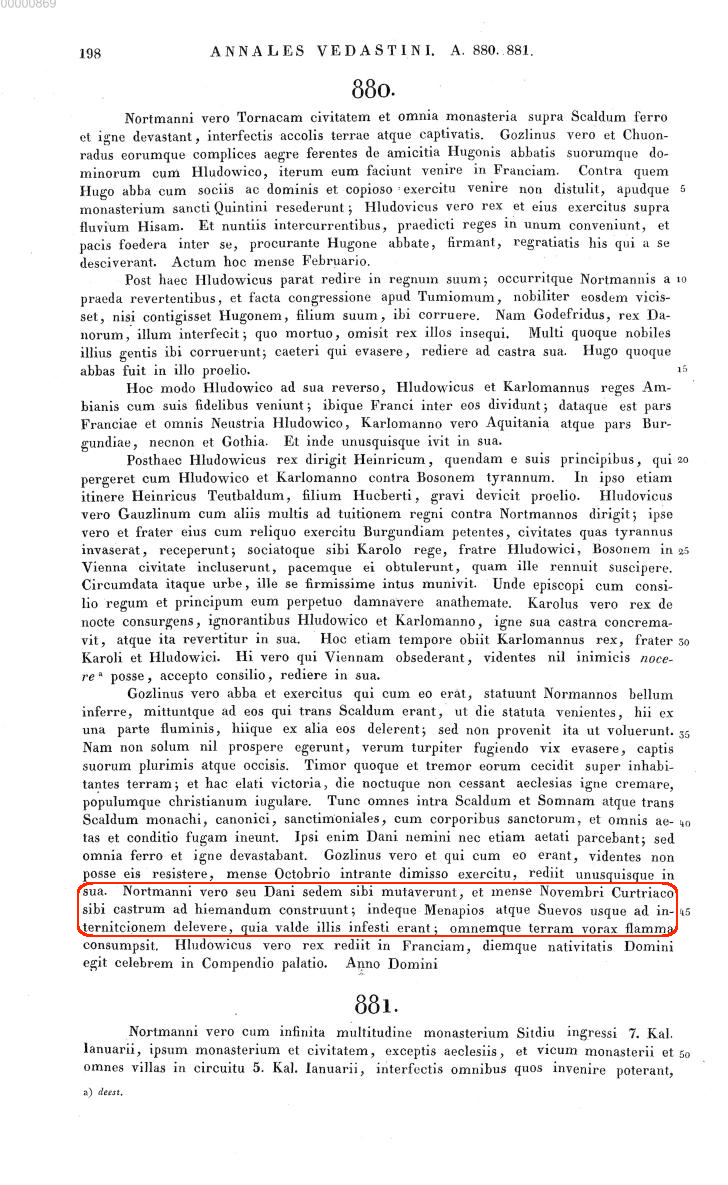
Annales Vedastini 880

Anno DCCCLXXX

Anno Domini *DCCCLXXX. Nortmanni vero Tornacam civitatem et omnia monasteria supra Scaldum ferro et igne devastant, interfectis accolis terrae atque captivatis. Gozlinus vero et Chuonradus eorumque complices aegre ferentes de amicitia Hugonis abbatis suorumque dominorum cum Hludowico iterum eum faciunt venire in Franciam. Contra quem Hugo abba cum sociis ac dominis et copioso exercitu venire non distulit, apudque monasterium sancti Quintini resederunt, Hludowicus vero rex et eius exercitus supra fluvium Hisam, et nuntiis intercurrentibus praedicti reges in unum conveniunt et pacis foedera inter se procurante Hugone abbate firmant, regratiatis his qui a se disciverant. Actum est hoc mense Februario.

Post haec Hludowicus parat redire in regnum suum, occurritque Nortmannis a praeda revertentibus. Et facta congressione apud Timiomum nobiliter eos vicisset, nisi contigisset Hugonem filium suum ibi ruere. Nam Godefridus rex Danorum illum interfecit. Quo mortuo omisit rex illos insequi. Multi quoque nobiles illius gentis ibi corruerunt, caeteri, qui evasere, rediere ad castra sua. Hugo quoque abbas fuit in illo proelio.

Hoc modo Hludowico ad sua reverso, Hludowicus et Karlomannus reges Ambianis cum suis fidelibus veniunt, ibique Franci inter eos dividunt, dataque est pars Franciae et omnis Neustria Hludowico, Karlomanno vero Aquitania atque pars Burgundiae necnon et Gothtia; et inde unusquisque ivit in sua.

Post haec Hludowicus rex dirigit Heinricum quendam e suis principibus, qui pergeret cum Hludowico et Karlomanno contra Bosonem tyrannum. In ipso etiam itinere Heinricus Teutbaldum filium Hucberti gravi devicit proelio. Hludowicus vero Gauzlinum cum aliis multis ad tuitionem regni contra Nortmannos dirigit. Ipse vero et frater eius cum reliquo exercitu Burgundiam petentes civitates, quas tyrannus invaserat, receperunt. Sociatoque sibi Karolo rege, fratre Hludowici, Bosonem in Vienna civitate incluserunt, pacemque ei obtulerunt, quam ille rennuit suscipere. Circumdata itaque urbe ille se firmissime intus munivit. Unde episcopi cum consilio regum et principum eum perpetuo damnavere anathemate. Karolus vero rex de nocte consurgens, ignorantibus Hludowico et Karlomanno, igne sua castra concremavit, atque ita revertitur in sua. Hoc etiam tempore obiit Karlomannus rex, frater Karoli et Hludowici. Hi vero qui Viennam obsederant videntes nil inimicis posse . ., accepto consilio, rediere in sua.

Gozlinus vero abba et exercitus qui cum eo erat statuunt Nortmannos bellum inferre. Mittuntque ad eos qui trans Scaldum erant, ut die statuta venientes, hi ex una parte fluminis hique ex alia eosque delerent. Sed non provenit ita ut voluerunt. Nam non solum nil prospere egerunt, verum turpiter fugiendo vix evasere, captis suorum plurimis atque occisis. Timor quoque et tremor eorum cecidit super inhabitantes terram, et hac elati victoria die noctuque non cessant aecclesias igne cremari populumque Christianum iugulari. Tunc omnes intra Scaldum et Sumnam atque trans Scaldum monachi, canonici, sanctimoniales cum corporibus sanctorum et omnis aetas et conditio fugam ineunt. Ipsi enim Dani nemini nec etiam aetati parcebant, sed omnia ferro et igne devastant. Gozlinus vero et hi qui cum eo erant videntes non posse eos resistere, mense Octobrio intrante dimisso exercitu, rediit unusquisque in sua. Nortmanni vero seu Dani sedem sibi mutaverunt et mense Novembris Curtriaco sibi castrum ad hiemandum construunt.  Indeque Menapios atque Suevos usque ad internitionem delevere, quia valde illis infesti erant.  Omnemque terram vorax flamma consumpsit. Hludowicus vero rex rediit in Franciam diemque nativitatis Domini egit celebrem in Compendio palatio.

Suffice it to translate only the last part:

“The Northmen or Danes moved their camp in the month of November and they built a fort in Kortrijk to spend the winter there.  And then they [that is the Northmen] razed the land of the Menapii and the Suevi for they were very hostile to them.  And the eager flames devoured the entire country.”

Since we know where Kortrijk is we also know where, approximately, the Menapii (a Belgic tribe – whatever that means) and Suevi must have been:

kortrijk

At the very least this was rather interesting.  As previously discussed here some of the names in the area with the -in ending seemed similar to the -in endings in the east but they were hardly conclusive of a Slavic presence in the area (even if suggestive).

That the Suevi must have in part lived in this area alongside the Frisians we also know from Tacitus’ Agricola (28):

“The same summer a Usipian cohort, which had been levied in Germany and transported into Britain, ventured on a great and memorable exploit. Having killed a centurion and some soldiers, who, to impart military discipline, had been incorporated with their ranks and were employed at once to instruct and command them, they embarked on board three swift galleys with pilots pressed into their service. Under the direction of one of them—for two of the three they suspected and consequently put to death—they sailed past the coast in the strangest way before any rumour about them was in circulation. After a while, dispersing in search of water and provisions, they encountered many of the Britons, who sought to defend their property. Often victorious, though now and then beaten, they were at last reduced to such an extremity of want as to be compelled to eat, at first the feeblest of their number, and then victims selected by lot. Having sailed around Britain and lost their vessels from not knowing how to manage them, they were looked upon as pirates and were intercepted, first by the Suevi and then by the Frisii. Some who were sold as slaves in the way of trade and were brought through the process of barter as far as our side of the Rhine, gained notoriety by the disclosure of this extraordinary adventure.”

(A reference to the Suevi appears also in the curious story of “Indian” sailors.  Here they are Boii (in Pomponius Mela’s description) and Suevi (in Pliny’s).  That the Boii too may have been Suevi seems to have occurred to no one.  The similarity of these nautical stories also seems to have been hardly explored).

So we started poking around a little bit more but, notwithstanding some nearby place names (e.g., Lessines) and some river names), there were no major breakthroughs.

But then we came across the following:

pironche

And further down this:

peronnes

Now, again, this was the area (or close enough to the area) of the various -ins such as these (shown in red, see, e.g., Wavrin) so we were intrigued that this was where these various Perunnes were appearing (in blue):

v

Consequently, we were eager to get an explanation for the Peronnes. Picking one of these the Péronne in the Somme department, we tried to see how old this place was.  Strangely, it seems it is quite ancient with the first mention being already in the 6th century as Peronam urbem regiam by the poet Venantius Fortunatus (c. 530–c. 600/609).  This was easy to confirm in the MGH where we have the full “Life of Radegunde” including the aforementioned reference in the form “in Perunna villa”:

selencia

About the same time we have the mention of the town in a November 10, 585 edict of the Burgundian king Guntram:

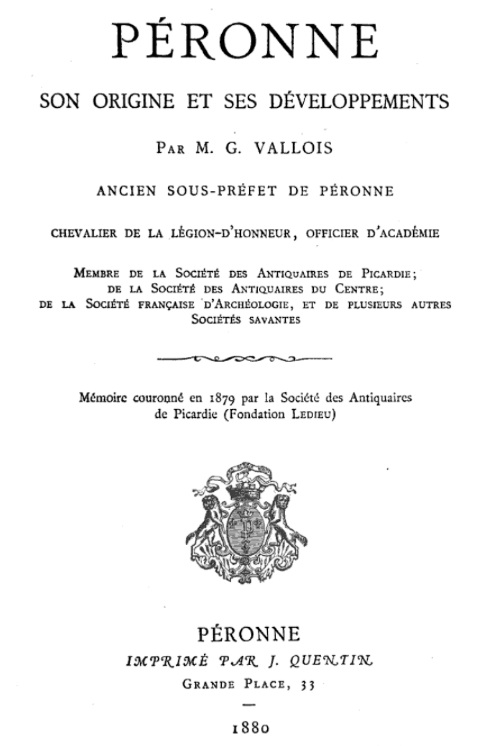
So the town is quite old and the name is quite old.  In fact, the town is so old that in 1880 it even got to have a book written about it:

est

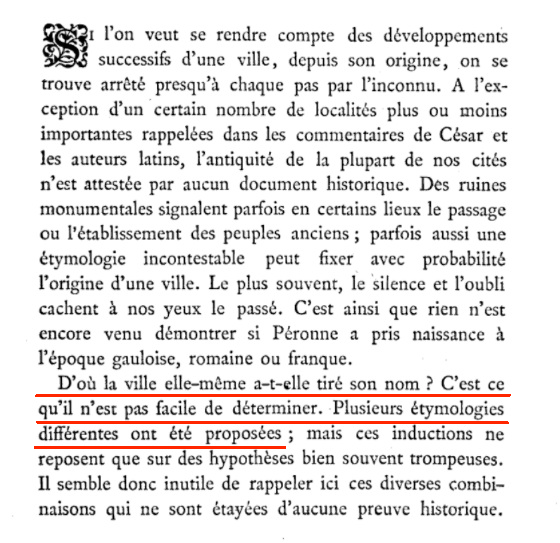
In that book the author begins, of course, with discussing the etymology of the name and, right from the start, there are snags!

nest

But there were other Perunian names in France.  Here they are along with the original Kortrijk location:thorstagCertainly, many of these have nothing to do with Slavs. Perhaps they refer to the fibula, the leg bone that was earlier referred to as the perone.  In fact, that continues to exist and be used in Italian, Spanish and other Romance languages (and Basque apparently).

Of course, one can ask whether the fibula looks like a thunderbolt but we leave that to you (or thunderbolt like a fibula):

fibilias

Slavic fibulae take on a whole new meaning

For the Dutch Veleti see here and here.  If you want to get really “far out” check out the fibula description in Basque:

euskaraSorburua means source meaning seemingly in other instances too “original” – so now we have the Sorbs – the original people…

To come full circle, note that Safarik thought that Venantius Fortunatus in one of his poems meant Veleti (in the Netherlands) when he talked about Vascos (i.e., Basques).  Was there a difference back then?  Note too that the below poem, again, mentions together the Suevi and Frisians suggesting that Suevi (also) lived in northwest Germany.  Perhaps in the neighborhood of the River Leda or the River Lippa.

fortunatusCopyright ©2016 jassa.org All Rights Reserved

February 3, 2016

Scla-vi-Scla-vi-Scla-vi-Scla…

Published Post author

If you want to get a quick answer where the Sclavi come from, all you have to do is close your eyes and say that name really fast over and over again.

BTW the same works for the Suavi.

🙂

Incidentally, if the Romans and Greeks inserted the “c” between the “S” and the “l” of “Sclavi because they found the “sl” sound hard to pronounce (as a lot of academics believe), wouldn’t it make sense that the “c” in Viscla was also inserted between the “s” and the “l”?  And if so aren’t we dealing here with an original sound that is the same as the Sclavi sound?

Note that Vistula had different spellings such as Viscla but also Vistla.  And ithe “t” there may have played a similar role as the “c”.  But what of “Sclabi”?  Well, the “b” and “v” sounds have changed.  Thus we have Suevi but also Suebi and also Suavi. Indeed we even have a Bisula designation for the Vistula in Jordanes’ Getica.

Copyright ©2016 jassa.org All Rights Reserved

January 28, 2016

Of Spain, Suevi, Iacetani and Napoleon

Published Post author

A reader forwarded to us a link to the Wikipedia page on the Suevi where one of the editors happily said the following;

“ALLARIZ BEARIZ MONDARIZ In Galicia there are different villages with names ending in IZ, like Allariz and Beariz (Ourense) and Mondariz (Pontevedra), which origin comes from the Swebian tribe. Allaritz, Bearitz, Mondaritz….like Austerlitz.”

Like Austerlitz indeed.

So, let us take a look at Austerlitz.  Austerlitz is, without a doubt, a German name.  It would seem to be a name that is completely unrelated to the Slavic name of the town.

But two interesting things come up right from the start here.

First, the current name of the town is – now – Slavkov u Brna (which, in Polish, is Sławków, i.e., its pronunciation is Suavkuv).

The Czech name literally means Slavkov by Brno, i.e., the Czech city of Brno (known in German as Brünn).  (We will not touch the topic of whether this Brno has some connection to Bern in the Switzerland and other similarly named cities… for now).

So that’s a quasi-Slav (Suevic?) connection.

Ok, whatever.

Second, and more importantly, the Czech name also seems to be a relatively new one and an older Czech name may have been Novosedlice (a name found already in Cosmas’ Chronicle of the Czechs).  It is, supposedly, from that Novosedlice that Austerlitz comes from.  If so, then Austerlitz is merely a corruption/mispronounciation of Sedlice or Sedlitz.

slavics

“Town stays Slavic & your Reich’s kaputt”

Ok, ok.

But there is something else.  Let’s look at the claims about Allariz, Beariz and Mondariz.  Allariz still stands as Allariz.  And so does Beariz and so does Mondariz.  Here they are in blue:

suebi

But are -iz and -itz endings Suevic?  Well, the stems certainly could be Germanic, e.g., Allariz may be from Alaric.  On the other hand, were place names with such suffixes to be found in East Germany they would likely be classified as Slavic.  Add to that that where they’d be classified as German it would be in West Germany.  But in West Germany such names appear only in certain areas – towards the south – not in west central or north and certainly not in Scandinavia.  They’d be found somewhere in between the Slavic and the ancient Vindelician area.  That itself is, or at least should be, interesting.

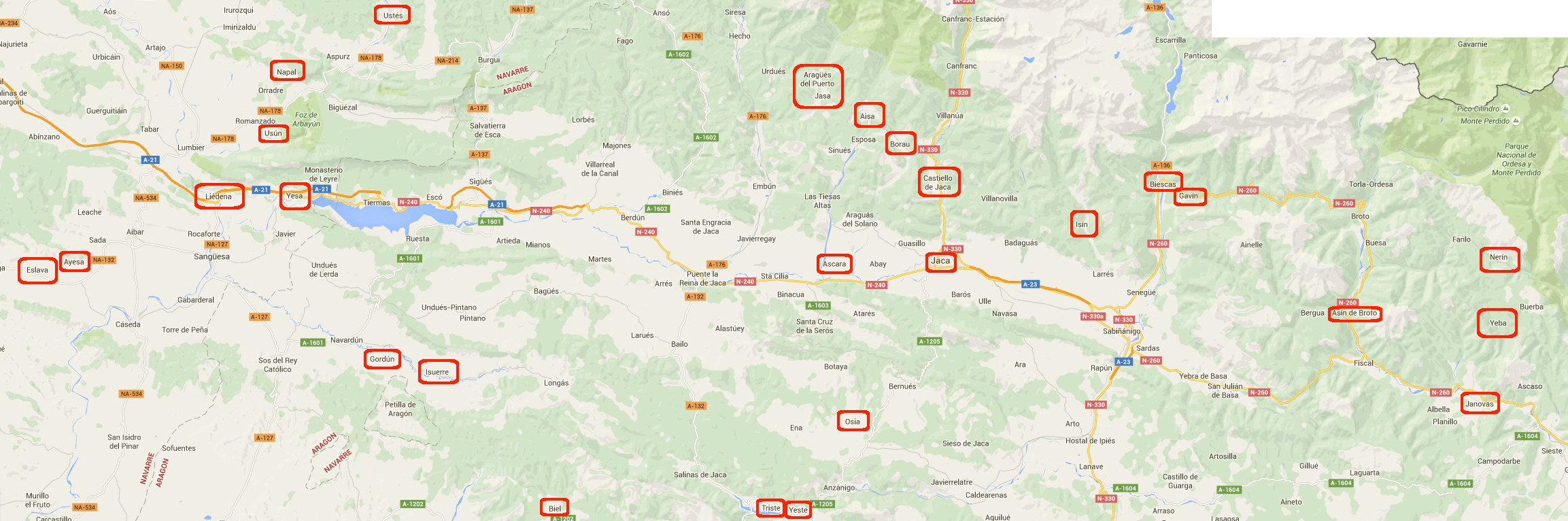
However, there is more, there are other places with -iz and indeed even -itz (!) in Spain.  Are these also Suevic?  The problem is that they are nowhere near the former Suevic kingdom.  For example, take a look at these with special notice of the cluster just north of Pamplona and into France:

biarritzes

Are these all Basque?  The largest concentration just north of Pamplona is really in Navarre.  There are Basques in Navarre, for sure.  Indeed, the first King of Pamplona was called Eneko (Íñigo) Arista and was Basque.  But the rest of Basque country (Navarre currently is not in Basque country) contains such names only sporadically.

BTW what are these green stars you ask?  They are other interesting names such as:

  • Grocin
  • Zubiri
  • Eslava, and our favourites:
  • Liedena, which just happens to be right next to
  • Yesa

And there are more…

spain

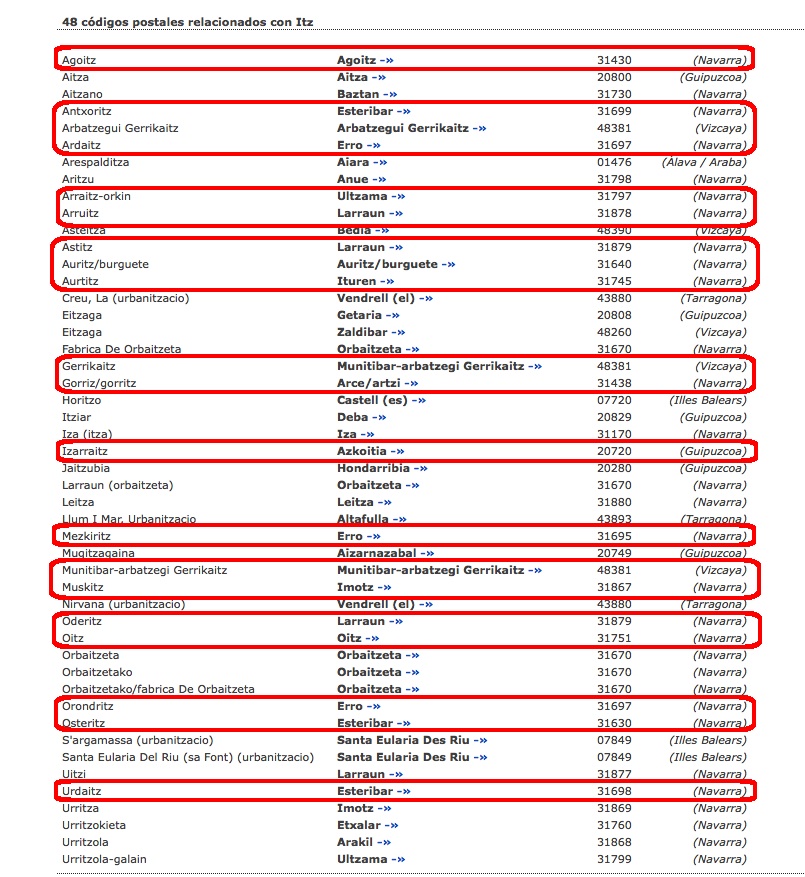
This Navarre bias is demonstrated here too if you use the Buscador tool to look for -itz suffixes which gives you this (we mark the pure -itzes not, e.g., -itzu or -itza – though if you look closely those too are primarily in Navarre) (Vizcaya is Bizkaia or the current administrative province of Basque country):

gorrtitz

Apparently, these references may be a sign of the former tribe of the Iacetani.

iasetani

For more of this you can look at the Venetic area about Bretagne.  As far as we know the only major recent effort to compare Slavic and Basque languages was in the “Veneti: First Builders of European Community” book which. while not the clearest in exposition, is certainly more than worth reading.

Copyright ©2016 jassa.org All Rights Reserved

January 28, 2016

On a Light-er Note

Published Post author

In Germanic languages the word for summer is, well, summer applied as follows:

  • sumor (Old English);
  • simmer (West Frisian);
  • zomer (Dutch);
  • sumar (Old Norse/Icelanding);
  • sommar (Swedish);
  • Sommer (Danish, Bokmål Norwegian);
  • sommar/sumar (New Norwegian);

These have, seemingly, little to do with the Slavic “summer” or:

  • Leto (Czech/Slovak/Russian);
  • Lato (Polish);
  • Lito (Ukrainian);
  • Leta (Belorussian);
  • Ljeto (Serbian/Croatian);
  • Poletje (Slovenian);

lighter

It might come as a surprise then that Old English months of June and July (roughly) bore the following names:

June

  • lida (as per Bede’s On the Reckoning of Time or De Temporum Ratione);
  • Ærra Līþa (as per George Hickes’ 1703 in De antiquae litteraturae septentrionalis utilitate sive de linguarum veterum septentrionalium usu Dissertatio epistolaris)

July

  • lida (as per Bede’s On the Reckoning of Time or De Temporum Ratione);
  • ærra litha (as per the 1031 Biblia Cattoniensis);
  • Æftera Līþa (as per George Hickes’ 1703 in De antiquae litteraturae septentrionalis utilitate sive de linguarum veterum septentrionalium usu Dissertatio epistolaris);

Ærra Līþa literally means “ere” or “before,” presumably, Midsummer.   Æftera Līþa literally means “after” Midsummer (?).  There may also have been Þrilīþa meaning (?) “Third Midsummer” (perhaps in those years which had 13 months). (Whether these have anything to do with the, e.g., Polish lipiec (July) we do not discuss here.  Suffice it to say that there seems to be a connection to the Slavic summer).

Perhaps (as per dictionary.com) this is related to lithe, i.e., Old English liðe “soft, mild, gentle, meek,” from (alleged) Proto-Germanic *linthja (cognates: Old Saxon lithi “soft, mild, gentle,” Old High German lindi, German lind, Old Norse linr, “with characteristic loss of “n” before “th” in English”), from PIE root *lent- “flexible” (cognates: Latin lentus “flexible, pliant, slow,” Sanskrit lithi).  In Middle English, used of the weather. Current sense of “easily flexible” is from c. 1300. Related: Litheness.  (though one has to ask whether the loss of the “n” really happened in English if the word was lithi already (that is already without any “n”) in Sanskrit).

And what of light?

In this telling June/July would be the lithe or mild months. It is also hard not to notice the similarity of these words (as well as the Slavic Lato or Ljeto or Leto) to words such as lethargic. Is there a relation to summer?  Perhaps.  In Latin “deep sleep” or lethargy were called sopor and the God of Sleep was… Somnus.  The cognates of that one are, supposedly, the following: Sanskrit svapnah, Avestan kvafna-, Greek hypnos, Lithuanian sapnas, Old Church Slavonic sunu, Old Irish suan, Welsh hun “sleep,” Latin sopor “a deep sleep.”  And then there is Old English swefn, Old Norse svefn “a dream”.  Not to mention the Polish/Czech/Slovak sen which has the identical meaning of “a dream.” (Same for Serbo-Croat/Slovene san(je)).

brueckner1

brueckner2

Brueckner’s arrogance wafts off the paper

Further, what appears to be March was called in Germanic languages (among other versions) hlythahlyda, hlydmonath.  Whether this has anything to do with the, e.g., Polish name for February – luty – we leave to the readers.

Copyright ©2016 jassa.org All Rights Reserved

January 23, 2016

Not Everyone Is Hannibal

Published Post author

Here is a simple topographic map of North Central Europe:

version1 Say you wanted to invade the Roman Empire and you were coming down from the Danish Jutland Peninsula.  How would you do it if you did not care for crossing mountains, hills and other hard to pass natural barriers?  Here is one way.  The red lines are the “lazy man’s invasion routes” and the blue line is an approximate Roman border (obviously it changed over time).

version1z

Now compare this to the Ketrzynski map of Slav settlement (again, only in Germany and only West of the Elbe-Saale, i.e., Uaba/Souava line):

ketrinski3

More on the Hammer of Thor here.

Copyright ©2016 jassa.org All Rights Reserved

January 18, 2016