Category Archives: Origins

Slavs Being Drung Nach Westen

Published Post author

After publishing his study “About the Slavs who once lived between the Rhine and the Elbe, Saale and Czech borderlands”  (O Słowianach, mieszkających niegdyś między Renem a Łabą, Salą i czeską granicą), Wojciech Kętrzyński went on a book tour and gave a speech regarding the reasons for having written his pamphlet.  A portion of that speech is worth quoting here:

***************

k1

“It is well known that there is currently a debate as to when the Slavs settled the wide spaces they currently hold, for according to theories proposed by Deutsche scholars all of Central Europe was previously held by Deutsche nations.*  There was, thus, no room for the Slavs, who could only have moved into these spaces [according to the Deutsche theories] once the Deutsche left them, which is supposed to have happened in the 6th, though maybe already in the 4th century A.D.”

[* note: Kętrzyński uses the Slavic word niemiecki for the common English adjective “German”.  For the sake of clarity, we thought of retaining the usage of the word “German” in this translation.  In light of Ketrzynski’s arguments, however, at least in this article it seemed hardly fair to let a people who’ve always called themselves just Deutsche appropriate the word German or Germanic entirely for themselves.]

“From the Slavic side there was frequently opposition to such a theory, though [such opposition] was not always effective.  So too the little pamphlet of this author “Die Lygier” [“The Lugians” though it should be “The Legianslegiorum!], published in 1868, had the same goal and the same result, i.e., it remained completely unaddressed.  To this day one opinion meets another opinion though the Deutsche are in ascendance for they fight using linguistic evidence, which tend to impress, for no one can challenge them [i.e., without also assailing linguistic theories]; it is on such [linguistic theories] that they build their hypotheses and to fit   such [linguistic] theories do they correct the [writings of] ancient authors; and yet linguistic evidence, in and of itself, cannot serve to establish a sufficient historical proof but rather can only be an additional, auxiliary argument.”

“It is for this reason that the author believed, that the entire matter should be placed on a new foundation which in the here mentioned work I’ve tried to do.”

***************

k2

“It has been known for quite a long time that the Elbe and Saale as also the Czech [Bohemian] border did not separate the Slavic and Deutsch peoples but that even beyond this line towards the West there exist Slavic place names.  It is for this reason that the author decided to collect them all in one place, taking into account primarily the suffix itz [Deutsch] ica, ici, ice [Slavic], as also names such as Winden, Wenden and those containing them, which the Deutsch scholars too have agreed indicate Slavic settlements.”

“The author was able in the process to gather together approximately 800 such names between the Rhine and the above-mentioned [Elbe-Saale] line, between the North Sea and the Alps; their placement has been shown on 4 maps.”

Deutsche scholars explain this phenomenon in two ways: 1) they claim that they [the Deutsche] so love foreign names [!] that they immediately Ge-deutsch them as their own; 2) usually, however, they assert that these were Slavic colonies, formed under orders of the Deutsch masters, among the Deutsche.”

“As regards the first point, the author shows [in his pamphlet] that Deutsche, everywhere where they encountered the Slavs (and also too in places where the Slavs had not been conquered by the Deutsche) they Ge-deutsched local place names, the proof of this stretches from Czechia, to Silesia to West Prussia and so forth, as it is also shown in the current behaviour of Deutsche regarding Polish place names.”

“Villages, founded by war prisoners and other unfree peoples in areas that were supposedly purely Deutsch could not have had Slavic names since what a place was called was in the oldest times determined by the surroundings [peoples?], later still by the lord and owner but a slave without any rights could neither force his will nor his language onto the locally dominant peoples/nation.”

“Villages, even in otherwise Slavic parts, that were founded by unfree Slavs but established for a Deutsch master, received Deutsche names.”

“Thus, if such place names could not have come about during the time of Deutsche dominance over the Slavs, their origin must predate such time…”

***************

The talk given by Kętrzyński continues but for the purposes of this post, we do not need to continue with it.  Suffice it to say that the same Deutsche arguments that so annoyed Kętrzyński over a century ago are to this day made by various German scholars.  So, for example, we have this from Roland Steinacher’s brief summary (Wenden, Slawen, Vandale, Eine fruehmittelalterliche pseudologische Gleichsetzung und Ihre Nachwirkungenof his longer doctoral theses:

ashh

“Such toponyms are to be found also far removed from the Slavic settlement area and show the settlement of Slavic servants by Frankish landowners.”

Steinacher, like his predecessors over a century ago, neither disputes the Slavic character of such villages nor offers proof for the old theory that these were “new” settlements of Slavic war captives.  Of course, that theory is based on nothing other than the supposition that this must be the case because the alternative (Ketrzynski’s, i.e., that these were remnants of Slavic villages dating to Roman and pre-Roman times) would upend at least two centuries (but not much more – pre-19th century scholars displayed a more modest approach and showed less blind certitude!) of German scholarship.

Incidentally, Steinacher is also an author of a new book about the Vandals which, thankfully, begins its tale in the 4th century.  Here he appears mildly wistful but, in the end, mostly resists the urge to write his Vandalic history in the subjunctive:

wielk“If one could factually establish a connection between the Vandili of Plinius and Tacitus and the Przeworsk culture, were these peoples connected with those who hundreds of years later appeared on the Danube and the Rhein and eventually conquered Carthage, then the Vandals would have had a long pre-history.  But such connections are not provable.”

As we know, there is no mention of Vandals, as a people, by Tacitus and Pliny’s slim mention of Burgundians (though in all but one Ptolemaic manuscript – Buguntians without an “r”!) provides only the most ephemeral evidence of Vandals being in Poland (as opposed to somewhere in the Elbe area – which, if they came from Vendsyssel, would seem the logical place to put them).  In any event, Steinacher, notwithstanding his silly repetition of the “merry Slavic captives” theory, scores here a touch above Wolfram whose work on the topic is in the realm of historical fiction.

Copyright ©2016 jassa.org All Rights Reserved

June 4, 2016

Jonas of Bobbio’s “The Life of Columban”

Published Post author

Saint Columban (or Columbanus) was an abbot and missioner.  He was born in Leinster (Ireland), circa 543; died circa 615 at Bobbio, Italy, a monastery which he founded. His feast day is November 23.  The “Life of Columban” (Vita Columbani) by the monk Jonas of Bobbio contains the first mention of Slavs in the West: “ueneticorum qui & sclaui dicuntur

colu

We introduce that work here along with an introduction about Jonas by D.C. Munro who is the work’s translator.  We also include the sections referring to the Suevi.  The pics are from the Saint Gallen Codex 553.  [*Note that, although Columban was also known as “Columba”, Columban is distinct from Saint Columba, who was founder of Iona, who was born in 521, and died in 597, and whose feast day is June 9.]

Introduction by  D.C. Munro

“During the sixth and seventh centuries the greatest missionary activity was shown by the Scots who dwelt in Ireland. In that country religion was cherished with greater zeal than elsewhere, and learning was fostered for the sake of the Cchurch. But not content with the flourishing state of Christianity in their own island, the most zealous monks often passed over to the continent. There even the nominal Christians were little inclined to follow the precepts of the religion which they professed. Gaul especially attracted the attention of the bold missionaries from Ireland, and the Irish usages became well established in some parts of lie country.  Unfortunately almost all the accounts of the missionaries from Ireland have been lost; consequently this biography of Columban is of great value.”

bobs

Bobbio

“Jonas, the author of this “Life”, became a monk at Bobbio, in northern Italy, three years after Columban’s death.  He was soon employed on this biography, for which he obtained material, as he himself said, from the stories told by the saint’s companions. Living as be did, among the, latter, his account reflects their feelings faithfully, and we may be certain that he has recorded the events accurately, and often reproduced the saint’s own words.  As is usual in such biographies, the miracles are numerous; for the contemporaries these formed the most valuable portions; for modern students they are full of instruction, and throw much light on the daily life of the monks.”

Sections of “Life of Saint Columban”
by the Monk Jonas of Bobbio

Section 15 

“While the holy man was wandering through the dark woods and was carrying on his shoulder a book of the Holy Scripture, he happened to be meditating. And suddenly the thought came into his mind, to which he would prefer, to suffer injuries from men or to be exposed the rage of wild beasts. While he thought earnestly, frequently signing his forehead with the sign of the cross and praying, he decided that it was better to suffer from the ferocity of wild beasts, without any sin on their part, than from the madness of men who would lose their souls.”

32

And while he was turning this over in his mind he perceived twelve wolves approaching and standing on the right and on the left, while he was in the middle. He stood still and said: ‘Oh, God, come to my aid. Oh, Lord, hasten to aid me!’ They came nearer and seized his clothing. As he stood firm they left him unterrified and wandered off into the woods.”

33

“Having passed through this temptation in safety, he continued his course through the woods. And before he had gone far he heard the voices of many Suevi, wandering in the hidden paths. At this time they were robbing in those places. And so at length by his firmness, having dismissed the temptation, he escaped the misfortune. But he did not know clearly whether this was some of the devil’s deceit or whether it had actually happened. At another time he withdrew from his cell and entering the wilderness by a longer road he found an immense cliff with precipitous. There he perceived a hollow sides and rocky paths difficult for men. in the rock. Entering to explore its hidden recesses he found in the interior of the cave the home of a bear, and the bear itself. He ordered the beast to depart and not to return to that place again. The beast mercifully went, nor did she dare to return again. The place was distant from Anegray seven miles more or less.”

Section 53

“At length they arrived at the place designated, which did not wholly please Columban; but he decided to remain, in order to spread the faith among the people, who were Swabians.”

99

“Once as he was going through this country, he discovered that the natives were going to make a heathen offering. They had a large cask that they called a cupa [cubam], and that held about twenty-six measures, filled with beer and set in their midst. On Columban’s asking what they intended to do with it, they answered that they were making an offering to their God Wodan [uadono]  (whom others call Mercury).”

100

“When he heard of this abomination, he breathed on the cask, and lo! it broke with a crash and fell in pieces so that all the beer ran out. Then it was clear that the devil had been concealed in the cask, and that through the earthly drink he had proposed to ensnare the souls of the participants. As the heathens saw that, they were amazed and said Columban had a strong breath, to split a wellbound cask in that manner. But he reproved them in the words of the Gospel, and commanded them to cease from such offerings and to go home.”

101

“Many were converted then, by the preaching of the holy man, and turning to the learning and faith of Christ, were baptized by him. Others, who were already baptized but still lived in the heathenish unbelief, like a good shepherd, he again led by his words to the faith and into the bosom of the church.”

Section 56

“Once Columban though going to the land of the Wends, who are also called Slavs, in order to illuminate their darkened minds with the light of the Gospel and to open the way of truth to those who had always wandered in error.”

105

“When he proposed to make his vows, the angel of the Lord appeared to him in a vision, and showed him in a little circle the structure of the world, just as the circle of the universe is usually, drawn with a pen in a book. ‘You perceive,’ the angel said, ‘how much remains set apart of the whole world. Go to the right or the left where you will, that you may enjoy the fruits of your labors.’ Therefore Columban remained where he was, until the way to Italy opened before him.”

105ab

Copyright ©2016 jassa.org All Rights Reserved

May 30, 2016

Rusty the Bear

Published Post author

An interesting thing about the Slavic word for bear is that it has been universally etymologically explained as meaning “honey eater”.  Honey = med; vjed = to eat out.rustAnother interesting thing about the Slavic words for bears is that they are of roughly two types.  Most begin with an “m” whereas the Polish version begins with an “n”.  Thus we have, e.g.:

  • medvjed – in Croatian, but
  • niedźwiedź – in Polish.

Since miod in Polish is much the same as med (or mead for that matter) but the bear name has in Polish the first letter “n”, it seems that the “m” version is the “correct” or, at least, the older one and that the Polish “m” became an “n” over time.

Yet another interesting thing is that continental European brown bears are, well, brown.

Finally, we note this interesting translation from a dictionary put together by Oskar Priese in 1890:rost

Copyright ©2016 jassa.org All Rights Reserved

May 27, 2016

Germania and Its Manuscripts – Part II

Published Post author

What else can we say?

BOOK

Boiis not Osis?

In section 28, we have the following:

Igitur inter Hercyniam silvam Rhenumque et Moenum amnes Helvetii, ulteriora Boii, Gallica utraque gens, tenuere. Manet adhuc Boihaemi nomen significatque loci veterem memoriam quamvis mutatis cultoribus.  

Sed utrum Aravisci in Pannoniam ab Osis, Germanorum natione, an Osi ab Araviscis in Germaniam commigraverint, cum eodem adhuc sermone institutis moribus utantur, incertum est, quia pari olim inopia ac libertate eadem utriusque ripae bona malaque erant.

“The region therefore between the Hercynian Forest and the rivers Moenus and Rhine, was occupied by the Helvetians; as was that beyond it by the Boians, both nations of Gaul. There still remains a place called Boiemum, which denotes the primitive name and antiquity of the country, although the inhabitants have been changed.”

“But whether the Araviscans are derived from the Osians, a nation of Germans passing into Pannonia, or the Osians from the Araviscans removing from thence into Germany, is a matter undecided; since they both still use the language, the same customs and the same laws.”

But that is not exactly what is said in the manuscripts.  Specifically, abois or a boiis.  Since “a” can  mean “from” just as “ab” can, saying a Boiis, essentially means “from the Boii.”  Now, right after that, Tacitus says or the Osians from Araviscans and then mentions “both” as still using the same language.  The emendation to “ab Osis” is one way to resolve the incongruity.

Another way, however, would be to note that right above this sentence, Tacitus talks about the Boii.  Therefore, you could just as easily say “an Boii ab Araviscis”.

Essentially, the paragraph would then read:

“The region therefore between the Hercynian Forest and the rivers Moenus and Rhine, was occupied by the Helvetians; as was that beyond it by the Boians, both nations of Gaul. There still remains a place called Boiemum, which denotes the primitive name and antiquity of the country, although the inhabitants have been changed.  But whether the Araviscans are derived from the Boians, a nation of Germans passing into Pannonia, or the Boians from the Araviscans removing from thence into Germany, is a matter undecided; since they both still use the language, the same customs and the same laws.”

This would suggest that the Germanic (in the sense of their place of origin) Boii may have come into Germany originally from Pannonia (leaving the Aravisci behind in Pannonia) or, alternatively, that the Pannonian Araviscans may have come from Germany into Pannonia (leaving the Boii behind in Pannonia).

As an aside we also learn that the Aravisci (a nation of Germania) spoke the same language as the Ossi or, in our version, the Boii (whether the Boii have anything to do with the boyars or with the Bavarians is another matter).

marg

You will also notice that the Nervii were rather the Neruli, which also brings up the Heruli.  (It also raises the question whether the Nahanarulos (as per manuscripts) were a tribe that lived “near” (?) the Neruli, rather than being any Nahanarvalos (seemingly made up by Müllenhoff).  And Ubii, at least in one place may have been Nubii (!).  All these, of course, can be mistaken as there are inscriptions mentioning these other peoples but, working from Tacitus’ manuscript alone, the conclusions reached by Müllenhoff are not entirely obvious.

Other Tribal Names – Dulgicubuni not Dulgubni, etc?

In section 34 we have the Dulgubni of Müllenhoff.  However, they are never actually named that way.  Instead we have:

  • Dulgicubuni (dulgibnii in the margin)
  • dulgitubini
  • Dulgibini
  • dulgibini (and above that dulcubuni)

And the Chasuarii are actually:

  • Thasuarii
  • tasuarii
  • occasuarii
  • chasudrii

gubni

In section 40, we note that the Suardones are actually:

  • Suarines (Suardones in one manuscript only in margin).

These latter are most obviously associated with the town of Schwerin which is in East Germany and has the typical -in Slavic suffix which, normally, would seem to make it a Slavic town.

varini

In section 42, Müllenhoff talks about the Varisti.  The source for this is unclear and this has been corrected in most English editions to Naristi (originally inhabitants of Noricum?).  Naristi is a name used in some manuscripts but in others we have:

  • Narisci, or
  • maristi

noraWhat else?

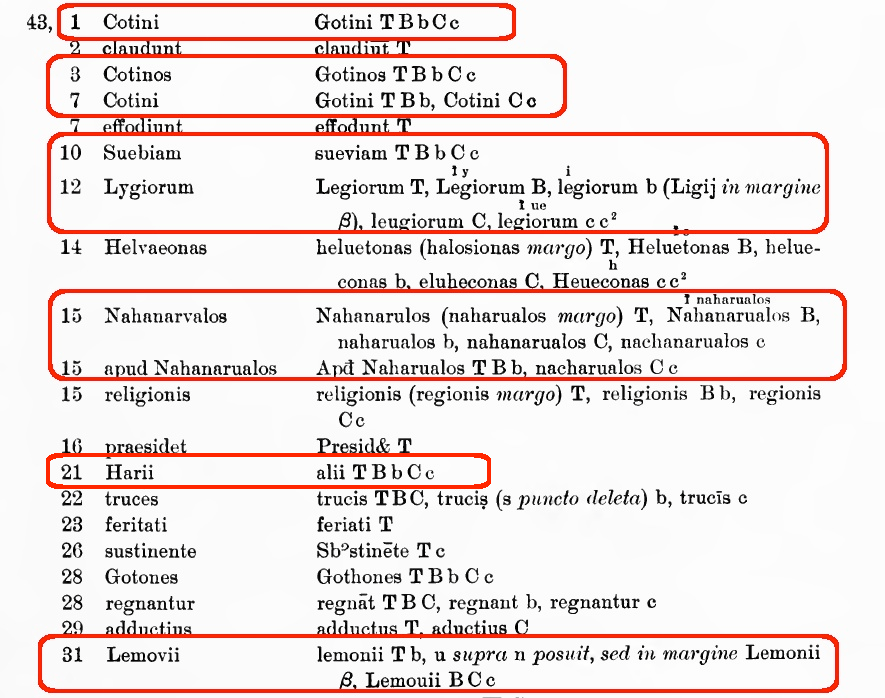
In section 43, we have references to Lygiorum (Lugii!) but they are actually to:

  • Legiorum (with a y (?) above)
  • legiorum (Ligij in the margin)
  • leugiorum
  • legiorum

Aesinas

Right where we’ve come to expect the Polish Lachs or Lechs, of course.

same

The Cotini are actually Gotini (though seemingly separate from the Gothones).

The Harii are actually alii (?)

coti

The Naharnavalos of Müllenhoff are never referred to that way.  Instead they are:

  • Nahanarulos (naharualos in the margin)
  • Nahanarualos
  • naharualos
  • nahanarualos
  • nachanarualos

Interestingly, the Lemovii – who could otherwise have been connected to the Lemovii of Gall – are written as either:

  • Lemouii (same as Lemovii), or
  • lemonii

Now, the “lemonii” have likely little to do with lemons (?) but they do bring to mind Kadlubek’s mention of a Lemanian tyrant who wanted to marry princess Wanda.  That tribal name has been interpreted as referring to the Alemanni, i.e., Germans.  However, if you really believe that the Vandals lived on the shore of the Baltic, then a connection appears between the Vandals’ Wanda and the nearby “Lemonii” (who we know lived on the Baltic).

Neithu of the Nuithones?

There is, of course, no such goddess as Hertha.  But there is more.  Continuing with section 40, Müllenhoff’s Nerthum is Nerthum only in one manuscript and Nertum in another.  At other times the reference is to:

  • nethum
  • Neithu
  • neithum

So instead of Hertha we have Neitha?

berthum

Whether that name can have something to do with the Polish Goddess Nia is a question that, we think, is fair to ask given all this.

Copyright ©2016 jassa.org All Rights Reserved

May 21, 2016

Germania and Its Manuscripts – Part I

Published Post author

Disintermediation is a concept that gains more and more currency with technological change.  In the realm of economics, disintermediation generally refers to the removal of the middle-man.  The value added by various intermediaries previously consisted of access to a web of connections jealously guarded by such strategically placed individuals or companies.  Nowadays, however, we have machinery and the internet.  The impact of these developments on various professions and trades has been tremendous.

However, the presence of the “world-wide web” has had far-reaching consequences even outside of purely economic transactions.  In the realm of academia, it has made vast amounts of knowledge readily accessible, viewable and, importantly, scrutinizable by people who previously could not have dreamt of being able to access such arcana.  This, in turn, has led to ordinary people being able to question the validity of the product sold being by the academic priest classes.  Although specialized knowledge is, of course, helpful and Internet quacks are indeed an unfortunate byproduct of all this technological change, the ability to easily access the vast amount of data out there by more people can only be viewed as positive.

Outside of physics and other highly technical subjects, most of the data belonging to the “soft sciences” can nowadays be critically analyzed by the rankest of amateurs provided they have an interest in the given topic and a sufficient amount of time on their hands.  Thus, for example, the old manuscripts can be examined directly – without the interpolation of old wise men.

BOOK

Now, interestingly, some high-profile manuscripts have not yet been available to the public… Tacitus’ works, for example, seem not to be a priority for preservation efforts – Germania, in particular.  Nevertheless, wide access to information these days also includes access to secondary sources that were previously only available in far away academic communities.

So let’s take a look at Germania

What Does Germania Really Say?

Well, to deflate the balloon, it says pretty much what you think it says… but there are a few interesting variations from the “standard” editions.  An investigation of sections 38, etc of the Germania is therefore worthwhile.

A typical translation of Germania is ultimately derived from the Karl Müllenhoff (1818-1884) edition first put out as “Germania antique” in 1873 and then elaborated on by Müllenhoff in his Deutsche Altertumskunde, volume 4 (posthumously issued by Max Roediger in 1900).  All the below Latin paragraphs are from the Müllenhoff version.

Suevi not Suebi

Section 38 of Germania says the following:

[38] “Nunc de Suebis dicendum est, quorum non una, ut Chattorum Tencterorumve, gens; maiorem enim Germaniae partem obtinent, propriis adhuc nationibus nominibusque discreti, quamquam in commune Suebi vocentur. Insigne gentis obliquare crinem nodoque substringere: sic Suebi a ceteris Germanis, sic Sueborum ingenui a servis separantur. In aliis gentibus seu cognatione aliqua Sueborum seu, quod saepe accidit, imitatione, rarum et intra iuventae spatium; apud Suebos usque ad canitiem horrentem capillum retro sequuntur. Ac saepe in ipso vertice religatur; principes et ornatiorem habent. Ea cura formae, sed innoxia; neque enim ut ament amenturve, in altitudinem quandam et terrorem adituri bella compti, ut hostium oculis, armantur.”

However, Müllenhoff notes himself that the manuscripts B b C c, each say something different.  Specifically, they say Nunc de Suevis.  In fact, Müllenhoff says “and everywhere the same way” (et ubique modem modo): Suevi, Suevorum, Suevos; hence we have:

“Nunc de Suevis dicendum est, quorum non una, ut Chattorum Tencterorumve, gens; maiorem enim Germaniae partem obtinent, propriis adhuc nationibus nominibusque discreti, quamquam in commune Suevi vocentur. Insigne gentis obliquare crinem nodoque substringere: sic Suevi* a ceteris Germanis, sic Suevorum** ingenui a servis separantur. In aliis gentibus seu cognatione aliqua Suevorum seu, quod saepe accidit, imitatione, rarum et intra iuventae spatium; apud Suevos usque ad canitiem horrentem capillum retro sequuntur. Ac saepe in ipso vertice religatur; principes et ornatiorem habent. Ea cura formae, sed innoxia; neque enim ut ament amenturve, in altitudinem quandam et terrorem adituri bella compti, ut hostium oculis, armantur.”

* in b: “Suevi a”
** in T: “servoss”*

* on this see below too…

And so forth throughout Germania.  But maybe that’s only in the B b C c manuscripts?  Well, the problem is that these were the only manuscripts that Müllenhoff was working with…

So there was a subsequent manuscript discovered?

The answer is yes… but it does not matter since, e.g., the T (“Toledo”) manuscript also has Sueuos…

But maybe… let’s see… the “u” > “b” – possibly but not for Tacitus’ Suevi.

Here is a list from Frank Abbott showing the “standard” Müllenhoff edition on the left and the actual manuscripts on the right:

abbott1

Mühlenhoff on the left, reality on the right

And it gets better

In section 41, Müllenhoff says:

“Moreover this quarter of the Suebians stretches to the middle of Germany.”  (Et haec quidem pars Sueborum in secretiora Germaniae porrigitur.)

So should we correct that to Suevorum?  Well, no because the word used is:

verbo4

Serbos or Servos???  So now we might have Serbs masquerading as Suevians?  If so (and it is an “if” we admit!), does anyone still believe that Suevi have absolutely nothing to do with the Slavs?  Not to mention that this brings up the words of Vibius SequesterAlbis Germaniae Suevos a Cerveciis dividiit: mergitur in Oceanum.

serv

What about Müllenhoff?

It is difficult not to conclude that Müllenhoff’s choice here was driven by his desire to make the name as similar as possible to that of the Schwaben.

Aha! What about the Codex Aesinas?  Seems same.

korrekturen

With such a sensitive work, lots of “Korrekturen” were necessary…

So there you have it.

Incidentally, given the name of this site, we would be remiss if we did not point out that the Codex Aesinas was discovered (in 1902) at Iesi/Jesi, an “Umbrian” town before its conquest by the Gallic Senones.

And speaking of the Gallic Senones.

Semones (or Senones) not Semnones

The most ancient Suevic tribe is listed by Tacitus as that of the Semnones (section 39).  Except Germania does not say that except in the C, c class (and only once while the name appears twice in the book) and in margin notes in the T class.  Instead we have:

  • B – Semones (Señones on top);
  • T – Semones (Semnones in margin);
  • bsenones (with “m” above the first n);
  • C csemones;

semn

Later, in the same section 39, we have:

  • Semonum (Semnonuss in the margin)
  • Semonu (sennonu above)
  • senonum
  • semnonum

semonum

Which raises a few questions about their relationship to:

  • the Gallic and Italic (in Galia Cisalpina really) Senones;
  • Samo, the merchant king;
  • most interestingly, Semovith (or Samovith), the son of Piast (Pazt) of the Gallus Chronicle;*

* the fact that Semovith’s son’s name was, as per Gallus, Lestik or Lesthko(n) seems interesting too, given that Lethuc was an ancient king of the Lombards, i.e., of Suevi Longobardi.  Lestik’s son was Zemimizl (but also Zemomisl, and in margins Semimizl, Szemimisl), the father of Mieszko I also suggests that the Semo-vith and the Zemo-misl (?) may have shared a prefix.

semovitai

Gallus

Incidentally, the suffix -misl or -mysl refers to the “mind” (mysl = thought).  Thus, it is likely related to “mind” and we cannot help but notice that mind itself may be cognate with various Slavic “smarts” words, such as the Czech moudrý or the Polish mądry.  The latter, however, may be pronounced mundry and it certainly could be phonetically transliterated that way into English.  From there there is no further distance to prefixes with –mund commonly found in Nordic names.  Of course, those prefixes refer to “protection”?

There are plenty of other interesting aspects of these manuscripts.

Copyright ©2016 jassa.org All Rights Reserved

May 19, 2016

Signs of Lada – Part II

Published Post author

We wrote about the Polish God (or Goddess?) Lada here, here and here.  We discussed potential appearances of the name here.

jugz

There is, of course, more:

A Clay Jug

In 1866, Karl Disch a member of the Friends of Antiquity Society in the Rheinland was said to possess a red jug made of clay, found, we speculate, somewhere in the Rheinland.  The jug was old, decorated with pictures of grape vines and apparently dated to Roman times.  It bore the following inscription:

IMPLEOLADA

This was assumed to be a form of a greeting to the owner – someone named Lada, in the form of:

“Imple, O Lada”

The society’s yearbook in 1866 speculated that the name is similar to the name of the famous Greek runner – Ladas.

imple

But this seems strange.  A statue to Ladas is mentioned by Pausanias in his description of the sanctuary of Apollo Lycius in Argos and again when Pausanias describes  Ladas’ tomb on the road between Sparta and Arcadia.  (Ladas apparently did not make it home and died on his way back.)  There apparently also was a stadium named after Ladas that was located somewhere between Mantinea and Orchomenus where Ladas practiced his running feats (this too from Pausanias).  Further, Pausanias also mentions another Ladas (from Aegium in Achaea) who later won a stade race at an another Olympiad.  Ladas appears too in later literature and a famous statue of him was apparently sculpted by Myron.

All this is well and good but while the fact that there had been a “fleet-footed” Ladas in Greece may serve to establish that such a name did in fact exist in ancient Greece… it seems to have less bearing on the question of names in the much later Roman Rheinland.

And in any event the Greek runner’s name was Ladas – not Lada.

The society’s members thought that perhaps the same name was also displayed in the following inscription found in a Berlin museum: P VAL LADAE, apparently a seal of one P. Valerius Ladas with a banded staff (Thyrsus – typically a staff of Dionysus) and a caduceus (a winged staff with two snakes on it – usually a symbol of Hermes).

thyrs

They also pointed to an inscription of CVR LADAE a name of Minerva (?) (contesting the reading Curia Lada).  This inscription had been known for a while and, already, in the early 18th century was giving some German researchers headaches.

lada3

This?

Or this?

Or this?

This comes from the 1730 book “Kleiner Teutscher Schrifften, etc” by Herrmann Ulrich von Lingen who put together no less than three conjectures:

lada

But getting back to our mug.

Why does a mug need to be greeting its owner?  Or is it a warning about too much drinking?  Or, perhaps, as the society’s members speculated, instead a dedication from the one who gave the owner this gift?  As the society’s members noted that would not be unprecedented.

Yet perhaps, instead, the invocation was an appellation?

Probably not to implore.  But it could be Imple o Lada, as in “fill it up Lada!”  Was Lada a serving girl?  Or was this something reminiscent of the Lelum and Polelum cries of the medieval Poles who would beseech the Gods (Lel & Polel) to keep the beer flowing? (from that did Brueckner apparently conclude that these were just drinking shouts – both may be true).

Oh, and did we mention that this jug was apparently found somewhere along the Rhein? (perhaps it was from elsewhere – this is not entirely clear – but since the society dealt with local artifacts it would have made little sense for them to have much of a discussion about a jug coming from, say, Rome).

Copyright ©2016 jassa.org All Rights Reserved

May 17, 2016

On Perigord & Gordes

Published Post author

Perigord

Under year 768, the Royal Frankish Annals contain the following statement:

“Here [in Saintes] he [Pepin] left the queen with her retinue and entered Perigord.  When Waifar had been killed, Pepin returned in triumph to Saintes.”
peri

Putting aside the unhappy end of Waifar’s life (he was a duke of rebellious Acquitannians who the Frankish Pepin apparently felt he just had to deal with), one must ask what is a Perigord?

Well, it’s a region of France.  Its capital is Périgueux.  Périgueux’s name comes from the Latin Petrocorii.  Petrocorii is a Latinization of Celtic words meaning “the four tribes”.  Perigord is supposedly also derived from these Petrocorii.  Thus, the Petrocorii were translated once into Périgueux and once into Perigord.

It seems then this cannot have anything to do with Slavs.  While the suffix -gord may mean walled off burgh, this was a country not an actual gord.

But just to not let any stone lie unturned, we will look at this in some detail.

One has to ask first, who are these Petrocorii? They are mentioned only twice.  First, in Caesar’s Gallic Wars, Book 7, chapter 75 where the glorious one says:

“While those things are carried on at Alesia, the Gauls, having convened a council of their chief nobility, determine that all who could bear arms should not be called out, which was the opinion of Vercingetorix, but that a fixed number should be levied from each state; lest, when so great a multitude assembled together, they could neither govern nor distinguish their men, nor have the means of supplying them with corn. They demand thirty-five thousand men from the Aedui and their dependents, the Segusiani, Ambivareti, and Aulerci Brannovices; an equal number from the Arverni in conjunction with the Eleuteti Cadurci, Gabali, and Velauni, who were accustomed to be under the command of the Arverni; twelve thousand each from the Senones , Sequani, Bituriges, Sentones, Ruteni, and Carnutes; ten thousand from the Bellovaci; the same number from the Lemovici; eight thousand each from the Pictones, and Turoni, and Parisii , and Helvii; five thousand each from the Suessiones, Ambiani, Mediomatrici, Petrocorii, Nervii, Morini, and Nitiobriges; the same number from the Aulerci Cenomani; four thousand from the Atrebates; three thousand each from the Bellocassi, Lexovii, and Aulerci Eburovices; thirty thousand from the Rauraci, and Boii; six thousand from all the states together, which border on the Atlantic, and which in their dialect are called Armoricae (in which number are comprehended the Curisolites, Rhedones, Ambibari, Caltes, Osismii, Lemovices, Veneti, and Unelli). Of these the Bellovaci did not contribute their number, as they said that they would wage war against the Romans on their own account, and at their own discretion, and would not obey the order of any one: however, at the request of Commius, they sent two thousand, in consideration of a tie of hospitality which subsisted between him and them.”

We note first that many of these names sound suspiciously similar to Slavic tribes (e.g., Osismii in Armorica who were also called Ostimi (as per Pytheas via Strabo), the “last ones”; not to mention the Lemovices who sound very much like the Lemovii of Tacitus).  For more of these see here.

More importantly, however, it is not clear where these Petrocorii should be located.  Caesar mentions “Suessiones, Ambiani, Mediomatrici, Petrocorii, Nervii, Morini, and Nitiobriges.”  Other than the Nitiobriges (or Nitiobroges) none of the above tribes seems to have been located anywhere near the Petrocorii (they all seem to be placed in northeastern France or Belgium).

We have, however, another source to work with and that is Strabo who says in Book 4, chapter 2 of his Geography:

“Those tribes between the Garumna and the Liger that belong to Aquitania are, first, the Elui, whose territory begins at the Rhodanus, and then, after them, the Vellavii, who were once included within the boundaries of the Arverni, though they are now ranked as autonomous; then the Arverni, the Lemovices, and the Petrocorii; and, next to these, the Nitiobriges, the Cadurci, and those Bituriges that are called “Cubi”; and, next to the ocean, both the Santoni and the Pictones, the former living along the Garumna, as I have said, the latter along the Liger; but the Ruteni and the Gabales closely approach Narbonitis. Now among the Petrocorii there are fine iron-works, and also among the Bituriges Cubi; among the Cadurci, linen factories; among the Ruteni, silver mines; and the Gabales, also, have silver mines.  The Romans have given the “Latin right” to certain of the Aquitani just as they have done in the case of the Auscii and the Convenae.”

It is thus Strabo that places the Petrocorii somewhere between the Liger and the Garumna.

Strabo was likely right but even so, does that mean that Perigord refers to Petrocorii?  Where is the “t”?  Gone to the ages we suppose.  We do have a Peiragastus… but we’ll tentatively let this one go.

Conclusion: probably Celtic.

So we’re done with France for now… almost

Gordes

In southeastern France we have the town of Gordes.  From a 1987 book about local history (Gordes notes d’histoire by Jean-Louis Morand) we learn that the name derives from the Celtic “Vordense”.  But that’s not quite the end of it.  We also learn that “Vordense was pronounced Gordenses, then Gordae/Gordone, and finally Gòrda then translated into French ‘Gordes’.”  All that is well and quite good but a few questions need to be asked.

gani

What is Vordense?  This is, apparently, a reference to a “Celto-Ligurian” people.  How do we know such people existed?  Well, in the nearby Apt Cathedral there is a Roman inscription that says the following:

paganoi

C. ALLIO. C. F VOLT. CELERI nn. VIR. FLAM AVGVR. COL. I APTA. EX. V. DEC . VORDENSES PAGANI PATRONO

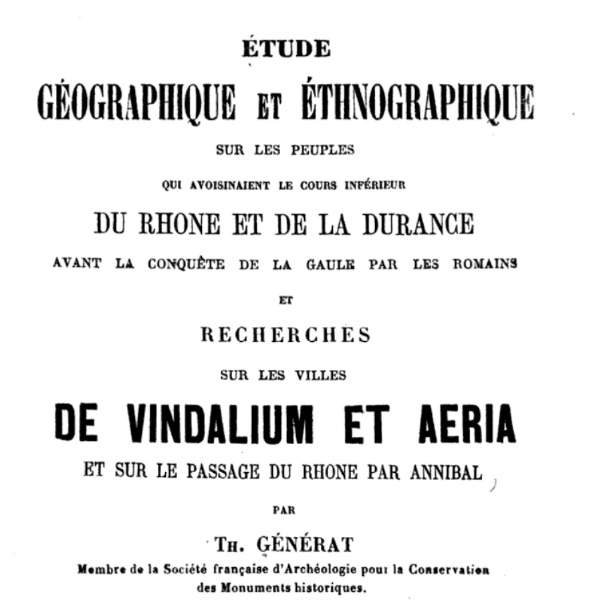
But then Mr. Generat in his 1860 ethnographic study of the peoples in the area suggested that Vordenses was a geographic description not necessarily a name of a tribe.

There is also no reason to believe that Vordenses has anything to do with Gordes.  It was just an idea of how to explain Gordes.  Gordes needed explaining apparently, there was a nearby inscription with Vordenses and perhaps one w-ord led to another.

Two things are worth noting:

First, Generat’s study was regarding the geography & ethnography of the villages Aeria and… Vindalium.

pagani3

Vindalium (noted by Strabo – see post scriptum below) is the site of a 120 BC battle between between the Romans and the Gallic army of the Allobroges and Voconces.  It is commonly identified with Vedene in France and it is Vedene (Vaucluse) that Generat was studying.  Both Gord and Vedene are near to each other (in the area of Avignon):

pagnoiSo now we have some form of Vindi.

Second, what is this Gord (if not related to any Vordense)?  Well, Gordes was apparently (and here Morand agrees) the site of an oppidum.  What is an oppidum?  Well, it’s basically a Latin word for a large fortified settlement – typically associated with “Celts”.  Now the word “guard” is common to Indo-European languages (e.g., Garda Síochána of Ireland) but the word “gord” or “gard” as a designation of an enclosed “burgh” is a Slavic word.  The German peoples may have had “garden” but that referred to a vegetable or flower patch rather than an enclosed settlement.  There also are no “gords” or “gards” in countries known to speak Celtic languages so what gives?

And BTW, the Tabula Peutingeriana shows a tribe named Veliate in this area:

Post Scriptum

We note here what Strabo says of Vindalium (Book 4, chapter 1):

“…Between the Druentia and the Isar there are still other rivers which flow from the Alps to the Rhodanus, namely, two that flow round a city of the Cavaran Vari, and coming together in a common stream empty into the Rhodanus; and a third, the Sulgas, which mingles its waters with the Rhodanus near the city of Undalum [elsewhere Vindalium], where in a great battle Gnaeus Ahenobarbus turned many myriads of Celti to flight.”

A few observations:

  • That Druentia has to have something to do with Drwęca in northern Poland (sources in Masuria – former territory of the Prussians) is likely.  Whether this means that there were Celts in northern Poland or Slavs in France or something else altogether (Veneti?) is, of course, up for grabs;
  • We also encourage you to read the rest of Strabo’s passage, including mentions of:
    • Vienna (Vienne)
    • Segusiavi
    • Lugdunum

If you keep reading you will also come to this passage of interest, we think, to anyone interested in Paphlagonian connections to Balts (or Slavs):

“The people who are called Tectosages closely approach the Pyrenees, though they also reach over small parts of the northern side of the Cemmenus; and the land they occupy is rich in gold. It appears that at one time they were so powerful and had so large a stock of strong men that, when a sedition broke out in their midst, they drove a considerable number of their own people out of the homeland; again, that other persons from other tribes made common lot with these exiles; and that among these are also those people who have taken possession of that part of Phrygia which has a common boundary with Cappadocia and the Paphlagonians.  Now as proof of this we have the people who are still, even at the present time, called Tectosages; for, since there are three tribes, one of them — the one that lives about the city of Ancyra — is called “the tribe of the Tectosages,” while the remaining two are the Trocmi and the Tolistobogii.  As for these latter peoples, although the fact of their racial kinship with the Tectosages indicates that they emigrated from Celtica, I am unable to tell from what districts they set forth; for I have not learned of any Trocmi or Tolistobogii who now live beyond the Alps, or within them, or this side of them.  But it is reasonable to suppose that nothing has been left of them in Celtica on account of their thoroughgoing migrations — just as is the case with several other peoples.  For example, some say that the second Brennus who made an invasion against Delphi was a Prausan, but I am unable to say where on earth the Prausans formerly lived, either.

All this may also be of interest to anyone looking at ancient Anatolia and the capital of Phrygia – Gordion.  Now this was supposedly named after one (there were at least two) of the Phrygian rulers – Gordias (he of the Gordian knot) – but who knows where the truth may be here (did Slavs get the idea for a burgh to be called a gord from having lived near (or in) Gordion?

Copyright ©2016 jassa.org All Rights Reserved

May 15, 2016

Illyrian Veneti of Appian

Published Post author

That, in addition to the:

  • Papflagonian
  • Adriatic
  • Gallic
  • Danubian (see Tabula Peutingeriana), and
  • Vistula

Veneti, there also were Illyrian Veneti we have hints from Herodotus.  But those hints are unclear to say the least.  There is another source suggesting Venetic presence (B.C.) along the northern Macedonian border.  The below report comes from Appian (AD 95 – AD 165) of Alexandria (Appianus Alexandrinus) the Greek-Roman historian who in his book Ῥωμαικά Rhomaiká or Historia Romana describes the campaigns of Lucius Cornelius Sulla Felix (139 BC – 78 BC).  Sulla had been causing havoc in Anatolia but, at some point, withdrew to Greece where, apparently, he decided to have some R&R by going after the local tribes:

“…Such were the terms which he offered. Archelaus at once withdrew his garrison from all the places he held and referred the other conditions to the king. In order to make use of his leisure in the meantime, Sulla marched against the Eneti, the Dardani, and the Sinti, tribes on the border of Macedonia, who were continually invading that country, and devastated their territory. In this way he exercised his soldiers and enriched them at the same time.”

Historia Romana, Book 12 (The Mithridatic Wars), chapter 8, section 55 (Terms of Treaty).

Incidentally, the Mithridatic Wars deal with much interesting stuff around the understudied area of Pontus and Paphlagonia where some names of local potentates are, to say the least, interesting.  We will only mention here that, for example, Bithynia was ruled by monarchs with names such as Prusias…  You can read all about that in Appian’s History.

And, as we mentioned, if you go East you get to the curious Laks (whose tribal names seemingly end in -vand but whose language is (currently) Caucasian)), the Svaneti or such monarchs as Kuji of Colchis.

Copyright ©2016 jassa.org All Rights Reserved

May 14, 2016

Beggars Must Be Choosers

Published Post author

Tendentious history writing has been a plague upon Central European nations.  In the West few deign to deal with Central Europe or Slavs and those who do often do so poorly.  What’s worse though is that the works of the few Western authors who do spend time on Central Europe are often praised and accepted uncritically in the East simply because the fact that such authors have shown any interest at all garners them credit in excess of the credit otherwise merited by the qualify of their writing.  In other words, the adage that beggars can’t be choosers has apparently been enthusiastically endorsed in historiography.

norm

Take Norman Davies.  His “God’s Playground” is considered “the” English-language work on Poland.  And yet, we’ve found its constantly meandering style virtually unreadable and not just for someone casually interested in the subject.  Add to that the author’s paternalistic didacticism and you have a recipe for a – rather expensive – door stop.

The Story of Life in the Hypothetical Homeland

Of course, given the focus of this site, what concerns us the most about Davies’ book is the distortive effect of the highly politicized view of the early European state that the author brushstrokes himself to conjure.  In the section discussing early Poland, nearly every paragraph begins with an unfounded sentence whose doubtful message the author then proceeds to dutifully develop while casting derisive sneers at those whose arguments he prefers to mock rather than address.

Thus, the book is full of gems such as this paragraph:

According to this hypothesis, the modern Polish nation is descended from a uniquely tenacious  group of Protoslavs, who, whilst their kinfolk migrated to the west, east, or south obstinately remained on their native soil.  The Poles are seen as ‘autochtones’, as ‘permanent residents’, and as ‘the native population; all other peoples of the area are relegated to the status of ‘aliens’, ‘transients’, or ‘invaders’.  It is an unusual situation to say the least.  At a period when the population was in flux in every other part of Europe, and in every other part of Slavdom, the forefathers of the Poles were planted at a stroke and with extraordinary precision in the one spot of God’s earth where they could rest indefinitely.  There may be a long prehistory of England before the English, of France before the French, of Bohemia before the Czechs, of Hungary before Hungarians, even of Russia before the Russians, but not it seems, of Poland before the Poles.

This paragraph might fairly be read to suggest that Davies believes that history is less about truth than about what’s “good enough” for a given people – a curious approach to the subject area – one more fitting a political agitator than a serious scholar.  Moreover, his premise of a population in a state of “flux” is itself full of half-truths:

  • it is not clear that there was a Bohemia before the Czechs.  Put differently, we do not know who the “mysterious” Boii were.  There is nothing to suggest that they could not have been the ancestors of the Czechs.  There is further precious little to suggest what happened to the Boii after the Marcomanni invaded their territories.  Even if one were to assume a Czech migration into Bohemia, there is nothing to suggests that this could not have been a back-migration after the Marcomanni (whoever they were) departed these lands.
  • The same more or less holds true of the Russians – while the name Rus is new, similar names were in use in the Ukraine long before the Varangians appeared on the scene (take the Roxoalani as just one example).
  • Even in the case of England modern DNA studies suggest that the majority of the (white obviously) population derives its roots from pre-6th century inhabitants of the same area.
  • Not to mention that the “state of flux” itself has been challenged – no less than by Davies’ fellow historical travelers – who, as it’s become fashionable, have downplayed the role of the Voelkerwanderung (indeed most of the so-called “Leftist” theories of national origins if put together next to each other fail in their inconsistency – about the only thing that unites them is a visceral desire to vanquish “national myths”);

What else?  First of all, the statement that there was no Poland before the Poles is, of course, a banal truism used as a rhetorical device.  Why rhetoric has to be employed by a historian is itself curious but, be that as it may, the next question concerns Davies’ real purpose, namely, the implication that there were people in “Poland” before the ancestors of the Poles.  From the context it is clear that he believes that the Slavs had waltzed into the area at some point around the 7th-8th centuries.  Where from?  Davies implies that this was somewhere north of Carpathians around the Dnieper.  He presents this map:

illyrian

Davies then argues that such a location of a “Slavic homeland” agrees with:

linguistic evidence , which demands firstly that the Slavs did not disperse until relatively recently; and secondly that they should have passed the formative years in contact not only with Germans and Balts but also with Illyrians, Thracians and Iranians.  [Such a location] encourages the identification of these early Slavs with the ‘Scythian farmers’ of the fifth century B.C. whom Herodotus put at three days’ march from the Dnieper. Here the Slavs would have developed their characteristic social institution, the zadruga or ‘joint family’, where all the relatives of the chieftain lived together under fierce patriarchal discipline.  Here subjected first to the Scythians and then from the second century BC to the Sarmatians, they learned their common religious vocabulary, most of which… is of Sarmato-Iranian derivation… Here in the first century of our era, they would have witnessed the slow migration of the Germanic Goths and Gepids whose route from the Baltic Coast to the Black Sea is clearly marked by a trail of characteristic settlement and funeral sites.  Here they would have experienced the successive arrivals of the Huns and the Avars.  Their own main expansion, which probably began in the coat-tails of the nomads, grew into a flood with the collapse of Avar supremacy in the seventh century. ‘The barriers were down, and the Slavs poured out.’… According to this schedule, the ‘Protopoles’ would have been one of the last of the Slavs to drift away front the North Carpathian homeland, and would have settled in the valleys of the Odra and Vistula in the course of the seventh and eight centuries.  By the end of the prehistoric period, the new wave of Slavonic colonization had obliterated most of the underlying layers of previous settlement.  The main implication of this hypothesis for Polish history is that the Poles would be but the latest of many Indo-European groups who have settled on the territory of present-day Poland.  Such a conclusion… is hard to refute…”

Davies who just above was willing to mock people positing “a uniquely tenacious group of Protoslavs” living in Poland throughout the ages, then proceeds to posit a uniquely tenacious group of Protoslavs living North of the Carpathians…

They are even given a dating of 5th century B.C. (!).  From their Protoslavonic dwellings Davies’ Protoslavs witness the Scythians, the Sarmatians, the Goths, the Gepids, the Huns and the Avars passing by on their way to exploits elsewhere – all while “tenaciously” clinging to their North-Carpathian dwellings from which the same Scythians, Sarmatians, Goths, Gepids, Huns and Avars are either unable or unwilling to dislodge Davies’ proto-Slavs….

Jordanes may have claimed a vast realm for the Goths – a realm where the Gothic kings have subjugated every conceivable tribe (including the Veneti) – but, in Davies’ telling, once Davies discounts the role of the Veneti (on that see below), Jordanes makes no mention of these North-Carpathian Protoslavs when discussing Gothic conquests.  Why?  Perhaps the Goths were simply so traumatized by their inability to take on the tenacious Slavs that even a few centuries later the greatest Gothic historian did not dare to broach the subject?

Thus, it seems “tenacity” is not really the issue – Davies’ Protoslavs are as tenacious (if not more) than the Proto-Slavs of Lehr-Splawinski.  The issue for Davies seems rather the location of these Protoslavs…

(and this leaves out the fact that zadruga is a Southern Slavic term – not some form of ueber-Slavic societal organization)

The Story of the Linguistic Evidence

So what of the location?  Why the North-Carpathians?  Davies trots out “linguistic evidence” which, as noted above, he claims “demands firstly that the Slavs did not disperse until relatively recently; and secondly that they should have passed the formative years in contact not only with Germans and Balts but also with Illyrians, Thracians and Iranians.”

But Czechs and Russians can still understand each other – not entirely but passably – even one and a half millennia (!) after their “separation” from the Protoslavonic mix.  And this is true notwithstanding that the spaces covered by the modern Russians and Czechs stretch literally from the heart of Europe all the way to Vladivostok.  Even if one posits a smaller recent extent of the Slavs (to the Volga, say) we are still talking about enormous distances.  The fact is that the similarity of various Slavonic languages says absolutely nothing about the rate (even assuming a constant rate!) of change away from some hypothetical Slavonic original.  And it certainly says nothing about the geographic expanse of the original Slavonic homeland.

Moreover, the reference to these other peoples likewise does not “demand” anything special.  One might first ask who were the Illyrians and Thracians?  What do we know of their language(s)?  Answer: close to nothing.  But even assuming that these existed as distinct (and non-Slavic) peoples, all of Davies’ conditions for a close Slavic neighborhood with the above tribes would be met by positing a Slavic homeland between Vindelicia and Pannonia… Or Central Germany and western Poland…

As regards the “Iranian” element, first it should properly be called the “Eastern” element for it has as much to do with India as with Iran.  Second, we have no idea what language the Scythians or Sarmatians spoke – the assumption is that it was “Iranian” but this is virtually unsubstantiated.  We simply do not know and anyone who tells you otherwise is either lying or is a fool.  The fact that so many Scythians (and later Alans) are described as light-haired individuals suggests that – whatever they may have been – they did not have the look of (most of) today’s Persians.  Even if such peoples spoke an “Iranian” dialect, there is no reason to look for them on the Dnieper.  The “Sarmatian” Jaziges were firmly established in Pannonia centuries before the Huns invaded Europe.

The Story of Goths, Celts and the Argentinean Gauchos (all in Poland)

Davies then proceeds to tell us who lived in Poland before the Poles:

From the early Bronze Age… the central and eastern areas of modern Poland were inhabited by Balts; the north-western areas fell within the fringe of Germanic settlement, which had stabilized in southern Scandinavia.  South-western areas formed part of the Central European Culture, which possessed an Illyrian-Celtic complexion.  Only  the extreme south-eastern corner of modern Poland…  would have fall within the extreme bounds of Slavonic settlement…

As to the Balts, no problem but all that follows is questionable.  We do not know what a “fringe” of Germanic settlement means.  Does Davies think that there were Nordics on the coast but maybe other non-Nordic peoples there as well?  As regards an “Illyrian-Celtic complexion”, we can’t even begin to address as to what this means and suspect neither does the author.  (Finally, what is the basis for Davies admitting that some super-extreme Slavs may have lived in some lower extremity of modern Poland?  Why even grant that?  Is this an exercise in throwing a bone?)

Davies continues on:

In the Roman period, a massive influx of Celts was provoked by disturbances over the mountains Bohemia.  The Celts filtered eastwards as far as the River San and beyond, building an impressive series of hill-forts… If it is unwise to put the Slavonic tag on any archaeological funds prior to AD 500, it is certainly improper to call anything at all at this juncture ‘Polish’…

How does Davies know there was any filtering at all?  And even assuming a “filtering” how does he know that the “filterers” built the “impressive” forts?  And as to either of those groups, how is Davies able to put a Celtic “tag” on them?

Davies is on a roll here…

Both the Goths and the Vandals lived in the Vistula Basin before migrating to the south and east on the first stage of their complicated wanderings… [F]ollowing the Avars’ failure at the gates of Constantinople in 626, the Avars lost control of their tributary lands north of the Carpathians, and their fragile realm disintegrated.  From that point onwards, the expansion of the Slavonic peoples could proceed without serious hindrance.  The nomadic life was losing its appeal…

Maybe (?) there were Goths at the mouth of the Vistula (whatever Vistula may have been back then) but were they settlers?  Or were they more in the nature of raiders like their Viking followers?  As to the entire Vistula basin, it’s not clear what is meant here.  Does Davies means that the entire Vistula basin was covered in Goths or that he does not know exactly where these Goths lived but for sure they lived somewhere in the “basin”.

As to the Vandals, we have noted that there is close to zero evidence that they lived anywhere in Poland.  Further, the Avars may have lost some control over their empire after 626 but they were not defeated until the pathological reign of Charlemagne.  Since they first appeared in Byzantine records mid-6th century, this means that about 3/4 of the Khaganate’s history did not take place until after their defeat at Constantinople.  Their realm was not so fragile and it did not disintegrate in 626.  Moreover, the expansion of the Slavonic peoples would have had to have taken place remarkably quickly “from that point onwards” since both Slavonic Wends and Slavonic Sorbs make their appearance on the fringes of the Frankish empire in Fredegar right around this time – and, as to the Sorbs, there is no suggestion of them having been tributaries to the Avars (frankly, there is no evidence of the north-Carpathian lands being tributary to the Avars at all but why quibble).

Davies then gets to his desired conclusion:

Inevitably, in the wake of so many human migrations, the ethnic mix of the population was extremely rich.

The only thing rich is the above statement.  First of all, Davies has no notion because he did not do any studies of the “ethnic mix” of Poland or any of the Slav lands as of the time he is describing.  He literally pulls this one out of his ass.  Second, what does “extremely rich” really mean?  Does it mean that Poland was filled with Bantu-speakers from West Africa, fiercely independent Mauri peoples, blood-thirsty Toltecs and curious Arab travelers?  Were the Polanie a tribe of Han Chinese particularly skilled at agriculture?  That kind of a “mix” would be extremely rich (outside of present day London or New York).  But, even assuming everything else he writes elsewhere is true, Davies’ Poland was unlikely to have had at the time any peoples other than what are today’s Central Europeans – whites, with hair that is neither very blonde nor “altogether inclining towards the dark” – the Baltic or Finnic “subtype” if you will.  This is confirmed by the modern DNA studies which both place the Poles as some of the least diverse people in Europe (!) and also show them to be related to various Finnic tribes such as the Veps peoples.

The Story of Isolationist Impossibilities 

Davies doesn’t stop digging here, of course:

As a result it is quite impossible to isolate anything resembling an ethnic core, or, at the distance of more than a thousand years, to distinguish Slavonic from non-Slavonic racial elements… People who imagine that the Poles or Polish culture are somehow ‘indigenous’ to the Polish lands are as mistaken as those who believe that Europe is the original home of the Europeans… To look for Poles in the eighth or ninth centuries, is as anachronistic, and as pointless, as looking for Englishmen in the age of Hengist and Horsa… In the last resort, all our ancestors were alien mongrel immigrants.

We will not dwell on Hengist and Horsa as they are not our business.  However, Davies seems to be kidding when he makes that statement.  Is it really the case that he can’t tell the “ethnic core” of a Pole from any of the peoples listed above?  To call Poles “mongrels” is to deprive that word of any reasonable meaning – even assuming that such a word could be used in polite company.

Poles may or may not be indigenous to Poland.  If you believe that all humans came from Africa then obviously all humans are – under that most pedantic definition – immigrants.  But even if this were true, there is little in the historical record to suggest that today’s Ukrainians, Poles, Sorbs, Slovenes and so forth are not – at least in significant part – the direct descendants of the various earlier tribes mentioned by historians.  The names of the various polities may have changed but did the people?  Davies makes assertions but provides no evidence.

Veneti Who?

What of the Veneti?

Davies says this:

The so-called Venedian culture of the Protoslavs must be set aside as yet another red herring… [Tacitus’] delphic reference to the ‘Venedii’ has been variously interpreted as proof of the existence of Germanic Vandals or else of Slavic Wends.

We have never thought that the Veneti could be seen as Vandals.  Nor are we aware of anyone seriously suggesting this except perhaps on the German pre-war far right.  Tacitus mentions the word Vandal but does not suggest any link to the Veneti who he also discusses.  (His reference to the Veneti is no more or less delphic than his references to various other peoples of Germania.)  To suggest that the Veneti could equally well have been Vandals as Slavs is to engage in intellectual relativism – just because you can come up with two opposing arguments and those to champion them does not mean that each argument is equally valid.  Davies is wrong in equating (and thereby legitimizing) these two approaches to the Venetii.  That the Venetii were the ancestors of the Slavs is, to us, highly likely – what is not certain is whether they encompassed all the Slavs and whether some other peoples (e.g., Balts) were understood under the Veneti name as well.

Davies also mentions Pliny for his amber stories but fails to mention that Pliny too talks of the Veneti at the Vistula.  Nor does he mention Procopius who speaks of the Venetic Gulf (Baltic Sea?).  Nor does he discuss the Tabula Peutingeriana.  So where, did these mysterious Veneti dwell according to Davies?  And, importantly, what happened to them?  Once again, if the Nordics came from Scandinavia, who lived in Central Europe before them and what happened to them?

Looking at his book, we are forced to conclude (with more than a touch of charity) that Davies is unprepared to discuss Polish or Slavic pre-history.  His methods and sources are, to put it gently, lacking.

The question is why?  One answer would be that he is not a very good historian or not a particularly bright man.  A more likely answer based on his didactic proclivities described above would be that he simply does not see the value in dwelling on the past and is quick to dismiss anything that might smack in his view of “chauvinism.”  But what this means is that Davies prefers not to examine facts that might lead him in a direction that he does not want to go in.  That however is not the path of an honest historian but one of a determined propagandist.*

Unlike a rich tribe which, given its abundance of sagacious historians, may well survive a few mediocre ones, a poorer tribe ought to take heed before endorsing a scholar merely because the scholar is willing to give such tribe some stage time.

* And speaking of politically engaged pseudo-scholars, a mention of this crude Twitter post from Paul Barford – an archeologist (degree from?) moonlighting as a historian deserves its own footnote:

Barford, who does not seem to have any known university education appears to be a cantankerous hobbyist archeologist who managed to move to Poland in Communist days, get himself employed by Polish cultural institutions (Brueckner might just provide answers as to how) and even to publish “The Early Slavs” (a book which, notwithstanding the author’s peculiarities, is still far more readable than Davies’ or Curta’s tedious volumes). His website features this logo which appears to be a boot imprint on his host country’s flag (the fact that insulting national symbols in Poland is a criminal offense there does not seem to bother him).

Copyright ©2016 jassa.org All Rights Reserved
May 13, 2016

Cairo Genizah Documents

Published Post author

Among the interesting documents from Hebrew literature that touch upon Slavs are those of the so-called Cairo genizah (storage room – this one in the attic of the Fustat-Misr synagogue on the southern outskirts of Cairo).  Although close to 2,000 documents exist that were rescued from the genizah (and are now at Cambridge), two have been studied more than others.  Both contain references to Slavic places and other mentions of interest.

Cambridge Document

The first is the so-called Cambridge Document – a letter from the Khazarian Jewish community probably in response to Hasdai bin Shaprut detailing the rise of the Hebrew Khazars.

schecterletterski

The letter (also known as the Schechter Letter, by reason of having been discovered among the Genizah documents in 1898 by Solomon Schechter) has a number of interesting aspects.  First, it mentions several names that are of interest:

  • the Rus (RWSY), and
  • their leader Oleg (HLGW – probably);

Second, the document starts with a reference to the Khazarian Jews having escaped from the yoke of Armenian idolaters.  It is difficult not to connect this event with what we know of the legend of Gisane and Demetr as related to us by Zenob Glak:

“Armenia, and [our] fathers fled before them […] for they were unable to bear the yoke of idol-worshippers, and the people of Quazaria received them.”

Third, the Schechter letter mentions rather curiously a name that may stand for the Pechenegs, PYYNYL (perhaps PSNYK) but perhaps, we think, could stand for the Polans of Kiev:

plz

Kievan Letter

This (manuscript T-S (Glass) 12.122) is a letter from the Jewish community of Kiev describing the affair of one Mar Jacob ben R. Hannukkah who guaranteed a debt incurred by his brother “to gentiles”.  Since Jacob’s brother was then killed by brigands, Jacob was put in a debtor’s prison for a year.  The Jewish community then paid off 60 coins of the debt but 40 coins still remained.  The letter was apparently sent to some other Jewish community to seek cash to repay the remaining debt.

kiev

The Kievan Letter was discovered in 1962 by Norman Golb.  What is interesting about it is that:

  • it mentions the city of Kiev by name; and
  • some of the signatories might have non-Jewish, precisely, Slavic names.

The name Kiev is written as follows: קייובי (QYYWB):

kiefz

The names of interest are the following:

  • GWSTT bar KYBR Kohen – perhaps Gostata (or Gostyata) bar Kiabar (name similar to various “Gasts”, “Gosts” and “Hosts”):

gostata

  • Judah/Yehuda, called SWRTH – perhaps Sawarta or Severyata (see Severyans):

severth

  • QWFYN bar Joseph – perhaps Kupin:

severth

Finally, we note that the letter begins with the invocation of the name of God by the words, “He Who is adorned with the diadem ‘Final and First'”.  This is essentially the “Alpha & Omega” title of the New Testament found, interestingly, also among the Gnostics in the form IAΩ with reference to Abraxas.

Copyright ©2016 jassa.org All Rights Reserved

May 11, 2016