Category Archives: Origins

Other Wandas Here, There and Everywhere

Published Post author

We’ve pointed out some time back that the name “Wanda” comes up in context other than the Wanda legend.

Gesta Abbatum Fontanellensium Again

Thus, in the Gesta Abbatum Fontanellensium we have – in addition to Saint Wandregisel or Wandrille of Fontenelle, the abbey’s founder (circa 570 – 668) – the later abbot and Saint, Wando (abbot 742 – 756) who, strangely, ended up exiled to Utrecht (On Slavic (?) Utrecht see here and here).   traiecto

We mentioned this Saint before but he gets his own chapter in the above Gesta (which also mentions a rivulet and town called Vinlena or Wintlana and other interesting rivers such as Vimina and Visrona):

abba

Tawagalawa Letter

But there are other places where the name comes up.  For example, on the other side of the continent (well, technically, in Asia), there appears the name Millawanda (Milawata; Miletus?) and Waliwanda of the “Tawagalawa Letter” (of the Ahhiyawa Texts) written by a Hittite king (Hattusili III?) to a king of Ahhiyawa (Beckham, Bryce, Cline translation):

wilusa

“But when I arrived in the town of Waliwanda, I sent to him…” (section 2)

“…And [I wrote to Piyamaradu?] in Millawanda: ‘Come here to me’…” (section 4)

“…Then I went to Millwanada… When Tawagalawa himself, [as the representative of?] the Greak King, crossed over to Millawanda…”  (section 5)

“… If you/he were [to…] Millawanda, then my servants would flee en masse to that […] one.  And, my brother, I have… over against the land of Millawanda.”

These are in addition to other interesting place names such as  Wilusa or Mount Hariyati that make their appearance in the Ahhiyawa Texts.

Of course, even further East we have Lake Van and even further East there lies Mount Damāvand (Demawend) the tallest mountain in today’s Iran that previously was associated with… Jason (Jasonius Mons).  About India, we wrote already, for example, here.

Copyright ©2016 jassa.org All Rights Reserved    

September 19, 2016

…sic Suevorum ingenui a Servis separantur

Published Post author

We’ve already discussed Tacitus’ Germania in numerous places including here.  But let’s revisit one point.  Take this phrase:

“sic Suevi a ceteris Germanis, sic Suevorum ingenui a servis separantur.”

That is the way this is usually quoted.  Except that the “servis” above is actually capitalized in some editions:

“sic Suevi a ceteris Germanis, sic Suevorum ingenui a Servis separantur.”

Why would Tacitus capitalize the noun “slaves”?

And how does that fit with Vibius Sequester’s:

“Albis Germaniae Suevos a Cerveciis dividiit: mergitur in Oceanum”?

More on that here and here.

There is something else.

It is more than strange that the Slavs had always been confused with Serbs (indeed Safarik and some others have previously stated that they thought “Serbs” may have been the original name) and here we have these Suevi and Servis.  And both of these in roughly the same geographic area.

What would Ockham’s Razor suggest?

jassa.org Copyright ©2015, All Rights Reserved


September 18, 2016

What Language Did the Goths Speak?

Published Post author

While this question may seem absurd to anyone who has spent any time with the Wulfila Bible or who is aware of any of the Gothic names, it is by no means such.  The Nordic character of the above is obvious.

But what does that tell us about the “Goths”?

It turns out, precious little.

Take the Wulfila Bible – a fourth century creation.  Wulfila or Ulfilas was a Goth… of “Cappadocian Greek” descent.  Or, in other words, he was an Anatolian Greek whose parents appear to have been kidnapped by the Goths during one of their forays into Anatolia.  (One could also ask how many of the Anatolians were actually descendants of Greeks).

He was raised a “Goth” – perhaps – notwithstanding the fact that no Goth “blood” flowed in his veins.  He also converted the Goths to (Arian) Christianity.  Since religion was and is part of culture, how Gothic was he if he was converting his people to a foreign religion?  He spoke Gothic… but we may well suppose he also spoke Greek.

Jordanes’ famous list of the various peoples that were conquered by the Gothic king Ermanaric is impressive. To recite it we have “Golthescytha [,] Thiudos, Inaunxis, Vasinabroncae, Merens, Mordens, Imniscaris, Rogas, Tadzans, Athaul, Navego, Bubegenae and Coldae.”*  After they were conquered, were all these peoples “Goths”?  Were the men that were placed into the Gothic “army” Goths?  Or do we believe that the Goths, after conquering all these tribes, did not utilize their manpower in war?  And this, before we even get to the Heruli and the “populous nation of the Veneti.”

[* The names of these tribes are not all clear but:

  • Thiudos are likely Finnic Chuds;
  • the Vasinabroncae may be the Ves (Visu of Ibn-Fadlan) or today’s Veps or Vepsians (a Finnish people with an apparently remarkable genetic similarity to the Poles) who may have something to do with the Vesi or the Visi-goths;
  • Merens are likely Meria, a Finnish people at both sides of the upper Volga by today’s Rostov;
  • Imniscaris are likely the Mescera – also Finnish;
  • Mordens likely the Mordvins, Mordva, Mordvinians, Mordovians – also Finnic;
  • Athaul was likely Atil or the Turkic name for large river (usually Volga but also possibly the Don);
  • Navego may refer to naevaeg mentioned as a Sarmatian tribe of Naevazae already by Pliny;
  • Coldae may be Coldui who may be Quadi (though that last emendation seems like a stretch);

an interesting aspect of the above names is that it appears to indicate that the Goths began their conquests somewhere in the Far North]

What languages did these people speak?  Most, probably, did not originally speak Germanic (the Heruli being the equally probable exception).  Did they learn Gothic?  Or did they pick up a few Gothic words here and there?  When they moved west with the Goths (or did the Goths leave them all behind?) did they change their language?  Or were their numbers such that the languages were retained?  Was there a need of single language in the Gothic “commune”?  If so, was it Gothic?

Ask yourself how much British there is in today’s America or Australia?  All (most of) these people speak English – a Germanic language by any standard classification – are they all Germanics?  On the other hand, there are sizable pockets of Americans and Australians that are bilingual (or who speak much better, say, Spanish than English) – they are all Americans and Australians.  Are they therefore Germanic?  Linguistically, sure.

In other words, how much Goth was there in the Goths of the 6th and 7th centuries?

P.S. and this before we even get into thorny questions of what “Tervingi” may mean or whether Ostr- and Vesi- really mean East and West (or something entirely different, like island Goths and field Goths).

Copyright ©2016 jassa.org All Rights Reserved

September 9, 2016

Emporial Embargoes

Published Post author

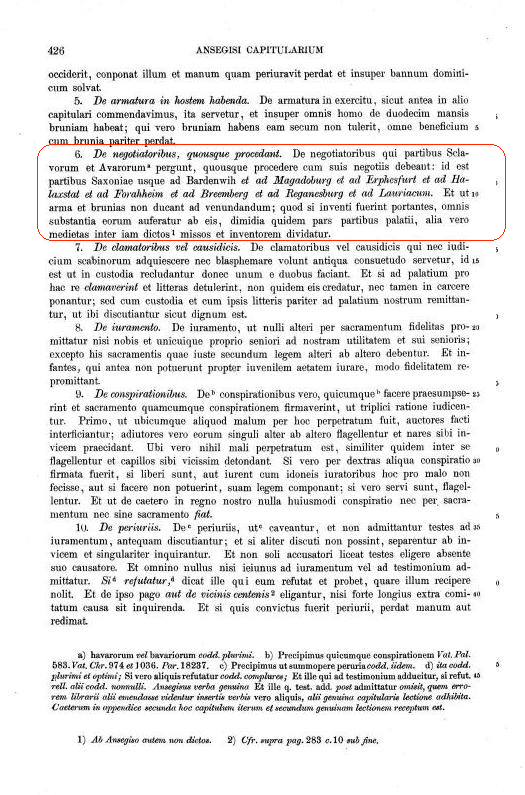
The following is an 805 list of Frankish trading places with the Slavs as well as requirements regarding what things not to sell to the Slavs – perhaps a lesson of the events, almost two centuries earlier, relating to the merchant Samo.  The list of the Frankish missi also shows the rough contours of the Frankish-Slav frontier at the beginning of the 9th century (some towns’ names are open to interpretation).  The source is Boretius (43-44) (translation by King) (pictures from the Parisian Codex 4995):

emba1

Double Capitulary of Thonville
(Duplex Capitulare Missorum in Teodonis Villa Datum,
Diedenhofener Kapitular Karls des Grossen)
December 24, 805

To One and All
(Ad omnes generaliter)

23(7) “Concerning merchants who travel to the territories of the Slavs and the Avars: how far they ought to proceed with their merchandise – to wit, in the regions of Saxony, as far as Bardowick, where Hredi is to be in charge, and to Scheessel [or Scheßlitz?], where Madalgaud is to be in charge, and to Magdeburg [first mention of the city], where Aito is to be in charge; and to Erfurt where Madalgaud is to be in charge; and to Hallstadt, where Madalgaud again is to be in charge; to Forschheim [first mention of the city] and to Premberg [or Pfreimd?] and to Regensburg, where Audulf is to be in charge; and to Lorch, where it is to be Werinar.  And that they are not to take arms and coats of mail to sell; and if they are discovered carrying them, all their stock is to be taken away from them, half going to the fisc, the other half being divided between the aforesaid missi and the discoverer.”

negotiatorum

(De negotiatoribus qui partibus Sclavorum et Avarorum pergunt, quousque procedere cum suis negotiis debeant: id est partibus Saxoniae usque ad Bardenuwic, ubi praevideat Hredi; et ad Schlezla, ubi Madalgaudus praevideat; ad Magadoburg praevideat Aito; et ad Erpesfurt praevideat Madalgaudus; et ad Halazstat praevideat item Madalgaudus; ad Foracheim et ad Breemberga et ad Ragenisburg praevideat Audulfus, et ad Lauriacum Warnarius. Et ut arma et brunias non ducant ad venundandum; quod si inventi fuerint portantes, ut omnis substantia eorum auferatur ab eis, dimidia quidem pars partibus palatii, alia vero medietas inter iamdictos missos et inventorem dividatur).

The Ansegisi Abbatis Capitularium collection contains a similar list:

emba2

Here is a map with the place names (some based on guesses, as noted above):

emporias

Copyright ©2016 jassa.org All Rights Reserved

September 6, 2016

Crantz’s Wends

Published Post author

Crantz (or Creontius/Craentius) was an eighth century Bavarian dignitary – chancellor to the Bavarian Duke Tassilo III (circa 736 – circa 796).

Tassilo (the last of the dynasty of Agolfings) was at various times in rebellion against Charlemagne and, as with all who rebelled against that tyrant, he did not profit by his resistance.  In the end he was outmaneuvered, forced to renounce his claims on Bavaria and was eventually tonsured (along with his son) and he and his family were forced to live out their lives as monks and nuns in the monastery at Lorsch and, as regards the daughters (as per the Chesne fragment), at Chelles and Laon.

baiern

Bavaria

So much for Tassilo.

fcrantz

Crantz does not appear much in literature but he is generally accepted as a genuine 8th century source.  References to Crantz’s now lost works are made in manuscripts written much later by Johann Georg Turmair or Thurmayr aka “Johannes Aventinus” or just Aventinus of Bavaria (1477 – 1534).  Aventinus is known as the father of Bavarian historiography and he mentions fragments that are generally accepted to have originated with Crantz.

The two works of note are Aventinus’:

  • Annales ducum Bavariae (the “Annals“), and
  • Baierische Chronik  (the “Chronicle“).

The Annals were written first in Latin.  The Chronicle is basically a German language version of the Annals.  Both were republished in the 19th century, most notably by Riezler (1882) as part of a wider set of Aventinus’ works.  They came to the attention of King when he was putting together an English translation of various sources regarding Charlemagne.

What interest us in particular are the mentions of Slavs – the Carantanians – in excerpts from the Annals and the Chronicle that attributed to Crantz.  We present these here in King’s English translation, along with the print versions of the same passages and the original manuscript pages (Clm 283 Annales; Cgm 1562 Chronik) .

We start with the print versions of the Annals:

friezler3

And of the Chronicle:

fkronik

Year 771
Annals

“…There succeeded Hadrian I, who supported the imperial regions against the Lombards.  The Lombards and stirred up (?) the Germans against the king of the Lombards.”

venetos

“The Lombards were were defeated by the Venetians [King notes ‘perhaps ‘by the Wends’ and notes that what follows (two words it seems) is ‘illegible’ ‘].”

venetiz

Year 772
Annals

“Theodo, son of Tassilo, was taken to Italy, to Desiderius, his grandfather, and thence to Rome; he was baptized (?) at Whitsuntide.”

charini

“A people extremely ferocious in war at this time were the Slavs or Wends, to use the language of common speech, or, to use their own, the Charini or Chariones [Carantanians], who lived on the rivers Drava and Mura [‘ad Dravus Nuciamque (?)’].  Into Italy with an immense multitude…”

[and the source breaks off]

[the parallel with the Charini of Pliny’s or, to the extent they were different, with the  Germanic Harii is interesting]

Year 772
Chronicle  

“And the above-named princes, duke Tassilo, his wife, the duchess Liutperga, and their son, duke Dieth or Theodo, out of special devotion for the salvation of their souls, dispatched to Rome with truly great offerings a splendid embassy: bishop Alim of Saeben, count Maegel, count Machelm and many other magnates, spiritual and temporal, brave and eminent men.  King Charles would not let them all pass;”

kronik1

“he allowed only the above-named Alim of Saeben or Brizen and abbot Atto of Mondsee to proceed to Rome and made all the other people go home again — But duke Tassilo was displeased by this affair; he felt insulted that his cousin, king Charles, had refused to let his people through and was seized by a great rancor towards him.  King Charles, for his part, was no less anxious about his cousin, duke Tassilo, who, to him, was aiming to be just too powerful; Tassilo was certainly at one with the Saxons, Wends and Huns, all of whom had long been sworn and mortal enemies of king Charles and all the kings in Francia.”

winti

“A fierce war was on the point of breaking out.  Then pope Hadrian intervened became a mediator and sent two bishops from Rome to Bavaria, to duke Tassilo, who made peace between the duke and the king.  Duke Tassilo came to his cousin, king Charles, at Worms [781] and gave him great gifts of goods and money; in return the king gave him even more, receiving duke Tassilo right honourably and treating him with great propriety and respect.  They concluded an eternal peace with each other.  And so duke Tassilo went back to Bavaria and again sent count Machelm, a very elderly lord, with many companions, on pilgrimage to Rome.  All died there, of fever.”

Post Scriptum

Note that the Annals, the Chronicle and other writings by Aventinus also mention Wends/Slavs elsewhere but those passages are not attributable to Crantz so we do not generally present them here.  Nevertheless, since Chapter 78 of the Chronicle does address Tassilo’s (Thessel’s) dealings with the Carantanian Slavs, we thought we should include those passage here.  We leave to you to translate the terrible things that the Carantanian Slav pagans did to deserve their fate according to the author.  The like source here is the Conversion of the Carantanians:

Karnten

Copyright ©2016 jassa.org All Rights Reserved

September 5, 2016

The Letters of Alcuin of York

Published Post author

Alcuin of York or Alcuinus (circa 735 – 19 May 804) aka Ealhwine, Albinus or Flaccus was an English scholar and teacher at the court of Charlemagne in 780s and 790s becoming the Abbot of Tours in 796.  Slavs appear in two of his letters which we present here (translation is courtesy of P.D. King) both from the collection in the Monumenta Alcuiniana, an 1873 work by Ernst Dümmler, W. Wattenbach and Philipp Jaffé.  The same may also be seen in Epistolae IV.2. in the MGH (1895).

alcuz

Alcuin to an unknown abbot
Wilti et Vionudi
(late 789)

“Be of good cheer, brother, and labour manfully in God’s service, fasting, praying and keeping vigils, as you have been doing hitherto.  Give my beloved bishop Willehad a thousand greetings. It grieves me greatly that he and I are separated.  Would that I might see him and complete my life’s course as a peregrinus!  Only pray for me, that the Lord God in HIs mercy may guide my ways.”

alcu

“Send me a letter to tell me how you are and what you are doing; and how favourably the Saxons are responding to your preaching; and whether there is any hope of the conversion of the Danes; and if the Wiltzites, or Wends, whom the king has recently secured are accepting the Christian faith; and what is happening in those parts; and what the lord king is going to do about the attack by the Huns.”

“Greet all those who are with you, serving God.  Labour manfully in the work which you have begun, that you may receive the supreme crown from GOd.  For it is not he who begins but he who endures until the end who shall be saved [compare Matthew 10, 22].”

“May divine grace aid and preserve you wherever you may be.”

Alcuin to Colcu
Sclavos, quos nos Vionudos dicimus
(early 790)

“I rejoiced with all my heart, [that] I own, to hear that your fatherhood was enjoying good health and good fortune.  And since I thought that you would be eager to know of our progress and of recent events in the world, I have been at pains to inform you prudence, through this unpolished letter of mine, of what I have seen and heard.”

alcu2

“In the first place, your belovedness should know that by God’s mercy HIs holy church in Europe enjoys peace, gains ground and grows greater.  For the Old Saxons and all the peoples of the Frisians have been converted to the faith of Christ under pressure from king Charles, who has won some over by rewards, others by threats.  Moreover, the said king last year fell upon the Slavs, whom we call Wends, with an army and subjected them to his authority.”

“Two years ago, furthermore, the Greeks descended upon Italy with a fleet but were overcome by the dukes of the aforementioned king and fled to their ships.  Their dead are said to have numbered 4000 and the prisoners 1000.  In like manner, the Avars too, whom we call Huns burst into Italy but returned home with ignominy after defat by the Christians.  They also attacked Bavaria; those invaders too were defatted by the Christian army and scattered…”

Copyright ©2016 jassa.org All Rights Reserved

September 4, 2016

Of Foolishness & Depravity

Published Post author

We present a short article from the Classical Review (Przegląd Klasyczny) an interwar Polish magazine published at Lviv (then Lwow).  The 1936 article presents an argument for equating the names Suevi with Suoviane, i.e., the English “Slavs”.suevi1It was written by one Janusz Bożydar Daniewski and was based on his earlier and longer PhD thesis entitled “Tacitus’ Suevi or Western Slavs in Roman Times” which was published in 1933.  Since the suggestion was controversial, the Classical Review also printed a much, much longer and highly derisive response by one Eugeniusz Leonard Słuszkiewicz who mocked the idea that Slavs descended from the Suevi contending instead that they came from the East (given his own physical appearance, a remote marsh/bog origin in the Pripet may in fact have been true – for him). Słuszkiewicz’s response to Daniewski, whatever one may think of its merits, can only very generously be described as “impolite”.  Daniewski then responded to Słuszkiewicz in a separate note.

With the benefit of hindsight, it is fascinating to note that Słuszkiewicz later, during World War II, surprisingly found paid work at the Cracow-based Institut für Deutsche Ostarbeit (“Institute for German Work in the East”) – an institute  established by Hans Frank (the Nazi governor-general of Poland), whose main task was to prove the German character of Poland and other Slavic lands.  One can only assume that, given Słuszkiewicz’s views/resume, he was a natural fit for the Institute.

We note that many of Daniewski’s assertion could be questioned but we found nothing in this excerpt that is fundamentally implausible.

On the the Slavic letter “Ł” or “ł” see here.

With that in mind, here is the text (thank you for assistance in translation to our interns):

suevi2

“In antiquity, the name Sueui (Tac.), Σοῆβοι (Strabo) was given to a number of tribes, settled on the Elbe, Oder, Vistula and on the shores of the Baltic, from the base of the peninsula, which today is called the Jutland [peninsula, that is the Cimbrian Peninsula], to the mouth of the Vistula.  Between antiquity and the Middle Ages we have a gap in [our written] sources.  But once at the dawn of the Middle Ages contemporary shone a light upon the aforementioned lands, everywhere there where in antiquity there dwelt tribes that went by the name Sueui, we find peoples, who are called Slavi, Slavi – that is the Latin name of peoples who are called Słowianie [pron Suovianie] in Polish, Славя́не [pron Slaviane] in Russian [and] in the language of the Baltic Slavs (Kashubians): Słevi [pron Suevi]*, that is Słowjanj [pron Suovianie] (Florian Cenova, Skorb. VI, p. 88).”

[*note: Cenova equates Suevi and Slavs but the Kashubian term he actually uses is Sławy, i.e., Suavy]

“The Baltic Sea, which in antiquity was called: mare Suevicum (Tac. Germ. 45), is called in the Middle Ages Slavicus Sinus (Script. R. Dan. VII p. 317).”

[note: haven’t seen the actual language though Adam of Bremen has a Slavic Gulf “et sinus sclavanicum” in Book IV]

“The gap, that we see at the turn of antiquity and the Middle Ages, is merely a gap in written sources.  In reality the medieval life is simply the continuation of life in antiquity.  The Middle Ages are not some new world separated from antiquity by some chasm that negates any connections [between the two].  The borderline drawn between antiquity and the Middle Ages is merely convention.  Just as the sinus Slavicus of the Middle Ages – the Baltic Sea is the same sea, which in antiquity was called mare Suevicum, so too the nation of Slavi, living by this sea, consists of the descendants of the nation called Sueui in antiquity.  The name changed while the body that it referred to, remained the same.  Many tribes of the Sueui nation continue in the Middle Ages in the same abodes under the general name Slavi, maintaining their ancient customs, traditions, rituals and religious rites, even political systems.”

suevi3

“Because I happen to have come across the opinion to the effect that the medieval Slavi cannot be descendants of the ancient Sueui nation because, the name Slavi allegedly does not correspond to the ancient name Sueui, I wish to analyze this matter in more detail here.  The setting together and equating the words SueuiSlavi is not the only evidence of the identity of these peoples, [rather] it is one of the links in a long chain of arguments.  It’s easy to come to the conclusion that these names are the same, the difference [between them] being only in transcription and in certain local and temporal forms of pronunciation.  The forms: SueuiΣοῆβοι , SlaviSclaviSłeviSłowianie, Славя́не – these are the different variants of the same name.”

“The first phone s appears in all the forms [of the name].”

“The second phone, the one that the Poles represent graphically with a ł, pronounce variously, in the East like a dental consonant/sonorant [?], in the West as a “short” u (), an asyllabic u [note: that is a vocalized L].  Baltic Slavs (Kashubians), like an asyllabic [], with the exception of one group of them, the so-called Beloks, who pronounce this l phone as a palatal consonant.  Ancient Romans and Greeks did not have the phone discussed – the dental consonant/sonorant [?] ł – in their  language, therefore there was no letter that could represent it [the phone] in the Latin and Greek alphabet.  The letter l with a slash through (ł) began to be used among the Poles first int he XVIth century.  In the Middle Ages, people made do in other ways to express this phone, either writing an l without any additions or writing cl – whereby the letter c played the same role at the side of an l as the line through the l in the letter ł (compare Viscla = Wisła).  Ancient Romans and Greeks who did not have in their speech the dental consonant/sonorant ł, not having in their possession a letter for this phone, not being in possession of the letter ł, which was only created many centuries later, were they able to better express the phone in question than by an asyllabic u or a short o (omnicron), in accordance with its phonetic pronunciation?  In the word Sueui the u is short, as indicated by the Greek transcription of  this word and not long.  The two beginning phones of the words: SueviΣοῆβοι,evi, Słowianie, Славя́не are identical, in the phonetic transcription they appear as S.”

“The vowel in the word Sueui – is [made of] the long eη.”  

“In the words Slavi and Славя́не – there appears an a, in the word owianie, an o, in the word evi, an e.  The vowels aoe, substitute for one another in Slavic languages, for example: Stolp = Słëpsk (here, in addition to the change of an  into an e, there is also a metathesis [he means the the vowel and the l/ł flip], Chołm =  Chełmrak (Polish) = rek (Kashubian), mały (Polish) = meły (Kashubian) and so forth; a countless number of such examples can be given.  The fact that an ancient nation living on the Baltic Sea between the lower Elbe and the Vistula was called Sueui – a word which sports the e vowel whereas in the words Slaviowianie, and so forth we have an a or an o, cannot, therefore, serve to establish that these are different names – especially since even today, among the Baltic Slavs (the Kashubians), who are a remnant of a once great nation whose seats stretched far into the West into lands on the left bank of the lower Elbe, the word pronounced by the Poles owianie [note: that is, Suovianie] occurs in the form evi, whereby the phonetic transcription is Suevi.  How does this word differ from that ancient word written by the Romans Sueui with the short u occurring after the S?  The fourth phone of the word under consideration is uv = β.  But the Greek β already in antiquity lost the character of a voiced bilabial stop/closed bilabial consonant [?] and phonetically corresponded to the Latin v.”

suevi4

“In certain editions of Tacitus’ Germania we see a systematically printed form Suebi and not SueviSueui.  What is the source of this?  The form Suebi does not exist in the codices used for critical editions of Germania.  Instead, we have everywhere the form Sueui, a fact that I personally had the opportunity to confirm in Rome and Naples.  While there does occur in some transcriptions the substitution of a b in place of a u = v, all the Tacitean codices feature a u, so that no editor of a critical edition should introduce this arbitrary change.  The Germans do this because the form Suebi is phonetically closer to the word Schwaben, desiring in this manner to transfer into the scientific realm the view commonly held by laypeople that ‘the Suevi are simply the same as the Swabians.'”

[note: compare these in the manuscripts of Germania here]

“In reality, the Swabians have nothing to do with the Suevi of antiquity other than the phonetical similarity of sounds.  The name of Swabians in Greek transcription is different, that is Σουαβοι [note: compare with Σοῆβοι] (Procopius, Bell. Goth. I, 15, 26); they appear only in the the third century.  In the Teubner [publishing house] critical edition [of Germania], there is an attempt to justify the change from vu to b.  In the critical  apparatus we read ‘sueuos libri ac sic deinceps’ (Tac. Germ. 2, 17), but, because in the 41st chapter of Germania the copyist made a mistake and in the codices there appears the word verborum instead of Suevorum – this copyist error is supposed to indicate [according to German scholars] that the true form of the word is Sueborum: ‘quae corruptela genuine formam nominis testatur.’  This copyist error is immediately used by the Germans as justification to replace the uv with a b everywhere the word Sueui appears.  The arbitrariness and bad faith is plainly visible here.  Despite this, Polish publishers, trusting the Germans blindly, have for some time now been following [the Germans] in printing not Suevi but Suebi.”

suevi5

“In the words owianieСлавя́не, to the root ov Słav there is added also a suffix before the ending [whereas], the words: Suevi, SlaviSłevi occur without a suffix.”

“What linguist should see difficulties in considering the words SueviSlavi = Słevi, that are in essence identical, to be the same?  Schönfeld (RE 2 R. IV. 1932, p. 578, nsv Suebi) states that the word Suavus has been connected with    the Latin word suavis ‘sweet’, as a play on words – here the accidental nature of the similarity is obvious.  This Schönfeld maintains that the word Sueui comes from the Gothic swes, ‘one’s own’ (eigen) and means probably ‘wir selbst’.  The fact that the Gothic swes means ‘one’s own’ in no way proves that this word has anything to do with the word Sueui – a certain phonetic similarity may be accidental.”

[note: a better argument may have been that ‘one’s own’ people is swoi (svoi) in, for example, Polish even today; and what does it say about the likelihood of the Germanic origin of this word when it is an East Germanic language like Gothic that is the only Germanic language with a words similar to the word in question?].

“This etymology is not worth more than the etymology of Suavus – suavis.”

[note: and yet being ‘sweet on someone’ may well hearken back to being with one of one’s own]  

“Whether it [this etymology] is correct or not, it does in no way gainsay the identity of the words SueviSlavi nor the Slavic nature of the Swevi.  Schönfeld ponders from what common word, should the word Suevi be derived from.  The correctness of Suevi = Slavi is an altogether separate matter that is unaffected by Schönfeld’s etymologies, even were they something more than conjectures.  The words Sueui – Slavi are identical not only in their form, but they are identical as to the thing they represent [note: that is being a designation for a people today called the Slavs].”

“The notion that the Slavs are not encompassed by any name known to the ancient authors, but rather that they sometime about the fifth century appeared from nowhere and populated an enormous part of Europe – a notion that has been a cardinal rule until now among scholars of the beginning of the Slavs, is fundamentally incorrect.  The Slavs were in antiquity not only understood under names known to us from those times but – as we have shown – this ancient name has been their own name in the lands on the Elbe, Oder and Vistula and on the shores of the Baltic, appearing also in later times and living on to this day.”

suevi6

“German scholars of the Berlin-Austrian school tell us about the arrival of the Slavs at the Elbe, Oder and the Baltic sometime between antiquity and the Middle Ages –  a tale that stands in contrast to the surviving historical monuments.  It is difficult to accept that German scholars may honestly believe what they write.  Slavic scholars should not repeat, how we’ve often noticed, tendentious untruths of German scholars, [but should] walk their own path in accordance with historical truth.  There occurs to one a thought from that Andersen fairy tale regarding the Emperor’s clothes: no one dares to say the obvious truth when that truth is contrary to the dominant, albeit notoriously false, opinion.”

“We are hopeful that not too long from now we will be able to say the following about the antiquity of Western Slavs in their historical settlements: ‘Nemo est tam stultus, qui haec non videat, nemo tam improbus, qui non fateatur.'”

[“no one is so foolish as not to see, no one so depraved as not to admit it”] (compare Cicero, Catil. 1.12.30)

Copyright ©2016 jassa.org All Rights Reserved
September 3, 2016

Aha!

Published Post author

The Germanic languages claim the river names with the suffix -ava or -awa.  We have the following words for water:

ahwa (Gothic), and

aha (Old High German and Old Saxon)

but some people think that these as well as the Latin aqua do not hearken back to old Indo European language (assuming there was one).  Here is a cite from a linguistics professor:

“A full discussion would not change the bottom line: *akʷā (or any laryngeally revamped version thereof) is not a valid PIE reconstruction.  The words we find in Germanic and Latin are regional, not common Indo-European… [previously noting that] [p]ossible traces of a Celtic word reconstructible as *akʷā are few and hardly substantial.”

The professor then concludes dourly:

“Their pedigree is uncertain; they may be loans from an unidentified pre-IE substrate (in which case their deeper history is unknowable for lack of data).”

arm

We lack the learning to agree or disagree with the above.

That said, we are not as pessimistic.

Regatas

In Spanish, the river name is rio but there are other names for smaller rivulets, e.g., arroyos.  On the Iberian peninsula you will also find:

regata (for a small stream)  or regato

reguero

or

rego or

rega such as the following regas (among others) in Asturia, Spain:

  • Rega do Calvario,
  • Rega As Penas,
  • Rega Da Cuba,
  • Rega Da Cal

which you can see at the approximate location here (next to, curiously, Lugo):regas

whereas rega refers to a “sprinkling, watering or rain” in Portuguese.

In fact, it is likely that the English “rain” has the same wet origin.

What is curious, however, is that the Online Etymology Dictionary gives the following origin of  regatta:

“regatta – (n.) 1650s, name of a boat race among gondoliers held on the Grand Canal in Venice, from Italian (Venetian dialectregatta, literally “contention for mastery,” from rigattare “to compete, haggle, sell at retail.” [Klein’s sources, however, suggest a source in Italian riga “row, rank,” from a Germanic source and related to English row (v.).] The general meaning of “boat race, yacht race” is usually considered to have begun with a race on the Thames by that name June 23, 1775 (see OED), but there is evidence that it was used as early as 1768.”

and from Dictionary.com:

“regatta – 645-55; < Upper Italian (Venetianregatta, regata, perhaps ≪ Vulgar Latin *recaptāre to contend, equivalent to *re- re- + *captāre to try to seize; see catch”

The slightly more trustworthy Collins gives this:

“regatta – First use: 17th century; Origin: from obsolete Italian (Venetian dialect) rigatta contest, of obscure origin

Webster give the following:

“regatta – Italian (Venetian) regata, gondola race, literally , a striving for mastery ; from rigattare, to compete, wrangle ; from ri- (; from Classical Latin re-, re-) + grattare, to scratch ; from Germanic an unverified form kratton from source German kratzen.”

Finally, the American Heritage Dictionary has this:

“regatta – Italian dialectal, a contention, regatta, from regattareto contend, perhaps from recatareto sell again, compete, from Vulgar Latin *recaptareto contend : Latin re-re- + Latin captareto seek to catch, frequentative of capereto seize; see catch.”

It is curious that this word appears in the Venetian dialect but maybe not so much if that is where the races took place?  But while it may well have later meant a “competition” what is the obscure origin of the word?

To state the obvious, If rega means “river” then “regata” could simply mean a “river race”.

But we know that rega means river… after all we have the:

  • Czech – řeka
  • Slovak – rieka
  • Russian – река,
  • Croatian – rijeka, or
  • Polish – rzeka

(and others).  The only thing that need be explained is the g > k.

As for the -ta, there are certain other interesting possibilities.  While the suffix is present in a number of forms in Latin, in certain participal nouns/substantives, it is present too in noun forms, e.g., in modern Italian (Crociata) but also, in the same unaltered form in Slavic languages both in the form of participial nouns and in adjectives (of the female gender, e.g., rogata), and in nouns (whose participal nature may have been forgotten) – there sometimes being replaced by the suffix –tka:

atas

Most modern Romance languages have variations of this suffix (although which are derivative and which are natural evolutions is debatable).

Rekas and their -Avas

What if this is just a misunderstanding?  What if the Latin and Germanic settlers did in fact hear the various -avas or -awas from the mouths of someone else and concluded that these must refer to water?

What if, those -avas or -awas had nothing (directly) to do with water?

Note that:

  • they do not appear as part of the names of bodies of water other than rivers, and
  •  they do appear as part of other non “hydro” names, such as town names.

(Admittedly, as to the latter, the sifting process is a bit difficult because cities back in the old days were almost uniformly founded at river banks for obvious practical reasons; nevertheless, where a city name differs from the name of the given river, it may be tentatively concluded that it is a separate -ava name, not having to do with the river).

What if these suffixes simply represent adjectives (descriptive or possessory adjectives)?  How can that be?  Well, what if in the “substrate” language the underlying noun is of the singular feminine gender necessitating an -va ending for the accompanying noun?

Thus, for example, we have Soława/Souava (salty? sunny?) river or the Polish capital city of Warszawa can be an adjective describing the river Vistula (at that point, presumably) or it can, in fact derive from the owners of the local village (or wieś is feminine too) the alleged Varshovtzi family of Bohemia or some other Warsz.  (In this way we also dispense with the need for Wars’ companion, Sawa, as per local legend).  

Of course, if this were true, then we would expect the first part of the adjective to fulfill its descriptive function – an examination is in order.

This is particularly true for Germania since many of its rivers originally did have -a or -ava endings but they do not anymore (some still do) and such river endings are very rare in Scandinavia – the homeland of the Nordics.

The fact that these are possessory is also indicated by the suffix -owa in those situations where possession not description is meant as, appropriately, we see with the peninsula (previously an island?) of Suabowa.

We also note that this does not, of course, mean (though it could!) that every place that has -avas is one where Slavs lived previously but it does suggest that, perhaps, people speaking a language similar to the later Slavic (Venetic?) were somehow present in such parts.

Food for Thought

Several other possibilities arise:

  • that the reason a river is called rega or reka is because it is similar to an arm (Slavic reka).
  • that the ruler reigns is because the early “kingdoms” were necessarily along river beds.
  • that the Slavic term for ruler/leader, i.e., wodz comes also from “water”.
  • that the Slavic wodit (i.e., to lead but also to lead about) is therefore related to the Germanic wend, i.e., as a river meanders/wends itself (though, as noted, wend also has Prussian and Slavic aquatic meanings, e.g., wędka (wendka) (fishing rod) or wędzić (wendzić) (to smoke, i.e., remove water from, fish). (note here how the Polish ę is a likely result of an earlier -en). 

Copyright ©2016 jassa.org All Rights Reserved

August 26, 2016

On Thuringian Loibas

Published Post author

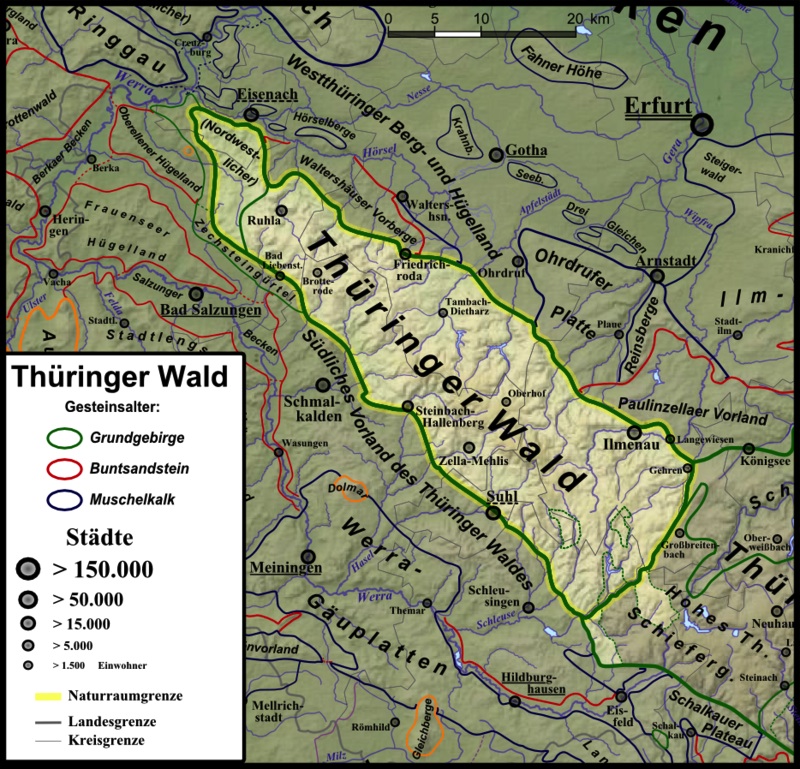
The question of the “original” (or at least the Middle Ages) name of the Thuringian Forest (Thuringer Wald) has been on the minds of many people for quite a while.  Specifically, the “forest” which is actually a mountain range covered by a forest has, in the past been referred to by the following names:

  • loiba
  • lovia
  • liuba
  • liube

The question, as usual, is what this means.

karte

The word appears seemingly for the first time in a report about the Polish Queen Richeza.  Richeza was the wife of Mieszko II.  She was apparently pledged to him at the summit at Merserburg in 1013 as a means of fostering peace between Poland and the Empire.  Although that did not work and the wars continued until 1018, Richeza or “Rixa” did her part by giving birth to MIeszko II’s son – Casimir (the Restorer) – and to two daughters (whether or not she was also the mother of Boleslaw the “Forgotten” depends partly on whether you think Boleslaw the Forgotten really existed – a topic for another time).  In any event, when Mieszko II became king of Poland in the year 1025, Richeza became Queen.  She was, however, as a German princess before, also the owner of various estates throughout Germany.  One of those was an area in Thuringia where the Thuringer Forest range stood.

venerabilis

In a report about her life, we have the first mention of the word – lovia.  Specifically, the monk of the Braunsweiler Abbey uses the phrase: “Saltus slavorum qui ob densitatem nemoris umbrosam juxta lingua eorum Lovia dicutur.”

Or, in English with some context:

In the forest mountains of the Slavs, which, by reason of the shadowy forest wilderness in their language is called lovia and which, on account of its wide desolateness length- and width-wise, still nourish a great quantity of bears, a huge bear caused much damage…  [The surrounding peoples called the count palatine Otto for help, because] it was his district – the Saalfeld – that he [the bear] destroyed the most.

lovi

This was with respect to the eastern part of the Thuringer Wald. But similar names are used for the western parts as well:

  • vastae solitudinis Loibae [Schenkungsurkunde Emperor Conrad’s to Ludwig the first local Landgraf, year 1039] [Codex dipl. Sax. reg. I, 1, nr. 85] [the Urkunde is false but that has no being on the words used in the document]

saxo

  • Terra quam Louvia et Haertz sylvae concludunt [Annales Quedlinburgenses MGH Scriptores III, p. 32.]
  • Scouunoburg in confinio loibae, cujus partem complurimam, quam eidem comiti ad id negotium genitor noster donavit [Schenkungsurkunde of Emperor Henry III, year 1044]
  • monasterium situm in confinio Loibae silvae [Stiftungsurkunde by Emperor Henry IV of the Reinhardsbrunn Abbey, year 1089] [Cod. Sax. I, 1, nr. 160; Schannat vind. I, 108]
  • monasterium situm in confinio Loibae silvae [Privilegium Pope Urban II’s, year 1093] [Cod. Sax. reg I, 1, nr. 168]
  • Luiba/Luibe [Urban II’s Konfirmationsurkunde, year 1092]
  • Loyba [an announcement by Archbishop Ruthard of Mainz]
  • praedium omne circa vel infra Loibam silvam jacens cum villuis prope positis aut ponendis scilicet montem Schoweburg, Dressenrot, Ermbrechtsrot, Friderichsrot, Unssenrot, Erphesrot [Emperor Henry V’s annonucement confirming, year 1114]
  • Silva, quae dicitur Leuba [Burgelin Abbey Stiftungsurkunde, year 1144]
  • blosse Loibe [Legend of Boniface]

thuringer

Immisch Pr. 74 claims that the name is derived from a Wend tribe lub which leads to luba the beloved.  There are apparently a whole number of Slavic names that use this and that later had been Germanized into Laube, Laube, Leube, Lobe or Lube – a favorite or best place.  Immisch decides against a derivation from lipa (Linden tree).

Reinhold Schottin in his book “The Slavs in Thuringia” (Die Slaven in Thüringen) discusses all these cases and concludes with the following noteworthy summary:

What a difference of views [about the origin of this word]! I do not see why one has to try to force this to be a German name since it has, admittedly, been used for a then Slavic area, [since] it has been labeled by the is monk of the Braunsweiler Abbey expressly as a Slavic word and [since] it is also otherwise commonly found, even today, in many different formerly Slavic places, but not in other purely German areas.

In any event, as possibilities for the origin of this word, we have the Slavic:

  • lube – beloved or friendly, see, e.g., Lubeck]
  • lipa – a lindentree
  • laba – the Labe, i.e., Lave, i.e., the Slavic name for the Elbe River (the author gives as an example also the castle Lauenburg which comes from Slavic name).

And speaking of that – we also now know that Łeba meant “forest” in Wendish…

So what does that mean for all the -leben suffixes in Germany?

thuring

Copyright ©2016 jassa.org All Rights Reserved

August 12, 2016