Category Archives: Origins

Agatho and the Slavs

Published Post author

We have previously discussed the letters of Pope Gregory the Great.  But a less known and yet interesting seventh century source on the history of the Slavs is the following letter from Pope Agatho (Pope from June 26, 678 till his death on January 10, 681).  The letter was addressed to the Sixth Ecumenical Council (aka the Third Council of Constantinople) which took place on November 7, 680 (and whose topic was the “Monothelite” heresy).

Agatho – looking good circa 1000

The council was the result of efforts by Byzantine Emperor Constantine IV to restore relations with Rome (the context being that the Byzantines had just survived the Arab siege of Constantinople in 678).   The emperor sent a letter to Pope Donus but this one died in the meantime.  Agatho who became his successor sent representatives  to the council.  They also carried a letter from the Pope which was then read to the attending patriarchs.

The letter was first published by Gian (Giovanni) Domenico Mansi (see here if you can’t get enough of Mansi) an Italian theologian in 1765 as part of volume 11 of his Sacrorum Conciliorum Nova et Amplissima Collectio.

In the letter Agatho mentions that he is relying on the consensus of synodical assent (based on prior councils held in the West in preparation for the Constatinople council) from bishops and missionaries working among “the Langobards, Slavs, Franks, Gauls, Goths and Britons.”

The Letter

“In the first place, a great number of us are spread over a vast extent of country even to the sea coast, and the length of their journey necessarily took much time. Moreover we were in hopes of being able to join to our humility our fellow-servant and brother bishop, Theodore, the archbishop and philosopher of the island of Great Britain, with others who have been kept there even till today; and to add to these various bishops of this council who have their sees in different parts, that our humble suggestion [i.e., the doctrinal definition contained in the letters] might proceed from a council of wide-spread influence, lest if only a part were cognizant of what was being done, it might escape the notice of a part; and especially because among the peoples, as the Longobards, and the Slavs, as also the Franks, the French, the Goths, and the Britons, there are known to be very many of our fellow-servants who do not cease curiously to enquire on the subject, that they may know what is being done in the cause of the Apostolic faith…”

“Primum quidem, quod numerosa multitudo nostrorum usque ad oceani regiones extenditur, cujus itineris longinquitas in multi temporis cursum protelatur.  Sperabamus deinde de Britannia Theodorum consamulum atque coepiscopum nostrum, magnae insulae Britanniae archiepiscopum et philosophum, cum aliis qui ibidem usque hactenus demorantur, exinde ad nostram humilitatem conjungere, atque diversos hujus concilii servilis nostra suggestio fierer, ne si tantum pars, quod agebatur, cognosceret, partem lateret: et maxime, quia in medio gentium, tam Langobardorum, quamque Slavorum, nec non Francorum, Gallorum, et Gothorum, atque Britannorum, plurimi consamulorum nostrorum esse noscuntur…”

Copyright ©2017 jassa.org All Rights Reserved


March 11, 2017

Ptolemy’s Secrets

Published Post author

Ptolemy’s Geography is a rather extensive work and we have only began to scratch its surface.  In order, to dig a little deeper, we asked ourselves whether or not there are places listed in Geography that could conceivably be Slavic or related to the Veneti.  We went through the entire book starting with the East (Books V, VI and VII).  Most of these are likely simply Indoeuropean but since the exercise is fun, bear with us.  We start with Book V.  The others we leave for later if there is interest.

Book V

Chapter 1
(Pontus and Bithynia)

  • Prusias (in Bithynia)
  • Bogdomanis region
  • Libyssa
  • Prusa on the Hypius river
  • Prusa near Mount Olympus

Chapter 2
(Asia)

  • Assus
  • Lebedus
  • Lycus river
  • Iasus
  • Juliogordus (town in Lydia)
  • Nysa (town in Lydia)
  • Sala

Chapter 3
(Lycia)

  • Cragus Mountains
  • Podalia
  • Nysa
  • Megiste island

Chapter 4
(Galatia)

  • Zagorum
  • Olgassys mountains
  • Zagira (Paphlagonian town)
  • Sacora (Paphlagonian town)
  • Germanicopolis (!)

Here it is also worth mentioning that “[i]n the interior of Paphalgonia toward the west are the Tolistobogi, whose towns are” among others:

  • Germa colonia
  • Vindia
  • Tolastochora

Chapter 5
(Pamphylia)

  • Syedra
  • Lysinia
  • Milyas
  • Prostama
  • Adada
  • Olbasa
  • Dyrzela

Chapter 6
(Cappadocia)

  • Iasonium promontory
  • Cotyora
  • Ischopolis
  • Scordiscus [Scordisci were supposedly Celts that lived in modern day Serbia]
  • Piala
  • Zela
  • Sarvena
  • Odoga [think Ladoga]
  • Maroga
  • Siva
  • Sobara
  • Olbasa
  • Siala
  • Ladana
  • Zimara
  • Orsa [think Orsza]
  • Iassus
  • Nyssa

Chapter 7
(Cilicia)

  • Issicus bay
  • Cydnus river
  • Issus
  • Olbasa
  • Castabala

Chapter 8
(Asiatic Sarmatia)

on the Pontus:

  • Sinda village
  • Oenathia [Venethia?]
  • Udon river [Don? Odin?]

“Its cattle feed in the Sarmatian meadow lands in the region near the unknown land of Hyperborean Sarmatia; and below these are the Basilici Sarmatians; and the Modoca race; and the Hippophagi Sarmatians; and below these are the Zacatae Sarmatians; the Suardeni and the Asaei; then next to the northern bend of the Tanais river are the Perierbidi, a great race near the southern race of the Iaxamatae.”

Other tribes listed:

  • Nesioti
  • Siraceni
  • Psessi

“Between the Rha river and the Hippici mountains is the Mithridatis region; below which are Melanchlani, then the Amazones; and between the Hippici mountains and the Cerauni mountains are the Suani and the Sacani; moreover between the Cerauni mountains and the Rha river are the Orinei, the Vali, and the Serbi; between the Caucasus mountains and the Cerauni mountains are the Tusci and the Diduri; and near the Caspioan sea are the Udae, the Alontae, the Isondae, and the Gerri… and the Suanocolchi.  The towns and villages on the lesser Rhombitus river are: Axaraba… Suruba… Nasunia”

Chapter 9
(Colchis)

“The Lazi occupy the maritime coast of Colchis”

Chapter 10
(Iberia)

  • Lubium village
  • Varica
  • Zalissa

Chapter 11
(Albania)

  • Adiabla
  • Ablana
  • Osica
  • Baruca
  • Chabala
  • Chobota
  • Boziata

Chapter 12
(Armenia Major)

  • Gordyaei mountains
  • Lychnitis lake
  • Lala
  • Ptusa
  • Choluata
  • Thalina
  • Sana
  • Brizaca
  • Cubina
  • Codana
  • Cachura
  • Zaruana
  • Babila
  • Gordyene
  • Cholimma
  • Sardeva [unusual outside of Dacia]

Chapter 13
(Cyprus)

  • Chytrus [:-)]

Chapter 14
(Syria)

  • Germanicia [!]
  • Deba
  • Pagrae
  • Batna
  • Iabruda
  • Lysinia
  • Saana
  • Adra
  • Danaba
  • Atera
  • Gerrha

Chapter 15
(Palestina or Judaea)

  • Ascalon
  • Iamnia
  • Lydda
  • Sebaste
  • Bedoro

Chapter 16
(Arabia Petraea)

  • Lysa
  • Gubba
  • Auara [Avara?]
  • Adru
  • Ziza
  • Adra

Chapter 17
(Mesopotamia)

  • Chabora
  • Zitha
  • Deba
  • Bithias
  • Edessa
  • Sinna
  • Gorbatha

Chapter 18
(Arabia Deserta)

  • Addara
  • Save

Chapter 19
(Babylonia)

  • Duraba
  • Volgaesia

Copyright ©2017 jassa.org All Rights Reserved

March 9, 2017

Something Gothic This Way Comes – Part I

Published Post author

The Goths – the conquerors of many tribes (including some/all (?) of the Veneti) a name that inspired greatfear throughout the Roman Empire before dissolving into nothing but a mist of that fear.  What were their names?

We know of two pairings: Ostrogoths and Visigoths (initially we see Visi).  We also see Greutingi and Tervingi.  (It is never Visigoths and Greutingi or Ostrogoths and Tervingi).  Thus, it has fairly been assumed that Ostrogoths were the Greutingi and the Visigoths were the Tervingi.

But what do the sources actually report?

We will start with the Visigoths.

Genethliacus of Maximian Augustus

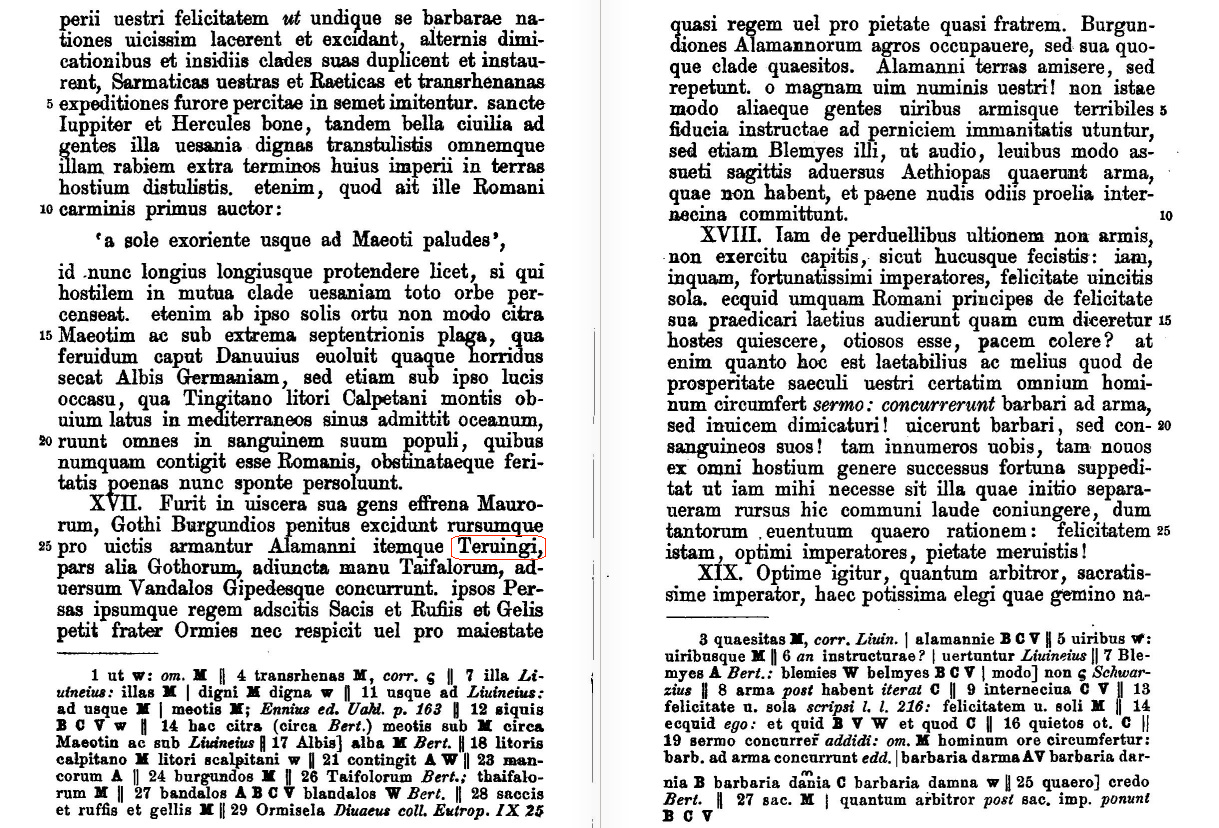
The Teruingi are first mentioned in the Genethliacus of Maximian Augustus (part of the Panegyrici Latini XI, 17) from 21 July, 291:

“The unruly Moorish tribe rages against its own flesh, the Goths utterly destroy the Burgundians, and again the Alamanni wear arms for the conquered, and the Tervingi too, another group of Goths,* with the help of a band of Taifali join battle with the Vandals and Gepids.  Ormies [Hormizd] with the Saci and Rusii and Geli** as allies assaults the Persians themselves and the king himself [Bahram II], and respects neither his king’s majesty nor his brother’s claims on his loyalty.  The Burgundians have taken over the land of the Alamanni, but obtained at great cost to themselves.  The Alamanni have lost the land but seek to regain it.  O great power of your deity!  Not only those and other races, terrible in strength of arms, yield to their confidence, armed for the ruin of barbarism, but even those Blemmyes, I hear, used only to light arrows, seek arms which they do not have against the Ethipians, and john murderous battle with as it were naked hatred.”*

** Furit in viscera sua gens efferent Maurorum, Gothi Burgundos penitus excitant rursumque pro uictis armature Alamanni itemque Teruingi pars alia Gothorum adjunct manu Taifalorum, aduersum Vandalos Gipedesque concurrunt.

** The Rusii and Geli are quite fascinating.  The Geli may well be the Gelones of Herodotus.  Their name comes up again in late antiquity as part of the bands raiding Gaul (of course, their inclusion on the list of barbarians may have been a result of the various writers wanting to describe everything and the kitchen sink as being thrown at Rome.

Notitia dignitatum

The Notitia dignitatum – a Roman administrative document dated to the late 4th or early 5th century (circa 388 – circa 405) – at sections 4 & 5 (or 5 & 6 depending on version) mentions Visi and Teruingi.  Here are the references from the Paris manuscript (14th century):

visiz

teruingiz

(Note also the Vindices).

And the associated shields from the 1436 manuscript (MS. Canon. Misc. 378 Bodleian) for the Visi:

visi

and the Tervingi:tervingiz

These crests are similar… but they are not the same (and, just to be clear they are mentioned separately).

And this from the 1651 Labbe edition (although the spelling here seems like Vrsi or even Ursi, as you can tell from the above, it’s actually Visi):
The sameness of the names is alleged based on the similarities of these sections.  Both are in the “Eastern” portion of the Notitia.  The first one in part V reads:

Auxilia palatina XVIII. Bataui seniores.  Braccati iuniores.  Salii. Constantiani. Matoiaci seniores. Sagittarii seniores Gallicani. | Sagittarii iuniores Gallicani. Tertii sagittarii Valentis. Defensores. Retobarii. | Anglevarii. Hiberi. Visi. Felices Honoriani iuniores. | Victores. Primi Theodosiani. Tertii Theodosiani. Felices Theodosiani Isauri…

The second one in part VI reads:

Auxilia palatina XVII. Regii.  Cornuti.  Tubantes.  Constantiniani.  Mattiaci iuniores.  Sagittarii seniores Orientales.  Sagittarii iuniores Orientales.  Sagittarii dominici.  Vindices.  Bucinobantes.  Falchovarii.  Thraces.  Tervingi.  Felices Theodosiani.  Felices Arcadiani iuniores.  Secundi Theodosiani.  Quarti Theodosiani…

For more on the Notitia see an interesting page here.

Wherefrom the Visigoths?

Thus, we have the following mentions:

  • Tervingi – 291, 388-405
  • Vesi – 388-405

What about other sources?

And what about the Ostrogoths?  Here there are seemingly more sources.

All that to come.

Copyright ©2017 jassa.org All Rights Reserved

March 4, 2017

Argentine Netherlands

Published Post author

Were going to reply to one of the posts but a longer note is in order.  First, thanks for the note on “isep”.  Second, you are, of course, right.

Thus, for example: “que inter fluuium Viszla et dictam lacum nyeczecza cum insulis vulgariter yspy” (from March 16, 1468):

Note isep or ispa is still Slavic with a clear meaning (wysep, nasyp, etc) as in sypać, that is to “spill” or “pour” or “strew” pieces of a solid substance (like grains of sand).  Brückner derives all of these from suć (also noting Lithuanian/Old Prussian supis and Latin supare).

For that matter note the English “dissipate” (see you found that too) which the Online Etymology Dictionary pronounces as coming from Latin:

“early 15c., from Latin dissipatus, past participle of dissipare “to spread abroad, scatter, disperse; squander, disintegrate,” from dis- “apart” (see dis-) + supare “to throw, scatter,” from PIE *swep- “to throw, sling, cast” (source also of Lithuanian supu “to swing, rock,” Old Church Slavonic supo “to strew”). Related: Dissipateddissipatesdissipating.”

Note also the Latin variations suposuparesupavisupatus.  This is defined as “pour”, “strew”, “scatter”, “throw” as per the highly authoritative (:-)) Latin Dictionary which states its age as “unknown”.

As Boryś describes it, it is land “surrounded on ALL sides” by water.  So if one thinks “ostrow” (which, as noted, it does not) implies a river island he can look to the Slavic isep or ispa for any island.

So was Meillet not aware of this?

What Else Can One Do With This?

On this topic, check out “Słownik historyczno-geograficzny ziem polskich w średniowieczu” for a village (still there apparently) “Isep”.  Now that seems to have been first recorded as “yssep” in 1462 (?).

Meillet in that article could not place insula into any Indo-European bucket.  And yet, above we have a Slavic/Baltic etymology.

Does insula have anything to do with the above Slavic yssep?

Not clear but if you want to get closer…

In the Netherlands we have the river IJssel (a part of the Rhine).  In West Flemish this river is also spelled Yssel.  Now the name of this river may relate to the Proto IE root *eis- “to move quickly” as in the Polish jazda (“ride”).  Although, it may just mean the “flowing” or passage of water/time  (as in the word yesterday) or may relate to being in Indo-European (“is” “its” “jest“) or elsewhere 

But the Yssel was also spelled IslaIsala.  So maybe the river was named after its islands?

(But compare Ister, Saal, Solawa/Soława).  (For more on potential Slavic signs in the Netherlands see here and here).

For a real brain teaser, check out the “Arte, y vocabulario de la lengua Lule, y Tonocotè” by Antonio Machoni where we find the following definition (at least one of them) of the Spanish word isla in the Argentine Lule languageA to yesitip.

Now all that remains is to connect the Lule to the Sami Lule, then to the River Lule and onwards full circle to Lulajże, Jezuniu (since Jesus’ name, as well as its Hebrew variant Yehoshua, may well have Old European roots that take it back to the ancient Esus/Ister (a lord > don > (Slovene) donava (the Lord’s river? :-)).  Note too that Ister (“Illyrian”?) as well as the Old Greek version of Ister – Ístros – has the same etymology as “stream” or, for that matter ostrow).

And we have not even gotten to Ispania yet… All you have to recall is our discussion of the Pyrenee name.  For signs of Slavs in Spain see here.  Spain’s name is supposedly Phoenician.  But if there is a link between the Phoenicians and the Veneti, maybe the Veneti thought Spain to be an island  even though it turns out to be more of a peninsula?

And one other thing: although półwysep (peninsula) has been declared a creation from the German (Halbinsel), note that there seems little proof of that.  The problem with the German-Slavic comparisons (or for that matter Latin-German) is that the German literary language preceded Slavic and Latin preceded German.  Thus, the “earlier” attested word will inevitably appear in the earlier literary language.  That, however, can only be a proof of that earlier written appearance.  It is, of course, not proof that the later appearing word – even if constructed in the same fashion – is just a translation of the earlier appareling one.  One could just as easily claim the opposite (that Halbinsel is a translation of półwysep).  We don’t do that because the bias is to assume, given two similar constructs, that the German one is the earlier (same with Latin German going the other way).  In the end, absent direct evidence of a translation, all we can talk about is when some words appeared in some languages’ literary tradition.

A similar complaint may be raised about saying that some word is “only attested” since [12]th century.  This may, of course, be true but that should not be taken to mean that that word was not in existence prior to that time.  This is particularly true with Slavic languages where the literary tradition is not old but no one would claim that we know nothing of Slavic before the 9th/10th century when first Slavic written records appear.

Copyright ©2017 jassa.org All Rights Reserved

February 25, 2017

Meillet and How the Veneti Discovered America – Part II

Published Post author

So where else does Meillet wander?

Argument 3?

He next proceeds to confess that the Slavic word for “stern”, that is, krma, крма, кормової, кърма, etc. is, in fact, Indo-European (note that this word does not appear in West Slavic languages – the Polish has a borrowing from the Dutch and the Czech and Slovak are too different – it’s not clear whether Meillet was even aware of this).  However, he notes that this is of no relevance since, of course, the back of the boat is of particular “importance” to the person who engages in paddling!  Why the back of the boat of the boat should be more relevant for the paddler than the rower (or, in fact, anyone who happens to be traveling on a boat) is left unclear  by Meillet and that is all that we will say about this.

Argument 4

Meillet then proceeds to argue that the Slavic name for an island indicates that this must be a river island.  He notes that this name is ostrovu (or ostrów) and that this means an island around which water flows.  He notes that the same concept is found in Indo-Iranian languages observing that the Sanksrit word for an island was dvipam meaning “water on both sides” and states that this concept only applies to a river island.  He also points to the dvaepa of the Avesta (but also maybe in Greek as per Meillet’s citation of Homer).

That ostrovu indicates a current flowing around something is unquestionable (same concept with the “str” of a “stream”).

Whether this has any bearing on the location of the Slavic “homeland” is quite another story.

First of all, the Slavic ostrovu does not feature any explicit concept of “two sides” (of whatever) that the Sanksrit version of the  island name seems to have.  Therefore, the Sanksrit parallel is of little use here.  We are not debating Sanskrit but Slavic vocabulary so let’s stick to Slavic words.

Second of all, a current can certainly flow around sea islands as well.   Ocean currents do exist and that is something that, presumably, Meillet was or should have been aware of.

Third, there is a fundamental problem here.  It may be that the “original” Slavic word for an island did have a “river” like connotation.  But the fact that such a name was then extended to sea islands tells us precisely nothing as to when that happened.  In other words, Slavs may well have called sea islands ostrovu already 2,000 BC in which case the whole discussion as to what their homeland remains completely impervious to the linguistic argument that Meillet raises.

One might observe that in German a lake is called a See but a “sea” is also a See.  And while German also has Meer (as does Slavic with its morje – incidentally, think of the north Gallic “Morini”), the English language does not and still calls a sea by the word “sea” (both from Proto-Germanic *saiwaz?) while using the mar concept for a “marsh”.  What precisely are we to conclude from this?  Presumably, that Germanic languages developed far from the seas and oceans?

Fourth, and this is again strange, Meillet forgets to mention some other Slavic names of islands. He notes that other IE languages use various names for the concept of an island (and in most of these cases their origin is, he says, “obscure”).  He mentions the Armenian kghzi, the Latin insula and the Greek νασος/νησί.  And yet, with all this vast knowledge of IE languages, he seems unaware of other Slavic names for an island.  

For example, in addition to ostrów, there is otok in Slovene and Polish (but also attested in Czech and Croat).  The concept of otok as in a place that is “surrounded” [by water] is similar to that of ostrów, except that it does not involve the concept of “flowing” around the island.  So ostrów minus the current.

Then there is the Polish wyspa (earlier wysepwysop) whose age is precisely unclear.

Incidentally, he says that islainsula is of uncertain derivation – may be – curiously, the Slavic Wisła (Vistula) may be broken to get an isla as in:

W-isła

Copyright ©2017 jassa.org All Rights Reserved

February 19, 2017

Meillet and How the Veneti Discovered America – Part I

Published Post author

Antoine Meillet‘s three and a half page article in the Revue des études slaves titled “De quelques mots relatifs a la navigation.” (A few words relating to navigation) has over the years served to muddy the Slavic origin waters.

We thought we should start tackling it here.

So what does Meillet have to say about navigation and the Slavs?

Essentially, he argues that the Slavic vocabulary contains a limited number of navigational words, indicating the Slavs landlocked origins.

Argument 1

The Indo-European root for “rowing”, present “across” the IE spectrum disappeared in Slavic.  Why?  Meillet has the answer.  Because the Slavs only navigated rivers and lakes.  Therefore, they had no use of “rowing” or “oars”, etc.  Instead, the used simpler “furrowing” techniques of transportation on water evidenced by the use of the word grebo meaning “I dig” or “burrow”.  Of course, the digging notion is present also in other IE languages.  Take, for example, the German Grab or the same grave (English).  A similar concept exists for physically “grabbing” someone.  Conceptually similar Slavic words can be found in greben (comb) or greblio (rake) or, for that matter, grobla (causeway/levee/dike – presumably, a result of digging up enough dirt).

As proof how easily such an association might arise in someone’s mind, Meillet cites a passage from Arrian of Nicomedia‘s Indica regarding Gedrosians (being from the coast between the Strait of Hormuz and the Indus river) that the travelers observed:

“…a pilot sailed with them, a Gadrosian called Hydraces… Thence about midnight they sailed and came to a harbour Cophas, after a voyage of about four hundred stades; here dwelt fishermen, with small and feeble boats; and they did not row with their oars on a rowlock, as the Greeks do, but as you do in a river, propelling the water on this side or that like labourers digging in the soil.

That “digging” or “burrowing in” water could have been a natural progression of the concept of digging to simple navigation is, of course, obvious and hardly needs the above example from an entirely different part of the world.

More importantly, it is strange that Meillet should have chosen the Bulgarian or Russian гребло as the only “paddling” word to focus.  The word doesn’t seem to have existed in West Slavic languages.  Instead he could have just as easily looked at wiosło, весло, вясло, veslo – meaning “oar” in all Slavic languages.

The wiosło, вясло, veslo (an “oar” or “paddle” being a tool derived from wieźć – to carry, transport – hence wiosłować “to row”) contains ios or ies or ias just as jazda – ride which matches nicely with many European (Old European!) river names (Visla or Vis-tula but also Tam-issa, Is-ter and so forth).  Such Visla river names – aside from the well known Vistula itself – appear in as wide a variety of locations as the Alps (as in Wiesle) and the Shetlands.

This suggests a concept of movement and a rather ancient origin.  It also has nothing to do with digging, nor any such secondary meaning.  The concept of an oar embedded in the veslo can be applied to either a river or sea or ocean going ship.  The only thing that Meillet has shown is that the oar family of words began to mean – outside of Slavic – something other than mere paddling.  

Moreover, both of these types of words may have been associated with IE water travel.  The fact is that the -ios, -ias, -ies words existed outside of Slavic with same or similar meanings.  We said “ship” above but could have just as easily said “vessel”.  Now this comes from the Latin vasculum from vas a “container,” “vase” or “vessel” but also meant “ship” (a container ship concept all in one!).  Now, presumably the container concept came first but even that concept captures the notion of a fluid being contained (just think of a flower vase).

Yet, Meillet does not even discuss this – not even in a footnote!  

It seems very selective to focus on a word which – by the way – is not attested in all Slavic languages (such as West Slavic) – and build your sandcastle on that.

So why the selectivity?  He wrote his doctorate on Slavic languages.  He was familiar with Baltic languages (“anyone wishing to hear how Indo-Europeans spoke should come and listen to a Lithuanian peasant”).  On the other hand, he seems to have concentrated on Eastern and Southern Slavic languages and may have lacked the skill set to address as broad a topic as he tried to do within the above article.  In days past one could pretend to be a Slavicist solely coasting on your knowledge of Russian.

In the end, all that Meillet has shown is that in Bulgarian and in portions of Russian the word for a small boat oat developed from a word for digging.  Given that Slavic languages have another word for oar that carries no “digging” connotations, so what?  It’s as if he were to ignore the words ship, vessel, etc. and used the word “dinghy” to claim the British were not sea going people after all.

Argument 2

There is no “navi” type word for ship/boat in either Slavic or Baltic “probably” because that term did not survive as these folks were not seagoing.

For starters, this may instead suggest that such a word did not exist in IE at all and is a borrowing or a development that happened to non-Balto-Slavic languages. (And does Meillet seriously argue that the Balts did not engage in navigation on the Baltic?  Or just that their ships were not as big as Meillet would have liked them to be?).

More relevantly, the word did exist in the sense of “going to nava” (as in Krok went to the land of the dead when he passed away).  This nava has been understood in architectural terms but a reference to “Viking” boat funeral would provide a similar explanation with a nautical angle.

Furthermore, why should it matter that non-Slavic languages developed a word for ship that contains nauh or navis?

Isn’t the better question whether Slavs had a name for the concept of a “ship” whatever that name may have been?

Here Meillet makes a sub argument.  He states that Slavs do not have own words for the concept of a ship or a larger boat which he thinks is consistent with their simple navigation arts.  Thus, for example, the Byzantines speak of the Slavic monoxylae (i.e., μονοξυλα  ωλοια, as in the Russian odnoderevka, from “one trunk”).

He notes that all the basic words for boats in Slavic languages indicate simple boats made from single hollowed tree trunks of such “monoxyla” type such as:

  • чёлн [choln] or czółno (i.e., a canoe), or
  • aludiiladiiladja or лодья (lodya) (i.e., a boat, also Lithuanian aldija)

He associates the first with the Lithuanian keltas meaning “ferry” that reminds him (!) of Lithuanian kelmas “tree trunk”.  The second, he notes, Liden derives from the Norwegian olle meaning “big trough”, i.e., made from a hollow tree trunk.

Yet all of this is raw and wild speculation.  You could just as easily claim that lodya comes from lod (лод) meaning “ice” and try to prove that early Slavs had ice floats for boats.  Or that the aludii comes from ludi meaning “people” – after all the transport of people was the point of ferry boats, etc.

In fact, Meillet completely ignores statek.  This word existed in Polish for quite a while.  Why does he ignore it?  Just because he can’t find it elsewhere in Slavic?  But maybe it was “forgotten” just as the Slavs “forgot” nauh type words… We may note that Meillet’s reasoning is so razor thin we could just as easily use another Polish word okręt (meaning “that which is turned” – a word for a “ship” that is dated very roughly to the 16th century) to claim that this proves that the Poles were the first to propellers.  Or if that’s too much of a stretch, we could claim that okręt has something to do with the kra – again, floating ice – thereby confirming the above ice hypothesis or, in the “advanced Slavs” version, firmly (or as firmly as one can in these unchartered waters) establishing the fact that Slavs were the first to pioneer ice breakers…

A Slav proudly presenting his home-made propeller

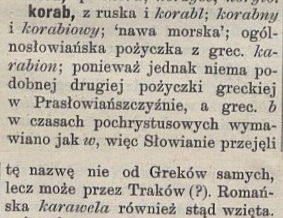
We should note another interesting point made by Meillet.  He claims that korab, another Slavic name for a boat is a borrowing.  Specifically, he notes that this is a borrowing from Greek (karabos) and perhaps one of the earliest of such borrowings from Greek to Slavic.

The reason for the “early” nature of this claim is that the Slavic clearly has a “b” pronunciation in there but the Greeks, by the 1st or 2nd century, began to pronounce their b’s as v’s so, if Slavs, who supposedly appear on the historical stage first in the 6th century, had borrowed this word from Greeks they should have borrowed it in the form korav (indeed, this is the source of the later caravel).  This has given a number of historians/etymologists problems.  Thus, Alexander Brueckner, for example, suggests that the name may have been borrowed earlier via an intermediary language.  He says perhaps the Slavs got this from the Thracians.  That is, in his view, it’s impossible for the Slavs to have been neighbors to the Greeks in the 1st or 2nd century but conceivable for them to have been located next to the Thracians.

The above argument ignores the possibility of Greek colonies on the Black Sea (see the story of the Geloni and Budini in Herodotus, for example, to imagine the possibilities) but let’s put that aside.

We aim to show here on just how little these arguments are based.  Each such theory allows its inventor to write his or her doctoral thesis no doubt but too often carries us merely sideways.

The Greek word is karabos.  But what does it mean?  Well, it means a “ship”, of course.  Yet the use of the word in Greek for a ship seems to postdate antiquity (it’s really a Byzantine concept it seems).  So where does the Greek word come from?

An article by Jukka Hyrkkanen and Erkki Salonen first observes that Greek etymological dictionaries are scanty on the origin but that, for the most part, they seem to point towards the “beetle” or “lobster” (hence, too, a scarab).

Then the authors note that such an explanation is “unconvincing” and suggest that the word is not even Greek.  And, indeed, some etymological dictionaries suggest the origin of the word may be Macedonian.  The authors go further and suggest similarities with Arabic!  Indeed, in Arabic there is a word qarib meaning “boat”.   But they do not stop there.  The Arabic word may have come from Aramaic and originally from?  They suggest another language of a Semitic (?) people skilled in navigation such as the Phoenicians.  But then they note that the word may also appear in Ugaritic (“to approach”) and Akkadian (with the meaning “to approach/to bring/to transport?”).  They can’t quite pin this down but note that their view is that it is very improbable that the word is Greek and think that it is, instead, a borrowing into Greek from some unspecified Middle Eastern – probably Semitic – language.

What about the Slavs?  It seems they are merely the excuse for the authors’ excursus designed to establish that the word is not Greek but a conclusion must be presented nevertheless.  So what do we find out?  The paper notes that it is possible that the Slavs borrowed this non Greek word from the Greeks (which, of course, we know from the above would indicate an early Slav-Greek contact) but also may have borrowed it from that mysterious naval Semitic (?) people hundreds of years before the Slavs first had contact with the sea.

Of course this too raises questions.  How? Did the naval travelers also travel on the rivers to reach these landlocked Slavs?

We will pause here and address Meillet’s other arguments subsequently.  For now, a reflection is in order.

Thoughts

If we must posit ocean travelers, must they be Semitic Phoenicians?  Why not the Veneti?  (In fact, is there a link between the two?).

Which brings us to another name for a “boat”.  We know that the Finns (and other “Uralic” speaking peoples such as the Veps, Estonians, etc) call the Slavs Venäjä.  This means, in effect, boat people.  Thus, “boat” in Finnish is vene (veneh in Veps).  

Does this mean that the name Veneti was passed to the Romans via Finns?  Perhaps the secret, hidden Finns or Scritifinni!?  Or… did the Germans get that name from the Finns but then this would suggest Finnic-Slavic contact before Germanic-Slavic contact.

Who knows.

The point is that the above kinds of arguments could be used to prove just about anything.

You want to know something interesting about boats?

Ok, so take чёлн [choln] or czółno – why does it sound so similar to a “canoe“?  We know that a “canoe” is a word derived from a certain language spoken in the Lesser Antilles islands.

In that same language we have another name for a small boat.  This is pirogue.  And yet we have also heard in the Old World of pirones.  Recently we mentioned such reference in our discussion of Aethicus Ister as in “… the Albanians, Maeoti, and Mazeti, people from the Ganges, and Turks all use these boats, and call them pirones in their barbarian tongue.”

What language is that?  What language brought us both canoe and pirogue?  Why, the Carib language, of course.  Does this have anything to do with the Arabic qarib, the Greek karabos or the Slavic korab?

To top it off we will note again that the Slavic word orkan is supposed to have come from the word hurricane which is supposed to have come from another Arawakan (Carib is an Arawakan language) language of the Taíno people – the Taíno an extinct and “poorly attested” language.

And yet, hundreds of years before Columbus, the great wind-swept Slavic temple on the island of Ruegen was inside the Slavic city of Arkona… (Ruegen itself has a Slavic etymology from ruga, that is, a “wrinkle” – compare the Italian and Latin name for the same).

And then we have these Slavic Veneti.

Holy Quetzalcoatl! (after all we already had the Algonquian language featured here; the continental Caribs referred to the Europeans as “spirits of the sea” – Palanakili.  Palana, apparently, means sea in their language).

Copyright ©2017 jassa.org All Rights Reserved

February 17, 2017

Iazyges

Published Post author

“But the Slavs and the Rus are one people.”  This quote from Nestor is one of a number where the word for people that is used is the same as the word for tongue, i.e., iazyk.  Iazyk thus means tongue and language and, previously in Eastern Slavic languages, also a people.  Nestor does the same for the Slavs more generally.  Interestingly, very little has been done to research whether this concept has any connection with the tribe of the Iazyges that lived by the Danube.  Although Nestor does not discuss Iazyges, he does follow the view that the Slavs came from the Danube.  Nearby dwelt too the Quadi who are understood to be a tribe of the Suevi and who had had long relations with the Iazyges.  Now, the few Iazyges names that we have do not suggest that they spoke Slavic (they were “Sarmatians” whatever that may mean).  But the concept of “tongue as people” may have been introduced into Nestor’s Slavic via the Iazyges.  By the 5th/6th century accounts of the Iazyges cease.

Copyright ©2017 jassa.org All Rights Reserved

January 26, 2017

The Slavs of Ibn al-Saghir’s Chronicle of Tahart

Published Post author

Moving West to East along the African coastline away from Al-Bakri’s Morocco and its Kingdom of Nekor, we next come to Tahart in Algeria in the Chronicle of Ibn al-Saghir which is one of two chronicles (the other being by Abu Zakariya) about the imams of Tahart (aka Tahert or Tihert, a city six miles west of today’s Tiaret) from the Rustamid dynasty.  The Rustamids were a Persian dynasty of the Ibāḍ complexion that ruled the Berber tribes in central Maghreb between 776/777 and 908/909.  Tahart was their capital.  The Rustamids appear to have been quite liberal with all kinds of cultures crossing their state (pre-Arab Christians (perhaps even Vandals and Alans?), Jews, etc).  It was also a prosperous seat of commerce (the writer of the Chronicle seems to have at one point in his life been a shopkeeper in a part of town called ar-Rahadina – perhaps a reference to the Radhanites).

The Chronicle (for lack of a better term) contains a few interesting mentions of the Slavs.  As a point of curiosity, its first edition was put together by a Slavic (Polish) Frenchman (born in Mascara, Algieria) – one Adolphe de Calassanti Motylinski  (Chronique d’Ibn Ṣaghir sur les imams Rostemides de TahertActes du 14e Congrès des Orientalistes (Algiers 1905), volume III/2; an earlier version in Bibliographie du Mzab, les livres de la secte abadhiteBulletin de correspondance africaine, (1885), volume III).  This was based on the only known “manuscript” copy that he located in M’Zab (the M’zabis are Ibāḍis so that may have helped the manuscript being preserved there – this copy was put together only in the 18th century by one Abu Bakr Ibn-Yusuf).  Motylinski supplemented this with a work that mentions pieces of Ibn al-Saghir’s Chronicle written by a 15th century writer al-Barradi (Kitab al-Gawahir al muntaqat).

So, thanks to the efforts of all these people in the middle of Algeria we can now read a little bit more about the Slavs!  The Slavs mentioned are those in Baghdad and in Tahart.  We also mention the ar-Rahadina quarter (in Tahart) references as these may have been named after the Radhanite merchants.

Incidentally, the M’Zab is a deep, narrow valley with five towns dominating it at different points.  The most important one is called… Ghardaïa (as per Wiki: Ghardaïa has its origins in a female saint named Daïa who lived in a cave (ghār) in the area before it blossomed into a town inhabited by Ibadite Muslims who came to escape persecution from Fatimite Muslims in the north).

Slavic Rebels in Baghdad

“When Aflah took over the reigns of government [872?], he proved himself to be full of energy and and decisiveness…  His son Abu ‘l-Jaqzan [ruled 874 – 894] was respected by all on account of his piety.  He begged his father to allow him to make a pilgrimage [to Mecca].  He left with a caravan and arrived at Mecca.  After he completed the ritual circling and runs [Tawaf], he was discovered by the agents of the Abbasids who had arrived [in the city] at the same time as he.  They were told that the son of the chief of as-Surat had arrived from Maghreb sent by his father so as to stock of the situation in the country and to send out his men in all directions [so as to make contact] with those people who held their views [of as-Surat] and tenets of their denomination, so as to prepare them for the time when his father would arrive from the Maghreb.”

“Abu ‘l-Jaqzan was carried off from Mecca together with a certain man from the Nafusa tribe who had been his servant and he came with him to Madinat as-Salam.  And the ruler at that time was al-Mutawakkil or some other ruler who lived at such time.  He gave the order to throw him [that is Abu ‘l-Jaqzan] in prison.  The one who told me this said: ‘I was told by my father repeating the words of Abu ‘l-Jaqzan ‘My imprisonment took place at the same time as that of the brother of the caliph who had been punished for reprimanding the caliph.’ and spoke further: ‘He gave the same order for each of us to be thrown into the same prison.  He also gave me a daily stipend of 120 dirrhems.’  And he spoke further: ‘These sums were paid to me for as long as I did not leave [the prison].  And when I finally left and they let me leave they said: ‘Think who should receive the stipend [for you, i.e., to take to you] that you’ve been receiving so that we do not lose track of you and your name does not get deleted from our records [as a person receiving/entitled to the money].”

“He spoke further: ‘The cause of my release, by the will of Allah, was that the caliph’s brother grew fond of me in prison and we became great friends.  He would not eat or drink anything without calling me over and I too repaid him the same.’  And he spoke: ‘While we remained so, we heard that matters took a new turn in the world and that there had been a revolution.  The caliph had been killed and my friend who had prison with me had been elevated [to caliph] in his place.'”

“[Abu ‘l-Jaqzan] spoke: ‘We did not even notice when Slavs entered our dwelling [prison] with soldiers and he [caliph’s brother] was taken [away from prison].'”

“The one who said this to us mentioned neither the name of the caliph who had been killed nor the caliph who took power [as a result of the revolution].”

“He spoke: ‘As soon as my companion had become the ruler and set up his government, I was set free from the prison and, on his orders, taken to the vezir, who had been ordered by the caliph to watch over me, treat me with dignity and take care of my needs until such time as I could be seen by the caliph…'”

“Thereafter, the caliph ordered the vezir to take care of me and prepare my equipment for the journey.  He ordered to give me a ten trade of fabric which was then pitched for me as well as money for my upkeep and clothes.  He also wrote letters for me addressed to the various governors resident in provincial capitals [ordering them] to take care of my safety, show me goodwill, deliver what I ask for and treat me with respect.  I began to set my matters in order and then got under way.'”

“As regards Aflah ibn ‘Abd al-Wahhab, when he found out that he had lost his son and that he had been kidnapped and taken to Baghdad, he was greatly saddened at this and long worried.  He lived since that time constantly in sorrow and grief until his death which occurred when his son was still prisoner in Baghdad.”

Slavic Servants in Tahart 

“One day I asked Suleiman who was a freedman of qadi Muhammad ibn ‘And Allah: ‘What reason is there for Muhammad ibn ‘And Allah to have shown such disgust at [his] post as qadi* and to have given up his seal and chest for books and [to dare] to speak so to Abu ‘l-Jaqzan as he had done.  And he answered: ‘May God reward you in the life to come my son!  This [is what took place]: We were sitting on a certain night after the last prayer.  He [Muhammad ibn ‘And Allah] easily preferred me to the others as regards serving him.  And when we remained so, there was a rapid knock on our door.  He said to me: ‘Get up Suleiman! I fear something happened and news comes in the name of the sultan.”’

“And he [the freedman Suleiman] spoke: ‘I opened the gates and found myself in the presence of a woman catching her breath who was accompanied by a Slav carrying a lamp.’  And he spoke: ‘I said: ‘what is it that you wish woman?  She answered: ‘I wish [to speak with] the qadi.’  So I returned to him and informed him of this.  And he said: ‘Bring her in.’  I brought her in.  When she stood before him, he said to her: ‘What do you wish woman and what brings you here at this hour?’  She answered: ‘Gladly.  Just now the servants sent by Zachariah, the son of the emir forced their way into my house and took in before my very eyes my daughter.  So I said to my son: ‘Get up and chase them!’  He answered: ‘I am afraid that they might kill me should I wish to do that. And if they themselves would not kill me, I am afraid that they will have some of their mercenaries lay an ambush for me or bandits serving them so as to kill me…” [so presumably she sought help with the qadi]

* Qadi meaning a magistrate or judge.

Radhanite Quarters?

“…At this I got up and said to him: ‘Let God grant you prosperity!  I own a store at ar-Rahadina where I buy and sell…”

“…One day when I as at a mosque in ar-Rahadina, a man who was an outstanding personality among the  Ibāḍites – Suleiman, who came from the Huwwara [tribe] – spoke to me thus…”

Copyright ©2017 jassa.org All Rights Reserved

January 23, 2017

Iasion or Jasion

Published Post author

The name Yassa appears both in the context of light (jasny) as also in the context of fertility concept (e.g., the English year or Slavic yar).  Both these meanings appear in the names for Fall and Spring (jesien and wiosna), in addition to appearing in the names of certain local Deities such as Gerovit (pronounced Yerovit).    What’s more this Deity is frequently mentioned in the fertility rites descriptions associated with spring/summer – a role similar to Dionyssus (Dio-nyssus or “our God”?).  In fact, the concept of the wondering Johnny was preserved in Polish folklore for many years as (Jaś Wędrowniczek) and in 1893 Johnny Walker became the Hero of Maria Konopnicka’s children’s poem “Of the Wondering Johnny” (O Janku Wędrowniczku):

What’s even more remarkable about the Slavic Yassa God is the similarity to the Greek Jasion (there are several persons named that in Greek Mythology in addition to the other (?) “J” – Jason but here we talk about the Jasion of Demeter fame).

In light of that we decided to list the appearances of Jasion in ancient sources.    Thankfully most of our work was already done by this excellent website.

Homer, Odyssey
5.125 ff (trans. Shewring) (Greek epic C8th B.C.)

“[Hermes commands Kalypso (Calypso) to release Odysseus:] Kalypso shuddered, and her words came forth in rapid flight : ‘You are merciless, you gods, resentful beyond all other beings; you are jealous if without disguise a goddess makes a man her bedfellow, her beloved husband . . . So it was when Demeter of the braided tresses followed her heart and lay in love with Iasion in the triple-furrowed field; Zeus was aware of it soon enough and hurled the bright thunderbolt and killed him.’”  [N.B. the cutting of three furrows was part of fertility rites performed to inaugurate the new agricultural year.]

Hesiod, Theogony
969 ff (trans. Evelyn-White) (Greek epic C8th or C7th B.C.)

“Demeter, bright goddess, was joined in sweet love with the hero Iasion in a thrice-ploughed fallow in the rich land of Krete (Crete), and bare Ploutos (Plutus, Wealth), a kindly god who goes everywhere over land and the sea’s wide back, and him who finds him and into whose hands he comes he makes rich, bestowing great wealth upon him.”

Hesiod, Catalogues of Women Fragment
102 (from Oxyrhynchus Papyri 1359 fr. 2) 

“Elektra (Electra) was subject to the dark-clouded Son of Kronos (Cronus) [Zeus] and bare Dardanos . . ((lacuna)) and Eetion . . ((lacuna)) who once greatly loved rich-haired Demeter. And cloud-gathering Zeus was wroth and smote him, Eetion, and laid him low with a flaming thunderbolt, because he sought to lay hands upon rich-haired Demeter.” [N.B. Eetion is an alternate name for Iasion.]

Pseudo-Apollodorus, Bibliotheca
3.138 (trans. Aldrich) (Greek mythographer C2nd A.D.)

“Elektra (Electra), the daughter of Atlas, and Zeus were the parents of Iasion and Dardanos (Dardanus). Now Iasion had a lust for Demeter and was hit by a thunderbolt as he was about to attack her.”

Diodorus Siculus, Library of History
5.48.2 ff (trans. Oldfather) (Greek historian C1st B.C.)

“There were born in that land [of Samothrake (Samothrace)] to Zeus and Elektra (Electra), who was one of the Atlantides, Dardanos and Iasion and Harmonia . . . Zeus desired that the other of his two sons [Iasion] might also attain honour, and so he instructed him in the initiatory rites of the mysteries [of Samothrake], which had existed on the island since ancient times but was at that time, so to speak, put in his hands; it is not lawful, however, for any but the initiated to hear about the mysteries. And Iasion is reputed to have been the first to initiate strangers into them and by this means to bring the initiatory rite to high esteem.  After this Kadmos (Cadmus), the son of Agenor, came in the course of his quest for Europe [i.e. his sister who had been abducted by Zeus] to the Samothrakians, and after participating in the initiation [into the Mysteries of Samothrake] he married Harmonia, who was the sister of Iasion and not, as the Greeks recount in their mythologies, the daughter of Ares. [N.B. The usual account was that Harmonia was given to Elektra mother of Iasion to raise as her own.]  This wedding of Kadmos and Harmonia was the first, we are told, for which the gods provided the marriage-feast, and Demeter, becoming enamoured of Iasion, presented him with the fruit of the corn, Hermes gave a lyre, Athene the renowned necklace and a robe and a flute, and Elektra the sacred rites of the Great Mother of the Gods [Rhea-Kyebele], as she is called, together with cymbals and kettledrums and the instruments of the ritual; and Apollon played upon the lure and the Mousai (Muses) upon their flutes, and the rest of the gods spoke them fair and gave the pair their aid in the celebration of the weding. After this Kadmos, they say, in accordance with the oracle he had received, founded Thebes in Boiotia, while Iasion married Kybele (Cybele) [here identified with Demeter] and begat Korybas (Corybas) [leader of the Korybantes]. And after Iasion had been removed into the circle of the gods, Dardanos and Kybele [Demeter] and Korybas conveyed to Asia the sacred rites of the Mother of the Gods and removed with them to Phrygia . . .  To Iasion and Demter, according to the story the myths relate, was born Ploutos (Plutus, Wealth), but the reference is, as a matter of fact, to the wealth of the corn, which was presented to Iasion because of Demeter’s association with him at the time of the wedding of Harmonia.

Now the details of the initiatory rite are guarded among the matters not to be divulged and are communicated to the initiates alone; but the fame has travelled wide of how these gods [the Kabeiroi (Cabeiri)] appear to mankind and bring unexpected aid to those initiates of their who call upon them in the midst of perils. The claim is also made that men who have taken part in the mysteries become both more pious and more just and better in every respect than they were before. And this is the reason, we are told, why the most famous both of the ancient heroes and of the demi-gods were eagerly desirous to taking part in the initiatory rite; and in fact Jason and the Dioskouroi (Dioscuri), and Herakles and Orpheus as well, after their initiation attained success in all the campaigns they undertook, because these gods appeared to them.”

Diodorus Siculus, Library of History
5.48.1 

“One of the inhabitants of the island [of Samothrake (Samothrace)], a certain Saon [probably the same as Iasion], who was a son, as some say, of Zeus and a Nymphe, but, according to others, of Hermes and Rhene, gathered into one body the peoples who were dwelling in scattered habitations and established laws for them.”

Strabo, Geography 7
Fragment 49 (trans. Jones) (Greek geographer C1st B.C. to C1st A.D.):

Iasion and Dardanos, two brothers [sons of Elektra (Electra)], used to live in Samothrake (Samothrace). But when Iasion was struck by a thunderbolt because of his sin against Demeter, Dardanos sailed away from Samothrake, went and took up his abode at the foot of Mount Ida, calling the city Dardania.”

Clement, Exhortation to the Greeks
2.12 (trans. Butterworth) (Greek Christian writer C2nd A.D.)

“[An early Christian critique of the pagan Mysteries:] A curse then upon the man who started this deception for mankind, whether it be Dardanos, who introduced the Mysteria for of the Meter Theon (Mother of the Gods); or Eetion [i.e. Iasion], who founded the Samothracian orgies and rites (orgiateletas).”

Pseudo-Hyginus, Fabulae
250 (trans. Grant) (Roman mythographer C2nd A.D.)

“Teams [of horses] which destroyed their drivers . . . Horses destroyed Iasion, son of Jove [Zeus] by Electra, daughter of Atlas.” [N.B. Presumably Iasion was killed when Zeus cast his lightning bolt, causing his horses to bolt in panic and throwing him from the chariot.]

Pseudo-Hyginus, Fabulae
270 

“Those who were most handsome. Iasion, son of Ilithius, whom Ceres [Demeter] is said to have loved.”

Pseudo-Hyginus, Astronomica
2.4

Hermippus [Greek writer C3rd B.C.?], who wrote about the stars, says that Ceres [Demeter] lay with Iasion, son of Thuscus. Many agree with Homer that for his he was struck with a thunderbolt. From them, as Petellides, Cretan writer of histories, shows, two sons were born, Philomelus and Plutus, who had but little Favour for one another. The latter, who was extremely rich, imparted no share of his substance to his brother, who being fore reduced, sold the small estate he had, bought two oxen with the price, and set about the cultivating of the ground, and was the first that applied himself to agriculture. His Mother Ceres, after having admired the Art which her son had invented, placed him among the stars, where he forms the Boötes, or the Artophylax.”

Pseudo-Hyginus, Astronomica
2.22

“[Constellation Gemini the Twins:] Others have called them Triptolemus, whom we mentioned before [i.e. as the constellation Ophiochus], and Iasion, beloved of Ceres [Demeter]–both carried to the stars.”

Ovid, Metamorphoses
9.421 ff (trans. Melville) (Roman epic C1st B.C. to C1st A.D.)

“A rumbling argument arose in heaven, the gods all grumbling why others should not be able to grant such gifts [the restoration of youth to the elderly, the sole prerogative of the goddess Hebe]. Aurora [Eos] grumbled at her husband’s [Tithonos’] age, and gentle Ceres [Demeter] that Iasion was going grey.”

Ovid, Amores
(trans.  A. S. Kline)
3.10

“Here comes the annual festival of Ceres: my girl lies alone in an empty bed.  Golden Ceres, fine hair wreathed with ears of wheat, why must your rituals spoil our pleasure All peoples, wherever, speak of your bounty, Goddess, no other begrudges good to humanity less.  Before you, the bearded farmers parched no corn, the word threshing-floor was unknown on the Earth, but oak-trees, the first oracles, carried acorns: these and tender herbs in the grass were our food. Ceres first taught the seeds to swell in the fields, and first with sickles cut the ripened sheaves: first bowed the necks of oxen under the yoke, and scarred the ancient earth with curved blade.  Can anyone believe she delights in lovers’ tears that right worship lies in torment and lonely beds? Still, though she loves fertile fields, she’s no rustic, nor does she have a heart bereft of love. The Cretans are witness – Cretans’ don’t always lie. Crete was proud to nurse the infant Jove. There, he who steers the world’s starry courses, sucked milk, with tender mouth as a little child. Proof from a mighty witness: witnessed by his praise. I think Ceres might confess to the charge I make. She saw Iasus on the slopes of Cretan Mount Ida [Viderat Iasium Cretaea diva sub Ida], slaughtering the game with unerring hand. She saw him, and flames pierced her to the marrow, from there, love, partly drove out her shame. Shame quelled by love: you could see parched furrows and the sowing itself gave the least of returns. Though the fields were struck with well-aimed mattocks, and the soil was broken with the curving plough, and the seed scattered evenly over wide acres, the farmers were cheated of their useless prayers. Deep in the woods the goddess of fertility lingered: the garland of wheat-ears slipping from her long hair. Only Crete was enriched by a fruitful year: Wherever the goddess showed herself, there was harvest: Ida itself, home of forests, was white with crops, and the wild boars reaped corn in the woods. Minos the law-giver prayed for more such years: he should have wished for Ceres’s love to last forever. Because you were sad on lonely nights, golden goddess, why should I be forced now to endure your rites?Why should I be sad, when your daughter’s found again, her fate to rule a kingdom second only to Juno’s?  This festive day calls for loving, and poetry, and wine: these are the gifts it’s right to carry to the gods.”

Ovid, Sorrows of an Exile (Tristia)
(Trans. E. J. Kenney)
2.1

“Outside, and Venus with the avenger placed.
Sitting in Isis’ fane she’ll ask why Juno
Drove her so far across the Ionian sea.
Endymion to the Moon, Venus to Anchises,
Iasion to Ceres linked will be.”

Conon, Narrations
21

“Dardanus and Jasion, both sons of Jupiter and Electra, daughter of Atlas, lived on the island of Samothrace.  Jasion, having tried to search the ghost of Ceres, was killed by a thunderbolt. Dardanus, terrified at what had just happened to his brother, put himself on a raft, for there were no ships yet, and passed through the country which is opposite to Samothrace, a bountiful and fertile land famous for Mount Ida which forms part of it.  There lived Teucer, son of the river Scamander and a Nymph.  The inhabitants were named Teucriens and land was called Teucrie. Teucer, after some conversation with Dardanus, gave him half his kingdom. The new Sovereign built a city in the very place where he had landed on his raft.  After Teucer died, Dardanus united the whole country under his dominion.”

Dionysius of Halicarnassus
Roman Antiquities 1.61 (Trans. Cary/Spelman)

“That the Trojans, too, were a nation as truly Greek as any and formerly came from the Peloponnesus has long since been asserted by some authors and shall be briefly related by me also.  The account concerning them is as follows.  Atlas was the first king of the country now called Arcadia, and he lived near the mountain called Thaumasius.  He had seven daughters, who are said to be numbered now among the constellations under the names of the Pleiades; Zeus married one of these, Electra, and had by her two sons, Iasus and Dardanus.  Iasus remained unmarried, but Dardanus married Chryse, the daughter of Pallas, by whom he had two sons, Idaeus and Deimas; and these, succeeding Atlas in the kingdom, reigned for some time in Arcadia.  Afterwards, a great deluge occurring throughout Arcadia, the plains were overflowed and for a long time could not be tilled; and the inhabitants, living upon the mountains and eking out a sorry livelihood, decided that the land remaining would not be sufficient for the support of them all, and so divided themselves into two groups, one of which remained in Arcadia, after making Deimas, the son of Dardanus, their king, while the other left the Peloponnesus on board a large fleet.  And sailing along the coast of Europe, they came to a gulf called Melas and chanced to land on a certain island of Thrace, as to which I am unable to say whether it was previously inhabited or not.  They ca;led the island Samothrace, a name compounded of the name of a man and the name of a place.  For it belongs to Thrace and its first settler was Samon, the son of Hermes and a nymph of Cylene, named Rhene.  Here they remained but a short time, since the life proved to be no easy one for them, forced to contend, as they were, with both a poor soil and a boisterous sea; but leaving some few of their people in the island, the greater part of them removed once more and went to Asia under Dardanus as leader of their colony (for Iasus had died in the island, being struck with a thunderbolt for desiring to have intercourse with Demeter), and disembarking win the strait now called the Hellespont, they settled in the region which was afterwards called Phrygia.  Idaeus, the son of Dardanus, with part of the company occupied the mountains which are now called after him the Idaean mountains, and there built a temple to the Mother of the Gods and instituted mysteries and ceremonies which are observed to this day throughout all of Phrygia.  And Dardanaus built a city named after himself in the region now called the Troad; the land was given to him by Teucer, the king, after whom the country was anciently called Teucris.  Many authors, and particularly Phanodemus, who wrote about the ancient lore of Attica, say that Teucer had come into Asia from Attica, where he had been chief of the deme called Xypete, and of this tale they offers many proofs.  They add that, having possessed himself of a large and fertile country with but a small native population, he was glad to see Dardanus and the Greeks who came with him, both because he hoped for their assistance in his wars against the barbarians and because he desired that the land should not remain unoccupied.”

in Venerem Anchises, in Lunam Latmius heros,
in Cererem Iasion, qui referatur, erit.
omnia perversae possunt corrumpere mentes;

According to Theoi.com here are some other sources:

OTHER SOURCES

Other references not currently quoted here: Servius ad Aeneid 1.384 & 3.15 & 3.167, Ovid Amores 3.25 [?], Scholiast ad Theocritus 3.30, Eustathius ad Homer 1528, Tzetzes ad Lycophron 29, Stephanus Byzantium s.v. Dardanos.

Copyright ©2017 jassa.org All Rights Reserved
January 19, 2017

Al-Bakri’s Village of the Slavs

Published Post author

We have for a long time been receiving requests for the text about the “village of the Slavs” (Qarjat as-Saqaliba) near Nokour in Morocco.  We oblige.  The village is mentioned by the great historian and geographer Al-Bakri (Abū ʿUbayd ʿAbd Allāh ibn ʿAbd al-ʿAzīz ibn Muḥammad ibn Ayyūb ibn ʿAmr al-Bakrī, or simply Al-Bakri), a Spaniard by birth who worked primarily in Cordoba.  Al-Bakri (circa 1014 – 1094) wrote a number of works but only two have survived:

  • Kitāb al-Masālik wa-al-Mamālik (“Book of Highways and of Kingdoms”), and
  • Mu’jam mā ista’jam

It is the Book of Highways and of Kingdoms that contains the famous passages about the Slavs front he work/embassy of Ibrahim ibn Ya’qub.  The relevant passages to the present query also appear there in the translation of William McGuckin (also Mac Guckin and MacGuckin), aka Baron De Slane Description de L’Afrique Septentrionale par Abou-Obeid-El-Bekri published in 1911 (previously also in 1859) and in the French translation of the same published in 1913.

The references are to ancient Nokour or Nekor where Said ibn Salih (864-916) was ruler at the time of these events.  For more not the Kingdom of Nekor see here.

“…The Maknassi (Miknaça) having refused to pay Saleh the taxes they owed him, the prince [Saleh] wrote them a threatening letter and, having sealed it, he put it in a sack, which he bound on the back of his donkey.   He then said to one of his trusted men: ‘Take this animal to the middle of the land of the Maknassi; leave it there with this bundle, and then return.’  The order was executed.  The Maknassi found the donkey, recognizing it as Saleh’s.  They examined the packet, and, after reading the letter which was there, held counsel together.  At first an attempt was made to cut the hocks of the donkey, and to persist in the rebellion, but afterwards they resolved to collect the whole sum of money, to put it on the animal’s back with a fine cloth cover [Mervienne (r)] and bring everything back to Saleh.  At the same time they demanded the forgetting of their past and in fact were forgiven for their insubordination.  Saleh ibn Said died after a reign of twenty-eight years.”

“Said, his younger son, to whom authority was given, had scarcely established himself in the government, that the Slavs belonging to his family by right of purchase came to demand their emancipation.  He replied, ‘You are our militia and our servants; You are just like free men, since you are not counted among things that are inherited and the law governing the division of inheritance is not applied to you.  Why, then, do you wish to be freed?'”

It’s somewhere over there

“In spite of these observations, they persisted in their demand, and on his refusal to satisfy them, they uttered rude insults and took as their leader his brother Obeid Allah and his uncle Abu Ali er-Rida.  Attacked by these rebels even in his own palace, Said, who was supported only by his pages and by the women of his family, fought them from the top of the castle and forced them to depart.  Expelled from the city by the populace, the insurgents went to post themselves at the village of the Slavs, a village situated above Nokour.”

“They stayed there for seven days, when Said, having finally put together a few troops, went out to attack them.  After a battle he overcame the mutineers and imprisoned his brother Obeid Allah and his uncle Er-Rida, whose daughter he had as a spouse.  El-Aghleb, Abu’l-Aghleb, and the other cousins ​​of Said who had taken part in the revolt, were sentenced to death.  Obeid Allah was sent to Mecca under guard, and remained there until the end of his days.”

“Seada-t-Allah, son of Harun and cousin of El-Aghleb, was indignant at these executions: ‘How is this!?’ said he, ‘Said kills my cousins ​​and leaves life to his brother and his uncle who were as guilty as El-Aghleb!’  And he set to work to get help from the [tribe of the] Beni Islites who lived about the mountain of Abu ‘Hacen [and] he succeeded in winning them over despite the fact that he was from Nokour (and did so without Said having any knowledge of the plot).  The Islites revolted then.”

Nekor was a lush kingdom

“[In response,] Said gathered his followers and went out with Seada-t-Allah to punish the rebels. When the battle was joined, Seada-t-Allah betrayed his leader and went with his own men over to the side of the enemy.  Said fled, after losing a thousand of his followers and abandoned his flags and drums to the conquerors.  Having shut himself up in Nokour, he withstood a siege against the Islites commanded by Seada-t-Allah.  Victorious [Said] succeeded in repelling them.  Having then taken prisoner Memun, son of Harun and brother of Seada-t-Allah, he took his life.  Then he devastated and burned the houses belonging to Seada-t-Allah who had escaped to Temcaman.  Some time later, Seada-t-Allah made peace with his sovereign and returned to Nokour.”

“Filled with bravery and audacity, he went out again, accompanied by all who relied on him, and penetrated into the territory belonging to the Botovis and the Beni Ourledi.  Having obtained from these tribes the possession of Coloue Djara, he placed himself at their head and then invaded the districts occupied by the Mernica and the Zenata.  After having killed many and subjected all this region, he returned to Nokour, where he never ceased to serve Said with fidelity.  Ahmad, son of Idris, son of Mohammed, son of Soleiman, son of Abd-Allah, son of El-Hacen, son of Adam, Ali, son of Abu Taleb.  The marriage was celebrated at Nokur, and Ahmed spent the rest of his days with his wife.”

Saqaliba warrior scouting party

Later we also read the following where there is a reference to an assassination which may have perpetrated by Slavs or just by slave pages:

“El-Cacem, son of Obeid Allah, left a large family, whose members remain among the Zenata. The posterity of Mohammed es-Chehid also inhabits the territory of Zenata.  Abu’l-Aish, son of Obeid Allah, left two sons, Hammoud and Yahya.  The posterity of this one lives Tazeghedera. Hammoud had three children:  El-Cacem, Ali and Fatema.  Ali obtained the caliphate of Andalusia in the year 1016/1017.  He was killed in a bath at the palace of Cordova by two Slav pages. The assassins were subjected to the death penalty.  He left two sons, Yahya and Idris, the first of whom was his successor, the designe and lord of the Maghreb.  The second had the city of Malaga.”  

Copyright ©2017 jassa.org All Rights Reserved

January 19, 2017