Category Archives: Polabians

The Astronomer’s Slavs

Published Post author

One of the principal sources for the times of Louis the Pious is the so-called Astronomer‘s “The Life of Emperor Louis” or Vita Hludovici (the others include Thegan as well as Ermoldus Nigellus that is Ermold or Ermoald the Black).  It was written sometime after 840.

Here are the Slavic excerpts from that work.  The translation is that of Thomas Noble (and the notes are his).  (Note that we do not include references to place names that might have an etymology suspiciously resembling Slavic such as Triburi, that is, “three forests” (Drevergau) not necessarily “drei Höfe”; Vlatten (“probably of Celtic origin” as in Vlatos = the ruler… but certainly not from Wladyka); or the River Cisse flowing into the Loire; or monastery at Vadala (San Salvador de la Valeda in Berga near Barcelona? Or Vandala? Or Veleda?).

Chapter 25

“…The emperor then ordered the Saxon counts and the Abotrits, who had formerly submitted themselves to the lord Charles, to give aid to Harald, so that he could be restored to his own kingdom.  Baldric was deputized to carry this message.  When they had crossed the Eider River, they entered the land of the Northmen in a place called Sinlendi.  Although the sons of Godfred had abundant forces and two hundred ships, they did not wish to come close and give battle.  Both forces withdrew, and our men destroyed and burned everything they encountered, and what is more, they received forty hostages from that same people.  Having done this, they returned to the emperor in a place called Paderborm, where he had gathered all his people in a general assembly [July 815] .  To that same place came the princes of the eastern Slavs and all their most important men*…”

[* note: “Other sources specify Abotrits, Sorbs, Wilzi, Bohemians, and Moravians.” The wording used is Quo in loco principes Sclavorum orientalium omnes primoresque venerunt]

Chapter 26

“After the emperor spent the harsh winter in restful health and calm success, and with the approach of summer’s most welcome charms, those who are called the eastern Franks and the counts of the Saxon people were sent by him against the Slavic Sorbs, who were said to have withdrawn from his authority.  With Christ’s help their attempt was suppressed very quickly and easily…”

Chapter 27

“…While he was staying in that palace [Aachen], he also received the envoy of Emperor Leo of Constantinople, whose name was Nicephorus.  Apart from friendship and alliance, the legation treated the boundaries of the Dalmatians, Romans, and Slavs.  But because they [the Slavs] were not present, nor was Cadalo [margrave of Friuli], the prefect of those border regions, and because without them affairs could not be brought into order, Albgar was sent to Dalmatia to pacify and organize the situation, along with Chadalo, the prince of those very same borderlands…”

Chapter 29

“…With these things already properly ordered, the emperor then, in that assembly, wished for his firstborn son Lothar, to be, and to be called, co-emperor, and he sent forth two of his sons, Pippin into Aquitaine and Louis into Bavaria, so that people might know whose authority they ought to obey.  Immediately, a defection of the Abotrits was announced to him.  They had come to an understanding with the sons of Godfred and were disturbing Saxony beyond the river Elbe.  The emperor sent adequate forces against them, and with God’s favor their movement was stopped…”

Chapter 30

“…The emperor, for the purpose of avenging their [the Bretons’] insolence, assembled a military force from all sides and headed for the Breton frontier.  He held a general assembly at Vannes [August or September 818], entered the province, an with little time or effort devastated everything until Murman [Breton leader], while he was attacking the baggage train, was killed by a certain keeper of the royal horses named Coslus [see Ermoldus Nigellus for more].  All of Brittany was conquered with him, gave up, and surrendered to whatever conditions the emperor might wish to impose, in the end, future servitude..  The Bretons gave and accepted hostages – who they were and hoe many, he decided – and he organized the whole land according to his will.”

Chapter 31

“…Meanwhile, the envoys of other peoples were there too, that is, of the Abotrits, Goduscani, and Timotani,* who had recently renounced an alliance with the Bulgars and associated themselves with us.  And the envoys of Liudewit [Croat leader rebelled in 819 and was murdered in 823], the commander of lower Pannonia, were there also accusing Cadalo [margrave of Friuli], falsely as it turned out, of being unbearably cruel to them.  All these were heard, dealt with, and dismissed, and the emperor moved on to that very palace where he planned to spend the winter.   While he was there, King Slaomir of the Abotrits was paraded before him by the Saxon leaders.  Since he was accused of defection and could not answer the charge, he was sent into exile, and his kingdom was given to Ceadrag, a son of Thrasco.**”

[* note: These are the south Abotrits “who lived on the north bank of the middle Danube.  The Goduscani lived on the Croatian-Dalmatian coast.  The Timotiani lived along the Serbian-Bulgarian frontier.  These people were pressured by the recent expansion of Bulgaria.”]

[** “Slaomir had mirdered Thrasco in 809 or 810 and the, from about 816 or 817, shared rule over the Abotrits with Ceadrag”]

Chapter 32

“…In the following summer [819], his people came to him in the palace of Ingelheim.  There he received the messengers from his army that had been sent to suppress the open treachery of Liudewit, but that affair remained more or less unresolved.  Indeed, puffed up by arrogance on account of his actions, Liudewit, through his envoys, laid before the emperor certain demands that, if the emperor were prepared to fulfill them, would lead him to return to his former obedience to Louis’ commands.  But these seemed pointless to him, and so he tossed them aside and did not accept them.  Liudewit decided to remain disloyal, and he associated with himself in perfidy whomever he could.  Indeed, after the return of the army from the frontiers of Pannonia, and while Liudwit was still in opposition, Duke Cadalo of the Friuli succumbed to fever and lived his last day.  Baldric took his place. When he first came into the provide and entered the lands of the Carinthians, he put the forces of Liudewit to flight near the river Drava with only a few men.  Harrying the rest, he compelled them all to leave his territory.  Chased out by Baldric, Liudewit confronted Borna, the duke of Dalmatia, who was camped on the Kupa River.  Borna had been deserted because of the treater or the fear of the Goduscani – it is not clear which – and he escaped the impending reckoning of accounts safe and sound only by using a force of personal bodyguards.  Later on he dealt with those who had deserted him.”

“Meanwhile Liudewit entered Dalmatia again, in the following winter. and he tried to destroy everything by cutting down with the sword every living thing and by setting fire to every inanimate thing.  Since Borna was unable to meet his attack, he looked for a way to harm him by cunning.  He did no declare open war on him but harassed him and his army with sneak attacks such that Liudewit was ashamed and sorry that he haas undertaken such things.  With three thousand of his soldiers killed and many horses and lots of equipment of various kinds destroyed, he was forced by Borna to leave the region.  The emperor, who was them at Aachen, heard all these things most joyfully…”

Chapter 33

“In that same palace, with winter [January 820] coming on, the emperor gather together an assembly of his people.  At that time Borna, who complained bitterly about the attack of Liudewit, received form the emperor substantial forces to help him grind down Liudewit’s land.  The forces were int he first place divided into three, and they devastated almost all the land under his authority by fire and sword, but Liudewit protected himself by the heights of a certain fortress and would not come forth to fight or to talk.  After these forces returned home, the people of Carniola and certain of the Carinthians who had give over to Liudewit surrendered to our duke Baldric…”

Chapter 34

“In this year the lord emperor spent the winter [820/821] season in Aachen.  In that same winter, im February, an assembly was held at Aachen, and three armed bands were dispatched to lay waste the land of Liudewit…In the midst of these things, Borna lost his life, and the emperor made his nephew Ladasclao his successor…”

Chapter 35

“…At the same time, he sent an army from Italy into Pannonia against Liudewit, Since he was unable to maintain himself there, he left his own city [Sisak as per the Carolingian Annals] and went to a certain chieftain of Dalmatia and was admitted to his city.  Then, however, he turned the gables on his host, brought him grief, and subjected the city to his own domination.  And although he would neither fight nor talk with our men, nevertheless he sent envoys to say that he had made a mistake and he promised that he would come to the lord emperor…”

“…With these things taken care of, he spent the autumn, hunting in the way of the kings of the Franks, and to pass winter, he sought out a place across the Rhine whose name is Frankfurt.  There he ordered an assembly of the neighboring peoples to come together, of all of those, that is, who lived beyond the Rhine and who obeyed the command of the Franks.  He discussed with them everything that appeared to contribute to the public good, while he took thought suitably for the affairs of each.  In that same meeting, a legation of the Avars appeared bearing gifts*…”

[* note: apparently last ever contemporaneous mention of the Avars]

Chapter 36

“In that same estate, that is, Frankfurt, after winter had ended, the emperor in May held an assembly of the eastern Franks, the Saxons, and of the other peoples who bordered on them.  There he brought to a fitting end a struggle between two brothers who were fiercely contending for the kingship.  They were WIlzi by birth, sons of King Liubi, and their names were Milegast and Celeadrag.  When their father, Liubi, declared war on the Abotrits, he was killed by them, and the kingdom was conveyed to the firstborn,  But when he showed himself to be more sluggish in the administration of the kingdom than the situation demanded, the favor of the people shifted on behalf  of the younger son.  They came into the emperor’s presence on account of this altercation.  He investigated, discovered the will of the people, and declared the younger to be chief.  The emperor endowed both with ample gifts, bound them by oaths, and dismissed them as friends, both to himself and to each other…”

“…In that same assembly the death of the tyrant Liudewit was announced.  He was killed by some trickery.  The emperor dissolved this assembly and called for another one at Compiegne in the autumn [of 823].”

Chapter 39

“Later the emperor ordered an assembly to be celebrated by his people in May [of 825] at Aachen.  While it was meeting, a legation from the Bulgarians, who had for a long time lived in Bavaria according to his instructions, was brought in to be heard.  They were especially concerned about the boundaries to be observed between the Bulgarians and the Franks after the establishment of the peace.  Present as well, and promising submission and obedience with many words, were not a few leaders of the Bretons, among whom was Wiomarc’h, who seemed to exceed the others in authority, the very one who had by reckless boldness and stupid audacity gone so far as to provoke the emperor to send a expedition into those regions to suppress his insolence.  Therefore, when he said that he regretted his deeds and that he would commit himself loyally to the emperor, he was received mercifully by him in his usual fashion – for he was always accustomed to bestow clemency – and he, along with totters of his countrymen, was endowed with gifts.  He was allowed to go home. But later, not unmindful of his customary perfidy yet forgetful of all that he had promised an dog the good things that he ha experienced, he did not miss a chance to complain about his neighbors, the emperor’s faithful men, and to harass them with persistent harm.  So it happened that, overwhelmed by the men of Lambert, he met the end of all his evils and the term of his life in his own house.”

“So, having dismissed the envoys of the Bulgarians and of the Bretons, the emperor went off hunting in the wilds of the Vosges, believing that he could do that until the month of August, when he would return to Aachen to hold an assembly, as he had planned.  At that time he ordered that the peace which the Northmen were seeking be confirmed in October…”

“…When the envoys of the Bulgarians returned from that assembly bearing the emperor’s letters, their king received what was written with little pleasure, because he had not obtained what he had sought.  With a certain irritation he sent back that same messenger and demanded that either a common boundary be established or he would, with whatever force he could muster, see to his own frontiers.  But then the rumor spread that the king who had made such demands had lost his kingdom, so the emperor retained the envoy for a bit, until he could send Bertric, the count of the palace, who learned that what was going around was false.  Having learned the truth he dismissed the envoy with that affair still unfinished.”

Chapter 40

“…On the first of June [of 826] the emperor came to Ingelheim and an assembly pif his people met him there, just as he had instructed…  Moreover, two dukes, Ceadrag of the Abotrits and Tunglo of the Sorbs, when they were accused and the verdict did not appear clear enough, were chastised and sent home…”

Chapter 42

“In February of the following winter [in 828], there was a public assembly at Aachen… Also a charge was lodged and investigated against Duke Baldric of the Friuliu, that on account of his laxity and carelessness the Bulgarians had wasted our land.  He was expelled from his duchy, and his power was divided among four of his counts.  But, then, the spirit of the emperor was most mild by nature, and he was always eager to request mercy for those who had sinned…”

Copyright ©2017 jassa.org All Rights Reserved

June 6, 2017

Lollus of the Borderlands

Published Post author

It has been assumed that Germanic gods were Odin/Wotan, Thor and the like.  But their worship in Germany proper is attested only poorly.  On the other hand, during the Enlightenment, German amateur anthropologists and folklore collectors began to write down and study local folk tales, myths and superstitions.  The most well-known of this bunch are, of course, the Brothers Grimm.  However, already many years before them, folklore research was well under way in Germany.

Some of the more curious discoveries in the Main include references to old German Gods.  Many of these have been discarded as untrustworthy but they nevertheless merit mention.  This is particularly so since – whether or not they were actual Gods – their names suggest a Slavic origin and, thus, a Slavic presence far West of the Elbe.

Such names include Germanic Krodo (perhaps related to the Polish Krotoszyn/Krotoschin?), the Sorbian Flins but also, among a number of Thuringian Gods, Jecha, Ostara, Cisa and Biel (a Sun God!) and others.

Take Lollus described usually as a Frankish agricultural God.  Apparently, a statue or a figurine was discovered at some point near Schweinfurt (originally mentioned as Suinuurde in about 720 – what does it really refert to?).

The statue was of a youth with curly hair who holds his stretched out tongue in his right hand and a bucket of corn (mixed with wine?) in the left.  According to the tale, he was worshipped along with the Goddess Diana in a holy grove on the shore of the river Main.  The locals are supposed to have given him grape offerings (Dionysus?).  Saint Killian the Irish monk had the effigy of Lollus thrown into the Rhein but… after Killian perished a martyr’s death, a new statue was cast and worshipped.  The name of the God survives in the name of a square in Schweinfurt called the little Lollein.  A second effigy of the God was found in the wall of a churchyard at Lellenfeld near Eichstadt.

The first to report the figure’s discovery was Johann Laurentius in his chronologic Swinfurtensia in the 1600s (though an earlier 16th century letter may have mentioned the same).  He reported that even in his day the place where the Lollus was worshipped previously was called the Löhle or Lölle.

(Then the story appeared many other folklore works – in Johann Heinrich Bockreuß’ (or Bochris’) the Elder’s (1687-1716) Miscellanea lipsiensia, ad incrementum rei litherariæ edita volume 3 (1716) (edited by Karl Friedrich Pezold), in Johann Wilhelm Englert’s Dissertatio historico-theologica Franconiam in tenebris Ethnicismi et in luce Christianismi sistens…, in Johann Georg Sulzer’s Charaktere der vornehmsten Dichter aller Nationen, volume 7 (1803); in Heinrich Christian Beck’s the Chronik der Stadt Schweinfurt (1836) and in many other authors).

The name Lollus appears also as Lullus, Loellus and Lallus.

Whether he may have something to do with the Polish Lel (or Polel)  is an obvious question.

Another question is whether the name could have something to do with Tacitus’ Alcis.

Yet another question can be asked whether this has something to do with “dolls.”  A lalka is a doll in Polish (as also in Slovene and among some East Slavs).  Was the name “dolls” originally applied just to little idols?

In some Slavic languages a similar word indicates a familial relationship.  Thus:

  • lola means father (Polabian, portions of Ukraine/Belarus)
  • lela means aunt and lelak uncle (Bulgarian/Balkan and portions of Ukraine/Belarus)

Note also that a laluś in Polish is a boyish dandy who cares about his looks a bit too much (with all the same connotations as in English).

A more nuanced question could be asked why is it that in the Frankish dialect Loell or Lolli refers to someone who can’t speak well.  Why does that matter?  Because lulac means to try to put to sleep (and or ululac means to put to sleep).  This is, of course, in some unknown way cognate with a “lullaby” and the English “lull” as in a peaceful pause.

But, interestingly, in Polish the same meaning of “not being able to speak well” is expressed but the word ululany which just means someone who is way drunk.  That someone like that won’t speak well is, of course, obvious (it seems to be the opposite of the Latin ululare, that is, to howl).  That Lel/Polel were also described as bar drinking expressions in the Polish late Renneisance is also interesting (in fact, the much later Brueckner is on the record for claiming that these were not deity names but merely drinking shouts).  And so we may come all the way to Jas, Dionyssus or Bacchus.

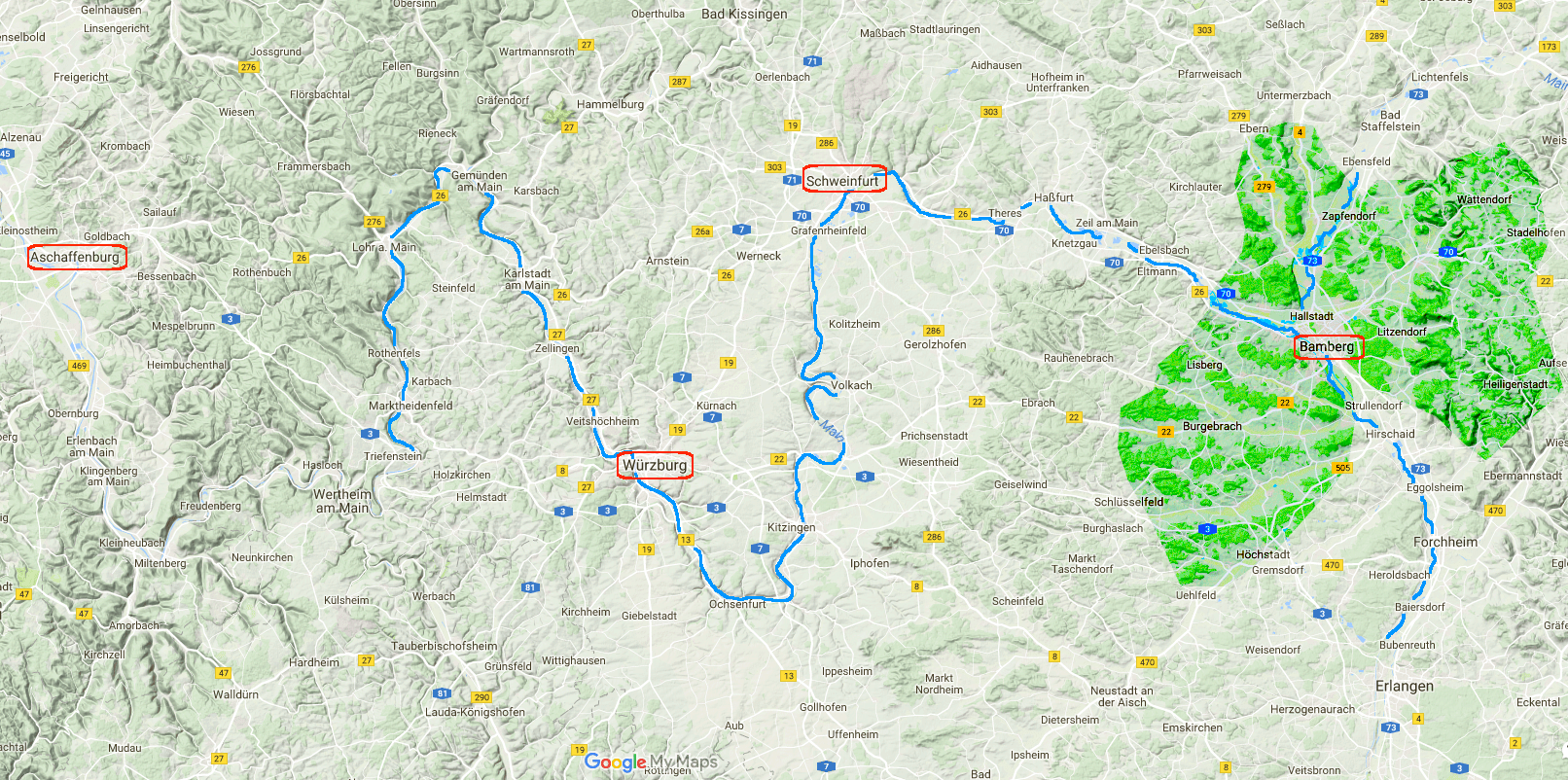
About the Main and Regnitz Wends we already wrote here.  About Würzburg we wrote here.  About Bamberg here.  About the River Jossa/Jassa in the vicinity of Aschaffenburg, here.  Here is a map showing these places in relation to Schweinfurt with the terra Slavorum in rough outline.

And here is another German map of Slavic place names – the roughly same highlighted area, this time in the western portion of the map.Make of it what you want but something tells us that at least some of the Slavs did not come from the East.

Interestingly, in 1990 halfway between Bamberg and Munich, in Kemathen – which these days is  a part of the town of Kipfenberg (Landkreis Eichstätt) there was discovered a Germanic warrior grave from about 420-450.  In it was found this belt (picture from Ludwig Wamser’s book). 

While the rosette is a common symbol, this type was particularly popular as a protection symbol in Polish houses.  Check these out from the Podhale region.

Starry Detour

Incidentally, if the rosettes above remind you of the asterisk symbol, you should know that an asterisk is derived from Greek for “little star”.  On the star of Jastarnia see here.  The interesting thing about stars is that Balto-Slavic languages have a very different word for them:

  • gwiazda (Polish)
  • żwai(g)zdē (Lithuanian)

Interestingly, in Prussian swaigstan meant “light” (Polish światło). Even more interestingly, stara in Slavic means “the old one” (female gender).  Whether this goes to something meaning “stars” or has more to do with old people lacking a certain flexibility (compare “to stare” or “stiff) is another matter.

Back to Our Stary, err… Story

Finally, it is also interesting that a lelek refers to a stork in parts of Poland (lelek is also a separate type of bird – the nightjar.  The more typical name for stork (nowadays German Storch) is bocian (compare that with Latin buteo and Germanic buse and busart (!)).

Copyright ©2017 jassa.org All Rights Reserved

May 27, 2017

On Herbert’s Recorded Miracles

Published Post author

We cannot emphasize enough that telavic mythology has not been thoroughly explored.  The major studies of sources have produced plenty of material but missed some items.  Note that a lot of these items are not well known even in their respective countries of production.  This can be said of the mentions of Slavic religious practices by:

We were guided to yet another such find just recently.  A scholar of the Jagiellonian University* from Kielce – Michał Łuczyński with a translation by Małgorzata Kruszelnicka – published an article  in 2009 wherein he notes a reference to Slavic religion in  Herberti turrium sardiniae archiepiscopal De miraculis libri tres (Herbert Archbishop of Torres in Sardinia – Of the Miracles in Three Books).  The specific reference is to a confrontation between a Christian monk and a Slavic pagan “demon”.

[* Incidentally, it was also a scholar of the Jagiellonian University – Maria Kowalczyk (or Kowalczykówna) – who discovered the most ancient references to Polish Gods in in the sermons of Lucas of Great Kozmin (see “Wróżby, czary i zabobony w średniowiecznych rękopisach Biblioteki Jagiellońskiej,” 1979).  Like Szacherska’s work, this was ignored, except in Stanisław Bylina’s 1993 article (“The Church and Folk Culture in Late Medieval Poland” in Acta Poloniae Historica vol 68, page 27), until  the Leszek Kolankiewicz’s (a theatrical scholar!) book “Dziady” brought it back to light in 1999.   Łuczyński’s article came out in 2009 – ten years after Kolankiewicz’s book so it seems something is brought to light every ten years – we’ll take it.]

This story is only present in three manuscripts of the Miracles where (as Chapter 93) it is referred to as: Quomodo zabulus in scemate regio se ipsum ydalatris ostendebat or “How the devil revealed himself to idolaters in [some] unattractive country.” (elsewhere aka De converso, qui vidit ante conversionem dyabolum ydolatris se ostendere in scemate regio)

The same was previously also noted by a Danish writer in the 1930s (exact source now escapes memory), by Stella Maria Szacherska in 1968 in her work Rola klasztorów duńskich w ekspansji Danii na Pomorzu Zachodnim u schyłku XII wieku (“The role of Danish monasteries in Denmark’s expansion in Western Pomerania at the end of the 12th century”) and, more recently, in 2005 by  Gabriela Kompatscher Gufler (Herbert von Clairvaux und sein Liber miraculorum: die Kurzversion).  For other mentions of this work, you can see Łuczyński’s article in Mythologia Slavica, volume 16, 2013, page 69.

Note that the Miracles appear in Migne’s Patrologia Latina – volume 185 (starting on p. 1272) but do not contain the aforesaid adventure.  This is because the Migne version used the most common manuscript version.  Interestingly, even that version contains a reference to Slavs in Book Three, Chapter 36 (which corresponds to Chapter 94 of the version containing the Quomodo story) (though that story of the Slavs has been interpreted to refer to Prussia instead in Wiener’s work which was also accepted by Marian T.W. Łodyński).  Because the Slav portion appears right after the Quomodo story we showcase both here (For the Quomodo story we use the Łuczyński/Kruszelnicka translation with some alterations – for example, scemate regio probably refers to an unattractive country not to “regal gowns”).  

So who was Herbert?  We are talking about Herbert of Clairvaux (circa 1130 – circa 1181) Monk at Clairvaux (1153–68/9), abbot of Mores in Champagne; but later also archbishop of Sassaria or Porto Torres, Sardinia (circa 1181).  To be clear he did not perform the miracles in his “Miracles”.  Rather his book is a composition of stories regarding others’ miracles put together by Herbert.  In the case of the Quomodo story Herbert notes that it was relayed to him by Henry of Clairvaux but the name of the protagonist monk remains unknown.

How the devil revealed himself to idolaters in [some] unattractive country
[Chapter 93]

“This is [the story] that the dignified-looking Henry, once a monk of Claraevallis, now an abbot residing in Denmark for many years, told us – [a story of] a noble monk from his abbey.  The monk in question, now still wearing holy gowns, in his youthful years went to the pagan land mentioned above* for the purpose of [carrying on of] negotiations.”

[* note – if above refers to the prior Chapter 92, that would be the same as Migne’s Book III, Chapter 35 in which indeed a “ad terram paganorum” does appear.  Since nothing says that that is a Slavic country, It is also, therefore, possible that this story also does not have anything to do with Slavs though, given, the timing of composition, that is unlikely – given that in the 12th century the only openly pagan European countries would have been parts of Slavic lands and Baltic regions – but the Christianization of the Baltics did not start in earnest till the 13th century and also those lands were further from Denmark which is the residence of the abbot conveying the story]

“However, in that territory there is an unclean statue inhabited by a most frightening God, who answers many calls and who is worshipped by the local inhabitants solely out of fear.  Sometimes he made himself visible and appeared as if a tyrant with a terrifying countenance and voice and he made these unhappiest people worship him by means of threats and beatings.  Furthermore, on that God’s order, he frequently sent diseases, disasters, infertility and other plagues and aroused fear in the unfaithful.”

“[But] if it had ever appeared that he was giving up those criminal acts or that he was acting more gently, [then] he was regarded as the deliverer of blessings.  Every year, on specified days they [these people] used to arrive festively at his temple from everywhere and they used to feast together although their participation was dishonorable [from a Christian view]. They used to set up a separate table and set it lavishly with delicious dishes, and all that used to be devoured in an invisible way by the gluttonous spirit. Then, when they [the people] saw everything had been eaten, they themselves ate joyfully because they thought the tipsy deity would be favourable to them.”

“One day, when they gathered in one place, the young Christian [I] mentioned before happened to be there. Suddenly, the well-known spirit appeared, decorated with royal ornamentation, sat down on his throne and spoke to them in a proud and contemptuous way.  Yet, those lamentable people mocked at by that shameless deity stood terrified at the sight of him and worshipped him.  When the young Christian saw it, he understood that it was the devil turned into an angel of light.  He felt fear of Satan and, calling the name of Christ, he secretly made a sign of the cross . He did not dare, however, to make the sign of the cross openly on his forehead due to a great number of people being there.  Having noticed what he did secretly, the wild deity spoke to him in his native language: ‘Hey, you deceitful Christian, tell me what you are plotting in secrecy.  Hiding under the cloak, you have made the hateful sign of the cross on your chest.  Are you also making an attempt to throw me out of my temple?  I had left the place from which you came to [come to?] my land.  I hid in the sea escaping from your cross and now that I have returned, you do not allow me to find shelter from your cross in my own temples.  You have eaten my food, you have armed against me with your signs and once again you are expelling me against my will from my domicile like an ungodly traitor’.”

“When the pagans heard the demon’s voice, they hardly understood the conversation and they were very surprised at who participated in the conversation and what it was about.  The alarmed young Christian who heard and who understood the speech, hid in the crowd because he was weak and inexperienced in his faith to such a degree that he was afraid he would be captured by the infidels and punished with death.  However, once the demon disappeared, the crowd dispersed, the young man’s wonderment diminished and [instead] what he saw and heard helped him to deepen his Christian faith.  Soon, when he returned to his native land, he went to the abbey mentioned above, where he [continued] in the service of God, and he revealed to the abbot and to the other monks what had happened to him, in order to strengthen them spiritually.”

“What else can be said: if the power of the Cross is so great that a Christian of small faith furtively and fearfully made the sign of cross [and that] caused the rulers of darkness to escape, what do you think [then] happens when men of virtue and missionaries strong in faith arrive with what is the word of God?  How many piles of corpses they created, what great multitudes of pagans they gained [for the faith] in a short time, they discovered it [all] in the words of truth which are in the Psalm: ‘A thousand fall by your side, and ten thousand to your right. And in the Ministerial Book: Five of you will chase a hundred, and a hundred will chase ten thousand. God wishes this kind of [bountiful] harvest in order to send harvesters to reap. Harvest is plentiful, but [there are] very few harvesters.  However, those very few harvesters who came from all over are blessed profusely and they reap the harvest of souls for God.  As a result, thousands of pagans only just baptized, in a short time grow in number more and more to such a degree that the bishops and metropolitans are appointed in many cities and God’s grapevine is spread far and wide among barbaric people, who [previously] may have heard the name of wine but [until then]  did not taste [that] wine.”

Quomodo zabulus in scemate regio se ipsum ydalatris ostendebat
aka De converso, qui vidit ante conversionem dyabolum ydolatris se ostendere in scemate regio

Vir venerabilis Hainricus, quondam monachus Claraeuallis et nunc iam per annos plurimos abbatizans in regione Danensi, de quodam honesto monasterii sui converso tale aliquid nobis significavit.  Predictus itaque frater dum adhuc secularem habitum gereret, in iuvenili aetate perrexit ad negociandum in supradictam terram paganorum.  Est autem in illis locis symulacrum inmundum, in quo demon atrocissimus habitans et responsa plurima prestans pro solo timore ab illis incolis excolebatur. Siquidem interdum visibiliter seipsum ostendens, quasi tyrannus aliquis vultu et voce terribilis apparebat atque miserrimos homines illos minis ac verberibus illatis ad suam reverenciam imperiose cogebat. Preterea morbos, clades, sterilitates atque similia ex divina permissione inducens frequenter, terrorem suum super infidelibus populis incuciebat. Si quando vero ab huiusmodi malignacionibus cessare aut micius agere videbatur, magni beneficii largitor tenebatur.  Statutis quoque diebus in anno soliti erant undique ad phanum ipsius sollempniter convenire et pollutis sacrificiis participando convirare. Aliam vero e regione mensam laucioribus epulis copiose refertam seorsum apponebant, que videlicet omnia spiritus ille gulosus plerumque adveniens avida voracitate invisibiliter absorbebat. Cumque universa consumpta conspicerent, tunc et ipsi letanter epulabantur, quia crapulanti numinis gratiam iam secure prestolabantur.  Quadam itaque die, convenientibus in unum, contigit et interesse prefatum illum iuvenem christianum. Et ecce repente apparuit ibi notifer ille spiritus imperialibus ornamentis fantastice redimitus, qui residens in throno suo in superbia et in abusione concionabatur ad illos. Porro miserandi homines illi tanta demonis impudencia ludificati in aspectu eius obstupescebant et execrando prodigio divinitatis honorem impendebant. At vero iuvenis christianus cum talia cerneret, intelligens esse diabolum in angelum lucis transfiguratum, exhorruit a facie maligni et invocans nomen Christi adhibita pectori suo manu signum crucis latenter impressit. Neque enim audebat se propter gentilium multitudinem in fronte signare. Ferum tamten spiritus nequam quae facta fuerant in abscondito linceis oculis deprehendens materna iuvenis lingua allocutus est eum dicens: Eia, perfide christiane, decito mihi, quid est, quod in abscondito machinaris? Ut quid nunc in pectore tuo operiente te pallio crucem illam idibilem figurasti? Numquid etiam de phano meo eicere me queris? Ex quo venisti ad terram meam, ego inde exivi ac fugiendo crucem tuam usque nunc in pelago latitavi et nunc tandem sero reversus, ne pateris me a facie crucis tue saltem in delubris meis habere refugium? Nunc enim saturatus epulis meis armatus es contra me signaculis tuis iterumque me de statione mea tanquam proditor impius violenter expellis. Cum ergo barbari illi homines hanc vocem demonis audirent et minime loquelam intelligerent, satis superque mirabantur, quid diceret aut cui loqueretur. At vero iuvenis audiens et intelligens pavidus in turba latitabat, quia fragilis adhuc et fide tenellus teneri ab infidelibus atque ad supplicium protrahi metuebat. Disparente autem demone solutoque conventu cum grandi admiracione recessit et ex hiis, quae viderat et audierat, multum in fide christiana profecit. Postmodum autem cum ad natalem patriam repedasset, in supradicto monasterio se convertit, ubi religiose conversando domino militare curavit et ea, quae sibi acciderant, ad multorum edificacionem abbati et fratribus indicavit. Si quid nos ad ista dicemus: Si tanta est virtus et gloria crucifixi, ut ante pusillanimem et modice fidei christianum propter signum crucis et trepide et latenter inpressit, principes tenebrarum ita diffugerent, quid putamus fieret, si viri virtutum et fortes in fide predicatores cum gladio spiritus, quid est verbum Dei, accederent. Et quantas hostium strages darent, quantas gentilium turbas in brevi acquirerent, vere cito cognoscerent de verbo veritatis, quid legitur in psalmo: Cadent a latere tuo mille et d[ecem] m[ilia] a[d] d[exteris] tuis. Et in Levitico: Persequentur quinque de vobis – centum alienos, et centum ex vobis – decem milia. Pro huiusmodi ergo rogandus est dominus messis, ut mittat operarios in messem suam. Messis est enim multa et operarii autem pauci. Verum tamen ipsi pauci, immo ut verius dicam, paucissimi, qui in partibus illis reperiuntur in missis undique; falcibus predicationis cum tanta benedictionis habundantia et animarum fruges Domino colligunt et ut nimia paganorum milia nuper in brevi tempore baptizata cottidie magis ac magis multiplicentur et adeo ut episcopi atque metropolitani in civitatibus plurimis nunc de novo creentur et vinea domini Sabbaoth in populis barbaris, qui vini forsitan nomen antea audierant, vinum tamen non biberant, hodie longe lateque propagetur.

The Introduction of the Christian faith in Slavonia, demons scatter from it with horrible noise, as if defeated in battle by an army, and they are routed and put to flight
Chapter 94 (also Migne, Book 3, Chapter 36)

“In the country of Slavonia, the greater part of which has only recently been converted to Christianity, many Cistercian monasteries have already been founded.  Furthermore, the monks who toil daily there for the Lord on converting the heathens received the power to baptize [them] from the Supreme Pontiff.”

“It happened that some of these brothers, who were invited from certain of the faithful, one day came to one of the neighboring villages, baptizing a multitude of pagans in it, [a village] which had recently received the faith and which and which required a regeneration of grace.”

“And the prior night, before they reached this [village], there is a huge noise to be heard from [that place] and a great roar, as if [made] by a great army resonating during the entire night time in the streets and squares of that town; seemingly, as if another army made a powerful assault and finally defeated [the first] from the back and left in a great upheaval.  Moreover, the locals fleeing heard the noise and flights sounds [but] not seeing anyone became dismayed and greatly frightened not knowing what this new thing was or what malice [?] it portended.”

“The next day the monks who arrived at the village baptized there throngs [of people] of [men and women].  But at this time it was made known to the faithful that the noises of the prior night were nothing other than legions of demons complaining and fleeing the Lord for they were not able to withstand the angels and the coming of the Holy Spirit.  Truly many are consoled in the presence of the Lord and especially so the newly-baptized who were saved from eternal damnation.”

Christiana fide in Sclavoniam inducta, diffugiunt ex ea daemones cum horrendo strepitu, velut exercitus praelio victi, et fusi ac fugati

In regione Sclavoniae, quae noviter est ad fidem Christianam conversa magna ex parte, plurima jam Cisterciensis Ordinis monasteria constat esse fundata.  Porro monachi illi qui ibidem Domino serviunt, ob quotidianam conversionem gentilium baptizandi potestatem a sumno pontifice acceperunt.  Factum est autem ut aliqui. de fratribus illis, a quibusdam fidelibus invitati, statuta die venirent ad unam de proximis viltis, paganorum multitudinem in ea baptizaturi, quae nuper fide recepta regenerationis gratiam flagitabat.  Praecedenti ita que nocte, antequam illuc pervenissent, auditus est ibi sonus et fremitus ingens, quasi exercitus grandis, toto tempore noctis per vicos et plateas ejusdem villae perstrepentis, qui velut ab alio exercitu forteter impugnatus, tandemque superatus, terga vertere, atque cum magna turbulentia exire videbatur.  Porro homines loci, recedentium strepitum et fugam communiter audientes, et personam aliquam non videntes, stupebant ac metuebant, nimirum ignorantes quae ista novitas esset aut quid boni malive portenderet.  In crastinum autem venientes monachi ad eamdem villam, baptizaverunt ibi promiscui sexus turbam copiosam.  Tunc vero cunctis fidelibus manifeste innotuit quod tumultus ille nocturnus nihil aliud exstitit, nisi daemonum legiones, ab obsessis hominibus increpante Domino fugientes; qui beatorum angelorum praesentiam, et sancti Spiritus adventum sustinere non poterant.  De qua videlicet re multum in Domino consolatu sunt universi, praecipue vero neophyti illi qui ab immunda damnatione fuerant liberati.

Copyright ©2017 jassa.org All Rights Reserved

May 15, 2017

Willibald’s Life Of Saint Boniface

Published Post author

And speaking of Würzburg.

We have previously discussed Boniface’s comments on Slav matters here, here and here.  Boniface died in 754 but Slavs managed to follow him and make it (once) into the “Life of Boniface” when that work was penned by Willibald about the year 768:

“…Burghardo verotionis parrochiam commendavit in loco qui vocatur Wirzaburg dignitatis officium delegavit, et ecclesias in confiniis Francorum et Saxonum atque Sclavorum suo officio deputavit…”

According to the translator of that work, this WIllibald was not the Willibald of Eichstätt whose own “Life” we already discussed here.  Rather, the author of Saint Boniface’s “Life” (incidentally, the first of such works regarding Boniface) was “a simple priest who had never come into direct contact with Boniface and what he says is based upon the facts that he was able to collect from those who had been Boniface’s disciples.”

Here is that Slavic mention (from Talbot, C. H., trans., The Anglo-Saxon missionaries in Germany; being the lives of SS. Willibrord, Boniface, Sturm, Leoba, and Libuin, together with the Hodoeporicon of St. Willibald and a selection from the correspondence of St. Boniface)

Chapter 8

How throughout his whole life he preached with zeal and how he departed from this world

“During the rule of Carloman all the bishops, priests, deacons, and clerics and everyone of ecclesiastical rank gathered together at the ruler’s instance and held four synodal councils. At these Archbishop Boniface presided, with the consent and support of Carloman and of the metropolitan of the see and city of Mainz. And being a legate of the Roman Church and the Apostolic See, sent as he was by the saintly and venerable Gregory II and later by Gregory III, he urged that the numerous canons and ordinances decreed by these four important and early councils should be preserved in order to ensure the healthy development of Christian doctrine. For as at the Council of Nicaea, held under Constantine Augustus, the errors and blasphemies of Arius were rejected; as under Theodosius the Elder an assembly of one hundred and fifty bishops condemned Macedonius, who denied the divinity of the Holy Spirit; as in the city of Ephesus under Theodosius [II] two hundred bishops excommunicated Nestorius for declaring that there are two Persons in Christ; and as at the Council of Chalcedon an assembly of six hundred and thirty bishops, basing their decision on an earlier one of the fathers, pronounced an anathema against Eutyches, an abbot of Constantinople, and Dioscorus, who defended him, for attacking the foundations of the Catholic faith – So in the Frankish territories, after the eradication of heresy and the destruction of wicked conspirators, he urged that later developments of Christian doctrine and the decrees of the general councils should be received. With this in view there should be a meeting of the bishops in synod each year in accordance with the decree of the aforesaid council of bishops. This holding of synods had fallen into desuetude through the constant fear of war and the hostility and attacks of the surrounding barbarian tribes and through the attempts of hostile enemies to destroy the Frankish realm by violence. They had been forgotten so completely that no one could recall such an assembly’s having taken place within living memory. For it is in the nature of the world to fall into ruin even though it is daily restored, while if no attempt is made to reform it it quickly disintegrates and rushes headlong to its predestined doom. Therefore if in the course of this mortal life means have been discovered to remedy such evils they should be preserved and strongly defended by Catholics and fixed indelibly in the mind. Otherwise human forgetfulness and the enticement of pleasure, both of them instigated by the devil, will prove a stumbling block. For this reason the holy bishop, in his anxiety to deliver his people from the baleful influence of the devil, repeatedly urged Carloman to summon the episcopal synods already mentioned in order that both present and later generations should learn spiritual wisdom and should make the knowledge of Christianity available to all. Only in this way could unsuspecting souls escape being ensnared.”

“After he had set before all ranks of society the accepted norm of the Christian life and made known to them the way of truth, Boniface, now weak and decrepit, showed great foresight both as regards himself and his people by appointing a successor to his see, as ecclesiastical law demands. So, whether he lived or whether he died, the people would not be left without pastors and their ministration. He promoted two men of good repute to the episcopate, Willibald and Burchard, dividing between them the churches that were under his jurisdiction in the land of eastern Franks and on the Bavarian marches. To Willibald he entrusted the diocese of Eichstätt, to Burchard that of Würzburg, putting under his care all the churches within the borders of the Franks, Saxons, and Slavs. Nevertheless, even to the day of his death he did not fail to instruct the people in the way of life.”

“Then Pepin, with the help of the Lord, took over the rule of the kingdom of the Franks as the happy successor to his above-mentioned brother [i.e. Carloman]. When disorders among the people had subsided, he was elevated to the kingship. From the outset he conscientiously carried out the vows he had sworn to the Lord, to put into effect without delay the synodal decrees, and he renewed the canonical institutions which his brother, following the advice of the holy archbishop Boniface, had so dutifully set on foot. He showed the saint every mark of veneration and friendship and obeyed his spiritual precepts. But because the holy man, owing to his physical infirmities, was not able to attend the synodal assemblies, he decided, with the king’s approval and advice, to appoint a suitable person to minister to his flock. To his purpose he appointed Lull, a disciple of outstanding ability, whose duty it would be to continue his instruction to the people. He consecrated him bishop, and committed to his care the inheritance that he had won for Christ by his zealous efforts. Lull was the man who had been his trusted companion on his journeys and who had been closely connected with him both in his sufferings and his consolations…”

Copyright ©2017 jassa.org All Rights Reserved

May 6, 2017

Würzburg’s Roots

Published Post author

The city of Würzburg is perhaps first listed in the Ravenna Cosmography under the name Uburzis.

A bit later (?) (704) the city is mentioned as castellum Virteburch.

Incidentally Solist (which some connect to Hohenzollern) looks much like Soest of which Quazwini says later:

“Schuschit [Soest] is a town in the land of the Slavs.  There lies a salty spring, while there otherwise is no salt in that area.  When the people need salt, they take water from this source, fill with it a pot and set it on a stone oven and make a great fire underneath so that it becomes thick and turbid.  Then it sits until it becomes cold and turns into hard, white salt.  In this way is salt made in all the lands of the Slavs.”

So what is Uburzis?  Oddly, the Polish house spirits Uboże come to mind…

Apparently, when the bishopric at Würzburg was founded (which happened a few decades later in 741) it was permitted to collect taxes from the Franks and the Slavs.  This grant was later reconfirmed in Arnulf of Carinthia’s 889 confirmation of Würzburg’s rights), it was mentioned that it should collect taxes (steora vel osterstuopha) from the Slavs:

decimam tributi, quae de partibus orientalium Franchorum vel de Sclavis ad fiscum dominicum annuatim persolvere solebant, quae secundum illorum linguam steora vel ostarstuopha vocatur, ut de illo tributo sive reditu annis singulis pars decima ad preductum locum persolvatur, sive in melle sive in paltenis seu in alia qualibet redibutione, quae, ut diximus, prius e pagis orientalium Franchorum persolvebatur.  Id est de pago uualdsazzi. et de pago thubargouue. et vuingartuueiba. et iagasgeuui. mulahgeui. necchargeuui. et chochangeuui et rangeuui et gollahgeuui. et iphgevui. hasagevui. et grapfeld. et dullifeld. salageuvi. uueringeuui. gozfeld. et badanahgeuui. et decimam de fiscis dominicis. Id est de ingulunheim. reotfeld in rangevue. roudeshof in folhfeldon. ad chruzinaha et neristein. et omuntesstat. et albsteti. et chuningeshofa et sundrunhofa. et gollahofa. et berenheim. et ikilenheim, et uuielantesheim. et roumfeld. Gouvmheim in gozfeldon. et drozoltesheimhalazesstat in ratenzgovue, chungeshofe. et item chuningeshofe. et salz. et hamulunburcg. et iphahofa et thetilabach. et in blaihfeld. et heiligbrunno. et louisin.  In his fiscis et uillis dominicis. seu in predictis pagis….

Pippin is presumably Pepin the Short who would have been around in 741.  What secundum illorum lingua means we will let you guess. Maybe, it means German – as opposed to Latin – but the Latin language would not have been the language of the illorum

Copyright ©2017 jassa.org All Rights Reserved

May 3, 2017

The Slavs of Wipo’s Deeds of Conrad II

Published Post author

We present here the full Slavic contingent from Wipo’s The Deeds of Conrad II (Gesta Chuonradi II imperatoris).  We previously featured one little component of that work but here is the full account in Karl Morrison’s translation.

Wipo of Burgundy (also Wippo circa 995 – circa 1048) was Conrad’s chaplain and served also his son Henry III so he was intimately familiar with the goings on at court.  Although he is obviously biased towards his masters, his sycophancy does not prevent him from delivering a number of interesting facts.

I. On the Assembly of Princes

“In the year 1024 from the incarnation of the Lord, the Emperor Henry II, although of sound mind, was taken with an infirmity of the body, which prevailing, he departed this life the 3rd of the Ides July [July 13]… [lists the various eminent members of the Empire]  These were the dukes, on the other hand, contemporaries of the wove-mentioned men: … Udalric, duke of Bohemia…”

II. On the Election of the King

“…While all the magnates, and, so to say, the valor and the vitals of the kingdom, had convened there, they pitched camps on this side and in the region about the Rhine.  As it [the Rhine] separated Gaul from Germany the Saxons, with their neighbors, the Slavs, the eastern Franks, the Bavarians, and the Alamanni, convened from the German side; and from Gaul, the Franks who live above the Rhine, the Ribuarians, and the Lotharingians were joined together.

IX. Of Boleslaus, Duke of the Slavs

In the same year [1025] which I have mentioned above, Boleslaus Sclavigen [of the Slavic nation], duke of the Poles, took for himself in injury to King Conrad the regal insignia and the royal name.  Death swiftly killed his temerity.”

“But his son Misico, similarly rebellious, cast his own brother Otto out into the province of Russia because he favored the partisans of the King [Conrad].  I shall tell in its proper place how King Conrad afterwards curbed the impudence of this Misico and the perfidy of a certain Udalric, duke of Bohemia.”

XXI.  That the King of Burgundy Came to meet the Emperor at Basel

“…Shortly after, Adalbero, duke of the [H]istrians or Carinthians, convicted of less majesty, was exiled  with his sons by the Emperor, and that Cuono just mentioned received from the Emperor his dukedom, which the father of this very Cuono is said to have had once.  So Duke Cuono, as long as he lived, remained faithful and one who strove well for the Emperor and also for his son, King Henry.”

XXIX.  Rudolf, King of Burgundy, Died, and Odo Invaded His Realm

“In the year of the Lord 1032, Rudolf, king of Burgundy, the uncle of the Empress Gisela, died in peace.  Count Odo Francigen, son of his sister, invaded his realm, and took certain very well-armed castles or cities by craft or battle.  Neither did he dare to make himself king nor, indeed, did he wish to lose the kingdom.  Some persons related that he had often said that he never wished to be king, yet always to be the master [magister] of a king.  In this fashion he drew away [for himself] a great part of Burgundy, although King Rudolf had already confirmed, not long ago, through a solemn oath that the kingdom of Burgundy should go to Emperor Conrad and his son, King Henry, after his death.  But while Count Odo did these things in Burgundy, Emperor Conrad was in Sclavonia with his troops.*  What he did there and how he afterwards repelled Odo from Burgundy, I shall tell in the following [passages].”

* note: In his expedition against Misico (Mesko), which was begun in 1031 and concluded with a treaty at Merseburg in 1032. [notes are Morrison’s]

“When the aforementioned Boleslaus, duke of the Poles, died, he left two sons, Misico and Otto.  Misico persecuted his brother Otto and expelled him into Russia.  While Otto lived there for some time in a miserable condition, he began to ask the favor of Emperor Conrad, in order that through his intercession and assistance he might be restored to his fatherland.  Since the Emperor was willing to do this, he decided that he himself would attack Misico with troops on one side and Otto on the other.  Since Misico was unable to withstand this attack, he fled into Bohemia to Duke Udalric, against whom at that title the Emperor was enraged.  But Udalric was willing, in order to please the Emperor, to give Misico up to him.  Caesar renounced this dishonorable pact, saying that he did not wish to buy an emery from an enemy.  Otto was restored to his fatherland and made duke by Caesar; but since, after some time, he acted wit too little caution, he was slain secretly by one of his household.**  Then Misico sought in every way the favor of the Empress Gisela, and of the othe princes, that he might be found worthy to return to the favor of the Emperor.  Caesar, moved by compassion, granted him pardon; and after the province of the Poles had been divided into three parts, he made Misico tetrarch and commended the remaining two parts to two other men.  So, with his power diminished, his temerity was reduced.  After the death of Misico,*** Casimir, his son, has served our emperors faithfully until this very time.****”

** note: 1032
*** note: 1034
**** note: From 1042 his relations with Henry II worsened, and in 1050 Henry readied an expedition against him.  The expedition was canceled however by Casimir’s voluntary submission.

XXXIII.  That King Henry Subjected the Slavs

“In the meantime, while the Emperor was doing those things in Burgundy which have been recounted above, his son, King Henry, although still in the years of boyhood, attended no less energetically the affairs of the commonwealth in Bohemia and in the other regions of the Slavs, where he vigorously subjugated Udalric, duke of Bohemia, as well as many other opponents of Caesar.  When his father returned, he met him, and thus he gave to the peoples double joy because of the double victory.”

“Then, when troops had been collected from Saxony, the Emperor came upon those who are called Liutizi and who, once semi-Christian, now are wholly pagan through the wickedness of apostasy; and there he brought to an end an implacable conflict in an astounding fashion.  For there were at that time many quarrels and border raids between the Saxons and the pagans.  And when Caesar came, he began to to inure by which side the peace, which had lon bgeen inviolate between them, had been destroyed first.  The pagans said that t peace was disturbed first by the Saxons and that this would be proven through a duel, if Caesar so commanded.  The Saxons, on the other hand, although they contended unjustly, similarly pledged before the Emperor their willingness to engage in single combat to refute the pagans.  The Emperor, even though he took the counsel of his princes, did not act cautiously enough and permitted this matter to be adjudged by a duel between them.  At once two fighters met, each elected by his own men.  The Christian began to fight boldly, confiding in that faith alone which, however, is dead without works of righteousness, and not diligently heeding the fact that God, who is Truth, disposes everything in true judgment, He who makes His sun to rise over good and evil, who causes rain to fall on the just and the unjust.  The pagan, however, put up a staunch resistance, having before his eyes only the consciousness of the truth for which he fought.  Finally, the Christian fell, wounded by the pagan.  Because of this outcome, the pagans became so greatly elated and bold that, if the Emperor had not been present, they would have thrown themselves upon the Christians straightaway.  But, in order to curb their incursions, the Emperor constructed the castle of Werben in which he stationed garrisons of knight,s and he constrained the princes of Saxony by solemn oath and imperial order to resist the pagans of one accord.  Then he returned to Franconia.”

“But in the following year, the same castle was taken by the pagans through craft, and many of our men who were in it were killed by them.  Disturbed by this, the Emperor again came with troops to the Elbe River.  But since the pagans prevented the crossing, the Emperor sent part of the army across under cover through another ford of the river.  When the enemies had been set to flight in that way, Emperor Conrad entered the region by the now-free bank of the river and laid them so low with immense devastations and burnings everywhere except in impregnable places that afterwards they paid to him the tax which had been imposed by emperors of old and which was now increased.”

“For both before and at that time, Emperor Conrad toiled greatly amidst the nation of the Slavs. Because of this, one of us composed a short account in verse which afterwards he presented tot he Emperor.  There one may read how the Emperor sometimes stood in h marshes up to the thighs, fighting in person and exhorting the soldiers to fight; and how, after the pagans had been conquered, he slew them with the greater ferocity because of a certain reprehensible superstition of their.  For it is said that at some time the pagans kept a wooden effigy of our crucified Lord Jesus Christ in shameful mockery and spat upon it and struck it with blows; finally they tore out the eyes and cut off the hands and feet.  To avenge these deeds, the Emperor in a similar manner mutilated a great multitude of captured pagans for one effigy of Christ and destroyed them with various deaths.  Therefore Caesar is called an avenger of the Faith in these verses and is compared with the Roman princes Titus and Vespasian, who in avenging the Lord had exchanged thirty Jews for one coin since the Jews sold Christ for that many denarii.”

“After his return the Emperor imperiously cast aside whatever resistance he found in the kingdom.  In the same year, Adalbero, duke of the Carinthians lost the favor of the Emperor and was deprived dog his dukedom and sent into exile.”

40. Verses on the Death of the Emperor Conrad

[after telling how Conrad subdued the Saxons, Alemanni, Bavarians, Rome, Ravenna and Verona  (Pavia?) he comes to the Slavs]

“…The Emperor never tarried, everywhere the giver of peace.
He carried war to the pagans lest they harm Christians:
The marsh did not defend them, nor was there safety in the waters;
Well he made the barbarian Slavs and all peoples depraved feel his force.
O King God, guard the living and have mercy upon the dead.”

Copyright ©2017 jassa.org All Rights Reserved

March 31, 2017

Thietmar (Book V)

Published Post author

We presented the Slavs and Slavic place names in the first four books of Thietmar’s Chronicle here.  We now continue with Book V (translation is David Warner’s).

Chapter 7 [year 1002]

“…The course of Ekkehard’s life loas so worthy that his lord allowed him to hold the greater part of his benefice as personal property.  He forced the free-born Milzeni under the yoke of servitude.  With flattery and threats, he won Duke Boleslav [III] of Bohemia, called the ‘Red”, for  his military service and turned the other Boleslav [Chrobry of Poland] into a personal ally.  He acquired the office of duke over all of Thuringia by the election of the whole populace.  With only a few exceptions, he reckoned on the support of the eastern counts and therefore of the duchy.  All of this came to such a miserable end.”

Chapter 9 [1002]

“Meanwhile, Boleslav [Chrobry of Poland] , a son far inferior to his father Miesco, rejoiced over the death of Margrave Ekkehard.  Shortly after this, he assembled an army and seized Margrave Gero’s march as far as the river Elbe.  Then, with siege troops sent ahead, he captured the burg Bautzen [Budisin], with all its possessions,and immediately thereafter attacked Strehla.  Secretly, he also tried to bribe the residents of Meissen who were always happy for something new.  One day, when they realized that most of the garrison had left to find fodder for the horses, Duke Gunzelin of Kuchenburg led them in an assault on the east door, in that part of the city inhabited by ministeriales known in Slavic as Withasen [witeź].”

“After killing Bezeko, one of Count Herman’s ministeriales, they took up arms and met at the count’s chamber where they threw large rocks at the window and loudly demanded that Ozer, the lord of the city, be handed over to them for execution.  But the miles Thietmar, having no other protection that the room itself, asked them: ‘Why are you doing this?  What madness so seduced you that, forgetful of the benefits bestowed by Margrave Ekkehard and your willing invitation, you rise up to destroy his son?  If you wish to reveal the reason for such an outrage, either publicly or secretly to one of us, on behalf of my lords and all of us, I firmly promise you an agreeable settlement of the offence and security regarding your future concerns.  As for the man you seek to have handed over, namely so that he can be killed, you will not received him as long as we are living.  We are few and you should know for certain that we will either die together or leave this city unharmed.’  After they had heard this and consulted among themselves, the attackers granted the garrison freedom to leave.  Then, they sent messengers to summon Duke Boleslav and received him with open doors.  Hence, the words of the scriptures were fulfilled: ‘They may rejoice when they act wickedly, and exult in evil things and again.  Their beginnings are as honey and their end as absinthe.'”

Chapter 10 [1002]

“Elated by this success, Boleslav occupied the entire region up to the Elster and secured it with a garrison.  Then, when our people gathered together to resist him, that deceitful man sent a messenger who announced to them that these things had been done with the favour and permission of Duke Henry.  He added that Boleslav would in no way injure the inhabitants and, if Henry came to power in the realm, he would assen  to his will in all things, but if otherwise, he would willingly do whatever pleased them,.  Considering this, our people believed the beautiful words and shamefully advanced to him as if to their lord, thereby exchanging their inborn honour for supplication and unjust servitude.  Hoe unequally are our ancestors and our contemporaries compared!  In the days of the illustrious Hodo, this man’s father Miesco, would not have dared to wear furs when entering a house in which he knew him to be or to sit while he was standing.  May God forgive the emperor for making a lord out of a tributary and raising him to the point that, forgetful of his father’s customs, he might dare to gradually drag his superiors into subjection and seize those caught with the shameful hook of temporal wealth to the detriment of both slaves and free.”

Chapter 11 [1002]

“Also the other Boleslav [III], the Bohemian ruler nicknamed ‘the Red’ and generally a source of the worst impiety, departed from his usual custom and supported Duke Henry…”

Chapter 15 [1002]

“From there [Thuringia], Henry went to Merseburg where he was received by Abbot Heimo and by his faithful count Esiko [24 July].  Esiko had manfully held this city along with Allstedt, Dornburg and all their possessions until his lord arrived, though this had greatly angered Ekkehard while he lived.  Here also were Archbishop Liawizo of Bremen and Giselher of Magdeburg with other colleagues: Rethar of Paderborn, Bernward of Hildesheim, Arnulf of Halberstadt, Ramward of Minden, Eid of Meissen, Bernhar of Verden, Hugh [II] of Zeitz.  Also present were dukes Bernhard and Boleslav with the margraves Liuthar and Gero and the count palatine Frederick.  Many others were also there, both bishops and counts, but it would take too long to give their names individually.  All of these received the king with humble devotion.

Chapter 18 [1002]

Except for Liudger, everyone who had served the previous emperor offered his hand to the king and swore to aid him faithfully.  Meanwhile, Boleslav schemed to acquire the burg Meissen at whatever cost.  Because it was not advantageous to the realm, he got nowhere with the king and only barely succeeded in securing it for his brother-in-law Gunzelin.  He himself received the regions of Lausitz and the Milzeni.  Margrave Henry, my cousin, held Boleslav in great esteem and aided him freely and amicably in whatever way he could.  As he prepared to escort Boleslav, departing well rewarded and with the king’s permission, he saw an armed multitude gathering and moving to attack them.  May God be my witness, this was without the involvement or knowledge of the king!  When he wanted to discover the cause of this great tumult, and resolve it so that more damage might not arise, he was barely able to get away and lead his companion out by breaking the exterior door.  Out of his entourage, some warriors were plundered by the surging mob while others though severely wounded escaped death with the help of Duke Bernhard.  Because they had entered the royal court armed and refused to leave when ordered, the penalty they paid was justified by their own offense.  Boleslav saw this as part of an evil plot and, deeply disturbed, blamed the king although unjustly.  After bidding farewell to Henry and firmly promising his aid, should it ever be required, he quickly returned to his own lands.  When he arrived at the city of Strehla, he immediately set fire to it and abducted a large part of the populace. At the same time, he sent back representatives through whom he tried to attract as many of the king’s supporters as possible.  Soon afterwards, when this came to the king’s ears, he asked his dependents to inquire about the secret plots of the Slav and, if possible, to capture his spies.”

Chapter 23 [1002]

Meanwhile, because the power of a consort and successor always inspires fear, the duke of the Bohemians, Boleslav [III], castrated his brother Jaromir and wanted to suffocate the younger brother in his bath.  Then he sent both brothers and their mother into exile.  Then, ruling alone like the noxious basilisk, he oppressed the people unspeakably.  When they could no longer bear the weight of this outrage, they secretly called Wlodowej [Duke of Bohemia 1002 – 1003] from Poland, whose name means power of the army.  He was a poisonous snake who treated his people without any respect for the law.  After Boleslav the basilisk had been deposed, this one was unanimously elected in his place because of his consanguinity and because of the people’s affection.  I can say one thing about him that is incredible and not to be copied by any Christian, namely that he could not endure even one hour without drink.  As this was the only path of escape open to him, Boleslav fled to Margrave Henry, then his neighbor, who seized him as an enemy because of past injuries.  Afterwards, because he had arrived as a guest, he was set free and, being fond of his life, he went to the like-named son of his aunt who was his equal in shamefulness though unequal in ability.  Inclined to better advice, the other one went to the king, then residing oat Regensburg, and recognized him as his lord with humble subjection and the promise of loyalty.  He received what he sought from him as a benefice and, after being treated warmly in all matters, returned in peace.

Chapter 24 [1002]

“…In the expectation of receiving the abundant support promised by the Italians, the king sent Duke Otto of Carinthia and Verona, Otto the son of Count Heribert, Ernst the son of Margrave Leopold, and a few others to resolve the situation [December 1002 to beginning of January 1003].

Chapter 29 [1003]

Meanwhile Duke Wlodowej died and the brothers who had been expelled along with their mother were recalled by the repentant Bohemians.  But Boleslav, the ruler of the Poles, collected an army and expelled them again.  He then restored his exiled namesake to his previous dignity and went home, with his plots deeply concealed.  He knew that his cousin would be too vindictive towards those who had supported his expulsion and hoped that at a more auspicious moment he might himself intervene.  And so it actually happened.  When Boleslav [III] of Bohemia perceived that his people dedicated themselves to paganism in all security, his own impiety was fortified for breaking the peace treaty which he had confirmed by oath.  Thus, when all the great men had been assembled before him in one house, he himself killed his brother in law by striking him in the head with a sword and then, with his evil supporters, this bloody and deceitful man who was unworthy of half the days conceded to him, killed the others although they were unarmed and it was the holy season of Lent.

Chapter 30 [1003]

The rest of the people, in great fear because of this, secretly sent representatives to Boleslav of Poland who revealed the magnitude of the shameful deed and asked him to rescue them from fear of the future.  He heard these things with pleasure and immediately asked the other Boleslav, through a faithful representative, to come to him at a certain citadel for a personal discussion regarding matters of mutual interest.  The younger Boleslav agreed to this, came to the agreed-upon place, and was affectionately received by him.  The following night he was blinded by the other’s henchmen thereby ensuring that hew would never treat his people in that manner again or even be able to rule there.  He was also sent into a long exile.  On the following day, the elder Boleslav travelled quickly to Prague where he was introduced and unanimously acclaimed as lord by the inhabitants who were always happy to have a new ruler.  As his world power increased, his willfulness became much greater than is normal in a restrained mind.  Note this well, dear reader: he who becomes too proud in prosperity will often be brought lower in adversity.  It is affirmed by scripture that a wise man does not do this.”

Chapter 31 [1003]

“The king learned all of these things from hearsay, and accepted them with the due seriousness of a patient mind.  At least, he imputed to his sins whatever misfortune occurred in the kingdom in his time.  Therefore, as seemed most opportune to him, he ignored everything that had happened to the Bohemians, and sent representatives to Boleslav with the following demand: if he wished to retain the land he had recently occupied, by the king’s grace, as the ancient law requires, and serve him in all things faithfully, the king would agree to his requests.  If otherwise, he would oppose him with arms.  Boleslav received this legation unworthily, though it was just and well composed, and therefore deservedly brought revenge on himself in the future.  When the Lenten fast was finished, as I have mentioned, the king followed the custom of his predecessors by celebrating Easter, in an appropriate manner, at Quedlinburg [28 March].  There, as befits such a great feast, he ignored both Boleslav‘s evil presumption and Henry’s ambitions and enjoyed the company of his familiars.  On the same occasion, the king bestowed royal gifts on Dukes Otto and Ernst, recently returned after their disastrous defeat, and consoled them with fatherly encouragement.  He also received representatives of the Redarii and the people known as the Liutizi and, claiming these rebels with the sweetness of gifts and the joy of promises, turned them from enemies into friends.”*

* Warner’s note: this refers to “Henry II’s controversial decision to form an alliance against Boleslav Chrobry with the pagan confederation of the Liutizi.”

Chapter 32 [1003]

“After this, the king celebrated the Rogation days, which should be observed by all the faithful of Christ, at Merseburg [3-5 May].  There he learned of the open rebellion of Duke Boleslav and Margrave Henry.  Then he celebrated the feast of Pentecost at Halberstadt [16 May].  After this, he travelled to Bavaria where he initially tried to defeat Henry, who was offering resistance with the help of Boleslav but afterwards concentrated on quashing conspiracies instigated elsewhere.  In this regard, he learned that Ernst whom he had recently honoured and Bruno [Henry II’s brother, later the bishop of Augsburg] , his own brother, had also joined the conspiracy.  They were heedless of what has been written: ‘Virtue lacking council fails of its own weight.’  To restrain their arrogance, the king gathered his supporters from all sides and, at the beginning of August, wasted the lands of Margrave Henry, thereby forcing him to abandon his residence and hide wherever he could.  Anyone aware of the cause of the margrave’s stubbornness would say that his actions were necessary: the higher powers may not withdraw something firmly promised to a faithful servant without alienating the devotion of others,  Tho those, I respond, every dominion in this world derives from God and whoever rises against it offends the divine majesty.  One must weather the sudden burst of injustice with the rudder of patience and, with humble supplication await a consolation which will be truly useful.  I think it better to ascend the heights gradually rather than incur a sudden and insurmountable ruin.  I admit that I would defend my cousin in some other way, if I did not fear to violate that truth which must be honoured by all faithful people.”

Chapter 33 [1003]

“In many ways, the proverbs of the ancients have been confirmed: the old crimes of humankind bring forth new acts of evil and shame.  For Margrave Henry’s father had often opposed the father of the king, as if an enemy rather than one of his milites, and himself admitted that he had supported the emperor’s side because of a boon promised under oath.  In similar fashion, Margrave Henry had been faithful to Otto III until the latter’s death and serve King Henry strenuously up to this unhappy time.  The king was still intensely aware of their fathers’ rivalry, but I believe that the love of Christ would have moved him to let it go entirely unpunished, if only he had not seen Margrave Henry in the company of his other enemies, opposing him so cruelly and openly.  Although Margrave Henry alone might appear guilty in this crime, it was not undertaken without the advice of others from the very beginning.  Because betrayal is deemed particularly shameful in this world, however, he preferred to pursue the matter, with his conscience groaning, rather than increase his own blame by endangering others.  Thus, he who once zealously defended the realm from the enemy now opened it to pillaging.  He secretly received aid from Boleslav though it did him no good.”

Chapter 34 [1003]

“When the king was traveling to a place called Hersbuck, the royal treasure, having been sent ahead, was seized by the margrave’s miles Maganus and his band.  Dividing the booty among themselves, they returned happily to the burg at Ammerthal.  The king followed and, after preparing for a siege, forced them to ask only for their lives., through intercessors, and to return both the burg and booty.  Then, after the burg had been virtually destroyed and the many Poles divided among his men, he set forth for the castle at Creussen where Margrave Henry’s brother, Bukko, was supposed to be guarding the Margrave’s wife, Gerberga, and his children.  From outside, Margrave Henry and his supporters fought the army which had surrounded the burg on all sides…”

Chapter 36 [1003]

“Meanwhile, as the king was besieging Margrave Henry’s burg at Creussen, Boleslav was straining with every effort to injure him in some way.  Secretly collecting an army, he sent representatives to demand that his brother-in-law, Gunzelin, surrender the burg of Meissen into his power and renew their old alliance as he had promised.  Gunzelin knew, however, that with Boleslav’s entry he would virtually be excluded from the king’s favour and from his own domain.  Thus, he offered the following response: ‘Everything you ask from me other than this, dear brother-in-law, I will freely provide and, if ever the opportunity arises for doing what you ask, I will not refuse.  But my lords retainers are with me and they would not suffer such things [senioris mei satellites(!)].  And, if this were revealed, my life and all that I possess would be endangered.’  When Boleslav heard this message, he put the messengers under guard and ordered his army to hasten to the Elbe.  He hollowed them, the next morning, after the character of the fords had been determined.  At the burg Strehla, because it was his daughter’s morning gift, he declared that the occupants had nothing to fear from him but that they should not try to warn their neighbors by crying out.  Without delay, the duke ordered the army to divide into four parts and reconvene in the evening at the burg Zehren.  Two detachments were sent ahead to ensure that they would not be troubled by the margrave.  In one day, the whole fertile region of Lommatzsch was ravaged with fuire and sword and had its inhabitants abducted.”

Chapter 37 [1003]

“Here, it might be recalled how Boleslav Chrobry who was so often accustomed to deceive others was himself fooled by the garrison of the citadel of Muegeln.  When they were besieged by the detachment sent against them they asked: ‘Why are you doing this?  We know your lord to be the best and hold him above us.  Just go on, and have no doubt that we will follow with our families and possessions.’  After they said these things their enemies ceased to harass them and reported to their lord that the garrison would arrive shortly.  Nevertheless, when Duke Boleslav saw that his retainers arrived late at the agreed-upon spot, and that the garrison stayed at home, was very angry and threatened to punish this false allies.  The next morning, at sun-up, a huge amount of booty was sent ahead.  A large part of the enemy drowned in the Elbe, but the rest returned home uninjured and divided the booty, assigning the best parts to God and their lord.  There were at least three thousand captives and eye witnesses have said that the actual number was still larger.”

Chapter 38 [1003]

“Margrave Henry, now perceiving that he had failed, hurried to the burg Kronach where he found Siegfried, the young son of Count Siegfried, who awaited him with aid.  Siegfried saw no hope of a rebellion in those parts, whether at his own or Henry’s instigation.  At last, after they had talked for a long time, Henry set the burg on fire and, together with lord Bruno and his remaining supporters, went to Boleslav the invader of Bohemia.  Siegfried, his hope of open resistance frustrated, did not go with them, but instead returned, intent on making amends fro what he had done.  The king had followed his enemy to Kronach and was pleased to see that he had taken the trouble to destroy everything.  Then he sent Bishop Henry of Wuerzburg and Erkanbald, abbot of Fulda, to burn and destroy the burg Schweinfurt.  When they arrived, Margrave Henry’s illustrious mother, Eila, received and greeted them, as was proper for such persons.  As soon as she understood the nature of the king’s orders, she became agitated and hurried to the church, declaring that she would rather die in the flames than cooperate in the burning of this building by departing alive.  Hence, the previously mentioned lords, putting aside secular concerns in favour of the love of Crhist, modified the punishment and merely pulled down the walls and outbuildings.  They also mollified the sorrowful woman with the promise that they would themselves restore everything, whenever the king’s favour permitted.”

“After he had restated all the count’s property and distribute it along with his benefice, the king went to Bamberg where he dismissed his army and celebrated the birth of the Mother of God with joyful festivities [8 September].  From thence he went to the forest of Spessart and relaxed from the labour of the expedition with the pleasure of the hunt.  Having passed a pleasant autumn there, he travelled through Franconia to Saxony where he announced that he would undertake an expedition against the Milzeni during the upcoming winter.  After this, he celebrated the birth of the Lord at Poehlde with spiritual and secular splendor, according to the custom of his predecessors.”

Chapter 39 [1004]

“…The king granted this and the prelate, traveling in a wagon as was his cutom, went to his estate at Trebra where he departed from this world after two days, on 25 January.”

Chapter 44 [1004]

“…Whatever he demanded from his most beloved Tagino, he received as a gift from his abundant good will.  Concerning the bishoprics of Meissen and Zeitz, he ordered a complete restoration, by royal power, because in this instance the earlier situation could justify the removal.  Therefore, I will compose a reface and sing songs of Christ with these verses.”

Copyright ©2017 jassa.org All Rights Reserved

March 19, 2017

Hüter am Rhein

Published Post author

An interesting study of Slavic place names on the Rhine* was conducted at the end of the 19th century.  These place names were assumed by the author – Hubert Marjan – to have appeared there by reason of the resettlement policies of Constantine the Great who in 334 supposedly resettled 300,000 Sarmatians somewhere in the Roman Empire, presumably including Gall.  According to other authors, the settlement took place under Constantius II in 359.  If some or all of these Sarmatians happened to speak Slavic then their settlement would have left a mark.

(* note – we have come across a view that the very name of the river is Slavic… how, well, in some old documents (including the Vita Louis) the river is repeatedly referred to as Hrenus and the suggestion is that the H was a G originally G>H, in which case the next step would be to change the “e” to an “a” and add an -ica so that we have granica/граница (Croat, Polish, Russian) or better yet hraniční (Czech) or hraničné (Slovak) (it’s different in Slovenian/Ukrainian).  That way the Rhine would the “border”.  Since the Slavs would presumably be on its Eastern side, they would neatly fit with the Suevi yet again.  That said, the above requires a number of steps which we are not convinced are justified.)

Whether or not this resettlement is true or, if true, whether or not it has any relation to the below data, the below data is interesting in and of itself.

Where are or were those places?

We put them on the map:

Most of them are in red.  (The blue square is a place the author did not associate with Slavs.  It is the town Graach which appears in documents first as Gracho, Gracha and Graca).

Here is the list (you would not have guessed them and we are not saying we agree with all of them as being Slavic (or with classifying others, not listed below, such as the above Gracho, not with Slavs)):

  • Trechirgau – Latin Trigorium, otherwise Trechere, Drikerigau, Trichire, Drachere, Trekere, Trechgere – “three mountains”;
  • Brodenbach – from brod, i.e., “ford”;
  • Sarmersheim, Simmern, Simmerbach – meaning “Sarmatian-“;
  • Traust – previously Trausrait from trusa, trusti  author compares with Truosnasteti in Sclavis (from the area of Meiningen).  Meaning “reeds” trstinatrskatростни́кtrichina*trъstina;
  • Riegenroth – from reka;
  • Windesheim – obvious from Venadi (presumably Venadi Sarmatae);
  • Strimmig – from stream – Indoeuropean (e.g., German Strom) but with the Slavic diminutive -ig as in -ik, strumyk – “little stream”; (compare the German forms Sterminaberg, Strimitz, Strimmelitz, Stremmen, Strummin – all Slavic);
  • Kleinich –  previously Clenniche, Cleniche.  From klen or klon;
  • Crastel – chrast, that is, “brushwood”;
  • Savershausen – from the tribe of the Savari;
  • Seibershausen – from sebru – “farmer”;
  • Rhaunen – previously Hruna which he ties to a Croatian Pagus Crauvati, Chrouvat, praedia… Chrouata et Runa by Knittenfeld in Austria;
  • Weithersheim – from vetr, vetoer, vjetar, etc;
  • Namedi – earlier Namedey, Namedy – from Nemci or Nemetes (or same?) or “Germans”;
  • Veitskopf – that is “Vit’s head”;
  • Künskopfe – “horses’ heads”;
  • Pfalzfeld – because of the discovery of this column which, however, may have looked like the below reconstruction before (note the heads on top – this detail comes from earlier descriptions); this column has been classified as Celtic:
  • Hoch-Simmer – from zima (compare ZImor in Bohemia); Same concept as Sniezka;
  • Nurburg – from Mons Nore – Slavic nora;
  • Hoch-Pochten – Puthena  from bohin or pogoda or others (this one seems highly suspect);
  • Saffenburg – from “frogs” – compare with other such names from clearly Slavic places such as Sabnica or Sabniza, Safen and Saffin – all referring to frogs;
  • Sehl – previously Sele; nearby mountain Soch;
  • Soch – mountain name from socha/sucha that is “dry” – he notes the reference the “completely uncultivated” mountain in 1144 (penitus incultus).
  • Cochem – previously Cuchuma, Cuhckeme, Cochomo, Cochma, Kuchema and others – compared with villa Cugme (Serb) on the Danube which was Schaffarik thought was related to the word kukma, that is comb (but compare the Gujarati village Kukma);
  • Sarmersbach – “Sarmatian stream”.  Here the author relies on spring celebrations which were recorded in the village and which seem to have involved young men going around, with a basket that had a spruce in it and collecting eggs.  They would go house to house and demand eggs of young ladies singing as follows: “Will das Mädchen nicht obstohn, Fein Liebchen fein! So wollen wir’s in die Blotz dröhn.”  The “Blotz” had been explained as referring to an “offering” (Gothic blotan or Ahd pluozan).  But the author compares this to bloto meaning “mud”, i.e., if you do not give us eggs we will throw you in the mud.  He further compares this to the dyngus of Poland and Silesia (not found elsewhere in Germany).
  • Mückeln – in the area there are (or were in the 19th century) many pagan burial sites that the locals called tumuli.  The author derives the name from the Slavic mogila (see also Mugilones) and cites Miklosich as showing similar names in the area of Magdeburg such as Müglenz, Muggel, Möchling, Mücheln, Muchil, Mügeln, Muggelink.
  • Ober-Wesel – Wesel meaning froh or “happy” vesel, Veselka, Veseloe, Vjessel  

These people belong to a local “Keltengruppe” – look at these faces :-).

Copyright ©2017 jassa.org All Rights Reserved

February 3, 2017

Thegan’s Deeds of Louis (the Pious) and its Few Slavs (or Suavs)

Published Post author

The following are the few Slavic excerpts from Thegan’s Deeds of Louis (the Pious) (778 – 840).  That “Vita” (Gesta Hludowici imperatoris) is one of the few (relatively) contemporary biographies written about Louis (the others – the Life of Louis (the Pious) and Carmina in honorem Hludowici Caesaris –  having been written, respectively, by the anonymous, so-called Astronomer and by Ermold) .  Thegan (before 800 – circa 850) was the bishop of Trier.

About twenty manuscripts of this work remain.  One of the oldest (from about 1090) is one where the scribe could not quite make up his mind how to spell Slavs.  In the earlier section we have Suavos and in the later we have Sclavos (the other manuscripts seem to have Sclavos in both places).

Louis

It is interesting to note (see below) how easily a “u” may become a “cl” (or vice versa).

Gesta Hludowici imperatoris

14. In the next year [815] of his reign he held his general assembly in the territory of Saxony and there he decreed many good things.  Danish legates came to him requesting peace; all who were in the surrounding pagan countries came to him.  Bernard came to him there, and Louis sent him back to Italy.  After Louis confirmed the confines of his kingdom in these territories, he returned to his seat in the palace at Aachen and there spent the winter.

15.  In the following year [816] Louis sent his army against the Slavs who lived in the east.  The Franks overcame them and were victorious by the gift of God.  That done, each of them returned to his own lands.

27.  In the following year [820] Louis sent his army against the eastern Slavs.  The leader of the Slavs was named Ljudovit.  The Franks put him to flight and laid waste to that land.  Returning from there, they went home.

34.  In the next year [825] Louis was at the palace at Aachen with his army and there legates of the Bulgars came bearing gifts.  Louis received them graciously and dismissed them to return to their own land.

Copyright ©2017 jassa.org All Rights Reserved

February 2, 2017

All of Thietmar’s Slavs (Books I – IV)

Published Post author

Except for some excerpts, we have not presented here the famous Chronicle of Thietmar of Merseburg.  We begin to correct that now with the first four books (out of eight),  Here are the mentions of the Slavs in Books I – IV of the Chronicle of Thietmar.  The translation by David Warner is based on the manuscript at Dresden (available in facsimile which was prepared pre-WWII; the actual manuscript was destroyed in the bombing of that city) but with additions from the other manuscript in existence that of Brussels which seems to stem from the Corvey Abbey. The Dresden manuscript seems to have been prepared by Thietmar and his team and so is superior but is incomplete due to some pages having been destroyed already prior to the sixteenth century (hence they are not part of the facsimile).  The Brussels pieces are marked with italics as done by Warner.

Book I

Chapter 3

“Merseburg had its beginning with Henry who unified the city’s holdings, legally belonging to many at the time, and treaty added to them through his virtue and industry…  Born of the noble lineage of Otto and Hadwig, he grew from boyhood like a tree in secret.  Like a flower in early spring, moreover, he gradually revealed himself to be a warrior of good character.  His father sent him with a large army to that province which we Germans call Daleminzia but the Slavs call Lommatsch*.  After much destruction and burning, he returned victorious.  But I should now relate how that region acquired its name.  Lommatsch is a spring located not more than two miles from the Elbe.  It is the source of a pool which often produces marvels, so the local populace claims, and many others have verified this with their own eyes.  If a good peace is to be expected, and the earth does not falsely promise its fruits, it is covered with wheat, oats, and acorns.  This brings joy to the hearts of the populace which frequently gathers there.  When the savage storms of war threaten, it gives a clear indication of the outcome with blood and ash.  The entire population venerates and fears this pool more than the churches, albeit with dubious expectations, and this region, which extends from the Elbe up to the Chemnitz, derives its name from it.”

* note: David Warner when translating this chose to supply the appropriate modern place names rather than the archaic form used by Thietmar (here Glomaci). “Widukind notes that the defeated Daleminzi subsequently called on the Hungarians for aid.  As the first known raid by the Hungarians occurred in 906, it has been assumed that Henry’s campaign occurred in the same year,  As a king, Henry continued and even intensified his aggressive posture towards the Slavs and, by 929, had sufficiently dominated them that they could be forced to pay tribute.”

Chapter 4

“While returning from an expedition against the Bohemians, Bishop Arn of Wurzburg set up his tent near this river, in the region of Schkeuditz, on a hill by the road leading to the north.  As he changed the mass, he was surrounded by a hostile army.  After all his companions had been martyred, he too was offered to God, along with the host which had been consecrated to these sacrifice of praise.  This occurred in the year 892 of the Incarnation and in the times of Emperor Arnulf.  Nowadays, burning lights are often seen there and not even the Slavs doubt that these are the holy martyrs of God.  During his period of office, the aforementioned priest built a templet God in the city of Wurzburg and, in ten years, built nine churches on the same model within his bishopric…”

Chapter 10

“As I will be speaking of Otto, I think it unnecessary to discuss each of his father’s accomplishments.  The extent of King Henry’s dignity can be perceived in his son and, in any case, the brilliance of his life shines sufficiently in the writings of many others [presumably a reference to Widukind whose chronic forms the basis for this chapter].  But I will add certain things which I find particularly noteworthy.  He made the following regions pay tribute: Bohemia, Daleminzia, and the lands of the Abodrites, Wilzi, Hevelli, and Redarii.  They immediately rebelled and, inciting others to join them, attacked, destroyed and burned the burg Walsleben.  To avenge this, pour army convened and besieged the burg Lenzen.*  Meanwhile, they beat back and utterly defeated a counterattack by the burg’s defenders, allowing only a few to escape.  The burg was also taken.  Among our people, two of my great-grandfathers, both named Liuthar, fell with many others on 5 September.  They were distinguished men, the best of warriors, of illustrious lineage, and the honour and solace of the homeland.”

* “A Slavic burg located approximately 50 kilometers north-west of Havelberg, at a strategic crossing over the river Elbe.  The Saxons occupied it in 929, and in 948 it was assigned to to the bishops of Havelberg.  After the Slavic uprising of 983, it was occupied by the Abodrites.”

Chapter 16

“He [Henry I]* established a settlement on a then densely forested mountain next to the Elbe and built a burg there which he called Meissen from a certain brook which flowed from it in a northerly direction [928/929].  As is the custom today, he strengthened it with a garrison and certain other remeasures.  From here, he compelled the Milzeni, already subject to his will, to pay tribute.  Furthermore, after long besieging the burg Lebusa, of which I will speak more extensively later, he forced the residents to flee to a small inner fortress and then to surrender. From that day, om which he justly destroyed by fire, to the present, the burg has been uninhabited.  If, as many say, Henry enriched himself unjustly during his reign, may merciful God forgive him.”

* Henry I died in 936.

Book II

Chapter 2

[years 929-935] “Many adversities disturbed his fortunes.  For the wicked Boleslav [I], having killed his brother Wenceslaus, Duke of the Bohemians and faithful to God and the king, remained full of pride for a long time.  But afterwards, the king conquered him by force and placed him in the custody of his brother Henry, the duke of the Bavarians [i.e., in 950].  The Hungarians, once enemies of his father but long pacified, again invaded but quickly retreated [February 937].  No small amount of discord arose among our fellow countrymen and colleagues who incited Tammo, son of the king and Liudgard.  All of this because the office formerly possessed by Count Siegfried of Merseburg,m which he claimed for himself, had been given to Margrave Gero and, so it appeared, Tammo’s maternal inheritance was to be entirely taken away from hi,.  The king besieged his son in the Eresburg and tried to move him from his evil presumption both with threats and promises.  But then the army entered the captured city and drove the youth, exhausted by the fighting, to retreat to the church of Saint Peter where previously the ancient Irminsul had been worshipped.  At last, pierced from behind through a window by Maginzo’s lance, he died before the altar [28 July].  Later, in the second year of his reign, the king punished Maginzo with a cruel death.”

Chapter 12

“As these events were transpiring, the Slavs started a horrible war at the instigation of Counts Wichman and Ekbert under the leadership of Nacco and his brother Stoignew.  Lacking confidence in his own ability to defeat them, the commander, Herman, asked the king for help.  Energetic as he was, the latter took  a strong force and invaded those northern regions which, as scripture teaches, so often produce evil [Jerome 1:14].  There, the king had Stoignew beheaded, after capturing him in a wood in which he had hidden as his supporters fled.  He pursued the authors of this outrage, the brothers Wichman and Ekbert, sons of his maternal aunt…”

Chapter 14

“…Gero, margrave of the eastern march, subjugated Lausitz, Selpuli, and even obligated Miesco [I of Poland] and his subjects to pay tribute to the emperor.  Duke Herman also made Selibur [of the Wagri], Mistui [of the Abodrites], and their followers pay tribute to the emperor.”

Chapter 22

“The emperor summoned Richer, the third abbot of the church of Magdeburg – for Anno and Otwin, then bishops, had preceded him – and wanted to decorate him with the episcopal dignity.  But after examining a letter which had been secretly given to him, he changed his mind.  Instead, he chose the monk Adalbert of Trier who had been previously ordained bishop for Russia but expelled by the heathen.  Otto promoted that illustrious and much-tested father to the archiepiscopal dignity on 18 October, in the year 970 of the Incarnation, and with papal authority.  Then, he sent him to his see with great honour, ordering all the leading  men of Saxony to be with him at the next celebration of Christmas.  The archbishop was received with magnificence by the clergy and the whole populace.  During these feast days, he consecrated Boso as first pastor of the church of Merseburg, Burchard as foist overseer of the church of Meissen, and Hugh as first bishop of Zeitz.  Also present was Dudo, the first guardian of Havelberg who had been previously consecrated.  All of these promised obedience to him and to his successors and to each was conveyed his specific diocese.  Thietmar, first pastor of the church of Brandenburg who had been previously consecrated and Jordan first bishop of Poznan joined these brethren.”*

* Bishop Jordan of Poznan (968 – 984) arrived in Poland as part of the entourage of Dobrawa, wife of Mieszko I.

Chapter 29

“Meanwhile, the illustrious Margrave Hodo collected an army and attacked Miesco [Mieszko I] though the latter was faithful to the emperor and paid tribute for territory extending to the river Warta.  Only my father, Count Siegfried, then a young man and unmarried, came to his aid with warriors of his own.  When the battle began at Zehden, on the feast of John the Baptist, they were initially successful [24 June 972].  But then Mieszko‘s brother, Cidibur [Czcibor], attacked and killed all the best warriors, with the exception of the two counts.*  The emperor was very  disturbed when he learned this miserable news and sent representatives from Italy who ordered Hodo and Miesco to leave off their fighting and preserve the peace until he returned, or risk losing his favour.”

* This refers to the Battle of Cedynia.

Chapter 31

“From thence, he went to Quedlinburg to celebrate the upcoming feast of Easter with divine praise and earthly joy [23 March 973].  Here also, at the emperor’s order, Dukes Miesco and Boleslau, and legates of the Greeks, Beneventans, Hungarians, Bulgarians, Danes, and Slavs gathered along with all the leading men of the kingdom.  When all matters had been settled peacefully and gifts had been distributed, they went home satisfied.  But the emperor’s joy was disturbed when Duke Herman died there on 1 April.  While his son Bernhard was preparing to transport Herman’s body to Luneburg, he encountered Bishop Bruno of Verden, who was near by.  Because the bishop had placed the duke under the ban during his lifetime, the son tearfully asked that he might immediately grant absolution and permit burial in the church.  But his request was not granted.”

Chapter 37

For a portion of this chapter dealing with the Slavs see here.

Chapter 38

“Because i have already spoken briefly about Duke Conrad, the emperor’s son-in-law who was killed at the river Lech, I believe that it would be appropriate for me to reveal certain things which were not discussed at that time.  Much later, during a stay at Merseburg, the emperor learned from an informant that the Slavs at Zwenkau under lord Kuchawiz, whom he much esteemed, had possession of the duke’s armour.  With Kuchawiz‘s aid, a judicial duel was held and the losers were hanged at the emperor’s order.  Most of the booty was restored.  I do not know whether they took these things as murderers or, without guilt, discovered the duke’s death by chance.  In any case, they rightly paid with their lives for having presumed to keep this secret.”

Chapter 42

“In the days of the previously mentioned emperor, there was a certain count, named Hed, who built a church in Heeslingen in honour of the athlete of Christ Vitus.  Because he had no heir, he endowed it with the greatest part of his property and, after establishing a congregation of nuns there, placed the same abbey under the protection of Archbishop Adaldag of Bremen.  But alas, the two venerable matrons who were placed over this foundation – each named Wendelgard – died quickly…”

Book III

Chapter 1

“…The emperor looked upon the still impoverished bishopric of Merseburg with generous concern, giving to Bishop Giselher, whom he loved greatly, first the abbey in Pohlde and then the burg Zwenkau with all its appertinences, this for the service of Saint John the Baptist.  He also granted to him whatever lay within the walls of Merseburg, including the Jews, the merchants, and the mint; also the forest between the river Saale and the Mulde or rather between the districts of Siusuli and Pleissnerland; as well as Kohren, Nerchau, Pausitz, Taucha, Portitz, and Gundorf.  All of this was conveyed through a diploma which he confirmed with his own hand.”*

* The various back & forths regarding these lands conducted by bishops and emperors should not cause us to lose sight of the fact that the lands at the time consisted primarily of Slavic villages.

Chapter 4

“…By election and by the emperor’s grant, Warin was quickly amnointed in his place [as archbishop].”

Chapter 7

“In the year 976 of the Incarnation of the Lord, Henry, duke of the Bavarians, fled to Bohemia after being deprived of both his office and the communion of the church.  While he was residing there, with Duke Boleslav, the emperor attacked with a strong army, but gained nothing at all against these two.  Moreover, through the treachery of one of Boleslav‘s warriors, he lost a great troop of Bavarians who were coming to his aid had just set up camp next to the burg Pilsen.  In the evening, the Bavarians were washing themselves without having set a guard for security.  Suddenly, the mailed enemy arrived and cut them down as they ran naked to their tents and through the meadow.  The enemy returned with all of their booty, happy and unharmed.  Hearing of the loss of so many men, and knowing that no other route of rerun was accessible to him, the emperor went directly to his burg at Cham.  In the following, he brought the duke to submission as the latter sought refuge at Passau.  In the next year, Duke Henry, Count Ekbert, and Bishop Henry were accused before the emperor at Magdeburg.  Afterwards, they were captured and sent into a long exile.

Chapter 11

“While the emperor was still in Rome, Archbishop Adalbert, in the thirteenth year after his consecration, was traveling around Bishop Giselher’s dopes, teaching and confirming his flock – this because Giselher himself was then with the emperor.  He celebrated mass at Merseburg on 19 June and happily spent the following night in Corbetha with Hermuzo, an honorable layman.  The next morning, after arising, he complained bitterly of a severe headache.  He departed nonetheless.  When he had passed through the village of Zscherben, on the way to Freckleben, he began gradually to sink down on his horse and would have fallen to the ground had he not been supported by his companions…”

Chapter 16

“After receiving the emperor’s permission, Giselher came to Magdeburg, on 30 November, in the company of Bishop Dietrich of Metz.  Dietrich was a friend of the emperor and very dear to him.  He also belonged to that group of corrupt men who, in return for obscuring the truth, had accepted one thousand pounds of gold an silver from the archbishop.  One morning, at the emperor’s order, someone jokingly blessed Dietrich in the following manner: ‘May God satisfy you with gold in the hereafter since we here cab by no means do so!’ Then everything previously belonging to our church was wretchedly divided, as if in accord with the custom of the Slavs by which, after a family has been accused, its property is dispersed by being put up for sale.  Bishop of Zeitz received that part of our diocese which lay between the Saale, Elster, and Mulde rivers; and between the districts of Pleisse, Wethau and Teuchern; and including the villages of Possen and Pissen [Bishop Frederik of Zeitz was bishop circa 980 – circa 990].  Bishop Folkold of Meissen was given a piece which included the villages of Wechselburg and Lastau and pertained to eastern Schkeuditz, being bordered by the rivers Chemnitz and Elbe.  For himself, Giselher kept nine burgs, namely: Schkeuditz, Taucha, Wurzen, Puechen, Eilenburg, Dueben, Pouch, Loebnitz and Zoecheritz.  Documents which conveyed royal or imperial gifts he either burned or, by altering the name of the recipient, mad ether refer to his own church.  Payers of tribute, and everything that was supposed to belong to Merseburg, he intentionally scattered so that they might never be gathered together again.  He established an abbey at Merseburg itself and set over it Ohtrad, a venerable monk of the monastery of Saint John.  Later he gave it to Heimo who came front he same monastery.  But note, O reader, what came of this destruction!”

Chapter 17

“Margrave DIetrich’s arrogance so irritated peoples who had already accepted both Christianity and the status of tribute payer in regard to our kings and emperors, that their members unanimously decide to take up arm’s.  This turn of events was predicted to my father, Count Siegfried, in the following way.  In a dream, he saw a sky filled with dense clouds.  Astonished, he asked what it meant and a voice replied: ‘Now that prophecy must be fulfilled: ‘God allows the rain to fall both on the just and the unjust.” [Matthew 5:45]  The outrage began on 29 July, with the murder of the garrison and destruction of the cathedral at Havelberg.  Three days late, at the sounding of prime, the entire band of Slavs attacked the bishopric of Brandenburg, a see established beyond Magdeburg some thirty years previously.  Folkmar, the third bishop of that seem had already fled, and his defender, Dietrich, barely escaped with his warriors on the same day as the attack.  The clergy who remained were captured.  The second bishop, Dodilo, was dragged from his tomb.  He had been strangled by his own people and, though three years in the grave, his body and priestly vestments were as yet uncorrupted.  The greedy dogs then plundered him and carelessly threw him back again.  They also stole all of the church’s treasures and brutally spilled the blood of many.  Thus various cults of demonic heresy were venerated instead of Christ and his fisherman., the venerable Peter.  And not only the heathen praise this sorrowful change, but also Christians!”

Chapter 18 

“In those times, the church of Zeitz was captured and wasted by an army of Bohemians under the leadership of Dedi.  Its first bishop, Hugh, had already fled.  Afterwards, the Slavs devastated the monastery of Saint Lawrence at Calbe and pursued our people as if they were so many fleeing deer.  Our spirits were fearful because of our sins, but their spirits were strong.  Duke Mistui of the Abodrites burned and ravaged Hamburg which was formerly the residence of the bishop.  Yet all of the Christendom should piously note the miracle that Christ performed there from heaven.  A golden hand came down from the highest regions and, with outstretched fingers, reached into the middle of the fire.  This occurred in full view of all.  The army looked on in astonishment, and Mistui was both terrified and dumbfounded.  This incident was related to me by Avico who was then Mistui’s chaplain, but later became my spiritual brother.  We both came to the conclusion that God had, in this way, taken the relic up to heaven and, at the same time, terrified and put the enemy to flight.  Later, Mistui lost his mind and was held in chains. After being immersed in water that ha been blessed, he shouted: ‘Saint Lawrence is burning me!’ But before he could be freed, he died wretchedly.

Chapter 19

“By the time the Slavs had burned and pillaged all the burgs and villages as far as the river Tanger, there were more than thirty bands of warriors on foot and horseback.  Without sustaining any losses and aided by their Gods, they did not hesitate to ravage the rest of the region, as their blaring trumpets preceded them.  We did not remain unaware of these events.  Bishops Giselher and Hildeward joined with Margrave Dietrich and with the other counts: Rikdag, Hodo, Benizo, Frederick, Dudo, my father Siegfried, and many others.  At dawn, on Saturday, they heard mass together.  Then, after fortifying body and spirit with the sacrament of heaven, they confidently fell upon the approaching enemy and, except for a few who found refuge on a hill, completely annihilated them.  The victors praised God, marvelous in all his works, and the truthful word of the treater, Paul, was confirmed: There is neither prudence nor strength nor counsel against the Lord. [actually from Proverbs] Utterly abandoned were those who had once dared to reject God and stupidly chose to worship meaningless idols, which they themselves had made, rather than their own creator.  Unfortunately, as night approached and our forces made camp some distance await, the Slavs of whom I have spoken above furtively escaped.  The next day our people happily returned to their homeland, after sustaining only three casualties.  While on their way, or once they were at home, they were congratulated by everyone they encountered.”

Chapter 21

[this describes Otto’s campaign in Italy in July 982]

“Along with Duke Otto and several others, the emperor fled to the sea where, in the distance, he spotted a ship f the type known as a salandria.  He hurried out to it on a horse belonging to the Jew Calonimus but the ship’s crew refused to take him in and continued on their way.  Returning to the safety of the shore, he found the Jew still standing there, anxiously awaiting the fate of his beloved lord [or the return of his stolen horse :-)].  When the emperor saw that his enemies had also arrived on the scene, he sorrowfully asked this man: ‘What now will become of me?’  Suddenly, he noticed that a second salandria was following the first once, and realized that a among the ship’s occupants was a friend who might be expected to help him.  Once again, he urged his horse into the water hand hurried out to the ship where he was recognized only by his warrior Henry, whose Slavic name is Zolunta.  He was taken on board and placed in the bed of the ship’s commander.  Eventually, the commander also recognized him and asked if he was the emperor.  After denying out for some time, Otto finally conceded and declared: ‘Yes, it is I, reduced to this miserable state because of my sins.  But listen carefully to what we may now do together.  I have just lost the best men of my empire and, tormented by this sorrow, can never again set foot in this land and have no further desire to see those who have befriended it.  Only, let us go to the city of Rossano where my wife awaits my arrival.  We will take he and all the treasure, of which I have an unspeakable amount, and go to your emperor, my brother.  As I hope, he will be a loyal friend to me in my time of need.’  Delighted at this pleasant conversation, the ship’s commander hurried day and night to reach this place.  As they approached their destination, the warrior with the two names [i.e., Henry/Zolunta] was sent ahead to summon the empress and Bishop Dietrich, who accompanied her, and also to fetch the many treasure-lade pack animals.”

Chapter 24

“… In the year 983 of the Incarnation of the Lord, the emperor held court at Verona and Henry the Younger, having been released from exile, was made duke of the Bavarians.  And in this same year, the Slavs united in resistance to the emperor and Margrave Dietrich.  Also, the emperor’s son was unanimously elected lord.”

Book IV

Chapter 2

“After leaving Magdeburg, Henry went to Quedlinburg to celebrate the joyful feast of Easter.  The great men of the duchy also gathered there, and some who did not wish to come in person sent a representative who was to scrutinize everything carefully.  During the celebration, the duke’s supporters openly greeted him as king and he was honoured with divine laudes.  Dukes Miesco, Mistui and Boleslav converted there along with innumerable others and swore oaths confirming their support for him as king and lord.  Many others, not daring to violate their oath to the king, for fear of God, withdrew somewhat and hurried to the Asselburg where there allies, now openly plotting against the duke, were meeting.  These are their names: from the East, along with Duke Bernhard and Margrave Dietrich, there were the Counts Ekkehard, Binizo, Esiko, the count and priest Bernward, Siegefried and his son, the brothers Frederich and Ziazo; from that region also were the brothers Dietrich and SIgbert, Hoiko, the brothers Ekkehard and Bezeko, Brunig and his brother; and, at the order of Archbishop Willigis, the milites of Saint Martin, joined by a great multitude from the West.”

Chapter 5

“In the company of his supporters, Henry then sought out Boleslav [II], duke of the Bohemians, who had always been willing to help him, whatever the circumstances.  The duke receive him honorably and had his army conduct hiom from the boundaries of his territory through those of the territories of Nisan and Daleminzia as far as Muegeln.  Then, with our people coming to meet him, he proceeded to Magdeborn.  Meanwhile, one of Duke Boleslav of Bohemia‘s milites, Wagio, who had been among the trips which ac companied Henry, stopped at Meissen while making his way home.  After conversing with the inhabitants of the place, the had an intermediary invite Frederich, ally and warrior of that Margrave Rikdag, whip then resided at Merseburg, to meet with him for a discussion at a certain church outside of the city.  As he went out, however, the door closed after him.  Rikdag, guardian of that city and a celebrated warrior, was ambushed and killed by them, at a stream called Triebischbach.  The city was soon furnished with a garrison by Boleslav and it quickly accepted him both as lord and resident.”

Chapter 6

“At the instigation of the ever capricious people, Boleslav drove out Bishop Folkold, who then went to Archbishop Willigis and was accorded a friendly reception.  The bishop had nourished him as if he were his own son and, when sent to those eastern regions, had warmly recommended to Otto II that WIlligis succeed him as the king’s teacher.  WIlligis never forgot this favour and acknowledged it with all gratitude, especially now, when Folkold was in greatest need.  He ordered that Folkold be cared for and given every consideration, at Erfurt, a location the bishop himself had chosen.  After residing there [at Erfurt] for a long time, he was able to return to his own see after Margrave Rikdag died and was succeeded by the illustrious Ekkehard, and when Boleslav returned to his own lands [October/November 985].  Afterwards, he became Boleslav‘s close friend.  When he was in Prague, where he had celebrated Maundy Thursday and, on the following day, which is Good Friday, he was rightly proceeding with the memory of he divine passion, he was paralysed vt stroke and had to be carried away…”

Chapter 9

“The king celebrated the next fewest of Easter at Queldinburg where he was ministered to by four dukes: Henry at his table, Conrad as chamberlain, Henry ‘the Younger’ as cellarer, Bernhard as marshal [April 4, 986].  Boleslav and Miesco also came here with their followers and, after everything was taken care of, departed again, richly endowed with gifts.  In those days, Miesco commended himself to the king and, along with other gifts, presented him with a camel.  He also joined the king on two expeditions… The king did not cease to assault the Slavs with many harsh campaigns [June – July 986].  He also conquered certain peoples in the East, who presumed to rise up against him.  In the West he contended by force and guile to conquer an enemy which repeatedly took up arms and plundered far and wide.  It is unnecessary to describe Otto’s childhood, and it would take too long to recount what he accomplished with the advice of prudent counsellors.”

Chapter 11

“At that time, Miesco and Boleslav [II] had a falling out and did much damage to one another.  Boleslav called on the aid of the Liutizi who had always been loyal to him and to his forefathers. But Miesco sought help from Empress Theophanu.  She was then in Magdeburg and sent Giselher, archbishop of that place, and the counts, Ekkehard, Esiko, and Bizino, along with my father and another of the same name, and with Bruno, Udo, and several others.  With barely four weak bands, they set off for the region called Selpuli.  While under way, they stopped by a swamp, over which a long bridge extended.  On the previous day, one of Willo’s companions had been captured by the Bohemians as he was going ahead of the group to inspect his land.  Now, in the silence of night, he escaped and gave Count Binizo the first news of an imminent attack.  At his warning, our forced quickly roused themselves and prepared for battle.  They heard mass in the grey dawn, some standing, others on horseback; and, anxious about the outcome of the coming battle, left their encampment as the sun rose.”

Chapter 12

“Then, on 13 July, Boleslav came with troops and both sides sent out scouts.  From Boleslav‘s side, a certain miles named Slopan approached to inspect our forces.  After returning, his lord asked for his opinion regarding this army and whether or not he would be able do battle with it.  Indeed, his milites had demanded that none of our people be permitted to depart alive.  Slopan offered him the following assessment: ‘This army is small in number, but of the best quality and armed richly in iron.  It is possible for you to do battle with it, but should the victory fall to you, you will be so weakened that you will have to flee your enemy Miesco and will only escape his constant harassment with great effort, or perhaps not at all.  Moreover, you will acquire the Saxons as your enemy in perpetuity.  If you are defeated, it will mean your end and that of your entire kingdom.  There will remain no hope of resistance for you, surrounded everywhere by the enemy.’  Boleslav‘s fury was calmed by these words and, after peace had been concluded, he asked our leading men, who had come to attack him, if they would go with him to Miesco and, in the matter of restoring his property, put in a good word with that prince.  Our people agreed to this and Archbishop Giselher, Ekkehard, Esiko and Benizo went with him.  All the rest departed for their homes in peace.  Now, with the day turning to evening, all were relieved of their arms until an oath was sworn, after which they were returned.  Boleslav came with our people as far sat the Oder.  There, a messenger was sent to tell Miesco that his allies were in Boleslav‘s power.  If he were to return the lands he had seized, he would permit these men to depart unharmed, if not, all would die.  But Miesco responded to him in these words: ‘If the king wishes to rescue his people or avenge third eats, he may do so.  In any case, he would not give up anything for their sake.’  When Boleslav heard this, he plundered and burned the surrounding areas as much as he could but left all of our people unharmed.”

Chapter 13

 “Returning from there, he besieged a fortress called […] and, with no opposition from the occupants, he conquered it along with its lord, whom he ave to the Liutizi for decapitation.  Without delay, this sacrificial victim was offered to their supportive Gods in front of the city and all departed for home.  Boleslav knew that, without his help, our forces could not reach home without being attacked by the Liutizi.  Thus, he dismissed our people at dawn on the following day and warned them to move quickly.  As soon as their enemies learned of this, they were eager to go after them with a large band of chosen warriors.  Boleslav was barely able to restrain them with words such as these: ‘You who came to help me, see that you complete what you have undertaken.  Know that I took those men under my protection and dismissed them in peace; and, as long as I live, I will not suffer even one of them to be harmed today.  It would be neither honorable nor wise for us to turn close friends into open enemies.  I know of the hatred between you, but you will find much more suitable occasions for satisfying it.’  After calming the Liutizi with words such as these, he managed to detain them for two more days.  Then, after taking leave of one another and renewing their ancient alliance, they departed.  Now, those infidels chose two hundred warriors who followed our force which were few in number.  Our forces were soon informed of this by one of Margrave Hodo’s milites.  Immediately quickening their pace, they arrived in Magdeburg unharmed (thank God!), while their enemies labored in vain.” 

Chapter 18

“Meanwhile Archbishop Adaldag of Bremen died and was succeeded by Liawizo who, from his homeland between the Alps and Swabia, had followed there exiled Pope Benedict here and so had put forward a claim to this office before God and the king [29 April 988].  After there fortresses on the Elbe were restored, the Slavs were attacked and made subject to the king.  In the winter, a flood and a great wind did much damage.  Excessive heat did great damage to the crops and many people died from a savage pestilence…*”

* as in Annales Quedlinburgenses under 987 and 988.

Chapter 19

“…In the fourth year, a great pestilence broke out in the eastern regions along with famine and war [995].  Also the king attacked the Abodrites and ravaged the lands of the Wiltzi.”

Chapter 21

“…The preceding winter [994] had been harsh, unhealthy, cold, windy and unusually dry.  At this time, the Slavs were defeated.”

Chapter 22

“But because I have spoken above about the destruction of the church of Brandenburg, now I will briefly explain how it was subjected to the king for a time.  In our vicinity, there was a celebrated miles, named Kizo, who was treated by Margrave Dietrich in a manner that did not please him.  Because of this and because no other means were available to him, he went over to our enemies.  The latter, recognizing him to be entirely faithful to them in all things, commended the above-mentioned burg to him in order to harm us that much more.  But after being mollified by our flattery , he surrendered it and himself into the king’s power.  Thereafter, the Liutizi, burning with anger, attacked him there with every available warrior [October 995].  Meanwhile, the king was in Magdeburg.  When informed of the situation, he quickly sent all the forces he had with him: Margrave Ekkehard, my three maternal uncles, Frederick the count palatine, and my paternal uncle.  As they were arriving there together, along with their forces, they were dispersed by a ferocious enemy attack.  After a number of millets had been killed, one part of our orcs managed to reach the fortress, the remainder had to retreat.  Then, after assembling supporters from all sides, the king himself quickly went there.  The enemy was severely pressing the burg’s defenders, but when they saw our forces in the distance, they quickly abandoned their camp and fled.  Rejoicing in their liberation, the defenders sang Kyrie eleison, and those who were approaching responded with one voice.  The king provided the burg with a a garrison and, after his departure, held it for a long time.  Later, when Kizo came to Quedlinburg, he was deprived not only of his burg, but his wife and milites as well.  Afterwards, he received everything back, except for the burg.  The burg was placed in the power of one of his warriors called Boliliut, on whose advice all of this had been done though he was not then present.  But Kizo, the best of warriors, secretly tried to exact revenge in those regions and was killed, along with his supporters.”

Chapter 28

“In the beginning of the summer, Adalbert, bishop of the Bohemians, arrived.  He had received the name Woyciech at his baptism, the other name, at his confirmation, from the archbishop of Magdeburg.  He was educated in letters, in that same city, Ochtrich about whom we have already spoken.  As he was unable to separate his flock from the ancient error of wickedness through godly teaching, he excommunicated them all and came to Rome to justify himself before the Pope.  For a long time, wit the Pope’s permission, he lived an exemplary life according to the strict rule of Abbot Boniface.  With the same Pope’s permission, he later tried to subdue the Prussians, their thoughts still estranged from Christ, with the bridle of holy preaching.  On 23 April, pierced by a spear and beheaded, he alone received the best martyrdom, without a groan.  This occurred just as he himself had seen it in a dream and had predicted to all the brothers, saying: ‘I thought I saw myself celebrating mass and communicating alone.’ Seeing that he had now died, the authors of this wicked crime increased both their wickedness and the vengeance of God by throwing the blessed body in the water.  His head, however, they scornfully transfused with a stake.  They returned home with great joy.  After learning of this,  Boleslav, Miesco’s son, immediately purchased both the martyr’s celebrated body and his head.  In Rome, after the emperor had been informed, he humbly offered praises to God because, during his lifetime, he had taken such a servant for himself through the palm of martyrdom…”

Chapter 29

“After departing from Romania, the emperor visited our regions and, having learned of a rebellion of the Slavs, advanced with an armed force on Stoderania which is also called the land of the Hevelli [latter half of May 997].  After wasting these lands with fire and great plundering, he returned victorious to Magdeburg [post-20 August].  Because of this, a great multitude of our enemies attacked Bardengau, but were conquered by our forces.  Bishop Ramward of Minden took part in that battle.  Followed by the standard-bearers, he had taken up his cross in his hands and ridden out ahead of his companions, thereby greatly encouraging them for battle.  On that day, Count Gardulf died along with a few others, but among the enemy, a great number were killed.  There remainder fled after abandoning their booty.”

Chapter 38

“Let us recall to memory what wretched damage occurred to Archbishop Giselher because of his carelessness.  For the protection of our homeland, the emperor had the Arneburg reinforced with necessary defensive works and policed it in Giselher’s custody for a period of four weeks [early to mid-June 997]  Through some as yet unknown ruse, he was invited to a meeting with the Slavs and went out, accompanied only by a small entourage.  Some went ahead, while others remind in the fortress.  Suddenly, one of his companions announced that their enemies were bursting out of the woods.  After milites from both sides were joined in combat, the archbishop, who had been traveling in a cart, fled on a fast horse.  Only a few of his companions escaped death.  Thus, the victorious Slavs plundered the belongs of the dead in complete security – it was 2 July – and complained only that the archbishop had escaped.  In spite of the fact that his forces had been so severely cut up, Giselher guarded the fortress up tp the agreed upon day.  While he was returning home, in great sadness, he encountered my paternal uncle, Margrave Liuthar, in whose care the aforementioned burg was now to reside.  Without hesitation, he commended it to him and departed.  When the margrave arrived, he saw smoke and fire coming from the fortress.  A messenger was sent to request that the archbishop return, but without success and Liuthar himself tried to put out the fire, now raging in two different places.  When nothing came of theism he surrendered the portal, open to the enemy, and sadly returned home.  Afterwards, when complaints about him were brought before the emperor, he purged himself of any guilt by swearing an oath.  Nine days after the aforementioned slaughter, on 13 July, my mother, Cunegunde, died at burg Germersleben.”

Chapter 45

“When he arrived at Zeitz, the emperor was received in a manner appropriate to an emperor by Hugh II, third pastor of that see [circa 10 February].  Then he went by a direct route to Meissen where he was honorably received by Eid, the venerable bishop of this church, and by Margrave Ekkehard whom he regarded highly.  Then, having traversed the territories of the Milzeni, he was met as he arrived at the district of Diadesi by Boleslav whose name is interpreted as ‘greater praise’ not by merit but by old custom.  With great rejoicing, Boleslav offered the emperor hospitality at a place called Eulau.  It would be impossible to believe or describe how the emperor was then received by him and conducted to Gniezno.  Seeing the desired city from afar, he humbly approached barefoot.  After being received with veneration by Bishop Unger, he was led into the church where, weeping profusely, he was moved to ask the grace of Christ for himself through the intercession of Christ’s martyr.  Without delay, he established an archbishopric there, as I hope legitimately, but  without the consent of the aforementioned bishop to whose diocese the whole region is subject.  He committed the new foundation to Radim, the martyr’s brother, and made subject to him Bishop Reinbern of Kolobrzeg, Bishop Poppo of Krakow, and Bishop John of Wroclaw, but not Unger of Poznan.  And with great solemnity, he also placed holy relics in an altar which had been established there.”

Chapter 46

“After all issues nada been settled, the duke honoured Otto with rich presents and, what was even more pleasing, three hundred armored warriors.  When the emperor departed, Boleslav and an illustrious entourage conducted him to Magdeburg where they celebrated Palm Sunday with great festivity [24-25 March]…”

Chapter 55

“I cannot place in its correct order everything that ought to be treated within the context of this book.  In what follows, therefore, I will not be embarrassed to add a few recollections.  Indeed, I rejoice in the change of pace much as the traveller who, because of its difficult or perhaps from ignorance, leaves the course of the more direct road and sets out on some winding secondary path.  Hence, I will relate the remaining deeds of Miesco, the celebrated duke of the Poles, who has already been treated in some detail in the previous books.  He took a noble wife from the region of Bohemia, the sister of Boleslav the Elder.  Her life corresponded to her name – she was called Dobrawa in Slavic, which, in German, means ‘the good’.  For this one, faithful to Christ, and realizing that her husband was mired in various heathen errors, turned her humble spirit to the task of binding him to the faith as well.  She tried in every way to conciliate him, not because of the threefold appetite of this evil world but rather for the sake of the admirable and, to all the faithful, desirable fruit of future salvation.”

Chapter 56

“She sinned willingly for a while, that she might later be good for a long time.  For during Lent, which closely followed he marriage, though she intended to offer an acceptable tithe to God by abstaining from meat and through the affliction of he body, her husband asked and tried to coax her into giving up her plan.  She consented, thinking that he might therefore be more willing to listen to her on some other occasion.  Some say that she only ate meat during a single Lenten period, others say three.  Now, O reader, you have heard her sin, now also consider the attractive fruit of her pious will.  She labored for the sake of her husband’s conversion and was heard by the Creator in his kindness; and through his infinite goodness that most zealous persecutor came to his senses.  After being admonished frequently by his beloved wife, he vomited out the poison of his unbelief and, in holy baptism, wiped away the stain of his birth.  Immediately, members of his hitherto reluctant people followed their beloved head and lord and, after accepting the marriage garments, were numbered among the wards of Christ.  Jordan, their first bishop, labored much with them, while he diligently invited them by word and deed to the cultivation of the heavenly vineyard.  Then the couple rightly rejoiced, namely the man and the noble woman, and all who were subject to them rejoiced at their marriage in Christ.  After this, the good mother gave birth to a son who was very different from her and the misfortune of many mothers.  She named him Boleslav, after her brother.  He first revealed his innate evil to her and then raged against his own flesh and blood, as I will reveal in the following.”

Chapter 57 [977]

“But when his mother died, his father married Margrave DIetrich’s daughter, a nun at the convent called Calbe, without the approval of the church.  Oda was her name and great was her presumption.  She rejected her celestial spouse in favour of a man of war, which displeased all the pastors of the church but most of all her own bishop, the venerable Hildeward.  But the welfare of the land, and the need to strengthen the peace, kept this from leading to a break; rather it provided a healthy and continuous incentive for reconciliation.  For she increased the service of Christ in every way: many captives were returned to their homeland, prisoners were released form their chains, and the prisons of those who had been accused were opened.  O hope that God will forgive her the magnitude of her sin, since such love of pious deeds was revealed in her.  We read, however, that he who does not entirely abandon the evil he has begun, will try in vain to placate the Lord.  She bore her husband three sons: Miesco, Swentepulk and…  She passed her life there, highly honoured, until her husband’s death.  She was beloved among those with whom she lived and useful to those from whom she had come.”

Chapter 58

“But on May 25, in the year of the Incarnation 992, the tenth year of Otto III’s kingship, the aforementioned duke, now old and feverish, went from this place of exile to his homeland, leaving his kingdom to be divided by many claimants.  Yet, with fox-like cunning, his son Boleslav unified it once more in the hands of one ruler, after he had expelled his stepmother and brothers, and had their familiars Odilien and Przibiwoj blinded.  That he might be able to rule alone, he ignored both human and divine law.  He married the daughter of Margrave Rikdag, but later sent her away and took a Hungarian woman as his wife.  She bore him a son, named Bezprym, but he also sent her away.  His third wife was Emnilde, a daughter of the venerable lord, Dobromir.*  Faithful to Christ, she formed her husband’s unstable character completely for the better and strove unceasingly to wash away both of her sins through the generous dispersal of alms and abstinence.  She bore two sons, Miesco and another one whom the father named after his beloved lord.  She also produced three daughters of whom one was an abbess, the second married Count Herman, and the third the son of King Vladimir.  I will say more about them later.”

* Dobromir was probably a Milseni duke of the Lausitz (guess).

Copyright ©2017 jassa.org All Rights Reserved
January 22, 2017