Category Archives: Poles

Writing Your Own History

Published Post author

We have received some emails bemoaning the lack of quality English language works regarding Central European history that are also not woefully out of date.  While it’s true that the offering here is not as rich as it could be, there are some decent books that fit the bill.

For example, regarding Poland, we have the “eminently readable” newly updated version of Adam Zamoyski’s The Polish Way, now retitled “Poland, a History.”  We don’t agree with everything in the book (how about a history of Poles as opposed to of Poland) but, hey, we don’t have to.

So, if you fear being rendered comatose by the lifeless print of internationalist ideologues like Norman Davies (and don’t want to fill the coffers of putschistic twiteratti like Paul Barford), buy Zamoyski’s book.

Of course, Poland is not a stand in for the entire region (though given the country’s changing borders the above manages to touch a bit upon Ukrainians, Belarussians, Lithuanians and others) and we still await similar books about the histories of other Central European nations.

The one thing that we are still waiting for is a serious work regarding the early history of the peoples of Central Europe.  Certainly, that terrain ought not to be left to off the cuff nonsense (Schenker) or purposeful confabulations (Wolfram, Pohl & others).

Copyright ©2017 jassa.org All Rights Reserved

March 16, 2017

Fragments of Muhammad al-Idrisi’s Tabula Rogeriana

Published Post author

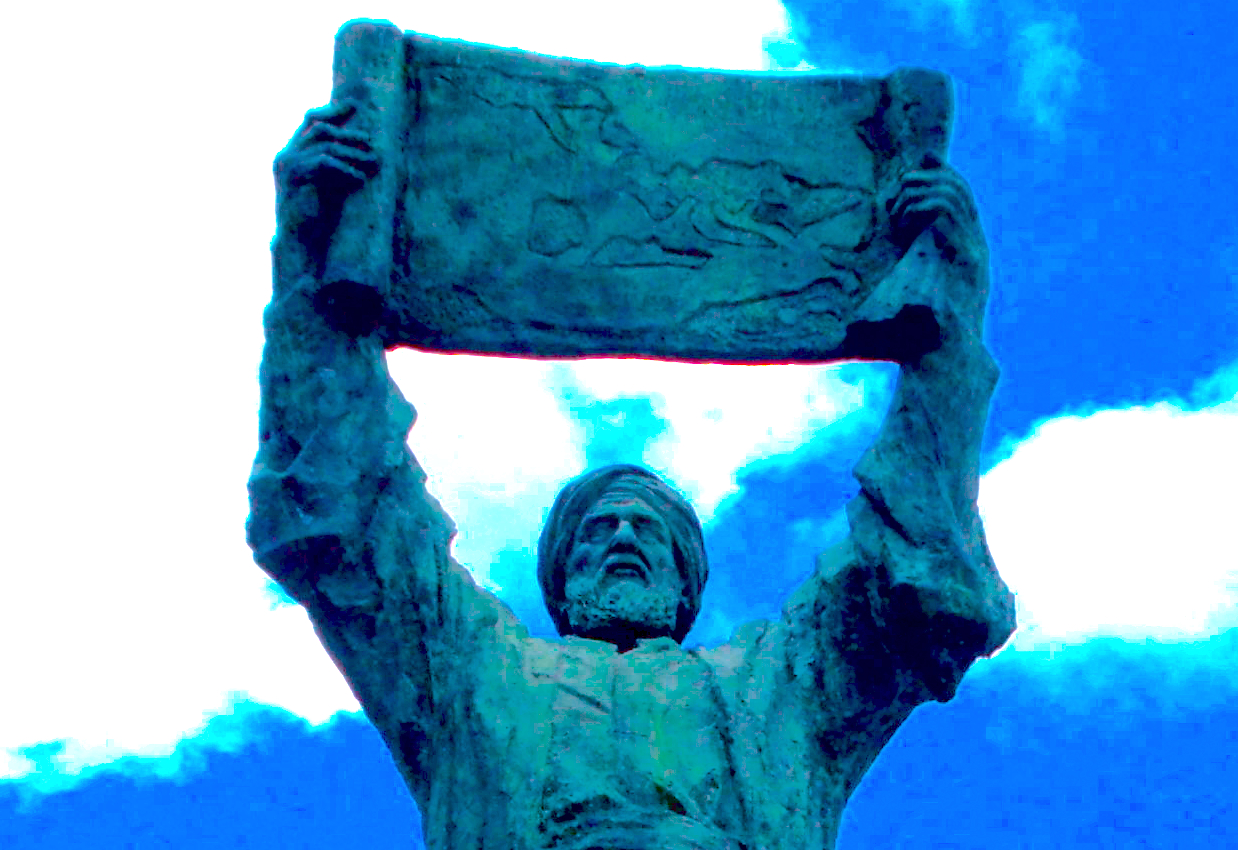
Muhammad al-Idrisi (1100 – 1165) born in Ceuta in Andalusian Spain was the Arab writer of a famous treatise on Geography that was loosely based on Ptolemy and updated through al-Idrisi’s time.  This, together, with the accompanying map has been referred to as the Tabula Rogeriana – a world map and description made by al-Idrisi for the Norman King of Sicily – Roger II in the year 1154.  The book, which was published in Paris in the year 1840, contains references to various Slavic countries in the description of the so-called “Sixth Clime.”  The sections referring to Central and Eastern Europe are found in the third section, fourth section and fifth section.  We may present them all at some point but for now we just present the description of Poland and Russia which is found at the end of the fourth section.

Sixth Clime
Section Four 

“… From Akli to Stlifanos, a large city which used to be even more important before, [it is] one day’s [travel].  We shall hereafter give an indication of the roads leading from this city to the neighboring countries.  As for Poland, a country of science and Greek [ar-Rum, i.e., Byzantine] wisemen, it is fertile, furrowed by streams, covered with towns and villages. The vine and the olive grow there as well as all species of trees and fruits. Its main cities are: Cracal, Djenazia, Anklaia, Serdawa, Neghrada and Chithow.*  They are all beautiful, flourishing and celebrated, especially because there live there men versed in the knowledge of sciences and of the Greek [Byzantine] religion and by skillful and intelligent workmen.  [As regards the city of] Cracal, Djenazia and the other towns we have just mentioned, they are filled with contiguous dwellings, possess very many resources and singularly resemble each other in their size and their appearance.  The objects which are manufactured there are nearly all of the same nature.  This county is separated from Saxony, Bohemia, and Russia by mountains which surround it on all sides.”

[* note: another reading has “Ikraku, Gnazna, Rtslaba, Srada, Ngrada, Stnu”]

Gniezno and Cracow shown in blue on the right (picture is upside down for ease of reading)

“The distances in Poland:”

“From Cracal to Masela, 130 miles
From Cracal to Djenazia, 80 miles
From Djenazia to Anclaia, 60 miles
From Anclaia to Zaca, 12 days
From Zaca to Bermowa, 180 miles
From Bermowa to Galisia, 200 miles”

“These last two countries belong to Russia”

Roger

“The principal rivers of Poland include Butent and Tessia [Tisza?]”

“They take their sources in the mountains which separate Poland from Russia, from north to south.  They flow towards the west, then unite and form a single stream which flows into the Danube to the west of Kawor [Sremski Karlovci?].”

“As for Russia, it is a vast country where there are few towns and scattered dwellings, so that to go from one region to another, one must travel immense distances through uninhabited places.   The Russians are in constant wars and disputes either among themselves or with their neighbors.  Among the cities of Russia included in this section are Sermeli, Zana, Barmounia and Galisia.  Among the cities of Russia included in this section are Sermeli, Zana, Barmunia and Galisia.  The first of these cities [Sermeli] is situated on the Dniestr, in the northern part of the course of this river which flows towards the east to Zana, a 12 day distance.  From Zana, a city on its [Dniestr’s] banks, to Barmouni, [it is a] 9 days’ [journey]. And from Barmuni to Galisia, 200 miles.”

Copyright ©2017 jassa.org All Rights Reserved

January 29, 2017

All of Thietmar’s Slavs (Books I – IV)

Published Post author

Except for some excerpts, we have not presented here the famous Chronicle of Thietmar of Merseburg.  We begin to correct that now with the first four books (out of eight),  Here are the mentions of the Slavs in Books I – IV of the Chronicle of Thietmar.  The translation by David Warner is based on the manuscript at Dresden (available in facsimile which was prepared pre-WWII; the actual manuscript was destroyed in the bombing of that city) but with additions from the other manuscript in existence that of Brussels which seems to stem from the Corvey Abbey. The Dresden manuscript seems to have been prepared by Thietmar and his team and so is superior but is incomplete due to some pages having been destroyed already prior to the sixteenth century (hence they are not part of the facsimile).  The Brussels pieces are marked with italics as done by Warner.

Book I

Chapter 3

“Merseburg had its beginning with Henry who unified the city’s holdings, legally belonging to many at the time, and treaty added to them through his virtue and industry…  Born of the noble lineage of Otto and Hadwig, he grew from boyhood like a tree in secret.  Like a flower in early spring, moreover, he gradually revealed himself to be a warrior of good character.  His father sent him with a large army to that province which we Germans call Daleminzia but the Slavs call Lommatsch*.  After much destruction and burning, he returned victorious.  But I should now relate how that region acquired its name.  Lommatsch is a spring located not more than two miles from the Elbe.  It is the source of a pool which often produces marvels, so the local populace claims, and many others have verified this with their own eyes.  If a good peace is to be expected, and the earth does not falsely promise its fruits, it is covered with wheat, oats, and acorns.  This brings joy to the hearts of the populace which frequently gathers there.  When the savage storms of war threaten, it gives a clear indication of the outcome with blood and ash.  The entire population venerates and fears this pool more than the churches, albeit with dubious expectations, and this region, which extends from the Elbe up to the Chemnitz, derives its name from it.”

* note: David Warner when translating this chose to supply the appropriate modern place names rather than the archaic form used by Thietmar (here Glomaci). “Widukind notes that the defeated Daleminzi subsequently called on the Hungarians for aid.  As the first known raid by the Hungarians occurred in 906, it has been assumed that Henry’s campaign occurred in the same year,  As a king, Henry continued and even intensified his aggressive posture towards the Slavs and, by 929, had sufficiently dominated them that they could be forced to pay tribute.”

Chapter 4

“While returning from an expedition against the Bohemians, Bishop Arn of Wurzburg set up his tent near this river, in the region of Schkeuditz, on a hill by the road leading to the north.  As he changed the mass, he was surrounded by a hostile army.  After all his companions had been martyred, he too was offered to God, along with the host which had been consecrated to these sacrifice of praise.  This occurred in the year 892 of the Incarnation and in the times of Emperor Arnulf.  Nowadays, burning lights are often seen there and not even the Slavs doubt that these are the holy martyrs of God.  During his period of office, the aforementioned priest built a templet God in the city of Wurzburg and, in ten years, built nine churches on the same model within his bishopric…”

Chapter 10

“As I will be speaking of Otto, I think it unnecessary to discuss each of his father’s accomplishments.  The extent of King Henry’s dignity can be perceived in his son and, in any case, the brilliance of his life shines sufficiently in the writings of many others [presumably a reference to Widukind whose chronic forms the basis for this chapter].  But I will add certain things which I find particularly noteworthy.  He made the following regions pay tribute: Bohemia, Daleminzia, and the lands of the Abodrites, Wilzi, Hevelli, and Redarii.  They immediately rebelled and, inciting others to join them, attacked, destroyed and burned the burg Walsleben.  To avenge this, pour army convened and besieged the burg Lenzen.*  Meanwhile, they beat back and utterly defeated a counterattack by the burg’s defenders, allowing only a few to escape.  The burg was also taken.  Among our people, two of my great-grandfathers, both named Liuthar, fell with many others on 5 September.  They were distinguished men, the best of warriors, of illustrious lineage, and the honour and solace of the homeland.”

* “A Slavic burg located approximately 50 kilometers north-west of Havelberg, at a strategic crossing over the river Elbe.  The Saxons occupied it in 929, and in 948 it was assigned to to the bishops of Havelberg.  After the Slavic uprising of 983, it was occupied by the Abodrites.”

Chapter 16

“He [Henry I]* established a settlement on a then densely forested mountain next to the Elbe and built a burg there which he called Meissen from a certain brook which flowed from it in a northerly direction [928/929].  As is the custom today, he strengthened it with a garrison and certain other remeasures.  From here, he compelled the Milzeni, already subject to his will, to pay tribute.  Furthermore, after long besieging the burg Lebusa, of which I will speak more extensively later, he forced the residents to flee to a small inner fortress and then to surrender. From that day, om which he justly destroyed by fire, to the present, the burg has been uninhabited.  If, as many say, Henry enriched himself unjustly during his reign, may merciful God forgive him.”

* Henry I died in 936.

Book II

Chapter 2

[years 929-935] “Many adversities disturbed his fortunes.  For the wicked Boleslav [I], having killed his brother Wenceslaus, Duke of the Bohemians and faithful to God and the king, remained full of pride for a long time.  But afterwards, the king conquered him by force and placed him in the custody of his brother Henry, the duke of the Bavarians [i.e., in 950].  The Hungarians, once enemies of his father but long pacified, again invaded but quickly retreated [February 937].  No small amount of discord arose among our fellow countrymen and colleagues who incited Tammo, son of the king and Liudgard.  All of this because the office formerly possessed by Count Siegfried of Merseburg,m which he claimed for himself, had been given to Margrave Gero and, so it appeared, Tammo’s maternal inheritance was to be entirely taken away from hi,.  The king besieged his son in the Eresburg and tried to move him from his evil presumption both with threats and promises.  But then the army entered the captured city and drove the youth, exhausted by the fighting, to retreat to the church of Saint Peter where previously the ancient Irminsul had been worshipped.  At last, pierced from behind through a window by Maginzo’s lance, he died before the altar [28 July].  Later, in the second year of his reign, the king punished Maginzo with a cruel death.”

Chapter 12

“As these events were transpiring, the Slavs started a horrible war at the instigation of Counts Wichman and Ekbert under the leadership of Nacco and his brother Stoignew.  Lacking confidence in his own ability to defeat them, the commander, Herman, asked the king for help.  Energetic as he was, the latter took  a strong force and invaded those northern regions which, as scripture teaches, so often produce evil [Jerome 1:14].  There, the king had Stoignew beheaded, after capturing him in a wood in which he had hidden as his supporters fled.  He pursued the authors of this outrage, the brothers Wichman and Ekbert, sons of his maternal aunt…”

Chapter 14

“…Gero, margrave of the eastern march, subjugated Lausitz, Selpuli, and even obligated Miesco [I of Poland] and his subjects to pay tribute to the emperor.  Duke Herman also made Selibur [of the Wagri], Mistui [of the Abodrites], and their followers pay tribute to the emperor.”

Chapter 22

“The emperor summoned Richer, the third abbot of the church of Magdeburg – for Anno and Otwin, then bishops, had preceded him – and wanted to decorate him with the episcopal dignity.  But after examining a letter which had been secretly given to him, he changed his mind.  Instead, he chose the monk Adalbert of Trier who had been previously ordained bishop for Russia but expelled by the heathen.  Otto promoted that illustrious and much-tested father to the archiepiscopal dignity on 18 October, in the year 970 of the Incarnation, and with papal authority.  Then, he sent him to his see with great honour, ordering all the leading  men of Saxony to be with him at the next celebration of Christmas.  The archbishop was received with magnificence by the clergy and the whole populace.  During these feast days, he consecrated Boso as first pastor of the church of Merseburg, Burchard as foist overseer of the church of Meissen, and Hugh as first bishop of Zeitz.  Also present was Dudo, the first guardian of Havelberg who had been previously consecrated.  All of these promised obedience to him and to his successors and to each was conveyed his specific diocese.  Thietmar, first pastor of the church of Brandenburg who had been previously consecrated and Jordan first bishop of Poznan joined these brethren.”*

* Bishop Jordan of Poznan (968 – 984) arrived in Poland as part of the entourage of Dobrawa, wife of Mieszko I.

Chapter 29

“Meanwhile, the illustrious Margrave Hodo collected an army and attacked Miesco [Mieszko I] though the latter was faithful to the emperor and paid tribute for territory extending to the river Warta.  Only my father, Count Siegfried, then a young man and unmarried, came to his aid with warriors of his own.  When the battle began at Zehden, on the feast of John the Baptist, they were initially successful [24 June 972].  But then Mieszko‘s brother, Cidibur [Czcibor], attacked and killed all the best warriors, with the exception of the two counts.*  The emperor was very  disturbed when he learned this miserable news and sent representatives from Italy who ordered Hodo and Miesco to leave off their fighting and preserve the peace until he returned, or risk losing his favour.”

* This refers to the Battle of Cedynia.

Chapter 31

“From thence, he went to Quedlinburg to celebrate the upcoming feast of Easter with divine praise and earthly joy [23 March 973].  Here also, at the emperor’s order, Dukes Miesco and Boleslau, and legates of the Greeks, Beneventans, Hungarians, Bulgarians, Danes, and Slavs gathered along with all the leading men of the kingdom.  When all matters had been settled peacefully and gifts had been distributed, they went home satisfied.  But the emperor’s joy was disturbed when Duke Herman died there on 1 April.  While his son Bernhard was preparing to transport Herman’s body to Luneburg, he encountered Bishop Bruno of Verden, who was near by.  Because the bishop had placed the duke under the ban during his lifetime, the son tearfully asked that he might immediately grant absolution and permit burial in the church.  But his request was not granted.”

Chapter 37

For a portion of this chapter dealing with the Slavs see here.

Chapter 38

“Because i have already spoken briefly about Duke Conrad, the emperor’s son-in-law who was killed at the river Lech, I believe that it would be appropriate for me to reveal certain things which were not discussed at that time.  Much later, during a stay at Merseburg, the emperor learned from an informant that the Slavs at Zwenkau under lord Kuchawiz, whom he much esteemed, had possession of the duke’s armour.  With Kuchawiz‘s aid, a judicial duel was held and the losers were hanged at the emperor’s order.  Most of the booty was restored.  I do not know whether they took these things as murderers or, without guilt, discovered the duke’s death by chance.  In any case, they rightly paid with their lives for having presumed to keep this secret.”

Chapter 42

“In the days of the previously mentioned emperor, there was a certain count, named Hed, who built a church in Heeslingen in honour of the athlete of Christ Vitus.  Because he had no heir, he endowed it with the greatest part of his property and, after establishing a congregation of nuns there, placed the same abbey under the protection of Archbishop Adaldag of Bremen.  But alas, the two venerable matrons who were placed over this foundation – each named Wendelgard – died quickly…”

Book III

Chapter 1

“…The emperor looked upon the still impoverished bishopric of Merseburg with generous concern, giving to Bishop Giselher, whom he loved greatly, first the abbey in Pohlde and then the burg Zwenkau with all its appertinences, this for the service of Saint John the Baptist.  He also granted to him whatever lay within the walls of Merseburg, including the Jews, the merchants, and the mint; also the forest between the river Saale and the Mulde or rather between the districts of Siusuli and Pleissnerland; as well as Kohren, Nerchau, Pausitz, Taucha, Portitz, and Gundorf.  All of this was conveyed through a diploma which he confirmed with his own hand.”*

* The various back & forths regarding these lands conducted by bishops and emperors should not cause us to lose sight of the fact that the lands at the time consisted primarily of Slavic villages.

Chapter 4

“…By election and by the emperor’s grant, Warin was quickly amnointed in his place [as archbishop].”

Chapter 7

“In the year 976 of the Incarnation of the Lord, Henry, duke of the Bavarians, fled to Bohemia after being deprived of both his office and the communion of the church.  While he was residing there, with Duke Boleslav, the emperor attacked with a strong army, but gained nothing at all against these two.  Moreover, through the treachery of one of Boleslav‘s warriors, he lost a great troop of Bavarians who were coming to his aid had just set up camp next to the burg Pilsen.  In the evening, the Bavarians were washing themselves without having set a guard for security.  Suddenly, the mailed enemy arrived and cut them down as they ran naked to their tents and through the meadow.  The enemy returned with all of their booty, happy and unharmed.  Hearing of the loss of so many men, and knowing that no other route of rerun was accessible to him, the emperor went directly to his burg at Cham.  In the following, he brought the duke to submission as the latter sought refuge at Passau.  In the next year, Duke Henry, Count Ekbert, and Bishop Henry were accused before the emperor at Magdeburg.  Afterwards, they were captured and sent into a long exile.

Chapter 11

“While the emperor was still in Rome, Archbishop Adalbert, in the thirteenth year after his consecration, was traveling around Bishop Giselher’s dopes, teaching and confirming his flock – this because Giselher himself was then with the emperor.  He celebrated mass at Merseburg on 19 June and happily spent the following night in Corbetha with Hermuzo, an honorable layman.  The next morning, after arising, he complained bitterly of a severe headache.  He departed nonetheless.  When he had passed through the village of Zscherben, on the way to Freckleben, he began gradually to sink down on his horse and would have fallen to the ground had he not been supported by his companions…”

Chapter 16

“After receiving the emperor’s permission, Giselher came to Magdeburg, on 30 November, in the company of Bishop Dietrich of Metz.  Dietrich was a friend of the emperor and very dear to him.  He also belonged to that group of corrupt men who, in return for obscuring the truth, had accepted one thousand pounds of gold an silver from the archbishop.  One morning, at the emperor’s order, someone jokingly blessed Dietrich in the following manner: ‘May God satisfy you with gold in the hereafter since we here cab by no means do so!’ Then everything previously belonging to our church was wretchedly divided, as if in accord with the custom of the Slavs by which, after a family has been accused, its property is dispersed by being put up for sale.  Bishop of Zeitz received that part of our diocese which lay between the Saale, Elster, and Mulde rivers; and between the districts of Pleisse, Wethau and Teuchern; and including the villages of Possen and Pissen [Bishop Frederik of Zeitz was bishop circa 980 – circa 990].  Bishop Folkold of Meissen was given a piece which included the villages of Wechselburg and Lastau and pertained to eastern Schkeuditz, being bordered by the rivers Chemnitz and Elbe.  For himself, Giselher kept nine burgs, namely: Schkeuditz, Taucha, Wurzen, Puechen, Eilenburg, Dueben, Pouch, Loebnitz and Zoecheritz.  Documents which conveyed royal or imperial gifts he either burned or, by altering the name of the recipient, mad ether refer to his own church.  Payers of tribute, and everything that was supposed to belong to Merseburg, he intentionally scattered so that they might never be gathered together again.  He established an abbey at Merseburg itself and set over it Ohtrad, a venerable monk of the monastery of Saint John.  Later he gave it to Heimo who came front he same monastery.  But note, O reader, what came of this destruction!”

Chapter 17

“Margrave DIetrich’s arrogance so irritated peoples who had already accepted both Christianity and the status of tribute payer in regard to our kings and emperors, that their members unanimously decide to take up arm’s.  This turn of events was predicted to my father, Count Siegfried, in the following way.  In a dream, he saw a sky filled with dense clouds.  Astonished, he asked what it meant and a voice replied: ‘Now that prophecy must be fulfilled: ‘God allows the rain to fall both on the just and the unjust.” [Matthew 5:45]  The outrage began on 29 July, with the murder of the garrison and destruction of the cathedral at Havelberg.  Three days late, at the sounding of prime, the entire band of Slavs attacked the bishopric of Brandenburg, a see established beyond Magdeburg some thirty years previously.  Folkmar, the third bishop of that seem had already fled, and his defender, Dietrich, barely escaped with his warriors on the same day as the attack.  The clergy who remained were captured.  The second bishop, Dodilo, was dragged from his tomb.  He had been strangled by his own people and, though three years in the grave, his body and priestly vestments were as yet uncorrupted.  The greedy dogs then plundered him and carelessly threw him back again.  They also stole all of the church’s treasures and brutally spilled the blood of many.  Thus various cults of demonic heresy were venerated instead of Christ and his fisherman., the venerable Peter.  And not only the heathen praise this sorrowful change, but also Christians!”

Chapter 18 

“In those times, the church of Zeitz was captured and wasted by an army of Bohemians under the leadership of Dedi.  Its first bishop, Hugh, had already fled.  Afterwards, the Slavs devastated the monastery of Saint Lawrence at Calbe and pursued our people as if they were so many fleeing deer.  Our spirits were fearful because of our sins, but their spirits were strong.  Duke Mistui of the Abodrites burned and ravaged Hamburg which was formerly the residence of the bishop.  Yet all of the Christendom should piously note the miracle that Christ performed there from heaven.  A golden hand came down from the highest regions and, with outstretched fingers, reached into the middle of the fire.  This occurred in full view of all.  The army looked on in astonishment, and Mistui was both terrified and dumbfounded.  This incident was related to me by Avico who was then Mistui’s chaplain, but later became my spiritual brother.  We both came to the conclusion that God had, in this way, taken the relic up to heaven and, at the same time, terrified and put the enemy to flight.  Later, Mistui lost his mind and was held in chains. After being immersed in water that ha been blessed, he shouted: ‘Saint Lawrence is burning me!’ But before he could be freed, he died wretchedly.

Chapter 19

“By the time the Slavs had burned and pillaged all the burgs and villages as far as the river Tanger, there were more than thirty bands of warriors on foot and horseback.  Without sustaining any losses and aided by their Gods, they did not hesitate to ravage the rest of the region, as their blaring trumpets preceded them.  We did not remain unaware of these events.  Bishops Giselher and Hildeward joined with Margrave Dietrich and with the other counts: Rikdag, Hodo, Benizo, Frederick, Dudo, my father Siegfried, and many others.  At dawn, on Saturday, they heard mass together.  Then, after fortifying body and spirit with the sacrament of heaven, they confidently fell upon the approaching enemy and, except for a few who found refuge on a hill, completely annihilated them.  The victors praised God, marvelous in all his works, and the truthful word of the treater, Paul, was confirmed: There is neither prudence nor strength nor counsel against the Lord. [actually from Proverbs] Utterly abandoned were those who had once dared to reject God and stupidly chose to worship meaningless idols, which they themselves had made, rather than their own creator.  Unfortunately, as night approached and our forces made camp some distance await, the Slavs of whom I have spoken above furtively escaped.  The next day our people happily returned to their homeland, after sustaining only three casualties.  While on their way, or once they were at home, they were congratulated by everyone they encountered.”

Chapter 21

[this describes Otto’s campaign in Italy in July 982]

“Along with Duke Otto and several others, the emperor fled to the sea where, in the distance, he spotted a ship f the type known as a salandria.  He hurried out to it on a horse belonging to the Jew Calonimus but the ship’s crew refused to take him in and continued on their way.  Returning to the safety of the shore, he found the Jew still standing there, anxiously awaiting the fate of his beloved lord [or the return of his stolen horse :-)].  When the emperor saw that his enemies had also arrived on the scene, he sorrowfully asked this man: ‘What now will become of me?’  Suddenly, he noticed that a second salandria was following the first once, and realized that a among the ship’s occupants was a friend who might be expected to help him.  Once again, he urged his horse into the water hand hurried out to the ship where he was recognized only by his warrior Henry, whose Slavic name is Zolunta.  He was taken on board and placed in the bed of the ship’s commander.  Eventually, the commander also recognized him and asked if he was the emperor.  After denying out for some time, Otto finally conceded and declared: ‘Yes, it is I, reduced to this miserable state because of my sins.  But listen carefully to what we may now do together.  I have just lost the best men of my empire and, tormented by this sorrow, can never again set foot in this land and have no further desire to see those who have befriended it.  Only, let us go to the city of Rossano where my wife awaits my arrival.  We will take he and all the treasure, of which I have an unspeakable amount, and go to your emperor, my brother.  As I hope, he will be a loyal friend to me in my time of need.’  Delighted at this pleasant conversation, the ship’s commander hurried day and night to reach this place.  As they approached their destination, the warrior with the two names [i.e., Henry/Zolunta] was sent ahead to summon the empress and Bishop Dietrich, who accompanied her, and also to fetch the many treasure-lade pack animals.”

Chapter 24

“… In the year 983 of the Incarnation of the Lord, the emperor held court at Verona and Henry the Younger, having been released from exile, was made duke of the Bavarians.  And in this same year, the Slavs united in resistance to the emperor and Margrave Dietrich.  Also, the emperor’s son was unanimously elected lord.”

Book IV

Chapter 2

“After leaving Magdeburg, Henry went to Quedlinburg to celebrate the joyful feast of Easter.  The great men of the duchy also gathered there, and some who did not wish to come in person sent a representative who was to scrutinize everything carefully.  During the celebration, the duke’s supporters openly greeted him as king and he was honoured with divine laudes.  Dukes Miesco, Mistui and Boleslav converted there along with innumerable others and swore oaths confirming their support for him as king and lord.  Many others, not daring to violate their oath to the king, for fear of God, withdrew somewhat and hurried to the Asselburg where there allies, now openly plotting against the duke, were meeting.  These are their names: from the East, along with Duke Bernhard and Margrave Dietrich, there were the Counts Ekkehard, Binizo, Esiko, the count and priest Bernward, Siegefried and his son, the brothers Frederich and Ziazo; from that region also were the brothers Dietrich and SIgbert, Hoiko, the brothers Ekkehard and Bezeko, Brunig and his brother; and, at the order of Archbishop Willigis, the milites of Saint Martin, joined by a great multitude from the West.”

Chapter 5

“In the company of his supporters, Henry then sought out Boleslav [II], duke of the Bohemians, who had always been willing to help him, whatever the circumstances.  The duke receive him honorably and had his army conduct hiom from the boundaries of his territory through those of the territories of Nisan and Daleminzia as far as Muegeln.  Then, with our people coming to meet him, he proceeded to Magdeborn.  Meanwhile, one of Duke Boleslav of Bohemia‘s milites, Wagio, who had been among the trips which ac companied Henry, stopped at Meissen while making his way home.  After conversing with the inhabitants of the place, the had an intermediary invite Frederich, ally and warrior of that Margrave Rikdag, whip then resided at Merseburg, to meet with him for a discussion at a certain church outside of the city.  As he went out, however, the door closed after him.  Rikdag, guardian of that city and a celebrated warrior, was ambushed and killed by them, at a stream called Triebischbach.  The city was soon furnished with a garrison by Boleslav and it quickly accepted him both as lord and resident.”

Chapter 6

“At the instigation of the ever capricious people, Boleslav drove out Bishop Folkold, who then went to Archbishop Willigis and was accorded a friendly reception.  The bishop had nourished him as if he were his own son and, when sent to those eastern regions, had warmly recommended to Otto II that WIlligis succeed him as the king’s teacher.  WIlligis never forgot this favour and acknowledged it with all gratitude, especially now, when Folkold was in greatest need.  He ordered that Folkold be cared for and given every consideration, at Erfurt, a location the bishop himself had chosen.  After residing there [at Erfurt] for a long time, he was able to return to his own see after Margrave Rikdag died and was succeeded by the illustrious Ekkehard, and when Boleslav returned to his own lands [October/November 985].  Afterwards, he became Boleslav‘s close friend.  When he was in Prague, where he had celebrated Maundy Thursday and, on the following day, which is Good Friday, he was rightly proceeding with the memory of he divine passion, he was paralysed vt stroke and had to be carried away…”

Chapter 9

“The king celebrated the next fewest of Easter at Queldinburg where he was ministered to by four dukes: Henry at his table, Conrad as chamberlain, Henry ‘the Younger’ as cellarer, Bernhard as marshal [April 4, 986].  Boleslav and Miesco also came here with their followers and, after everything was taken care of, departed again, richly endowed with gifts.  In those days, Miesco commended himself to the king and, along with other gifts, presented him with a camel.  He also joined the king on two expeditions… The king did not cease to assault the Slavs with many harsh campaigns [June – July 986].  He also conquered certain peoples in the East, who presumed to rise up against him.  In the West he contended by force and guile to conquer an enemy which repeatedly took up arms and plundered far and wide.  It is unnecessary to describe Otto’s childhood, and it would take too long to recount what he accomplished with the advice of prudent counsellors.”

Chapter 11

“At that time, Miesco and Boleslav [II] had a falling out and did much damage to one another.  Boleslav called on the aid of the Liutizi who had always been loyal to him and to his forefathers. But Miesco sought help from Empress Theophanu.  She was then in Magdeburg and sent Giselher, archbishop of that place, and the counts, Ekkehard, Esiko, and Bizino, along with my father and another of the same name, and with Bruno, Udo, and several others.  With barely four weak bands, they set off for the region called Selpuli.  While under way, they stopped by a swamp, over which a long bridge extended.  On the previous day, one of Willo’s companions had been captured by the Bohemians as he was going ahead of the group to inspect his land.  Now, in the silence of night, he escaped and gave Count Binizo the first news of an imminent attack.  At his warning, our forced quickly roused themselves and prepared for battle.  They heard mass in the grey dawn, some standing, others on horseback; and, anxious about the outcome of the coming battle, left their encampment as the sun rose.”

Chapter 12

“Then, on 13 July, Boleslav came with troops and both sides sent out scouts.  From Boleslav‘s side, a certain miles named Slopan approached to inspect our forces.  After returning, his lord asked for his opinion regarding this army and whether or not he would be able do battle with it.  Indeed, his milites had demanded that none of our people be permitted to depart alive.  Slopan offered him the following assessment: ‘This army is small in number, but of the best quality and armed richly in iron.  It is possible for you to do battle with it, but should the victory fall to you, you will be so weakened that you will have to flee your enemy Miesco and will only escape his constant harassment with great effort, or perhaps not at all.  Moreover, you will acquire the Saxons as your enemy in perpetuity.  If you are defeated, it will mean your end and that of your entire kingdom.  There will remain no hope of resistance for you, surrounded everywhere by the enemy.’  Boleslav‘s fury was calmed by these words and, after peace had been concluded, he asked our leading men, who had come to attack him, if they would go with him to Miesco and, in the matter of restoring his property, put in a good word with that prince.  Our people agreed to this and Archbishop Giselher, Ekkehard, Esiko and Benizo went with him.  All the rest departed for their homes in peace.  Now, with the day turning to evening, all were relieved of their arms until an oath was sworn, after which they were returned.  Boleslav came with our people as far sat the Oder.  There, a messenger was sent to tell Miesco that his allies were in Boleslav‘s power.  If he were to return the lands he had seized, he would permit these men to depart unharmed, if not, all would die.  But Miesco responded to him in these words: ‘If the king wishes to rescue his people or avenge third eats, he may do so.  In any case, he would not give up anything for their sake.’  When Boleslav heard this, he plundered and burned the surrounding areas as much as he could but left all of our people unharmed.”

Chapter 13

 “Returning from there, he besieged a fortress called […] and, with no opposition from the occupants, he conquered it along with its lord, whom he ave to the Liutizi for decapitation.  Without delay, this sacrificial victim was offered to their supportive Gods in front of the city and all departed for home.  Boleslav knew that, without his help, our forces could not reach home without being attacked by the Liutizi.  Thus, he dismissed our people at dawn on the following day and warned them to move quickly.  As soon as their enemies learned of this, they were eager to go after them with a large band of chosen warriors.  Boleslav was barely able to restrain them with words such as these: ‘You who came to help me, see that you complete what you have undertaken.  Know that I took those men under my protection and dismissed them in peace; and, as long as I live, I will not suffer even one of them to be harmed today.  It would be neither honorable nor wise for us to turn close friends into open enemies.  I know of the hatred between you, but you will find much more suitable occasions for satisfying it.’  After calming the Liutizi with words such as these, he managed to detain them for two more days.  Then, after taking leave of one another and renewing their ancient alliance, they departed.  Now, those infidels chose two hundred warriors who followed our force which were few in number.  Our forces were soon informed of this by one of Margrave Hodo’s milites.  Immediately quickening their pace, they arrived in Magdeburg unharmed (thank God!), while their enemies labored in vain.” 

Chapter 18

“Meanwhile Archbishop Adaldag of Bremen died and was succeeded by Liawizo who, from his homeland between the Alps and Swabia, had followed there exiled Pope Benedict here and so had put forward a claim to this office before God and the king [29 April 988].  After there fortresses on the Elbe were restored, the Slavs were attacked and made subject to the king.  In the winter, a flood and a great wind did much damage.  Excessive heat did great damage to the crops and many people died from a savage pestilence…*”

* as in Annales Quedlinburgenses under 987 and 988.

Chapter 19

“…In the fourth year, a great pestilence broke out in the eastern regions along with famine and war [995].  Also the king attacked the Abodrites and ravaged the lands of the Wiltzi.”

Chapter 21

“…The preceding winter [994] had been harsh, unhealthy, cold, windy and unusually dry.  At this time, the Slavs were defeated.”

Chapter 22

“But because I have spoken above about the destruction of the church of Brandenburg, now I will briefly explain how it was subjected to the king for a time.  In our vicinity, there was a celebrated miles, named Kizo, who was treated by Margrave Dietrich in a manner that did not please him.  Because of this and because no other means were available to him, he went over to our enemies.  The latter, recognizing him to be entirely faithful to them in all things, commended the above-mentioned burg to him in order to harm us that much more.  But after being mollified by our flattery , he surrendered it and himself into the king’s power.  Thereafter, the Liutizi, burning with anger, attacked him there with every available warrior [October 995].  Meanwhile, the king was in Magdeburg.  When informed of the situation, he quickly sent all the forces he had with him: Margrave Ekkehard, my three maternal uncles, Frederick the count palatine, and my paternal uncle.  As they were arriving there together, along with their forces, they were dispersed by a ferocious enemy attack.  After a number of millets had been killed, one part of our orcs managed to reach the fortress, the remainder had to retreat.  Then, after assembling supporters from all sides, the king himself quickly went there.  The enemy was severely pressing the burg’s defenders, but when they saw our forces in the distance, they quickly abandoned their camp and fled.  Rejoicing in their liberation, the defenders sang Kyrie eleison, and those who were approaching responded with one voice.  The king provided the burg with a a garrison and, after his departure, held it for a long time.  Later, when Kizo came to Quedlinburg, he was deprived not only of his burg, but his wife and milites as well.  Afterwards, he received everything back, except for the burg.  The burg was placed in the power of one of his warriors called Boliliut, on whose advice all of this had been done though he was not then present.  But Kizo, the best of warriors, secretly tried to exact revenge in those regions and was killed, along with his supporters.”

Chapter 28

“In the beginning of the summer, Adalbert, bishop of the Bohemians, arrived.  He had received the name Woyciech at his baptism, the other name, at his confirmation, from the archbishop of Magdeburg.  He was educated in letters, in that same city, Ochtrich about whom we have already spoken.  As he was unable to separate his flock from the ancient error of wickedness through godly teaching, he excommunicated them all and came to Rome to justify himself before the Pope.  For a long time, wit the Pope’s permission, he lived an exemplary life according to the strict rule of Abbot Boniface.  With the same Pope’s permission, he later tried to subdue the Prussians, their thoughts still estranged from Christ, with the bridle of holy preaching.  On 23 April, pierced by a spear and beheaded, he alone received the best martyrdom, without a groan.  This occurred just as he himself had seen it in a dream and had predicted to all the brothers, saying: ‘I thought I saw myself celebrating mass and communicating alone.’ Seeing that he had now died, the authors of this wicked crime increased both their wickedness and the vengeance of God by throwing the blessed body in the water.  His head, however, they scornfully transfused with a stake.  They returned home with great joy.  After learning of this,  Boleslav, Miesco’s son, immediately purchased both the martyr’s celebrated body and his head.  In Rome, after the emperor had been informed, he humbly offered praises to God because, during his lifetime, he had taken such a servant for himself through the palm of martyrdom…”

Chapter 29

“After departing from Romania, the emperor visited our regions and, having learned of a rebellion of the Slavs, advanced with an armed force on Stoderania which is also called the land of the Hevelli [latter half of May 997].  After wasting these lands with fire and great plundering, he returned victorious to Magdeburg [post-20 August].  Because of this, a great multitude of our enemies attacked Bardengau, but were conquered by our forces.  Bishop Ramward of Minden took part in that battle.  Followed by the standard-bearers, he had taken up his cross in his hands and ridden out ahead of his companions, thereby greatly encouraging them for battle.  On that day, Count Gardulf died along with a few others, but among the enemy, a great number were killed.  There remainder fled after abandoning their booty.”

Chapter 38

“Let us recall to memory what wretched damage occurred to Archbishop Giselher because of his carelessness.  For the protection of our homeland, the emperor had the Arneburg reinforced with necessary defensive works and policed it in Giselher’s custody for a period of four weeks [early to mid-June 997]  Through some as yet unknown ruse, he was invited to a meeting with the Slavs and went out, accompanied only by a small entourage.  Some went ahead, while others remind in the fortress.  Suddenly, one of his companions announced that their enemies were bursting out of the woods.  After milites from both sides were joined in combat, the archbishop, who had been traveling in a cart, fled on a fast horse.  Only a few of his companions escaped death.  Thus, the victorious Slavs plundered the belongs of the dead in complete security – it was 2 July – and complained only that the archbishop had escaped.  In spite of the fact that his forces had been so severely cut up, Giselher guarded the fortress up tp the agreed upon day.  While he was returning home, in great sadness, he encountered my paternal uncle, Margrave Liuthar, in whose care the aforementioned burg was now to reside.  Without hesitation, he commended it to him and departed.  When the margrave arrived, he saw smoke and fire coming from the fortress.  A messenger was sent to request that the archbishop return, but without success and Liuthar himself tried to put out the fire, now raging in two different places.  When nothing came of theism he surrendered the portal, open to the enemy, and sadly returned home.  Afterwards, when complaints about him were brought before the emperor, he purged himself of any guilt by swearing an oath.  Nine days after the aforementioned slaughter, on 13 July, my mother, Cunegunde, died at burg Germersleben.”

Chapter 45

“When he arrived at Zeitz, the emperor was received in a manner appropriate to an emperor by Hugh II, third pastor of that see [circa 10 February].  Then he went by a direct route to Meissen where he was honorably received by Eid, the venerable bishop of this church, and by Margrave Ekkehard whom he regarded highly.  Then, having traversed the territories of the Milzeni, he was met as he arrived at the district of Diadesi by Boleslav whose name is interpreted as ‘greater praise’ not by merit but by old custom.  With great rejoicing, Boleslav offered the emperor hospitality at a place called Eulau.  It would be impossible to believe or describe how the emperor was then received by him and conducted to Gniezno.  Seeing the desired city from afar, he humbly approached barefoot.  After being received with veneration by Bishop Unger, he was led into the church where, weeping profusely, he was moved to ask the grace of Christ for himself through the intercession of Christ’s martyr.  Without delay, he established an archbishopric there, as I hope legitimately, but  without the consent of the aforementioned bishop to whose diocese the whole region is subject.  He committed the new foundation to Radim, the martyr’s brother, and made subject to him Bishop Reinbern of Kolobrzeg, Bishop Poppo of Krakow, and Bishop John of Wroclaw, but not Unger of Poznan.  And with great solemnity, he also placed holy relics in an altar which had been established there.”

Chapter 46

“After all issues nada been settled, the duke honoured Otto with rich presents and, what was even more pleasing, three hundred armored warriors.  When the emperor departed, Boleslav and an illustrious entourage conducted him to Magdeburg where they celebrated Palm Sunday with great festivity [24-25 March]…”

Chapter 55

“I cannot place in its correct order everything that ought to be treated within the context of this book.  In what follows, therefore, I will not be embarrassed to add a few recollections.  Indeed, I rejoice in the change of pace much as the traveller who, because of its difficult or perhaps from ignorance, leaves the course of the more direct road and sets out on some winding secondary path.  Hence, I will relate the remaining deeds of Miesco, the celebrated duke of the Poles, who has already been treated in some detail in the previous books.  He took a noble wife from the region of Bohemia, the sister of Boleslav the Elder.  Her life corresponded to her name – she was called Dobrawa in Slavic, which, in German, means ‘the good’.  For this one, faithful to Christ, and realizing that her husband was mired in various heathen errors, turned her humble spirit to the task of binding him to the faith as well.  She tried in every way to conciliate him, not because of the threefold appetite of this evil world but rather for the sake of the admirable and, to all the faithful, desirable fruit of future salvation.”

Chapter 56

“She sinned willingly for a while, that she might later be good for a long time.  For during Lent, which closely followed he marriage, though she intended to offer an acceptable tithe to God by abstaining from meat and through the affliction of he body, her husband asked and tried to coax her into giving up her plan.  She consented, thinking that he might therefore be more willing to listen to her on some other occasion.  Some say that she only ate meat during a single Lenten period, others say three.  Now, O reader, you have heard her sin, now also consider the attractive fruit of her pious will.  She labored for the sake of her husband’s conversion and was heard by the Creator in his kindness; and through his infinite goodness that most zealous persecutor came to his senses.  After being admonished frequently by his beloved wife, he vomited out the poison of his unbelief and, in holy baptism, wiped away the stain of his birth.  Immediately, members of his hitherto reluctant people followed their beloved head and lord and, after accepting the marriage garments, were numbered among the wards of Christ.  Jordan, their first bishop, labored much with them, while he diligently invited them by word and deed to the cultivation of the heavenly vineyard.  Then the couple rightly rejoiced, namely the man and the noble woman, and all who were subject to them rejoiced at their marriage in Christ.  After this, the good mother gave birth to a son who was very different from her and the misfortune of many mothers.  She named him Boleslav, after her brother.  He first revealed his innate evil to her and then raged against his own flesh and blood, as I will reveal in the following.”

Chapter 57 [977]

“But when his mother died, his father married Margrave DIetrich’s daughter, a nun at the convent called Calbe, without the approval of the church.  Oda was her name and great was her presumption.  She rejected her celestial spouse in favour of a man of war, which displeased all the pastors of the church but most of all her own bishop, the venerable Hildeward.  But the welfare of the land, and the need to strengthen the peace, kept this from leading to a break; rather it provided a healthy and continuous incentive for reconciliation.  For she increased the service of Christ in every way: many captives were returned to their homeland, prisoners were released form their chains, and the prisons of those who had been accused were opened.  O hope that God will forgive her the magnitude of her sin, since such love of pious deeds was revealed in her.  We read, however, that he who does not entirely abandon the evil he has begun, will try in vain to placate the Lord.  She bore her husband three sons: Miesco, Swentepulk and…  She passed her life there, highly honoured, until her husband’s death.  She was beloved among those with whom she lived and useful to those from whom she had come.”

Chapter 58

“But on May 25, in the year of the Incarnation 992, the tenth year of Otto III’s kingship, the aforementioned duke, now old and feverish, went from this place of exile to his homeland, leaving his kingdom to be divided by many claimants.  Yet, with fox-like cunning, his son Boleslav unified it once more in the hands of one ruler, after he had expelled his stepmother and brothers, and had their familiars Odilien and Przibiwoj blinded.  That he might be able to rule alone, he ignored both human and divine law.  He married the daughter of Margrave Rikdag, but later sent her away and took a Hungarian woman as his wife.  She bore him a son, named Bezprym, but he also sent her away.  His third wife was Emnilde, a daughter of the venerable lord, Dobromir.*  Faithful to Christ, she formed her husband’s unstable character completely for the better and strove unceasingly to wash away both of her sins through the generous dispersal of alms and abstinence.  She bore two sons, Miesco and another one whom the father named after his beloved lord.  She also produced three daughters of whom one was an abbess, the second married Count Herman, and the third the son of King Vladimir.  I will say more about them later.”

* Dobromir was probably a Milseni duke of the Lausitz (guess).

Copyright ©2017 jassa.org All Rights Reserved

January 22, 2017

Scythian Gods of Callimachus

Published Post author

An interesting fragment from Filippo Buonaccorsi‘s (1437 – 1496) “The Life of Zbigniew Oleśnicki” (Vita et mores Sbignei cardinals).  (Oleśnicki was the one who commissioned Jan Długosz’s (1415 – 1480) annals).  This Vita was never published and remains in manuscript form at the Jagiellonian Library.  

However, an edition of it came out published by Ludwik Finkel (also published as part of Monumenta Poloniae Historica volume 6).

The first portion of the book contains an interesting description of the Poles as well as an explanation of their pagan beliefs.  It is not clear where Buonaccorsi (aka “Callimachus”) got this information from.  However, he was describing Oleśnicki’s family and claimed that the family – whose coat of arms was “Dębno” – must have been established by a Scythian warrior Deombrotus.  Deombrotus having been a Scythian teacher of the Poles…  Thus, by extension, the learned Oleśnicki was descended from the first Polish Scythian wiseman.

From the Okulski armorial

The relevant parts state the following:

“The family Dembno likely got its surname from Deombrotus having distorted his name somewhat, though those who do not know such ancient history, conjecture that the name arose later from an oak tree of remarkable height…”

[Because a dąb (damb or demb) means “oak” – interestingly, see also the name of Mons Jasonius aka Mount Damavand but also Mount Dembavend in Moses Khorenatsi’s work!]

and further:

“[He, i.e., Deombrotus once he took over the Poles] instructed them to venerate Vesta whom the Scythians call Labiti, Ceres whom they call Apia and Jove/Jupiter who is known as Jasde among them.  The wisemen/mages thought that these gods are: fire, earth and air.  But over time the Poles corrupted the Scythian names and said Lada in place of LabitiMia in lieu of Apia [and] Iesse rather than Jasde.  He introduced too certain ways of divining from the leaves of a linden tree which, having divided such leaves into three parts, they wrap around their fingers…”

The “Scythian” gods are actually based on a passage from Herodotus:

“They worship only the following gods, namely, Vesta, whom they reverence beyond all the rest, Jupiter, and Tellus, whom they consider to be the wife of Jupiter; and after these Apollo, Celestial Venus, Hercules, and Mars. These gods are worshipped by the whole nation: the Royal Scythians offer sacrifice likewise to Neptune. In the Scythic tongue Vesta is called Tabiti, Jupiter (very properly, in my judgment) Papaeus, Tellus Apia, Apollo Oetosyrus, Celestial Venus Artimpasa, and Neptune Thamimasadas. They use no images, altars, or temples, except in the worship of Mars; but in his worship they do use them.”

Thus, Herodotus has Vesta named Tabiti – not, as Callimachus would have it, Labiti.  How Labiti may have become Lada, Callimachus does not say.  Further, while Tellus corresponds to Ceres and, as per Herodotus, Apia (i.e., Earth), it is not clear how Apia should then have become the Polish Nia.  Finally, Herodotus never mentions Jasde but rather Papaeus.

Neither Herodotus nor anyone else mentions Deombrotus the Scythian (Callimachus provides a genealogy for Deombrotus connecting him with some Herodotian Scythian figures).

And so here we are.

The above is Finkel’s print edition.  The below may be Finkel’s handwriting (it’s not the actual autograph).

Copyright ©2016 jassa.org All Rights Reserved

December 7, 2016

The Slavs of Hermann of Reichenau

Published Post author

Here are some excerpts from the Chronicle of Hermann of Reichenau in a translation by I.S. Robinson.  Hermann (July 18, 1013 – September 24, 1054) was also called Hermannus Contractus or Hermannus Augiensis or Herman the Cripple or the Lame.  Amongst his many achievements, he wrote a chronicle (which was later continued by his student Berthold of Reichenau).  Here are the Slav passages of Hermann’s chronicle.

hermann

1004

“King Henry went by way of Verona into the region of Italy on this side of the Po and subjected to himself all the cities in that region.  On the very day on which he was crowned, he broke into Pavia and subdued it by fire and sword.  After taking hostages, he returned from there into Saxony and after a few days he turned his arms against the Slavs.  He forced the Bohemians to accept their former duties of services and payment of tribute; he also brought Boleslav, the duke of the Polish Slavs, into subjection, together with all his people,* and returned to Saxony victorious.  Duke Herman of Swabia died and he was succeeded in the duchy by his son, Herman, who was a boy and acceptable to all the people.”

* In autumn 1004 Henry restored the exiled Duke Jaromir of Bohemia.  The reference to Boleslav is to Boleslav Chrobry (duke 992 – 1025; king 1025).  The expedition took place in August to September of 1005.

1032

“Rudolf, the indolent petty king of Burgundy, died and his crown and the insignia of the kingship were brought to Emperor Conrad by Seliger.  In these days, while the emperor was leading an army against Miesco, the king of those Slavs who are called Poles,* Odo the son of the sister of the same Rudolf, a prince of Champagne in France, invaded the kingdom of Burgundy, captured the fortresses of Neuenburg and Murten and placed his own garrisons in them…”

* Mieszko II (ruling 1025 – 1034).  The emperor’s unsuccessful expedition was in September.

1034

“…The pagan Slavs known as Liutizi attacked the frontiers of Saxony…”

1035

“…Duke Adalbero of Carinthia and Istria lost the emperor’s favor and was also deprived of his duchy.  The Liutizi captured the fortress of Werben, which was secretly betrayed to them, and killed or led away captive many of our men.  The emperor forced a crossing of the River Elbe, entered their province and laid it waste far and wide.  A great synod was assembled in Tribur.”

1036

“…The Liutizi Slavs were obliged to pay tribute to the emperor…”

1039

“…King Henry undertook an expedition to Bohemia, but when Bretislav the duke of that people, had sen him his son as a hostage and had promised – although it was a feigned promise – that he himself would come and perform what was commanded of him, he at once returned.  During the winter Peter, king of the Hungarians invaded the frontiers of his kingdom and laid it waste, plundering burning and taking captives.”

1040

“King Henry attacked the duke of the Bohemians, who was once again in rebellion.  In order to storm the forest obstruction or rampart on both sides, he sent the lightly armed part of the army through a lonely mountain pass into the province.  When, however, the knights entered the difficult and heavily wooded terrain, on 22 August on this side and on the following day on the other side, and while with futile labour, already wearied, they sought in vain to attack a particular earthwork, the Bohemians poured in all sides and they were slaughtered, taken prisoner or put to flight.  Those of our men who still remained in the province were brought out through the intervention of the hermit Gunther* and returned safely.  Meanwhile the king departed with the loss of very many knights and princes and with his purpose unfulfilled…”

* “from the Thuringial comital familypf Schwarzburg and Kaefernburg, monk of Niederaltaich, founded settlement of hermits at Rinchnach.”

1041

“King Henry restored to the Bohemian duke his son, who had been held as a hostage, and ransomed the prisoners who had been captured in the forest.  The following summer he collected a grate army, entered that province by an unfrequented route and laid everything waste with pillage and burning until the duke was compelled by hardship to sue for peace.*  He summoned the king’s vassals to him and promised them his own surrender and subjection together with all his people and also promised that he would come to the king in Regensburg and perform what was commanded him.  He soon fulfilled his promise through his actions after the king departed.**  In the same year the treacherous Hungarians set up again…”

* “Henry entered Bohemia on 15 August and campaigned until 29 September according to Steindorff (1874).”

** “He appeared in Regensburg in October, paid tribute, took an oath of fidelity and promised service to Henry and received from him Bohemia and two Polish provinces according to Steindorff again (1874).”

1042

“…After the subjection of the Hungarians of that territory since they refused to accept Peter, he installed for them as duke one of their number who was at that time in exile among the Bohemians.  Immediately after the king’s departure, however, Aba drove the duke back into Bohemia and the latter was unable to put up any resistance…”

1045

“…The Slavs who are called Liutizi were troubling the borders of Saxony; but when the king came there with a force of his vassals, they surrendered and promised the customary tribute.  In the autumn the hermit Gunther departed to Christ and was laid to rest in Prague, a city of Bohemia…”

1047

“…At that time he promoted the Swabian count Welf, son of the former count Welf, to be duke of Carinthia…”

1048 

“…THe emperor left Regensburg, where he celebrated Easter [3 April] with Duke Otto and Duke Bretislav* and many princes, and, coming back to Swabia, he entered our own Reichenau…”

* “Duke Bretislav I of Bohemia, whose wife Judith (Jutta) of Schweinfurt was Duke Otto’s sister.”

1050

“…After Easter the lord pope agains assembled a synod in Rome and, subsequently advancing beyond Rome, he subjected some of the princes and cities in that region both to himself and to the emperor by means of an oath and excommunicating the Beneneventans, who were still in rebellion.  Some princes of the foreig nations also sent envoys to him as pope and promised him subjection.  The emperor prepared an expedition against Casimir, duke of the Poles, who was planning a rebellion.  He was, however, held back by a serious illness and received him when he requested peace and a treaty and departed…”*

* According to the German scholar Steindorff (1874): “Casimir I (ruling 1034 – 1058) was accused of having usurped by force a province given by the emperor to the duke of the Bohemians.  He came to the emperor on the royal estate of Goslar and defended himself against the accusation by means of an oath and those matters in which he was guilty he corrected according to the emperor’s judgment.”

1051

“…The following autumn the emperor, disdaining to accept the pact that King Andreas offered through his envoys, invaded Hungary with a great army.  While Bishop Gebhard of Regensburg, Duke Welf and Duke Bretislav were sent to lay waste to the northern Danube region, he himself marched through the territory of Carinthia.  He made a long detour because of the overflowing of rivers, while supplies were brought from the ships, as far as possible on horses.  He invaded the treacherous kingdom and laid waste all the surrounding territory, as long as supplies were available for the army, since the Hungarian army fled rapidly higher and thither like a band of robbers, nowhere daring to give battle on equal terms.  When, however, the army began to suffer from scarcities and hunger, the Hungarians prepared to cut off their retreat, having stationed their forces on the riverbanks that they had previously fortified band in shallow marches, and threatened either to force them all to surrender or to starve them to death.  The knights were undismayed and unhesitatingly waded over and put to flight the enemies who opposed them on the rivers.  Certain Burgundian, Saxon and Polish knights* crossed the river, not without danger to themselves, and in a short time stormed and captured a very strong fortress built at the bridge over the River Repcze, in which the enemy had t he greatest trust.  They cut down and scattered the Hungarians and opened the way for the rest of the army.  After almost all had passed through, the fortress was set on fire, which cut off some of the hindmost, placing them in great danger because the enemy was pushing them.  The emperor thus returning and those whom he had sent beyond the Danube having png since come back after achieving success in their enterprises, King Andreas sent a request for peace to our Margrave Adalbert and promised peace on his own part.”

* The presence of Polish knights may be explained by the fact that Casimir I had previously gotten German support for the enterprise of reclaiming the Polish throne.


Copyright ©2016 jassa.org All Rights Reserved

December 4, 2016

On the Pagan Rebellion

Published Post author

On July 13, 1024 Boleslaw Chrobry’s great rival, the German Emperor Henry II passed away.  The next Easter (either on April 18 or April 23, 1025), Boleslaw crowned himself king (most probably in Gniezno).  He too would pass away shortly (on June 17, 1025) but the deed was done.  Poland was a kingdom and it was up to Boleslaw’s son Mieszko II to continue the legacy.

The Unhappy Reign of Mieszko II

Mieszko II was crowned king most likely already by Christmas 1025.  At that time the German throne was held by Conrad II.  At first Conrad had to deal with some opposition in Swabia and Lotharingia and it appears that West Germans tried to get Mieszko energized about helping them.  Unfortunately for Mieszko, by the time he launched his campaign against Conrad (in 1028), the latter had already dealt with his internal opponents (sometime in 1027).  Mieszko’s invasion of Saxony in January 1028 was largely a success (apparently he took huge numbers of hostages) but it only served to refocus the Emperor on the East.

eszk

Mieszko II

Conrad began his counterattack in 1029 wanting to finally deal with his meddlesome Polish neighbors.  To do that he raised a truly giant army and set out for Poland.  However, at first things did not go so well for him.  The German advance crossed the Polish border at the river Solawa (Saale) and entered Milsko and Luzyce (today’s Meissen and Lausitz).  But the army never reached Poland proper getting stuck and coming apart at Budisin (Bautzen).  In 1030, in turn, the Emperor’s attention was diverted by the Hungarians who decided that they wanted to have Bavaria for themselves.

imperator

Conrad II

From then on things went south for Mieszko.  The Hungarians and Germans concluded a peace treaty in 1031.  Conrad tried his hand against Poland again.  But this time he did not go it alone. For starters, he’d drawn in the Czechs.  They had previously been humiliated by Mieszko’s father, Boleslaw who conquered most of Bohemia and Moravia and made it part of his realm.  Since then the Czechs revolted on Mieszko’s watch and under their duke Udalrich were ready to assist the Germans.  Moreover, Conrad coordinated with the leader of Kievan Rus, Yaroslav.  Since the Rus had been defeated by Boleslaw as well, they too were ready to help out and recover some of their lost lands.  Furthermore, both the Germans and the Rus brought with them each a son of Boleslaw’s.  With the Germans came Otto, Boleslaw’s youngest son (named after Otto III the Red).  With the Rus there came Bezprim, Boleslaw’s oldest son.  Although Mieszko II was clearly his father’s choice to succeed him, he was not the only contender.  He likely had kicked his brothers out of his kingdom after his father’s death but that only wounded their pride and so they sought help abroad.

olri

Oldřich (Udalrich)

Mieszko sought refuge.  Because of a temporary break between Conrad and Udalrich, his best bet seemed to be to go to Bohemia.  Udalrich had already met Mieszko and indeed had imprisoned him back in 1014 when Mieszko tried to win Udalrich over to an alliance.  But Udalrich was not ready to risk everything for the now weak Mieszko.  Mieszko’s father, Boleslaw, had blinded Udalrich’s brother (Boleslaw III) and now, allegedly in revenge, Udalrich had Mieszko castrated.  The Rus recovered some of the lands they’d previously lost to the Germans.  Milsko and Luzyce went to the Germans.  The Polish crown was sent to Germany either by Bezprim or by Mieszko’s wife (whom he left in Poland).  Bezprim was installed as a duke and Otto may have gotten a piece too.  The Pomeranians revolted.  In the meantime, Mazovia apparently also separated from the rest of Poland under the leadership of one Maslaw or Mieclaw (Mieszko II’s former cup bearer).

slav

Yaroslav

This situation was not stable, however.  Bezprim was apparently not the most beloved leader and, it seems, was quickly murdered by local opposition.  Mieszko was released by Udalrich but was forced to go see the Emperor at Merseburg.  There, he was forced to confirm the Emperor’s overlordship as well as agree to have his younger brother Otto get Silesia and to have Dietrich (another grandson of Mieszko I) obtain possession of another part of the country.

But things did not turn out so badly for Mieszko (other than the whole castration thing).  Apparently, full of energy he used the Emperor’s to reclaim Polish lands if not the crown.  About 1033 both Otto and Dietrich die or disappear.  How that came about you can speculate just as well yourself.  The Rus, satisfied with their prior land grab, did not intervene without German help.  Thus, Mieszko was able to reunify the country briefly before his own death (apparently of natural causes) in 1034.

And then we come to a bit of a hole in history.

What Happened Next?

What happened next is, to put it mildly, very unclear.  There is a suggestion (happily jumped on by all kinds of conspiracy theorists and various reflexively anti-Catholic personas) that next in line to the throne was Mieszko’s oldest son, Boleslaw.  Boleslaw’s very existence, however, has been questioned (hence, he is called Boleslaw the “Forgotten”).  As per the conspiracy theorists, Boleslaw’s being “forgotten” is a result of a vast nefarious Catholic conspiracy to erase his memory from the list of Polish rulers.  Why would the Church do that?  Well, the theory goes because Boleslaw’s faith was Slavic-rite or maybe he was even a pagan (anything but Catholic).  There are a number of sources that provide some support for the existence of a Boleslaw but they are either very late (such as the Greater Poland Chronicle – see below) or the support they provide is only very indirect.  We will perhaps get back to this controversy to discuss it in detail.  For now, suffice it to say, that it is highly unlikely that such a ruler (not mentioned by the rather meticulous German annalists or by any of the Czech, Russian or Hungarian sources) existed.  On balance, it is more likely that the next Polish ruler really was Casimir the “Restorer”.

Nevertheless, Casimir did not take charge of Poland in 1034.  Between 1034 and 1039 a lot of things happened though information regarding these things is scant.  For one thing, we know that Udalrich’s son, duke Bretislaw ascended the Czech throne in 1034.  By 1037 he had made his way to Poland leveling both Gniezno and Poznan and taking the bones of Saint Adalbert (Wojciech) to Prague.  Casimir had fled Poland earlier and had been held in Hungary.  He was only released in 1038 when the Hungarian throne changed hands.  He then went to see his mother in Germany and, apparently against her advice and that of the Emperor, decided to return to Poland taking with him about “500 knights.”  It was that group that effectively reconstituted the Polish realm building alliances inside the country, routing the Mazovians and defeating the Pomeranians.

But let’s get back to 1034 – 1039.  These are the years of the so-called “pagan rebellion.”

What we know is, well, very little.  Nevertheless, it seems that in light of the total collapse of rule in 1034, secessionism and foreign invasions, some form or a rebellion took place against whatever then remained of the Piasts’ authority.  Whether the rebellion had more of a “class” dimension or was more of a religious character is unclear.  It was probably some combination of both.

The written sources are scant and likely, some of them, wrong.  Let’s break this up a bit.

The Year 1022

The first mention of a “pagan” revolt comes in the year 1022 and it appears in two places.  Cosmas of Prague and the much later Jan Dlugosz.

Cosmas notes laconically in Book I of his Chronicle of the Czechs under the year 1022:

“A persecution of Christians was carried out in Poland.”

cosm

Cosmas

This would have put, at least this, “pagan” revolt during the reign of Boleslaw Chrobry (died 1025) rather than after the death of Mieszko II.

Possible?

cosma

Sure, but the problem with Cosmas is that, writing almost a hundred years after the events in question his knowledge of them seems highly distorted.  For example, he ascribes many of the deeds of Boleslaw Chrobry to his father Mieszko I.  Not only that, he does not even know some Czech matters.  Thus, he claims that Uldrich was the son of Boleslaw III of Bohemia, rather than, as we know, the latter’s brother.  It is, therefore, highly unlikely that such a small detail would have been gotten right by Cosmas.

Cosmas does later (in Book II) discuss the Czechs invasion of Poland in the year 1037 but says nothing at that time about any pagan or other rebellion.

Another source for an earlier rebellion is  Jan Dlugosz who does have an entry under 1022 that characterizes the events in a similar but slightly different way:

“…For some among the nobles, incited by satan, found giving sheaf tithes and the fulfillment of Christian duties to be burdensome, which complaints were made especially by those who having been raised in the errors of paganism grew weary of the yoke of the true faith of Christ; [and] after much scheming they decided to return to the old life of impiety and idolatry, to fail to timely pay their tithes, nor to attend churches, to throw out, in fact, priests and God’s servants from the temples.  And when Boleslaw the Polish king found out about this, he would not, this fervent evangelist of the Catholic faith, allow this smoldering rebellion to grow but nipped it in the bud; sending out squadrons of knights he captured the ringleaders and some of them he ordered beheaded while others he had flogged; and only those that had less guilt, having been seduced by others’ persuasion, did he spare any punishment.”

A slight problem with Dlugosz, of course, is that he writes even later in the 15th century and, for all we know, may have relied here on Cosmas.

The Year 1025 (or 1030?)

Nestor’s “Primary Chronicle” (PVL) mentions under the year 1030 the following:

1030 or year 6538:

“… At this same time, Boleslav the Great died in Poland, and there was a revolt in the Polish country.  The people arose and killed the bishops, the priests, and the boyars, and there was rebellion among them.”

pavl

He goes on to say that in the “year 1031 (or 6539)] Yaroslav and Mstislav collected a large force and marched into Poland.  They recaptured the cities of Cherven, and ravaged the Polish country side.  They also captured many Poles and distributed them as colonists in various districts.  Yaroslav located his captives among the Ros’, where they live to this day.”

rosl

Since Nestor places this event immediately after Boleslaw Chrobry’s death and since Chrobry died in 1025, it seems reasonable to assume that some sort of a pagan rebellion took place at that point.

Unless, of course, Nestor also confused Boleslaw Chrobry with Mieszko II.

The Year 1034

The Greater Poland Chronicle (GPC) places these events after Mieszko II’s death.  Although the chronicler gets the year wrong (1033 versus 1034), he seems nevertheless to associate the “pagan” rebellion with the time immediately before Casimir the Restorer took charge.

kpreal1

GPC

The GPC says:

“After he [Mieszko II] died in the year of Our Lord 1033, his firstborn son Boleslaw* came to rule.  But after this one was crowned, he caused his mother many indignities.  His mother, who came from an excellent family, not being able to endure his wickedness, taking her little son Casimir, returned to her homeland to Saxony, to Brunswick and placing her son there to study was said to have entered some convent.  Whereas Boleslaw, on account of his cruelty and monstrosity of deeds that he committed, poorly ended his life and, though honoured with a royal crown, is not counted among the kings and princes of Poland.”

* Boleslaw the (Previously) Forgotten or Boleslaw the Made-Up depending on your point of view.

kpreal2

GPC

“After his death, there arose in the Polish country much turmoil and many wars, rather internal than external.  But when the Polish state – by reason of [these] wars – fell almost completely , the great lords of the country set out immediately on a journey to Saxony to their Lady, the queen with the aim of finding their Lord, Casimir.”

kpbi

“From her they learned that she had sent him to Paris to study the liberal arts where, while spending time there and working, he took on the oath of Saint Benedict at the Cluney Abbey.  Rushing to him, they beheld that he had already been ordained a deacon.”

In accord with this dating are the Hildesheim Annals which have the following entry under the (correct) year 1034:

misa

The famous Hildesheim Annals entry (Paris MS)

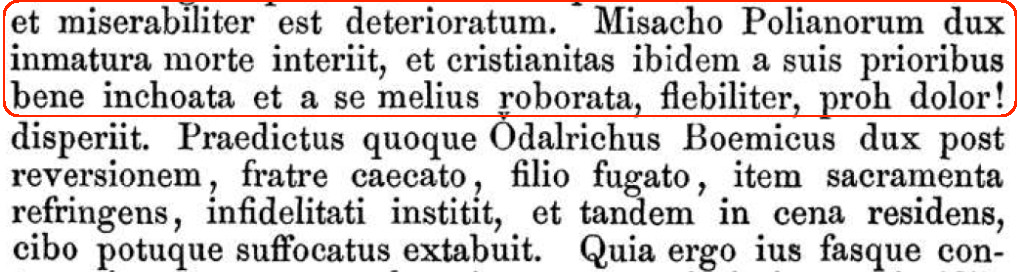
“Mieszko the duke of the Poles died prematurely and Christianity there so well begun by his predecessors and by him [Mieszko II] even strengthened, alas, lamentably perished.”

misacho

(the same entry is also in the Magdeburg Annals)

Other Sources

Gallus Anonymous does speak of a pagan rebellion.  He does not say when it took place but does place it after the death of Mieszko II and after the expulsion of Casimir the Restorer from Poland.   Thus, it seems that we are looking at 1034 – 1036.  Since he discusses these events before the Czech invasion of 1037 we can tentatively say no later than that year.  Perhaps.

Here is Gallus’ Chapter 19: 

“At this time kings and dukes neighboring Poland, each in his own turn violated her and took towns and border castles or, after the taking, burn them down.  And so exposed to so many sorrows and painful defeats, she was treated even shabbier and more abominably by her own inhabitants.  For the slaves rose against masters, freedmen against the nobles, announcing themselves as nobles in turn, taking their [nobles’] wives and beds and most cruelly persecuting the same [nobles].”

gallus1

Gallus

gal1

“Renouncing too the Catholic faith, which we are unable to mention without shedding many a tear, they rebelled against the bishops and priests, and some of these, in their eyes being more prominent/honorable, they put to the sword; and some others, as if deserving a more ignoble death, they had stoned.  In the end, by reason of foreign causes as too by reason of her own inhabitants, did Poland suffer such ruin, that she was almost completely deprived of riches and people.  It was then that the Czechs destroyed Gniezno and Poznan and took the body of Saint Adalbert.  And those who managed to flee the hands of the enemies or who were escaping the rebellion of their serfs, made their way across the River Vistula to Mazovia.*  And the aforementioned cities remained abandoned so long that in the Church of Saint Adalbert as well as at Saint Peter’s wild animals set up their dens…”

gallus2

Gallus

* Of course, Mazovia too was going to rebel under Maslaw (or Mieclaw) the recently repurposed cup bearer.

gal2

There is not else on the pagan rebellion.  Thietmar’s Chronicle only reaches the year 1018.  Kadlubek’s Chronicle is silent.  There is another Bohemian source and some Russian sources (preserved in much later books) but they all add little else to the topic.  Nevertheless, a “pagan” rebellion was altogether possible.  A similar rebellion took place in Bohemia between 921 and 935 and, of course, the Great Slav Uprising of 983 in Polabia had not only anti-Frankish/Saxon but also anti-Christian character.

Copyright ©2016 jassa.org

November 30, 2016

More Manuscripts of the Pentacostal Postilla Number 2

Published Post author

Some readers have been asking us to show more detailed manuscript pages of the Pentacostal Postilla no. 2 by Lucas from Great Koźmin (currently Koźmin Wielkopolski).  We have displayed some already here but are happy to provide more from another manuscript (preserving the original spelling in the title headings:

“Lado, Yassa‘ et attendere” [?]

1z“LadoYassaNya”

2z“No Lada, no Yassa, noy Nya”

3z

As mentioned a number of times previously, there are only three Gods mentioned here.

Copyright ©2016 jassa.org All Rights Reserved

November 7, 2016

Just Three Gods

Published Post author

The various Polish Gods listed by Lucas from Great Kozmin come in three lists.  You can see the entire passages here but, the bottom line, the following names appear in the respective passages:

  1. ‘Lado, Yassa‘ et attendere [?]
  2. LadoYassaNia
  3. Non Lada, non Yassa, non Nia

However, we have been told that there was also another name mentioned – Quia or Qui or Kiy.  Of course, the immediate connection drawn would be with Kyiv.  The name supposedly appears in the second passage between Yassa and Nia.

However, as we have already mentioned before, in the manuscripts that we have seen, no such name appears.  See for example:

yast

or:

astr

We have not examined the other manuscripts but so far it does not look promising…  This is not to say that the Poles only had three Gods – Lucas does say “and others” – but it does mean that there is simply no mention of Kiy.

So where did the idea of a Kiy come from?  This fragment from LofGK was first noticed by Maria Kowalczyk.  She does mention Quia based on a manuscript from the Jagiellonian Library (BJ 1446) so an examination of that manuscript would seem to be in order.

Copyright ©2016 jassa.org All Rights Reserved

July 13, 2016

What Widukind’s “Deeds of the Saxons” Has to Say Regarding the Slavs – Part II

Published Post author

After this first part, here we continue with the work of Widukind of Corvey – Res Gestae Saxonicae – and its discussion of the Ottonian dynasty’s Henry I (919-936) and Otto I (936-973).  Our focus, of course, is on the book’s mentions of the Slavs.  This part brings together all the mentions of the Slavs from Books II and III.  Again, this comes from the David and Bernard Bachrach translation.

tops

Book II

3. Regarding the war undertaken against Boleslav.

“In the meantime, the barbarians were raging to stir up new troubles, and Boleslav killed his brother, a Christian man and, as they say, most devout in the cultivation of God.  Boleslav feared having a minor prince nearby who followed the orders of the Saxons, and so waged war against him.  So the latter sent a messenger to Saxony to ask for aid.  Asik was dispatched to him along with the legion of Merseburgers, and a strong force of men from Hassegau.  The Thuringian expeditionary levy also was added to Asik’s force.  The unit from Merseburg was recruited from thieves.  King Henry was quite severe with foreigners, but showed mercy to his countrymen in all cases.  When he saw that a thief or highwayman was strong and syuted to war, Henry spared the man from punishment that was due, and settled him in a suburb of Merseburg.  He gave them fields and arms and ordered them to spare their country men.  However, they were to exercise their thievery against the barbarians as much as they dared.  When a large number of men of this type had been gathered, Henry created a legion that was fully prepared to go on campaign.”

Interea barbari ad novas res moliendas desaeviunt, percussitque Bolizlav fratrem suum, virum Christianum et, ut ferunt, Dei cultura religiosissimum, timensque sibi vicinum subregulum, eo quod paruisset imperiis Saxonum, indixit ei bellum. Qui misit in Saxoniam ad expostulanda sibi auxilia. Mittitur autem ei Asic cum legione Mesaburiorum et valida manu Hassiganorum, additurque ei exercitus Thuringorum. Erat namque illa legio collecta ex latronibus. Rex quippe Heinricus cum esset satis severus extraneis, in omnibus causis erat clemens civibus; unde quemcumque videbat furum aut latronum manu fortem et bellis aptum, a debita poena ei parcebat, collocans in suburbano Mesaburiorum, datis agris atque armis, iussit civibus quidem parcere, in barbaros autem in quantum auderent latrocinia exercerent.  Huiuscemodi ergo hominum collecta multitudo plenam in expeditionem produxit legionem.

“When Boleslav learned of the Saxon army and that the Saxons and Thuringians were marching against him separately, he decided, since he was a very good tactician, to divide his own forces and position them to oppose each of the armies.  The Thuringians, when they saw the unsuspected approach of th enemy, avoided danger in flight.  However, Asik, with his Saxons and other support troops, did not delay at all his attack on the enemy, and killed the greater part of them in battle.  He forced the remainder to flee, and returned to his camp as a victor.  But Asik was unaware of the army that had pursued the Thuringians, and did not use caution after his victory.”

Bolizlav autem audiens de exercitu Saxonico, et quia Saxones seorsum et seorsum Thuringi irent contra se, divisis et ipse sociis, sicuti erat acerrimus consilio, utroque exercitui occurrere disposuit. At Thuringi, ut hostes inprovise sibi occursitare viderunt, fuga periculum devitaverunt. Asic autem cum Saxonibus et caeteris auxiliariis nichil cunctatus in hostes ruit maximamque partem ex eis armis fudit, caeteros fugere conpulit, victorque ad castra reversus est. Et cum ignorasset de exercitu, qui insecutus fuerat Thuringos, minus caute usus est victoria perpetrata.

“When Boleslav saw that our army was dispersed, with some men taking spoils from the dears, and others resting, and still others busy gathering hay for their horses, he brought together in a single army the forces that had returned and those that had fled.  Boleslav killed the commander [Asik] and destroyed the entire army.  Then, Boleslav marched to the stronghold of the minor prince, captured it in the first assault, and turned it into a wilderness, which it remains to this day.  This war lasted until the fourteenth year of the king’s reign [950].  After this point, Boleslav became a faithful and useful dependent of the king.”

Bolizlav autem videns exercitum nostrum dispersum et alios in extrahendis spoliis caesorum, alios in suis corporibus reficiendis, alios in paleis equorum congregandis occupatos, fugatum reversumque coadunans exercitum, super inprovisos ac recenti victoria securos subito irruit et ducem cum omni nostro exercitu delevit. Pergensque inde ad urbem subreguli primo eam inpetu cepit et usque in hodier num diem solitudinem fecit. Perduravitque illud bellum usque ad quartum decimum regis imperii annum; ex eo regi fidelis servus et utilis permansit.

4. Regarding the king’s campaign against the barbarian nations.

“The king was little disturbed when he received word from a messenger about what had happened.  Rather, fortified by divine strength, he crossed the frontiers of the barbarians to restrain their savagery with his entire army.  Otto’s father had already waged war against them because they had mistreated the legates sent by his son Thankmar, a matter that we plan to discuss more fully below.  The king then decided to establish a new military commander.  He chose for this office a noble, diligent, and quite prudent man named Hermann.  By bestowing this office, however, Otto aroused the jealousy not only of the other commanders, but also of Hermann’s brother Wichmann.  It is for this reason that Wichmann pretended some illness and left the army.  Wichmann was a powerful and brave man, generous, skilled in war, and possessed of such learning that he was said by his people to have superhuman knowledge.”

Rex autem audito huiuscemodi nuntio minime turbatur, sed divina virtute roboratus cum omni exercitu intrat terminos barbarorum ad refrenandam illorum saevitiam. Datum quippe erat illis et antea a patre suo bellum, eo quod violassent legatos Thancmari filii sui, de quo in sequentibus plenius dicturos arbitramur. Placuit igniter novo regi novum principem militiae constituere. Elegitque ad hoc officium virum nobilem et industrium satisque prudentem nomine Herimannum. Quo honore non solum caeterorum principum, sed et fratris sui Wichmanni offendit invidiam. Quapropter et simulata infirmitate amovit se ab exercitu. Erat namque [71] Wichmannus vir potens et fortis, magnanimus, belli gnarus et tantae scientiae, ut a subiectis supra hominem plura nosse predicaretur.

“Hermann, who was in the front rank of the battle line, found himself in combat against the enemy as he crossed there frontier into their region.  He inflicted a grave defeat on them, and, because of this, the jealousy of his enemies burned even hotter. Among them was Ekehard, the son of Liudolf.  Ekehard was so enraged by Hermann’s success that he swore that he would either do something even greater, or wished to die in the attempt.  So Ekehard gathered together the ablest men from the entire army and, violating the king’s orders, crossed a swamp that was located between the enemy’s stronghold and the royal encampment.  He immediately attacked but, surrounded by the enemy, he died along with all of his men.  Eighteen men chosen from the entire army died there with him.  However, the king, after killing many of the enemy, and making the others tributaries, returned to Saxony.  This happened on September twenty-fifth [936].”*

* note from translators: this was a campaign conducted in 936 against the Redarii.

Herimannus autem cum esset in prima acie, in introitu regionis in hostium pugnam incidit eosque fortiter vicit, et ob hoc maiori invidia inimicos accendit. Inter quos Ekkardus filius Liudulfi, qui in tantum aegre passus est fortunam Herimanni, ut sese promitteret maiora facturum aut vivere nolle. Unde collectis ex omni exercitu fortissimis viris interdictum regis rupit et paludem, quae erat inter urbem hostium et castra regis, cum sociis transiit, statimque hostes offendit, et ab his circumfusus cum omnibus suis periit. Erant autem qui cum eo ceciderant electorum ex omni exercitu virorum decem et octo. Rex autem caesa hostium multitudine et caeteris tributariis factis reversus est in Saxoniam. Acta sunt autem haec VII. Kalend. Octobris.

14. Again regarding the Hungarians and how they retreated with heavy losses.

“…The other part of the [Hungarian] army had been led to the north to a place called Droemling through the trickery of a certain Slav.  However, discomfited by the difficult terrain, and overwhelmed by armed forces, this army was destroyed.  Thew result frightened the other Hungarians.  The commander of this army was captured along with a few others.  He was led to the king, and then ransomed for a large price.  When they learned what had happened. ,the enemy’s entire camp was thrown into confusion, and they sought safety in flight.  Nor have they reappeared in Saxony for thirty years.”

[this was somewhere near the Aller and Ohre rivers, north of Helmstedt in the old pagus of Belxa – as per the editors]

Altera autem pars exercitus ad aquilonem versus et arte cuiusdam Sclavi in locum qui dicitur Thrimining deductus, difficultate locorum ac manu circumfusus armatorum periit timoremque nimium caeteris incussit. Dux autem illius exercitus cum paucis elapsus comprehenditur, et ad regem deductus pretio magno redimitur. His auditis castra hostium omnia turbata, fuga salutem quaesierunt, nec ultra per triginta annos in Saxonia apparuerunt.

20.  How the barbarians sought to kill Gero, and dragged out the war for a long time.

“The barbarians were delighted by our misfortunes, and not cease their arson, murder, and devastation.  They also considered cunning ways to kill Gero, whom the king had assigned to govern them.  But Gero, anticipating their trickery with his own, killed almost thirty leading men of the barbarians in one night after they were drunk from wine and buried in sleep following an excellent feast.*  But Gero did not have sufficient forces to fight against all of the barbarian people.  Indeed, at this time, the Obodrites were rebelling, after having annihilated our army, and killed its commander named Haika.  So the king often led the army in person, striking against them, inflicting substantial losses on them, and finally driving them almost to the point of complete defeat.**  Nevertheless, they chose war instead of peace, putting aside all thoughts of misery in the pursuit of costly freedom.”

[* these were probably Hevellians; note the similarity to the Polish legend of the poisoning of the uncles of Popiel by that “nefarious” king at the urging of his wife.]

[** The editors think that this is “a polite way of saying that King Otto was not able to defeat the Obodrites at this time in 939]

Barbari autem labore nostro elati nusquam ab incendio, caede ac depopulatione vacabant, Geronemque, quem sibi rex prefecerat, cum dolo perimere cogitant. Ipse dolum dolo preoccupans, convivio claro delibutos ac vino sepultos ad triginta fere principum barbarorum una nocte extinxit. Sed cum non sufficeret contra omnes nationes barbarorum – eo quippe tempore et Apodriti rebellaverant, et caeso exercitu nostro ducem ipsum nomine Haicam extinxerunt, ab ipso rege saepius ductus exercitus eos laesit et in multis afflixit et in ultimam pene calamitatem perduxit. Illi vero nichilominus bellum quam pacem elegerunt, omnem miseriam carae libertati postponentes.

“They were a tough people, and able to endure hardship.  Accustomed to a poor way of life, the Slavs desire those things that seem heavy burdens to us.  Thre was truly a long struggle between the two sides, with lone fighting for glory and a great and broad empire, and the other fighting for liberty or against the worst kind of slavery.  In those days, the Saxons were afflicted by many enemies, the Slavs from the east, the Franks from the south, the Lotharingians from the west, and the Danes and Slavs from the north.  It is for this reason that the barbarians carried on the war for so long.”

Est namque huiuscemodi genus hominum durum et laboris patiens, victu levissimo assuetum, et quod nostris gravis oneris esse solet, Sclavi pro quadam voluptate ducunt. Transeunt sane dies plurimi, his pro gloria et pro magno latoque imperio, illis pro libertate ac ultima servitute varie certantibus. Multos quippe illis diebus Saxones patiebantur hostes, Sclavos ab oriente, Francos a meridie, Lotharios ab occidente, ad aquilone [85] Danos itemque Sclavos: proptereaque barbari longum trahebant certamen.

21. Regarding the Slav, who was released by King Henry.

“There was a certain Slav. released by King Henry, who by paternal right of succession was to be the lord of those people who are called the Hevelli.  His name was Tugumir.  Having been convinced by a great deal of money, and persuaded by the promise of even more, Tugumir agreed to betray his own land.  And so acting as if he had escaped in secret, he came to the fortress of Brandenburg.  He was acknowledged by the people and received as their lord.  A short time later, he fulfilled his promise.  For he invited his nephew, who had gained a dominant position among all of the leaders of his people, to visit him.  After Tugumir captured his nephew through trickery, he killed him and delivered his fortress along with the entire region to the king.*  After this was done, all of the barbarian nations up to the Oder river subjugated themselves to royal tribute in a similar manner.”

* Tugumir delivered what was to become Brandenburg to King Otto I.  Note the Tugu- prefix similar to Touga of the Croats.  What the prefix or the name may mean is unlear.  Interestingly,  Tugend is German for “virtue.”

Fuit autem quidam Sclavus a rege Heinrico relictus, qui iure gentis paterna successione dominus esset eorum qui dicuntur Heveldi, dictus Tugumir. Hic pecunia multa captus et maiori promissione persuasus professus est se prodere regionem. Unde quasi occulte elapsus venit in urbem quae dicitur Brennaburg, a populoque agnitus et ut dominus susceptus, in brevi quae promisit inplevit. Nam nepotem suum, qui ex omnibus principibus gentis supererat, ad se invitans dolo captum interfecit urbemque cum omni regione ditioni regiae tradidit. Quo facto omnes barbarae nationes usque in Oderam fluvium simili modo tributis regalibus se subiugarunt.

30.  Regarding Gero, the frontier commander.

“At this time, the war against the barbarians* was raging.  When the soldiers, who had enlisted in Gero’s forces, were worn down by the recent campaigns, and were receiving less in the way of pay and booty, because the tribute was not being paid, they developed a seditious hatred of Gero.*  But the king always stood by Gero for the common good of the state.  So it happened that the soldiers were so riled up that they turned their hatred of Gero against the king as well.”

* These “barbarians” were Slavs.

** “This was the tribute that Henry I and Otto I had imposed not he Slavic peoples living east of the Elbe river [translators].”

Eo tempore bellum barbarorum fervebat. Et cum milites ad manum Geronis presidis conscripti crebra expeditione attenuarentur et donativis vel tributariis premiis minus adiuvari possent, eo quod tributa passim negarentur, seditioso odio in Geronem exacuuntur. Rex vero ad communes utilitates rei publicae Geroni semper iuxta erat. Unde factum est, ut nimis exacerbati odia sua in ipsum quoque regem vertissent.

36. Regarding the harmony between the brothers, their manner of life and their characters 

[note: the reference is to Otto I and Henry; note too that nothing is said below about Otto’s ability to write; we know from Einhard that Charlemagne never learned to write]

“…His [Otto I’s] intelligence is exceptional.  For after the death of Queen Edith [January 946], he learned his letters, which he had not done previously, and did so well that he can now easily read and understand books.  Furthermore, he knows how to speak the Romance and Slavic languages.  But it is rarely the case that he finds it useful to do so.  He frequently goes hunting, and loves table games.  He also gracefully practices his horsemanship in a weighty royal manner.  He has grown into a large body that shows his full royal dignity.  His head is covered with white hair…”

Ingenium ei admodum mirandum; nam post mortem Edidis reginae, cum antea nescierit, litteras in tantum didicit, ut pleniter libros legere et intelligere noverit. Preterea Romana lingua Sclavanicaque loqui scit; sed rarum est, quo earum uti dignetur. In venationibus creber, tabularum ludos amat, equitatus gratiam regia gravitate interdum exercens. Accessit ad haec et moles corporis, omnem regiam ostendens dignitatem, capite cano sparsus capillo…

40. Regarding the hostages from Boleslav.

“At that time, while the king spent some in forested regions hunting, we saw the hostages sent by Boleslav,* whom the king ordered to be presented to the people.  The king was very happy about them.”

* note from translators: “Whether Duke Boleslav I sent hostages at such an early date is not clear.  Otto undertook a major campaign against the Bohemia in 950.  Consequently, if Boleslav did send hostages in either 945 or 946, relations between the two rulers deteriorated significantly after this date.”

Eo tempore cum moraretur rex in campis silvestribus venationem agens, obsides Bolizlavi [ibi] vidimus, quos populo rex presentari iussit, satis super eis laetatus.

Book III

8. How the king led an army against Boleslav

“At that time, the king campaigned against Boleslav, the king of the Bohemians.  After he had captured the fortress called ‘New’ [Nymburk], in which Boleslav’s son [i.e., Boleslav II] had been one of those who was besieged, the king, following prudent advice, ended the fighting.  He did so to avoid having any of his soldiers fall prey to danger while seizing the spoils from the enemy.  After he had taken stock of the great strength of the king, and the enormous size of his army, Boleslav departed from his city [Prague], preferring to subject himself to such great majesty rather than suffer ultimate ruin,  So, standing under the banners, listening to the king, and giving answers, he earned mercy.  After he had achieved glory through this complete victory the king returned to Saxony.”

Illo tempore rex proficiscitur in militiam contra Bolizlavum regem Boemiorum; et cum capienda esset urbs quae nuncupabatur Nova, in qua clausus obsidebatur Bolizlavi filius, prudenti rex consilio diremit prelium, ne miles in rapiendis hostium spoliis aliquod periculum incideret. Considerata itaque virtute regis ac innumera multitudine exercitus, Bolizlav urbe egressus maluit tantae maiestati subici quam ultimam perniciem pati. Sub signisque stans et regem audiens responsaque reddens, veniam tandem promeruit. Inde plena victoria gloriosus factus, rex Saxoniam regreditur.

42. How the Ukrani were defeated by Gero.

“In that year, the Slavs, who are called Ukrani, were defeated by Gero with great glory because Duke Conrad was dispatched to provide aid to him.  They captured an enormous quantity of booty, and great happiness reigned in Saxony.” [this was in 954]

Eo anno Sclavi qui dicuntur Uchri a Gerone cum magna gloria devicti, cum ei presidio esset dux Cuonradus a rege missus. Preda inde ingens ducta; Saxoniae laetitia magna exorta.

44. Regarding the famous triumph that the king achieved over the Hungarians.

“When the king entered Saxony around the beginning of July, he met legates from the Hungarians, who presented themselves as if they had come to see him because of their established good faith and friendship.  In truth, however, as it seemed to some people, they had come to learn about the outcome of the civil war.  The king kept them with him for a few days and then sent them back in peace, bearing some minor gifts.  But he then learned from messengers sent by his brother, the duke of the Bavarians, that: ‘Behold numerous Hungarians have invaded your lands and stand prepared for battle with you.’  As soon as he heard this, the king, acting as if he had not endured any labor in the war just ended, began to march against the enemy.  He took a small force with him, and particularly few from among the Saxons, because they were now threatened by a war with the Slavs…”

[note: what follows is the account of the Battle on the Lechfeld at the Lech river where Otto defeated the Hungarians in 955.]

Ingressusque Saxoniam circa Kalend. Iulii obvios habet legatos Ungariorum, tamquam ob antiquam fidem ac gratiam eum visitantes; re autem vera, ut quibusdam videbatur, eventum belli civilis considerantes. Quos cum secum aliquantis diebus retinuisset et aliquibus munusculis donatos remisisset in pace, audivit a nuntiis fratris, ducis scilicet Boioariorum, quia: «Ecce Ungarii diffusi invadunt terminos tuos statuuntque tecum inire certamen». His auditis rex, quasi nichil laboris preterito bello toleravisset, coepit ire contra hostes, sumptis secum paucis admodum ex Saxonibus, eo quod iam bellum Sclavanicum urgeret…

45. Regarding Thiadric’s battle against the Slavs.

“While these events were going on in Bavaria, Thiadric fought with mixed luck against the barbarians.  While attempting to capture one of their strongholds, Thiadric pursued the enemy up to the entrance of the gate, forcing them inside the wall.  He captured the fort and burned it.  All of those who were outside the walls were either captured or killed.  He returned when the fire died out.  Half of his soldiers crossed through a swamp that was adjacent to the fort.   When the Slavs realized that our men were in a tight spot because of the difficulty of the terrain, and that they did not have enough men to fight, and did not have anywhere to flee, they attacked our men from the rear with a great shout.  They killed about fifty of our men and the remainder   fled.”

Dum ea geruntur in Boioaria, varie pugnatum est a preside Thiadrico adversus barbaros. Cum capere nisus esset quandam urbem illorum, usque ad introitum portae persecutus est adversarios, cogens illos intra murum, oppido potito et incenso et omnibus quae foras murum erant captis vel interfectis; cum iam incendio extincto reverteretur, et paludem, quae erat urbi adiacens, medietas militum transisset, Sclavi videntes nostros in arto sitos ob difficultatem loci nec copiam habere pugnandi nec locum adeo fugiendi, insequebantur a tergo revertentes clamore magno; peremerunt ex eis ad quinquaginta viros, foeda fuga nostrorum facta.

49. Regarding the triumph of the king.

“The king made glorious by this celebrated triumph, was named father of the fatherland and emperor by his army.  Then he decreed that worthy honor and praise be given to God in every church.  He had word of his triumph sent by messenger to his sainted mother, and then with great happiness and joy, he returned to Saxony as a victor, and was received most early by his people.  No king in the two hundred years before him had celebrated a victory if this size.  The Saxons had not been present at the battle with the Hungarians, having been held in reserve for the battle against the Slavs.”*

* According to the translators, Widukind may perhaps be comparing the Lechfeld victory of 955 over the Hungarians to the victory of Charles Martel over the Muslims in 732.  Also, apparently, the last sentence about the Saxons not having been there was edited out of one of the manuscripts!

Triumpho celebri rex factus gloriosus ab exercitu pater patriae imperatorque appellatus est; decretis proinde honoribus et dignis laudibus summae divinitati per singulas ecclesias, et hoc idem sanctae matri eius per nuntios demandans, cum tripudio ac summa laetitia Saxoniam victor reversus a populo suo libentissime suscipitur. Neque enim tanta victoria quisquam regum intra ducentos annos ante eum laetatus est. [Nam ipsi bello Ungarico aberant, Sclavanico certamini reservati].

50. Regarding the king and Wichmann’s cunning.

“…After he [Wichmann] had spent several days’ in [Count] Ibo’s company, he asked that he be permitted to go into the forest to go hunting.  He gathered some of his companions, who had hidden there, and returned to his fatherland.  After occupying some fortifications, he was joined by his brother Eckbert, and raised up arms against the emperor.  However, Duke Hermann’s efforts easily suppressed thrum, and foxed thrum across the Elbe.  When they realized that they could not oppose the duke, they joined forces with two minor barbarian kings, who had been troubling the Saxons for a long time, namely Nacco and his brother [Stoinef – both of the Obodrites, as per the translators].”

Aliquantis diebus cum eo degens, petit post haec venandi gratia silvam ire liceret. Ibi absconditos socios secum sumens perrexit in patriam et, occupatis aliquibus urbibus, iuncto sibi Ecberhto arma sumit contra imperatorem. Industria autem ducis Herimanni facile eos obpressit trans Albiamque coegit. Illi cum se sensissent duci resistere non posse, sociaverunt sibi duos subregulos barbarorum, Saxonibus iam olim infestos, Naconem et fratrem eius.

51.  Regarding the army that almost captured Wichmann in the stronghold of Suitleiscranne.

“An army commanded by the duke found them in a stronghold that was called Suitleiscranne.  They were almost captured along with the fort.  But they were warned by the shouting and hastened to arm themselves.  Forty armed men were killed before the fates of the fort, and Duke Hermann departed loaded down with spoils taken from the dead men.  Henry, the frontier commander [praeses], and his brother Siegfried [of Stade?], aided him.  Both of them were prominent and powerful men, excelling equally in both war and in peace.  This action took place at the beginning of the forty-day period of fasting.”

Ductus exercitus a duce, reperti sunt in urbe quae dicitur Suithleiscranne. Et pene erat, ut cum urbe caperentur, nisi clamore cuiusdam citarentur et ad arma prosilirent; caesis tamen ante portam urbis ad quadraginta armatis caesorumque spoliis potitus, dux Herimannus discedit. Erant autem qui eum adiuvarent Heinricus preses cum fratre Sigifrido viri eminentes et fortes, domimilitiaque optimi. Facta sunt autem haec initio quadragesimalis ieiunii. 

52.  How the fortress of the Cocarescemi* was captured.

“Just after Easter that year [Easter was April 15 in 955], the barbarians raided the region.  They were guided by Wichmann in this action, although he was not their commander.  Hermann did not delay.  He brought up military forces to resist them.  However, when Hermann saw that the enemy army was large, and that his own forces were small as a result of the demands of the ongoing civil war, he decided that it would be better to put off battle under these adverse conditions.  He also ordered the great multitude of people, who had fled into one fortress, because they didn’t trust the others, to ask for peace under whatever terms they could obtain.  Hermann’s soldiers were opposed to this plan, especially Siegfried, who was an exceptionally powerful warrior.  But the people of the Cocarescemi did as the duke had ordered and made peace under the following conditions: the free men along with their wives and children should climb up onto the wall, unarmed.  They were to leave behind all of their slaves and other goods in the middle of the fort for the enemy.  However, when the barbarians rushed into the stronghold., one of them recognized the wife of a certain free man his slave.  When the barbarian tried to seize her from the hands of the man, the barbarian was struck, and then shouted that the agreement had been broken by the Saxons.  So it happened that all of the enemy turned to killing, and they left no one behind.  They killed all of the adults and took the mothers and children away as captives.”

*  note from translators: Cocarascemi (also Cocarescesii or Cocarescemii) were “Slavs who lived under Ottonian rule.  They were not Saxon settlers in erstwhile Slavic lands.  Although the Cocarascemi have not been identified by scholars, it is almost certainly the case that these events took place east of the Elbe river.”

Barbari vero post proximum pascha irruunt in regionem, ducem habentes Wichmannum ad facinus tantum, non ad imperium. Nullam moram agens sed et ipse dux Herimannus cum presidio militari adest; vidensque exercitum hostium gravem sibique parvas admodum belli copias affore civili bello urgente arbitratus est consultius differre certamen in dubiis rebus constitutis, multitudinique imperare, quae maxima in unam urbem confluxerat, dum caeteris diffiderent, quoquo pacto possent, pacem expostularent. Quod tamen consilium milites aegre valde tulerunt, et maxime Sigifridus, qui erat bellator acerrimus. Faciunt tamen cives Cocarescemiorum, ut dux imperarat, pacemque eo pacto obtinent, quo liberi cum uxoribus et natis supra murum inermes ascenderent, conditione servili et omni suppellectili in medio urbis hostibus relicta. Cum intra urbem irruerent barbari, quidam illorum suum mancipium agnoscit in cuiusdam liberti uxore; quam cum rapere de manu viri niteretur, ictum pugne accipit, irritumque pactum ex parte Saxonum proclamitat. Unde fit, ut omnes ad caedem verterentur nullumque relinquerent, sed omnes perfectae aetatis neci darent, matres cum natis captivos ducerent.  

53. How the king avenged this raid.

“The emperor, who was eager to avenge this evil deed now that he had achieved victory over the Hungarians, invaded the lands of the barbarians.  He took counsel regarding the Saxons who had conspired with the Slavs, and judged it fitting that Wichmann and Eckbert be declared public enemies.  However he would spare the others insofar as they were willing o return to their own people.  A legation of the barbarians was present announcing that they wished to pay their tribute in the customary manner, but that they wished to have the dominant position among the other peoples of their region.  Under these conditions they wished peace.  Otherwise, they would fight for their liberty.  The emperor responded to them in this manner: he had no desire to deny them peace.  But under no circumstances could he give them peace unless they purged themselves in an honorable manner for the injury they had caused, and provided compensation.”

Quod scelus imperator ulcisci gestiens, victoria iam de Ungariis patrata, regiones barbarorum hostiliter intravit. Consultum de Saxonibus, qui cum Sclavis conspiraverant, iudicatum est Wichmannum et Ecberhtum pro hostibus publicis habere oportere, caeteris vero parcere, siquidem remeare voluissent ad suos. Aderat et legatio barbarorum tributa socios ex more velle persolvere nuntians, caeterum dominationem regionis velle tenere; hoc pacto pacem velle, alioquin pro libertate armis certare.  Imperator ad haec respondit: pacem quidem eis nequaquam negare, sed omnimodis dare non posse, nisi iniuriam perpetratam digno honore ac emendatione purgarent.

“The emperor then led an army throughout their lands, burning and devastating everything,* until finally establishing his camp along the Recknitz river, which was very difficult to cross because of the swamps.**  Here the army was surrounded by enemies.  From the rear the path was blocked by powerful trees that were defended by a force of armed men.***  Directly in front of them, the river,  the swamp adjacent to the river, and a high army of Slav warriors blocked the work as well as the path of the army.  The army was bothered by other difficulties as well, namely sickness and hunger in equal measure.  After operating under these conditions for several days, Count Gero was dispatched to the leader of the barbarians, who was called Stoinef, to give him a chance to surrender to the emperor.  The emperor thus offered to receive him as a friend, and not to test him as an enemy.”

* note from the translators: The lands of the Obodrites were in the regions north and east of the Havel river in modern Mecklenburg-Vorpommern.  Apparently, the devastation wrought by Otto I’s army during this invasion has been confirmed by excavations (see Jens Ulrich’s “Der Burgwall von Klempenow, Landkreis Demmin.”

** note from the translators: “The likely location of this camp was nearby the modern town of Ribnitz-Damgarten.”

*** note from the translators: “The Obodrites felled trees along the route traveled by the advancing Ottonian army in order to cut off their line of communication back to imperial territory.”

Omniaque vastando et incendendo per illas regiones duxit exercitum, donec tandem castris positis super Raxam fluvium ad transmeandum paludibus difficillimum ab hostibus circumfunditur. A tergo namque [via] arborum robore obstruitur, eademque armatorum manu vallatur. Ex adverso fluvius fluvioque contigua palus et cum ingenti exercitu Sclavus bellatores et ab opere et ab itinere prohibens. Vexatur autem et aliis incommodis exercitus, morbo pariter ac fame. Dum talia agerentur per plures dies, mittitur ad principem barbarorum, qui dicebatur Stoinef, Gero comes, quatinus imperatori se dedat: amicum per id adepturum, non hostem experturum.

54. Regarding the frontier commander Gero.

“Gero excelled in many areas.  He was skilled in war, and offered good counsel in peacetime matters.  He was quite eloquent, and very learned.  He preferred to demonstrate his prudence through deeds rather than words.  He showed great energy in gaining wealth, and generosity in giving it away.  But best of all, he showed zeal for the worship of God.  Therefore, the frontier commander greeted the barbarians over the swamp and the river, which was adjacent to the swamp.  A Slav responded to him similarly.  The frontier commander then addressed him in the following manner: ‘It would be enough if you waged war against one of the servants of my lord, and not against my lord king himself.  What kind of army do you have what kinds of arms that you would presume to do such a thing?  If you have any strength, if you have the skill, if you have sufficient bravery, give ys room to cross over to you.  Or do you wish to cross over to us so that the strength of the fighters might be seen on even ground?'”

Erant quippe in Gerone multae artes bonae, bellandi peritia, in rebus civilibus bona consilia, satis eloquentiae, multum scientiae, et qui prudentiam suam opere ostenderet quam ore; in adquirendo strennuitas, in dando largitas et, quod optimum erat, ad cultum divinum bonum studium. Igitur preses super paludem et flumen, cui palus adiacens erat, barbarum salutabat. Cui Sclavus aequalia respondit. Ad quem preses: «Satis tibi esset, si bellum gereres contra unum nostrum de servis domini mei, et non etiam contra dominum meum regem. Quis tibi exercitus, quae arma, ut talia presumas? Si aliqua vobis virtus adsit, si artes, si audatia, date nobis locum ad vos transeundi, sive nos vobis huc veniendi, et aequato loco fortitudo appareat pugnatoris».

“But the Slav raged at him in the barbarian way and, vomiting out fuses, mocked Gero, the emperor, and the whole army knowing that they were burdened by many problems.  Gero, who grew angered by this because he had such an ardent spirit, said: ‘Tomorrow the day will make clear whether you and your people are strong or not.  Let there be no doubt that tomorrow you will see us attacking you.’  Gero, who for a long time had achieved renown for his many great deeds, was especially celebrated at this point because he had defeated the Slavs, called the Ukrani, with such great glory.”

Sclavus barbarico more frendens et multa convicia evomens irrisit Geronem imperatoremque et omnem exercitum, sciens eum multis molestiis aggravatum. Gero ad haec commotus, ut erat animi ardentissimi: «Crastinus», inquit, «dies declarabit, tu et populus tuus fortes viribus sitis an non. Cras enim nos vobiscum congredientes procul dubio videbitis». Gero denique, olim licet multis gestis insigniis clarus haberetur, iam tamen magnus ac celebris ubique predicabatur, eo quod Sclavos qui dicuntur Uchri cum magna gloria cepisset.

“Gero returned to camp and reported what he had heard.  The emperor, who rose while it was still night, ordered that bows and other machines be deployed for battle as if he wished to cross the river and swamp in force.  Following the warning of the previous day, the Slavs did not think that this preparation boded anything else.  So they prepared for battle, defending the path with all of their forces.*  But Gero, along with his allies the Ranen,** traveled almost a mile downstream from the camp, without the enemy realizing it, and quickly constructed three bridges.  Gero then sent a messenger to the emperor summoning the entire army.  Where the barbarians realized what had happened they hurried to mer the legions.  But the foot soldiers of the barbarians had to run a longer route before entering the battle.  Thus, overcome by fatigue, they quickly gave way before the soldiers.  They were immediately cut down as they sought the safety of flight.”***

* note from the translators: “They deployed all of their men in defensive positions to deny Otto I’s army the ability to cross the river, likely over a ford.”

** The Ranen or Rani or Ruiani lived in the area of the island of Rugen (including on the island itself) which later was the site of their Svantevit temple.

*** As per the Annals of Saint Gall, this battle took place on October 16th, 955 (the feast of Saint Gall). Apparently, it also included on the Slavic side the Circipani.

Gero reversus in castra retulit quae audierat. Imperator vero de nocte consurgens iubet sagittis et aliis machinis ad pugnam provocare, et quasi vi flumen paludemque transcendere velle. Sclavi autem hesterna comminatione nichil aliud arbitrati ad pugnam pariter conspiravere, iter totis viribus defendentes. At Gero cum amicis Ruanis miliario ferme uno a castris descendens hoste ignorante tres pontes celeriter construxit et misso nuntio ad imperatorem totum exercitum revocavit. Quo viso barbari et ipsi obviare legionibus contendunt. Pedites barbarorum dum longiorem viam currunt et certamen ineunt, fatigatione dissoluti militibus citius cedunt; nec mora, dum fugae presidium quaerunt, obtruncantur.

55. Regarding Stoinef, the king of the barbarians, and the solider who killed him.

Stoinef waited on events with some mounted troops atop a high hill.  Recognizing that his companions were fleeing, he also took flight.  But he was discovered in a certain wood, along with two of his bodyguards, by a soldier whose name was Hosed.  After being overcome in combat, Stoinef was striped of his arms, and beheaded.  One of his bodyguards was captured alive.  The soldier presented him along with Stoinef’s head and the spoils taken from that minor king to the emperor.  Through this act, Hosed became renowned and distinguished.  The dewar for this famous deed was an imperial grant with an income equivalent to twenty farms [hoba].”

Stoinef autem colle eminenti cum equitibus eventum rei expectabat. Socios inire fugam cernens fugit et ipse, lucoque quodam cum duobus satellitibus repertus a viro militari, cuius vocabulum erat Hosed, certamine fatigatus armisque nudatus capite caesus est. Satellitum alius vivus captus imperatorique cum capite et spoliis reguli ab eodem milite presentatus est. Ex hoc Hosed clarus et insignis habitus. Merces tam famosi gesti donativum imperiale cum reditu viginti mansuum. 

“That same day, the enemy camp was attacked, and many men were killed or captured.  The killing went on far into the night.  The next morning, the head of this minor king was placed in a field  Around it, seven hundred prisoners were beheaded.  The eyes of his adviser were torn out, as was his tongue.  He was then left helpless in the midst of the corpses.  WIchmamn and Eckbert, conscious of their evil deeds, left for Gaul and escaped to Duke Hugh.”*

* As per the translators this is Hugh the Great, the brother-in-law of Otto I.

Eo die castra hostium invasa, et multi mortales interfecti vel capti, caedesque in multam noctem protrahebatur. Postera luce caput subreguli in campo positum, circaque illud septingenti captivorum capite caesi, eiusque consiliarius oculis erutis lingua est privatus in medioque cadaverum inutilis relictus. Wichmannus vero et Ecberhtus scelerum conscii in Galliam profecti, ad Hugonem ducem fuga elapsi sunt. 

58.  Regarding the letter that reported his death.

“A letter bringing news of his death [Liudolf’s – the emperor’s son’s who was campaigning in Italy] was carried to the emperor while he was on campaign, fighting against the Redarii.* He poured out many tears on account of his son’s death.  As for the rest, he remained faithfully committed to God, the guide of all things, who had ordained his empire up to now.”

* As per the translators, the continuators of Adalbert of Magdeburg record this campaign of Otto I’s in 957 (against the “Slavs”).

Litterae autem obitus eius allatae sunt imperatori, cum esset in militia, qua militavit contra Redarios; quapropter satis plurimum lacrimarum pro filii interitu fudit; de caetero, qui adhuc ordinavit imperium suum, rectori omnium Deo fideliter commisit.

66. Gero because of his oath, released Wichmann.

“Not unmindful of his oath, when Count Gero saw that Wichmann had been accused, and recognized that he was guilty, he released him back to the barbarians from whom he had acquired him.  They happily received Wichamnn, who then wore down the barbarians, who live even further away, with numerous battles.  Wichmann derated King Miesco, who ruled over the Slavs called the Licicaviki, in two battles, and killed his brother.  He then extorted a great quantity of booty from them.”

Gero igitur comes non inmemor iuramenti, cum Wichmannum accusari vidisset reumque cognovisset, barbaris, a quibus eum assumpsit, restituit. Ab eis libenter susceptus longius degentes barbaros crebris preliis contrivit. Misacam regem, cuius potestatis erant Sclavi qui dicuntur Licicaviki, duabus vicibus superavit fratremque ipsius interfecit, predam magnam ab eo extorsit.

67. How Gero conquered the Lutizi.

“During this time, the frontier commander Gero badly defeated the Slavs who are called the Lutizi, and compelled them to accept the heaviest burdens of servitude.*  Thus victory, however, was not accomplished without Gero having suffered as serious wound, and the death of his nephew, who was among the best of men, and the deaths of many other outstanding men.”

* as per the translators, these were the Lusatians (see below – Lusiki) of the Lausitz district “between the Bobr and Kwisa rivers and the Elbe… The population of Upper Lusatia during the Ottonian period consisted of the Milceni… [the Lusatians were conquered by the Germans in about 963] These heavy burdens likely refer to extensive tribute payments, and also the requirement to build and to support the numerous fortifications that were established by the Ottonians in this region.” note: it’s not clear why the translators chose to translate Lusiki as Lutizi if they knew that Lusiki referred to the Lusatians and not to the Lutizi (aka Wiltzi, aka Veleti, aka Welatawe, aka Welatabe) who were living on the Baltic coast – far to the north of Lusatia and the Lusatians.

Eo quoque tempore Gero preses Sclavos qui dicuntur Lusiki potentissime vicit et ad ultimam servi tutem coegit, non sine sui tamen gravi vulnere nepotisque optimi viri casu, caeterorum quoque quam plurimorum nobilium virorum.

68. Regarding two minor kings and Wichmann.

For this section, see here.

69. Regarding the death of Wichmman.

“When Wichmann learned that the fort had been captured and that his companions had been punished, he went east and again joined with the pagans.  He took up with the Slavs called the Wuloini,* who wished to wage war against Miesco, the friend [amicus, as in subordinate political ally, as per translators] of the emperor, something that was not hidden at all from Miesco.  Consequently, Miesco sent a request to King Boleslav of the Bohemians, who was his father-in-law,** and received two inits of mounted troops from him.  When Wichmann led his army against Miesco, the latter first dispatched his foot soldiers against him.***  However, at the duke’s order, they gradually withdrew before Wichmann so that he was pulled ever further from his fortified encampment.  Then, when Miesco had sent his mounted troops to attack from the rear, he used a signal to order the foot soldiers, who had been withdrawing, to advance against the enemy.”

* note from the translators: “Their place of settlement included the island of Wollin, which is located off the coast of modern Poland in the lagoon area at the mouth of the Oder river.”

** Because of Dobrawa to whom Mieszko was married then.

*** note from the translators: “This battle took place on September 21, 967, and Wichmann was killed the following day.”

Audiens autem Wichmannus urbem captam sociosque afflictos ad orientem versus iterum se paganis inmersit, egitque cum Sclavis qui dicuntur Vuloini, quo modo Misacam amicum imperatoris bello lascesserent; quod eum minime latuit. Qui misit ad Bolizlavum regem Boemiorum – gener enim ipsius erat – accepitque ab eo equitum duas acies. Cumque contra eum Wichmannus duxisset exercitum, pedites primum ei inmisit. Cumque ex iussu ducis paulatim coram Wichmanno fugerent, a castris longius protrahitur, equitibus a tergo inmissis, signo fugientes ad reversionem hostium monet. 

“When he was being pressed from the front and from rear, Wichmann attempted to flee.  But he was accused of betrayal by his companions.  Although he had convinced them to go into battle, when it became dangerous, he did not hesitate to try to flee on his horse.  After being forced to dismount, Wichmann joined with his companions on foot, and entered the battle.  He fought very bravely that day, defended by his armor.  The next morning worn down by hunger and the long road that he had traveled, fully armed, through the entire night, he and a few others entered a building belonging to some man.”

Cum ex adverso et post tergum premeretur, Wichmannus fugam inire temptavit. A sociis igitur arguitur sceleris, quia ipse eos ad pugnam instigaverit fidensque equo, cum necesse fuerit, fugam facile inierit. Coactus itaque equo cessit, pedestris cum sociis certamen iniit, eoque die viriliter pugnans armis defenditur. Ieiunio autem et longiori via, qua per totam noctem armatus incessit, mane cum paucis admodum aream cuiusdam iam fessus intravit.

“When some leading men among the enemy found him, they recognized from his arms that he was an important man.  When they asked who he was, he responded that he was Wichmann.  They demanded that he lay down his arms.  They swore that they would resent hm safe to their lord, and that he would see to it that Wichmann was returned unharmed to the emperor.  Wichmann, who now found himself in dire straights, was not unmindful of his earlier nobility and strength, and disdained surrendering to such men.  So he asked that they bring word to Miesco that he would lay down his arms and surrender to him.  While they set off to fund Miesco, an enormous crowd surrounded Wichmann, bitterly attacking him.  Although he was exhausted, Wichmann struck down many of them.  At last, he raised up his sword, and said the following to one of the more capable of his enemies: ‘Take this sword, and carry it to your lord. Let him have this as a symbol of his victory, and send it to his friend the emperor so that he might know that he can laugh at the death of an enemy, but should weep at the death of a kinsman.’  After he said this, Wichmann turned to the east and prayed in his mother tongue,* as best he could,  to the Lord, and poured out his soul, filled with many misfortunes and troubles, to the mercy of the Creator of all things.  This was the end of Wichmann, and such also was the end of for almost all of those who raise their arms against your father.  Here ends book three.”**

* presumably his “native” language was Saxon.

** note from the translators: “This is the text of version A.  The final two chapters dealing with Wichmann form a kind of epilogue for the entire book.  In versions B and C, the reference to ‘your father’ and the mention of this as the end of Book Three both are dropped.” Note below versions in Latin.

Optimates autem hostium cum eum repperissent, ex armis agnoscunt, quia vir eminens esset. Interrogatusque ab eis, quisnam esset, Wichmannum se fore professus est. At illi arma deponere exhortati sunt. Fidem deinde spondent salvum eum domino suo presentari hocque apud ipsum obtinere, quatinus incolumem imperatori restituat. Ille, licet in ultima necessitate sit constitutus, non inmemor pristinae nobilitatis ac virtutis, dedignatus est talibus manum dare, petit tamen, ut Misaco de eo adnuntient: illi velle arma deponere, illi manus dare. Dum ad Misacam ipsi pergunt, vulgus innumerabile eum circumdat eumque acriter inpugnat. Ipse autem, quamvis fessus, multis ex eis fusis, tandem gladium sumit et potiori hostium cum his verbis tradidit: «Accipe», inquit, «hunc gladium et defer domino tuo, quo pro signo victoriae illum teneat imperatorique amico transmittat, quo sciat aut hostem occisum irridere vel certe propinquum deflere». Et his dictis conversus ad orientem, ut potuit, patria voce Dominum exoravit animamque multis miseriis et incommodis repletam pietati creatoris omnium effudit. 
      [Versio B/C:] 
Is finis Wichmanno, talisque omnibus fere, qui contra imperatorem arma sumpserunt. 
      [Versio A:] 
Is finis Wichmanno, talisque omnibus fere, qui contra imperatorem arma sumpserunt patrem tuum. Explicit liber tercius.

70. After he had received Wichmann’s arms, the emperor, who was now certain [of his death], wrote a letter to be dispatched throughout Saxony.

“After the emperor* received Wichmann’s arms, the emperor, and was certain of his death, he wrote a letter to the military commanders and counts of Saxony in the following manner: ‘Otto, august emperor by divine grace, to Hermann, Thiadric,** and the other counts of our state, every friendly greeting.  By the will of God, I am well, and all of my affairs are advancing without pause.  Furthermore, messengers have come to us from the king of Constantinople,*** very distinguished men, who, as I understand, are very interested in seeking peace.  However this matter turns out, they certainly will not dare, God willing, to test us with war.  Unless we can come to an agreement, i will gain from them the provinces of Apulia and Calabria, which they have held until now.  However, if they accept our will, we will send our wife and our like-named son [Otto II who became co-emperor in 967 at age 12] this summer to Francia, and we promise you that, with God’s aid, we shall go on campaign to Frainet, to destroy the Saracens.  Furthermore, we wish, if the Redarii have indeed suffered very heavy losses, as we have heard – you know how often they have broken their oaths and what injuries they have inflicted – that they shall have no peace from you.  Discuss these matters with Duke Hermann, and attack with all of your forces, so that you can bring about their final destruction.  If it is necessary, we shall march against them ourselves.  On the Nativity of the Lord, our son received the crown, as a sign of the imperial office from the bless apostle.  Written on 18th January at Capua in Campania.'”

* Otto I became emperor on February 2, 962.

** As per the translators, Thiadric was one of the five successors to Gero.  He was responsible for the Saxon north march which eventually came to be called, the Altmark.

*** This is a slap at the Byzantine Emperor, i.e., Otto is now the emperor but the Byzantines just have a “king”.  Otto fought two campaigns against the Byzantines in the south of Italy in 968 and 969, with mixed results.  The coronation of Otto II (the Red) was designed to enable Otto’s son to become married to the Byzantine princess Theophanu in 972 (the Byzantines were objecting to the use of the term “emperor” for the Ottonians since they saw themselves as the only legitimate heirs of the Western Roman Empire).  Otto I finally returned to Germany in August 972 and died at Memleben in 973. Otto II succeeded him as sole Emperor.  He ruled till 983 and saw (from Italy – where he was and from which he did not return) the beginning of the Lutici-caused “Great Slav Uprising” (started about June 29, 983) against the Ottonians, feudalism and, of course, Christianity.  Out of the marriage of Otto II and Theophanu came Otto III (born 980).  Theophanus was the niece of the Byzantine Emperor John I Tzimiskes.

Imperator itaque acceptis armis Wichmanni de nece eius iam certus factus scripsit epistolam ad duces et prefectos Saxoniae in hunc modum: Oddo divino nutu imperator augustus Herimanno et Thiadrico ducibus caeterisque publicae rei nostrae prefecfis omnia amabilia. Deo volente salus omniaque prospera plane succedunt. Caeterum nuntii Constantinopolitani regis dignitate satis insignes nos adeunt, pacem, ut intelleximus, admodum quaerentes. Quoquo modo tamen res agatur, bello Deo volente nullo modo nos temptare audebunt. Apuliam et Calabriam provincias, quas hactenus fenuere, nisi conveniamus, dabunt. Si vero voluntati nostrae paruerint, ut presenti aestate coniugem cum aequivoco nostro in Franciam dirigentes, per Fraxanetum ad destruendos Sarracenos Deo comite iter arripiemus, et sic ad vos, disponimus. Preterea volumus, ut, si Redares, sicut audivimus, tantam stragem passi sunt – scitis enim, quam saepe fidem fregerint, quas iniurias attulerint -, nullam vobiscum pacem habeant. Unde haec cum Herimanno duce ventilantes totis viribus instate, ut in destructione eorum finem operi inponatis. Ipsi, si necesse fuerit, ad eos ibimus. Filius noster in nativitate Domini coronam a beato apostolico in imperii dignitatem suscepit. Scripta XV. Kal. Febr. in Campania iuxta Capuam. 

“When this letter was read aloud to the assembled leaders and a great crowd of common people, who had gathered at the assembly, which was being held at a place called Werla, it seemed appropriate to keep the peace that had been made with the Redarii, since there was a threat of war against the Danes at that time, and because they did not have sufficient forces to wage two ward at the same time.”

His litteris lectis in conventu populi in loco qui dicitur Werla coram principibus et frequentia plebis, visum est pacem iam datam Redariis oportere stare, eo quod tunc bellum adversum Danos urgeret, et quia copiae minus sufficerent ad duo bella pariter conficienda.

Copyright ©2016 jassa.org All Rights Reserved
June 12, 2016

What Widukind’s “Deeds of the Saxons” Has to Say Regarding the Slavs – Part I

Published Post author

Widukind (Witikindus) of Corvey (circa 925-935 – circa after 973) , the author of the Deeds of the Saxons has much to say about the Slavs.  He was perhaps, named after Wittekind (Child of the wood”?)  the Saxon war hero who fought against the Franks during the Saxon Wars (777-785) and lost… then converted to Christianity and, as per the Vita Liudgeri (biography of Saint Ludger), subsequently accompanied Charlemagne on the latter’s campaign against the Veleti and their leader Dragovit.

wits

1577 edition

Although we’ve already mentioned some references (e.g., to the Licikaviki of Mieszko), we thought we should also discuss other mentions of the Slavs.  The following comes from the Bernard and David Bachrach translation of Res gestae Saxonicae.  We present it here in several parts.

vitu

author?

Book I

17.  Regarding King Henry

“…From his youth, Henry [I] devoted every bit of his strength to bringing glory to his people, and to strengthening peace.  When the father saw the wisdom of the youth, and his exceptional judgment, he dispatched Henry with a Saxon levy and the ducal military household against  the Daleminzi, whom he himself had fought for many years.  The Daleminzi were not able to withstand Henry’s attack and summoned against him the Avars, whom we now call the Hungarians, a people that is exceptionally brutal in war.” [906?]

…nam maximum ei ab adolescentia studium erat in glorificando gentem suam et pacem confirmando in omni potestate sua. Pater autem videns prudentiam adolescentis et consilii magnitudinem reliquit ei exercitum et militiam adversus Dalamantiam, contra quos diu ipse militavit. Dalamanci vero inpetum illius ferre non valentes conduxerunt adversus eum Avares, quos modo Ungarios vocamus, gentem belli asperrimam.

19.  The Hungarians were confined by Charlemagne, but were set free by Arnulf

“The Hungarians were defeated by Charlemagne, driven across the Danube river, enclosed within a huge wall, and prohibited from raiding other peoples in their customary manner.  However, during the reign of Arnulf [887-899], this work was undone, and a path was opened up for them to renew their killing since the emperor angered Zwentibold, the king of the Moravians [Svatopluk I, 870 or 871-894].  The great slaughter and tremendous injuries inflicted by the Hungarians on the Frankish empire are attested by the cities and regions that remain desolate up to the present day.  We judge it useful to provide information about this people so that your highness will understand the kind of people against whom you grandfather and father fought, and from what kind of enemies almost all of Europe has been liberated by strength of your grandfather’s and father’s widow and under their banners.”

Victi autem a Magno Karolo et trans Danubium pulsi ac ingenti vallo circumclusi, prohibiti sunt a consueta gentium depopulatione. Imperante autem Arnulfo destructum est opus, et via eis nocendi patefacta, eo quod iratus esset imperator Centupulcho regi Marorum. Deinde quantam stragem quantamque iniuriam imperio Francorum fecerint, urbes ac regiones adhuc desolatae testantur. Haec ideo de hac gente dicere arbitrati sumus, ut possit tua claritas agnoscere, cum qualibus avo tuo patrique certandum fuerit, vel a quibus hostibus per eorum providentiae virtutem et armorum insignia tota iam fere Europa liberata sit.

20.  How the Hungarians devastated Saxony,

“The Hungarian army, mentioned above, was guided by the Slavs and inflicted great slaughter in Saxony.  After taking huge quantities of booty, they returned to Dalminzia and met another Hungarian army there.  The second Hungarian army threatened to make war on the allies of the first army because they refused to provide help to them,* while leading the first army to such great plunder.  So it happened that Saxony was laid waste a second time by the Hungarians.  The first army awaited the second in Daleminzia, and by their presence caused such a dearth of food that they [Daleminzi] were forced that year to leave their own homes and serve other nations to obtain sustenance.”

* apparently the Slavic Daleminzi did not want to help this second Hungarian army notwithstanding the fact that they helped the first.

Predictus igitur exercitus Ungariorum a Sclavis conductus, multa strage in Saxonia facta et infinita capta preda, Dalamantiam reversi obvium invenerunt alium exercitum Ungariorum; qui comminati sunt bellum inferre amicis eorum, eo quod auxilia eorum sprevissent, dum illos ad tantam predam duxissent.  Unde factum est, ut secundo vastaretur Saxonia ab Ungariis, et priori exercitu in Dalamantia secundum expectante, ipsa quoque in tantam penuriae miseriam ducta sit, ut aliis nationibus eo anno relicto proprio solo pro annona servirent.

35.  How King Henry used his nine years of peace.

“…After Henry had accustomed his subjects to this legal obligation and discipline, he immediately attacked the Slavs who are called the Hevelii.  First, Henry wore them down with numerous battles.  Then he established his encampment on the ice during the coldest part of the winter.  Finally, through hunger, iron, and cold, he captured the fortress of Brandenburg [Brennaburg].  Then having captured the entire region along with this fortress, Henry turned his banners against Daleminzia where his father long before had placed him in command of an army.  There he besieged a fortress called Gana,* and finally captured it after twenty days.  Henry distributed the booty from the fortress among his soldiers.  All of the adults were killed, while the youths and maidens were led off as slaves.  After this, Henry marched to Prague, the fortress of the Bohemians, with his entire army.  He received the surrender of the king of the Bohemians.  Certain miraculous stories are told about this king, but we think that it is better to remain silent about them because we have no proof that they happened.  He was the brother of Boleslav who remained loyal and helpful to the emperor as long as he lived.  So Henry made the Bohemians tributaries and returned to Saxony.”

* This may be a fortress between Hof and Stauchitz on the river Jahna about southwest from  Riesa.  That Ganna was the seeress in Germania after Veleda we know from Tacitus.  Ganna, Ganna and Poganie…

Tali lege ac disciplina cum cives assuefaceret, repente irruit super Sclavos qui dicuntur Hevelli, et multis eos preliis fatigans, demum hieme asperrima castris super glaciem positis cepit urbem quae dicitur Brennaburg fame ferro frigore. Cumque illa urbe potitus omnem regionem signa vertit contra Dalamantiam, adversus quam iam olim reliquit ei pater militiam; et obsidens urbem quae dicitur Gana, vicesima tandem die cepit eam. Preda urbis militibus tradita, puberes omnes interfecti, pueri ac puellae captivitati servatae. Post haec Pragam adiit cum omni exercitu, Boemiorum urbem, regemque eius in deditionem accepit; de quo quaedam mirabilia predicantur, quae quia non probamus, silentio tegi iudicamus. Frater tamen erat Bolizlavi qui quamdiu vixit imperatori fidelis et utilis mansit. Igitur rex Boemias tributarias faciens reversus est in Saxoniam.

corvt

Corvey abbey today

36.  Regarding the Redarii and how they were defeated.

“And so after the following neighboring peoples were made tributaries by King Henry, namely the Obodrites, Wilzi, Hevelli, Daleminzi, Bohemians, and Redarii, and peace had been established, the Redarii rebelled.  They mobilized a huge force and attacked a stronghold called Walsleben, which they captured, killing everyone living there, comprising a great multitude.  All of the barbarian nations were inspired by this act, and dared to rebel as well.”

Cumque vicinae gentes a rege Heinrico factae essent tributariae, Apodriti, Wilti, Hevelli, Dalamanci, Boemi, Redarii, et pax esset, Redarii defecerunt a fide, et congregata multitudine inpetum fecerunt in urbem quae dicitur Wallislevu ceperuntque eam, captis et interfectis omnibus habitatoribus eius, innumerabili videlicet multitudine. Quo facto omnes barbarae nationes erectae iterum rebellare ausae sunt.

“In order to repress the ferocity of the barbarians, the expeditionary levy as well as a force of professional soldiers were dispatched under the command of Bernhard, who already held authority over the province of the Redarii.  Thietmar also was dispatched to join the legate as a colleague.  They were ordered to besiege the stronghold called Lenzen.”

Ad quarum ferocitatem reprimendam traditur exercitus cum presidio militari Bernhardo, cui ipsa Redariorum provincia erat sublegata, additurque legato collega Thiatmarus, et iubentur urbem obsidere quae dicitur Lunkini.

“On the fifth day of the siege, which was a Friday, scouts announced that an army of barbarians was not far off, and that the barbarians had decided to launch an attack on the Saxon encampment that night.  After this had been confirmed by many others, the people believed the report, since it was corroborated.  When the people had gathered around the tents of the legate, he issued orders following the advice that had been given to him that very hour by his colleague.  The men were to remain prepared through the night in order to prevent a barbarian assault on their camp.”

Quinto obsidionis die venere custodes exercitum barbarorum non longe esse adnuntiantes, et quia nocte contigua inpetum in castra facere decrevissent. Cumque plures eadem confirmarent, populus fidem paribus dabat dictis. Et cum conventus esset populi circa tentoria legati, eadem hora collega dictante precepit, ut per totam noctem parati essent, ne qua forte irruptio barbarorum in castra fieret.

“When the large group of defenders  had been ordered to stand down, emotions in camp were very mixed.  Some were melancholy and others were happy.  Some dreaded the battle and others were looking forward to it.  The fighting men moved between hope and fear according to the nature of their personalities.  In the meantime, the day went by, and the night was much darker than usual because of a huge rainstorm,.  Thus, by God’s will, the evil plan of the barbarians was thwarted.”

Cum autem dimissa esset multitudo, in castris variavere moestitia pariter atque laetitia, aliis bellum formidantibus, aliis autem desiderantibus; et pro qualitate morum inter spem metumque versabantur bellatores. Interea dies transit, et nox solito tenebrosior cum ingenti pluvia adest nutu divino, quatinus consilium pessimum inpediretur barbarorum.

“As had been ordered, the Saxons remained armed throughout the night.  Then at first light, after the signal had been given, they all received the sacrament.  Then each man promised under oath, first to the commanders, and then to each other, that they wiuld do their duty in the resent battle.  After the sun rose, for fine clear weather had returned after the rain storm, they raised their banners and marched out of camp. ”

Ut ergo iussum est, tota nocte illa armati erant Saxones, et primo diluculo dato signo sacramentoque accepto, primum ducibus, deinde unusquisque alteri operam suam sub iuramento promittebat ad presens bellum. Orto autem sole – nam post pluviam clara redit serenitas -, erectis signis procedebant castris.

“The legate, who was in the first rank, launched an attack against the barbarians.  But he was not able to overcome the innumerable enemy with his small force.  When he teruned to the army, he reported that the barbarians did not have many mounted men. However, because of their enormous number of men on foot, and because the rain the previous night had created such an obstacle, the enemy could not be drawn to engage in battle against his own mounted troops.”

In prima quidem fronte legatus in barbaros inpetum faciens, sed cum pauci non prevalerent adversus innumerabiles, reversus est ad exercitum referens, quia barbari non plures haberent equites, peditum vero innumerabilem multitudinem et nocturna pluvia in tantum inpeditam, ut vix ab equitibus coacti ad pugnam procederent.

“As the sun blazed down on the wet clothing of the barbarians, and made steams rise up to the sky, the people of God gained hope and faith as the brihgteness and serenity of His countenance shined around them.  Then the signal was given, and the legate urged on the legions that charted with a great shout against the enemy.  When it became clear that the great number of the enemy would not allow the Saxons to drive through them, they struyck then on the left and right with their weapons.  Whenever they*  were  able to separate some of them** from their fellows, they killed them all.”

* Saxons
** Slavs

Igitur sole cadente in humida vestimenta barbarorum, fumum ascendere fecit usque in caelum, spem fiduciamque prestans Dei populo, cuius faciei claritas atque serenitas circumfulsit illos. Igitur dato signo et exhortante legiones legato cum clamore valido irruunt in hostes. Cumque nimia densitate iter pertranseundi hostes non pateret, dextra laevaque ferro erumpentes, quoscumque a sociis secernebant, neci dabant.

“As the battle intensified with many dead on each side, and the barbarians still managing to maintain their formation , the legate ordered his colleague to provide support to the legions.  So Thietmar dispatched a commander with fifty heavily armed mounted troops against the enemy’s flank and disrupted their entire formation.  From this point on, the enemy faced only flight and death.  When they had been slaughtered through the fields, some of the survivors attempted to flee to the fortress.  But the colleague prevented them from doing this, so they entered a nearby lake.  So it happened that of this enormous multitude, almost all were killed by the sword or drowned in the lake.  None of the foot soldiers survived, and just a few of the enemy mounted troops.  The battled ended with the defeat of all of their adversaries.”

Cumque iam bellum gravaretur, et multi hinc atque inde caderent, et adhuc barbari ordines tenerent, legatus collegam, ut legionibus auxilio esset, expostulat. Ille vero prefectum cum quinquaginta armatis lateri hostili inmisit et ordines conturbavit; ex hoc caedi fugaeque tota die hostes patebant. Cum ergo per omnes agros caederentur, ad urbem vicinam fugere temptabant. Collega autem hoc eis precavente, proximum mare ingressi sunt, et ita factum est, ut omnis illa nimia multitudo aut gladio consumeretur aut in mari mergeretur. Nec peditum ullus superfuit, equitum rarissimus, deponiturque bellum cum casu omnium adversariorum

“There was a huge burst of joy following the victory.  Everyone praised the commanders, and each of the soldiers praised his fellows.  Even the cowards enjoyed some praise, as often happened when there is such good fortune.  The next day, they marched to the aforementioned fortress.  The defenders lay down their arms and asked only for their lives.  They received this.  The unarmed men were ordered to depart the city.  However, the slaves, and all of the money along with the wives, children and goods of the king of the barbarians were carried into captivity.  On our side, two men named Liuthar died, along with manny other noblemen.  The legate, his colleague, and other commanders returned to Saxony as victors.  They were received honorably by the king and given all due praise since with God’s favor and mercy their small forces had gained a magnificent victory.  The next day, all of the captives, as they had promised, were beheaded.”*

* As the editors note, “[t]his is the first reference to the beheading of captives, and it is not clear whether it refers to the slaves and royal family taken at Lenzen, to the captives taken in the battle, or to both.”

Ingens interea oritur laetitia ex recenti victoria, dum omnes laudant duces, unusquisque vero militum predicat alium, ignavum quoque, ut in tali fortuna solet fieri. Postera autem luce movent signa urbi prefatae; urbani vero arma deponunt, salutem tantummodo deposcunt ac merentur. Inermes igitur urbe egredi iussi; servilis autem conditio et omnis pecunia cum uxoribus et filiis et omni suppellectili barbarorum regis captivitatem subibant. Ceciderunt etiam ex nostris in illo prelio duo Liutharii et alii nobiles viri nonnulli. Igitur legatus cum collega et aliis principibus Saxoniam victores reversi honorifice a rege sunt suscepti satisque laudati, qui parvis copiis divina. favente clementia magnificam perpetraverint victoriam. Nam fuere qui dicerent barbarorum ducenta milia caesa. Captivi omnes postera die, ut promissum habebant, obtruncati.

38.  The king’s speech and how he defeated the Hungarians in an open battle.

“…After these events, the Hungarian legates came to the king to receive their customary gifts.  But they departed from him to return to their own land empty-handed.  When they heard this, the Avars did not delay.  They hurried to enter Saxony with a large hostile force.  They took the route through Daleminzia and sought help from the old friends.  But they*, knowing that the Hungarians were hurrying to Saxony, and that the Saxons were ready to fight them, gave a very fat dog to the Hungarians as their gift.  The Hungarians did not have time to avenge this insult as they were hurrying on to a different fight.  For quite a while the Daleminzi pursued their ‘friends’ while mocking them…”

* Daleminzi.

“…Post haec legati Ungariorum adierunt regem pro solitis muneribus, sed ab eo spreti in terram suam vacui sunt reversi. Haec audientes Avares, nichil morati cum gravi hostilique manu festinant intrare Saxoniam. Et iter agentes per Dalamantiam ab antiquis opem petunt amicis. Illi vero scientes eos festinare ad Saxoniam Saxonesque ad pugnandum cum eis paratos, pinguissimum pro munere eis proiciunt canem. Et cum non esset iniuriam vindicandi locus ad aliam pugnam festinantibus, cum ridiculosa satis vociferatione longius prosequuntur amicos…”

corvei

Corvey on a map from 1620

Copyright ©2016 jassa.org All Rights Reserved

June 5, 2016