Just Three Gods

Published Post author

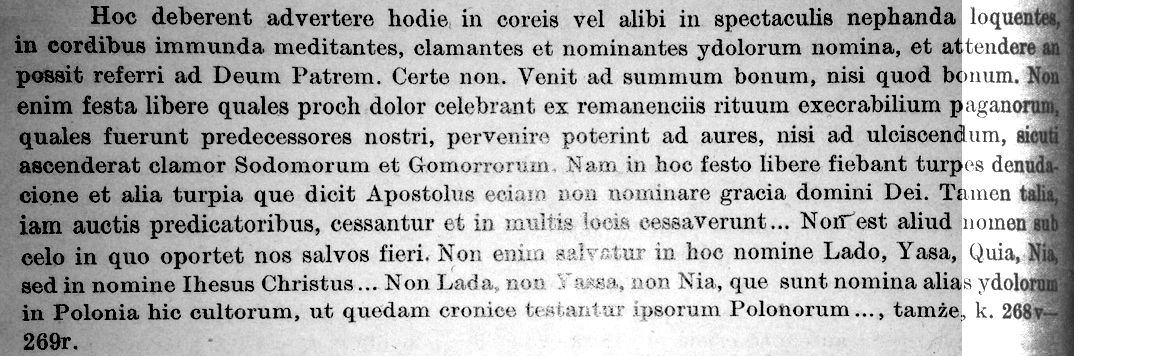
The various Polish Gods listed by Lucas from Great Kozmin come in three lists.  You can see the entire passages here but, the bottom line, the following names appear in the respective passages:

  1. ‘Lado, Yassa‘ et attendere [?]
  2. LadoYassaNia
  3. Non Lada, non Yassa, non Nia

However, we have been told that there was also another name mentioned – Quia or Qui or Kiy.  Of course, the immediate connection drawn would be with Kyiv.  The name supposedly appears in the second passage between Yassa and Nia.

However, as we have already mentioned before, in the manuscripts that we have seen, no such name appears.  See for example:

yast

or:

astr

We have not examined the other manuscripts but so far it does not look promising…  This is not to say that the Poles only had three Gods – Lucas does say “and others” – but it does mean that there is simply no mention of Kiy.

So where did the idea of a Kiy come from?  This fragment from LofGK was first noticed by Maria Kowalczyk.  She does mention Quia based on a manuscript from the Jagiellonian Library (BJ 1446) so an examination of that manuscript would seem to be in order.

Copyright ©2016 jassa.org All Rights Reserved

July 13, 2016

Idols

Published Post author

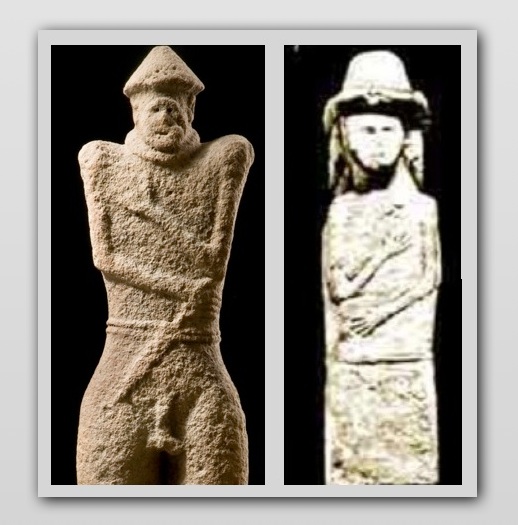
There has been some recent discussion (again) about the authenticity of the famous Światowid from Zbruch or just the Zbruch idol.  We’re not going to get into that but thought we’d do a visual comparison with another figure – the so-called Warrior from Hirschlanden (Krieger aus Hirschlanden) near Stuttgart (Swabia) which has been classified as Celtic:

kelten

Well, the arms are reversed, he’s got a penis (we think), a waist and the hat is pointier…  Nevertheless, there are some similarities.  This is obviously of great importance.  Now we can safely conclude that Celts lived as far as Zbruch river in the Ukraine.  Who would have thought!?

Copyright ©2016 jassa.org All Rights Reserved

July 12, 2016

On Długosz & Brückner – Part II

Published Post author

So what did Brückner think about the “misunderstood” names were?

1

Jesza

Regarding Jesza his judgment was that it was an old expression meaning, roughly, “let it be” or “please let it happen.”  He stated that it existed in Old Church Slavonic.

The first issue with this is that Brückner, as is symptomatic of his writing more generally, offers no proof showing how we came to this conclusion.  He makes his assertion without any citations or references.  Thus, the erudite exercises his prerogative no.1 – take me at your word as I know more than you do.

The second issue here is that, assuming arguendo, that Brückner were right as to the existence of such a word in OCS, we have to ask what difference does that make for the occurrence of the word in Polish?  The relevance, we suppose, would be present if Polish were somehow derived from OCS.  However, whether OCS is the “oldest” (whatever that may mean) Slavic language is debatable.  Old Slovenian also shows signs of antiquity and an entire separate debate could be had about that topic.  As it stands, the word Jassa, appears in a whole host of sources across most of the ancient world where Slavs or Veneti touched foot and in some places where, to our knowledge, they did not:

  • It was the word for “law” under Genghis Khan;
  • It appears to mean “flowing” as in the Polish jazda or jechac and is found as the name or as part of the name of numerous “Old” European rivers;
  • It was, arguably, the name of the hero Jason and the Greek (Dardanic) demi-god Jasion;
  • It may be related to the word jazyk, as in tongue (but perhaps that too is by reason of flowing (saliva? words):
  • we mentioned many other appearances of similar names all over the world and know of many others (including in India);

There is thus not much reason to assume that the OCS version – from whatever time (Brückner, of course, does not say) should be relevant for the Polish usage. Or, put differently, the fact that the word had a particular meaning somewhere in Russia does not mean that it had the very same meaning in other Slavic countries.  In fact, one might ask whether the older appearance is not the one from Poland?  Of course, we can’t even begin to discuss which was earlier because Brückner gives no cites for the OCS usage or for the time of the alleged usage (are we repeating ourselves here?).  It is also notable that the Czechs mention the same God as Chasson which sounds much as Jasion.  However, the Czech writers identify the same with the Sun, i.e., Chasson Sol.

Third, even if in fact such usage did exist somewhere and sometime in OCS lands and even if we were to assume that the usage was similar to the version promoted by Brückner, one has to ask, so what?  In other words, we do know of mentions of an East Slavic God – Dadzbog – whose name means as much as “God give” or, in more prosaic words, “let it be” or “let it happen”.  If we’re going to dip into Eastern Slavic folklore for Jesza then it’s only fair that we should be able to dip into it for Dadzbog too, it seems.

Lada

“Lado” Brückner states is a vocative of Lada.  But then notes that the word also appears in masculine form as lado.  Thus, it could be either it seems.  No problem there but what of it?

Brückner explains lada as a favored female, “my love,” “my dearest”, etc.  For this proposition he cites  two appearances (though there may have been others) of the word in the Tale of Igor’s Campaign (only manuscript from the 16th century)*.  One has to assume that that work is genuine, of course, but let’s assume that.  Separately, he notes the appearance of the word in the Life of Saint Catherine and notes that in Dalimil’s Chronicle the same means a pretty girl (presumably lado would then be the masculine equivalent).  He even notes a use of the word in 1562 in Poland (but does not provide a specific citation).

Then Brückner claims that Długosz was inconsistent in that, a few years earlier, he stated that Lada was a local Mazovian Goddess rather than a God of War, Mars (as he claimed later).  The two, however, need not be inconsistent and the fact that Herodotus and others spoke of women who catheterized their cut off breasts and served as warriors, i.e., the Amazons, leaves a tempting solution to this conundrum.

In any event, what Brückner really claims is that the later Polish usage should be determinative of the earlier Polish usage.  Alternatively, he seems to suggest that the non-Polish usage should be determinative of Polish usage.  There is, however, no reason to prefer either such interpretation.  In any event, Lada as a goddess also appears outside of Poland (more on that later).

Nia

Brückner says nothing regarding Nia other than to note that Jakub Parkoszowic did not show where the Nia he mentioned (in 1440 so before Długosz) was supposed to have come from.  The fact that Parkoszowic chose not to delve into the origin of Nia may suggest that the Deity was well-known at the time, or it may suggest that Parkoszowic did not feel the need to explain himself since he was writing a treatise on orthography, not theology.

Brückner notes that Długosz simply defaulted here to Pluto but says nothing about the existence or nonexistence of the Deity by that name.

Dilela or Dzidzilela

What of Dilela? Brückner argues that this is made up from  the words leli, which Długosz misunderstood from the peasants’ songs of yleli (where the y just meant “and”).  Note that Lel & Polel do not appear in Długosz’ pantheon.  In this respect, there probably is a connection between Leli and “Dilela”.  They were likely the same.  But so what? Brückner does not say.

He rambles on without really explaining the origin of all these names.  He talks of drinking songs and proverbs of “LelumPolelum” but does not answer the fundamental question of the source of these “sayings.”  He notes that the name also appears in other places as the name of a Deity but then suggests that maybe the name Leli has something to do with an old Polish verb indicating swaying or wiggling.  Because why precisely?  Brückner does not say.

Where does this leave us?

Well, first, to be anal about this, the Długosz formulation is actually Dzidzilela or Dzidzilelya (a note on one of the manuscripts also has Dzydzylyna).

Second, the prefix dzidzi (though dzi perhaps as well) suggests Persian daevadeitas or deus.  In fact, depending on the case it could be cognate with a number of these.  As an alternative, it is also possible that the invokers really meant the children of Lela, i.e., Didi Leli.  If so, this can explain the connection with Castor & Pollux.  Further, as the mother of Dioskouri was Leda, this can establish a connection to Lada or Lyada.  

In any event, all of this suggests a connection to divine names rather than, as Brückner would have it, a purely made up construct.

But there are other names in the Długosz pantheon.

Marzanna

Here Brückner claims that Długosz needed to fill the roles of Ceres and Diana.  Why?  Because Poland was the land of forests and meadows so sylvan or agricultural deities were absolutely necessary.  For Ceres, Długosz allegedly found inspiration in the Marzanna being carried out by villagers and thrown into water at the end of winter.  This, so Brückner implies, was a natural “fit” because Marzanna was also (Marynia) the name of a plant.

Note that Brückner himself does not question the village custom.  He just calls Her a “goddess”.  But surely, Marzanna’s divine status cannot be disproven – as against the word of Długosz – solely by putting the word “goddess”, as Brückner does, in quotation marks.  In fact, later Długosz himself explains the custom of “drowning” Marzanna as a restaging of the even surrounding the Polish “baptism” when the local Divinities were broken or tossed in the waters (a practice also known from Russia if are allowed to draw parallels).

So for all of Brückner’s derision, all that he may have shown is that the Długosz did not explain the connection between Ceres and Marzanna.  On that, Brückner is, of course, right but neither was that the goal of Długosz (see below).

Dziewanna

Here Brückner notes that there was a plant by that name (or, rather, by a similar name) (which is true) and that using a plant name for a required (as per Brückner – see above) parallel for the Roman goddess of nature just made sense.  Add to that, he says, that both the plant name and the the Roman goddess name ended in the same suffix –ana and the connection was perfected.

Well, the name of the plant was actually slightly different (Brückner can’t help himself but admit that – presumably to show off his botanical erudition).  And we will give Brückner the benefit of the doubt and assume that he hadn’t heard of the Goddess Tāfanae  (which, however, some (particularly German) writers insist on writing as Tanfana or Tamfana).

But more importantly, Brückner’s “critique” is nothing but speculation.  He has, of course, no proof or knowledge as to how exactly Długosz came upon his names but neither does he have very strong reasons to doubt Długosz who did not say anything extraordinary regarding Dziewanna.  The fact that a plant could be named after a Goddess is hardly shocking and that the memory of the latter may have faded while the name of the former endures is also unsurprising (more on the plant later).

We note too that one of the glosses to the Mater Verborum has Diana as Devanna.  If Hanka forged that he forged either being aware of Długosz’s pantheon or independently coming up with the name for Diana.

Pogoda & Zywie

Brückner discusses Pogoda and Zywie and asserts that Długosz must have simply “Slavicized” the names Podaga and Siwa – known from the Helmold chronicle (though Brückner seems astounded that Helmold’s Chronicle somehow managed to find its way into the hands of Długosz).  However, he says nothing about these Deities’ existence or nonexistence.  And weren’t they supposed to have been Deities of Polabian Slavs (even if an Indian connection seems present at least with Siwa – remember Veneti =?= Vindi) so what’s their to Slavicize (perhaps Helmold got them wrong in the first place?).

Boda

Boda was not part of Długosz’ pantheon but Brückner mentions Her (?) when discussing the passage regarding “Lada, Boda, Leli“.  All he says is “I don’t know where this came from.”

2

Why Does Brückner Think He is Right?

The why is quite simple. Putting aside that Brückner thought he was right because he was Brückner (as if an explanation were needed), he also states that there could not have been any pagan rituals left in the 15th century because by then Poland was throughly Christianized.  In other words, all of the past customs that had not been incorporated into Church practice were forgotten.  Five hundred years after the “baptism” of the country, the entire pagan culture must have been lost.

A number of observations are in order.

First, despite the words that Brückner uses to describe Marzanna (“some sort of Marzanna”) surely he must have known exactly what the ritual was about.  After all, the ritual has survived to this day in many places in Poland and a scholar like Brückner would have been intimately familiar with it in the 19th century.  So why so dismissive?  It’s difficult not to suspect that Brückner does not wish to discuss Marzanna because, if that ritual survived from the 15th to the 19th century, it sure as hell could have survived from the 10th to the 15th.  In other words, to this day we have all kinds of rituals that date years in the past and while the maintenance of such rituals in a preliterate society would no doubt have been harder (and more variations would likely have accrued), it, by no means would have been impossible.

Second, notwithstanding the baptism of the court of Mieszko, the reality was a bit more complicated.  We know that a number of partly-pagan rebellions took place in Poland in the first half of the 11th century.  We know that paganism survived as official state religion in several Slavic dukedoms into the 12th century.  We know that the nearby Prussians remained pagan as late as the 15th century.  We know that church penetration was fairly weak initially – one parish per 100 miles or so (this is partly because evangelists – then as now – claim success when they have converted the rulers; they know that, over time, the rulers, using state power, will convert the commoners).  We know that Church attendance and mindless repetition of a few prayers was all that was  required of the lay villagers back then (back then?).  We know that Poland suffered from a Mongol invasion as well as invasions by various other pagans (Prussians, Pomeranians, Jatvingians, Lithuanians, etc).  We know that the country was split apart in 1138 and did not recover (and then only in parts) till 1320 or so.  Thus, in effect, the state preoccupied with other matters, was unable, except locally, to conduct a Christianization campaign for almost 200 years.  The Polish state did not emerge in a more or less stable state until the 14th century.  That in 1405 the dean of Cracow university should remember pagan rituals (as he claimed) and that, perhaps, a Cracow priest like Długosz could later in the same century have some notion of the same is certainly not beyond the realm of decent possibility. Brückner is right to raise doubts but he is wrong to be wholly dismissive.

Third, Brückner assumes that the only kind of Polish paganism that may have survived till the 15th century was the “original” pre-966 paganism.   Given that assumption it is easier for him to then argue how hard (or impossible as he would have it) it would be for pagan beliefs to survive 500 years of Christianization.  To be fair to Brückner, this is partly driven by the fact that Długosz placed his information about paganism right at the beginning, i.e., prior to discussing Poland’s Christianization.  However, it is also entirely possible that the Polish Gods of Długosz have nothing or little to do with 10th century Polish divinities (whatever they may have been).  And yet Długosz’ Gods may well have been worshipped in the 14th or 15th centuries.

Although Długosz may have been reluctant to admit that pagan practices were still going on in his time in a work of the type that he was writing (Annals of the Kingdom, etc), as we noted before, there is plenty of evidence (for example, from the various internal Church documents) that pagan rituals were, in fact, continuing into the 15th century.  That said, religious practices change over time and the ones of the 15th century may have been very different from the ones of the 10th.  Poles may have worshipped Jessa in the 15th but not necessarily in the 10th century.

And if that is true then we do not need any pagan practices to have “survived” five centuries of Christianization.  Such pagan practices may have evolved over time or, perhaps, they may have been stopped by the Church and then restarted anew in an entirely different way.

Overall, one can’t help but note that Brückner’s article is set up in a rather strange way.  Normally, one would expect to see a thesis and then a careful analysis of the pros and cons.  Instead, Brückner strives very hard to show that there was nothing to the Polish Olympus and only then, when he thinks he is done, in a manner of a magician that reveals the secrets of some trick to gullible children, he tells us why this has to be so.  Although writing formats of the 19th century may have differed from today’s so some slack may be cut, the overall inescapable conclusion seems to be that Brückner already knew his “conclusion” before he wrote most of his paper and that the paper’s body is merely designed to “prove” that a priori conclusion.

So Where Are We?

Brückner’s theorizing leads him to conclude that:

1) although Długosz did not make anything up out of thin air, nevertheless his Gods are not worth much, and that

2) Długosz simply made up connections to Roman gods.

As regards 1), we have shown that there does not seem to be a reason to question Długosz on a number of the above names or their variants (Jesza, Lada, Didi-lela).  Others yet, Brückner himself does not really address other than, perhaps to say that they are Polabian Slav Deities (Pogoda, Zywie) but, again, what of it?  Others he says nothing about (Nia) or admits that they existed, whether as divinities or not, at least as part of village ritual (Marzanna).  As to the non-Długoszian Boda, he says nothing other than to acknowledge its mention in one source.

When all is said and done, the only Divinity that suffers – perhaps – from all of the Brücknerian sneering seems to be Dziewanna.  And even there, we have shown it is really Brückner’s word against Długosz’.

Again, scholars are free to criticize but they have to establish their case.  While one can express doubt about some of Długosz’ claims (he, like Brückner, does not cite anything but Długosz can, perhaps, be excused as he wasn’t writing a scholarly article!), he does state his case and there is nothing in what Długosz wrote that strikes us as improbable or outright crazy.

Thus, in the end, Brückner asks us to accept his word over Długosz’ as to what the situation with Polish paganism was in the 15th century.   Or, to put it differently, he asks us to accept that he, Brückner, knows the customs of the 15th century Polish villagers better than a 15th century Polish high church official.  Of course, stranger things have happened but Brückner fails to convince us that this is one of them.

Further, Brückner seems affected by two trends of 19th century Germany.  One was the already mentioned 19th century perception of Catholic priests as backwards and one of the cause of the collapse of the Polish state (as compared with Prussian protestantism).  The second was the resuscitation of Germanic paganism as something pure and original (along with Germania, etc).  This led to the resuscitation of various Slavic antiquities as almost a response.  Underlying all of this was the notion that original paganism was good because it was national in character.   Brückner seems to transfer the motives of 19th century folk chroniclers onto the 15th century Długosz.  How valid is that?  Why does Brückner think it would have been important for Długosz to have shown Poland’s pagan roots at the level of detail that he did?  Długosz may have been a patriot but he was a churchman of the 15th century and any notion that he was trying to bolster national pride by listing Roman-like deities seems a projection back in time of Brückner’s perceptions of Brückner’s own present.  Długosz may have taken secret pride in “rich” pagan beliefs but if so he gives no hint of this in his matter-of-fact writing on the subject.

And what of 2)?

Here Brückner does have a point. Długosz does not say why the various Polish Gods must correspond to their respective alleged Roman counterparts.  But, that said, Brückner’s point is a bit of a “so what?”

In other words, we have to ask why did Długosz strive for his interpretatio romana.  The answer is likely to be simple. Długosz was writing – in Latin – to explain (very briefly) Polish paganism to an audience which may or may not have been familiar with it but would certainly have been familiar with Roman paganism.  Hence the usefulness of parallels, even if imperfect, from Roman mythology.  And that’s it.  If it turns out that Jesza did not have the exact attributes of the Roman Jupiter, so what?  Maybe it’s enough that He was the head of the pantheon as the “Main God” – a portfolio similar to Jupiter’s.  Even if Devanna was not Diana, so what?  From Długosz we still learn that She may have been a “forest lady” type.  If Nia was not Pluto but was, nevertheless, a God (Goddess?) of the underworld, would that make much of a difference?  And Lada may have been both a guardian of Jesza – in the form of a war god – as also an Amazon-like female.  If, as we are told, women can do anything men can do, then certainly Goddesses should be able to do anything Gods can.

So what’s up with Brückner?  We’ll have more to say about that later.

P.S. In a similar vein Brückner criticized the Baltic Pantheon – criticizing shows how smart (and entirely not gullible) you are.

Copyright ©2016 jassa.org All Rights Reserved

July 11, 2016

On Długosz & Brückner – Part I

Published Post author

One of the more peculiar persons in Slavic historiography was the erudite Teuton Aleksander Brückner.

An erudite enjoy certain privileges.  For one, his command of facts allows an erudite to dominate discourse to the point that – should he choose to make something up – he is more likely to go unchallenged (prerogative no. 1).  After all, if someone is right 99 times in a row, are you really going to question the next fact that he posits as truth?  See, for example, the BS written by well-known (well-known among historians – fame’s relative) historians such as Karl Müllenhoff or, more recently, Herwig Wolfram.

Another benefit of being an erudite is that an erudite just sounds smart.  In other words, all too frequently, an erudite’s audience is likely to mistake his command of facts for intelligence and wisdom (prerogative no. 2).  But being able to memorize lots of things does not mean you can process them equally well.  As the story of John Nash shows, sometimes too many facts/neurons firing can also lead to information overload and the result is, well, crap.

Which brings us back to Brückner – the erudite.

OGRE

Brückner seemed happier in his youth

Brückner, was considered the preeminent Prussian Slavist of the late 19th century.  He was not only a walking encyclopedia but also a workaholic (the latter, no doubt, leading to the former).   He had, however, also a number of less attractive qualities.  For purposes of this entry, let it suffice to say that he was not half as smart as he thought himself to be and he could also be a rather unpleasant individual.

Specifically, Brückner’s particular form of “stream of consciousness” writing appears at times to lack any basis in fact and any logic in its conclusions.  He tosses facts into a verbal stew that is his writing through mere assertions, not troubling to document them (fact creation – erudite’s prerogative no. 1) and then builds his sand castle theses in the thinnest of air usually based on overactive criticism of anything that does not fit his, obviously, preconceived notions of historical truth (making sweeping conclusions that sound “smart” so long as they are not carefully scrutinized – erudite’s prerogative no. 2).

In addition, and more concerning, was Brückner’s seeming eagerness to obviously pleasure himself by mocking, belittling and deriding his opponents – real or imagined – current or past.  Of course, no man – great or otherwise – should be exempt from criticism.  On the other hand, few things are as nettlesome as a great man being mocked by an overweening mediocrity who, to top it off, is not even witty.

Therefore, it bugs the proverbial shit out of us that nearly five hundred years after he wrote his Polish Annals, the Polish chronicler Jan Długosz became yet another target of Brückner’s assinine ridicule.  While some of what Długosz wrote could be (and was) subjected to healthy criticism, Brückner’s variant of such criticism appears notable not for its astuteness but for its boorish mean-spriritedness and lack of logical thinking.

(A more interesting dissertation on the subject may have been Bandtke’s De Jessa et Nia duobus Polonorum diis which, unfortunately, seems to have been preserved in only one notebook/manuscript (number 702) and was burned down by the Germans in 1944 when they – purposefully – torched the Biblioteka Ordynacji Zamojskiej  or the Zamoyski Library in the Blue Palace in Warsaw).

The Cantankerite in Action 

Specifically, Brückner took it upon himself to describe, “Polish Mythology” devoting less than eighty pages to the task in his rather derisive pamphlet of the same name.  The title of the first chapter, “The Birth of the Alleged Polish Olympus” sets the tone for the rest of it and the first contemptuous words bring to mind a flehming Brückner:

“Deeply did the Cracovian canon Jan Długosz fall into his thought, in his room* cluttered with manuscripts and parchments: he felt on his shoulders the weight of the task placed upon him by his spiritual father Zbigniew,* the Cracow bishop.  It was for him that he undertook to write the histories of the fatherland, from the beginning till that day even but then got stuck right at the beginning.  Having completed the physical topography of the land as well as the moral topography of its inhabitants, it behooved him to say something with respect to the pagan times and their primeval idolatry: what kind of idols* did the old Poles worship?  The complete picture of this prehistory could not be written without this detail, which seemed to be both rather easy and rather hard all at the same time.  Easy, since all idolatries were, after all, the works of the same satan who traps humans in his snares; for everywhere it was the same; Greek idols were the same as Roman: Athena-Minerva, Ares-Mars, and so too among the Poles there must have been the same Mars, Pluto, Venus, Jupiter as among the Romans and only their names were local, Polish. That was easy and simple but where should these names be found?  After all, the scrupulous scholar knew how futile it would be to ask these of the common folk who, Christian now for five centuries, gave up all such idols.  It was thus not without reason that the canon did fall so pensive; but his brow suddenly cleared, for he recalled now that he’d read somewhere the names of these pagan idols.  And indeed, after a long search, he did locate the above-mentioned note… But what was this note?  We too have it in our possession.”

* While the above lengthy introduction makes for good reading it’s hard to fully convey the condescension in Brückner’s voice.  Thus, the text is filled with diminutives – a typical Polish (though not only) derisive device; the form “room”  Brückner refers to as izdebka, a diminutive of izba as if Długosz – the parchment nerd – were locked in some rathole the size of a standard Japanese hotel room, sweating on how to please his clerical boss – the bishop Zbyszko (a diminutive of Zbigniew) – more than the miller’s daughter sweated trying to figure out how to spin straw into gold.  Also, the word bożki – “idols” – is, in Polish, in effect, a diminutive of “God” (Bog).

jandlugosz

Perhaps Brückner drew inspiration from the Matejko painting of Długosz

The royal “we”, Brückner proceeds to tell us, “too have” this note in “our possession” – referring to the Statuta provincialia breviter discussed here.  He then continues his harangue:

“all the mentions of the Polish idols can be derived from this single source… So finally Długosz found what he was looking for: pagan idol names… all that was left was to provide a classification of these which he took on the responsibility of doing himself.  In the front he placed JesseJassa because the name reminded him of Jove; perhaps he heard somewhere about gardzina – a hero when he also heard lado and so he designated the latter one as Mars; in rather than ileli [reference to yleli in Sermones per circulum anni Cunradi – see here] he’d read somewhere about some dzileli and threw in Venus/Aphrodite and Nya… became Pluto.  And so, all four main Roman gods did he happily place on the ‘Polish Olympus.’ But what sort of names were these?”

Put aside the fact that it is rather untrue that Venus and Pluto were part of the “four main Roman gods” as Brückner claims. (Where is Juno/Hera?  Where is Minerva/Athena?  If Mars is part of this, where then is Quirinus?)…

Put aside the derisive tone of the whole thing.

Let’s focus on other things such as the fact that Brückner offers statements that are either false or completely baseless.  As regards the latter, Brückner had, of course, no idea how Długosz found the names he mentioned. Brückner had as much information about what Długosz read or “perhaps… heard” as he had about the size of the room that Długosz wrote in.

Why did, according to Brückner, Jassa remind Długosz of Jove? Brückner implies this is because of the name similarity.  But that seems a major stretch.  If anything, the name Jassa should have reminded Długosz of the Greek demigod Jasion.  Długosz did apply an interpretatio romana but Jassa likely became Jupiter/Jove not by reason of any name similarities but rather because in all the documents that Długosz may have come across (or at least that Brückner claims, Długosz came across) the name Jassa appeared and, usually, appeared first.  The notion that Długosz heard something about a gardzina (basically, “guardian”) and therefore made Lado equivalent to Mars is silly.  The primary function of Ares was as God of War, not as a guardian of Jupiter.  Brückner’s argument regarding how Didilela became Venus/Aphrodite, is unintelligible (to us).  Moreover, he does not explain how or why Nya became Pluto.

Of course, one can question Długosz but the problem is that Brückner has no idea so he lets his imagination run wild for a moment in much the same way that he accuses Długosz of having done.  When Brückner tires of this mental masturbation, he basically, stops pretending to make any arguments and, basically says, “Długosz just made it up and I won’t spend time on this any further.”

There is also the fact that Brückner was wrong about the variety of sources available to Długosz.   The canon may well have relied on Statuta provincialia breviter but we now know that there were earlier* sources such as the Pentacostal Postillas.  Moreover, those postillas (written by the rector of Cracow University) are quite explicit that they discuss heathen Gods and, again, name the names of the same in much the same way as three of Długosz’ names.

More importantly, none of the various sources mentioned shows any indication of being derivative of the Statuta.  The only reason for this claim in Brückner’s mind seems to be that the Statuta were the earliest source known to him.  However, it is illogical to suggest, without more, that, each written source must be derivative of an earlier written source.  If the Postillas came before the Statuta, Brückner’s logic would suggest that the latter must be derived from the former simply because the former preceded the latter.  The discovery of a yet earlier source wouldn’t matter either as, based on this line of thought, we’d just be discovering the “real” autograph (until an earlier one still were found and so on).

To claim that a work is derivative of another one has to show dependencies.  Here, however, no such dependencies are evident.  For one thing, the Statuta only discuss two names – Długosz has a number of others.  Moreover, the Statuta do not mention Nya who was mentioned by the earlier Postillas.

So why did Brückner say what he said?

Brückner’s Spelunking

Brückner’s basic argument is that these Names meant all kinds of things except what the numerous authors claimed them to be, i.e., pagan Divinity Names.

How is then that all the scribes were mistaken about them?  Brückner’s argument here is that priest in the 14th and 15th century were all superstitious morons who saw the devil plotting everywhere and any kind of dance or frolic was interpreted as some form of idolatry by these primitives.  To support this claim he gives an example of a Czech priest – Jan from Holešov – who, apparently, misinterpreted “vele” in an old Czech carol “Vele, vele, stojí dubec vprostřed dvoru” (apparently, the oldest Slavic carol) as being a reference to the Mesopotamian deity Baal.

A number of things come to mind.

First, as regards the Czech example, it is hard not to note that the refrain “vele, vele” appears very similar to the East Slavic God Veles (who, albeit by later writers, may also have been mentioned among Czech Deities, as Hecate, in the form Wyla).  While, Veles is obviously not Baal, he was a pagan divinity and Brückner’s objection can hardly be merely that Jan from Holešov misidentified the idol.  In fact, if one thought that the reference was to a non-Christian divinity but one had not heard of Veles, it would be not altogether unnatural to try to make sense of this by referring to Baal about whom Jan was no doubt well informed by reason of his Bible Study and all.  And that’s before we even note that the oak (the dubec above) was certainly often associated with various pagan Gods.  The fact that the song was a carol does not necessarily change its roots.  While all of this is supposition, so are Brückner’s fancies regarding the astuteness of Jan from Holešov’s observations.

Second, even if one priest in Bohemia could have been mistaken, a whole host of priests being repeatedly mistaken seems a bit much.  While priests, like all people of that time, were obviously limited in their education and outlook, they were, nevertheless, the most educated caste among the people.  It seems it is for this reason that Brückner needs all his God mentions to be derivative from the Statuta.  Then only the first priest would need have been mistaken.  (Of course, that priest would have to have been someone writing the Statuta at a synod (so not just some local parish priest)).  Nevertheless, as we’ve shown above, there is no basis for concluding that the various sources for the existence of Polish (Venetic? Slavic?) Gods are in any way interrelated.

Third, given Brückner’s tone in his introduction and given some of his other writings, it is difficult to escape the impression that Brückner’s perception of the priest class was coloured by the time that he was living in.  Recall that he was a citizen of a reborn Germany, driven by its main engine – Protestant Prussia.  Poland, on the other hand, had been partitioned as a failed state.  In the narrative justifying partition, the Prussian occupiers stressed the backwardness of the Polish nobility and of its (Catholic) clergy (of course, it was that nobility and clergy that also were, to a large extent, the carriers of the national spirit – something that the Prussians and Russians did not fail to notice – hence another reason for the official disparagement of them).  Based on his style, it seems that, to a not insignificant extent, Brückner was influenced by that narrative and transplanted his perceptions of the present to help himself in making a point about the past.

But what of these Names!?

gosz

We’ll be back to that.

Copyright ©2016 jassa.org All Rights Reserved

July 9, 2016

Ptolemy’s Geography – Arabic Style

Published Post author

While we are on the topic of Arab writers: Muḥammad ibn Mūsā al-Khwārizmī al-Majūsiyy al-Quṭrubbaliyy (aka al-Khwārizmī)‘s Kitāb Ṣūrat al-Arḍ (A Book of the Portrait of the Earth*) contains additional mentions of the Slavs.  Al-Khwārizmī was born probably in or around Baghdad or in Khorasan (in which case he was a Persian) circa 780/790 and worked in the first half of the ninth century (the book in question was probably written before 842).  He was a scientist as well as a geographer and a historian but, back then, you could dabble in all disciplines.  The words algorithm and algebra probably come from mispronunciations of his name.  Obviously someone this important must have written something about the Slavs.

* note: different from Ibn-Hawqal’s; also notice the similarity between the Indo-European Germanic *ertho (Erde) and al-Arḍ  strange, no?

manu

“The” manuscript – front cover

His book also translates as “Geography” and, indeed, it is a reworking/updating of Ptolemy’s work.  The book is a description of maps, most of which did not seem to have survived.  The single existing manuscript was subject to study and printed in 1926 by the Austrian scholar  Hans von Mžik (in Bibliothek arabischer historiker und geographen).  The following is from page 105:

qaraz

“The country [G]ermania.  This is the same as the land of the Slavs.  Its center lies at longitude 36 40 and latitude 52 0….”

gera

“The country Sarmatia.  This is the same as the country Burgan [Bulgaria,* less likely Burgundia].   Its center lies at longitude 45 0 and latitude 52 0….”

* already al-Fazari circa 775 mentions the Danube Bulgarians between the Khazar/Alans and Byzantium.

“The country Sarmatia.  This is the same as the country al-Lan [Alan].   Its center lies at longitude 73 0 and latitude 59 30….”

Copyright ©2016 jassa.org All Rights Reserved

July 8, 2016

Oldest Arabic Mention of Slavs

Published Post author

The oldest mention of Slavs by an Arab writer (at least oldest currently known) from the end of the 7th century (circa 690).  It is a simile by Al-Ahtal (circa 640 – 710) an Arab warrior-poet of the Omayyad period (real name: Ghiyath ibn-al-Salt or Ghiyath ibn Ghawth al-Taghlibi).  Al-Ahtal was in the midst of warring (against the Qaisites who were the enemies of the Al-Ahtal’s Taghlibites) and composing poems and many of the poems refer to battles of his patrons.

The Slavic reference is in one of the poems that make up the Diwan collection. The collection itself has most recently seen editions by P. Antun Salhani (twice – based on different manuscripts) and by Eugenio Griffini (another, “Yemeni”, manuscript).  The language (not present in all manuscripts) is as follows:

“As if they saw in them a throng of light- [or red- or ruddy-] haired Slavs”

octis

The “they” apparently refers to desert birds (on that see Melanges Asiatiques by Dorn) that were flying/escaping from people (the “them”).  The birds were escaping the people as if the people were a group of light-haired (blonde?) or red-haired Slavs.  Possibly, the reference of light or red or ruddy is to the skin color of the afore-mentioned Slavs.  If red, then perhaps so by reason of the desert sun.  In any case, the author apparently thought the Slavs (red or light) were something to be escaping from.

ptolif

Copyright ©2016 jassa.org All Rights Reserved

July 6, 2016

The Veneti of Solinus & Martianus Capella

Published Post author

We have previously briefly mentioned Solinus (Gaius Julius Solinus), the Latin writer of the early 3rd century, when discussing the River Vistula here. He wrote “The wonders of the world” (De mirabilibus mundi aka Polyhistor), a book which includes a mention of the Veneti of Paphlagonia.   Although much of the work is derived from Pliny and Pomponius Mela, we wanted to include the reference for completeness’ sake here (with the C.L.F. Panckoucke edition).

Martianus Capella (Martianus Minneus Felix Capella) lived and worked at the beginning of the 5th century.  We know this only because his one monumental work that survived – “On the Marriage of Philology and Mercury” (De nuptiis Philologiae et Mercurii) mentions the sack of Rome by the Goth Alaric (in 410) but the writer is apparently unaware of the conquest of Africa by the Vandals (in 429).  It seems (as per Cassiodorus) he was a native of Madaura in the Roman province of Africa (in today’s Algeria).  He may have been a lawyer in (Roman) Carthage.    The “marriage” book was quite popular in the middle ages.  More importantly for us, it also contains a geographic description of some parts of the world including a passage on the “Province of Phrygia”.  That passage, which appears based on Solinus, also refers to the Paphlagonian (and Italian) Veneti.  Therefore, we include it here as well.

Solinus
De mirabilibus mundi aka Polyhistor
C.L.F. Panckoucke edition (Paris 1847)
45. Paphlagonia, et Venetorum origo.

“In the back of Galatia is terminated by Paphlagonia.  This Paphlagonia, looks at Taurica [Crimea] from Cape Carambis; [there] rises Mount Cytor stretched into a height of sixty-three [thousand?] miles; this is where the noteworthy place of the Veneti lies, from which, as Cornelius Nepos certifies, the Paphlagonians set out to Italy and, thereupon, they were named Veneti. The Miletians founded many cities there.  The town of Mithridates (VI of Pontus) Eupator once it was conquered by Pompei, became known as Pompeiopolis.*”

* This refers to a Roman city near the modern Turkish town of Taşköprü.

polyhistor

(Paphlagoniam limes a tergo Galaticus amplectitur. Ea Paphlagonia Carambi promontorio spectat Tauricam, consurgit Cytoro monte porrecto in spatium passuum trium et sexaginta millium, insignis loco Heneto: a quo, ut Cornelius Nepos perhibet, Paphlagones in Italiam transvecti, mox Veneti sunt nominati. Plurimas in ea regione urbes Milesii condiderunt, Eupatoriam Mithridates: quo subacto a Pompeio, Pompeiopolis est dicta.)

Martianus Capella
“On the Marriage of Philology and Mercury”
Book VI
(Province of Phrygia)

“…Thereafter [comes] Paphlagonia, where [lies] the end of Galatia; but here is the city [land] of the Veneti from whose citizens [inhabitants], they [people] claim, the Veneti of Italy have arisen…”

veneticapellamartinus

(De Phrygia Provincia.  Phrygia Troadi imminet, ab aquiilone Galatia est, a meridie Lycaonia et Pisidiae Mygdoniae confinis est, ab oriente Lyciae, a septentrione Mysiae et Cariae.  Dehinc Tmolus corco florens, amnisque Pactolus.  Ioniae Miletos caput.  Ibi etiam Colophon, oraculo Clarii Apollinis celebrata.  Maconiae principium Sipylus; Smyrna etiam Homero notissima, quam circumfluit Meles fluvius; nam Smyrnaeos campos tiermus intersecat, qui ortus Dorylao Phrygiam Cariamque dispescit.  Juxta Ilium sepulcrum Memnonis jacet.  Ibi inter omnes Asiae civitates Pergamum clarius.  Nam Bithynia initium Ponti est, et ab ortu Thraciae adversa, a Sagari flumine primos habitatores habet, qui fluvius alii fluvio Gallo miscetur, a quo Galli dicuntur ministri matris deum.  Hace et Bebrycia et Mygdonia dicta est; a Bithyno rege Bithynia.  In ea civitas Prusias, quam Hylas inundat lacus, quo puer ejusdem nominis dicitur interceptus.  Ibi Libyssa locus, Nicomediae proximus, in eo sepulcrum Hannibalis memoratur.  Dehinc Ponti ora, post fauces Bosphori et amnem Rhesum Sagrimque sinus Mariandyni, in quo Heraclea civitas, portus Acone, ubi herba veneni acnitum procreatur, specus Acherusius, qui mergitur in profunda telluris.  Inde Paphlagonia, ubi a tergo Galatia est; sed hic Henetosa* etiam civitas, a cujus civibus in Italia ortos Venetos asserunt.  Ibi promontorium Carambis, quod a Ponti ostio abest millibus passum ducentis viginti, tantundem a Cimmerio.  Ibi etiam mons Cytorus, et civitas Eupatoria, quam Mithridates fecerat; sed eo victo Pompejopolis appellata.)

* also: Enetusa, Venetusa and in one other version in the margin, Henetorum.

Copyright ©2016 jassa.org All Rights Reserved

July 5, 2016

Gervase of Tilbury on the Slavs, Suevi and Vandals

Published Post author

Gervase of Tilbury‘s (circa 1150–1228) Otia Imperialia (“Recreation for an Emperor”) was written between 1209 and 1214 for the Holy Roman Emperor Otto IV.  In Slavic studies it is best known for its assertion  (in a note written – probably – by Gervase in one of the manuscripts) that Poles were Vandals (as Gervase says, he had it on good local authority – some have suggested of Mater Kadlubek).  However, the work contains many other interesting bits – some of which are clearly spurious – regarding Slavs, Suevi, Vandals and others.  We include these here as well as any related miscellaneous stories that could be of interest (e.g., the story of Lombards fighting the Huns and not the Vandals in their name-getting inaugural battle).  There is also a remarkable passage about the fierce battles of the Gauls in Pannonia and thereabout which must immediately bring to mind the legend of King Krak (or Gracchus) as told by Master Kadlubek who has Poles or, really, Lechites take on the Gauls and divide the world between the two peoples (there is also a king of Greece in the Otia called Graecus).  Whether Gervase is the same Gervase behind the so-called Ebstorf Map, we leave up to you.

essex

Tilbury is in Essex and this is some place in Essex

The translation of these fragments comes from the recent edition by Banks & Binns.  The pictures are from a French manuscripts (Bibliothèque Nationale, ms, Francais 9113., fol.195.

(Incidentally, the Kętrzyński referred to in the notes by the editors is not Wojciech – about whom we have written – but rather his son, Stanisław Kętrzyński. Stanisław was a historian at Warsaw University, was arrested by the Gestapo and survived Auschwitz only to die a few years after the WWII of heart failure)

Book II
Section 2. (Europe)

“Europe begins, as we have said, at the river Don in the northern region.  This river has its source in the  Rhiphaean Mountains beyond the Sarmatian Sea; it then flows past the altars and boundary stones of Alexander the Great which he set up in the territory of the Rhobasci, and swells Lake Maeotis, whose immense overflow near the city of Theodosia runs far put into the Euxine Sea, causing it to be called the Fresh-water Sea.  From this long straits lead down past Constantinople to where the Mediterranean, which we call ‘our sea’, receives them.  The Arm of Saint George is there.  Europe ends in Spain at the western ocean, at the point where the Pillars of Hercules are seen near the islands of Cadiz, and where the ocean flows into the mouth of the Tyrrhenian Sea.  The city of Hispalis, now called Seville, is situated there.”

Book II
Section 7.  The Northern part of Europe

“Now that we have completed our account of Asia, both greater Asia and Asia Minor, our next task is to describe Europe.   Europe begins in the north and ends in the western ocean, where the Pillars of Hercules are seen near the islands of Cadiz.  We shall give fuller lists of the cities of Europe that we did for those of Asia, partly because our knowledge of them is surer, and partly because Europe is more densely populated with bishoprics and archbishoprics known to us by name.”

“So then, Europe starts from the Rhiphaean Mountains, the river Don, and Lake Maeotis in the east; it runs along the shore of the northern ocean as far as Gallia Belgica and the river Rhine in the west; it then comes down as far as the Danube in the south; this river, also called the Ister, flows eastwards, and empties into the Black Sea.  In the east is Alania, and in the centre Dacia; Gothia is also in that region.  Europe takes its name from King Europa, or from Europa, daughter of Agenor.”

“In northern Europe are the Rhiphaean Mountains, so-called from the perpetual gale that blows there; for ριφη in Greek means impetus (blast) in Latin.  Between the Rhiphaean Mountains and the ocean there is a wide area which is held in the grip of relentless cold and perpetual ice, owing to the absence of the sun; this land is consequently uninhabitable.  This is where the northern zone is, called αρκτσς by the Greeks; it is also called septentrio from its seven stars (septum stellar).  At the upper end of the Rhiphaean Mountains is the source of the river Lentulus, which flows into Lake Maeotis between the Alanus and the river Don.  Much further on, below the river Don (which also flows down to it from the Rhiphaean Mountains, after passing the altars and boundary stones of Alexander situated in the territory of the Rhobasci), Lake Maeotis merges with the Euxine Sea near the city of Theodosia, sending a great stream right out into the sea.  As a result the sea as far as the Euxine is called ‘the freshwater sea’ by the local inhabitants.  Now the Black Sea runs down to the west opposite the Euxine; hence arose the popular saying which makes a comparison in incorrect terms: ‘The Black Sea is sweeter that the Adriatic.’  After receiving the waters of the Don, Lake Maeotis is further swelled by the river Lentulus, and later by the river Alanus.  Now the river Don (Tanais) is named after King Tanus.”

“The first region of Europe, beginning from the river Don, is called Lower Scythia.  It stretches from Lake Maeotis up between the Danube and the northern ocean as far as Germany.  The first part of Lower Scythia. as we have said, is Alania; then come Dacia and Gothia.  Then, opposite Dacia towards the north, theres is Scandinavia, an island in the ocean.  The Burgundians are said to have come from this island in the time of the emperor Tiberius.  They got their name of Burgundiones from the fact that they were the first to build separate fortified towns (burgi) to live in.”

“From the Danube to its source in the Alps is Upper Germany, so-called from its engendering (germinando) of peoples.  This country has the Rhine as its boundary to the west, and the river Elbe to the north; like the Danube, this river rises in the Alps and flows into the Black Sea.  Between Germany and Lake Maeotis in the east lives the fierce tribe of the Vandals.  Again, between the Vandals and Lake Maeotis live the Sarmatians.  The Sarmatian Sea is named after them; this sea is fed by the river Sarmaticus, the river Vandal, which flows through the Vandals’ territory, and the Danube to the east.”

“In the region of Upper Germany is Suevia, called after Mount Suevus.  Next comes Alemannia, named after the river Leman, as in Lucan’s:

‘tents pitched by Leman'”

“In the Passion of the Thebans, however, one reads that Lake Geneva also has the name of Leman; the Rhone flows into this lake.  Raetia is likewise in that region.  In Suevia is the source of the Danube, which is also called Ister; and so the poet calls it:

‘the Ister with its two names.'”

“This river is joined by sixty principal tributaries, and enters the Black Sea divided, like th eNile, into seven mounts.  After rising in Suevia, it descends from the Alps through Bavaria, then Austria, and then Hunia; from there it climbs back into the Alps and produces a great waterfall; after that it crosses the land of Croatia, and divides at Pozarevac.  North of these are the Cumani, who worship the first thing that meets them in the morning.  The Getae and the Coralli [Gorali?] live there.  From the division of the Danube to Constantinople it is twenty-four days’ journey to the south-east.  First one comes to the wilderness of Bulgaria, which is the territory of Blactum, where the villages of Rawanica and Nis are found.  On the edge of there wilderness is the city of Stralitz, the capital of Romania.  Then there is Philippopolis, after which comes Adrianople, and then Constantinople; alongside Constantinople is the narrow strait of the Arm of Saint George.  From there to Iconium it is twelve days’ journey; it takes another twelve to travel on from there to Antioch.”

“Noricus, also called Bavaria, is in Upper Germany too.  Between Noricus and Hungary or Hunia is Austria, which the people all Austerica.  Next to Austria is Bavaria, and bordering on Bavaria and Austria is Bohemia.  The might Saxon race touches on Bohemia to the north; their name comes from their endurance and strength, in which they resemble rocks (saxa).  Between Saxony and Westphalia is the river Elbe.  It is the tribes of Westphalia who are known as the Suevi.”

“The land between the river Elbe and the ocean is called Lower Germany.  It contains the region of Albia, which is bounded b the ocean to the north.  The land of the Danes is in this region, as is Norway.  The land of the Danes is the one nearer to Saxon Germany; beyond Denmark is Norway, and beyond Norway, across the sea to the north, lies Russia.  This sea is linked to the British Sea and the ice-bound sea, with islands breaking its expanse in between.  And so it is easy to cross the sea, going from one island to another, though the distance is long.  On these islands of the ocean gerfalcons are skillfully lured down from the highest cliffs overhanging the sea.  Also in Lower Germany is the land of the Marcomanni, a land hemmed in by the ocean to the north and by the mountains to the south.  In all there are fifty-four tribes living in Upper and Lower Germany.”

“I shall now set down the territory which the Danube separates from the land of the barbarians, down to the Mediterranean Sea.  So then, Pannonia is a twofold country, consisting of Upper and Lower Pannonia.  Upper Pannonia faces Moesia to the south-east, and the source of the river Danube to the north-west.  Lower Pannonia has the Also to the north-west; like Lombardy, it is closed in by the Alps.”

“That region is called Barbarica on account of the barbarian tribes living in it.  They say that the part where the race of the Huns originated is called Hungary or Hunia.  The precipice of the Danube is here, beyond which the river flows down to the sea.  Bordering on Hungary is Bulgaria, which they call Lower Macedonia, where Alexander came from; it belongs to Europe, and lies between the Adriatic Sea and the Alps, first the Hungarian Alps and then the Slavonian Alps towards the east.”

poulaz2

“Between the Hungarian Alps and the ocean is Poland, the name Poland being the equivalent of Campania in their language.  [It is known as the land of the Vandals, from the river Vandal which runs through it; I learned this from the inhabitants themselves.]*  Touching on Poland at one end is Russia, otherwise known as Ruthenia, to which Lucan refers:

‘The fair-haired Ruthenians were freed from their long garrison-duty.'”

[* Note from the editors: “This phrase, written in the margin of [manuscript] N, provides valuable support for identifying the hand of the marginalia with that of the author, couched as it is in the first person.  It also indicates that the information in this passage was derived from an oral source, from one or more natives of Poland; further confirmation of this is provided by the two references to the local language (‘in forum ydiomate‘ and ‘secundum uulgaris illorum lingue interpretationem‘), and by the specific details provided concerning Poland and Russia.  Ketrzynski (‘Ze Studyow’) pointed to the significance of this passage, and argued that Gervaise might have made the acquaintance of Vincent [Kadlubek] of Cracow, possibly in Bologna; this has been disputed (see Wilkinson, ‘The Otia Imperialia‘, pages 109-110, note 30), but it remains clear that Gervaise had either talked to people from Poland or visited the country himself.”]

that, strangely, the editors have a footnote here but do not have this footnote in the text.  Could this be perhaps a reference to Master Kadlubek?]

“The race of the Ruthenians lives here in an idle stupor; they give themselves up tot heir enthusiasm for hunting, and to disgusting drinking-bouts.  They hardly ever go beyond the confines of their own region; rather, whenever the urge to travel comes upon one of them, he sends his slaves to satisfy it; they have a great many slaves.  In return for the effort involved in making the journey, he bestows the reward of freedom on the slave.  As a result those ex-slaves go about both naked and wretched, begging their sustenance from others, despised by all, fellow-Christians and heathens alike; no one they meet proves an enemy or a robber, as if it were of them that it was written:

‘The traveller with nothing to lose
Will sing in the face of the robber.'”

Ruthenia stretches eastwards towards Greece, extending, so they say, a hundred days’ j0unrey in length.  The Ruthenian city nearest to the Norwegian Sea is Kiev.  At the end facing Hunia is the city of Galich.  [Halich?] Between Poland and Russia there are two rivers whose names interpreted from the local speech, are the Aper [Wieprz?] and the Armilla [Narew because armilla meant naramiennik, i.e., armlet?].  The Russian city of Vladimir lies opposite Poland, looking westwards.  Between Russia and Greece are found the Getae, the Polowcy, and the Coralli, [Gorali?] a very fierce tribe of pagans who live on the raw flesh for their food.  Between Poland and Livonia are the pagans who are called the Jadzwingi.  Beyond them to the north are the Livonians, a very virtuous tribe of pagans [same view expressed by Adam of Bremen].”

“Let us now return to Barbarica.  Between Barbarica and our sea is Moesia, so-called from its rich yield of harvests (messes).  To the east Moesia has the mouths of the river Danube, to the south-east Thrace, to the south Macedonia, to the south-west Dalmatia, to the west Istria, to the north-west Pannonia, and to the north the Danube.  It contains the city of Silistra…”

“… Dalmatia takes its name from the city of Delminium.  It has Macedonia to the east, Dardania to the north-east, Moesia to the north, Istria, the Liburnian Gulf, and the Liburnian Islands to the west, and the Adriatic Gulf to the south.  On the border of Dalmatia and Pannonia is the town of Stridon, once destroyed by the Goths; the inestimable Jerome, whose father was Eusebius, was born there.  The city of Salonae is in Dalmatia.”

“This whole area, once known as the land of Kittim, is sometimes called Greece, after King Graecus.  It begins at the Mediterranean Sea, and projects southwards into the Greaet Sea.  It is also called Illyricum; the city of Scia is in Illyricum.  Epirus is in Greece; this region is named after Pyrrhus, son of Achilles…”

“…To the north-west Venice looks towards Auileia; to the north it faces Slavonia.  It is separated from Italy by a narrow straight.”

Book II
Section 9. (Sees)

“Let us now go on to list the bishops and archbishops of Europe and the names of their cities.  All these cities are known to be subject to the Church of Rome, for we have a fuller knowledge of the European cities.”

pologneolo

Poland.  Poland has an archbishop at Gniezno, and he has as suffragans the bishops of Wloclawek, Lowicz, Kujawy, Plock, Krakow, Poznan, Masovia, and Pomerania.”

Bulgaria.  These are the archbishops of Bulgaria: the archbishop of Tirnova is the primate, and then there are the archbishops of Kjustendil and Preslav.  The bishops of Bulgaria are these: Skopje, Pristina, Budva, Nisch, and Kostolac.”

Slavonia.  Slavonia has an archbishop at Dubrovnik; his suffragans are Ston, Djacovika, Trebinje, Kotor, Portoroz, and Vidin.  Slavonia has another archbishop at Pdogorica; he has the following suffragans: Ulcinj, Svac, Danj, Pulati, Scodra, Albanese, and Sardoniki or Shkoder.”

“Hungary. Hungary has two archbishops.  The first is at Esztergom; his suffragans are these: Eger, Nitra, Vac, Gyor, Pecs, and Veszprem.  The second archbishop of Hungary is at Kalocsa; his suffragans are Gyulafehervar, Zagreb, Varad, and Csanad.”

“Istria-supra-Mare.  Istria-supra-Mare has a patriarchate at Grado.  Its suffragans are Castello, Torcello and Equilio or Jesolo, Caorle, Chioggia, and Cittanova d’Istria.”

“Dalmatia.  Dalmatia-supra-Mare has a patriarchate at Aquileia.  Its suffragans are as follows: Mantua, Como, Trent, Verona, Padua, Vicenza, Treviso, Concordia, Ceneda, Feltre and Belluno (these two being united), Pola, Parenzo, Trieste, Biben, Capodistria, Murano , and Citta Nuova or Asola.”

“Alemannia.  Alemannia has six metropolitan sees.  Mainz has the following suffragans: Prague, Olomouc, Eichstatt, Wurzburg, Konstanz, Chur, Strasbourg, Speyer, Worms, Verden, Hildesheim, Halberstadt, Paderborn, and Bamberg (which comes under the jurisdiction of the lord pope).  The archbishop of Cologne  in Alemannia has the following suffragans: Liege, Utrecht, Munster, Minden, and Osnabruck.  The archbishop of Bremen in Alemannia has the following suffragans: Bardowick, Schelswig, Ratzeburg, Schwerin, Mecklenburg, Lubeck, and Riga.  The archbishop of Magdeburg in Alemannia has the following suffragans: Havelberg, Brandenburg, Meissen, Merseburg, and Zeitz or Naumberg.  The archbishop of Salzburg in Alemannia has the following suffragans: Passau, Regensburg, Freising, Gurk, and Brixen im Thale.  The archbishop of Trier in Alemannia has the following suffragans: Metz, Toul, and Verdun.”

“Lombardy.  Lombardy has two metropolitan sees.  The archbishop of Milan has the following suffragans: Bergamo, Brescia, Ivrea, Cremona, Lodi, Novara, Vercelli, Turin, Asti, Acqui, Alba, Tortona, Savona, Albenga, Ventimiglia, Piacenza (under the lord pope), Pavia (under the lord pope), and Ferrara (under the lord pope).  Genoa has the following suffragans: Bobbio, Brugnato, and Mariana.”

“The Duchies of the Kingdom of Hungary.  Between Hungary and the Adriatic Sea there are two archbishoprics, Zadar and Split, belonging by right, so they say, to the king of Hungary, with the title of duchies.  The archbishop of Zadar has the following suffragans: Ossero, Krk, Rab, Nin, Krbava, and Knin.  The archbishop of Split has the following suffragans: Trogir, Skradin, and Croatia.”

“The Province of Flamminia.  In the province of Flaminnia the archbishop of Ravenna has the following suffragans: Adria, Rimini, Comacchio, Sito, Cervia, Forli…”

Book II
Section 10.

“…Further antiquity taught that there were three Gauls: Gallia Togata, that is Lombardy, where they wear the toga like the Romans, Gallia Comata, that is Burgundy and Francia, where they have long hair, and Gallia Braccata, that is Teutonia, where they wear long trousers (bracae).”

“We read that the Lombards, or Longbeards, go their name as follows. The tribe of the Lombards, before its adoption of this name, left Scandinavia (an island in the ocean, or rather between the ocean and the Danube, from which the Burgundians also came), and crossed the Danube with their women and children.  Since the Huns had made preparations to attach the people coming over into their land, the Lomabards took their women and tied the hair of their heads to their cheeks and chins, so that by imitating the appearance of men, with the hair on their cheeks looking like a beard, they might be better able to give the impression of a very large host of fighting men.  It is reported that a voice spoke from above, saying: ‘These are the Longbeards (Longobardi).  At this the Lombards shouted: ‘You who have given us a name, grant us the victory!’  With these words they overcame the Huns and took over part of Pannonia…”

Book II
Section 17.

“[To the council of King Arthur] …from the subject islands came the king of Ireland, the king of Iceland, the king of Gotland, the king of the Orkneys, the king of Norway, the king of Denmark, and the duke of Ruthenia (that is Flanders; some people, though, call Russia Ruthenia and there is also a city of Ruthenia in the province of Narbonne, subject to the archbishop of Bourges).”

Book II
Section 25.

“…Let us now briefly enumerate the provinces of Europe.  To the north, then, beginning from the river Don, the first region of Europe is called Lower Scythia, and includes Alania, Gothia, and Scandinavia.  Then come Ruthenia, Poland, and Dacia; these extend in a broad tract towards the ocean, but are separated from it by some islands.  Between these provinces and our sea is Illyricum, which includes Dalmatia-supra-Mare, First Pannonia (containing Sirmium), Second Pannonia, Valeria, Livonia, Slavonia, Upper Moesia, Old Epirus, New Epirus, Noricus on the banks of the Danube, Noricus on the Mediterranean, Dardania, the island of Crete, Achaea, Macedonia, and Thessaly.  Next there are the provinces of First Thrace, Second Thrace, Lower Moesia, and Lesser Europe (containing Constantinople, originally called Lycus, later Byzantium); after the is come Rhodope and Boeotia.  Next, on the shores of our sea, Dalmatia-supra-Mare (where Aquileia is) borders, as we have said, on Pannonia.  Then comes Italy, bouynjded by the Adriatic and Mediterranean Seas and the Cottian Alps.*  Italy includes the following provinces: Romulea (in which lies, or rather whose capital is, Rome), Tuscany, Umbria, Flamminia (which contains Ravenna), Campania (which contains Capua), Picenus, Liguria (which contains Milan), Venetia, the Cottian Alps, Samnium, Nursia, Emilia, Apulia, Calabria, Brutia with Lucania, First Raetia, Second Raetia, Sicily, Sardinia, and Corsica.”

[*note: think of the Cottians of Tacitus (?)]

ottoiv

Otto IV

Book III
Section 59.

“In England, near the diocese of Ely, there is a town called Cambridge.  In its territory, not far from the town, is a place which they call Wandlebury, because the Vandals pitched camp there when they were laying waster whole areas of Britain, cruelly slaughtering the Christians.  Now in the place on top of a slight hill where they set up their tents, a plate is enclosed by earthworks forming a circle, open for access by a single gate-like approach…”

Book III
Section 66.

“Further, in Poland onagers are often hunted.  These animals are virtually identical to asses in their nature: they are in fact wild asses, with antlers like deer, and of a melancholic constitution.  Since they have an innate dryness, they are thirsty creatures.  Consequently, when they hear the warning of hunters’ horns being sounded, they rush to the springs themselves with an enormous draught of water, so that when their dryness is increased by the hear of running, they may counterbalance it with the wetness of the drink they have taken.  Then m with the dogs pressing hard upon them, they gradually slacken their pace, when the dogs overtake them, they overwhelm them with such a great deluge from their nostrils that they both hinder them from pursuing them for some time by blinding them, and give themselves the chance to run away quickly while the dogs’ eyes are darkened.  A psalm in its literal meaning says of these: ‘The wild asses shall expect in their thirst.'”

Addendum from manuscript β only

“I have aded the following, concerning the might and progress of the Gauls, from Justin’s Epitoma of the books of Trogus Pompeius.  The Gauls grew in numbers until the lands which had given them birth could no longer contain them.  Then they sent 300,00 people to search for a new place to live.  Out of these, one group settled in Italy, capturing and burning the city of Rome, and another group, guided by birds (for the Gaulsare more highly-versed than any other race ion the business of augury), penetrated the Illyrian gulf, slaughtering the barbarians in their way, and settled in Pannonia; a rough, bold, and warlike race they crossed the unconquered peaks of the Alps and regions uninhabitable from the cold, the first people to do so after Hercules, whose feat won him admiration for his courage and the certainty of immortality.  There, having subjugated the Pannonians, for many years they engaged in warfare with the neighboring peoples.  Finally, encouraged by success they divided their forces, and some of them went into Greece while others headed for Macedonia, laying low with the sword everything in their path.  Such was the terror inspired by thgehn name of the Gauls that even kings who had not yet been attacked bought peace of their own accord with huge sums of money.”

“Indeed the young men of the Gauls were so immensely vigorous that they filled the whole of Asia with, as it were, a swatm of offspring.  Eventyally the situation obtained that the kings of the east never went to war without hiring a force of Gallic mercenaries, nor did kings expelled from their kingdoms seek refuge with anyone except the Gauls… However, such great slaughter was inflicted on the Gauls in Macedonia by King Antigonus that the report of this victory assured him of peace, not only from the Gauls, but also from his powerful neighbors.  And so when the Gauls were called in by the king of Bithynia to lend him their aid, having obtained the victory, they shared the kingdom with him, and called the region which they received Gallograecia.”

[note: Gervase then describes how the Gauls – finally defeated at the temple of Apollo at Delphi on Mount Parnassus – became two peoples Scordisci (settled on the Save) and Tectosagi (went back to Toulouse but then went back to Illyria, and “having despoiled the Istrians, settled in Pannonia.”]

eberstorfer

Was the same Gervase the author of the Eberstorfer maps mundi? Unlikely but possible.

Copyright ©2016 jassa.org All Rights Reserved
July 2, 2016

Vinde-Lachi

Published Post author

We’ve previously drawn your attention to the curiously Slavic sounding names in the north east corner of Lake Constance around Lindau and Bregentz:

Edelitz
Engelitz
Grod
Lenkatz
Altwinden
Reutin
Belgrad
Koechlin
Kremlen (there are similar place names in Austria such as Krimml and eastern Germany such as Kremmen.

weitnow

But there are others:

Raitnow
Guiken or Gwiken
Mulin
Lipach
Svitwitz (Svitwiss?)
Millow
Pirnaw
Prugna
Giesen
Boznau
Gatnau
Woitnow
Hemikoten (?)
Biesebg (berg? but nevertheless)
Indie
Arga – from the river (think Jason or maybe Jasion).

And, of course, Isny which also serves as a name for the Isnyer Ach.  Prior names include:  Ysne, Hisinina, Isine, Isenina.

If any of these were found in Brandenburg, they’d be declared for Slavic.  But they’re not and the dogma is that there were no Slavs around Lake Constance.

mikoten

If there had been, then the name of the lake – Lacus Veneticus – would beg the question as to whether these Slavs were in fact the Vindelici of history.  One might also ask about why Poles were worshipping a deity named Boda in Poland and whether that Boda had anything to do with the Bodensee.  And if you ask that, then who really was Marbod?

We do not often make predictions but it seems to us there is enough here to conclude that these were a people that we would later call Slavs (most likely due to their merging with the Suevi and, later in Pannonia, possibly with the Jaziges).


Copyright ©2016 jassa.org All Rights Reserved

June 25, 2016

Pomesanians

Published Post author

The Pomesanians were a Baltic people who manage to survive long enough to have a written evidence of their language composed (the so-called “Prussian Enchiridion”).  They lived just east of the Vistula:

pamez

The name comes from pomedien which in Prussian meant “beyond the trees” (the prefix -po serving the same function as in Slavic languages, i.e., as “after”).  Nevertheless, the name became Pomezania.

Now, here is a map of Tuscany from the 16th century (Ortellius) with a Pomezano in Tuscany.  Some other names there are also interesting.  And we have not gotten to the Appenines yet.

pomez

Incidentally, the -mezano may refer to Massa a town downstream the Versilia river.  Of course, this suggests that a construct of po- plus name existed in Italy just as it did in Slavic countries.

Copyright ©2016 jassa.org All Rights Reserved

June 25, 2016