Emporial Embargoes

Published Post author

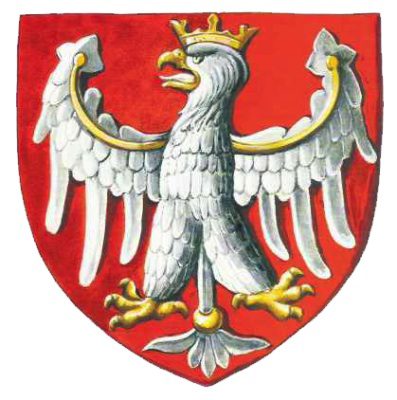
The following is an 805 list of Frankish trading places with the Slavs as well as requirements regarding what things not to sell to the Slavs – perhaps a lesson of the events, almost two centuries earlier, relating to the merchant Samo.  The list of the Frankish missi also shows the rough contours of the Frankish-Slav frontier at the beginning of the 9th century (some towns’ names are open to interpretation).  The source is Boretius (43-44) (translation by King) (pictures from the Parisian Codex 4995):

emba1

Double Capitulary of Thonville
(Duplex Capitulare Missorum in Teodonis Villa Datum,
Diedenhofener Kapitular Karls des Grossen)
December 24, 805

To One and All
(Ad omnes generaliter)

23(7) “Concerning merchants who travel to the territories of the Slavs and the Avars: how far they ought to proceed with their merchandise – to wit, in the regions of Saxony, as far as Bardowick, where Hredi is to be in charge, and to Scheessel [or Scheßlitz?], where Madalgaud is to be in charge, and to Magdeburg [first mention of the city], where Aito is to be in charge; and to Erfurt where Madalgaud is to be in charge; and to Hallstadt, where Madalgaud again is to be in charge; to Forschheim [first mention of the city] and to Premberg [or Pfreimd?] and to Regensburg, where Audulf is to be in charge; and to Lorch, where it is to be Werinar.  And that they are not to take arms and coats of mail to sell; and if they are discovered carrying them, all their stock is to be taken away from them, half going to the fisc, the other half being divided between the aforesaid missi and the discoverer.”

negotiatorum

(De negotiatoribus qui partibus Sclavorum et Avarorum pergunt, quousque procedere cum suis negotiis debeant: id est partibus Saxoniae usque ad Bardenuwic, ubi praevideat Hredi; et ad Schlezla, ubi Madalgaudus praevideat; ad Magadoburg praevideat Aito; et ad Erpesfurt praevideat Madalgaudus; et ad Halazstat praevideat item Madalgaudus; ad Foracheim et ad Breemberga et ad Ragenisburg praevideat Audulfus, et ad Lauriacum Warnarius. Et ut arma et brunias non ducant ad venundandum; quod si inventi fuerint portantes, ut omnis substantia eorum auferatur ab eis, dimidia quidem pars partibus palatii, alia vero medietas inter iamdictos missos et inventorem dividatur).

The Ansegisi Abbatis Capitularium collection contains a similar list:

emba2

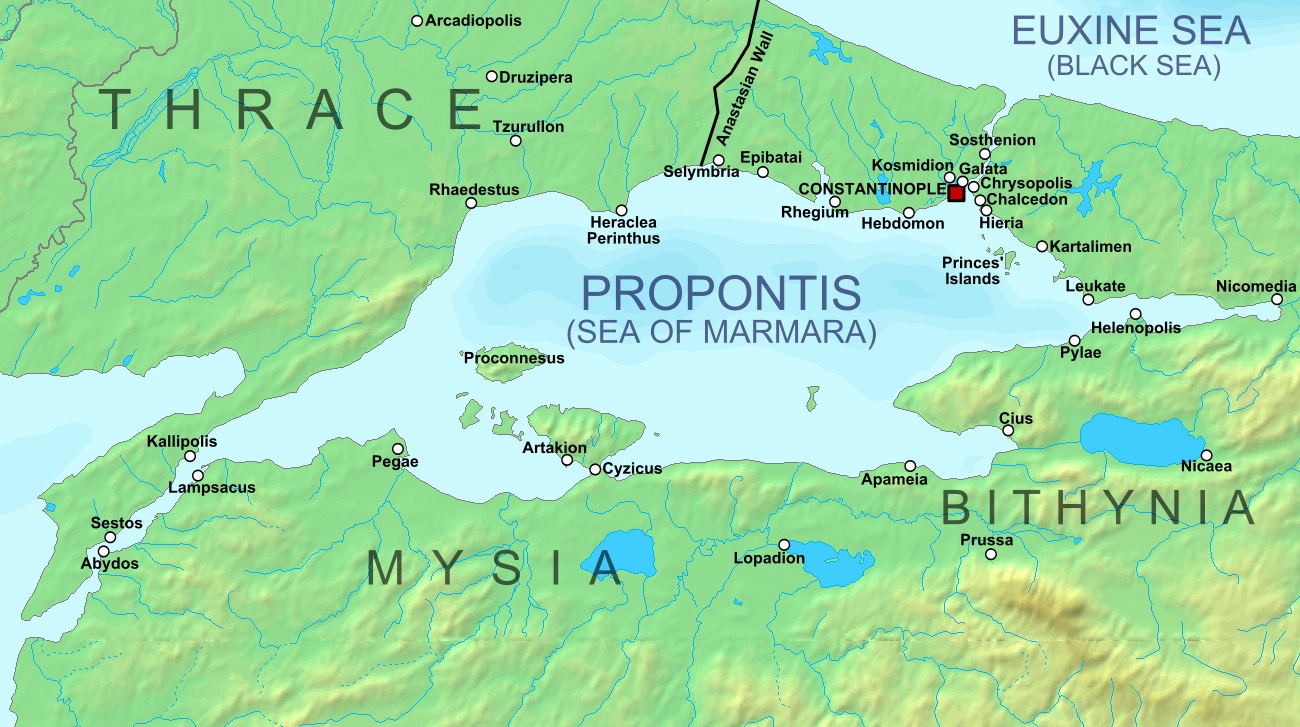
Here is a map with the place names (some based on guesses, as noted above):

emporias

Copyright ©2016 jassa.org All Rights Reserved

September 6, 2016

Crantz’s Wends

Published Post author

Crantz (or Creontius/Craentius) was an eighth century Bavarian dignitary – chancellor to the Bavarian Duke Tassilo III (circa 736 – circa 796).

Tassilo (the last of the dynasty of Agolfings) was at various times in rebellion against Charlemagne and, as with all who rebelled against that tyrant, he did not profit by his resistance.  In the end he was outmaneuvered, forced to renounce his claims on Bavaria and was eventually tonsured (along with his son) and he and his family were forced to live out their lives as monks and nuns in the monastery at Lorsch and, as regards the daughters (as per the Chesne fragment), at Chelles and Laon.

baiern

Bavaria

So much for Tassilo.

fcrantz

Crantz does not appear much in literature but he is generally accepted as a genuine 8th century source.  References to Crantz’s now lost works are made in manuscripts written much later by Johann Georg Turmair or Thurmayr aka “Johannes Aventinus” or just Aventinus of Bavaria (1477 – 1534).  Aventinus is known as the father of Bavarian historiography and he mentions fragments that are generally accepted to have originated with Crantz.

The two works of note are Aventinus’:

  • Annales ducum Bavariae (the “Annals“), and
  • Baierische Chronik  (the “Chronicle“).

The Annals were written first in Latin.  The Chronicle is basically a German language version of the Annals.  Both were republished in the 19th century, most notably by Riezler (1882) as part of a wider set of Aventinus’ works.  They came to the attention of King when he was putting together an English translation of various sources regarding Charlemagne.

What interest us in particular are the mentions of Slavs – the Carantanians – in excerpts from the Annals and the Chronicle that attributed to Crantz.  We present these here in King’s English translation, along with the print versions of the same passages and the original manuscript pages (Clm 283 Annales; Cgm 1562 Chronik) .

We start with the print versions of the Annals:

friezler3

And of the Chronicle:

fkronik

Year 771
Annals

“…There succeeded Hadrian I, who supported the imperial regions against the Lombards.  The Lombards and stirred up (?) the Germans against the king of the Lombards.”

venetos

“The Lombards were were defeated by the Venetians [King notes ‘perhaps ‘by the Wends’ and notes that what follows (two words it seems) is ‘illegible’ ‘].”

venetiz

Year 772
Annals

“Theodo, son of Tassilo, was taken to Italy, to Desiderius, his grandfather, and thence to Rome; he was baptized (?) at Whitsuntide.”

charini

“A people extremely ferocious in war at this time were the Slavs or Wends, to use the language of common speech, or, to use their own, the Charini or Chariones [Carantanians], who lived on the rivers Drava and Mura [‘ad Dravus Nuciamque (?)’].  Into Italy with an immense multitude…”

[and the source breaks off]

[the parallel with the Charini of Pliny’s or, to the extent they were different, with the  Germanic Harii is interesting]

Year 772
Chronicle  

“And the above-named princes, duke Tassilo, his wife, the duchess Liutperga, and their son, duke Dieth or Theodo, out of special devotion for the salvation of their souls, dispatched to Rome with truly great offerings a splendid embassy: bishop Alim of Saeben, count Maegel, count Machelm and many other magnates, spiritual and temporal, brave and eminent men.  King Charles would not let them all pass;”

kronik1

“he allowed only the above-named Alim of Saeben or Brizen and abbot Atto of Mondsee to proceed to Rome and made all the other people go home again — But duke Tassilo was displeased by this affair; he felt insulted that his cousin, king Charles, had refused to let his people through and was seized by a great rancor towards him.  King Charles, for his part, was no less anxious about his cousin, duke Tassilo, who, to him, was aiming to be just too powerful; Tassilo was certainly at one with the Saxons, Wends and Huns, all of whom had long been sworn and mortal enemies of king Charles and all the kings in Francia.”

winti

“A fierce war was on the point of breaking out.  Then pope Hadrian intervened became a mediator and sent two bishops from Rome to Bavaria, to duke Tassilo, who made peace between the duke and the king.  Duke Tassilo came to his cousin, king Charles, at Worms [781] and gave him great gifts of goods and money; in return the king gave him even more, receiving duke Tassilo right honourably and treating him with great propriety and respect.  They concluded an eternal peace with each other.  And so duke Tassilo went back to Bavaria and again sent count Machelm, a very elderly lord, with many companions, on pilgrimage to Rome.  All died there, of fever.”

Post Scriptum

Note that the Annals, the Chronicle and other writings by Aventinus also mention Wends/Slavs elsewhere but those passages are not attributable to Crantz so we do not generally present them here.  Nevertheless, since Chapter 78 of the Chronicle does address Tassilo’s (Thessel’s) dealings with the Carantanian Slavs, we thought we should include those passage here.  We leave to you to translate the terrible things that the Carantanian Slav pagans did to deserve their fate according to the author.  The like source here is the Conversion of the Carantanians:

Karnten

Copyright ©2016 jassa.org All Rights Reserved

September 5, 2016

The Letters of Alcuin of York

Published Post author

Alcuin of York or Alcuinus (circa 735 – 19 May 804) aka Ealhwine, Albinus or Flaccus was an English scholar and teacher at the court of Charlemagne in 780s and 790s becoming the Abbot of Tours in 796.  Slavs appear in two of his letters which we present here (translation is courtesy of P.D. King) both from the collection in the Monumenta Alcuiniana, an 1873 work by Ernst Dümmler, W. Wattenbach and Philipp Jaffé.  The same may also be seen in Epistolae IV.2. in the MGH (1895).

alcuz

Alcuin to an unknown abbot
Wilti et Vionudi
(late 789)

“Be of good cheer, brother, and labour manfully in God’s service, fasting, praying and keeping vigils, as you have been doing hitherto.  Give my beloved bishop Willehad a thousand greetings. It grieves me greatly that he and I are separated.  Would that I might see him and complete my life’s course as a peregrinus!  Only pray for me, that the Lord God in HIs mercy may guide my ways.”

alcu

“Send me a letter to tell me how you are and what you are doing; and how favourably the Saxons are responding to your preaching; and whether there is any hope of the conversion of the Danes; and if the Wiltzites, or Wends, whom the king has recently secured are accepting the Christian faith; and what is happening in those parts; and what the lord king is going to do about the attack by the Huns.”

“Greet all those who are with you, serving God.  Labour manfully in the work which you have begun, that you may receive the supreme crown from GOd.  For it is not he who begins but he who endures until the end who shall be saved [compare Matthew 10, 22].”

“May divine grace aid and preserve you wherever you may be.”

Alcuin to Colcu
Sclavos, quos nos Vionudos dicimus
(early 790)

“I rejoiced with all my heart, [that] I own, to hear that your fatherhood was enjoying good health and good fortune.  And since I thought that you would be eager to know of our progress and of recent events in the world, I have been at pains to inform you prudence, through this unpolished letter of mine, of what I have seen and heard.”

alcu2

“In the first place, your belovedness should know that by God’s mercy HIs holy church in Europe enjoys peace, gains ground and grows greater.  For the Old Saxons and all the peoples of the Frisians have been converted to the faith of Christ under pressure from king Charles, who has won some over by rewards, others by threats.  Moreover, the said king last year fell upon the Slavs, whom we call Wends, with an army and subjected them to his authority.”

“Two years ago, furthermore, the Greeks descended upon Italy with a fleet but were overcome by the dukes of the aforementioned king and fled to their ships.  Their dead are said to have numbered 4000 and the prisoners 1000.  In like manner, the Avars too, whom we call Huns burst into Italy but returned home with ignominy after defat by the Christians.  They also attacked Bavaria; those invaders too were defatted by the Christian army and scattered…”

Copyright ©2016 jassa.org All Rights Reserved

September 4, 2016

The Slavs of the Paschal Chronicle

Published Post author

Here are some excerpts from the Paschal Chronicle (prob written in the 7th century) regarding Slavs.  The context is the attack on Constantinople in 623 and the subsequent, famous siege in 626.  The translation is that of the Whitbies with a Schenker paragraph or two.  We also include some of the footnote text by the Whitbies that relates to the Slavs  The beautiful picture below is by the Strassburgian artist Antoine Helbert.

onzs

Year 623

“Indiction 11, year 13, the 12th post-consulship of Heraclius Augustus.”

“And from 22nd inclusive of the month of January it is recorded as year 11 of the reign of Heraclius II Constantine.”  

H&HConstantinesolidus

“In this year in month Daisius, on June 5th according to the Romans, a Sunday, the emperor Heraclius was in the Thracian regions with certain officials, and not only certain property owners and clergy, but also shopkeepers and partisans from each of the two factions and a considerable throng of others, when the Chagan of the Avars approached the Long Wall with an innumerable throng, since, as it was supposedly rumored, peace was about to be made between Romans and Avars, and chariot races were about to be held at Heracleia.  An innumerable throng, misled by this rumor, came out from the all-blessed city.  And about hour 4 of this Lord’s Day the Chagan of the Avars signaled with his whip, and all who were with him charged and entered the Long Wall, although he said that he would have both entered the wall and taken the city except that God prevented him.  However, his men who entered on this Lord’s Day plundered all whom they found outside the city from the west as far sat the Golden Gate, together also with the men and animals of various kinds present for whatever reason in the suburbs.  They entered both Saints Cosmas and Damian at Blachernae, and the Archangel on the far side in the quarter of Promotus; not only did they remove the ciboria and other treasures, but the also broke up the holy altar itself of the church of the Archangel, and without any opposition transported everyone, along with the things removed, tho the far side of the Danube.”

Year 624

“Indiction 12, year 14, the 13th post-consulshiop of Heraclius Augustus.”

“And from 22nd inclusive of the month January it is recorded as year 12 of the reign of Heraclius II Constantine.”

“In this year in the month of Dystrus, March according to the Romans, on the 25th of the month, on the day of the Annunciation of our Lady the Mother of God, the emperor Heraclius departed for the eastern region s, together with his children Heraclius and Epiphania, who was also called Eudocia, and the empress Martina.  In their company he kept the Easter festival near the city of Nicomedia; after the festival the emperor Heraclius himself with Martina the empress set out for the eastern regions, and Anianus domesticus of the magister was also with them; but his children returned to Constantinople.”

cons

“In this year in the month Artemisius, May according to the Romans, int he 12th indiction, under Sergius patriarch of Constantinople, it was decided that there should be a chant after everyone had partaken of the Holy Mysteries, when the clergy were about to replace in the sacristy the precious flagella, patens, chalices, and other holy vessels, after the distribution had also been entirely replaced on the holy altar from the credence tables, and the final verse of the Communion had been changed: this antiphon too should be recited, ‘Let our mouth be filled with praise, Lord, so that we may hymn your glory because you have deemed us worthy to share in your Holy Mysteries.  Preserve us in your holiness as we rehearse your justice throughout the whole day.  Alleluia!’.”

Year 625

“Indiction 13, year 15, the 14th post-consulship of Heraclius Augustus.

And from 22nd inclusive of the month January it is recorded as year 13 of the reign of Heraclius II Constantine.”

Year 626

“Indiction 14, year 16, post-consulship of Heraclius Augustus year 15.”

“And from 22nd inclusive of the month January it is recorded as year 14 of the reign of Heraclius II Constantine.”

“In this year in the month Dystrus, March according to the Romans, an exceedingly bright star appeared for 4 days in the west after sunset.”

“In this year in the month of Artemisius, on May 14th according to the Romans, a Wednesday, at the Holy Mid-Pentecost itself, the scholar and many others of the multitude congregated in the most holy Great Church and changed against John who was called Seismos, because he wished to remove the bread of the scholar in the name of the soldiers.  And the Patriarch Sergius promised to appease the crows if only they would allow the sacred liturgy to take place.”

“On the fifteenth of the same month more people were again present in the most holy Great Church, and changed against said John.  The patriarch, Alexander, the praetorian prefect, and certain other officials, including Leontius the comes Opsariou and spatharius, went up into the ambo of the Great Church, and since many changes were made by the assembly against the stated John was called Seismos to the effect that he should no longer participate in affairs of state, that man was demoted and his images were at once destroyed.  And Alexander the praetorian prefect made an address, saying, ‘From now on you have a grant of bread from me, and I hope that I may speedily make restitution as regards it.’ For the said John Seismos, when a loaf was being sold for 3 follies, himself planned to make it cost 8 follies.  And God destroyed his plan.”

“It is good to describe how now too the sole most merciful and compassionate God, by the welcome intercession of his undefiled Mother, who is in truth our Lady Mother of God and ever-Virgin Mary, with his mighty hand saved this humble city of his from the utterly godless enemies who encircled it in concert, and redeemed the people who were present within it from the imminent sword, captivity, and most bitter servitude; no-one will find a means to describe this in its entirety.  For the accursed Salbaras, commander of the Persian army, while he was awaiting (as it seems and was indeed finally revealed by deeds) the arrival of the utterly godless Chagan of the Avars, had for these very many days past been at Chalcedon; he impiously burnt all the suburbs and palaces and houses of prayer, and thereafter remained, awaiting the advent of that man.”

“And so on the 29th of the month June of the present indiction 14, that is on the day of the Feast of the holy and glorious chief apostles, Peter and Paul, a vanguard of the God-abhorred Chagan arrived, about 30,000.  He had spread the rumor by means of reports that he would capture both the Long Wall and the area within it, and as a result, on the same day, which was a Lord’s Day, the excellent cavalry who were present outside the city came inside the new Theodesian wall of this imperial city.  The same advance guard remained in the regions of Melantias, while a few of them made sallies at intervals as far as the wall, and prevented anyone from going out or collecting provisions for animals at all.”

byzi1

“In the meantime, when as many as ten days in succession had elapsed and none of the enemy appeared near the wall, soldiers went out with camp followers and civilians with the intention of harvesting a few crops about ten miles distant; it happened that the enemy encountered them, that some fell on either side, and that some of the soldiers’ camp followers and of the civilians who had gone out with them were also apprehended.  For if it had not happened that the soldiers were diverted to the defense of their camp followers and the civilians, considerable number of the enemy would have been slaughtered on that day.”

“Shortly afterwards some of the enemy, as many as 1,000, approached the venerated church of the Holy Maccabees on the far side at Sycae; they made themselves visible to the Persians, who had congregated in the regions of Chrysopolis, and they made their presence known to each other by fire signals.”

“In the meantime the accursed Chagan dismissed Athanasius the most glorious patrician from the regions of Adrianopolis, after saying to him, ‘Go and see how the people of the city are willing to conciliate [placate] me, and what they are willing to give me to make me retire [depart].’ And so when the same most glorious Athanasius entered and announced this to Bonus, the most glorious patrician and magister, and to the other officials, they reproached him for having thus cringed before the accursed Chagan and for having promised that the people of the city would perform acts of conciliation for him.  The the most glorious Athanasius said that that these had been his instructions from the most glorious officials at the time when he was dispatched on embassy; thereafter he had not learnt that the defenses had been strengthened thousand that an army was present here; however, he was ready to tell the Chagan without alteration the message given to him.  Then, after the same most glorious Athanasius requested that he first wished to inspect the army that was in the city, a muster was held and about 12,000 or more cavalry resident in the city were present.  And then the officials gave him a response that was intended by every means to cause the accursed Chagan <not[?]> to approach the wall, that is the city.  Then, after the most glorious Athanasius had reached the vicinity of that man, he was not received, but the cursed Chagan said that he would not give way at all unless he obtained both the city and those who were in it. ”

“On the 29th of the month of July the same God-abhorred Chagan reached the wall with the whole of his horde, and showed himself to those in the city.*  After one day, that is on the 31st of the same month July, he advanced, arrayed for battle, from the gate called Polyandrion as far as the gate of the Pempton and beyond with particular vigour: for there he stationed the bulk of his horde, after stationing Slavs within view along the remaining part of the wall.  And he remained from dawn until hour 11 fighting first with unarmoured Slav infantry, and in the second rank with infantry in corsets.**  And towards evening he stationed a few siege engines and mantelets from Brachialion as far as Brachialion.”

[*note: The Whitbies offer the following comment: Tuesday 29th July: the Chagan’s personal display was intended to intimidate the defenders, and Theodore Syncellus provides an impressionistic account of th exterior inspired by they AVars, wight heir armour glittering in the sun, while the Patriarch Srgius paraded on the walls to counteract this, and Bonus made preparations within the city; on the next day the Chagan prepared for combat and demanded food, which the defenders graciously supplied without managing to appease him.  Thereafter the Avars began the siege, which had three main elements: a direct attack against the Theodosian walls where the Avars could deploy their fearsome siege technology and use their subordinates, of whom the most numerous were Slavs, as a human wave; an attempt to bring Persian troops over from Chalcedon by means of Slav canoes; and a naval attack down the Golden Horn, using the Slav canoes to threaten an unprotected (or dilapidated) section of Constantinople’s perimeter.”] 

[**Whitbies’ note: “Attack on the walls: Theodore gives a very generalized account of the Avar attack not he third day (July 31st) which was repulsed through the Virgin’s miraculous defense.  The Avars had a formidable reputation as besiegers…They concentrated their attack not he central hilly section of the land walls, from the gate of the Pempton in the Lycus valley, extending about 1 kilometre south to the Poluyandrion Gate, the modern Yeni Mevlevihane Kapisi near the summit of Constantinople’s seventh hill.  However, to keep the defamers occupied, the dispensable Slav infantry and a few siege machines were stationed along the entire length of the land walls.  George of Pisidia record that about 80,000 barbarians approached the gate of Philoxenus (which is not securely located).”]  

“And again on the following day he stationed a multitude of siege engines close to each other against that part which had been attacked by him, so that those in the city were compelled to station very many siege engines inside the wall.  When the infantry battle was joined each day, through the efficacy of God, as a result of their superiority our men kept off the enemy at a distance.  But he bound together his stone-throwers and covered them outside with hides; and in the section from the Polyandrion gate as far as the gate of Saint Romanus he prepared to station 12 lofty siege towers, which were advanced almost as far as the outworks, and he covered them with hides.  And as for the sailors who were present in the city even they came out to assist the citizens.  And one of these sailors constructed a mast and hung a skiff on it, intending by means of it to burn the enemies’ siege-towers.  Bonus the all-praiseworthy magister gave commendation to this sailor for having dismayed the enemy not inconsiderably.”*

[*Whitbies’ note: “Sailors: presumably the crews not of the Roman warships (who had to be ready to oppose the Slav canoes) but of trading vessels in the capital’s harbors; see the Miracles of Saint Demetrius for sailors from grain ships manning siege engines during an Avar attack on Thessalonica.  Heraclius had sent instructions for everyone to be involved in the defense.”] 

“But the same most renowned magister, after the enemy’s approach to the wall, did not cease from urging him to take not only his agreed tribute but also any other condition for the sake of which he had come as far as the wall.  And he did not accept, but said, ‘Withdraw from the city, leave me your property, and save yourselves and your families.’ He was anxious to launch to sea the canoes which he had brought with him, and was prevented but he cutters.  Finally he prepared for these to be launched at the bridge of Saint Callinicus after a third day of the fighting.  It was for this reason that he prepared for the canoes to be launched there, because the area was shallow and the cutters were unable to approach there.  But the cutters remained within sight of the canoes from Saint Nicholas as far as Saint Conon on the far side at Pegae, preventing the canoes from going past.”*

[*Whitbies’ note: “Naval preparations: the Slavs launched their canoes at the head of the Golden Horn, near the bridge of Saint Acllinicus over the Barbysses stream.  They had brought the canoes (monoxyla) with them, apparently overland front he Danube; these may have been simple dugouts, but it is possible that some were rather more sophisticated ‘log boats’ which could have been dismantled for easier transport, but also been large enough to ferry the Persian cavalry across the Bosporus.  The Roman fleet was deployed across the Golden Hirn from Saint Nicholas at Blachernae to Saint Conon in Galatia to prevent the Slavs sailing down the Golden Horn. Pegae: the Springs, identified with Kasimpasa north of the Golden Horn.”]  

avas

“On Saturday in the evening, that is on the second of the month August,  the Chagan asked for officials to converse with him.  And there went out to him George the most glorious patrician, and Theodore the most glorious commerciarus for [t woad t], and Theodosius the most glorious patrician and logothete, and Theodore syncellus most dear to God, and Athanasius the most glorious patrician.  And when they had set out, the Chagan brought into their sight three Persians dressed in pure silk who ha been sent to him from Salbaras.  And he arranged that they should be seated in his presence, while our ambassadors should stand.  And he said, ‘Look, the Persians have sent an embassy to me, and are ready to give me 3,000 men in alliance.  Therefore if each of you in the city is prepared to take no more than a cloak and a shirt, we will make a compact with Salbaras, for he is my friend: cross over to him and he will not harm you; leave me your city and property.  For otherwise it is impossible for you to be saved unless you can become fish and depart by sea, or birds and ascend to the sky.  For look – as the Persians themselves say – neither has your emperor invaded Persia nor is your army arrived.’  But the most glorious George said to him, ‘These men are impostors and do not speak a word of truth, since our army is arrived here and our most pious lord is in their country, utterly destroying it.’  Then one of the Persians was infuriated and in the presence of the Chagan insulted the said most glorious George, and he himself replied to him, ‘It is not you who insult me, but the Chagan.’  But the most glorious officials who had come out to him also said this to the Chagan, “Although you have such great hordes, you need Persian help.’  And he said, ‘If I wish, they will provide me with men in alliance, for they are my friends.’ And again our officials said to him, ‘We will never relinquish the city, for www came out to you in the expectation of discussing something material.  So if you do not wish to discuss with us peace proposals, dismiss us.’  And he dismissed them.”*

[* Whitbies’ note: “Co-operation between Avars and Persians: In view of the large numbers of troops at the Avars’ disposal, the presence of the Persians at the embassy was intended partly to demonstrate Constantinople’s utter helplessness, which the Chagan hopes to impress on the Roman envoys.  However, the Persians could also contribute their expertise at siege warfare, and the Chagan made a treaty with the Persians to convey them across the Bosporus in Slav canoes.”]

“Straightway, during the night preceding the Lord’s Day, through the efficacy of the good and mercy-loving God, the same Persians who had been not he embassy to the CHagan, while they were crossing over to Chrysopolis by way of Chalae, encountered our skiffs, in which there were also some of those from the orphanage,  And one of these Persians was found after he had thrown himself into a small skiff known as a sandalos, face down and beneath the coverings, and was crossing over to Chrysopolis thus ; but the sailor who was in this skiff and was steering it, adroitly signaled to those from the orphanage who pulled back and removed the coverings, and found this Persian unharmed and lying face down; they slew him and removed his head.  They overpowered the other two Persians along with the sailor as well, while they were crossing over in another boat, and these they brought at dawn to the wall.  Our men chopped off two hands of one of the surviving Persians, tied round his neck the head of the man slain in the skiff, and sent him to the Chagan.  The other was thrown into a skiff and taken off alive to Chalcedon; when he had been exhibited to the Persians our men beheaded him just as he was in the skiff, and threw his head onto land with a message that read like this: ‘The Chagan, after making terms with us, sent us the ambassadors who were dispatch dot him by you; two of them we have beheaded in the city, while look! you have the head of the other.'”

“On the same Lord’s Day the accursed Chagan set out for Chalae and put to sea canoes which were intended to set out for the opposite side and bring the Persians to him, in accordance with their promise.  When this was known, in the evening about 70 of our skiffs sailed up towards Chalae, even though the wind was against them, so as to prevent the canoes from crossing over.”*

[*note, here is another translation of this from Alexander Schenker: “On that Sunday [August 3, 626] the accursed kagan went to Khalai [Bebek] and put in the sea the monoxyla which were to cross to the other side [of the Bosphorus] and bring him the Persians in accordance with their promise.  When this became known, our naval vessels accompanied by light boats set out on the same day to Khalai, despite an unfavorable wind, in order to prevent the monoxyla from reaching the other shore...]

“And towards evening the accursed Chagan retired to the vicinity of the wall, and some food and wine were sent to him from the city.  Hermitzis, commander of the Avars, came to the gate saying, ‘You have committed a grave deed in killing those who ate with the Chagan yesterday, and furthermore in sending him the head and the other with his hands cut off.’  In the night then, as Monday was dawning, their canoes were able to escape our watch and cross to them…”*

[*Whitbies’ note: “Attempt to ferry across the Persians: Although the Persians on the Asiatic shore were visible to the Avars, they were so unskilled in nautical matters that they had to await the arrival of Slav canoes before attempting to slip across the Bosporus by night.  The canoes reached the Asiatic shore (perhaps while the Roman shops were delayed by a head wind), but their subsequent man oeuvres, encumbered by Persian passengers, were thwarted by the Roman fleet; according to Sebeos 4,000 Persians perished in this naval engagement.  Hermitzis: the Hermi were an element in the Avar federation.  Lacuna: the words ‘to them’ end the folio (a noun is probably lost) in the Vatican manuscript: at this point one folio is missing, and the phrase ‘they sank…’ refers to the Roman defeat of the subsequent Slav naval attack down the Golden Horn.  In the intervene ing days, the Chagan made preparations for a concerted land and sea attack; on Wendesday (August 6) the Romans repulsed an attack on the walls.”]

“…They sank them and slew all the Slavs found in the canoes.”*

[*note, here is another translation of this from Alexander Schenker: “Neither on Sunday night nor at daybreak on Monday did their boats manage to deceive our watches and cross over to the Persians.   All the Slavs who came in the monoxyla were thrown into the sea or were slaughtered by our people.“]

“And the Armenians too came out from the wall of Blachernae and threw fire into the portico which is near Saint Nicholas.  And the Slavs who had escaped by diving from the canoes thought, because of the fire, that those positioned by the sea were Avars, and when they came out there they were slain by the Armenians.  A few other Slavs who had escaped by diving, and who came out in the region where the godless Chagan was positioned, were slain at his injunction.  And at God’s command through the intercession of our Lady the Mother of God, in a single instant, calamity at sea came to him.*  Our men drove all the canoes onto the land, and after this had happened, the accursed Chagan retired to his rampart, took away from the wall the siege engines which he had set beside it and the palisade which he had constructed, and began to dismantle the siege towers which he had constructed: by night he burnt his palisade and the siege towers and the mantelets, after removing the hides, and retreated.”

[*Whitbies’ note: “Naval attach: Thursday August 7th; see Theodore Syncellus for day and date, and for more impressionistic accounts and George of Pisidia (the latter including details of ploys used by shipwrecked Slavs to escape destruction; same for Bulgars on Slav boats).  The attach was concentrated in the Golden Horn, on which side the city was probably not protected by a wall.”]

“Some people said that the Slavs, when they saw what had happened, withdrew and retreated, and for this reason the cursed Chagan was also forced to retreat and follow them.”

“And this is what the godless Chagan said at the moment of the  battle: ‘I see a woman in stately dress rushing about on the wall all alone.’* When he was on the point of retreating, he declared, ‘Do not imagine that I am retreating because of fear, but because I am constrained for provisions and did not attack you at an opportune moment.  I am departing to pay attention to supplies, and will return intending to do to you whatever you have accomplished against me.'”**

[*Whitbies’ note: “Divine assistance: a key element in Theodore Syncellus’ account of the siege (e.g., icons of the Virgin set at the gates by Sergius; the Virgin sinks the Slav fleet at Blachernae). Nicephorus alludes to divine destruction of Avar siege towers, and a subsequent thanksgiving at Blachernae; Cedrenus reports a phantom embassy by a distinguished woman who was mistaken for the empress.  The Chagan’s mention of his vision is inserted here to confirm the Virgin’s intervention; see Miracula Sancti Demetrii for Demetrius terrifying Slavs at Thessalonica; also the CP, Zosimus, Evagrius, Theophylact for comparable apparitions during sieges; and H. Chadwick for visions of the Virgin as a woman in purple.  During the siege Sergius had maintained the morale of defenders with the Virgin Mary and her precious relics at Blachernae taking pride or place…”]

[**Whitbies’ note: “Avar withdrawal: After the humiliating failure of his attempts, the Chagan needed to restore his authority over the Avar federation, which was in danger of disintegration as Slavs (and other subjects) rebelled.  The Chagan used shortage of supplies as an excuse for withdrawal; this has been doubted by Stratos who regards it as no more than a face-saving formula: however, organization of food supplies was frequently as much of a problem for besiegers as for the besieged, and the Avars were known to be troubled by supply shortages, so the Chagan’s excuse may have been true.”]

“On the Friday a rearguard of cavalry remained in the vicinity of the wall, setting fire to many suburbs on the same day up till hour 7; and they withdrew.  They burnt both the church of Saints Cosmas and Damian at Blachernae and the church of Saint Nicholas and all the surrounding areas.  However, after approaching the church of our Lady the Mother of God and the Holy Reliquary, the enemy were completely unable to damage any of the things there, since God showed favour, at the intercession of his undefiled Mother.*  And he requested the most glorious commerciarius to converse with him, and Bonus the all-praiseworthy magister declared this to him: ‘Until the present I had the power to talk and make terms with you.  But now the brother of our most pious lord has arrived together with the God-Protected army.  And look! he is crossing over and pursuing you as far as your territory.  And three you can talk with one another.'”

[*Whitbies’ note: “…Church of our Lady: the Blachernae church, although unprotected by a wall, survived the siege, and the Slav naval assault was defeated in its vicinity; the adjacent chapel of the Holy Reliquary contained the relics deposited by Leo I…”]

Copyright ©2016 jassa.org All Rights Reserved
September 3, 2016

Archeological Conundrums

Published Post author

One of our friends sent in this inspiring piece:

jozi

Copyright ©2016 jassa.org All Rights Reserved

September 3, 2016

Of Foolishness & Depravity

Published Post author

We present a short article from the Classical Review (Przegląd Klasyczny) an interwar Polish magazine published at Lviv (then Lwow).  The 1936 article presents an argument for equating the names Suevi with Suoviane, i.e., the English “Slavs”.suevi1It was written by one Janusz Bożydar Daniewski and was based on his earlier and longer PhD thesis entitled “Tacitus’ Suevi or Western Slavs in Roman Times” which was published in 1933.  Since the suggestion was controversial, the Classical Review also printed a much, much longer and highly derisive response by one Eugeniusz Leonard Słuszkiewicz who mocked the idea that Slavs descended from the Suevi contending instead that they came from the East (given his own physical appearance, a remote marsh/bog origin in the Pripet may in fact have been true – for him). Słuszkiewicz’s response to Daniewski, whatever one may think of its merits, can only very generously be described as “impolite”.  Daniewski then responded to Słuszkiewicz in a separate note.

With the benefit of hindsight, it is fascinating to note that Słuszkiewicz later, during World War II, surprisingly found paid work at the Cracow-based Institut für Deutsche Ostarbeit (“Institute for German Work in the East”) – an institute  established by Hans Frank (the Nazi governor-general of Poland), whose main task was to prove the German character of Poland and other Slavic lands.  One can only assume that, given Słuszkiewicz’s views/resume, he was a natural fit for the Institute.

We note that many of Daniewski’s assertion could be questioned but we found nothing in this excerpt that is fundamentally implausible.

On the the Slavic letter “Ł” or “ł” see here.

With that in mind, here is the text (thank you for assistance in translation to our interns):

suevi2

“In antiquity, the name Sueui (Tac.), Σοῆβοι (Strabo) was given to a number of tribes, settled on the Elbe, Oder, Vistula and on the shores of the Baltic, from the base of the peninsula, which today is called the Jutland [peninsula, that is the Cimbrian Peninsula], to the mouth of the Vistula.  Between antiquity and the Middle Ages we have a gap in [our written] sources.  But once at the dawn of the Middle Ages contemporary shone a light upon the aforementioned lands, everywhere there where in antiquity there dwelt tribes that went by the name Sueui, we find peoples, who are called Slavi, Slavi – that is the Latin name of peoples who are called Słowianie [pron Suovianie] in Polish, Славя́не [pron Slaviane] in Russian [and] in the language of the Baltic Slavs (Kashubians): Słevi [pron Suevi]*, that is Słowjanj [pron Suovianie] (Florian Cenova, Skorb. VI, p. 88).”

[*note: Cenova equates Suevi and Slavs but the Kashubian term he actually uses is Sławy, i.e., Suavy]

“The Baltic Sea, which in antiquity was called: mare Suevicum (Tac. Germ. 45), is called in the Middle Ages Slavicus Sinus (Script. R. Dan. VII p. 317).”

[note: haven’t seen the actual language though Adam of Bremen has a Slavic Gulf “et sinus sclavanicum” in Book IV]

“The gap, that we see at the turn of antiquity and the Middle Ages, is merely a gap in written sources.  In reality the medieval life is simply the continuation of life in antiquity.  The Middle Ages are not some new world separated from antiquity by some chasm that negates any connections [between the two].  The borderline drawn between antiquity and the Middle Ages is merely convention.  Just as the sinus Slavicus of the Middle Ages – the Baltic Sea is the same sea, which in antiquity was called mare Suevicum, so too the nation of Slavi, living by this sea, consists of the descendants of the nation called Sueui in antiquity.  The name changed while the body that it referred to, remained the same.  Many tribes of the Sueui nation continue in the Middle Ages in the same abodes under the general name Slavi, maintaining their ancient customs, traditions, rituals and religious rites, even political systems.”

suevi3

“Because I happen to have come across the opinion to the effect that the medieval Slavi cannot be descendants of the ancient Sueui nation because, the name Slavi allegedly does not correspond to the ancient name Sueui, I wish to analyze this matter in more detail here.  The setting together and equating the words SueuiSlavi is not the only evidence of the identity of these peoples, [rather] it is one of the links in a long chain of arguments.  It’s easy to come to the conclusion that these names are the same, the difference [between them] being only in transcription and in certain local and temporal forms of pronunciation.  The forms: SueuiΣοῆβοι , SlaviSclaviSłeviSłowianie, Славя́не – these are the different variants of the same name.”

“The first phone s appears in all the forms [of the name].”

“The second phone, the one that the Poles represent graphically with a ł, pronounce variously, in the East like a dental consonant/sonorant [?], in the West as a “short” u (), an asyllabic u [note: that is a vocalized L].  Baltic Slavs (Kashubians), like an asyllabic [], with the exception of one group of them, the so-called Beloks, who pronounce this l phone as a palatal consonant.  Ancient Romans and Greeks did not have the phone discussed – the dental consonant/sonorant [?] ł – in their  language, therefore there was no letter that could represent it [the phone] in the Latin and Greek alphabet.  The letter l with a slash through (ł) began to be used among the Poles first int he XVIth century.  In the Middle Ages, people made do in other ways to express this phone, either writing an l without any additions or writing cl – whereby the letter c played the same role at the side of an l as the line through the l in the letter ł (compare Viscla = Wisła).  Ancient Romans and Greeks who did not have in their speech the dental consonant/sonorant ł, not having in their possession a letter for this phone, not being in possession of the letter ł, which was only created many centuries later, were they able to better express the phone in question than by an asyllabic u or a short o (omnicron), in accordance with its phonetic pronunciation?  In the word Sueui the u is short, as indicated by the Greek transcription of  this word and not long.  The two beginning phones of the words: SueviΣοῆβοι,evi, Słowianie, Славя́не are identical, in the phonetic transcription they appear as S.”

“The vowel in the word Sueui – is [made of] the long eη.”  

“In the words Slavi and Славя́не – there appears an a, in the word owianie, an o, in the word evi, an e.  The vowels aoe, substitute for one another in Slavic languages, for example: Stolp = Słëpsk (here, in addition to the change of an  into an e, there is also a metathesis [he means the the vowel and the l/ł flip], Chołm =  Chełmrak (Polish) = rek (Kashubian), mały (Polish) = meły (Kashubian) and so forth; a countless number of such examples can be given.  The fact that an ancient nation living on the Baltic Sea between the lower Elbe and the Vistula was called Sueui – a word which sports the e vowel whereas in the words Slaviowianie, and so forth we have an a or an o, cannot, therefore, serve to establish that these are different names – especially since even today, among the Baltic Slavs (the Kashubians), who are a remnant of a once great nation whose seats stretched far into the West into lands on the left bank of the lower Elbe, the word pronounced by the Poles owianie [note: that is, Suovianie] occurs in the form evi, whereby the phonetic transcription is Suevi.  How does this word differ from that ancient word written by the Romans Sueui with the short u occurring after the S?  The fourth phone of the word under consideration is uv = β.  But the Greek β already in antiquity lost the character of a voiced bilabial stop/closed bilabial consonant [?] and phonetically corresponded to the Latin v.”

suevi4

“In certain editions of Tacitus’ Germania we see a systematically printed form Suebi and not SueviSueui.  What is the source of this?  The form Suebi does not exist in the codices used for critical editions of Germania.  Instead, we have everywhere the form Sueui, a fact that I personally had the opportunity to confirm in Rome and Naples.  While there does occur in some transcriptions the substitution of a b in place of a u = v, all the Tacitean codices feature a u, so that no editor of a critical edition should introduce this arbitrary change.  The Germans do this because the form Suebi is phonetically closer to the word Schwaben, desiring in this manner to transfer into the scientific realm the view commonly held by laypeople that ‘the Suevi are simply the same as the Swabians.'”

[note: compare these in the manuscripts of Germania here]

“In reality, the Swabians have nothing to do with the Suevi of antiquity other than the phonetical similarity of sounds.  The name of Swabians in Greek transcription is different, that is Σουαβοι [note: compare with Σοῆβοι] (Procopius, Bell. Goth. I, 15, 26); they appear only in the the third century.  In the Teubner [publishing house] critical edition [of Germania], there is an attempt to justify the change from vu to b.  In the critical  apparatus we read ‘sueuos libri ac sic deinceps’ (Tac. Germ. 2, 17), but, because in the 41st chapter of Germania the copyist made a mistake and in the codices there appears the word verborum instead of Suevorum – this copyist error is supposed to indicate [according to German scholars] that the true form of the word is Sueborum: ‘quae corruptela genuine formam nominis testatur.’  This copyist error is immediately used by the Germans as justification to replace the uv with a b everywhere the word Sueui appears.  The arbitrariness and bad faith is plainly visible here.  Despite this, Polish publishers, trusting the Germans blindly, have for some time now been following [the Germans] in printing not Suevi but Suebi.”

suevi5

“In the words owianieСлавя́не, to the root ov Słav there is added also a suffix before the ending [whereas], the words: Suevi, SlaviSłevi occur without a suffix.”

“What linguist should see difficulties in considering the words SueviSlavi = Słevi, that are in essence identical, to be the same?  Schönfeld (RE 2 R. IV. 1932, p. 578, nsv Suebi) states that the word Suavus has been connected with    the Latin word suavis ‘sweet’, as a play on words – here the accidental nature of the similarity is obvious.  This Schönfeld maintains that the word Sueui comes from the Gothic swes, ‘one’s own’ (eigen) and means probably ‘wir selbst’.  The fact that the Gothic swes means ‘one’s own’ in no way proves that this word has anything to do with the word Sueui – a certain phonetic similarity may be accidental.”

[note: a better argument may have been that ‘one’s own’ people is swoi (svoi) in, for example, Polish even today; and what does it say about the likelihood of the Germanic origin of this word when it is an East Germanic language like Gothic that is the only Germanic language with a words similar to the word in question?].

“This etymology is not worth more than the etymology of Suavus – suavis.”

[note: and yet being ‘sweet on someone’ may well hearken back to being with one of one’s own]  

“Whether it [this etymology] is correct or not, it does in no way gainsay the identity of the words SueviSlavi nor the Slavic nature of the Swevi.  Schönfeld ponders from what common word, should the word Suevi be derived from.  The correctness of Suevi = Slavi is an altogether separate matter that is unaffected by Schönfeld’s etymologies, even were they something more than conjectures.  The words Sueui – Slavi are identical not only in their form, but they are identical as to the thing they represent [note: that is being a designation for a people today called the Slavs].”

“The notion that the Slavs are not encompassed by any name known to the ancient authors, but rather that they sometime about the fifth century appeared from nowhere and populated an enormous part of Europe – a notion that has been a cardinal rule until now among scholars of the beginning of the Slavs, is fundamentally incorrect.  The Slavs were in antiquity not only understood under names known to us from those times but – as we have shown – this ancient name has been their own name in the lands on the Elbe, Oder and Vistula and on the shores of the Baltic, appearing also in later times and living on to this day.”

suevi6

“German scholars of the Berlin-Austrian school tell us about the arrival of the Slavs at the Elbe, Oder and the Baltic sometime between antiquity and the Middle Ages –  a tale that stands in contrast to the surviving historical monuments.  It is difficult to accept that German scholars may honestly believe what they write.  Slavic scholars should not repeat, how we’ve often noticed, tendentious untruths of German scholars, [but should] walk their own path in accordance with historical truth.  There occurs to one a thought from that Andersen fairy tale regarding the Emperor’s clothes: no one dares to say the obvious truth when that truth is contrary to the dominant, albeit notoriously false, opinion.”

“We are hopeful that not too long from now we will be able to say the following about the antiquity of Western Slavs in their historical settlements: ‘Nemo est tam stultus, qui haec non videat, nemo tam improbus, qui non fateatur.'”

[“no one is so foolish as not to see, no one so depraved as not to admit it”] (compare Cicero, Catil. 1.12.30)

Copyright ©2016 jassa.org All Rights Reserved

September 3, 2016

Aha!

Published Post author

The Germanic languages claim the river names with the suffix -ava or -awa.  We have the following words for water:

ahwa (Gothic), and

aha (Old High German and Old Saxon)

but some people think that these as well as the Latin aqua do not hearken back to old Indo European language (assuming there was one).  Here is a cite from a linguistics professor:

“A full discussion would not change the bottom line: *akʷā (or any laryngeally revamped version thereof) is not a valid PIE reconstruction.  The words we find in Germanic and Latin are regional, not common Indo-European… [previously noting that] [p]ossible traces of a Celtic word reconstructible as *akʷā are few and hardly substantial.”

The professor then concludes dourly:

“Their pedigree is uncertain; they may be loans from an unidentified pre-IE substrate (in which case their deeper history is unknowable for lack of data).”

arm

We lack the learning to agree or disagree with the above.

That said, we are not as pessimistic.

Regatas

In Spanish, the river name is rio but there are other names for smaller rivulets, e.g., arroyos.  On the Iberian peninsula you will also find:

regata (for a small stream)  or regato

reguero

or

rego or

rega such as the following regas (among others) in Asturia, Spain:

  • Rega do Calvario,
  • Rega As Penas,
  • Rega Da Cuba,
  • Rega Da Cal

which you can see at the approximate location here (next to, curiously, Lugo):regas

whereas rega refers to a “sprinkling, watering or rain” in Portuguese.

In fact, it is likely that the English “rain” has the same wet origin.

What is curious, however, is that the Online Etymology Dictionary gives the following origin of  regatta:

“regatta – (n.) 1650s, name of a boat race among gondoliers held on the Grand Canal in Venice, from Italian (Venetian dialectregatta, literally “contention for mastery,” from rigattare “to compete, haggle, sell at retail.” [Klein’s sources, however, suggest a source in Italian riga “row, rank,” from a Germanic source and related to English row (v.).] The general meaning of “boat race, yacht race” is usually considered to have begun with a race on the Thames by that name June 23, 1775 (see OED), but there is evidence that it was used as early as 1768.”

and from Dictionary.com:

“regatta – 645-55; < Upper Italian (Venetianregatta, regata, perhaps ≪ Vulgar Latin *recaptāre to contend, equivalent to *re- re- + *captāre to try to seize; see catch”

The slightly more trustworthy Collins gives this:

“regatta – First use: 17th century; Origin: from obsolete Italian (Venetian dialect) rigatta contest, of obscure origin

Webster give the following:

“regatta – Italian (Venetian) regata, gondola race, literally , a striving for mastery ; from rigattare, to compete, wrangle ; from ri- (; from Classical Latin re-, re-) + grattare, to scratch ; from Germanic an unverified form kratton from source German kratzen.”

Finally, the American Heritage Dictionary has this:

“regatta – Italian dialectal, a contention, regatta, from regattareto contend, perhaps from recatareto sell again, compete, from Vulgar Latin *recaptareto contend : Latin re-re- + Latin captareto seek to catch, frequentative of capereto seize; see catch.”

It is curious that this word appears in the Venetian dialect but maybe not so much if that is where the races took place?  But while it may well have later meant a “competition” what is the obscure origin of the word?

To state the obvious, If rega means “river” then “regata” could simply mean a “river race”.

But we know that rega means river… after all we have the:

  • Czech – řeka
  • Slovak – rieka
  • Russian – река,
  • Croatian – rijeka, or
  • Polish – rzeka

(and others).  The only thing that need be explained is the g > k.

As for the -ta, there are certain other interesting possibilities.  While the suffix is present in a number of forms in Latin, in certain participal nouns/substantives, it is present too in noun forms, e.g., in modern Italian (Crociata) but also, in the same unaltered form in Slavic languages both in the form of participial nouns and in adjectives (of the female gender, e.g., rogata), and in nouns (whose participal nature may have been forgotten) – there sometimes being replaced by the suffix –tka:

atas

Most modern Romance languages have variations of this suffix (although which are derivative and which are natural evolutions is debatable).

Rekas and their -Avas

What if this is just a misunderstanding?  What if the Latin and Germanic settlers did in fact hear the various -avas or -awas from the mouths of someone else and concluded that these must refer to water?

What if, those -avas or -awas had nothing (directly) to do with water?

Note that:

  • they do not appear as part of the names of bodies of water other than rivers, and
  •  they do appear as part of other non “hydro” names, such as town names.

(Admittedly, as to the latter, the sifting process is a bit difficult because cities back in the old days were almost uniformly founded at river banks for obvious practical reasons; nevertheless, where a city name differs from the name of the given river, it may be tentatively concluded that it is a separate -ava name, not having to do with the river).

What if these suffixes simply represent adjectives (descriptive or possessory adjectives)?  How can that be?  Well, what if in the “substrate” language the underlying noun is of the singular feminine gender necessitating an -va ending for the accompanying noun?

Thus, for example, we have Soława/Souava (salty? sunny?) river or the Polish capital city of Warszawa can be an adjective describing the river Vistula (at that point, presumably) or it can, in fact derive from the owners of the local village (or wieś is feminine too) the alleged Varshovtzi family of Bohemia or some other Warsz.  (In this way we also dispense with the need for Wars’ companion, Sawa, as per local legend).  

Of course, if this were true, then we would expect the first part of the adjective to fulfill its descriptive function – an examination is in order.

This is particularly true for Germania since many of its rivers originally did have -a or -ava endings but they do not anymore (some still do) and such river endings are very rare in Scandinavia – the homeland of the Nordics.

The fact that these are possessory is also indicated by the suffix -owa in those situations where possession not description is meant as, appropriately, we see with the peninsula (previously an island?) of Suabowa.

We also note that this does not, of course, mean (though it could!) that every place that has -avas is one where Slavs lived previously but it does suggest that, perhaps, people speaking a language similar to the later Slavic (Venetic?) were somehow present in such parts.

Food for Thought

Several other possibilities arise:

  • that the reason a river is called rega or reka is because it is similar to an arm (Slavic reka).
  • that the ruler reigns is because the early “kingdoms” were necessarily along river beds.
  • that the Slavic term for ruler/leader, i.e., wodz comes also from “water”.
  • that the Slavic wodit (i.e., to lead but also to lead about) is therefore related to the Germanic wend, i.e., as a river meanders/wends itself (though, as noted, wend also has Prussian and Slavic aquatic meanings, e.g., wędka (wendka) (fishing rod) or wędzić (wendzić) (to smoke, i.e., remove water from, fish). (note here how the Polish ę is a likely result of an earlier -en). 

Copyright ©2016 jassa.org All Rights Reserved
August 26, 2016

The Slavs of Al-Ya’qubi’s The Book of Countries and of The History

Published Post author

Al-Ya’qubi (died either circa 897 or 905) refers to the Arab geographer Ahmad ibn Abu Ya’qub ibn Ja’far ibn Wahb Ibn Wadih al-Ya’qubi.  He is also referred to sometimes as Ahmad al-Katib or Ibn Wadih or the Abbasidian (by reason of his ancestor having been freed by the Abbasids).  He lived in Armenia, Khorasan and northeast Persia where he served the local Tahirid dynasty.  After the fall of that dynasty he left for India and then Egypt where he settled.  He also visited the Maghreb.

Al-Ya’qubi’s Kitāb al- Buldān (the “Book of Countries” written about 891/892) exists in two known manuscripts (Munich 959 and Berlin Oct. 133 from the Kern collection).  The below comes from the Michael Jan de Goeje edition.

kitab

Al-Ya’qubi’s Tarih (The “History” written about 904/905 – assuming Al-Ya’qubi was still alive – before 897, otherwise) is a history of the world (the first part) and of the Caliphate (the second and longer part) through the year 872.    It is possible that this is the same as the History of the Abbasids which al-Masudi says was written by Al-Ya’qubi.  It is preserved in three manuscripts (Cambridge H 1684/85 or 1685/6, 2), Manchester and 4, 2403 from the Topkapi palace library in Constantinople).  The below come from the edition by Martijn Theodoor Houtsma (which was based on the Cambridge manuscript).

Among works of Al-Ya’qubi which are now lost are a work on the Byzantine Empire (written in Armenia), a book on the wars of Tahir of Khorasan against al-Amin (written in Khorasan) and a work on the Arab conquest of northwest Africa (written in Egypt).  Of these, the first may perhaps have contained other mentions of the Slavs.

Kitab al-buldan

II

“When he began to rule the Caliphate, Abu Ga’far al-Mansur, also known as ‘And Allah ibn Muhammad ibn ‘Ali ibn ‘And Allah ibn al-‘Abbas ibn ‘And al-Mutalib, built a city between Quffah and Hirrah, and he called it al-Hasimya and he stayed there some time, until he decided to send his son Muhammad al-Mahdi on an expedition against the Slavs in the year 757/758.  He set out  for Baghdad, stopped there and asked: ‘My God!  This is the city that my father Muhammad ibn ‘Ali told me he would build, that I will dwell therein and that, after me, my son will dwell in it.”

Tarih

VII (32)

“Japhet, son of Noah, settled between the East and West.  Born to him were Gumar, Tubal, Mas, Masih and Magug.  The descendants of Gumer are the Slavs, of Tubal the Burgans [Danube Bulgars or Burgundians!?], and of Mas, Turks and Khazars.  The descendants of Masih are al-Isban and of Magug are Jagug and Magug, who live in the East of the Earth, towards the Turks.  The lands of the Slavs and the Burgans were at ar-Rum before the rise of the Byzantines.  These are the descendants of Japhet.”

VIII (40)

“God separated their language into seventy two [different] languages.  And in that same moment he divided them into seventy-two parts [peoples].  And among the descendants of Shem there were 19 languages, among the descendants of Cham, 16 languages, and among the descendants of Japhet, 37 languages.  When they noticed their predicament, they came to Falig son of Abir, who said onto them: ‘And so as a result of the separation of your languages, the Earth won’t contain you all.’  And they replied: ‘Divide the Earth among us.’  And so he [Falig] divided [the Earth among them] and the descendants of Japhet, the son of Noah received: China, India, Sindh, Turkey [in the old sense],  Khazaria, Tibet [at-Tubbat], Bulgaria [al-Bulgar], Daylam and all that borders the lands of the Khorassan.”

IX

“Next, all that lies beyond ad-Darb [belongs to the descendants of Japhet or to the Byzantines!?], until the lands of the Slavs, Alans [al-Alan] and Franks [al-Ifrag], and among famous and well-known cities, in the Byzantine land, there are, for example: Rumiya [Rome], Niqiya, Qustantiniya [Constantinople], Amasiya, Harsana, Qurra, Ammuriya, Sumaluh, al-Qalamiya, Samandu, Haraqla, Siquilya, Malakina, Antaqiya al-muhtaraqa, Dahirnata, Muluya, Saluqiya, Amarta, Quniya, Gabus, Tulul, Taragis and Saluniqa [Thessalonica].”

X (70)

“The kingdoms of the North.  the descendants of Amur, son of Tubal… son of Noah… after the division of the Earth among the descendants of Noah, set out towards the Northeast.  A certain part of these people, the descendants of Tagarmay, went northwards, in the direction of al-Garbi.  They spread out in this country and established a number of kingdoms.  And these are: al-Burgan, ad-Daylam, al-Babr, at-Taylasan, Gilan, Filan, al-lab, al-Hazar, ad-Dudaniya and al-Arman. The Khazars took over the entire country of Armenia.  Their ruler is a king called Haqan, who has a deputy called Izid Bulas.  Arran, Gurzan, al-Busfurragan and as-Sisagan.  These lands were called Armenia.  It was conquered by Qabad, the king of the Persians and it then transferred to king Anusarwana all the way to Bab al-Lan, for over 100 farsahs [parsecs].  It contains 360 cities.  The King of the Persians conquered al-Bab wa ‘l-Abwab, Tabarsaran and al-Balangar and built a city called Qaliqala and many [other] cities and he settled there people from among the inhabitants of Fars.  Thereafter, the Khazars conquered what once had been conquered by the Persians.  And [that country] remained theirs for some time.  Thereupon, these countries were conquered by the Byzantines who placed a king named al-Murijan on the Armenian throne.  Later [these lands] divided themselves into several independent principalities, the duke of each of which had his own fortress/castle.  And these are well-known kingdoms.”

XII

“And al-Malik sent Maslama against Byzantium, ordering him to head towards Constantinople and to stop there for as long as it took to conquer it.  Maslama went [and] reached Constantinople, where he stayed until the sowing season and [even] until what was sown [was harvested] and eaten.  Then he headed towards the interior of the country and conquered the Madinat al-Saqaliba [the “City of the Slavs“].  Thereafter, the Muslims [that is the expeditionary force] suffered ill luck, hunger and cold.  [The news of?] Maslama’s situation and of those who were with him reached Suleiman, [who] sent help: ‘Amr ibn Qays by land and ‘Umar ibn Hubayr al-Fazari by sea… ‘Umar ibn Hubayr reached Halig al-Qustantinija [the “Straight of Constantinople”/Bosphorus].”

XIII

“During his reign in the year 714/715 Maslam went on an expedition and he conquered Hism al-Hadid and he wintered in Byzantine lands, as also had Umar ibn Ubayra who [came by way of] the sea.  They raided [lands] between al-Halig [the “Straits”] and Constantinople and they took Madinat as-Saqaliba [the “City of the Slavs“].”

XIX (126)

“Al-Mutawakkil sent the elder Buga.. He went against the Sanarians and fought against them.  [But] they broke through his ranks and forced him to flee, and he defeated retreated…  Then he chased after those [Sanarians] whom he had freed/granted amnesty earlier and took them.  Some of those escaped and wrote to the ruler of Byzantium and the ruler of the Khazars and the ruler of the Slavs, whose armies [then] assembled in great numbers.  [Buga] notified al-Mutawakkil of this, and he sent Muhammad ibn Halid ibn Yazid ibn Masyad as-Saybani.  After he arrived, those who would stir discontent calmed down and he renewed their amnesty.”

Copyright ©2016 jassa.org All Rights Reserved

August 23, 2016

What Can We Learn From Strabo?

Published Post author

Here is an exercise in what one can surmise out of Strabo’s Geography.  Let’s take this passage (Book 7.1.3):

“Here, too, is the Hercynian Forest, and also the tribes of the Suevi, some of which dwell inside the forest, as, for instance, the tribes of the Coldui, in whose territory is Boihaemum, the domain of Marabodus, the place whither he caused to migrate, not only several other peoples, but in particular the Marcomanni, his fellow-tribesmen; for after his return from Rome this man, who before had been only a private citizen, was placed in charge of the affairs of state, for, as a youth he had been at Rome and had enjoyed the favor of Augustus, and on his return he took the rulership and acquired, in addition to the peoples aforementioned, the Lugii (a large tribe), the Zumi, the Butones, the Mugilones, the Sibini, and also the Semnones, a large tribe of the Suevi themselves. However, while some of the tribes of the Suevi dwell inside the forest, as I was saying, others dwell outside of it, and have a common boundary with the Getae.  Now as for the tribe of the Suevi, it is the largest, for it extends from the Rhenus to the Albis; and a part of them even dwell on the far side of the Albis, as, for instance, the Hermondori and the Langobardi; and at the present time these latter, at least, have, to the last man, been driven in flight out of their country into the land on the far side of the river.”

  • The Suevi include Coldui, the Semnones and Hermondori and Langobardi;
  • The Suevi dwell between the Rhine and the Elbe except that the Hermondori and Langobardi have been driven onto the other side of the Elbe;
  • The Suevi border the Getae and thus the Getae are not Suevi;
  • The Getae cannot be the Dacian Getae since these are nowhere near the Elbe; therefore, the Getae are likely Goths;
  • Lugii, Zumi, Butones, Mugilones and Sibini are not Suevi;
    • Butones cannot be “emendated” to “Gutones” since that role is filled by the Getae;  perhaps they are the Budinoi;
  • There are basically three groupings here:
    • Suevi – a confederation (?) of several tribes
      • some of these have “Germanic” names such as Hermondori and Langobards;
      • others not necessarily, such as Coldui or Semnones;
    • non-Suevic/non-Getic tribes – Zumi, the Butones, the Mugilones, the Sibini; and
    • Getae.

Copyright ©2016 jassa.org All Rights Reserved

August 20, 2016

Sicherstellung

Published Post author

Quite by chance, a correspondent of this site happened to forward to us an excerpt from the website of the University of Warsaw discussing our favourite topic – the Vandals.  We previously discussed the scientific project that gave rise to this website here.  But, in retrospect, we seem to have missed some of the morsels.

This is what that excerpt says:

“Vandals.  A Germanic people whose original lands were located in the territories of today’s Poland… Based on [the works of Pliny and Tacitus] one may suppose that already at that time the Vandals constituted a large tribal confederacy inhabiting the lands of Western Poland near to the Goths (who the scholars are united in agreeing are represented by the Wielbark culture).  This is confirmed by Jordanes who states that the Goths defeated the Ulmerugi and Vandals having landed on the southern shore of the Baltic… According to the opinion of most scholars who study this area, the Vandals were most likely a member of the tribal confederation called the Lugian Union… This hypotheses is supported by an analysis of archeological sources…  A small part of the Vandals may have remained in its old lands [after the outmigration of the Vandals to Africa].  This is supported by the testimony of Procopius who says that during the kingship of Geiseric (439-477) there arrived a Vandalic embassy from their old dwellings… The archeological sign of these ‘old dwellings’ may be Germanic settlements from the later portion of the Migration Period – in the Kuyavia region and in the middle of the river Prosna.”

At first, we admit, we were a bit concerned.  The view that the Vandals occupied vast tracks of Poland expressed in the write up finds no support in the source material as we already discussed many times before.

To recap:

  • No ancient source locates a people named Vandals in the territory of today’s Poland
  • In fact, if one discards Tacitus’ (as he calls it) conjecture and Pliny’s Vinde-lici, no ancient source knows of a people named Vandals before their appearance in Dacia (Romania) in the third century (perhaps second).
  • There is nothing to suggest that Legii (Lougii, Luti, Lugii) were Vandals.
  • Recent scholarship has been skeptical on the connection of Vandals with Przeworsk.
  • Even assuming, arguendo, that Vandals had lived in Poland in the first or second century, they’d since would have moved and it seems much more likely that, in the middle of the 5th century (time of the embassy), their “old dwellings” would refer to any of Spain, Gall, Pannonia or Dacia where they had lived for close to 300 years before hopping over to Africa.

Was this a copy of something that bullshitter extraordinaireHerwig Wolfram wrote?

It turns out that the answer is “no”… Wolfram’s texts are nowhere listed in the biography generously provided by the authors of the website.

So what kind of scholarship were the authors of the above excerpt relying on?  Most of the works listed in the accompanying biography are not particularly interesting but two things are striking.

First, let us note what’s not there.  Whoever wrote that text did not seem interested in relying on/reading the latest scholarship on the Vandals – as in “The Vandals” by Andrew Merrills and Richard Miles.  For a project selling itself as the latest and greatest on the topic, this seemed like a rather surprising omission.

Second, some of the works listed as relevant to the topic appeared, to put it charitably, questionable as regards their scholarship and genesis…

umbe

We decided to investigate – if only a little bit.

What Was “So Yesterday” Is Now All the Rage Again

The first book brought to our attention was Ferdinand Ludwig Schmidt‘s (1862 – 1944) History of the Vandals (Geschichte der Wandalen), published in Leipzig in 1942.  This was actually a reprint of an earlier 1901 edition of the same work.  Schmidt, best known for Die Geschichte der deutschen Stämme bis zum Ausgang der Völkerwanderung, was your typical turn of the century German historian with all the stereotypical baggage associated with that category.  He, rather simplistically, equated Germanic tribes with modern Deutschen and let his interpretations be guided by scholars like Muhlenhoff who, as we noted, were always ready to fudge answers to difficult questions and to “emendate” left and right when the manuscripts did not show what they wanted to see.

Thus, Schmidt places the Vandals in Silesia, slavishly following Muhlenhoff, notwithstanding a complete lack of historic sources for such assertions.  He also interprets the Legii name as Lugii and claims that their name signifies The Lying Ones (from luegnen) – a name allegedly given to these Lugii by their neighbors… Schmidt didn’t elaborate whether the same brilliant (and Germanic) etymology should be applied to the Lougei of Portugal, Lugdunum (Lyons) of France (City of Liars? A name given by a Germanic merchant cheated out his gold!?) or the Lugi of Scotland (incidentally, who lived next to the Smertae – what could that mean in German?). And so forth…

1942

Ferdinand Ludwig Schmidt was not a fanatic but, as seen above, his Vandal history was written properly enough such that the country’s new management ordered an unaltered reprint in 1942.

Still, it is the other book listed as a worthwhile source by Warsaw University that piqued our interest…

ossi

Martin Jahn’s Die Wandalen – formed a portion of the Vorgeschichte der deutschen Stämme as edited by Hans Reinerth (volume 3: Die Ostgermanen und Nordgermannen) published in Leipzig-Berlin in 1940.  This volume remains a hit since it is available from many sources including from this outfit, sporting a charmingly vibrant logo:

true

So who were Jahn and Reinerth?

Martin Jahn (born in 1888) was a pre-historian known for such inspiring titles as, for example:

  • “The Siling – the Holy Mountain of the Vandals” (Der Siling, der heilige Berg der Wandalen),
  • “The Separation of Culture Groups and Peoples in Pre-History” (Die Abgrenzung von Kulturgruppen und Völkern in der Vorgeschichte)

and similar titles that appropriately reflected the then prevalent Zeitgeist.

Not content to be merely a preeminent historian, Jahn was also engaged in various extracurricular activities.  He took valuable time away from his studies to become a member of a number of social welfare,  veterans‘ and teachers‘ organizations as well as a member of an environmentalist league specifically concerned with air quality.  

welf

After the war, he continued on his progressive path joining in 1947 a local labour federation.

But the real piece of work is the next fella.

Hans Reinerth, the editor of the volume, born in 1900, was, it seems, a man with a keen political sense.  Early on he became a member of the KfdK (Kampfbund für deutsche Kultur) before joining a local socialist party in 1931.  In March of 1933, he was one of the signatories of a declaration (in a local town paper) endorsing the then new budding leadership of Germany.

In 1933 he set out to rework the old Deutsche Gesellschaft für Vorgeschichte (founded by Gustaf Kossina) into a more open, diverse and inclusive organization which went by the name Reichsbund für Deutsche Vorgeschichte witha charming motto:

Zehntausende deutscher Volksgenossen bekennen sich in machtvoller Kundgebung zur Ehre unserer germanischen Vorfahren und zu unserem heiligen Lande: Deutschland!)

and whose leader he became in 1934.

The RDV organized frequent social events (also referred to in those days as Reichstagungs) such as this one (the 5th Reichstag was a splendid event – the best powwow in 1936 Germany, save for the Olympics):

reinerth

Also in 1934 Reinerth replaced Kossina as head of German archeology at Berlin University bringing with him a more “modern” approach to that respected chair.

In 1937 Reinerth made the following comment in a German periodical by the name of Volk und Heimat:

Wer unsere germanischen Vorfahren schmäht und herabsetzt, steht heute nicht mehr dem vereinzelten völkischen Kämpfer, sondern der geschlossenen Front aller nationalsozialistischen Deutschen gegenüber

We will let you translate that.

By 1939 our Hans was the head of the Pre-History Department in a respected German historical think tank.  Through hard Arbeit Reinerth quickly rose to become a leader in a Sonderstab for pre-history in the think tank’s department charged with striving to preserve European cultural heritage at all cost.  During his career there he also gained a vast international experience leading, for example, an expedition to Greece in 1941 where he preserved an early Stone Age site that unequivocally showed that Greece had originally been settled and its ancient civilization established by various Germanic tribes from the north…

In 1942 Hans became a leader in another outstanding archeological institution.  His boss continued to entrust Hans with massive and highly challenging scientific undertakings:

From the 21 of September 1942, I have tasked Dr. Reinerth with the obtaining, securing and researching pre- and early-historical Germanic and Slavic finds and other types of legacy goods in scientific institutes, private collections and other places in the occupied territories in the East.

Alfred Rosenberg to Richard Harder (Bundesarchiv (Deutschland), Signatur NS 8/265, S. 15)

And did we mention that not only was Herr Reinerth an outstanding scholar but also a stylish hipster?  Check out these glasses and period-appropriate moustache – so fashionable in German pre-history circles of the 1940s:

hans

After the war Reinerth lived on a life devoted to scholarship where he continued to publish titles that firmly established German history and archeology as independent and free of the ghosts of its nationalistic excesses such as this darling piece:

scar

He led an active and busy life, our Hans (what with all the researching, not to mention the obtaining and securing) and Warsaw University today should be thankful that he was able to pull himself away from his demanding responsibilities to edit the Vorgeschichte der deutschen Stämme.  

What would they have known to write about the Vandals had Herr Jahn and Herr Reinerth not taken the time to put together their volume?

unis

In the West, folks who cite Nazi literature to support their claims about the past tend to lose their jobs and be ostracized by mainstream society.  Different rules apply in Eastern Europe it seems.  Let’s just hope these same researchers do not turn their attention to Holocaust studies or Warsaw University might get to have an international incident on its hands.  That it hasn’t thus far, speaks volumes about the quality of the academic environment there.

Copyright ©2016 jassa.org All Rights Reserved

August 19, 2016