Scythian Gods of Callimachus

Published Post author

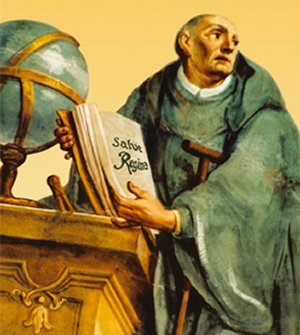
An interesting fragment from Filippo Buonaccorsi‘s (1437 – 1496) “The Life of Zbigniew Oleśnicki” (Vita et mores Sbignei cardinals).  (Oleśnicki was the one who commissioned Jan Długosz’s (1415 – 1480) annals).  This Vita was never published and remains in manuscript form at the Jagiellonian Library.  

However, an edition of it came out published by Ludwik Finkel (also published as part of Monumenta Poloniae Historica volume 6).

The first portion of the book contains an interesting description of the Poles as well as an explanation of their pagan beliefs.  It is not clear where Buonaccorsi (aka “Callimachus”) got this information from.  However, he was describing Oleśnicki’s family and claimed that the family – whose coat of arms was “Dębno” – must have been established by a Scythian warrior Deombrotus.  Deombrotus having been a Scythian teacher of the Poles…  Thus, by extension, the learned Oleśnicki was descended from the first Polish Scythian wiseman.

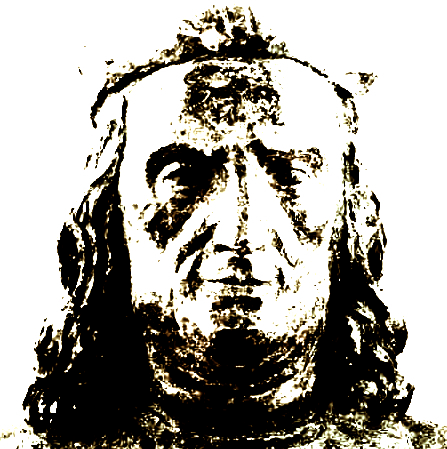
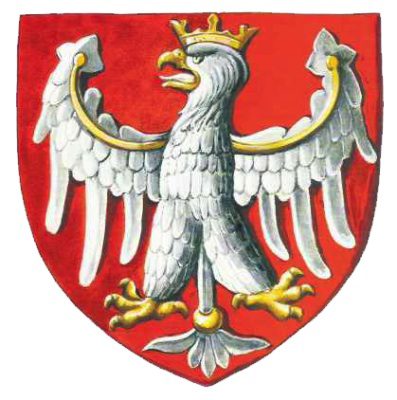
From the Okulski armorial

The relevant parts state the following:

“The family Dembno likely got its surname from Deombrotus having distorted his name somewhat, though those who do not know such ancient history, conjecture that the name arose later from an oak tree of remarkable height…”

[Because a dąb (damb or demb) means “oak” – interestingly, see also the name of Mons Jasonius aka Mount Damavand but also Mount Dembavend in Moses Khorenatsi’s work!]

and further:

“[He, i.e., Deombrotus once he took over the Poles] instructed them to venerate Vesta whom the Scythians call Labiti, Ceres whom they call Apia and Jove/Jupiter who is known as Jasde among them.  The wisemen/mages thought that these gods are: fire, earth and air.  But over time the Poles corrupted the Scythian names and said Lada in place of LabitiMia in lieu of Apia [and] Iesse rather than Jasde.  He introduced too certain ways of divining from the leaves of a linden tree which, having divided such leaves into three parts, they wrap around their fingers…”

The “Scythian” gods are actually based on a passage from Herodotus:

“They worship only the following gods, namely, Vesta, whom they reverence beyond all the rest, Jupiter, and Tellus, whom they consider to be the wife of Jupiter; and after these Apollo, Celestial Venus, Hercules, and Mars. These gods are worshipped by the whole nation: the Royal Scythians offer sacrifice likewise to Neptune. In the Scythic tongue Vesta is called Tabiti, Jupiter (very properly, in my judgment) Papaeus, Tellus Apia, Apollo Oetosyrus, Celestial Venus Artimpasa, and Neptune Thamimasadas. They use no images, altars, or temples, except in the worship of Mars; but in his worship they do use them.”

Thus, Herodotus has Vesta named Tabiti – not, as Callimachus would have it, Labiti.  How Labiti may have become Lada, Callimachus does not say.  Further, while Tellus corresponds to Ceres and, as per Herodotus, Apia (i.e., Earth), it is not clear how Apia should then have become the Polish Nia.  Finally, Herodotus never mentions Jasde but rather Papaeus.

Neither Herodotus nor anyone else mentions Deombrotus the Scythian (Callimachus provides a genealogy for Deombrotus connecting him with some Herodotian Scythian figures).

And so here we are.

The above is Finkel’s print edition.  The below may be Finkel’s handwriting (it’s not the actual autograph).

Copyright ©2016 jassa.org All Rights Reserved

December 7, 2016

The Slavs of Hermann of Reichenau

Published Post author

Here are some excerpts from the Chronicle of Hermann of Reichenau in a translation by I.S. Robinson.  Hermann (July 18, 1013 – September 24, 1054) was also called Hermannus Contractus or Hermannus Augiensis or Herman the Cripple or the Lame.  Amongst his many achievements, he wrote a chronicle (which was later continued by his student Berthold of Reichenau).  Here are the Slav passages of Hermann’s chronicle.

hermann

1004

“King Henry went by way of Verona into the region of Italy on this side of the Po and subjected to himself all the cities in that region.  On the very day on which he was crowned, he broke into Pavia and subdued it by fire and sword.  After taking hostages, he returned from there into Saxony and after a few days he turned his arms against the Slavs.  He forced the Bohemians to accept their former duties of services and payment of tribute; he also brought Boleslav, the duke of the Polish Slavs, into subjection, together with all his people,* and returned to Saxony victorious.  Duke Herman of Swabia died and he was succeeded in the duchy by his son, Herman, who was a boy and acceptable to all the people.”

* In autumn 1004 Henry restored the exiled Duke Jaromir of Bohemia.  The reference to Boleslav is to Boleslav Chrobry (duke 992 – 1025; king 1025).  The expedition took place in August to September of 1005.

1032

“Rudolf, the indolent petty king of Burgundy, died and his crown and the insignia of the kingship were brought to Emperor Conrad by Seliger.  In these days, while the emperor was leading an army against Miesco, the king of those Slavs who are called Poles,* Odo the son of the sister of the same Rudolf, a prince of Champagne in France, invaded the kingdom of Burgundy, captured the fortresses of Neuenburg and Murten and placed his own garrisons in them…”

* Mieszko II (ruling 1025 – 1034).  The emperor’s unsuccessful expedition was in September.

1034

“…The pagan Slavs known as Liutizi attacked the frontiers of Saxony…”

1035

“…Duke Adalbero of Carinthia and Istria lost the emperor’s favor and was also deprived of his duchy.  The Liutizi captured the fortress of Werben, which was secretly betrayed to them, and killed or led away captive many of our men.  The emperor forced a crossing of the River Elbe, entered their province and laid it waste far and wide.  A great synod was assembled in Tribur.”

1036

“…The Liutizi Slavs were obliged to pay tribute to the emperor…”

1039

“…King Henry undertook an expedition to Bohemia, but when Bretislav the duke of that people, had sen him his son as a hostage and had promised – although it was a feigned promise – that he himself would come and perform what was commanded of him, he at once returned.  During the winter Peter, king of the Hungarians invaded the frontiers of his kingdom and laid it waste, plundering burning and taking captives.”

1040

“King Henry attacked the duke of the Bohemians, who was once again in rebellion.  In order to storm the forest obstruction or rampart on both sides, he sent the lightly armed part of the army through a lonely mountain pass into the province.  When, however, the knights entered the difficult and heavily wooded terrain, on 22 August on this side and on the following day on the other side, and while with futile labour, already wearied, they sought in vain to attack a particular earthwork, the Bohemians poured in all sides and they were slaughtered, taken prisoner or put to flight.  Those of our men who still remained in the province were brought out through the intervention of the hermit Gunther* and returned safely.  Meanwhile the king departed with the loss of very many knights and princes and with his purpose unfulfilled…”

* “from the Thuringial comital familypf Schwarzburg and Kaefernburg, monk of Niederaltaich, founded settlement of hermits at Rinchnach.”

1041

“King Henry restored to the Bohemian duke his son, who had been held as a hostage, and ransomed the prisoners who had been captured in the forest.  The following summer he collected a grate army, entered that province by an unfrequented route and laid everything waste with pillage and burning until the duke was compelled by hardship to sue for peace.*  He summoned the king’s vassals to him and promised them his own surrender and subjection together with all his people and also promised that he would come to the king in Regensburg and perform what was commanded him.  He soon fulfilled his promise through his actions after the king departed.**  In the same year the treacherous Hungarians set up again…”

* “Henry entered Bohemia on 15 August and campaigned until 29 September according to Steindorff (1874).”

** “He appeared in Regensburg in October, paid tribute, took an oath of fidelity and promised service to Henry and received from him Bohemia and two Polish provinces according to Steindorff again (1874).”

1042

“…After the subjection of the Hungarians of that territory since they refused to accept Peter, he installed for them as duke one of their number who was at that time in exile among the Bohemians.  Immediately after the king’s departure, however, Aba drove the duke back into Bohemia and the latter was unable to put up any resistance…”

1045

“…The Slavs who are called Liutizi were troubling the borders of Saxony; but when the king came there with a force of his vassals, they surrendered and promised the customary tribute.  In the autumn the hermit Gunther departed to Christ and was laid to rest in Prague, a city of Bohemia…”

1047

“…At that time he promoted the Swabian count Welf, son of the former count Welf, to be duke of Carinthia…”

1048 

“…THe emperor left Regensburg, where he celebrated Easter [3 April] with Duke Otto and Duke Bretislav* and many princes, and, coming back to Swabia, he entered our own Reichenau…”

* “Duke Bretislav I of Bohemia, whose wife Judith (Jutta) of Schweinfurt was Duke Otto’s sister.”

1050

“…After Easter the lord pope agains assembled a synod in Rome and, subsequently advancing beyond Rome, he subjected some of the princes and cities in that region both to himself and to the emperor by means of an oath and excommunicating the Beneneventans, who were still in rebellion.  Some princes of the foreig nations also sent envoys to him as pope and promised him subjection.  The emperor prepared an expedition against Casimir, duke of the Poles, who was planning a rebellion.  He was, however, held back by a serious illness and received him when he requested peace and a treaty and departed…”*

* According to the German scholar Steindorff (1874): “Casimir I (ruling 1034 – 1058) was accused of having usurped by force a province given by the emperor to the duke of the Bohemians.  He came to the emperor on the royal estate of Goslar and defended himself against the accusation by means of an oath and those matters in which he was guilty he corrected according to the emperor’s judgment.”

1051

“…The following autumn the emperor, disdaining to accept the pact that King Andreas offered through his envoys, invaded Hungary with a great army.  While Bishop Gebhard of Regensburg, Duke Welf and Duke Bretislav were sent to lay waste to the northern Danube region, he himself marched through the territory of Carinthia.  He made a long detour because of the overflowing of rivers, while supplies were brought from the ships, as far as possible on horses.  He invaded the treacherous kingdom and laid waste all the surrounding territory, as long as supplies were available for the army, since the Hungarian army fled rapidly higher and thither like a band of robbers, nowhere daring to give battle on equal terms.  When, however, the army began to suffer from scarcities and hunger, the Hungarians prepared to cut off their retreat, having stationed their forces on the riverbanks that they had previously fortified band in shallow marches, and threatened either to force them all to surrender or to starve them to death.  The knights were undismayed and unhesitatingly waded over and put to flight the enemies who opposed them on the rivers.  Certain Burgundian, Saxon and Polish knights* crossed the river, not without danger to themselves, and in a short time stormed and captured a very strong fortress built at the bridge over the River Repcze, in which the enemy had t he greatest trust.  They cut down and scattered the Hungarians and opened the way for the rest of the army.  After almost all had passed through, the fortress was set on fire, which cut off some of the hindmost, placing them in great danger because the enemy was pushing them.  The emperor thus returning and those whom he had sent beyond the Danube having png since come back after achieving success in their enterprises, King Andreas sent a request for peace to our Margrave Adalbert and promised peace on his own part.”

* The presence of Polish knights may be explained by the fact that Casimir I had previously gotten German support for the enterprise of reclaiming the Polish throne.


Copyright ©2016 jassa.org All Rights Reserved

December 4, 2016

On the Pagan Rebellion

Published Post author

On July 13, 1024 Boleslaw Chrobry’s great rival, the German Emperor Henry II passed away.  The next Easter (either on April 18 or April 23, 1025), Boleslaw crowned himself king (most probably in Gniezno).  He too would pass away shortly (on June 17, 1025) but the deed was done.  Poland was a kingdom and it was up to Boleslaw’s son Mieszko II to continue the legacy.

The Unhappy Reign of Mieszko II

Mieszko II was crowned king most likely already by Christmas 1025.  At that time the German throne was held by Conrad II.  At first Conrad had to deal with some opposition in Swabia and Lotharingia and it appears that West Germans tried to get Mieszko energized about helping them.  Unfortunately for Mieszko, by the time he launched his campaign against Conrad (in 1028), the latter had already dealt with his internal opponents (sometime in 1027).  Mieszko’s invasion of Saxony in January 1028 was largely a success (apparently he took huge numbers of hostages) but it only served to refocus the Emperor on the East.

eszk

Mieszko II

Conrad began his counterattack in 1029 wanting to finally deal with his meddlesome Polish neighbors.  To do that he raised a truly giant army and set out for Poland.  However, at first things did not go so well for him.  The German advance crossed the Polish border at the river Solawa (Saale) and entered Milsko and Luzyce (today’s Meissen and Lausitz).  But the army never reached Poland proper getting stuck and coming apart at Budisin (Bautzen).  In 1030, in turn, the Emperor’s attention was diverted by the Hungarians who decided that they wanted to have Bavaria for themselves.

imperator

Conrad II

From then on things went south for Mieszko.  The Hungarians and Germans concluded a peace treaty in 1031.  Conrad tried his hand against Poland again.  But this time he did not go it alone. For starters, he’d drawn in the Czechs.  They had previously been humiliated by Mieszko’s father, Boleslaw who conquered most of Bohemia and Moravia and made it part of his realm.  Since then the Czechs revolted on Mieszko’s watch and under their duke Udalrich were ready to assist the Germans.  Moreover, Conrad coordinated with the leader of Kievan Rus, Yaroslav.  Since the Rus had been defeated by Boleslaw as well, they too were ready to help out and recover some of their lost lands.  Furthermore, both the Germans and the Rus brought with them each a son of Boleslaw’s.  With the Germans came Otto, Boleslaw’s youngest son (named after Otto III the Red).  With the Rus there came Bezprim, Boleslaw’s oldest son.  Although Mieszko II was clearly his father’s choice to succeed him, he was not the only contender.  He likely had kicked his brothers out of his kingdom after his father’s death but that only wounded their pride and so they sought help abroad.

olri

Oldřich (Udalrich)

Mieszko sought refuge.  Because of a temporary break between Conrad and Udalrich, his best bet seemed to be to go to Bohemia.  Udalrich had already met Mieszko and indeed had imprisoned him back in 1014 when Mieszko tried to win Udalrich over to an alliance.  But Udalrich was not ready to risk everything for the now weak Mieszko.  Mieszko’s father, Boleslaw, had blinded Udalrich’s brother (Boleslaw III) and now, allegedly in revenge, Udalrich had Mieszko castrated.  The Rus recovered some of the lands they’d previously lost to the Germans.  Milsko and Luzyce went to the Germans.  The Polish crown was sent to Germany either by Bezprim or by Mieszko’s wife (whom he left in Poland).  Bezprim was installed as a duke and Otto may have gotten a piece too.  The Pomeranians revolted.  In the meantime, Mazovia apparently also separated from the rest of Poland under the leadership of one Maslaw or Mieclaw (Mieszko II’s former cup bearer).

slav

Yaroslav

This situation was not stable, however.  Bezprim was apparently not the most beloved leader and, it seems, was quickly murdered by local opposition.  Mieszko was released by Udalrich but was forced to go see the Emperor at Merseburg.  There, he was forced to confirm the Emperor’s overlordship as well as agree to have his younger brother Otto get Silesia and to have Dietrich (another grandson of Mieszko I) obtain possession of another part of the country.

But things did not turn out so badly for Mieszko (other than the whole castration thing).  Apparently, full of energy he used the Emperor’s to reclaim Polish lands if not the crown.  About 1033 both Otto and Dietrich die or disappear.  How that came about you can speculate just as well yourself.  The Rus, satisfied with their prior land grab, did not intervene without German help.  Thus, Mieszko was able to reunify the country briefly before his own death (apparently of natural causes) in 1034.

And then we come to a bit of a hole in history.

What Happened Next?

What happened next is, to put it mildly, very unclear.  There is a suggestion (happily jumped on by all kinds of conspiracy theorists and various reflexively anti-Catholic personas) that next in line to the throne was Mieszko’s oldest son, Boleslaw.  Boleslaw’s very existence, however, has been questioned (hence, he is called Boleslaw the “Forgotten”).  As per the conspiracy theorists, Boleslaw’s being “forgotten” is a result of a vast nefarious Catholic conspiracy to erase his memory from the list of Polish rulers.  Why would the Church do that?  Well, the theory goes because Boleslaw’s faith was Slavic-rite or maybe he was even a pagan (anything but Catholic).  There are a number of sources that provide some support for the existence of a Boleslaw but they are either very late (such as the Greater Poland Chronicle – see below) or the support they provide is only very indirect.  We will perhaps get back to this controversy to discuss it in detail.  For now, suffice it to say, that it is highly unlikely that such a ruler (not mentioned by the rather meticulous German annalists or by any of the Czech, Russian or Hungarian sources) existed.  On balance, it is more likely that the next Polish ruler really was Casimir the “Restorer”.

Nevertheless, Casimir did not take charge of Poland in 1034.  Between 1034 and 1039 a lot of things happened though information regarding these things is scant.  For one thing, we know that Udalrich’s son, duke Bretislaw ascended the Czech throne in 1034.  By 1037 he had made his way to Poland leveling both Gniezno and Poznan and taking the bones of Saint Adalbert (Wojciech) to Prague.  Casimir had fled Poland earlier and had been held in Hungary.  He was only released in 1038 when the Hungarian throne changed hands.  He then went to see his mother in Germany and, apparently against her advice and that of the Emperor, decided to return to Poland taking with him about “500 knights.”  It was that group that effectively reconstituted the Polish realm building alliances inside the country, routing the Mazovians and defeating the Pomeranians.

But let’s get back to 1034 – 1039.  These are the years of the so-called “pagan rebellion.”

What we know is, well, very little.  Nevertheless, it seems that in light of the total collapse of rule in 1034, secessionism and foreign invasions, some form or a rebellion took place against whatever then remained of the Piasts’ authority.  Whether the rebellion had more of a “class” dimension or was more of a religious character is unclear.  It was probably some combination of both.

The written sources are scant and likely, some of them, wrong.  Let’s break this up a bit.

The Year 1022

The first mention of a “pagan” revolt comes in the year 1022 and it appears in two places.  Cosmas of Prague and the much later Jan Dlugosz.

Cosmas notes laconically in Book I of his Chronicle of the Czechs under the year 1022:

“A persecution of Christians was carried out in Poland.”

cosm

Cosmas

This would have put, at least this, “pagan” revolt during the reign of Boleslaw Chrobry (died 1025) rather than after the death of Mieszko II.

Possible?

cosma

Sure, but the problem with Cosmas is that, writing almost a hundred years after the events in question his knowledge of them seems highly distorted.  For example, he ascribes many of the deeds of Boleslaw Chrobry to his father Mieszko I.  Not only that, he does not even know some Czech matters.  Thus, he claims that Uldrich was the son of Boleslaw III of Bohemia, rather than, as we know, the latter’s brother.  It is, therefore, highly unlikely that such a small detail would have been gotten right by Cosmas.

Cosmas does later (in Book II) discuss the Czechs invasion of Poland in the year 1037 but says nothing at that time about any pagan or other rebellion.

Another source for an earlier rebellion is  Jan Dlugosz who does have an entry under 1022 that characterizes the events in a similar but slightly different way:

“…For some among the nobles, incited by satan, found giving sheaf tithes and the fulfillment of Christian duties to be burdensome, which complaints were made especially by those who having been raised in the errors of paganism grew weary of the yoke of the true faith of Christ; [and] after much scheming they decided to return to the old life of impiety and idolatry, to fail to timely pay their tithes, nor to attend churches, to throw out, in fact, priests and God’s servants from the temples.  And when Boleslaw the Polish king found out about this, he would not, this fervent evangelist of the Catholic faith, allow this smoldering rebellion to grow but nipped it in the bud; sending out squadrons of knights he captured the ringleaders and some of them he ordered beheaded while others he had flogged; and only those that had less guilt, having been seduced by others’ persuasion, did he spare any punishment.”

A slight problem with Dlugosz, of course, is that he writes even later in the 15th century and, for all we know, may have relied here on Cosmas.

The Year 1025 (or 1030?)

Nestor’s “Primary Chronicle” (PVL) mentions under the year 1030 the following:

1030 or year 6538:

“… At this same time, Boleslav the Great died in Poland, and there was a revolt in the Polish country.  The people arose and killed the bishops, the priests, and the boyars, and there was rebellion among them.”

pavl

He goes on to say that in the “year 1031 (or 6539)] Yaroslav and Mstislav collected a large force and marched into Poland.  They recaptured the cities of Cherven, and ravaged the Polish country side.  They also captured many Poles and distributed them as colonists in various districts.  Yaroslav located his captives among the Ros’, where they live to this day.”

rosl

Since Nestor places this event immediately after Boleslaw Chrobry’s death and since Chrobry died in 1025, it seems reasonable to assume that some sort of a pagan rebellion took place at that point.

Unless, of course, Nestor also confused Boleslaw Chrobry with Mieszko II.

The Year 1034

The Greater Poland Chronicle (GPC) places these events after Mieszko II’s death.  Although the chronicler gets the year wrong (1033 versus 1034), he seems nevertheless to associate the “pagan” rebellion with the time immediately before Casimir the Restorer took charge.

kpreal1

GPC

The GPC says:

“After he [Mieszko II] died in the year of Our Lord 1033, his firstborn son Boleslaw* came to rule.  But after this one was crowned, he caused his mother many indignities.  His mother, who came from an excellent family, not being able to endure his wickedness, taking her little son Casimir, returned to her homeland to Saxony, to Brunswick and placing her son there to study was said to have entered some convent.  Whereas Boleslaw, on account of his cruelty and monstrosity of deeds that he committed, poorly ended his life and, though honoured with a royal crown, is not counted among the kings and princes of Poland.”

* Boleslaw the (Previously) Forgotten or Boleslaw the Made-Up depending on your point of view.

kpreal2

GPC

“After his death, there arose in the Polish country much turmoil and many wars, rather internal than external.  But when the Polish state – by reason of [these] wars – fell almost completely , the great lords of the country set out immediately on a journey to Saxony to their Lady, the queen with the aim of finding their Lord, Casimir.”

kpbi

“From her they learned that she had sent him to Paris to study the liberal arts where, while spending time there and working, he took on the oath of Saint Benedict at the Cluney Abbey.  Rushing to him, they beheld that he had already been ordained a deacon.”

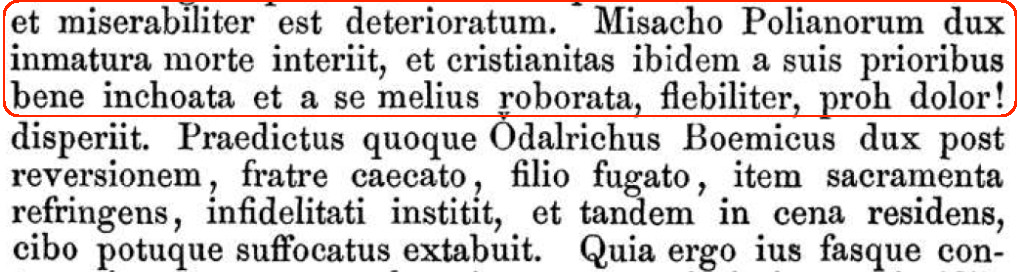
In accord with this dating are the Hildesheim Annals which have the following entry under the (correct) year 1034:

misa

The famous Hildesheim Annals entry (Paris MS)

“Mieszko the duke of the Poles died prematurely and Christianity there so well begun by his predecessors and by him [Mieszko II] even strengthened, alas, lamentably perished.”

misacho

(the same entry is also in the Magdeburg Annals)

Other Sources

Gallus Anonymous does speak of a pagan rebellion.  He does not say when it took place but does place it after the death of Mieszko II and after the expulsion of Casimir the Restorer from Poland.   Thus, it seems that we are looking at 1034 – 1036.  Since he discusses these events before the Czech invasion of 1037 we can tentatively say no later than that year.  Perhaps.

Here is Gallus’ Chapter 19: 

“At this time kings and dukes neighboring Poland, each in his own turn violated her and took towns and border castles or, after the taking, burn them down.  And so exposed to so many sorrows and painful defeats, she was treated even shabbier and more abominably by her own inhabitants.  For the slaves rose against masters, freedmen against the nobles, announcing themselves as nobles in turn, taking their [nobles’] wives and beds and most cruelly persecuting the same [nobles].”

gallus1

Gallus

gal1

“Renouncing too the Catholic faith, which we are unable to mention without shedding many a tear, they rebelled against the bishops and priests, and some of these, in their eyes being more prominent/honorable, they put to the sword; and some others, as if deserving a more ignoble death, they had stoned.  In the end, by reason of foreign causes as too by reason of her own inhabitants, did Poland suffer such ruin, that she was almost completely deprived of riches and people.  It was then that the Czechs destroyed Gniezno and Poznan and took the body of Saint Adalbert.  And those who managed to flee the hands of the enemies or who were escaping the rebellion of their serfs, made their way across the River Vistula to Mazovia.*  And the aforementioned cities remained abandoned so long that in the Church of Saint Adalbert as well as at Saint Peter’s wild animals set up their dens…”

gallus2

Gallus

* Of course, Mazovia too was going to rebel under Maslaw (or Mieclaw) the recently repurposed cup bearer.

gal2

There is not else on the pagan rebellion.  Thietmar’s Chronicle only reaches the year 1018.  Kadlubek’s Chronicle is silent.  There is another Bohemian source and some Russian sources (preserved in much later books) but they all add little else to the topic.  Nevertheless, a “pagan” rebellion was altogether possible.  A similar rebellion took place in Bohemia between 921 and 935 and, of course, the Great Slav Uprising of 983 in Polabia had not only anti-Frankish/Saxon but also anti-Christian character.

Copyright ©2016 jassa.org
November 30, 2016

Updates

Published Post author

Just so that you do not think we’ve been idle, we link to the slightly improved versions of:

  • the story of Boz, and
  • the remaining relevant portions of the Getica.

We’ve cleaned them up and added some pretty manuscript pictures.

Copyright ©2016 jassa.org All Rights Reserved

November 29, 2016

Signs of Lada – Part III

Published Post author

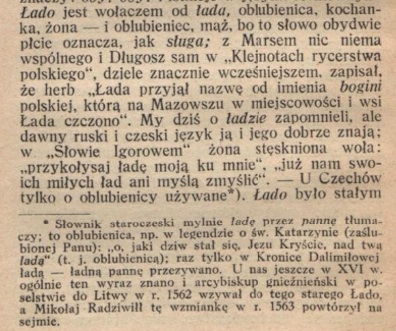
We have previously written about signs throughout Europe of the Goddess Lada (see here and here).  Aleksander Brückner famously derided the idea of Lada being a Goddess, instead claiming that the word simply meant “my love” or “my dearest” or “wife” (in male form lado, also husband).  We have addressed this issue here and, specifically, here showing that Brückner’s arguments really do not shed any light regarding the question of the divinity of Lada.
bruck1

On one thing, however, Brückner was potentially right about is that in Eastern Suavdom, the name lada really did mean “my love” and “wife”.

What is interesting is that the name appears outside of Europe.  Specifically, in Anatolia where, in today’s Turkey, there was once a region called Lycia.

anatolia

Several books came out in the 19th century regarding the Lycian language mostly keying off of the various inscriptions found there.  For example:

  • “The Lycian inscriptions” by Moriz W. J. Schmidt, or
  • “Neue lykische Studien” by the same author.

lycian

It turns out that the same name Lada appears in these Lycian inscriptions and, there, it does mean “wife.”  Although other Lycian words do not bear an immediate similarity to Suavic, the fact that this one word should have the exact same meaning as the East Suavic lada is peculiar.

lada

Carl Pauli (Altitalische Forschungen)

Gattin means “wife” or “spouse” in German so there you have it.

Thus, lada has the same meaning in Suavic and Lycian languages.  Query then the nature of the Lycian language.

(Incidentally, a town named Liada also appears between Nicomedia and Ancyra in the Itinerarium Burdigalense – a pilgrim’s itinerary dated to the year 333.  As another point of interest, there is, in the same segment of that journey, also a mention of a town named Malogardis – little grod – which has been interpreted as Manegordus.)

How is that the same term means the same thing in Suavic and Lycian languages?  The languages seemingly do not contain that many other connections but then does this mean that the Lycians spent time in Suav lands or Suavs in Lycian lands to have made this borrowing?

Incidentally, this is not the only such connection. Vasmer lists others: the “Chaldian” (Χαλδία) lute „woman” and the Avaric (NE Caucasus) tladi also “woman”. For more information you can see the writings of Kretschmer and Trubeckoj. The cause of the similarities? Vasmer thinks just chance.

Copyright ©2016 jassa.org All Rights Reserved

November 26, 2016

The Slavs of Regino of Prüm (& Adalbert of Magdeburg)

Published Post author

Here we present entries related to Slavs (or of interest to Slavs, see 889 regarding the name “Germany” – similar word play again to germs/spores) from the less known Chronicle of Regino of Prüm (circa 840 – 915) and from the Continuation of the same Chronicle by Adalbert of Magdeburg (910 – 981).  The translation and annotations are by Simon MacLean.

regino

Book I

605-611

…King Dagobert fought with the Slavs and overcame them.  At that time a dux named Samo ruled over them.  He also restrained the rebellious Gascons with the sword.  The Huns and Bulgars joined in battle among themselves.  The Huns defeated the Bulgars.  Utterly defeated and driven from Pannonia, nine thousand with their wives and children appealed to King Dagobert for land they needed to live on.  The king ordered that they be received in scattered houses in Bavaria for the winter, and one nigh he ordered them all to be killed together with their wives and children…

Book II

860

In the year of the Lord’s incarnation 860, Eigil voluntarily renounced the abbacy of Prüm, and Ansbald, a man notable in all sanctity and goodness, succeeded him in command.  In these times the elder Louis [the German], brother of Emperor Lothar [I], very strenuously prosecuted many wars against the Slavic peoples.  Accordingly, he invaded the lands of the Moravians and completely tamed everything by force of arms, capturing their leader Rastiz and ordering his eyes to be gouged out for violating treaties…

876

…After this, the three aforementioned brothers met in the place called Schwaifeld, and there they divided the paternal kingdom.  Karlmann received Bavaria, Pannonia and Carnuntum [Carinthia], which in bad style is called Carantanum, and also the realms of the Slavs, Bohemians and Moravians.  Louis got east Francia, Thuringia, Saxony, Frisoia and part of Lothar’s kingdom.  To Charles’s portion fell Alemnania and some cities in the kingdom of Lothar.

880

In the year of the Lord’ incarnation 880, King Karlmann ended his last day on 22 March after a decline into paralysis.  He was buried with due honour in Bavaria, in the place called Altoetting. That most excellent king was learned in letters, dedicated to the Christian religion, just. peace-loving, and in all of  his habits adorned with probity.  The beauty of his body was extraordinary, and his strength too was remarkable; no less so was his greatness of his spirit.  In fact he fought very many battles together with his father, and still more without him, in the lands of the Slavs and always brought back the triumph of victory.  He added to and extended thus the borders of his kingdom with the sword.  He appeared mild to his own people., terrible to his enemies.  He was affable in speech, decorated with humility, and unusually gifted in ordering the affairs of the realm.  In short, nothing which was appropriate to royal majesty seemed to lack in him…

…When Louis [the Younger] heard that his brother had died, he went to Bavaria and came to Regensburg, where all the leading men of the kingdom flocked to him and put themselves under his command.  The king conceded Carinthia to Arnulf because his father had already conceded it to him.; there lies the very well defended stronghold of Moosburg, so called because of the impenetrable bog which surrounds it and offers very difficult entry to those who approach it.

889

…This is why such great numbers of peoples spring up under the northern skies, so that it is quite correct to call that entire region from the Don to the west by the general name of Germany, though individual places in it also have their own names.  Because Germany is so populous, innumerable groups of captives are often taken from there and sold to southern peoples for money.  Peoples have frequently led this region because it produces so many human beings that there re barely enough resources to feed them.  These groups have afflicted Asia, but mainly they have troubled adjacent parts of Europe.  Ruined cities throughout Illyricum and Gail testify to this, but a hove all unhappy Italy has experienced the savagery of almost all of these peoples.

The Hungarians were thus driven from their home in these lands by a neighboring people called the Petchenegs, because they were superior to them in strength and number and because, as we said before, their own country was not sufficient to accommodate their swelling numbers.

After they had been forced to flee by the violence of the Petchenegs, they said goodbye to their homeland and set out to look for lands where they could live and establish settlements.  First they roamed the wildernesses of the Pannonians and the Avars, and sought their daily food by hunting and fishing.  Then they attacked the lands of the Carinthians, Moravians and Bulgars with the infestation of constant raids, killing a very few with the sword and many thousands with arrows, which they fire from their bows made of horn with such skill that it is almost impossible to avoid being hit by them…

890

In the year of the Lord’s incarnation 890, King Arnulf gave the command [ducats] of the Bohemians to King Zwentibald of the Moravian Slavs.  Hitherto, the Bohemians had rulers from among their own kind and people, and had kept the fidelity they promised to the kings of the Franks by inviolable agreement.  Arnulf did this because, before he had been raised to the throne of the kingdom, he had been joined to Zwentibald in close friendship.  In fact, he raised from the holy font Arnulf’s son, who was born to him by a concubine, and named him Zwentibald after him.  This matter [the granting of Bohemia to Zwentibald of Moravia] provided a considerable stimulus for discord and defections.  For the Bohemians, on the one hand, withdrew the fealty that they had long kept, and Zwentibald, on the other, believing himself to have gained considerable strength through that acquisition of another realm and puffed up with the arrogance of price, rebelled against Arnulf.  When Arnulf learned about this reinvaded the Moravian realm and razed everything outside the cities to the ground.  Finally, because even the fruit trees were being uprooted, Zwentibald asked for peace and, having given his son as a hostage, belatedly gained it…

891

…While this [invasion by the Northmen] was going on, King Arnulf was staying in the furthermost parts of Bavaria, restraining the insolence of the Slavs…

892

…At that same time Arn, the venerable bishop of Wuerzburg, set out to fight the Slavs at the urging and encouragement of Poppo dux of the Thuringians, and was killed in battle [July 13].  Count Conrad’s brother Rudolf gained his seat and succeeded him as bishop.  Arnulf granted some of Count Megingoz’s offices to his son Zwentibald…”

894

…Also around this time Zwentibald king of the Moravian Slavs, a man most prudent among his people and very cunning by nature, ended his final day.  His sons held his kingdom for a short and unhappy time, because the Hungarians utterly destroyed everything in it.*

* Moimir and Zwentopulk.  By 906 the Hungarians encouraged by the Franks, had effectively destroyed Moravian power.

Adalbert’s Continuation 

907

The Bavarians fought the Hungarians, and many were cut down with a great slaughter.  In this battle dux Liutpold [of Bavaria] was killed.  His son Arnulf succeeded him in the command [ducatus]*

* The Battle of Bratislava was a major defeat for the Franks.

921

…Meanwhile King Henry strongly persisted in stabilizing peace and restraining the savagery of the Slavs.

928

King Henry attacked the Bohemians with hostile intent and with God’s aid he courageously conquered them.  At that time a son named William was born to the same king’s son Otto…

931

King Henry made the king of the Abodrites and the king of the Danes into Christians…

934

King Henry cut the Hungarians down with a great slaughter, and took even more prisoner.  In that same year he attacked the Slavs called Vucrani with hostile intent; he defeated them and made them his tributaries…

950

…In the same year Boleslaw, ruler of the Bohemians, rebelled against the king, who went against him with a very strong force and enforced his lordship completely…

955

The Hungarians came forth with such a great multitude that they said they could not be defeated by anyone unless the earth swallow them up or the sky fell and crushed the them.  With God’s support they were defatted at the River Lech by the army of the kings with so great a slaughter that never before among our people was such a victory heard of or accomplished.  Conrad, the former dux, was killed there.  When he had returned from there there king sent his army against the Slavs, where he won a similar victory and struck them down with a great massacre.*  Wichmann was expelled.  The king’s brother Henry, after recovering from his desperate situation and receiving the dukedom of Bavaria, died.  The pious king gave the ducats and the march to Henry’s son Henry.  The king’s son Otto [future Otto II] was born.

* The Battle of Recknitz (October 16), at which Otto defatted the Abodrites and their allies.

957

The king attacked the Slavs [Redarii] again…

958

…In that same year, by the doing of Archbishop Brun’s faction, Count Reginar was captured and sent into exile among the Slavs…

959

The king invaded the Slavs again, and Thietmar was killed there.*

*Presumably Otto’s battle against Slavs led by Wichmann the Younger during the previous year.

962

…Their sons Adalbert and Guy wandered aimlessly here and there, but they along with their followers still possessed certain fortifications, namely the strongholds at Garda* and Val Travaglia, and an island on Lake Como…

* notice the Slavic (?) Garda near Lake Como.  For Jesen in the area see here.

963

…Back home the Slavs called Lausitzer were also subdued.

965

…In the meantime Bishop Guy of Modena approached the emperor in Saxony on a mission for Adalbert, pretending with fox-like cunning to be loyal to the emperor and boasting that he would betray those who were unfaithful.  But he did not share in the emperor’s presence or conversation.  Instead, after he had been allowed to return home in shame, he was arrested int he Alps on the other side of Chur and, after being sent back to Saxony, wass placed in custody among the Slavs.

Copyright ©2016 jassa.org All Rights Reserved

November 25, 2016

Of Rugians and Rani

Published Post author

The name of the Rani tribe has given people headaches for many years.  The Greater Poland Chronicle derived it as follows:

“The Rani are called so for when fighting enemies they had the custom to yell ‘rani!’ ‘rani!’ that is, wound ’em!, wound ’em!”

GPC

Item Rani seu Rana dicuntur ex eo, quia semper in conflictu hostium vociferare solebant rani! rani! id est vulnera, vulnera.

Here’s Brueckner on rana (wound):

rana

Widukind writes of the Ruani.  In the Life of Otto we hear of the Rutheni (terra barbarorum, qui Rutheni dicuntur; also Ruthi sive Rutheni, de Rutzen; and Brutenis; also Ruthos sive Ruthenos de Rutzen; but Pomerania post se in Oceano Daciam habet et Rugiam insulam).  Adam of Bremen spoke of “Rani or Runi… a might Slavic peoples” (Rani vel Runi… fortissima Slavorum gens).  Some years later Helmold of Bosau wrote of “Rani called Rugiani” (Rani qui et Rugiani [or Rani sive Rugiani]).  Wibald of Corvey said in 1149: “which [island] is called Ruyana by the Germans, Rana by the Slavs.” (pro recipienda regione, quae a Teutonicis Rujana, a Slavis Rana dicitur).  Saxo Grammaticus has the name as Rugiani.

Now let’s look at something else: the etymology of the name and the origin of the tribe.

The predominant theories provide two postulates:

  • that the name Rani is derived from the Germanic Rugians, and
  • that the Slavs arrived on the island of Ruegen sometime in the second half of the 8th century.

As we can show, one of these is likely false.

The conversion of the Rugians to the name Rani is supposed to have happened approximately as follows:

Rugii > Rugiani > Rujani > Rani

As an aside, we are told that it was the Germans who called the island of Ruegen Rujana whereas the Slavs called it Rana (a Teutonicis Rujana, a Slavis Rana).  If this is true then it seems that it was the German name that changed demonstrably whereas we see no proven changes in the Slavic name.

As another aside, the Germanic etymology of Ruegen and the Germanic tribe of the Rugii seems as uncertain as the Slavic one.

Be that as it may, the suggestion is that the Rugii lived on the island of Ruegen and then some or all of them headed out to conquer the Roman Empire, etc.  In their place there appeared the Slavs who eventually settled on the island of Ruegen (in the 8th century or so), overtook the remnants of the Rugii along with their name and changed the latter to Rujani and then shortened it to Rani.

Can all this be true?

As regards the etymological derivation of Rani we can say only that it seems improbable but not impossible.

As regards, the arrival of the “Rani” Slavs on Ruegen in the 8th century this too is theoretically possible.

The problem arises when we ask what the name of the Slavic tribe which “took over” Ruegen before it did so?  One might say what does that matter?  And yet it does.

The reason for this is that the name Rani (as well as Granii) appears well before the 8th century in a famous passage in Getica (chapter 3) wherein Jordanes writes (in the 6th century although it is not clear whether this description does not refer to an even earlier time):

“Furthermore there are in the same neighborhood the Grannii, Augandzi, [Eunixi, Taetel, Rugi,]* Arochi and Ranii, over whom Roduulf was king not many years ago. But he despised his own kingdom and fled to the embrace of Theodoric, king of the Goths, finding there what he desired. All these nations surpassed the Germans in size and spirit, and fought with the cruelty of wild beasts.”

Getica

(Sunt quamquam et horum positura Grannii, Augandzi, [Eunixi, Taetel, Rugi,]* Arochi, Ranii, quibus non ante multos annos Roduulf rex fuit, qui contempto proprio regno ad Theodorici Gothorum regis gremio convolavit et, ut desiderabat, invenit. Hae itaque gentes, Germanis corpore et animo grandiores, pugnabant beluina saevitia.)

* we have followed the translators here; while the manuscript above shows zieunixitae and telrugi or, if you will, zieunixi taetel rugi, this seems to be a result of carrying over the “zi” – see here from the MGH (the above is P):

mghhPutting aside the fact that Jordanes clearly distinguishes between these [Scandinavian?] nations and the Germans and distinguishes the Rugii from the Ranii (and the Granii whoever they were), we are confronted with the question:

How could there be Rani in the 6th century if the Slavs had not reached Ruegen until 200 years later?

As we said, one of the above statements is likely false.  Either the name Rani is not derived from the name Rugii/Ruegen or the Slavic Rani arrived (or were) on Ruegen much earlier than the 8th century.

Of course, it IS possible to solve this conundrum and still preserve both propositions but doing so requires some rather precarious  footwork… The Rugii may have ran (no pun intended) into some Slavs on the former’s excursions all over Europe during the Voelkerwanderung times.  The name may have then transferred to the Slavs.  The Slavs may have subsequently altered it to Rani and so forth…

Even so, how did these Rani then find their way to the island of Ruegen?  Did they find out about it from the Germanic Rugii and headed for it afterwards arriving around the turn of the 9th century?

Or maybe the island was not even called Ruegen in the 6th century and only the Slavs brought the name?  But if the Slavs were already called Rani, then why did the island ever become known as Ruegen?

(Bede in Book 5, chapter 9 of his Ecclesiastical History of England discusses Bishop Egbert (circa year 688) and his ambitions to convert some continental Europeans listing “the Frisians, the Rugini, the Danes, the Huns, the Old Saxons, and the Boructuari.” lt is unclear who these Rugini are at this point.  They could be Germanic Rugini or they could be Slavs.  Certainly, the Huns were not (at least originally) Germanic).

Something is not right here.

Of course, it is also true that rano refers to the “morning.”  Back to Brueckner:

pren

It is also noteworthy that the word świt means “dawn” whereas Svantovit/Sventovit or Świętowit was a Deity worshipped among the Rani on Arkona.  The name of that Deity is usually translated as Strong Master or Strong Lord.  But maybe it meant the Dawn Lord?

swit

If so He would be celebrated in the morning, i.e., in the ранок or rano. Note that in most Slavic languages “morning” is jutro.  Regarding the possibility of connections of that word with yester-day and the Goddess Eostre of Easter (as well more Bede) see here.

Post Scriptum

Incidentally, the Germanic Rugii is supposedly derived from the word for rye (rugr), i.e., rye people.  They have been posited to have migrated from Norway to Ruegen at the beginning of the Christian Era.  They may have from Rogaland in Southwest of the country (though whether that was a major rye growing area is a question).  If so, then they made it just in time to be mentioned by Tacitus in Germania.

All of this is uncertain. For one thing, a similar word for rye may have existed in Slavic languages.  For another, a similar name was born by the Slavic Reregi or (?) Rarogi.  Rügen in German means as much as “reprimand” (therefrom, supposedly, the Polish rugować).  Ruga itself also means “wrinkle” in some Latin languages.

Finally, we should mention that Rugila (in the form Ρούγας (Rougas), Ρουας (Rouas), and ΄Ρωίλας (Roilas)) was a Hun leader before Bleda and Attila (who were probably his nephews) in the 420s and 430s.

As for rana, curiously, Rana is also the name of a Norwegian municipality – rana – perhaps – meaning “fast” in Old Norwegian.  There is also a mountain in Norway named Råna.  On the other side of the world, we have a Nepali dynasty by the same name (now well remembered) and the name rana signifies too a “ruler” in Rajput.  Also Rana is a rather popular name from Iran to India.  Moving further afield, Ra’na was a village in Palestine (now Gal On) and is a town in Burkina Faso.  Coming back towards Slavic lands, two villages bear the name in the Czech Republic.

Of course, there is also the matter of the spear from Dahmsdorf-Müncheberg (in Brandenburg so relatively close to Arkona) inscribed with, supposedly, the following text:  ᚱᚨᚾᛃᚨ (ranja). Not rugia but ranja.

Copyright ©2016 jassa.org All Rights Reserved

November 23, 2016

Semno(n) of the Logiones

Published Post author

A famous passage in Zosimus (Historia Nova, Book I, 67, 3 in its only surviving manuscript) discusses (as we mentioned previously) a leader of the Legii/Lugii – here in Zosimus written Logi – Semno and we’ve already mentioned this and the leader’s names obvious similarity with names such as Semovit (Siemovit) or Samo:

zosimos

The emperor terminated several other wars, with scarcely any trouble; and fought some fierce battles, first against the Logionesa Germanic nation, whom he conquered, taking Semno their general, and his son, prisoners. These he pardoned upon submission, but took from them all the captives and plunder they had acquired, and dismissed, on certain terms, not only the common soldiers, but even Semno and his son.

But one thing that we did not point out is that the Greek accusative singular is written Σεμυωνα – in Latin Semuona. [maybe Σεμνωνα Semnona]

semn

1590 Sylburg edition

The assumption in reconstructing the nominative version of the name is that the Greek writer (Zosimus) added the “n” to a base of Semuo to fit a name ending with -n into an accusative case (to avoid having to write Semuoa).  But working solely from the accusative Semuona, can we necessarily conclude that the nominative was Semuo?  Or is it simpler to reconstruct the nominative as Semuon?  If Semuon were the nominative would the  accusative have been Semuonona?  And if not, and if it instead would have been Semuona then isn’t it simpler to assume the base nominative as Semuon (rather than Semuo plus a Zosimus fix of adding an -n?).

While Semuo may have been Germanic or Slavic, Semuon sure sounds more Slavic (or Greek). That suffix would make the name similar to a number of Slavic or Greek names with an -on ending (for example, Jason but also Zenon and so forth); incidentally, on means “he” in Slavic).  Now, if such a name – Semuon – were to appear in Slavic lands in the 11th century it would be interpreted as the Slavic Siemion which, in turn, supposedly, goes back to the Hebrew Simon.

probus

The Emperor Probus

But two things are of interest:

First, we are not talking about the 11th century but about the year 279.

Second, and this is where things get really interesting, there is a question as to whether Simon is a Hebrew name at all or whether it is Greek.  The events above took place at the end of the 3rd century and it is unlikely that any Germanic (or Slavic) prince would be boasting a Hebrew name at that point in time.  This suggests that Simon or something like it may have been an Indoeuropean name.  Whether that name – at some point in time – also found its way (probably with some Indoeuropeans) into the Middle East or whether it independently arose in the Middle East is a separate matter.

As for the rabbit hole we’re in, cognate words likely include semensome, etc.

pomegranate

A rimon

Finally, note the slight connection between the Lugii and the Semnones as shown by Strabo:

“…for after his return from Rome this man, who before had been only a private citizen, was placed in charge of the affairs of state, for, as a youth he had been at Rome and had enjoyed the favour of Augustus, and on his return he took the rulership and acquired, in addition to the peoples aforementioned, the Lugii (a large tribe), the Zumi, the Butones, the Mugilones, the Sibini,18 and also the Semnones, a large tribe of the Suevi themselves. (Strabo’s Geography, Book 7, chapter 1, 3).”

The derivation of the Mugilones name from the Slavic mogila is well known, notwithstanding Vasmer’s half-hearted critique.

Copyright ©2016 jassa.org All Rights Reserved

November 20, 2016

The Climes of al-Farghānī

Published Post author

Abū al-ʿAbbās Aḥmad ibn Muḥammad ibn Kathīr al-Farghānī (circa 800/805 – circa 870) was a Persian astronomer also known, in Europe, as Alfraganus.  His Kitāb al-harakāt as-samāwija wa-Jawāmiʿ ʿIlm al-Nujūm (The Book of Celestial Motions and Compendium of Information Regarding the Stars) was written about sometime between 838 and 861, as a summary of Ptolemy’s Almagest.  It was translated into Latin in 1135 by John of Seville (Johannes Hispalensis or Johannes Hispaniensis) and Gerard of Cremona.  This was published in Ferrara, Nuremberg and Paris (in 1493, 1537 and 1546, respectively).

1537nuremberg

Nuremberg edition

There was also a Hebrew edition and a Latin translation of the Hebrew.  A separate Latin version was published by Jacobus Golius in the Netherlands (in 1669).  Finally, there was also an edition by Romeo Campani of a XIV-th century manuscript found in the Medici library (see the 1910 publication – secondo il Codice Mediceo-Laurenziano, pl. 29, cod. 9 / Alfragano).

fargani

The Book of Celestial Motions and Compendium of Information Regarding the Stars

“The sixth clime begins in the East and includes the land of Yagogs [Gog].  Then it includes the country of the Khazars and the middle of the Gurgan Sea, further towards the Byzantine lands.  The clime cuts through Gurzan [Gerorgia?], Amaseya, Haraqla/Heraqla [Heraclea?], Halquidun/Halquedun [Chalcedon in Bithynia], Constantinople and the Burgan [Danube Bulgars or Burgundians?] country and reaches the Western Sea [Atlantic?].”

“The [sixth or] seventh clime begins in the East, in the north of the land of Gog.  Next it cuts through the land of the Turks, then the northern shore of the Gurgan Sea.  Then it cuts through the ar-Rum sea [Black Sea], the land of the Danube Bulgars and Slavs and reaches the Western Sea [Atlantic or Baltic which Arabs thought to be part of the “Ocean”].”

nurem2z

Solanoru more or less

“As regards what lies beyond these climes, until the end of inhabited lands known to us, [such part] begins in the East in the land of Gog.  Next it cuts through the countries of the al-Togurgur [Toguzguz?] and lands of the Turks, then the country of the Alans, then through at-Tatar [or al-babe?], then Danube Bulgars, then through the Slavs and [so] reaching the Western Sea [Atlantic or Baltic which Arabs thought to be part of the “Ocean”].”

Copyright ©2016 jassa.org All Rights Reserved

November 7, 2016