Category Archives: Religion

Just Three Gods

Published Post author

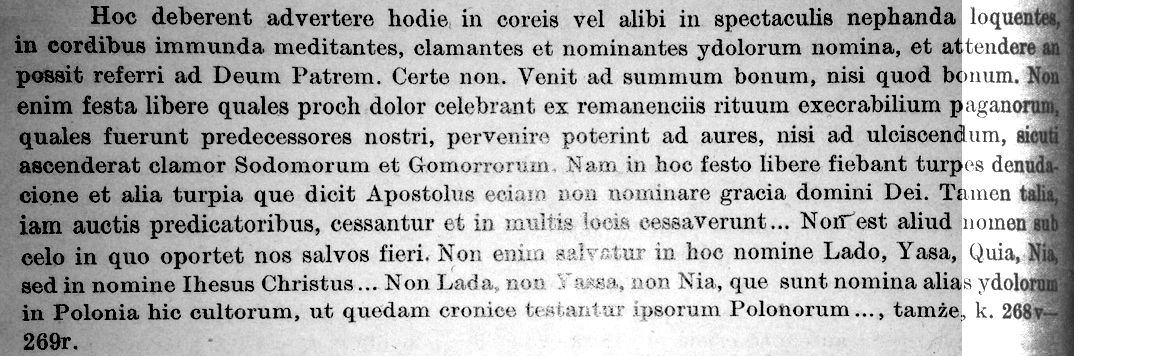
The various Polish Gods listed by Lucas from Great Kozmin come in three lists.  You can see the entire passages here but, the bottom line, the following names appear in the respective passages:

  1. ‘Lado, Yassa‘ et attendere [?]
  2. LadoYassaNia
  3. Non Lada, non Yassa, non Nia

However, we have been told that there was also another name mentioned – Quia or Qui or Kiy.  Of course, the immediate connection drawn would be with Kyiv.  The name supposedly appears in the second passage between Yassa and Nia.

However, as we have already mentioned before, in the manuscripts that we have seen, no such name appears.  See for example:

yast

or:

astr

We have not examined the other manuscripts but so far it does not look promising…  This is not to say that the Poles only had three Gods – Lucas does say “and others” – but it does mean that there is simply no mention of Kiy.

So where did the idea of a Kiy come from?  This fragment from LofGK was first noticed by Maria Kowalczyk.  She does mention Quia based on a manuscript from the Jagiellonian Library (BJ 1446) so an examination of that manuscript would seem to be in order.

Copyright ©2016 jassa.org All Rights Reserved

July 13, 2016

On Długosz & Brückner – Part II

Published Post author

So what did Brückner think about the “misunderstood” names were?

1

Jesza

Regarding Jesza his judgment was that it was an old expression meaning, roughly, “let it be” or “please let it happen.”  He stated that it existed in Old Church Slavonic.

The first issue with this is that Brückner, as is symptomatic of his writing more generally, offers no proof showing how we came to this conclusion.  He makes his assertion without any citations or references.  Thus, the erudite exercises his prerogative no.1 – take me at your word as I know more than you do.

The second issue here is that, assuming arguendo, that Brückner were right as to the existence of such a word in OCS, we have to ask what difference does that make for the occurrence of the word in Polish?  The relevance, we suppose, would be present if Polish were somehow derived from OCS.  However, whether OCS is the “oldest” (whatever that may mean) Slavic language is debatable.  Old Slovenian also shows signs of antiquity and an entire separate debate could be had about that topic.  As it stands, the word Jassa, appears in a whole host of sources across most of the ancient world where Slavs or Veneti touched foot and in some places where, to our knowledge, they did not:

  • It was the word for “law” under Genghis Khan;
  • It appears to mean “flowing” as in the Polish jazda or jechac and is found as the name or as part of the name of numerous “Old” European rivers;
  • It was, arguably, the name of the hero Jason and the Greek (Dardanic) demi-god Jasion;
  • It may be related to the word jazyk, as in tongue (but perhaps that too is by reason of flowing (saliva? words):
  • we mentioned many other appearances of similar names all over the world and know of many others (including in India);

There is thus not much reason to assume that the OCS version – from whatever time (Brückner, of course, does not say) should be relevant for the Polish usage. Or, put differently, the fact that the word had a particular meaning somewhere in Russia does not mean that it had the very same meaning in other Slavic countries.  In fact, one might ask whether the older appearance is not the one from Poland?  Of course, we can’t even begin to discuss which was earlier because Brückner gives no cites for the OCS usage or for the time of the alleged usage (are we repeating ourselves here?).  It is also notable that the Czechs mention the same God as Chasson which sounds much as Jasion.  However, the Czech writers identify the same with the Sun, i.e., Chasson Sol.

Third, even if in fact such usage did exist somewhere and sometime in OCS lands and even if we were to assume that the usage was similar to the version promoted by Brückner, one has to ask, so what?  In other words, we do know of mentions of an East Slavic God – Dadzbog – whose name means as much as “God give” or, in more prosaic words, “let it be” or “let it happen”.  If we’re going to dip into Eastern Slavic folklore for Jesza then it’s only fair that we should be able to dip into it for Dadzbog too, it seems.

Lada

“Lado” Brückner states is a vocative of Lada.  But then notes that the word also appears in masculine form as lado.  Thus, it could be either it seems.  No problem there but what of it?

Brückner explains lada as a favored female, “my love,” “my dearest”, etc.  For this proposition he cites  two appearances (though there may have been others) of the word in the Tale of Igor’s Campaign (only manuscript from the 16th century)*.  One has to assume that that work is genuine, of course, but let’s assume that.  Separately, he notes the appearance of the word in the Life of Saint Catherine and notes that in Dalimil’s Chronicle the same means a pretty girl (presumably lado would then be the masculine equivalent).  He even notes a use of the word in 1562 in Poland (but does not provide a specific citation).

Then Brückner claims that Długosz was inconsistent in that, a few years earlier, he stated that Lada was a local Mazovian Goddess rather than a God of War, Mars (as he claimed later).  The two, however, need not be inconsistent and the fact that Herodotus and others spoke of women who catheterized their cut off breasts and served as warriors, i.e., the Amazons, leaves a tempting solution to this conundrum.

In any event, what Brückner really claims is that the later Polish usage should be determinative of the earlier Polish usage.  Alternatively, he seems to suggest that the non-Polish usage should be determinative of Polish usage.  There is, however, no reason to prefer either such interpretation.  In any event, Lada as a goddess also appears outside of Poland (more on that later).

Nia

Brückner says nothing regarding Nia other than to note that Jakub Parkoszowic did not show where the Nia he mentioned (in 1440 so before Długosz) was supposed to have come from.  The fact that Parkoszowic chose not to delve into the origin of Nia may suggest that the Deity was well-known at the time, or it may suggest that Parkoszowic did not feel the need to explain himself since he was writing a treatise on orthography, not theology.

Brückner notes that Długosz simply defaulted here to Pluto but says nothing about the existence or nonexistence of the Deity by that name.

Dilela or Dzidzilela

What of Dilela? Brückner argues that this is made up from  the words leli, which Długosz misunderstood from the peasants’ songs of yleli (where the y just meant “and”).  Note that Lel & Polel do not appear in Długosz’ pantheon.  In this respect, there probably is a connection between Leli and “Dilela”.  They were likely the same.  But so what? Brückner does not say.

He rambles on without really explaining the origin of all these names.  He talks of drinking songs and proverbs of “LelumPolelum” but does not answer the fundamental question of the source of these “sayings.”  He notes that the name also appears in other places as the name of a Deity but then suggests that maybe the name Leli has something to do with an old Polish verb indicating swaying or wiggling.  Because why precisely?  Brückner does not say.

Where does this leave us?

Well, first, to be anal about this, the Długosz formulation is actually Dzidzilela or Dzidzilelya (a note on one of the manuscripts also has Dzydzylyna).

Second, the prefix dzidzi (though dzi perhaps as well) suggests Persian daevadeitas or deus.  In fact, depending on the case it could be cognate with a number of these.  As an alternative, it is also possible that the invokers really meant the children of Lela, i.e., Didi Leli.  If so, this can explain the connection with Castor & Pollux.  Further, as the mother of Dioskouri was Leda, this can establish a connection to Lada or Lyada.  

In any event, all of this suggests a connection to divine names rather than, as Brückner would have it, a purely made up construct.

But there are other names in the Długosz pantheon.

Marzanna

Here Brückner claims that Długosz needed to fill the roles of Ceres and Diana.  Why?  Because Poland was the land of forests and meadows so sylvan or agricultural deities were absolutely necessary.  For Ceres, Długosz allegedly found inspiration in the Marzanna being carried out by villagers and thrown into water at the end of winter.  This, so Brückner implies, was a natural “fit” because Marzanna was also (Marynia) the name of a plant.

Note that Brückner himself does not question the village custom.  He just calls Her a “goddess”.  But surely, Marzanna’s divine status cannot be disproven – as against the word of Długosz – solely by putting the word “goddess”, as Brückner does, in quotation marks.  In fact, later Długosz himself explains the custom of “drowning” Marzanna as a restaging of the even surrounding the Polish “baptism” when the local Divinities were broken or tossed in the waters (a practice also known from Russia if are allowed to draw parallels).

So for all of Brückner’s derision, all that he may have shown is that the Długosz did not explain the connection between Ceres and Marzanna.  On that, Brückner is, of course, right but neither was that the goal of Długosz (see below).

Dziewanna

Here Brückner notes that there was a plant by that name (or, rather, by a similar name) (which is true) and that using a plant name for a required (as per Brückner – see above) parallel for the Roman goddess of nature just made sense.  Add to that, he says, that both the plant name and the the Roman goddess name ended in the same suffix –ana and the connection was perfected.

Well, the name of the plant was actually slightly different (Brückner can’t help himself but admit that – presumably to show off his botanical erudition).  And we will give Brückner the benefit of the doubt and assume that he hadn’t heard of the Goddess Tāfanae  (which, however, some (particularly German) writers insist on writing as Tanfana or Tamfana).

But more importantly, Brückner’s “critique” is nothing but speculation.  He has, of course, no proof or knowledge as to how exactly Długosz came upon his names but neither does he have very strong reasons to doubt Długosz who did not say anything extraordinary regarding Dziewanna.  The fact that a plant could be named after a Goddess is hardly shocking and that the memory of the latter may have faded while the name of the former endures is also unsurprising (more on the plant later).

We note too that one of the glosses to the Mater Verborum has Diana as Devanna.  If Hanka forged that he forged either being aware of Długosz’s pantheon or independently coming up with the name for Diana.

Pogoda & Zywie

Brückner discusses Pogoda and Zywie and asserts that Długosz must have simply “Slavicized” the names Podaga and Siwa – known from the Helmold chronicle (though Brückner seems astounded that Helmold’s Chronicle somehow managed to find its way into the hands of Długosz).  However, he says nothing about these Deities’ existence or nonexistence.  And weren’t they supposed to have been Deities of Polabian Slavs (even if an Indian connection seems present at least with Siwa – remember Veneti =?= Vindi) so what’s their to Slavicize (perhaps Helmold got them wrong in the first place?).

Boda

Boda was not part of Długosz’ pantheon but Brückner mentions Her (?) when discussing the passage regarding “Lada, Boda, Leli“.  All he says is “I don’t know where this came from.”

2

Why Does Brückner Think He is Right?

The why is quite simple. Putting aside that Brückner thought he was right because he was Brückner (as if an explanation were needed), he also states that there could not have been any pagan rituals left in the 15th century because by then Poland was throughly Christianized.  In other words, all of the past customs that had not been incorporated into Church practice were forgotten.  Five hundred years after the “baptism” of the country, the entire pagan culture must have been lost.

A number of observations are in order.

First, despite the words that Brückner uses to describe Marzanna (“some sort of Marzanna”) surely he must have known exactly what the ritual was about.  After all, the ritual has survived to this day in many places in Poland and a scholar like Brückner would have been intimately familiar with it in the 19th century.  So why so dismissive?  It’s difficult not to suspect that Brückner does not wish to discuss Marzanna because, if that ritual survived from the 15th to the 19th century, it sure as hell could have survived from the 10th to the 15th.  In other words, to this day we have all kinds of rituals that date years in the past and while the maintenance of such rituals in a preliterate society would no doubt have been harder (and more variations would likely have accrued), it, by no means would have been impossible.

Second, notwithstanding the baptism of the court of Mieszko, the reality was a bit more complicated.  We know that a number of partly-pagan rebellions took place in Poland in the first half of the 11th century.  We know that paganism survived as official state religion in several Slavic dukedoms into the 12th century.  We know that the nearby Prussians remained pagan as late as the 15th century.  We know that church penetration was fairly weak initially – one parish per 100 miles or so (this is partly because evangelists – then as now – claim success when they have converted the rulers; they know that, over time, the rulers, using state power, will convert the commoners).  We know that Church attendance and mindless repetition of a few prayers was all that was  required of the lay villagers back then (back then?).  We know that Poland suffered from a Mongol invasion as well as invasions by various other pagans (Prussians, Pomeranians, Jatvingians, Lithuanians, etc).  We know that the country was split apart in 1138 and did not recover (and then only in parts) till 1320 or so.  Thus, in effect, the state preoccupied with other matters, was unable, except locally, to conduct a Christianization campaign for almost 200 years.  The Polish state did not emerge in a more or less stable state until the 14th century.  That in 1405 the dean of Cracow university should remember pagan rituals (as he claimed) and that, perhaps, a Cracow priest like Długosz could later in the same century have some notion of the same is certainly not beyond the realm of decent possibility. Brückner is right to raise doubts but he is wrong to be wholly dismissive.

Third, Brückner assumes that the only kind of Polish paganism that may have survived till the 15th century was the “original” pre-966 paganism.   Given that assumption it is easier for him to then argue how hard (or impossible as he would have it) it would be for pagan beliefs to survive 500 years of Christianization.  To be fair to Brückner, this is partly driven by the fact that Długosz placed his information about paganism right at the beginning, i.e., prior to discussing Poland’s Christianization.  However, it is also entirely possible that the Polish Gods of Długosz have nothing or little to do with 10th century Polish divinities (whatever they may have been).  And yet Długosz’ Gods may well have been worshipped in the 14th or 15th centuries.

Although Długosz may have been reluctant to admit that pagan practices were still going on in his time in a work of the type that he was writing (Annals of the Kingdom, etc), as we noted before, there is plenty of evidence (for example, from the various internal Church documents) that pagan rituals were, in fact, continuing into the 15th century.  That said, religious practices change over time and the ones of the 15th century may have been very different from the ones of the 10th.  Poles may have worshipped Jessa in the 15th but not necessarily in the 10th century.

And if that is true then we do not need any pagan practices to have “survived” five centuries of Christianization.  Such pagan practices may have evolved over time or, perhaps, they may have been stopped by the Church and then restarted anew in an entirely different way.

Overall, one can’t help but note that Brückner’s article is set up in a rather strange way.  Normally, one would expect to see a thesis and then a careful analysis of the pros and cons.  Instead, Brückner strives very hard to show that there was nothing to the Polish Olympus and only then, when he thinks he is done, in a manner of a magician that reveals the secrets of some trick to gullible children, he tells us why this has to be so.  Although writing formats of the 19th century may have differed from today’s so some slack may be cut, the overall inescapable conclusion seems to be that Brückner already knew his “conclusion” before he wrote most of his paper and that the paper’s body is merely designed to “prove” that a priori conclusion.

So Where Are We?

Brückner’s theorizing leads him to conclude that:

1) although Długosz did not make anything up out of thin air, nevertheless his Gods are not worth much, and that

2) Długosz simply made up connections to Roman gods.

As regards 1), we have shown that there does not seem to be a reason to question Długosz on a number of the above names or their variants (Jesza, Lada, Didi-lela).  Others yet, Brückner himself does not really address other than, perhaps to say that they are Polabian Slav Deities (Pogoda, Zywie) but, again, what of it?  Others he says nothing about (Nia) or admits that they existed, whether as divinities or not, at least as part of village ritual (Marzanna).  As to the non-Długoszian Boda, he says nothing other than to acknowledge its mention in one source.

When all is said and done, the only Divinity that suffers – perhaps – from all of the Brücknerian sneering seems to be Dziewanna.  And even there, we have shown it is really Brückner’s word against Długosz’.

Again, scholars are free to criticize but they have to establish their case.  While one can express doubt about some of Długosz’ claims (he, like Brückner, does not cite anything but Długosz can, perhaps, be excused as he wasn’t writing a scholarly article!), he does state his case and there is nothing in what Długosz wrote that strikes us as improbable or outright crazy.

Thus, in the end, Brückner asks us to accept his word over Długosz’ as to what the situation with Polish paganism was in the 15th century.   Or, to put it differently, he asks us to accept that he, Brückner, knows the customs of the 15th century Polish villagers better than a 15th century Polish high church official.  Of course, stranger things have happened but Brückner fails to convince us that this is one of them.

Further, Brückner seems affected by two trends of 19th century Germany.  One was the already mentioned 19th century perception of Catholic priests as backwards and one of the cause of the collapse of the Polish state (as compared with Prussian protestantism).  The second was the resuscitation of Germanic paganism as something pure and original (along with Germania, etc).  This led to the resuscitation of various Slavic antiquities as almost a response.  Underlying all of this was the notion that original paganism was good because it was national in character.   Brückner seems to transfer the motives of 19th century folk chroniclers onto the 15th century Długosz.  How valid is that?  Why does Brückner think it would have been important for Długosz to have shown Poland’s pagan roots at the level of detail that he did?  Długosz may have been a patriot but he was a churchman of the 15th century and any notion that he was trying to bolster national pride by listing Roman-like deities seems a projection back in time of Brückner’s perceptions of Brückner’s own present.  Długosz may have taken secret pride in “rich” pagan beliefs but if so he gives no hint of this in his matter-of-fact writing on the subject.

And what of 2)?

Here Brückner does have a point. Długosz does not say why the various Polish Gods must correspond to their respective alleged Roman counterparts.  But, that said, Brückner’s point is a bit of a “so what?”

In other words, we have to ask why did Długosz strive for his interpretatio romana.  The answer is likely to be simple. Długosz was writing – in Latin – to explain (very briefly) Polish paganism to an audience which may or may not have been familiar with it but would certainly have been familiar with Roman paganism.  Hence the usefulness of parallels, even if imperfect, from Roman mythology.  And that’s it.  If it turns out that Jesza did not have the exact attributes of the Roman Jupiter, so what?  Maybe it’s enough that He was the head of the pantheon as the “Main God” – a portfolio similar to Jupiter’s.  Even if Devanna was not Diana, so what?  From Długosz we still learn that She may have been a “forest lady” type.  If Nia was not Pluto but was, nevertheless, a God (Goddess?) of the underworld, would that make much of a difference?  And Lada may have been both a guardian of Jesza – in the form of a war god – as also an Amazon-like female.  If, as we are told, women can do anything men can do, then certainly Goddesses should be able to do anything Gods can.

So what’s up with Brückner?  We’ll have more to say about that later.

P.S. In a similar vein Brückner criticized the Baltic Pantheon – criticizing shows how smart (and entirely not gullible) you are.

Copyright ©2016 jassa.org All Rights Reserved
July 11, 2016

On Długosz & Brückner – Part I

Published Post author

One of the more peculiar persons in Slavic historiography was the erudite Teuton Aleksander Brückner.

An erudite enjoy certain privileges.  For one, his command of facts allows an erudite to dominate discourse to the point that – should he choose to make something up – he is more likely to go unchallenged (prerogative no. 1).  After all, if someone is right 99 times in a row, are you really going to question the next fact that he posits as truth?  See, for example, the BS written by well-known (well-known among historians – fame’s relative) historians such as Karl Müllenhoff or, more recently, Herwig Wolfram.

Another benefit of being an erudite is that an erudite just sounds smart.  In other words, all too frequently, an erudite’s audience is likely to mistake his command of facts for intelligence and wisdom (prerogative no. 2).  But being able to memorize lots of things does not mean you can process them equally well.  As the story of John Nash shows, sometimes too many facts/neurons firing can also lead to information overload and the result is, well, crap.

Which brings us back to Brückner – the erudite.

OGRE

Brückner seemed happier in his youth

Brückner, was considered the preeminent Prussian Slavist of the late 19th century.  He was not only a walking encyclopedia but also a workaholic (the latter, no doubt, leading to the former).   He had, however, also a number of less attractive qualities.  For purposes of this entry, let it suffice to say that he was not half as smart as he thought himself to be and he could also be a rather unpleasant individual.

Specifically, Brückner’s particular form of “stream of consciousness” writing appears at times to lack any basis in fact and any logic in its conclusions.  He tosses facts into a verbal stew that is his writing through mere assertions, not troubling to document them (fact creation – erudite’s prerogative no. 1) and then builds his sand castle theses in the thinnest of air usually based on overactive criticism of anything that does not fit his, obviously, preconceived notions of historical truth (making sweeping conclusions that sound “smart” so long as they are not carefully scrutinized – erudite’s prerogative no. 2).

In addition, and more concerning, was Brückner’s seeming eagerness to obviously pleasure himself by mocking, belittling and deriding his opponents – real or imagined – current or past.  Of course, no man – great or otherwise – should be exempt from criticism.  On the other hand, few things are as nettlesome as a great man being mocked by an overweening mediocrity who, to top it off, is not even witty.

Therefore, it bugs the proverbial shit out of us that nearly five hundred years after he wrote his Polish Annals, the Polish chronicler Jan Długosz became yet another target of Brückner’s assinine ridicule.  While some of what Długosz wrote could be (and was) subjected to healthy criticism, Brückner’s variant of such criticism appears notable not for its astuteness but for its boorish mean-spriritedness and lack of logical thinking.

(A more interesting dissertation on the subject may have been Bandtke’s De Jessa et Nia duobus Polonorum diis which, unfortunately, seems to have been preserved in only one notebook/manuscript (number 702) and was burned down by the Germans in 1944 when they – purposefully – torched the Biblioteka Ordynacji Zamojskiej  or the Zamoyski Library in the Blue Palace in Warsaw).

The Cantankerite in Action 

Specifically, Brückner took it upon himself to describe, “Polish Mythology” devoting less than eighty pages to the task in his rather derisive pamphlet of the same name.  The title of the first chapter, “The Birth of the Alleged Polish Olympus” sets the tone for the rest of it and the first contemptuous words bring to mind a flehming Brückner:

“Deeply did the Cracovian canon Jan Długosz fall into his thought, in his room* cluttered with manuscripts and parchments: he felt on his shoulders the weight of the task placed upon him by his spiritual father Zbigniew,* the Cracow bishop.  It was for him that he undertook to write the histories of the fatherland, from the beginning till that day even but then got stuck right at the beginning.  Having completed the physical topography of the land as well as the moral topography of its inhabitants, it behooved him to say something with respect to the pagan times and their primeval idolatry: what kind of idols* did the old Poles worship?  The complete picture of this prehistory could not be written without this detail, which seemed to be both rather easy and rather hard all at the same time.  Easy, since all idolatries were, after all, the works of the same satan who traps humans in his snares; for everywhere it was the same; Greek idols were the same as Roman: Athena-Minerva, Ares-Mars, and so too among the Poles there must have been the same Mars, Pluto, Venus, Jupiter as among the Romans and only their names were local, Polish. That was easy and simple but where should these names be found?  After all, the scrupulous scholar knew how futile it would be to ask these of the common folk who, Christian now for five centuries, gave up all such idols.  It was thus not without reason that the canon did fall so pensive; but his brow suddenly cleared, for he recalled now that he’d read somewhere the names of these pagan idols.  And indeed, after a long search, he did locate the above-mentioned note… But what was this note?  We too have it in our possession.”

* While the above lengthy introduction makes for good reading it’s hard to fully convey the condescension in Brückner’s voice.  Thus, the text is filled with diminutives – a typical Polish (though not only) derisive device; the form “room”  Brückner refers to as izdebka, a diminutive of izba as if Długosz – the parchment nerd – were locked in some rathole the size of a standard Japanese hotel room, sweating on how to please his clerical boss – the bishop Zbyszko (a diminutive of Zbigniew) – more than the miller’s daughter sweated trying to figure out how to spin straw into gold.  Also, the word bożki – “idols” – is, in Polish, in effect, a diminutive of “God” (Bog).

jandlugosz

Perhaps Brückner drew inspiration from the Matejko painting of Długosz

The royal “we”, Brückner proceeds to tell us, “too have” this note in “our possession” – referring to the Statuta provincialia breviter discussed here.  He then continues his harangue:

“all the mentions of the Polish idols can be derived from this single source… So finally Długosz found what he was looking for: pagan idol names… all that was left was to provide a classification of these which he took on the responsibility of doing himself.  In the front he placed JesseJassa because the name reminded him of Jove; perhaps he heard somewhere about gardzina – a hero when he also heard lado and so he designated the latter one as Mars; in rather than ileli [reference to yleli in Sermones per circulum anni Cunradi – see here] he’d read somewhere about some dzileli and threw in Venus/Aphrodite and Nya… became Pluto.  And so, all four main Roman gods did he happily place on the ‘Polish Olympus.’ But what sort of names were these?”

Put aside the fact that it is rather untrue that Venus and Pluto were part of the “four main Roman gods” as Brückner claims. (Where is Juno/Hera?  Where is Minerva/Athena?  If Mars is part of this, where then is Quirinus?)…

Put aside the derisive tone of the whole thing.

Let’s focus on other things such as the fact that Brückner offers statements that are either false or completely baseless.  As regards the latter, Brückner had, of course, no idea how Długosz found the names he mentioned. Brückner had as much information about what Długosz read or “perhaps… heard” as he had about the size of the room that Długosz wrote in.

Why did, according to Brückner, Jassa remind Długosz of Jove? Brückner implies this is because of the name similarity.  But that seems a major stretch.  If anything, the name Jassa should have reminded Długosz of the Greek demigod Jasion.  Długosz did apply an interpretatio romana but Jassa likely became Jupiter/Jove not by reason of any name similarities but rather because in all the documents that Długosz may have come across (or at least that Brückner claims, Długosz came across) the name Jassa appeared and, usually, appeared first.  The notion that Długosz heard something about a gardzina (basically, “guardian”) and therefore made Lado equivalent to Mars is silly.  The primary function of Ares was as God of War, not as a guardian of Jupiter.  Brückner’s argument regarding how Didilela became Venus/Aphrodite, is unintelligible (to us).  Moreover, he does not explain how or why Nya became Pluto.

Of course, one can question Długosz but the problem is that Brückner has no idea so he lets his imagination run wild for a moment in much the same way that he accuses Długosz of having done.  When Brückner tires of this mental masturbation, he basically, stops pretending to make any arguments and, basically says, “Długosz just made it up and I won’t spend time on this any further.”

There is also the fact that Brückner was wrong about the variety of sources available to Długosz.   The canon may well have relied on Statuta provincialia breviter but we now know that there were earlier* sources such as the Pentacostal Postillas.  Moreover, those postillas (written by the rector of Cracow University) are quite explicit that they discuss heathen Gods and, again, name the names of the same in much the same way as three of Długosz’ names.

More importantly, none of the various sources mentioned shows any indication of being derivative of the Statuta.  The only reason for this claim in Brückner’s mind seems to be that the Statuta were the earliest source known to him.  However, it is illogical to suggest, without more, that, each written source must be derivative of an earlier written source.  If the Postillas came before the Statuta, Brückner’s logic would suggest that the latter must be derived from the former simply because the former preceded the latter.  The discovery of a yet earlier source wouldn’t matter either as, based on this line of thought, we’d just be discovering the “real” autograph (until an earlier one still were found and so on).

To claim that a work is derivative of another one has to show dependencies.  Here, however, no such dependencies are evident.  For one thing, the Statuta only discuss two names – Długosz has a number of others.  Moreover, the Statuta do not mention Nya who was mentioned by the earlier Postillas.

So why did Brückner say what he said?

Brückner’s Spelunking

Brückner’s basic argument is that these Names meant all kinds of things except what the numerous authors claimed them to be, i.e., pagan Divinity Names.

How is then that all the scribes were mistaken about them?  Brückner’s argument here is that priest in the 14th and 15th century were all superstitious morons who saw the devil plotting everywhere and any kind of dance or frolic was interpreted as some form of idolatry by these primitives.  To support this claim he gives an example of a Czech priest – Jan from Holešov – who, apparently, misinterpreted “vele” in an old Czech carol “Vele, vele, stojí dubec vprostřed dvoru” (apparently, the oldest Slavic carol) as being a reference to the Mesopotamian deity Baal.

A number of things come to mind.

First, as regards the Czech example, it is hard not to note that the refrain “vele, vele” appears very similar to the East Slavic God Veles (who, albeit by later writers, may also have been mentioned among Czech Deities, as Hecate, in the form Wyla).  While, Veles is obviously not Baal, he was a pagan divinity and Brückner’s objection can hardly be merely that Jan from Holešov misidentified the idol.  In fact, if one thought that the reference was to a non-Christian divinity but one had not heard of Veles, it would be not altogether unnatural to try to make sense of this by referring to Baal about whom Jan was no doubt well informed by reason of his Bible Study and all.  And that’s before we even note that the oak (the dubec above) was certainly often associated with various pagan Gods.  The fact that the song was a carol does not necessarily change its roots.  While all of this is supposition, so are Brückner’s fancies regarding the astuteness of Jan from Holešov’s observations.

Second, even if one priest in Bohemia could have been mistaken, a whole host of priests being repeatedly mistaken seems a bit much.  While priests, like all people of that time, were obviously limited in their education and outlook, they were, nevertheless, the most educated caste among the people.  It seems it is for this reason that Brückner needs all his God mentions to be derivative from the Statuta.  Then only the first priest would need have been mistaken.  (Of course, that priest would have to have been someone writing the Statuta at a synod (so not just some local parish priest)).  Nevertheless, as we’ve shown above, there is no basis for concluding that the various sources for the existence of Polish (Venetic? Slavic?) Gods are in any way interrelated.

Third, given Brückner’s tone in his introduction and given some of his other writings, it is difficult to escape the impression that Brückner’s perception of the priest class was coloured by the time that he was living in.  Recall that he was a citizen of a reborn Germany, driven by its main engine – Protestant Prussia.  Poland, on the other hand, had been partitioned as a failed state.  In the narrative justifying partition, the Prussian occupiers stressed the backwardness of the Polish nobility and of its (Catholic) clergy (of course, it was that nobility and clergy that also were, to a large extent, the carriers of the national spirit – something that the Prussians and Russians did not fail to notice – hence another reason for the official disparagement of them).  Based on his style, it seems that, to a not insignificant extent, Brückner was influenced by that narrative and transplanted his perceptions of the present to help himself in making a point about the past.

But what of these Names!?

gosz

We’ll be back to that.

Copyright ©2016 jassa.org All Rights Reserved

July 9, 2016

The Gods and Holy Places of the Knýtlinga Saga

Published Post author

Knýtlinga saga (The Saga of Cnut’s Descendants) is an Icelandic saga written in the 1250s, which covers a long period of Denmark’s history (from the early 10th century story of Harald Gormsson “Bluetooth” till the end of the 12th).  The Cnut or Canute of the saga is probably the legendary Harthacnut (Cnut I or Canute I).  (The alternative title might be the Lives of the Kings of the Danes – not to be confused with Saxo’s Gesta Danorum).

The story most likely came to Iceland by virtue of the efforts of Óláfr Þórðarson (the nephew of the famed Icelandic writer Snorri).  Óláfr traveled to Norway and then Denmark where he stayed at the court of Valdemar II (the son of Valdemar I who had conquered Arkona).  If  Þórðarson is really the author of the Knýtlinga saga then the pagan references in the Knýtlinga saga (as the saga itself obviously) are younger than Saxo Grammaticus’ chapters in Gesta Danorum (Saxo died about 40 years before the assumed composition date of the Knýtlinga saga) which we presented here.  Nevertheless, spending time at the Danish court may have given Óláfr an opportunity to access additional sources or hear more tales.

In the saga, Svantovit is represented as Svanteviz but five other Gods are also mentioned: the trio of Rinvit, Turupid and Puruvit – corresponding, presumably to Rugievit, Porenut and Porevit;  but also Pizamar (in Jasmund) and Tjarnoglofi, the Rugian’s God of War (who “went” with them on military expeditions – recall Thietmar’s discussion (at 8, 64) of the Veletian campaign alongside the Germans where the Slavic Goddess had been “disrespected” by a German commanded and the Emperor had to figure out a way to placate his allies).  Neither Pizamar nor Tjarnoglofi are mentioned elsewhere.  Whether the latter had anything to do with Thietmar’s Cernobog or with the famous Pomeranian Triglaf (described, for example, here and here and here; other sources elsewhere on this site) or was (either as a result of a conscious decision of the local religious leaders or the confusion of the Danes in telling the stories) a combination of the two, we do not even begin to guess.  Whether Boka (Böku) is another deity or just a sacred grove of some unspecified God, we likewise do not know.

The English translation of the saga is connected with another Canute – Canute IV (circa 1042 – 10 July 1086) who was king of Denmark and later got himself canonized and became the patron saint of Denmark.  His path led, of course, via martyrdom.  Specifically, Canute died during a peasant revolt which broke out on (appropriately) Vendsyssel.  The King escaped to Saint Alban’s priory at Odense where the peasant rebels caught up with him and made him a martyr in 1086.  The 900th anniversary of Canute’s death was celebrated in 1986 by the city of Odense (where he is buried at Odense Cathedral) as a major event.  As part of the celebrations, the town notables convinced two professors, Hermann Pállsson (of Iceland) and Paul Edwards (a professor with varied interests at the University of Edinburgh – where the two professors probably met) to translate the Knýtlinga saga into English.  Pálsson and Edwards translation is the only known English translation to date.

viks

With all that in mind here is the invasion of Arkona as told in the Knýtlinga saga (as regards the Slavic Gods we follow the translators and give the Old Norse version below):

English

Section 101
King Eirik in Wendland

“King Eirik the Unforgotten, once he felt secure in his kingdom, was harsh and severe with the people of Denmark.  His own brother, Harald Kesja, and two of his sons Eirik had put to death along with many other friends of King Nikulas.  It was one year after the death of King Nikulas that Harald Kresja was killed.”

“A year later, King Eirik took his army to Wendland, plundering far and wide and causing great havoc.  He took a town called Arkona where the people were heathen, but by the time he left they had the whole population of the town baptized before he returned to Denmark.  But immediately the king had gone they renounced the faith and returned to the offering and sacrifice and other heathen practices.”

Section 121
Plundering in Wendland

“Towards the end of winter, Valdimar raised yet another levy for a seafaring expedition and sailed to Rugen.  They went ashore at Strele to a certain sacred grove called Boka where they set fire to and burnt everything apart from the people and the cattle, which they drove to the ships.  Then they went to another part of Valong and burnt the place down, then to Vik where they set everything ablaze all the way to the market place.  From there they rowed over to Hiddensee and lay there at anchor for twenty days, resting.”

“After that,  the king asked Absalon to sail on ahead , while he and the Jutes moved up to Strele. When dusk began to fall, the bishop rowed with his troops past the king over to Parez, then set up to a town called Gartz, where the Wends confronted them and at once began to attack the bishop by a certain lake.  It was a great battle and many fell in it but the bishop won the victory.  Eleven hundred men had been killed on the side of the Wends, but only one man on the bishop’s, though two of the bishop’s men died by drowning in a swimming match.  Later the bishop rode out to his ships.  As they were cantering aboard, King Valdimar came up to ask what they had been working at and the bishop told him.  The king gave him generous thanks for this victory and then they all travelled together to Strele.  The Isle-Danes had by now laid hands on a great deal of booty, and the Jutes were envious, saying that the Isle-Danes took everything while the Jutes lost everything but they did not risk saying this in the king’s hearing.”

“Afterwards the king went with an army to Jasmund and harried there, killing a chieftain called Dalemar and seizing all the people there and cattle.  Next they went to Hiddensee where the Rugians came to the king begging for mercy: they handed over hostages, paid him all the tribute he asked for, and swore their allegiance.  After that, the king went back to Denmark.”

Section 122
Pagan Idols in Wendland

“King Valdimar gave his son Kristoforus authority in Jutland: he was a powerful man ad had a dukedom at Hedeby and associated districts.”

“While he ruled over the kingdom, King Valdimar was always a busy man, having led eight expeditions to Rugen [Rugia] before winning control of it.”

“One winter around the time of Lent, Duke Kristoforus and Bishop Absalon went to Svold River and set everything ablaze as far as Tribuzis so that the place lay desolate for many years after.  They remained weather-bound for twenty days in the River Svold with a fearful gale but then they got a favourable wind and sailed back home.”

“After this, everything was quiet for three years until the Rugians once again broke the agreement made earlier.  So King Valdimar had to make yet another levy for an expedition by sea, sailing to Rugen and arriving on Whit Sunday to take the town of Arkona, mentioned earlier.  Then Tetizlaf, King of the Rugians, and his brother Jarmar, and all their leading men came to King Valdimar, surrendering themselves and their country into his power and telling he could do whatever he wished with them.  Then the king told them to embrace Christianity, for the land had been heathen ever since they renounced the Christian faith they received when Eirik the Unforgotten had them baptized on the conquest of the town of Arkona, as described earlier.  They said they would now do as the king and Bishop Absalon had asked.”

“Then the king ordered Soni Ebbason and others with him to go into the town of Arkona to the temple there, cut down the god called Svantaviz, drag it out of the town and plunder the temple of anything valuable.  As the townspeople feared the angrier of the god they would not dare cut him down, but bishop Svein and Soni Ebbason came and cut down the god, then put a rope round his neck and forced the Rugians themselves to drag him outside.  Once he was out, the heather were all amazed that he was unable to help himself and had less faith  in him than before.  After that, men came up and hacked him apart and burned him under their cauldrons; then the Rugians realised they had been deceived and no longer believed in him.  Bishop Absalon and all the clergy converted the people to Christianity, baptizing thirteen hundred ain one day, and when they left, the people agreed to give their obedience to the king and the bishop.”

“Next morning the king went to the place called Gartz and had three idols cut down, called Rinvit, Turupid and Puruvit.  These idols caused strange things to happen: if any man had intercourse with a woman inside the town the two were stuck together like dogs and were unable to go free until they left the town.  On the day their idols were destroyed, nine hundred people converted to Christianity and eleven graveyards were consecrated.  A great deal of wealth was taken from the gods, gold and silver, silks and furs and costly fabrics, helmets and swords, tailcoats and all kinds of weapons.  The fifth god was called Pizamar from a place called Jasmund, and was destroyed by fire,  There was also Tjarnaglofi, their god of victory who went with them on military campaigns.  He had a moustache of silver and resisted longer than the others buyt they managed to get him there years later.  Altogether, they christened five thousand on this expedition.  King Valdimar, Bishop Absalon and all the troops now returned home.”

Old Norse

Section 101

Herferð Eiríks konungs 

Eiríkr eymuni var harðr ok stirðr við fólk alt í Danmörk, þegar hann þóttiz festaz í ríkinu; hann lét drepa Harald kesju, bróður sinn, ok sonu hans II ok marga aðra vini Níkuláss konungs. Þat var einum vetri eptir fall Níkuláss konungs, er Haraldr kesja var drepinn.

1
En vetri síðar fór Eiríkr konungr til Vinðlands með her sinn ok herjaði þar víða ok vann þar mikit hervirki; hann vann þar stað þann, er Arkún heitir; þat fólk var heiðit, er þann stað bygði. Eiríkr konungr fór svá þaðan, at þeir tóku áðr við kristni, er eigi váru drepnir af heiðnum mönnum, ok lét konungr kristna alt fólk í staðinum; fór hann síðan heim til Danmerkr. En þegar konungr var í brottu þaðan, þá köstuðu þeir aptr kristni ok efldu síðan blót ok heiðinn sið.

2

Section 121

Frá Valdimar konungi 

En er vetrinn leið af, bauð Valdimarr enn út leiðangri ok fór til Réinga ok lögðu upp á Strælu við blótlund einn, er heitir Böku, ok brendu þar alt ok bældu, en tóku fólk ok fé ok fóru til skipa með. Ok þá lögðu þeir upp á annan veg á Valung ok brendu þar ok fóru þaðan til Víkr ok brendu landit alt til torgs þeirra.Þaðan reru þeir til Heðinseyjar ok lágu þar II nætr ok hvílduz. Þá bað konungr Absalón biskup fyrri fara, en konungr ok Jótar lögðuz þá upp við Strælu;

3

en er røkkva tók, reri biskup upp með sínu liði fram um konunginn til Parez ok reið síðan upp til borgar þeirrar, er heitir Garðz, en þar kómu Vinðr í móti þeim ok réðu þegar til orrostu við biskup ok börðuz við vatn eitt; þar varð mikil orrosta ok mannfall mikit, ok hafði biskup sigr, en þar fell af Vinðum XI hundruð manna, en einn maðr af biskupi; en II menn fóruz á kafi af biskups mönnum, er reyndu sund með sér fyrir kapps sakir. Síðan reið biskup út til skipa sinna, en er þeir hleyptu hestunum út á skipin, þá kom Valdimarr konungr þar ok spurði, hvat þeir hefði sýslat, en biskup sagði honum. Konungr þakkaði fögrum orðum sigr þenna, ok fara síðan allir samt til Strælu. Eylendingar höfðu nú fengit hlutskipti mikit, en Jótar lögðu þar öfund á ok sögðu, at Eylendingar fengu alls, en Jótar misstu; en þeir þorðu þó eigi at mæla þetta, svá at konungr heyrði. Eptir þat fór konungr með herinn til Ásund ok herjaði þar; þar drápu þeir höfðingja þann, er Dalemarr hét, ok tóku þar fólk alt ok fé ok fóru síðan til Heðinseyjar. Þar kómu Réingar til móts við konung ok báðu sér miskunnar ok settu honum gísla ok gáfu honum skatta slíka, sem hann kvað á, ok játuðu konungi hlýðni. Fór konungr heim til Danmerkr eptir þetta.

4

Section 122

Valdimarr konungr gaf Kristófóró syni sínum ríki á Jótlandi; hafði hann hertogadóm í Heiðabœ ok þat ríki, sem þar fylgir; hann var ríkr maðr. Valdimarr konungr hafði jafnan starfsamt, meðan hann réð ríkinu; hann hafði VIII leiðangra til Réinga, áðr hann vann landit. Einn vetr um föstu fór Kristófórús hertogi ok Absalón biskup til Svöldrs ok brendu þar alt upp til Tribuzis, svá at þar lá autt marga vetr síðan; þá lágu þeir XX nætr veðrfastir í ánni Svöldr í óveðrani miklu ok fengu síðan byr ok fóru heim.  Eptir þetta stóð kyrrt III vetr, áðr* Réingar rufu enn þá sætt, sem fyrr var gör. Þá bauð Valdimarr konungr enn út leiðangri ok fór til Réinga ok kom þar at hvíta sunnudegi ok vann borgina Arkún, er fyrr var nefnd. Þá kom til Valdimars konungs Tétizláfr, er var konungr þeirra, ok Jarmarr, bróðir hans, ok allir enir beztu menn af Réingum ok gáfu þá landit ok sjálfa sik í vald Valdimars konungs ok báðu hann gera af slíkt, er hann vildi. Þá bauð konungr þeim at taka við kristni, þvíat þar var jafnan heiðit, síðan þeir köstuðu aptr kristni, þá er Eiríkr konungr eymuni lét skíra þá, þá er hann vann borgina Arkún, sem fyrr var sagt; þeir sögðuz nú gera vildu, sem konungr beiddi ok Absalón biskup.

5

Þá kvaddi konungr til Sóna Ebbason ok menn með honum at ganga í borgina Arkún ok til hofs þess, er þar var, ok bað hann höggva niðr goðit, er Svanraviz* [or Svaravist?] hét, ok draga þat út af borginni, en ræna hofit öllu, því er fémætt er; en þeir, er fyrir váru í borginni, þorðu eigi at draga hann út, ok hrædduz þeir mjök reiði hans. Þá gekk til Sveinn biskup ok Sóni Ebbason ok hjoggu niðr goðit; síðan lögðu þeir reip um háls honum ok neyddu Réinga sjálfa at draga hann út; en er hann kom út, undruðuz allir heiðingjar, er hann mátti þá ekki hjálpa sjálfum sér, ok trúðu minnr á hann en fyrr.

6

Þá gengu menn til ok klufu hann í sundr ok brendu hann undir kötlum sínum. Sá þá Réingar, at þeir váru sviknir, ok trúðu ekki á hann síðan. En Absalón biskup ok allir lærðir menn kristnuðu fólkit ok skírðu XIII hundruð einn dag, ok fóru svá þaðan, at þeir játuðu konungi hlýðni ok svá biskupi. En um morgininn eptir fóru þeir konungr til þess staðar, er Karenz heitir, ok lét hann þar höggva niðr þrjú skurðgoð, er svá hétu: Rinvit, Turupið ok Puruvit; en skurðgoð þessi gerðu svá mikil undr, at þegar, ef nökkurr maðr átti samlag við konu innan borgar, þá loddu þau saman sem hundar, ok eigi losnuðu þau, fyrr en þau kómu út af borginni. En þann dag, er þessi skurðgoð váru brend, þá kristnuðu þeir IX hundruð ok vígðu XI kirkjugarða. Þar tóku þeir mikit fé af goðunum, bæði gull og silfr, silki og pell ok guðvef, hjálma ok sverð, brynjur ok allskonar vápn. Et fimmta goð hét Pizamarr; hann var á Ásund, svá heitir einn staðr; hann var ok brendr.

7

Þá hét ok Tjarnaglófi, hann var sigrgoð þeirra, ok fór hann í herfarar með þeim; hann hafði kanpa af silfri; hann helz lengst við, en þó fengu þeir hann á þriðja vetri þar eptir; en þeir kristnuðu alls á landinu V þúsundir í þeirri ferð. Eptir þat fór Valdimarr konungr heim ok Absalón biskup ok allr herrinn.

Copyright ©2016 jassa.org All Rights Reserved

May 30, 2016

Numero Uno

Published Post author

Ains

The number one in various indo-european languages.

  • *ās (Hittite)
  • *ainaz (proto-Germanic)
  • ains (Gothic)
  • oenus, unus (Latin)
  • aīns (Prussian)
  • vienas (Lithuanian)

There are also some languages where the -s drops out so that you have a variation of uno or ein (in some Latin, Germanic and Celtic languages, e.g., unan in Breton).  Those probably belong as a subgroup of the above.

It is remarkable that the first group’s “one” corresponds to the name of God, e.g., one Ass or the plural Aesir of Asgard.

Then you have the Slavic languages:

  • odin (Russian)
  • odyn (Ukrainian)
  • adzin (Belorussian)
  • jeden (Polish, Kashubian, Slovak
  • jaden (Lower Sorbian)
  • jedyn (Upper Sorbian)
  • (but ena in Slovene)

Here the remarkable thing is that this “one” corresponds to Odin of Asgard.  Now, you might say that the fact that the name for the numeral “one” corresponds to a God’s name is hardly surprising.  However, what is so strange about this is that the Slavic “one” corresponds to what is supposedly a Nordic God.  Did the Slavs not have the concept of one “one” before they ran into the Goths?  Was it ena as preserved by the Slovenes? (in which case the Slovenes would have been the only ones untouched by the Goths?) But the Slovene “one” is likely a later borrowing from Italian.

Note that -in is a typically (though not always) Slavic ending.

And note too that odyniec is the name of the lone male wild boar.  The name is Ukrainian or Russian and a borrowing in other Slavic languages – supposedly.  No proof of this has been given.

Odin is associated with many animals (especially ravens) but generally the boar is more of the animal of Freyr (Gullinborsti) or Freya (Hildisvini)…

(though Varaha the boar is an avatar of Vishnu (albeit only one of ten main ones) and there is also the Govindagam vindata explanation).

lonely

The loner “odyniec” only rarely came back to the herd – but when he did, everyone had a good time

Boar Worship in Eastern Europe

What is striking is that we know about boar-worship from Tacitus (Germania, 45) that:

“Turning, therefore, to the right hand shore of the Suevian sea, we find it washing the country of the Aestii, who have the same customs and fashions as the Suevi, but a language more like the British. They worship the Mother of the Gods, and wear, as an emblem of this cult, the device of a wild boar, which stands them in stead of armor or human protection and gives the worshiper a sense of security even among his enemies.”

And much later from Thietmar:

“From the olden days, the stories of which were often falsified with all kinds of erroneous tales, we have the testimony that whenever harsh griefs of a civil war rear their heads, so comes out of the above-mentioned lake a mighty boar with foam glistening on white tusks and in front of all eyes he rolls in the puddle among terrible tremors.”

The cantankerous Brueckner thought that Svarozic was fire, i.e., the “little” Svarog (with the “big” Svarog being the heavenly fire of the Sun).  If one were to apply this logic to Odin you would get the following:

  • Svarog (Sun?) > Svarozic (fire?)
  • Odin > Odyniec

P.S. Then we have the following from Caesar

(Gallic War, Book 6, chapter 21):

“The Germans differ much from these usages, for they have neither Druids to preside over sacred offices, nor do they pay great regard to sacrifices. They rank in the number of the gods those alone whom they behold, and by whose instrumentality they are obviously benefited, namely, the sun, fire, and the moon; they have not heard of the other deities even by report.”

So who were these Germans?

Copyright ©2016 jassa.org All Rights Reserved
April 22, 2016

Jassa of the Veneti

Published Post author

A claim has been made that the Veneti worshipped – as their Sun God – Jason or maybe Jasion/Iasion.  This claim, if true, would, combined with the reports of the Polish God Jassa and the Czech God Chasson (identified, at least in Jan Rosa’s Grammatica Linguae Bohemicae, as a sun God, that is Sol or Phoebus or Astron), suggest that at least these two nations were in fact connected with the Veneti or perhaps descend from the Veneti.

turagon

What’s more, because the claim was made regarding the Adriatic Veneti, this would not only further strengthen the Slavic-Venetic connection but, in fact, expand it all the way to Venice – no doubt helping “Venetologists” such as Matej Bor.

But, as regards the Adriatic Veneti at least, is the claim true?

What Says Strabo?

Strabo does say (Book V, I):

“And in the very recess of the Adriatic there is also a temple of Diomedes that is worth recording, “the Timavum“; for it has a harbour, and a magnificent precinct, and seven fountains of potable waters which immediately empty into the sea in one broad, deep river.  According to Polybius, all the fountains except one are of salt water, and what is more, the natives call the place the source and mother of the sea.  But Poseidonius says that a river, the Timavus, runs out of the mountains, falls down into a chasm, and then, after running underground about a hundred and thirty stadia, makes its exit near the sea.”

timava

Timavus – the underground portion stretches quiteaways before getting to the waters of the Adriatic

“As for the dominion of Diomedes in the neighbourhood of this sea, not only the “Islands of Diomedes” bear witness thereto, but also the historical accounts of the Daunii and Argos Hippium, which I shall relate insofar as they may be historically useful; but I must disregard most of the mythical or false stories, as, for example, the stories of Phaethon, and of the Heliades that were changed into poplar-trees near the Eridanus (the Eridanus that exists nowhere on earth, although it is spoken of as near the Padus), and of the Electrides Islands that lie off the Padus, and of the guinea-fowls on them; for not one of these things is in that region, either.  It is an historical fact, however, that among the Heneti certain honours have been decreed to Diomedes; and, indeed, a white horse is still sacrificed to him, and two precincts are still to be seen — one of them sacred to the Argive Hera and the other to the Aetolian Artemis.”

And later (Book VI, III):

“Now, however, Argyrippa is smaller; it was called Argos Hippium at first, then Argyrippa, and then by the present name Arpi.  Both are said to have been founded by Diomedes.  And as signs of the dominion of Diomedes in these regions are to be seen the Plain of Diomedes and many other things, among which are the old votive offerings in the temple of Athene at Luceria — a place which likewise was in ancient times a city of the Daunii, but is now reduced — and, in the sea near by, two islands that are called the Islands of Diomedes, of which one is inhabited, while the other, it is said, is desert; on the latter, according to certain narrators of myths, Diomedes was caused to disappear, and his companions were changed to birds, and to this day, in fact, remain tame and live a sort of human life, not only in their orderly ways but also in their tameness towards honorable men and in their flight from wicked and knavish men.  But I have already mentioned the stories constantly told among the Heneti about this hero and the rites which are observed in his honour.  It is thought that Sipus also was founded by Diomedes, which is about one hundred and forty stadia distant from Salapia … In Daunia, on a hill by the name of Drium, are to be seen two hero-temples: one, to Calchas, on the very summit, where those who consult the oracle sacrifice to his shade a black ram and sleep in the hide, and the other, to Podaleirius, down near the base of the hill, this temple being about one hundred stadia distant from the sea; and from it flows a stream which is a cure-all for diseases of animals.  In front of this gulf is a promontory, Garganum, which extends towards the east for a distance of three hundred stadia into the high sea; doubling the headland, one comes to a small town, Urium, and off the headland are to be seen the Islands of Diomedes.  This whole country produces everything in great quantity, and is excellent for horses and sheep; but though the wool is softer than the Tarantine, it is not so glossy.  And the country is well sheltered, because the plains lie in hollows.  According to some, Diomedes even tried to cut a canal as far as the sea, but left behind both this and the rest of his undertakings only half-finished, because he was summoned home and there ended his life.  This is one account of him; but there is also a second, that he stayed here till the end of his life; and a third, the aforesaid mythical account, which tells of his disappearance in the island; and as a fourth one might set down the account of the Heneti, for they too tell a mythical story of how he in some way came to his end in their country, and they call it his apotheosis.”

You can read more about the Veneti of the Adriatic here.

So we seem to have the worship of Diomedes by the Veneti…

Is Diomedes Jason?

Well, for many years Jason was equated with Diomedes…

In 1711, Abbe Antoine Banier claimed that “[Chiron] taught [Jason] the Sciences, which he himself professed, especially Medicine, and gave him for that Reason the name of Jason, instead of Diomedes, which he had before.”

This was repeated as fact by many subsequent scholars.  What is the source of this information?

Apparently, it is this:

“When Jason became a man and had learned from Chiron the healing art, he was called Jason, having first been called Dolomedes.”

This is from the 1581 edition of a Natali Conti Mythologiae.  However, the first edition of the same (in the year 1567) did not contain the last clause.

It seems that Conti added this, misreading

Winifred Warren Wilson claimed in 1910 that in the 1581 edition Conti added new material (from Apollonius of Rhodes), and misread the Greek word δολόμηδες (“crafty”) as a proper name and then attributed it to Jason – as a proper name of Jason’s.  And then Dolomedes became Diomedes.  How?  Well, apparently there was a misprint of Diomedes for Dolomedes in subsequent editions of Comes’ treatise.  More on this on a site by this guy (yes, he is Jason too) who claims that there are no ancient sources equating Jason with Diomedes.

If this is true then the story ends right there and the temple to Diomedes is not any temple to Jason.  And so the Slovenian Venetologists lose (at least one argument)…

Enter the Dragon

But… did you know that (according to the website for the Slovenian capital Ljubljana:

“Once upon a time, Greek hero Jason and his Argonaut comrades stole a golden fleece, the coat of a golden ram, from the King of Colchis on the Black Sea. On board the Argo they fled their pursuers and found themselves at the mouth of the River Danube instead of going south towards the Aegean Sea and their Greek homeland. There was no way back, so they went on, up the Danube and then along the River Ljubljanica. They had to stop at the source of the Ljubljanica and overwintered here. They then took the Argo apart and in the spring carried it on their shoulders to the Adriatic coast, where they put it back together again and went on their way. According to the legend, on their arrival between what is now Vrhnika and Ljubljana, the Argonauts came across a large lake with a marsh alongside. Here lived a terrible marsh dragon that Jason killed after a heroic struggle. The monster would have been the Ljubljana dragon. It is said that Jason should have been the first real Ljubljana citizen.

ljub

Of course, Jason actually did encounter a dragon – Ladon (Lada?) – who had just been defeated by Hercules but was still twitching (Apollonius of Rhodes’ Argonautica).  And is there any connection to Krak of Wawel?

After all we do know that the word a..i.su.n. (accusative) for “God” does appear among the Venetic inscriptions.  And does Iazze really mean “I” (ia se)?

So how old is this Slovenian legend?  Older than Conti’s misprint or not?

And here is another interesting thing: a river mentioned in ancient times (including later in the Getica ad Pontem Sontii) that bears a striking similarity to Jason’s name: its Slovene name is Soča but, at various times, it went in antiquity by AesontiusSontius, and Isontius then – as per Marko Snoj – super Sontium (in 507–11), a flumine Isontio (1028), in Lisonçum (1261), an die Ysnicz (1401), and an der Snicz (ca. 1440).

Snoj suggests that the Latin (and Romance) Sontius was probably based on the substrate (!) name *Aisontia, presumably derived from the PIE root *Hei̯s- ‘swift, rushing’, referring to a quickly moving river (or the pre-Romance (!) root *ai̯s- ‘water, river’.

Copyright ©2016 jassa.org All Rights Reserved

April 13, 2016

Yes-Iris?

Published Post author

We discussed some strange connections/explanations of Jassa/Jesza.  See for example here.  There are, of course, others.  Thus, for example, there is the Greek-Roman Plutarch (ΠλούταρχοςPloútarkhos) (circa 45 AD – 125 AD) in his “Isis and Osiris“:

plutarch

Hyes or Yes?

“It is proper to identify Osiris with Dionysos…  They say that the sun and moon do not use chariots, but boats in which to sail round in their courses; and by this they intimate that the nourishment and origin of these heavenly bodies is from moisture. They think also that Homer, like Thales, had gained his knowledge from the Egyptians, when he postulated water as the source and origin of all things; for, according to them, Oceanus is Osiris, and Tethys is Isis, since she is the kindly nurse and provider for all things. In fact, the Greeks call emission apousia and coition synousia, and the son (hyios) from water (hydor) and rain (hysai); Dionysus also they call Hyes since he is lord of the nature of moisture; and he is no other than Osiris.  In fact, Hellanicus seems to have heard Osiris pronounced Hysiris by the priests, for he regularly spells the name in this way, deriving it, in all probability, from the nature of Osiris and the ceremony of finding him.  That Osiris is identical with Dionysus who could more fittingly know than yourself, Clea? For you are at the head of the inspired maidens of Delphi, and have been consecrated by your father and mother in the holy rites of Osiris.”

(see also the constellation Hyades)

Now the H-yes may also be a Yes for the “H” sound  was indicated by a little sign in the upper right hand corner of the Y, i.e., a smear mark could in theory have been interpreted as an “H” addition.  This, of course, is speculation but a review of the oldest manuscripts could help.

More relevantly, the connection between Dionysos and Osiris seems to bring Osiris into the realm of Iasion and, of course, jesien/wiesna, etc.  As we already noted previously,  Iasion seems similar to Jesze/Chason with his female counterpart being Ceres/Demeter or Marzanna (as per Dlugosz). Whether N

Indeed, the claim of equality between Dionysos and Osiris is also made by Herodotus who also claims that the worship of Dionysos originated in Egypt (as Osiris):

“Osiris is he who is called Dionysos in the Greek tongue.” (Herodotus 2. 49, 2.144).

What did Dio-nysos mean?  We do not know but there are plenty of suggestions made by ancient authors.  Thus, for example, Diodorus Siculus (1.15) proposes “The God from Nysa“.  Others see the name as Thracian.

And where was Nysa?  Hesychius locates Nysa in Egypt, Ethiopia, or Arabia. (Lexicon 742).  Hesiod locates it “near the streams of Aegyptus” (Frag. 287) – same for the author of the first  Homeric Hymn to Dionysos and for Apollonius Rhodius (Argonautica 2.1214).  Herodotus places Nysa either in Egypt (3.97) or Arabia (3.111).  Diodorus Siculus is in agreement with the Arabic location (1.15).  For more see this excellent blog entry.

But… was Nysa a “city” as the above assume?  Or was it something else?  We know that Osiris was associated with water (see above).  And there are plenty of similar or even identical river names in Slavic lands, e.g., Nysa-Neisse).  Also notice that the sound “as/es/os” is associated with the flow of water (Ozero/Ezero/Jezioro) or, more generally, with movement.

neisse

One of them Nysas

Moreover, the Egyptians clearly identified the sky with water as in the “Barge of Ra”.  That same myth also involved Osiris and Isis.  Note that Veleda is a recipient of a Roman galley as an offering to her by the Germanic (?) tribes who captured it.  On the cult of sky “ships” in Germany – see here.

On the other hand, Osiris was incorporated into Egyptian religion only after Ra and while Osiris became one of the chief Egyptian gods, it was Ra who was the Sun god (though Osiris was part of the cyclical worship/explanation of the existence of day and night).

Also, note that the presence of Osiris in Egypt (even if the form H-yes or Ies is accepted) does not mean the derivation of Jesza from Egypt.  Both of these seem predated by the Assyrian gods and goddesses and what the source of these is, is anyone’s guess.  Given our discussion about Anatolian countries, we note that some Anatolian/Cappadocian “Syrians” were described as Leuco-Syrians or “White Syrians”.  That “Leuko” sounds like “Lecho” should not be difficult to note.  Whether these were also the Paphlagonian Veneti is another matter.

osiris

Osiris – actual footage taken by an American special mission force

We’ll let you speculate on whether Nysa has any connection with Nia and on the relationship between the titan goddess Tethys and Krok’s Tetka.

Note too that Herodotus’ Budini also worshipped Dionysos (Histories, IV, 108):

“The Budinoi are a very great and numerous race, and are all very blue-eyed and fair of skin: and in their land is built a city of wood, the name of which is Gelonos, and each side of the wall is thirty furlongs in length and lofty at the same time, all being of wood; and the houses are of wood also and the temples; for there are in it temples of Hellenic gods furnished after Hellenic fashion with sacred images and altars and cells, all of wood; and they keep festivals every other year to Dionysos and celebrate the rites of Bacchus: for the Gelonians are originally Hellenes, and they removed from the trading stations on the coast and settled among the Budinoi; and they use partly the Scythian language and partly the Hellenic. The Budinoi however do not use the same language as the Gelonians, nor is their manner of living the same.”

Copyright ©2016 jassa.org All Rights Reserved

April 2, 2016

Statuta dioecesis Cracoviensis

Published Post author

That names of former gods were invoked in Polish Christian ceremony and that various pre-Christian ceremonies and customs survived the Baptism of Poland, we know from many sources.  Here are the 1408 statutes of the Cracow (& Sandomierz?) diocese.   These statutes contain prohibitions dealing with practices such as sorcery/fortunetelling, invocations of pre-Christian Gods at Christian events (around the Pentacost again) and practices around Christmas (calends).

scriptores

The source for these is a publication by Bolesław Ulanowski in the Archive of the Historical Commission volume 5 (as printed in Scriptores Rerum Polonicarum volume 13). The manuscript is in the collection of the Cracow Cathedral library and may perhaps one day be viewable here.

Part I

Of Fortune-Telling

“Also we prohibit, lest anyone or some damnably [should] presume to tell and assert fortune-telling and divinations; when [to] no one does this [behaviour] appear to be harmful but [rather] beneficial [and if they say that] it is not a sin, those who say that, err in the faith.”

(De sortilegiis.  Item prohibemus, ne aliquis vel aliqua dampnabiliter presumat dicere et asserere sortilegia et divinaciones, quando nulli videntir esse in dampnum sed in profectum, non esse peccatum, quia hoc est dicere in fide errare.)

Part II

Of the Pagan Ritual Hitherto Preserved By Christians

“And, it is not without great contempt for the divine name that certain Christian cults presume to practice idolatry, especially at the time that the Holy Spirit with his gifts [asks].  Therefore, we prohibit pagan songs at the time of the Pentacost, in which the names of idols are invoked and venerated, but [with] all the strength of Christ’s faithful should be pointed out and excluded to diminish idolatry and to strengthen the Catholic faith being conducive to their welfare.”

(De ritu paganico hucusque seruato per christianos.  Item non sine magno contemptu nominis divini aliqui specie christiani cultim ydolatrie presumunt exercere, presertim tempore quo spiritus sanctus cum suis donis est querendus.  Ideo prohibemus, ne tempore Pentecosthen fiant cantus paganisci, in quibus ydola invocatur et venerantur, sed totis viribus populus Christi fidelis inducatur et arceatur ad dimittenda ydolatica et ad amplecantanda fidei katholice congrua et saluti eorum proficua facienda.)

Part III

Of the Carolling* Done By the Commoners

“Also at the instigation of the devil perverse men fell into the custom of walking among people before, during and after Christmas and at whatever other time [per columbacianem], where they would commit many murders, thefts and many other crimes.  We therefore prohibit such things from happening in the future; and you should restrain your parishioners from the above.”

kalends

No fighting and everyone ends up at the manger – that’s the public version

(De columbacione per laicos exercenda etc. Item ex instinctu dyaboli et hominum peruersorum abusu uenit in consuetudinem aput laycos ante, citra et post festum Natiuitatis domini et quocunque alio tempore ambulare per columbacianem, ubi contiugunt multa homicidia, furta et alia plura crimina.  Nos igitur prohibemus, ne de cetero talia fiant; et vos rectores animarum vestros subditos a predictis curetis cohibere.)

* These were the people walking around villages kalendae or calends (going back to the Latin “first of the month).  See also: Welsh Calennig.  These were very much like the English carolers.  Earlier on the same topic we also have Bishop Nanker’s order against similar practices from 1323 entitled De columbacionis solucione.

statuta

More on similar happenings in Croatia here and here more on similar (but later – circa 1420) prohibitions from Greater Poland (the above presumably refer to practices around Cracow, i.e., in Little Poland).

Copyright ©2016 jassa.org All Rights Reserved

January 23, 2016

Widukind on Slavic Saturn with Some Miscellany

Published Post author

We have had something to say about Widukind, the chronicler of the Saxons (Res gestae saxonicae sive annalium libri trespreviously.  And we will have more to say later.  However, for now, we note a curious passage in Book III, chapter 68 (chapter 66 of the same book mentions the Licikaviki) that mentions a bronze idol of… Saturn (father of Jupiter) captured from the Slavs – possibly at Stargard/Oldenburg – by “Duke” Hermann Billung.

The cast of characters includes:

  • Duke Hermann Billung – a servant of Emperor Otto I for Saxony and margrave of the so-called Billung March from 936 to 973 (though never officially a “duke”/Herzog).  He was the younger brother of Wichmann the Elder.
  • Wichmann the Elder – although not mentioned in the below tale, it was Wichmann the Elder’s outrage at having his younger brother Hermann be named „princeps militia“ (military leader) of the East Saxon areas, that caused him to rebel against Otto I – a rebellion soon suppressed.
  • Wichmann the Younger – together with his half-brother Egbert, he continued his father’s rebellion against his uncle duke Hermann and to aid him in this he went to the Slavs.
  • Duke (King) Mistivoj (Mistav) – duke of the Obodrites, perhaps the son of Nakon/Nacco; although he fought against the Saxons, he lost and became their ally which, perhaps, led to the Saxons favouring him in his conflict with Selibur (who was the duke of the Wagrians but also perhaps Mistav’s brother).  Later in life he participated in Otto II’s campaigns against the Saracens in Italy and, according to both Thietmar and Helmold, turned on the Germans in 983 during the Great Slav Uprising.
  • Duke (King) Zelibor (Selibur) – duke of the Wagrian Slav portion of Obodrite Confederation – perhaps the brother of Mistav (and hence, perhaps, the son of Nakon).  He allied with Wichmann the Younger against  Hermann Billung.  Apparently, he thought he should have been made duke (or, if you will, king) of all the Obodrites.

Sidenote 1: 

Mistav/Mistivoj’s daughter Tove became the second wife of Harald Bluetooth of Denmark.  She (and Mistav/Mistivoj) are mentioned on the so-called Sønder Vissing Runestone where it says: Tōfa lēt gørva kumbl, Mistivis dōttiR, øft mōður sīna, kona Hara[l]ds hins gōða, Gōrms sonar (or “Tofa, the daughter of Mistivoj, the wife of Harald the Good, son of Gorm, had this monument raised for her mother.”  What Mistivoj’s wife’s (and Tove’s mother’s) name was, however, we do not know.

vissing1Sidenote 2: 

It is possible that Sweyn Forkbeard was the child of Harald with Tove.  Sweyn Forkbeard fathered Cnut the Great with another Slavic princess – Świętosława (Sigrid the Haughty or Gunhild of Wenden). If so, then Cnut would have been Slavic on his father’s side as well.  It is also possible that Świętosława was the sister of Cnute (which name she would not have borne unless a connection existed to Slavs in the family); see “Santslaue soror CNVTI regis nostri”  in the Hyde Register, i.e., “Liber vitae of the New Minster and Hyde Abbey Winchester” (British Library Stowe MS 944):

SantslauesororCNVTIregisnostri

That is all just background and now for the story:

basel1

Once again, the 1532 Basel edition

Deeds of the Saxons

Book III, Chapter 68 Regarding two minor kings and Wichmann

(Bernard & David Bachrach translation)

“There were two minor kings under the jurisdiction of Duke Hermann who had inherited enmity toward each other from their fathers.  One was named Selibur and the other Mistav.  Selibur ruled the Wagrians.  Mistav ruled the Obodrites.  They frequently brought accusations against each other.  Finally, however, Selibur was convicted after an investigation by the duke, and condemned to pay fifteen talents of silver.  Taking this fine very badly, Selibur decided to raise arms agains the duke.  But since he did not have sufficient forces to fight against him, Selibur sent a messenger to ask Wichmann for aid against the duke.  Wichmann, who thought that there was nothing more pleasant than to have some means of troubling his paternal uncle, immediately set out with is companions to join with the Slav.  However, as soon as Wichmann gained entry into the stronghold, it was immediately laud under siege by the enemy, who surrounded it with a wall.  An army commanded by the duke also besieged the fort.  In the meantime, whether by chance or by prudent counsel, Wichmann left the stronghold along with a few others, pretending as if they were going to seek aid from the Danes.”

“Within a few days, the food for the fighting men and the fodder for the baggage animals began to give out.  There were those who said that the Slav had only undertaken a sham rather than a true war.  It seemed incredible that a man, who had been accustomed to war from his youth, could have made such bad preparations.  They argued that this was, instead, a plan conceived by the duke so that he might be able to overcome his nephew by whatever possible means, so that he could recover him safely in his fatherland rather than allowing him to perish utterly among the pagans.  So the garrison, burdened by hunger and by the stink of their cattle, was forced to exit the stronghold.”

“The duke spoke bitterly to the Slav about his treachery, denounced him as wretched because of his actions.  The duke then received this response from the Slav: ‘Why do you accuse me of treachery?’ he said.  ‘Behold, here are men whom neither you nor your lord emperor were able to overcome.  They stand here unarmed because of my treachery.’  The duke was silent after receiving this answer.  He deprived the Slav of the lands that he held under the duke’s authority.  The duke then handed this territory with full authority to the son of the Slav, whom the duke darker had received as a hostage.  The duke imposed a range of punishments on Wichmann’s soldiers, and gave booty from the stronghold as a gift to his open soldiers.  On hi victorious return to the fatherland, the duke brought forth an idol of Saturn made of bronze, which he had found among the other spoils in the fort, as a great spectacle for his people.”

basel2better

(LXVIII. De duobus regulis et Wichmanno.

Erant duo subreguli Herimanno duci, inimicitiae a patribus vicariae relicti; alter vocabatur Selibur, alter Mistav. Selibur preerat Waaris, Mistav Abdritis. Dum invicem quam saepe accusantur, victus tandem ratione Selibur condempnatus est quindecim talentis argenti a duce. Eam dampnationem graviter ferens arma sumere contra ducem cogitavit. Sed cum ei belli copiae non sufficerent, missa legatione postulat presidium ab Wichmanno contra ducem. Ille nichil iocundius ducens, quam aliquam molestiam inferre posset patruo, cito cum sociis adest Sclavo. Ut autem suscipitur in urbem Wichmannus, statim urbs obsidione vallatur ab inimico. Ductus quoque exercitus a duce urbem obsedit. Interim, casu nescio an prudenti consilio, Wichmannus cum paucis urbem est egressus, quasi ad extra[143]henda sibi de Danis auxilia. Pauci dies intererant, dum victus bellatoribus et pabulum iumentis defecerat. Fuerunt etiam qui dicerent Sclavum speciem quidem belli gessisse, non verum bellum. Incredibile omnimodis fore hominem a puero bellis assuetum bellicas res tam male preparatas habuisse; sed id consilii machinatum ducem, ut quoquo pacto posset nepotem vinceret, ut saltem in patria salutem recuperaret, quam inter paganos penitus perdidisset. Fame itaque urbani ac foetore pecorum aggravati urbe egredi sunt coacti. Dux Sclavum austerius alloquens de perfidia et nequam eius actibus arguit, hocque ab eo responsi accepit: «Quid me», inquit, «de perfidia arguis? Ecce, quos nec tu nec dominus tuus imperator vincere potuistis, mea perfidia inermes assistunt.» Ad haec dux conticuit, eum suae ditionis regione privans, filio ipsius, quem antea obsidem accepit, omni ipsius potestate tradita. Milites Wichmanni variis poenis afflixit, urbis predam suis militibus donavit, simulacro Saturni ex aere fuso, quod ibi inter alia urbis spolia repperit, magnum spectaculum populo prebuit victorque in patriam remeavit.)

Copyright ©2016 jassa.org All Rights Reserved

January 19, 2016

On Jason & the Argonauts

Published Post author

Some of the Suebi sacrifice also to Isis.  I cannot determine the reason and origin of this foreign cult, but her emblem, fashioned in the form of a Liburnian [or small/light] ship, proves that her worship came in from abroad. (Cornelius Tacitus, Germania)

argo

USCGC

Some actually believed Tacitus’ statement verbatim to be the truth.  Isis was worshipped in Rome and, apparently, had a maritime connection.  Thus, in the Kalendarium Rusticum, the 5th of March was in Rome the day of the Isidis navigium.  For example, we have Apuleius in his Metamorphoses Book 11 give this statement by Isis:

“The morrow that from the present night will have its birth is a day that eternal religion hath appointed as a holy festival, at a period when, the tempests of winter having subsided, the waves of the story sea abated, and the surface of the ocean become navigable, my priests dedicate to me a new ship, lade with the first-fruits of spring [!], at the opening of the navigation.”  (see also Lactantius Instit. i. 27).

Jacob Grimm thought that the mysterious goddess Isis was the Germanic goddess Zise/Ziza who was apparently worshipped in the area of Augsburg (i.e., in Swabia) which was allegedly called Zisaris of old.  We say allegedly because the sole reference for that is a 14th century poem by Küchlin for Peter Egen the new mayor of Augsburg.  (Incidentally, the suggestion that Zisa, Cisa was a Germanic name (in the Nordic sense) is itself worthy of a polemic – note too below the reference to the Vindelici):
zisa

Further, the Chronicle of Rudolf of Saint Trond (Gesta Abbatum Trudonensium),relates that in 1133 at Inda (Vinda!? supposedly, Muenster!) a ship was secretly constructed in a forest and then wheeled to Aix and then onto Mastricht and further.  The people engaged in this enterprise were apparently dancing and playing music (to the consternation of the priests).

gesta1

gesta2

The carrying of ships also occurred at Ulm (again in Swabia) and in Tuebingen.  This is attested by the prohibitions against the practice issued by the local authorities in 1530 and 1584, respectively (in each case this was an event that occurred on Shrove Tuesday).  A similar festival is attested at Mannheim on the Rhine and Brussels, Belgium (Ommegank).  Whether these have anything to do with Isis is unclear.

However, another possibility presents itself.

If Isis was really Isaya or Yassa then a ship reference becomes tantalizingly suggestive.  Remember that Johannes Georgius Stredowsky’s  Sacra Moraviae Historia lists a deity by the name of Chasson sive Jassen.  Theres should be little question that this is the same as Yassa, Yessa, Jessa.  But what of the “n” at the end?  Here, we suggest that the Czech Jassen or Polish Jas could be identified with a ship.

Which ship?

jason

Argonaut Council meets

Why, the Argo, of course.  The ship of Jason and the Argonauts.  (We’ve, of course, already made this suggestion when discussing the legends of the name of Poland where Colchis – the location of the Golden Fleece – makes an appearance.  The fact that Colchis included a province called Suania სვანეთი, aka Svaneti makes this suggestion even more delicious – for more on the same, see Menander the Guardsman).

For a similar line of thought (albeit without a Slavic connection) see George W. Cox’s “The Mythology of the Arian Nations”, (vol 2, p 119).

Regarding the Roman ship that was made an offering for Veleda, you can see here.  If Lada was really the prior Veleda then the fact that she (he?) was a protector/guardian of Jassa gives further flavour to this reasoning – see “Alado gardzyna yesse“.

Copyright ©2015 jassa.org

December 27, 2015