Category Archives: Religion

Signs of Lada Part VII – Harmonia, the Amazon Gardzyna

Published Post author

The God or Goddess Lada is mentioned in Polish sources multiple times but the Deity is characterized only three times.

  1. The Postilla Husitae anonymi aka Postilla Husitae Polonici uses the words “Alado gardzyna Yesse” meaning most likely “Lad(a), the guardian/hero/champion of Yesse.” 
  2. Insignia seu clenodia regis et regni Poloniae of Jan Długosz says “Lada is a name of a Polish goddess which was venerated in Mazovia in the place and village Lada.” (Lada a nominee dee Polonice, que in Mazouia in loco et in villa Lada celebatur, vocabulum sumpsit exinde)
  3. In his Annales, Długosz refers to Lada as a male war God: “Mars they called Lada.  The imagination of poets made him a leader and a war god.  The prayed to him for victory over their enemies and for courage for themselves, honoring him with the wildest rites.”

So we have: a Champion (male or female), a female Goddess worshipped in Mazovia and a God of War.


What can you do with this?


Well, first of all we can ask what does the Name Lada mean?

Brueckner gives us the etymology or at least meaning of the word ład as this:

ład, ładnyłado łado w przyśpiewie pieśni weselnych, ładzić z kim (‘zgadzać się’); prasłowiańskie; w cerk. tylko ładĭn, ‘równy’, u Czechów i na Rusi ład, jak u nas, rus. razład, ‘rozstrój’; niema odpowiednika w litew. i dalej. Służyło oznaczaniu »ładzącej z sobą pary« i przeszło wręcz na ‘męża i żonę’, albo ‘kochanków’ (tak w dawnem czeskiem i ruskiem, np. w Słowie o Igorze z r. 1186), i dlatego ten przyśpiew weselny, chociaż o żadnej bogini (niby o Wenerze słowiańskiej) niema w nim mowy.”

Essentially ład meant “order” and “harmony.” (Out of that original meaning the words ładny/ładna began to mean “pretty”).

The next step is to hearken back to Yessa/Yassa which, likely, refers to Iasion. Here perhaps we can rely on Greek myths a bit to help us solve this riddle. Specifically, Diodorus Siculus in his “Library of History” (5, 48, 2) says the folllowing:

“There were born in that land [of Samothrake (Samothrace)] to Zeus and Elektra (Electra), who was one of the Atlantides, Dardanos and Iasion and Harmonia . . . Zeus desired that the other of his two sons [Iasion] might also attain honour, and so he instructed him in the initiatory rites of the mysteries [of Samothrake], which had existed on the island since ancient times but was at that time, so to speak, put in his hands; it is not lawful, however, for any but the initiated to hear about the mysteries. And Iasion is reputed to have been the first to initiate strangers into them and by this means to bring the initiatory rite to high esteem. After this Kadmos (Cadmus), the son of Agenor, came in the course of his quest for Europe [i.e. his sister who had been abducted by Zeus] to the Samothrakians, and after participating in the initiation [into the Mysteries of Samothrake] he married Harmonia, who was the sister of Iasion and not, as the Greeks recount in their mythologies, the daughter of Ares. [N.B. The usual account was that Harmonia was given to Elektra mother of Iasion to raise as her own.] This wedding of Kadmos and Harmonia was the first, we are told, for which the gods provided the marriage-feast, and Demeter, becoming enamoured of Iasion, presented him with the fruit of the corn, Hermes gave a lyre, Athene the renowned necklace and a robe and a flute, and Elektra the sacred rites of the Great Mother of the Gods [Rhea-Kyebele], as she is called, together with cymbals and kettledrums and the instruments of the ritual; and Apollon played upon the lure and the Mousai (Muses) upon their flutes, and the rest of the gods spoke them fair and gave the pair their aid in the celebration of the weding. After this Kadmos, they say, in accordance with the oracle he had received, founded Thebes in Boiotia, while Iasion married Kybele (Cybele) [here identified with Demeter] and begat Korybas (Corybas) [leader of the Korybantes]. And after Iasion had been removed into the circle of the gods, Dardanos and Kybele [Demeter] and Korybas conveyed to Asia the sacred rites of the Mother of the Gods and removed with them to Phrygia . . . To Iasion and Demeter, according to the story the myths relate, was born Ploutos (Plutus, Wealth), but the reference is, as a matter of fact, to the wealth of the corn, which was presented to Iasion because of Demeter’s association with him at the time of the wedding of Harmonia. Now the details of the initiatory rite are guarded among the matters not to be divulged and are communicated to the initiates alone; but the fame has travelled wide of how these gods [the Kabeiroi (Cabeiri)] appear to mankind and bring unexpected aid to those initiates of their who call upon them in the midst of perils. The claim is also made that men who have taken part in the mysteries become both more pious and more just and better in every respect than they were before. And this is the reason, we are told, why the most famous both of the ancient heroes and of the demi-gods were eagerly desirous to taking part in the initiatory rite; and in fact Jason and the Dioskouroi (Dioscuri), and Herakles and Orpheus as well, after their initiation attained success in all the campaigns they undertook, because these gods appeared to them.”

Thus, we have Harmonia, a sister of Iasion. Harmonia is the Goddess of, well, harmony and concord. And Diodorus connects Her with Iasion.

Diodorus, however, says something else as well. He says that other myths relate Harmonia to be a “daughter of Ares,” i.e., the God of War. And, indeed, the earlier writer Apollonius of Rhodes says the following in his Argonautica (2, 986):

“The Amazons of the Doiantian plain [by the river Thermodon on the Black Sea] were by no means gently, well-conducted folk; they were brutal and aggressive, and their main concern in life was war. War, indeed, was in their blood, daughters of Ares as they were and of the Nymphe Harmonia, who lay with the god in the depths of the Akmonian (Acmonian) Wood and bore him girls who fell in love with fighting.”

Harmonia, in this telling is a nymph and a mother of the Amazons. A mother of Amazons and daughter of Ares would certainly make a worthy Champion for Jassa, whether or not She was His Sister…


Then there is something else… Lada was a Goddess worshipped in Mazovia. Mazovia’s etymology has always been unclear (it may refer to a marsh region) although a number of people tried to derive the name from the Amazons. Now, according to King Alfred’s Orosius, north of the northern Croats there lay the country of Maegdaland (Be norþan Horoti is Mægþa land; and be norþan Mægþa londe Sermende oþ þa beorgas Riffen), a land of virgins (maids).

The idea of a female warrior Goddess, an Athena (Minerva) that is a protector (gardzyna) of a male Chief God who Himself comes and wanes with the seasons is appealing to explain the worship of Mary in Poland. Here is a painting of the Mary the Green Mother of God (Matka Boża Zielna) – the “green” refers to the harvest. This is a feast celebrated on August 15th and is commonly known as the Feast of the Assumption of Mary (the painter is Adam Setkowicz).


Going back to Greek myth we also note that, according to Diodorus, Harmonia marries Cadmus. Cadmus is the founder of Thebes but he also is involved in the killing of Ismenios, a dragon whose teeth were then sown by Jason (but, according to Pseudo-ApollodorusBibliotheca (1, 128 – 130), Iason) to produce warriors (spartoi). Here we see that Jason too sows seeds into the Earth much like the “agricultural” Iasion and, here, even, the name Iason (not Jason) is used.

Jason himself, like Cadmus, confronts a dragon and also, in some tellings, comes across a dragon called Ladon (incidentally, spawned by a half-snake, half-woman creature known as Echidna – compare with the Polish ohyda/ohydna)… Also, here too note that Cadmus sows the dragon’s teeth (in this telling Ares’ dragon’s) much as Jason in the Jason myth.

Whether Jason’s Colchis refers to kołki, that is a peg, a stake or a spike (like a sown dragon tooth sticking out of the ground) I’ll let the reader to think through.

Cadmus (or Jason?) fighting the dragon with Harmonia (or Lada?) on the left (or right?)

Copyright ©2018 jassa.org All Rights Reserved

November 21, 2018

Acta Visitationis Pragensia (1382)

Published Post author

Here is a copy of a short piece by Vincenc Jan Zíbrt (Čeněk Zíbrt), Český lid, I (1892), page 186. This too was made part of Karl Meyer’s collection in his Fontes. It describes a visitation by higher clergy in a local parish. These were common, usually undertaken by a bishop (in this case an archdeacon) to see how things were going in the country side for the local priests, check out their progress in evangelizing, to show their authority and to spy around. Apparently, during a visitation to a town (Kralovice by Plasy) it came to light that one of the inhabitants, a tailor, was a of the belief that he had a sprite living in his house who helped to watch over the house. The gosling or sprite referred to in the below note is likely a skřítek (Czech) or skrzat (Polish).


“The local priest says that some Holybrius, a tailor, likewise says, that he has a household godling in his home of whom he [the tailor] says that he looks out [listens] for thefts and helps with other [house] problems. Thereupon, the lord archdeacon Paul ordered that the same tailor should personally appear in front of the archdeacon the next morning.”

Plebanus dicit, quod quidam Holybrius sartor ibidem dicit, se habere penatem in domo sua, a quo dicit se audire furta et excessus alios releuari. Ibi quoque dominus Paulus archidiaconus mandavit, quod idem sartor cras mane coram eodem archidiacono personaliter compareat. – Vicarius ibidem dicit de Holibrio sartore ut supra.


Copyright ©2018 jassa.org All Rights Reserved

October 18, 2018

Certain Portions of the Chronicle of Adémar of Chabannes – The γ Version

Published Post author

The Chronicle of Adémar de Chabannes (the legendary, chronicler, musical composer and literary forger extraordinaire) has been well known for years (as Chronicon Aquitanicum et Francicum or Historia Francorum). It contains a number of mentions of Suavic rulers that originated mostly in other sources. In other words they are not particularly original and do not possess new information (for example, Thrasco and other Suav rulers are mentioned but the sources of Ademar’s here are likely the various Frankish or abbey annals). However, the third book of the Chronicle is mostly original. Moreover, one redaction of the Chronicle contains an interesting passage in that book that is not found in other versions.

A portion of this passage deals with the activities of Saint Adalbert (Wojciech) and Saint Bruno among the peoples of Prussia, Poland, Russia and Hungary containing some religious motifs albeit only in generalities. This portion probably ones from some Life of Saint Adalbert. Another portion,however, delivers an entirely new and original piece of information – it deals with the opening of the tomb of Charlemagne by Otto III. Ademar writes that upon opening the tomb Charlemagne’s body was discovered sitting untouched by age on a golden throne. That throne Otto sent to Boleslav the Great of Poland in exchange for the body parts of Saint Adalbert [Wojciech] who had been recently killed by the Prussians. (However, it is not entirely clear from this fragment that, as some people maintain, Boleslav had actually been present at Aachen).


Carolus drawn by Chabbanese Adémar himself (under Carolus’ butt, the seat in question)

Interestingly, we now know that this version of the Chronicle was an autograph of Adémar’s. For a description of the issues and controversies surrounding this edition of the Chronicle, you can see an article by Dariusz Andrzej Sikorski from 2002 “The Chronicle of Adémar de Chabannes: A Recovered Source for the Earliest History of Poland” (Kronika Ademara z Chabannes – odzyskane źródło dla najwcześniejszych dziejów Polski – in Polish). This was a review of the then new Pascale Bourgain edition of the Chronicle (oddly, Sikorski or his editor did not realize that Bourgain is a woman). Another Polish article on this is Miłosz Sosnowski’s “Boleslav Chrobry and Charlemagne: Legitimization Between Cult and Imitation.” The “γ” refers to the text that was labeled by Bourgain as such. Note, however, that the Latin text below follows the MGH edition. Note that the person to first bring the attention of Polish historians (in 1902) to this underappreciated fragment was Stanislaw Kętrzyński, the son of none other than the multi-talented Wojciech Kętrzyński (on his theories, see here, here, here, here, here and here). 

Book III, Chapter 31
English Version

At this time with Otto II dead, his son Otto, third in act and name, gained the imperial power. Who interested in philosophy and thinking about the riches of Christ, that he might render a double talent before the tribunal of the Judge, he sought to convert by the will of God the peoples in the surrounding areas given over to idols to the worship of God.


In truth, it was two reverend bishops, namely the holy Adalbert archbishop of the city of Prague which lies in the province of Bohemia and also the holy Bruno the bishop of the city of Querfurt which lies in the province of Bavaria, a relative of the same Emperor.  The holy Adalbert was of small stature [while] the reverend Bruno was tall. 


And whenever Saint Adalbert was in the imperial palace, he would leave alone in the middle of the night for the forest and carried wood on his own shoulders, walking on bare feet, delivering it, none knew, to the poorhouse.* He then prepared the sale of this timber himself. And after many days the Emperor found about this [and said]: “A bishop such as you are should follow this up by teaching to the peoples of the Slavs.”

* compare this with John Capgrave’s fragment on Saint Wenceslas: “propriis humerus ligna deferens, ante fires viduarum et pauperum clam depnebat…”


The bishop kissed the emperor’s feet and quickly agreed [to the emperor’s joking suggestion] to undertake this [mission]; lest the emperor could talk him out of it. And at the bishop’s request in his city of Prague a  replacement archbishop was ordained, whom the bishop had selected, and the emperor gladly assented to this. Having made all the necessary preparations, he departed barefooted to the province of the Poles, where no one had heard the name of Christ and began to preach the Gospel. 


Bishop Bruno followed his example and requested that the emperor appoint a bishop, by the name of Odalric, for his [Bruno’s] seat whom he had chosen. When this was done he humbly departed for the country of Hungary, that is called White Hungary to differentiate it from that other Black Hungary, by reason of the fact that its population has a brownish color like the Ethiopians. 


Lastly, Saint Adalbert converted to the faith of Christ those four provinces that had been of old held [in the grasp] of paganism, that is Poland, Slavania, Waredonia* [and] Cracow.  And after he built a foundation of faith, he went for the province of the Pincenatori** to speak to them of the Lord. That people worshipped many fierce idols, [and] after eight days he had come to them and had began to proclaim Christ to them, [but] on the ninth day they found him to have fallen into prayers, piercing him with missiles even of iron, they made a martyr for Christ. Then he [?] cut off the head, submerged the body in a great lake  but the head they tossed to the field for the wild beasts. The angel of the Lord accepted the head but the body he set upon the other shore; there he remained immobile and intact and uncorrupted, until such time as a merchant boat passed by his location. And they took the holy treasury [of his body] and delivered it to Slavania. And then the King of Slavania by the name of Boteslav, whom Saint Adalbert had baptized, was given these great gifts and accepted them with honor and built a monastery in his [Adalbert’s] great name and many miracles began to occur through this martyr of Christ. But Saint Adalbert was martyred on the 24th day of April, that is on the ninth day before the Calends of May.  

* Wenedonia?
** Prussians?


However, Saint Bruno converted to the Faith the province of Hungary and another that is called Russia. He converted the King of Hungary who is called Gouz* and he changed his name in the baptism and [Bruno] called him Stephen, [he] whom the Emperor Otto received in baptism at the birth of the martyr Stephen and [whose] kingdom he [Otto] allowed him freely to possess, giving him permission to carry the sacred lance everywhere, as it is the custom of the emperor to do so, and the remains of the key of the Lord and the spear of Saint Maurice to replace his own spear. And the above-mentioned king ordered Saint Bruno to baptize his own son, giving him the same name [that is] Stephen.   

* Géza
** Stephen I, Géza’s son


And to his son Stephen, the emperor Otto gave away in marriage the sister of Henry, the subsequent emperor….* 

[skipping some portions of the narrative about Hungarians – the complete Latin version is below]

* Gisela of Bavaria, the sister of Henry II, future emperor  


In those days, the emperor Otto [III] was told in a dream to raise the remains of Charlemagne which were buried at Aachen.  But as age erases memory, so was it not known exactly where he had been laid to rest.  Yet after a three day fast the emperor had a vision as to where the body was and so it was found sitting on a golden throne in an arched-ceilinged cave under the basilica of the Holy Mary wearing a golden crown set with precious stones and wielding a sword of the purest gold and his body was preserved and unrotten.  It was raised and shown to the masses.  And one of the canons of that place, Adalbert, though a man sporting a great and tall frame, was shown to have an insufficient brow for having tried to fit on Charlemagne’s crown, it proved to be too wide for the circumference of his head.  And comparing his shin too to the shins of the king, he proved the shorter, and also was his shin [by reason of this arrogant deed] broken through Heavenly Might.  Going on to live yet forty years he remained nevertheless a cripple forever.  And the rediscovered body of Charlemagne was laid to rest on the right side of the basilica right behind the altar of Saint John the Baptist.  And there was built over it a wondrous golden crypt which begun at once to glimmer with many portends and miracles.  Yet he [Charlemagne] has no holy day of his own, [he is] just [remembered during] the commonly celebrated All Saints Day.  His golden throne, the emperor Otto [III] earmarked for king Botislav in exchange for the relics of the holy martyr Adalbert [Wojciech].  And the king Botislav accepted the gift and [in exchange] sent the emperor the martyr’s shoulder and the emperor received it happily and to honor the holy martyr Adalbert he built in Aachen an extraordinary basilica and set in it a convent of [female] servants of the Lord.  He also built another monastery in Rome to honor the same martyr. 


Latin Version

Ea tempestate Hotone secundo mortuo, Hoto filius eius, tercius actu et nomine, imperio potitus est. Qui philosophiae intentus, et lucra Christi cogitans, ut ante tribunal Iudicis duplicatum redderet talentum, Dei voluntate populos in circuitum ydolis deditos ad Dei cultum convertere studuit.*

* [compare this to the version found in other editions of the Chronicle: Ea tempestate Hotone secundo mortuo, Hoto filius eius, tercius actu et nomine, imperio potitus est. Qui philosophiae intentus, et lucra Christi cogitans, ut ante tribunal Iudicis duplicatum redderet talentum, Dei voluntate populos Ungriae una cum rege eorum ad fidem Christi convertere meruit]


Etenim erant ei duo episcopi reverentissimi, sanctus videlicet Adalbertus archiepiscopus de civitate Pragra, que est in provincia Bevehem, sanctus etiam Brunus episcopus de civitate Osburg, quę est in provintia Baioarie, consanguineus ejusdem imperatoris. Nam sanctus Adalbertus parvus statura, sanctus Brunus procero corpore erant.


Et quandocumque sanctus Adalbertus in aula imperatoris interesset, nocte intempesta solus ad silvam abiens, ligna propriis humeris, pedibus nudis, deferebat, nemine sciente, ad hospitium suum. Que ligna vendens victum preparabat sibi. Quod cum post multos imperator comperiens dies, cum pro sancto duceret, die quadam solito locutus cum eo, dixit jocando: “Talis episcopus, sicut vos estis, debuisset pergere ad predicandum Sclavorum gentes”. 


Mox episcopus pedes imperatoris deosculans, ait, se hoc incipere; nec postea imperator eum avertere potuit ab hac intentione; et rogante ipso episcopo, ordinatus est pro eo in urbe Pragin archiepiscopus, quem elegerat ipse, et libenter imperator assensit. Et preparatis omnibus necessariis, pedibus nudis abiit in Pollianam provinciam, ubi nemo Christi nomen audierat, et praedicare coepit euangelium.


Quod exemplum eius secutus Brunus episcopus, petiit imperatorem, ut pro eo iuberet consecrare in sede sua episcopum, quem elegerat, nomine Odolricum. Quo facto, et ipse humiliter abiit in provinciam Ungriam, quae dicitur Alba Ungria ad differentiam alteri Ungrie Nigre, pro eo quod populus est colore fusco velut Etiopes.


Sanctus denique Adalbertus convertit ad fidem Christi quattuor istas provincias, quae antiquo paganorum errore detinebantur, scilicet Pollianam, Sclavaniam, Waredoniam, Cracoviam. Quas postquam fundavit in fide, abiit in provintiam Pincenatorum, ut eis praedicaret Dominum. Illa gens nimium idolis effera, post octo dies ad eos venerat et Christum eis adnunciare coeperat, nono die reperientes eum orationi incumbere, missilibus quam ferreis confodientes, Christi martirem fecerunt. Deinde secto capite, corpus eius in lacum magnum demerserunt; capud autem bestiis in campum proiecerunt. Angelus autem Domini accipiens capud, posuit iuxta cadaver in ulteriorem ripam; ibi immobile et intactum et incorruptum permansit, quousque negotiatores navigio per illum locum praeterirent. Qui auferentes sanctum thesaurum, patefeceruntque Sclavaniam. Quo comperto rex Sclavanie nomine Botesclavus, quem ipse sanctus Adalbertus baptizaverat, datis magnis muneribus, capud et cadaver excepit cum honore, et monasterium in eius nomine maximum construxit, et multa miracula fieri coeperunt per eundem Christi martirem. Passus est autem sanctus Adalbertus 24. die mensis Aprilis, id est nono Kalendas Mai.


Sanctus autem Brunus convertit ad fidem Ungriam provintiam, aliam, que vocatur Russia. Regem Ungrie baptizavit, qui vocabatur Gouz, et mutato nomine in baptismo Stephanum vocavit, quem Oto imperator in natali protomartiris Stephani a baptismate excepit, et regnum ei liberrime habere permisit, dans ei licentiam ferre lanceam sacram ubique, sicut ipsi imperatori mos est, et reliquias ex clavis Domini et lancea sancti Mauricii ei concessit in propria lancea. Rex quoque supradictus filium suum baptizare iussit sancto Bruno, imponens ei nomen sicut sibi Stephanum.


Et ipsi filio eius Stephano Oto imperator sororem Eenrici, postea imperatoris, in coniugio dedit.  At vero sanctus Brunus cum ad Pincenates properavisset, et Christum praedicare cepisset illis, passus est ab eis, sicut passus fuerat sanctus Adalbertus. Nam Pincenati diabolico furore sevientes, viscera omnia ventris per exiguum foramen lateris ei extraxerunt, et fortissimum Dei martirem perfecerunt. Corpus eius Russorum gens magno precio redemit, et in Russia monasterium eius nomini construxerunt, magnisque miraculis coruscare cepit. Post paucos dies quidam Grecus episcopus in Russiam venit, et medietatem ipsius provintiae, quae adhuc idolis dedita erat, convertit, et morem Grecum in barba crescenda et ceteris exemplis eos suscipere fecit. Odolricus autem, qui sancto Bruno successerat, ad Dominum migrans, magnis virtutibus clarere meruit. Ideoque monasterium foris civitatem Osburg eius nomini construxit episcopus item Brunus, successor eius, frater Eenrici imperatoris. Eadem vero urbs apud Romanos vocabatur Valentina ab imperatoris nomine, qui eam condidit primus.


Quibus diebus Oto imperator per somnum monitus est, ut levaret corpus Caroli Magni imperatoris, quod Aquis humatus erat, sed vetustate obliterante, ignorabatur locus certus, ubi quiescebat. Et peracto triduano ieiunio, inventus est eo loco, quem per visum cognoverat imperator, sedens in aurea cathedra, intra arcuatam speluncam infra basilicam Marie, coronatus corona ex auro et gemmis, tenens sceptrum et ensem ex auro purissimo, et ipsum corpus incorruptum inventum est. Quod levatum populis demonstratum est. Quidam vero canonicorum eiusdem loci Adalbertus, cum enormi et procero corpore esset, coronam Caroli quasi pro mensura capiti suo circumponens, inventus est strictiori vertice, coronam amplitudine sua vincentem circulum capitis. Crus proprium etiam ad cruris mensuram regis dimetiens, inventus est brevior, et ipsum eius crus protinus divina virtute confractum est. Qui supervivens annis 40, semper debilis permansit. Corpus vero Caroli conditum in dextro membro basilicae ipsius retro altare sancti Iohannis baptistae, et cripta aurea super illud mirifica est fabricata, multisque signis et miraculis clarescere coepit. Non tamen sollempnitas de ipso agitur, nisi communi more anniversarium defunctorum. Solium eius aureum imperator Oto direxit regi Botisclavo pro reliquiis sancti Adalberti martiris. Rex autem Botisclavus, accepto dono, misit imperatori brachium de corpore eiusdem sancti, et imperator gaudens illut excepit, et in honore sancti Adalberti martiris basilicam Aquisgrani construxit mirificam, et ancillarum Dei congregationem ibi disposuit. Aliud quoque monasterium Romae construxit in honore ipsius martiris.

Copyright ©2018 jassa.org All Rights Reserved

October 14, 2018

Mine is the Sunlight, Mine is the Morning

Published Post author

In thinking about the Polish Jove Jassa, we came, repeatedly, into contact with the rosette symbol. This is not too surprising because the rosette, particularly the leafed rosette, has appeared throughout centuries all over the world, usually as a religious symbol. Perhaps the earliest rosette symbol is from these Mycenean coins (1600 BC) from some female graves:

For more cool rosette pics, see here. Also a blog devoted to Spanish (!) Asatru has this interesting post (trying to connect the rosette as the hexapedal star with the Visigoths) – see here.

There was, however, little to connect the God of Light with the rosette (or Flower of Life) other than speculation. The thing that seemed most convincing to me, at least in terms of Polish etymologies is the that the Polish name for ash is jesion and this is the picture of an ash (or jesion) leaf:

Now, jesion, again, means ash and an ash is is an ash and askr Yggdrasil is in Norse mythology, the World Tree which is probably an ash and is very similar to the “tree of life.” For more on Yggdrasil as a “star” (gwez or gwozd) tree see here. Now, there is the fact that the above rosette is also called the Flower of Life.

But all of that is speculation. Then, however, is this fine inscription from, of all places, Cherchell, Algeria (that city being, interestingly, an important conquest of the Vandals):

PEREGRINVS[—
QVODESVS*FVIT*IVBEN[—

or, perhaps:

Peregrinus [—] | quod Esus fuit iuben[s—].

Now, I am not sure I see it but if the above interpretation is right (this means “Peregrinus (name or perhaps just ‘A Traveller’) who worshipped Esus”) then this is direct connection between the rosette and Esus. For more on this see here.

Notice that the writer of this blog, correctly, notes that the above symbol looks like a “sand dollar” but can’t be a sand dollar because a sand dollar has five arms or slits not six. This is correct. But the rosette that has six arms or petals is the Flower of Life which is what this image seems to look like.

You can also get more data from this book (which featured this inscription originally): Philippe Leveau, Nouvelles inscriptions de CherchelBAA, t. VII, 1, 1977-1979, p. 111-192. Note that Leveau also wrote rather recently this interesting article: Ésus en Afrique : à propos d’une inscription fragmentaire de Caesarea Mauretaniae commémorant l’exécution d’une injunction d’Ésus; which you can see here.

It is curious that various scholars have suggested that the Polish God Yassa has a Tatar, Uralic/Finno-Ugric, Germanic (Aesir) or even a Celtic origin. In the Celtic religion there was the God Esus (primarily known from Lucan though also on two pillars in France/Germany as well as, perhaps, from an incantation).

Here is a nice rosette which clearly shows these rays or slits as leaves:

In Poland, the symbol also frequently appears on coins (for example from Pyrzyce).

Curiously, the symbol also appears in connection with the Star of David (which, also, was a common symbol before becoming associated with Judaism). That David could be read Da-vid and that Vid/Vit means “lord” and Dadzbog essentially means “May God Give” is curious as well. Here are some rosettes and Stars of David from the Coptic area. These are from a work by the Germanized Polish art historian’s Josef Strzygowski’s “Coptic Art” (Koptische Kunst). He sees these as “Arabic” but given his rather loose methodology, perhaps another look is warranted.

However, note that the geometry of this is not altogether that difficult or unique as explained in this article.

Copyright ©2018 jassa.org All Rights Reserved

October 10, 2018

Mythologies

Published Post author

I always laugh when I hear complaints about the paucity of information regarding Slavic mythology. The question I have is “as compared to what?”

There are several phases of the study of religion & customs. First, there is the initial appearance of stories. These stories get passed around and are told to the next generations. They vary with the storyteller, morph and change widely. This is the organic phase.

Second, there comes a time where a polity arises. If the polity’s citizens are in some percentage literate then the stories get written down. This could be done by local writers or poets as arts develop in this pagan polity. This could also be done by government sanctioned scribes who are hired to present the officially approved version of the stories (perhaps tying them to the local dynasty’s claims on the throne). Either way, when such writers write the folk stories down, they necessarily have to choose which versions to write down, what to emphasize, what to downplay or outright omit. The inhabitants of the polity may believe such myths, may just enjoy them or, importantly, may simply value them for as part of their heritage.

Third, there may come a time when the old myths are no longer commonly widely believed and the polity may have even chosen a new direction in terms of official mythology. Yet there may still exit people who value these old wives’ tales and stories. These then become ethnographers and scriveners of the old ways. Thus, we have the birth of mythography.

In the Slavic case, there clearly was a vibrant phase I and for the last few hundred years we have also enjoyed phase III. However, most Slavic countries did not experience a phase II – a pagan society into a state form with a decent level of literacy. If you don’t write it down, it’s like it didn’t happen. After all which IE societies did preserve their mythologies? Well, we have:

  • Greek myths
  • Roman myths
  • Persian and Indian myths (or, in the latter case, still functioning religions!) in the East

But that’s about it.

Slavic (?) idol from Germany with the ever present drinking horn (cornucopia)

There is not much more preserved Celtic mythology than Slavic mythology. There is no Germanic mythology. You might object that we have Germanic mythology but the reality is that what has come down to us is not Germanic from Germany, it’s not even Scandinavian. What we have is basically Icelandic. In that one remote part of Europe one or two guys decided to act as anthropologists and wrote some old stories down. We think that other Scandinavians had similar myths. We think that, by extension, so did continental Germans but there is literally no proof of this. It’s possible. With some Scandinavians it may even be likely but it’s hardly certain. The reason for this that neither Celts nor Germanics nor Scandinavians developed literate pagan state structures. But for the efforts of Snorri Sturluson we would have no inkling of Icelandic mythology. And his mythology is not mythology – it was too late for that even in Iceland – it’s mythography. Snori was an anthropologist, an ethnographer, perhaps a historian but not a believer or representative of a pre-Christian government writing the official version of state religion.

In fact, the famous Fontes historiae religionis slavicae, collected by Karl Meyer was the fourth Fontes volume of ancient myths published in the 20s and 30s. The others dealt with Persians (volume 1),  Egyptians (volume 2 – multiple parts), Germans (volume 3), Celts (volume 5), primitive and pre-IE religions (volume 6) and Indian (volume 7). Some of these come in multiple parts (the Celtic volume has three parts) but others do not. The Slavic pamphlet does not look shabby in comparison with these others. (Note that the sources are those sources that were written in Greek or Latin only).

Copyright ©2018 jassa.org All Rights Reserved

October 1, 2018

Polonistic Pantheonic Thoughts

Published Post author

A few notes on Polish mythology that seem to escape people commenting on the topic. There is zero evidence for a God named Perun in Poland or in Polabian lands. While there certainly was such a deity at Kiev and Novgorod, many people, suspect that this is a Slavic translation of the function of Thor. In Polish and Kashubian, the name persists meaning thunderbolt as piorun. That is all that means. In eastern Slavic lands, the word for thunderbolt is grom. However, “grom” is a derivative of various words meaning “large” or “many” such as ogromny (gigantic) or gromada (flock, gathering). Piorun on the other hand always meant thunderbolt. Indeed, I strongly suspect that not only the name of Mount Pirin but also the name of Pyrennes has something to do with Piorun. In fact, the Greek (and Venetic) word for a “fork” has a pyorunian etymology. Because of these “softer” sounding versions of the name, I strongly suspect that piorun was the original name and Perun is a version taken off of the Baltic tribes (shortening Perkunas). None of this, however, proves that there was a God by that name, except, again, in Eastern Slavic lands during the reign of the Scandinavians. Note too that place names referring to piorun are likely to be place names where a thunderbolt struck. Finally, remember that Procopius refers to Eastern Slavs (albeit pre-Varangian) and does not name Perun either. In fact, he says that Slavs worshipped the maker of lightning not specifically thunderbolts.  There is a reference not entirely clear to the Lithuanian or Baltic Perkunas but then in order to get to Slav lands the Varangians must have passed through the Baltics so they may have picked up a name from them and the concept they brought themselves. Of course, there is plenty of evidence for an IE thunder god but piorun was the name for the atmospheric effect which then in the Baltic form might well have gotten transferred to the Scandinavian Thor but again only in Ukraine/Novgorod. Of course, this is speculation but however it might have been in the East, in Poland no such evidence of Piorun worship exists. In fact, Joachim Bielski writes: “They [Poles] venerated too Piorun” but adds almost apologetically “especially Ruthenia/Russia [did] just as also Strib, Chorz, Mokosh” which makes it clear that he got this from Nestor. While Ruthenia was partly part of Poland at the time, it is clear that in today’s terms he meant Ukraine.

There is zero evidence too for a God named Svarog in Poland. Svarozic was worshipped by the Redarii but that’s about it. Whether that meant the son of Svarog or simply referred to “fire” as Brueckner thought, I can’t tell but no cult of Svarog or Svarozic existed in Poland. The references to Swarzedz, Swarozyn and the like may simply, as with pioruns, refer to heat or svar unless proven otherwise. It is also noteworthy that there is also almost zero evidence for a God named Svarog (Svarozic – as fire – does appear at least once somewhere in Ukraine) even among the Eastern Slavs. The only mention of Svarog (as opposed to Svarozic) comes as a gloss written by some scribe or commentator on the John Malalas Chronicle in precisely one manuscript (probably from Bulgaria). The famous Nestor pantheon says nothing about Svarog (though obviously does talk about Perun). Thus, all we can say is that Svarozic was worshipped in Polabia and Svarog may have been understood as a God among at least some Eastern Slavs. However, there is plenty of evidence of what Gods the Poles celebrated and those include: Yassa, Lada and Nia. Secondarily, also Dzidzilela (think “tits” and lulaj – no kidding), Devana as well as Marzanna (think also Goddess of the sea – Morana). Perhaps also Pogoda and Pogwizd. And that’s it. Jessa or Yassa is not just a thunder God. He is the God of Light (Jasny Pan and, I suspect, Jasna Gora also has a connection to Yassa). This name is cognate with plenty of IE names, especially, of course, with the Aesir and Asagarta. I will say that because Swarga or Svarga Loka (location, place, Loki!), conceptually ties with the sky (Sanskrit svársúvar) and the Sun, it seems that that concept is closer to Yassa than that of the thunderbolt (but perhaps there were two Gods in IE – the Sky God and the Thunder God – Jason and Paron or Godoin and Peron). There is also the cryptic Biblical reference which hints that the Biblical God may have both a sky and a thunder (but in any case a similar) origin (yava after all means – in Slavic – the “conscious existence” and the word sounds extremely IE as demonstrated by some of the Anatolian languages and the various -ovo, -ava suffixes strewn about Europe). I also suspect that, were we to look among the Eastern Slavs for Yassa, we would find him not in Perun but in Chors which name would have originally been a Yari but via a Baltic intermediation would have become Yars, Yors then Chors. (Another crazier alternative is Horus-Re…).  In other words, I would give Jan Dlugosz a lot more benefit of the doubt than most ethnologists and anthropologists have done so far. The man did not make this stuff up.


Copyright ©2018 jassa.org All Rights Reserved

September 29, 2018

Arnoldus Lubicensis

Published Post author

Here are some fragments from the Arnold of Lübeck’s Chronicle that discuss Suavic religion including the unknown Deity Gutdracco (probably the name of a local river). The chronicle itself is a continuation of Helmold’s Chronicle and covers the years 1179 to 1209. The green portions below correspond to the portions published by Karl Heinrich Meyer in his Fontes historiae religionis Slavicae. The first piece deals with the siege of Lübeck and may loosely suggest that the city stood where once a Slavic cultic center was found. The second piece either confirms Slavic worship of rivers or else is the only mention of a Slavic Deity by the name Gutdracco.


Book II, 21
Concerning the Siege of Lübeck by the Emperor

“The emperor crossed the river and arrived at Luebeck. An army of Slavs and Holsteiners hastened to meet him. Also King Waldemar of Denmark came with a great fleet to the mouth of the Trave and so the city came to be surrounded from land and sea. Trapped inside were Count Simon of Tekeneburg, Count Bernhard of Aldenburg, and Count Bernhard of Wilpe with Markrad the governor of Holstein and Emeco of Nemore [Holstein?] with several very brave Holsteiners and a countless throng of citizens. King Waldemar appeared with a great retinue and presented himself lavishly with great pageantry in front of the emperor. Then he betrothed his daughter with the Duke of Swabia, the emperor’s son and then the wedding vows were solemnly consecrated and confirmed in the presence of the bishops. During the siege bishop Henry found himself in the city and it was to him that the citizens came saying: ‘We beg your holiness, most revered father to go to the emperor and to say to him in our name: ‘Lord, we are your servants. We are ready to obey your imperial majesty. And what have we done so wrong that we should be visited by you with this great siege. We have had this city in our possession thanks to the generous grace of our lord, Duke Henry and we have erected it as a firm stronghold of Christianity on what was once a place of fright and an empty wasteland; on this place where, now, as we hope, there is a house of God but where before there was a seat of Satan on account of the pagan false belief. And so this city we shall not deliver into your hands but we will instead persevere in defending its freedom with arms, as long as we are able to. But it is for this reason that we ask your eminence  to permit us the grant of safety so that we can go to see our lord, the Duke, so as to learn from him what to do and how we may best take care of ourselves and of our city in this hour of need. And if he should promise us relief then it would be proper that we should protect the city for him and if not then we will do what pleases you. If you should not permit this, then know that we would rather die honorably protecting our city than live in ignominy having broken our allegiance.’ And so the bishop went to the emperor and conveyed the same carefully…”

De  obsidione civitatis ab imperatore

Imperator autem transito flumine venit Lubeke, et occurrit ei exercitus Sclavorum et Holtsatorum. Waldemarus quoque rex Danorum cum multa classe venit ad ostium Travene, et obsessa est civitas terra marique. In civitate vero erant Simon comes de Tekeneburg et Bernardus comes de Aldenburg et equivocus eius comes de Wilepe cum Marcrado prefecto Holzatorum et Emecone de Nemore cum quibusdam Holzatis strenuissimis et multitudine infinita civium. Rex vero Waldemarus cum multo comitatu veniens in presentiam imperatoris, cum magna iactantia glorie sue ei se exhibuit et filiam suam filio ipsius, duci videlicet Suevie, desponsavit, et episcoporum iuramentis firmata sunt sacramenta coniugalia. In ipso autem tempore obsidionis domnus Heinricus episcopus in civitate constitutus erat, quem adierunt burgenses [scil. Lubicenses] dicentes: Rogamus  sanctitatem tuamreverendissime  patrumut ad domnum imperatorem exeatis et ei verbis nostris dicatis: „Domine,  servi vestri sumusimperatorie maiestati vestre servire parati sumus;  sed quid commisimusquod tanta obsidione a vobis conclusi sumusCivitatem istam hactenus ex munificentia domini nostri Heinrici ducis possidemusquam etiam ad honorem Dei et robur christianitatis in loco hoc horroris et vaste solitudinis edificavimusin qua ut speramus nunc habitatio Deised prius per errorem gentilitatis sedes Sathane fuitHanc igitur in manus vestras non trademussed eius libertatem viribus et armisquantum possumusconstantissime tuebimurHoc tamen u rogamus apud magnificentiam vestramut data occasione paciseamus ad dominum nostrum ducempercunctaturi ab eoquid sit faciendumqualiter vel nobis vel civitati nostre in presenti necessitate sit consulendumQui si liberationem nobis promiseritiustum estut civitatem ei servemussin autemquod placitum est in oculis vestris faciemusQuod si facere nolueritissciatisomnes nos pro defensione civitatis nostre magis optare honeste moriquam fidei violatores inhoneste vivere.” Episcopus ergo veniens ad imperatorem hec diligentissime peroravit…


Book V, 24
Concerning the Death of Bishop Berno and Duke Henry

At this time, Berno, bishop of Schwerin died. He had been the first bishop there. For the bishop of Schwerin was, in the days of the Ottonians, called the Mecklenburg bishop.  But the seat of the bishop was moved [from Mecklenburg to Schwerin] out of fear of the Slavs who frequently attacked that bishop. Bishop Berno who’d been installed by Duke Henry was the first Christian teacher whom these people received. He suffered being beaten and slapped and was mockingly forced to witness their demonic sacrifices. Nevertheless, strengthened by his Christian faith, he eradicated the worship of demons, cut down the holy groves and made it so that they honored Bishop Gotthard* instead of Gutdracco** so that the Faithful were confident that he led his life well.”

* Saint Gotthard of Hildesheim
** This is unexplained. It may be the name of a river worshipped by the Suavic Warnowi – probably the Warnow river. The reason for this hypothesis is that a similar name appears in the Knýtlinga saga (chapter 119 has “Guðakrsá“) and in Saxo Grammaticus’ Gesta Danorum (Book 14, chapter 25, section 16 has “inde ad Gudacram amnem nauigatione discessum” – “From there they sailed off as far as the River Gudacra.”).

Heinrich Bangert edition

De Morte Bernonis Episcopi et Heinrici Ducis

Hoc dierum curriculo mortuus est domnus Berno Zverinensis episcopus, primus eiusdem tituli antistes. Qui enim nunc est Zverinensis, olim tempore Ottonum dicebatur Magnopolitanus. Unde eadem sedes propter timorem Sclavorum translata est, a quibus idem antistes sepius contumeliatus. Qui a duce Heinrico episcopus eis prefectus, primus nostris in temporibus doctor illis exstitit catholicus, alapas, colaphos ab eis pertulit, ita ut frequenter ludibrio habitus ad sacrificia demonum artaretur. Ille tamen per Christum confortatus, culturas demonum eliminavit, lucos succidit et pro Gutdracco Godehardum episcopum venerari constituit, ideoque bono fine cursum certaminis terminasse fidelibus placuit.

Copyright ©2018 jassa.org All Rights Reserved

September 27, 2018

The Annales Augustani Endorse Horse Theft

Published Post author

The Annals of Augsburg (Annales Augustani) report (written in 1135) for the winter of the year 1068 of a curious excursion undertaken by Burchard II bishop of Halberstadt (MG SS III 1839, 1068 (p 128)).


“Burchard, bishop of Halberstadt, entered the lands of the Lutici, set them on fire, ravaged them, carried away that horse who in Rethra they celebrated as a God, and rode off on it returning to Saxony.” 

Burchardus Halberstatensis episcopus, Liuticiorum provintiam ingressus, incendit, vastatit, avecto que equo, quem pro Deo in Rheda* colebant, super eum sedens in Saxoniam rediit.

* Rethra, the capital of the Redari


According to the historian James Westfall, Bishop Burchard was also very fond of children.

Horse theft was just one of the crimes that caught up with Burchard along with the Lutici posse

Copyright ©2018 jassa.org All Rights Reserved


September 25, 2018

Closter Tyniec A.D. 1230

Published Post author

The following comes from the Diplomatic Codex of the Tyniec Abbey (also the location of the Walgierz Wisuav drama). It is a papal letter of Gregory IX (May 7th, 1230) to the Brzesk Abbot, Zwierzyniec Premonstratensian (Norbertine) prior and the prior of the Cracow Dominicans to deal with the excesses of Cracow school students that they committed near the Tyniec monastery scandalizing the brethren. Maksymilian Kawczyński connected this with the Yule celebrations known from the Heimskringla but one does not need to look beyond Slavic lands to see similar entertainments – compare with the earlier letter of Innocent III and the Croatian customs:

Gregorius episcopus servus servorum dei dilectis filiis… abbati de Bresk et… de Zverincia Praemonstratensis ordinis et… sanctae trinitatis ordinis fratrum praedicatorum prioribus Cracoviensis dioecesis salutem et apostolicam benedictionem. Abbas et conventus Tinciensis sua nobis insinuatione monstrarunt, quod scholares, qui Cracoviae commorantur, imitantes quandam pravam et detestabilem consuetudinem, quae in illis partibus inolevit, in ipsorum monasteriis, festo nativitatis dominicae et per dies aliquos, qui sequuntur, comissationibus et ebrictatibus, cantilenis, ludibriis et abominationibus aliis insistentes usque ad effusionem sanguinis rixantur ad invicem, bona ipsorum diripiunt ac alias ludificationes committunt horribiles et obscoenas, unde monasteria ipsa laedunt enormiter, fratrum quietem perturbant et corda ipsorum plurimum scandalizantur. Quia igitur ex iniuncto nobis officio domus dei zelus nos comedit et, ne opprobria exprobrantium sibi super nos cadere dignoscantur, discretioni vestrae per apostolica scripta mandamus, quatenus scholares eosdem a talibus, monitione praemissa, per censuram ecclesiasticam sublato apellationis obstaculo compescatis. Quod si non omnes his exsequendis potueritis interesse, duo vestrum ea nihilominus exsequantur. Datum Laterani nonis Maii, pontificatus nostri anno quarto.”

To the abbot and convent of Tyniec, we bring to your attention that students that stay in Cracow, imitating the wrong and detestable custom that exists in their country in their monasteries, on the day of the birth of the Lord and on other days that follow, engage in orgies and drunkenness,  songs, mockeries and other abominations and brawl with one another solely to spill blood, destroying their goods as well as committing other horrible and obscene mockeries, thereby inflicting enormous suffering on the monastery, disturbing the monks’ peace and providing offense to the hearts of many of the monks.

Copyright ©2018 jassa.org All Rights Reserved

September 19, 2018

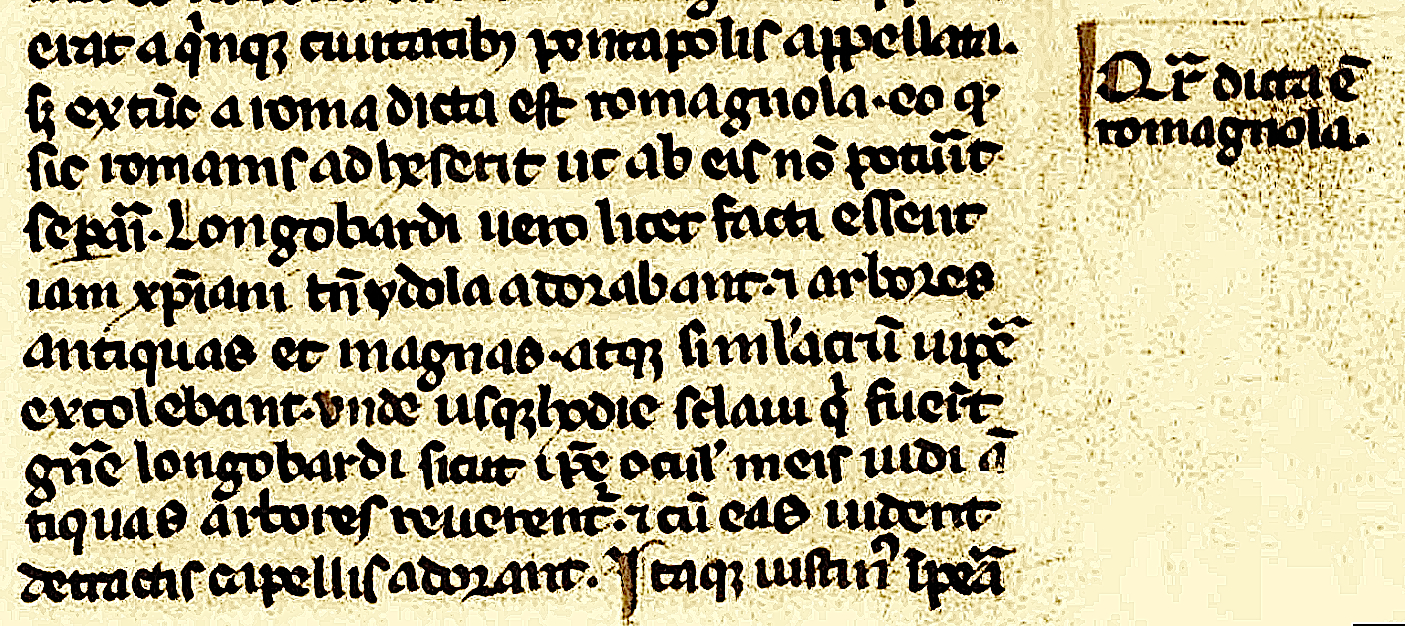
Thomas Tuscus’ Gesta imperatorum et pontificum

Published Post author

An allusion to Slavic religious practices is made in the 13th century Franciscan’s Thomas Tuscus‘ Gesta imperatorum et pontificum. The description is probably based on general assumptions about paganism held by the then Christian priests but, given the paucity of Slavic religious material, we’ll take it. The book was modeled on Martin of Opava’s chronicle of the same type (which, itself, is interesting for the antiquity it gives the Slavs) but this reference is seemingly original to Tuscus.


“The Lombards by then had become Christian,  yet they still worshipped idols and ancient and great trees and honored pictures of snakes; and to this day, the Slavs, who were a type of a Lombard, as seen with my own eyes, revere ancient trees and when they behold them, worship solitary baby goats.”

Longobardi vero licet facti essent iam christiani, tamen ydola adorabant et arbores antiquas et magnas atque simulacrum vipere excolebant, unde usque hodie Sclavi, qui fuerunt genere Longobardi, sicut ipse oculis meis vidi, antiquas arbores reverentur et cum eas vident, detractis capellis adorant.


Thomas (aka Thomas of Pavia) claims to have travelled throughout Europe, though what he “saw with his own eyes” and where he saw it (Slovenia because Pavia would be closest?) is, of course, debatable. Certainly the pagan goat imagery would have been stereotypical for a Christian viewer. On the other hand, a lone, baby goat seems a bit specific as a cult animal to be entirely made up – and not exactly threatening but rather, perhaps, cutely pathetic.

Slavs’ moment of truth

Copyright ©2018 jassa.org All Rights Reserved

September 11, 2018