Category Archives: Origins

On Names – Part I

Published Post author

Slavs

The interesting thing about ancient Slavic names is that it is difficult to claim with certainty that any of them are “really” Slavic.  For what does it really mean “really Slavic”?  To a modern Slav any name with the following suffixes (or prefixes) would “sound” Slavic:

  • -mir
    • Branimir
    • Dragomir
  • -gost
    • Milogost, Miłogost
    • Riedogost
  • -slav or –sław (i.e., -suav)
    • Boleslav, Bolesław
    • Branislav, Bronisław
    • Yaroslav, Jarosław

The first means “peace” or “world”.  The second “guest”.  The third fame.  All or most of these can be made female by just adding an -a at the end, e.g., Dragomira.

Germans

But it is quickly made clear that various Germanic/Scandinavian peoples used similar names.  And so we have the corresponding suffixes (and prefixes):

  • -mar, -mer but also -mir, e.g.:
    • Visimar
    • Merobaudes
    • Vithimiris
    • Geilamir
  • -gast
    • Arvagastes
    • Cunigastus
    • Merogaisus
    • Neviogastus

Slavs Again

To add confusion, the very first Slavic chieftain names are written also with a -mer not necessarily -mir and with a -gast not always -gost.  Thus, for example we have the Slavic (or Antes) chieftains (see here for more details):

  • -mer
    • Mezamer (Antes)
  • – gast
    • Ardagastus
    • Kelagast (Antes)
    • Peiragastus

So were the Slavs led by a Germanic leader class?  Or did the Slavs not have names of their own before they met the Germans?  (OTOH, the Germanic -bod suffix occasionally showed up in Slavic names too as –bud meaning “to be” or “being”).

Thankfully, we can grow some comfort from the fact that the prefix and suffix -slav are 100% pure Slavic.  It may be that the Western Slavs will pronounce that -suav but the Germanic Schwaben never had such names.

Germans Again

Well, not exactly true, they did have names like Suabhard, Swabberaht, Suab, Swab, Suabo, Swap, Suabalah, Suabberi, Suabilo, Suabin, Swabulf, Swabinc, Swabizho, Swapold, Swabperaht, Swabger, Suabgast, Suaphart, Swabahilt, Suaprod, Suabolach (!), Suavarich, Suabrito.  (Most of these are out of Forschungen zur deutschen Geschichte, volume 16).

But here is another source showing much of the same :

swab1 sawab2

Slavs Return

But at least we still have our suffixes!  And that is how you can tell a true Slav.  Or for that matter a Slava – if we are talking female.  So we have, e.g., the above names

  • Boleslav, Bolesław – great fame
  • Branislav, Bronisław – defender of the fame
  • Yaroslav, Jarosław – strong fame

and the female versions

  • Boleslava, Bolesława
  • Branislava, Bronisława
  • Yaroslava, Jarosława

Thus, we see that the only way to be absolutely sure that we have us a “Slav” is to have a suffix with –slav or -slava in it.

There are just two problems.  Hopefully, they are minor.

First, the meaning of the above words is odd.  Fame is Chwala or Slava but not Slav.  Boguchwal or Boguslav works because the chwal or slav could be a verb in the injunctive.

But Boleslav, Branislav, Yaroslav or for that matter Wladyslaw does not work if slav is meant to be the noun Slava.  That is because the prefix is not a noun that can be modified by a subsequent verb (as in Boguslav/Boguchwal) but rather is an adjective (Bole-) or a verb (Brani- or Yaro-) that modifies the subsequent noun, i.e., -slav.  But if -slav is a noun it cannot mean fame since fame is Slava not Slav.

But maybe it works for the female names?  Well, it’s a bit better but not really convincing.  That is because in Slavic languages the adjective gender has to match up with the noun gender.  So you would have to have had Yaraslava not Yaroslava.  This suggests that the female version is merely a derivative of the male onto which the -a was slapped on.  But the male version does not work as we note above.  Is there a solution?

Well, you could make it work if you thought that Slav was not a reference to any “fame” or “glory” but rather to a person, i.e., to a Slav or, as the Western Slavs would pronounce it, to a Suav.  Then you would have a:

  • Boleslav – Great Slav
  • Bronislav – Defender Slav
  • Yaroslav – Strong Slav (this one does not work perfectly, maybe Yareslav?)
  • Wladyslaw – Ruling Slav

(all pronounced Suav for the Western Slavs if they so insist and yes Wlady, Vald and Veleda are likely Indo-Europeano related)

In other words, now the prefix is an adjective that describes the ethnic Slav.

So we fix the first problem.  And we continue to own our own Slav name.  In fact, we own Slav and the female Slava!  That is how you can tell a Slav or a Slava!

Hmmm

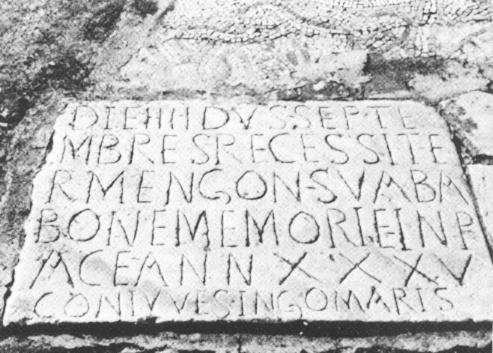
Hippo Regius was a Vandalic-controlled town in Africa.  Many ruins remain to today.  Here is an inscription on one female tomb (dated to 474):

ermengon

The woman’s husband who gave the dough to pay for this was named Ingomar.  No problem there – sounds very Swedish/Germanic.

So does the woman’s name is – the best scientists inform us – Ermengond, a lovely Germanic name for no doubt a beautiful person.  The name is actually written RMENGON as you can see.  So it seems the husband could not fit the initial “E” or the final “D”.  He did manage to fit in the woman’s ethnic designation, however – SVABA.  Strange, you do not fit the actual name but focus on ethnic details?  Was it that important that the world know that Ermengond was a woman of the Suevi (or, as it so happens here, Suavi)?  Did it matter that she was not of local stock or of the ruling Vandals or Alans (whatever was left of the latter by that time)?  Or was that, perhaps, part of her name?

[E]RMENGON[D]SVABA

RMENGONSVABA

Nothing seems sacred to these people!  Now there is that separator dot between the “N” and the “S” so maybe these are two words.  But then we hear (again from the same volume of Forschungen zur deutschen Geschichte) of Altswab, Adalswab and Erchanswab.

Other Thoughts

There are other interesting names.  E.g., the ultra-Slavic Bogdan meaning “God’s gift”.  If you want to have fun just change Bog to the Greek θεός/Theo/Theos and you get Theo[s]dan.

Or Bozydar (same meaning) – and you get Theo[s]dar.  And there was that stuff about -ik being a Slavic suffix (bartnik, miecznik, etc).  Or, for that matter the words dar or podarek (meaning a gift or present).  We will return to podarek when discussing Veneti again.

Funny stuff.

Copyright ©2015 jassa.org All Rights Reserved

May 30, 2015

On Ariovistus

Published Post author

Before Armin-ius there was Ariovist-us.  With Arminius, oddly, once you take away the Latin -ius, the ending becomes the Slavic -in.  What happens with Ariovistus?

wieszcz

Well, first we have Ariovist.  Then we break it down to Ario-vist.  Now, we are not going to weigh in on Ario-.  (Supposedly, it is a Celtic prefix meaning “noble”).

However, -vist seems familiar.

wieszcz2

Smith’s Dictionary of Greek and Roman Biography and Mythology translates -vistus by  claiming it is simply the German Fürst, “a prince”.  Alternatively, the suffix is supposed to be Celtic from, as per the ever correct Wikipedia, uid-, uidi-, uissu-, meaning “perception, knowledge.”

wieszcz3

To know that -vid means knowledge one does not need to look to Celtic.  The Indian vedas have the same derivation.  In fact, so does the Polish wiedza.  But the suffix is -vist not -vid.

If you are thinking sight, as in vista, you may be right.  Assuming that is correct, we may want to ask if there is a word that expresses the concept?

wieszcz4

If you said Czech věštec, Slovak veštec or Polish wieszcz (essentially, viest) we think you could be right.  (If one accounts for the fact that the Polish mazurzenie seems to have been the correct way of talking of old, the Czech/Slovak and Polish versions would sound the same except for the -ec suffix not present in the Polish version (though there is a Polish – diminutive version – wieszczek).  What does that mean?

wieszcz5

A teller of news, a fortune teller, an augured, a seer but also – the necessarily derivative – magician, mage.  Linde’s Polish dictionary from 1814 also has the following Slavic forms visct, vjesct, vishtac.  Bruckner’s etymological dictionary concurs showing the Polish wieść (“news”) to be cognate with the Avestani visti-, Indian vit-ti.

ariov

Thus, Ariovist would be a seer/magician.  And we must not forget his contemporary anti-Roman rebel commander, the Getae-Dacian chief Byrebistas, Boirebistas or Buruista/Burvista.  Again, once you eliminate the -as, you end up with Burebist or something like that.  However, as we pointed out, in Greek at least, the “b” in many places meant “v” (see, e.g., Sklabinoi, Sklaboi).

Another interpretation may be that vist meant as much as man.  Aleksander Brueckner believed that niewiasta (nye-veasta) (woman) originated from a word for a bride meaning one who was not known yet because she came from “the outside” (of the family).  Therefore, there was “no knowledge” (no wiedza or vista) of her (he analogizes the Hungarian word for son in law – igen).  However, this use appears at best secondary and at worst slightly contrived.  If one were to assume that nie-wiasta simply means “not a man” (sorry), that would match up with the vist being just a man.  The association of man with knowledge and woman with no knowledge thus seems unnecessary (or at least secondary).  The words may simply have meant man and not man (i.e., woman).

It seems entirely plausible that a vist, over time became the knowledgeable leader – wieszcz, its original meaning of “man” forgotten.  On the other hand, niewiasta (nye-veasta) may have lived on as the original name for a woman and this even after Slavic languages developed their own term for “wise woman/leader”, i.e., wieszczka.

Finally, yet another etymology name is possible. Assuming for the moment that this name was not some sort of a “call sign” given to him “in the Suavic military” but rather was simply a name given to him by, well, you know, his parents, the above reference to wieść (“news”) suggests a simpIer explanation:

(y)ari-vist

meaning:

“robust (good) news”

This would make the name similar to, for example, Tęgo-mir (aka Tugumir), that is, “robust (strong) world.”

Note too that the name Arwist (sometimes shown as Herwist) appears Polish source, although it is perhaps possible that the name is of Old Prussian origin:

And so, as they say, here we are.

things

When you are enjoying a vista of the Rodina, take a moment to give some thought to the sacrifices of Ariovist and Burevist

Copyright ©2015 jassa.org All Rights Reserved

May 26, 2015

On the Danube Theories and the Suavi – Part IV

Published Post author

It seems that the Suavi survived the Ostrogothic attack and remained in the Danubian Suavia (or Savia or Pannonia Savia).  We may draw this inference from Paul the Deacon who in his History of the Lombards cites from the Origo Gentis Langobardorum to claim that the Langobards subdued the Suavi apparently after they defeated the Heruli in 508-512 (causing the Heruli to, in part, head for Scandinavia through the lands of the Slavs) but before they entered Pannonnia (about 546) from Moravia where the Heruli kingdom used to be – right next to that of the Rugii).

We know this because Paul and Origo claim that this happened during the reign of Wacho or Waccho, a Langobard who helped himself to the Langobard throne by killing the prior occupant of the same, Tato in the year 510 but who ended his career in about 539-540, i.e., supposedly  before the Langobards entered Pannonia (there is some doubt here given what Paul writes as to the length of the Langobard stay in Pannonia before they left for Italy in 568).

We give here both the cite from Paul and the original version from the Origo.

Paul the Deacon, Book I, chapter 21

“But after these things Tato indeed did not long rejoice in the triumph of war, for Waccho, the son of his brother Zuchilo, attacked him and deprived him of his life.  Tato’s son Hildechis also fought against Waccho, but when Waccho prevailed and he was overcome, he fled to the Gepidae and remained there an exile up to the end of his life. For this reason the Gepidae from that time incurred enmities with the Langobards.”

paulus1

“At the same time Waccho fell upon the Suavi and subjected them to his authority. If any one may think that this is a lie and not the truth of the matter, let him read over the prologue of the edict which King Rothari composed of the laws of the Langobards and he will find this written in almost all the manuscripts as we have inserted it in this little history.”

“And Waccho had three wives, that is, the first, Ranicunda, daughter of the king of the Turingi (Thuringians);  then he married Austrigusa, the daughter of the king of the Gepidae, from whom he had two daughters; the name of one was Wisegarda, whom he bestowed in marriage upon Theudepert, king of the Franks, and the second was called Walderada, who was united with Cusupald, another king of the Franks, and he, having her in hatred gave her over in marriage to one of his followers called Garipald.  And Waccho had for his third wife the daughter of the king of the Heroli, by name Salinga. From her a son was born to him, whom he called Waltari, and who upon the death of Waccho reigned as the eighth king over the Langobards. All these were Lithingi; for thus among them a certain noble stock was called.”

Origo Gentis Langobardorum, Part IV

“Claffo, the son of Godehoc, reigned after him. And after him reigned Tato the son of Claffo. The Langobards settled three years in the fields of Feld. Tato fought with Rodolf king of the Heruli and killed him and carried off his banner and helmet. After him the Heruli had no kingly office. And Wacho the son of Unichis killed king Tato his paternal uncle together with Zuchilo.”

origo1

“And Wacho fought, and Ildichis the son of Tato fought, and Ildichis fled to the Gippidi where he died. And to avenge his wrong the Gypidis made war with the Langobards.”

“At this time Wacho bent the Suabians under the dominions of the Langobards.”

origo2

“Wacho had three wives : (first) Raicunda, daughter of Fisud king of the Turingi. After her he took as his wife Austrigusa a girl of the Gippidi. And Wacho had from Austrigusa two daughters; the name of one was Wisigarda whom he gave in marriage to Theudipert king of the Franks, and the name of the second was Walderada whom Scusuald king of the Franks had as his wife, but having her in hatred he transferred her to Garipald for a wife. He had as his third wife the daughter of the king of the Heruli, Silinga by name. From her he had a son, Waltari by name. Wacho died and his son Waltari reigned seven years without posterity. They were all Lethinges.”

Post Scriptum

C.H. Mierow in his translation writes of this passage: “It is hard to see what people are designated by this name. The Suavi who dwelt in the southwestern part of Germany, now Suabia, are too far off. Hodgkin (p. 119) suggests a confusion between Suavia and Savia, the region of the Save. Schmidt says, “There is ground to believe that this people is identical with the Suevi of Vannius who possessed the mountain land between the March [Morava] and the Theiss [Tisa].”

Of course, if these were the Suavi of Savia or Pannonia Savia then the problem would be solved.  Therefore, we would have Suavians in the 520s-530s in the Danube area (though Hunimund may not have been so lucky himself – we do not know).

Incidentally, Wacho’s insurrection also brings into question the location of the Slavs in another way.  One of the claimants to the Langobard throne was one Hildigis who fled (a number of times), in Procopius’ version, to the Slavs – where these were is also uncertain and a subject of great speculation.  A topic for another day.

Finally, if you think it odd that a number of the Langobard names sound like Slavic diminutives or nicknames, we agree – although the same can be said of some Bavarian rulers and, perhaps, of some Goths.  It is also true that much later Adam of Bremen made the claim that the Slavic lands, i.e., Slavia were basically occupied by the Winuli – apparently, the Langobards’ original name – though this may be taken with a grain of salt given that Adam also called the Winuli Vandals – a tribe which was the main antagonist of the Langobards in the History of the latter (and indeed how the Langobards got their name is linked, of course, to their fight with the Vandals).  Whether Wisegarda had anything to do with the Visegrád Castle (tall hard/burgh) in Hungary or Višegrad town in Bosnia on the Serbian border, is another question – probably not but the name is curious.

Copyright ©2015 jassa.org All Rights Reserved

May 25, 2015

Of Stavanoi & Souobenoi, etc

Published Post author

An argument has been made numerous times that Slavs may have originated in the East – in fact in the far east.  What evidence is for this usually involves two names mentioned by Ptolemy in his Geography.

We ought to mention up front that all of Ptolemy’s Geography is open to interpretation and has, in fact, been interpreted by cartographers and been interpreted differently.  So that you may see one Ptolemy map drawn with certain tribes shown this way and another one – being the “same” Ptolemy map as the first one – showing the same tribes in a slightly (if you’re lucky) different location.

Stavanoi

The first is “Stavanoi” (Σταυανοί).  These are mentioned in Book III, chapter 5 entitled “Location of European Sarmatia.” (shown on Ptolemy’s “Eighth Map of Europe”).  This is what he says:

europaoctava

“Among those we have named to the east: below the Venedae are the Galindae. the Sudini, and the Stavani [actually, Stavanoi], extending as far as the Alauni…”

Souobenoi/Sovobenoi

The second is “Souobenoi/Sovobenoi” (Σουοβενοι).  These people are mentioned in Book VI, chapter 14 entitled “Scythia this side of the Imaus Mountains.”  (shown on Ptolemy’s “Seventh Map of Asia”).  To be clear, the “Imaus Mountains” are typically perceived to be the Pamir Mountains.  In other words, this is way after even the Asiatic Sarmatia (chapter 8).  Ptolemy says the following:

souobenoi

“After this bend of the  Imaus mountains toward the north.  Those who inhabit Scythia toward the north along the Terra Incognita are called Alani-Scythae, Suobeni [actually, Souobenoi/Sovobenoi]  and Alanorsi.  The part which is below these is held by the Satiani, the Massaei, and the Syebi.”

Others

There are other curious names out there.  We have the Suardeni (Book V, chapter 8 – Location of Asiatic Sarmatia – Second Map of Asia).  We have the Serbi (same location).  On the other hand, we have the town of Serbinum right in Lower Pannonia (Book II, chapter 14).  We have Prusias  in Ponthus/Bithynia but also Borusci (Borussia is the Latin word for Prussia) in European Sarmatia  It’s all very confusing and it is highly unlikely that any one of these, apparently, very small tribes became the Slavs of today.

What all this suggests is perhaps something much more complicated than one tribe getting up and moving in a particular direction to establish a new homeland.

Vast numbers of people may have seen themselves as being part of some tribe or other and migrated in all kinds of directions.  The Alani are a perfect example as they appear both in Sarmatia and in Scythia and altogether in numerous places.  They may even have been the same people moving about.  Or they may have been different Alani as they have different “sub tribal” designations as shown above.

It may thus well be that, e.g., the Suobenoi were Slavs but that in and of itself does not mean that they were the only Slavs out there at the time.  For example, were we to know nothing about the location of the Slavs in the middle ages and were we then to discover that the Slovenes lived in Carinthia in the middle ages (at the latest!) we would not be entitled to clam that all Slavs must have lived in Carinthia at that same time.

These Souobenoi may have been a stray Slavic tribe gone rogue (i.e., gone East).  On the other hand, as the designation of Sloveni seems to have often been a border designation it may well be that a number of other tribes between these Souobenoi and Europe [?] were already Slavic, with them being a “Grenzvolk.”  Or, it may be that these Souobenoi (or Sovobenoi?) were in no way related to the Slavs.  Or, maybe they were – but only to some Slavs.  The mysteries continue.

alanoialanoi

Copyright ©2015 jassa.org All Rights Reserved

May 24, 2015

On the Danube Theories and the Suavi – Part III

Published Post author

nedao2

Attila’s “strava” was not going so well

Jordanes Getica

Chapter 34

[first half of 5th century]

“And what more? Valia (to repeat what we have said) had but little success against the Gauls, but when he died the more fortunate and prosperous Theodorid succeeded to the throne. He was a man of the greatest moderation and notable for vigor of mind and body. In the consulship of Theodosius and Festus the Romans broke the truce and took up arms against him in Gaul, with the Huns as their auxiliaries. For a band of the Gallic Allies, led by Count Gaina, had aroused the Romans by throwing Constantinople into a panic. Now at that time the Patrician Aetius was in command of the army. He was of the bravest Moesian stock, the son of Gaudentius and born in the city of Durostorum. He was a man fitted to endure the toils of war, born expressly to serve the Roman state; and by inflicting crushing defeats he had compelled the proud Suavi and barbarous Franks to submit to Roman sway.”

Comment: It is not clear which Suavi these were but we mention them here just in case they might have been Danubian Suavi.  The famous patrician Aetius who galvanized Rome and its allies against the Huns, lived between 391 and 454 A.D.  This story should have come after the story presented below in Chapter 48.

Comment: There follows in Chapter 44, the story of the Suavi of Galicia and Lusitania (i.e., in Portugal/Spain) with Riciarius their king fighting Theodorid of the Visigoths – and losing and having appointed over them, Theodoric’s retainer Agrivulf (“born of the stock of the Varni, far below the nobility of Gothic blood”) who then betrayed the Visigoths and was beheaded as a result – in Visigoths’ great mercy, the Suavi were then nevertheless allowed to choose one of their own people as ruler – choosing Rimismund.  We mention this for completeness although the story obviously pertains to events in the Iberian Peninsula and does not directly have anything to do with the Danube Suavi.

Chapter 48

[turn of the 5th century]

“And later, after the death of Vinitharius, Hunimund ruled them, the son of Hermanaric, a mighty king of yore; a man fierce in war and of famous personal beauty, who afterwards fought successfully against the race of the Suavi.  And when he died, his son Thorismud succeeded him, in the very bloom of youth. In the second year of his rule he moved an army against the Gepidae and won a great victory over them, but is said to have been killed by falling from his horse. When he was dead, the Ostrogoths mourned for him so deeply that for forty years no other king succeeded in his place, and during all this time they had ever on their lips the tale of his memory. Now as time went on, Valamir grew to man’s estate. He was the son of Thorismud’s cousin Vandalarius.

Comment: It is interesting that the preceding text comes right after the story of Boz and Vinitharius who “to show his courage” made war against the country of the Antes.  See here.  Thus, Vinitharius defeated the Antes and Hunimund the son of Hermanaric  fought against the race of the Suavi.

This must have happened in the late 4th, perhaps early 5th century – whether this was what drove the Suavi or some of them West with the Vandals and Alans is uncertain.  Chronologically, the story of Vinitharius and Hunimund should have come before Chapter 34’s story about the Suavi of Spain and Portugal.

Chapter 50 

[Battle of Nedao (454 A.D.)]

“…They took up arms against the destruction that menaced all and joined battle with the Huns in Pannonia, near a river called Nedao. There an encounter took place between the various nations Attila had held under his sway. Kingdoms with their peoples were divided, and out of one body were made many members not responding to a common impulse. Being- deprived of their head, they madly strove against each other. They never found their equals ranged against them without harming each other by wounds mutually given. And so the bravest nations tore themselves to pieces. For then, I think, must have occurred a most remarkable spectacle, where one might see the Goths fighting with pikes, the Gepidae raging with the sword, the Rugi breaking off the spears in their own wounds, the Suavi fighting on foot [or “fighting with slings”], the Huns with bows, the Alani drawing up a battle-line of heavy-armed and the Heruli of light-armed warriors.“

nedao3

Nedao – Suavi on the Left, Heruli on the Right – Ardaric of the Gepids in the middle (Tacitus called Scandinavia the “vagina of nations”)

Comment: After the Battle of the Catalaunian Fields (451 A.D.) [yes, Cat-alauni-an – having something to do with Alans?] and subsequent battles of Attila, the Hunnnic chieftain was driven back to, probably, Pannonia and then died (in 453 A.D.) after a party in the hands of his new bride.  Thereafter, after a proper strava (whether that is a Slavic word is debatable and debated), Attila was buried and the Huns and Goths fought against a coalition of Gepids, Rugi, Heruli, Alani and Suavi in Pannonia at the so-called Battle of the River Nedao in 454 A.D.  The passage above describes that.  The Huns and Goths lost and had to search for other places to live.  The Huns fled eastwards, the Goths, at least initially into Pannonia.  Even though the following does not have any descriptions of the Suavi we quote this here because it sets up nicely the situation of the various temporary kingdoms that arose in the post-Atyllic world after the Battle of Nedao and before the next two big events: the Gothic march against Odoacer that would create the Ostrogothic Kingdom at Ravenna and the invasion by the Lombards.  This is what Jordanes has to say:

“But the Gepidae by their own might won for themselves the territory of the Huns and ruled as victors over the extent of all Dacia, demanding of the Roman Empire nothing more than peace and an annual gift as a pledge of their friendly alliance. This the Emperor freely granted at the time, and to this day that race receives its customary gifts from the Roman Emperor.”

“Now when the Goths saw the Gepidae defending for themselves the territory of the Huns and the people of the Huns dwelling again in their ancient abodes, they preferred to ask for lands from the Roman Empire, rather than invade the lands of others with danger to themselves. So they received Pannonia, which stretches in a long plain, being bounded on the east by Upper Moesia, on the south by Dalmatia, on the west by Noricum and on the north by the Danube. This land is adorned with many cities, the first of which is Sirmium (Sremska Mitrovica) and the last Vindobona (Vienna).”

“But the Sauromatae, whom we call Sarmatians, and the Cemandri and certain of the Huns dwelt in Castra Martis [Kula, in northwestern Bulgaria], a city given them in the region of Illyricum. Of this race was Blivila, Duke of Pentapolis, and his brother Froila and also Bessa, a Patrician in our time. The Sciri, moreover, and the Sadagarii and certain of the Alani with their leader, Candac by name, received Scythia Minor and Lower Moesia.  Paria, the father of my father Alanoviiamuth (that is to say, my grandfather), was secretary to this Candac as long as he lived. To his sister’s son Gunthigis, also called Baza [compare with Boz?], the Master of the Soldiery, who was the son of Andag the son of Andela, who was descended from the stock of the Amali, I also, Jordanes, although an unlearned man before my conversion, was secretary. The Rugi, however, and some other races asked that they might inhabit Bizye [in European Turkey] and Arcadiopolis [same].”

“Hernac, the younger son of Attila, with his followers, chose a home in the most distant part of Lesser Scythia. Emnetzur and Ultzindur, kinsmen of his, won Oescus and Utus and Almus in Dacia on the bank of the Danube, and many of the Huns, then swarming everywhere, betook themselves into Romania, and from them the Sacromontisi and the Fossatisii of this day are said to be descended.”

Chapter 53 

[about 470 A.D.] 

“When the tribe of the Huns was at last subdued by the Goths, Hunimund, chief of the Suavi, who was crossing over to plunder Dalmatia, carried off some cattle of the Goths which were straying over the plains; for Dalmatia was near Suavia and not far distant from the territory of Pannonia, especially that part where the Goths were then staying. So then, as Hunimund was returning with the Suavi to his own country, after he had devastated Dalmatia, Thiudimer the brother of Valamir, king of the Goths, kept watch on their line of march. Not that he grieved so much over the loss of his cattle, but he feared that if the Suavi obtained this plunder with impunity, they would proceed to greater license.”

“So in the dead of night, while they were asleep, he made an unexpected attack upon them, near Lake Pelso [the Balaton].  Here he so completely crushed them that he took captive and sent into slavery under the Goths even Hunimund, their king, and all of his army who had escaped the sword. Yet as he was a great lover of mercy, he granted pardon after taking vengeance and became reconciled to the Suavi. He adopted as his son the same man whom he had taken captive, and sent him back with his followers into Suavia.”

“But Hunimund was unmindful of his adopted father’s kindness. After some time he brought forth a plot he had contrived and aroused the tribe of the Sciri, who then dwelt above the Danube and abode peaceably with the Goths. So the Sciri broke off their alliance with them, took up arms, joined themselves to Hunimund and went out to attack the race of the Goths. Thus war came upon the Goths who were expecting no evil, because they relied upon both of their neighbors as friends. Constrained by necessity they took up arms and avenged themselves and their injuries by recourse to battle. In this battle, as King Valamir rode on his horse before the line to encourage his men, the horse was wounded and fell, overthrowing its rider. Valamir was quickly pierced by his enemies’ spears and slain. Thereupon the Goths proceeded to exact vengeance for the death of their king, as well as for the injury done them by the rebels. They fought in such wise that there remained of all the race of the Sciri only a few who bore the name, and they with disgrace. Thus were all destroyed.”

Comment: The above is confusing in that Dalmatia was not near Suavia raising the question of whether the Suavi were coming from somewhere else, e.g., Savia on the River Sava.  A similar issue regarding the location of Suavia comes up in Paul the Deacon’s History of the Lombards (and indeed in the Origin of the Lombards).

Some have suggested that Jordanes was confusing Suavian lands in northern Pannonia with Pannonia Savia.  Alternatively, it may be that Pannonia Savia was also referred to as Suavia at the time and that the Suavians lived there at the time.  See for example Cassiodorus’ Variae (12, 7) and elsewhere.  Whether those Suavians were Swabians, however, is another matter. The fact that a country occupied in the 6th/7th century by Slavs is occupied by the Suavi at the end of the 5the century is suggestive.  In fact, Cassiodorus refers to the invaders of Venetia as Suevi coming, apparently, out of Pannonia Savia in the year A.D. 536. Modern dogma is that the Slavs settled Pannonia after the Avars migrated in 567 A.D. (see below on Drnovo)     

pannonias

The above map shows the administrative division of the area from the 4th century.  Nevertheless it is instructive.  Notice the ancient Roman town of Serbinum (appears in Ptolemy’s Geography) suggesting that the Serbs at least may well have been in Europe (perhaps together with the Iazyges) way before the Huns and Avars.  Not to mention the town of Serbinum is actually on the Sava River.  

And speaking of towns we have another confirmation of where the “Suavi” were in Procopius as cited in a recent blog post here.  We reproduce that quote:

“But above them [the Veneti] are the Siscii and Suavi (not those who are subjects of the Franks, but another group), who inhabit the interior. And beyond these are settled the Carnii and Norici. On the right of these dwell the Dacians and Pannonians”

Intermission from Jordanes to Talk About Marshy Logic

Now, what town is just north of Serbinum?  Yes, Siscia.  Suggesting that the Suavi would be just up the river (as per Procopius) and what town lies there up the river? Yes, Noviodunum (really Neviodunum, today’s Drnovo in Slovenia).  So perhaps this is the Noviodunum of Jordanes where Slavs (but now, we’re pretty certain, referred to as Suavi, lived all the way to Lake Musianus (or Mursianus)?  Let’s bring up Jordanes again:

“(Near their left ridge [it appears he is talking about the Carpathians], which inclines toward the north, and beginning at the source of the Vistula, the populous race of the Venethi dwell, occupying a great expanses of land.  Though their names are now dispersed amid various clans and places, yet they are chiefly called the Sclaveni and Antes.  The abode of the Sclaveni extends from the city of Noviodunum and the lake called Mursianus to the Danaster, and northward as far as the Vistula.”

Thus, we would have the following areas of possible settlement depending on which Noviodunum we use and which Lake Musianus/Mursianus you use.  We’ve already had one proposition here but here are some other ones:

Noviodunum (Novietunense):

– Isaccea, Romania (Castra Noviodunum, Roman Province of Moesia);

– Drnovo, Slovenia (Neviodunum);

BTW some people reject the Drnovo hypothesis because, as per them, there should have been no Slavs in the area until after the Avars came into Pannonia about 567 A.D. but this is just about the most circular reasoning you can get since the problem at hand is obviously where the Slavs were at the beginning of the 6th century.  If one were to follow this result-driven logic, nothing would suffice and an ancient author placing a Slav in the middle of the Colosseum during Nero’s reign would be shown to have (A) meant a [Greek] or (B) meant not Rome but [Pinsk] or (C) meant not Nero but [Victor Emmanuel II] or (D) been [drunk].  And after all that would only have been one Slav, and we all know no theory can be right about Slavs unless you can show that at least  [seven] were present at a given time and place.

(And, of course, we know from Procopius that already about 512 A.D. they were north of the Heruli – meaning probably in Poland, southeastern Germany and, perhaps, Bohemia.  We’ve recently come across a lovely map that, apparently to avoid this result, has the Heruli migrate from Moravia to Denmark not straight up but first south (some Heruli did go southeast to the Gepids/Byzantines but not these) then via Moldavia, then along the Black Sea coast, then along the Carpathians, via southern Poland and then onto Germany and Denmark – this resembles the way Ptolemy’s geocentric theory with its dozens of orbital circles needed to sustain it – but, hey, it  is theoretically possible – however unlikely –  that Ptolemy will ultimately be proven right whereas Copernicus will be shown wrong).

Lake Musianus/Mursianus:

– marshes in Northern Romania at Buzau Siret Dunare;

– marshes in Southern Moldavia around Galati;

– Drava- Danube marshes – hypothesis of F. Taube from 1778 (seems rather a random choice);

(BTW what’s up with all these marshes where everyone wants to put Slavs? They leave the Pripet Marshes only to end up in more marshes?  Why leave then? Is there no better real estate in the world?  Jordanes says swamps and forests – brother can you spare a Gambreta?)

– Lake Constance – see our prior post on this;

We should say that some people have tried to put together a Lake Musianus that is in Dabube delta with the Noviodunum that is Isaccea resulting in a grotesquely thin triangle.  But Slavs, like Zeno’s paradox just refuse to be squished like that.

map1

The above illustrates the River Vistula and the locations of each of Lake Musianus/Mursianus and the city of Noviodunum.  The lake options are in blue and the two city options are in red.

There is an interesting (though this does not readily square with Procopius and Jordanes) possibility might be the Lake Constance to Drnovo option.

There is also the possibility of the Slovenian Drnovo location and the Danube delta.

The maximum stretch would be from Lake Constance to the Danube delta and this probably reflects closest the situation in the 7th century (except for the Avars in the middle) and also a lake would actually be a lake not some marshlands.

So perhaps (at least some of) the Slavs are a mix of the Suevi and Serbs from the Savia/Suavia area?  And the rest are Suavi or, in the north at the Vistula, a Suavi/Veneti mix?

Back to Jordanes

Comment: What happened to Hunimund is uncertain although a Hunimund does appear as a attacked of the town of Batavia (today’s Pasau) in the Vita Severini by Eugippius (22):

“Mox igitur eo discedente Hunumundus paucis barbaris comitatus oppidum, ut sanctus praedixerat, Batavis invasit ac, paene cunctis mansoribus in messe detentis, quadraginta viros oppidi, qui ad custodiam remanserant, interemit. Presbyterum quoque illum, qui tam sacrilega contra famulum Christi in baptisterio fuerat elocutus, ad eundem locum confugientem insequentes barbari peremerunt. Frustra enim illuc offenso Deo veritatis inimicus accessit, ubi tam impudenter excesserat.”

Elsewhere, Hunimundus, Humimundus or Hodemundus. 

Curiously an Alemannic leader may have been in the same area at that time (Gibuldus = Gebavult?) (19):

“Batavis appellatur oppidum inter utraque flumina, Aenum videlicet atque Danuvium, constitutum, ubi beatus Severinus cellulam paucis monachis solito more fundaverat, eo quod ipse illuc saepius rogatus a civibus adveniret, maxime propter Alamannorum incursus assiduos, quorum rex Gibuldus summa eum reverentia diligebat.”  

The etymology of Hunimund is uncertain and may precede the Hunnic invasion though may nevertheless have something to do with the Huns.

(Did we mention that Severin was a Norican and, of course, as per Nestor, the Slavs came from Noricum 🙂 )

Chapter 54 

[about 470 A.D.] 

“The kings [of the Suavi], Hunimund and Alaric, fearing the destruction that had come upon the Sciri, next made war upon the Goths, relying upon the aid of the Sarmatians, who had come to them as auxiliaries with their kings Beuca and Babai. They summoned the last remnants of the Sciri, with Edica and Hunuulf, their chieftains, thinking they would fight the more desperately to avenge themselves. They had on their side the Gepidae also, as well as no small reenforcements from the race of the Rugi and from others gathered here and there. Thus they brought together a great host at the river Bolia in Pannonia and encamped there. Now when Valamir was dead, the Goths fled to Thiudimer, his brother.  Although he had long ruled along with his brothers, yet he took the insignia of his increased authority and summoned his younger brother Vidimer and shared with him the cares of war, resorting to arms under compulsion.”

“A battle was fought and the party of the Goths was found to be so much the stronger that the plain was drenched in the blood of their fallen foes andlooked like a crimson sea. Weapons and corpses, piled up like hills, covered the plain for more than ten miles. When the Goths saw this, they rejoiced with joy imspeakable, because by this great slaughter of their foes they had avenged the blood of Valamir their king and the injury done themselves. But those of the innumerable and motley throng of the foe who were able to escape, though they got away, nevertheless came to their own land with difficulty and without glory.”

Comment:  Once again we see the Suavi allied with the Sarmatians.

Chapter 55 

[about 470 A.D.] 

“After a certain time, when the wintry cold was at hand, the river Danube was frozen over as usual. For a river like this freezes so hard that it will support like a solid rock an army of foot-soldiers and wagons and sledges and whatsoever vehicles there may be – nor is there need of skiffs and boats. So when Thiudimer, king of the Goths, saw that it was frozen, he led his army across the Danube and appeared unexpectedly to the Suavi from the rear. Now this country of the Suavi has on the east the Baiovari, on the west the Franks, on the south the Burgundians and on the north the Thuringians. With the Suavi there were present the Alamanni, then their confederates, who also ruled the Alpine heights, whence several streams flow into the Danube, pouring in with a great rushing sound. Into a place thus fortified King Thiudimer led his army in the winter-time and conquered, plundered and almost subdued the race of the Suavi as well as the Alamanni, who were mutually banded together.”

“Thence he returned as victor to his own home in Pannonia and joyfully received his son Theodoric, once given as hostage to Constantinople and now sent back by the Emperor Leo with great gifts. Now Theodoric had reached man’s estate, for he was eighteen years of age and his boyhood was ended. So he summoned certain of his father’s adherents and took to himself from the people his friends and retainers — almost six thousand men. With these he crossed the Danube, without his father’s knowledge, and marched against Babai, king of the Sarmatians, who had just won a victory over Camundus, a general of the Romans, and was ruling with insolent pride. Theodoric came upon him and slew him, and taking as booty his slaves and treasure, returned victorious to his father. Next he invaded the city of Singidunum, which the Sarmatians themselves had seized, and did not return it to the Romans, but reduced it to his own sway.”

Comment:  This Suavia actually makes sense as the Swabia of today – assuming, that is, the Baiovari were then in Bavaria already.

Copyright ©2015 jassa.org All Rights Reserved
May 23, 2015

On Birds

Published Post author

Nay further, they [Antes & Slavs] do not differ at all from one another in appearanceFor they are all exceptionally tall and stalwart men, while their bodies and hair are neither very fair or blonde, nor indeed do they incline entirely to the dark type, but they are all slightly ruddy in color.

(Procopius)

slovikpicture slovik

(Suovik, bird name; e.g., Old Church Slavonic suaviy, Russian souoviey proven to be from original *souv meaning a grey-yellow color (German sal “dirty-gray”); Prussian salovis is a borrowing).

(Aleksander Brückner – Etymological Dictionary of the Polish Language)

In English thrush nightingale (Luscinia luscinia) and in German Sprosser.  Here is where they live and where they spend the winter.

sprosserNow you know too why the River Souava (Solawa) is called Saale in German.  Also, say suovik and then change the “s” to a “ch” & you get “chuovik”.  Anyone know what that is?

So maybe the Wends or Veneti were not Western Slavs but rather Eastern Slavs?

Copyright ©2015 jassa.org All Rights Reserved

May 20, 2015

On the Danube Theories and the Suavi – Part I

Published Post author

A number of Slavic chroniclers identify Slavs as coming out of the Danube area.  Most famously, we have Nestor in the PVL who calls Slavs Noricans and says they, after “many years,” settled on the Danube.  But a similar set of concepts appears in other sources, e.g., the Vincenty Kadlubek Chronicle (Crocus conducts raids in and returns North from Carinthia) or the Greater Poland Chronicle (Slavs come from Pannonia).  Jan Dlugosz himself thought that Poles came from somewhere in Dalmatia (Psary Castle as the source of the eponymous forefather Lech).

We think there is value in returning to this theory primarily for two reasons:

  • The Suevi, now more often as Suavi, are present in the middle Danube (Donau-Sueben), and
  • The same Suevi have now associated themselves with the Sarmatians.

The importance of the Slavic connection to the middle Danube cannot thus be overstated.  Why you ask? Well, let’s see:

If the presence of the Suevi in the greater part of Germania (the same part that later is called Sclavinia, i.e., Slavia/Suavia by Adam of Bremen) were not enough (why is it not enough? Well, maybe it should be but maybe it’s just too long a time? A millennium to be exact), now, we have a chronological “contact” zone much closer in “distance”.

Moreover, there are the repeated mentions of the Suevi and various Sarmatian folk that we know were present in Pannonia and that may well have had contact with the Slavs.

The Donau Sueben & Other Suavi… 

The Suevi are famous mostly by reason of Caesar’s Gallic War (Ario-vist-us), the later works dealing with the Armin-ius/Marobod-us revolt and the Marcomannic Wars in the 170s.  Then they supposedly (not true – see below) disappear from view and reappear emigrating with the Vandals (but also with Alans) into Gaul and then onto Spain/Portugal.  What was left of them was apparently left only in Swabia.

Thus, a people whom Tacitus described as covering the greater part of the land area between the Rhine through the Vistula and beyond are supposed to have become the relatively insignificant Swabians and the smallest contingent in the Vandal-Alan-Suevi confederacy (so small that no one in Portugal or Spain spoke a Suevic language past the 7/8th centuries).   One might say either Tacitus is a liar or the history set out above is pure bunk.

Well, if you look, you will find that, in fact, there were “Others” – Suevi, starting in the 5th century often appearing as Suavi (i.e., with an “a”) in the Danube area.  What’s more these Suavi also appear in a number of places where references to them are rather “hard to explain” using traditional assumptions about who they were and ended up being.  There are references to these and related Suevi in numerous sources.  Some of them include:

  • possibly Tacitus’ Annals (see below);
  • possibly Cassius Dio (see below);
  • Ammianus Marcellinus (see below);
  • arguably, the Marcus Aurelianus section of the Historia Augusta (see below);
  • Procopius’ Gothic Wars;
  • Jordanes’ Getica;
  • possibly, the Vita Severini;
  • Cassiodorus’ Letters;
  • Origin of the Lombards;
  • Paul the Deacon’s History of the Lombards;
  • possibly, Gregory of Tours, History of the Franks;
  • possibly, the Annales Mettenses Priores;
  • possibly, the diplomatic correspondence of Henry I the Fowler;
  • possibly, the Chronicle of the Priest of Dukla;
  • and others…

We also know from other (late) sources that there were Suevi living in Slovenia near the beautiful Lake Cerknica (Zirknitzer See) in a place called Gotschee – though they spoke a true “Teutonic” tongue apparently.

zirknitzer

This is described here by Wolfgang Lazius (aka Wolfgang Laz) a 16th century author of the first “modern” book about the Voelkerwanderung: lazio1

lazalaza

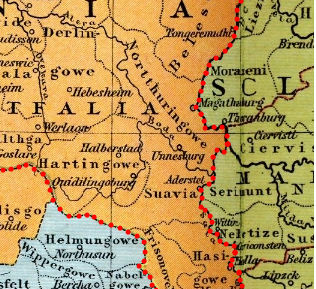
Outside of the Danube area, the Suavi name also comes up.  Thus, we learn that right outside of Magdeburg (where Slavs lived) – far from Swabia – there was an area called Suavia (on the River Boda – for the Polish Deity Boda see here) which was, however, we are told, named that way by reason of the Suevi not Slavs… 

suaviagermania

And their Sarmatian Connection…

What is more many of these Suevi/Suavi – particularly the Danube Suavi – are known to have interacted with Sarmatians.  (This makes eminent sense since the Iazygi lived by Pannonia).  Why is that relevant?  For one thing, the Polish nobility for the longest time believed itself to have been Sarmatian in descent which may (or may not) be a clue.  The Sarmatians are known to have had a large slave, i.e., serf class who repeatedly revolted against their overlords…

More importantly, it is often said that the Slavs “must have” lived next to Iranian-speaking peoples – and, if so, then they should have been living closer to Persia.  This is a rather absurd proposition and a violation of the Occam’s Razor principle if one considers that there were always plenty of Sarmatians within Europe – especially in Pannonia.

The Iazygi (and here notice that, e.g., the PVL’s Nestor refers to Slavic “tribes” as “Iazyks” – not to mention the fact that Iazyg is also the Slavic word for “tongue” – both as in language but also as in the organ) are attested in Europe (in Pannonia) in Ptolemy’s Geography; the Sarmatians (who could be the same) are listed as being in Europe (likely in Pannonia) in Germania.  The examples of the interaction are numerous (the third and fourth also dispel the notion that there was no mention of the Suevi after the Marcomannic Wars of the 170s until the 5th century):

  • Tacitus Annals – At this same time, Vannius, whom Drusus Caesar had made king of the Suevi, was driven from his kingdom. In the commencement of his reign he was renowned and popular with his countrymen; but subsequently, with long possession, he became a tyrant, and the enmity of neighbours, joined to intestine strife, was his ruin. Vibillius, king of the Hermunduri, and Vangio and Sido, sons of a sister of Vannius, led the movement… an immense host of Ligii, with other tribes, was advancing, attracted by the fame of the opulent realm which Vannius had enriched during thirty years of plunder and of tribute. Vannius’s own native force was infantry, and his cavalry was from the Iazyges of Sarmatia an army which was no match for his numerous enemy.  Consequently, he determined to maintain himself in fortified positions, and protract the war. But the Iazyges, who could not endure a siege, dispersed themselves throughout the surrounding country and rendered an engagement inevitable, as the Ligii and Hermunduri had there rushed to the attack ; …He then fled to the fleet which was awaiting him on the Danube, and was soon followed by his adherents, who received grants of land and were settled in Pannonia. Vangio and Sido divided his kingdom between them; they were admirably loyal to us [i.e., the Romans]…” [close to the years 40-50];
  • Cassius Dio – “In Moesia the Lygians, having become involved in war with some of the Suebi, sent envoys asking Domitian for aid. And they obtained a force that was strong, not in numbers, but in dignity; for a hundred knights alone were sent to help them. The Suebi, indignant at his giving help, attached to themselves some Iazyges and were making their preparations to cross the Ister with them.   Masyus, king of the Semnones, and Ganna, a virgin who was priestess in Germany, having succeeded Veleda, came to Domitian and after being honoured by him returned home.” [year 98];
  • Historia Augusta – “Aurelian, too, during that same time, fought with the greatest vigour against the Suebi and the Sarmatians and won a most splendid victory… It is not without advantage to know what manner of triumph Aurelian had… there were Goths, Alans, Roxolani, Sarmatians, Franks, Suebians, Vandals and Germans — all captive, with their hands bound fast.”  (Item Aurelianus contra Suebos et Sarmatas iisdem temporibus vehementissime dimicavit ac florentissimam victorian rettulit… Non absque re est cognoscere qui fuerit Aureliani triumphus… Gothi, Alani, Roxolani, Sarmatae, Franci, Suebi, Vandali, Germani, religatis manibus captive) [years 270-275];
  • Ammianus Marcellinus – “…but he [Constantius II] was alarmed by frequent reliable reports that the Suebi were attacking the two provinces of Raetia and the Quadi Valeria, and that the Sarmatians, who are particularly expert marauders, were devastating Upper Moesia and Lower Pannonia” [years 357-358];
  • Paulinus of Beziers – Says that the pillage of Gaul was by “Sarmatians, Vandals and Alans”; note that here the Suebi are actually replaced by Sarmatians [year 407];
  • Saint Jerome – “Nations innumerable and most savage have invaded all Gaul. The Whole region between the Alps and the Pyrenees, the ocean and the Rhine, has been devastated by the Quadi, the Vandals, the Sarmati, the Alani, the Gepidae, the hostile Heruli, the Saxons, the Burgundians, the Alemanni, and the Pannonians.” Again, the Vandals and the Alans are accounted for so which/where are the Suebi?
  • And, of course, the Baltic Sea is the Suevic Sea of Tacitus but also the Sarmatian Ocean of Ptolemy.

Having listed the first four mentions of what may be Donau-Sueben we continue with Procopius in a subsequent blog post.

Copyright ©2015 jassa.org All Rights Reserved

May 17, 2015

On Words Part I

Published Post author

On Latin Germani

At first, we have discussions regarding the word Germani:

germ

On Greek Sporoi

Later, we have Procopius who writes about the Sporoi as being the ancestors of the Antes and the Sclavines.

spore

On Our Suevi

And then, of course, the discussion expands to yet another name – but this one of the tribe’s own making.

sporoi

The Suevi (at least the “Semnones”?), we know, are not born, they are “sown”.  This phrase appears in various 8th and 9th century manuscripts and, too, in the Bavarian Geographer:

sueviseminati

Ludwig Uhland wrote in 1849 to Johann Andreas Schmeller regarding what he found in CLM (Codex Latinus Monacchensis):

“die folgende Bermerkung Suevi non sunt nati sed seminati.  Diese Stelle ist mir fuer eine kleine Arbeit im Gebiete des schwäbischen Altertums von besonderen Belang und ich erlaube mir daher, Herrn Prof. Schmeller, unter freundschaftlichen Gruesse, um kurze Notiz zu bitten:

… ob nicht etwa aus dem Zusammenhang, in welchem die Bemerkung gemacht ist, such Einiges zur Aufhellung derselben ergebe?”

Eight days later Schmeller replied with his Aufhellung:

“Dieses Codex ist aus dem XII Jahrhundert.  Er enthält… Darauf folgt die Bemerkung “Suevi… Beire non dicuntus Bavarii sec Boiarii a boia fluvio.””

“Ein Zusammenhang entweder mit der merkwürdigen Aufzählung der Slawenstaaten oder mit den vorausgehenden astronomischen & mathematischen Materien ist nicht abzusehen.”

Indeed, especially if one chooses not to look.

(On the Suebi, Suevi, indeed, Suavi (!) (see Jordanes, Procopius) and “Slavs” connection, again, see Ketrzynski (Suevi were Slavs) and Edward Romuald Bogusławski (same name but Suevi were the “overlords”).  Jacob Grimm’s view on the subject was given here earlier).

Copyright ©2015 jassa.org All Rights Reserved

May 7, 2015

On Amber

Published Post author

One of the reasons we know that the Slavs/Suavs could not have lived on the shore of the Suavian Sea and been the Veneti is because Rome traded amber with the Germans and the Slavs do not have their own word for amber, bursztyn being a corruption of the Germanic Bernstein.  Even the Slavic word for an island is supposedly a word for a river island only – the word being ostrov. 

This is, as all those who are not certain of their arguments like to stress, “undoubtedly true.” 

amberski

Pliny the Elder Natural History – Book 37, Chapter 11

“Next in rank among the objects of luxury, we have amber; an article which, for the present, however, is in request among women only…”  [lists various theories on amber’s origin] “…There can be no doubt that amber is a product of the islands of the Northern Ocean, and that it is the substance by the Germans called “glæsum;” for which reason the Romans, when Germanicus Cæsar commanded the fleet in those parts [at Wolin?], gave to one of these islands the name of Glæsaria, which by the barbarians was known as Austeravia [pron. Ostrovia?]. … Amber is imported by the Germans into Pannonia, more particularly; from whence the Veneti, by the Greeks called Eneti, first brought it into general notice, a people in the vicinity of Pannonia, and dwelling on the shores of the Adriatic Sea…  From Carnuntum in Pannonia, to the coasts of Germany from which the amber is brought, is a distance of about six hundred miles, a fact which has been only very recently ascertained.”

Germanic Words 

*glaza is, supposedly, a Germanic word meaning “amber, resin” (presumably off of something like glare).  And, of course, there is the above passage.  There it says that Germans trade glæsum.  True enough.  But isn’t it strange that:

  • there is a specific word for stone in Germanic, i.e., stone/stein, of course;
  • there is a specific German word for amber called Bernstein (burning stone) glass means, well, glass in Germanic languages and just that;
  • Germans also used to call stone, hammer; 
  • The general Slavic word for stone – kamin – is thought to be a Baltic borrowing from *okmien; lit. akmuo, or grec. akmōn;
  • so bottom line is that Germans have, supposedly, at least three words for stones (Stein, Glass, Hammer and one specifically for amber, Bernstein) and Slavs have none;
  • Inevitable conclusion: Slavs came from an area which had no stones.  Given that the Earth is made (on the outside, of course) of rock, it, must be the case that the Slavs came either from the inner core (the “Morlock” Hypothesis) or came from gaseous clouds in outer space (the “Mutara Nebula” Hypothesis);

(BTW Latin word was electrum and the current word amber is supposedly Arabic);

Of course, there is the Slavic word  glaz (pronounced “guaz”) which means a boulder or rock (e.g., in Polish but also in other Slavic languages).  The word is seen as borrowed from Germanic in the course of the amber trade – except, as, Professor Saskia Pronk-Tiethoff notes, there is no evidence that Slavs played any role in amber trading along the amber route.  So Pronk-Tiethoff worries that “the semantic connection between the Germanic and Slavic forms is not straightforward…. [its reflexes] in Slavic vary greatly in meaning and give the impression of being a relic rather than a relatively recent loanword.”  She continues by adding that “[t]he word has nowadays largely been regarded as an inherited word, although the etymology is not entirely clear.”;

(One should also note that the eye is called glaz (глаз) in Russian – glassy perhaps although it’s small and round one can note we think)

A sad song but maybe someone will, in the future, figure it all out.

images

“it is the substance by the Germans called “glæsum;” for which reason the Romans, when Germanicus Cæsar commanded the fleet in those parts, gave to one of these islands the name of Glæsaria, which by the barbarians was known as Austeravia.”

We should note that the above passage from Pliny comes from a chapter Pliny titled “Amber the Many Falsehoods That Have Been Told About It.

Copyright ©2015 jassa.org All Rights Reserved

May 7, 2015

On Martin of Braga’s List of Barbarians

Published Post author

One of the earliest mentions of Slavs is by archbishop Martin of Braga (Martinus Bracarensis) in a poem which he wrote sometime in the 570s (before he became a Saint).  He dedicated it to that other Saint Martin, Saint Martin of Tours – Versus Martini Dumiensis Episcopi in Basilica (according to that other guy from Tours – Gregory – who also placed this work in the basilica of Braga (History of the Franks, 5, 38)).  Our Martin was a Pannonian who lived sometime between 520s-580s, traveled West and ended up as bishop of Dumio and then as archbishop of Braga (Roman Bracara Augusta in Gallaecia).  [Our] Martin participated in the conversion of the Suevi from the errors of Arianism onto the clear path of Catholicism.  This brought him joy and he composed a poem listing all those who had already been converted and expressing happiness that they will now be joined by the Suevi.  Here is the text from the 8th century Codex Parisinus Latinus :

Basilica1

 Versus Martini Dumiensis episcopi in basilica

(aka In Basilica)

Post evangelicum bisseni dogma senatus,
Quod regnum Christi toto iam personat orbe,
Postque sacrum Pauli stilum, quo curia mundi
Victa suos tandem stupuit siluisse sophistas,
Arctous, Martine, tibi in extrema recessus
Panditur inque via fidei patet invia tellus.
Virtutum signis meritorum et laude tuorum
Excitat affectum Christi Germania frigens,
Flagrat, et accenso Divini Spiritus igne
Solvit ab infenso obstrictas Aquilone pruinas.
Immanes variasque pio sub foedere Christi
Adsciscis gentes. Alamannus, Saxo, Toringus,
Pannonius, Rugus, Sclavus, Nara, Sarmata, Datus,
Ostrogothus, Francus, Burgundio, Dacus, Alanus,
Te duce, nosse Deum gaudent. Tua signa Suevus 
Admirans didicit fidei quo tramite pergat,
Devotusque tuis meritis haec atria claro
Culmine sustollens, Christi venerabile templum
Constituit, quo clara vigens, Martine, tuorum
Gratia signorum votis te adesse fatetur
Electum, propriumque tenet te Gallia gaudens
Pastorem, teneat Gallicia tota patronum.

basilica2

Roughly: “you attract various and fierce peoples under the sacred covenant of Christ: the Alaman, the Saxon, the Thuringian, the Pannonian, the Rugian, the Sclav, the Nara, the Sarmatian, the Datian, the Ostrogoth, the Frank, the Burgundian, the Dacian and the Alan rejoice to know God under your guidance.  Your standards are admired by the Suev who learned the faith, continues on the path…”   This list is similar to that of Sidonis Apollinaris (with Nara being Neurus and Datian being a double of Dacian).

So, with those Slavs (looks like a Byzantine spelling) as Sueves, let’s just say, not everything is entirely clear.

Copyright ©2015 jassa.org All Rights Reserved

May 2, 2015