Category Archives: Poles

On the Moinu-Winidi & the Ratanz-Winidi & the Vindelici

Published Post author

It is true that we have not posted all the early reference to Slavs as Wends/ Winids/Windische.  We’ve got to keep you coming back after all.  For the earlier version of this topic see here.  And now back to the Wends:

Part I

From the year 846 (a document from the time of Louis the German) we have the following information (regarding an earlier time around the year 793-794 or so):

Qualiter… domnus Karolus… episcopis praecepisset, ut in terra Sclavorum, qui sedent inter Moinum et Radantiam fluvios, qui vocantur Moinuwinidi et Ratanzwinidi [or Radanzwinidi] una cum comitibus, qui super eosdem sclavos constituit erant, procurrassent, ut inibi sicut in ceteris christianorum locis ecclesiae construerentur, quatenus ille populus noviter ad christianitatem conversus habere potuisset, ubi et baptismum perciperet et praedicationem audiret….

(Moinum/Moinu refers to the River Main.  Radantiam/Ratanz refers to Radęca or, as it is called these days, River Regnitz/Rednitz).

It tells of how “Charlemagne sent his bishops into the “terra Sclavorum”, i.e., the land of the Slavs who live between the Main and the Regnitz and who were, therefore, called the Main-Wends and the Regenz-Wends.”  It is part of an order by Charlemagne to the Würzburg Bishop Bernwelf (768 or769 – 800) to build fourteen missionary churches among these Slavs.

Wilhelm Obermüllerʼs Deutsch-Keltisches, geschichtlich-geographisches Wörterbuch explains their placement by asserting that they arrived there as conquerors after Samo’s victory over Dagobert in the year 630 but this seems an anticipatory argument as no source, including Fredegar’s Chronicle, says anything of the sort – the Chronicle merely notes that there were raids into Frankish lands following the Wendish victory at Wogastisburg – the suggestion of a permanent settlement seems to have been made up by Obermüller.

What’s more other sources such as the Annales Mettenses Priores seem to indicate vaguely Slavic names with -in endings such as:

  • Mohin (the name for the River Main!); and
  • Wirzin-burg (or Wirsin-burg)mohinmohim

We include here a map showing the presumed location of this land with the red line showing the River Main, the blue line the River Regnitz and the slightly darker blue line showing its tributary the River Rednitz.  The pins point to various “Wind” towns in the area: Burgwindheim, Bad Windsheim, Windsfeld, Windsbach and Windelsbach.  We let you find Pommersfelden (probably in someways tied to Pomerania but maybe not) by yourself.  Perhaps the area is just very windy?

moinwiniti

 Part II

So that is that – but now take a look at this map which we put together thinking of those other Vindi or rather Vinde-lici discussed by Strabo.

picturez

a l m o s t there

Vindelici were supposedly a Celtic tribe – the Celtic designation often seemingly being that dumping place where you put things that are clearly not Germanic but that – or so you think – cannot possibly be Slavic (their city was  Kambodunon a rather Celtic name though!).  Yet in his Vergilii Aeneidem commentary (Commentaries on Virgil’s Aeneid), we are told by Marcus Servius Honoratus that the Vindelici were Liburnians.  He says at paragraph 243:

illyricos penetrare sinus Antenor non Illyricum, non Liburniam, sed Venetiam tenuit.  ideo autem Vergilius dicit ‘Illyricos sinus’, quod inde venit quidam Henetus rex, qui Venetiam tenuit, a cuius nomine Henetiam dictam posteri Venetiam nominaverunt. tutus ideo tutus, quia Raeti Vindelici ipsi sunt Liburni, saevissimi admodum populi, contra quos missus est Drusus.  hi autem ab Amazonibus originem ducunt, ut etiam Horatius dicit “quibus mos unde deductus per omne tempus Amazonia securi dextras obarmet, quaerere distuli” . hoc ergo nunc ad augmentum pertinet, quod tutus est etiam inter saevos populos.

illiricosMaurus Servius Honoratus. In Vergilii carmina comentarii. Servii Grammatici qui feruntur in Vergilii carmina commentarii; recensuerunt Georgius Thilo et Hermannus Hagen. Georgius Thilo. Leipzig. B. G. Teubner. 1881.

A number of things are of interest here:

  • we’ve got another Vind tribe in its own area of Vindelicia (previously discussed);
  • the Vind tribe’s (or tribes’) area of settlement includes the town of Bregenz (shown in red above) on the shore (breg) of Lake Venetus (previously discussed);
  • all of those are remarkably close to the area of the Veneti (previously discussed);

Now what was not previously discussed (in detail) are the following facts:

  • all of those places/peoples are incredibly close to the seats of the Moinu-winidi and Ratanz-winidi;
  • the river that runs nearby the seats of the Vindelici towards the Danube is the Lech (shown in red above); and
  • the Liburnians are a people of unclear ethnicity who were later “absorbed” by the Croats.

liburnia

Specifically, Liburnia is in Croatia and it was here that the Croats were supposedly invited at the beginning of the 7th century as per Constantine Porphyrogenitus’ De Administrando Imperio.  More interesting, however, is that the Polish chronicler, Jan Dlugosz stated that the founder of the Poles – Lech – came from this area – specifically the mysterious Psary castle.  In fact, there is even an island here that is named Krk – somewhat like Cracow.  Krk is the former Roman Curicta but the city itself was Liburnian before being conquered by the Romans.  It also later fell to the Avars.  Interestingly, the allegedly Slavic R1a1 Y-dna was found at the highest concentrations in Croatia (except for Osijek) exactly at Krk.

Whether it matters that Cornelius Tacitus also wrote as follows:

“… some of the Suevi sacrifice to Isis [Yassa? Remember, in the statutes Cunradi it is written ysaya].  Whence the cause and origin of the foreign rite I have not ascertained, except that the symbol itself, in the shape of a Liburnian ship, indicates that the religion was brought from abroad.”

Is another question.

Part III

Finally, we ought to point something else out.  No one denies that the Germans (whoever they were back then) called their neighboring Slavs Wenden or Winden.  It has been suggested that this was a carryover from the Sarmatian Veneti whose name was “transferred” to the Slavs by the Germans.  Others have suggested that the Sarmatian Veneti were Slavs.  We have had a number of posts on this topic and we will not regurgitate that here.

However, now we have said “let us not forget the Vindelici” who usually are not identified with Slavs.  After all here you have a case of a “d” without anyone having to do any d>t and/or t>d transformations.  These people were Vinde and the Slavs were Windishe (the “v” and “w”, to state the obvious, are pronounced the same – there was no “w” in the time of the Vinde-lici).

And you got your -lici as in, maybe, lechy.

But there is something else.  If you look at the map below you will notice that the actual Vindelici are placed West of the River Lech (originally written by Latin writers as Liccus, i.e., Licc plus the Latin -us suffix).  That territory is now known as (Eastern) Swabia and on the connections (?) between Slavs, i.e., Suoveeane and the Suevi who are identified with the Schwaben of Swabia we’ve already spilt much ink on this website.

videlicia

In fact, these days the Bodesee whose Obersee portion was previously referred to as Lacus Venetus is referred to, on occasion, as the Suevian Sea.

So were the Vinde-lici the ancestors of Lechs/Lechites/Lachs, i.e., Poles?  Were they simply Winds called Lici? Was the fact that Mieszko is described by Widukind of Corvey as leader of the Licikaviki somehow relevant here?  Were the Windi-lici driven down the Lech river North by Tiberius after their defeat on Lake Constance.

(Speaking of which there is also this curious reference).

Others have suggested that the Veneti were the Eastern Slavs, the name being Finnish or Ugrian (the White (?) Ugrians having driven deep into what is today Belarus and Ukraine).  The same people claimed that the Suevi were the Western Slavs.

But here we now have a connection between these Western Slavs (who were referred to as Wenden but not Veneti, the former name being German, the latter not) and their self-given name of Lechites.

In other words, all agree that Wends were a type of Slavs in the 600s but the connection between the Vinde-lici as a type of Suevi at the turn of the millennium is seemingly ignored.  If you were willing to admit that connection there would, of course, be a second question to ask, as to whether Vinde-lici really are the future Wends and the Suevi, the future Suoveanne or Slavs (we say “future” in a historiographic sense; obviously these people may already have been referred to as Wends and may have referred to themselves as Slavs but writers of that time only pick up Vindelici and Suevi).

Finally, recall that Nestor mentioned not only that the Slavs came from the Danube area but that, specifically, they were Noricans.  Noricum is right next to Vindelicia (see above map).  Of course, everyone assumes that when he says the Vlachs attacked/harassed the Slavs he is referring to the 600s.  But what if he was referring to the war on the Vinde-lici and their allies 600 years earlier?  Those too would have been Vlachs as in Italians.

Curious – those Pripet Marshes just do not look so convincing anymore.

So are we on to something or are we just pulling a Däniken?

Copyright ©2015 jassa.org All Rights Reserved

April 13, 2015

On the Bavarian Geographer – Suevi non sunt nati sed seminati?

Published Post author

Researching early Slavic tribal names and histories is a rather difficult task for the simple reason that outside of Fredegar, Einhard, Paul the Deacon (and, possibly, Porphyrogenetus) or the various Carolingian annals’ mentions, very few sources regarding the same exist prior to the late 10th century.    What the above contain, in turn, is very little.  Therefore, speculation about  Slavic tribal polities is necessarily mostly that – speculation.  One example of an exhaustive, though rather skimpy, source is the so-called Note of the Bavarian Geographer.  Discovered in 1772 in the Bavarian Prince Elector’s library by the nosy Louis-Gabriel Du Buat-Nançay (the French ambassador to the Saxon Court), it dates to the 9th century (probably the first half of it) and was published in 1796 by Jan Potocki the Polish archeologist (and, if this may not prove redundant, eccentric).  It was Potocki that called it a note of the “Bavarian” geographer although it is unlikely that the writer was Bavarian (more likely Frankish) and even less likely that he was a geographer (most likely a spy or scout).  So the French spy found a note by his predecessor-in-trade.

What is interesting about this note is that it lists not just the nearby Polabian Slavic tribes that we know from the much later writings of Thietmar, Adam of Bremen, Helmold and Saxo Grammaticus but it also lists tribes populating portions of Poland, the Czech lands and, more generally, contains a “Description of cities and lands north of the Danube” (Descriptio civitatum et regionum ad septentrionalem plagam Danubii).  Although the note says nothing other than the name of the tribe and a measure of its relative strength expressed by the number of “civitates”, i.e., cities/towns that such tribe possesses, of some of these tribes it is the only witness to their existence.

Looking at this from the viewpoint of Polish historiography, it contains no mention of any Polans or Mazovians (though does contain Vislans and the Slenzans of Silesia).  Neither does it mention Croats anywhere nor, probably, any Eastern Slav tribes.   On the other hand, it does mention the Sorbs, what appear to be Bohemian tribes and the Prussians.  Some of these names are obvious, the others’ association with known tribal entities is more tentative and yet others only leave us scratching our heads.  Also note that researchers believe that there were perhaps two different source documents – therefore, we break up the piece below into two separate parts roughly corresponding to the two (proposed) pieces.

Without further ado here is the Bavarian Geographer:

Part I

“Description of cities and lands north of the Danube.  These are they who reside closer to the borders of Denmark. who are called Nortabtrezi, where the region has 53 cities divided among their dukes.  Vuilci who have 95 cities and 4 regions.  Linaa are people who have 7 cities. Near them reside those whom they call Bethenici and Smeldingon and Morizani, who have 11 cities. And next to them are those who are called Hehfeldi, who have 8 cities. And next to them is the country called [of the ] Surbi, [in] which country there are many [people], and they have 50 cities.  And next to them are the ones who are called Talaminzi who have 14 cities.  Beheimare who have 15 cities.  Marharii have 11 cities.  The country of the Vulgarii is immense and the people plenty [and] they have 5 cities, because there is a great multitude of them and it is not [the work] of the cities to have them [?]  There is a people who are called Merehanos, they have 30 cities.  These are the countries that terminate/end at our borders.”

bavaraieins

(Descriptio civitatum et regionum ad septentrionalem plagam Danubii.   Isti sunt qui propinquiores resident finibus Danaorum, quos uocant Nortabtrezi, ubi regio, in qua sunt civitates LIII, per duces suos partite.  Vuilci in qua civitates XCV et regiones IIII.  Linaa est populus, qui habet civitates VII.  Prope illis resident, quos vocant Bethenici et Smeldingon et Morizani, qui habent civitates XI.  Juxta illos sunt, qui vocantur Hehfeldi, qui habent civitates VIII.  Juxta illos est regio, quae uocatur Surbi, in qua regione plures sunt, quae habent ciuitates L.  Juxta illos sunt quos uocantur Talaminzi qui habent ciuitates XIIII.  Beheimare in qua sunt ciuitates XV.  Marharii habent ciuitates XI.  Vulgarii regio est inmensa et populus multus habens ciuitates V, eo quod mutitudo magna ex eis sit et non sit eis opus ciuitates habere.  Est populus quem uocant Merehanos, ipsi habent ciuitates XXX.  Iste sunt regiones, que terminant in finibus nostris.)bavaraizwei

bavaraitrei

Part 2

“These are the ones that reside next to them.  Osterabtrezi in whose [country] there are more than 100 cities.  Miloxi who have 67 cities.  Phesnuzi have 70 cities. Thadesi more than 200 towns.  Glopeaniwho have 400 cities or even more.  Busani have 231 cities.  Sittici country is immense with many towns and people.  Stadici have 516 cities an infinite people.  Sebbirozi have 90 cities.  Unlizi a populous people have 318 cities.  Neriuani have 78 cities.  Attorozi have 148, a very fierce people.  Eptaradici have 263 cities.  Vuillerozi have 180 cities.  Zabrozi have 212 cities. Znetalici have 74 cities.  Aturezani have 104 cities.  Chozirozi have 250 cities.  Lendizi have 98 cities.  Thafnezi have 257 cities.  Zeriuani, that is the only kingdom, to have arisen from all of the nations of the Slavs, and the origin, as they claim, they lead.  Prissani, 70 cities.  Velunzani, 70 cities.  Bruzi are many on all sides from the Enisa [Ems? Neisse? Enns (Danube tributary)?] to the Rhine.  Vuizunbeire.  Caziri 100 cities.  Ruzzi.  Forsderen.  Liudi.  Fresiti.  Serauici.  Lucolane.  Ungare.  Vuislane.  Sleenzane, 15 cities.  Lunsici 30 cities.  Dadosesani 20 cities.  Milzane, 30 cities.  Besunzane, 2 cities.  Verizane, 10 cities.  Fraganeo 40 cities.  Lupiglaa 30 cities.  Opolini 20 cities.  Golensizi 5 cities.”

[we conclude with the note at the bottom of the page]

“Sueui are not born but sown [?].  Beire are not called Bavarians, but Boiarii from the river Boia.”

(Isti sunt, qui iuxta istorum fines resident.  Osterabtrezi in qua ciuitates plus quam C sunt.  Miloxi, in qua ciuitates LXVII.  Phesnuzi habent ciuitates LXX.  Thadesi plus quam CC urbes habent.  Glopeani, in qua ciuitates CCCC aut eo amplius.  Zuireani habent civitates CCCXXV.  Busani habent ciuitates CCXXXI.  Sittici regio inmensa, populis et urbibus munitissimis.  Stadici in qua ciuitates DXVI populusque infinitus.  Sebbirozi habent ciuitates XC.  Unlizi populus multus, ciuitates CCCXVIII.  Neriuani habent ciuitates LXXVIII.  Attorozi habent CXLVIII, populus ferocissimus.  Eptaradici habent ciuitates CCLXIII.  Vuillerozi habent ciuitates CLXXX.  Zabrozi habent ciuitates CCXII.  Znetalici habent ciuitates LXXIIII.  Aturezani habent ciuitates CIIII.  Chozirozi habent ciuitates CCL.  Lendizi habent ciuitates XCVIII.  Thafnezi habent ciuitates CCLVII.  Zeriuani, quod tantum est regnum, ut ex eo cuncte gentes Sclauorum exorte sint, et originem, sicut affirmant, ducant.  Prissani, ciuitates LXX.  Velunzani, ciuitates LXX.  Bruzi plus est undique, quam de Enisa ad Rhenum.  Vuizunbeire.  Caziri, ciuitates C. Ruzzi.  Forsderen.  Liudi.  Fresiti.  Serauici.  Lucolane.  Ungare.  Vuislane.  Sleenzane, ciuitates XV.  Lunsici ciuitates XXX.  Dadosesani ciuitates XX.  Milzane, ciuitates XXX.  Besunzane, ciuitates II.  Verizane, ciuitates X.  Fraganeo ciuitates XL.  Lupiglaa ciuitates XXX.  Opolini ciuitates XX.  Golensiz ciuitates V.  Sueui n[on] s[unt] nati s[ed] seminati.   Beire non dicuntur Bauarii, s[ed] Boiarii a Boia fluvio.)

bavaraiavierasta

A few interesting things to note:

1) Zeriuani, “that is the only kingdom, to have arisen from all of the nations of the Slavs, and the origin, as they claim, they lead.”  Who are these?  Serbs (Surbi) have already been listed above so they do not really fit this role (though repeats of some of these tribes are possible).  Perhaps Severians but which ones (in Russia or on the Danube – there were two)?

Or perhaps, this has something to do with the man that the Armenian historian Mosis Chorenensis aka Moses Khorenatsi’s (Moses of Khoren) wrote about as Zerovanus (Moses wrote many interesting things – we will be back to him), a Bactrian king who was by others (Berosus) seen as the same as Zoroaster.

2) Bruzi “are many on all sides from the Enisa [Ems? Neisse? Enns (Danube tributary)?] to the Rhine.”  This makes little sense unless either Rhine means something else than the Rhine or we are placing Prussians, if that is who they are, between the Enns and the Rhine, i.e., basically in today’s Netherlands.

3) Sometimes German names are used while at other times Slavic but Osterabtrezi is in a “Slavic section” – does it mean Eastern Abotrites?  Or those Abotrites who worship Oster?

4) And then there is the below little note (written by?):

“Sueui are not born but sown [?]. Beire are not called Bavarians, but Boiarii from the river Boia.”

bavaraiafunfta

which brings us to the Suevi… but we will not tackle them yet.

BTW the above is the only known existing copy of this listing.

Copyright ©2015 jassa.org All Rights Reserved

March 8, 2015

On the Venerable Bede, Jastarnia, Yesterday and Facing the Past or Future

Published Post author

invulnerable

The Venerable One at Work – unbeknownst to His Venerm, He was about to cause some future controversy

 On the Most Venerable Bede

The English and very Venerable Bede (circa AD 672/3 – AD 735) was one of the most famous and accomplished medieval scholars.  In point of fact he was so significant a figure and so respected that to this day we call him the Venerable Bede (it could be that in combination with the fact that Bede just seems too short a name for a monk of any stature).

He was respected in his day and age (7th/8th centuries).

He was respected in the 11th and 12th centuries our esteemable (but note not “Esteemable”) William of Malmesbury relied heavily on Bede in constructing his own works.

And the relevance of Bede continues to this day!  It seems he has been at the center of a feud over the meaning of Easter between normal Christians on the one hand and fundamentalist Christians/fundamentalist atheists on the other hand.  The relevant passages are about the word Easter and its origin and are in the work called Of the Reckoning of Time (De temporum ratione), specifically in Chapter XV entitled “Of the Months of the English” (De meniscus Anglorum) in which Bede tackles the origin of the English month names, relating the original name for April to be Easter-monat, which he then derives from the name of an alleged Anglo-Saxon goddess Eostre leading the self-righteous in our society (and our society lately abounds in the self-righteous) to point out the rather obvious that Easter has pagan roots and then claim that those ever so-silly Christians had no idea how foolish they were.  Boohoo.  Here is what Bede actually says:

venerabilisintroaascationsis

“In the days of old the English people, for it did not seem fitting to me that I should speak of other nations’ observance of the year and yet be silent about my own nation’s – calculated their months according to the course of the Moon.  Hence, after the manner of the Greeks and the Romans [the months] take their name from the Moon, for the Moon is called mona and the month month.”

(Antiqui autem Anglorum populi (neque enim mihi congruum videtur, aliarum gentium annalem observantiam dicere, et meae reticere) iuxta cursum lunae suos menses computavere; unde et a luna Hebraeorum et Graecorum more nomen accipiunt. Si quidem apud eos luna mona, mensis monath appellatur).

“The first month, which the Latins call January, is Giuli; February is called Solmonath; March Hrethmonath [sic – see below]; April, Eosturmonath; May, Thrimilchi; June, Litha; July, also Litha; August, Wodmonath; September, Halegmonath; October, Winterfilleth; November, Blodmonath; December, Giuli, the same name by which January is called.  They began the year on the 8th kalends [December 25th], when we celebrate the birth of the Lord.  That very night, which we hold so sacred, they used to call by the heathen word Modranecht, that is, mother’s night”, because (we suspect) of the ceremonies they enacted all that night.”

(Primusque eorum mensis, quidem Latini Januarium vocant, dicitur Giuli. Deinde Februarius Sol-monath, Martius Rhed-monath, Aprilis Eostur-monath, Maius Thrimylchi, Junius Lida, Julius similiter Lida, Augustus Vueod-monath, September Haleg-monath, Oktober Vuinter-fylleth, November Blod-monath, December Giuli, eodem Januarius nomine, vocatur.  Incipiebant autem annum ab octavo Calendarum Januariarum die, ubi nunc natale Domini celebramus. Et ipsam noctem nunc nobis sacrosanctum, tunc gentili vocabulo Modranicht, id est, matrum noctem, appellabant, ob causam, ut suspicamur. ceremoniarum quas in ea pervigiles agebant).

“Whenever it was a common year, they gave three lunar months to each season.  When an embolismic year occurred (that is one of 13 lunar months) they assigned the extra month to summer, so that three months together bore the name “Litha”; hence they called [this embolismic] year “Thrilithi”. It had four summer months, with the usual three for the other seasons. But originally, they divided the year as a whole into two seasons, summer and winter, assigning the six months in which the days are longer than the nights to summer, and the other six to winter.  Hence they called the month in which the winter season began “Winterfilleth”, a name made up from winter and “full Moon”, because winter began on the full Moon of that months.”

(Et quotiescunque communis esset annus, ternos menses lunares singulis anni temporibus dabant. Cum vero embolismus, hoc est, XIII mensium lunarium annus occurreret, superfluum mensem aestati apponebant, ita ut tunc tres menses simul Lida nomine vocarentur, et ob id annus ille Thri-lidi cognominabatur, habens IV menses aestatis, ternos ut semper temporum caeterorum. Item principaliter annum totum in duo tempora, hyemis, videlicet, et aestatis dispartiebant, sex illos menses quibus longiores noctibus dies sunt aestati tribuendo, sex reliquos hyemi. Unde et mensem quo hyemalia tempora incipiebant Vuinter-fylleth appellabant, composito nomine ab hyeme et plenilunio, quia videlicet a plenilunio eiusdem mensis hyems sortiretur initium).

“…Hrethmonath is named for their Goddess Hretha [but see Rheda [Rod?] below], to whom they sacrificed at this time.  Eosturmonath has a name which is now translated “Paschal month”, and which was once called after a Goddess of theirs named Eostre, in whose honor feasts were celebrated in that month.  Now they designate that Paschal season by her name, calling the joys of the new rite by the time-honored name of the old observance…”

venerabilis

Eostre oh Eostre, where does thou come from?

(Rhed-monath a deo illorum Rheda, cui in illo sacrificabant, nominatur; Eostur-monath, qui nunc paschalis mensis interpretetur, quondam a dea illorum quae Eostre vocabatur, et cui in illo festa celebrabant, nomen habuit, a cuius nomine nunc paschale tempus cognominant; consueto antiquae observationis vocabulo gaudia novae solemnitatis vocantes).

With that behind us, let us reinsert ourselves into this “debate”, if only tangentially and with all due attention paid rather more to those matters that actually do concern us – those of the Slavs.

On Jastarnia

There is a small town on the Hel peninsula on the Bay of Gdansk.  At various times in its history it was referred to as Osternese (1582; Kossina, incorrectly, sticks in a 1532), Hesternest (1599), Hesternia (1627), Jasternia (1664) and now Jastarnia.   Now the area in the past was (and some portions of it continue to be) populated by those Pomeranians who go by the name of Kaszubs.  And at Easter, the Kaszubs celebrate Jastry instead of the Polish Swieta Wielkanocne (the Holidays of the Great Night – here too there is no Pascha).  Now most people agree that that is a reference to the German Ostern (i.e., Easter).  Well, there were Germans in Gdansk and the surrounding area.  There were Scots, Dutchmen, etc.  Some of them may well have lived in Jastarnia so if the locals became Polonized or simply took over the German name, that seems like nothing that is very exciting or unusual -so far.  So let’s go on further.

jaestarniaskis

Jastarnia

The Hel Peninsula is called that because of the tiny town called Hel at its tip.  Now, its name supposedly derives from Hel, the Germanic goddess of the underworld.  So we have some deities finally.  Maybe.  The Polish etymology points “dune” or to helasz as in “to get away” (as in “get the hell out” or did you think that was a reference to an actual Hell?).  The Linde Dictionary  – that is The Dictionary of the Polish Language (from 1807) by Samuel Bogumił Linde – puts it this way:

helasz1

“Hellaway from land – don’t spare the oars”

The name of the town was originally Gellen or, perhaps, Gellin (as per a Danish Chronicle about a Danish King’s Valdemar II Victorious’ ship that floundered about there in 1192 – his dad was the guy who took Arkona for the Danes).

Perhaps though it is a German name.  German hell means “light” or “bright” – presumably there was fire and brimstone involved in the Germanic underworld as in most well functioning underworlds.  But perhaps the word hell means not the bright goddess of the underworld Hel per se but simply “bright”?  But bright what or who?

hela

Nowhere else to run but straight into Eostre’s arms?

And here we come to the light.

The Kaszubian word jastny (also in old Czech) means the same as jasny in Polish (i.e., light, bright) or hell in German. Ok… so?

letopis

So Jastarnia may also refer to brightness.  Ok?

ceskei

And it may refer to Ostern/Easter.

That is to say, it may mean both bright/light and Easter.  Easter may be a celebration of light.  Whose light?  Well, Jassa‘s of course.  We do know “Chiason sive Jassen” was connected by the Czech author with Sol, i.e., a solar cult.  And Jasny does mean bright/light in Polish which seems an easy etymological fit for Yasse of Lucas of Great Kozmin and Jan Dlugosz.

Further, there is a concept of Jastrebog i.e., Jastergod in Kaszubian (and among the Polabian Slavs too).  For example, the below states as follows:

Jastrebog

Jastrebog, but also Jutrobog [on that see below], the name of a hillock in the district (Gaupago) of Wejherowo, lying between the villages of Linia and Miloszewo.  And that is proof, that these here lands from many a century are Polish, before a German foot stood here, ha! even before Christianity arrived in these parts.  Jutroboh, vel Jutrzyboh, vel Jutrzejboh, according to mythology the brother of Juternica, both the children of Swiatovid and Nocena, twins and a couple [ywww], mean the light that fights the shadows in the dawn.  To honor Jutrzebog the town of Juterboh was built on the Saxon border.”

The above text comes from the Little Kaszubian Dictionary from 1875.

jasterbog1875

Now, we do not think that the “mythology” referred to above is exactly backed up by anything (perhaps folk tales?  the author-priest does not say) and would even be inclined to dismiss a lot of it.  On the other hand, the information about the hill of Jastrebog, seems plausible.  And there are other Kaszubian dictionaries that mention the same hillock and, explicitly loop in Easter such as the following Kaszubian Comparative Dictionary:

jastershorter

which notes:

jastre

“Jastry – Easter, jastrzany – of Easter; Jastrzebog – the name of a hillock in the district (Gaupago) of Wejherowo,.  Compare Old Slavic utrojutro, za ustra, Lithuanian, auszra, Polish jutrojutrznia, Polabian jeutreJutrobohJutrzejboh [on that see below] – deus solis orientis; German Ostra-alee – East street, Old German ostara, German Ostern.”

The same dictionary offers the following explanation for the town name Jastarnia:

heisternest

“Jastarniaa village on the Hel Pensinsula, German Heisternest; the German etymologists derive the from HeisterHaster – Elster and nest.  Which name was the original, Polish or German?  The origin of Jastarnia from “asterjaster” [i.e., aster the flower] does not seem likely to me; a more likely derivation would be from a German name from ElsterHasterAlster – magpie, because those kinds of birds were there [at Jastarnia] and continue to be there, while asters [flowers] were never there and continue not to be [there].  Also compare the following words: [goes to Jastry – see above]”

And the German town of Jüterbog continues to exist having been first mentioned under the year 1007 by our very own friend Thietmar of Merseburg as Jutriboc.

wappenstelling

No Wendish or pagan connections here – move along now!

Now, whether that is a reference to a deity or to a “bok”, i.e., Slavic word for a “side” or to a Germanic “bach”, i.e.,  “stream” is a separate question (though Bach seems a stretch and even if it were a Bach, a question would have to be answered whether it was Jaster‘s/Jutro‘s Bach).

Here is an explanation from Linde again:

Iuterbok

“Iuterbok – Serbian town within the borders of Lower Lusatia, so called after Iutroboh, that is the Goddess of dawn, who the Sorbs counted among their Gods”.

And then there is this:

juterbok

coincidence?

In any event, as regards Jastarnia at least, the German writers describe it as a hive of superstition (Aberglaube), seemingly supporting its pagan roots

For example, so writes the redoubtable Carl Joseph Hübner in the the bestselling “Polens Ende, historisch, statistisch und geographisch beschrieben (mit vier (!) Kupfern und eine Landkarte)” published and republished in 1797-1807:

aberglaube1807

And to top it off with Hel, the town itself was for the longest time a pirate heaven.  In fact, it was raided by the Teutonic Knights (at the request of the Hanseatic League) in the 14th century once the knights had helped themselves to Gdansk.  Apparently, that did not stop the pirate activity and, eventually, the city was claimed by the sea – interestingly, the approximate date of this event is known (or at least it is claimed that it is known) and it is 1560 – specifically at Green Holidays (Zielone Swiatki), i.e., at Pentecost the sea destroyed the old pirate heaven…  We have written about Pentecost so much already that we will not repeat ourselves here but we urge you to peruse prior postings.  Apparently, a visitor to Hel in the 18th century saw the remains of an old church and the name Michel Tuba inscribed on the stone.  Whatever that may mean, we, at least, do not even pretend to know.

Consequently, it seems plausible to suggest that ancient (relatively speaking) Polish Slavs worshipped Jassa while there Pomeranian cousins (or Kaszub Poles, if you prefer) worshipped Jasterbog.  And the latter name also provides a clear (under the circumstances) connection with Easter which connects with Eostre further proving Jassa‘s and Jasterbog‘s divine connections.  

What can Jastarnia mean then?

How about Oster-nese or flipping it Nase-oster, i.e.,  “nase” (i.e., our) Jaster.

osternese

If you write it in Gothic script, it looks more authoritative

On Yesterday

There is another interesting thing about all of this – namely, yesterday:

iutro

Linde – you just can’t get enough of this stuff

In Slovenian tomorrow is “jutri”.  In Polish “jutro”.  In Czech “zitra”.  In Croatian & Serbian “sutra” and in Russian/Ukrainian “zavtra”.  These seem slightly different.

The Sorb language has both “jutře”, folkl. “zajtra”.  So maybe the s’ and z’s are just vernacular (or maybe their Slavic is a bit different for some interesting (?) reason – think Porphyrogenitus).

Now the Sorb language also has the concept of “raniši kraj”, or just “ranje”.  Which means… the East (Morgenland) (the West in German would be Abendland).

(Now, Ranie or Ranii were a tribe of Ruegen as we already discussed and, oh by the way, they appear in Jordanes’ Getica as a Germanic tribe: “Sunt quamquam et horum positura Grannii, Augandzi, Eunixi, Taetel, Rugi, Arochi, Ranii, quibus non ante multos annos Roduulf rex fuit, qui contempto proprio regno ad Theodorici Gothorum regis gremio convolavit et, ut desiderabat, invenit. Hae itaque gentes, Germanis corpore et animo grandiores, pugnabant beluina saevitia.”)

Getting back on point.  East.  We’re heading East.  In Russian it is vostok, i.e., to stick out (versus West, zapad, i.e., to fall down).  The other Slavic languages generally have some similar version of  (e.g., Serb and Croatian, istok zapad) though Polish and Ukrainian are slightly different (Wschod/Skhid & Zachod/Zakhid – coming up and going down not sticking out & falling) with Sorb (and to some extent Czech & Slovak) again straddling the fence.

(Incidentally, ostry means sharp.  In many ways it is similar to East and its meaning.  Why? How so? Because of the sharpness of the rising Sun.  Similarly, ostrow means an island in Slavic.  Why? Because it is like a cut in the surface of the water).

Trying to get back to our point again:

The prior day is “yesterday” in English (this one is not a revelation) and is “gestern” in German. But in Slavic languages, a cognate “jutro” is the subsequent day.  (However, another cognate appears to be the Slavic “vecer” pronounced vecher, which means evening and also presumably vechoray, meaning yesterday).  So that the Germanic language would see the East/Eostre behind their backs, yesterday.  In Slavic, however, the East/Jaster would come tomorrow.  So does that mean that the Slavs were heading East but the Germans West?  And, if so how did they meet (assuming they did not go all the way around)?

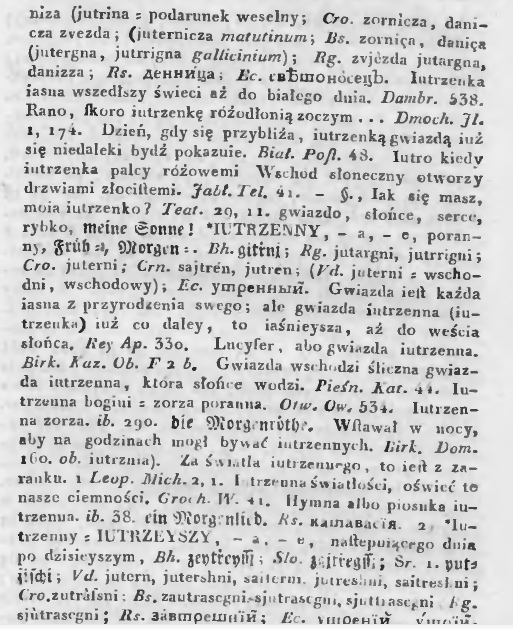
Once more we hop on to Linde re: Jutrzenka, i.e. Morning Star (in Windish Juterniza – cognate to Jastarnia?):

iuterozenkasko1

justernica2And what does that mean for “gestern”‘s and “yesterday”‘s relationship with “stern” and “star,” respectively? jastarnia has a “star” in it but in Slavic “star” is g- or -h or “zvezda”.  But “stari” or “stara” or “staro” means “old”.  Interesting, isn’t?

So was Jassa/Jessa the divine light and the divine morning and the God of the spring (see vesna, wiosna)?  Or was that just Jaster? And was Eostre, the Goddess of both the spring and the morning.  All of them being divinities of the awakenings?

Copyright ©2015 jassa.org All Rights Reserved

February 28, 2015

On the Mountains of Jassa

Published Post author

Note to our readers:

Yes, we will continue with the Polabian Gods’ description and we have a Pomeranian project coming too BUT in the meantime we have a desire to make a brief detour (more to come later on this too).  A detour that leads us far North – or does it?

Hrubyhruby

Hrubý Jeseník (Tall Jesenik) range – the tower in the background is at the highest point known as Praded (grandfather, old man or old…God) (Interestingly, the range also contains such peaks as Keprnik – so that too is not a German word)

The Saga of Hervor & King Heidrek the Wise is an Icelandic saga.  It comes to us in a variety of manuscripts and versions.

One English translation is Nora Kershaw’s 1921 translation under the title of “The Saga of Hervor and Heithrek” (Hervarar Saga og Heiðreks) (so-called manuscript R).

Another is Christopher Tolkien’s 1960 translation of “The Saga of King Heidrek the Wise” (Saga Heiðreks konúngs end vitra) (so-called manuscript H).

Finally, there is the more recent Peter Tunstall’s 2005 translation titled “The Saga of Hervor & King Heidrek the Wise” which itself is a composite of (1) “The Saga of Hervor and Heithrek” (Hervarar Saga og Heiðreks) and of (2) “The Saga of King Heidrek the Wise” (Saga Heiðreks konúngs end vitra).

There are several interesting things about these texts.

First, to get this out of the way, they contains a bagful of names that have made it to J.R.R. Tolkien’s writings.  Tolkien was into the Old English language and Anglo-Saxon myths in general (e.g., Beowulf translation).  If you ever asked yourself where Balin or Gimli come from or, for that matter Boromir and Faramir, these kinds of sagas are it.  (To a Slav, the -mirs and -ins may sound vaguely Slavic and we will have more to say about that later when we discuss -mir’s, -mer’s, -gast’s and -gost’s).  In any event, his son Christopher enjoyed similar topics and, as noted above, also came up with his own translation of the saga in question here.

(Interestingly, although the Tolkien family is usually described as coming to Britain from Germany, his last name is neither English nor German.  For our best guess, together with the requisite German connection, see the village of Tołkiny (German Tolkynen – both from Old Prussian) deep in former East Prussia and today’s Poland).

Second, the sagas although written down much later (earliest manuscripts from the 13th century) deal with what is, in effect, pre-history.  They speak of the Gothic struggle against the Huns, for example.  It is highly unlikely that their writers were using and “improving” on Ammianus Marcellinus, Jordanes, Procopius and the like.   Consquently, they are a window into a time and place which remained largely untouched and unobserved by the Roman writers who, naturally, were only concerned with the various barbarian tribes once those got too close to the Roman frontiers.

Third, there are several interesting Slavic “connections” or at least “hooks”.  The chronicles talk about Gardarike, a term that may be Russia but also may be Pomerania (which was called that by the Scandinavians by reason of all the grads or gards on its shores – e.g., the various Stargards – this what one might have thought were a purely Slavic term (grad, grod, gorod) itself presents problems – e.g., see As-gard…).  Also, in a number of places, there are references to Harvaða mountains, which have been identified with the Harvati, i.e., the Croats and which – may – be the Carpathians (there were also the residences of the Carpi though (as well as the Avari…)).  Thus, we have:

Norse:

“Hinn mælti: ‘Taktu sverðit undan höfðafjölinni ok fá mér,” en sá tók ok brá ok sneið höfuð af fiskinum, ok þá kvað hann vísu: “Þess galt hún gedda fyr Grafár ósi, er Heiðrekr var veginn und Harvaða fjöllum.”

English (Kershaw):

“And he took it and unsheathed it, and cut off the fish’s head, and then spoke a verse:

This pike at the mouth of the river
Has paid the penalty
For the slaughter inflicted on Heithrek,
‘Neath the Mountains of Harvath”

English (Tunstall):

“And he took it and drew it and cut the head off the fish, and then he chanted a verse:

The price was paid
by the pike at Grave River,
when Heidrek was slain
under Harveth Fells.

Other Interesting Things

But there is another interesting aspect of all of this and it is in the following language:

Old Norse:

“Angantýr kvað:

“Kenndu at Dylgju ok á Dúnheiði, ok á þeim öllum Jassarfjöllum; þar opt Gotar gunni háðu ok fagran sigr frægir vágu.”

Nú reið Gizurr í brott ok þar til, er hann kom í her Húna. Hann reið eigi nær en svá, at hann mátti tala við þá. Þá kallar hann hári röddu ok kvað:

“Felmtr er yðru fylki, feigr er yðarr vísir, gnæfar yðr gunnfáni, gramr er yðr Óðinn.” Ok enn:  “Býð ek yðr at Dylgju ok á Dúnheiði orrostu undir Jassarfjöllum; hræ sé yðr at hái hverjum, ok láti svá Óðinn flein fljúga, sem ek fyrir mæli.””

English (Kershaw): 

“King Angantyr replied:

“Challenge them to battle at Dylgia and on Dunheith, and upon all the heights of Jösur, where the Goths have often won renown by glorious victories!”

Then Gizur rode away until he came to the host of the Huns. He rode just within earshot, and then called loudly, crying:

Your host is panic stricken, And your prince is doomed to fall; Though your banners are waving high in the air, Yet Othin is wroth with you all. Come forth to the Jösur Mountains, On Dylgia and Dunheith come fight; For I make a sure boast, In the heart of your host The javelin of Othin will light!

English (Tunstall):

“Angantyr said:

“Point them to Dylgja and to Dun Heath direct them and mark out all the Mounts of Jass;
there Goths often have given battle and fine victory they, famous, gained.”

Now Gizur rode off till he came to the army of the Huns. He rode no nearer than he needed to talk to them. Then he calls out in a loud voice and said:

“There’s fear on your forces, fey are your generals; the battle-banner above you looms; wrath with you is Odin.” And also: “I offer you at Dylgja and on Dun Heath I offer a fight under the Jassar Fells. A corpse be to you on every horse. May Odin let the javelin fly just as I decree.”

 Commentary on Jassarfjöll [um]:

Tolkien:

“These mountains have not been identified.  It has been suggested that their name is identical with that of the Gesenke, the mountains in norther Moravia, and that both the Norse and German forms of this name are corruptions of Slavonic Jesenik meaning “ash-mountain.”

What are “ash” mountains?  Well, they are not volcanoes (unless we are way off geographically (or chronologically! 🙂 ). They are not even “ashen” mountains.  They are simply mountains covered with ash trees (old English “æsc“).  And therein lies the problem for anyone making a reference to these mountains as such – ash in Germanic does not have a “j”.

Botany intrudes once again

Botany intrudes once again

Why are we even talking about ash trees?  Probably because those who interpreted these words were looking to Ptolemy’s mention of Asciburgius Mountains in his section on Germania (he also mentions a town of Asciburgium (also in Germany).  Ptolemy places these mountains right next to the Sudeten (Sudety).  This makes sense except that the Sudeten of Ptolemy may not be the current Sudeten.  Or are they?

Thus, where (it seems) ash or the like is indicated in the same saga, the author has no problem using the Germanic spelling:

Ok er þeir bræðr koma í Sámsey, sjá þeir, hvar tvau skip liggja í höfn þeiri, er Munarvágr hét. Þau skip hétu askar. Þeir þóttust vita, at Hjálmarr mundi þessi skip eiga ok Oddr inn víðförli, er kallaðr var Örvar-Oddr. Þá brugðu Arngríms synir sverðum ok bitu í skjaldarrendr, ok kom á þá berserksgangr. Þeir gengu þá sex út á hvárn askinn. En þar váru svá góðir drengir innan borðs, at allir tóku sín vápn, ok engi flýði ór sínu rúmi, ok engi mælti æðruorð.

(And when the brothers come to Samsey, they see two ships lying in the cove which is called Munway. Those ships were the kind called ‘ashes’. They thought these ships must belong to Hjalmar and Odd. Then Arngrim’s sons drew their swords and bit on their shield-rims, and the berserk-state came on them. Then six of them went out onto each of the ashes. And there were such good warriors on board there that they all took up their weapons, and no one fled from his post, and no one uttered a word of fear.)

[What are “ash” ships (ashen?) as in the above paragraph, is a separate question – thankfully, it seems so far, not for us].

However, the Slavic word for “ash” is jesion which obviously does have the advantage of having an a “J” in it.  The mountains then would be mountains such as the Hrubý Jeseník (German Hohes Gesenke or Altvatergebirge – see above picture discussing the peak Praded) range or the Nízký Jeseník (German Niederes Gesenke).  These are in the Eastern Sudeten Mountains (in Moravia).

samuel

The 1812 (Polish) Linde definition (thank you for the contribution!)

(That the Slavs sometimes kept or added their “J”s is evident from, e.g., jeden vs. eins.  But see Icelandic giant Thjasse (did someone say “giant”? Like a Riese?  Like Riesengebirge?). They also kept the “D”s.  About jeden (Czech, Pol) odin (Ukr, Rus) and Chris Hemsworth’s father Odin, we will, of course, have a lot more to say later… as too about other numerals, e.g., which Slavic numeral is related to et cetera? 🙂 Too easy, no points for this one!)

That there may have been a battle between Goths and Huns we also learn from Widsith’s “Bard’s Tale” poem:

Wulfhere sohte ic ond Wyrmhere; ful oft þær wig ne alæg, þonne Hræda here ymb Wistlawudu heardum sweordum wergan sceoldon ealdne eþelstol ætlam leodum.

(I visited Wulfhere and Wyrmhere; there battle often raged in the Vistula woods, when the Gothic army with their sharp swords had to defend their ancestral seat against Attila’s host.)

That the Jeseniks are close to the sources of the Vistula is, of course, quite correct:

jesenik

Jesenik on the left, Vistula sources on the right

The trouble is that, according to official chronology, there should have been no Slavs in Moravia at the time the Goth-Hun battle took place (or if there were any at all, they would have, perhaps, come with the Hun army which means that no one would have cared what they named the mountains in their tongue).

And so here we are.

Zeitschrift für Erdkunde, etc (from 1847):

This suggests the “hilly” terrain next to the village Jeser in Pomerania… With all due respect “hilly” terrain seems a bit underwhelming for the site of such a mountain battle (we can believe the Huns, in their short reign, made it to Moravia but Pomerania seems a bit of a stretch).

Afterthought

Note also that some Slavic “nationalist” historians disputed the location of these Jassar mountains in the Sudeten.  The reason seems to be that that would have meant admitting that Goths had been in Poland/Moravia or close enough.  Consequently, they looked for name Jassar further east, as in the Bieszczady or even further around Ossetia where the Gothic kingdom would have ended and where various Sarmatian tribes included the Iazyges and other similar sounding tribes (that some of these tribes may have, in fact, reached Poland did not seem to have bothered them).  For the same reason, the same historians placed Gardarike as far East as possible, leaving all of Poland, Belarus and Ukraine free of their domination (e.g., insisting that Palteskia means Polotsk and not, for example, Pultusk).

palteskia

The famous Hauksbok with Palteskia, Pulina land and Polena (to the east of which is Reidgota land and, thereafter, Hunland)

(BTW, the Hauksbok does not contain the references to Jassarfjöllum since it ends in the middle of Gestumblindi’s riddles leaving what happened later to other manuscripts)

What they did not seem to see, however, was the potential connection of the Sudeten Mountains with a, possible, pre-Germanic stratum (of whatever type but tied to Poles), assuming one were willing to read Jassarfjöllum as a case of (so to speak) singular possessive, as in Jassa’s Mountains (e.g., Stary Ded or Altvater).

(And aren’t these Jesenik mountains close to the R-Iesen Gebirge (Krkonoše or should it be Craco- or Krakonose!?), so maybe these latter ones are the Jassarfjöllum! Ok, so we are getting out of control here – time to stop)

answers

Lucas of Great Kozmin’s eerily ancient answer???

For more see here regarding Polish Gods and here regarding crazy etymologies.

Copyright ©2015 jassa.org, All Rights Reserved

February 14, 2015

Reports of the Slavs From Muslim Lands Part I – Ibrahim ibn Ya’qub’s Account

Published Post author

Ibrahim ibn Ya’qub al-Israili, was a Jewish merchant from Tortosa (whether he was also a Muslim is debatable).  In the year A.D. 965, he traveled from Muslim-occupied Spain (the formerly Vandal, Al-Andalus) to Mainz and then to Magdeburg, the residence of German Emperor (as of 962) Otto I where, interestingly, he claimed to have been received by the Emperor (or was it puffery?).  Who was Ibrahim?  He was a merchant but beyond that we are not sure.  That he was given access to Otto suggests that he may have been an envoy and his account below suggests that either he also may have been a scout or a spy or that he was just naturally curious or, most likely, both.  If he was an envoy/spy then he was in the service of the Cordoban caliph Al Hakaman II (ruler between 961-976).

nottortosa

Ibrahim was thrilled to get new orders from the caliph and leave the sleepy Spanish Coast…

It is worthwhile to mention that we have briefly met his father Abd-ar-Rahman III already.  The father, also bears mentioning at this point, was a warrior who may have had a special Slavic guard of over thirteen thousand soldiers who helped him conquer portions of Spain and also North Africa (but maybe they were just slaves not Slavs…unclear).

The son, Al Hakhaman was a patron of the arts (his library contained something like 400,000 plus manuscripts) but was not a warrior.  What he was, however, was homosexual and was known to have kept a number of (male) harems.  Of course, a rich ruler gets bored easily and so his harems need replenishing.  Thus, it may well be that while his father kept Slav warrior slaves, the son was sending Ibrahim on a mission to get him some information and some male Slav sex slaves.  At the time the slave trade was booming and Slavs were the primary bounty (yes, we will have more on that later).  Prague was the center of this trade as of other trade as Ibrahim, himself, describes below.  Of course, we do not know Ibrahim’s mission for sure and, likely, will never know leaving the above in realm of speculation.

presussen2

…for a little nature get away

It was in the service of Abd-ar-Rahman III, the father, by the way, that Hasdai ibn Shaprut performed all his diplomatic miracles as mentioned here. Ibrahim, it is worth noting may well have known Hasdai since the latter did not pass away until the year 970 or so.  It is conceivable then that Ibrahim would have brought back to Hasdai the news of the defeat and final collapse (A.D. 965) of the Khazar Kingdom at the hands of the newly emergent Rus.

In any event, it appears that after visiting with Otto I in Magdeburg he went on to Prague (the year was 965 so the princess Dobrava was just heading out to see her new husband, still non-Christian, Mieszko) and also went to see the Obotrites in the North though the order of his travels is uncertain (his visits to the Czech capital and to the Obotrite capital are relatively clear from the distances given and a description of the approaches to those cities (another reason that suggests that he was more than a merchant).  As for Poland, the lands of Walitaba (Veleti), the Prussians or the Amazons, it seems that Ibrahim had not ventured to those and that his information comes second-hand from people he met in his travels.

Ibrahim’s original account did not survive but, as already mentioned, some of his writings are replicated in Abu ‘Ubayd al-Bakri’s (11th century) “Book of Roads and Kingdoms.”  Since this is a “classic” account containing some of the first mentions of the Bohemian (first mention of Prague), Polish (other than Widukind’s mention of 963, this seems the earliest mention of Polish lands) and West Slavic countries (and of Baltic Prussia – Burus), we transcribe it here in most of the relevant parts (skipping only the German, lengthy Bulgarian and “hearth & home” sections – the last one we will return to in part III of this series).

From Abu ‘Ubayd al-Bakri’s Book of Roads and Kingdoms

“The Saqaliba are descendants of Madhay, son of Yafith (Japheth) and they dwell in the north-west.” says al-Bakri, then switching to Ibrahim’s reporting:

Ibrahim ibn Ya’qub al-Israili says:

‘The country of Saqualiba extends from the eastern Mediterranean to the north Atlantic.  The tribes of the north dominate them and now live among them.  They are of many different kinds.  They were once united under a king named Makha, who was from a group of them called Walitaba.[1]  This group was of high status among them, but then their languages diverged, unity was broken and the people divided into factions, each of them ruled by their own king.”

[We note that a similar term appears in other Arabic writings, e.g., Majik of the Walitaba or Walinana – which, presumably, is a reference to the Volinians of Wolin (or Wollin) Island – who are the same as the Veleti or Walitaba – either way from the Veletian Union on Wolin (from Masudi on the Slavs from A.D. 943; of course, the same Masudi speaks of the majus when speaking of, apparently, Viking (but, maybe, Wendish pirates – more on that later when we discuss Britain) raiders hitting the coasts of Al-Andalus); same people aka the Wilzi in some sources]

“At the present time they have four kings: the king of the Bulqars; Boreslav [the Cruel], king of Prague (Faraga) and Cracow (Karaku); Mieszko (Mashaqu), king of the North; and Nakon (Naqun), who rules farthest west.”

On Nakon’s Country

[Duke of the Obodrites]

“The country of Nakon is bordered on the farthest west by the Saxons [Saksun] and some Norsemen [Murman].  His country has low prices and many horses, which are exported to other places.  They are well armed, with shields, helmets and swords.”

grossgross

A museum at Gross Raden

“From Burgh (Fargh [Magdeburg?]) to Mayliyah [?] is ten miles and from [there] to the bridge is fifty miles.  It is a wooden bridge, a mile long.  From the bridge to the fortress of Nakon is around 40 miles, and it is called Grad, which means a “large fort”  Facing Grad jus a fort built in a freshwater lake.  This is the kind of place where the Saqaliba build most of their forts, in swampy meadows with thick foliage.”

prussia

There be thick foliage

“They trace out a circular or square space the size they want their for to be, and then dig a trench along the perimeter and heap up the earth into a rampart, which they then reinforce with planks and logs, until the walls of the fort are the height they require.  They make a gate wherever they want and build a wooden bridge leading to it.  From the fort of Grad to the Surrounding Sea is eleven miles.  No army can penetrate the lands of Nakon without great difficult, because the country is all marshy, thickly forested and muddy.”

starogardreconstruction

Stargard (Oldenburg in Schleswig-Holstein) reconstruction

[we note here that Nakon died about 965-966, a fact that Ibrahim does not seem to know about suggesting he visited there immediately before those events – maybe a hit commissioned by Otto using a Cordoban “merchant” emissary – let your imagination roam]

On Boreslav’s Country

[Boleslav, Duke of the Czechs]

“As for the country of Boreslav, from the city of Prague to the city of Cracow is a journey of three weeks; its length is comparable to that of the country of the Turks.  The city of Prague is built of stone an dime.  It is the pinrcipal trading city.  The Rus and the Saqaliba go there from Cracow, to trade, and so do Muslim merchants from the lands of the Turks, as well as Turks and Jews, with [mathaquil al-marqatiyya [?] weights [?]].  They carry away slaves, tin and various kinds of furs [?].  Their country is the best in the north the richest in provender.  There a man can buy enough flour for a month for a qinshar.  In Prague are made saddles and griddles and the leather shields used in their countries.”

prahaska

Prague, a few hundred years after Ibrahim’s visit but before the tourists ruined it

“In Bohemia are made small lightly-woven kerchiefs like nets, embroidered with crescents, which have no practical use.  The value of ten of these kerchiefs is always equivalent to none qinshar.  They trade and exchange them, and have receptacles full of them.  They constitute wealth, and the most expensive things can be purchased with them, wheat, slaves, horses, gold and silver and everything else.  It is surprising that the people of Bohemia have brown or black hair; blonds are rare among them.”

“The road from Madhinburgh [Magdeburg?] to the country of Boleslav [to] and from it to the fort of Qaliwa is ten miles, and from it to Nub Grad is two miles.  It is a fort built of stone and lime, and it is on the Saale River [Slawah], into which falls the River Bode.  And from Nub Grad to Mallahat al-Yahud [Salzmunde?]  which is on the Saale River, is thirty miles.  From there to the fort of Burjin, which is on the River Mulde [Muldasah] … and from it to edge of the forest is twenty-five miles; from its beginning to its end is forty miles, through mountains and forests. for,, it to the wooden bridge over the mud is about two miles.  From the end of the forest the city of Prague is entered.”

On Mieszko’s Country

[Duke of the Poles]

“As for the country of Mieszko, it is the most extensive of their countries.  It abounds in food and meat and honey and cultivated fields.”

gnieznensi

Gniezno reconstruction; courtesy: the Museum of the Beginnings of the Polish State

“His taxes are levied in [mathalqil al-margatiyya [according to how much they weigh?]], and they are used to pay the monthly salaries of his men, each of whom receives a fixed number.  He has 3,000 shield-bearers.  One hundred of his soldiers are equal of 1,000.  The men are given clothing and horses and  weapons and everything they require.  If one of them has a child, he is immediately assigned an allowance, whether it is male or female.  When it grows up, if it is male, he provides for its marriage and gives a dowry to the father of the girl.  Dowries are very important to the Saqaliba, and their customs concerning them are like those of the Berbers.  If a woman has two or three daughters, they are considered a form of wealth.  If a man has two sons, it is a cause of poverty.”

On the Prussians

[that is the Baltic Prussians]

“Mieszko is bordered to the east by the Rus and to the north by Prussia.  The inhabitants of Prussia live on the shore of the Surrounding Sea.  They have their own language, and do not know the languages of their neighbors.”

masure

Old Prussians’ defenses were impregnable – at any temperature above 32 Fahrenheit

“They are famous for their courage.  If an army comes against them, not one of them waits until his comrade joins him, but each man charges on his own, striking with his sword until he is killed.  The Rus raid them in ships from the west [presumably Vikings from Sweden].”

On the City of Women 

“West of the Rus lies the City of Women [Magda/Mazovia?].  They have fields and slaves, and they bear children from their slaves.  If a woman has a male child, she kills it.  They ride horses and devote themselves to war; they are brave and fierce.”

ibrahim

In telling his Amazon story to Ibrahim, Otto (in the middle) relied heavily on visual aids

“Ibrahim ibn Ya’qub says: ‘The story of this city is true; Otto, the king of the Romans, told me so himself.'”

On the Walitaba Country

[Veleti]

“To the west of this city is a tribe of the Saqaliba called the nation of Walitaba.  It is in the scrbuands of the country of Mieszko to the north-west.”

coastline

Wollin coast – it was a lot woodier in the olden days

“They have a great city on the Surrounding Ocean [presumably Wolin].  It has twelve gates and a harbor, with a revetment of wooden pilings [?] [wa hum yasta maluna la-hi shuturan harlan].  They make war on Mieszko and are very courageous.  They have no king and trade with no one.  Their judges are their old men.”

[1] this name Walitaba refers to the Veleti.  Also known as Wilzi.

Copyright ©2015 jassa.org All Rights Reserved

January 10, 2015

On the Water-Witch of Lubusz

Published Post author

The Chronicon Monte Sereni was written at the Lauterberg Abbey near Halle.  It contains a number of interesting pieces of information about surrounding Wendic/Slavic lands.  Among them there is the recollection of the tale of the witch of Wladyslaw Laskonogi (or “Spindleshanks”).

For context, Wladyslaw was one of the grandsons of Boleslaw III, Krzywousty (and a son of Mieszko III the Old).  He was born in the 1160s and died in 1231 (apparently killed by a German Maedel he tried to, ahem, “bed”).  He was, as per Jan Dlugosz, not very loved by his people given his propensity for lecherous activities (see above).  The period between 1138 and 1320 was a period of the (self-inflicted) partitions of Poland where every little prince
and duke was at war with one another – a very interesting time which we hope to discuss in detail.

sereni

courtesy, MGH

For now, however, the incident of interest is his conflict with Konrad II the margrave of Nieder Lausitz (Lower Lusatia).  Konrad (who was also Wladyslaw’s brother-in-law) decided to invade so-called Lubusz (Lebus) Land – an area then part of Greater Poland (now the city itself is in Brandenburg) and besieged Lubusz.  Wladyslaw, then in charge of GP marched against him.  It was March, 1209.

witches

The witch sans sieve – she was a jolly one

To make a long story short, the Chronicle reports that the Polish prince first set the time and place of battle but thereafter broke his word and tried to attack by surprise.  This failed.  However, as the Polish forces, crossed the Oder, the Germans noted that the Poles were being led by a witch who carried with her a magical sieve containing water from the river, and reports were coming in that the sieve retained the water (they say), this being a certain omen of upcoming victory.    The chronicler then notes that the Germans first killed the witch – apparently, so as not take chances.

This seems to be the first Polish (confirmed) sighting of an actual witch.

Copyright ©2015 jassa.org, All Rights Reserved

January 8, 2015

Polish Gods Part IV – On the Baptism of Poland by Jan Dlugosz & its After-Effects by Thietmar of Merseburg

Published Post author

We relate here what the Polish priest Jan Dlugosz says in his Chronicle of the Poles of the fateful events surrounding the “Baptism of Poland” under the heading “The year of our lord 965” [Dobrava arrived in 965, the baptism took place in 966].

We note that there may have been earlier attempts to convert portions of Polish lands – indeed Cracow may already have been Christian by 966.  There is, for example, a threatening missive from Methodius to the “duke in Vislech” to accept Chrisianity willingly or have it shoved down his throat at the point of the sword (see the Chronicle of Methodius).  Nonetheless, little is known of this and those portions were, apparently, not portions of Poland yet (Cracow likely belonged to the Czechs until Mieszko or Boleslaw took it).

believer

The famous “Methodius’ Offer” painting (water colors) from the IXth century, shows Methodius listing the benefits of conversion to the “Duke in Vislech”

BTW we mention Dlugosz from the 15th century since earlier sources (Gallus Anonymous, Master Kadlubek and the Great Poland Chronicles) do not discuss these events in any detail other than to note that Mieszko was first blind but then, at seven, finally gained his sight – this aws an allegory (apparently) to the future baptism of the entire country.  Now, Dlugosz wrote half a millennium after the events in question so that one might question how much of this is accurate but, having said that, this is all we have… almost since there are also reports from the Germans like Thietmar… but first to Dlugosz.

Jan Dlugosz

regius1

“A.D. 965 – Mieczyslaw, the duke of Poland marries Dobrava the daughter of the Czech duke and leaving pagan idols, accepts the christian faith with the entire nation”

“After a warning from Christian believers and friars Mieczyslaw left his seven concubines tied to him with the love of the flesh, so that the female pleasures should not hold him in the blind addiction of idolatry.”

priorwives

Mieszko’s prior wives in traditional Polish red-white uniforms (picture taken at a harvest festival)

“After separating from them [the concubines, i.e., current wives] he sent his envoys to Boleslaw, the Czech duke, the brother and killer of Saint Wenceslas, asking for the hand of his daughter Dobrava which he desired to marry as the only and lawful wife.  The Czech duke said that he won’t refuse such an honorable and excellent son-in-law so long as he should first give up his pagan errors and accept the order of the Christian faith; otherwise he won’t allow his daughter to marry a pagan duke and an idolater; the princess gave a similar answer from her side that it is not proper for a Christian woman to marry a pagan; but if Mieczyslaw the Polish duke should give up the disgusting idol worship and accepting baptism he should be reborn with a new life, then in that case she will not deny him her hand;”

dabrova

Dobrava in a local Plzner promotion – Mieszko’s choice could not have been more difficult

“When the envoys came back to Poland with these messages, duke Mieczyslaw called all the elders and lords and in a well-attended meeting he tried to get counsel what one should do.  The lords had different views so that it was decided to delay the decision till the next day.”

mieszko

Mieszko got agitated at the council meeting

“But that night the foreseeing God, took mercy on the penury and blindness of the Polish nation, and during their sleep filled Mieczyslaw in his dreams as well as a majority of his advisers with a dire warning and order that they should not miss the serendipitous opportunity presented them and to know, before accepting their new faith, that their country should blossom into the future [should they accept it].”

changeofcircumstances

Many of the best of the country’s citizens had an unexpected change of heart over night

“With this revelation, the Polish duke was convinced and he and the elders unanimously agreed to surrender themselves to the holy faith of Christ. And so many envoys  were now sent to the Czechs and promised that in order to obtain marriage not only the Polish duke but also the entire Polish nation, after having first learned exactly the tenets of the Christina faith, will accept baptism…”

[the Czech duke Boleslaw now, of course, agrees to provide his daughter together with worthy dowry]

regius2

“… there were among the lords and elders of the kingdom many who were strongly opposed to this not allowing to accept the Christian faith.  Some argued that this new Christian faith is full of superstitions and nonsense; others argued that it would be hard to keep such a faith; others that it i unworthy to give up the faith of their fathers and mothers, and freely bend their necks to a new and unknown faith.  These, however, and other difficulties, the loving god, who gives good counsel to kings, took pity on the foolishness and blindness of the Poles, took away their doubts, and filled them with the spirit of agreement and drove them to accept the Christian faith so that, by rejecting it, they should not become a target of shame among the Czechs and others…”

shaming

The Czechs’ mockery – what Mieszko feared the most

“… After a few days, prince Mieczyslaw [BTW it’s always Mieszko – Mieczyslaw is Dlugosz’s invention], after having learned the rules and rites of the correct faith from monks and hermits, which with this purpose in mind, he had brought [to his country], together with lords, nobles and certain better [!] citizens gives up the darkness of prior errors and accepts the rightful faith of Christ; the first step of his conversion to the light of the faith he celebrates with the cleansing mercy by accepting his baptism here in Gniezno.  And so cleansed of his sins in the holy fount of rebirth, he uses the baptismal water to cleanse mistakes and paganisms, away from the superstitious worship of idols and towards the knowledge of the true go of the pure and chaste faith…”

“… and at this time, the entire Polish nation accepted the shackle [this is in the text] of salvation of the holy Christian faith; from the mercy of the lord, and with the fervent attempts of Mieczyslaw and his wife Dobrava, Poles saw the light of the faith, when in the Peter Chair there sat Leon VIII, a born Roman who also in this year said good bye to the world and after him there sat down…”

fiathfullight

The light of the true faith is best seen from this angle

“… and thereafter from the most severe command of the duke, and a unanimous resolution of the lords and nobles [1%? of the population?] all the idols were broken and statues of false Gods, their temples were burned and their worshippers and believers were condemned  to the loss of their property and the penalty of the sword.  Polish Duke Mieczyslaw not only abrogated all the feasts and rites honoring the pagan Gods, but also brought together all the magicians, augurers, sorcerers and such and forbade all festivities public and private which were previously part of idol worship.”

refusenik

A Polish refusenik at a Sacred Grove

“Our God, namely, is not similar to those false gods about whom the Polish people thought that they could be roused with noises, feasts and festivities and all kinds of godlessness.  A happy and god-chosen duke who first brought the Poles to the faith of salvation and allied with the holy church through the knowledge of the truth and the abandonment of the idols.  And because in almost all the larger towns and villages there stood statues of Gods and Goddesses, idols and sacred groves, which the people were not altogether eager to destroy, as they were commanded by Mieczyslaw, therefore he ordered that the seventh of March be designated as the day when they shall be crushed and destroyed in all the Polish lands.”

“When this day came, all the towns and villages were forced to hit and topple the statutes of their Gods, and, once crushed, to drown them in marshes, lakes and ponds, and to cover them with stones, [a task] for which there came forth in great numbers people of  both sexes and not without mournful sorrow and cries of the worshippers of these idols, especially among those, who, by reason of having performed rites to honor these [Gods] derived certain benefits [i.e., the priest class], but because of the fear of ducal officials they dared not resist the order.  A reminder of this destruction and drowning of these false Gods and Goddesses idols lives on until the present day in certain Polish villages, where in the fourth Sunday of Lent [Laetare Sunday] they stick on long poles images of Dziewanna and Marzanna [Dzyexwyanye et Marzane], and then they throw them and drown them in nearby bogs.  And so the continuation of this task has not yet ceased among the Poles in this ancient custom.”

dlugosz2

And so it was that Mieszko converted his country so as to marry the woman he loved.  We note that being a much more noble reason than that of Henry VIII who converted his country just to get a divorce.

Thietmar 

And now this is bishop Thietmar of Merseburg reporting on the events in Poland after Mieszko’s passing during the reign of Boleslaw the Great:

thietmar

Bishop Thietmar – known for his writings on cattle, mules and scrota – never saw an Abrahamic religion he didn’t get a hard on for

 “In the country of her [Oda’s] husband [i.e., Boleslaw the Great’s country] there are many customs and although they are terrible, some must be applauded.  His people, namely, must be watched like cattle and need a whip like a stubborn mule; also it is impossible to rule with the interest of the ruler in mind if the ruler does not apply the harshest punishments.  If anyone from these people should dare to enchant someone else’s wife [remember polygamy was permitted before the year 966] or engage in lascivious acts, he is then subject to the following penalty: he is led to a market bridge and then attached to it with a nail through his scrotum.  And then there is placed next to him a sharp knife and so he is given a tough choice: either he should die or to cut off that part of the body” [we have a rather difficult time picturing the exact mechanics here but, be that as it may, the whole thing sounds unpleasant].

successful

And the same refusenik, now, after having undergone a successful conversion

“If it has been discovered that someone ate meat [during Lent], he was punished severely by having his teeth knocked out.  God’s law you see, only recently introduced to this country, grows greater in strength through such duress than it would [only] through the Lent/fasting ordered by the bishops.”

[we chose not to publish the “teeth” photos as they seemed too drastic and, therefore, unsuitable for our audience]

Copyright ©2015 jassa.org, All Rights Reserved

January 6, 2015

On the Synodal Statutes (1420?) of Andrew, the Bishop of Poznan

Published Post author

statutatsattt

the original (or as original as we get)

Andrew (of the clan “Godziemba”) of Gosławice (pol, Andrzej Łaskarz z Gosławic herbu Godziemba) was the Bishop of Poznan (between 1414 and 1426) and a well-regarded and quite an accomplished man.

We know this, in the first instance, because he appears in the literature under names suggesting importance, relevance and being an altogether heavy-hitter.  Thus, for example, he is written up as Andreas Lyaskarius de Goslawicze, nobiles (but, of course!) de domo Godziamba.  He was born in 1362 as the son of Laskarz and Dorota from Goslawice (and that should also tell you that he was important since  were he of peasant stock, his contemporaries may not have even known his parents’ names or dates of birth and we certainly, six centuries later, would not even dream of knowing them).  His father was a castellan of Konin and his mother was, likely, related to the the later Poznan Bishop Piotr Wysz.  Andrew studied in Brodnica and then, at 17, moved on to Prague where he received his bachelors degree in 1392/1393.  He then moved on to the University of Padua where he received a doctorate in 1405.

However, putting all of this “silver spoon” stuff aside, he used his privileged upbringing quite well and to the service of his country (even while juggling his studies it seems).  He was an emissary to the Grand Master of the Teutonic Knights Konrad von Wallenrode (who was followed by the Jungingen brothers, the second of whom ended up going to see his lord at Grunwald/Tannenberg).  In 1397, Andrew became a secretary to queen Jadwiga.  He participated in various church councils, he traveled to the Holy Land, he represented Poland against the Teutonic Knights at various diplomatic meetings (along with the more famous Paul Wlodkowic) and, of course, was a bishop of Poznan.  He is likely to have known Lucas of Great Kozmin.

In 1415 he was at the Council of Constance as a member of the Polish delegation.  That council concluded in 1418 (and is best known in history for putting the Czech church reformer Jan Hus to the torch).  Upon returning from Constance, the Primate of Poland, Mikolaj Traba called for a provincial meeting of the clergy first at Wielun and then the clergymen continued their deliberations at Kalisz.  The purpose presumably was to educate the locals on the new church findings/doctrines/laws and start the implementation phase (maybe gossip about Hus).  We may assume that other European Constance attendees had similar “country” meetings after returning home.  Those provincial Wielun/Kalisz meetings concluded on the 25th of September 1420 (as per Jan Dlugosz).  Their result was a series of statutes that applied country wide to all of Poland.

After the provincial synod, the local clergy, in turn, returned to their own dioceses and called for meetings there.  In the case of Andrew, he returned to Poznan and it was then at that point that he called for a meeting of the local Poznan clergy that produced the below discussed Statuta Synodalia Andreae Episcopi Posnaniensis, i.e., the statutes (or laws) for the Poznan diocese (diocese being a part of the Polish province).  Presumably, they were a reflection both of what was discussed at Constance and later at Wielun/Kalisz.  Again, we may assume that similar meetings were taking place at all the local church levels all over Poland (and Europe) in a kind of a trickle-down evangelism.  Note for example that we already briefly (breviter) mentioned here the Statuta Breviter of Gniezno.  When did the meeting in Poznan take place?  Presumably after the national Wielun/Kalisz meeting so September 26th 1420 would be the earliest date – but before Andrew died in 1426.

laskarza1These Poznan statutes (but also the Statuta Brevier which deal with similar issues in places) are of great interest as they deal with all kinds of deviations from church policy/docrine and with other excesses.  While some are trivial (in their nature, if not in effect) and read a bit like a list of sins of the political class of any respectable middle or southern European country (or of a banana republica latina), others are point to folk practices, beliefs, superstitions and customs that co-existed with and in full view of Christianity – in fact, many local priests participated in these “excesses”.  It is a selection of these latter ones that we present here for our readers.  We note, upfront, that some of these may be or “proto-Slavic” nature (indeed some of them are also subject to scorn in Bohemia), others may have developed in Poland alongside of Christianity and others yet may have come from other countries (e.g., dyngus from Germany?).  Some of these customs we would likely see today as joyful and fun, others as great if kept in moderation, others yet as clearly “excessive” and yet others as, likely, troublesome.

Statuta Synodalia Andreae Episcopi Posnaniensis

(selected items)

 VII.  De fonte baptismali  (Of the baptismal font)

vii1


vii2

Item statuimus et sub poena trium marcarum mandamus, ut quilibet curatus fontem baptismalem, crisma et oleum sacrum, ac sacratissimum corpus domini nostri Jesu Christi sub seris et clausuris semper habeant, ut nulli alteri quam ipsis pateat accessus propter sortilegia et maleficas mulieres, et conservent in mundis et decentibus locis; caldareque aereum vel plumbeum in fonte baptismali infra hinc et festum Paschae proximum habeant comparatum propter stillicidium, quod fit fontibus ligneis.

(Furthermore, we order and command, under the penalty of [three (?) marks], that in each parish the baptismal fount, chrism/myrrh and sacred oil, the most sacred body of our Lord Jesus Christ be kept under lock and that no one have access to these except [the priests] because of sorcerers and witch women and to keep such [relics] in a clean and decent/well thought-out place; Caldar [?] [bronze/steel/lead vase for, e.g., sprinkling Holy Water] to be placed below the font [at the time/close to?] Easter… in cases of fonts made of wood [?]) (you get the gist)

XXIX. De columbationibus (On caroling/kolenda/kolyadam)*  

xxix

Item prohibeatis columbationes nocturnas in festo sancti Stephani, cum illa nocte furta, homicidia et plura mala committantur.

(Also, let there be forbidden carolers (kolednicy/calenda – see too here for a Croatian version of yule-tiding mariner carolers) going about at night on the second day of Christmas (Saint Stephen’s Night) for on that night there occur therefore murders, thievery and other bad excesses)

Note this was also the Latin sterna, i.e., auguries, e.g., for the new year.

XXX. De ludis festorum (On festive games)

xxx

Item in vigilia Nativitatis Christi prohibeantur ludi et superstitiosae opiniones, quae – proh dolor! – in hac vigent patria.

(Likewise, let there be forbidden on Christmas Eve games and superstitious beliefs/doctrines which – alas! – blossom in this country)

XXXI. De incantationibus mendosis et benedictionibus (On mistaken incantations and blessings)

xxxi1

Item superstitiosae benedictiones et mendosae, quae non habent in sacris scripturis fundamentum, prohibeatis.

(Also, let there be prohibited superstitious and mistaken blessings that do not have foundations in the sacred scriptures)

xxxi2

Item omnes incantationes, quae consueverunt fieri de nocte sanctorum Philippi et Jacobi Apostolorum prohibeantur.

(Likewise, let there be prohibited the enchantments that have become commonplace during the nights/Feats of Saints Phillip and James (this was May 1st – now, since the reform of the Roman calendar in mid-20th century, May 3rd)).

XXXIII.  De incantationibus et abusionibus carnis privii (Regarding incantations and other Lent [i.e., carnival] abuses)*

xxxiii

Item, quia multe incantationes et superstitiones consueverunt fieri in carnis privio, arceatis [articulate?] populum, verum ut a talibus desisteret, et a dissolutionibus effrenatae consuetudinis, ut viri mulierum vestibus, et mulieres virorum vestibus utantur.

(Also, because it is customary to name many enchantments and superstitions during the Lent time, tell the people to desist from such and to terminate/dissolve the carrying on of such customs, such as the dressing of men in women’s clothes and women putting on men’s clothes).

* Whether these carnival abuses then then also led to carnal ones is another matter (not for this blog; let us just say that winters are cold in Europe).  Note that the etymology of carnival is that of “letting go of meat”, i.e., giving up meat on Lent before Easter (as to Easter, note the connection to Yassa/Yasse via Yasterbog/Jasterbog of the Kaszubians – see, e.g., Jastarnia – we will return with stories of the Venerable Bede & Einhard & others, later)

XXXIV. De pactatione ovorum (On trading eggs)

xxxiv1

Item prohibeatis, ne feria secunda et tertia post festum Paschae masculi foeminas, et foeminae masculos praesumant pro ovis et aliis muneribus depactare, vulgariter dyngowacz, nec ad aquam trahere, cum tales insolentiae et strangulationes non sunt sine gravi peccato et sine divini nominis offensa, cum in die Pasche vel circa hoc tempus sunt eucharistiae sacramento procurati; igitur sint solliciti qualiter in omni devotione et disciplina morum se custodiant et observent.

(Also prohibit, on the second and third day after Easter (e.g., Lany Poniedzialek and thereafter) that men ask women and women ask men for eggs and other presents, which in the common tongue is called dyngowacz, and to run to water because such lawlessness and insolence do not take place without also them being grave sins and offenses against the divine name, when this happens around the time of Eucharist/Easter; therefore, be careful and observe whether they they will keep themselves in every lesson in moral conduct and in devotion)*

* The feast of Smigus-Dyngus (whether this comes from Germany (Schmackostern (from, yes, smacking), Stiepern – stypy?) is a topic for another post though we will note here that the only places in Germany where this was a practice seem to be only the former Slavic ones so whether this is originally of a Slavic or of a Germanic beginning is to us unclear although the dyngowacz seems to be of German origin – Dingen = things you give so as not to get smacked) was originally a kind of “trick or treat” event.  Specifically, you might get whacked/smacked with a branch from a “palm” tree (remember Palm Sunday?) unless you treated your interlocutors with presents.

Alternatively, the branch was replaced with water and the presents with eggs – and, voila! here is your Easter (or, rather, the fun parts!);

xxxiv2

Item prohibeatis comessationes et ebrictates, cum secundum apostolum tales regnum Dei non possidebunt, et praesertim in festivatibus Pentecostes Navitatis Dominin et aliis festis, sed ut divinis officiis sint intenti.

(Also prohibit eating and drunken debauchery [whoa!?] [especially during the Pentecost, Christmas and at other Holy Days, for as the Apostles tell us such persons [acting this way] shall not inherit the Kingdom of God)

XXXV.  De imagine straminis in jejunio (Of [the carrying of] straw imagines during fasting [Lent])

xxxv

Item prohibeatis, ne in dominica “Laetare”, alias “Biala niedziela”, superstitiosam consuetudinem observent, efferentes quamdam imaginem, quam mortem vocant, et in lutum postea projiciunt, quia non carent hujus modi facta scrupulo superstitionis.

(Also prohibit on the Laetare Sunday* (alias White Sunday), the superstitious custom of carrying around a kind of a puppet that they call “death” (i.e., Marzanna), which they then throw into the mud as they are not free from these kinds of superstitions)

Same practices were also subject to prohibitions in the Prague diocese in 1366 and again in 1384 during a local synod.

* Fourth Sunday of Lent

XL. De abusionibus circa funera (Of abuses at the time of funerals)

xl

Item superstitiosas, consuetudines, quae consueverunt fieri circa funera, prohibeatis.

(Prohibit also the superstitious rituals that are customary at funerals)

LVIII. De choreis nocturnis festorum (Of night dances and feasts)

lviii

Item inhibeatis nocturnas choreas in diebus sabbativis et in vigiliis sanctorum Joannis Baptistae, Petri et Pauli, cum plures fornicationes, adulteria et incestus illis temporibus committuntur.

(Prohibit too the nightly dances that take place during days of the sabbath (sobotki or kupalnocki in the summer) and on the days of the Saints John the Baptist and Saints Peter and Paul, for there are fornications and adultery and incest committed in those times)

Copyright ©2015 jassa.org, All Rights Reserved

January 3, 2015

The Tale of Piast and Popiel as seen in Gallus Anonymous’ Chronicle

Published Post author

We thought it  interesting to produce an English translation of some of the more popular stories and myths of Slavic countries without analysis, interpretation and paraphrasing (something different this time).  To give you what’s there – literally – in the old chronicles.  We will start with the earliest versions but, to the extent we think there is interesting stuff in subsequent iterations of the tale, we will include those as well.  We will start this series with the tale of Piast (with Popiel) but have plans for other stories as well.

With regards to Polish sources, we have the Anonymous Chronicle as the most ancient source, then Master Vincent Kadlubek’s Chronicle, then Dzierzwa and then the Greater (Old) Poland Chronicles.  Finally, there is Jan Dlugosz who is hardly an ancient source but whose versions are always entertaining – for that reason we will include him as well.  Subsequent tales and myths of Miechow, Kromer, Bielski or Guaginin/Stryjkowski we will not include in these series as they are more modern and, we think, do not add much worthwhile material in this respect.

Gallus Anonymous Chronicle

About Duke Popiel [called Choscisko]:

latino1

There was namely in the town of Gniezno, whose meaning in Slavic is simply “nest”, a duke by the name of Popiel, who had two sons; according to pagan custom he prepared a great feast for their postrzyzyny [hair cutting ceremony wherein the boy became admitted to adulthood – aka First Communion or Pole-mitzvah], to which feast he invited a ver many of his magnates and friends.  It happened, however, from God’s mysterious will, that there arrived two guests , who were not only not invited to the feast but were even in hurtful ways turned away from city gates.

threewanderers

Some versions of this story have three guests arriving

And they, outraged at the cityfolk’s inhumane treatment of them, went straightaway to the burbs [i.e., the area around the city walls where poorer people dwelt], where they fortuitously happened upon the little house of a ploughman of the aforementioned duke who was arranging the feast for his sons [this “who” seems to refer to the duke’s feast, rather than to the ploughman].

gnieznen

Piast’s house is the second bottom one from the left

This poor man full of compassion, invited the strangers to his house making it available [to them] in all of its poverty.  And they, grateful to be so invited upon entering the friendly house, said unto him:  “Be happy indeed that we have come and perhaps our arrival will bring unto you a wealth of all good things, and from your offspring pride and fame.”

About Piast the Son of Choscisko:

latino

[note that this section has caused much confusion as it suggests, given the title of the preceding section, that Piast was the son of Popiel – as far as we know that is an unresolved issue and people have lived with this problem and, absent new sources, will have to continue to so live; incidentally, Choscisko seems to mean someone with out of control hair]

“Those who lived in this friendly house were one Piast, the son of Choscisko and his wife by the name Rzepka; and both of them with all their heart tried to tend to the needs of their guests, and seeing their prudence/wisdom, they got ready to run secret plan they had concocted by the guests [?].  When sitting down and according to custom they talked about various things, and the visitors asked, what is there to drink, the hospitable ploughman answered: “I have a barrel of fermented beer which I have prepared for the postrzyzyny of my only son but what does such a small barrel mean?  Drink it should you will so!”  The poor man decided namely at a time when his duke and master was hosting a feast for his sons – for at another time he could not do so because of his poverty – to prepare a slightly better meal for the postrzyzyny of his little one and to invite a few of his likewise poor friends to this feast but rather for a modest snack; and so he’d been fattening a pig for this occasion.

rzepka

Piast’s wife Rzepka trots out the very best

Strange things will I say but who can understand the mind of the Lord?  Or who would dare to question the goodness of God who in this life not once elevates the humbleness of the poor and does not hesitate to reward hospitality even among the pagans?  Calmly the guests thus ask Piast to pour the beer because they well knew that the amount of beer will not be lessened by drinking it but rather will only increase.  And so the there was more and more beer until all the borrowed cups were filled while those that feasted with the duke found their cups to be empty.  They order then to kill the afore mentioned pig whose meat – aching unbelievable – was to fill ten vessels known in Slavic as “cebry” [singular, ceber].

THE AMAZING RACE 14

The names of Piast’s other wives did not make it into the annals of history – yet their role getting that pig was equally important

Piast and Rzepka when seeing these miracles that were happening, sensed in them an important augury for their son and almost intended to invite the duke and his guests but they dared not do so without first asking the travelers.  Why wait?  Thus, at the guests’ counsel and with their encouragement, their lord the duke and all his revelers are invited by the peasant Piast, and the invited duke certainly did not see shame to come to his own peasant’s house.

welcome

Piast is eager to welcome Popiel to his humble house

For at that time the Polish dukedom was not so great, nor did the duke of the country have yet so much pride and did not go about so richly surrounded by a procession of vassals.  So when the customary feast was organized and all the foods were aplenty, the guests cut the boy’s hair and gave him the nama Siemowit [or Siemovit] as an augury of future occurrences.”

About the duke Ziemowit, the Son of Piast:

latino3

“After all this, the young Siemowit, son of Piast Chosciskowiec [i.e., Piast son of Choscisco, with Chosciskowiec being a patronymic] grew in strength and in years and each day grew also in virtues until at last the king of kings and duke of dukes with the common agreement of all made him a duke of Poland and Popiel, together with his descendants, he [i.e., God] removed completely from the duchy.  Wise men also say that this Popiel once thrown out of the kingdom was so greatly pursued by mice, that for this reason he was brought by his people to an island, where he was long defended in a wooden tower against these enraged animals who swam there, until he was finally abandoned because of the great stench that arose from the many killed [mice? men?] and died there in the most shameful way, for he died being torn/bitten apart by these monsters…

miceswithtoms

Popiel’s last stand (from the Hanna Barbera documentary)

But let us leave the histories of people, the recollection of whom has been lost in the forgetfulness of centuries and who were sullied by the errors of idolatry, and mentioning them only briefly let us move on to herald those matters which have been solidified by exact memory.

Siemowit thus, having obtained the duke’s honors, passed his youth not on pleasures and fleeting entertainments but rather, devoting himself to hard work and knightly service, his respectability became well-known and so did his worthy fame and he expanded the borders of his dukedom further than anyone before him.  After his passing, his place was taken by his son Lestek who by his knightly deeds equaled his father in his respectability and courage.  After Lestek’s death there came Siemomysl, his son, who multiplied threefold the memory of his ancestors both through his birth as by his honor.”

[the next story in the Chronicle is the story of Mieszko]

Copyright ©2014 jassa.org, All Rights Reserved

December 27, 2014

Polish Gods Part II – On the Night on Bald Mountain

Published Post author

lysagora

Tranquility Itself

Merry Christmas y’all.  The Łysa Góra (aka ŁysiecŚwięty Krzyż or in English Bald Mountain) Benedictine abbey in the Holy Cross Mountains in Poland was (and what remains is) a very famous abbey.

lysagora2

Of course, the monks were only able to buy their tranquility by investing in a high quality ray gun – guaranteed to stop any Polish Gods… at least if they come at you from space at a 90 degree angle

As such it deserved to have its history written and, as it deserved it, so it got its desserts.  In particular, the history of the establishment was written in the so-called Powieść Rzeczy Istey (publication year 1538? (the Latin version came out in 1536)).

isteyintro

We will let readers take it all in at their own time and pleasure but, in general, the story starts with the existence of a castle (Łysiec or “baldy”) on Bald Mountain.  In that castle there lives a Lady so arrogant that she demands to be worshipped as if she is the goddess Diana.  Such sacrilege cannot go on and so the castle is torn apart by thunder such that its remaining stones can be seen to this day (and to this day too).

stones

Money for the new monastery was there – just not enough for proper cleanup of what was there before

In that place there was (then? later?) a church to three idols (trzy balwany) named LadaBoda and Leli where the common people would come to pray and make offerings on the first of May (recall the Green Week and the Pentacostal Postillas/Sermons).

isteyintro2

This was seen by  the Czech princess Dobrawa on her way to marry Mieszko and she being a good Christain could not tolerate such an affront and ordered that (the old church be razed and) a church (a “real” one) be built to be dedicated to the Holy Trinity.

formerwallsorsomething

The monk Benedict Kiddo used the Five-Point-Palm-Exploding-Wall Technique to break down the Lada/Boda/Leli church temple ramparts – effective, if messy

She also founded (and apparently funded from her dowry) a Benedictine monastery (tradition says in 1006 though she was already departed by then) and invited six monks from Bohemia to run it, i.e, to be doing whatever monks do in monasteries there.   Later, at her request, her son Boleslaw Chrobry after his coronation strengthened the construction (there is talk of some masonry) and donated more funds to it.

istey

Now, since Dobrawa died before Mieszko in 977 and Boleslaw was not crowned until 1025 (although in this version of Powieść Rzeczy Istey he was king for 25 years so since the year 1000 – suggesting BTW that the Gniezno meeting with Otto III resulted in a coronation… a topic for another time) some time must have passed between Dobrawa’s request and Chrobry’s further works on the monastery (at least 23 years if the crowning is to be in the year 1000 or 48 years otherwise if we go with the crowning in the year 1025 as is usual).  In any event, Boleslaw Chrobry passes shortly after his (real) coronation in 1025 with the story noting that his passing was foretold by a large and very bright comet (“Kometa wielka i bar(d)zo Jasna).

istey2

So we are left with another list of Gods with the mystery figure here being Boda as the others are already known from Jan Dlugosz and others.

The stuff that went on on Bald Mountain was quite extraordinary

A priest of Boda on Bald Mountain?

Although Jan Dlugosz allegedly also referred to Lel and Polel (as well as Świst, Poświst, Pogoda) as being venerated on Łysa Góra, I have not been able to confirm this.

Note also that the above story about Bald Mountain was mentioned in one form or another by the Greater Poland Chronicle and by Jan Dlugosz later as well.


Here is the version from the above Powieść Rzeczy Istey.  It contains parts labeled 2 and 3 above:

English

“This Boleslaw was the son of Mieszko [who was] the Polish duke [and] was the one who was first to spread the Christian faith in Poland and who at his baptism in lieu of his name Mieszko was named Mieczyslaw. His mother was a good Christian named Dabrowka a Czech duchess, [and] the granddaughter of Saint Wenceslaus the martyr.  This Dabrowka desiring to spread wider the glory of the Lord in Poland, tried to find worthy places to build a church.  She liked one place – Bald Mountain called after the castle Lysiec (bald) which stood on it and which was so called as it shone from afar.”

“It was in this castle that a certain lady who had lived there earlier; having grown in pride for she had defeated the great Alexander at this mountain, ordered that she be worshipped as the goddess Diana.  But she right away learned God’s wrath for this blasphemy for he threw all thunder at this castle; this lady too, together with all the servants he stifled so that till this day there lie at this place a great many stones.   At this same place there stood once a temple to three idols who were named Lada, Boda, Leli.  It was to these that the commoners would come on the first day of May so as to pray to them and to make offerings.  Therefore, the afore-said Dabrowka, having cast down their temple, ordered that a church be built there and dedicated to the veneration and praise of the reverend Holy Trinity.  Having called there six monks from the order of Saint Benedict, godly men from the Czech town of Sázava [Benešov District], she built there a small monastery and gave it a portion of her property that came from her dowry; which monastery later, the great and famous King Boleslaw Chrobry, at the request of this Dabrowka, his mother, whose only son was he, in the sixth year after his coronation, endowed with a greater estate and built up robustly with masonry.”

Polish

Był ten Bolesław syn Mieyszki książęcia polskiego który napierwey w Polszcze począł szczepić wiarę Krześcijanską który też na krzcie w miasto imienia Mieyszki nazwan był Mieczysław.  Matką iego była dobra krześcijanka imieniem Dąbrówka księżna Czeska wnuczka świętego Wacława męczennika. Ta to Dąbrówka chcąc chwałę bożą w Polszcze rozmnożyć, iakoby młode szczepie, szukaiąc mieysca godnego ku budowaniu kościoła. Spodobało się iey mieysce iedno, Łysa gora wezwane od zamku Łysiec, który na niey był, który też tak zwano, iż się z daleka bielał. 

Na tym zamku pani iedna przedtym mieszkaiąca, podniowszy się w pychę, iż była poraziła wielkiego Alexandra pod tą gorą, kazała się za boginią Dyane chwalić. Ale natychmiast za to bluźnierstwo pomstę Bożą uznała, iż on zamek wszystek grom rostrącił onę też panią ze wszystkimi służebniki potłumił, tak iż ieszcze podziś dzień leżą na tym miescu wielkie gromady kamienia. Na tym też miescu był kościół trzech bałwanów, kthóre zwano Lada, Boda, Leli. Do których prości ludzie schadzali się pierwszego dnia Maia, modłę im czynić y ofiarować. Tedy Dąbrówka przerzeczona pokaziwszy ich bożnice kazała zbudować kościoł y poswięcić ku czci y ku chwale wielebney świętey Troyce. Tamże wezwawszy szesć mnichow zakonu S. Benedykta meżow nabożnych z Zozea miasta Czeskiego zbudowała klasztor niewielki y nadała im cześć imienia z posagu swego kthory potym klasztor wielki a sławny Krol Bolesław Chabry, na prośbę teyże Dąbrówki matki swey, ktorey był syn iedyny, roku szóstego po koronacyey więtszym imieniem nadał y dostatkiem więtszym zmurował.

Copyright ©2014 jassa.org All Rights Reserved

December 25, 2014